International Journal Advances in Social Science and Humanities Available online at: www.ijassh.com
RESEARCH ARTICLE
Judith, JSK et. al.| May 2016 | Vol.4 | Issue 05 |28-39 28
Students’ Role in Managing Gender-Based Violence in Kenyan
Universities
Judith Adikinyi Wafula
1; Judith, JSK*, Janet Kassilly
Masinde Muliro University of Science and Technology-Kenya.
Abstract
Gender-based violence (GBV) consists of physical acts of force, social and psychological harm meted to an individual or group of individuals for no other reason than that they are male or female. The review of literature provides evidence that the GBV exists hence the objective of this paper, is to assess the role students play in helping to eliminate GBV at universities for greater development of potentialities. The variables that were studied include: Sexual exploitation and harassment; derogatory language; discrimination and class; non-responsive learning environment; stereotypes and negative indoctrination (National Commission on Gender and Development, 2006). This paper was based on a study conducted in three public and three private universities. The study population consisted of the male and female students. The researcher used a sample size of 335 public and 327 private university students from a population of 151,600 and 47,912 respectively (Education Insight, 2010; Republic of Kenya 2010). Simple random sampling was used to choose public and private universities from their clusters based on a minimum of 10% of the population size for small samples (Salkind, 2004).To avoid class interruptions, convenience sampling was be used to obtain students who were free from class at the time of data collection to participate. Questionnaires were filled, collected and analyzed using PASW (formerly SPSS) to obtain means, percentages, standard deviations in this paper.
Keywords:Violence,Gender,Derogatory,Discrimination,Indoctrination,Streotyping.
Background
GBV occurs in both the public and private lives and does not only violate human rights but also hampers productivity [1]. Consequently it is a problem that requires urgent address as the trends are worrying. World Health Organization (WHO) estimates show that at least one in every three women experience GBV in their lifetime (WHO, 2005). Moreover, one in every six men was also found to experience GBV. Managing GBV involves the prevention of GBV, support for victims and actions being taken on the perpetrators to curb the vice. Worth noting is that some of the acts of violence that occur are hidden, others are taken for granted hence go unrecognized while others are unreported due to the fear of repercussions or fear of rejection (ibid). Thus, the challenge lies in bringing out hidden GBV acts and the
handling of those that are made known to curb the vice.
Instances of GBV go on at universities even though they are rarely spoken about openly. However, there are a few cases that are reported as in the case of the University of Namibia where students staged a peaceful demonstration against GBV and presented an 18-point petition to the Vice Chancellor [2]. The petition included a call for action against those who distribute pornography of their sexual encounters via mobile phones, facebook or internet and those who abused power by exchanging marks for sex.
Judith, JSK et. al.| May 2016 | Vol.4 | Issue 05 |28-39 29
These figures reveal how much children, and by extension students observe and experience GBV. GBV hinders peaceful co-existence and mutual respect among genders. Additionally, the management of GBV is a prerequisite for gender equality. However, an IUCEA report identifies gender inequality as an overarching issue facing universities in Kenya [3]. This is because GBV prevents individuals from realizing their potentials in life. For instance, in one of the universities under study a lecturer expressed that some female students do not voice their opinions in class for fear of being called aggressive.This implies that such students do not exhibit their full capabilities. Further, reflections from university students in Kenya revealed that exchange of sex for basic resources such as sanitary supplies, transport, food and for better marks were evident. These issues concerning GBV are of great concern vis-a-vis human development especially in the 21st
century where societies and communities are eagerly drawing towards each other for faster and greater global developments.
The variables studied include: Sexual exploitation and harassment; derogatory language; discrimination and class; non-responsive learning environment; stereotypes and negative indoctrination
based on NCGD [4] report. The paper therefore probes the contribution of students in dealing with the vice.
Conceptual Framework
The study was founded on the social feminist theory, social learning theory and post-structuralism which explain different aspects of GBV. The social feminist theory questions the role of education in perpetuating class structures through marxist/capitalistic ideologies .These ideologies explain the link between education and social stratification where education is seen as a site that perpetuates the class structures by assigning different status to the genders thus contributing to GBV. The stratification comes out clearly especially since education separates those considered to have succeeded from those
considered as failures. Subsequently any gender not given equal opportunities in education is disadvantaged in the social stratification.
The part played by the social and cultural allocation of roles and status to gender in perpetuating GBV was explained by post-structuralism. The theory exposes women and men as agents of social construction of gender capable of embracing or rejecting their positions in society [5]. It objects to the view that male and female genders are polar opposites since if left free to interact they would share in a continuum of traits and abilities. It further disapproves the allocation of class to gender and gender discrimination.
Consequently, the social learning theory of connectionism came in to explain that what is learned can be de-learned. The negative aspects of gender can be discarded and positive ones developed. Hence the objective of this paper is to assess the role students played in helping to eliminate GBV for greater development of potentialities. According to the theory reward for correct behavior and punishment for incorrect behavior play a major part of learning [6]. Thus, behaviour that is followed by motivation and reward tends to be repeated whereas unrewarded behavior will tend to die out. This implies that appropriate behaviours for the promotion of non-violence against any gender can be rewarded for example, through incorporation in programmes to manage GBV while inappropriate behaviours that promote GBV can be discouraged by means such as provisions of sanctions in the policies [7].
Study Methodology
Judith, JSK et. al.| May 2016 | Vol.4 | Issue 05 |28-39 30
from Daystar University, 120 from USIU and 199 from Kenya Methodist University giving a total of 168 male and 231 female students. Those who responded and returned the questionnaires were 335 public and 327 private university students constituting 300 female and 362 male students. Both probability and non-probability sampling techniques were used. The probability sampling techniques include simple random sampling and cluster sampling while the non-probability technique was convenience sampling. Simple random sampling was used to choose public and private universities from their clusters based on a minimum of 10% of the population size for small samples [3]. Convenience sampling was applied in that students who were free from class at the time study are the one who took part in the study albeit through random sampling by gender to avoid class interruptions as per the university management conditions. Questionnaires were filled, collected and analyzed using PASW (formerly SPSS) to obtain the means, percentages and standard deviations.
Findings
The Role of Students in the Prevention of GBV
Figure 1 overleaf shows that the students are involved in awareness campaigns to
prevent the occurrence of GBV as shown by responses from 19.2% of the students. They do this through societies and clubs, talks with each other, open forums for gender and organized social events. In addition they undertake courses on gender to help them have a good understanding on gender issues. Students also take care of themselves (15%). In this, they avoid compromising situations, risky places and secluded places. Further, they protect themselves by choosing friends wisely and being at the right place at the right time. Nevertheless 8.7% of the students go further to ensure they stay in groups and are able to defend each other against any threats of GBV. The self-protective mechanisms by students reveal that they do not feel fully protected through the mechanisms put in place by the universities thus taking up additional protective mechanisms.
Though reporting cases of GBV was seen as an uphill task by other students, 11.8% of the respondents reported cases of GBV to avoid recurrence. However, they do not have any definite office to report to as they gave varied offices such as security, student leaders, dean of students, police and university administration. Yet for the successful management of GBV, data on the reported and concluded cases is essential in evaluating the progress.
Figure1: Private university students' responses on methods of preventing GBV 0 5 10 15 20 Ad h ere n ce t o r u le s N o n -to le ra n ce t o … Re p o rt in g case s Cou n se lli n g Eq u ity in stu d en t… Strik e Soc ial m e d ia Te am b u ildin g… Av o id d ru g a b u se H el p f ro m St u d en t… Ke ep si le n t U se o p in ion b o x Sp e ak o u t ab o u t it K n ow ing o u r rig h ts I d o n o t kn o w /n o t… N o th in g Ad o p t Chris ti an … Aw ar en es s Ad vo cat e p ro p er… Be in g in gro u p s Ap p re ciat e d iv e rs it y Tak e ca re o f se lf Av o id b e in g… 9.4 1.0 11.8
2.8 1.0 0.3 0.3 10.1
Judith, JSK et. al.| May 2016 | Vol.4 | Issue 05 |28-39 31
The findings further show that the universities made it possible for students to be involved in team building activities to improve relations between the genders as revealed by 10.1% of respondents. The aim is to enhance friendly interactions among the genders and promote respect for each other. This was followed by 9.4% of students who supported the rules and regulation provided by the universities. Consequently they endeavoured to abide by them in a bid to assure their security. Thus, the gender policies and the student code of conduct documents come in handy for these students. The universities also ensured gender equity in student leadership as expressed by 1% of respondents. Unfortunately 5.2% of the students did not know of any prevention measures against GBV that were taken by the universities. This is compounded by the 1.4% of the respondents who indicated nothing was done to prevent GBV occurrence and another 1.4% who were silent about GBV. This implies that they did not participate in the universities’ role in managing GBV. Silence on issues of GBV and lack of action in its prevention by some students are therefore revealed as major hindrances in the fight against GBV.
The universities’ role in preventing GBV was enhanced by students who were non-tolerant to perpetrators by not keeping silent whenever perpetrators are identified. In
some cases students resort to strikes (1.0%) when no action is taken by the universities. Even though counselling was not mentioned by many students as a preventive measure, 2.8% of students indicated that the universities provided counselling programmes.
Figure 2 shows that 21.6% of the public university students take personal initiative to prevent GBV by taking care of themselves. In taking care of themselves, studies indicate that they avoid any activities at night and walking in lonely paths; keep professional relationships with lecturers and staff; alienate themselves from perpetrators and are selective on the company they keep. Hence, the university mechanisms do not fully protect the students in these areas. They also lock their rooms whenever they are inside. This shows that the universities provide them with lockable rooms to protect them.
Surprisingly, some female respondents said they avoid ethnic-based groups as a protective device from GBV. This indicates the influence of some negative ethnic-based traditional norms on GBV. These are norms that tolerate or justify violence against women or support male entitlement over women as highlighted.
Figure 2: Public university students' responses on the prevention of GBV 0.0
5.0 10.0 15.0 20.0 25.0
1.5 16.4
4.1 1.9 0.7 3.4 11.6
5.2
1.9 1.1 9.3 6.7 1.1 2.6 2.2 21.6
8.6
Per
ce
n
tage
Fr
e
q
u
e
n
cy
Judith, JSK et. al.| May 2016 | Vol.4 | Issue 05 |28-39 32
16.4% of the students in established that the public universities provided awareness campaigns. In the awareness campaigns, students hold open forums amongst themselves where they educate one another on their rights. The clubs and societies are similarly used to discuss some gender issues that affect them. The students hold demonstrations in the event that the GBV case was made known to them, to call for action. One university established the Women Association for female students although the students decried not being equipped.
Further findings show that private universities empowered students to report cases of GBV more (11.8%) than public universities (9.3%). The higher percentage of students who report cases in private universities also shows that more students feel they can obtain assistance by reporting as opposed to public universities. The public university cases are mainly reported to the police, security personnel, student welfare office, gender office or administration.
Unfortunately, the respondents said they only report in extreme situations. Moreover, the students approach different offices to report revealing that they did not know the specific office to report the cases to, yet record-keeping on reported cases is essential in monitoring and assessing progress in the provision of services and the fight against GBV. Further analysis of the responses exposed the following sentiment, “Deal with the cases already reported first”. This is indicative that some cases had not been concluded.
Whereas 9.4% of private university students found adherence to university rules and regulations helpful in preventing the occurrence of GBV only 1.9% in public universities found the rules appropriate in preventing GBV occurrences. This disclosure is further supported by the high percentage that said nothing was done (11.6%) in public universities. One student gave his opinion as “Enact strong GBV policies and use existing ones strictly” while another said “We have no say”.
The second sentiment shows a state of helplessness and lack of empowerment in the fight against GBV. On the other hand, even though public university students did not feel empowered to report the cases of GBV as much as private university students (9.8% and 11.8% respectively) more public university students (1.4%) share the GBV cases as opposed to keeping silent compared to private university students (0.7%). This is evidenced further by the higher percentage of students who go for counselling in public universities (4.1%) as a protective measure in relation to 2.8% in private universities.
It was also noted that public university students have “student oriented security groups” especially when they hold events (2.6%). Apart from protecting students at the events the female students are escorted back to their hostels. Another 2.2% of the public university respondents said they take action on perpetrators of GBV to prevent re-occurrence. The action includes mob justice and stoning the perpetrators. One responded “We spring to action ourselves if nothing is done”. These findings divulge that in some cases the students do not feel satisfied with the universities’ actions to prevent GBV occurrence.
Role of Students in Helping Victims
of GBV
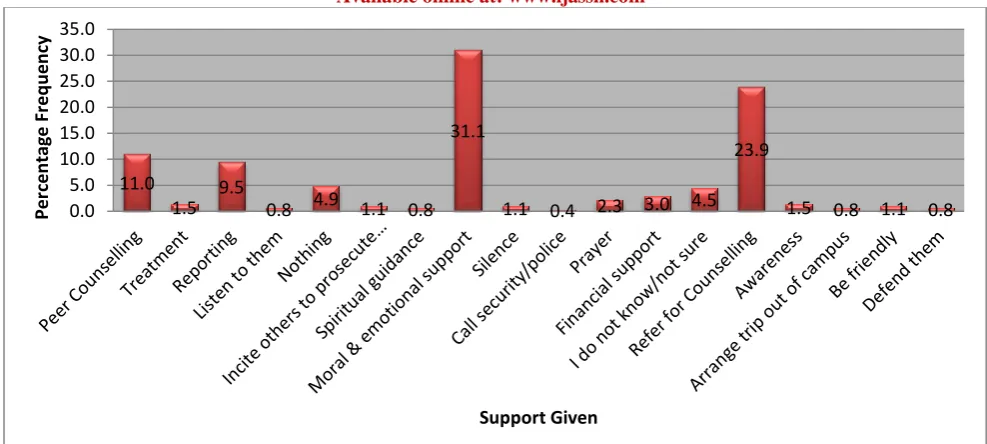
A summary of the responses from private university students on the support they provide to the victims of GBV is given in figure that follows:
Judith, JSK et. al.| May 2016 | Vol.4 | Issue 05 |28-39 33
Figure 3: Private university students' responses on the support for victims of GBV
This implies that they acknowledged the provision of counselling programmes by the universities. However, some who went for counselling to health facilities outside the universities. This was interpreted to be due to the need for confidentiality as a result of stigmatization from fellow students and other members of the university.
The findings also show that 9.5% of the respondents affirmed that there was room within the universities to report cases of GBV. This is evidence that some students felt they could obtain help from the universities if the cases are reported. However, the cases were reported in different places which include the health centres, security officers, police, deans of students, administration and the council. An emphasis of the findings that they did not know the specific place where they could report the cases is seen.
11.0% of the students indicated they had peer counselling programmes where victims of GBV could obtain help. This percentage points towards the students who did not want their cases to be known by the university authorities, therefore confided in a fellow student. The students revealed that the peer counsellors helped victims of GBV to deal with stigma and stress.
3.0% of the respondents established that there was treatment for victims of GBV. Nevertheless, some students give financial
support to victims of GBV as disclosed by 1.5% of the respondents. The research found that financial support was given to help the victims of GBV in paying medical bills. This is an indicator that some students sought medical help outside the university health facilities since they would not be required to pay for treatment within the university health facilities. These findings corroborate past studies by Chege, [9] that students did not want their cases to be known as a result of fear of stigmatization and repercussions. The problem of keeping silent due to fear was also reported by 1.1% of respondents who said they supported the victims silently. One of the respondents added that they supported individuals through silence “If people are not aware”.
The presence of spiritual nurture programmes in supporting the victims of GBV is expressed by 2.3% of the respondents who cited prayer while 0.8% cited spiritual guidance. On the converse 1.1% said said they incited others to prosecute the offenders. The reason for this action was that they believed the offenders would not be punished by the universities. In the same light, 4.9% of students said nothing is done to help victims of GBV. This was followed closely by those who did not know what is done (4.5%). One of the students who said nothing is done to help victims of GBV expressed that “we take it easy and life continues” while another said 11.0
1.5 9.5 0.8 4.9 1.1 0.8 31.1
1.1 0.4 2.3 3.0 4.5 23.9
1.5 0.8 1.1 0.8 0.0
5.0 10.0 15.0 20.0 25.0 30.0 35.0
Per
ce
n
tage
Fr
e
q
u
e
n
cy
Judith, JSK et. al.| May 2016 | Vol.4 | Issue 05 |28-39 34
“we only gossip”. Some students said they were not sure or did not know the support given to victims as they had not encountered any such case.
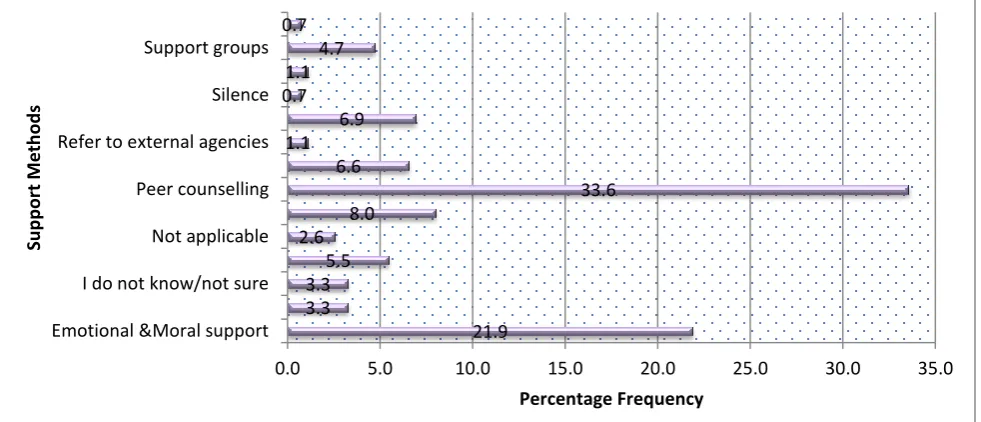
The findings from public university students indicate that they majorly provide peer counselling (33.6%) to the victims of GBV as illustrated in figure 5.7. This is in contrast to 11.0% of students in private universities.
Most students in private institutions (23.9%) expressed that the universities support victims of GBV through having counsellors within the student welfare department where they refer the cases. In public universities, 6.6% referred cases for counselling. This suggests that students in public universities prefer to confide in fellow students as supported by the remarks that “We counsel each other privately to avoid victimization”.
Figure 4: Public university students' support for victims of GBV
This is followed by students who take personal initiatives to provide moral and emotional support at 21.9%. They so do by providing a shoulder to cry on; listening to them; being friendly; encouraging them and accommodating them. 6.9% of the students
divulge that offices are available where victims of GBV can report the cases. This is a lower percentage compared to 9.5% of respondents in private universities. This shows that more students in private universities report cases of GBV in relation to public universities. However, in public universities support groups came out strongly as a method of supporting victims of GBV (4.7%) contrary to private universities.
Worth noting also is the fact that more students in public universities acknowledged the universities’ support for victims of GBV through provision of medical help (5.5% in relation to 1.5% in private universities). Nevertheless some go to the medical
facilities outside the university. Even though, the students visit them, help them to take medication and assist them to pay the medical bills. Further uniqueness is seen in public universities where students (1.1%), obtain help from external agencies such as Prolife Movement to victims of GBV. On this, they remarked that “That is where GBV is addressed”.
8% of students in public universities said nothing was done and that “The perpetrators go on harassing fellow students”. 2.6% said it was not applicable to them as they had not experienced cases of GBV. A closer look at the respondents who said students remain silent shows that a higher percentage was from private universities (1.1%) compared to 0.7% in public universities. Shockingly, 0.7% of public university respondents unveiled that they take action on perpetrators to support victims of GBV since the universities would not take action.
21.9 3.3
3.3 5.5 2.6
8.0
33.6 6.6
1.1 6.9 0.7
1.1 4.7 0.7
0.0 5.0 10.0 15.0 20.0 25.0 30.0 35.0
Emotional &Moral support I do not know/not sure Not applicable Peer counselling Refer to external agencies Silence Support groups
Percentage Frequency
Su
p
p
o
rt
M
e
th
o
d
Judith, JSK et. al.| May 2016 | Vol.4 | Issue 05 |28-39 35
Actions taken by Students on
Perpetrators of GBV
The students from private universities gave responses that are summarized in figure 5.9 below:
Figure 5: Students' responses on the actions taken on perpetrators of GBV in private universities
It was noted that the private universities provided mechanisms for reporting perpetrators of GBV as reported by 26 % of the respondents although students reported when the cases had reached extreme levels that they had no other option. This was revealed through sentiments like “In extreme cases we take them to the administration”. However they added that policies need to be reviewed and strengthened to deal with GBV appropriately. The presence of the disciplinary machinery within the universities is emphasized by 9% of the respondents who referred the perpetrators for disciplinary action.
Quite a high percentage (13%) of respondents used guiding and counselling services on the perpetrators of GBV in the universities. It was hoped that the services would assist them to “See things differently instead of condemning them”. The students also sought to understand why perpetrators behaved in that manner. Through peer counselling services laid down by the universities the students are able to understand the perpetrators and counsel them on good relations. This was a positive way of looking at the GBV problem with a hope that the perpetrators would reform.
The same light, 2% referred them to the student welfare office for counselling.
In some cases the students are suspended or expelled (7%). This indicates that the universities have put penalties against perpetration of GBV. The documentary analysis also showed that restitution fines to individuals or groups may also be required for damages incurred. However the students indicated that they observe to see if the perpetrators are expelled. Those who are reinstated after suspension are alienated. The universities also use the country’s legal system against some cases of GBV where police are called in. The study revealed that the universities involve the police to arrest perpetrators of GBV. The involvement of the police is also evidenced where the students (4%) disclosed that legal procedures are instituted against perpetrators of GBV.
Most of the other actions taken against perpetrators of GBV are student driven as opposed to the university laid down mechanisms. This shows that the students are impatient with the universities’ mechanisms of dealing with perpetrators of GBV. The impatience is explained by the findings that the cases take long to be completed. In this connection, 9% of the respondents reported alienation of the
Report them 26%
Act on them 4%
Guide and counsel 13% Alienate them
9% Arrest
4% Awareness
2% Suspension and
expulsion 7%
Nothing 7% Caution them
1%
Refer for counselling 2%
Refer for disciplinary action
9%
I do not know/not sure 8%
Put them to shame 3%
Keep silent 1%
Pray for them 1% Sacking
1%
Judith, JSK et. al.| May 2016 | Vol.4 | Issue 05 |28-39 36
perpetrators. One of the respondents expressed that “You cannot teach an old dog new tricks”. Therefore, they condemned them, criticized them and hated them. This is retrogressive as it serves to escalate the violence instead of resolving it.
The punishment against perpetrators was further aggravated by those who “acted on them” as divulged by 4% of the respondents. The findings show that students dealt with the perpetrators physically through mob justice or beating them thoroughly outside the university premises. This happened especially if the perpetrators are not punished by the university authorities, as a respondent explained that “We deal with them physically if the case is not addressed”. This implies that the universities punished GBV perpetrators even though some students felt that not all were punished. The students therefore took action on those individuals. .Another respondent said “We beat them outside school”. However, some students (9%) indicated that they alienated themselves from perpetrators of GBV as they feared them. This shows that violence is escalated instead of being resolved and can yield dangerous results if not resolved. Yet the public universities have disciplinary procedures. The procedures show that disciplinary issues begin with committees. There are committees in different areas such as residential level (Halls Disciplinary Committee) and college level (College Disciplinary Committee). The committees have powers to impose penalties and give recommendations to the Senate Disciplinary Committee for approval. The police or any other members of the public are also entitled to take action on the offending students for the interest of security and public order. Escalation of violence shows that the different committees put in place do not manage the cases to control the situations.
More so, 3% of students put perpetrators to shame. They do so by spreading “beefed up” stories about them and exposing them to others. One of the respondents said “we insult them heavily”. This reveals that they try to use all means possible to demean the perpetrators of GBV. This further shows that the violence is escalated despite the
resolution mechanisms put in place. Some 2% of the respondents do awareness so that other students can know the perpetrators of GBV and avoid them in addition to knowing their own rights. However, avoidance of perpetrators is only a temporary solution that also fosters stigmatization. Management of the vice as per policy is essential for lasting resolution.
Amidst all these, some students (7%) took the stance that universities do not do anything against perpetrators of GBV while 8% divulged that they do not know what is done. The reasons given for these responses were diverse. They include lack of proper protocol of handling the GBV issues whereas others were not aware of any perpetrators of GBV. A respondent said, “Nothing is done, but students have to be serious on perpetrators”. Worse still, it came out that universities sack some perpetrators (1%). This is indicative of university employees who perpetrate violence. Another 1% each of the respondents said they prefer to be silent or pray and not report perpetrators of GBV to the universities. Reasons for this were diverse ranging from lack of action on perpetrators to fear.
15.8% of the Students from public universities expressed that no action was taken by the universities against perpetrators of GBV as shown in figure 5.11 on the next page. They indicated that “They get away with it”. One student pointed out that students “Watch as things happen” and would like to be neutral. Another explained that the universities did not provide clear protocols to follow concerning cases of GBV. On the other hand, they gossiped about the GBV cases. This revelation emphasizes the stigmatization on victims of GBV making them to be silent instead of reporting.
Judith, JSK et. al.| May 2016 | Vol.4 | Issue 05 |28-39 37
did by castigating perpetrators outside the universities, ruthlessly handling them or using “comrade power”. A respondent mentioned that, they burn perpetrators
while a further 14.3% specifically exposed that they beat them up. This indeed can be quite extreme.
Figure 6: Public university students' responses on the actions taken against perpetrators of GBV
More legal action was sought in public universities (9.3%) compared to private universities where 4% of students indicated that perpetrators were arrested. The public universities did this by reporting cases to the police stations and submitting their statements. Others went further to assist in investigations to obtain evidence for the case. It was also revealed that the universities arrested perpetrators some of whom were sentenced to jail. However it was noted that cases took long to be finalized.
The universities provide the structures for students to report perpetrators of GBV. Students in private universities were more inclined to report to the university administration (26%) than public universities (10.8%). 6.8% of the respondents in public universities reported cases to the security personnel. This shows that students in public universities trusted security personnel to handle the cases by a considerable number of students. Besides, whereas public universities take more extreme actions on perpetrators of GBV they contrariwise referred more of them for counselling (5.0%) than private university students (2%).
The findings show that even though the university authorities were putting effort to fight GBV, students sought more means of handling the vice in a bid to ensure the perpetrators are punished. Consequently, they employed other methods that were not as stipulated by the university policies, with the hope that the problem would be resolved. However these alternative methods only serve to escalate the violence.
Challenges Faced by Students in
their Role of Managing GBV
Amidst all the efforts students put in to make their stay at the university comfortable they faced a myriad challenges in fighting GBV. Some of them include lack of awareness of how to go about reporting and where to report. They also lacked forums to share issues affecting them or be heard. Besides, they felt that no action was taken on perpetrators and if any action was taken it was delayed. Some students felt that those in administration did not care hence they feared to come out and speak about it as they would be victimized, nobody in authority would believe them and those in authority would take sides. In some cases there was a gap between students and the
0.0 2.0 4.0 6.0 8.0 10.0 12.0 14.0 16.0
Alienate them Condemn their action Legal action taken Not applicable Peer counselling Refer for counselling Report to Uni. authority Strict punishment Act on them
3.2 14.3
0.7
0.4 9.3
14.0
2.5 15.8
3.9
0.7 5.0
6.8 10.8
1.1 2.9
1.8 6.8
Percentage Frequency
A
ction
Tak
e
Judith, JSK et. al.| May 2016 | Vol.4 | Issue 05 |28-39 38
administration due to unapproachable personnel in relevant offices. Consequently, the victims of GBV were shameful or felt that they were being looked down upon by other students or laughed at. Furthermore they felt that there was lack of confidentiality in their cases and that the cases were not well handled. Some found the attitudes of perpetrators wanting.
Additionally, students said ‘blind love’ was a challenge to them as they were not sure of who to trust. Some victims of GBV said they had financial crises or lack of basic needs that made them to fall prey of GBV. Cultural beliefs, discrimination, stereotypes and differences in the treatment of genders also posed challenges as some students felt that their issues would not be taken seriously if they reported. Hence, the victims had fear of stigmatization; embarrassment and emotional stress. Other fears that students had were: fear of being ignored; noticed or isolated and being seen as a sinner. Some feared repercussions such as conflicts in the family, being victimized or criticized, labeling, intimidated, losing friends, reaction from friends, negative talk, judgment, being branded as traitors by peers, ridiculed and reprisal by perpetrators.
Other reasons for keeping silent were the feeling that it is difficult to deal with the problem conclusively and the assumptions that the victim approved of the act but was pretending. There were difficulties in giving evidence on GBV cases and as a result it was hard to seek redress making one to feel wasted. In addition the legal framework was inadequate in helping victims. The students further reported that GBV resulted in exam failure and fear of discontinuation and harassment by those in authority. Male students felt that male-based violence was sidelined yet they went through similar experiences as women. On the other hand some students said they felt awkward talking about GBV while others expressed that they did not know whom to talk to about GBV since they did not trust university counsellors. Largely results show that students harboured lots of fears that prevented them from reporting. There was
also a feeling among students that some of them were ignorant and did not notice that they could become victims of violence due to lack of awareness on GBV issues [10].
Conclusion and Recommendations
Generally the study corroborated the earlier studies on the fact that GBV exists and learning institutions were not exempt. Students were affected by the vice but chose to be silent due to a feeling that nothing would be done about it among other reasons. The fact that talking about GBV especially sexual violations was viewed as a taboo, served to perpetrate the vice. Other reasons for keeping silent include; fear of stigmatization, embarrassment and emotional stress among others.Judith, JSK et. al.| May 2016 | Vol.4 | Issue 05 |28-39 39
The research revealed that victims of GBV had no peace as they were psychologically, socially, morally and emotionally traumatized. Students generally took every
initiative they could to protect themselves from the vice. However they could breathe a sigh of relieve if the problem was intentionally and fully managed.
References
1 Chege F, Parkes J (2010) Engendering Empowerment: Education and Equality. Girls' Education and Violence: Reflections on The First Decade of The Twenty-FirstCentury. Dakar: United Nations Girls' Education Initiative.
2 Matali JT (2011) University Students Demonstrate. Retrieved May 7, 2011, from allafrica.com: http//allafrica.com
3 Salkind NJ (2004) Statistics for People Who (Think They) Hate Stastics (2nd ed.). London: Sage Publications.
4 National Commission on Gender and Development (2006) Desk Survey on Gender Issues in Kenya, Final Draft. Nairobi: NCGD. 5 UNESCO (2003) Gender and Education for All.
Paris: UNESCO.
6 Marshall S (1992) Educational Psychology for the Teacher in Africa. London: EdwardArnold,A Division of Hodder & Stoughton.
7 Baksh R et al. (2005) Gender Mainstreaming in Conflict Transformation: Building SustainablePeace. London: Commonwealth Secretariat.
8 Republic of Kenya (2010) The Constitution of Kenya. Nairobi: Government Printer.
9 Chege F (2007) Education and Empowerment of Girls Against Gender-Based Violence.
Journal of International Cooperation in Education, 10(1):53-70.
10 Africa Sexual and Gender Based Violence Population Council. (2008). Sexual and Gender Based Violence in Africa:Key Issues for Programming. Retrieved November 4, 2010, from