Is Transfusion in Coronary Artery Surgery a
Predictor or a Cause of Reduced Long-Term
Survival?
Alexander Manché
1, Liberato Camilleri
21. Department of Cardiothoracic Surgery, Mater Dei Hospital, Malta
2. Department of Statistics and Operations Research, Faculty of Science, University of Malta
Corresponding author:
Alexander Manché, Department of Cardiothoracic Surgery, Mater Dei Hospital, Malta
Tel: 00356 79320111
E-mail: [email protected]
Introduction
Approximately a third of patients undergoing cardiac surgery require blood products, more than in any other category of planned major surgery.[1,2] Transfused patients present with higher risk and experience increased mortality, both in the short and long-term. [3,4,5] Transfusion may be necessary because of preoperative anaemia, blood loss, coagulopathy and haemodilution,[6,7] or because of haemodynamic instability,[1] the majority of patients receiving 2 units of blood.[7] Pre-existing anaemia is associated
with other comorbidities and results in increased post-operative renal impairment as well as a higher stroke rate and mortality.[8] Prolonged intensive care stay exacerbates this situation leading to increased transfusion requirements.[9,10] Guidelines propose transfusion in unstable patients with a haemoglobin level below 7g/ dL,[11] but clinical decisions often overrule this recommendation, particularly in older patients.[12] There is evidence that transfusion in low-risk patients results in higher long-term mortality, and this practice should be avoided whenever possible.[13] Retrospective
© 2020 Author(s). This is an Open Access article distributed under the terms of the Creative Commons Attribution CC-BY-4.0 license CC-BY-4.0 (http://creativecommons.org/ licenses/by/4.0/), which permits use, distribution and reproduction, provided the original work is properly cited.
Abstract
Background
Transfusion is common after coronary bypass surgery. Transfused patients present with higher operative risk and an increased hazard ratio for curtailed long-term survival. There is debate as to whether transfusion itself may further exacerbate late mortality. Methods
Long-term survival was studied in 2550 survivors following coronary revascularization in this retrospective, observational study. Kaplan-Meier survival curves were constructed to compare all transfused and non-transfused patients, as well as survival in propensity-matched transfused and non-transfused patients.
Results
Operative mortality was 1.05% (original cohort 2577). Maximum follow-up was 23 years (mean 11.8, median 12.4 years). 34.7% of patients received a transfusion (mean 2 units packed red blood cells). Baseline risk characteristics (age, female gender, small body habitus, risk stratification scoring, diabetes, hypertension and reduced stroke volume) operative parameters (urgency and no internal thoracic graft) as well as post-operative parameters (intensive care, hospital stay and ventilation time) and complications (haemorrhage, intra-aortic balloon, ventricular arrhythmias, prolonged inotropic support, atrial fibrillation, dialysis, doubling of creatinine and resternotomy) were higher in the transfused patients. The long-term survival of these patients was significantly reduced when compared with that of non-transfused patients (log rank test p<0.001). When analyzed as a sole risk factor, transfusion was associated with reduced long-term survival (log rank test p<0.001) but when analyzed collectively with other risk factors, transfusion failed to demonstrate a causative effect (p=0.953). When propensity matched groups were compared (612 transfused versus 1222 non-transfused patients) long-term survival was similar (log rank test p=0.554).
Conclusions
Transfusion was required in higher risk patients undergoing coronary revascularization. Long-term survival was curtailed in this group but this was due to preoperative risk and not directly to transfusion. Transfusion was a predictor but not a cause of reduced long-term survival.
Keywords: blood transfusion; coronary artery bypass surgery; long-term survival
data shows improvement in some patients after transfusion, whilst in others with certain comorbidities, the outcome is worse.[14] Moreover, the loose temporal relationship between transfusion and the onset of complications or death makes for an uncertain causative role,[15] particularly in the setting of poorer outcomes. [16,17]
Patients and methods
This retrospective, observational, cohort study was conducted using our dedicated coronary surgery database and included all consecutive patients undergoing solitary coronary artery bypass grafting utilizing cardiopulmonary bypass in a single-surgeon practice between 1st April 1995 and 31st December 2016. Data was collected prospectively and analyzed in December 2018 (observation time 2 to 23.5 years) and included patient demographics, operative urgency, risk scores, cardiac indices, surgery-, anaesthesia- and intensive care-related data, and in-hospital length of stay and complications (table 1). Transfusion-related data was recorded on anaesthesia and intensive care forms. All data were completed and validated at the point of the patient’s discharge from hospital, and further systematically validated on a yearly basis. The primary endpoint was all-cause mortality during the follow-up period. Data pertaining to date of death was obtained from the National Statistics Office, using a unique personal identity number assigned to every patient. Patients, who died within 30 days, or while still in hospital after surgery, were excluded from the study.
Patients were risk-stratified by Parsonnet score (from 1995) as well as by additive (after 2000) and logistic EuroSCORE (after 2006). All complications were recorded in real time and classified according to organ-system. Data collection included incidence of perioperative myocardial infarction, arrhythmia, intra-aortic balloon counter-pulsation and permanent pacemaker use, transient ischaemic attack, stroke, temporary renal impairment, dialysis, gastrointestinal haemorrhage or perforation and resternotomy for tamponade or haemorrhage. Ventilation time, blood volume loss and transfusion, and inotropic support were also recorded.
Packed red blood cells, fresh frozen plasma and platelet transfusions were prescribed by the attending surgeon and anaesthetist. Indications were based on haemodynamic data, blood loss, haemoglobin and haematocrit levels and comorbid conditions. Thromboelastometry-guided therapy supplemented routine activated clotting time, international normalized ratio and activated partial thromboplastin time, platelet counts and fibrinogen levels where indicated. A lower target haemoglobin level was accepted in younger patients. The decision to transfuse was also guided by the clinical picture.
Antiplatelet drugs were stopped 5 days before routine surgery when logistically feasible, but aspirin and/or heparin were administered until surgery in acute coronary syndrome, and in urgent or emergency cases. All patients underwent cardiopulmonary bypass with surface-modified tubing and membrane oxygenator at normothermia and myocardial protection was with antegrade cold blood cardioplegia. Tranexamic acid was used routinely whereas aprotinin was only administered rarely and for excess blood loss.
Table 1.Risk indicators in transfused and non-transfused patients
parameter transfused n%/m(SD) n:886
not transfused n%/m(SD)
n:1664 p value
age 64.89 (8.84) 61.39 (8.72) <0.001
female gender 296 (33.4%) 204 (12.3%) <0.001
height 1.60 (0.10) 1.63 (0.09) <0.001
weight 74.40 (13.16) 79.36 (13.22) <0.001
body surface area 1.77 (0.19) 1.85 (0.18) <0.001 body mass index 29.15 (4.41) 29.68 (4.24) 0.005 Parsonnet score 7.96 (5.79) 5.35 (4.66) <0.001 additive EuroSCORE 3.38 (2.23) 2.30 (1.93) <0.001 logistic EuroSCORE 3.37 (4.01) 2.33 (1.95) <0.001
diabetes 260 (29.3%) 353 (21.2%) <0.001
hypertension 428 (48.3%) 621 (37.3%) <0.001 ejection fraction 71.23 (13.49) 72.15 (12.96) 0.146 stroke volume 87.38 (28.60) 93.55 (28.71) <0.001
urgent 236 (26.6%) 354 (21.3%) 0.002
emergency 20 (2.3%) 12 (0.7%) 0.001
single coronary bypass 16 (1.8%) 38 (2.3%) 0.425 double coronary bypass 203 (22.9%) 361 (21.7%) 0.481 triple coronary bypass 400 (45.1%) 788 (47.4%) 0.287 quadruple coronary bypass 234 (26.4%) 401 (24.1%) 0.199 quintuple coronary bypass 32 (3.6%) 76 (4.6%) 0.254 no internal thoracic graft 32 (3.6%) 31 (1.9%) 0.007 ischaemic time 29.89 (9.44) 30.20 (8.71) 0.424 bypass time 57.74 (16.53) 56.69 (16.01) 0.126 intensive care (dy) 1.06 (0.38) 1.02 (0.42) 0.023 high dependency (dy) 1.70 (4.37) 0.84 (2.15) <0.001
ward (dy) 3.16 (2.60) 2.80 (2.18) <0.001
ventilation (hr) 9.23 (7.94) 7.43 (5.79) <0.001 ventilation >24hr 20 (2.3%) 14 (0.8%) 0.003 haemorrhage (ml) 620.8 (347.9) 491.7 (169.6) <0.001 intra-aortic balloon 46 (5.2%) 17 (1.0%) <0.001
permanent pacemaker 3 (0.3%) 3 (0.2%) 0.432
ventricular arrhythmia 19 (2.1%) 18 (1.1%) 0.033 inotropic support >24hr 309 (34.9%) 269 (16.2%) <0.001 atrial fibrillation 159 (17.9%) 237 (14.2%) 0.014
atrial flutter 10 (1.1%) 20 (1.2%) 0.870
dialysis 22 (2.5%) 2 (0.1%) <0.001
doubling of creatinine 53 (6.0%) 18 (1.1%) <0.001
gastric haemorrhage 3 (0.3%) 5 (0.3%) 0.870
stroke 7 (0.8%) 12 (0.7%) 0.847
transient ischaemic attack 8 (0.9%) 8 (0.5%) 0.199
Statistical Methods
Kaplan-Meier survival curves were constructed to compare all transfused and non-transfused patients, as well as survival in propensity matched transfused and non-transfused patients. Risk indicators in the two groups were compared using the chi-squared test for categorical variables and the Student’s t-test for continuous variables. Cox regression analysis was used to calculate hazard ratios for curtailed long-term survival.
Results
A total of 2550 patients (886 transfused, 1664 not transfused) were included after elimination of 27 patients who died perioperatively (mortality 1.05%). Risk indicators were significantly higher in the transfused patients. These included age, female gender, small body habitus, Parsonnet score, additive EuroSCORE and logistic EuroSCORE, diabetes, hypertension, lower stroke volume, operative urgency, no internal thoracic graft, intensive care, hospital stay and ventilation time, haemorrhage, intra-aortic balloon, ventricular arrhythmias, prolonged inotropic support, atrial fibrillation, dialysis, doubling of creatinine and resternotomy (table 1).
The transfused patients experienced more post-operative haemorrhage (620.8±347.9ml versus 491.7±169.6ml, p<0.001) and a higher incidence of excessive haemorrhage (9.9% versus 1.0% >1L p<0.001, 2.7% versus 0.06% >1.5L, p<0.001). Of the transfused patients, 45.5% received 1 unit, 34.6% 2 units, 15.1% 3-4 units, 2.9% 5-6 units and 1.9% over 6 units. There was a significant positive correlation between the haemorrhage volume and the amount transfused (figure 1).
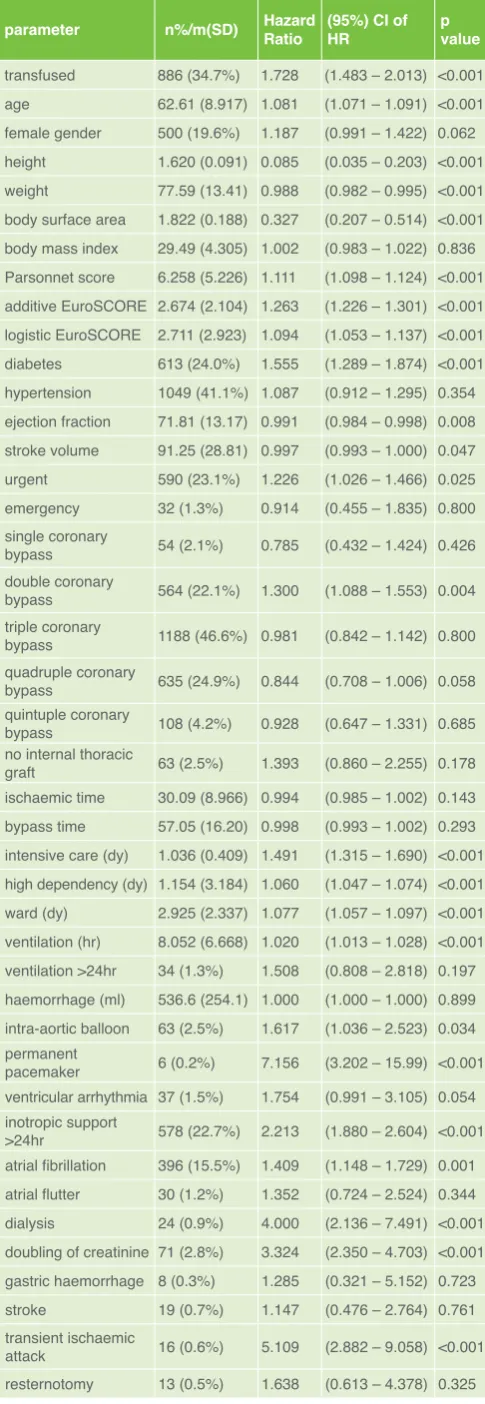
The hazard ratio for each parameter was calculated by Cox Regression analysis (table 2). All explanatory variables with p values less than the 0.05 level of significance were significant predictors of survival duration. When the explanatory variables were analyzed individually, twenty-four variables were found to be significant predictors of survival duration; however when the variables were analyzed collectively these predictors (except Parsonnet score
Table 2. Cox-Regression analysis relating survival duration to each predictor individually
parameter n%/m(SD) Hazard Ratio (95%) CI of HR p value
transfused 886 (34.7%) 1.728 (1.483 – 2.013) <0.001 age 62.61 (8.917) 1.081 (1.071 – 1.091) <0.001 female gender 500 (19.6%) 1.187 (0.991 – 1.422) 0.062 height 1.620 (0.091) 0.085 (0.035 – 0.203) <0.001 weight 77.59 (13.41) 0.988 (0.982 – 0.995) <0.001 body surface area 1.822 (0.188) 0.327 (0.207 – 0.514) <0.001 body mass index 29.49 (4.305) 1.002 (0.983 – 1.022) 0.836 Parsonnet score 6.258 (5.226) 1.111 (1.098 – 1.124) <0.001 additive EuroSCORE 2.674 (2.104) 1.263 (1.226 – 1.301) <0.001 logistic EuroSCORE 2.711 (2.923) 1.094 (1.053 – 1.137) <0.001 diabetes 613 (24.0%) 1.555 (1.289 – 1.874) <0.001 hypertension 1049 (41.1%) 1.087 (0.912 – 1.295) 0.354 ejection fraction 71.81 (13.17) 0.991 (0.984 – 0.998) 0.008 stroke volume 91.25 (28.81) 0.997 (0.993 – 1.000) 0.047 urgent 590 (23.1%) 1.226 (1.026 – 1.466) 0.025 emergency 32 (1.3%) 0.914 (0.455 – 1.835) 0.800 single coronary
bypass 54 (2.1%) 0.785 (0.432 – 1.424) 0.426
double coronary
bypass 564 (22.1%) 1.300 (1.088 – 1.553) 0.004 triple coronary
bypass 1188 (46.6%) 0.981 (0.842 – 1.142) 0.800 quadruple coronary
bypass 635 (24.9%) 0.844 (0.708 – 1.006) 0.058 quintuple coronary
bypass 108 (4.2%) 0.928 (0.647 – 1.331) 0.685 no internal thoracic
graft 63 (2.5%) 1.393 (0.860 – 2.255) 0.178
ischaemic time 30.09 (8.966) 0.994 (0.985 – 1.002) 0.143 bypass time 57.05 (16.20) 0.998 (0.993 – 1.002) 0.293 intensive care (dy) 1.036 (0.409) 1.491 (1.315 – 1.690) <0.001 high dependency (dy) 1.154 (3.184) 1.060 (1.047 – 1.074) <0.001 ward (dy) 2.925 (2.337) 1.077 (1.057 – 1.097) <0.001 ventilation (hr) 8.052 (6.668) 1.020 (1.013 – 1.028) <0.001 ventilation >24hr 34 (1.3%) 1.508 (0.808 – 2.818) 0.197 haemorrhage (ml) 536.6 (254.1) 1.000 (1.000 – 1.000) 0.899 intra-aortic balloon 63 (2.5%) 1.617 (1.036 – 2.523) 0.034 permanent
pacemaker 6 (0.2%) 7.156 (3.202 – 15.99) <0.001 ventricular arrhythmia 37 (1.5%) 1.754 (0.991 – 3.105) 0.054 inotropic support
>24hr 578 (22.7%) 2.213 (1.880 – 2.604) <0.001 atrial fibrillation 396 (15.5%) 1.409 (1.148 – 1.729) 0.001 atrial flutter 30 (1.2%) 1.352 (0.724 – 2.524) 0.344 dialysis 24 (0.9%) 4.000 (2.136 – 7.491) <0.001 doubling of creatinine 71 (2.8%) 3.324 (2.350 – 4.703) <0.001 gastric haemorrhage 8 (0.3%) 1.285 (0.321 – 5.152) 0.723
stroke 19 (0.7%) 1.147 (0.476 – 2.764) 0.761
transient ischaemic
attack 16 (0.6%) 5.109 (2.882 – 9.058) <0.001 resternotomy 13 (0.5%) 1.638 (0.613 – 4.378) 0.325 Figure 1 Correlation between haemorrhage volume and amount
transfused
Correlation between amount transfused and haemorrhage volume
Pearson correlation 0.433
p value 0.000
and double coronary bypass) were not significant since their p values exceeded the level of significance of 0.05. Using a forward procedure, three predictors were found to be significant (table 3). The parsimonious survival model, that analyzed all the explanatory variables collectively and retained the significant predictors, identified Parsonnet score as the strongest predictor of survival duration, followed by doubling of creatinine and double coronary bypass.
When analyzed as a sole risk factor, transfusion was associated with reduced long-term survival (log rank test p<0.001) but when analyzed collectively with other risk factors, transfusion failed to demonstrate a causative effect (p=0.953).
The survival probability of transfused patients was significantly worse (p <0.001), (figure 2). This difference was present from the early postoperative phase and increased with time (44% versus 62% 19-year survival).
274 patients (30.9%) were deleted from the transfused group (886-274=612) and 442 patients (26.6%) from the non-transfused group (1664-442=1222) in order to achieve propensity matching for 18 important risk factors. The deleted patients (table 5) included high-risk patients from the transfused group and low-risk patients from the not-transfused group, with the former having 24 risk factors that were significantly worse than the latter. The resultant propensity-matched groups were comparable for age, gender, height, additive EuroSCORE and logistic EuroSCORE, ejection fraction and stroke volume, urgency, no internal thoracic graft, ischaemic time, permanent pacemaker, ventricular arrhythmia, atrial fibrillation and flutter, gastric haemorrhage, stroke, transient ischemic attack and resternotomy (table 4). The survival probability (figure 3) and the cumulative hazard (figure 4) of the propensity-matched transfused and non-transfused patients were similar (p =0.554).
Discussion
Patients who died perioperatively were excluded from this study because common causes of hospital death such as cardiogenic shock and sepsis could overshadow the influence of transfusion as a contributory factor.[18]
Transfusion of 1 to 2 units of packed red blood cells has been shown to increase perioperative morbidity [19] and mortality,[7] as well as mortality in the medium term.[20] There is evidence to suggest that preventing a low haemoglobin immediately after bypass, and its attendant renal complications, may be preferable to correcting it with a transfusion. However it is difficult to
determine whether the anaemia or the transfusion is the cause of increased early morbidity.[21]
When haemorrhage results in severe anaemia with organ dysfunction due to reduced oxygen-carrying capacity, transfusion can correct the situation. Transfusion has been postulated to be detrimental by way of its depleted 2,3 Diphosphoglycerate, shifting the oxygen dissociation curve leftwards and reducing oxygen delivery. Transfusion also raises cytokine levels, increasing the already high inflammatory state after cardiopulmonary bypass. [22,23]
Table 3. Parsimonious survival model using a forward procedure
parameter Wald df p value Hazard Ratio 95% lower limit
95% upper limit Parsonnet score 65.760 1 0.000 1.149 1.111 1.189 doubling of
creatinine 10.333 1 0.001 3.705 1.667 8.232
double coronary
bypass 4.487 1 0.037 1.730 1.042 2.870
Table 4. Risk indicators in propensity-matched transfused and non-transfused patients
parameter transfused n%/m(SD) n:612
not transfused n%/m(SD) n:1222
p value
age 62.85 (8.56) 62.89 (8.95) 0.924 female gender 89 (14.5%) 179 (14.6%) 0.995 height 1.62 (0.09) 1.63 (0.09) 0.397 additive EuroSCORE 2.71 (1.92) 2.70 (1.86) 0.973 logistic EuroSCORE 2.56 (2.81) 2.67 (1.93) 0.621 ejection fraction 70.92 (13.20) 71.88 (13.22) 0.201 stroke volume 89.57 (29.30) 91.83 (28.08) 0.166 urgent 142 (23.2%) 292 (23.7%) 0.798 no internal thoracic graft 22 (3.6%) 26 (2.1%) 0.060 ischaemic time 30.65 (9.76) 30.10 (8.58) 0.220 permanent pacemaker 1 (0.2%) 2 (0.2%) 0.997 ventricular arrhythmia 14 (2.3%) 14 (1.1%) 0.545 atrial fibrillation 96 (15.7%) 192 (15.6%) 0.966 atrial flutter 9 (1.5%) 14 (1.1%) 0.870 gastric haemorrhage 3 (0.5%) 4 (0.3%) 0.588
stroke 5 (0.8%) 9 (0.7%) 0.843
transient ischaemic
attack 4 (0.7%) 8 (0.7%) 0.994
resternotomy 6 (1.0%) 4 (0.3%) 0.071
Figure 2 Kaplan-Meier survival curves in transfused and non-transfused patients
Overall Comparisons
Previous studies have shown little [24] or no [25] effect of transfusion on long-term survival whereas a study, by Jakobsen et al, demonstrated a strong correlation between transfusion in low-risk patients (EuroSCORE 0-4) and reduced long-term survival. [26] A possible mechanism proposed is immune modulation following a transfusion.[27] 54.7% of our transfused patients and 75.7% of our non-transfused patients were in a comparable risk category but our results are at variance with this study, which had a maximum follow-up of 12 years and also included patients undergoing valve replacement. Moreover, in our propensity-matched groups the additive EuroSCORE was equivalent at a mean of 2.7 and long-term survival was similar.
Urgent and emergency operations were significantly more frequent (p=0.002 and p=0.001 respectively) in the transfused group. These patients received aspirin and/or Heparin immediately prior to surgery, making them more likely to bleed excessively postoperatively, and to require transfusion. This risk factor was present equally in the propensity-matched groups.
The strong correlation between the amount of blood transfused and the postoperative haemorrhage volume suggests that the clinical decision to transfuse was justified. Reassessment of the clinical situation after the first unit resulted in a lesser amount transfused (80.1% received 1-2 units).
Although total postoperative stay was higher in transfused patients (mean 5.92 versus 4.66) this still represented a short hospital stay, taking into consideration the higher mean age (64.9 versus 61.4) and the fact that all patients were discharged to their home. In these patients transfusion may have helped expedite their recovery and mitigate an even longer hospital stay.
There is still no consensus regarding transfusion in critically ill patients undergoing coronary artery surgery. Practices vary widely in different centres, but transfusions tend to be more frequent in elderly, female patients receiving anti-platelet medications.[28] A life-saving transfusion must be weighed up against possible infection, lung-injury, circulatory overload, and possible adverse long-term outcomes.[29] Withholding transfusion when the Table 5. Risk indicators in transfused and non-transfused
deleted patients
parameter transfused n%/m(SD) n:274
not transfused n%/m(SD) n:442 p value
age 68.9 (7.917) 57.10 (6.543) <0.001
female 194 (70.8%) 25 (5.7%) <0.001
height 1.54 (0.092) 1.66 (0.079) <0.001
weight 69.88 (11.277) 81.48 (13.094) <0.001 body surface area 1.68 (0.160) 1.89 (0.176) <0.001 body mass index 29.41 (4.549) 29.615 (4.042) 0.554 Parsonnet score 10.85 (6.135) 3.85 (3.576) <0.001 additive EuroSCORE 4.61 (2.264) 1.15 (1.663) <0.001 logistic EuroSCORE 5.71 (5.883) 1.66 (2.123) <0.001
diabetes 73 (26.6%) 98 (22.2%) 0.173
hypertension 126 (46.0%) 162 (36.7%) 0.013
ejection fraction 71.59 (14.139) 73.14 (11.794) 0.190 stroke volume 83.98 (27.017) 98.25 (29.385) <0.001
urgent 91 (33.2%) 68 (15.4%) <0.001
emergency 11 (4.0%) 5 (1.1%) 0.011
single coronary bypass 5 (1.8%) 11 (2.5%) 0.559 double coronary bypass 70 (25.5%) 92 (20.8%) 0.141 triple coronary bypass 139 (50.7%) 196 (44.3%) 0.096 quadruple coronary
bypass 57 (20.8%) 118 (26.7%) 0.074
quintuple coronary
bypass 2 (0.7%) 25 (5.7%) 0.001
no internal thoracic graft 10 (3.6%) 6 (1.4%) 0.044 ischaemic time 28.20 (8.476) 30.51 (8.916) 0.001 bypass time 54.78 (15.257) 57.18 (16.445) 0.054 intensive care (dy) 1.04 (0.294) 1.00 (0.067) 0.024 high dependency (dy) 1.47 (2.162) 0.67 (1.106) <0.001 ward (dy) 3.45 (2.809) 2.60 (1.296) <0.001 ventilation (hr) 8.80 (5.406) 6.81 (3.267) <0.001 haemorrhage (ml) 542.26 (331.383) 500.64 (160.124) 0.053 intra-aortic balloon 16 (5.8%) 4 (0.9%) <0.001
permanent pacemaker 2 (0.7%) 1 (0.2%) 0.311
ventricular arrhythmia 4 (1.5%) 4 (0.9%) 0.492 inotropic support >24hr 93 (33.9%) 55 (12.4%) <0.001 atrial fibrillation 63 (23.0%) 46 (10.4%) <0.001
atrial flutter 3 (1.1%) 5 (1.1%) 0.964
ventilation >24hr 4 (1.5%) 1 (0.2%) 0.054
dialysis 7 (2.6%) 0 (0.0%) 0.001
doubling of creatinine 15 (5.5%) 3 (0.7%) <0.001
gastric haemorrhage 0 (0.0%) 1 (0.2%) 0.431
stroke 1 (0.4%) 3 (0.7%) 0.584
transient ischaemic
attack 4 (1.5%) 0 (0.0%) 0.011
resternotomy 2 (0.7%) 1 (0.2%) 0.311
Figure 3 Survival probability of the propensity-matched transfused and non-transfused patients
Overall Comparisons
haematocrit is above 24% has not been shown to increase early morbidity and mortality.[30] A lack of clear evidence on the benefits of transfusion should promote a restrictive transfusion policy.
Limitations
The retrospective nature of this observational study necessarily limits the proof of a causal relationship between transfusion and poorer outcomes, especially in the long-term.
Although transfusion was not a predictor of long-term survival, other confounders that were either not measured, or that were not matched by propensity scoring, may have influenced survival. The severity of the clinical presentation with high-risk patients and urgent operations is more likely to affect outcomes or to overshadow the role of transfusion.
Propensity score analysis was employed to reduce bias in this observational study, as randomization into two treatment groups was not possible. Propensity matching was only achieved for 18 out of 41 risk variables as further matching would have significantly reduced the size of both groups, rendering them unrepresentative of the original cohorts.
Conclusion
Blood transfusion can save lives when used appropriately. This study shows that long-term survival was curtailed in transfused patients but this was due to preoperative risk and not directly to transfusion, which was a significant predictor but not a cause of reduced long-term survival. Controversy still exists regarding the causal nature of transfusion and long-term outcomes and it would be prudent to use blood products with greater vigilance. Further research is required to clarify the problem.
Declarations of interest
The authors declare no conflict of interest.
Acknowledgements
The authors agree to abide by the requirements of the Statement of publishing ethics of the International Cardiovascular Forum Journal.[31]
References
1. Geissler RG, Rotering H, Buddendick H, et al.: Utilization of blood components in cardiac surgery: a single-centre retrospective analysis with regard to diagnosis-related procedures. Transfus Med Hemother. 2015; 42(2): 75-82. Doi: 10.1159/000377691
2. Schwann TA, Habib JR, Khalifeh JM, et al.: Effects of blood transfusion on cause-specific late mortality after coronary artery bypass grafting – less is more. Ann Thorac Surg. 2016; 102(2): 465-473. Doi: 10.1016/j. athoracsur.2016.05.023
3. Bobich MP, Koch CG, Johnston DR, et al.: Trends in blood utilization in United States cardiac surgical patients. Transfusion. 2015; 55(4): 805-814. Doi: 10.1111/trf.12903
4. Ad N, Massimiano PS, Burton NA, et al.: Effect of patient age on blood product transfusion after cardiac surgery. J Thorac Cardiovasc Surg. 2015; 150(1): 209-214. Doi: 10.1016/j.jtcvs.2015.03.022
5. Acharya D, Gulack BC, Loyaga-Rendon RY, et al.: Clinical characteristics and outcomes of patients with myocardial infarction and cardiogenic shock undergoing coronary artery bypass surgery: data from the Society of Thoracic Surgeons National Database. Ann Thorac Surg. 2016; 101(2): 558-566. Doi: 10.1016/j.athoracsur.2015.10.051
6. Koch CG: Tolerating anemia: taking aim at the right target before pulling the transfusion trigger. Transfusion. 2014; 54(10): 2595-2597. Doi: 10.1111/ trf.12832
7. Paone G, Likosky DS, Brewer R, et al.: Transfusion of 1 and 2 units of red blood cells is associated with increased morbidity and mortality. Ann Thorac Surg. 2014; 97(1): 87-93. Doi: 10.1016/j.athoracsur.2013.07.020 8. Kulier A, Levin J, Moser R, et al.: Impact of preoperative anemia on outcome
in patients undergoing coronary artery bypass graft surgery. Circulation. 2007; 116(5): 471-479. Doi: 10.1161/CIRCULATIONAHA.106.653501 9. Corwin HL, Parsonnet KC, Gettinger A: RBC transfusion in the ICU. Is there
a reason? Chest. 1995; 108(3): 767-771. Doi: 10.1378/chest.108.3.767 10. Lako A, Bilali S, Memishaj S, et al.: The impact of blood use on patients
undergoing coronary artery bypass surgery: a prospective study. G Chir. 2014; 35(1-2): 20-26. PMCID; PMC4321579
11. Patel NN, Avlonitis VS, Jones HE, et al.: Indications for red blood cell transfusion in cardiac surgery: a systematic review and meta-analysis. Lancet Haematol. 2015; 2(12): e543-553. Doi: 10.1016/S2352-3026(15)00198-2
12. Paone G, Herbert MA, Theurer PF, et al.: Red blood cells and mortality after coronary artery bypass graft surgery: an analysis of 672 operative deaths. Ann Thorac Surg. 2015; 99(5): 1583-1589. Doi: 10.1016/ j.athoracsur.2014.12.064
13. Jakobsen CJ, Ryhammer PK, Tang M, et al.: Transfusion of blood during cardiac surgery is associated with higher long-term mortality in low-risk patients. Eur J Cardiothorac Surg. 2012; 42: 114-120. Doi: 10.1093/ejcts/ ezr242
14. Dejam A, Malley BE, Feng M, et al.: The effect of age and clinical circumstances on the outcome of red blood cell transfusion in critically ill patients. Crit Care. 2014; 18(4): 487. Doi: 10.1186/s13054-014-0487-z 15. Shander A, Goodnough LT: Can blood transfusion be not only ineffective,
but also injurious? Ann Thorac Surg. 2014; 97(1): 11-14. Doi: 10.1016/ j.athoracsur.2013.08.007
16. Engoren M, Arslanian-Engoren C: Long-term survival in the Intensive care unit after erythrocyte blood transfusion. Am J Crit Care. 2009; 18(2): 124-131. Doi: 10.4047/ajcc2009193
17. Vamvakas EC, Carven JH: RBC transfusion and postoperative length of stay in the hospital or the intensive care unit among patients undergoing coronary artery bypass graft surgery: the effects of confounding factors. Transfusion. 2000; 40(38): 832-830. Doi: 10.1046/j.1537-2995.2000.40070832.x 18. Kuduvali M, Oo AY, Newall N, Grayson AD, Jackson M, Desmond MJ, et al.:
Effect of peri-operative red cell transfusion on 30-day and 1-year mortality following coronary artery bypass surgery. Eur J Cardiothorac Surg. 2005; 27: 592-598. Doi: 10.1016/j.ejcts.2005.01.030
19. Kinnunen EM, Zanobini M, Onorati F, Brascia D, Mariscalco G, Franzese I, et al.: The impact of minor blood transfusion on the outcome after coronary artery bypass grafting. J Critical Care. 2017; 40: 207-212. Doi: 10.1016/ jjcrc.2017.04.025
20. Kuduvalli M, Oo AY, Newall N, Grayson AD, Jackson M, Desmond MJ, et al.: Effect of peri-operative red blood cell transfusion on 30-day mortality and 1-year mortality following coronary artery bypass surgery. Eur J Cardiothorac Surg. 2005; 27: 592-598. Doi: 10.1016/j.ejcts.2005.01.030 21. Hardy JF, Martineau R, Courturier A, Belisle S, Cartier R, Carrier M. Influence
of haemoglobin concentration after extra-corporeal circulation on mortality and morbidity in patients undergoing cardiac surgery. Br J Anaesth. 1998; 81(Suppl 1): 38-45. PMID: 10318987
22. Zallen G, Moore EE, Ciesla DJ, Brown M, Biffl WL, Silliman CC. Stored red blood cells selectively activate human neutrophils to release IL-8 and secretory PLA2. Shock. 2000; 13: 29-33. Doi: 19.1097/00024382-200013010-00006
23. Fransen E, Maessen J, Dentener M, Senden N, Buurman W. Impact of blood transfusion on inflammatory release in patients undergoing cardiac surgery. Chest. 1999; 116: 1233-1239. Doi: 10.1378/chest.116.5.1233. Figure 4 Cumulative Hazard of the propensity-matched
transfused and non-transfused patients
Overall Comparisons
24. Surgenor SD, Kramer RS, Olmstead EM, Ross CS, Sellke FW, Likosky DS, et al.: The association of perioperative red blood cell transfusions and decreased long-term survival after cardiac surgery. Anesth Analg. 2009; 108: 1741-1746. Doi: 10.1213/ane.0b013e3181a2a696
25. Weightman WM, Gibbs NM, Sheminant MR, Newman MAJ, Grey DE. Moderate exposure to allogeneic blood products is not associated with reduced long-term survival after surgery for coronary artery disease. Anesthesiology. 2009; 111: 327-333. Doi: 10.1097/ALN.0b013e3181ab6743 26. Jakobsen C-J, Ryhammer PK, Tang M, Andreasen JJ, Mortensen PE.
Transfusion of blood during cardiac surgery is associated with higher long-term mortality in low-risk patients. Eur J Cardiothorac Surg. 2012; 42: 114-120. Doi: 10.1093/ejcts/ezr242
27. Blumberg N. Deleterious clinical effects of transfusion immunomodulation: proven beyond a reasonable doubt. Transfusion. 2005; 45(Suppl 2): 33S-39S. Doi: 10.1111/j.1537-2995.2005.00529.x
28. Bennett-Guerrero E, Zhao Y, O’Brien SM, Ferguson TB, Peterson ED, Gammie JS, et al.: Variation in use of blood transfusion in coronary artery bypass graft surgery. JAMA. 2010; 304: 1568-1575. Doi: 10.1001/ jama.2010.1406
29. Bidstrup BP. Blood transfusion: the epidemic continues. Eur J Cardiothorac Surg. 2012; 42: 120-121. Doi: 10.1093/ejcts/ezs007
30. Hajjar LA, Vincent JL, Galas FRBG, Nakamura RE, Silva CMP, Santos MH, et al.: Transfusion requirements after cardiac surgery: the TRACS randomized controlled trial. JAMA. 2010; 304: 1559-1567. Doi: 10.1001/ jama.2010.1446