User Guide for
Hospice Quality Reporting
Data Collection
Fiscal Year 2015 Reporting Cycle:
Data Collection: Calendar Year 2013
Data Submission: by April 1, 2014
Payment Impact: Fiscal Year 2015 APU
Version 2.0
Last Updated: August 2013
PRA Disclosure Statement: According to the Paperwork Reduction Act of 1995, no persons are required to respond to a collection of information unless it displays a valid OMB control number. The valid OMB control number for this information collection is 0938-1153. The time required to complete this information collection for both measures combined is estimated to average 181 hours per hospice per year, including the time to review instructions, search existing data resources, gather the data needed, and complete and review the information collection. If you have comments concerning the accuracy of the time estimates or suggestions for improving this form, please write to: CMS, 7500 Security Boulevard, Attn: PRA Reports
Clearance Officer, Mail Stop C4-26-05, Baltimore, Maryland 21244-1850. OMB Control # 0938-1153
Table of Contents
Section I: Int roduction ... 3
Purpose and Explanation of Data Collection ... 4
Fiscal Year 2015 Reporting Cycle Requirements: Who, What, When & How ... 5
Resources ... 7
Section II: The Structural Measure ... 8
Background ... 9
Structural Measure Reporting ... 10
Structural Measure Data Submission: ... 11
Section III: NQF #0209 Pain Measure ... 12
Background ... 13
Implementing the NQF #0209 Pain Measure in Your Hospice Organization... 14
Data Collection... 15
Initial Comfort Question: ... 15
Follow-up Comfort Question: ... 17
NQF #0209 Data Submission ... 26
Section IV: Appendices ... 27
Appendix A: NQF #0209 Pain Measure Worksheet ... 28
Section I:
Purpose and Explanation of Data Collection
The Hospice Quality Reporting Program (HQRP) was mandated by Section 3004 of the
Affordable Care Act (ACA). As part of the HQRP, all Medicare-certified hospices are required to submit quality data to CMS. Currently, hospice providers submit quality data in the form of facility-level quality measure data to CMS. Quality measures for each HQRP cycle are selected by CMS. Through rulemaking processes, hospice providers are notified of HQRP quality measures, data collection periods, data
submission deadlines, and other requirements.
Providers that fail to meet HQRP requirements as specified in rulemaking will receive a 2 percentage point reduction in their Annual Payment Update (APU) for the upcoming fiscal year (FY). The HQRP is currently a “pay-for-reporting” program, meaning it is the act of submitting required data by specified deadlines that determines compliance. Performance level on quality measures is not a factor in determining compliance and APU.
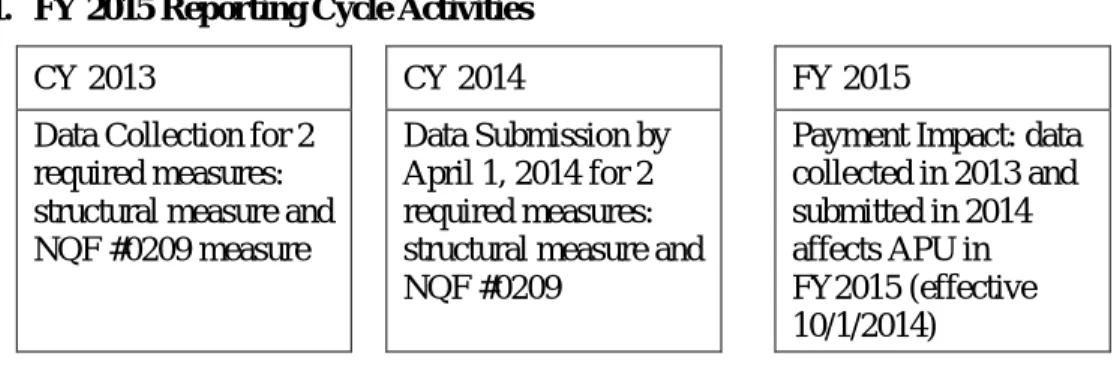
The HQRP currently operates on a cycle of data collection, data submission, and payment impact that spans three years. HQRP reporting cycles are referenced by the FY they impact. For example, the current HQRP cycle -- the FY 2015 Cycle -- will consist of data collection in Calendar Year (CY) 2013, data submission in CY 2014, impacting the APU for FY 2015. See Figure 1, below.
To avoid a reduction in the APU for FY 2015, all hospice providers that are Medicare-certified and have a valid CCN (CMS Certification Number; also known as the Medicare Provider Number) as of March 3, 2014, are required to collect and submit data to CMS for two measures: the structural measure and the NQF #0209 Pain Measure. Hospice providers must submit data for both measures to CMS no later than April 1, 2014 to comply with reporting requirements. Hospice providers will submit their data to CMS using a web-based data entry system. Details of the data submission process will be provided on the CMS Hospice Quality Reporting Program (HQRP) website: http://www.cms.gov/Medicare/Quality- Initiatives-Patient-Assessment-Instruments/Hospice-Quality-Reporting/index.html?redirect=/Hospice-Quality-Reporting/
Figure 1. FY 2015 Reporting Cycle Activities
CY 2013 CY 2014 FY 2015
Data Collection for 2 required measures: structural measure and NQF #0209 measure
Data Submission by April 1, 2014 for 2 required measures: structural measure and NQF #0209
Payment Impact: data collected in 2013 and submitted in 2014 affects APU in FY2015 (effective 10/1/2014)
Fiscal Year 2015 Reporting Cycle Requirements:
Who, What, When & How
Who:
All hospice providers that are Medicare-certified and have a valid CMS Certification Number (CCN, or Medicare Provider Number) as of March 3, 2014, are required to collect and submit data to meet the requirements for the FY 2015 Reporting Cycle.
For Hospices with Multiple Locations: Hospices will report data for both measures to CMS on a per-CCN basis.
• Hospice providers with multiple locations, sharing one CCN, should aggregate facility-level data from all locations so the data entered on the CMS data entry site represent data for the single CCN.
Quality Measure reporting is required for all patients, which includes:
• All payers (Medicare, Medicaid, and private payers) and
• All hospice provider settings (inpatient, home care, nursing home, assisted living facility, etc.)
What:
For FY 2015 Reporting Cycle, providers will be required to submit data for two measures to CMS: 1. The structural measure – providers will answer one yes/no question regarding their Quality
Assessment and Performance Improvement (QAPI) Program to fulfill reporting requirements for this measure. Answering the single yes/no question fulfills requirements for this measure; no other data or performance scores will be submitted.
• Data Collection: hospices need to keep documentation of the Quality Indicators (QIs) that they use in their QAPI programs. Hospices do not need to collect/submit any patient- or facility-level QI/QAPI data to meet the structural measure reporting requirements.
• Data Submission: providers must submit their answer to the structural measure question by April 1, 2014 to comply with requirements
2. The NQF #0209 Pain Measure – providers will collect patient-level data and submit facility-level data to CMS.
• Data Collection: providers should collect NQF #0209 pain measure data on all
admissions January 1, 2013 – December 26, 2013 to comply with reporting requirements.
FAQ: What’s the CCN Number?
The CCN number is the CMS
Certification number, also known as the Medicare Provider Number.
It is a 6-digit number, usually in the format xx-xxxx.
FAQ: Am I required to report for this cycle?
If you did not have a valid CCN on March 3, 2014, you are not required to report for FY 2015 Reporting Cycle. Even if your hospice was Medicare-certified as of March 3, 2014, if your hospice did not have an actual CCN on March 3, 2014, you are not required to report.
• Data Submission: Providers will aggregate their calendar year 2013 data and submit their NQF #0209 data by April 1, 2014 to comply with reporting requirements for this
measure. All NQF #0209 data collected during 2013 will be reported once in 2014; there will be no quarterly reporting for the FY 2015 Reporting Cycle.
APU determination:
The FY 2015 Reporting Cycle is “pay for reporting”. This means that compliance with HQRP requirements and APU determination is based on the act of submitting data for both measures by the required deadline – April 1, 2014. Performance level is not a consideration in determining a hospice provider’s APU at this time.
When:
For the FY 2015 Reporting Cycle, there is a single reporting deadline for both the NQF #0209 and the structural measure. Data for both measures must be submitted to CMS via the data entry website no later than April 1, 2014. Data will be submitted in 2014 for the entire Calendar Year 2013; there will be no quarterly or monthly data reporting.
How:
Hospice providers will enter their data online and submit them to CMS using the designated data entry site.
• The data entry site will be active for data entry and submission January – April 1, 2014.
• Providers will be able to access the data entry site through the “Data Submission” portion of the CMS Hospice Quality Reporting Program (HQRP) website:
http://www.cms.gov/Medicare/Quality-Initiatives-Patient-Assessment-Instruments/Hospice-Quality-Reporting/Data-Submission.html, at the bottom of the webpage under “Related Links”.
• Hospice providers may utilize vendors for their individual hospice provider data submission, but CMS will not support batch submissions involving scripting or database imports for multiple hospice providers from vendors.
Resources
CMS HQRP Webpage:
The CMS HQRP webpage is the official website for updates and announcements pertinent to the HQRP, including information about User Guides, trainings, and other general resources:
http://www.cms.gov/Medicare/Quality-Initiatives-Patient-Assessment-Instruments/Hospice-Quality-Reporting/index.html. Providers should bookmark the web address above and visit the CMS HQRP site on a regular basis in order to have the most up-to-date information pertinent to the HQRP.
User Guides Available for Providers:
There are two User Guides available for providers. Providers should review both User Guides carefully.
1. This Data Collection User Guide contains instruction and guidance for HQRP data collection processes only. The Data Collection User Guide can be found on the “Data Collection” portion of the CMS HQRP website: http://www.cms.gov/Medicare/Quality-Initiatives-Patient-Assessment-Instruments/Hospice-Quality-Reporting/Data-Collection.html, at the bottom of the webpage, under “Downloads.”
2. A Technical User Guide will also be available to instruct providers on data entry and submission processes. The Technical Guide for Hospice Quality Reporting Data Entry and Submission will be made available for provider download on the “Data Submission” portion of the CMS HQRP website: http://www.cms.gov/Medicare/Quality-Initiatives-Patient-Assessment-Instruments/Hospice-Quality-Reporting/Data-Submission.html at the bottom of the webpage, under “Downloads”.
Resources and Training Available for Providers:
CMS will post a slide presentation that summarizes the clinical data collection processes. In addition, there will be a data submission training to help providers prepare for the FY 2015 Reporting Cycle. Further details about the availability of additional resources and training will be announced on the CMS HQRP website:
http://www.cms.gov/Medicare/Quality-Initiatives-Patient-Assessment-Instruments/Hospice-Quality-Reporting/index.html
Help Desk Contact Information:
There are two Help Desks to assist hospice providers with HQRP quality questions and technical issues:
1. Quality Help Desk: For issues pertaining to either of the required measures
reporting requirements(including who is required to report), please e-mail the Quality Help Desk at the following:
E-mail:[email protected]
2. Technical Help Desk: For technical website/data entry issues including finding the data entry site, username/password issues, or general website difficulty/error messages, please call or e-mail the Technical Help Desk at the following:
E-mail:[email protected]
Phone: 1-877-201-4721
Section II:
The Structural Measure
Data Submission: by April 1, 2014
Background
The structural measure is intended to indicate whether a hospice organization’s calendar year 2013 (January 1 – December 31, 2013) Quality Assessment and Performance Improvement (QAPI) program includes three or more quality indicators related to patient care. For the FY 2015 Reporting Cycle, hospice providers shall answer one question to satisfy measure reporting requirements:
• Q1: Does your hospice have a Quality Assessment and Performance Improvement (QAPI) program that includes three or more quality indicators related to patient care?
Providing a yes/no answer to Q1 satisfies the structural measure reporting requirement for the FY 2015 Reporting Cycle. Hospice providers will not submit any information about individual quality indicators, quality indicator topics, or QAPI performance scores/raw data.
Hospice providers shall complete and submit their answer to Q1 to CMS no later than April 1, 2014.
FAQ: How has the structural measure changed from last year (FY 2014 FY 2015 Reporting Cycles)?
Elimination of Q2 and Q3. Last year, providers had to answer 3 questions as part of the FY 2014 structural measure: Q1 – Q3. This year, Q2 (the QAPI/QI checklist) and Q3 (QAPI /QI Data Source) have been eliminated. This means for the FY 2015 Reporting Cycle, providers are required only to answer the one structural measure question to satisfy structural measure reporting requirements. Providing a yes/no answer to this question satisfies the entire FY 2015 Reporting Cycle requirement.
Deadline is now April 1. Last year, there were two separate reporting deadlines for the two required measures. This year, there is a single deadline for reporting both measures. This means that for the FY 2015 Reporting Cycle, providers will have until April 1, 2014 to submit both their structural and NQF #0209 measure data.
Structural Measure Reporting
Structural measure reporting consists of answering one yes/no question. Answering the yes/no question is the only structural measure reporting requirement for the FY 2015 Reporting Cycle. Hospices will not be required to submit details about individual quality indicators (QIs) or topic areas; nor will they be required to submit any performance scores or actual numeric data. Details on how to answer the structural measure question are outlined below.
Structural Measure Question: Does your hospice have a Quality Assessment and Performance Improvement (QAPI) program that includes three or more quality indicators (QIs) related to patient care?
Answer “yes” or “no” based on the structure and content of your hospice organization's QAPI program.
Answer “Yes” if your hospice’s QAPI program included 3 or more patient care-related quality indicators from January 1, 2013, to December 31, 2013.
In order to answer “Yes” to the structural measure question, hospice providers must be able to identify at least 3 QIs in their QAPI program that meet all of the following criteria:
• Are quality indicators: A quality indicator is a metric used to assess hospice care processes or outcomes. It is aggregated from patient-level data and reported at the facility-level for monitoring as part of your QAPI program. Care goals such as “all patients will be free of pain” are not quality indicators because they are not clearly defined and measureable.
• Are related to patient care: Patient care-related indicators include QIs in patient care domains such as management of physical or psychosocial symptoms, patient preferences, care coordination, patient safety, or medication errors. Organizational or business-related quality indicators, such as staff turnover rates, patient contact hours, cost-savings metrics, employee training/certification/education, and patient length of stay/primary diagnosis, are not patient care-related and should not be included in structural measure reporting.
• Are in place (or were added) between January 1 and December 31, 2013: Quality Indicators that you stopped using before January 1, 2013, or any indicators added to your QAPI program after December 31, 2013, should not be considered when determining your answer to the structural measure question.
Answer “No” if your hospice’s QAPI program included fewer than 3 patient care-related quality indicators from January 1, 2013, to December 31, 2013.
• Even if you answer “no”, you should still submit data to CMS. The FY 2015 Reporting Cycle is “pay for reporting”. This means that compliance with the HQRP and the APU
determination are based on the act of submitting data for both measures by the required deadline – April 1, 2014. Performance level is not a consideration in determining a hospice’s APU in the FY 2015 Reporting Cycle.
Structural Measure Data Submission:
Data Submission Deadline: April 1, 2014
Hospice providers will report their structural measure to CMS via a web-based data entry and submission website. The data entry website will be available for data entry, attestation, and data
submission January – April 1, 2014. The link to the data entry site will be accessible to providers via the Data Submission portion of the CMS HQRP website: http://www.cms.gov/Medicare/Quality-Initiatives-Patient-Assessment-Instruments/Hospice-Quality-Reporting/Data-Submission.html.
Providers must submit their structural measure via the data entry site no later than 11:59 PM Eastern Time on April 1, 2014 in order to avoid a 2 percentage point reduction in their APU. After April 1, 2014, providers will only be able to view the data entry website via the Data Submission portion of the CMS HQRP webpage. No data entry or data submission can occur after 11:59 Eastern Time on April 1, 2014.
For Hospice Providers with Multiple Locations:
Hospice providers will report data to CMS on a per-CCN basis.
• Hospice providers with multiple locations that share one CCN should aggregate facility-level data from all locations so the data entered on the CMS data entry site represent data for the single CCN.
Technical User Guide for Data Submission:
This Data Collection User Guide contains instruction and guidance for HQRP data collection processes only. A Technical User Guide will also be available to instruct providers on data entry and submission processes. The Technical Guide for Hospice Quality Reporting Data Entry and Submission will be made available for provider download on the “Data Submission” portion of the CMS HQRP website: http://www.cms.gov/Medicare/Quality-Initiatives-Patient-Assessment-Instruments/Hospice-Quality-Reporting/Data-Submission.html at the bottom of the webpage, under “Downloads”. Providers should review both User Guides carefully.
APU Determination:
The FY 2015 Reporting Cycle is “pay for reporting”. This means that compliance with HQRP requirements and APU determination is based on the act of submitting data for both measures by the required deadline – April 1, 2014. Performance level is not a consideration in determining a hospice’s APU at this time.
• In practical terms, this means providers should still submit their structural measure to CMS even if their answer to the structural measure question is “no”.
Section III:
NQF #0209 Pain Measure
Data Collection: All admissions January 1, 2013 – December 26, 2013
Data Submission: by April 1, 2014
Background
The NQF #0209 Pain Measure was re-endorsed by the National Quality Forum (NQF) in February 2012. It measures the percentage of patients who report being uncomfortable because of pain at the initial assessment (after admission to hospice) who report that pain was brought to a comfortable level within 48 hours. By implementing this measure, hospice providers are able to determine what percentage of their patient population is admitted with pain and how well that pain is managed in the early days of hospice care. This measure is
particularly significant to hospice care as it addresses a basic aspect of hospice practice—pain management—and ensures integration of patient choice for desired level of treatment with the care process by incorporating the patient’s own pain goals and perception of his or her own degree of comfort. Because the measure incorporates both patient preference and measure outcomes, it is useful and meaningful for consumers, providers, and payers.
For measure specifications and details, please visit NQF:
http://www.qualityforum.org/MeasureDetails.aspx?actid= 0&SubmissionId=457#k=0209. Additional details about how to use/implement this measure are available
from the measure steward, National Hospice and Palliative
Care Organization (NHPCO): http://www.nhpco.org/i4a/pages/Index.cfm?pageID=3376.
Figure 3. FY 2015 Reporting Cycle: NQF #0209 Activities
CY 2013 CY 2014 FY 2015
Data Collection: Collect NQF #0209 data on all admissions 1/1/13 – 12/26/13
Data Submission: submit NQF #0209 data by April 1, 2014
Payment Impact: data collected in 2013 and submitted in 2014 affects APU in FY 2015 (effective 10/1/2014)
FAQ: How has the NQF #0209 Pain Measure changed from last year (FY 2014 FY 2015 Reporting Cycles)?
Data Collection Period now an entire Calendar Year: There were no changes in the NQF #0209 Pain Measure itself from the FY 2014 to FY 2015 Reporting Cycles. As measure specifications are the same, providers should collect and submit NQF #0209 data for the FY 2015 Reporting Cycle in the same manner as they did last year. The only NQF #0209 change from the FY 2014 to FY 2015 Reporting Cycles is a change in the data collection period. Last year, providers collected NQF #0209 data only for admissions during the 4th quarter of 2012. This year, providers should collect NQF #0209 data on admissions on a calendar year schedule. This means that for the FY 2015 Reporting Cycle, NQF #0209 data should be collected on all admissions January 1, 2013 – December 26, 2013.
Implementing the NQF #0209 Pain Measure in
Your Hospice Organization
NQF #0209 Pain Measure implementation for the Hospice Quality Reporting Program (HQRP) should occur in two broad phases: Data Collection and Data Submission.
Data Collection: generate and record NQF #0209 data on all admissions January 1 – December 26, 2013 In order to submit data for the NQF #0209 Pain Measure for the purposes of the CMS Hospice Quality Reporting Program (HQRP), hospice providers will generate and record NQF #0209 Pain Measure data on all admissions from January 1 to December 26, 2013 .
As previously stated, the NQF #0209 Pain Measure calculates the percentage of patients who report being uncomfortable because of pain at the initial assessment (after admission to hospice services) who report that pain was brought to a comfortable level within 48 hours. Data for the measure are generated by asking patients two comfort questions:
• The initial comfort question “Are you uncomfortable because of pain?” is asked at the time of initial assessment.
• For patients that answer “yes” to the initial comfort question, the follow-up comfort question “Was your pain brought to a comfortable level within 48 hours of the start of hospice care?” is asked between 48 to 72 hours after initial pain assessment.
To comply with CMS requirements, the NQF #0209 comfort questions should be asked (and responses documented) for all admissions from January 1 – December 26, 2013.
Data Submission: retrieve and report collected NQF #0209 data January – April 1, 2014
After the data collection period ends in December, the data submission phase will begin. The NQF #0209 data submission phase spans January 2014 to April 1, 2014. During this time, hospice providers will retrieve all of their NQF #0209 data that were collected during 2013, aggregate them, and report the seven data elements to CMS no later than April 1, 2014. Details on the seven data elements will be included later in this section.
Data Collection
Generate and Record NQF #0209 data on all admissions January 1 – December 26, 2013.
NQF #0209 Pain Measure data collection consists of generating and recording data for the initial and/or the follow-up comfort questions on all admissions January 1 – December 26, 2013.
To collect the necessary data for NQF #0209 measure reporting, hospice providers should generate and record data for the initial and/or follow-up comfort questions using the following process:
I. Initial Comfort Question:
The initial comfort question will be asked of all patients determined eligible for the measure, based on step 1, below.
Step 1. Determine patient eligibility for
measure inclusion. In order to be asked the initial comfort question -- and to be eligible for the NQF #0209 measure entirely – a patient must meet three initial eligibility criteria. The patient must be:
• Criterion 1: At least 18 years of age
• Criterion 2: Able to self-report comfort
o The patient must be able to understand the initial question and provide a reliable yes/no response. The clinician
conducting the assessment must use his/her clinical judgment to evaluate the patient’s ability to self-report.
• Criterion 3: Able understand the language of the clinician conducting the assessment
o If a patient cannot understand the language of the clinician conducting the assessment, the patient should not be included in the NQF #0209 Pain Measure. Hospices are, however,
permitted to use interpreters if the patient cannot understand the language of the clinician conducting the assessment. Use of a qualified interpreter will suffice to surmount the language barrier and include the patient in the NQF #0209 measure. Hospices should apply the same standard regarding use of an interpreter for the comfort question(s) as they would for any regular assessment or visit.
If a patient does not meet all three criteria listed above, they should be excluded from the NQF #0209 measure entirely. This means they should not be asked the initial or the follow-up comfort question.
Step 2. Ask the initial comfort question. If a patient is eligible for the measure based on Step 1, above, ask the patient the initial comfort question for the NQF #0209 measure. Specifics for asking the question are as follows:
FAQ: Which patients should be included in CMS HQRP NQF #0209 reporting?
• All admissions January 1 – December 26, 2013
o An admission is defined as any and all patients who are admitted to your hospice for the first time or readmitted to your hospice after an interruption in service provision. Patients who are transferred from another hospice provider to your hospice organization should also be included in the measure collection, even though the measure questions may have already been asked by the previous hospice.
• All payers (Medicare, Medicaid, and private payers)
• All hospice settings (inpatient, home care, and nursing home hospice patients)
Who. The initial comfort question should be asked by a nurse, and the nurse must ask the question in-person.
How.The initial comfort question should be asked exactly as follows. The staff member conducting the initial assessment should ask the patient the exact question:
• “Are you uncomfortable because of pain?”
o Do not substitute a pain scale rating for the patient’s yes/no response.
o Do not substitute family/caregiver report of pain comfort for patient self-report.
o Do not ask the initial comfort question if the patient was excluded from the measure because they were under 18, unable to self-report, or there was a language barrier.
When. The initial comfort question should be asked during the initial nursing assessment, prior to completing a pain assessment.
Step 3. Record initial comfort question data in the patient’s medical record. After asking the initial comfort question, the clinician should record the initial comfort data in the patient’s medical record. Initial comfort data should be recorded as:
• A patient’s yes or no response to the initial comfort question, along with the time the question was asked
• Or, if the patient was excluded from the measure, the reason for exclusion:
o Under 18 years of age
o Unable to self-report at time of initial comfort question
o Language barrier.
Remember:
• In order to avoid missing data at the time of data submission, it is important for hospice providers to record complete initial comfort question data (the patient’s yes/no response and the time the question was asked, or the reason for exclusion).
II. Follow-up Comfort Question:
The follow-up comfort question will only be asked of those patients who answered “yes” to the initial comfort question. If the patient answered “no” or was determined to be ineligible for the measure, the hospice provider is not required to collect NQF #0209 follow-up data for that patient.
Step 1. Ask the follow-up comfort question
. If the patient answered “yes” to the initial comfort
question, the follow-up comfort question should be asked 48 – 72 hours after asking the initial comfort question. Specifics for asking the question are as follows:Who. The follow-up comfort question can be asked by any member of the hospice staff; the question does not have to be asked by a nurse. Additionally, the hospice provider can contact the patient via telephone to ask the follow-up comfort question.
How. The follow-up comfort question should be asked as follows:
• “Was your pain brought to a comfortable level within 48 hours?”
o Do not substitute a pain scale rating for the patient’s yes/no response.
o Do not substitute family/caregiver report of pain comfort for patient self-report.
o Do not ask the follow-up comfort question if the patient was determined ineligible for the measure, or if the patient answered “no” to the initial comfort question.
When. Hospice providers must contact the patient between 48 to 72 hours after asking the initial comfort question to ask the follow-up question.
• The follow-up question should be asked 48 to72 hours after the initial nursing assessment, not the admission to hospice, if these two events occurred at different times.
• The follow-up question should not be asked earlier than 48 hours after the initial assessment.
• Hospices should make every effort to contact the patient 48 to 72 hours after the initial pain
assessment to ask the measure follow-up question. At times it may not be possible to contact the patient within 72 hours (e.g., the patient is sleeping and the family caregiver asks that the hospice call back later). Therefore, the endpoint for asking the follow-up question can be defined as 3 days. Given this time frame, hospices should ask patients the follow-up question by 11:59 PM of the third day.
FAQ: What’s the earliest (and latest) I can ask the follow-up question for the NQF #0209 Pain Measure?
Earliest. If a patient is asked the initial question on 11/6/13 at 2 pm, the follow-up question should not be asked prior to 2 pm on 11/8/13 (or 48 hours after the initial comfort question was asked).
Latest. While it is ideal to contact the patient 48-72 hours after asking the initial question, hospices are permitted up until midnight of the third day to ask the follow-up question. For a patient admitted 11/6/13 at 2pm, the hospice thus has until 11:59 pm on 11/9/13 (midnight of the third day) to ask the follow-up question.
Patients who are unable to self-report (either due to decline in status, death, or live discharge) at the time of follow-up. If at the time you are to ask the follow-up question the patient is no longer able to self-report or has been discharged (live or due to death), the patient cannot be asked the follow-up comfort question. Reasons for not asking the follow-up question can be summarized in 3 main categories, using the following terminology:
• Discharge (live or due to death)
• Condition deteriorated—patient no longer able to communicate/self-report
• Other (with explanation)
Step 2. Record NQF #0209 follow-up comfort question data. After asking the follow-up comfort question, the clinician should record the patient’s yes or no answer to the question in the medical record, along with the time the follow-up question was asked. If the patient was unable to self-report at the time of follow-up, the clinician should record the reason in the medical record in lieu of a yes/no response:
• Discharge (live or due to death)
• Condition deterioration (patient no longer able to communicate/self-report)
• Other (with explanation)
Remember:
• Follow-up data must only be recorded for patients who answered “yes” to the initial comfort question. If the patient answered “no” to the initial question or was ineligible for the measure, no NQF #0209 follow-up data are recorded in the chart.
• The follow-up question must be asked 48-72 hours after the initial comfort question.
• It is important for hospice providers to record complete follow-up comfort question data (the patient’s response or the reason why the patient was unable to answer the follow-up question) in order to avoid missing data at the time of data submission.
General Notes about the NQF #0209 Measure:
NQF #0209 Pain Measure data collection is not a substitute or replacement for usual pain management practices. In practical terms, providers may find that some NQF #0209 measure
specifications appear to be at odds with their established clinical pain management practices. The two NQF #0209 measure questions (initial comfort question and follow-up comfort question) do not replace usual clinical pain management practice and should not be part of an ongoing pain assessment.
FAQ: Is it acceptable to ask the follow-up question before 48 hours?
Hospices should check in with the patient for symptom management purposes before 48 hours. However, you cannot use these clinical check-ins for NQF #0209 data collection purposes. For NQF #0209 measure purposes, the follow-up comfort question should not be asked prior to 48 hours. The only data that can be used in NQF #0209 reporting is the data that was collected by asking the exact NQF #0209 follow-up question between 48-72 hours.
It is usual clinical practice to follow-up with patients experiencing pain prior to the 48-72 hour mark used for the NQF #0209 measure. Clinicians often assess pain daily or even more frequently by asking patients to rate pain, describe whether their pain is improving,
worsening, or staying the same in response to treatment, or performing other appropriate clinical assessment. These clinical assessments do not preclude a patient from NQF #0209 reporting.
In addition to these usual clinical practices, hospices will ask the patient the specified NQF #0209 follow-up question between 48 – 72 hours: “Was your pain brought to a comfortable level within 48 hours?”
Data Submission
Retrieve and report NQF #0209 Pain Measure data January 2014 – April 1, 2014.
After the data collection phase ends in December 2013, hospice providers will enter the data submission phase, which spans January 2014 to April
1, 2014. During this time, hospice providers will retrieve data collected in calendar year (CY) 2013, aggregate them, and submit their data to CMS no later than April 1, 2014.
During the data submission period, hospices will review their patients’ medical records to retrieve NQF #0209 Pain Measure data. Hospice providers should review patient medical records for all patients that were admitted between January 1 and December 26, 2013, extract, and aggregate applicable NQF #0209 data. After retrieving and aggregating their data, hospice providers will submit seven data elements to CMS for the NQF #0209 Pain Measure (described below). Hospice providers will submit NQF #0209 data for the entire CY 2013; data will not be reported on a quarterly or monthly basis.
The seven data elements can be grouped into 3 categories:
• Total number of admissions (Data Element 1)
• Initial comfort question data (Data Elements 2-4)
• Follow-up comfort question data (Data Elements 5-7)
Details for retrieving the 7 Data Elements are outlined on the next page.
To facilitate the NQF #0209 data entry/submission process, providers may wish to complete Appendix A: NQF #0209 Data Submission Worksheet found in this User Guide. The Appendix A worksheet is formatted to match Data Elements 1 – 7 as they will appear on the Data Entry Website. Therefore, it is highly recommended that providers complete Appendix A prior to beginning their data entry on the data entry/submission website. Providers may also wish to have a copy of Appendix A available for completion of data entry.
FAQ: Since data collection includes admissions 1/1/13 – 12/26/13, how do I account for admissions 12/27/13 – 12/31/13?
Inclusion for NQF #0209 measure reporting hinges on a patient’s admission date. For the NQF #0209 measure, you will only report data for patients that were admitted 1/1/13-12/26/13. This means Data Element 1, "total admissions," will be defined as all admissions 1/1/13-12/26/13. Data Elements 2-7 will be based on those patients that were included in Data Element #1. For example, a patient admitted on 12/26 may have their initial question asked on 12/27 and their follow up question asked on 12/29. Inclusion in NQF #0209 reporting hinges on the admission date; since the patient was admitted on 12/26, they, along with the rest of their data, would be included. A patient admitted on 12/27 who also had their initial question asked on 12/27 and their follow-up on 12/29 would not be includedin this Reporting Cycle at all since they were admitted after 12/26. Patients admitted 12/27/13 – 12/31/13 will not be accounted for in NQF #0209 reporting.
The following pages detail the seven data elements that will be reported to CMS for the NQF #0209 measure. Included in the right-hand sidebar of the following pages is an integrated example detailing how NQF #0209 data collection maps to the seven data elements that will be reported to CMS.
The integrated example follows 10 fictional patients (Patients A – J) from Sunshine Hospice through the NQF #0209 data collection process.
Examples are grouped into the 3 data element categories:
• Total Admissions: Data Element 1
• Initial Comfort Question: Data Elements 2-4
• Follow-up Comfort Question: Data Elements 5-7
• Even though missing data are not reported to CMS, examples are also given for how to account for missing data.
Data Element 1: Total Number of Admissions
Enter the number of admissions during the data collection period (all admissions January 1, 2013 through December 26, 2013)
• Hospice providers should enter the total number of admissions from January 1 to December 26, 2013.
• Providers should answer Data Elements 2-7 based on the patients included in the total number of admissions for Data Element 1.
Example:
Total Admissions:
During Calendar Year 2013, Sunshine Hospice had 10 admissions (Patients A-J). Nine of the 10 patients were admitted during the data collection period, which is defined as all admissions January 1, 2013 – December 26, 2013. One of the 10 patients (Patient J) was admitted on December 28, 2013.
Data Element 1:
With respect to the Data Elements, this means that:
• Data Element 1 = 9 patients
Explanation: Patients A-I are included in Data Element 1 since they were admitted between January 1, 2013 and December 26, 2013. Patient J is not included in Data Element 1, total number of admissions, since he/she was admitted on December 28, 2013, after the admission cutoff date. Since Patient J was admitted after the cutoff date, he/she will not be included in any of the 7 Data Elements.
Initial Comfort Question - Data Elements 2-4:
Data Element 2: Patients who answered “yes” to the initial comfort question
Pain Measure Denominator: Enter the number of patients who answered “yes” to the question “Are you uncomfortable because of pain?” at the initial assessment (after admission to hospice services) during the data collection period .
• Include only the number of “yes” responses you generated and recorded in your patient records, initial assessment forms, or on measure worksheets
Data Element 3: Patients who answered “no” to the initial comfort question
Enter the number of patients who answered “no” to the question “Are you uncomfortable because of pain?” at the initial assessment (after admission to hospice services) during the data collection period.
• Include only the number of “no”
responses you generated and recorded in your patient records, initial assessment forms, or on measure worksheets
Data Element 4: Patients excluded from the measure
Enter the number of patients excluded due to ineligibility.
• This data element is the number of patients who were determined ineligible for the measure at the initial nursing assessment because they were:
o less than 18 years of age
o unable to self-report or
o there was a language barrier.
• This data element should only include patients who were excluded for one of the three reasons listed above; patients who were eligible for the measure but were simply not asked the initial comfort question are considered “missing” and should not be included in Data Element 4.
Example:
Initial Comfort Question Data:
The first step in collecting initial comfort question data is determining eligibility for the measure. Remember, patient eligibility for the measure is based on the patient being over 18, able to self-report, and having no language barrier issues. Sunshine Hospice had 9 patients (A-I) admitted during the Data Collection period. Of the 9 admissions for the data collection period:
• Patient A was unable to self-report at admission
• Patients B-I met all eligibility criteria (were over 18, able to self-report, no language barrier)
The second step in initial comfort question data is asking the initial comfort question. Remember, the initial comfort question should only be asked of patients eligible for the measure. Since one patient (Patient A) was ineligible because he/she was unable to self-report, he will be excluded and will not be asked the comfort question. That leaves 8 patients (Patients B-I) eligible for the measure and thus 8 patients to be asked the initial comfort question:
• Patient B answers “no” he is not uncomfortable.
• Patients C-H answer “yes” they are uncomfortable.
• Patient I was not asked the initial comfort question, despite meeting all eligibility criteria With respect to the Data Elements, this means that:
• Data Element 2 = 6 patients
Explanation: Patients C-H answered “yes” to the initial comfort question
• Data Element 3 = 1 patient
Explanation: Patient B answered “no” to the initial comfort question
• Data Element 4 = 1 patient
Explanation: Patient A was excluded from the measure because they were unable to self report on admission
Note: Patient I is not included in Data Elements 2-4; even though Patient I was eligible for the measure, Patient I was not asked the initial comfort question. This means Patient I is “missing” with respect to initial comfort question data (Data Elements 2-4). Missing data for the initial comfort question is
Missing Data for the Initial Comfort Question: Data Elements 2-4
A patient is considered “missing” with respect to initial comfort question data (Data Elements 2-4) if he/she:
• was eligible for the measure, but was not asked the initial comfort question;
• was eligible for the measure, was asked the initial comfort question, but it was outside of the specified
timeframe;
• was eligible for the measure, was asked the initial comfort question, but the patient’s yes/no response was not recorded in the medical record; or Missing data will not be reported to CMS. Thus, a patient who is “missing” with respect to initial comfort question data will not be included in Data Elements 2, 3, or 4. A patient who is missing with respect to initial comfort question data will be accounted for in the seven Data Elements as follows:
• Data Element 1: Patients who are missing with respect to the initial comfort question will still be included in Data Element 1, total admissions
• Data Elements 2 – 4: Patients who are missing with respect to the initial comfort question will not be reflected in Data Elements 2, 3, or 4.
• Data Elements 5-7: Patients who are missing with respect to the initial comfort question will not be reflected in Data Elements 5, 6, or 7
Although missing data are not reported to CMS, hospice organizations are encouraged to record missing data for internal quality improvement processes. Hospices should aim to have no missing data.
Example:
Initial Comfort Question -- Missing Data:
Patient I was eligible for the measure and should have been asked the initial comfort question, but was not. This means initial comfort question data is missing for Patient I. Missing data is not be reported to CMS. Thus, Patient I will not be included in Data Elements 2-4.
Neither will Patient I be included in Data Elements 5-7.
Patient I should still be included in Data Element 1. Although Patient I is not reported to CMS in Data Elements 2-7, hospice providers may wish to track missing data patients for internal quality
improvement purposes.
Data Element Summary Table: Data Element 1:
Total Admissions
9 Patients (A-I)
Data Element 2: Yes to Initial Question
6 Patients (C-H)
Data Element 3: “No” to Initial Question
1 Patient (B)
Data Element 4: Excluded from Measure
1 Patient (A)
Initial Question Missing Data (Not reported to CMS)
Follow-up Comfort Question - Data Elements 5-7:
Data Elements 5-7 all relate to the follow-up comfort question. Remember, hospice providers should only collect and report follow-up data on those patients who answered “yes” to the initial comfort question (Data Element 2). Patients who answered “no” to the initial comfort question (Data Elements 3) or were ineligible for the measure (Data Element 4) should not be included in follow-up question data (Data Elements 5-7).
Data Element 5: Patients who answered “yes” to the follow-up comfort question
Enter the number of patients during the data collection period who answered “yes” to the follow-up question “Was your pain brought to a comfortable level within 48 hours of the start of hospice care?” at the time of follow-up.
• Include only the number of “yes” responses generated and recorded in patient records, initial assessment forms, or on measure worksheets
Data Element 6 – Patients who answered “no” to the follow-up comfort question
Enter the number of patients during the data collection period who answered “no” to the follow-up question “Was your pain brought to a comfortable level within 48 hours of the start of hospice care?” at the time of follow-up.
• Include only the number of “no” responses generated and recorded in patient records, initial assessment forms, or on measure worksheets
Data Element 7: Patients unable to self-report (due to death, live discharge or condition deterioration) at follow-up
Enter the number of patients unable to self report at follow-up. This includes patients whose condition deteriorated, leaving them unable to answer the follow-up question; patients who died prior to follow-up; and patients who were discharged live prior to follow-up. These reasons may appear in the medical record as:
• Discharge (live or due to death)
• Condition deteriorated and patient is no longer able to communicate
• Other (with explanation)
This data element should only include patients who were unable to self-report at follow-up for one of the three reasons listed above; patients who were not asked the follow-up comfort question in accordance with measure specifications are considered “missing” and should not be included in Data Element 7.
Example:
Follow-up Comfort Question Data:
Follow-up comfort data should only be collected on those patients who answered “yes” to the initial comfort question. This means that for Sunshine Hospice, follow-up comfort question data will be collected on the 6 patients who answered “yes” to the initial comfort question, Patients C-H.
With respect to follow-up data:
• Patient C was unable to self-report at follow-up
• Patient D answered “yes” to the follow-up question, but the question was asked after 11:59 PM of the third day
• Patient E died prior to the time of follow-up
• Patient F-H said “yes” to the follow-up comfort question
With respect to the Data Elements, this means that:
• Data Element 5 = 3 patients
Explanation: Patients F - H answered “yes” to the follow-up question. Patient D also answered “yes” to the follow-up question; however, Patient D was asked the follow-up question outside of the timeframe. This means data for Patient D is “missing” and shouldn’t be included in Data Element 5. Missing data is further explained on the next page.
• Data Element 6 = 0 patients
Explanation: Zero patients answered “no” to the follow-up comfort question.
• Data Element 7 = 2 patients
Explanation: Patient C and Patient E are included in Data Element 7 since they were both unable to self-report at the time of follow-up. Patient C was unable to self-report due to condition deterioration; Patient E was unable to self-report due to death.
Missing Data for the Follow-up Comfort Question: Data Elements 5-7
A patient is considered “missing” with respect to follow-up comfort question (Data Elements 5-7) if he/she:
• answered “yes” to the initial comfort question, but was never asked the follow-up question;
• answered “yes” to the initial comfort question, was asked the follow-up comfort question, but it was outside of the specified timeframe (either before 48 hours or after 11:59 PM of the 3rd day); or
• answered “yes” to the initial comfort question, was asked the follow-up comfort question, but the patient’s yes/no response was not recorded in the medical record.
Missing data will not be reported to CMS. Thus, a patient who is “missing” with respect to follow-up comfort question will not be included in Data Elements 5, 6, or 7. A patient who is missing with respect to follow-up comfort question data will be accounted for in the seven Data Elements as follows:
• Data Element 1: Patients who are missing with respect to the follow-up comfort question will still be included in Data Element 1, total admissions.
• Data Elements 2-4: Patients who are missing only with respect to the follow-up question are not precluded from being represented in initial comfort question data (Data Elements 2-4). This means, even if a patient is not included in Data Elements 5-7, he/she should still be accounted for in initial comfort question data elements (Data Element 2, 3, or 4).
• Data Elements 5-7: Patients who are
missing with respect to the follow-up question will not be included in Data Elements 5-7.
o Remember: patients who are unable to self-report or are discharged prior to/at the time of follow-up are not considered missing. These patients should be included in Data Element 7.
Although missing data is not reported to CMS, hospice organizations are encouraged to record
Example:
Follow-up Comfort Question – Missing Data:
For Sunshine Hospice, Patient D was eligible for the measure, answered yes to the initial comfort question, and thus should have been tracked through to follow-up. Although the Patient D was asked the follow-up comfort question, it was outside the timeframe.
This means follow-up question data is missing for Patient D. Missing data is not reported to CMS. Thus, Patient D will not be included in Data Elements 5-7.
A patient who is missing with respect to the follow-up comfort question should still be included in initial comfort question data; this means that Patient D will be included in Data Elements 2-4. Patient D should also still be included in Data Element 1, total number of admissions.
Although Patient D is not reported to CMS in Data Elements 5-7, hospice providers may wish to track missing data patients for internal quality
improvement purposes.
Data Element Summary Table: Data Element 5:
“Yes” to Follow-up Question
3 Patients: (F-H)
Data Element 6: “No” to Follow-up Question
0 Patients
Data Element 7: Unable to Self-Report at Follow-up
2 Patients (C, E)
Follow-up Question Missing Data (not reported to CMS)
Example:
NQF #0209 Measure Calculation:
Sunshine Hospice had 9 admissions for the Data Collection period (January 1 – December 26, 2013). Their NQF #0209 score is calculated as follows:
Data Element 5/ Data Element 2 or 3/6 = 50%
Explanation: The NQF #0209 Measure is calculated using only two of Data Elements – Data Element 2 (number of patients who answered “yes” to follow-up comfort question) and Data Element 5 (number of patients who answered “yes” to initial comfort question). None of the other Data Elements are used in calculating the score, but they do provide important
contextual information that is useful for interpreting the score.
Even though there were two patients unable to self-report at follow-up, these patients are not excluded from measure calculation and remain in the denominator of the measure.
NQF #0209 Measure Calculation:
Only the seven Data Elements shall be submitted to CMS for the NQF #0209 Pain Measure. Hospice providers will not submit their actual NQF #0209 Pain Measure score; however, your score will be automatically calculated for you and displayed on the data entry site, based on the data you enter.
The NQF #0209 Pain Measure score represents the percentage of patients who were
uncomfortable because of pain at the initial assessment and had their pain brought to a comfortable level within 48 hours of the initial assessment. Providers may write down their facility-level score for use in internal quality improvement initiatives. The NQF #0209 facility score that will be displayed on the data entry site is calculated using the following formula:
Calculation of the NQF #0209 measure score is based only on Data Elements 5 and 2; there are no exclusions for this measure. This means that patients who are unable to self-report at follow-up remain in the measure denominator.
Numerator: Number of patients who replied “yes” when asked if their pain was brought to a comfortable level within 48 hours of initial assessment (follow-up question)
Data Element 5 Data Element 2
Denominator: Patients who replied “yes” when asked if they were uncomfortable because of pain at the initial assessment (after admission to hospice services)
FAQ: Why are patients who are unable to self-report at follow-up not excluded from the measure?
As per measure steward specifications, all patients who report being uncomfortable because of pain on admission remain in the denominator for the NQF #0209 measure, including those who are unable to self-report at follow-up. This specification is designed to minimize patients "lost to follow-up" by
incentivizing hospices to make every effort to follow-up with the patient. The number of patients who are unable to self-report at follow-up should be tracked carefully by hospices. This number is a reportable data element and does provide important context in interpreting NQF #0209 measure scores for performance improvement.
NQF #0209 Data Submission
Data Submission Deadline: April 1, 2014
Data Submission Deadline: April 1, 2014
Hospice providers will report their NQF #0209 Pain Measure to CMS via a web-based data entry and submission website. The data entry website will be available for data entry, attestation, and data submission January– April 1, 2014. The link to the data entry site will be accessible to providers via the Data Submission portion of the CMS HQRP website: http://www.cms.gov/Medicare/Quality-Initiatives-Patient-Assessment-Instruments/Hospice-Quality-Reporting/Data-Submission.html.
Providers must attest and submit their NQF #0209 Pain Measure via the data entry site no later than 11:59 PM Eastern Time on April 1, 2014 in order to avoid a two percentage point reduction in APU. After 11:59 PM on April 1, 2014, providers will only be able to view the data entry website via the Data Submission portion of the CMS HQRP webpage. No data entry, attestation, or data submission can occur after April 1, 2014.
To facilitate the data entry and submission process, it is highly recommended that providers complete the Appendix A: NQF #0209 Pain Measure Worksheet prior entering NQF #0209 data on the data entry website.
If you already submit NQF #0209 Pain Measure data to NHPCO:
Hospice providers that submit NQF #0209 Pain Measure data to NHPCO must also submit the seven Data Elements to CMS to comply with HQRP reporting requirements. NHPCO does not submit the seven elements to CMS on your behalf. Hospice providers may choose to submit their NQF #0209 data to both NHPCO and CMS.
For Hospice Providers with Multiple Locations:
Hospice providers will report data to CMS on a per-CCN basis.
• Hospice providers with multiple locations that share one CCN should aggregate facility-level data from all locations so the data entered on the CMS data entry site represents data for the single CCN.
Technical User Guide for Data Submission:
This Data Collection User Guide contains instruction and guidance for HQRP data collection processes only. A Technical User Guide will also be available to instruct providers on entry and submission processes. The Technical Guide for Hospice Quality Reporting Data Entry and Submission will be made available for provider download on the “Data Submission” portion of the CMS HQRP website: http://www.cms.gov/Medicare/Quality-Initiatives-Patient-Assessment-Instruments/Hospice-Quality-Reporting/Data-Submission.html at the bottom of the webpage, under “Downloads”.
Providers should review both User Guides carefully.
APU Determination:
The FY 2015 Reporting Cycle is “pay for reporting”. This means that compliance with HQRP requirements and APU determination is based on the act of submitting data for both measures by the required deadline – April 1, 2014. Performance level is not a consideration in determining a hospice organization’s APU at this time.
Section IV:
Appendix A: NQF #0209 Measure Worksheet
Appendix A: NQF #0209 Pain Measure Worksheet
This worksheet contains the seven data elements as they will appear on the CMS data entry website. For further instructions on filling in answers to the seven data elements listed below, please see section NQF #0209 Data Submission in this User Guide.
Data Element 1.
Enter the number of admissions during the data collection period (January 1 - December 26, 2013). Providers should answer Data Elements 2-7 based on the patients included in the total number of admissions for Data Element 1.
____________________________________
Data Element 2.
Pain Measure Denominator: Enter the number of patients who answered YES to the question “Are you uncomfortable because of pain?” at the initial assessment (after admission to hospice services) during the data collection period.
______________________________________
Data Element 3.
Enter the number of patients who answered NO to the question “Are you uncomfortable because of pain?” at initial assessment (after admission to hospice services) during the data collection period .
___________________________________________
Data Element 4.
Enter the number of patients excluded.
_______________________________________ Data Element 5.
Pain Measure Numerator: Enter the number of patients who answered YES to the follow-up question “Was your pain brought to a comfortable level within 48 hours of the start of hospice care?” during the data collection period.
________________________________________
Data Element 6.
Enter the number of patients who answered NO to the follow-up question “Was your pain brought to a comfortable level within 48 hours of the start of hospice care?” during the data collection period.
_____________________________________________
Data Element 7.
Enter the number of patients unable to self-report at follow-up.
Appendix B: Glossary
Term Definition
CCN CMS Certification Number, also known as the Medicare provider number. This is a 6-digit
number, usually in the format: xx-xxxx.
Denominator The number in the bottom part of a fraction; represents the total population in terms of which statistical values are expressed.
Look-back period (data collection period)
The timeframe in which data for a quality measure is collected. For both the NQF #0209 Pain Measure, the look-back period is all admissions January 1, 2013 – December 26, 2013.
NQF #0209 Pain Measure
The NQF #0209 Pain Measure reflects the number of patients who report being
uncomfortable because of pain at the initial assessment (after admission to hospice services) who report that pain was brought to a comfortable level within 48 hours.
Numerator The number in the top portion of a fraction; represents a subset of the entire population in terms of which statistical values are expressed.
Patient care-related Quality Indicator
Quality Indicators that include patient care domains such as management of physical or physiological symptoms. They might also address care coordination, transitions,
communication with the patient and family, or patient safety issues like falls and medication errors. Patient care-related indicators do NOT address organizational or business goals. QAPI program A CMS Condition of Participation (CoP) requires hospice providers to develop, implement,
and maintain an effective, ongoing, hospice-wide data-driven quality assessment and
performance improvement (QAPI) program. The hospice organization's governing body must ensure that the program reflects the complexity of its organization and services; involves all hospice services (including those services furnished under contract or arrangement); focuses on indicators related to improved palliative outcomes; and takes actions to demonstrate improvement in hospice performance. The hospice provider must maintain documentary evidence of its quality assessment and performance improvement program and be able to demonstrate its operation to CMS. For more details about the QAPI program CoP please see:
http://www.ecfr.gpoaccess.gov/cgi/t/text/text-idx?c=ecfr&sid=818258235647b14d2961ad30fa3e68e6&rgn=div5&view=text&node=42:3.0. 1.1.5&idno=42#42:3.0.1.1.5.3.3.4.
Quality Indicator (QI)
A metric used to track quality of care. It should be clearly defined and measureable. Data for quality indicators may come from a variety of data sources including paper or electronic medical records, patient or family surveys/questionnaires, and/or incident reports/logs. Structural Measure The Structural Measure provides CMS with details about hospices’ QAPI programs.