Amsterdam: IOS Press
© 2004 IMIA. All rights reserved
Implementation and Initial Evaluation of a Web-based Nurse Order Entry System for
Multidrug-Resistant Tuberculosis Patients in Peru
Sharon S Choi
ac, Darius G Jazayeri
ac, Carole D Mitnick
ac, Katiuska Chalco
d, Jaime Bayona
ad,
Hamish S F Fraser
abcaProgram in Infectious Disease and Social Change, Dept. of Social Medicine, Harvard Medical School, Boston, MA, USA bChildren’s Hospital Informatics Program, Boston, MA, USA
cPartners In Health, Boston,MA, USA d Socios En Salud, Lima, Peru
Sharon S Choi, Darius G Jazayeri, Carole D Mitnick, Katiuska Chalco, Jaime Bayona, Hamish S F Fraser Abstract
Socios En Salud uses directly observed therapy to treat a major-ity of the multidrug-resistant tuberculosis in Peru. The nurses play an important role in this community-based model as the pa-tients’ primary care givers. Since nurses, rather than physicians, are involved in patients’ daily care, we developed a nurse-order entry system to test whether such a system would improve the ac-curacy and quality of medication data. We compared regimen information from patient electronic medical records, paper charts and pharmacy records. After a two-month training period on the new system, we conducted the trial for 52 days in two of Lima’s six geographic treatment areas, and re-reviewed the three sources of medication data. We measured the error rates after the trial period and found there was no significant differ-ence in the control group’s (Lima Este), error rate (8.6% vs. 6.9%, P=0.66) after the trial. The intervention group (Lima Cal-lao), however, showed a significant drop in the error rate (17.4% vs. 3.1%, P=0.0074) after the same time interval. Addi-tionally, the nurse expressed satisfaction with the order entry system and its ease of use. The decrease in error rates and user satisfaction regarding the system are promising measures of our order entry system’s success.
Keywords:
Medical record systems, Computerized, Software, Evaluation studies, User-computer Interface, Internet, Medical Errors/pre-vention & control
Introduction
According to the World Health Organization (WHO), tuberculo-sis is second only to AIDS as the most deadly infectious disease in the world. It is a major killer in developing countries; and mul-tidrug-resistant tuberculosis (MDR-TB) jeopardizes even the most highly advanced nations.
Using a novel, community-based approach, Socios En Salud (SES), in conjunction with the Peruvian National TB Program (NTP), treats a substantial proportion of the multidrug-resistant tuberculosis patients in Peru.1 We developed a web-based elec-tronic medical record (EMR) for managing these patients.2 The
EMR includes much of the same patient information recorded in paper charts. Data from all current and previous patients in Peru are entered into the database.
Like other TB therapy in Peru, this pilot project relies on directly observed therapy. Consequently, the nurses serve an important role in this community-based model as the primary point of con-tact for the patients.3 As the organization scaled up rapidly from treating 50-100 patients with one office to treating more than 1500 patients throughout Peru coordinated from 2 major offices, the system for managing medications data became inadequate. We conducted a trial to test the benefits of a nurse-order entry system for TB medications using the web-based EMR.
Provider-order entry, usually by physicians, has become increas-ingly popular in the U.S. as a way of improving the quality and accuracy of prescribing. Among the many benefits of provider order entry, it eliminates legibility problems, speeds information flow and reduces medication error.4,5,6,7 It also provides oppor-tunities to incorporate alert and reminder systems. While the sys-tems typically used in the United States can be costly and highly complex, the low-cost EMR system we have developed is user-friendly, bi-lingual, and suitable for use in developing countries.
Materials and Methods
Qualitative study of information flow
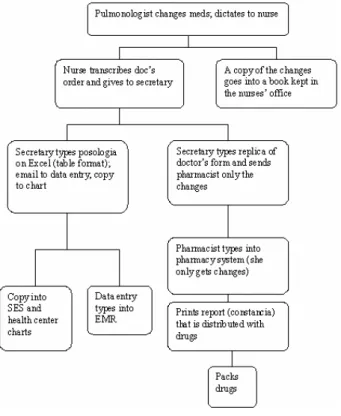
We surveyed the information flow from the NTP physician, nurse, data entry staff and pharmacy and found multiple points of duplicate data entry and other inefficiencies. Additionally, we found that there was no easily accessible, signed copy of the physician’s medication orders. The physicians write the orders in the patients’ health center charts, but do not provide the nurse with copies. Instead, the nurse transcribes the dictated orders. See Figure 1.
Order entry system design
We conducted an intervention beginning in February 2003 to streamline the drug information flow (See Figure 2 below). The nurses’ assistants recorded medication changes in a spreadsheet and emailed it to the pharmacy and data entry staff. To simplify
this process, we designed a system in which the nurse performs order entry. With the new system, the nurse enters the informa-tion directly into the EMR. She is able to send the informainforma-tion to the pharmacy with a single click and duplicate information entry is eliminated. We additionally incorporated adverse event alerts and drug susceptibility reminders. The nurses are exceedingly busy, as seven nurses are responsible for the care of over 1500 patients, and are on call 24 hours per day.3 A poorly designed system that did not gain the nurse’s approval would have result-ed in a failure to conduct this study.
Figure 1 - Information flow prior to intervention
Figure 2 - Information flow after intervention
We created a new page in the EMR for the nurse to enter patient regimen changes. After she logs in, she searches for the patient for whom she wants to enter a change. When she finds the pa-tient, and clicks on his/her link, the following page appears (see Figure 3).
Figure 3 - Patient regimen change page
A checkbox is located next to each medication. In the upper box, the nurse checks the medications that the patient will continue to take. In the lower box, the nurse checks the medications that will be added to the regimen. When the nurse attempts to enter a drug to which the patient is resistant or has had an adverse event, a warning message appears on the following page. If none ap-pears, she adds dosing information and, if a drug is suspended, the reason for suspension (see Figure 4). If a warning message does appear, she can consult with the prescribing physician.
Figure 4 - Dose change page
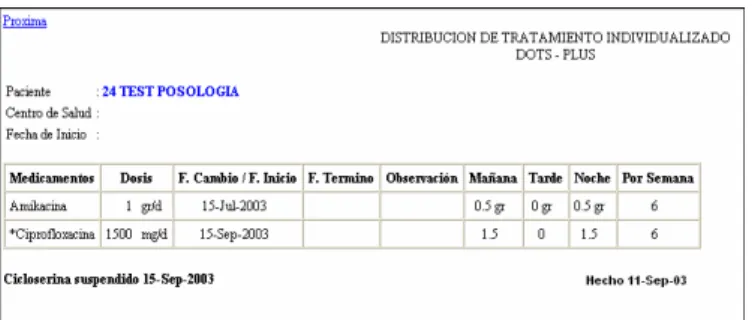
Finally, when she is finished making changes, she clicks a link that emails the final version to the pharmacist and sees the fol-lowing printable page that is archived in the paper chart (see Fig-ure 5).
Intervention study design
Lima is divided into six geographic treatment areas, called DISAs. More than 1500 patients have been enrolled in treatment, and they are unequally divided between DISAs. We conducted this trial in two DISAs – an intervention group (Lima Callao) and a control group (Lima Este). To measure baseline data, we reviewed chart, pharmacy and electronic medical records for 92 and 81 patients in Lima Callao and Lima Este, respectively. After we implemented the intervention, we
reviewed 95 and 102 charts in Lima Callao and Lima Este, respectively.
Figure 5 - Printable prescription order
We hypothesized that the intervention would improve the accu-racy and quality of medications data. To determine the sources from which errors were introduced, we reviewed and cross-checked paper charts, EMR data and pharmacy records prior to the intervention in December 2002, and again in April 2003 after the new system had been in use for 52 days. At least three regi-mens were compared for each of the 370 patients in the study. Some patients had multiple chart records, EMR regimen pages, and pharmacy orders that were reviewed. In total, 1500-2000 pa-tient regimens were reviewed during the study period.
We calculated mean error rates per patient for the four groups and compared the differences in means using the Wilcoxon Signed Rank test. The test shows that the observed data are not consistent with the null hypothesis of the two means being equal in Lima Callao. EMR error rates went down. We used the JMP statistical package (SAS Institute, Carey, NC).
We discussed this paper with the Harvard Medical School Insti-tutional Review Board.
Results
EMR error rates went down significantly in the test site, Lima Callao, from December to April while the rates remained static in the control group, Lima Este.
Table 1: Percentage EMR errors per patient. *P=0.0075 **P=0.66, Wilcoxon signed rank test
The above table shows the percentage of EMR error per patient for the two DISAs in December 2002 and in April 2003. The 17.4% error rate fell significantly in the study group to 3.1% per patient, P=0.0075. The error rate did not differ statistically in the Este control group, and was determined to be relatively stable (8.6% to 6.9%, P=0.66).
For reasons not yet determined, the initial error percentage was significantly higher in Callao than in Este (17.4% vs. 8.6%, P=0.04). Before and during the study period, more patient regi-mens were changed or entered in Este than in Callao (332 vs. 277 from Nov. 2002 to Feb. 2003, respectively). Accordingly, the higher error rate in Callao could not be attributed to a larger vol-ume of data entry.
We logged 10 types of errors, grouped into three categories. The electronic medical record (EMR) system errors included five types: extra/missing drug, erroneous suspension, typing error, frequency error and timeliness. The paper chart errors included two types: typing error and timeliness. The pharmacy record er-rors included three types: incorrect dose, missing drug and extra drug. Table 2 provides more detail about the types of errors we logged.
Table 2: Error descriptions
The largest proportion of EMR and paper chart errors was due to timeliness. Of total EMR errors, those due to timeliness account-ed for 56% (20 of 36). Eighty-three percent (40 of 48) of paper chart errors represented timeliness errors.
The qualitative aspects of this study were as important as the quantitative aspects, and the nurse affirmed the system’s usabil-ity. She enjoyed working with the new system because it simpli-fied her workflow. Her ability to view all of the information regarding a patient’s medication history on one page was the system’s most important improvement over the paper chart. The paper chart only allows her to see the current drug information and most recent change. The web system, however, shows a pa-tient’s entire regimen history from the initial regimen to the present. Additionally, the web system allowed the nurse to see all of the changes at one time.
Date/DISA Lima Callao Lima Este
December 2002 17.4%* 8.6%**
April 2003 3.1%* 6.9%**
Error type Description
EMR errors
Extra/missing drug An additional drug not prescribed to the patient is included or a pre-scribed drug is missing from the regimen.
Erroneous suspension A system bug erroneously stopped some drugs on dates of change, ini-tiation or re-iniini-tiation after suspen-sion.
Typing error Typographical errors resulting in erroneous dates or doses.
Frequency error While most drugs are given 6 times per week, some are given only twice per week. Any discrepancies were logged as errors.
Timeliness Tardiness, even by one day, in data entry of medication changes was logged as an error.
Paper chart errors
Typing error Typographical errors resulting in erroneous dates or doses. Timeliness Tardiness, even by one day, in
archiving of medication changes in the paper chart.
Pharmacy record errors
Incorrect dose An incorrect dose of a prescribed drug dispensed to the patient. Missing drug A prescribed drug not dispensed to
the patient.
Additional drug A drug not prescribed but dispensed to the patient.
Discussion
The improvement in error rate shown in this study compares fa-vorably to other hospital information systems. Researchers from the Hospital Robert Debre in Paris, France logged prescribing and administration of drug errors in handwritten prescriptions versus computerized prescriptions.8 They recorded a 20.7% total prescription error rate, of which 10.6% were computerized er-rors and 87.9% were handwritten erer-rors. Of total prescriptions recorded, electronic errors accounted for 9.2%, and handwritten errors accounted for 11.4%. The initial error rates in Callao were higher than the 9.2% average error rate shown in the aforemen-tioned study. However, the intervention dropped the rate well below the 9.2% rate to 3.1%.
While the reduction in error rate was significant, the initial error rate for Callao was higher than we expected. Initially, the regi-men module of the EMR had not been used for clinical manage-ment. Rather, it was more of a research tool. Timeliness is a much higher priority in a clinical EMR than in a research-fo-cused system. We expect that shifting to a more clinically-fo-cused system will decrease timeliness errors. Eliminating multiple transcriptions will further aid in improving the system’s timeliness.
Notably, the new EMR error rates in the intervention group were lower than the error rates for the pharmacy. These results suggest that further errors could potentially be reduced if the EMR were linked with the pharmacy system.
The drug resistance pop-up messages provided important re-minders, and the nurse was pleased with this alert system. She commented that she would like to have a similar alert system with adverse events. We are currently updating adverse event formation in the EMR, which has the potential to greatly in-crease the quality of patient care. After receiving such a warning, the nurse can refer the problem back to the prescribing physi-cian. This could result in fewer medication errors in physician prescribing, as well as in the transcription of orders.
Study Limitations
The major limitation in this study was the lack of a good gold standard. Unlike in the United States, there is no signed prescrip-tion form used in Peru for tuberculosis medicaprescrip-tions. The physi-cian writes his/her notes in the patient’s chart and then dictates these changes to the nurse. Since a single-source gold standard was unavailable, a comparison method was used instead. A no-ticeable trend in the three sources was that, over time, the three sources came to agree. For those cases where the three sources did not come to agree, errors were followed up with the nurse, her assistant or the pharmacist to discover the correct informa-tion. This system is unable to identify those errors that originate with the prescribing physician or that occur between the physi-cian and the nurse, unless the nurse photo-copied the physiphysi-cians orders from the clinic chart.
A second limitation was the sample size studied in this interven-tion. At the outset of the study, the research team expected to conduct the follow-up chart review four weeks after the inter-vention was proposed. This time period was based on the as-sumption that a large number of patient regimens would be
changed in that time. Many intervening factors caused the exper-iment to run longer than previously projected. The training pro-cess took two months, rather than a few days. This is partly attributable to the fact that a new interface had to be designed to allow the nurse and her assistant to enter data into the EMR. The two months included the time it took to fix systematic errors that occurred in the new interface, as well as the time necessary to implement suggested changes. After the new interface was deemed satisfactory, a much smaller group of patients had regi-men changes than the research team originally expected.
Conclusions
Provider-order entry is a relatively new phenomenon that is vir-tually unknown in the developing world. This study has shown that a low-cost, web-based electronic medical record has the po-tential to provide such a function. While this study examined a limited sample size, preliminary results appear promising. We are repeating this study in a second DISA. The physicians are now using a carbon-copy prescription form for all drug changes that we implemented as a result of this study. This will provide a definitive “gold standard” for future studies. In the coming months, nurses from all DISAs will begin entering regi-men changes directly into the EMR. Future projects include comparisons of drugs entered in the EMR and dispensed by the pharmacy against drugs prescribed by the physician on the pre-scription form, as well as measurements of the number of chang-es in drug-related adverse events once the order entry system is deployed on a wide scale.
Acknowledgements
The Bill & Melinda Gates Foundation provided grant support for the EMR and the patients’ treatment.
References
[1] Mitnick C, Bayona J, Palacios E, Shin S, Furin J, Alcantara F, Sanchez E, Sarria M, Becerra M, Fawzi MC, Kapiga S, Neuberg D, Maguire JH, Kim JY, Farmer P. Community-based therapy for multidrug-resistant tuberculosis in Lima, Peru. N Engl J Med 2003; 348(2):119-28.
[2] Fraser HS, Jazayeri D, Mitnick CD, Mukherjee JS, Bayona J. Informatics tools to monitor progress and outcomes of patients with drug resistant tuberculosis in Peru. Proc AMIA Symp 2002; 270-4.
[3] Palacios E, Guerra D, Llaro K, Chalco K, Sapag R, Furin J. The role of the nurse in the community-based treatment of multidrug-resistant tuberculosis (MDR-TB). Int J Tuberc Lung Dis 2003; 7(4):343-6.
[4] Bates DW, Cohen M, Leape LL, Overhage JM, Shabot MM, Sheridan T. Reducing the frequency of errors in medi-cine using information technology. J Am Med Inform Assoc 2001; 8(4): 299-308.
[5] Bates DW, Leape LL, Cullen DJ, Laird N, Petersen LA, Teich JM et al. Effect of computerized physician order entry and a team intervention on prevention of serious medication errors. JAMA 1998; 280(15):1311-1316.
[6] Kaushal R, Bates DW. Information technology and medi-cation safety; what is the benefit? Qual Saf Health Care 2002; 11(3):261-5.
[7] Bates DW, Pappius E, Kuperman GJ, Sittig D, Burstin H, Fairchild D, Brennan TA, Teich JM. Using information sys-tems to measure and improve quality. Int J Med Inf 1999; 53(2-3):115-24.
[8] Fontan JE, Maneglier V, Nguyen VX, Loirat C, Brion F. Medication errors in hospitals: computerized unit dose dis-pensing system versus ward stock distribution system. Pharm World Sci 2003; 25(3):112-7.
Address for correspondence Sharon Choi,
643 Huntington Avenue, Boston, MA, 02115 [email protected]