© 2011 by Venture Philanthropy Partners
The publisher encourages and grants permission for the distribution and reproduction of copies of this work for non-commercial purposes. Such copies, in whatever form, must be unmodified, in their entirety, including copyright notice and full attribution. Any adaptation,
Performance Management
The Neglected Step in Becoming an Evidence-Based Program
by Kristin Anderson Moore, Ph.D., Karen Walker, Ph.D.,
and David Murphey, Ph.D.
Child TrendsAn essay from the book
Leap of Reason
,
which is available in full at leapofreason.org
The current focus on being “evidence-based” has drawn consider-able attention to the value of random-assignment and quasi-exper-imental evaluations, and that’s a good thing. Random-assignment evaluations are the exquisite show horses of the evaluation world, while quasi-experimental evaluations are the trotters. These two kinds of evaluations help funders, practitioners, and policymakers identify whether and for whom programs can make a real and last-ing difference. Implementation evaluations—another thorough-bred—focus on whether a program is being implemented well and with fidelity. But the focus on these pretty horses has drawn attention away from the workhorses that help programs manage and improve their performance on an ongoing basis—performance-management systems.
The Neglected Step in Becoming an Evidence-Based Program
by Kristin Anderson Moore, Ph.D., Karen Walker, Ph.D.,
The Process of Becoming an Evidence-Based Program
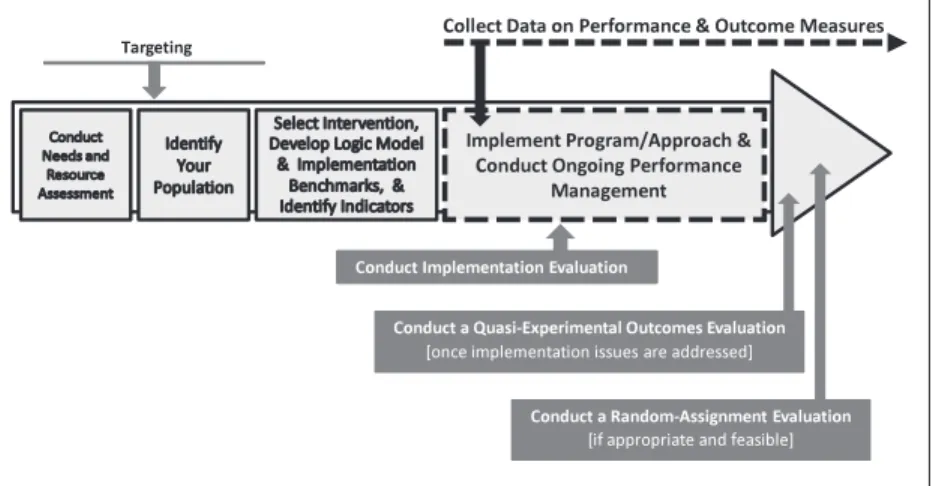
Figure 1 outlines one common process for becoming an organization that uses data to drive performance and better outcomes.
Figure 1: Becoming Performance-Driven
As the figure shows, the initial step involves assessing the risks and needs of a community, along with its available resources, followed by an identification of the groups or places with the highest incidence of these. Following a risk assessment, the focus may shift to identifying programs or intervention strategies that have been evaluated and found to affect the risks or needs of the community. To illustrate, let’s say that a risk assessment identifies teen pregnancy as an important issue for a community and, further, that the rate is highest among Latinas. Having identified a program that has been rigorously evaluated and found to reduce the birth rate among Latina teens, the community decides to implement this new program.
Given today’s focus on outcome and impact evaluations, a nonprofit may immediately jump ahead and decide to conduct an evaluation of the program as soon as possible. It might be a quasi-experimental or random-assignment evaluation, or perhaps an implementation evaluation. But any of these would be premature. It
Having such a system enables an organization to monitor program implementation and success over time.
Taking Full Advantage of Performance Management
The term “performance management” covers a broad range of activi-ties. Any program that examines participant characteristics to make sure that the people who enroll are meeting their eligibility require-ments is doing performance management. So are programs that ask new participants to complete assessments to determine the services they need, and programs that monitor attendance in activities to make sure that they are engaging their clients.
Most programs do some form of performance management; funding requirements may demand that they serve particular popu-lations or reach certain participation levels. But few programs take full advantage of the power of performance management, which requires the following:
} The capacity to collect and analyze information on an
ongoing basis
} Defined benchmarks to assess the progress of participants, the staff, and the program
} Efforts to identify reasons for failing to reach the benchmarks
} The capacity to draw on multiple sources of data to identify the
best explanations for a program’s challenges
} A willingness to modify programs to address challenges
} The capacity to collect and analyze information to see whether program modifications have addressed the challenges.
Building Your Own “War Room”
once a program has performance measures, what can you do with them? Most broadly, these become the wall charts prominently dis-played in your lobby. Winston Churchill had his “war room,” with fre-quently updated maps and other information about the progress of the Allied and enemy forces. Your program should have the equivalent— the three or four key measures tracking the success of the enterprise. At a more fine-grained level, performance measures can help identify variation—for example, among sites, groups of clients, or program activities—that should prompt further investigation. Why are those folks so much more successful than these folks? What is a particular site doing so well, and how could its success be brought to other sites?
At a still finer level, performance measures can figure in employ-ees’ performance evaluations. Performance measures provide a way to act on the genuine desire of staff to “make a difference.” The idea here is not to suggest that any one staff person is solely responsible for trends on performance measures, but rather to give employees an opportunity to articulate their own contributions to one or more of the measures, and (ideally) to see their efforts reflected there. But most important, performance management focuses on providing ongoing data on program operations and performance outcomes that can be used to assess and improve program effectiveness.
Data Help WINGS Take Flight
WINGS for Kids is an educational program focused on social-emo-tional learning. It is designed to teach elementary school children to behave well, make good decisions, and build healthy relationships. To do this, WINGS provides activities five days a week for three hours a day, and children have time to eat, engage in activities of their choice, and do homework or other academic activities in the after-school hours. But it also adds extras: In each day’s first thirty minutes, chil-dren play games intended to highlight and provide lessons on
Group leaders (staff members, who are usually college students) are assigned to work with small groups of children. While working with students on the day’s academic and free-choice activities, group leaders closely observe the children’s behavior to take advantage of “teachable moments” when they have opportunities to intervene, both to redirect negative behavior and to reinforce positive behavior.
As one might imagine, ensuring the quality of a program that employs college students and focuses on improving behavior and social interactions poses challenges. Each year the organization must train new group leaders and ensure that they apply the program’s strategies consistently. To address these challenges, program manag-ers have developed a performance-management system that is used diagnostically to ensure that staff are monitoring the students and properly addressing emerging behavioral problems. Group leaders rate children’s behaviors on a weekly basis, and supervisors review ratings prior to regular supervision meetings.
Managers also use the system to supervise staff. Group leaders are expected to record a number of “teachable” moments each week, and supervisors read the case notes of those interactions in order to ensure both their quantity and their quality.
Finally, managers use the system to make progress on the pro-gram’s goals. one of the propro-gram’s key goals is the improvement of children’s behavior during regular school time. Specifically, the pro-gram aims for all children to achieve a rating of 85 percent or higher on school behavior, as measured by indicators on the student’s report cards such as organizational skills and the ability to work with other students. Several years ago, when managers realized that many chil-dren were not reaching the 85 percent benchmark, WINGS added a program component to address in-school behavior. In order to focus on those children’s needs and support and encourage communication with teachers, group leaders write individualized student plans and share those with teachers. Although the program has not yet achieved its goal for all students, report cards indicate steady progress.
Conclusion
As critical as good evaluations are, they need to be preceded by and built upon the knowledge provided by a performance-management system. Essentially, this means developing and using your in-house capacity before inviting others in to do expensive random-assign-ment or implerandom-assign-mentation evaluations.