INOX: A Managed Service Platform for Inter-Connected
Smart Objects
Stuart Clayman
Dept. of Electronic Engineering University College London, London, UK[email protected]
Alex Galis
Dept. of Electronic Engineering University College London, London, UK
[email protected]
ABSTRACT
In this paper we present a service management platform and an architecture which integrates the features of IoT with the management features of modern autonomic network man-agement, and many service features from the world of Ser-vices. We present an architecture for INOX, a robust and adaptable Service Platform for the Internet of Things and Inter-Connected Smart Objects. The platform integrates many of the ideas from Autonomic Network Management and Ser-vices and provides the functionality which allows for better use of the sensors, things and the smart objects through en-hanced application development, more flexible service de-ployment, virtualized elements, and better service manage-ment. This paper presents the current status of our work on a reference framework for the management and integration of smart objects and virtual networks into such a service plat-form.
1.
INTRODUCTION
The Internet of Things (IoT) is evolving from simple sensors with simple network connectivity into a collec-tion of Inter-Connected Objects and Inter-Connected Smart Objects. For maximum benefit and usefulness of these connected objects we need to enable the integra-tion of the funcintegra-tions of these inter-connected objects in the context of both user services and system man-agement. In this paper we present a platform for IoT, which integrates the features of IoT with the ment features of modern autonomic network manage-ment, and many service features from the world of Ser-vices (IoS). This integration encompasses network and service infrastructures, having resources with enhanced management capabilities, together with uniform
inter-Permission to make digital or hard copies of all or part of this work for personal or classroom use is granted without fee provided that copies are not made or distributed for profit or commercial advantage and that copies bear this notice and the full citation on the first page. To copy otherwise, to republish, to post on servers or to redistribute to lists, requires prior specific permission and/or a fee.
ACM IoTSP 2011, December 6, 2011, Tokyo, Japan. Copyright 2011 ACM 978-1-4503-1043-7/11/0012 ...$10.00.
faces.
A significant number of solutions and research activi-ties fail to address some of the main issues of application and service development required for the full realisa-tion of IoT into a fully connected Internet environment, as they are focussed on power issues, wireless network-ing, protocols, and end-to-end interaction [3]. Service platforms for IoT are a relatively new area of inter-est. In particular, the following topics need addressing in IoT service platforms: naming, identity, scalability, visibility for small objects with limited connection and computation capabilities, security, and finally orches-tration and management of applications for millions of devices. A significant effort in platform design and ar-chitecture is needed to enable Internet-connected ob-jects to become seamlessly integrated into services and important real-life stakeholder applications, thus avoid-ing the commonly heard complaint in IoT that there are
too many silos. The main purposes of such a platform
are (i) to extend the Internet with a large number of connected things and objects and (ii) to extend services to utilise thing and object-based resources.
We have seen that many of the deployed systems of IoT are unable to inter-operate with other IoT systems, even when deployed in the same physical environment.
There is the well know effect ofsilos,independent pillars
or vertical systems of systems [17], [21]. We have seen that many of the applications in the arena of IoT are fixed to one set of sensors. That is one application in-teracts with one set of sensors, and another application interacts with another set of sensors. For example, two systems in the same building will have 2 separate sets of sensors and actuators, and 2 independent control appli-cations. It can be difficult to integrate them, or share data from both systems, to show in a single applica-tion. We need to overcome these limitations in the IoT arena, so that we can have sensors from multiple do-mains within the same applications. Such sharing and combining is commonly seen in many web-services data aggregation and mashup applications [16]. The limita-tion of this 2 layer approach has been understood, and efforts to extend the IoT model to a 3 layer approach
are being taken. By making the control application for the sensors and things use an access end-point, more flexibility and adaptability is available. Although ef-forts such as ZigBee [10], are making some impact in this area, it is limited compared to a full Service Plat-form. Such efforts are a good start for inter-operability, but they do exhibit some scalability problems. Numer-ous projects in the area of Internet of Things (IoT), and Internet Connected Smart Objects have proposed con-nectivity architectures for the systems they develop [2] [20] [9] [15] [26]. All of these systems are faced with very similar problems in design of their service architecture. The INOX platform presented here borrows ideas from the world of Internet Services and network management in order to benefit the world of IoT. As such, the sen-sor network is presented as a service element within a larger environment. The environment is managed by a management framework with advanced facilities, an example of this being UMF [25]. UMF In-network man-agement is an approach where manman-agement and control functions are distributed and located in or close to the
managed system and its elements. INOX represents
a new approach with the following capabilities: (i) a new service and smart object based platform, (ii) the embodiment of enhanced management functionality in the platform, for maximising the efficiency of operation, (iii) the dynamic federation of different sensor networks, within the platform.
In the remainder of this paper we present the design approach used to integrate IoT with Internet services and network management, and then outline some of the main elements of the INOX platform. Then we present a testbed that has been developed to evaluate the ar-chitecture and the ideas outlined here.
2.
BACKGROUND
IoT comprises a digital overlay of information over a highly heterogeneous physical world of objects. In the
near future, suchobjectsare expected to outnumber the
human population by at least one order of magnitude. The IoT is expected to provide to the Internet, a re-source fabric interfacing to the physical world, by means of a ubiquitously deployed substrate of embedded, con-nected, and networked devices. The resources provided are Near Field Communication (NFC) enabled objects, Radio Frequency Identification (RFID) tags, and smart objects that are small computers with communication capabilities as well as the sensors and/or actuators, etc. Control systems, business services and end-user ap-plications will use such resources and the interaction capabilities of the objects, with respect to real world entities. They will need to find the relevant data, con-text information, and then the resources that provide information about these entities and allow interactions with them.
As we have already seen, there are efforts in the IoT arena which are trying to address the usefulness of
things and sensors in the large. These efforts are
con-centrating in 3 main areas: (i) the lower level commu-nication frameworks; (ii) the mechanisms for integrat-ing the thintegrat-ings; and (iii) the frameworks for combinintegrat-ing
things for higher-level processing. Our work
encom-passes areas (ii) and (iii), but goes much further. There is a fundamental need to allow service plat-forms to take advantage of the things and smart ob-jects. There are on-going discussions regarding these ef-forts under the auspices of the IAB at the IETF confer-ences [24]. Moreover, the Internet is seen as a common infrastructure for connecting networks, for inter-working services, for inter-operating computing machines, and for the flow of information. Smart objects will re-quire improvements in its general capabilities and its
core system components. For services, it should
in-herently support a framework of general connectivity, mobility, security, Quality of Service with Service Level Agreements. As the network evolves to support a mul-titude of new devices, services, and applications, the general capabilities need to provide robustness and re-silience, but also to provide inherent management in or-der to simplify the handling of networks for users [12]. Service models for ad-hoc networks have been addressed in previous work [18].
In the following sections we outline the context within which we propose the INOX platform as a solution for enhanced IoT applications.
2.1
IoT - Context
A key research theme is developing globally, which considers the concept of an Inter-Connected Object or an Internet of Smart Objects from the Internet of Things (IoT), as part of a federated Internet. The paradigms of Internet of Systems will enable the IoT arena to achieve the desired levels of dynamicity, efficiency, scal-ability, and economic incentives, in order to manage both the current and future services, together with net-works of object-based resources that are becoming more and more pervasive and sophisticated. This is why there is a need to gather all of the relevant competencies to progress this field into maturity by generating high lev-els of industrial impact, maintaining a business-driven approach, and utilising the high-value of previous work. Smart Objects are emerging in very large numbers as new Internet connectivity points, as well as being new resources for use by networks, services, and appli-cations. As such, these Internet-connected objects are an integral part of the Internet and can be defined and viewed as a dynamic and global resource. To participate effectively in this view, they require a network and ser-vice infrastructure with self-management capabilities, based on inter-operable communications protocols, and
enablers for rapid, cost-effective service and application deployment.
One important and essential integration element is the introduction of a virtualization mechanism that of-fers a virtualized view of the inter-connected object to the applications as well as views for supporting the vir-tualization of smart objects and their combination in virtual aggregations [13].
Virtualization has been employed effectively in net-working environments [14], and in computing environ-ments [4] as a mechanism to share out the same physical
resource to more than oneuser in a concurrent way. To
facilitate this, an information system and data model, plus the related services are required. Such an infor-mation system and data model would aid the interac-tion between applicainterac-tions and objects. These virtual-ized smart objects need to have identities, physical and virtual attributes, and use service interfaces to enable seamless integration into the information, context, and knowledge planes of the Internet.
The service interfaces for such objects would facil-itate: (i) object interactions and interoperation over the Internet; (ii) the querying and changing of an ob-jects state, information, and behaviour associated with it; (iii) event-based notification mechanisms and pro-cessing; (iv) applications and service deployment with seamless roaming across of the Internet, for mixed ob-ject and non-obob-ject resources.
2.2
Internet - Context
The current Internet has been founded and developed in the last 40 years on a basic architectural premise, that is: a simple network service can be used as a uni-versal means to interconnect both dumb and intelligent
end systems. The simplicity of the current Internet
has pushed complexity into the end-points, and has al-lowed impressive scale in terms of inter-connected de-vices. However, while the scale has not yet reached its limits, the growth of functionality and the growth in size have both slowed down and may soon reach both its architectural capability and capacity limits. Internet applications increasingly require a combination of capa-bilities from traditionally separate technology domains to deliver the flexibility and dependability demanded by users. Internet use is expected to grow massively over the next few years with an order of magnitude more Internet services, the inter-connection of smart objects from the Internet of Things (IoT), and the integration of increasingly demanding enterprise and social appli-cations.
Although the current Internet has been extraordinar-ily successful, as a ubiquitous and universal means for communication and computation, there are still many unsolved problems and challenges some of which have basic aspects. Many aspects leading to these problems
could not have been foreseen when the first parts of the Internet were built, but these do need to be addressed now. The very success of the Internet is now creating obstacles to the future innovation of both the network-ing technology that lies at the Internets core and the services that use it.
We are faced with an Internet that is good at deliv-ering packets, but shows a level of inflexibility at the network and service layers with a lack of built-in facili-ties to support any non-basic functionality.
There are some missing capabilities and solutions in the current Internet infrastructures which limit the in-tegration of Inter-Connected Smart Objects[12]. The missing capabilities are as follows:
• System aspects: Service platforms and facilities, which take advantage of the sharing of resources via virtualization (including connectivity, compu-tation, storage and object-based resources); On-demand provisioning of new functionality; Infras-tructures for interconnection of smart objects; In-herent system management; Easy and efficienct deployment of both services and management. • Service aspects: New applications and usage;
Guar-anteeing and facilities to support QoS and SLA; Knowledge-based society.
• Enhanced aspects: Appropriate addressing and nam-ing for smart objects; Security, Trust and Privacy; enablers for Context-Awareness.
• Economic aspects: Cost considerations; economic viability of service offering including the need for appropriate incentives, diverse business models, le-gal, regulative and governance issues.
The list of features here is by no means exhaustive, but gives a flavour of what the issues are, if such large scale deployment of smart objects are to be harnessed into large scale applications.
2.3
Primary Requirements
From the areas of IoT, smart object, services and the Internet, we can derive some main requirements for the INOX platform. Similar requirements also apply to other service based environments, such as those of service cloud computing [23]. Service clouds have been successfully developed and deployed for large scale ser-vices, and have even been deployed in federated envi-ronments[22], in a way that is required for a successful IoT service platform.
The main requirements of the INOX platform are as follows:
• Automated deployment: The platform should sup-port automated provisioning of service applications, possibly complex ones, based on a manifest which
specifies the service elements and the run-time be-haviour for QoS purposes.
• Virtualisation technology: The platform should sup-port different virtualization technologies and in particular the virtualisation IoT resources. • Scalability: ensure that the platform can cope with
a large numbers of services and IoT resources. • Adaptability: so that the platform can adapt to
altered circumstances, including varying computa-tional and network loads, to keep services running. • Federation: so that any resource, real or virtual, which resides on another domain, can be used and managed correctly from a service.
• Autonomic: so that the platform can keep run-ning without manual intervention, management, and reconfiguration.
• Continuous optimization: The platform should con-tinuously optimize the alignment of infrastructure resources with management goals.
These main requirements help define the functionality and the features of the the platform.
3.
THE INOX PLATFORM
This paper presents the INOX platform, which inte-grates elements from the world of Internet of Things, the world of Internet Services and network manage-ment, and unites them into a single combined world.
The goal of this platform design will be the devel-opment of a new architecture and infrastructure that enables the IoT services to be fully deployed as has previously been discussed. We expect it to have the following functionality and characteristics:
• Uniform service interfaces and business driven
in-terfaces to enable generic integration of the inter-connected smart object functions in the context of user services, taking special care of preserving their autonomous operation capability.
• Efficient linking of real-world entities with relevant
resources of the IoT.
• Information and Context model and services to
ob-jects and applications.
• Service and self-management enablers for
applica-tions and service provisioning on the platform.
• Virtualisation of all resources: Object resources,
Service Computation resources, Networking resources.
• Federation capabilities enabling service access across
multiple domains.
• A security and privacy framework tailored to the
needs of the IoT world.
This is a wide-ranging set of features, which is com-monly seen in the management and services world [14] [12] [5], but is not common yet in the IoT world. We believe that as IoT service platforms become more per-vasive more of these functions and characteristics will be seen.
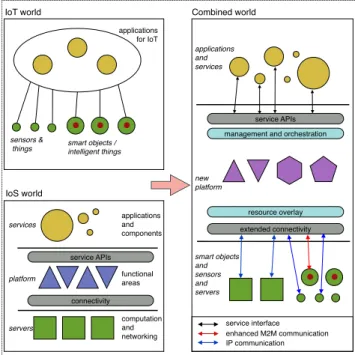
First we consider the transition from both IoT world and the services world to the new INOX platform. This transition is depicted in figure 1.
sensors &
things smart objects / intelligent things
applications for IoT IoT world IoS world servers computation and networking functional areas platform services applications and components Combined world smart objects and sensors and servers new platform applications and services
management and orchestration
resource overlay connectivity service APIs extended connectivity service APIs enhanced M2M communication IP communication service interface
Figure 1: Combining IoT and Services Architec-tures
The top left part of figure 1 shows the common 2 layer IoT application environment where there are ap-plications talking directly to the sensors and things, as well as to smart objects. The bottom left part shows the common services and management architectural model. We see 5 main aspects in this model: (i) the services themselves, (ii) service APIs, which services use to in-teract with the service platform, (iii) the service plat-form middleware with the main functional blocks, (iv) network connectivity, and (v) servers and routers that are used for computation and networking. The right hand side of figure 1 shows the new enhanced, com-bined, and integrated model. We see a primarily ser-vices model with the sensors and things from the IoT model pushed into the layer with the servers, and the applications from the IoT model pushed into the later with the services themselves.
Now we consider the platform in more detail, high-lighting the layers and the main building blocks. The
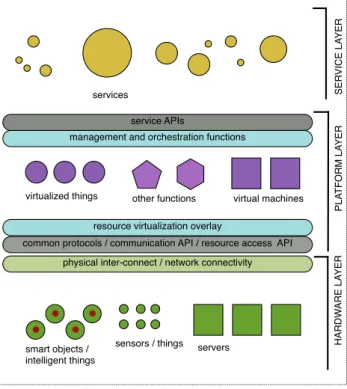
INOX platform is split into 3 main layers. These in-clude:
• the service layer- which supports and contains the services themselves. The services use the various service APIs in order to access the elements in the platform layer.
• the platform layer - which contains all of the neces-sary management and orchestration functions needed to build and deploy services and the virtualiza-tion technologies that will virtualize the elements in hardware layer, such as the smart objects. • the hardware layer - which contains all of the
sen-sors, things and smart objects which are part of an IoT environment, together with the servers that will provide the functionality for hosting services and virtual machines.
Figure 2, shows these presented main layers of the INOX platform. It also highlights the other main facilities.
common protocols / communication API / resource access API physical inter-connect / network connectivity
service APIs
management and orchestration functions
H AR D W AR E L A YER PL A T F O R M L A YER SER VI C E L A YER
resource virtualization overlay services servers sensors / things smart objects / intelligent things virtual machines virtualized things other functions
Figure 2: INOX: Multiple Platform Layers
Again we see theservice APIs that are used by
ser-vices. These service APIs are combined with the
man-agement and orchestration functions, and the resource virtualization overlay, shown in blue in Figure 2, plus main building blocks, shown in purple. The provided platform functionality consists of the following main functions and building blocks:
• a Registry and Discovery of the relevant things and
smart objects. These processes utilize the follow-ing attributes: identifiers, location, type, provider, topic, or a combination of these.
• Lookup of resources that can provide information
about the objects or allow interactions with them.
• Monitoring of objects and keeping the dynamic
links between them up-to-date.
• Virtualisation of objects, networking and
compu-tational resources and linking virtual resources with real resources.
• Service enablers and self-* functionality (self-management,
self-monitoring, self-configuration, self-optimisation, self-healing, self-protection and self-adaptation) which are part of the autonomic functions of the plat-form.
• Orchestration capabilities for controlling and
man-aging the services within different domains. The communication API and communication protocols for interacting with the real things and sensors are likely to be the specially devised protocols for the IoT area, in-cluding 6LowPAN [19], ZigBee [10], ROLL [1], or CoAP [11].
To aid the development of the INOX platform and to ensure inter-operability between the main components we define some special interfaces. The definition of such interfaces are:
service interfaces: to provide a rich set of service APIs to enable highly customized applications and soft-ware as service entities. These service interfaces will allow: (i) smart object interaction and inter-operation over the Internet; (ii) the querying and updating of an objects state, information, and be-haviour; (iii) event-based notification mechanisms and processing; (iv) application and service de-ployment for mixed object and non-object resources.
orchestration interfaces: to provide APIs to orches-trate and govern systems and virtual resources that meet stated business goals having specific service requirements. The purpose of the orchestration is to govern and integrate the behaviours of the sys-tems and resources in response to changing con-text and in accordance with applicable high-level goals and policies. The orchestration supervises and integrates all other behaviour by ensuring the integrity of the management operations. It is sponsible for organizing groups of resources in re-sponse to changing user needs, business require-ments, and environmental conditions.
virtualisation interfaces: these mainly provide APIs that deal with virtual system setup and manage-ment issues. The APIs consist of methods for ma-nipulating local network/service/storage/object re-sources abstracted as objects (i.e. as virtualized resources) or directly into the real resources (i.e. with no virtualisation). The abstraction isolates upper layers from hardware dependencies or other
proprietary interfaces. The virtualisation
inter-faces isolate the diversity of setup and manage-ment requests from the actual control loop that
executes them. They are responsible for
deter-mining what portion of a component (i.e. a set of virtual resources) is allocated to a given task. This means that all or part of a virtual resource can be used for each task, providing an optimised parti-tioning of physical resources according to business needs, priority, and other requirements.
comms interfaces: these APIs provide access to lower level resources. It is a collection of protocols that enable the exchange of state and control informa-tion at a very low level between different types of resources and the external agents of the re-sources. The resource types considered are: trans-port resources, forwarding resources, computation resources, storage resources, and content resources. By having these interfaces defined, it becomes possible to build an INOX platform in a modular and flexible way, based on these interfaces.
3.1
Benefits
The main benefits that INOX brings to the IoT and smart object arena are:
• to evolve from centralized and fixed computing
and networking architectures, towards dynamic ar-chitectures, based on shared resources using virtu-alisation and service management in the new plat-form. This is a shift in control, enabling significant sharing of resources for multiple application design and deployment.
• a reduction in the complexity of inter-networking
M2M protocols, networks, devices and data w.r.t enterprise applications, networks, devices and data. This is because the platform deals with many of the complex issues.
• a migration from simple object lookup mechanisms
towards standards and approaches to search and discovery for shared resources (e.g. objects, com-putation resources, networking resources)
• the migration from low-level M2M communication
architectures to a service architecture, having a
service-aware infrastructure with new communica-tion interfaces towards all resources in the Inter-net.
• the introduction of a new virtualisation layer, which
will facilitate and simplify the interaction between both services and end-user applications with the
shared smart object resources. The sharing of
smart object resources will be enabled by a vir-tualisation layer, and includes sensors, actuators, RFID devices, Near Field Communication devices. As the INOX platform is designed in more detail, the interfaces fully specified, and all of the architectural el-ements built and tested, more of the benefits of the platform will become apparent.
4.
TESTBED
To help verify the design and architecture of the INOX platform that has been outlined in this paper, various evaluations need to be carried out. It is difficult to ac-cess multiple live and real sensor networks and then add experimental new features and facilities as outlined in this paper. In order to undertake such evaluations and experiments, UCL is developing an early implementa-tion of the INOX platform. This development is a small software-based service testbed - a Lightweight Service
Platform. This testbed allows us to emulate all of the
elements of a IoT deployment, combined with all of the relevant management functionality outlined for INOX. For example, each thing or sensor can be emulated using a software element. The benefits of our testbed include validating all of the management functions outlined in section 3, as well as testing for scalability, manageabil-ity, connectivmanageabil-ity, and deployment of services.
To be as versatile as possible, the components in the testbed are very general. The testbed comprises of a very lightweight router combined with virtual
net-work connectivity. These elements can be combined
in order to build any network topology required. The created virtual network is designed with the goal of transmitting and routing datagrams from any source to any destination. It behaves like a lightweight data-gram network, but it has management facilities to start and stop virtual routers on-the-fly, together with the ability to create and destroy network connections be-tween virtual routers dynamically. Furthermore, these lightweight routers have an application layer interface that provide the capability to start and stop small Java software applications. These applications use a data-gram API, which can send and receive datadata-grams, and thus act as the service elements within the platform. Such flexibility means that a whole virtual sensor/thing environment can be created to fit any need.
By using the Lightweight Service Platform testbed, it is possible to implement each of the emulated
sen-sors as tiny applications. Each of the virtual routers in testbed is implemented within a Java Virtual Machine, and represents a sensor end-point, and each virtual link represents an emulated network link in the Internet. To deploy these virtual machines and their associated ap-plications requires a set of physical machines. However, a physical machine, such as a server, can accommodate up to 70 virtual routers, which in our emulation envi-ronment would be equivalent to 70 sensor end-points.
In the Figure 3 we see how the elements of the INOX platform map onto the testbed. Each of the 3 main layers of the platform, namely: the service layer, the platform layer, and the hardware layer are present in the testbed.
UCL servers java
virtual machines
virtual network connectivity / datagram API
software sensors services SER VI C E L A YER PL A T F O R M L A YER H AR D W AR E L A YER
UCL Very Lightweight Service Platform
VLSP virtual routers
physical inter-connect / network connectivity transmission of
measurements
Figure 3: The VLSP Testbed
We have created a virtual sensor layer on the testbed by using the Lattice monitoring system [7]. This moni-toring system behaves very similarly to a IoT environ-ment and matches the behaviour of sensors very well, since both a resource constrained environment and mo-bility are emulated. Lattice is designed to be flexibile and adaptable, and has been also used in virtual net-working environments [8].
To test the first parts of the functionality of the INOX system, we have built a Registry component and a Mon-itoring component. These has been coupled with a dy-namic management component, in the style of UMF. The benefits of UMF are support for self-management features, higher automation and autonomicity capabil-ities, easier use of management tools and empowering the system with in-built cognition and intelligence. Ad-ditional benefits include reduction and optimisation in the amount of external management interactions, which is key to the minimization of manual interaction and the sustaining of manageability of large systems and moving from a managed object paradigm to one of management
by objective. The current management system that al-locates aggregation points around the network, based on dynamic traffic profiles from the virtual sensors. This work can be read in more detail in [6].
In order to create large test systems using the testbed, we utilise a large number of physical servers. In our experiments so far, at UCL we have executed over 700 virtual routers over 12 physical servers. For a very large scale test we will need a considerable number of physical servers to be available.
We will continue the work of developing the main building blocks of INOX within the testbed, and con-tinue experimentation and validation of the INOX de-sign.
5.
CONCLUSIONS
Things and Smart Objects are emerging in very large numbers as new Internet connectivity points, as well as new resources for use by networks, services, and ap-plications. As such, these Internet-connected objects are an integral part of Internet and would be defined as a dynamic and global resource. To participate effec-tively, they require a network and service infrastructure, based on interoperable communications protocols, and enablers for rapid, cost-effective service and application deployment.
How to build large scale, flexible and adaptable ap-plications for these things and connected smart objects is an on-going discussion. In this paper we have pre-sented a model and an architecture for things and smart objects that deals with the service and application de-ployment and autonomic management in an integrated virtualised network, commutation, storage and IoT
re-sources. We believe that following theservice model is
an effective way to bring about the desired gains. By having a platform that has the functionality of a service cloud, with virtualisation facilities and the abil-ity to run shared applications, yet accommodates all of the things and smart objects from IoT, we can say that we are working towards an IoT cloud environment.
6.
ACKNOWLEDGEMENT
This work is partially supported by the European Union UniverSELF project [25] of the 7th Framework Program.
7.
REFERENCES
[1] Routing Over Low power and Lossy networks. https:
//datatracker.ietf.org/wg/roll/charter/.
[2] Advanced Sensors and lightweight Programmable middleware for Innovative RFID Enterprise applications, FP7. Aspire.
[3] Luigi Atzori, Antonio Iera, and Giacomo Morabito. The internet of things: A survey.
Computer Networks, 54(15):2787 – 2805, 2010. [4] P Barham, B Dragovic, K Fraser, S Hand, et al.
Xen and the art of virtualization.SIGOPS Oper.
Syst. Rev., 37(5):164–177, 2003. [5] L Cheng, A Galis, B Mathieu, K Jean,
R Ocampo, L Mamatas, J Rubio-Loyola, J Serrat, A Berl, H de Meer, S Davy, Z Movahedi, and L Lefevre. Self-organising management overlays
for future internet services. InMACE 2008:
Proceedings of the 3rd IEEE international workshop on Modelling Autonomic
Communications Environments, pages 74–89, Berlin, Heidelberg, 2008. Springer-Verlag. [6] S Clayman, R Clegg, L Mamatas, G Pavlou, and
A Galis. Monitoring, Aggregation and Filtering for Efficient Management of Virtual Networks. In
Conference on Network and Service Management - CNSM 2011, 2011.
[7] S. Clayman, A. Galis, C. Chapman, G. Toffetti, L. Rodero-Merino, L.M. Vaquero, K. Nagin, and B. Rochwerger. Monitoring service clouds in the
future internet. InTowards the Future Internet
-Emerging Trends from European Res earch. IOS Press, April 2010.
[8] S. Clayman, A. Galis, and L. Mamatas. Monitoring virtual networks with lattice. In
Management of Future Internet - ManFI 2010, 2010.
[9] EPCGlobal. EPCGlobal: The EPCGlobal Architecture Framework 1.3.
http://www.epcglobalinc.org/, March 2009.
[10] S Farahani.ZigBee Wireless Networks and
Transceivers. Newnes, Newton, MA, USA, 2008. [11] B Frank, Z Shelby, K Hartke, and C Bormann.
Constrained Application Protocol (CoAP). Technical Report draft-ietf-core-coap-07.txt, IETF Secretariat, Fremont, CA, USA, July 2011. [12] A. Galis, H. Abramowicz, M. Brunner, D. Raz,
P.R. Chemouil, J. Butler, C. Polychronopoulos, S. Clayman, H. de Meer, T. Coupaye, A. Pras, K. Sabnani, P. Massonet, and S. Naqvi. Management and service-aware networking architectures for future internet: System
functions, capabilities and requirements. InIEEE
2009 Fourth International Conference on Communications and Networking in China (ChinaCom09), August 2009. Invited paper. [13] A. Galis, S. Clayman, L. Lefevre, A. Fischer,
H. de Meer, J. Rubio-Loyola, J. Serrat, and S. Davy. Towards In-Network Clouds in Future
Internet. InThe Future Internet - Future Internet
Assembly 2011: Achievements and Technological Promises, volume 6656, page 465 pp. Lecture
Notes in Computer Science, May 2011.
[14] A. Galis, S. Denazis, A. Bassi, P. Giacomin, et al.
Management Architecture and Systems for Future Internet Networks. IOS Press,
http://www.iospress.nl, ISBN 978-1-60750-007-0, April 2009.
[15] IOTA. EU FP7 Internet of Things Architecture
project.http://www.iot-a.eu/public.
[16] M Jarrar and M. D. Dikaiakos. A Data Mashup Language for the Data Web. LDOW2009, April 2009.
[17] A Mainwaring, D Culler, J Polastre, R Szewczyk, and J Anderson. Wireless sensor networks for
habitat monitoring. InProceedings of the 1st
ACM international workshop on Wireless sensor networks and applications, WSNA ’02, pages 88–97, New York, NY, USA, 2002. ACM. [18] A. Malatras, G. Pavlou, and S. Sivavakeesar. A
programmable framework for the deployment of services and protocols in mobile ad hoc networks.
IEEE Transactions on Network and Service Management, 4(3):12–24, Dec. 2007. [19] G Mulligan. The 6lowpan architecture. In
Proceedings of the 4th workshop on Embedded networked sensors, EmNets ’07, pages 78–82, New York, NY, USA, 2007. ACM.
[20] Cooperating Objects NoE. Cooperating Objects NoE, FP7.
http://www.cooperating-objects.eu/.
[21] J Paek, K. Chintalapudi, R. Govindan, J. Caffrey, and S. Masri. A wireless sensor network for structural health monitoring: performance and
experience. InProceedings of the 2nd IEEE
workshop on Embedded Networked Sensors, pages 1–9, Washington, DC, USA, 2005. IEEE
Computer Society.
[22] B. Rochwerger, D. Breitgand, D. Hadas, I. Llorente, R. Montero, P. Massonet, E. Levy, A. Galis, M. Villari, Y. Wolfsthal, E. Elmroth, J. Caceres, C. Vazquez, and J. Tordsson. An
architecture for federated cloud computing.Cloud
Computing, April 2010.
[23] B Rochwerger, D Breitgand, E Levy, A Galis, et al. The RESERVOIR model and architecture
for open federated cloud computing.IBM Journal
of Research and Development, 53(4), 2009. [24] H. Tschofenig and J. Arkko. Interconnecting
Smart Objects with the Internet. Internet Draft 01, July 2011.
[25] Univerself consortium. Univerself project.
http://www.univerself-project.eu/.
[26] O. Vermesan and P. Friess.Internet of Things
-Global Technological and Societal Trends. River Publisher Series in Communications, 2011.