Muhammad Ansori & Nahar Nurun Nafi’
Universitas Sebelas Maret, Indonesia
[email protected] & [email protected]
Abstract: Although the flipped classroom has attracted much attention, the flipped classroom research in the English teaching context has not been widely explored. This research is intended (1) to explore the general responses of English teachers toward the flipped classroom methodology and (2) to investigate the perceived benefits and challenges of its implementation in English teaching. The total of 10 English teachers from different institutions that applied flipped classroom participated in this research. The data were collected by using questionnaire and interviews. The data were analyzed by using quantitative descriptive and qualitative data analysis. The results reveal that English teachers have positive responses to the flipped classroom methodology. Some perceived benefits of its implementation are facilitating active learning, developing collaborative teamwork, stimulating autonomous learning, and increasing classroom interaction. Meanwhile, the perceived challenges of its implementation deal with supporting facilities, technical and technological problems, and the challenge of creating flipped learning material.
Keywords: general responses, perceived benefits, perceived challenges, flipped classroom methodology
INTRODUCTION
(2012) have explained the flipped classroom in a broad view. They state that the flipped classroom is a setting where students take charge of their learning. The flipped classroom method then gives priority to students where all students are engaged in their learning, and the teacher becomes the “guide on the side” and not “the sage on the stage” as found out by Baker (2000).
There are some viewpoints on the characteristics of the flipped classroom method. According to the University of Minnesota in Suwarna et al. (2016), the most successful flipped classroom method has three characteristics. First, in-class learning environments are highly structured, which means the educator has to plan for every single minute to keep the students engage with the lesson. Second, the in-class activities need to design in such a way that students solve the problems, answer the quizzes, apply the content that they learned in the flip video. Last, the students are massively encouraged via grading, in-class activities, and educator expectations to complete out-of-class work and show up for in-person sessions.
Implementing the flipped classroom in the learning process shows a high growing interest (Bergman and Sams, 2012). This method gives a positive impact on the students (Wagner et al. as cited in Long, 2016). It also becomes an alternative model to develop the quality of teaching and learning (Halili and Zainuddin, 2015). In the English teaching context, the research indicates that the flipped classroom allows the students to be more active in the classroom and gives them more opportunities to develop their academic language proficiency and confidence in using the language (Marshall & DeCapua in Abdelshaheed, 2017).
well as its benefits and challenges that they encountered when implementing the flipped classroom in their classroom practice.
LITERATURE REVIEW
Bergmann and Sams introduced the flipped classroom at Woodland Park High School, Colorado in 2007. In 2012, they successfully published a book “Flip Your Classroom Reach Every Student in Every Class Every Day." At this point, it appears an idea of what a flipped class entails. Basically, the concept of a flipped class reflects the concept that traditionally done instruction in class is now done at home, and that traditionally done learning as homework is now completed in class (Jon & Sams, 2012). Furthermore, the aim of flipping the classroom establishes a framework that ensures students to receive a personalized education adjusted to their individual needs.
The flipped classroom is a part of the blended learning model in which students have some controls of time, place, path, and/or pace (Staker & Horn, 2012). Besides, it is one of the blended learning approaches which has been recently recognized as an alternative instructional strategy (Ekmekci, 2017). The notion behind a flipped classroom is based on a concept as active learning and participation, students‟ involvement, blended course design, and course podcasting (Educause, 2012). The role of instructors in flipped classrooms is to guide and advise students during the class hour.
provide fluency and how they can develop a cognitive understanding of students. Additionally, P is the abbreviation of Professional Educator. The responsibility of flipped classroom educators is more than the ones using the traditional approach. Flipped classroom educators continuously observe the students during the course, evaluated their studies and make feedbacks (flippedlearning.org, 2018).
There are some previous researches which are relevant to the present research. The first was conducted by Khodr and Waller (2015), after inquiring the responses of engineering students at Saudi University. The result of their research shows that flipped learning methodology could be useful to improve learning and hold the potential to engage the learners‟ attention during the learning process. The next research, conducted by Danker (2015), indicates that the flipped classroom was able to remodel large classes into active-learning classes. Furthermore, the in-class active-learning activities that were purposefully designed as the inclusion of the exploratory learning through guided inquiry-based activities in the flipped classroom was a successful way to engage students on a deeper level, increased the students‟ curiosity, and engaged them to develop higher-order thinking skills.
Another research also revealed that the flipped classroom gives the benefits as well as the challenges in higher education teachers. Long et al. (2016) studied instructors‟ experiences and perspectives on using the flipped classroom model in instruction. The result visualizes that the students would have strong learning motivation if the teachers employed the flipped classroom. Moreover, the available time in class could be used for active learning. However, the primary challenge of using the flipped classroom model was the students‟ potential lack of preparation prior to class.
of the flipped classroom. Moreover, it was beneficial in terms of four categories based on the content analysis of the responses: learning at one‟s own pace, advance student preparation, overcoming the limitations of class time, increasing the participation in the classroom.
The research on the flipped classroom in Indonesia is still limited. One of which was conducted by Afrilyasanti et al., (2017) who observed Indonesian EFL students‟ perceptions on the implementation of the flipped classroom model. They took state senior high school students in Malang as the research participants. The students perceived that the implementation of the flipped classroom model was meaningful. Moreover, they also perceived that their writing competency improved as a result of the implementation of the flipped classroom model. This happened as in the flipped classroom model the students were assisted during their three writing stages (pre-, during, and post-writing stages).
Compared to the previous researches, this research attempts to find out English teachers‟ responses, benefits, and challenges when implementing the flipped classroom in the learning process. Eventually, the result of this research provides recommendations for English teachers and school stakeholders to improve the English teaching and learning process.
METHOD
This research was conducted to find out English teachers‟ responses, benefits, and challenges to the implementation of the flipped classroom methodology. A questionnaire and semi-structured interview employed to collect the data. Then, the data were analyzed by using the quantitative descriptive and qualitative technique.
to 10 selected English teachers (5 males and 5 females) through the online form.
A semi-structured interview was also conducted with three selected participants randomly to gain in-depth data. The interview questions were adapted from Long et al. (2016). The participants were asked to share their responses to the flipped classroom methodology as well as the benefits and challenges they encountered. The result of the interview was collected, transcribed, presented, and summarized as the findings of the research.
There were ten participants in this research. They were selected from 25 English teachers who obtained flipped classroom methodology training and online course facilitated by a university. They came from different institutions which were the formal institution such as junior and senior high schools and private course institution. All of them have applied the flipped classroom methodology in their classroom practice.
FINDINGS AND DISCUSSION
Teachers’ Responses to Flipped Classroom Implementation
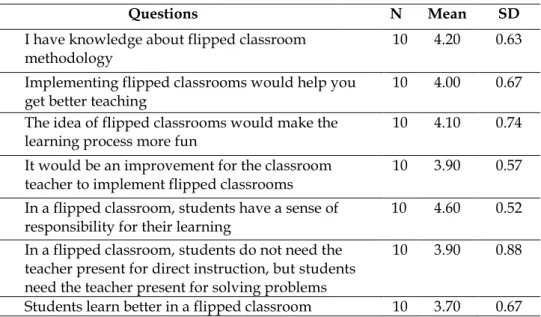
Table 1 displays a summary of the means and standard deviations from various survey questions related to the teachers‟ response to the flipped classroom methodology. The teachers strongly agree that the flipped classroom made the students have a sense of responsibility for their learning (M = 4.60). Meanwhile, the lowest score of the survey questions exemplifies a mean of 3.70. It indicates that the flipped classroom methodology was sufficient to make students better in learning.
Both of the teachers and students were satisfied when applying the flipped classroom. It was visible in one of the interviewees' opinions related to the research question number 1.
would be given questions related to materials. I was pleased to apply it because it helped me to solve the learning distance” (T1).
Table 1. The description of questions, mean, and standard deviation
Questions N Mean SD
I have knowledge about flipped classroom methodology
10 4.20 0.63
Implementing flipped classrooms would help you get better teaching
10 4.00 0.67
The idea of flipped classrooms would make the learning process more fun
10 4.10 0.74
It would be an improvement for the classroom teacher to implement flipped classrooms
10 3.90 0.57
In a flipped classroom, students have a sense of
responsibility for their learning 10 4.60 0.52 In a flipped classroom, students do not need the
teacher present for direct instruction, but students need the teacher present for solving problems
10 3.90 0.88
Students learn better in a flipped classroom 10 3.70 0.67
T1‟s statement indicated such a positive response with the implementation of the flipped classroom method. He agreed that it could be a suitable method to bridge the students‟ need and controlled the learning process regardless of the learning distance. This is in line with Bergmann and Sams‟ (2012) theory that flipping classroom establishes a framework that ensures the students to receive a personalized education tailored to their individual needs.
The similar response occurred to another interviewee who said:
“The most important thing was the role of teacher to give evaluation from the students’ performances in the classroom. The positive feedbacks and motivation would help students to grow confidence to show in the next chance and nice evaluation would make students think they need to improve and revise” (T2).
autonomously. The positive feedbacks and motivation would improve the students‟ confidence in participating in any kinds of activities in the classroom. Yang (2017) agrees that the teacher thought that the flipped classroom could be useful for motivating the students and the extra workload of finding or making suitable pre-lesson online videos was the main concern for the teachers.
Perceived Benefits of Flipped Classroom Methodology in Instructional Process
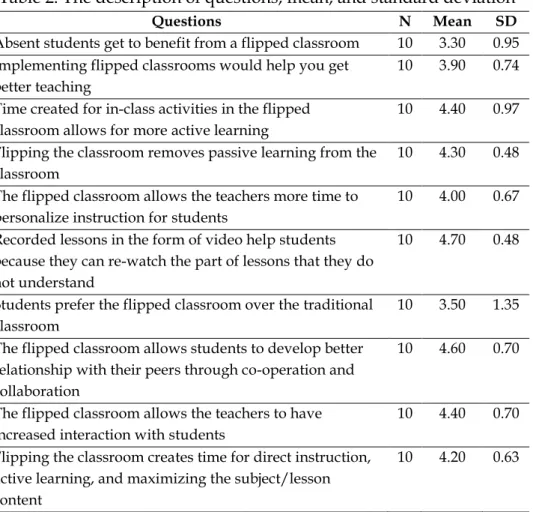
Table 2 explains the mean and standard deviation related to the question survey about the benefits of applying the flipped classroom. The teachers mostly agree that the implementation of the flipped classroom gave benefits that were shown in the statement recorded lessons in the form of video help students because they can re-watch the part. They agree that the flipped classroom gave benefits (Mean 4.70). In addition, the low mean score (M=3.30) meant that the teachers were neutral when they were asked about the benefits to the students who were absent in class.
The result of the interview was also in line with the result of the questionnaire. One of the respondent‟s statements was:
“My opinion related to the advantages of flipped learning is that it could help the teachers to make the students to be independent. The students would not rely too much on the teacher if they had problems. They would try to solve it by their own. The second advantage was that it can serve as the teaching tool of creativity. The students would be more creative by making video with their friends. They would develop their soft skills and brilliant ideas to do the tasks of flipped classroom together with their friends in the same group. The third advantage is a model to be autonomous. After the students were accustomed with the tasks and assignments they obtained during the flipped classroom, the seeds of autonomous learning would grow” (T3).
providing opportunities for the students to meaningfully talk and listen, write, read, and reflect on the content, ideas, issues, and concerns of an academic subject (Meyers & Jones, 1993). As generally comprehended, active learning would put the students at the heart of the learning experience. Moreover, it enabled them much more engaged with their own learning (www.ucl.ac.uk/teaching-learning).
Table 2. The description of questions, mean, and standard deviation
Questions N Mean SD
Absent students get to benefit from a flipped classroom 10 3.30 0.95 Implementing flipped classrooms would help you get
better teaching
10 3.90 0.74
Time created for in-class activities in the flipped classroom allows for more active learning
10 4.40 0.97
Flipping the classroom removes passive learning from the classroom
10 4.30 0.48
The flipped classroom allows the teachers more time to personalize instruction for students
10 4.00 0.67
Recorded lessons in the form of video help students because they can re-watch the part of lessons that they do not understand
10 4.70 0.48
Students prefer the flipped classroom over the traditional classroom
10 3.50 1.35
The flipped classroom allows students to develop better relationship with their peers through co-operation and collaboration
10 4.60 0.70
The flipped classroom allows the teachers to have increased interaction with students
10 4.40 0.70
Flipping the classroom creates time for direct instruction, active learning, and maximizing the subject/lesson content
10 4.20 0.63
their interpersonal skills. The third benefit is that it facilitates the teachers to imbue autonomous learning. Since the students did not perceive themselves as autonomous enough in language learning, the teachers needed the ability to move their students towards autonomous learning (Masouleh & Jooneghani, 2012).
By applying the flipped classroom, the students were accustomed to the tasks they obtained during the flipped classroom. Besides, the motivations of autonomous learning would automatically grow. They would try to learn even though they were not at school. They would read a book even no one obliges them to do it. That was the final goal of the flipped classroom which was to construct the students to become an autonomous learner. They would learn because they were aware that they needed it.
Meanwhile, another respondent uttered:
“I thought that there were two main advantages. Those were activeness and cooperation. Since the students already watched the video prior classroom activity they would have enough data or provision in their brain about the materials. So in the classroom, the students just do and practice the concepts they got from the video. They would contribute their active speaking in the debate simulation, they would confidently express their confidence in the mini drama, etc.” (T1).
This interviewee stipulated two main advantages including students‟ collaborative team-work and active participation in the classroom. Collaborative team-work could encourage social interaction, teamwork, and cultural diversity among students, making it easier for them to help each other mutual learning and for those of different skill levels to support one another (Du et al., 2014). The interviewee gave an example that students were active as well as enthusiastic in participating in the debate and performance in the classroom.
classroom provides the students such “control of the remote” of their own learning. Meanwhile, Nouri (2016) explains that the flipped classroom model offered promising ways to engage students in more effective, supportive, motivating and active learning, especially for low achievers and students that may struggle with traditional lectures.
Teachers’ Perceived Challenges of Flipped Classroom Methodology in Instructional Process
Table 3 informs the means and standard deviations related to challenges in applying the flipped classroom. The teachers agree that technological problems often occurred when they implement the flipped classroom methodology (Mean=4.20). Another challenge is shown by the mean of 3.90. It indicated that the teachers also faced other challenges stated in table 3 above.
Table 3. The description of questions, mean, and standard deviation
Questions N Mean SD
Implementing flipped classroom method needs more complicated preparation than that of conventional teaching
10 3.90 1.20
Technological problems occur during the implementation of the flipped classroom
10 4.20 0.79
The flipped classroom is challenging for some students to access due to the additional technology required outside the school
10 3.90 1.29
From the result of the interview, one of the respondents said:
“I thought that sometimes I had difficulties to have tight preparation of conducting flipped classroom. Some the teachers were not ready with the time-consuming preparation for flipped classroom” (T2).
practice or discussion. Some teachers minded with it. The time-consuming in preparation sometimes made the teachers rethought to use this method. This challenge was supported by Low and Hew (2017), they state that the major problems of using the flipped classroom method include teachers‟ considerable workload of creating flipped learning materials. They also argue that the challenges of implementing the flipped classrooms mainly were identified into student-related challenges, faculty challenges, and operational challenges.
The next challenge was the unexpected error of electricity and internet connection as uttered by one of the interviewees below:
“The second drawback was the high dependence of technology. This would be a big problem if the electricity was suddenly off then both the teachers and students did not have internet access” (T3).
As mentioned in T3‟s statement above, flipped classroom depended mainly on the internet. This would cause a problem when the electricity was off. The internet connection was cut down and the flipped classroom was unable to happen. Hertz (2012) as cited in Nawi et al. (2015) points out the same idea, the prominent issue in the implementation of the flipped classroom, whether it is in the rural or urban areas, deals with the accessibility to the lesson outside the classroom that depend on computer and internet access. He added that weak internet connections can be a factor that discouraged students to want to access the online lesson. Of course, the teachers should be creative when they are trapped in that position. Another teaching strategy should be prepared before entering the class.
Another challenge was the lack of students‟ motivation. The interviewee explained the following statement:
Though the facilities were already supporting and the teachers were well-prepared, but there is a case when the students did not have good motivation in the flipped classroom. According to Nawi et al., (2015), the challenge encountered in implementing the flipped classroom was the lack of students‟ participation and interactions in the classroom activities. These hindered the lesson from achieving an active learning environment. In line with this, Du et al., (2014) also stated that flipped classroom relies heavily on students‟ self-motivated. Some students are not as motivated as others, and this method of teaching may allow those less motivated students to get less done. As a consequence of this condition, the learning process would not be maximal since the flipped classroom needed good cooperation between the teachers and students to conduct autonomous learning. If the students disliked the flipped classroom, they ignored the teacher‟s instruction to watch videos which had been prepared by the teachers.
CONCLUSION
This research provides a number of suggestions for English teachers and school stakeholders. English teachers are suggested to implement the flipped classroom in the learning process in order to engage the students‟ participation effectively and stimulates their autonomous learning. Meanwhile, the school stakeholders should provide such relevant training and adequate facilities to support the implementation of the flipped classroom.
The present research focuses on the responses from a small number of English teachers. The further researcher can explore the implementation of the flipped classroom by doing classroom observation that involves a large number of population. Besides, the effect of using the flipped classroom to the students‟ achievement can be another significance research.
REFERENCES
Abdelshaheed, Bothina S. M. (2017). Using Flipped Learning Model in Teaching English Language among Female English Majors in Majmaah University. English Language Teaching; Vol. 10, No. 11. http://doi.org/10.5539/elt.v10n11p96
Afrilyasanti, R., Cahyono, Y.B., Astuti U. (2017). Indonesian EFL Students' Perceptions on the Implementation of Flipped Classroom Model. Journal of Language Teaching and Research. Vol. 8, No. 3. http://dx.doi.org/10.17507/jltr.0803.05
Bajurny, Amy. (2014). An Investigation into the Effects of Flip Teaching on Student Learning. Unpublished-thesis. Department of Curriculum, Teaching and Learning Ontario Institute for Studies in Education of the University of Toronto
Retrieved from http://www.classroomflip.com/ , accessed on January 2019
Basal, A. (2015). The implementation of a flipped classroom in foreign language teaching. Turkish Online Journal of Distance
Education-TOJDE, 16(4), 28–34.
https://dx.doi.org/10.17718/tojde.72185
Bergmann, J., & Sams, A. (2012). Flip Your Classroom: Rich every student and every class every day. International Society for Technology in Education (ISTE). USA.
Danker, Brenda. (2015). Using Flipped Classroom Approach to Explore Deep Learning in Large Classrooms. The IAFOR Journal of Education. Volume III-Issue I – Winter 2015.
Du, Shi-Chun, Fu, Ze-Tian, & Wang, Y. (2014). The flipped classroom: Advantages and challenges. Atlantis Press. Paper presented at the International Conference on Economic, Management and Trade
Cooperation (EMTC). Retrieved from
https://download.atlantis-press.com/article/11721.pdf
Educause. (2012). 7 things you should know about flipped
classrooms. Retrieved from
https://library.educause.edu/~/media/files/library/2012/ 2/eli7081-pdf.pdf
Ekmekci, E. (2017). The Flipped Writing Classroom in Turkish EFL Context: A Comparative Study on a New Model. Turkish Online Journal of Distance Education-TOJDE, 18 (2), 151-167. https://dx.doi.org/10.17718/tojde.306566
Gough E., DeJong D., Grundmeyer T., & Baron M. (2016). K-12 Teacher Perceptions Regarding the Flipped Classroom Model for Teaching and Learning. Journal of Educational
Technology Systems, 45(3) 390–423.
Halili, S. H., & Zainuddin, Z. (2015). Flipping the Classroom: What We Know and What We don‟t. The Online Journal of Distance Education and e-Learning, Vol 3, 15-22.
Khodr M., & Waller L. (2016). Analysis of Engineering Students‟ Responses to Flipped Classroom Methodology in the United Arab Emirates. Asian Social Science. 12 (2). http://dx.doi.org/10.5539/ass.v12n2p93
Long T., Cummins J., & Waugh M. (2016). Use of the flipped classroom instructional model in higher education: instructors‟ perspectives. Journal Computer Higher Education. Springer Science and Business Media New York. http://dx.doi.org/10.1007/s12528-016-9119-8
Meyer, C., & Jones, T. B. (1993). Promoting active learning: Strategies for the college classroom. San Francisco: Jossey-Bass
Nawi, N., Jawawi, R., Matzin, R., Jaidin, J, H., Shahrill, M., & Mundia, L. (2015). To Flip or Not to Flip: The Challenges and Benefits of Using Flipped Classroom in Geography Lessons in Brunei Darussalam. Review of European Studies; Vol. 7, No. 12; 2015. Published by Canadian Center of Science and Education. http://dx.doi.org/10.5539/res.v7n12p1333
Nouri, Jalal. (2016). The flipped classroom: for active, effective and increased learning especially for low achievers. International Journal of Educational Technology in Higher Education. https://doi.org/10.1186/s41239-016-0032-z
Staker, H., & Horn, M. B. (2012). Classifying K-12 blended learning. Retrieved from https://www.christenseninstitute.org/wp-
content/uploads/2013/04/Classifying-K-12-blended-learning.pdf