7
All Rights Reserved © 2012 IJARCSEE
Roadmaps for Usability Engineering
Sanjeev Narayan Bal
Asst. Prof. Dept. of Comp.Sc.
Trident Academy of Creative Technology, Bhubaneswar
[email protected]
Abstract-- Usability engineering is a cost-effective, user centered process that ensures a high level of effectiveness, efficiency, and safety in complex interactive systems. A major challenge, and thus opportunity, in the field of human-computer interaction (HCI) and specifically usability engineering (UE) is designing effective user interfaces for emerging technologies that have no established design guidelines or interaction metaphors, or introduce completely new ways for users to perceive and interact with technology and the world around them. This paper presents a brief description of usability engineering activities, and discusses our experiences with leading usability engineering activities for different applications. we propose a usability engineering approach that employs user-based studies to inform design, by iteratively inserting a series of user-based studies into a traditional usability engineering lifecycle to better inform initial user interface designs. We will discuss interaction, visualization, and adaptive user support for maps on mobile devices. we propose an entangled User Centered System Design (UCSD) and Feature Driven Development (FDD) process for MCI ,where a usability engineering model is used.
Index Terms--Usability engineering, mobile devices, Mass Casualty Incident, User Centered Design, Feature Driven Development, virtual environments
I.
I
NTRODUCTIONUsability engineering is a cost-effective, user-centered process that ensures a high level of effectiveness, efficiency, and safety in complex interactive systems . Activities in this process include user analysis, user task analysis, conceptual and detailed user interface design, quantifiable usability metrics, rapid prototyping, and various kinds of user-centered evaluations of the user interface. These activities are further explained in Section "Activities in Usability Engineering." Usability engineering produces highly usable user interfaces that are essential to reduced manning, reduced human error, and increased productivity. Unfortunately, managers and developers often have the misconception that usability engineering activities add costs to a product's development life cycle. In fact, usability engineering can reduce costs over the life of the product, by reducing the need to add missed functionality later in the development cycle, when such additions are more expensive. The process is an integral part
of interactive application development, just as are systems engineering and software engineering. Usability engineering activities can be tailored to allow individualizing as needed for a specific project or product development effort. The usability engineering process applies to any interactive system, ranging from training applications to multimedia CD-ROMs to augmented and virtual environments to simulation applications to graphical user interfaces (GUIs). The usability engineering process is flexible enough to be applied at any stage of the development life cycle, although early use of the process provides the best opportunity for cost savings.
II.
A
CTIVITIESI
NU
SABILITYE
NGINEERING8
All Rights Reserved © 2012 IJARCSEE As mentioned in the introduction, usability engineering
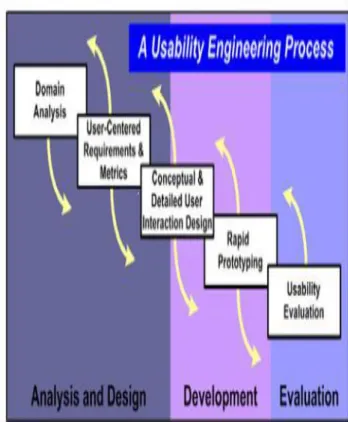
consists of numerous activities. Figure 1 shows a simple diagram of the major activities. Usability engineering includes both design and evaluations with users; it is not just applicable at the evaluation phase. Usability engineering is not
typically hypothesis-testing-based experimentation, but
instead is structured, iterative user-centered design and evaluation applied during all phases of the interactive system development life cycle. Most existing usability engineering methods were spawned by the development of traditional desktop graphical user interface (GUIs).
In the following sections, we discuss several of the major usability engineering activities, including domain analysis, expert evaluation (also sometimes called heuristic evaluation or usability inspection), formative usability evaluation, and summative usability evaluation.
Domain Analysis
Domain analysis is the process by which answers to two critical questions about a specific application context are determined:
• Who are the users?
• What tasks will they perform?
Thus, a key activity in domain analysis is user task analysis, which produces a complete description of tasks, subtasks. and actions that an interactive system should provide to support its human users, as well as other resources necessary for users and the system to cooperatively perform tasks . While it is preferable that user task analyses be performed early in the development process, like all aspects of user interface development, task analyses also need to be flexible and potentially iterative, allowing for modifications to user performance and other user interface requirements during any stage of development. In our experience, interviewing an existing and/or identified user base, along with subject matter experts and application '"visionaries", Provides very useful insight into what users need and expect from an application. Observation-based analysis requires a user interaction prototype, and as such, is used as a last resort. A combination of early analysis of application documentation (when available) and interviews with subject matter experts typically provides the most effective user task analysis. Domain analysis generates critical information used throughout all stages of the usability engineering life cycle. A key result is a top-down, typically hierarchical decomposition of detailed user task descriptions. This decomposition serves as an enumeration and explanation of desired functionality for use by designers and evaluators, as well as required task sequences. Other key results are one or more detailed scenarios, describing potential uses of the application, and a list of user-centered requirements. Without a clear understanding of application domain user tasks and user requirements, both evaluators and developers are forced to "best guess" or interpret desired functionality, which inevitably leads to poor user interface design.
Expert Evaluation
Expert evaluation (also called heuristic evaluation or usability inspection) is the process of identifying potential usability problems by comparing a user interface design to established usability design guidelines. The identified problems are then used to derive recommendations for improving that design. This method is used by usability experts to identify critical usability problems early in the development cycle, so that these design issues can be addressed as part of the iterative design process. Often the
usability experts rely explicitly and solely on established usability design guidelines to determine whether a user interface design effectively and efficiently supports user task performance (i.e.. usability). But usability experts can also rely more implicitly on design guidelines and work through user task scenarios during their evaluation. Nielsen recommends three to five evaluators for an expert evaluation, and has shown empirically that fewer evaluators generally identify only a small subset of problems and that more evaluators produce diminishing results at higher costs. Each evaluator first inspects the design alone, independently of other evaluators' findings. Then the evaluators combine then data to analyze both common and conflicting usability findings. Results from an expert evaluation should not only identify problematic user interface components and interaction techniques, but should also indicate why a particular component or technique is problematic. This is arguably the most cost-effective type of usability evaluation, because it does not involve users.
Formative Usability Evaluation
Formative evaluation is the process of assessing, refining, and improving a user interface design by having representative users perform task-based scenarios, observing their performance, and collecting and analyzing data to empirically identify usability problems. This observational evaluation method can ensure usability of interactive systems by including users early and continually throughout user interface development. This method relies heavily on usage context (e.g.. user tasks, user motivation), as well as a solid understanding of Formative evaluation produces both
qualitative and quantitative results collected from
representative users during their performance of task scenarios . Qualitative data include critical incidents, a user event that has a significant impact, either positive or negative, on users' task performance and/or satisfaction. Quantitative data include metrics such as how long it takes a user to perform a given task, the number of errors encountered during task performance, measures of user satisfaction, and so on. Collected quantitative data are then compared to appropriate baseline metrics, sometimes initially redefining or altering evaluators' perceptions of what should be considered baseline. Both qualitative and quantitative data are equally important since they each provide unique insight into a user interface design's strengths and weaknesses.
Summative Usability Evaluation
9
All Rights Reserved © 2012 IJARCSEE
III.
U
SABILITYE
NGINEERINGA
PPROACHEST
OD
ESIGININGU
SERI
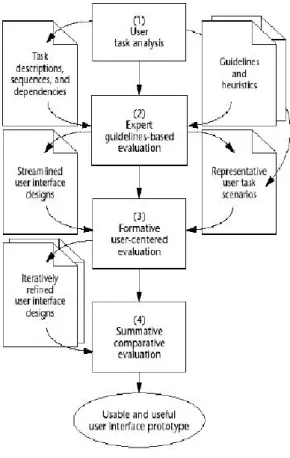
NTERFACESTo date, numerous approaches to software and user interface design have been developed and applied. The waterfall model, developed by Royce, was the first widely known approach to software engineering. This model takes a top-down approach based on functional decomposition. Royce admitted that while this process was designed to support large software development efforts, it was inherently flawed since it did not support iteration; a property that he eventually added the model. The spiral model (Boehm, [1]) was the first widely recognized approach that utilized and promoted iteration. It is useful for designing user interfaces (as well as software), because it allows the details of user interfaces to emerge over time, with iterative feedback from evaluation sessions feeding design and redesign. As with usability engineering approaches, the spiral model first creates a set of user-centered requirements through a suite of traditional domain analysis activities (e.g., structured interviews, participatory design, etc.). Following requirements analysis, the second step simply states that a "preliminary design is created for the new system". Hix and Hartson [2] describe a star life cycle that is explicitly designed to support the creation of user interfaces. The points of the star represent typical design/development activities such as "user analyses", "requirements/ usability specifications", "rapid prototyping", etc, with each activity connected through a single center "usability evaluation" activity. The points of the start are not ordered, so one can start at any point in the process, but can only proceed to another point via usability evaluation. The design activities focus on moving from a conceptual design to a detailed design. Mayhew [3] describes a usability engineering lifecycle that is iterative and centered on integrating users throughout the entire development process. With respect to design, the usability engineering lifecycle relies on screen design standards, which are iteratively evaluated and updated. Both the screen design standards as well as the detailed user interface designs rely on style guides that can take the form of a platform" style guide (e.g., Mac, Windows, etc.), "corporate" style guide (applying a corporate "look and feel"), "product family" style guide (e.g., MS Office Suite), etc. Gabbard, Hix and Swan [4] present a cost-effective, structured, iterative methodology for user-centered design and
evaluation of virtual environment (VE) user interfaces and interaction. Fig. 2, depicts the general methodology, which is based on sequentially performing:
1. user task analysis,
2. expert guidelines-based evaluation, 3. formative user-centered evaluation, and 4. summative comparative evaluations.
While similar methodologies have been applied to traditional (GUI-based) computer systems, this methodology is novel because we specifically designed it for —and applied it to —VEs, and it leverages a set of heuristic guide- lines specifically designed for VEs. These sets of heuristic guidelines were derived from Gabbard's taxonomy of usability characteristics for VEs [5,6]. A shortcoming of this approach is that it does not give much guidance for design activities. The approach does not describe how to engage in design activities, but instead asserts that initial designs can be created using input from task descriptions, sequences, and dependencies as well as guidelines and heuristics from the
field. Since this methodology assumes the presence of guidelines and heuristics to aid in designs to be evaluated during the "expert guidelines-based evaluation" phase, it is not applicable to emerging technologies such as augmented reality, where user interface design guidelines and heuristics have not yet been established. When examining many or the approaches described above - and specifically the design and evaluation activities - in most cases, design activities rely on leveraging existing metaphors, style guides or standards in the field (e.g., drop down menus, a browser's "back" button, etc.). However, in cases where an application falls within an emerging technological field, designers often have no existing metaphors or style guides, much less standards on which to base their design. Moreover, in cases where the technology
provides novel approaches to user interaction or
fundamentally alters the way users perceive the interaction space (i.e., where technology and the real world come together), designers often have little understanding of the perceptual or cognitive ramifications of "best guess" designs. As a result, a process is needed to help designers of novel user interfaces iteratively create and evaluate designs, to gain a better understanding of effective design parameters, and to determine under what conditions these parameters are best applied. Without this process, applications developed using traditional usability engineering approaches can only improve incrementally from initial designs which again, are often based on developer's best guesses, given the absences of guidelines, metaphors, and standards.
Fig. 2 The user-centered design and evaluation methodology for virtual environment user interaction described by Gabbard .
User Interface Design Activities for Augmented Reality
10
All Rights Reserved © 2012 IJARCSEE
(such as AR). As a technological field evolves,
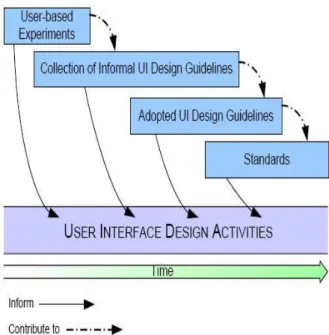
lessons learned from conducting user-based studies are not only critical for the usability of a particular application, but provide value to the field as a whole in terms of insight into a part of the user interface design space (e.g., of occlusion or text legibility). As time progresses, contributions to the field (from many researchers) begin to form a collection of informal design guidelines and metaphors from which researchers and application designers alike can draw from. Eventually, the informal design guidelines are shaken down into a collection of tried-and-true guidelines and metaphors that are adopted by the community. Finally, the guidelines and metaphors become "defacto" standards or at best deemed "standards" by appropriate panels and committees. The context of the work reported here, however, falls within the application of user-based studies to inform user interface design; the left-most box of Fig. 3. Based on our experiences performing usability engineering, and specifically design and evaluation activities for the Battlefield Augmented Reality System, we propose an updated approach to user interface design activities for augmented reality systems. This approach emphasizes iterative design activities in between the user task analysis phase (where requirements are gathered and user tasks understood) and the formative user-centered evaluation phase (where an application-level user interface prototype has been developed and is under examination) (Fig. 2). With this approach, w7e couple the user expert evaluation and user-based studies to assist in the user interface design activity (Fig. 3). Expert evaluations can be iteratively combined with well-designed user-based studies to refine designers' understanding of the design space, understanding of effective design parameters (e.g., to identify subsequent user-based studies), and most importantly to refine user interface designs. A strength of this approach is that interface design activities are driven by a number of activities; inputs from the user task
analysis phase (Fig. 2), user interface design parameters correlated with good user interface performance (derived from user-based studies), and expert evaluation results.
With this methodology, expert evaluations along with user-based studies are iteratively applied to refine the user interface design space.
Of the three main activities shown in Fig. 3, there are two logical starting points: user interface design and user based studies. An advantage of starting with user interface design activities is that designers can start exploring the design space prior to investing time in system development, and moreover, can explore a number of candidate designs quickly and easily. In the past, we have successfully used PowerPoint mockups to examine dozens of AR design alternatives. If mocked up correctly, the static designs can be presented through an optical see through display, which allows designers to get an idea of how the designs may be perceived when viewed through an AR display in a representative context (e.g., indoors versus outdoors). Once a set of designs have been created, expert evaluations can be applied to assess the static user interface designs, culling user interface designs that are likely to be less effective than others. The expert evaluations are also useful in terms of further understanding the design space by identifying potential user-based experimental factors and levels. Once identified, user-based studies can be conducted to further examine those factors and levels to determine, for example, if the findings of the expert evaluation match that of user-based studies. In cases where the design space is somewhat understood and designers have specific
questions about how different design parameters might support user task performance, designers may be able to conduct a user-based study as a starting point. Under this approach, designers start with experimental design parameters as opposed to specific user interface designs. As shown in Fig. 4, user based studies not only identify user interface design parameters to assist in UI design, but also have the potential to produce UI design guidelines and lessons learned, as well as
generate innovation, which provides both tangible
contributions to the field while also improving the usability of a specific application. Ultimately, a set of iteratively refined user interface designs are produced that are the basis for the overall application user interface design. This design can then be evaluated using formative user-centered evaluation, as described by Hix, Gabbard, and Swan [4].
Fig. 3 User-based experiments are a critical vehicle for discovery and usability early in an emerging field's development. Over time, contributions from the field emerge, leading eventually to adopted user interface design guidelines and standards.
11
All Rights Reserved © 2012 IJARCSEE
IV.
U
SABILITYE
NGINEERINGF
ORM
OBILED
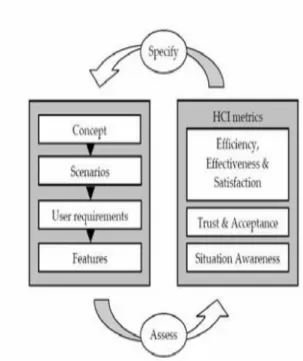
EVICESUsability determines to a major extent the success of products and services that are based on information and communication technology. Usability engineering [10] is an approach to develop software that is easy to use. effective and efficient, and is in our opinion based on three principles: 1) Early and continuous focus on user and tasks. 2) empirical measurement. 3) and iterative design. In UE several development cycles (Figure 5), with assessments and re-specifications, are worked through. A complex and interesting scenario is developed with users, from which user requirements and features can be derived. The features are implemented and the quality is assessed by human computer interaction (HCI) metrics. These metrics are closely related to the social challenges, regarding comfort and acceptance, but the technological challenges are also addressed in the metrics. When taking the user as the center of the design it is also important to take into account his or her cognitive task load [9], for which several metrics exist. The assessment of the metrics can be done in several different ways, either by experts or users.
UE is a good design approach for a usable mobile map. But thorough understanding of the dynamic use context is crucial for user-centered design of mobile applications [7, 12]. With mobile devices it is necessary to test them eventually while the user is mobile, which makes evaluation difficult. Depending on the task and the application, usability can highly differ between a sunny day and a rainy day, between a noisy environment and a silent environment. The choice between a lab-experiment or a field experiment is therefore far from crucial for mobile devices [13]. The use of the mobile map is mostly a secondary task; the primary task (route planning or looking for a nearby restaurant) does have a strong influence on the way of use. Not only the device has to have a high degree of fidelity, but the primary task has to be simulated realistic too. Zhang and Adipat [13] give an overview of challenges in usability testing of mobile devices. These challenges are the same as the design challenges for mobile applications: mobile context, connectivity, small screen size, different display resolutions, limited processing capability and power, and different data entry methods. An example is that low screen resolution can have disastrous effects on the usability of a mobile application. There are different frameworks for usability testing of mobile devices [11,13]. In all frameworks, it is an important question whether to do a usability test in the laboratory or in the field, and whether experts are used or prospective users. Lab-experiments are appropriate for improvement of the interface design, for which the real device or an emulator can be used. Field-experiments on the other hand are more appropriate when the final application is tested [13]. The framework of Streefkerk et al. [11] extends the framework of Zhang and Adipat by that it not only gives instructions on which experimental method to use , but gives constraints for when to
Fig. 5 The Usability engineering method use which experimental method.
We conclude that difficulties for usability testing for mobile devices exist, but several frameworks are available which can be used for designing usable mobile map applications. Because there are many challenges for mobile applications, ease of use and effectiveness are crucial. Using a sound usability engineering approach, we decide which interface features for mobile maps help dealing with the technological, environmental, and social challenges.
Example-- Tourist information and navigation support by using 3D maps displayed on mobile devices
12
All Rights Reserved © 2012 IJARCSEE visualization of the viewpoint was examined and several HCI
metrics were used to measure the usability of the design. Users were included in both the design and the usability testing.
V.
U
SABILITYE
NGINEERINGF
ORM
ASSC
ASUALITYI
NCIDENTSTo design an application system that is usable in case of an MCI, we propose an entangled approach of User-Centered System Design (UCSD) and Feature Driven Development (FDD) [14,15,16,17]. To prepare users to be able to handle a system in case of an MCI, we propose that the MDGS provides training for MCIs within the regular day-to-day business . This should be accomplished by using similar support systems for handling MCIs and regular rescue and transport missions. Speaking in terms of software engineering, support for an MCI should be provided by an additional module of the same MDGS framework that is used for handling the regular day-to-day business.
Development Process
As already mentioned, we follow an entangled approach that combines UCSD and FDD to keep the project and development process focused (Figure 6). Classic elements of UCSD (e.g. user studies, interviews) will be complemented by:
•observing MCI exercises;
•accompanying paramedics and emergency physicians while they are using the MDGS in regular missions;
•evaluating the usability of the MDGS in regular missions; •attending emergency medical aid and MCI related workshops.
Combining these and scientific information, features can be derived. Natural dependencies between these "small, client valued function[s]" [17] and a prioritization process will lead to a sorted list of feature sets. To work through the list, we use the iterative and incremental process of FDD. By using an
entangled FDD/UCSD process as our software
engineering paradigm, we are able to quickly roll out feature-sets, as well as keeping them close to the users' needs and expectations through repeated user-feedback.
General Principles for MDGSs
Figure 7, gives an overview of our proposed MDGS. The overall design is based on the assumption that an MDGS that follows the principle has to be technically feasible and suitable for handling day-to-day rescue and transport missions as well as MCIs. The basic features as shown in the figure are:
• All rescue workers (paramedics, emergency physicians, team leader, and incident commander) are using the same handheld device, most likely a rugged tablet PC.
• All stakeholders (public-safety answering point, crisis squad, hospital staff, and rescue teams) are kept in the loop. They are aware of all necessary information. The users are guided by dialogues that are simple enough to be still useful even in very demanding situations.
• The location of every patient and rescue worker is made available by location-based services for the stake holders in command.
• Ambulance crews are informed on their way to the area of operation as well as while waiting at the ambulance assembly area. Supplying this information to the rescue workers can help to cope with anxieties and help to prepare them for the situations they will be confronted with .
• All relevant information is stored on central servers for ad-hoc as well as post-hoc analyses. This information can be very useful to implement organizational learning and gradually improving the whole man-machine-system over time.
At the moment our project is still in a first prototypical state. The goal is to integrate the system as a module into the R2-System, an end-to-end solution for regular transport and rescue missions, of the DIGITALYS GmbH.
Fig. 6 Process model combining FDD and UCSD .
13
All Rights Reserved © 2012 IJARCSEE
VI.
C
ONCLUSIONFrom these three applications, we have learned many lessons on how to improve the process of usability engineering.
We have presented a modified usability engineering approach to design that employs a combination of user interface design, user-based studies and expert evaluation to iteratively design a usable user interface as well as refine designers' understanding of a specific design space. In this paper we looked at the usability of maps on mobile devices. Different methods of visualization, interaction, and adaptive user support to obtain good usability were discussed in the view of technical, environmental and social challenges. We have also disclosed a model for Usability Engineering for Mass Casualty Incidents.
REFERENCES
[1] B.W. Boehm, "A Spiral Model of Software Development arid Enhancement", IEEE Computer, 21(5), 1-72,1988. [2] D. Hix and H.R. Hartson, "Developing User Interfaces: Ensuring Usability Through Product and Process", New York, NY, John Wiley & Sons,1993.
[3] D.J. Mayhew, "The Usability Engineering Lifecycle, a Practitioner's Handbook for User Interface Design", San Francisco, CA, Morgan Kaufmann Publishers, 1999.'
[4] J.L. Gabbard, D. Hix and J.E. Swan II, "User-Centered Design and Evaluation of Virtual Environments". Invited Paper to IEEE Computer Graphics and Applications, Volume 19, Number 6, pages 51-59, November / December, 1999. [5] J.L. Gabbard, "Taxonomy of Usability' Characteristics in Virtual Environments". Master's thesis. Department of Computer Science, Virginia Tech, 1997.
[6] J.E. Swan II and J.L. Gabbard, "Survey of User-Based Experimentation in Augmented Reality", In Proceedings of 1st International Conference on Virtual Reality, HCI International 2005, Las Vegas, Nevada, USA, July 22-27,2005.
[7] Gorlenko. L. & Merrick, R. (2003). No wires attached: Usability challenges in the connected mobile world. IBM Systems Journal, 42, 639-651.
[8] Laakso. K., Gjesdal. O., & Sulebak, J. R. (2003). Tourist information and navigation support by using 3D maps displayed on mobile devices. Proceedings of HCI in Mobile Guides (Udine, Italy: in conjunction with Mobile HCI 2003). [9] Neerincx. M. A. & Lindenberg. J. (2005). Situated cognitive engineering for complex task environments. Proceedings of the Seventh International Naturalistic Decision Making Conference.
[10] Nielsen. J. (1994). Usability Engineering. Morgan Kaufmann.
[11] Streefkerk, J. W.. Esch-Bussemakers. M. P.. & Neerincx. M. A. (2006). Designing personal attentive user interfaces in the mobile public safety domain. Computers in Human Behavior, 22, 749-770.
[12] Vetere. F., Howard. S.. Pedell. S.. & Balbo. S. (2003). Walking through mobile use: novel heuristics and their application. Proceedings of OzCHI, 24-32.
[13] Zhang. D. & Adipat. B. (2005). Challenges. Methodologies, and Issues in the Usability Testing of Mobile Applications. INTERNATIONAL JOURNAL OF HUMAN-COMPUTER INTERACTION, 18, 293-308.
[14] Chu, Y. and Ganz, A. 2007. WISTA: a wireless telemedicine system for disaster patient care. Mob. Netw. Appl. 12,201-214.
[15] Demchak, B., Chan, T. C, Griswold, W. G., and Lenert, L. A. 2006. Situational awareness during mass-casualty events: command and control. A MI A Anna Symp Proc, 905. [16] Norman, D. A. and Draper, S. W. 1986. User centered system design. New perspectives on human-computer interaction. Erlbaum, Hillsdale, N.J.
[17] Palmer S. R. and Felsing J. M. 2002. A Practical Guide
to Feature-Driven Development. Prentice Hall
PTR, Upper Saddle River NJ.
Author
Sanjeev Narayan Bal MBA, MCA, MTech (CSE) Assistant Professor (CSE)
Trident Academy of Creative Technology, Bhubaneswar. Life Member - ISTE