International Journal of Science Engineering and Advance Technology, IJSEAT, Vol. 5, Issue 1
ISSN 2321-6905 January -2017
www.ijseat.com Page 134
A New Multilevel Inverter Topology of D-STATCOM to Compensate
Reactive and Nonlinear Loads
Mattaparthi Suresh1, K Dhana Raju2
M.Tech Student, Department of EEE, KIET, kakinada, India.1 Asst. Professor, Department of EEE, KIET, Kakinada, India.2
Abstract— This work proposes an enhanced hybrid distribution static compensator (D-STATCOM) topology to address some practical issues like power loss, filter size, performance etc. A LCL filter has been utilized at the front end of a voltage source inverter (VSI), which gives better exchanging harmonics elimination while utilizing much littler estimation of an inductor as contrasted and the conventional L channel. A capacitor is utilized in as eries with LCL channel to diminish the dc-interface voltage of the D-STATCOM. This thusly lessens the power rating of the VSI. With lessened dc-connect voltage, the voltage over the shunt capacitor of the LCL filter will be additionally less. It will decrease the power misfortunes in the damping resistor as contrasted and the conventional LCL filter with latent damping. In this way, the proposed DSTATCOM topology will have decreased weight, cost, rating, and size with enhanced proficiency and current pay capacity contrasted and the conventional topology. A deliberate methodology to outline the segments of the inactive filter has been displayed. A multilevel cascaded-H-bridge is executed in the VSI operation of a D-STATCOM topology. The viability of the proposed DSTATCOM topology over customary topologies is approved through MATLAB/SIMULINK programming.
Index Terms— Distribution static compensator (DSTATCOM), multilevel inverter (MLI), cascaded H-bridge, passive filter, power quality (PQ).
I. INTRODUCTION
Generally static capacitors and inactive channels have been used to enhance control quality (PQ) in a conveyance framework. Be that as it may, these generally have issues, for example, settled remuneration, framework parameter-subordinate execution, and conceivable reverberation with line reactance [2]. A conveyance static compensator (DSTATCOM) has been proposed in the writing to beat these downsides [3]–[8]. It infuses responsive and music segment of load streams to make source ebbs and flows adjusted, sinusoidal, and in stage with the heap voltages. Be that as it may, a
customary DSTATCOM requires a powerful evaluating voltage source inverter (VSI) for load remuneration. The power rating of the DSTATCOM is specifically corresponding to the current to be remunerated and the dc-interface voltage [10].Generally, the dc-connect voltage is kept up at much higher incentive than the greatest estimation of the stage to-nonpartisan voltage in a three-stage four-wire framework for acceptable pay (in a three-stage three-wire framework, it is higher than the stage to-stage voltage) [2], [10]–[12]. Be that as it may, a higher dc-connect voltage builds the rating of the VSI, makes the VSI substantial, and brings about higher voltage rating of protected door bipolar transistor (IGBT) switches. It prompts to the expansion in the cost, size, weight, and power rating of the VSI. Likewise, conventional DSTATCOM topologies utilize a L-sort interfacing channel for molding of the VSI infused streams [13], [14]. The L channel utilizes an expansive inductor, has a low
slew rate for following the reference streams, and delivers a huge voltage drop crosswise over it, which, thus, requires a higher estimation of the dc-connect voltage for legitimate remuneration. In this manner, the L channel includes cost, size, and power rating. Some half breed topologies have been proposed to consider the previously mentioned confinements of the customary DSTATCOM, where a diminished rating dynamic channel is utilized with the detached segments [15]–[21]. In [15] and [16], cross breed channels for engine drive applications have been proposed. In [17], creators have accomplished a lessening in the dc-connect voltage for responsive load pay. Be that as it may, the lessening in voltage is restricted because of the utilization of a L-sort interfacing channel. This likewise makes the channel greater in size and has a lower slew rate for reference following. A LCL channel has been proposed as the front end of the VSI in the writing to beat the impediments of a L channel [22]–
[25]. It gives better reference following execution while utilizing much lower estimation of aloof parts. This likewise diminishes the cost, weight, and size of the uninvolved part. Nonetheless, the LCL channel utilizes a International Journal of Science Engineering and Advance Technology, IJSEAT,
Vol. 5, Issue 1
ISSN 2321-6905 January -2017
www.ijseat.com Page 134
A New Multilevel Inverter Topology of D-STATCOM to Compensate
Reactive and Nonlinear Loads
Mattaparthi Suresh1, K Dhana Raju2
M.Tech Student, Department of EEE, KIET, kakinada, India.1 Asst. Professor, Department of EEE, KIET, Kakinada, India.2
Abstract— This work proposes an enhanced hybrid distribution static compensator (D-STATCOM) topology to address some practical issues like power loss, filter size, performance etc. A LCL filter has been utilized at the front end of a voltage source inverter (VSI), which gives better exchanging harmonics elimination while utilizing much littler estimation of an inductor as contrasted and the conventional L channel. A capacitor is utilized in as eries with LCL channel to diminish the dc-interface voltage of the D-STATCOM. This thusly lessens the power rating of the VSI. With lessened dc-connect voltage, the voltage over the shunt capacitor of the LCL filter will be additionally less. It will decrease the power misfortunes in the damping resistor as contrasted and the conventional LCL filter with latent damping. In this way, the proposed DSTATCOM topology will have decreased weight, cost, rating, and size with enhanced proficiency and current pay capacity contrasted and the conventional topology. A deliberate methodology to outline the segments of the inactive filter has been displayed. A multilevel cascaded-H-bridge is executed in the VSI operation of a D-STATCOM topology. The viability of the proposed DSTATCOM topology over customary topologies is approved through MATLAB/SIMULINK programming.
Index Terms— Distribution static compensator (DSTATCOM), multilevel inverter (MLI), cascaded H-bridge, passive filter, power quality (PQ).
I. INTRODUCTION
Generally static capacitors and inactive channels have been used to enhance control quality (PQ) in a conveyance framework. Be that as it may, these generally have issues, for example, settled remuneration, framework parameter-subordinate execution, and conceivable reverberation with line reactance [2]. A conveyance static compensator (DSTATCOM) has been proposed in the writing to beat these downsides [3]–[8]. It infuses responsive and music segment of load streams to make source ebbs and flows adjusted, sinusoidal, and in stage with the heap voltages. Be that as it may, a
customary DSTATCOM requires a powerful evaluating voltage source inverter (VSI) for load remuneration. The power rating of the DSTATCOM is specifically corresponding to the current to be remunerated and the dc-interface voltage [10].Generally, the dc-connect voltage is kept up at much higher incentive than the greatest estimation of the stage to-nonpartisan voltage in a three-stage four-wire framework for acceptable pay (in a three-stage three-wire framework, it is higher than the stage to-stage voltage) [2], [10]–[12]. Be that as it may, a higher dc-connect voltage builds the rating of the VSI, makes the VSI substantial, and brings about higher voltage rating of protected door bipolar transistor (IGBT) switches. It prompts to the expansion in the cost, size, weight, and power rating of the VSI. Likewise, conventional DSTATCOM topologies utilize a L-sort interfacing channel for molding of the VSI infused streams [13], [14]. The L channel utilizes an expansive inductor, has a low
slew rate for following the reference streams, and delivers a huge voltage drop crosswise over it, which, thus, requires a higher estimation of the dc-connect voltage for legitimate remuneration. In this manner, the L channel includes cost, size, and power rating. Some half breed topologies have been proposed to consider the previously mentioned confinements of the customary DSTATCOM, where a diminished rating dynamic channel is utilized with the detached segments [15]–[21]. In [15] and [16], cross breed channels for engine drive applications have been proposed. In [17], creators have accomplished a lessening in the dc-connect voltage for responsive load pay. Be that as it may, the lessening in voltage is restricted because of the utilization of a L-sort interfacing channel. This likewise makes the channel greater in size and has a lower slew rate for reference following. A LCL channel has been proposed as the front end of the VSI in the writing to beat the impediments of a L channel [22]–
[25]. It gives better reference following execution while utilizing much lower estimation of aloof parts. This likewise diminishes the cost, weight, and size of the uninvolved part. Nonetheless, the LCL channel utilizes a International Journal of Science Engineering and Advance Technology, IJSEAT,
Vol. 5, Issue 1
ISSN 2321-6905 January -2017
www.ijseat.com Page 134
A New Multilevel Inverter Topology of D-STATCOM to Compensate
Reactive and Nonlinear Loads
Mattaparthi Suresh1, K Dhana Raju2
M.Tech Student, Department of EEE, KIET, kakinada, India.1 Asst. Professor, Department of EEE, KIET, Kakinada, India.2
Abstract— This work proposes an enhanced hybrid distribution static compensator (D-STATCOM) topology to address some practical issues like power loss, filter size, performance etc. A LCL filter has been utilized at the front end of a voltage source inverter (VSI), which gives better exchanging harmonics elimination while utilizing much littler estimation of an inductor as contrasted and the conventional L channel. A capacitor is utilized in as eries with LCL channel to diminish the dc-interface voltage of the D-STATCOM. This thusly lessens the power rating of the VSI. With lessened dc-connect voltage, the voltage over the shunt capacitor of the LCL filter will be additionally less. It will decrease the power misfortunes in the damping resistor as contrasted and the conventional LCL filter with latent damping. In this way, the proposed DSTATCOM topology will have decreased weight, cost, rating, and size with enhanced proficiency and current pay capacity contrasted and the conventional topology. A deliberate methodology to outline the segments of the inactive filter has been displayed. A multilevel cascaded-H-bridge is executed in the VSI operation of a D-STATCOM topology. The viability of the proposed DSTATCOM topology over customary topologies is approved through MATLAB/SIMULINK programming.
Index Terms— Distribution static compensator (DSTATCOM), multilevel inverter (MLI), cascaded H-bridge, passive filter, power quality (PQ).
I. INTRODUCTION
Generally static capacitors and inactive channels have been used to enhance control quality (PQ) in a conveyance framework. Be that as it may, these generally have issues, for example, settled remuneration, framework parameter-subordinate execution, and conceivable reverberation with line reactance [2]. A conveyance static compensator (DSTATCOM) has been proposed in the writing to beat these downsides [3]–[8]. It infuses responsive and music segment of load streams to make source ebbs and flows adjusted, sinusoidal, and in stage with the heap voltages. Be that as it may, a
customary DSTATCOM requires a powerful evaluating voltage source inverter (VSI) for load remuneration. The power rating of the DSTATCOM is specifically corresponding to the current to be remunerated and the dc-interface voltage [10].Generally, the dc-connect voltage is kept up at much higher incentive than the greatest estimation of the stage to-nonpartisan voltage in a three-stage four-wire framework for acceptable pay (in a three-stage three-wire framework, it is higher than the stage to-stage voltage) [2], [10]–[12]. Be that as it may, a higher dc-connect voltage builds the rating of the VSI, makes the VSI substantial, and brings about higher voltage rating of protected door bipolar transistor (IGBT) switches. It prompts to the expansion in the cost, size, weight, and power rating of the VSI. Likewise, conventional DSTATCOM topologies utilize a L-sort interfacing channel for molding of the VSI infused streams [13], [14]. The L channel utilizes an expansive inductor, has a low
slew rate for following the reference streams, and delivers a huge voltage drop crosswise over it, which, thus, requires a higher estimation of the dc-connect voltage for legitimate remuneration. In this manner, the L channel includes cost, size, and power rating. Some half breed topologies have been proposed to consider the previously mentioned confinements of the customary DSTATCOM, where a diminished rating dynamic channel is utilized with the detached segments [15]–[21]. In [15] and [16], cross breed channels for engine drive applications have been proposed. In [17], creators have accomplished a lessening in the dc-connect voltage for responsive load pay. Be that as it may, the lessening in voltage is restricted because of the utilization of a L-sort interfacing channel. This likewise makes the channel greater in size and has a lower slew rate for reference following. A LCL channel has been proposed as the front end of the VSI in the writing to beat the impediments of a L channel [22]–
International Journal of Science Engineering and Advance Technology, IJSEAT, Vol. 5, Issue 1
ISSN 2321-6905 January -2017
comparative dc-interface voltage as that of DSTATCOM utilizing a L channel. Henceforth, hindrances because of high dc-interface voltage are still present when the LCL channel is utilized. Another difficult issue is reverberation damping of the LCL channel, which may push the framework toward shakiness. One arrangement is to utilize dynamic damping. This can be accomplished utilizing either extra sensors or sensor less plans. The sensor less dynamic damping plan is anything but difficult to actualize by altering the inverter control structure. It takes out the requirement for extra sensors. Be that as it may, higher request advanced channels utilized as a part of these plans may require to be tuned for palatable execution [26]. Another approach is to go for aloof damping. This does not require additional sensor hardware. Nonetheless, inclusion of a damping resistor in the shunt part of a LCL channel brings about additional power misfortune and decreases the effectiveness of the framework [26]. This paper proposes an enhanced cross breed DSTATCOM topology where the LCL channel took after by the arrangement capacitor is utilized at the front end of the VSI to address the previously mentioned issues. This topology lessens the measure of the aloof parts and the rating of the dc-connect voltage and gives great reference following execution at the same time. Alongside this, a critical lessening in the damping power misfortune is accomplished, which makes this plan reasonable for mechanical applications. The execution of the proposed topology is approved through the broad reenactment comes about.
II. PROPOSED DSTATCOM TOPOLOGY A three-phase equivalent circuit diagram of the proposed DSTATCOM topology is shown in Fig. 1. It is realized using
Fig.1. Proposed DSTATCOM topology in the
distribution system to compensate unbalanced and nonlinear loads.
A three-stage four-wire two-level unbiased point-clasped VSI. The proposed conspire associates a LCL channel at the front end of the VSI, which is trailed by an arrangement capacitor Cse. Presentation of the LCL channel fundamentally decreases the span of the uninvolved part and enhances the reference following execution. Expansion of the arrangement capacitor decreases the dc-connect voltage and, in this manner, the power rating of the VSI. Here, R1 and L1 speak to the resistance and inductance, individually, at the VSI side; R2 and L2 speak to the resistance and inductance, separately, at the heap side; and C is the channel capacitance shaping the LCL channel part in every one of the three stages. A damping resistance Rd is utilized as a part of arrangement with C to soggy out reverberation and to give aloof damping to the general framework. VSI and channel streams are if1a and if2a, separately, in stage an and comparable for different stages. Moreover, voltages crosswise over and streams through the shunt branch of the LCL channel in stage an are given by Vsha and isha, separately, and likewise for the other two stages. The voltages kept up over the dc-interface capacitors are Vdc1 = Vdc2 = Vdcref . The DSTATCOM, source, and loads are associated with a typical point called the purpose of normal coupling (PCC). Loads utilized here have both straight and nonlinear components, which might be adjusted or lopsided. In the conventional DSTATCOM topology considered in this paper, the same VSI is associated with the PCC through an inductor Lf [27]. In the LCL channel based DSTATCOM topology, a LCL channel is associated between the VSI and the PCC [22]. IIa. MULTILEVEL INVERTER TOPOLAGIES
An inverter is an electrical gadget that believers coordinate current (DC) to substituting current (AC); the changed over AC can be at any required voltage and recurrence with the utilization of suitable transformers, exchanging, and control circuits. Static inverters have no moving parts and are utilized as a part of an extensive variety of utilizations, from little exchanging power supplies in PCs, to huge electric utility high-voltage coordinate current applications that vehicle mass power. Inverters are regularly used to supply AC control from DC sources, for example, sun powered boards or batteries. The electrical inverter is a high-control electronic oscillator. It is so named in light of the fact that early mechanical AC to DC converters was made to work backward, and along these lines were "upset", to change over DC to AC. The inverter plays out the inverse capacity of a rectifier. Sorts in multilevel inverter are International Journal of Science Engineering and Advance Technology, IJSEAT,
Vol. 5, Issue 1
ISSN 2321-6905 January -2017
comparative dc-interface voltage as that of DSTATCOM utilizing a L channel. Henceforth, hindrances because of high dc-interface voltage are still present when the LCL channel is utilized. Another difficult issue is reverberation damping of the LCL channel, which may push the framework toward shakiness. One arrangement is to utilize dynamic damping. This can be accomplished utilizing either extra sensors or sensor less plans. The sensor less dynamic damping plan is anything but difficult to actualize by altering the inverter control structure. It takes out the requirement for extra sensors. Be that as it may, higher request advanced channels utilized as a part of these plans may require to be tuned for palatable execution [26]. Another approach is to go for aloof damping. This does not require additional sensor hardware. Nonetheless, inclusion of a damping resistor in the shunt part of a LCL channel brings about additional power misfortune and decreases the effectiveness of the framework [26]. This paper proposes an enhanced cross breed DSTATCOM topology where the LCL channel took after by the arrangement capacitor is utilized at the front end of the VSI to address the previously mentioned issues. This topology lessens the measure of the aloof parts and the rating of the dc-connect voltage and gives great reference following execution at the same time. Alongside this, a critical lessening in the damping power misfortune is accomplished, which makes this plan reasonable for mechanical applications. The execution of the proposed topology is approved through the broad reenactment comes about.
II. PROPOSED DSTATCOM TOPOLOGY A three-phase equivalent circuit diagram of the proposed DSTATCOM topology is shown in Fig. 1. It is realized using
Fig.1. Proposed DSTATCOM topology in the
distribution system to compensate unbalanced and nonlinear loads.
A three-stage four-wire two-level unbiased point-clasped VSI. The proposed conspire associates a LCL channel at the front end of the VSI, which is trailed by an arrangement capacitor Cse. Presentation of the LCL channel fundamentally decreases the span of the uninvolved part and enhances the reference following execution. Expansion of the arrangement capacitor decreases the dc-connect voltage and, in this manner, the power rating of the VSI. Here, R1 and L1 speak to the resistance and inductance, individually, at the VSI side; R2 and L2 speak to the resistance and inductance, separately, at the heap side; and C is the channel capacitance shaping the LCL channel part in every one of the three stages. A damping resistance Rd is utilized as a part of arrangement with C to soggy out reverberation and to give aloof damping to the general framework. VSI and channel streams are if1a and if2a, separately, in stage an and comparable for different stages. Moreover, voltages crosswise over and streams through the shunt branch of the LCL channel in stage an are given by Vsha and isha, separately, and likewise for the other two stages. The voltages kept up over the dc-interface capacitors are Vdc1 = Vdc2 = Vdcref . The DSTATCOM, source, and loads are associated with a typical point called the purpose of normal coupling (PCC). Loads utilized here have both straight and nonlinear components, which might be adjusted or lopsided. In the conventional DSTATCOM topology considered in this paper, the same VSI is associated with the PCC through an inductor Lf [27]. In the LCL channel based DSTATCOM topology, a LCL channel is associated between the VSI and the PCC [22]. IIa. MULTILEVEL INVERTER TOPOLAGIES
An inverter is an electrical gadget that believers coordinate current (DC) to substituting current (AC); the changed over AC can be at any required voltage and recurrence with the utilization of suitable transformers, exchanging, and control circuits. Static inverters have no moving parts and are utilized as a part of an extensive variety of utilizations, from little exchanging power supplies in PCs, to huge electric utility high-voltage coordinate current applications that vehicle mass power. Inverters are regularly used to supply AC control from DC sources, for example, sun powered boards or batteries. The electrical inverter is a high-control electronic oscillator. It is so named in light of the fact that early mechanical AC to DC converters was made to work backward, and along these lines were "upset", to change over DC to AC. The inverter plays out the inverse capacity of a rectifier. Sorts in multilevel inverter are International Journal of Science Engineering and Advance Technology, IJSEAT,
Vol. 5, Issue 1
ISSN 2321-6905 January -2017
comparative dc-interface voltage as that of DSTATCOM utilizing a L channel. Henceforth, hindrances because of high dc-interface voltage are still present when the LCL channel is utilized. Another difficult issue is reverberation damping of the LCL channel, which may push the framework toward shakiness. One arrangement is to utilize dynamic damping. This can be accomplished utilizing either extra sensors or sensor less plans. The sensor less dynamic damping plan is anything but difficult to actualize by altering the inverter control structure. It takes out the requirement for extra sensors. Be that as it may, higher request advanced channels utilized as a part of these plans may require to be tuned for palatable execution [26]. Another approach is to go for aloof damping. This does not require additional sensor hardware. Nonetheless, inclusion of a damping resistor in the shunt part of a LCL channel brings about additional power misfortune and decreases the effectiveness of the framework [26]. This paper proposes an enhanced cross breed DSTATCOM topology where the LCL channel took after by the arrangement capacitor is utilized at the front end of the VSI to address the previously mentioned issues. This topology lessens the measure of the aloof parts and the rating of the dc-connect voltage and gives great reference following execution at the same time. Alongside this, a critical lessening in the damping power misfortune is accomplished, which makes this plan reasonable for mechanical applications. The execution of the proposed topology is approved through the broad reenactment comes about.
II. PROPOSED DSTATCOM TOPOLOGY A three-phase equivalent circuit diagram of the proposed DSTATCOM topology is shown in Fig. 1. It is realized using
Fig.1. Proposed DSTATCOM topology in the
distribution system to compensate unbalanced and nonlinear loads.
A three-stage four-wire two-level unbiased point-clasped VSI. The proposed conspire associates a LCL channel at the front end of the VSI, which is trailed by an arrangement capacitor Cse. Presentation of the LCL channel fundamentally decreases the span of the uninvolved part and enhances the reference following execution. Expansion of the arrangement capacitor decreases the dc-connect voltage and, in this manner, the power rating of the VSI. Here, R1 and L1 speak to the resistance and inductance, individually, at the VSI side; R2 and L2 speak to the resistance and inductance, separately, at the heap side; and C is the channel capacitance shaping the LCL channel part in every one of the three stages. A damping resistance Rd is utilized as a part of arrangement with C to soggy out reverberation and to give aloof damping to the general framework. VSI and channel streams are if1a and if2a, separately, in stage an and comparable for different stages. Moreover, voltages crosswise over and streams through the shunt branch of the LCL channel in stage an are given by Vsha and isha, separately, and likewise for the other two stages. The voltages kept up over the dc-interface capacitors are Vdc1 = Vdc2 = Vdcref . The DSTATCOM, source, and loads are associated with a typical point called the purpose of normal coupling (PCC). Loads utilized here have both straight and nonlinear components, which might be adjusted or lopsided. In the conventional DSTATCOM topology considered in this paper, the same VSI is associated with the PCC through an inductor Lf [27]. In the LCL channel based DSTATCOM topology, a LCL channel is associated between the VSI and the PCC [22]. IIa. MULTILEVEL INVERTER TOPOLAGIES
International Journal of Science Engineering and Advance Technology, IJSEAT, Vol. 5, Issue 1
ISSN 2321-6905 January -2017
www.ijseat.com Page 136
examined beneath. There are three sorts of traditional multilevel inverters specifically diode cinched, fell H-scaffold and flying capacitor.
IIb. Fell H-Bridges inverter
A solitary stage structure of a m-level fell inverter is delineated in fig.2. Every different dc source (SDCS) is associated with a solitary stage full-scaffold, or H-connect, inverter. Every inverter level can produce three diverse voltage yields, +Vdc, 0, and –Vdc by interfacing the dc source to the air conditioner yield by various blends of the four switches, S1, S2, S3, and S4. To get +Vdc, switches S1 and S4 are turned on, while –
Vdc can be acquired by turning on switches S2 and S3. By turning on S1 and S2 or S3 and S4, the yield voltage is 0. The air conditioner yields of each of the distinctive full-connect inverter levels are associated in arrangement with the end goal that the integrated voltage waveform is the entirety of the inverter yields. The quantity of yield stage voltage levels m in a course inverter is characterized by m = 2s+1, where s is the quantity of particular dc sources. An illustration stage voltage waveform for a 11-level fell H-connect inverter with 5 SDCSs and 5 full extensions is appeared in figure. The phase voltage v
an= v
a1+ va2+ va3+ va4+ va5.
Fig 2 Single-phase structure of a multilevel cascaded H-bridges inverter
III. DSTATCOM CONTROL
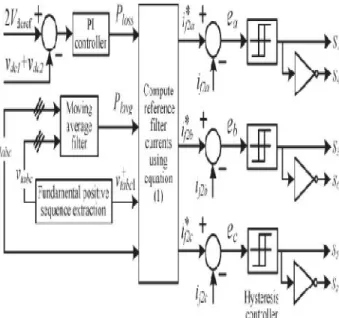
The overall control block diagram is shown in Fig. 3. The DSTATCOM is controlled in such a way that the source currents are balanced, sinusoidal, and in phase with the respective terminal voltages. In addition, average load power and losses in the VSI are supplied by the source. Since the source considered. here is non stiff, the direct use of terminal voltages to calculate reference filter
currents will not provide satisfactory compensation. Therefore, the fundamental positive sequence components of three-phase voltages are extracted to generate reference filter currents. The equations required for the control of a D –Statcom analyzed through SRF theory with PI controller.(1)
Fig 3 Controller block diagram.
IV.SIMULATION CIRCUITS AND RESULTS
4.1 SIMULATION BLOCK DIAGRAM
WITHOUT D-STATCOM/COMPENSATION:
International Journal of Science Engineering and Advance Technology, IJSEAT, Vol. 5, Issue 1
ISSN 2321-6905 January -2017
from waveforms, both the source currents and the PCC voltages contain switching frequency components of the VSI. The three-phase filter currents are shown in Fig. 5(c). The waveforms of voltages across upper and lower dc capacitors, as well as the total dc-link voltage, are presented in Fig. 5(d). The voltage across each capacitor is maintained at 520 V, whereas the total dc-link voltage is maintained at 1040 V using the PI controller. The source currents and PCC voltages are balanced and sinusoidal but contain significant switching harmonics ripple. Their percentage total harmonic distortions (THDs) are given (1). To accommodate power losses in the damping resistor, the source currents are slightly increased compared with the traditional topology. Moreover, the total dc-link voltage is maintained at 1040 V (same as the traditional scheme) to achieve load compensation.
Fig.4.1WITHOUT
D-STATCOM/COMPENSATION
4.2 SIMULATION RESULTS:
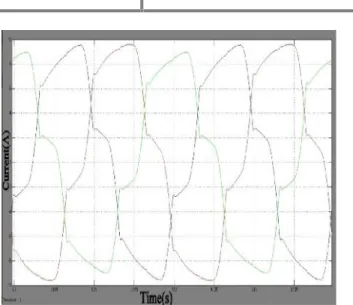
Fig.4.2 (a) wave form for Isa
Fig.4.2 (b) Source current:
Fig.4.2(C) PCC Voltage
4.3a SIMULATION BLOCK
International Journal of Science Engineering and Advance Technology, IJSEAT, Vol. 5, Issue 1
ISSN 2321-6905 January -2017
www.ijseat.com Page 138
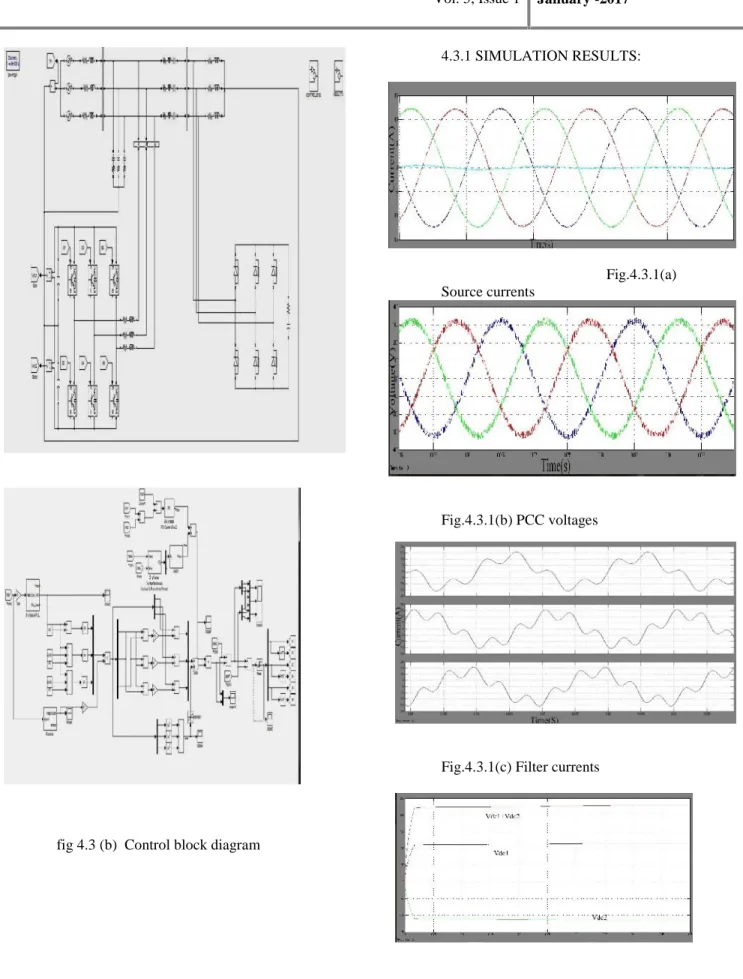
fig 4.3 (b) Control block diagram
4.3.1 SIMULATION RESULTS:
Fig.4.3.1(a) Source currents
Fig.4.3.1(b) PCC voltages
Fig.4.3.1(c) Filter currents International Journal of Science Engineering and Advance Technology, IJSEAT,
Vol. 5, Issue 1
ISSN 2321-6905 January -2017
www.ijseat.com Page 138
fig 4.3 (b) Control block diagram
4.3.1 SIMULATION RESULTS:
Fig.4.3.1(a) Source currents
Fig.4.3.1(b) PCC voltages
Fig.4.3.1(c) Filter currents International Journal of Science Engineering and Advance Technology, IJSEAT,
Vol. 5, Issue 1
ISSN 2321-6905 January -2017
www.ijseat.com Page 138
fig 4.3 (b) Control block diagram
4.3.1 SIMULATION RESULTS:
Fig.4.3.1(a) Source currents
Fig.4.3.1(b) PCC voltages
International Journal of Science Engineering and Advance Technology, IJSEAT, Vol. 5, Issue 1
ISSN 2321-6905 January -2017
Fig.4.3.1 (d) Voltage across the dc link
Fig.4.3.1 (e)Reduced Total Harmonic Distortion(4.96%)
5.1 SIMULINK BLOCK DIAGRAM OF PRAPOSED TOPOLOGY
5.2 Source currents and PCC voltages
5.3 Filter voltages
5.4 Reduced Total Harmonic Distortion(0.9%)
VI.CONCLUSION
In this project, design and operation of an improved hybrid DSTATCOM topology is proposed to compensate reactive and harmonics loads. The hybrid interfacing filter used here consists of an LCL filter followed by a series capacitor. This topology provides improved load current compensation capabilities while using reduced dc-link voltage and interfacing filter inductance. Moreover, the current through the shunt capacitor and the damping International Journal of Science Engineering and Advance Technology, IJSEAT,
Vol. 5, Issue 1
ISSN 2321-6905 January -2017
Fig.4.3.1 (d) Voltage across the dc link
Fig.4.3.1 (e)Reduced Total Harmonic Distortion(4.96%)
5.1 SIMULINK BLOCK DIAGRAM OF PRAPOSED TOPOLOGY
5.2 Source currents and PCC voltages
5.3 Filter voltages
5.4 Reduced Total Harmonic Distortion(0.9%)
VI.CONCLUSION
In this project, design and operation of an improved hybrid DSTATCOM topology is proposed to compensate reactive and harmonics loads. The hybrid interfacing filter used here consists of an LCL filter followed by a series capacitor. This topology provides improved load current compensation capabilities while using reduced dc-link voltage and interfacing filter inductance. Moreover, the current through the shunt capacitor and the damping International Journal of Science Engineering and Advance Technology, IJSEAT,
Vol. 5, Issue 1
ISSN 2321-6905 January -2017
Fig.4.3.1 (d) Voltage across the dc link
Fig.4.3.1 (e)Reduced Total Harmonic Distortion(4.96%)
5.1 SIMULINK BLOCK DIAGRAM OF PRAPOSED TOPOLOGY
5.2 Source currents and PCC voltages
5.3 Filter voltages
5.4 Reduced Total Harmonic Distortion(0.9%)
VI.CONCLUSION
International Journal of Science Engineering and Advance Technology, IJSEAT, Vol. 5, Issue 1
ISSN 2321-6905 January -2017
www.ijseat.com Page 140
power losses are significantly reduced compared with the
LCL filter-based DSTATCOM topology. These contribute
significant reduction in cost, weight, size, and power rating of the traditional DSTATCOM topology .A cascaded multilevel inverter D-STATCOM significantly reduces the total harmonic distortion in this project. Effectiveness of the proposed topology has been validated through extensive MATLAB simulation.
REFERENCES
[1] Chandan Kumar, Student Member, IEEE, and Mahesh K. Mishra,
Senior Member, IEEE” An Improved Hybrid DSTATCOM Topology to
Compensate Reactive and Nonlinear Loads” IEEE TRANSACTIONS ON INDUSTRIAL ELECTRONICS, VOL. 61, NO. 12, DECEMBER 2014.
[2] S. Ostroznik, P. Bajec, and P. Zajec, “A study of a hybrid filter,”IEEE Trans. Ind. Electron., vol. 57, no. 3,
pp. 935–942, Mar.2010.
[3] A. Ghosh and G. F. Ledwich, Power Quality
Enhancement Using Custom Power Devices.. Norwell,
MA, USA: Kluwer, 2002.
[4] H. Hu, W. Shi, Y. Lu, and Y. Xing, “Design
considerations for DSPcontrolled 400 Hz shunt active
power filter in an aircraft power system,” IEEE Trans. Ind. Electron, vol. 59, no. 9, pp. 3624–3634, Sep. 2012. [5] B. Singh and S. Arya, “Back-propagation control algorithm for power quality improvement using
DSTATCOM,”IEEE Trans. Ind. Electron., vol. 61, no. 3,
pp. 1204–1212, Mar. 2014.
[6] B. Singh and S. Arya, “Implementation of single -phase enhanced -phase locked loop-based control algorithm for three-phase DSTATCOM,” IEEE Trans. Power Del., vol. 28, no. 3, pp. 1516–1524, Jul. 2013. [7] J. Liu, P. Zanchetta, M. Degano, and E. Lavopa,
“Control design andimplementation for high performance shunt active filters in aircraft power grids,”IEEE Trans. Ind. Electron., vol. 59, no. 9, pp. 3604–3613, Sep. 2012. [8] M. Singh, V. Khadkikar, A. Chandra, and R. Varma,
“Grid interconnection of renewable energy sources at the distribution level with powerquality improvement
features,” IEEE Trans. Power Del., vol. 26, no. 1, pp.
307–315, Jan. 2011.
[9] A. Bhattacharya and C. Chakraborty, “A shunt active
power filter with enhanced performance using
ANN-based predictive and adaptive controllers,” IEEE Trans. Ind. Electron., vol. 58, no. 2, pp. 421–428, Feb. 2011. [10] R. Inzunza and H. Akagi, “A 6.6-kv Transformerless shunt hybrid active filter for installation on a power
distribution system,” IEEE Trans. Power Electron., vol.
20, no. 4, pp. 893–900, Jul. 2005.
[11] B. Singh and S. Sharma, “Design and
implementation of four-leg voltage source- converter-based VFC for autonomous wind energy conversion
system,”IEEE Trans. Ind. Electron., vol. 59, no. 12, pp.
4694–4703, Dec. 2012.
[12] P. Kanjiya, V. Khadkikar, and H. Zeineldin, “A non
iterative optimized algorithm for shunt active power filter under distorted and unbalanced supply voltages,” IEEE Trans. Ind. Electron., vol. 60, no. 12, pp. 5376–5390, Dec. 2013.
[13] S. Rahmani, N. Mendalek, and K. Al-Haddad,
“Experimental design ofa nonlinear control technique for