Abstract
In the evaluation of undergraduate and grad-uate study programs, there is an important issue about which competencies must be acquired by graduates. This study tested the importance of competencies in public administration study pro-grams in the light of expectations of employers in Slovenian public administration. The aim of the research was to fi nd out how various competen-cies acquired in higher education (undergradu-ate and gradu(undergradu-ate study in public administration) are evaluated by employers in public adminis-tration. On the basis of analysis of fi ndings of similar research projects, the competencies con-tained in programs by renowned universities and competencies defi ned for the work positions, a set of discipline-specifi c competencies (61) were designed. Research was conducted in 2015 and involved 343 respondents. A qualitative re-search method (survey) was used to collect the data which were then analyzed with the SPSS statistical program and Microsoft Excel. The re-sults show that the competencies related to eth-ics and ethical behavior were evaluated as the most important; generic competencies are better assessed than specifi c ones and on average the competencies received a higher assessment for graduates (compare to undergraduates) posi-tions.
Keywords: competencies, public adminis-tration, employers, study programs, higher edu-cation.
REQUIRED COMPETENCIES
IN PUBLIC ADMINISTRATION
STUDY PROGRAMS
Janez STARE
Maja KLUN
Janez STARE (corresponding author) Associate professor, Faculty of Administration, University of Ljubljana, Ljubljana, Slovenia Tel.: 00386-1-5805.585
E-mail: [email protected]
Maja KLUN
Professor, Faculty of Administration, University of Ljubljana, Ljubljana, Slovenia Tel.: 00386-1-5805.547
E-mail: [email protected]
Transylvanian Review
1. Introduction
The concept of quality in higher education has been drawing att ention of all in-terested parties in the education sector over the last few decades (Tasopoulou and Tsiotras, 2017). Both universities and employers, with the renewal of higher educa-tion programs (as a consequence of the Bologna process), gave special emphasis to competencies. A competence based approach could be considered as an att empt to make higher education institutions more standardized, comparable, accountable and cost-eff ective (Želvys and Akzholov, 2016). This raises the question of what com-petencies are, and which, from the perspective of employers, provide the expected ‘standardized’ qualifi cations. There are two views of ‘examining’ competencies: ex-amining competencies in actual work practice and exex-amining competencies in edu-cational programs. Despite the diff erent defi nitions of the concept of competencies in work and competencies in educational programs, the idea is that the study programs should primarily develop those competencies that the working environment recog-nizes as important. Despite the large variety of defi nitions of the concept of competen-cy, all competency involves knowledge, procedure and att itudes combined towards one goal, head knowledge (understanding), know-how (skills, abilities, aptitudes and capabilities), knowing how to be (att itudes), knowing what to be like (beliefs and val-ues), and being able to do (means and resources) (Martínez, Moreno and Brage, 2014).
Higher education programs in the fi eld of public administration must provide not only discipline-specifi c fundamental knowledge but also the general competencies required by the labor market. In the context of our research, two research questions were examined:
– Which competencies do employers expect from public administration graduates? – Are diff erent competencies expected for positions requiring a diff erent level of
education (undergraduate or graduate degree)?
The following section starts with a literature review on the determination of com-petencies in higher education. The next section defi nes the competencies collected from the diff erent sources and continues by presenting the research methodology and results. In conclusion, the importance of the fi ndings of the study is presented.
2. The acquisition of competencies in higher education
Several authors suggest that there has been limited academic research into the re-lationship between higher education institutions and organizations with regard to competencies that are linked to placements or a study degree or academic discipline (Frasquet, Calderón and Cervera, 2012; Plewa and Quester, 2007). Nevertheless there are also several studies that include the opinions of professionals or employers on the required competencies in diff erent disciplines (Frasquet, Calderón and Cervera, 2012; Boni and Lozano, 2007; Clemente-Ricolfe and Escribá-Pérez, 2013; Borza and Crișan, 2012; Oduma and Ile, 2012; Profi roiu, 2013; Martínez, Moreno and Brage, 2014; Varga, Hajós and Szira, 2016). In most cases, studies highlighted the increasing importance of general knowledge and competencies and the general competencies seem to be even more important than specifi c ones (Brown and Smetherham, 2006; Azevedo et al., 2012; European Commission, 2010). On the other hand, Jurše and Tominc (2008) and, for some specializations, the European Commission (2010) found that profes-sional competencies are slightly more elevated than general competencies.
According to diff erent research (Kuijpers and Meijers, 2012; Kuijpers and Scheer-ens, 2006; Savickas, 2000; GiddScheer-ens, 1991), the individual is expected to demonstrate increasing self-directedness, both on the labor market and in society as a whole. As a result of the trend, diff erent authors pointed out the importance of changing teaching methods (Kuijpers, Schyns and Scheerens, 2006; Winterton, 2009; Vila, Perez and Mo-rillas, 2012; Avargil et al., 2012; Gómez, Aranda and Santos, 2017) to more proactive and problem-based learning.
In the workplace, we use our competencies to perform a variety of behaviors and activities, which in turn generate outputs (products and services) that we provide to others. It is the quality of these outputs and the reactions of those who receive them that lead to results with positive, negative or neutral consequences for the organiza-tions: the people who work there and its suppliers, shareholders, clients and custom-ers (Picket, 1998, p. 103). The identifi cation and assessment of competencies, as well as the development of competency-based management frameworks to support activ-ities such as ‘gap analysis’, recruitment, learning and other key human resource pro-cesses, all refl ect an acknowledgement by organizations that their workforce is key to their success in the modern workplace (Bonder, Bouchard and Bellemare, 2011, p. 2).
3. Determination of the set of competencies
their study programs and try to meet higher standards which are defi ned diff erently, either as requirements for the acquisition of sectorial accreditations or in the form of recommendations of the authority in the fi eld. For this reason, we decided to use a long list of general competencies that usually, in other research, give a more compre-hensive evaluation and bett er contribute to public administration studies. In order to determine the set of competencies, the competencies from diff erent sources were used:
– competencies highlighted as important by the projects to date and peer associ-ations (TUNING: project which has developed into a process, an approach to (re)designing, developing, implementing, evaluating and enhancing quality of
fi rst, second and third cycle degree programs, EAPAA: The European Associa-tion for Public AdministraAssocia-tion AccreditaAssocia-tion, NASPAA: Network of Schools of Public Policy, Aff airs and Administration, IASIA: The International Association of Schools and Institutes of Administration);
– competencies identifi ed as the most important in theoretical contributions in the studied fi eld and highlighted as important by renowned universities in their study programs (EAPAA, NASPAA, IASIA accredited programs and other high-er education programs in the fi eld of administrative sciences); and
– competencies highlighted in actual work practice to defi ne the work (systemati-zation).
The results of the Tuning project represent one of the starting points of our re-search, serving in particular as a starting point for compiling a set of competencies. Connecting over 100 European universities, the project is aimed at developing con-crete suggestions for implementing the Bologna process at the level of higher educa-tion institueduca-tions and individual subject fi elds. Tuning (2016) has designed a method-ology for the (re)shaping, development, introduction and evaluation of study pro-grams for each of the three Bologna cycles. When it comes to the subject fi elds, one of the fi ve sets selected was the fi eld of generic and subject-specifi c competencies. Tuning distinguishes between three forms of generic competencies:
– instrumental or applicable competencies: cognitive, methodological, technologi-cal and linguistic abilities;
– interpersonal competencies: the abilities of an individual, such as the ability to behave in society and to cooperate; and
– systemic competencies: skills and abilities that concern entire systems (a combi-nation of understanding, susceptibility, knowledge and the necessary previously obtained knowledge and interpersonal competencies).
In order to determine the most important generic competencies for each academic
the skills of analysis, synthesis, learning and problem-solving were identifi ed as the most important in all fi elds. Other generic competencies such as the skill of apply-ing knowledge in practice, the skill of adaptapply-ing to new situations, the concern for quality, the ability to manage information, the skill of independent work, the skill of teamwork, the skill of organization, spoken and writt en communication in the moth-er tongue and intmoth-erpmoth-ersonal skills wmoth-ere described mainly by graduates and employ-ers as highly important for employability. Graduates and employemploy-ers also found that some of the above competencies are more useful and bett er developed than others. They highlighted the fact that more att ention should be devoted to a specifi c number of generic competencies to ensure that students are bett er prepared for their future positions. The results of this extensive discussion were presented in the project report after the fi rst stage (Gonzales and Wagenaar, 2003; Gonzales and Wagenaar, 2005).
‘The aim of the Tuning project was to contribute to the main objectives of the Bo-logna process by the transformation of traditional degrees into bachelor and master degrees and the reconstruction of the logic of their underlying study programs. Tun-ing aimed to implement the Bologna process at a university level and concentrated on transparency and the development of a common language in the description of HE programs, not least to enhance comparability and to foster their international recog-nition’ (Lokhoff et al., 2010, p. 11).
However, still more important for our research is the Tuning-PA project, which is inspired by the Tuning Project. Tuning-PA, which was carried out under the Euro-pean Association for Public Administration Accreditation (EAPAA) aimed to arrive at a set of competencies that are relevant for Public Administration degree programs in Europe, and that can be used by programs to articulate their specifi c aims and objectives. In this project, a set of 31 generic competencies (Tuning Generic Compe-tencies) where developed and tested (in the sense of their relevance for academic jobs for graduates and realization in certain degree programs) in more than 10 disciplines and in more than 15 countries through questionnaires for employers, graduates and academics (Reichard and van der Krogt, 2014).
In the area of improving the quality of public administration education, there is, in addition to the EAPAA ‘covering’ the European space, another important institution in the Network of Schools of Public Policy, Aff airs and Administration (NASPAA). In the accreditation procedure for education in public administration, the NASPAA cov-ers various competence aspects. The majority of the information regarding the com-petencies required under the NASPAA standard can be gleaned from the provisions of Standard 5 (Standard 5 Matching Operations with the Mission: Student Learning). The required knowledge includes fi ve areas of abilities (NASPAA, 2014):
– for management and governance in the public sector; – for cooperation and active contribution to policy-making;
– for analysis, synthesis, critical thinking, problem-solving and decision-making; – for articulating and applying public service visions; and
In addition to the generic competencies, the NASPAA also requires the formation of specifi c competencies that refl ect the environment or orientation of the educational institution. This may include knowledge of local government, non-profi t administra-tion, budget, fi scal policy and analysis, etc. Similar to the IASIA, ICAPA accreditation (ICAPA is the International Commission on the Accreditation of Public Administra-tion EducaAdministra-tion and Training Programs) expects several generic competencies from studies in public administration, such as professional competence regarding values, ethical behavior, knowledge, respect for life, transparency, accountability, recogni-tion of global interdependence, analytical and critical thinking, dealing with com-plexity and uncertainty, etc. (ICAPA Accreditation, 2008).
The second part of the study of competencies includes the competencies of study programs. The set of study programs taken into account when collecting competen-cies was assembled on the basis of publicly available information from the faculty web pages. Study programs were selected from the list of EAPAA, NASPAA and IASIA accredited programs. At the same time, an overview of some other programs (totaling 12) through general internet searches using keywords such as ‘Adminis-trative Science’, ‘Public Administration’, ‘Public Management’ and ‘Public Policy’ was performed. The focus was mainly on European higher education institutions but also included some US and Canadian universities in the set for comparison. The main focus was on study programs whose contents place them at the very top of public policy and public governance research and development1. In total the compe-tencies of 49 fi rst and graduate programs were examined. Study programs place con-siderable emphasis on developing competencies for the development and indepen-dence of students in analyzing, problem-solving and fi nding practical solutions. The study programs at most higher education institutions give graduates expert com-petencies and a broad understanding of public administration; graduates are able to defi ne public sector issues, perform quantitative and qualitative data analyses, develop and provide creative solutions and introduce implementation and ethical measures. Some competencies appear in all international study programs (e.g. the ability to analyze, an understanding of PA operation, research work, writt en and spoken communication, etc.).
Study program competencies at the individual cycle/level of education are entire-ly comparable and there are no major deviations. However, considerable diff erences exist in the vertical cycle of education. For example, undergraduate study programs (1st cycle study programs according to the Bologna process) give students general PA knowledge with a certain level of detail. Competencies common in undergraduate
study programs include a knowledge of legal, environmental and ethical issues in individual fi elds, an understanding of PA tradition and the main related theories, the ability to analyze public opinion and form public policies, the ability of nego-tiation, research, discussion, rhetoric, listening, confl ict situation management, etc. In addition to in-depth theoretical knowledge, graduate programs (2nd cycle study programs according to the Bologna process) also provide other competencies, partic-ularly problem-solving, complex analysis, the use of research methods, etc.
An important aspect in determining the desired (necessary, required) competen-cies are the competencompeten-cies arising from the concrete nature of work. This is the third part of the study of competencies. In the studied case, this primarily means compe-tencies arising from the descriptions of typical offi cial positions in Slovenian public administration and selected typical Slovenian Local Communities (according to the number of employees). Based on this, two analyses were prepared: an analysis of the document entitled ‘Descriptions of Typical Offi cial Positions’ and an analysis of typical offi cial positions based on the Systemization of selected Individual Local Communities. In both analyses of typical offi cial positions, we included only the po-sitions open to graduates of PA study programs: offi cial titles in public administra-tion, local community administrations and other state authorities, positions in public agencies, public funds, other public institutes, public economic institutes and other budget users and related positions. The results of both analyses were combined into a common document that solely included positions where a fi rst or graduate degree is required. In the fi rst stage of the analysis, a list of the tasks (including knowledge and skills) required for each offi cial position was prepared. Having analyzed the typical tasks (e.g., managing and coordinating the work of the state authority em-ployees, preparing general acts and other expert and organizational material and instructions from the state authority, etc.), in the second stage, a list was compiled with the competencies necessary for performing these tasks. The analysis of the tasks and the set of necessary competencies show that the typical competencies are related to the following:
– the ability to organize mutual cooperation, coordinate internal organizational units and cooperate with other authorities;
– the ability to participate in developing systemic solutions and other material of the highest complexity;
– the ability to independently prepare demanding analyses, development projects, information, reports and other complex material;
– the ability to manage and make decisions in demanding administrative proce-dures;
– the ability to manage the most demanding administrative procedures; – the ability to communicate;
– the ability to lead people and teams; and
The study of all the mentioned sources of competencies (study programs, accredit-ed programs, peer associations, systematizations) was a base for determining the list of competencies analyzed in our research.
4. Methodology
Based on the list of competencies from the above-mentioned sources, a set of com-petencies that we wanted to verify with potential employers was created. The set comprised over 1,600 competencies (including skills, desirable behaviors and knowl-edge), of which about 290 were acquired from theoretical contributions (TUNING (Tuning, 2016; Evenson, 2012; European Commission, 2002)), EAPAA (van der Krogt and Reichard, 2013; Reichard and van der Krogt, 2014; NASPAA (NASPAA, 2009), IASIA (United Nations Department of Economic and Social Aff airs, 2008), approxi-mately 940 from diff erent study programs and approximately 380 of them were high-lighted in actual work practice (Uredba, 2003).
When compiling the common set of competencies, all the related competencies were combined into a single competency. If for instance, a description of a position of employment required the ability to conduct police control, tax control, etc., the competence was determined as ‘the ability to conduct control’. Thus, competencies from diff erent sets were combined into logical units. The competencies that appeared in only a single set were preserved and not combined into units. The combining was mainly possible with generic and general competencies. The subject-specifi c com-petencies were related to specifi c abilities and mostly to specifi c positions requiring specifi c knowledge. In order to avoid an excessive set of specifi c competencies, thus reducing the possibility of accurately completed surveys, specifi c competencies were included in the survey by giving the respondents the option to evaluate the impor-tance of knowledge in the areas taught in the public administration programs. These areas include economics, management, HR management, law, public policies and fi -nally information systems and web portals. Using this method, a set of 55 generic or general competencies were compliant and, additionally, six areas were determined.
Based on the set of competencies, the survey questionnaire was prepared. The questionnaire included closed-ended questions, while the fi nal two questions were open-ended (the number of employees in the institution and the respondents’ general opinion on competencies). The fi rst two questions related to the determination of the type of position (study degree/cycle of education and type of job). The respondents chose from a set of education and employment options. This was followed by an eval-uation of the competencies from 1 (I disagree completely) to 5 (I agree completely). The respondents were asked to assess the skills and abilities that an individual, per-forming the same work as the participant, should have in order to be described as an ideal employee. This was followed by demographic questions on the age, gender and the institution of employment.
offi ce, with a request to distribute it among the employees who are either experts in the fi eld or HR experts). The survey was conducted from December 2014 to May 2015. There were 343 responses received.
5. Research results
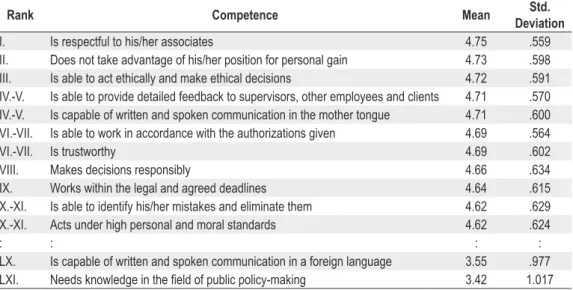
The average assessments of the importance of individual competencies according to the position of an employee are analyzed in three ways: together for 1 and 2 cycle degrees, and separately for undergraduate and graduate degrees. The average assess-ment of each competence based on all the participant responses showed (Table 1) that the competencies related to ethics and ethical behavior were assessed the highest. The competency of communicating in the mother tongue was also assessed very high. The lowest average assessment was given to competencies related to specifi c areas or knowledge, communication in a foreign language and working in an international environment. The highest rated competence was ‘Is respectful to his/her associates’ (4.75), the lowest one ‘Needs knowledge in the fi eld of public policy-making’ (3.42). The diff erence between the highest and the lowest rated competence is 1.33. Table 1 shows the highest (with an average grade of the maximum to -10% diff erence) and the lowest ranked (with an average grade of the minimum to + 10% diff erence) aver-age assessments of competencies.
Table 1: The highest and lowest ranked average assessments of competencies
Rank Competence Mean Std.
Deviation
I. Is respectful to his/her associates 4.75 .559
II. Does not take advantage of his/her position for personal gain 4.73 .598 III. Is able to act ethically and make ethical decisions 4.72 .591 IV.-V. Is able to provide detailed feedback to supervisors, other employees and clients 4.71 .570 IV.-V. Is capable of written and spoken communication in the mother tongue 4.71 .600 VI.-VII. Is able to work in accordance with the authorizations given 4.69 .564
VI.-VII. Is trustworthy 4.69 .602
VIII. Makes decisions responsibly 4.66 .634
IX. Works within the legal and agreed deadlines 4.64 .615
X.-XI. Is able to identify his/her mistakes and eliminate them 4.62 .629 X.-XI. Acts under high personal and moral standards 4.62 .624
: : : :
LX. Is capable of written and spoken communication in a foreign language 3.55 .977 LXI. Needs knowledge in the fi eld of public policy-making 3.42 1.017
Source: Survey among employers
de-gree, while 213 respondents have (had) a graduate degree or higher. The distinction between degrees is important in terms of research since employment at a particular workplace (thus also performing diff erent levels of work tasks) depends on the cycle of completed education.
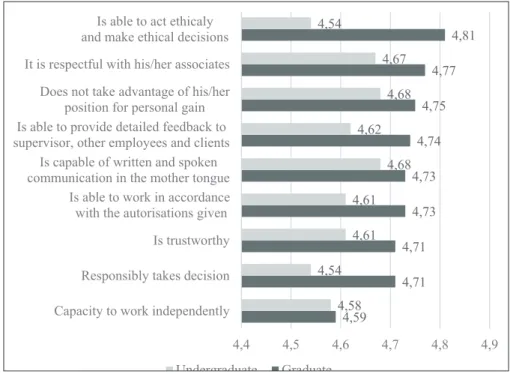
The highest evaluated competencies for each cycle of study are shown separately for each group in the fi gure below (Figure 1). The results show that the highest evalu-ated competencies for both cycles of study are similar, though there are diff erences in the average assessment of competencies.
4,59
4,71 4,71 4,73 4,73 4,74
4,75 4,77
4,81
4,58 4,54
4,61 4,61
4,68 4,62
4,68 4,67 4,54
4,4 4,5 4,6 4,7 4,8 4,9
Capacity to work independently Responsibly takes decision Is trustworthy Is able to work in accordancH with theautorisations given Is capable of written and spoken communication in the mother tongue Is able to provide detailed feedback to supervisor, other employees and clients
Does not take advantage of his/her positionfor personDO gain It is respectful with his/her associates
Is able to act ethicaly and make ethicaldecisions
Undergraduate Graduate
Figure 1: The highest average competency assessments based on the different cycles of education (the 7 highest for each level of education)
Source: Survey among employers
14 7 7 5 5 4 3 2 1
7 11 6 5 2 4 1 3
10
Capacity to work independently Responsibly takes decision Is trustworthy Is capable of written and spoken communication in the mother tongue Is able to provide detailed feedback to supervisor, other employees and clients
Does not take advantage of his/her SRVLWLRQfor personDO gain Is respect to his/her associates
Is able to act ethicaly and make ethicaldecisions
Is able to work in accordancH with theautorisations given
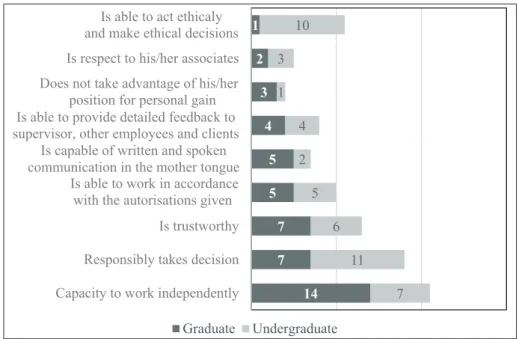
Figure 2: The highest rank of average competency assessments based on the cycle of education Source: Survey among employers
An analysis of the incidence of Tuning-PA competencies (31 competencies) in terms of the rank of researched competencies (from 1 to 61) was also performed. Tuning-PA competencies have been chosen because they are the most widespread competencies in higher education programs in the European area. The competencies studied in the research were divided into four groups according to the range. In the
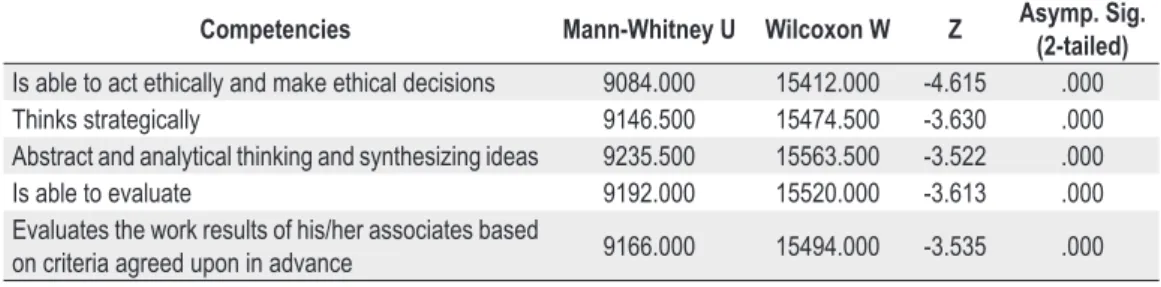
anal-ysis, evaluation and the assessment of associates. In addition, it is evident from the responses that people with a higher education who also hold higher positions give a higher assessment of the importance of ethical behavior, although this is a compe-tence already highly assessed by all respondents.
Table 2: Mann-Whitney U test results
Competencies Mann-Whitney U Wilcoxon W Z Asymp. Sig. (2-tailed)
Is able to act ethically and make ethical decisions 9084.000 15412.000 -4.615 .000
Thinks strategically 9146.500 15474.500 -3.630 .000
Abstract and analytical thinking and synthesizing ideas 9235.500 15563.500 -3.522 .000
Is able to evaluate 9192.000 15520.000 -3.613 .000
Evaluates the work results of his/her associates based
on criteria agreed upon in advance 9166.000 15494.000 -3.535 .000 Source: Survey among employers
The assessment of specifi c competencies was not statistically diff erent between both groups; nevertheless, the knowledge in the fi eld of economics, management, human resource management and policy-making were evaluated higher for higher positions in public administration, while specifi c competencies in the fi eld of public sector regulation and e-government were evaluated lower.
The other correlation tests, such as the infl uence of gender, age, the size of the institution and the type of institution did not show statistically proven correlations. This is in accordance with the second research question that the position of the em-ployee is the determining factor for the required competency.
6. Discussion
linked to recent political ‘scandals’ in Slovenia and in the EU, which could infl uence the opinion of the surveyed civil servants.
The results of the research are somewhat surprising in the case of the lowest as-sessed competencies. These are related to the ability to work in the international en-vironment, knowledge in the fi eld of public policy making and business economics, the ability to engage in entrepreneurial activity, leadership, management and control in public administration. In some other studies these competencies or competencies that are more directly related to leadership, management and/or public governance are more exposed (Forgues-Savage and Wong, 2017; Shevchenko, 2016; Melnikova, 2013; Clark and Pal, 2011).
According to the highest assessed competencies, the main diff erence in the per-ception of competency seems to be in the relationship between generic and specifi c competencies. Generic competencies seem to be more important to respondents. Such evaluation is expected since mentioned competencies are more important in terms of changing the working environment and jobs. It was similarl also to other research (ie., Manly, McKnight and Thomas, 2008; Lowden et al., 2011; NCVER, 2003). A log-ical explanation for the low assessed competencies related to foreign language ac-tivities is that the majority of respondents come from organizations that mostly do business with ‘domestic’ customers and rarely with customers abroad. In addition to other studies (Civil Services Human Resources, 2015; American Public Health Asso-ciation, 2001; Lee, 2008), the presented results showed that some specifi c knowledge is more important for undergraduate studies (competencies needed for practice, PA operation and legal acts) compared to graduate studies (economics, HR management, policy-making). At the same time, there are some competencies that are statistically diff erent and more important for higher positions (analytical and strategic thinking, ethical decision making, and evaluation capabilities).
Tuning-PA (Reichard, and van der Krogt, 2014) also highlights the importance of generic competencies. However, it is true that Tuning-PA competencies have been assessed worse than most other generic competencies analyzed in this project. The
fi ndings can also be reasonably linked to the Workforce Planning Resource Guide of Public Sector Human Resource Professionals (IPMA-HR, 2005), which defi nes com-petencies as ‘sets of behaviors (encompassing skills, knowledge, abilities and person-al att ributes) that, taken together, are critical to accomplishing successful work and achieving an organizational strategy’. In their model, they defi ne the functional level, which means that competencies cascade from the core competencies and are associat-ed with specifi c work functions or business units. According to the results, it would be interesting to check whether this would be confi rmed by further analysis of the specifi c competencies of individual subjects.
7. Conclusion
com-petencies that (1) emphatically emphasize theoretical contributions, from the results of previous projects and from ‘professional’ accreditation associations, (2) are list-ed in the study programs of renownlist-ed universities, and (3) are exposlist-ed to concrete working practice. Altogether more than 1,600 perceived competencies were detected. By analyzing the above set of competencies, a lot of substantive coherence was iden-tifi ed among individual competencies, therefore it was possible to perform a certain unifi cation. The result is that 61 competencies link ‘theory’ and ‘practice’ in the area of education or functioning in administration. The list includes competencies that are summarized from those jobs that require an undergraduate or graduate study degree in the fi eld of public administration. The study, therefore, demonstrates the devel-opment of the necessary competencies for education in the fi eld of administrative sciences. The results show a signifi cant match in the ranks of competencies studied and the importance of generic competencies. Along with other research, in our study, general competencies seem to be more important than specifi c ones.
Based on the expected ‘standardization’ of knowledge (competencies) that arises from the accreditation criteria and international standards (mainly from the two most important accreditation institutions for the fi eld of public administration education, the EAPAA and NASPAA), a set of competencies is used in diff erent environments. However, even though a set of competencies has been expanded with competencies from our preliminary study, similar research should also be carried out in other coun-tries. On the basis of the results obtained, potential diff erences in employers’ views could be identifi ed (their assessment of which competence would be appropriate to develop in the public administration study programs for undergraduate and grad-uate students). A comparison between countries would show potential diff erences in desirable competencies. In this way, the adequacy of the defi nition of the compe-tencies required in the study programs by (accredited) accreditation organizations could also be checked. All these would encourage an even greater need to use compe-tence-based learning in study programs.
References:
1. American Public Health Association, ‘Environmental Health Competency Project: Recommendations for Core Competencies for Local Environmental Health Practi-tioners’, National Center for Environmental Health, Centers for Disease Control and Prevention, May 2001, [Online] available at htt ps://www.cdc.gov/nceh/ehs/corecomp/ core_competencies_eh_practice.pdf, accessed on December 23, 2017.
2. Avargil, S., Herscovitz , O. and Dori, Y.J., ‘Teaching Thinking Skills in Context-based Learning: Teachers’ Challenges and Assessment Knowledge’, 2012, Journal of Sciences Education and Technology, vol. 21, no. 2, pp. 207-225.
3. Awortwi, N., ‘Building New Competencies for Government Administrators and Man-agers in an Era of Public Sector Reforms: The Case of Mozambique’, 2010, International Review of Administrative Sciences, vol. 76, no. 4, pp. 723-748.
Under-graduate Business Education with Industry Requirements’, 2012, The International Journal of Management Education, vol. 10, no. 1, pp. 12-28.
5. Bonder, A., Bouchard, C.D. and Bellemare, G., ‘Competency-Based Management – An Integrated Approach to Human Resource Management in the Canadian Public Sector’, 2011, Public Personnel Management, vol. 40, no. 1, pp. 1-10.
6. Boni, A. and Lozano, J.F., ‘The Generic Competencies: An Opportunity for Ethical Learning in the European Convergence in Higher Education’, 2007, Higher Education, vol. 54, no. 6, pp. 819-831.
7. Borza, A. and Crișan, C., ‘Employers’ Expectations: Competencies of Entrepreneurs versus Competencies of Graduates of Higher Education’, 2012, Quality Assurance Re-view for Higher Education, vol. 4, no. 2, pp. 29-40.
8. Brown, P. and Smetherham, C., ‘The Changing Graduate Labour. Market: A Review of the Evidence’, Technical Report for the Welsh Assembly, 2006, [Online] available at htt p://200.6.99.248/~bru487cl/fi les/libros/Tendencias/pdf/rr7-e.pdf, accessed on De-cember 22, 2017.
9. Civil Services Human Resources, ‘Civil Service Competency Framework 2012-2017’, 2015, [Online] available at htt ps://www.gov.uk/government/uploads/system/uploads/ att achment_data/fi le/436073/cscf_fulla4potrait_2013-2017_v2d.pdf, accessed on De-cember 23, 2017.
10. Clark, I.D. and Pal, L.A., ‘Master’s of Public Administration and of Public Policy: An Analysis of Academic Programs and Professional Competencies in Canada’, 2011, Cro-atian and Comparative Public Administration, vol. 11, no. 4, pp. 947-984.
11. Clemente-Ricolfe, J.S. and Escribá-Pérez, C., ‘Análisis de la Percepción de las Compe-tencias Genéricas Adquiridas en la Universidad’, 2013, Revista de Educación, no. 362, pp. 535-561.
12. European Commission, ‘Survey Eurobarometer: Employers’ Perception Considering Graduates Employability’, 2010, [Online] available at htt p://ec.europa.eu/public_opin-ion/fl ash/fl _304_en.pdf, accessed on December 22, 2017.
13. European Commission, ‘Tuning Educational Structure in Europe, Closing Confer-ence’, 2002, [Online] available at htt p://www.aic.lv/bolona/Bologna/Reports/projects/ Tuning/Tun_Book.pdf, accessed on December 22, 2017.
14. Evenson, W.E., ‘Strengthening Student Learning Through ‘Tuning’’, 2012, Journal of Science, Technology, Ethics and Policy, vol. 3, no. 1, pp. 18-24.
15. Forgues-Savage, L. and Wong, S., ‘Competency Management in Canada’s Core Public Administration’, Offi ce of the Chief Human Resources Offi cer, Treasury Board Secre-tariat in Canada, 2017, [Online] available at htt ps://soc.kuleuven.be/io/onderzoek/proj-ect/fi les/hrm27-country-report-canada.pdf, accessed on December 20, 2017.
16. Frasquet, M., Calderon, H. and Cervera, A., ‘University-Industry Collaboration from a Relationship Marketing Perspective: An Empirical Analysis in a Spanish University Higher Education’, 2012, The International Journal of Higher Education and Educational Planning, vol. 64, no. 1, pp. 85-98.
17. Giddens, A., Modernity and Self-identity: The Self and Society in the Late Modern Age, Lon-don: Polity Press, 1991.
19. Gonzales, J. and Wagenaar, R., ‘In Tuning Educational Structures in Europe: Final Re-port: Phase I’, University of Duesto and University of Groningen, 2003, [Online] avail-able at htt p://tuningacademy.org/wp-content/uploads/2014/02/TuningEUI_Final-Re-port_EN.pdf, accessed on December 22, 2017.
20. Gonzales, J. and Wagenaar, R., ‘Tuning Educational Structures in Europe II: Univer-sities’ Contribution to the Bologna Process’, University of Duesto and University of Groningen, 2005, [Online] available at htt p://tuningacademy.org/wp-content/up-loads/2014/02/Universities-Contribution_EN.pdf, accessed on December 22, 2017. 21. ICAPA Accreditation, ‘Standards of Excellence’, 2008, [Online] available at
www.ica-pa-accreditation.org/about-icapa/standards-of-excellence/, accessed on September 30, 2016.
22. IPMA-HR, ‘Certifi cation’, International Personnel Management Association for Hu-man Resources and Training Center of State Administration of Foreign Expert Aff airs, 2005, [Online] available at htt p://www.ipmahr.org/content.cfm?pageid=35, accessed on May 29, 2005.
23. Jurše, M. and Tominc, P., ‘Professional Competencies of Graduates as a Labour Market Mechanism for Aligning Business School Curriculum Reform with the Bologna Dec-laration Principles’, 2008, Journal of Contemporary Management Issues, vol. 13, no. 1, pp. 17-36.
24. Kuijpers, M. and Meijers, F., ‘Learning for Now or Later? Career Competencies among Students in Higher Vocational Education in the Netherlands’, 2012, Studies in Higher Education, vol. 37, no. 4, pp. 449-467.
25. Kuijpers, M., Schyns, B. and Scheerens, J., ‘Career Competencies for Career Success’, 2006, Career Development Quarterly, vol. 55, pp. 168-179.
26. Kuijpers, M.A.C.T. and Scheerens, J., ‘Career Competencies for the Modern Career’, 2006, Journal of Career Development, vol. 32, no. 4. pp. 303-319.
27. Lee, J.M., ‘Articulation of Undergraduate and Graduate Education in Public Health’, 2008, Public Health Reports, vol. 123, suppl. 2, pp. 12-17.
28. Lokhoff , J., Wegewijs, B., Durkin, K., Wagenaar, R., González, J., Isaacs, A.K., Donà dalle Rose, L.F. and Gobbi, M. (eds.), ‘A Tuning Guide to Formulating Degree Pro-gramme Profi les’, Bilbao, Universidad del Deusto, 2010, [Online] available at htt p:// www.unideusto.org/tuningeu/images/stories/documents/Tuning_Guide._Degree_ programme_profi les.pdf, accessed on December 22, 2017.
29. Lowden, K., Hall, S., Elliot D. and Lewin, J., ‘Employers’ Perceptions of the Employ-ability Skills of New Graduates’, University of Glasgow, 2011, [Online] available at htt ps://www.kent.ac.uk/careers/docs/Graduate_employability_skills%202011.pdf, ac-cessed on December 22, 2017.
30. Manly, S., McKnight, C.A. and Thomas, D.W., ‘Generic and Specifi c Skills: Stakehold-ers’ Perceptions and Evidence of Change’, 2008, Journal of Business Administration On-line, vol. 7, no. 1, [Online] available at htt ps://www.atu.edu/jbao/spring2008/manly_ mcknight_thomas_fi nal_version.doc, accessed on December 22, 2017.
31. Martínez, P.A.L., Moreno, J.J.M. and Brage, L.B., ‘Analysis of Professional Competen-cies in the Spanish Public Administration Management’, 2014, Journal of Work and Or-ganizational Psychology, vol. 30, no. 2, pp. 61-66.
33. NASPAA, ‘Accreditation Standards for Master’s Degree Programs’, 2009, [Online] available at htt ps://naspaaaccreditation.fi les.wordpress.com/2015/02/naspaa-accredi-tation-standards.pdf, accessed on December 10, 2017.
34. NASPAA, ‘Accreditation Standards. Commission on Peer Review and Accreditation’, 2014, [Online] available at htt ps://naspaaaccreditation.fi les.wordpress.com/2015/02/ naspaa-accreditation-standards.pdf, accessed on May 13, 2016.
35. NCVER, ‘Defi ning Generic Skills: At a Glance’, Adelaide, South Australia: The Nation-al Council for VocationNation-al Education Research, 2003, [Online] available at htt ps://www. ncver.edu.au/__data/assets/fi le/0020/4457/nr2102b.pdf, accessed on May 14, 2016. 36. Oduma, C.A. and Ile, C.M., ‘Leadership Competencies Desired by Employers of
Busi-ness Education Graduates for Eff ective Job Performance in Business Organizations’, 2012, African Research Review, vol. 6, no. 2, pp. 171-180.
37. Picket, L., ‘Competencies and Managerial Eff ectiveness: Putt ing Competencies to Work’, 1998, Public Personnel Management, vol. 27, no. 1, pp. 103-115.
38. Plewa, C. and Quester, P.G., ‘Key Drivers of University-Industry Relationships: The Role of Organisational Compatibility and Personal Experience’, 2007, Journal of Services Marketing, vol. 21, no. 5, pp. 370-382.
39. Profi roiu, A.G., ‘Lecturer and Student Perspective regarding Teaching Public Admin-istration in Romania’, 2013, Transylvanian Review of Administrative Sciences, Special Is-sue, pp. 141-155.
40. Reichard, C. and van der Krogt, T., ‘PA-Specifi c Competence Areas, Concept v2’, 2014, [Online] available at htt ps://docs.google.com/fi le/d/0B5JqxdPph9w_bUJrb3QxQWZ-TQ28/edit, accessed on October 10, 2014.
41. Rosenbaum, A., In Quest of Excellence: Approaches to Enhancing the Quality of Public Ad-ministration Education and Training, Bratislava: NISPAcee Press, 2015.
42. Savickas, M.L., ‘Career Development and Public Policy: The Role of Values, Theory, and Research’, in Hiebert, B. and Bezanson, L. (eds.), Making Waves: Career Development and Public Policy, Ott awa: Canadian Career Development Foundation, 2000, pp. 48-59. 43. Shevchenko, A., ‘The Essence and Structure of Masters’ of Public Administration Core
Competencies in the USA’, 2016, Comparative Professional Pedagogy, vol. 6, no. 3, pp. 62-68.
44. Tasopoulou, K. and Tsiotras, G., ‘Benchmarking towards Excellence in Higher Educa-tion’, 2017, Benchmarking: An International Journal, vol. 24, no. 3, pp. 617-634.
45. Tuning, ‘Tuning Methodology’, 2016, [Online] available at htt p://www.unideusto. org/tuningeu/images/stories/archivos/TUNING%20METHODOLOGY%20PARA%20 LA%20WEB.pdf, accessed on September 10, 2017.
46. United Nations Department of Economic and Social Aff airs, ‘Task Force on Standards of Excellence for Public Administration Education and Training’, Final Report, 2008, [Online] available at htt p://unpan1.un.org/intradoc/groups/public/documents/un-dpadm/unpan034307.pdf, accessed on December 22, 2017.
48. van der Krogt, T. and Reichard, C., ‘Competences and Learning Outcomes: The Tun-ing-PA Project, Version 5’, October 2013, [Online] available at htt ps://sites.google.com/ site/tuningpaproject/recent-uploaded-fi les/Downloads, accessed on December 22, 2017.
49. van Jaarsveldt, L.C. and Wessels, J.S., ‘Information Technology Competence in Under-graduate Public Administration Curricula at South African Universities’, 2015, Interna-tional Review of Administrative Sciences, vol. 81, no. 2, pp. 412-429.
50. Varga, E., Hajós, L. and Szira, Z., ‘The Examination of Relevant Competencies in the Labour Market from the Point of View of Employers’, 2016, ANNALS of Faculty Engi-neering Hunedoara – International Journal of EngiEngi-neering, vol. XIV, no. 2, pp. 155-159. 51. Vila, L.E., Perez, P.J. and Morillas, F.G., ‘Higher Education and the Development of
Competencies for Innovation in the Workplace’, 2012, Management Decision, vol. 50, no. 9, pp. 1634-1648.
52. Winterton, J., ‘Competence Across Europe: Highest Common Factor or Lowest Com-mon Denominator?’, 2009, Journal of European Industrial Training, vol. 33, no. 8/9, pp. 681-700.
53. Želvys, R. and Akzholova, A., ‘Challenges of Applying Competence-Based Learning in Higher Education’, 2016, Būsimųjų anglų kalbos mokytojų požiūris į savarankišką darbą