TRADE ADJUSTMENT ASSISTANCE
FOR WORKERS PROGRAM
REPORT TO THE COMMITTEE ON
FINANCE OF THE SENATE AND THE
COMMITTEE ON WAYS AND MEANS OF
THE HOUSE OF REPRESENTATIVES
The Department of Labor submits the following report on the Trade Adjustment Assistance (TAA) for Workers Program to the Committee on Finance of the Senate and Committee on Ways and Means of the House of
Representatives. Section 249B(d) of the Trade Act of 1974 requires the Department to submit an annual report
summarizing data collected by the Department on the TAA Program for the preceding Fiscal Year (FY). This report reflects data reported for FY 2015 and includes
TABLE OF CONTENTS
FIGURES AND TABLES INDEX ... 2
FY 2015 HIGHLIGHTS ... 4
I. PROGRAM DESCRIPTION ... 9
Reauthorization Changes and Operating Four Distinct Programs ... 9
Worker Group Eligibility for Petitions Filed in FY 2015 ... 11
II. PROGRAM LANDSCAPE ... 14
Petition Processing in FY 2015 ... 14
Industry Sectors in FY 2015... 17
Profile of New TAA Participants in FY 2015 ... 20
III. BENEFITS AND SERVICE RECEIVED ... 24
Benefits and Services Provided During FY 2015 ... 24
Enrollment in Training Waivers Issued in FY 2015 ... 25
Benefit and Service Information Collected at Program Exit... 27
IV. PERFORMANCE OUTCOMES ... 31
V. PROGRAM GUIDANCE ... 38
VI. FUNDING ... 40
National Aggregate Amount for Training and Other Activities ... 43
Distributions of FY 2015 Program Funds to States ... 44
Process for Providing Funds to States for TRA, ATAA, and RTAA ... 46
VII. CONCLUSION ... 49
APPENDIX A ... 50
APPENDIX B ... 53
FIGURES AND TABLES INDEX
Table 1: The Number, Percent, and Estimated Number of Workers Covered by Petitions Filed,
Certified, and Denied ... 14
Table 2: The Average Time for Processing Petitions ... 15
Table 3: FY 2015 Certified Petitions, Classified by the Basis for Certification ... 16
Figure 1: Number of Petitions Certified by Industry Sector in FY 2015 ... 17
Table 4: The Number of Petitions Certified and Denied in FY 2015 by Industry Sector ... 18
Table 5: FY 2015 Top 5 Industry Sectors for Post-TAA Participation Employment ... 19
Table 6: The Top 5 Industries for Reemployment by Manufacturing and Service Subsector in FY 2015... 19
Table 7: FY 2015 Demographics of New TAA Participants by Gender, Race, Pre-Program Educational Level, Age, and Employment Tenure ... 20
Table 8: FY 2015 Demographics of New TAA Participants Compared to the American Civilian Labor Force, by Gender, Race, Educational Level, Age, and Tenure ... 21
Table 9: FY 2011 to FY 2015 Rapid Response Rates ... 22
Figure 2: FY 2011 to FY 2015 Rapid Response Rates ... 23
Table 10: FY 2015 Participants Receiving Each Type of TAA Benefit or Service ... 24
Table 11: FY 2011 to FY 2015 Training Participation Trend ... 25
Table 12: The Number of Training Waivers Granted, Classified by Type of Waiver ... 26
Table 13: Percentage of Exiting TAA Participants by Program and Fiscal Year ... 27
Table 14: Training Exiters and Average Training Cost by Completion in FY 2015 ... 27
Table 15: FY 2011- FY 2015 Credentialing Rate ... 28
Figure 3: FY 2011 to FY 2015 Credentialing Rate... 28
Table 16: Average Duration of TAA Benefits and Services ... 29
Table 17: FY 2011 to FY 2015 ATAA and RTAA Participant Trends ... 30
Figure 4: FY 2011 to FY 2015 Percentage of Exiters Receiving ATAA or RTAA ... 30
Table 18: FY 2011 to FY 2015 Common Measures: Entered Employment Rate (EER), Employment Retention Rate (ERR), and Average Earnings (AE) ... 31
Figure 5: FY 2011 to FY 2015 Common Measure Results: Entered Employment Rate (EER),
Employment Retention Rate (ERR), and Six-Month Average Earnings (AE) ... 32
Table 19: FY 2015 Employment and Retention Rates by Age ... 33
Table 20: FY 2015 Earnings by Age ... 34
Table 21: FY 2015 Employment and Retention Rates by Education ... 35
Table 22: FY 2015 Earnings by Education ... 36
Table 23: FY 2015 Employment and Retention Rates by Training Received ... 36
Figure 6: FY 2015 Employment Rates by Training Received ... 37
Table 24: FY 2015 Earnings by Training Received ... 37
Table 25: Guidance Documents Issued ... 39
Table 26: FY 2015 Funds for Training and Other Activities Distributed to the States ... 41
Table 27: The Total Amount of Payments to the States in FY 2015 Used to Carry Out Training and Other Activities, Trade Readjustment Allowances (TRA), and Alternative Trade Adjustment Assistance/Reemployment Trade Adjustment Assistance (A/RTAA) ... 47
Table 28: Side-by-Side Comparison of TAA Program Benefits under the 2002 Program, 2009 Program, 2011 Program, and 2015 Program ... 50
Table 29: FY 2015 Petitions Filed, Certified, and Denied and Associated Estimated Number of Workers Covered by State ... 53
Table 30: FY 2015 Petitions Filed, Certified, and Denied and Associated Estimated Number of Workers Covered by State and Congressional District... 55
EXECUTIVE SUMMARY
The Trade Adjustment Assistance (TAA) program is a Federal program that offers benefits and services to workers whose employment has been adversely affected by foreign trade. The TAA program provides opportunities to obtain skills,
credentials, resources, and support to aid adversely affected workers to find sustainable employment through specific benefits: training, employment and case management services, job search allowances, relocation allowances, and income support in the form of Trade Readjustment Allowances (TRA). Reemployment TAA (RTAA) and Alternative TAA (ATAA) provide wage supplements for reemployed older workers whose reemployment resulted in lower wages than those earned in their trade-affected employment.
In FY 2015 (October 1, 2014-September 30, 2015), an estimated 57,631 workers became eligible for TAA benefits and services. The TAA program served 47,335 participants during FY 2015 and 54 percent of those participants received training during the year. Nearly 90 percent of those who completed training received a credential.
Performance outcomes for FY 2015 exceeded previous years, with 74 percent of TAA participants obtaining employment within three months of completing the program.
On June 29, 2015, the TAA program was reauthorized by the Trade Adjustment Assistance Reauthorization Act of 2015 (TAARA 2015), which also changed group eligibility criteria for program participation and the benefits and services available to TAA participants.
This report addresses the TAA operations of the Department of Labor (the “Department”) both before and after passage of the TAARA 2015, as well as benefits and services provided under the four distinct versions of the TAA program currently being administered. Appendix A provides a comparison of benefits among the versions of the program being administered by the Department. Appendices B and C provide a State-by-State, and an individual Congressional District, (respectively), breakdown of FY 2015 petitions filed, certified, and denied,
FY 2015
HIGHLIGHTS
Greater Access to Benefits and Services• An estimated 57,631 workers became eligible for TAA benefits and services.
• 66 percent of new TAA participants received Rapid Response services. • Nearly 54 percent of TAA participants received training during FY 2015. • Nearly 90 percent of TAA participants who completed training received a credential. Improved Performance Outcomes • 74 percent of TAA participants who exited the program found new
employment within three months.
• Over 92 percent of TAA participants who were employed in the first 3 months after exit were still employed six months later.
along with the associated estimated number of workers covered.
SUCCESS STORIES
In November 2013, Brandon lost his job as a maintenance mechanic in a company that he worked with for 13 years before it moved its plant overseas. Prior to becoming an adversely affected worker, Brandon held an associate's degree in Mechanics and a certificate in Welding from Southeast Community College.
Under the TAA Program, Brandon decided to enroll in the Nursing program at North Central Missouri College. The TAA Program provided Brandon the opportunity to pursue a completely different career, which he had been interested in for many years.
Brandon, a single father raising a son on his own, received training under TAA to become more competitive in the job market. In July 2015, Brandon successfully completed his training and received a Certificate in Nursing. He is now using his newly acquired skills and is working at a hospital in Fairfax, Missouri as a Licensed Practical Nurse. Brandon has been inspired to further his education and pursue a Registered Nursing Degree.
N
Fanggit Matias obtained full- time employment as an Electro-Mechanical Assembler and, after three years, moved into a
Customer Service Representative position where she worked for an additional four years. In 2013, Fanggit was laid off from her position and decided to take advantage of the opportunity offered by the TAA Program. She worked with the Valley Works Career Center (VWCC), with the goal of improving her life and the lives and well-being of her three young children.
Following a comprehensive assessment and labor market review with VWCC staff, Fangitt began pursuing an associate’s degree in Accounting and Bookkeeping , which would provide her with the needed certification to become reemployed. This also aligned with her prior education and her work history. Fanggit completed her program and received an Associate of
Debbie Kendrick found herself unemployed after 24 years of dedicated service when the plant where she worked closed. But, she soon found that she was eligible for TAA benefits and services. Having paused her educational pursuits after receiving her high school diploma, Debbie decided to use this as an opportunity to pursue her lifelong dream to become a nurse.
Because Debbie had always wanted to be a nurse, she had already begun planning for a career change by taking a few classes to apply toward a nursing degree. Thanks to the TAA Program, case management, and her pre-planning, Debbie was able to complete a Diploma in Practical Nursing in less than a year.
Debbie secured a position as a Licensed Practical Nurse with a local doctor’s office in August 2014. Debbie said, “I am very thankful to have the opportunity to achieve the goal of becoming a nurse, something I have always dreamed about.” Assisting adversely affected workers like Debbie to obtain the skills and credentials to become reemployed is what the TAA Program is all about.
Mr. Ho worked for a company in Oregon for seven years as a Product Service Technician before being laid off. When Mr. Ho and his fellow adversely affected workers were certified under the TAA Program, he became eligible to enroll for TAA benefits and services. Mr. Ho held a bachelor’s degree in Computer Science, but he lacked the work experience in the Computer Science field to make him more marketable. Mr. Ho wanted to expand and enhance his current level of education to make himself more competitive in the Computer Science field.
Mr. Ho’s TAA training was approved for the occupational goal of Software Developer. In March 2014, he successfully completed his training program and obtained multiple Microsoft Certifications. Upon graduating, his local American Job Center (WorkSource Oregon) helped to connect him with a company that hired him as an ERP Integration Developer.
Mr. Ho is grateful for the opportunities that the TAA Program gave him, as it helped him “pick up new skills,” that put him back to work in a very short period of time.
Despite limited education and work experience, Jose Martinez found employment performing packing and assembly operations. In his six years with his company, Jose was promoted to Forklift Operator in the warehouse department, but was eventually laid off due to a shift in work overseas.
Being an adversely affected worker, in May 2013, Jose took advantage of TAA Program benefits and services at the
ValleyWorks Career Center (VWCC), including a Career Center Seminar, and attended a meeting with the VWCC staff.
Following an initial and a Comprehensive Assessment, Jose was counseled on programs and workshops available for those impacted by the layoff. Jose had a foreign high school diploma from his native Dominica Republic, but no other credentials. During these consultations, it was determined that Jose could benefit from English as a Second Language (ESL) training, since improving his English skills would allow him to better transition to an occupational training program.
With continued TAA support, Jose was able to later enroll in a Heating, Ventilation, Air-Conditioning and Refrigeration (HVAC-R) occupational skills training program at a local vocational school. Jose was praised by the school as a student who was instrumental in assisting and motivating other less knowledgeable students. Jose graduated from the training program in July 2015, maintaining an overall G.P.A. of 4.0 throughout his studies. Upon graduating, Jose had three job offers and accepted employment as a Heating, Air Conditioning and Refrigeration Mechanic in July 2015.
For 12 years, Ms. Yodalsy Santoyo worked at a
telecommunications firm. She started as a Customer Care Representative and worked her way to Customer Service Coach-Supervisor until her position was outsourced overseas.
Yodalsy was certified for Trade Adjustment Assistance (TAA) and seized the opportunity to change her life by returning to college. Yodalsy had expressed an interest in the IT field and knew this was the industry that she wanted to pursue.
When Yodalsy was approved for training, she immersed herself in her studies and was at the top of her class. She maintained a 4.0 G.P.A. every college semester. Yodalsy is grateful that through the TAA Program she was able to successfully earn her Associate of Science degree in Networking Services Technology with Honors, and now has a promising future in the IT industry.
Yodalsy recognizes that at present, the IT field is a male-dominated industry and her motto is, “I’ll have to work harder than the rest.” Broward College awarded her a scholarship for the fall 2015/16 semester to help her achieve her educational goals as she aspires to earn a bachelor’s degree. While participating in full-time training, she was hired part time to work alongside the Broward College IT team. There, she gained hands-on experience applying her training and learning new skills. A college professor, confident of Yodalsy’s abilities and potential, personally recommended her for an IT Consultant position with a South Florida employer and Yodalsy was hired full time.
I. PROGRAM DESCRIPTION
Reauthorization Changes and Operating Four Distinct Programs
The TAA program for workers, established by the Trade Act of 1974, has been amended a number of times over the years. On June 29, 2015, the TAA program was reauthorized by the Trade Adjustment Assistance Reauthorization Act of 2015 (TAARA 2015 or the 2015 Act), which also changed group eligibility criteria for program participation and the benefits and services available to TAA participants.
At the conclusion of FY 2015, due in part to new provisions in TAARA 2015, the Department was administering four versions of the TAA program, referred to as: the 2002 Program, the 2009 Program, the 2011 Program, and the 2015 Program. A detailed description of the differences between the 2002, 2009, 2011, and 2015 Programs is provided in Appendix A of this report. TAARA 2015 repealed the sunset provision of the Trade Adjustment Assistance Extension Act of 2011, under which the Reversion 2014 Program had been in effect since January 1, 2014. The TAARA 2015 group eligibility provisions and TAA Program benefits and services are identical to those in the 2011 Program. However, as is detailed in Appendix A, there are differences between these two programs in the funding level for Training and Other Activities and in performance and reporting requirements. Training and Employment Guidance Letter (TEGL) No. 5-15 was issued to provide operating instructions to administer benefits and services under the 2015 Program and addressed the transition of workers from the Reversion 2014 Program to the 2015 Program.
The certification provisions of Chapter 2 of Title II of the Trade Act under TAARA 2015 are retroactive to January 1, 2014 (when the Reversion 2014 Program took effect and included reversion to the provisions that had been applicable to the 2002 Program), and apply to all petitions filed during that period, which are designated with a series of numbers, from TA-W-85,000 through TA-W-89,999. Petitions that were certified under the Reversion 2014 Program retain their designated petition number and retroactive provisions for individual benefits and services for those workers in groups certified under the Reversion 2014 Program, which took effect 90 days after enactment (September 28, 2015).
• OTAA began reconsidering negative determinations (denials) of petitions filed on or after January 1, 2014, and before June 29, 2015 (petition series number beginning with TA-W-85,000 through TA-W-89,999), and is conducting a full investigation under the
certification criteria of the 2015 Program. If the worker group is found to meet the certification criteria of the 2015 Program, OTAA certifies the group as eligible to apply for benefits and services under the 2015 Program.
• OTAA continues to investigate petitions filed while the Reversion 2014 Program was in effect (under the series number beginning with TA-W-85,000 through TA-W-89,999) and determinations for these petitions will be issued under the certification criteria in effect under the 2015 Program.
• Worker groups that did not submit petitions between January 1, 2014 and June 29, 2015, but wished to be considered under the group eligibility for workers based on the 2015 Program, had the opportunity to file a new petition within 90 days after enactment, before September 28, 2015. This included two worker groups that were not eligible under the certification provisions of the Reversion 2014 Program but may be eligible under the certification provisions of the 2015 Program -- service sector workers and worker groups whose jobs were adversely affected by trade from countries that are not parties to Free Trade Agreements (FTAs) with the United States (including China and India). While all petitions filed on and after June 29, 2015, will be investigated under the 2015 Program worker group eligibility criteria, TAARA 2015 provides that for petitions filed by midnight September 27, 2015, the certification will cover all members of the worker group who are separated or threatened with separations during the period beginning January 1, 2014, instead of the beginning date of no more than one year before the date of the petition as the law generally provides, and, as with other certifications, generally ending two years after the date of certification. Each of those certifications will describe the worker group and specify the January 1, 2014, beginning date and the ending dates of the certification period.
A participant who was a member of a worker group covered by an existing certification that was issued under the 2002, 2009, and 2011 Programs continued to receive benefits and services available under the respective program eligibility criteria applicable to those programs. Due to the long duration of participation, which averaged 643 days in FY 2015 (illustrated in Table 16), the majority of the “exiting” participants in FY 2015 were served under the 2011 Program. The term program exit means a participant has not received a service funded by the program or funded by a partner program for 90 consecutive calendar days and is not scheduled for future services. The exit date is the last date of service and is reported by states on a quarterly basis through the Trade Act Activity Report (TAPR). The percentage of exiting participants by program and fiscal year is set out in Table 13 found on page 26.
The petition activity, detailed in Section II, shows that the scope of the TAA program includes numerous affected industries, employers and communities. An estimated 57,631 workers became eligible to apply for TAA benefits and services in 2015.
Worker Group Eligibility for Petitions Filed in FY 2015
For a worker to be eligible to apply for TAA during FY 2015, the worker must be part of a group of workers that is the subject of a petition filed with and certified by the Department. Three workers of a company, a company official, a union or other duly authorized representative, a state workforce official, or an operator of an American Job Center (sometimes known locally as One-Stop Centers or by other names) may file a petition simultaneously with the Department, and the governor of the state in which the workers’ firm is located. In response to the filing, the Department initiates an investigation into whether the statutory criteria for determination that foreign trade was a contributing cause of the workers’ job loss or threat of job loss has been met. A worker group certified prior to reauthorization of TAARA 2015 under a petition filed between January 1, 2014, through June 28, 2015, was certified based on the worker group eligibility criteria under the Reversion 2014 Program. Certifications on or after June 29, 2015, are based on the worker group eligibility criteria under TAARA 2015. As set out in detail in the previous section, following enactment of TAARA 2015, worker group petitions filed from January 1, 2014, through June 29, 2015, have also been certified, by either statutorily required
reconsideration or continuing investigation, under the TAARA 2015 worker group eligibility criteria.
Eligibility under the Reversion 2014 Program required the workers to be in firms producing articles (service sector firms were not covered) and the workers to be experiencing a separation or threat of separation from employment based on one or more of the following criterion:
• Sales and/or production decreasing absolutely with increased imports of like or directly competitive articles contributing importantly to worker separations;
• The workers’ firm supplying component parts to a firm whose workers are primarily TAA-certified, comprising of at least 20 percent of the workers’ firm’s sales or the loss of business contributing importantly to worker separations; or
• The workers’ firm providing value-added production to a firm whose workers are
primarily TAA-certified based upon a trade impact from Canada or Mexico or the loss of business contributing importantly to worker separations or threat thereof.
TAARA 2015 amended worker group eligibility by including groups of workers eligible under the 2011 Program but excluded under the Reversion 2014 Program: workers of service sector firms; workers of firms named in a final determination by the U.S. International Trade
Commission (ITC) as being serious injured, materially injured, or suffering under market disruption, or threat thereof; and workers affected by shifts of production (or services) to any country. TAARA 2015 also expanded increased import provisions to include finished article imports based upon the workers’ firm producing a component part or supplying services used in the production of articles that had been included in the 2011 Program.
The group eligibility of workers under TAARA 2015 requires workers of a firm that produces an article or supplies services to be experiencing a separation or a threat of separation from employment, and one or more of the following criteria be met:
• That the firm has--
-- Sales and/or production decreasing absolutely; -- Increased imports of:
like or directly competitive articles or services;
finished articles for which the workers’ firm produces component parts or supplied services; or
articles directly incorporating foreign components that are like or directly competitive with the component parts made by the workers’ firm; and -- Such increased imports contributing importantly to worker separation or threat thereof;
• Shifts in production of articles or supply of services to a foreign country, contributing importantly to worker separations or threat thereof;
• The firm supplying components parts or services to firms with workers covered by a certification or perform additional, value-added production processes to firms with workers covered by a certification (minus the need for the trade-impact needing to be
derived from Canada or Mexico) and the loss of business contributing importantly to worker separations or threat thereof; or
• The firm is identified in an U.S. ITC final determination of injury or market disruption.
TAARA 2015 added an additional requirement for TAA investigations, bridging the Reversion 2014 Program and TAARA 2015 Program criteria for certification. All petitions filed and issued a negative determination on and after January 1, 2014, through June 28, 2015 (under the
Reversion 2014 Program), were automatically reviewed as statutory reconsiderations under the 2015 Program criteria.
In general, if the Department issues an affirmative determination (certification) on a TAA petition after an investigation, the certification will identify the worker group whose members are eligible to apply for TAA benefits. A notice of affirmative determination is sent out to the states and petitioners.
Once the state receives the notice of affirmative determination, it obtains a list of individual workers in the group covered by the certification and notifies them that they may apply to the state for benefits and services under the TAA Program through the American Job Center network. The benefits and services have separate statutory eligibility criteria that an individual worker must meet in order to qualify to receive the benefit or services.
With the enactment of TAARA 2015, the Department automatically began reconsidering 411 determinations due to the “retroactive” provisions detailed above. Furthermore, 359 new petitions were filed in the 90 day period after enactment. The influx of pending cases and the need to establish new procedures under TAARA 2015 increased processing times in the fourth quarter and created a backlog. The Department has subsequently taken steps to mitigate the delays in case processing but expects to see substantially higher processing times throughout much of FY 2016.
II. PROGRAM LANDSCAPE
Petition Processing in FY 2015
The Department certified 413, or 72 percent, of the petitions determined during FY 2015. As reflected in Table 1 below, an estimated 57,631 workers from various industries were covered by these certifications. Table 1 provides the number of workers certified and denied and the
corresponding petition activity. Petition activity by state is provided in Table 29 in Appendix B, and petition activity by Congressional District is provided in Table 30 in Appendix C.
Table 1 illustrates that the number of petitions filed increased from 990 in FY 2014 to 1,024 in FY 2015. The number of petitions filed in FY 2015 greatly increased after TAARA 2015 was enacted; 359 petitions were filed in the 90 day period following enactment and just prior to the end of FY 2015. The number of petitions certified and denied is lower than in previous years because many of the investigations of those petitions were not complete prior to the end of FY 2015.
Table 1: The Number, Percent, and Estimated Number of Workers Covered by Petitions Filed, Certified, and Denied
Fiscal Year Petitions Filed1 Petitions Certified % of Petitions Certified Est. # of Workers2 Petitions Denied % of Petitions Denied Est. # of Workers3 2013 1,545 1,049 79.2% 106,050 275 20.8% 22,630 2014 990 659 70.3% 70,203 278 29.7% 25,247 2015 1,024 413 71.8% 57,631 162 28.2% 19,444
1 During any fiscal year the number of petitions filed will not necessarily be the same as the number of
determinations issued for a variety of reasons: 1) the processing time for petitions may overlap fiscal years; and 2) petitioners may withdraw a petition once it has been filed, which results in the termination of an investigation. (Data is inclusive of workers added to petitions after amendments were filed.)
2
Estimated number of workers covered by a certified petition.
3
Table 2 illustrates the average time for processing petitions for FY 2013 through FY 2015. The Department averaged 47 days to complete the processing of petitions.
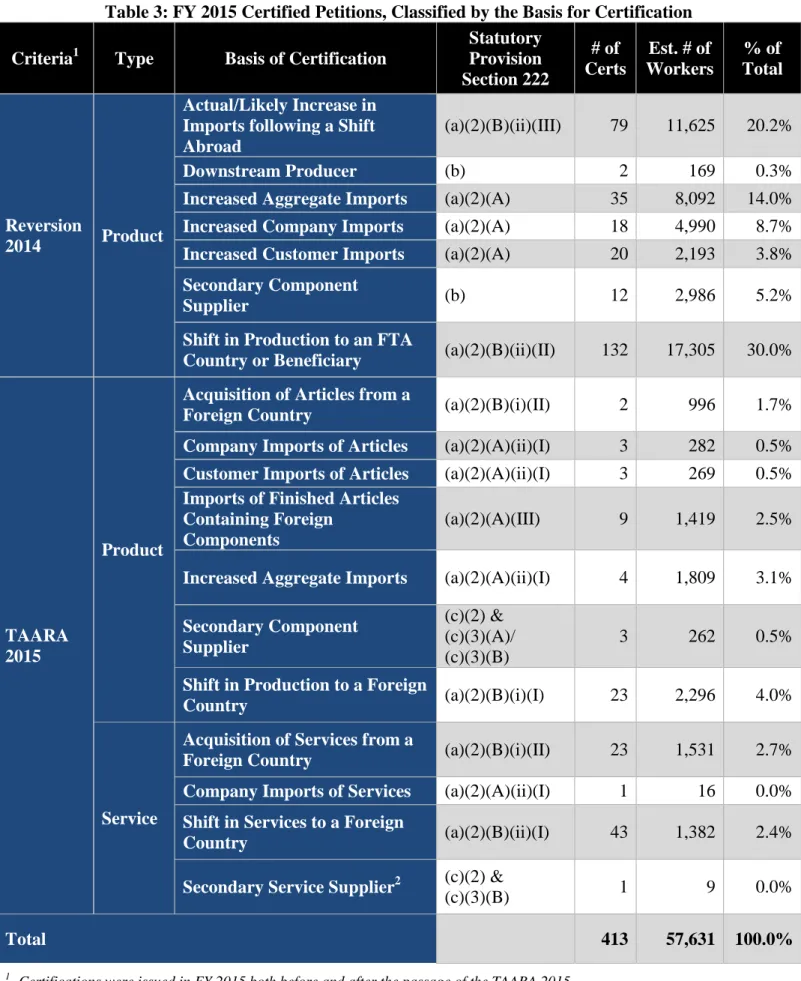
Table 3 provides a breakout of certifications and the estimated number of adversely affected workers who were certified and became eligible to apply for TAA benefits and services during FY 2015 by the determination criteria, type, and specific certification authority.
Table 2: The Average Time for Processing Petitions
Fiscal Year Average Processing Time
Certifications Denials Terminations1 Total
2013 41.4 Days 69.4 Days 38.3 Days 46.5 Days
2014 56.5 Days 57.2 Days 35.3 Days 53.7 Days
2015 47.9 Days 46.5 Days 45.8 Days 47.2 Days
1 Petitions may be terminated because the petitioner requests withdrawal, the petition is deemed invalid, an
existing certification has already been issued, another duplicate investigation is in process, or a negative determination was recently issued, among other reasons.
ETA TAA PROGRAM – FY 2015 16
Table 3: FY 2015 Certified Petitions, Classified by the Basis for Certification Criteria1 Type Basis of Certification
Statutory Provision Section 222 # of Certs Est. # of Workers % of Total Reversion 2014 Product Actual/Likely Increase in Imports following a Shift Abroad
(a)(2)(B)(ii)(III) 79 11,625 20.2%
Downstream Producer (b) 2 169 0.3%
Increased Aggregate Imports (a)(2)(A) 35 8,092 14.0%
Increased Company Imports (a)(2)(A) 18 4,990 8.7%
Increased Customer Imports (a)(2)(A) 20 2,193 3.8%
Secondary Component
Supplier (b) 12 2,986 5.2%
Shift in Production to an FTA
Country or Beneficiary (a)(2)(B)(ii)(II) 132 17,305 30.0%
TAARA 2015
Product
Acquisition of Articles from a
Foreign Country (a)(2)(B)(i)(II) 2 996 1.7%
Company Imports of Articles (a)(2)(A)(ii)(I) 3 282 0.5%
Customer Imports of Articles (a)(2)(A)(ii)(I) 3 269 0.5%
Imports of Finished Articles Containing Foreign
Components
(a)(2)(A)(III) 9 1,419 2.5%
Increased Aggregate Imports (a)(2)(A)(ii)(I) 4 1,809 3.1%
Secondary Component Supplier (c)(2) & (c)(3)(A)/ (c)(3)(B) 3 262 0.5%
Shift in Production to a Foreign
Country (a)(2)(B)(i)(I) 23 2,296 4.0%
Service
Acquisition of Services from a
Foreign Country (a)(2)(B)(i)(II) 23 1,531 2.7%
Company Imports of Services (a)(2)(A)(ii)(I) 1 16 0.0%
Shift in Services to a Foreign
Country (a)(2)(B)(ii)(I) 43 1,382 2.4%
Secondary Service Supplier2 (c)(2) &
(c)(3)(B) 1 9 0.0%
Total 413 57,631 100.0%
1
Certifications were issued in FY 2015 both before and after the passage of the TAARA 2015.
2
This certification was determined under the 2011 Program Criteria. This certification path was renewed under the TAARA 2015.
Industry Sectors in FY 2015
During FY 2015, numerous industry sectors were addressed by TAA determinations. Figure 1
illustrates the industry sectors with petition certifications during FY 2015. Table 4 shows both petitions certified and denied in FY 2015 and includes a breakout by the North American Industry Classification System (NAICS) sectors in which the adversely affected workers were employed. Both the Figure and Table reflect the fact that manufacturing still remains the top sector impacted by foreign trade with 320 petitions certified.
Figure 1: Number of Petitions Certified by Industry Sector in FY 2015
Note: See Table 4 for values for all industries.
1
Table 4: The Number of Petitions Certified and Denied in FY 2015 by Industry Sector Industry Sector Certifications Denials # of Petitions Est. # of Workers* # of Petitions Est. # of Workers** Manufacturing 320 (77.5%) 49,613 (86.1%) 67 (41.4%) 8,594 (44.2%)
Professional, Scientific, and
Technical Services 16 (3.9%) 783 (1.4%) 15 (9.3%) 635 (3.3%) Finance and Insurance 13 (3.2%) 1,147 (2.0%) 6 (3.7%) 341 (1.8%)
Information 12 (2.9%) 345 (0.6%) 10 (6.2%) 2,076 (10.7%)
Wholesale Trade 11 (2.7%) 563 (1.0%) 10 (6.2%) 343 (1.8%)
Mining, Quarrying, and Oil
and Gas Extraction 9 (2.2%) 1,428 (2.5%) 22 (13.6%) 3,375 (17.4%) Administrative and Support
and Waste Management and Remediation Services 7 (1.7%) 236 (0.4%) 13 (8.0%) 2,815 (14.5%) Retail Trade 7 (1.7%) 450 (0.8%) 4 (2.5%) 588 (3.0%) Transportation and Warehousing 5 (1.2%) 48 (0.1%) 5 (3.1%) 389 (2.0%) Educational Services 3 (0.7%) 53 (0.1%) (0.0%) (0.0%) Construction 2 (0.5%) 454 (0.8%) 1 (0.6%) 6 (0.0%) Management of Companies and Enterprises 2 (0.5%) 237 (0.4%) (0.0%) (0.0%) Real Estate and Rental and
Leasing 2 (0.5%) 1,562 (2.7%) (0.0%) (0.0%)
Utilities 2 (0.5%) 588 (1.0%) 2 (1.2%) 32 (0.2%)
Agriculture, Forestry,
Fishing and Hunting 1 (0.2%) 105 (0.2%) 1 (0.6%) 15 (0.1%) Other Services (except
Public Administration) 1 (0.2%) 19 (0.0%) (0.0%) (0.0%) Arts, Entertainment, and
Recreation (0.0%) (0.0%) 1 (0.6%) 15 (0.1%)
Health Care and Social
Assistance (0.0%) (0.0%) 5 (3.1%) 220 (1.1%)
Total 413 57,631 162 19,444
1 Estimated number of workers covered by a certified petition. 2 Estimated number of workers covered by a denied petition.
To provide further perspective on the sector impacts, Table 5 shows the list of the top five industry sectors in which adversely affected workers were reemployed in FY 2015 after TAA participation.
Table 6 lists the top five subsectors of the manufacturing industry sector and the service industry sectors in which workers were reemployed six months after exiting the program in order to provide more detail on the specific fields of employment.
Table 5: FY 2015 Top 5 Industry Sectors for Post-TAA Participation Employment
Industry Sector of Reemployment Total Count
Manufacturing 4,510 (25.6%)
Administrative and Support and Waste Management and
Remediation Services 2,317 (13.1%)
Health Care and Social Assistance 1,959 (11.1%)
Retail Trade 1,123 (6.4%)
Professional, Scientific, and Technical Services 722 (4.1%)
Table 6: The Top 5 Industries for Reemployment by Manufacturing and Service Subsector in FY 2015
Manufacturing Service
Aircraft Manufacturing Temporary Help Services
Plastics Product Manufacturing General Medical and Surgical Hospitals Heavy Duty Truck Manufacturing Elementary and Secondary Schools
Machine Shops Offices of Physicians
(except Mental Health Specialists) Pressed and Blown Glass and Glassware
Manufacturing
Nursing Care Facilities (Skilled Nursing Facilities)
Profile of New TAA Participants in FY 2015
Data described in this section tracks TAA participants who enrolled in the program during FY 2015, and were served under the 2002, 2009, 2011, Reversion 2014, and 2015 Programs. As shown in Table 7, the demographic characteristics of TAA participants who enrolled in the program during FY 2015 are similar to those who enrolled in the program in FY 2014, except that the gap between male and female new TAA participants in FY 2015 has increased; new TAA participants are slightly less likely to self-identify as white; and have a shorter tenure in their prior employment.
Table 7: FY 2015 Demographics of New TAA Participants by Gender, Race, Pre-Program Educational Level, Age, and Employment Tenure
Demographic Description TAA Participants FY 2014 TAA Participants FY 2015 Gender Male 57.5% 62.2% Female 42.2% 37.8% Race White 67.0% 65.6%
Black or African American 18.6% 15.2%
Hispanic/Latino 13.8% 14.3%
Asian 5.7% 7.9%
American Indian or Alaska
Native 1.3% 1.3%
Native Hawaiian or Other
Pacific Islander 0.5% 0.6%
Education
High School Diploma, GED
or less 56.8% 56.6%
Some Post-Secondary,
Associate’s 26.5% 27.8%
Bachelor’s & Beyond
Bachelor’s 13.3% 12.7%
Age (Years) Average (Mean) 48.0 48.1
Median 50.0 50.0 Tenure of Adversely affected Employment (Years) Average (Mean) 11.7 11.0 Median 8.2 8.0
Note: This chart reflects new participants in FY 2014 and FY 2015. Races are self-identified and a participant may identify more than one race. As such, the total of race identified percentages may be greater than 100 percent.
Table 8 compares the population served under the TAA program with the American Civilian Labor Force (ACLF) using Bureau of Labor Statistics data. The Bureau of Labor Statistics defines the ACLF as:
“All persons in the civilian non-institutional population (Persons 16 years of age and older residing in the 50 states and the District of Columbia, who are not inmates of institutions (e.g., penal and mental facilities, homes for the aged), and who are not on active duty in the Armed Forces) classified as either employed or unemployed.”
As shown in Table 8, compared with the ACLF, adversely affected workers participating in TAA have significantly less education (based on averages in calendar year 2014). While 59 percent of ACLF had post-secondary education, less than 40 percent of TAA participants entered the program with post-secondary education. Another significant distinction between ACLF and new TAA participants is their median tenure of employment. In FY 2015, new TAA participants entered the TAA Program with a median of eight years of experience in the adversely affected employment from which they were separated, exceeding the median tenure of employment for ACLF of less than five years, as of December 2015.
Table 8: FY 2015 Demographics of New TAA Participants Compared to the American Civilian Labor Force, by Gender, Race, Educational Level, Age, and Tenure
Demographic Description American Civilian Labor Force as of January 20151 TAA Participants FY 2015 Gender: Male 53.1% 62.2% Race: White 78.8% 65.6%
Education: Some College, Associate's
Degree, Bachelor's Degree, or More2 58.8% 37.5%
Age3 42.3 50
Tenure of Employment4 4.6 8.0
1 BLS Data on employed persons: 2015 Annual Averages data. Source: http://www.bls.gov/cps/ 2 TAA participant data based on pre-participation educational level.
3 Median Age in Years.
When TAA participants enrolled in the program during FY 2015, many of them entered after having received Rapid Response services. Rapid Response activities are services and immediate assistance to companies and their affected workers that are funded under title I of WIOA. These activities are operated by each state’s Dislocated Worker Unit. Under section 221 (a)(2)(A) of the Trade Act (19 USC 2271(a)(2)(A)), States are required to ensure that rapid response activities and appropriate career services (as described in Section 134 of t WIOA, 19 U.S.C. 3174) are made available to workers for whom a petition for trade adjustment assistance has been filed.
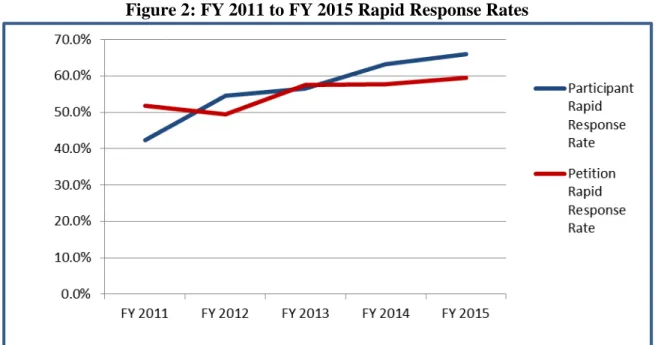
As shown in Table 9, Rapid Response services were provided relating to nearly 60 percent of petitions associated with FY 2015 new participants. These activities reached 66 percent of new TAA participants for FY 2015.
Table 9: FY 2011 to FY 2015 Rapid Response Rates Fiscal Year Participant Rapid Response Rate1 Petition Rapid Response Rate2 2011 42.5% 51.8% 2012 54.5% 49.5% 2013 56.5% 57.5% 2014 63.3% 57.8% 2015 66.0% 59.6%
1 Percentage of new participants who received Rapid Response services.
Table 9 and Figure 2 illustrate how FY 2015 continues a trend of substantial improvement in the provision of Rapid Response services. From FY 2011 to FY 2015, there was nearly a 25 percent increase in the number of new participants receiving Rapid Response services.
Section III will discuss what benefits and services were provided to TAA participants during FY 2015.
Figure 2: FY 2011 to FY 2015 Rapid Response Rates
Note: Participant Rapid Response Rate is the percentage of new participants who received Rapid Response services. Petition Rapid Response Rate is the percentage of petitions associated with new participants for which Rapid Response services were provided. For specific values, see Table 9.
III. BENEFITS AND SERVICE RECEIVED
Benefits and Services Provided During FY 2015
The TAA Program includes a range of benefits and services available under the different versions of the program. Details on the benefits and services available under each program are laid out in Appendix A. Table 10 shows the number of participants receiving each type of TAA benefit or service.
Table 10: FY 2015 Participants Receiving Each Type of TAA Benefit or Service Participant Benefit or Service
Number of Participants FY 2015 Percentage of Participants FY 2015 TAA (All) 47,335 -
Employment and Case Management Services 42,963 90.8%
Previous Certification1 5,437 11.5% Training 25,402 53.7% Occupational 22,357 47.2% Remedial 4,834 10.2% Prerequisite 533 1.1% Customized 97 0.2% On the Job 369 0.8% Apprenticeship 7 0.0% Pre-Layoff Training 304 0.6%
Training Leading to an Associate’s Degree 12,616 26.7%
Distance Learning 1,504 3.2%
Part Time Training 579 1.2%
TRA 26,595 56.2%
Basic 21,778 46.0%
Additional 18,513 39.1%
Remedial 1,033 2.2%
Completion 796 1.7%
Job Search Allowances 303 0.6%
Relocation Allowances 292 0.6%
ATAA/RTAA 6,213 13.1%
Note: TAA participants may receive more than one benefit listed.
1 Previous certification is not a benefit or service provided, but describes those served this year in compliance
Table 10 shows that over 90 percent of participants received employment and case management services, almost 54 percent participated in training, and over 56 percent received Trade
Readjustment Allowances (TRA).
The rate of training participation from FY 2012 to FY 2015 has been slowly, but steadily, increasing, as shown in Table 11.
Enrollment in Training Waivers Issued in FY 2015
The Trade Act authorizes the granting of waivers of the requirement that a TAA participant be enrolled in training by a certain deadline in order to receive TRA under certain conditions. Under the 2002 Program and the 2009 Program, six different bases for waivers are available to participants:
1. Recall – The worker has been notified that the worker will be recalled by the firm from which the separation occurred.
2. Marketable Skills – The worker possesses marketable skills for suitable employment (as determined pursuant to an assessment of the worker) and there is a reasonable
expectation of employment at equivalent wages in the foreseeable future.
3. Retirement – The worker is within two years of meeting all requirements for retirement.
Table 11: FY 2011 to FY 2015 Training Participation Trend
Fiscal Year Current
Participants Training Participants Training Participation Rate 2011 157,313 78,578 50.0% 2012 104,073 51,318 49.3% 2013 76,527 38,370 50.1% 2014 59,558 31,565 53.0% 2015 47,335 25,402 53.7%
5. Enrollment Unavailable – The first available enrollment date for approved training for the worker is within 60 days, or later, if there are extenuating circumstances to delay
enrollment.
6. Training Not Available – Approved training is not reasonably available to the worker from either governmental agencies or private sources, no training that is suitable for the worker is available at a reasonable cost, or no training funds are available.
Under the 2011 and the 2015 Programs, only three bases for waivers are available: Health, Enrollment Unavailable, and Training Not Available. For more information on the different bases for waivers and applicable deadlines for obtaining the waivers under all four TAA Programs, see Appendix A.
Since FY 2013, the total number of waivers issued by states has been steadily declining due to the elimination of the Recall, Marketable Skills, and Retirement bases for waivers for 2011 and 2015 Program participants, and this trend has continued from FY 2014 to FY 2015. Table 12
shows the substantial decrease in waivers since FY 2013.
Table 12: The Number of Training Waivers Granted, Classified by Type of Waiver
Training Waiver Type FY 2013 FY 2014 FY 2015
Recall1 23 6 1 Marketable Skills1 2,732 1,103 155 Retirement1 442 94 2 Health 110 115 55 Enrollment Unavailable 2,220 3,192 3,531 Training Unavailable 1,553 1,308 1,176
Waiver Participants (Total) 7,011 5,776 4,858
1 Recall, Marketable Skills, and Retirement waiver types were eliminated for 2011 and 2015 Program
Benefit and Service Information Collected at Program Exit
The data in this section reflects information on workers who exited the program from July 1, 2014, to June 30, 2015. Table 13 indicates that the majority of participants who exited were covered under either the 2009 Program (25 percent) or the 2011 Program (62 percent) (combined total of 87 percent.)
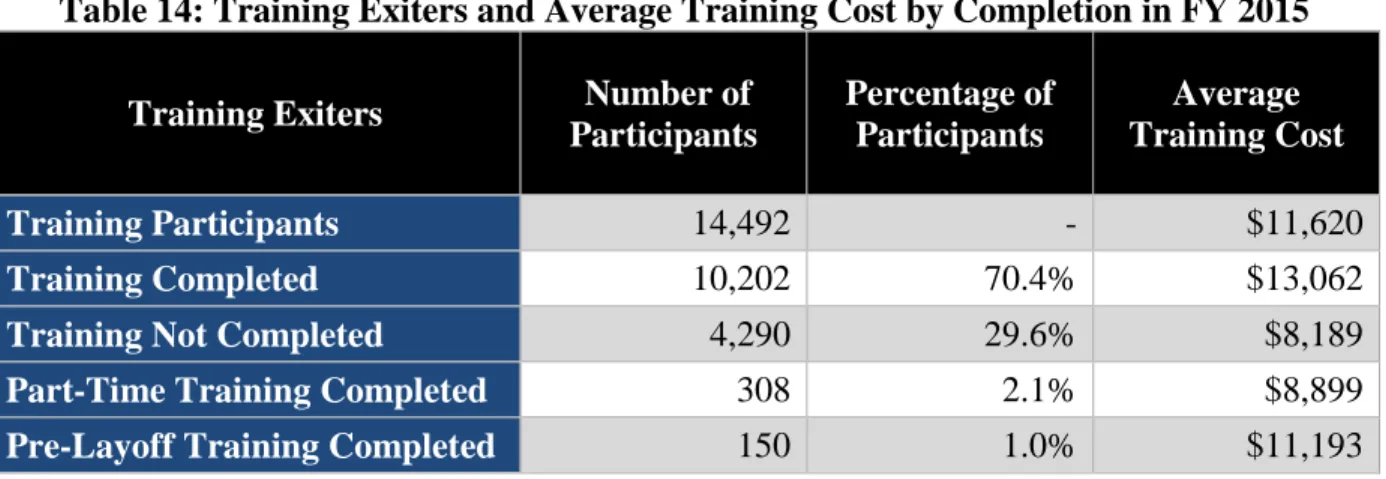
Table 14 shows that in FY 2015, over 70 percent of TAA exiters who participated in training completed their training plan and 1 percent of participants were adversely affected incumbent workers who entered training prior to separation from work. Furthermore, Table 14 shows the average training costs by training completion. In FY 2015, the average training cost for a training participant was $11,620.
Table 13: Percentage of Exiting TAA Participants by Program and Fiscal Year TAA Exiters by Program FY 2013 FY 2014 FY 2015
2002 18.4% 8.7% 3.7%
2009 67.7% 49.4% 25.4%
2011 13.9% 41.7% 61.6%
20151 0.0% 0.3% 9.3%
1 2015 Participants were members of worker groups certified as eligible under the Reversion
2014 Program criteria.
Table 14: Training Exiters and Average Training Cost by Completion in FY 2015 Training Exiters Number of
Participants Percentage of Participants Average Training Cost Training Participants 14,492 - $11,620 Training Completed 10,202 70.4% $13,062
Training Not Completed 4,290 29.6% $8,189
Part-Time Training Completed 308 2.1% $8,899
Table 15 indicates that, of the participants who completed training during FY 2015, more than 89 percent earned a post-secondary credential, including an industry-recognized credential, or a secondary school diploma or equivalent. This represents the highest credentialing percentage in the program to date.
Figure 3 illustrates that the five year trend on the rate of credentialing shows a consistently increasing trend. Since FY 2011, the credentialing rate has increased by nearly 27 percent.
Table 15: FY 2011- FY 2015 Credentialing Rate Fiscal Year Completed Training
(Exiters) Credentials (Exiters) Rate of Credentialing 2011 28,477 17,823 62.6% 2012 24,702 19,379 78.5% 2013 16,929 13,348 78.8% 2014 12,483 10,930 87.6% 2015 10,202 9,124 89.4%
Figure 3: FY 2011 to FY 2015 Credentialing Rate
Note: The Credentialing Rate is the Number of TAA exiters who received a Credential as a percentage of the number of TAA exiters who completed training. For specific values, see Table 15.
Table 16 identifies the average duration of participation in the TAA Program, as well as the average duration of receipt of training, TRA, and employment and case management services, respectively. The average duration of TAA participation in FY 2015 was 68 days shorter than FY 2014, and averaged less than two years (643 days or nearly 21.5 months). Table 16 also shows that the average duration for most TAA benefits and services decreased in FY 2015 as compared to FY 2014.
For those TAA participants exiting in FY 2015, despite decreasing numbers of exiters, a greater number of older workers received wage supplement from both ATAA and RTAA than in FY 2014. Appendix A illustrates the differences between ATAA and RTAA. Table 17 demonstrates the increase.
Table 16: Average Duration of TAA Benefits and Services
Benefit or Service FY 2014 Average
Duration (Days)
FY 2015 Average Duration (Days)
TAA Participation (All Services) 711 643
TAA Training (All Training) 560 495
TAA Training (No Remedial or Prerequisite) 504 452
TAA Training (Completed) 581 512
TAA Training (Not Completed) 503 452
TRA1 263 286
Employment and Case Management 573 512
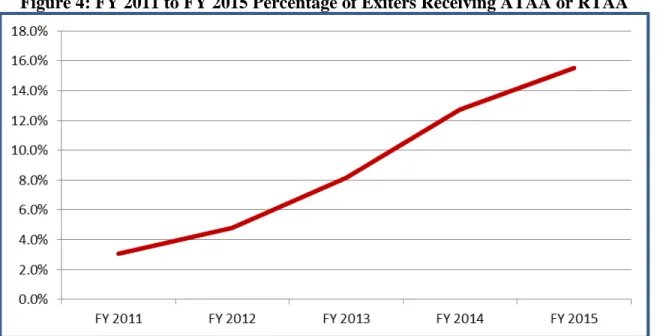
The increase in ATAA and RTAA recipients is more substantial when one considers the number of recipients as a percentage of TAA exiters. Figure 4 and Table 17 illustrate that the percentage of participants receiving ATAA or RTAA increased by over 12 percent from FY 2011 to FY 2015.
Section IV provides greater detail about the performance outcomes of these participants and will examine the credential attainment rate in more detail, as well as reemployment outcomes for participants who exited the program in FY 2015.
Table 17: FY 2011 to FY 2015 ATAA and RTAA Participant Trends Fiscal Year Total Exiters ATAA
Exiters1 RTAA Exiters2 Percentage of Exiters Receiving ATAA or RTAA 2011 79,012 1,121 1,298 3.1% 2012 53,970 342 2,247 4.8% 2013 37,278 126 2,907 8.1% 2014 26,179 13 3,036 11.6% 2015 21,833 72 3,316 15.5% 1
ATAA is available to participants served under the 2002 and Reversion 2014 Programs.
2
RTAA is available to participants served under the 2009, 2011, and the 2015 Programs.
Figure 4: FY 2011 to FY 2015 Percentage of Exiters Receiving ATAA or RTAA
IV. PERFORMANCE OUTCOMES
The Department collects data through the Trade Activity Participant Report (TAPR) to analyze the participant performance outcomes. Three core indicators of performance have been
established by the Department: (1) Entered Employment Rate (EER), which tracks the
percentage of those who obtained employment in a report quarter shortly after program exit; (2) Employment Retention Rate (ERR), which tracks whether those same employed individuals retained their job for an additional two quarters, and; (3) Six-Months Average Earnings (AE), which represents total six-month earnings of those same participants who are identified in the ERR. These core indicators, known as Common Measures, are a consistent set of measures used to assess performance across the Department’s employment and training programs.
Table 18 provides the Department established performance goal and result for each measure from FY 2011 to FY 2015. The time frames for each of these measures are detailed in the footnote to Table 18.
Table 18: FY 2011 to FY 2015 Common Measures: Entered Employment Rate (EER), Employment Retention Rate (ERR), and Average Earnings (AE)
Fiscal Year
Performance Goals Performance Results EER1 ERR2 AE3 EER1 ERR2 AE3
2011 61.9% 83.3% $13,172 65.1% 89.5% $18,116
2012 58.0% 83.2% $13,248 69.0% 91.3% $18,842
2013 58.9% 83.6% $13,360 71.6% 91.7% $18,104
2014 69.9% 91.1% $19,436 72.4% 91.4% $17,857
2015 71.1% 91.2% $19,799 74.0% 92.3% $17,911
1 Entered Employment Rate (EER) is the percentage of TAA participants who were employed in the first
quarter after exit as reported in the third quarter after exit. For example, FY 2015 EER is for participants who exited between January 1, 2014, and December 31, 2014, inclusively.
2
Employment Retention Rate (ERR) is the percentage of TAA participants employed in the first quarter after exit who are still employed in the third quarter after exit. This six month retention rate is based on data collected five quarters after exit to allow for time to collect and report data. For example, FY 2015 ERR is for participants who exited between July 1, 2012, and June 30, 2013, inclusively.
Table 18 demonstrates that EER has exceeded the established goal in each of the last five years. EER has increased nearly 9 percent over that five-year period, with FY 2015 reporting a high of 74 percent. Similarly, ERR has consistently exceeded the established goal. ERR now exceeds 92 percent in FY 2015. Gains in AE, however, have remained elusive with results failing to meet targets in FY 2014 and FY 2015. In FY 2015, the six-month AE was $17,911.
These performance results vary based on the age, pre-program educational level, and services provided. In addition to the Common Measures, we can examine the employment rates in the second and fourth quarter after exit, the median income in the quarter prior to participation, the median income in the second quarter after participation, and the wage replacement rate. Details of these calculations are available in the footnotes for Table 19 and Table 20.
Figure 5: FY 2011 to FY 2015 Common Measure Results: Entered Employment Rate (EER), Employment Retention Rate (ERR), and Six-Month Average Earnings (AE)
Note: Represents the performance results for EER, ERR, and AE from FY 2011 to FY 2015. EER and ERR are presented using the scale on the left of the chart. AE is presented using the scale on the right of the chart. For specific values, see Table 18.
As shown in Table 19, TAA participants in lower age categories at the time of separation were more likely to be employed after participation and were more likely to retain that employment over the quarters for which reports are collected.
Table 19: FY 2015 Employment and Retention Rates by Age
Age1 Percentage
of Exiters2 EER Q1 3
EER Q24 EER Q45 ERR6
Under 30 8.9% 83.8% 84.7% 82.9% 93.4% 30-39 18.2% 82.9% 84.2% 83.4% 94.2% 40-49 26.4% 80.0% 81.4% 79.9% 93.4% 50-59 36.4% 72.4% 73.2% 70.1% 91.8% 60+ 10.1% 39.8% 38.4% 33.5% 81.3% Total 100.0% 74.0% 74.8% 72.9% 92.3%
1 Age at the time of pre-participation separation. 2
Percentage of Exiters is the percentage of EER Q1 exiters in the particular category. For FY 2015, this represents TAA participants who exited between January 1, 2014, and December 31, 2014, inclusively.
3
Entered Employment Rate for Quarter 1 (EER Q1) is the percentage of TAA participants who were employed in the first quarter after exit as reported in the third quarter after exit. FY 2015 EER Q1 is for participants who exited between January 1, 2014, and December 31, 2014, inclusively. This is the standard measure included in Table 18.
4
Entered Employment Rate for Quarter 2 (EER Q2) is the percentage of TAA participants who were employed in the second quarter after exit as reported in the fourth quarter after exit. FY 2015 EER Q2 is for
participants who exited between October 1, 2013, and September 30, 2014, inclusively.
5 Entered Employment Rate for Quarter 4 (EER Q4) is the percentage of TAA participants who were employed
in the fourth quarter after exit as reported in the sixth quarter after exit. FY 2015 EER Q4 is for participants who exited between April 1, 2013, and March 31, 2014, inclusively.
6 Employment Retention Rate (ERR) is the percentage of TAA participants employed in the first quarter after
exit who are still employed in the third quarter after exit. This six month retention rate is based on data collected five quarters after exit to allow for time to collect and report data. FY 2015 ERR is for participants who exited between July 1, 2012, and June 30, 2013, inclusively.
Table 20 shows the earnings by age for both pre-participation and post-participation. Post-participation earnings are relatively consistent across age groups until the age of 60. However, because of higher pre-participation earnings in older age groups, wage replacement decreases with age.
Table 20: FY 2015 Earnings by Age Age1 Six-Month AE2 Quarterly Earnings Before Participation3 Quarterly Earnings After Participation4 Wage Replacement Percentage5 Under 30 $16,236 $6,625 $7,069 106.7% 30-39 $18,122 $8,356 $7,730 92.5% 40-49 $18,462 $9,420 $7,645 81.2% 50-59 $18,106 $10,161 $7,448 73.3% 60+ $15,706 $10,278 $5,671 55.2% Total $17,911 $9,233 $7,471 80.9% 1
Age at the time of pre-participation separation.
2 Average Earnings (AE) is the average (mean) earnings for TAA participants in the 2nd and 3rd quarters after
exit. As such, this value represents earnings over a six-month period. These earnings are based on data collected five quarters after exit to allow for time to collect and report data. FY 2015 AE is for participants who exited between April 1, 2013, and June 30, 2013, inclusively. This is the standard measure included in Table 18.
3
Quarterly Earnings Before Participation represents the median earnings in the first quarter (three-month period) prior to participation. In order to align TAA participants for wage replacement, TAA participants are included in this value four quarters after exit. For FY 2015, this represents participants who exited between October 1, 2013, and September 30, 2014, inclusively.
4 Quarterly Earnings After Participation represents the median earnings in the second quarter (three-month
period) following participation. These earnings are based on data collected four quarters after exit to allow for time to collect and report data. For FY 2015, this represents participants who exited between October 1, 2013, and September 30, 2014, inclusively.
5 Wage Replacement Percentage is the median earnings in the second quarter following participation as a
Table 21 shows that employment and retention rates are highest for participants with some post-secondary education, but without a bachelor’s or higher degree. However, these employment and retention rates are relatively consistent across educational levels.
Relative consistency across educational levels does not hold true for earnings. Table 22
illustrates that those with higher pre-participation education are likely to have higher earnings both before and after participation. Despite higher earnings after participation with greater education, post-participation earnings are still a lower percentage of pre-participation earnings in higher educational categories.
Table 21: FY 2015 Employment and Retention Rates by Education
Education1 Percentage of Exiters EER Q1 EER Q2 EER Q4 ERR
High School & Less than High School 58.6% 73.4% 74.5% 72.5% 92.5%
Associates, Post-Secondary
Certification, Some Post-Secondary 28.2% 75.6% 76.3% 74.6% 92.4% Bachelors & Beyond Bachelors 12.2% 73.7% 73.5% 71.0% 91.3%
Unknown 1.1% 72.6% 68.6% 58.8% 88.9%
Total 100.0% 74.0% 74.8% 72.9% 92.3%
Note: An explanation for each calculation is available in the footnotes for Table 19.
Table 23 shows that the employment and retention rates vary based on training received. As compared to those who do not receive training, TAA participants who do receive training are generally more likely to get employed and stay employed. Most notably, participants who received a credential during training are approximately 5 percent more likely to find
employment. Those who receive a credential or complete training are more likely to retain their employment.
Table 22: FY 2015 Earnings by Education
Age1 Six-Month AE Quarterly Earnings Before Participation Quarterly Earnings After Participation Wage Replacement Percentage High School & Less than
High School $15,890 $8,474 $6,937 81.9%
Associates,
Post-Secondary Certification, Some Post-Secondary
$18,653 $10,023 $7,920 79.0%
Bachelors & Beyond
Bachelors $27,059 $13,945 $10,561 75.7%
Unknown $17,025 $10,165 $8,255 81.2%
Total $17,911 $9,233 $7,471 80.9%
Note: An explanation for each calculation is available in the footnotes for Table 20.
1 Pre-program educational level.
Table 23: FY 2015 Employment and Retention Rates by Training Received Services Received Percentage
of Exiters EER Q1 EER Q2 EER Q4 ERR
Participants Not Enrolled in Training 32.7% 71.1% 71.3% 68.1% 91.4%
Training: Enrolled But Not Completed 15.2% 72.3% 73.3% 72.3% 91.1%
Training: Completed, No Credential 9.3% 69.3% 72.1% 71.8% 93.5%
Training: Received Credential 42.8% 77.9% 78.8% 78.1% 93.2%
Total 100.0% 74.0% 74.8% 72.9% 92.3%
Employment rates by training received are also presented graphically in Figure 6.
Table 24 illustrates that the relationship between training received and earnings is more elusive.
Table 24: FY 2015 Earnings by Training Received
Services Received Six-Month AE
Quarterly Earnings Before Participation Quarterly Earnings After Participation Wage Replacement Percentage Participants Not Enrolled in Training $19,440 $9,533 $7,941 83.3%
Training: Enrolled But
Not Completed $16,670 $8,603 $6,884 80.0% Training: Completed, No Credential $17,256 $9,382 $7,301 77.8% Training: Received Credential $17,352 $9,196 $7,389 80.4% Total $17,911 $9,233 $7,471 80.9%
Note: An explanation for each calculation is available in the footnotes for Table 20.
Figure 6: FY 2015 Employment Rates by Training Received
Note: For specific values, see Table 23. An explanation for each calculation is available in the footnotes for Table 19.
V. PROGRAM GUIDANCE
While the states are responsible for directly administering benefits and services under the four distinct programs, the Department’s Regional Trade Coordinators in the Department of Labor’s Employment and Training Administration (ETA) and other staff in the six ETA regions provide oversight and monitoring for the state delivery of TAA benefits and services. Overall direction and technical assistance for the consistent and timely delivery of these benefits and services nationwide is provided to the regions and the states by the Department through the ETA Office of Trade Adjustment Assistance (OTAA) in Washington, D.C.
The Department, through ETA, issued guidance, relating to funding, operating instructions, and other topics, to states in the form of Training and Employment Guidance Letters (TEGL) and Training and Employment Notices (TEN). Specifically, the guidance issued in FY 2015 addressed the operation of the 2015 Program; guidance for services and grants administered under the Workforce Innovation and Opportunity Act (WIOA or Opportunity Act), as related to the TAA Program; routine funding distributions; and guidance for completing petitions for TAA and partnering with Rapid Response Teams to improve quality of state-filed petitions.
Table 25: Guidance Documents Issued
Date Directives
September 4, 2015
TEGL No. 05-15: Operating Instructions for Implementing the Amendments to the Trade Act of 1974 Enacted by the Trade
Adjustment Assistance Reauthorization Act of 2015 (TAARA 2015).
July 1, 2015
TEGL No. 03-15: Guidance on Services Provided through the Adult and Dislocated Worker Program under the Workforce Innovation and Opportunity Act (WIOA or Opportunity Act) and Wagner Peyser, as Amended by WIOA, and Guidance for the Transition to WIOA Services.
July 1, 2015
TEGL No. 02-15: Operational Guidance for National Dislocated Worker Grants, pursuant to the Workforce Innovation and Opportunity Act (WIOA or Opportunity Act).
June 26, 2015
TEGL No. 40-14: Second Distribution of Fiscal Year (FY) 2015 Trade Adjustment Assistance (TAA) Training and Other Activities Funds and the Process for Requesting TAA Program Reserve Funds.
February 27, 2015
TEN No. 23-14: How-To-Guide for Completing a Petition for the Trade Adjustment Assistance (TAA) Program and Partnering with Rapid Response Teams to Improve the Quality of State-Filed Petitions.
February 27, 2015
TEGL No. 20-14: Fiscal Year (FY) 2015 State Initial Allocations for Trade Adjustment Assistance (TAA) Training and Other Activities and the Process for Requesting TAA Program Reserve Funds.
December 23, 2014
TEGL No. 16-14: Appropriations to Continue the Trade Adjustment Assistance (TAA) for Workers and Alternative Trade Adjustment Assistance (ATAA) and Reemployment Trade Adjustment Assistance (RTAA) Program Operations for Fiscal Year (FY) 2015.
VI. FUNDING
The Department provides funding to the states to provide benefits and services to adversely affected workers. Under section 239 of the Trade Act, the states provide benefits and services to eligible workers in the TAA Program as agents of the United States. Each state does so through one or more state agencies, one of which is designated as the Cooperating State Agency (CSA) in an agreement between the state’s Governor and the Secretary of Labor (Secretary).
Funds for the TAA Program are apportioned to the Federal Unemployment Benefits and Allowances (FUBA) account into three separate categories: (1) Training and Other Activities, which includes funds for training, job search allowances, relocation allowances, employment and case management services and related state administration; (2) Trade Benefits, which includes funds for TRA; and (3) Alternative/Reemployment Trade Adjustment Assistance (A/RTAA). In FY 2015, $711 million was appropriated to the FUBA account. However, this amount was subject to a 7.3 percent sequestration reduction ($51 million) required by the Balanced Budget and Emergency Deficit Control Act (BBEDCA) The Department applied the full sequestration reduction to the Training and Other Activities category of funds, and did not apply the reduction to funds appropriated for TRA or A/RTAA benefits. Accordingly, $52 million was subtracted from the Training and Other Activities amount of $286 million, reducing the amount available for Training and Other Services to $236 million. The total amount of FUBA funds provided to states in FY 2015 for all benefits and services was just over $659 million. Table 26 lists the total ($236 million) and by state amounts of funds distributed for Training and Other Services in FY 2015.