�
Scribe: Yee Lok Wong Department of Mathematics, MIT
November 7, 2006
1
Eventual Hitting Probability
In previous lectures, we studied the following PDE for ρ(x, t x| 0) that descrives a general stochastic
process:
∂ρ
∂t = Lρ = − � · Mρ (1)
where Land Mare operators describing the stochastic process examined, with approximate bound
ary and initial conditions imposed. It can be a continuous stochastic process such as the Wiener process, or a continuum approximation of a discrete random walk.
In the last lecture, we considered the cases when the operator L is independent of time (for
example, D�2), and derived a hiearchy of PDEs for the function gn(x|x0). In particular, we have
the following PDE for g0:
t Lg0 = −δ(x −x0), where g0(x|x0) =
0
ρ(x, t|x0)dt (2)
Suppose we have an absorbing boundary A, if we are interested in the location of the first
passage on A, but do not care about the first passage time, the eventual hitting PDF E(x) can be
obtained as the flux on boundary as follows:
E(x) = nˆ· Mρ, x ∈A (3)
We discussed this eventual hitting probability briefly and talked about the electrostatic analogy last time. In this lecture, we are going to discuss general techniques of calculating E(x) by using complex analysis.
2
Conformal Invariance: General Principle
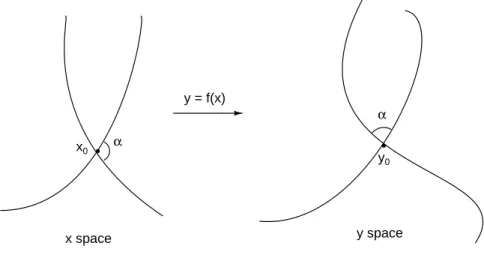
We now introduce the notion of conformal mapping. A conformal mapping defined by y� = f(�x)
can be viewed as a map that performs a local stretching and rotation on �x. The angle between any
intersecting curves is preserved under conformal mapping. For example, curves through x�0 which
are tangent to each other are mapped onto curves with a common tangent at y�0.
y = f(x) α α x0 y0 x space y space
S
x zFigure 1: conformal mapping - local streching and rotation. Note that the angle α is preserved
2.1 Examples of Conformal Mapping
Here are two examples of conformal maps:
(1) Any complex analytic function f (f is analytic if f� exists), with f� =� 0: w = f(z)
w = u +i v, z = x +i y (2) Stereographic Projection:
Consider the unit sphere S = x2
1 +x22 +x23 = 1. For every point on S, except the north pole
(0,0,1), we associate a complex number z = x1+i x2 . This mapping from the Riemann sphere S to
1−x3
the complex plane, or vice versa, is a one-to-one correspondence. This correspondence is called a
stereographic projection and it is conformal.
� �
�
Geometrically, we join a point z on the complex plane and the north pole of the Riemann sphere
with a straight line. The intersection of the line and the sphere is the corresponding projection. For more on stereographic projection, see any standard complex analysis text.
2.2 Properties
A number of properties of a conformal transformation that makes it a powerful tool for solving first passage problems.
(1)
d�y = | |J d�x,
∂yi
where the Jacobian J is a matrix defined by Jij = ∂x
j, and |J|= det(J) (2)
δx(�x −x�0) = |J|δy(�y−y�0),
since φ(y�0) = δy(�y−y�0)φ(�y)d�y
= δy(�y(�x)−�y(x�0))φ(�y(�x))|J|d�x (y�= �y(�x), and d�y = |J|d�x)
but φ(y�0) = φ(y�(x�0))
= δx(�x −x�0)φ(�y(�x))d�x
Comparing the two integrands, we get property (2).
(3)
2 2
x y
� = |J| �
Recalling the definition of �2, this means:
∂2 ∂2 ∂2 ∂2 ∂x2 1 + ∂x2 2 +... = |J|( ∂y12 + ∂y 22 +...) (4) �xφ·�x ψ = |J|�yφ·�y ψ (5) � b a ˆ n ·�xφ dx = � y(b) y(a) ˆ n ·�yφ dy
�
2.3 Conformally Invariant Transport Processes
Here we present examples of conformally invariant processes. (1) Simple Diffusion
Consider L= D�2 , M= −D�, then Lg0 = −δ(x|x0). We make the conformal transformation
y = y(x), which gives us the following:
=
Lx g0(x|x0) −δ(x −x0)
⇒ |J| Ly g0(y|y0) = |J| −δ(y−y0) (by property 3 above)
⇒ Ly g0(y|y0) = −δ(y−y0)
The probability of first passage to the absorbing boundary A between two points a and b in
x-space, P(a, b) = �ab E(x)dx = � yb E(y)dy (by property 5) = P(y(a), y(b)), which is the probability
ya
of first passage to the absorbing boundary y(A) between the points y(a) and y(b) in y-space.
Note the abuse of notation here. The function g0(y y| 0) in y-space is different from g0(x x| 0) in
x-space. But the point here is that we can solve for the hitting probability by conformal mapping. (2) Advection-Diffusion
=
Mρ ρ�φ − D�ρ
���� � �� �
advection in a potential flow �u=�φ diffusion
L= −�·M= −�·(ρ�φ−D�ρ) = δ(x −x0)
and 2φ = 0
This system of two PDEs is conformally invariant. (3) Nernst-Planck Equations (electrochemistry)
Ions in solution experience both concentration gradients and voltages. The total flux is therefore the sum of both diffusion and electromigration. The Nernst-Planck Equations describe such motions of ions.
Flux of ions of type i, F�i = −biρi�µi, where µi = kT log ρi +zi e φ, and bi = mobility Di
= � −D�� i�ρ�i −kT zi e�φ ,
�
where Di = bikT, zi = ±1, depending on the charge of the ion, e is the electron charge, and E = −�φ is the electric field
For steady state, we have the following invariant condition: ∂ρi
∂t = −�·F�i = 0
The electrostatic potential φ is determined by electroneutrality �ni=1 ziρi = 0, which is also an
invariant condition.
However, the operator L in this example is nonlinear. So it may not give us any information
about first passage of individuals.
3
Complex Analysis for Conformal Mappings of the plane
In this section, we discuss a few relevant concepts from complex analysis, and conclude with its application to first passage problems.
If the derivative of a complex function f exists, then f is said to be analytic and can be written as w = u +iv = f(z). Furthermore, if f� = 0, f is a conformal mapping and it is locally linear,
dw = f�(z)dz. Recalling Euler’s formula that any complex number z can be in the polar form as
z = reiθ, where r is the modulus and θ = arg(z) is the argument. The product of two complex
numbers can be written as z1z2 = (r1eiθ1)(r2eiθ2) = r1r2ei(θ1+θ2). This means f(z) stretches
(isotropically) by f�(z
0) and rotates by arg f�(z0) near a point z0.
| |
For an analytic functionf, we can take its derivative in the real and imaginary directions to get the following:
df ∂u ∂v ∂v ∂u
dz = ∂x +i∂x = ∂y −i∂y
This gives the Cauchy-Riemann conditions:
∂u ∂v = , ∂x ∂y ∂u ∂v and = ∂y −∂x
Consider the Laplace’s equation �2φ = 0, the function φcan be defined as the real (or imaginary)
part of a complex analytic potential Φ, where
Φ = φ+iψ
By the Cauchy-Riemann conditions, we then have
�φ = φx +iφy = φx −iψx = φx +iψx = Φ�(z) (4)
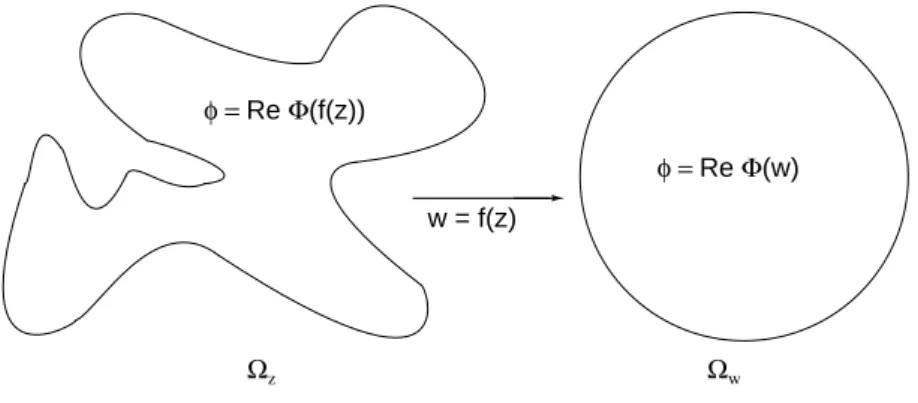
The Laplace’s equation is conformally invariant. So if we need to solve it in a domain with complicated geometry, we can apply a conformal mapping, solve the equation in a simple domain, and finally obtain the solution in our original domain according to the conformal map.
Ωw
Ωz
w = f(z)
φ = Re Φ(w) φ = Re Φ(f(z))
Figure 3: Conformal mapping of φ from a complicated domain Ωz to simple domain Ωw
Example: First passage to the unit circle from the center
2 � g0 = −D δ(w −w0) log w g0 = Re Φ(w), where ,Φ(w) = 2π = ln |w| 2π 1 1 Φ� =
2πw = 2πeiθ for w on the unit cicle E= nˆ· �φ = e iθ ·Re (�φ) = Re (eiθ ·Φ�) 1 = Re (eiθ ) iθ · 2πe So the eventual hitting PDF on the unit circle is
1
E(θ) = (5)
2π
We have solved the first passage problem on the unit cicle. By conformal invariance, theoretically we can get the solution of the first passage problem on any geometry, for example, first passage to a plane, a wedge, a parabola, or even an arbitrary polygon. The existence of such conformal maps are guaranteed by the Riemann Mapping Theorem. However, in practice, it may not be easy to come up with the desired conformal map. We will discuss more examples in the next lecture.
References
[1] Ahlfors, L., Complex Analysis, McGraw-Hill, 1979.
[2] Bazant, M. and Crowdy, D., Conformal Mapping Methods for Interfacial Dynamics,