RACIAL IDENTITY DEVELOPMENT, RACIAL DISCRIMINATION, AND OTHER PSYCHOSOCIAL OUTCOMES OF AFRICAN AMERICAN STUDENTS IN RURAL,
RACIALLY SEGREGATED HIGH SCHOOLS IN THE 21ST CENTURY.
Cherish Rashae Williams
A dissertation submitted to the faculty of the University of North Carolina at Chapel Hill in partial fulfillment of the requirements for the degree of Doctor of Philosophy in School
Psychology within the School of Education.
Chapel Hill 2018
Approved by:
© 2018
ABSTRACT
Cherish Williams: Racial Identity Development, Racial Discrimination, and Other Psychosocial Outcomes of African American Students in Rural, Racially Segregated High Schools in the 21st
Century
(Under the direction of Dr. Dana Thompson Dorsey)
After more than 50 years since the Brown v. Board of Education (1954) ruling to desegregate public schools, racially isolated schools continue to exist. Previous research has shown that students attending racially segregated schools are subjected to larger class sizes, fewer teachers, fewer and lower-quality course offerings (Darling-Hammond, 2004), lower achievement scores (Rossell, Armor, & Walberg, 2002; Bankston & Caldas, 1996, 1997), higher dropout rates (Mickelson, 2003), and lower graduation rates (Orfield, Frankenberg, & Garces, 2008). The current secondary analysis, explored and examined the racial identities and rural experiences of the students attending three racially segregated and geographically isolated high schools within in a county of a Southeastern state. Student participants (n = 373) completed the Diversity Assessment Questionnaire, which was also accompanied by focus group interviews from teachers and administrators from each respective school.
DEDICATIONS
This body of work is dedicated to the beautiful souls striving to make a difference in their community, culture, and the world. Continue to exude your greatness Kings and Queens, and never stop. Someone after you will push harder and strive for greater because you did not quit;
ACKNOWLEDGEMENTS
Thank you God for entrusting me to with the passion to complete this journey. I would like to thank my mother and best friend, Sherrie Williams, for your unwavering support at every
milestone I have accomplished thus far. You have been my listening ear, my shoulder to cry on, my prayer warrior, and you have encouraged me when I questioned my purpose and journey. Thank you to my sister and brother, Shanna and Dereck Williams, especially for blessing me with my niece and nephews (Sheniah, A’mari, and Ayden). In the eleventh hour I always thought of their faces to provide me with the motivation to finish. Special thanks to my life partner, Jonathan Smith, I remain grateful for your support and your mother’s support throughout the years. To Dr. Dana Thompson Dorsey, thank you for your mentorship and adopting me as a part of your research team. As promised, I will provide mentorship to the next Queen in need of support to finish this journey. Thank you to my linesisters, The VindiKatiOn, for always
TABLE OF CONTENTS
LIST OF TABLES ... viii
LIST OF FIGURES ... iiix
LIST OF ABBREVIATIONS ... xi
CHAPTER 1: INTRODUCTION ... 1
Racial Socialization as a Theoretical Lens ... 3
Research Questions ... 4
Definition of Terms... 5
Independent Variables ... 5
Dependent Variables ... 6
CHAPTER 2: LITERATURE REVIEW ... 7
Racial Socialization ... 7
Racially Segregated Schools ... 11
Racial Identity and Ideology ... 13
Racial Identity and Rurality ... 16
Racial Discrimination ... 18
Academic Achievement ... 20
Synthesis ... 23
Rationale For Study ... 25
CHAPTER 3: METHODS ... 28
Procedure ... 31
Measures ... 31
Statistical Analyses ... 33
Ethical Considerations ... 34
CHAPTER 4: FINDINGS AND RESULTS……… 34
Research Question 1………..36
Research Question 2………. 41
Research Question 3………. 42
Research Question 4………. 44
Research Question 5………. 45
Research Question 6………. 46
Results Summary……….. 53
CHAPTER 5: DISCUSSION ... 55
Review of Findings and Implications………... 58
Limitations and Future Research……….. 62
Conclusions………... 65
APPENDIX: Diversity Assessment Questionnaire (DAQ) ... 69
LIST OF TABLES
Table 1. Southeastern County Demographics Characteristics…………... 29
Table 2. Demographics by High Schools with the County………... 29
Table 3. Descriptive Statistics of All Students………. 37
Table 4. Descriptive Statistics by High School……… 38
Table 5. Summary of Correlations……… 42
Table 6. Summary of Regression Analysis for Racial Identity Development……….. 43
Table 7. Summary of Regression Analysis for Academic Achievement……….. 44
Table 8. Summary of Regression Analysis for Educational Aspirations………... 46
Table 9. Themes and Subthemes……….. 47
Table 10. Racial Socialization Themes and Quotes……….. 49
LIST OF FIGURES
Figure 1. Distribution of Racial Identity Development... 39
Figure 2. Distribution of Racial Discrimination………... 39
Figure 3. Distribution of School Climate/Institutional Support………... 40
Figure 4. Distribution of Educational Aspirations... 40
ABBREVIATIONS
DAQ Diversity Assessment Questionnaire
CHAPTER 1 INTRODUCTION
Racial segregation was once a legal mandate in the United States. The Jim Crow Era, lasting from 1897-1954, featured racially segregated churches, schools, and restaurants in the South. The Jim Crow South was permeated with signs forbidding the entrance of “coloreds” into White spaces. African Americans, referred to as coloreds during this time period, were coerced to use separate water fountains, restrooms, and separate entrances to buildings. During the Jim Crow South, African Americans created communities with businesses, schools, banks, hospitals, and housing to provide resources for their people to thrive. The Jim Crow laws made Blacks second-class citizens, as their separate facilities were never equal to the facilities provided for White citizens (Lippard, & Gallagher, 2014, p. 946). Following the landmark case, Plessy v. Ferguson (1896), African American students continued to live in segregation and attend schools
that were separate from their White counterparts. In 1954, Brown v. Board of Education, became known as the monumental court case, which ruled Separate, but Equal as
unconstitutional, thus promoting the integration of schools across the United States. After the Brown v. Board decision (1954), segregation was thought to be over, though many schools were
African-the Brown decision indicated that African-the White education system was superior to African-the Black education system. These Black students were thought to benefit from the direct exposure to White administrators and teachers (Green, 2004).
All children are supposed to receive equal educational opportunities according to the 14th
Amendment’s Equal Protection Clause, but that has not happened. A quality of education is not guaranteed for all. Additionally, Lutz (1996) noted a school’s racial and social class makeup affects academic achievement through the student’s peer interactions, teaching climate, and the
climate of the learning environment. The major concern is that minority students in racially segregated and geographically isolated schools may not be receiving equal educational
opportunities, despite federal mandates that have made efforts to provide an equal education to all students. Lutz (1996) also reported that students in racially segregated schools face barriers with low self-esteem due to negative perceptions of their racial demographic in comparison to the majority group and structural barriers created by the majority group, such as segregated housing for low-income families and white flight from public schools. Students in
geographically isolated rural areas experience similar barriers due to the segregated schooling and limited resources within their schools. Public education laws have continually changed over time to strive towards equal education opportunities, yet many students have not received equal opportunities due to factors such as lack of exposure to students from other backgrounds, budget cuts in systems, and loss of revenue in districts. It is important to understand the implications white flight has on public education and the loss of revenue, especially in rural and urban areas. A loss of public revenue for the public schools impacts the school’s academic resources,
Within the last two decades, there has been a focus on providing equal education
opportunities for all students in the public school setting through federal policies. The No Child Left Behind Act (NCLB) of 2002, which later evolved into the Every Student Succeeds Act (ESSA) of 2015, was developed to provide equal education opportunities to all students. Balfanz, Legter, West, and Weber (2007) concluded that NCLB’s legislation was failing high school students in low-performing high schools, due to their Adequate Yearly Progress being deemed inadequate. Many of the low-performing schools were characterized by urban and rural locations, high student-teacher ratios, Title I funds, high subgroup populations, high dropout rates, and limited resources (Balfantz et al., 2007). These students attending segregated schools are at risk of missing out on more than just an unequal education.
Racial Socialization as a Theoretical Lens
The research is viewed through a Race Socialization theoretical framework. How a parent chooses to define being Black in America to their children is known as racial socialization. Racial socialization is a continuous process where the African American parent teaches their child about how to cope with being Black and take pride in their ethnicity. Around the period of adolescence, the child is not only finding their identity within society, but they are also figuring out their racial identity. Hughes and Chen (1997) provide evidence suggesting that adolescence is the period of development where parents begin to instill messages within the child to help them cope and deal with racial discrimination. There are many external and internal factors that play a role in racial identity development such as family context and environmental experiences, just as the African American’s racial identity may be a key factor in the explanation of the
highlights the importance of the messages an individual receives about their race and how these messages provide a foundation in developing their racial identity (Gaskins, 2015). This
framework is an important factor to the current study, because the messages adolescents receive may also influence how they perceive experiences of racial discrimination. Racial socialization considers preparation for bias messages, cultural pride, mistrust of other ethnic groups, and silence about racial differences; whether the messages are negative or positive, they have a role in shaping the individual’s experience of racial discrimination, and their perceptions of sense of belonging within their racial group (Cooper and McLoyd, 2011).
To provide an initial overview of these issues, a literature review was conducted to determine the gaps in the literature and also to determine the presented research questions. The search was conducted using the UNC Libraries’ academic search engines to find research articles and books using a combination of the phrases: “racial identity”, “rural identity”, “academic achievement”, “race socialization”, “high schools”, “African Americans”, and “low-income”.
The previous research provides a foundation for the current research to build upon.
Research Questions
When assessing the role of racial identity development in the student’s academic achievement, there are several questions that will be further explored in the current study. Through examining quantitative and qualitative data from three high schools in a Southeastern state, the following research questions will be addressed: (1) What are the demographics, including high school, gender, grade level, and highest level of parents’ education of the Black
identity development and educational aspirations of Black students? (3) Does school climate and racial discrimination act as a significant predictor of racial identity development for Black
students? (4) Does school climate and racial discrimination act as a significant predictor of academic achievement for Black students? (5) Does school climate and racial discrimination act as a significant predictor of educational aspirations for Black students? (6) What are the faculty’s
perceptions of students and their educational aspirations in geographically isolated and racially
segregated schools?
DEFINITION OF TERMS Independent Variables
Geographical lsolation. Defined by the physical location of the school and proximity to a major city.
Gender. Defined by the individual’s self-reported binary gender classification, either male or female.
Parent’s Level of Education. This variable is based upon the participant’s report of their mother and father’s highest level of education attained.
Racial Discrimination. Defined by the individual’s reported negative experiences attributed to their race and their whole-group perceptions of their race through focus group interviews and the Diversity Assessment Questionnaire (DAQ).
School Climate. Also referred to institutional support. This variable is defined by the individual’s reported perception of emotional, social, behavioral, and academic support available
Racial Socialization. Implicit and explicit messages adolescent participants have received from adults, at home and within the school environment, about how they should view their race and navigate through society and race-related situations.
Dependent Variables
Racial Identity. Defined by the individual’s perception of their subgroup identification and whether their group’s role in society is significant. This variable is also defined by how the
individual identifies their personal sense of belonging in their racial group.
Rurality. Defined by the individual’s perception of how their geographical location may affect their identity and sense of belonging within their community.
Academic Achievement. Defined by the individual’s self-reported academic success in school.
CHAPTER 2 LITERATURE REVIEW Racial Socialization
Examining the African American family context and racial socialization can provide helpful insight into understanding how racial ideology is developed among African Americans (French & Coleman, 2013). In previous studies (Caldwell, Kohn-Wood, Schmeelk-Cone, Chavous, & Zimmerman, 2004) perceived discrimination has been linked with negative effects on the African American child’s psychosocial well-being (i.e., depressive symptoms and low self-esteem) but within this research protective factors that encourage positive outcomes for the child are of interest. One of those protective factors includes parental racial socialization. Parental racial socialization is defined as, “the implicit, explicit, purposeful, and unintended ways that parents’ beliefs and behaviors convey views about race to children” (Harris-Britt,
culture and being knowledgeable of African American history; these messages may also occur in schools through multicultural curriculum-based learning. Preparation for bias messages also includes messages about African American history in regard to oppression. These messages of racial socialization can also be related to findings from Stevenson (2004). Stevenson (2004) identified parental racial socialization messages as proactive and protective communication. These proactive messages endorse pride in the African American culture and experience, along with strengths associated with being Black; while protective messages aim to teach the child how to protect themselves in hostile situations attributed as a result of their race. Hughes et al. (2006) suggest there is a relationship between parental messages of racial socialization and the
individual’s racial identity development.
In a study focusing on the preservation of resilience when discrimination is perceived, Brown and Tylka (2010) viewed racial socialization as a potential moderator to reduce the impact of racial discrimination and build resiliency. The study was comprised of 290 African American participants ranging from ages 17-34 years. The participants were administered measures on racial discrimination, racial socialization, resilience, and social desirability. Brown and Tylka found evidence supporting their hypothesis of racial socialization acting as a
moderator between perceived racial discrimination and resilience. More specifically,
participants who reported high levels of cultural appreciation and pride messages and high levels of racial discrimination, also reported higher levels of resilience, in comparison to participants who reported a lower amount of cultural pride messages. The researchers noted participants who reported fewer messages of racial socialization and higher racial discrimination levels
the correlation between racial discrimination and resilience. Other messages such as cultural legacy messages, underscoring why African Americans should take pride in their history (i.e., civil rights and equality struggle), were found to lead to higher levels of resiliency in comparison to general cultural pride messages. This research certainly adds to the literature on racial
socialization, but there are gaps that should be addressed. The participant pool consisted of undergraduate, graduate, and professional students who either participated in an introductory psychology course or belonged a to multicultural student organization, implicating the participants may have shown a great deal of resiliency already and may have connections to networks and resources. The researchers conclude racial socialization messages could lead to better academic outcomes; however, no measure was administered to assess academic outcomes. Lastly, the results of this research were all correlational, therefore a deeper analysis of these findings is needed.
In a study by Harris-Britt, Valerie, Kurtz-Costes, and Rowley (2007) the researchers hypothesized racial socialization to be a moderator of the relationship between perceived discrimination and self-esteem. Participants were 128 African American eighth grade students who were given measures to assess perceived racial discrimination, messages of racial
negative outcomes for the child including feelings of helplessness and low self-esteem. Some major limitations within this study include self-reported data by the child, sampling participants from a predominantly Black school, and the lack of parental involvement (Harris-Britt et al., 2007).
Research conducted by Cooper and McLoyd (2011) focused on racial barrier
socialization, or what is referred to as preparation for bias, included 190 single mothers and their 12-16 year old children as participants. The participants were administered measures on racial barrier socialization, quality of the mother-adolescent relationship, and adolescent well-being. Cooper and Lloyd found gender differences in how adolescents respond to racial barrier socialization messages and their sensitivity to how messages are transmitted from the maternal parent. An association was not found between racial barrier messages and self-esteem. A major gap to this data is only one type of racial socialization message was addressed; making the assumption every parent had shared this type of message with their child. Solely focusing on racial barrier socialization messages also does not allow the researchers to capture the full racial socialization messages the mother has shared with her child. Other limitations within this research include the inclusion of only single-parent mothers and the participants were all from low-socioeconomic status backgrounds, implying the findings have low generalizability (Cooper & McLoyd, 2011).
individuals from other ethnic backgrounds when they enter school. Aldana and Byrd (2015) utilized a racial socialization framework to examine multicultural education practices in schools and the effects these practices have on racial identity development. The research consisted of a systematic literature review, but was inconclusive in determining the role schools have in shaping the racial identity development and understanding for African American youth.
Racially Segregated Schools
Racially segregated schools have a long history in the United States. More than 60 years ago, Black students were not allowed to be educated with White students. Plessy v. Ferguson (1896) was a landmark Supreme Court case that established the “separate but equal” doctrine,
and upheld segregation laws across the United States. This ruling was overturned by the Supreme Court’s ruling in Brown v. Board of Education (1954), which ruled segregation in
public education as an unconstitutional practice. Since, much research has focused on the effects of racially segregated or predominantly one-race schools and the effects of the environment on the students attending these schools. Relevant key findings from Frankenberg, Lee, and
Orfield’s (2003) research on the racial composition and segregation of America’s public schools
include: White students are the most segregated racial group in the public school system, the minority population of the nation’s public schools is nearly 40%, Latino students are currently
(segregation not imposed by the law) segregation and whether the school systems were
upholding the federal mandates of desegregation. Rothstein (2015) highlights the disadvantages of neighborhood segregation and how it influences the presence of segregated schools. Within this article, Rothstein suggests policies to address residential desegregation and geographical isolation, as a necessary step to narrow the racial achievement gap (2015).
Researchers in the field have continued to examine racially concentrated schools, why they continue to exist, and most importantly, how this effects the students enrolled in these schools. Ready and Silander (2011) attributed lower rates of foundational math and literacy skills to children in high minority concentrated schools. The researchers also concluded these minority students were learning at a slower rate than their White counterparts and racial isolation was a major factor in intensifying the state of educational inequality. In an analysis of literature, Thompson-Dorsey (2013) emphasizes the potential detrimental effects on students educated in racially isolated schools. These students were found to be at-risk to develop feelings of
inadequacy and inferiority, as well-being underexposed to cultural diversity and a culturally balanced curriculum.
(2011). Kucsera, Siegel-Hawley, and Orfield (2015) examined desegregation policies, efforts to address school inequity, and whether school segregation continues to be a problem in Southern California. The region was chosen based upon the history of segregated schools and unequal education based upon neighborhoods, despite its diverse demographics. The researchers provided data indicating students in segregated schools had lower graduation rates, and a lower percentage of students in college prep courses. This research identifies issues not only with unequal schools, but also how unequal learning affects educational opportunities and long-term outcomes (Kucsera et al., 2015).
Racial Identity and Ideology
Adolescence is typically a period where the child begins to explore and form their personal identity. This is a critical period for the child, especially in the social world. Within this time the child is also beginning to explore and form their identity within their race, also known as racial identity development. There are several researched models that explore racial identity development. Cross’ (1991) Nigresence model theorizes racial identity exploration is triggered through an experience of racial discrimination. Sellers, Smith, Shelton, Rowley, and Chavous (1998) developed the Multidimensional Model of Racial Identity (MMRI), an
assessment of the African American’s racial identity. Sellers et al. (1998) defined racial identity in African Americans as “the significance and meaning that African Americans place on race in defining themselves that we refer to as racial identity.” (p. 19). The dimensions of the MMRI
Racial ideology is a construct that shapes how African Americans interpret society and cope with race-related events and issues. Racial ideology could also influence how an African American may believe they should act in society. This measure identifies four non-mutually exclusive types of racial ideologies including the nationalist ideology, oppressed minority
ideology, assimilationist ideology and humanist ideology. The national ideology is characterized by the unique history of the oppression of African Americans. The oppressed minority ideology connects African Americans to other minority groups who have also faced oppression. As it implies, the assimilationist ideology emphasizes the importance in integrating into the American mainstream culture, and the humanist ideology emphasizes the idea of humanity as a whole being more important than racial differences.
Other research conducted on the MMRI focused on the validity and reliability of the Multidimensional Inventory of Black Identity (MIBI); a measure based on the MMRI (Sellers, Rowley, Chavous, Shelton, & Smith, 1997). The MIBI is comprised of the racial centrality, racial regard, and racial ideologies subscales. The sample from Sellers et al. (1997) included 474 self-identified African American college students who were all administered the MIBI. From this research Sellers et al. concluded the MIBI is a reliable and valid measure of racial identity (1997). Some gaps with this study include a non-representative sample; African American college students are not representative of the African American population at large. These results may not apply to the younger or older population and populations of lower socioeconomic status. This work on racial ideology from Sellers et al. (1997) was important, as it laid the
foundation for later measures of racial identity.
(1997) as a foundation. There were 89 participants, 84 of which identified as African American and five of which identified as bi-racial African Americans. Racial socialization was measured using Hughes and Chen (1997) measure of Racial Socialization and Fisher, Wallace, and Fenton’s (2000) egalitarian subscale. Racial Ideology was measured using the MIBI (Sellers et
al., 1997). French and Coleman assert ideological views surrounding race are developed from the African Americans historical context and sociocultural experiences (2013). The research concluded there are links between parental race socialization and racial ideologies developed by their children. In particular, Cultural Socialization was correlated with higher rates of nationalist ideological views, but on the contrary messages of Cultural Socialization were correlated with lower rates of humanist ideological views. The researchers also found preparation for bias messages did not predict any ideology and parental race socialization messages were not connected with the oppressed minority ideology. A few gaps in this research that should be acknowledged included the lack of parental involvement and the underrepresentation of male participants within this study (62 females, 27 males). The researchers also recommend further exploration of the psychometric properties of the racial ideology subscale (French & Coleman, 2013).
In a relatively early article, Streitmatter (1988) addressed issues of racial identity development, self-esteem, and academic achievement for students in segregated schools.
Streitmatter (1988) concluded that children who are comfortable and accepted within their school environments are able to achieve in their identity development. The researcher encouraged policymakers and educators to consider the well-being of the students and effects of segregation of their self-esteem and development as the American society strives towards integration
adolescent’s sense of belonging and positive affect towards their racial group acted as a buffer
against peer pressure and negative behavior, which was hypothesized as a strategy to maintain their positive racial identity.
Research conducted by Seaton, Upton, Gilbert, and Volpe (2014) measured racial identity through racial centrality, racial regard, and racial ideology for African American adolescents using a shortened version on the MIBI (Martin, Wout, Nyguyen, & Gonzalez, 2013). Seaton and colleagues also incorporated parental racial socialization into the study and they did not find support for a significant relationship between specific messages of racial socialization and racial ideology (2014).
Racial Identity and Rurality
Racial identity development is a critical developmental process within an individual’s
life, though the geographical environment and community in which an individual is reared also has a role in the identity development process. Rural identity considers the sense of belonging one feels within their environment. Atkin (2003) described rurality as a “social construct shaping attitudes, behaviors, and beliefs” and it is characterized by small, self-reliant, isolated,
traditional, conservative close-knit communities (p. 507). McGriff (2009) examined identity development for African American adolescents living in predominately White rural
this population, and lastly providing a space for these youth to share their lived experiences as methods to promote positive racial identity development for these Black youth.
Berkel, Murry, Hurt, Chen, Brody, Simons, Cutrona, and Gibbons (2009) noted much of the research examining the impacts of racial discrimination have focused on urban adults, and in some cases urban youth. The researchers found that youth (n = 373) in the study did not
conclude that racial discrimination impacted their self-pride and they underreported experiences of discrimination in the quantitative survey in comparison with the focus group interviews. One major finding in this study was the complexities to how adolescents define and understand racial discrimination. Other findings include the importance of rural communities’ protective
influences through racial socialization, gender differences in experiences of discrimination, and the importance of successful African Americans from the community to serve as role models for racial identity development.
Evans, Smokowski, and Cotter (2014) conducted research in rural North Carolina to examine the various dimensions of ethnic identity in rural youth. The participants consisted of 4,321 middle-school students from two rural counties. Factors examined included social support, self-esteem, gender, socioeconomic status, religious orientation, race/ethnicity, language, future optimism, school satisfaction, perceived discrimination, and parent-adolescent conflict. Results of the research yielded a significant positive relationship between ethnic identity and the
following variables: self-esteem, race/ethnicity, languages other than English, religious
Murry, Berkel, Brody, Miller, and Chen (2009) chose to focus on the emphasis rural African American families place on academic achievement as a mechanism to escape poverty and promote social mobility, while also examining the impact of racial socialization on academic achievement. Murry and colleagues (2009) sampled 671 families with 11-year old children across nine rural counties in Georgia. Messages of cultural pride and preparation for bias were positively correlated with racial identity and elevated self-esteem. These messages were also positively correlated with academic achievement. Murry and colleagues (2009) research was the first to focus on rural families and the dimensions of racial identity development, racial
socialization, and academic achievement. The existing studies provide support that characteristics of rurality, such as the close-knit community, traditional communities, and
geographical isolation have a significant role in individuals’ identity development, especially for African Americans and their racial identity development.
Racial Discrimination
the parent/caregiver and the adolescent, totaling 566 adolescent participants. The participants were given the Multigroup Ethnic Identity Measure (MEIM)-a measure on perceptions of racial discrimination; a measure on racial socialization, and latent transition analysis was used to examine changes in racial identity status over time. Seaton et al. (2012) found that experiences of racial discrimination were not associated with racial identity exploration and changes in racial identity status. The researchers also noted an association between parent racial socialization and well-developed racial identity status. However, Seaton et al. (2012) note inconsistences in the literature when addressing racial discrimination studies as a predetermining factor of racial identity development for African American youth. Other gaps within the research include convenience sampling, lack of parental involvement, and the researchers did not provide an association between racial discrimination and racial socialization.
Neblett, Phillip, Cogburn, and Sellers (2006) were among the first to research the relationship between racial discrimination experienced by African American adolescents and academic achievement. Neblett et al. (2006) examined racial socialization messages, academic outcomes, and racial discrimination experiences. The researchers found a negative relationship between adolescent discrimination experiences and academic curiosity, persistence, and
Racial discrimination can have a lasting impact on racial identity development and the individual’s academic achievement. Chavous, Rivas-Drake, Smalls, Griffin, and Cogburn
(2008) provided groundbreaking research regarding how gender plays a moderating role in youth’s experiences of school-based racial discrimination. This literature highlights society’s
harsh stereotypes of Black boys, which could also affect how they process and cope with racial discrimination. The researchers concluded that Black males experience a heightened level of racial discrimination as they age, which may affect their academic self-concept, whereas girls have shown resilience in response to hostile school-based racial discrimination (Chavous et al., 2008). It is also important to consider how racial discrimination impacts girls and their self-concept. The effects of racial discrimination, especially school-based racial discrimination, can lead to detrimental effects for all genders (Oyserman, Harrison, & Bybee, 2001).
Academic Achievement
Sellers, Chavous, and Cooke (1998) found a link between adopted racial ideological views by African Americans, context, and academic achievement. Amongst African American college students Rowley, Chavous, and Cooke (2003) found the students who grew up in predominantly Black neighborhoods and attended predominantly Black schools typically endorsed the nationalist ideological view more strongly and the assimilationist view less
linked with contextual factors including the demographic makeup of a neighborhoods and schools, and may affect the affiliation between how discrimination is perceived and academic success.
Banerjee, Harrell, and Johnson (2011) were interested in examining the independent and joint impact of parental involvement, such as racial socialization on the child’s later academic achievement and cognitive abilities. The research used previous data from the National Institute for Child Health and Human Development, which completed a study on Early Child Care and Youth Development. Only African American parent and child pairs were examined here, totaling 92 participants in the study. The data was collected over three phases beginning when the child was in 3rd grade and ending when the child was in 5th grade. Within Banerjee et al.
(2011) study, the families completed measures such as My Family’s Cultural Background to measure racial/ethnic socialization and the Woodcock-Johnson Psycho-Educational Battery to measure academic achievement and cognitive abilities; socioeconomic status and parental involvement in education were also assessed. Banerjee and colleagues (2011) did not find any direct associations between academic achievement and racial/ethnic socialization, though they believe racial socialization may indirectly influence academic achievement. Surprisingly, the researchers also did not find a correlation between parental involvement and academic
Friend, Hunter, and Fletcher (2011) were among the first to examine the effects of racial socialization and academic achievement and how results may vary according to gender and socioeconomic status. The study consisted of 134 African American mothers and their 5th grade
students as participants. Parents were given the Parents Experience of Racial Socialization Scale to measure racial socialization and academic achievement was measured using the student’s grade point average. The results indicated parental racial socialization was not a significant predictor and socioeconomic status was not a significant moderator of the child’s academic
achievement. However, when focusing on gender, there was a positive correlation between boys’ academic achievement and preparation for bias messages. These messages may serve as a
protective factor for boys against racial discrimination. A major limitation within this research article is the focus on the mother. Only the mothers were assessed for racial socialization messages, neglecting to examine how the child has received and translated these messages. The child’s experience with racial identity was also not taken into account within this research.
Neblett, Chavous, Nguyên, and Sellers (2009) conducted research examining racial socialization, racial discrimination, and academic outcomes for African American boys. The study consisted of 144 self-identified African American boys ranging from grades 7-11. Participants were given the Racial Socialization Questionnaire-Teen, Racism and Life Experience Scales, sociodemographic survey, and measures on academic curiosity and
persistence; academic performance was also assessed using the student’s grade point average.
Neblett et al. (2009) found experiences of racial discrimination were related to poorer academic performance for boys. Messages of self-worth had the highest outcomes for academic
performance; messages of positive socialization were also correlated with academic
showed low levels of academic performance. This research is certainly helpful to the existing literature, but data about the parents was not directly collected from the parents. Another gap within this literature is the narrow focus on adolescent boys, which affects the generalizability of the research.
More specifically related to racial segregation and the achievement gap between White and Black students, isolation of Black students in school has been identified as a factor in maintaining the achievement gap, whereas exposing Black students to White students was attributed to decreases in the achievement gap. The researchers also pointed out a limitation of studies examining racial segregation and the academic gap (Condron, Tope, Steidl, & Freeman, 2013).
Synthesis
There is an abundance of previous research completed on the African American race, however a large base of this research has mainly focused on racial discrimination and the African American’s racial identity. There is a wealth of knowledge and research on the topics of racial
identity development and African Americans, while the literature base for rurality and racial identity development in African American is sparse. Many external and internal factors play a role in racial identity development such as family context, geographical location, and
presented literature, it will also be important to consider if any gender differences exist in racial identity development and how African American youth perceive racial discrimination (Oyserman et al., 2001). Further research within these topics could provide parents and educators an
understanding of how the child’s perception of society motivates their academic achievement.
Since Hughes et al. (2006) initially noted a limited amount of research existing on the associations of academic achievement and racial socialization for African Americans; much research has been conducted (Banjeree et al., 2011; Friend et al., 2011; Neblett et al., 2009; Neblett et al., 2006; Murry et al., 2009), though gaps continue to exist.
School desegregation had been a major focus in educational and legal research, especially after the Brown v. Board of Education ruling in 1954. Much of the recent research has focused on whether desegregation has taken place in all districts and the effects of integration versus segregation. The reviewed research highlighted the concerns of reverse integration, as well as the white flight in integrated districts, and the detrimental effects of racially segregated schools (Frankenberg et al., 2003; Zhang, 2011; Thompson-Dorsey, 2013; Rothstein, 2015; Ready & Silander, 2011). Much of the research on racially segregated school has lacked direct data from the students attending racially segregated schools, which would provide a reliable perspective of how these students interpret their experiences within their schools. The student perspective is an important one to capture, as it will provide areas researchers and practitioners should focus to implement meaningful changes in these schools and districts.
literature review conducted by Aldana and Byrd (2015) identified other adults, within the schooling environment, who also play a role in shaping children’s racial identity. Though the
results of their research were inconclusive, an important conclusion is a need for further exploration within this topic. Previous research is mixed on whether the type of racial socialization message influences the child’s future psychosocial outcomes (Hughes & Chen,
1999; Fisher, Wallace, & Fenton, 2000). The current research could identify whether a particular type of racial socialization message serves a protective factor for the youth’s perception of their
racial identity and whether the messages they have received have encouraged positive academic outcomes in their lives.
RATIONALE FOR STUDY
Disparities in education continue to exist, just as racially segregated and geographically isolated schools remain an issue in the American education system. According to federal law, schools were desegregated in 1954 after the Brown v. Board of Education Supreme Court ruling. Throughout the United States, schools were forced to desegregate, which caused protest in the Deep South. After more than 50 years since the Brown v. Board of Education (1954) ruling to desegregate public schools, racially isolated schools continue to exist. Many Black students attend schools that are racially segregated and geographically isolated, while also being
Kenneth and Mamie Clark (1950) noted that segregated schooling had a negative impact the Black students’ self-concept and self-esteem. Other social science literature has reported the negative effects of segregation (e.g., larger class sizes, fewer teachers, fewer and lower-quality course offerings; Darling-Hammond, 2004), lower achievement scores (Rossell, Armor, & Walberg, 2002; Caldas & Bankston, 1997), as well as low graduation rates (Orfield,
Frankenberg, & Garces, 2008) and high dropout rates (Mickelson, 2003). The culture of pride in the segregated community, as well as teachers’ and parents’ involvement and high expectations,
helped produce a positive self-concept for Black students (Horsford, 2010; Jones, 1981; Noblit & Dempsey, 1996; Rodgers, 1961). However, that culture of pride and perhaps the positive self-concept that were prevalent years ago seem to have changed when desegregation policies took hold in this country.
The purpose of the study is to identify and examine the racial identity development and rurality of the students attending racially segregated high schools in these geographically isolated areas of a Southeastern state, as well as how the perception of their identities influences their academic achievement and long-term outcomes. The current study primarily examines
Research Questions
Research Question 1. What are the demographics, including high school, gender, grade level, and highest level of parents’ education of Black students attending geographically isolated and racially segregated schools?
Research Question 2. Are gender, parent’s highest level of education, and student’s grade level significantly related to racial identity development and educational aspirations of Black students? Research Question 3. Does school climate and experiences of racial discrimination significantly improve the prediction of racial identity development for Black students over and above the contribution of demographic, social, and school performance factors?
Research Question 4. Does school climate and experiences of racial discrimination significantly improve the prediction of academic achievement for Black students over and above the
contribution of demographic, social, and school performance factors?
Research Question 5. Does school climate and experiences of racial discrimination significantly improve the prediction of educational aspirations for Black students over and above the
contribution of demographic, social, and school performance factors?
Qualitative Research Questions
Research question six was developed to address the qualitative data used to support the
quantitative data within this study. Emergent themes from the qualitative data were analyzed to address the research questions.
CHAPTER 3 METHODS
The aim of this study was to examine and analyze the racial identity development of students attending racially segregated schools within a rural county. Throughout the analysis, six specific research questions were addressed: (1) What are the demographics, including high school, gender, grade level, and highest level of parents’ education of the Black students attending geographically isolated and racially segregated schools? (2) Are gender, parent’s highest level of education, and student’s grade level significantly related to racial identity development and educational aspirations of Black students? (3) Does school climate and racial discrimination act as a significant predictor of racial identity development for Black students? (4) Does school climate and racial discrimination act as a significant predictor of academic achievement for Black students? (5) Does school climate and racial discrimination act as a significant predictor of educational aspirations for Black students? (6) What are the faculty’s perceptions of students and their educational aspirations in geographically isolated and racially
segregated schools?
Data Collection Site
creation of three separate school districts within one county during the Jim Crow era. Schools within this county continue to have some of the lowest performing schools within the state. The county of the data collection was selected based on an analysis of ongoing segregation that continues to plague the schools and communities within this rural county and the impacts segregation has on the educational outcomes of students in their school districts. The
demographics are for the selected county, according to the 2015 are census listed in Table 1. Table 2 features the demographics of the three schools surveyed within the county, and the demographics of a predominately White neighboring high school as a source of comparison.
Table 1. Southeastern County Demographics
White 40.7%
Black or African American 53.1%
Hispanic or Latino 2.8%
American Indian or Alaskan Native 3.8%
Asian 0.8%
Bi-racial 1.3%
Table 2. Demographics by High Schools with the County Kenneth Clark HS Mamie Phipps HS Malcolm X HS Neighboring White HS African American or Black
86.3% 95.8% 95.1% 22.0%
American Indian or Alaskan Native
6.0% - 1.0% 0.4%
Asian - - 1.0% 1.4%
Bi-racial 1.5% 0.6% 2.0% 2.8%
Hispanic or Latino 1.5% 2.0% - 2.1
White 4.7% 1.1% 2.0% 71.0%
Total Enrollment 467 355 203 905
Note. Data for demographics in a Southeastern state from Civil Rights Data Collection (2013).
Participants
This dissertation study was based on data from a survey conducted by another researcher, as part of a larger research grant. The participants are students, teachers, and administrators of select high schools in a rural county of a Southeastern state. The survey data was collected in high schools consisting of participants in grades 9-12, at 3 select high schools within a rural county.
The original data set consisted of 421 de-identified high school participants, however due to the nature of the current research, only African American students within the example were examined (n = 373). Data were collected via convenience sampling, within the selected high schools. Participants within the quantitative data set were 49.6% male (n = 185), 49.9% female (n = 186), and 0.5% unidentified (n = 2) ranging from grades 9th-12th. Within the data,
demographic variables such as race/ethnicity, parent’s highest educational attainment, and grade
Procedure
This study was designed to analyze results from three racially segregated high schools in rural or geographically isolated counties of a Southeastern state. The description of the study methods includes quantitative survey data collected from three high schools, and qualitative focus group interviews from school faculty. Quantitative data were collected through a process of specifically requesting all 10th and 11th grade students to complete the survey measure. Qualitative data were collected via requesting core subject teachers and administrators for focus
group interviews.
Qualitative data were collected through classroom observations and audio-recorded focus group interview sessions, with the consent of each participant. Facilitators interviewed faculty of their respective school regarding their experiences within the school and their perception of their racial identity and rural experiences. The interviews were separated into sessions, which
included homogeneous groups of teachers or principals. The purpose of interviewing a homogenous group of teachers was to allow the teachers to be genuine in a space among their colleagues. This same idea was behind interviewing principals as a group. Teachers and administrators were asked to give their perceptions of how the school prepares the students for college, careers, and society beyond their rural community, as well as the school climate.
Measures
Diversity Assessment Questionnaire. The Diversity Assessment Questionnaire (DAQ) is a 70-item survey used to measure perceptions of diversity and school desegregation for adolescents in the 10th and 11th grade. The DAQ was developed by a team of experts from The
self-reported sections including: demographics, experiences in the school and classroom, classroom climate, future interests and goals, and experiences within the school and community. Items throughout the survey are presented in a multiple-choice format on a 4-5-point Likert scale. In the assessment, high school students are asked to rate items about the racial composition of their schools and classrooms, experiences of racial discrimination, available college and career readiness courses and support, academic effort, future goals and interests, multi-cultural
curriculum, experiences and exposures to other races and cultures, and available extracurricular activities. Composite variables within the DAQ have been examined to determine whether the questions were a reliable measure of their intended constructs, including institutional support and higher educational aspirations. Kurlaender and Yun (2001) determines the reliability and utility of the measure using a Cronbach’s alpha reliability and a principal components analysis that was
computed on each construct, with none of the constructs found to have reliability below 0.65. The DAQ measure utilized in the current study was adapted by the original investigator and questions 71-75 were added to examine racial identity development. This measure was administered to the high school student participants in the selected data collection sites. To examine the data for the current research, subscales were created to further investigate school climate, racial discrimination, racial identity development, academic achievement, and educational aspirations. School Climate included responses to questions 25-30 and 33 on the DAQ; the survey responses were assigned a numeric value (5= Strongly Disagree, 4 = Somewhat Disagree, 3 = Neither Agree or Disagree, 2 = Somewhat Agree, and 1 = Strongly Agree) and the average of the response from each question was used to create the School Climate variable. This same process was also used to create the Racial Discrimination variable, which included
Educational Aspirations, which included questions 47-51; and Racial Identity Development included questions 71-75. Academic Achievement included the survey responses to question 22; the survey responses were assigned the following numeric values, Mostly A’s = 4, Mostly B’s = 3, Mostly C’s = 2, Mostly D’s = 1, and Mostly F’s = 0. The DAQ measure is listed in Appendix
A.
Statistical Analyses
The quantitative data collected via the DAQ measure was summarized and examined using Statistical Program for Social Sciences (SPSS), a statistical analysis program. The transcribed qualitative data was coded and analyzed using Atlas.ti, a qualitative data analysis software program. The qualitative data was also organized and examined to determine emergent themes and subthemes from the focus group interviews to support the quantitative data.
To address the first research question, the data was summarized using descriptive
Ethical Considerations
CHAPTER 4
FINDINGS AND RESULTS
Geographically isolated schools continue to exist within the United States and
particularly in an economically disadvantaged county within a Southeastern state that continues to abide by a tripartite school district system that was established to segregate the schools during the Jim Crow South era. The three school districts within this county include two predominately Black school districts and one predominantly White school district. The purpose of this research was to examine and analyze the racial identity development of Black students attending racially segregated schools within this rural area, as well as how the perception of their identities
influences their academic achievement and long-term outcomes. The current study primarily examined quantitative data, along with the support of qualitative data to create a mixed methods research design. The quantitative data set provided responses from students and the qualitative data provided focus group interviews from the teachers, and administrators within their
respective schools. While there has been evidence of the effects of segregation on minority group members, such as African Americans, it is unclear whether combining notions of racial identity, rurality, and racial segregation play a role in the educational aspirations of Black
students. This research sought to examine whether these aforementioned factors have significant roles in the student’s perceptions of their subgroup and educational aspirations.
parent’s highest level of education, and student’s grade level significantly related to racial
identity development and educational aspirations of Black students? (3) Does school climate and racial discrimination act as a significant predictor of racial identity for Black students? (4) Does school climate and racial discrimination act as a significant predictor of academic achievement for Black students? (5) Does school climate and racial discrimination act as a significant
predictor of educational aspirations for Black students? (6) What are the faculty’s perceptions of the students and their educational aspirations in geographically isolated and racially segregated
schools?
Each research question is addressed and presented with accompanying statistics, charts,
and themes individually within this chapter. Key findings within this chapter include statistically
significant relationships between Racial Identity Development and Educational Aspirations, as
well as gender and Racial Identity Development. Other quantitative models also demonstrated
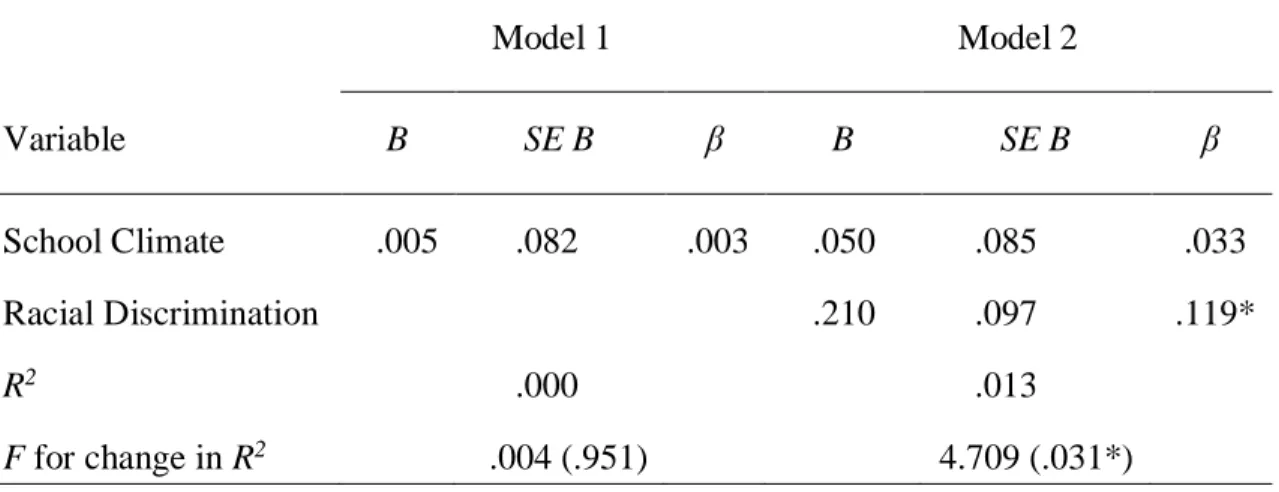
that Racial Discrimination was a significant predictor of Racial Identity Development ( = .119;
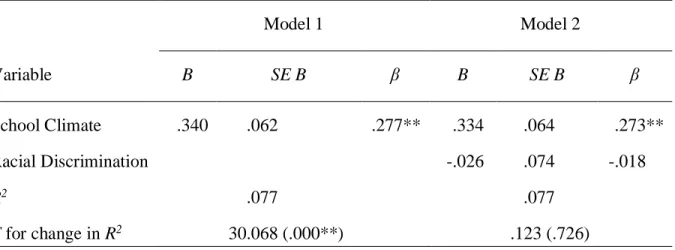
p < .05); School Climate was also found to be a statistically-significant predictor of students’ Academic Achievement at an alpha level of 0.01 ( = .277; p < .01), ( = .273; p < .01). Lastly,
within the quantitative models School Climate and Racial Discrimination were evidenced to be
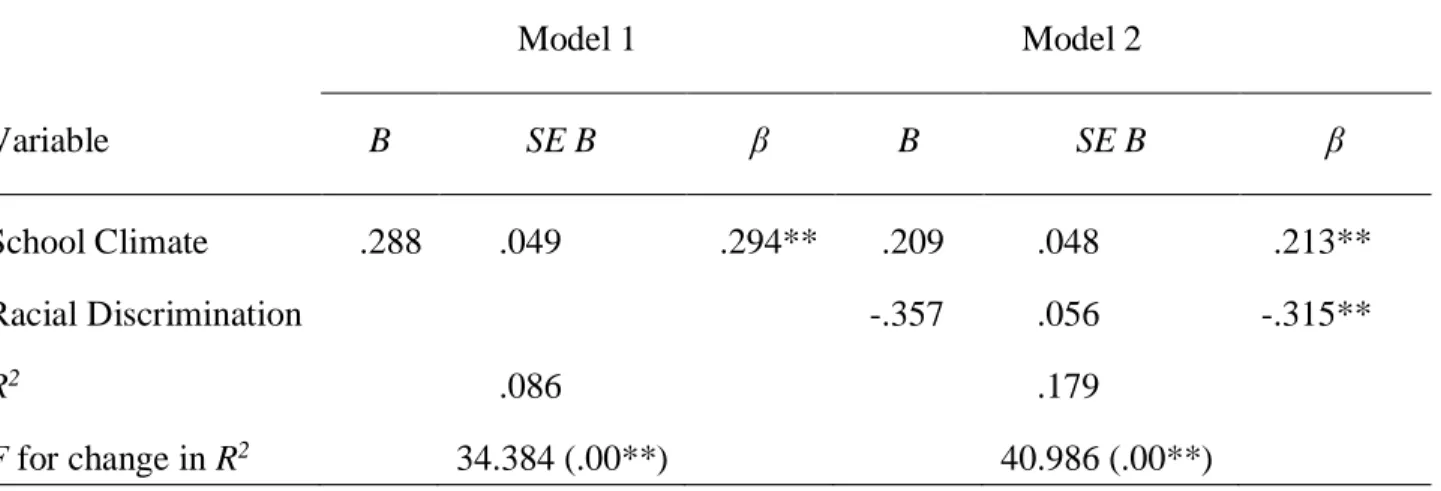
significant predictors of Educational Aspirations ( = .213; p < .01), ( = -.315; p <.01). The
mixed methods design also yielded key themes from the qualitative data which included college
and career readiness, academic climate, community influences, and exposure. The results of the
research are provided in further detail throughout Chapter 4. Chapter 5 will include an
Research Question One
The first step in analyzing the data was to examine the descriptive statistics of the
variables collected within the DAQ survey. The participant’s responses from the DAQ survey
were uploaded into SPSS, where each variable of interest was converted from a string variable
type into a numeric variable type. To compute the conversion, the survey responses were
assigned a numeric value (i.e., “Strongly Agree = 5”). This conversion was required to produce
frequency values and the relevant statistics to answer the research questions. To respond to
research question one, the data were organized into a table displaying the frequency of the
demographic variables gender, Grade Level, Mother’s Education, and Father’s Education of the
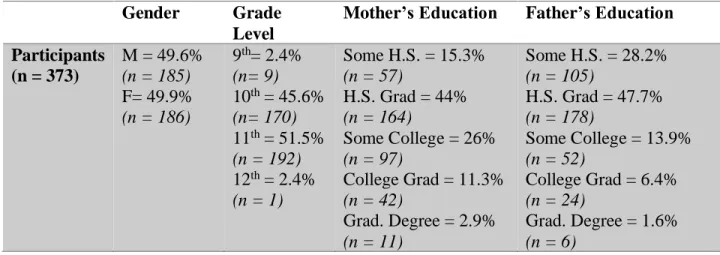
Black students attending the schools within the sample. The information in Table 3 displays the
frequency and percentages of the all the students’ reported demographics in the sample. The data indicates that 49.9% of the sample identified as female, 49.6% of the sample identified as male, and .5% of the sample did not provide a response. The data presented within the table indicates that 51.5% of the students participating in the sample were in the 11th grade. The
results presented in Table 3 also indicate that 44% of students reported that their mother’s
highest level of education attained was high school graduate and 47.7% of the students reported the same for their father’s highest level of education. Table 4, displays the frequencies of Black students participating from each school. Mamie Phipps High School included 41.3% (n = 154)
of sample, Malcolm X High School included 29.5% (n = 110) of participants, and Kenneth Clark
Table 3. Descriptive Statistics of All Students
Gender Grade
Level
Mother’s Education Father’s Education Participants
(n = 373)
M = 49.6% (n = 185) F= 49.9% (n = 186)
9th= 2.4%
(n= 9) 10th = 45.6%
(n= 170) 11th = 51.5%
(n = 192) 12th = 2.4%
(n = 1)
Some H.S. = 15.3% (n = 57)
H.S. Grad = 44% (n = 164)
Some College = 26% (n = 97)
College Grad = 11.3% (n = 42)
Grad. Degree = 2.9% (n = 11)
Some H.S. = 28.2% (n = 105)
H.S. Grad = 47.7% (n = 178)
Some College = 13.9% (n = 52)
College Grad = 6.4% (n = 24)
Table 4. Descriptive Statistics by High School
Gender Grade
Level
Mother’s Education Father’s Education Mamie
Phipps High School (n = 109)
M = 42.2% (n = 46) F= 57.8% (n = 63)
9th= 0%
(n= 0) 10th = 53.2%
(n= 58) 11th = 46.8%
(n = 51) 12th = 0%
(n = 0)
Some H.S. = 14.7% (n = 16)
H.S. Grad = 54.1% (n = 59)
Some College = 13.8% (n = 15)
College Grad = 15.6% (n = 17)
Grad. Degree = 0.9% (n = 1)
Some H.S. = 27.5% (n = 30)
H.S. Grad = 56.9% (n = 62)
Some College = 9.2% (n = 10)
College Grad = 3.7% (n = 4)
Grad. Degree = 0.9% (n = 1)
Malcolm X High School (n = 110)
M = 57.2% (n = 63) F= 41.8% (n = 46)
9th= 4.5%
(n= 5) 10th = 56.4%
(n= 62) 11th = 38.2%
(n = 42) 12th = 0%
(n = 0)
Some H.S. = 14.5% (n = 16)
H.S. Grad = 35.5% (n = 39)
Some College = 37.3% (n = 41)
College Grad = 7.3% (n = 8)
Grad. Degree = 5.5% (n = 6)
Some H.S. = 30% (n = 33)
H.S. Grad = 43.6% (n = 48)
Some College = 12.7% (n = 14)
College Grad = 10% (n = 11)
Grad. Degree = 1.8% (n = 2)
Kenneth Clark High School (n = 154)
M = 49.5% (n = 76) F= 50% (n = 77)
9th= 2.6%
(n= 4) 10th = 32.5%
(n= 50) 11th = 64.3%
(n = 99) 12th = 0.6%
(n = 1)
Some H.S. = 16.2% (n = 25)
H.S. Grad = 42.9% (n = 66)
Some College = 26.6% (n = 41)
College Grad = 11% (n = 17)
Grad. Degree = 2.6% (n = 4)
Some H.S. = 27.3% (n = 42)
H.S. Grad = 44.2% (n = 68)
Some College = 18.2% (n = 28)
College Grad = 5.8% (n = 9)
Grad. Degree = 1.9% (n = 3)
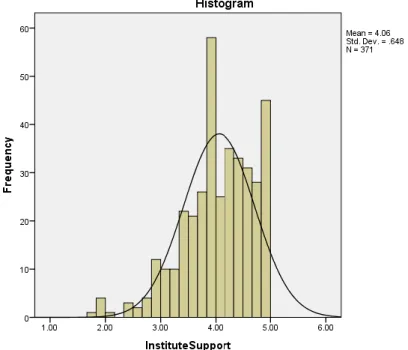
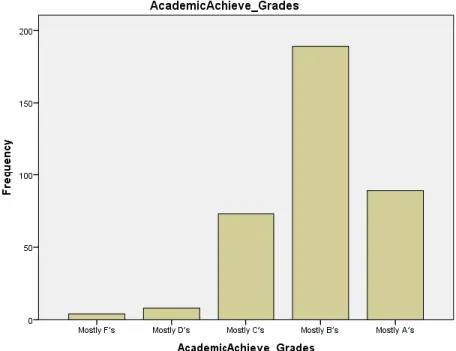
To supplement the data, descriptive graphs for the following variables were also
computed: Racial Identity Development, Racial Discrimination, School Climate, Educational
Aspirations, and Academic Achievement. These figures are listed below and provide an
racial discrimination, school climate or institutional support, educational aspirations, and
academic achievement.
Figure 1. Distribution of Racial Identity Development
Figure 3. Distribution of School Climate/Institutional Support
Figure 5. Bar Graph for Academic Achievement
Research Question Two
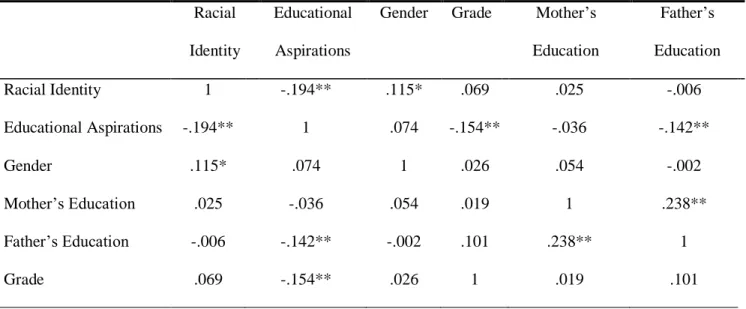
Research question two examined the relationship between the outcome variables and independent variables. Racial Identity Development and Educational Aspirations were the outcome variables of interest. To analyze this question within SPSS, each of the outcome and independent variables were converted into a logarithmic form. This process entailed converting the string variables into numeric form. The predictor variables analyzed within research question two included gender (male or female), grade level (9th, 10th, 11th, or 12th), mother’s highest level
in SPSS. The output of the correlation matrices are displayed within Table 5. The results display a significant negative correlation between Racial Identity Development and Educational Aspirations; gender was also found to be statistically significantly correlated with Racial Identity Development, within the model. The results also indicate a negative significant correlation between Educational Aspirations and Grade Level, as well as Educational Aspirations and the participant’s father’s highest level of education. Lastly, the correlation matrix also yielded a
slight positive and significant relationship between the mother and father’s highest level of education.
Table 5. Summary of Correlations
Racial
Identity
Educational
Aspirations
Gender Grade Mother’s
Education
Father’s
Education
Racial Identity 1 -.194** .115* .069 .025 -.006
Educational Aspirations -.194** 1 .074 -.154** -.036 -.142**
Gender .115* .074 1 .026 .054 -.002
Mother’s Education .025 -.036 .054 .019 1 .238**
Father’s Education -.006 -.142** -.002 .101 .238** 1
Grade .069 -.154** .026 1 .019 .101
*p < .05. **p < .01
Research Question Three
primary independent variables. In order to compute the regression model, the participant responses for school climate and racial discrimination were assigned numeric values and
averaged to create each respective scale. School Climate included responses to questions 25-30 and 33 on the DAQ; the survey responses were assigned a numeric value and the average of the response from each question was used to create the School Climate variable. This same process was also used to create the Racial Discrimination variable, which included questions 31-32, 34, 36, 44, and 58, and Racial Identity Development included questions 71-75. Research question three investigated whether school climate and racial discrimination act as a significant predictor of racial identity. Table 6 includes the results of the hierarchical regression computed to
examine the relationships between the variables of interest. Within this regression model, Racial Discrimination was found to be a significant predictor of Racial Identity Development with an alpha level of .05 ( = .119; p < .05).
Table 6. Summary of Regression Analysis for Racial Identity Development (N = 352)
Model 1 Model 2
Variable B SE B β B SE B β
School Climate .005 .082 .003 .050 .085 .033
Racial Discrimination R2
F for change in R2
.000 .004 (.951)
.210 .097 .013 4.709 (.031*)
.119*
Research Question Four
Research question four investigated the relationship between school climate, racial discrimination, and academic achievement. To test research question four, a hierarchical regression was executed with school climate and racial discrimination as the primary
independent variables and academic achievement as the dependent variable. In order to compute the regression model, the participant responses for school climate and racial discrimination were assigned numeric values and averaged to create each respective scale. Academic Achievement included the survey responses to question 22; the survey responses were assigned the following numeric values, Mostly A’s = 4, Mostly B’s = 3, Mostly C’s = 2, Mostly D’s = 1, and Mostly F’s
= 0. Research question four examined whether school climate and racial discrimination act as significant predictors of academic achievement. Table 7 includes the results of the hierarchical regression computed to examine the relationships between the dependent and independent variables. Within this regression model, School Climate was found to be a
statistically-significant predictor of Academic Achievement with an alpha level of .05 ( = .277; p < .01), (
= .273; p < .01).
Table 7. Summary of Regression Analysis for Academic Achievement (N = 362)
Model 1 Model 2
Variable B SE B β B SE B β
School Climate .340 .062 .277** .334 .064 .273**
Racial Discrimination R2
F for change in R2
.077
30.068 (.000**)
-.026 .074 .077 .123 (.726)
-.018
Research Question Five
Research question five assessed the relationship between school climate, racial discrimination, and educational aspirations. To address research question five, a hierarchical regression was performed with school climate and racial discrimination as the primary
independent variables and educational aspirations as the dependent variable. In order to compute the regression model, the participant responses for school climate and racial discrimination were assigned numeric values (1-5) and averaged to create each respective scale. Educational
Aspirations included participant responses to questions 47-51 on the DAQ; the survey responses were assigned a numeric value and the average of the responses to each survey question was used to create the Educational Aspirations variable. Research question five examined whether school climate and racial discrimination act as a significant predictor of the participant’s educational aspirations. Table 8 includes the results of the hierarchical regression computed to examine the relationships between the predictor and outcome variables. Within this regression model, School Climate and Racial Discrimination were found to be statistically-significant predictors of Educational Aspirations at an alpha level of .05 ( = .213; p < .01), ( = -.315; p