C
ANDIDATES
TRATEGY ANDA
SSESSMENTD
URINGE
LECTIONC
AMPAIGNSKevin K. Banda
A dissertation submitted to the faculty of the University of North Carolina at Chapel Hill in partial fulfillment of the requirements for the degree of Doctor of Philosophy in the Department of Political Science.
Chapel Hill 2013
Approved by:
Thomas M. Carsey
Pamela J. Conover
Virginia H. Gray
Michael B. MacKuen
c
2013
ABSTRACT
KEVIN K. BANDA: Candidate Strategy and Assessment During Election Campaigns. (Under the direction of Thomas M. Carsey)
I examine the formation and consequences of candidates’ issue agendas — the issues on
which they focus during election campaigns. I argue that candidates’ issue-based messages
are important for three reasons. First, the issues candidates discuss should affect the issues
that their opponents talk about. Second, the issues candidates discuss and the positions they
outline in their messages should influence citizens’ views of the candidates’ ideological and
issue positions. Last, the ideological portrayal of candidates’ opponents as communicated
through a negative message should have two effects: it should (1) alter citizens’ views of
the target of the attack in the way suggested by the message and (2) lead citizens to view
the sponsor of the attack as holding characteristics that are the opposite of their portrayal
of their opponent. I use data from 146 U.S. Senate and gubernatorial campaigns to assess
my first argument and data drawn from two survey experiments to address the second and
ACKNOWLEDGMENTS
I owe a great deal to a number of groups and individuals. The American Politics
Re-search Group (APRG) and the George Rabinowitz Seminar provided an intellectually
stim-ulating environment in which to learn about the craft of research from a diverse group of
scholars. The seminar also provided me with opportunities to practice giving talks and
re-sponding to questions, which was very helpful during the job market. Additionally, APRG
provided me with summer funding, thus allowing me to focus on research when I otherwise
might have concentrated on some other form of work. The Thomas M. Uhlman Fund at
UNC helped to fund some of my trips to conferences, for which I am grateful.
I am thankful to many of my classmates and graduate school colleagues, all of whom
provided me with a sense of camaraderie and who helped me through tough times. In no
particular order, I am especially grateful for the support offered by Mel Atkinson, Amber
Knight, Jason Windett, Elizabeth Coggins, Will Winecoff, Jeff Harden, Justin Kirkland,
Greg Wolf, John Lovett, Ali Stoyan, Paula Mukherjee, Alex Parets, Mark Yacoub, John
Cluverius, and Chelsea Phillips.
I also owe a great debt to my dissertation committee. Tom Carsey, Pam Conover,
Vir-ginia Gray, Mike MacKuen, and Jim Stimson all offered a great deal of helpful and patient
feedback on my research over the course of my five years at UNC. They also provided
me with much more of their time than they needed to, a fact for which I am very grateful.
This research would have suffered greatly without their dedication to guiding me through
graduate school. I also need to thank George Rabinowitz for serving on my master’s thesis
committee. George offered me a great deal of help on that project, which later turned into
the strongest chapter of my dissertation.
a great deal of guidance that far exceeded his professional obligations. Tom was generous
with both his time and his resources. I cannot fathom the number of hours he spent reading
and commenting on various drafts of papers that I sent him. Without his patient guidance I
would not be where I am today, and for that I am very grateful.
I would like to thank Chris Reynolds, Carl Nichols, Shannon Eubanks, Susan Heske,
and Cynthia Tang for helping me through the (mostly) nonacademic parts of graduate
school. I am also grateful for the support provided by my parents. Finally, I am
thank-ful to Melanie Ungar for her love, kindness, and support over the last two years. I am
very fortunate to have a partner who is invested in my happiness and success. My time in
TABLE OF CONTENTS
1 THE DYNAMICS OF CAMPAIGN ISSUE AGENDAS . . . 1
1.1 Campaigns, Candidates, and Issues . . . 2
1.1.1 Issue Selection. . . 4
1.1.2 Issue Agendas . . . 6
1.1.3 Electoral Competition . . . 9
1.2 The Dynamics of Campaign Advertising and Party-Owned Issues . . . 10
1.3 Research Design . . . 12
1.3.1 Contest and Candidate Level Characteristics . . . 15
1.3.2 Modeling Campaigns as Dynamic Processes . . . 17
1.3.3 Expectations . . . 19
1.4 Results . . . 19
1.4.1 Candidate Interaction and Party-Owned Issue Agendas . . . 20
1.5 Conclusion . . . 24
2 ISSUE OWNERSHIP, ISSUE POSITIONS, AND CANDIDATE ASSESSMENT . 29 2.1 Attitude Formation and Issues . . . 31
2.1.1 Party Ownership of Issues and Candidate Assessment . . . 32
2.2 Information Cues and Candidate Assessment . . . 34
2.2.1 Issue Ownership and Issue Position Cues . . . 35
2.2.2 Partisanship and Information Cues . . . 37
2.3 Research Design . . . 40
2.3.2 Treatments . . . 42
2.3.3 Measurement and Modeling . . . 44
2.3.4 Expectations . . . 47
2.4 Results . . . 49
2.4.1 Ideological Congruence . . . 49
2.4.2 Issue Position Congruence . . . 51
2.4.3 Partisan Lenses and Information Cues . . . 56
2.5 Conclusion . . . 62
3 NEGATIVITY AND CANDIDATE ASSESSMENT . . . 64
3.1 Campaigns and Attitude Formation. . . 66
3.1.1 Negative Campaigning . . . 67
3.2 Candidate Assessment and Negativity . . . 68
3.2.1 Two-Way Information Cues and Candidate Assessment . . . 70
3.2.2 Shared Partisanship as a Source Cue . . . 73
3.3 Research Design . . . 75
3.3.1 Model . . . 77
3.3.2 Expectations . . . 78
3.4 Results . . . 79
3.4.1 Ideological Perceptions . . . 79
3.4.2 Perceptions of Positions on Discussed Issues . . . 81
3.4.3 Perceptions of Positions on Unmentioned Issues . . . 83
3.5 Conclusions . . . 86
A APPENDIX FOR CHAPTER 1 . . . 89
A.1 Additional Analysis from Chapter 1 . . . 89
B APPENDIX FOR CHAPTER 2 . . . 93
C APPENDIX FOR CHAPTER 3 . . . 100
C.1 Treatments and Questions . . . 100
C.1.1 Control treatment . . . 100
C.1.2 Treatment A: Democrat attacks, Republican does not. . . 100
C.1.3 Treatment B: Republican attacks, Democrat does not . . . 101
LIST OF TABLES
1.1 U.S. Senate and Gubernatorial Election Contests Included in These Data . . . 13
1.2 Coding Scheme: Issue Ownership . . . 14
1.3 Summary Statistics at the Weekly Media Market Level . . . 16
1.4 Campaign Advertising and the Dynamics of Candidate Responsiveness . . . 27
1.5 Correlation of Residuals . . . 28
2.1 Cue Types . . . 35
2.2 Treatment Assignment . . . 42
2.3 Expected Signs of the Treatment Dummies’ Estimated Coefficients Relative to the Control Group . . . 48
2.4 Perceived Ideological Congruence of the Senator with the Senator’s Party. . . . 49
2.5 Perceived Congruence on Mentioned Issues of the Senator with the Sena-tor’s Party . . . 52
2.6 Perceived Congruence on Unmentioned Issues of the Senator with the Sen-ator’s Party . . . 54
2.7 Partisanship and Ideological Perceptions . . . 58
2.8 Partisanship and Perceptions of Issue Positions: Mentioned Issues . . . 59
2.9 Partisanship and Perceptions of Issue Positions: Unmentioned Issues . . . 61
3.1 Treatment Assignment . . . 76
3.2 Ideological Assessments . . . 80
3.3 Perceived Positions on Mentioned Issues . . . 82
3.4 Perceived Positions of the Democratic Candidate on Unmentioned Issues . . . . 84
3.5 Perceived Positions of the Republican Candidate on Unmentioned Issues . . . . 85
C.1 Ideological Assessments . . . 104
LIST OF FIGURES
1.1 Party-Owned Issue Agendas in Two Contests . . . 21
1.2 Total Short and Long Run Predicted Effects of Candidates’ Volume of Party-Owned Issue Ads on the Advertising Behavior of their Opponents . . . 22
2.1 Issue Position and Issue Ownership Cues’ Effects on Citizens Views of Can-didates’ Positions . . . 38
2.2 Ideological Continuum . . . 45
1 THE DYNAMICS OF CAMPAIGN ISSUE AGENDAS
Candidates and their campaign staffs expend a great deal of effort attempting to shape
the information environment voters face when choosing a candidate to support. Candidates
want to set the agendas of their campaigns in ways that will maximize their chances of
win-ning elections. One of the ways they might be able to exert agenda control is by focusing
on issues that favor them and harm their opponents. While this approach is straightforward,
several studies have shown that competing candidates often talk about the same issues even
when one candidate holds an advantage relative to her opponent (e.g. Sigelman and Buell
2004; Kaplan, Park, and Ridout 2006; Sides 2006). What drives candidates to discuss the
same sets of issues during campaigns?
I argue that the way in which candidates shape their issue agendas — the sets of related
issues they discuss during campaigns — is informed by two factors: the issue agendas of
their opponents and the competitiveness of the election environment they face. Candidates
must obtain the support of the median voter in order to win elections. One of the ways
they may attempt to do so is by responding to their opponents’ issue agendas by devoting
more of their own campaign’s focus to those same sets of issues, or converging in terms of
issue agendas.1 Doing so may help candidates appeal to the median voter by, for example,
broadening their perceived degree of expertise across a wider array of issues.
In addition, some scholars argue that the proclivity of candidates to respond to one
another is conditioned by the competitiveness of their elections (e.g. Kaplan, Park, and
Ridout 2006). Non-habitual voters are more likely to participate in competitive elections,
so candidates in competitive races may face additional pressure to address one another’s
issue agendas in order to appeal to occasional voters, who tend to be more persuadable
than habitual voters.
I test these propositions using advertising data collected by the Wisconsin Advertising
Project from 146 statewide campaigns — 92 of which were for U.S. Senate seats and 54
of which were for governorships — occurring during six election years across all 50 states.
I use a dynamic modeling technique to test my theory and find strong evidence of issue
agenda convergence in both noncompetitive and competitive campaigns, but a generally
higher level in the latter. In other words, candidates respond to the issue agendas of their
opponents and do so to a greater extent in competitive elections. These findings lead to
important implications for our understanding of campaign dynamics, candidate strategy,
and the importance of issues in statewide contests.
1.1 Campaigns, Candidates, and Issues
The principal finding of most contemporary research on campaigns and elections is
that campaigns matter in fundamental ways that can shape election outcomes (see for
ex-ample Carsey 2000; Stimson 2004; Brady, Johnston, and Sides 2006; Vavreck 2009). While
there is evidence that electoral decisions at the system level are influenced by campaigns
(Wlezien and Erikson 2002), there is less evidence that campaigns can persuade individual
citizens to change their vote choices (but see Mutz, Sniderman, and Brody 1996; Hillygus
and Shields 2008). One way that candidates may seek to influence citizens is by altering
their campaign messages in an attempt to change the criteria citizens use when they evaluate
candidates, a process known as heresthetic change (Riker 1990). Candidates may try to use
their campaigns to induce these changes in a number of ways: they may attempt to
stimu-late underlying predispositions (Berelson, Lazarsfeld, and McPhee 1954), produce a sense
of “enlightenment” about the state of the country among citizens (Gelman and King 1993),
level of ambiguity in politics by reducing citizens’ feelings of uncertainty about political
candidates (Franklin 1991; Alvarez 1997; Peterson 2004, 2009). In addition, candidates
may also attempt to change which issues the public finds most salient (Carsey 2000).
Sim-ilarly, coverage of campaigns by the news media can affect the perceived importance of
issues (Kinder 1998a,b; Iyengar and Simon 2000).
How then might candidates seek to win over potential voters during election
cam-paigns? Candidates could use one of three broad strategies when attempting to win an
election (e.g. Carsey 2000). The first broad strategy involves trying to change their
po-sitions on various issues so that their stated preferences are congruent with those of the
median voter. While this is a sensible strategy in the abstract, it is problematic for at least
three reasons. First, candidates may alienate their party’s activists by attempting to appeal
to moderates. This is a potentially dangerous strategy because activists tend to hold more
extreme policy preferences than other citizens and may sit out an election if they do not
feel as if their interests are being represented (Wittman 1983; Miller and Jennings 1986;
Erikson, Wright, and McIver 1993). Second, candidates may have well established records
which might be difficult to escape because their opponents and the news media will likely
discuss the weaknesses in candidates’ records. Finally, it may be difficult for candidates
to change their positions on issues because people are motivated reasoners and are likely
to respond to incongruent information about candidates by arguing against and discarding
it (Kunda 1990). Information that confirms previously held beliefs is also unlikely to alter
attitudes but is likely to be evaluated more positively than comparable incongruent
infor-mation (Taber and Lodge 2006). While candidates may attempt to improve their standing
among their opponents’ partisans, they may find it quite difficult to do so because these
par-tisans are already predisposed to dislike the candidates and may disregard messages
sug-gesting that they hold positions on some issues that are congruent with their non-preferred
The second broad campaign strategy available to candidates is to try to persuade
citi-zens to change their minds about one or more issues in ways that favor the candidate. Like
changing one’s positions, persuading citizens is also a daunting task. Candidates have little
reason to try to persuade their own supporters and those of their opponent are predisposed
to dislike them due to biased information processing brought on by partisanship. Trying
to convince citizens that their current attitudes are incorrect is difficult to accomplish,
es-pecially given that to do so, citizens must admit that their previous attitude was incorrect
(Riker 1990).
Because many candidates may find it difficult to change their positions or persuade large
numbers of citizens, they may instead pursue a third strategy, that of heresthetic change,
in which they attempt to affect the conditions under which citizens make their choices by
altering the salience of issues in the electoral environment (Riker 1990). Carsey (2000)
argues that candidates focus on the issues that advantage them the most relative to their
opponents while avoiding those for which their position is less advantageous. By spending
a great deal of time talking about the issues on which they are most advantaged, candidates
hope to induce citizens to think about their vote choices in a manner that favors them.
1.1.1 Issue Selection
Much of the extant research on issues in campaigns suggests that candidates should try
to focus on the issues that advantage them. There are several potential sources of candidate
advantage on issues. First, candidates’ records and personal characteristics appear to play
important roles in determining whether or not a candidate has an advantage on an issue
(Sellers 1998; Brasher 2003). Sellers (1998) and Damore (2004), for example, find that
candidates who hold popular positions on issues are advantaged relative to their opponents.
A second source of advantage stems from the issue ownership literature, which suggests
on these issues because citizens on average believe that they are better able to handle
prob-lems related to these issues than are members of the opposing party (Ansolabehere and
Iyengar 1994; Petrocik 1996; Petrocik, Benoit, and Hansen 2003; Egan Forthcoming).
These studies and others (see for example Budge and Farlie 1983; Carsey 2000) suggest
that candidates should mostly focus on different sets of issues and should, for the most part,
avoid engaging the same issues on which their opponents focus.2 Simon (2002) suggests
that candidates should never discuss the same issues as one another, even in competitive
campaigns when they may face pressure to do so. The logic underlying this argument
is that candidates have little to gain from discussing issues on which their opponents are
advantaged because doing so will likely remind citizens that the candidates’ opponents are
more desirable on some dimensions. In other words, candidates can only harm themselves
by addressing their opponents’ issues.
The results presented by scholars of issue convergence, however, suggest that
candi-dates routinely discuss many of the same issues that their opponents talk about during
elec-tion campaigns (Sigelman and Buell 2004; Kaplan, Park, and Ridout 2006; Sides 2006,
2007). “Issue convergence” in this literature refers to the process in which candidates
in-crease the degree to which they discuss an issue in response to inin-creases in their opponents’
focus on the same issue. It is about issue emphasis, not issue positions. There is also some
evidence suggesting that candidates diverge — discuss different issues — from one
an-other. Spiliotes and Vavreck (2002), for example, observe divergence among candidates
from different parties within districts and states. They do, however, observe convergence
among copartisans.
While the issue convergence literature focuses on individual issues, I focus on bundles
of related issues — issue agendas — in this research. The issues that make up a given issue
agenda may be related in a number of ways. First, the issues may be related to one another
in that they are all part of a single broader issue category. For example, medical insurance
for children, Medicare, and hospice services could all be viewed more broadly as being
directly related to health care policy. A second type of issue agenda is broader still; issues
relating to health care, education, and poverty programs are also similar to one another in
that they are all social policies.3 A third potential form that issue agendas might take are
through the relationships between issues and parties, i.e. issue ownership (Petrocik 1996;
Egan Forthcoming). Given the strong ties between the bundles of issues that make up an
issue agenda, candidates should not only respond to their opponents on individual issues
as has been observed in the issue convergence literature, but also across groups of related
issues that make up issue agendas.
1.1.2 Issue Agendas
There are several reasons to expect candidates’ issue agendas to converge over the
course of a campaign. First, parties should try to reduce the support for their opponents
by making overtures towards members of opposing coalitions (Downs 1957) and may do
so by focusing on wedge issues (Miller and Schofield 2003; Hillygus and Shields 2008).
Second, candidates who discuss their opponents’ issues may do so by reframing the issue
in a way to emphasize the strengths of the candidate or her party (Sides 2006). 4 Holian
(2004) provides a clear example on the Republican-owned issue of crime. Republicans
3Other examples of broad policy categories that can represent issue agendas are morality policies, eco-nomic policies, and foreign policies.
historically discussed crime in terms of punishment. When then Governor Clinton “stole”
crime during his 1992 campaign for the Presidency, he did so by reframing the issue in
terms of crime prevention, a dimension on which he was advantaged relative to his
oppo-nent. Third, candidates may also respond to their opponents’ attacks in order to defend their
records and positions (Skaperdas and Grofman 1995; Theilmann and Wilhite 1998; Lau
and Pomper 2004). Fourth, candidates may be more likely to discuss issues that are more
salient, which would lead candidates to discuss the same sets of issues even if they were not
attempting to directly respond to their opponents (Ansolabehere and Iyengar 1994). Last,
salient elections generate more information for citizens to consider when choosing among
candidates (Franklin 1991; Kahn and Kenney 1999) and citizens tend to use information
about issues and ideology in addition to partisan cues in these kinds of elections (Basinger
and Lavine 2005). More generally, engaging a larger set of issues also allows candidates
to provide citizens with more information about their candidacies (Geer 2006; Franz and
Ridout 2007).
Party-owned Issue Agendas
I focus more specifically in this research on issues that are owned by one of the two
major U.S. parties, i.e. the candidates’ party-owned issue agendas. I concentrate on party-owned issue agendas rather than individual issues or other kinds of issue agendas
be-cause citizens associate candidates with the party that owns the issues they discuss (Banda
2010) and tend tend to associate specific issues with individual parties (Walgrave,
Lefe-vere, and Tresch 2012). For example, citizens who are exposed to a candidate’s discussion
of Republican-owned (Democratic-owned) issues tend to link that candidate more strongly
with the Republican (Democratic) Party when forming attitudes about the candidate’s
ide-ological and issue positions. Thus, if citizens form attitudes about candidates in response
to the party ownership of the issues those candidates discuss, then candidates may respond
to their opponents’ party-owned issue agendas by discussing issues owned by the same
Republican-owned issues by discussing the same or other Republican-owned issues.
Party-owned issues are related to one another because citizens bundle them together and this
allows citizens to evaluate candidates on the same dimensions even when they discuss
dif-ferent — but related through party ownership — issues. Candidates, then, can communicate
consistent signals to citizens across many related issues simultaneously rather than issue by
issue.
I argue — contrary to strict proponents heresthetic change — that candidates should
respond to one another’s party-owned issue agendas by converging. In other words,
candi-dates should alter the degree to which they discuss Democratic or Republican-owned issues
as their opponent alters their own attention to these sets of issues. Stated more formally:
H1: The level of attention devoted to a set of party-owned issues by a candidate will increase as her opponent’s attention to the same set of party-owned issues increases.
Issue ownership does not speak to candidate behavior on all issues, merely to those
owned by a party. This is therefore a conservative test of issue agenda convergence
be-cause candidates on average are disadvantaged on the issues that are owned by the parties
of their opponents. This disadvantage should lead candidates who do not own a set of
is-sues to be less likely to discuss them. Put another way, it should be easier to observe issue
agenda convergence on issues that are not owned by parties relative to party-owned issues
because the former do not contain inherent advantages and disadvantages due to the
coun-tervailing influence of party ownership which should discourage issue agenda convergence.
Additionally, because citizens bundle party-owned issues together, it is useful to observe
the extent to which candidates (1) do so as well and (2) alter their strategies in response to
their opponents’ strategies.5
1.1.3 Electoral Competition
The extant literature suggests that the issue agendas of candidates will reflect one
an-other to a greater extent when the campaign environment is competitive (Kaplan, Park, and
Ridout 2006). Citizens may find competitive campaigns more interesting to follow because
the outcome is not so obvious before Election Day. Citizens who are faced with a
noncom-petitive campaign may be more likely to ignore political information because they view it
as both uninteresting — because the contest is fairly one sided — and irrelevant — because
the outcome of the election is not in doubt. Competitive campaigns may stimulate citizens
to become more interested in the campaigns, which may in turn lead them to want to learn
more about the candidates and their views. Thus, the additional interest that competitive
campaigns produce among citizens may lead candidates to feel compelled to respond to
their opponents’ party-owned issue agendas to teach citizens about themselves and their
opponents.
Kahn and Kenney (2004) found that competitive campaigns tend to be more negative
than those that are noncompetitive, in large part because frontrunners will bother to spend
time attacking their opponents in these contests. Competitiveness is key here for
front-running candidates because they only have an incentive to respond to their opponent’s
attacks when electoral conditions do not overwhelmingly favor them. More generally, when
a candidate is attacked, they may feel compelled to respond by either defending themselves
or by attacking their opponent on the same or a similar issue.
The news media should also be more interested in competitive campaigns for at least
two reasons. First, competitive elections produce information that can be easily framed into
a provocative narrative about an important political conflict. These narratives can then be
communicated to citizens who will be more receptive to consuming stories about
compet-itive elections than they will stories following lopsided contests, which do not lend
them-selves to being repackaged as compelling narratives. The second reason is that journalists
may not view noncompetitive elections as being particularly newsworthy. For this reason,
they may be less likely to devote scarce resources to covering noncompetitive contests.
Candidates are cognizant of the level of coverage the news media devotes to their
cam-paigns and may feel pressured to respond to their opponents’ party-owned issue agendas in
response to the additional coverage in order to avoid criticism.
Consistent with the work of other scholars (Kaplan, Park, and Ridout 2006), I argue that
as competition increases, so too should the likelihood that candidates’ own strategies are
informed by those of their opponents. In other words, candidates should converge on issue
agendas to a greater extent in competitive elections than they should in noncompetitive
elections. This potentially conditional relationship leads to the following hypothesis:
H2: The issue agenda convergence predicted in H1should be more pronounced
in competitive campaigns than in noncompetitive campaigns.
If strict proponents of heresthetic change are correct, candidates will not respond to
their opponents’ party-owned issue agendas in competitive or noncompetitive elections
because they will not want to engage in discourse about issues on which they are viewed
as being weak.
1.2 The Dynamics of Campaign Advertising and Party-Owned Issues
I propose a dynamic test of issue agenda convergence in which I model Candidate A’s
issue agenda as a function of their own issue agenda in the previous time period along with
Candidate B’s issue agenda in the previous time period. This modeling strategy allows
for a direct test of campaign dialogue; if candidates respond to one another by engaging
in dialogue, they will increase their attention to their opponents’ previous agendas. If
party-owned issue agendas.
I examine the attention given by candidates to party-owned issues expressed through
television advertisements for three reasons. First, television advertising is ubiquitous in
statewide and national campaigns and is increasingly prevalent as the competitiveness of
a campaign increases. Second, studying television advertising allows me to bypass the
the news media’s filter that would be present in an analysis using newspaper coverage
of campaigns. The advertisements run by candidates should reflect the candidates’ overall
campaign strategies because the advertising messages do not have to pass through the filters
of external actors. Third, candidates may change their strategies over the course of their
campaigns. Advertising data allows me to observe these changes dynamically.
I analyze U.S. Senate and gubernatorial campaigns for two reasons. First, I argue that
candidate strategy may differ based on whether or not an election is competitive. There
is little variation in presidential election competitiveness; they are all competitive, at least
at the national level.6 I therefore need contests for which there are both competitive and
noncompetitive contexts. Statewide elections like U.S. Senate and gubernatorial contests
fit this requirement. Second, candidates for statewide offices rely on advertising to
com-municate with citizens to a greater extent than do candidates running for the U.S. House
and for offices further down the ticket.
1.3 Research Design
I make use of the Wisconsin Advertising Project’s (WiscAds) 1998 through 20087U.S.
Senate and gubernatorial advertising data sets to test my theory.8 These data contain
in-formation on the date, time, and television station on which each political advertisement
ran in the 75 largest media markets in 1998, the 100 largest U.S. media markets from 2000
through 2004, and all U.S. media markets in 2008. I use all U.S. Senate and gubernatorial
contests in which both major parties were represented by a candidate9 and in which both
candidates ran general election television advertisements.10 Candidates who were
sacri-ficial lambs were thus excluded from my analysis. This left me with 146 contests — 92
Senate and 54 gubernatorial races — spread across six election years and all 50 states.
Given these constraints, advertisements aired in 161 media markets are included in my
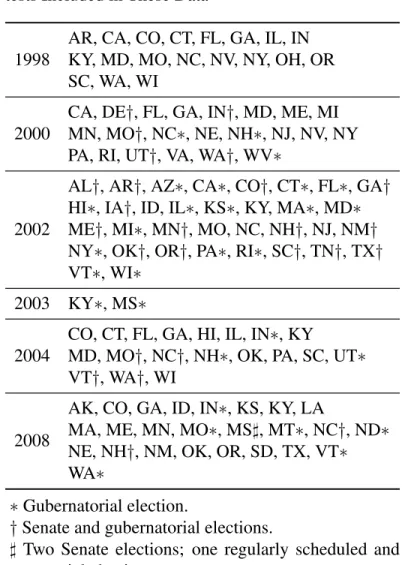
analysis. Table 1.1 lists the contests observed in this research.
Each advertisement airing was coded by members of the WiscAds teams for a large
number of characteristics, the most important of which for this research are the issues
discussed in the ads. Coders included up to four issues per advertisement and about 50
issues were included in the coding scheme.11 Some of these issues were transitory in nature,
but many were included in every year of the data. I coded 31 of these issues as being owned
7The years included are 1998, 2000, 2002, 2003, 2004, and 2008. The 1998 data only contains U.S. Senate ads and the 2003 data covers two gubernatorial campaigns.
8The data were obtained from a project of the University of Wisconsin Advertising Project includes media tracking data from TNSMI/Campaign Media Analysis Group in Washington, D.C. The University of Wiscon-sin AdvertiWiscon-sing Project was sponsored by a grant from The Pew Charitable Trusts. The opinions expressed in this article are those of the authors and do not necessarily reflect the views of the University of Wisconsin Advertising Project or The Pew Charitable Trusts.
9I treated Paul Wellstone and Walter Mondale as a single candidate in Minnesota’s 2002 Senate race due to the former’s death late in the campaign. Excluding the race from my analysis does not alter the substantive findings I report in this research.
10I excluded contests in which one candidate ran only a trivial number of advertisements or only ran ads in a single week. Excluded elections include New Mexico’s 2000 Senate race and New Hampshire’s 2004 Senate contest. The losing candidates in these elections aired fewer than 10 advertisements during their campaigns.
Table 1.1: U.S. Senate and Gubernatorial Election Con-tests Included in These Data
1998
AR, CA, CO, CT, FL, GA, IL, IN KY, MD, MO, NC, NV, NY, OH, OR SC, WA, WI
2000
CA, DE†, FL, GA, IN†, MD, ME, MI MN, MO†, NC∗, NE, NH∗, NJ, NV, NY PA, RI, UT†, VA, WA†, WV∗
2002
AL†, AR†, AZ∗, CA∗, CO†, CT∗, FL∗, GA† HI∗, IA†, ID, IL∗, KS∗, KY, MA∗, MD∗ ME†, MI∗, MN†, MO, NC, NH†, NJ, NM† NY∗, OK†, OR†, PA∗, RI∗, SC†, TN†, TX† VT∗, WI∗
2003 KY∗, MS∗
2004
CO, CT, FL, GA, HI, IL, IN∗, KY
MD, MO†, NC†, NH∗, OK, PA, SC, UT∗ VT†, WA†, WI
2008
AK, CO, GA, ID, IN∗, KS, KY, LA
MA, ME, MN, MO∗, MS], MT∗, NC†, ND∗ NE, NH†, NM, OK, OR, SD, TX, VT∗ WA∗
∗Gubernatorial election.
†Senate and gubernatorial elections.
] Two Senate elections; one regularly scheduled and one special election.
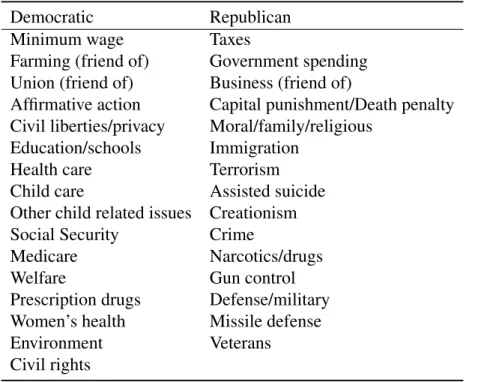
by either the Republicans or the Democrats, each of which is listed in Table 1.2. I selected
these issues because they fit Petrocik’s (Petrocik 1996) established descriptions of
party-owned issues (see also Egan Forthcoming). These are issues for which the parties have
long-standing advantages rather than issues that temporarily advantage one party or the
other.12
Table 1.2: Coding Scheme: Issue Ownership
Democratic Republican
Minimum wage Taxes
Farming (friend of) Government spending Union (friend of) Business (friend of)
Affirmative action Capital punishment/Death penalty Civil liberties/privacy Moral/family/religious
Education/schools Immigration
Health care Terrorism
Child care Assisted suicide
Other child related issues Creationism
Social Security Crime
Medicare Narcotics/drugs
Welfare Gun control
Prescription drugs Defense/military
Women’s health Missile defense
Environment Veterans
Civil rights
Next, I collapsed these advertising data by contest and media market and created weekly
time series. In each observation I recorded the number of advertisements that week that
mentioned at least one Democratic or Republican-owned issue.13 The number of
advertise-ments in a week that contained Democratic and Republican-owned issues for each of the
candidates serve as the dependent variables in my analysis. They are also key independent
variables in some of my models, as the attention given to them by a candidate’s opponent
should affect the former’s issue agenda.
1.3.1 Contest and Candidate Level Characteristics
I use the Cook Political Report’s race ratings as an indicator of electoral competition. In
its raw form, the ratings are a seven point measure for which competitiveness is strongest in
the middle categories. Its seven values are “solid Democratic,” “likely Democratic,” “lean
Democratic,” “toss up,” “lean Republican,” “likely Republican,” and “solid Republican.” I
collapsed this scale down to a simple dichotomous indicator of competition; contests coded
as “leaning” or “toss up” were coded as being competitive (1) while the rest were coded as
noncompetitive races (0).
I include dichotomous indicators of whether or not each candidate is an incumbent —
because incumbents may be less apt to discuss party owned issues due to their electoral
security — or a woman — because female candidates may be more likely to emphasize
women’s issues (Windett 2011), which also tend to be associated with the Democratic
Party — along with dummy variables indicating whether or not the contest was an open
seat election and whether or not the election occurred in each election year. I include
these latter two indicators to account for potential differences in candidate strategy in open
seat elections and in each of the years for which I have data. I also include dichotomous
indicators for whether or not each candidate is black and Latino. These indicators allow me
to control for potential differences in campaign strategy driven by race, as candidates who
are racial minorities may be more likely to spend time talking about racial issues, which
are owned by the Democratic Party.
Approximately 36% of elections were open seat contests and just under 59% of the
elec-tions were competitive. Thirty percent of contests involved at least one female candidate
while three and two percent contained at least one black or Latino candidate respectively.
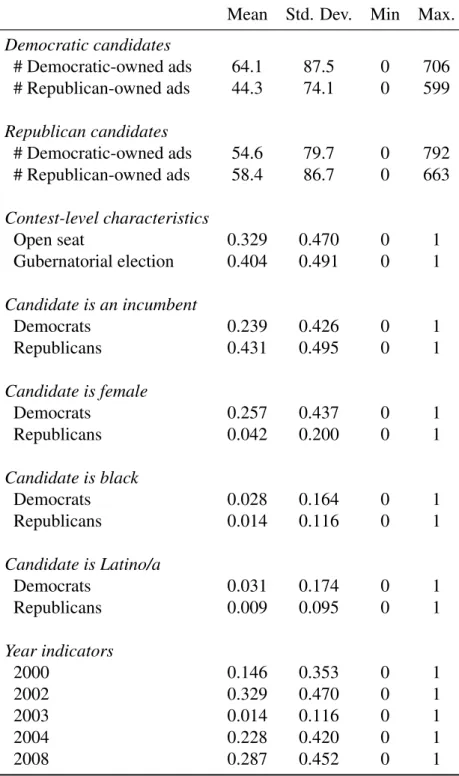
Thirty seven percent of the elections were for governorships. Table 1.3 contains summary
Table 1.3: Summary Statistics at the Weekly Media Market Level
Mean Std. Dev. Min Max.
Democratic candidates
# Democratic-owned ads 64.1 87.5 0 706
# Republican-owned ads 44.3 74.1 0 599
Republican candidates
# Democratic-owned ads 54.6 79.7 0 792
# Republican-owned ads 58.4 86.7 0 663
Contest-level characteristics
Open seat 0.329 0.470 0 1
Gubernatorial election 0.404 0.491 0 1
Candidate is an incumbent
Democrats 0.239 0.426 0 1
Republicans 0.431 0.495 0 1
Candidate is female
Democrats 0.257 0.437 0 1
Republicans 0.042 0.200 0 1
Candidate is black
Democrats 0.028 0.164 0 1
Republicans 0.014 0.116 0 1
Candidate is Latino/a
Democrats 0.031 0.174 0 1
Republicans 0.009 0.095 0 1
Year indicators
2000 0.146 0.353 0 1
2002 0.329 0.470 0 1
2003 0.014 0.116 0 1
2004 0.228 0.420 0 1
1.3.2 Modeling Campaigns as Dynamic Processes
I use pooled time series data in order to capture campaign dynamics. Because my theory
predicts interaction between candidates and the behavior I want to model occurs
simultane-ously, I must control for possible simultaneous and unmodeled correlation in the behavior
of the candidates.14 I do so using seemingly unrelated regression, which allows for multiple
equations and for the error terms of each equation be contemporaneously correlated with
one another (see Carsey, Jackson, Stewart, and Nelson 2011 for a similar application).
I employ an error correction modeling framework, which allows me to calculate long
and short term effects of time serial covariates on my dependent variables in my analysis
and is appropriate for both stationary and nonstationary data (DeBoef and Keele 2008).
The dependent variable of an error correction model is the first difference of the dependent
variable rather than the value at time t. This framework also requires the inclusion of a lagged dependent variable, the coefficient of which estimates the rate of error correction,
and both first differences and lagged levels of the remaining endogenous covariates.15
I estimate four equations simultaneously which predict the Democratic candidate’s
weekly number of advertisements containing (1) Democratic-owned issues, (2)
Republican-owned issues and the Republican candidate’s weekly number of advertisements containing
(3) Democratic-owned issues, and (4) Republican-owned issues. The equations follow:
∆DDit=a1DDit−1+b1RDit−1+c1∆RDit+ (d1RDit−1∗Comp) + (e1∆RDit∗Comp) +j1Comp
+kqControl+µ1
(1.1)
14Failing to do so would lead me to violate the assumption that my data are independently and identically distributed, which can lead to insurmountable problems when trying to interpret statistical results.
∆DRit=a2DRit−1+b2RRit−1+c2∆RRit+ (d2RRit−1∗Comp) + (e2∆RRit∗Comp) +j2Comp
+kqControl+µ2
(1.2)
∆RDit=a3RDit−1+b3DDit−1+c3∆DDit+ (d3DDit−1∗Comp) + (e3∆DDit∗Comp) +j3Comp
+kqControl+µ3
(1.3)
∆RRit=a4RRit−1+b4DRit−1+c4∆DRit+ (d4DRit−1∗Comp) + (e4∆DRit∗Comp) +j4Comp
+kqControl+µ4
(1.4)
In the preceding equations, each of the two letter long variables stands for one of the
issue agenda covariates. The first letter refers to the party of the advertising candidate
while the second refers to the party that owns the set of issues that were discussed in
the candidates’ advertisements that week. “DDit,” for example, refers to the Democratic
candidate’s emphasis of Democratic-owned issues while “RDit” refers to the Republican
candidate’s emphasis of Democratic-owned issues in media marketiand at timet. “Comp” refers to the dichotomous competition indicator. “Control” is a vector of control variables including whether or not the contest is for an open seat, a governorship, and the candidate
is a woman, an incumbent, black, or Latino. I also included a series of dummies indicating
the year in which the campaign took place.
The coefficients of the differenced covariates represent the average short term, or
con-temporaneous, change in the dependent variable that results from a one unit increase in the
covariate. The contemporaneous changes occur at time t. The coefficients of the lagged covariates correspond to a second short term effect, this time at timet + 1. These effects at time t + 1are not necessarily theoretically interesting on their own, but when they are divided by the negative of the coefficient generated for the lagged dependent variable, they
long run change in the dependent variable over future time periods given a one unit increase
of the associated covariate.16
The theory I have outlined in this paper is agnostic as to whether candidates will respond
to one another immediately or in the future. I will therefore focus on the total effects of
each of the endogenous covariates of interest each dependent variable. In other words, I
will focus on the long run multipliers.
1.3.3 Expectations
I expect that candidates will alter their issue agendas in response to those of their
op-ponents. Candidates should increase the number of advertisements mentioning a set of
party-owned issues as their opponents air more advertisements mentioning the same set of
party-owned issues. In other words, I expect that coefficientsbn,cn,dn,en, and their
asso-ciated long run multipliers will be positive and significantly (p≤.05) different than zero. Should these expectations be met, these results would offer support for my agenda
con-vergence theory rather than the various theories discussed above that predict non-response
among competing candidates.
1.4 Results
Before I report the results of my seemingly unrelated regression model, I first present
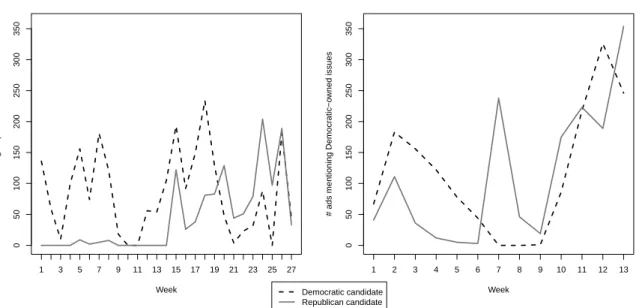
two brief examples of my data. Figure 1.1 contains four panels plotting the number of
advertisements mentioning Democratic and Republican-owned issues in the 2002 Texas
gubernatorial race and the 2004 North Carolina Senate campaign. In the case of the Texas
contest, the data are from the Houston media market while the North Carolina data are
from the Raleigh-Durham media market. The general pattern of these data suggests that
candidates’ party-owned issue agendas shift in response to one another. When one
candi-date increases or decreases their attention to Democratic or Republican-owned issues, so
too does the their opponent. The following analysis is an effort to determine whether this
pattern is consistent across a large number of races.
1.4.1 Candidate Interaction and Party-Owned Issue Agendas
Table 1.4 contains the results of a four-equation seemingly unrelated regression model.17
The first two columns of results are for equations estimating the extent to which Democratic
candidates emphasized Democratic and Republican-owned issues. Columns three and four
show the same for Republican candidates.
Error correction models produce output that can be difficult to interpret directly. The
model presented in Table 1.4 is further complicated by the presence of interaction terms.
Rather than focusing on individual coefficients, I will instead focus on illustrating my
find-ings from these models by generating predicted values of candidates’ total short and long
term campaign responsiveness as captured by the long run multipliers and presenting them
graphically. First, however, note that the estimated coefficients for the short term effects —
i.e. the differenced variables of the opponent’s advertising — suggest a general pattern of
contemporaneous issue agenda convergence among candidates. The interaction terms
fur-ther suggest that this tendency towards issue agenda convergence is stronger in competitive
elections than it is in noncompetitive elections.
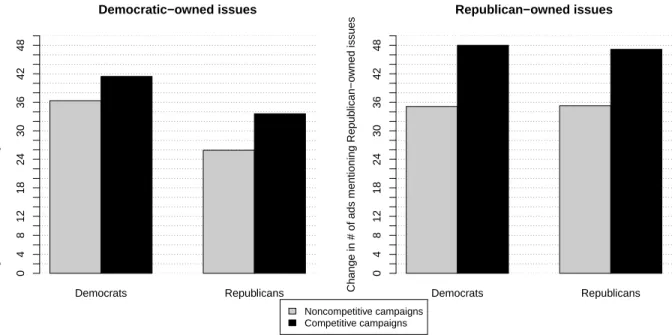
Figure 1.2 shows the total predicted effects of a one standard deviation increase in
the number of opponent-sponsored advertisements mentioning party-owned issues on a
0 50 100 150 200 250 300 350
2002 TX Gubernatorial Race in Houston: Democratic Issues
Week
# ads mentioning Repub
lican−o
wned issues
1 3 5 7 9 11 13 15 17 19 21 23 25 27
0 50 100 150 200 250 300 350
2002 TX Gubernatorial Race in Houston: Republican Issues
Week
# ads mentioning Repub
lican−o
wned issues
1 3 5 7 9 11 13 15 17 19 21 23 25 27
0 50 100 150 200 250 300 350
2004 NC Senate Race in Raleigh: Democratic Issues
Week
# ads mentioning Democr
atic−o
wned issues
1 2 3 4 5 6 7 8 9 10 11 12 13
0 50 100 150 200 250 300 350
2004 NC Senate Race in Raleigh: Republican Issues
Week
# ads mentioning Repub
lican−o
wned issues
1 2 3 4 5 6 7 8 9 10 11 12 13 Democratic candidate
Republican candidate
Democrats Republicans Democratic−owned issues
Change in # of ads mentioning Democr
atic−o
wned issues
0
4
8
12
18
24
30
36
42
48
Democrats Republicans
Republican−owned issues
Change in # of ads mentioning Repub
lican−o
wned issues
0
4
8
12
18
24
30
36
42
48
Noncompetitive campaigns Competitive campaigns
Note: The predicted effects plotted here are generated by one standard deviation increases in a candidate’s opponent’s party-owned issue emphasis.
candidate’s own volume of party-owned issue advertising. These effects were generated
using the long run multipliers. Recall that the long run multiplier in an expression of the
total short and long term effects of a change in an endogenous covariate on an outcome
variable.18 As shown in Figure 1.2, a one standard deviation — about 74 advertisements
— increase in the number of Republican-sponsored ads mentioning Democratic issues on
average leads Democratic candidates to run an additional 36 ads about Democratic issues in
noncompetitive elections. In competitive elections, Democrats instead respond by running
approximately 42 more ads. Republican candidates in noncompetitive elections respond to
a standard deviation — 87.5 ads — increase in the number of advertisements mentioning
Democratic-owned issues by running about 26 more ads. In competitive elections, this
number increases to just under 34 additional advertisements.
The pattern of response among candidates is similar for advertisements mentioning
Republican-owned issues. A one standard deviation — 86.7 advertisements — increase in
the number of Republican-sponsored ads mentioning Republican-owned issues on average
leads Democratic candidates to run about 35 and 48 more ads respectively in
noncom-petitive and comnoncom-petitive elections. For Republican candidates, these increases are nearly
identical: approximately 35 additional advertisements in noncompetitive elections and just
shy of 48 more advertisements in competitive elections for a one standard deviation — just
under 80 ads — increase in the number of Democratic-sponsored advertisements
mention-ing Republican-owned issues.
The pattern shown in Figure 1.2 is clear: Democratic and Republican candidates both
respond to increases in the number of party-owned ads their opponents run by increasing
the number of advertisements they air themselves mentioning the same set of party-owned
issues. They do so to a greater extent in competitive elections, which suggests that
candi-dates are more responsive to one another in more competitive campaign environments.19
The standard errors associated with the long run multipliers for competitive elections
indi-cate that the quantities presented in the figure for competitive and noncompetitive elections
differ significantly (p≤.05) from one another.
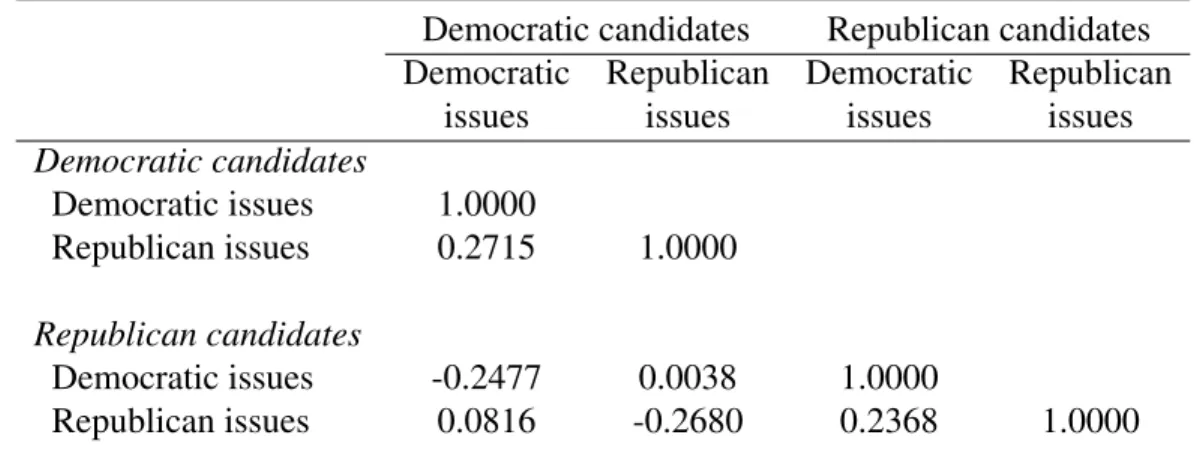
I present a brief analysis of the correlation of the residuals generated by each of the
equations of my seemingly unrelated regression model in Table 1.5. There is a surprisingly
low level of correlation among the residuals; the strongest correlation between residuals is
-.268. Correlations this low indicate that I could have run separate models without risking
biasing my results. Even so, given that I am modeling simultaneous candidate behavior
over time, a seemingly unrelated regression was the correct choice both theoretically and
methodologically.
1.5 Conclusion
The results of my analysis suggest that U.S. Senate and gubernatorial candidates react
to one another dynamically by altering their party-owned issue agendas in response to those
put forth by their opponents. These results provide support for the expectations generated
by issue agenda convergence theory rather than the expectation of nonresponse generated
by other theories of issue emphasis (e.g. Simon 2002). The convergence I observe in my
analysis appears to be even stronger in competitive campaigns than it is in noncompetitive
campaigns.
The results of this research lead to three implications. The first stems from the finding
that candidates can be encouraged to engage sets of issues — in this case the issues that
are owned by the party of their opponents — they might otherwise prefer to avoid if their
opponents increase the level of attention they give these issues.20 Issue agenda convergence,
19I present a distributed lag plot of these effects over five weeks that interested readers may examine in the appendix. The vast majority of the total effects I present in Figure 1.2 occur contemporaneously.
while certainly not required for democracy to function, could be useful for citizens because
they may find it easier to evaluate candidates who discuss related issues than candidates
who talk about unrelated issues. Issue agenda convergence on party-owned issues allows
citizens to assess candidates on the same dimensions — those implied by related issues —
when they otherwise might be forced to do so on the basis of disparate dimensions — those
implied by unrelated issues.
The second implication suggested by this research is that citizens may be presented
with a choice between candidates who are more responsive to one another during more
competitive campaigns. This may allow citizens to be better able to assess candidates using
similar sets of considerations. Competition in this sense may be an important component of
a democratic system because it encourages candidates to respond to one another more than
they might in noncompetitive election environments. Candidates in competitive elections
communicate more information to citizens about similar sets of issues. Citizens may then
use this information to form attitudes about candidates and to make direct comparisons
between them.
The third implication centers on what happens after elections. While there is some
evidence that candidates’ issue agendas do not affect election outcomes (Sides 2007), the
theory of issue uptake suggests that legislators often coopt the issue priorities of their
op-ponents even after the campaign ends (Sulkin 2005). Winning candidates, then, continue to
respond to the criticisms leveled against them and the issues discussed by their opponents
once they reach office.
Taken as a whole, these results suggest that candidates are not blind to the election
envi-ronments surrounding them. They react to their opponents and their responsiveness is
con-ditioned by competition. Future research might examine the responsive nature of candidate
strategy across other sets of related issues like social or economic issues, the dynamics of
candidate behavior in multi-stage elections, or the responsive behavior of candidates across
Table 1.4: Campaign Advertising and the Dynamics of Candidate Responsiveness
Democrats Republicans
Democratic issues Republican issues Democratic issues Republican issues
Error correction rate
# Sponsor’s issue adst−1 -0.449* -0.521* -0.459* -0.515*
(0.012) (0.012) (0.012) (0.013)
Opponent’s behavior
∆# Democratic issue ads 0.475* 0.466*
(0.026) (0.026)
∆# Democratic issue ads 0.029 -0.028
∗competition (0.031) (0.030)
# Democratic issue adst−1 0.205* 0.136*
(0.026) (0.023)
# Democratic issue adst−1 0.034 0.046†
∗competition (0.030) (0.026)
LRM for # Democratic issue ads 0.456* 0.296*
(0.026) (0.023)
LRM for # Democratic issue ads 0.075* 0.100*
∗competition (0.030) (0.026)
∆# Republican issue ads 0.286* 0.424*
(0.022) (0.037)
∆# Republican issue ads 0.173* 0.201*
∗competition (0.025) (0.041)
# Republican issue adst−1 0.211* 0.245*
(0.022) (0.038)
# Republican issue adst−1 0.067* 0.091*
∗competition (0.024) (0.040)
LRM for # Republican issue ads 0.405* 0.476*
(0.022) (0.037)
LRM for # Republican issue ads 0.128* 0.178*
∗competition (0.024) (0.040)
Election is competitive -0.910 1.773 -1.040 -1.303 (3.214) (2.699) (2.835) (2.970)
Open seat 11.162* 18.317* 8.072* 5.191†
(2.580) (2.227) (2.669) (2.911) Candidate is an incumbent 20.665* 18.057* 15.882* 16.835* (2.859) (2.428) (2.648) (2.870) Candidate is female -4.356† -3.920† 4.962 6.192
(2.336) (2.000) (4.797) (5.178) Candidate is black -3.977 -13.678* -25.255* -23.191*
(6.738) (5.811) (8.353) (8.964) Candidate is Latino/a -13.115* -14.802* 11.403 23.877* (6.307) (5.416) (10.497) (11.307) Gubernatorial election 5.127* -0.258 -4.028† -4.467†
(2.459) (2.102) (2.295) (2.509)
Year: 2000 5.143 -7.100† -3.082 -6.001
(4.756) (4.060) (4.431) (4.846)
Year: 2002 2.038 -0.469 -8.475* -7.490
(4.590) (3.920) (4.217) (4.608)
Year: 2003 32.730* -22.574* 1.476 46.193*
(10.138) (8.702) (9.491) (10.298)
Year: 2004 0.486 -1.225 -6.148 3.499
(4.785) (4.094) (4.483) (4.906)
Year: 2008 -7.202 3.540 -9.865* 0.648
(4.487) (3.852) (4.079) (4.474)
Intercept 11.020* -0.346 14.908* 14.318*
(4.313) (3.573) (4.078) (4.309)
R2 0.238 0.263 0.228 0.252
BIC 198,787.4
N 4,531
Note: Dependent variables are the first difference of a given candidate’s number of ads mentioning Democratic or Republican-owned issues in a week. Estimated OLS coefficients from a seemingly unrelated regression model are reported along with standard errors in parentheses. Long run multipliers are estimated using the Bewley (1979) transformation.
Table 1.5: Correlation of Residuals
Democratic candidates Republican candidates Democratic Republican Democratic Republican
issues issues issues issues
Democratic candidates
Democratic issues 1.0000
Republican issues 0.2715 1.0000
Republican candidates
Democratic issues -0.2477 0.0038 1.0000
Republican issues 0.0816 -0.2680 0.2368 1.0000
2 ISSUE OWNERSHIP, ISSUE POSITIONS, AND CANDIDATE ASSESSMENT
One of the most important topics that public opinion and campaigns scholars grapple
with is the degree to which citizens are responsive to politics. The classic findings suggest
that citizens tend to be politically inattentive, which may not be surprising given that most
individuals report that they are not interested in politics and that they care little about
elec-toral outcomes (Campbell, Converse, Miller, and Stokes 1960). More recent work confirms
these findings and further suggests that citizens may not even understand contemporary
pol-icy debates (Delli Carpini and Keeter 1996). These findings suggest the existence of two
potential problems. The first problem is related to democratic accountability: the public
must respond in reasonable ways to political conditions and events despite being made up
of individuals who tend to be politically inattentive. The second problem is faced by
can-didates, who must communicate with citizens who do not pay attention to or know much
about politics.
The conventional wisdom among scholars of public opinion is that party cues and party
labels are sufficient for citizens to make reasonably informed political decisions (Downs
1957; Conover and Feldman 1982; Feldman and Conover 1983; Rahn 1993) and that
is-sues do not play an important role in the formation of citizens’ attitudes. These findings
suggest the existence of an important puzzle: if issues do not matter because citizens do not
pay attention, then why do citizens claim that they want to know more about candidates’
policy solutions and why do citizens appear to dislike feeling uncertain about candidates’
positions (Bartels 1986; Alvarez 1997; but see Tomz and Van Houweling 2009)? It is also
puzzling that campaigns focus so much attention on the discussion of issues and “staying
does discussion of issues and issue positions by a candidate affect citizens’ views of the
candidate’s ideological dispositions and the candidate’s positions on the issues he does and
does not discuss?
Citizens tend to form attitudes about candidates based on key heuristics like party
iden-tification. While party is a powerful shortcut, citizens recognize that not all Democrats
and Republicans are identical. Citizens can update their views of candidates in response to
small bits of policy information embedded within candidates’ messages. These cues may
(1) reduce the uncertainty that citizens feel about candidates’ positions by offering citizens
more information from which they may draw when forming attitudes about candidates and
(2) offer inattentive citizens an easy source of additional information that is useful to those
who seek to learn about candidates while minimizing the costs associated with information
searches.
I focus on the effects of two kinds of information cues on citizens’ attitudes about
candidates. The first, issue ownership cues, are present in messages in which candidates discuss an issue that is “owned” — or strongly associated with — a party (Petrocik 1996).
Citizens should view the candidates as being more similar to to the party that owns the
issues the candidates discuss. The second kind of cue — “issue position cues” — are present when candidates identify their positions on issues. Citizens should again think
about candidates in terms of the party associated with the positions candidates outline.
These cues should influence citizens’ views of the candidates by associating them to
one of the two major parties. Issue ownership and issue position cues should affect
citi-zens’ perceptions of candidates’ positions on the issues they talk about because these kinds
of cues explicitly outline those candidates’ positions. These cues should also influence
citizens’ views of the candidates’ general ideological dispositions and their positions on
issues they do not discuss. Citizens tend to cluster issues together by party or candidate, so
(e.g. 2002).
I test my theory using a survey experiment embedded in the 2010 Cooperative
Con-gressional Election Study (CCES) in which I exposed participants to statements made by
a fictional Senator. These messages each contained party labels for the Senator.
Addition-ally, all of the experimental treatments contained one of several different combinations of
information cues. I varied the party ownership of the issues discussed in these treatments
along with whether or not positions were present in these messages. Finally, I varied the
positions the candidate took on the issues, which lined up with either the Democratic or the
Republican Party.
I test this theory in three contexts: participants’ placements of the Senator’s ideology,
his positions on the issues he mentioned in the treatments, and his positions on issues he
did not mention. My results show that citizens alter their views of the Senator in response
to these cues and imply that citizens may be more sophisticated that previous research
suggests because the meaning of issue ownership appears to extend beyond perceptions of
issue advantage. The discussion of party-owned issues appears to communicate positional
information about candidates, which further suggests that issues matter and have
poten-tially powerful effects on citizens’ views of political figures above and beyond the effects
produced by party labels.
2.1 Attitude Formation and Issues
Citizens draw information from several sources when forming attitudes about
dates during campaigns. Social cognition research suggests that citizens evaluate
candi-dates by categorizing them based on a social taxonomy in a subconscious attempt to reduce
the complexity of the social world because doing so is the most straightforward way of
reducing political complexity (Conover and Feldman 1989; Kinder 1986; Lodge, McGraw,
Sullivan 1990). Citizens hold expectations about which issues are associated with
mem-bers of the parties based on stereotypes associated with them (Rahn 1993). Democratic
and Republican elected officials have long exhibited consistently different policy
prefer-ences (Erikson, MacKuen, and Stimson 2002; Page 1978) and reputations (Snyder and
Ting 2002), a fact that likely reenforces Americans’ tendency to think about politics in
terms of groups (Converse 1964). Party labels and other partisan cues provide voters with
information shortcuts (Downs 1957) and knowledge about the partisanship of a candidate
allows people to make useful inferences (Conover 1981; Granberg, Kasmer, and Nanneman
1988; Hamill, Lodge, and Blake 1985; Hurwitz 1985; Jacoby 1988; Page 1978; Riggle,
Ot-tati, Wyer, Kuklinski, and Schwartz 1992; Wright and Niemi 1983). In short, cognitive
heuristics may make political attitude formation and decision-making easier for citizens
(but see Lau and Redlawsk 2001).
There is some evidence that citizens are unable to recall the issues that candidates talk
about during campaigns (e.g. Dalager 1996). If this is true, it would suggest that the issues
candidates choose to discuss in campaigns are irrelevant. However, there is evidence that
repetition in campaign advertising reinforces associations between issues and candidates
(Claibourn 2008) and that citizens evaluate candidates and people more generally using an
on-line process (Hamilton and Sherman 1996; Lodge, McGraw, and Stroh 1989; Lodge,
Steenbergen, and Brau 1995; McGraw and Stroh 1990; McGraw and Dolan 2007). This
suggests that even if citizens forget specifics, they will still update their attitudes about
candidates to reflect the information to which they have been exposed.
2.1.1 Party Ownership of Issues and Candidate Assessment
The issue ownership literature suggest that certain issues have become associated with
the parties in the sense that they are perceived by the electorate to be “owned” by one of the
parties (Budge and Farlie 1983; Petrocik 1996; Petrocik, Benoit, and Hansen 2003; Egan
problems stemming from the issues over time. When parties are successful, citizens on
average believe the party that owns an issue is better able to handle problems related to that
issue than parties that do not own the issue.1 Issue ownership, then, can be thought of as
a form of issue advantage that originates from the perceived strengths and weaknesses of
political parties rather than of individual candidates.
While some proponents of issue ownership argue that candidates should rarely if ever
discuss the issues owned by their opponents and should avoid discussing the same issues as
their opponents (e.g. Simon 2002), more recent work suggests that “issue trespassing” —
the discussion of issues owned by a different party — occurs frequently in U.S. campaigns
and that candidates competing against each other often discuss the same issues
(Sigel-man and Buell 2004; Kaplan, Park, and Ridout 2006; Sides 2006; Banda 2011; Banda and
Carsey 2012). Sides (2006) finds that candidates who discuss their opponents’ issues do
so by reframing the issue in a way to emphasize the strengths of the candidate or her party
(see also Holian 2004). While there is evidence that candidates are covered in a more
pos-itive way when the news media focuses more attention on the issues those candidates own
(Hayes 2008), it does not appear that the issue agendas of candidates as they relate to issue
ownership have strong effects on electoral outcomes (Sides 2007).
Scholars of issue ownership have mostly focused on the issue advantage dimension of
issue ownership and have not yet considered how issue ownership affects the ways citizens
view candidates’ ideological and issue positions. If citizens associate some issues with
specific parties, then they should — in the absence of positional information — view
can-didates who discuss a party-owned issue as being more ideologically congruent with the
party that owns the issue than they otherwise would have. In this sense, citizens should
be able to learn about the ideological dispositions of candidates even in the face of
oth-erwise ambiguous information. Similarly, when a candidate takes a position commonly
associated with a party, the candidate should also be viewed as being more ideologically
congruent with the party associated with that position. Citizens should also assess
candi-dates’ positions on issues they discuss in a similar fashion - by responding to information
cues embedded within candidates’ messages.
Citizens should also use the information that they have at their disposal to infer
candi-dates’ positions on issues that are not discussed. For example, a candidate who has taken
consistently conservative (liberal) positions on a number of issues may be viewed as
hold-ing conservative (liberal) positions on other issues. This sort of inference is reasonable
because political elites are ideologically constrained to a greater extent than are citizens
(Converse 1964). Politicians generally hold positions that are at the very least moderately
cohesive with their parties and clear messages are likely to be strong in the
contempo-rary period given the high levels of party polarization exhibited in the U.S. Congress (e.g.
Poole and Rosenthal 2007). In addition, the messages explicated by the parties during and
between campaigns suggest that members tend to hold fairly cohesive sets of preferences
(Carmines and Stimson 1989; Layman and Carsey 2002).
2.2 Information Cues and Candidate Assessment
The messages communicated by candidates to citizens during campaigns can contain
information cues that affect citizens’ views of the candidate by associating that candidate
with one of the two major U.S. political parties. These cues vary on two dimensions.
The first dimension is that of ownership; do the messages discuss issues that are owned
by either the candidate’s party or the opposing party? The second dimension is centered
on positions contained within candidates’ messages. A candidate’s messages may contain
positions that are congruent with their own party, congruent with the opponent’s party, or