Clinical Infectious Diseases
Clinical Infectious Diseases® 2017;64(6):711–8
Colistin Resistance in Carbapenem-Resistant Klebsiella
pneumoniae: Laboratory Detection and Impact on
Mortality
Laura J. Rojas,1,2,3 Madiha Salim,4 Eric Cober,5 Sandra S. Richter,6 Federico Perez,3,7 Robert A. Salata,7 Robert C. Kalayjian,8
Richard R. Watkins,9,10 Steve Marshall,3 Susan D. Rudin,1,3 T. Nicholas Domitrovic,1,3 Andrea M. Hujer,1,3 Kristine M. Hujer,1,3 Yohei Doi,11
Keith S. Kaye,4 Scott Evans,12 Vance G. Fowler Jr,13,14 Robert A. Bonomo,1,2,3,7,15,16 and David van Duin17; for the Antibacterial Resistance Leadership Group 1Department of Medicine, and 2Department of Molecular Biology and Microbiology, Case Western Reserve University School of Medicine, and 3Research Service, Louis Stokes Cleveland Department of Veterans Affairs Medical Center, Cleveland, Ohio; 4Division of Infectious Diseases, Detroit Medical Center, Wayne State University, Michigan; 5Department of Infectious Diseases, and 6Department of Laboratory Medicine, Cleveland Clinic, 7Division of Infectious Diseases and HIV Medicine, Department of Medicine, Case Western Reserve University School of Medicine, and 8Department of Medicine, MetroHealth Medical Center, Cleveland, Ohio; 9Department of Internal Medicine, Northeast Ohio Medical University, Rootstown, and 10Division of Infectious Diseases, Cleveland Clinic Akron General, Akron, Ohio; 11Division of Infectious Diseases, University of Pittsburgh School of Medicine, Pennsylvania; 12Department of Biostatistics and the Center for Biostatistics in AIDS Research, Harvard School of Public Health, Boston, Massachusetts; 13Division of Infectious Diseases, and 14Duke Clinical Research Institute, Duke University, Durham, North Carolina; 15Department of Molecular Biology and Microbiology, and 16Department of Pharmacology, Case Western Reserve University School of Medicine, Cleveland, Ohio; and 17Division of Infectious Diseases, University of North Carolina, Chapel Hill
Background. Polymyxins including colistin are an important “last-line” treatment for infections caused by carbapenem-resist-ant Klebsiella pneumoniae (CRKp). Increasing use of colistin has led to resistance to this cationic antimicrobial peptide.
Methods. A cohort nested within the Consortium on Resistance against Carbapenems in Klebsiella pneumoniae (CRACKLE) was constructed of patients with infection, or colonization with CRKp isolates tested for colistin susceptibility during the study period of December, 2011 to October, 2014. Reference colistin resistance determination as performed by broth macrodilution was compared to results from clinical microbiology laboratories (Etest) and to polymyxin resistance testing. Each patient was included once, at the time of their first colistin-tested CRKp positive culture. Time to 30-day in-hospital all-cause mortality was evaluated by Kaplan-Meier curves and Cox proportional hazard modeling.
Results. In 246 patients with CRKp, 13% possessed ColR CRKp. ColR was underestimated by Etest (very major error rate = 35%, major error rate = 0.4%). A variety of rep-PCR strain types were encountered in both the ColS and the ColR groups. Carbapenem resistance was mediated primarily by blaKPC-2 (46%) and blaKPC-3 (50%). ColR was associated with increased hazard for in-hospital mortality (aHR 3.48; 95% confidence interval, 1.73-6.57; P < .001). The plasmid-associated ColR genes, mcr-1 and mcr-2 were not detected in any of the ColR CRKp.
Conclusions. In this cohort, 13% of patients with CRKp presented with ColR CRKp. The apparent polyclonal nature of the iso-lates suggests de novo emergence of ColR in this cohort as the primary factor driving ColR. Importantly, mortality was increased in patients with ColR isolates.
Keywords. colistin; carbapenem-resistant Enterobacteriaceae; Klebsiella pneumoniae; mortality; ST258.
Carbapenem-resistant Klebsiella pneumoniae (CRKp) infec-tions remain a significant challenge associated with mor-bidity and mortality worldwide [1, 2]. Few antimicrobials retain activity against CRKp [3]. These include aminogly-cosides, tigecycline, and the recently approved ceftazidime/ avibactam. In addition, polymyxins including colistin are an important treatment option [3]. After being mostly
abandoned in the 1970s, these cationic antimicrobial pep-tides have reemerged as a “last-line” therapeutic option for several multidrug-resistant organisms [4, 5]. In severe CRKp infections, colistin is often used in combination with other antibiotics including tigecycline, meropenem, gentamicin, or fosfomycin [5].
With the rise in consumption of colistin, cases of colis-tin-resistant Klebsiella pneumoniae carbapenemase (KPC)– producing strains are reported globally [6]. This emergence of colistin-resistant (ColR) in CRKp creates a therapeutic challenge that threatens to return clinicians and patients to a “pre-antibiotic era.” Here, data from the multicenter Consortium on Resistance against Carbapenems in Klebsiella pneumoniae (CRACKLE) were analyzed to determine risk fac-tors for ColR and to compare outcomes of patients with ColR CRKp vs colistin-susceptible (ColS) CRKp.
M A J O R A R T I C L E
© The Author 2016. Published by Oxford University Press for the Infectious Diseases Soci-ety of America. All rights reserved. For permissions, e-mail: [email protected] DOI: 10.1093/cid/ciw805
Received 1 August 2016; editorial decision 11 November 2016; accepted 29 November 2016; published online December 10, 2016.
Presented in part: IDWeek. San Diego, California. 7–11 October 2015.
METHODS
Patients
CRACKLE is a prospective, multicenter, observational study of hospitalized patients with CRKp in the Great Lakes region of the United States [2, 7–9]. In this nested cohort within CRACKLE, patients were included once at the time of their first culture pos-itive for a CRKp isolate for which in vitro colistin susceptibility testing was performed as a part of clinical care at each study site from 2011 December to 2014 October. All health systems involved in this study had approval from their respective insti-tutional review board.
Microbiology
CRKp were defined as K. pneumoniae isolates with nonsus-ceptibility to any of the following carbapenems: meropenem, imipenem, or ertapenem, as outlined by the Clinical and Laboratory Standards Institute (CLSI) [10]. Bacterial identi-fication and routine antimicrobial susceptibility testing were performed with MicroScan (Siemens Healthcare Diagnostics) or Vitek2 (bioMérieux), supplemented by GN4F Sensititre tray (Thermo Fisher) or Etest (bioMérieux), as indicated. Colistin minimum inhibitory concentration (MIC) determination was performed in clinical microbiology laboratories using Etest and was reported as “no interpretation” due to a lack of CLSI and Food and Drug Administration (FDA) breakpoints.
Colistin (sulfate salt; Sigma-Aldrich) and polymyxin B (Sigma-Aldrich) MIC determination in the central research laboratory was performed in duplicate using a broth mac-rodilution method in glass sterile tubes using Escherichia coli
ATCC25922 as quality control, according to CLSI guidelines [11]. If the 2 MIC values were >1 dilution apart, further repeats were performed to determine the final MIC. The final colistin MIC thus determined was used to designate ColR vs ColS iso-lates. In vitro polymyxin resistance was defined per European Committee on Antimicrobial Susceptibility Testing guidelines as MIC of >2 mg/L [12]. Very major and major error rates were defined as described elsewhere [13]. Briefly, very major errors were those in which the clinical laboratory result was suscep-tible and the reference method result was resistant, and major errors were defined as those in which the clinical laboratory result was resistant and the reference method result was suscep-tible. Very major and major error rates were calculated using the 31 ColR CRKp isolates and the 215 ColS CRKp isolates as the denominator, respectively.
Detection of carbapenemase genes and repetitive extragenic palindromic (rep)-polymerase chain reaction (PCR) strain typ-ing was performed as previously described [2]. Briefly, PCR amplification of blaKPC, blaNDM, blaVIM, blaIMP, and blaOXA-48 genes was conducted using validated primers and methods; amplicons were sequenced at a commercial sequencing facility (MCLAB, San Francisco, California) and analyzed [14, 15]. rep-PCR was performed using the DiversiLab Strain typing system (Bacterial
BarCodes, bioMérieux, Athens, Georgia). Isolates with ≥95% similarity were considered to be of the same rep-PCR type [16]. In addition, all ColR CRKp were tested for the presence of mcr-1 and mcr-2 through PCR using the following primers:
mcr-1_F 5’- ATGATGCAGCATACTTCTGTGTGG -3’, mcr-1_R
5’- GTGCGGTCTTTGACTTTGTCC-3’ (amplifying the com-plete mcr-1 ORF according to GenBank sequence KU341381.1),
mcr-2_IF 5’ – TGTTGCTTGTGCCGATTGGA -3’, and mcr-2_ IR 5’ - AGATGGTATTGTTGGTTGCTG -3’ [17].
Clinical Data
Clinical data were entered into a centralized database using the electronic medical record (EMR). The index hospitalization was recorded as the first hospital stay within the study period during which the CRKp was obtained and tested for colistin susceptibility. CRKp infections were defined by the standard-ized criteria described previously [2]. Hospital acquisition was defined as timing of the first positive culture more than 2 days into the admission. Critical illness was determined as a Pitt bac-teremia score ≥4 points on the day of the index culture [18]. The Charlson comorbidity index was calculated, as described elsewhere [19].
Statistics
Differences between groups were analyzed using Wilcoxon rank sum for continuous variables. Fisher exact and Pearson testing were used for categorical variables where appropriate. Kaplan-Meier curves were constructed to compare time to 30-day in-hospital mortality between groups. Adjusted hazard ratios (aHRs) were calculated using Cox proportional hazards modeling on time to 30-day in-hospital mortality. In the Cox model, all variables were considered that were associated at the
P < .1 level with the outcome, followed by backward selection.
P values ≤ .05 were considered statistically significant. JMP 10.0.1 software (SAS, Inc, Cary, North Carolina) was used for all analyses.
RESULTS
Colistin Susceptibility Testing
definitive polymyxin B MIC could not be determined in spite of repetitive testing, due to the observance of “skipped wells” and trailing endpoints.
The distributions of colistin MIC as determined by the cen-tral research laboratory compared to the clinical microbiology laboratories and compared to polymyxin B MIC are shown in Figure 1. Testing in the research laboratory resulted in a differ-ent interpretation in 12/246 (5%) isolates (Figure 1). The very major error rate was 35% (11/31), and the major error rate was 0.4% (1/215).
Clinical Characteristics
Characteristics of patients with ColR vs ColS CRKp were similar (Table 1). Overall, 111 (45%) patients met criteria for CRKp infection. The anatomic sources of CRKp were urine (59%), blood (18%), respiratory system (11%), wound (5%), and others (7%). Remarkably, time from admission to first positive culture was shorter in patients in the ColR vs ColS group; at a median of 0 days (interquartile range [IQR], 0–3 days) in the ColR group vs 1 day (IQR, 0–9 days) in the ColS group (P = .01). The total length of stay (LOS) was also shorter for patients with ColR isolates; a median of 8 days (IQR, 5–12 days) compared to 13 days (IQR, 7–26 days) in the ColS group (P = .01). When only patients who survived their hospital stay were analyzed, this difference in LOS was simi-lar, albeit no longer significant (median 8 vs 12 days; P = .08). Finally, a marginal association was observed with prehospi-talization origin; patients with ColR CRKp were more likely to be admitted from home or a long-term acute care facility (LTAC), whereas patients with ColS CRKp were more likely to be admitted from a skilled nursing facility (SNF) or to be transferred from another hospital (P = .05). No specific SNF or LTAC appeared to be associated with ColR; 12 patients with ColR isolates were admitted from 4 LTACs and 5 SNFs.
Previous Antibiotic Exposure
Antibiotic exposures in the 14 days preceding the first positive culture were analyzed (Table 2). In 82 (33%) patients, antibi-otic use was not documented. In the remaining 164 (67%), vancomycin was the single most common drug exposure and was given to 80 (33%) patients. Twenty-seven (11%) patients received more than 3 classes of antibiotics in the 14-day period before the positive culture. Exposure to fluoroquinolones was less common in the ColR group compared to the ColS group. Otherwise, antibiotic exposures in this time period were not different between patients with or without ColR CRKp.
Documented previous colistin use in the 14 days leading up to the day of first positive culture was uncommon in the cohort as a whole, and patients in the ColR group did not receive colistin during this limited time period. Colistin exposure data beyond the 14-day period were available for 27 patients with ColR isolates, based on EMR of the healthcare system of the index hospitalization. In total, 6/27 (22%) patients were found to have previous colistin exposure at any time prior to first pos-itive culture with a ColR CRKp.
Microbiology
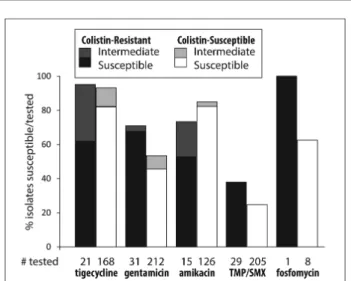
The susceptibilities for antibiotics other than colistin were determined as clinically indicated by clinical microbiology lab-oratories (Figure 2). ColR CRKp were significantly less likely to be amikacin susceptible; 8/15 (53%) of tested ColR CRKp were amikacin susceptible compared to 104/126 (83%) of tested ColS CRKp (P = .02). In contrast, ColR CRKp were more likely to be gentamicin susceptible; 21/31 (68%) of tested ColR CRKp were gentamicin susceptible compared to 97/212 (46%) of tested ColS CRKp (P = .03). Furthermore, ColR isolates were also more likely to be tigecycline nonsusceptible; 13/21 (62%) of tested ColR CRKp were tigecycline susceptible compared to 138/168 (82%) of tested ColS CRKp (P = .04).
Overall, a nonclonal distribution was observed. rep-PCR suggested that most strains belonged to clades ST258A (n = 76, 31%) and ST258B (n = 102, 41%). The remaining 68 (28%) iso-lates belonged to 28 other rep-PCR types. Likewise in the ColR group, a nonclonal pattern was observed (Figure 3). rep-PCR types corresponding to clades ST258A and ST258B together accounted for 77% of ColR isolates.
The presence of carbapenemase genes was confirmed in 238 (97%) isolates. The carbapenemase genes blaKPC-2 and
blaKPC-3 were the most common and were found in 113 (46%) and 124 (50%) of CRKp isolates, respectively. The distribu-tion of carbapenemase genes did not differ between ColR and ColS CRKp. Of note, blaNDM-1 was found in only 1 isolate. This
ColS isolate was extensively described previously using whole genome sequencing [2]. In the remaining 8 (3%) isolates, car-bapenemase genes were not detected. The plasmid-mediated colistin resistance genes, mcr-1 and mcr-2, were not detected in any of the ColR CRKp.
Table 2. Antibiotic Exposures
Variable All (n = 246) Colistin Resistant (n = 31)
Colistin Susceptible
(n = 215) P Value Classes of
antibiotics
.68
None 82 (33) 10 (32) 72 (33)
1 51 (21) 9 (29) 42 (20)
2 51 (21) 5 (16) 46 (21)
3 35 (14) 5 (16) 30 (14)
>3 27 (11) 2 (6) 25 (12)
Tigecycline 7 (3) 2 (6) 5 (2) .22
Carbapenem 36 (15) 4 (13) 32 (15) 1.0 Fluoroquinolone 44 (18) 1 (3) 43 (20) .02
Colistin 2 (1) 0 2 (1) 1.0
Vancomycin 80 (33) 8 (26) 72 (33) .54
β-lactam/β -lact-amase inhibitor
52 (21) 7 (23) 45 (21) .82
Cephalosporin 25 (10) 5 (16) 20 (9) .22 Aminoglycoside 14 (6) 2 (6) 12 (6) .69
Daptomycin 10 (4) 2 (6) 8 (4) .37
Metronidazole 19 (8) 4 (13) 15 (7) .27
Other 90 (37) 11 (35) 79 (37) 1.0
Shown is the documented exposure to antibiotics in 14 days prior to first positive culture. All data expressed as n (%).
Figure 2. The percentages of susceptible and intermediate isolates for each drug are shown separately for colistin-resistant (ColR) and colistin-susceptible (ColS) car-bapenem-resistant Klebsiella pneumoniae (CRKp). Underneath each bar is the number of CRKp tested for each drug in the ColR and ColS groups. The black and white bars represent the percentage of susceptible/tested CRKp isolates in the ColR and ColS groups, respectively. The dark-gray and light-gray bars on top of the black and white bars represent the percentage of intermediate/tested CRKp isolates in the ColR and ColS groups, respectively. Abbreviation: TMP/SMX, trimethoprim/sulfamethoxazole.
Table 1. Clinical Characteristics
Characteristic All
Colistin Resistant
Colistin
Susceptible P Valuea
N 246 31 215
Age in years, median (IQR)
67 (54–77) 62 (53–73) 67 (54–78) .43
Female 139 (57) 20 (65) 119 (55) .44
Race/Ethnicity .22
White 135 (55) 13 (42) 122 (57) Black 95 (39) 16 (52) 79 (37)
Hispanic 7 (3) 0 7 (3)
Other 9 (4) 2 (6) 7 (3)
Charlson comorbidity index, median (IQR)
3 (2–5) 3 (2–4) 3 (2–5) .78
Diabetes mellitus 118 (48) 15 (48) 103 (48) 1.0 Renal failureb 75 (30) 7 (23) 68 (32) .40
Heart disease 121 (49) 14 (45) 107 (50) .70 Chronic obstructive
pulmonary disease 62 (25) 8 (26) 54 (25) 1.0 Malignancy 41 (17) 8 (26) 33 (15) .19 Infection 111 (45) 13 (42) 98 (46) .85
Source .22
Urine 144 (59) 16 (52) 128 (60)
Blood 45 (18) 5 (16) 40 (19)
Respiratory system 28 (11) 4 (13) 24 (11)
Wound 13 (5) 1 (3) 12 (6)
Other 16 (7) 5 (16) 11 (5)
Days to first positive
culture, median (IQR) 1 (0–7) 0 (0–3) 1 (0–9) .01 Hospital acquisition 115 (47) 10 (32) 105 (49) .12
Origin .05
Home 90 (37) 14 (45) 76 (35)
Skilled nursing facility 76 (31) 6 (19) 70 (33) Hospital transfer 59 (24) 5 (16) 54 (25) Long-term acute care 21 (9) 6 (19) 15 (7)
Critical illnessc 86 (35) 7 (23) 79 (37) .16
Length of stay in days, median (IQR)
12 (6–24) 8 (5–12) 13 (7–26) .01
All data expressed as n (%), unless otherwise indicated. Abbreviation: IQR, interquartile range.
aUnivariable relationship between variable of interest and colistin resistance. bRenal failure defined as creatinine >2 mg/dL on admission.
Treatment and Mortality
In the first 7 days after the first positive culture, 143 (58%) patients received directed treatment. Treatment regimens used in these 143 patients are summarized in Table 3. Treatment with colistin was uncommon; colistin, either alone or in combination with other antibiotics, was given to 31 (22%) of treated patients. Colistin treatment was given to 30 of 127 (24%) treated patients in the ColS group compared to 1/16 (6%) treated patients in the ColR group. Other treatment regimens were similar between the 2 groups. The most commonly used antibiotics were aminoglycosides and tigecycline. Aminoglycosides were
given to 72 (50%) of treated patients; 36 (25%) patients received only aminoglycosides in the first 7 days. Similarly, 63 (44%) of treated patients received tigecycline, of whom 21 (15%) received tigecycline monotherapy in the first 7 days.
We evaluated time to all-cause in-hospital mortality, cen-sored at 30 days (Figure 4). In univariable Kaplan-Meier sur-vival curves, patients with ColR CRKp were at increased hazard of 30-day mortality (P < .0001). After adjustment, the aHR of ColR vs ColS was 3.48 (95% confidence interval [CI] 1.73–6.57;
positive CRKp culture (Table 4). Treatment variables and infec-tion vs colonizainfec-tion status were not associated with mortality, and inclusion of these into the model did not significantly alter the association between colistin and mortality. Of note, when the colistin resistance as determined by the clinical microbiol-ogy laboratory was entered into this model instead of ColR as determined by the research laboratory, this was still associated with increased mortality but to a lesser extent (aHR, 2.78; 95% CI, 1.22–5.71; P = .02; data not shown).
DISCUSSION
In this nested cohort of patients from CRACKLE—a prospec-tive, ongoing, multicenter evaluation of hospitalized patients
with carbapenem-resistant Enterobacteriaceae (CRE)—a ColR rate of 13% was observed in CRKp isolates. This rate was underestimated by testing as performed by clinical microbiol-ogy laboratories. In addition, even testing in optimal research conditions resulted in the need for repeat colistin MIC testing in 10% of isolates. Furthermore, polymyxin B MIC testing was also fraught with difficulties; a definitive polymyxin B MIC could not be determined in 6 isolates, even with repetitive test-ing. The difficulty in determining colistin MIC has been pre-viously reported by Hindler et al [20]. Broth macrodilution, as used here, was found to be the most reliable [20]. The American Society for Microbiology recently released a white paper on the issue of colistin testing, recommending that “laboratories that choose to test for colistin susceptibility should validate a broth microdilution method and report MIC values only” [21]. Clearly, the absence of FDA breakpoints and the resulting impossibility of an FDA-approved test for colistin susceptibility remains a major issue.
The association between ColR and mortality was also seen in an Italian case-control study on CRKp bloodstream infections [22]. In that study 30-day all-cause mortality rates were 51% in the ColR group (n = 142) vs 39% in the ColS group (n = 284;
P = .02). The increased mortality may be directly related to decreased colistin susceptibility of the organism. Alternatively, the observed mortality differences may be secondary to either variance in baseline characteristics of patients with ColR vs ColS CRKp or to an alteration in the virulence of the pathogen [23]. Regardless of causality, it is clear that patients with ColR CRKp are at increased risk of hospital mortality.
We observed that—similar to patients with tigecycline-re-sistant CRKp—isolation of ColR CRKp tended to occur ear-lier during hospitalization compared to ColS CRKp [7]. Our findings suggest that the introduction of ColR isolates may be present on admission to acute care hospitals. In the majority of patients, colistin exposure prior to the positive culture was not documented. This may be explained in a number of ways. First, some patients may have had unrecorded colistin exposure Table 3. Treatment Characteristics
Characteristic All ResistantColistin Colistin Susceptible
n 143 16 127
Any colistin in first 7 days 31 (22) 1 (6) 30 (24) One antibiotic in first
7 daysa 90 (63) 10 (63) 80 (63)
Aminoglycoside 36 (25) 5 (31) 31 (24)
Colistin 10 (7) 1 (6) 9 (7)
Tigecycline 21 (15) 3 (19) 18 (14) Trimethoprim/
sulfamethoxazole 13 (9) 0 13 (10)
fosfomycin 10 (7) 1 (6) 9 (7)
>1 antibiotic in first 7 days 53 (37) 6 (38) 47 (37) 2 antibiotics 38 (27) 5 (31) 33 (26) 3 antibiotics 13 (9) 1 (6) 12 (9)
4 antibiotics 2 (1) 0 2 (2)
Treatment is shown in the subset of patients who received at least 1 antibiotic with poten-tial in vitro anti–carbapenem-resistant Klebsiella pneumoniae (CRKp) activity in the first 7 days after first positive CRKp culture.
aOnly antibiotics with potential in vitro anti-CRKp activity were included.
Figure 4. Kaplan-Meier curve showing the 30-day in-hospital survival for patients with colistin-resistant carbapenem-resistant Klebsiella pneumoniae (CRKp) as compared to colistin-susceptible CRKp. Patients were censored at the time of hospital discharge.
Table 4. Cox Proportional Hazards Model on Time to 30-Day In-Hospital Mortality
Variable
Adjusted Hazard Ratio
95% Confidence
Interval P Value Colistin resistance 3.48 1.73–6.57 < .001
Age (by decade) 1.24 1.03–1.53 .02
Origin < .01
Home (reference) — —
Skilled nursing facility 2.52 1.12–6.03 Hospital transfer 2.64 1.18–6.35 Long-term acute care 5.18 2.17–12.82
Source < .01
Blood (reference) — —
Urine 0.35 0.19–0.66
at nonstudy hospitals. The intuitive link between colistin expo-sure and ColR has been previously documented for CRKp and carbapenem-resistant Acinetobacter baumannii (CRAB) [4, 22]. Second, patients with ColR CRKp without colistin exposure may have received ColR CRKp from either another person exposed to colistin or potentially from a food source. The latter option would appear less likely as no such food-re-lated transmission has been reported in the United States for
K. pneumoniae. In contrast, person-to-person transmission of ColR CRKp without further colistin exposure of subsequently infected patients was shown to be an important mechanism of spread in an outbreak-related report [24]. The lack of clonality in ColR CRKp described in that report argues against a single clonal outbreak but obviously does not rule out multiple per-son-to-person transmission events.
Previously we described various chromosomally mediated mechanisms of ColR for a subset of isolates in this cohort [25]. Of concern, 2 recently described plasmid-mediated, readily transmissible ColR mechanisms—mcr-1 and mcr-2—are being recognized in Enterobacteriaceae from animals and humans around the world [17, 26]. Even though mcr-1 has already been reported in the United States, this gene was not detected in any of the isolates described here [27, 28]. Reproducibility issues in polymyxin/colistin MIC testing, as well as variability between testing methods illustrated here and in other reports, may com-plicate tracking of mcr-1– and mcr-2–carrying isolates [20]. If screening of mcr carriage is only performed on isolates based on colistin MIC by Etest, the most common method used by clinical labs, the spread of mcr is likely to be underestimated.
There are a number of limitations to this work. We purpose-fully selected isolates in which colistin susceptibility testing was performed by the clinical microbiology laboratories as clinically indicated, and patients with CRKp isolates that were not tested are not included in this study. Therefore, our estimate of 13% ColR at first test may not necessarily be representative of all patients with CRKp. Furthermore, follow-up for patients in this observational study is limited to the duration of hospitalization. Consequently, we cannot comment on long-term outcomes. Another potential limitation of our work is that we included both patients who met standardized criteria for infection as well as those who did not. Nevertheless, standardized criteria have limitations in distinguishing patients with infection from those who are colonized. In addition, patients who do not meet cri-teria for infection often receive antibiotic treatment and are an important source of transmission. Finally, our study population was predominantly derived from the Great Lakes region of the United States. Therefore, these data may not accurately reflect incidence of ColR in other CRKp in the United States. In a study performed by the Centers for Disease Control and Prevention in 2012–2013 in 7 US communities, 12 CRE isolates were tested for colistin susceptibility. Nine of these were reported to be non-susceptible, based on testing performed in clinical laboratories
[29]. Additional data from other US regions are expected from ongoing surveillance programs and from the recently started national expansion of CRACKLE. Additionally, there are important differences in ColR rates in CRE isolates outside of the United States as well [17, 26].
In summary, we observed a 13% ColR rate in this multi-center, observational cohort of hospitalized patients with CRKp in US hospitals. Colistin in vitro susceptibility testing is char-acterized by reproducibility issues. Patients with ColR CRKp were at higher risk for mortality. They also tended to present earlier during admission. This, in combination with the pol-yclonality of the observed ColR CRKp isolates, suggests that direct patient-to-patient transmission of CRKp isolates within short-term acute care hospitals is unlikely to be the primary mechanism driving resistance rates. Alternative, not mutually exclusive explanations include within-patient development of ColR and transmission in healthcare settings outside of short-term acute care hospitals, such as LTACs or SNFs.
NOTES
Disclaimer. The contents are solely the responsibility of the authors and do not necessarily represent the official views of the National Institutes of Health.
Financial support. This work was supported by the National Institute of Allergy and Infectious Diseases (NIAID) of the National Institutes of Health (NIH; UM1AI104681 and R21AI114508) and by funding to D. v. D. and F. P. from the Clinical and Translational Science Collaborative of Cleveland (UL1TR000439) from the National Center for Advancing Translational Sciences component of the NIH and NIH Roadmap for Medical Research. V. G. F. was supported by a Mid-Career Mentoring Award (K24-AI093969) from NIH. In addition, research reported in this publica-tion was supported in part by the NIAID of the NIH (R21AI114508 to D. v. D. and R. A. B. and R01AI100560, R01AI063517, and R01AI072219 to R. A. B.). This study was supported in part by funds and/or facilities provided by the Cleveland Department of Veterans Affairs (1I01BX001974 to R. A. B.) from the Biomedical Laboratory Research & Development Service of the Veterans Affairs Office of Research and Development and the Geriatric Research Education and Clinical Center VISN 10 (R. A. B.). Further sup-port came from the Research Program Committees of the Cleveland Clinic and an unrestricted research grant from the STERIS Corporation (D. v. D.). Y. D. was supported by research awards from the NIH (R01AI104895 and R21AI107302). K. S. K. is supported by the NIAID, Division of Microbiology and Infectious Diseases (protocol 10–0065 and R01AI119446-01).
Potential conflicts of interest. S. S .R.: research support: bioMerieux, BD Diagnostics, BioFire, OpGen, Forest Laboratories, Achaogen, Nanosphere, Pocared; honorarium: bioMerieux. Y. D.: grant support: the Medicines Company, NIH; advisory board: Meiji, Tetraphase, Achaogen.
K. K: consultant, grant investigator, speaker’s bureau, consulting fee, grant recipient, speaker honorarium: Allergan; grant recipient, consultant: Merck; consultant: Xellia, Achaogen. R. R. W.: grant support, Allergan. R. A. B.: grant investigator, grant recipient: AstraZeneca, Merck, Melinta, Steris, NIH, VA Merit Review. V.G.F.: grant and research support, Advanced Liquid Logic, Cubist, Cerexa, MedImmune, Merck, NIH, Novartis, Pfizer, Theravance; paid consultant, Affinium, Baxter, Cerexa, Cubist, Debiopharm, Durata, Merck, Novartis, NovaDigm, the Medicines Company, MedImmune, Pfizer, Theravance, Trius; honoraria: Arpida, Astellas, Cubist, Inhibitex, Merck, Pfizer, Targanta, Theravance, Wyeth, Ortho-McNeil, Novartis, Vertex Pharmaceuticals; membership: Merck co-chair V710 Vaccine. D. v. D.:
submitted the ICMJE Form for Disclosure of Potential Conflicts of Interest. Conflicts that the editors consider relevant to the content of the manuscript have been disclosed.
References
1. Munoz-Price LS, Poirel L, Bonomo RA, et al. Clinical epidemiology of the global expansion of Klebsiella pneumoniae carbapenemases. Lancet Infect Dis 2013; 13:785–96.
2. van Duin D, Perez F, Rudin SD, et al. Surveillance of carbapenem-resistant Klebsiella pneumoniae: tracking molecular epidemiology and outcomes through a regional network. Antimicrob Agents Chemother 2014; 58:4035–41.
3. van Duin D, Kaye KS, Neuner EA, Bonomo RA. Carbapenem-resistant Enterobacteriaceae: a review of treatment and outcomes. Diagn Microbiol Infect Dis 2013; 75:115–20.
4. Qureshi ZA, Hittle LE, O’Hara JA, et al. Colistin-resistant Acinetobacter bauman-nii: beyond carbapenem resistance. Clin Infect Dis 2015; 60:1295–303. 5. Tumbarello M, Viale P, Viscoli C, et al. Predictors of mortality in bloodstream
infections caused by Klebsiella pneumoniae carbapenemase-producing K. pneu-moniae: importance of combination therapy. Clin Infect Dis 2012; 55:943–50. 6. van Duin D, Doi Y. Outbreak of colistin-resistant, carbapenemase-producing
Klebsiella pneumoniae: are we at the end of the road? J Clin Microbiol 2015; 53:3116–7. 7. van Duin D, Cober E, Richter SS, et al. Residence in skilled nursing facilities is
associated with tigecycline nonsusceptibility in carbapenem-resistant Klebsiella pneumoniae. Infect Control Hosp Epidemiol 2015; 36:942–8.
8. van Duin D, Cober E, Richter SS, et al. Impact of therapy and strain type on out-comes in urinary tract infections caused by carbapenem-resistant Klebsiella pneu-moniae. J Antimicrob Chemother 2015; 70:1203–11.
9. van Duin D, Cober ED, Richter SS, et al. Tigecycline therapy for carbapenem-re-sistant Klebsiella pneumoniae (CRKP) bacteriuria leads to tigecycline resistance. Clin Microbiol Infect 2014; 20:O1117–1120.
10. Clinical and Laboratory Standards Institute. Performance Standards for Antimicrobial Susceptibility Testing; Twenty-Second Informational Supplement. CLSI document M100-S22. Vol 32. Wayne, PA: Clinical and Laboratory Standards I, 2012.
11. Clinical and Laboratory Standards Institute. Methods for Dilution Antimicrobial Susceptibility Tests for Bacteria That Grow Aerobically; Approved Standard-Tenth Edition. CLSI document M07-A10. Wayne, PA: Clinical and Laboratory Standards I, 2015.
12. European Committee on Antimicrobial Susceptibility Testing. Breakpoint tables for interpretation of MICs and zone diameters, version 60. 2016. Available at:
http://www.eucast.org. Accessed 1 June 2016.
13. Tenover FC, Williams PP, Stocker S, et al. Accuracy of six antimicrobial suscepti-bility methods for testing linezolid against staphylococci and enterococci. J Clin Microbiol 2007; 45:2917–22.
14. Lascols C, Hackel M, Marshall SH, et al. Increasing prevalence and dissemination of NDM-1 metallo-beta-lactamase in India: data from the SMART study (2009). J Antimicrob Chemother 2011; 66:1992–7.
15. Viau RA, Hujer AM, Marshall SH, et al. “Silent” dissemination of Klebsiella pneumoniae isolates bearing K. pneumoniae carbapenemase in a long-term care facility for children and young adults in northeast Ohio. Clin Infect Dis 2012; 54:1314–21.
16. Endimiani A, Hujer AM, Perez F, et al. Characterization of blaKPC-containing Klebsiella pneumoniae isolates detected in different institutions in the eastern USA. J Antimicrob Chemother 2009; 63:427–37.
17. Xavier BB, Lammens C, Ruhal R, et al. Identification of a novel plasmid-medi-ated colistin-resistance gene, mcr-2, in Escherichia coli, Belgium, June 2016. Euro Surveill 2016; 21.
18. Chow JW, Yu VL. Combination antibiotic therapy versus monotherapy for gram-negative bacteraemia: a commentary. Int J Antimicrob Agents 1999; 11:7–12.
19. Charlson ME, Pompei P, Ales KL, MacKenzie CR. A new method of classifying prognostic comorbidity in longitudinal studies: development and validation. J Chronic Dis 1987; 40:373–83.
20. Hindler JA, Humphries RM. Colistin MIC variability by method for contempo-rary clinical isolates of multidrug-resistant gram-negative bacilli. J Clin Microbiol
2013; 51:1678–84.
21. American Society for Microbiology. White Paper on the Emergence of mcr-1 Plasmid-Mediated Colistin Resistance. Available at: https://www.asm.org/index. php/component/content/article/93-policy/94613-colistinres-10–16. Accessed 30 October 2016.
22. Giacobbe DR, Del Bono V, Trecarichi EM, et al. Risk factors for bloodstream infections due to colistin-resistant KPC-producing Klebsiella pneumoniae: results from a multicenter case-control-control study. Clin Microbiol Infect 2015; 21:1106.e1–8.
23. Kaye KS, Harris AD, Samore M, Carmeli Y. The case-case-control study design: addressing the limitations of risk factor studies for antimicrobial resistance. Infect Control Hosp Epidemiol 2005; 26:346–51.
24. Marchaim D, Chopra T, Pogue JM, et al. Outbreak of colistin-resistant, car-bapenem-resistant Klebsiella pneumoniae in metropolitan Detroit, Michigan. Antimicrob Agents Chemother 2011; 55:593–9.
25. Wright MS, Suzuki Y, Jones MB, et al. Genomic and transcriptomic analyses of colistin-resistant clinical isolates of Klebsiella pneumoniae reveal multiple path-ways of resistance. Antimicrob Agents Chemother 2015; 59:536–43.
26. Liu YY, Wang Y, Walsh TR, et al. Emergence of plasmid-mediated colistin resist-ance mechanism MCR-1 in animals and human beings in China: a microbiologi-cal and molecular biologimicrobiologi-cal study. Lancet Infect Dis 2016; 16:161–8.
27. McGann P, Snesrud E, Maybank R, et al. Escherichia coli harboring mcr-1 and blaCTX-M on a novel IncF plasmid: first report of mcr-1 in the United States. Antimicrob Agents Chemother 2016; 60:4420–1.
28. Castanheira M, Griffin MA, Deshpande LM, Mendes RE, Jones RN, Flamm RK. Detection of mcr-1 among Escherichia coli clinical isolates collected worldwide as part of the SENTRY antimicrobial surveillance program during 2014–2015. Antimicrob Agents Chemother 2016; 60:5623–4.