APPLICATION OF ORGANIC PHOTOREDOX CATALYSIS IN NEW REACTION METHODOLOGY: SYNTHESIS OF BUTYROLACTONES VIA POLAR RADICAL CROSSOVER CYCLOADDITION AND HYDRODECARBOXYLATION OF CARBOXYLIC
ACIDS
Mary A. Zeller
A dissertation submitted to the faculty at the University of North Carolina at Chapel Hill in partial fulfillment of the requirements for the degree of Doctor of Philosophy in the Department
of Chemistry.
Chapel Hill 2016
Approved by: David A. Nicewicz
Simon J. Meek Jeffrey S. Johnson
ii
iii ABSTRACT
Mary A. Zeller: Application of Organic Photoredox Catalysis in new Reaction Methodology: Synthesis of Butyrolactones via Polar Radical Crossover Cycloaddition and
Hydrodecarboxylation of Carboxylic Acids (Under the direction of David A. Nicewicz)
Synthesis of Butyrolactones via Polar Radical Crossover Cycloaddition
A direct catalytic synthesis of γ-butyrolactones from simple alkene and unsaturated acid starting materials is reported. The catalytic system consists of the Fukuzumi acridinium
photooxidant and substoichiometric quantities of a redox-active cocatalyst. Oxidizable alkenes such as styrenes and trisubstituted aliphatic alkenes are cyclized with unsaturated acids via polar radical crossover cycloaddition (PRCC) reactions. Using this method, α-alkylidine
butyrolactones can be synthesized. This method has been applied to the diastereoselective total synthesis of methylenolactocin and protolichesterinic acid.
Hydrodecarboxylation of Carboxylic and Malonic Acid Derivatives
iv
v
vi
ACKNOWLEDGMENTS
When I started the graduate school journey five years ago, I did not know anyone at UNC and I was already tired, determined to make a fresh start. I would like very much to thank Dave, and the early members of the Nicewicz lab, for welcoming me from the start. I did not expect to be part of a family, but Perkowski, Tien, Michelle, Hami, Jean-Marc, Nate, and Pete (for Pete’s sake!) wrapped me up in their humor and support, and let me be myself. These members, and the many who came after, all helped shape my experience here in numerous positive ways.
I would like to thank Jeremy, Cole, and Cortney for their endless banter. I will miss it when I’m gone. I’ll always have fond memories of the trips to student stores, and Buns.
I would like to thank my parents for their unconditional support as I’ve tried to meet the world as honestly as I know how. Over the course of my time in graduate school I’ve evolved and changed and grown in numerous ways, sometimes seemingly backwards, and they have been with me every step of the way. I would like to thank my brothers for always striving to grow, learn, and explore. It makes it easier for me to do the same, in my own way.
I would like to thank Michelle and Jeremy for collaborating with me on my projects. I learned so much from having a second perspective, and from being part of a team.
vii
challenging experience of graduate school into an experience that will have a very positive impact on the rest of my life, in whichever direction I chose to go.
viii PREFACE
ix
TABLE OF CONTENTS
LIST OF TABLES………..….xiii
LIST OF FIGURES………..……xiv
LIST OF ABBREVIATIONS AND SYMBOLS………..………...xix
CHAPTER ONE: INTRODUCTION TO PHOTOREDOX CATALYSIS………...……….1
1.1 Introduction………1
1.2 Thermodynamics of photoinduced electron transfer……….4
1.3 Recent advances in photoredox catalysis………...8
1.4 The Fukuzumi acridinium catalyst………...12
1.5 Development of the hydrofunctionalization catalyst system………...15
1.6 Other uses of the Fukuzumi acridinium………...19
References………..22
CHAPTER TWO: SYNTHESIS OF BUTYROLACTONES ………..25
2.1 Introduction………..25
2.1.1 Importance of the butyrolactone moiety………...25
x
2.1.3 Intramolecular strategies for the synthesis of butyrolactones………...27
2.1.4 Intermolecular strategies for the synthesis of butyrolactones………...28
2.1.5 Strategies for α-methylene and α-alkylidine butyrolactone synthesis……..29
2.1.6 Initial idea for our method………32
2.1.7 Previous syntheses of paraconic acids………..34
2.1.8 Initial strategy for the synthesis of paraconic acids………..35
2.2 Background………..36
2.2.1 Anti-Markovnikov hydroacetoxylation of alkenes………...36
2.2.2 Synthesis of tetrahydrofurans via polar radical crossover cycloaddition….38 2.2.3 5-exo-trig radical cyclizations to form butyrolactones……….41
2.2.4 The arene oxidation………...43
2.3 Results and Discussion………44
2.3.1 Initial results with acrylic and crotonic acid……….44
2.3.2 Adaptation to monoester fumarates………..46
2.3.3 Adaptation to cinnamic acid derivatives………...48
2.3.4 Adaptation to alkynoic acids……….49
2.3.5 Determination of relative stereochemistry………51
xi
2.3.7 Application to the synthesis of methylenolactocin and protolichesterinic
acid………...……….53
2.4 Conclusion………...57
2.5 Further developments of this Strategy……….57
2.6 Experimental Details………58
References………..74
CHAPTER THREE: HYDRODECARBOXYLATION………...77
3.1 Introduction………..77
3.1.1 Importance of carboxylic acids and esters in synthesis………77
3.1.2 Barton decarboxylation……….79
3.1.3 Kolbe electrolysis………..80
3.1.4 Ground state oxidation methods………...81
3.1.5 Photoredox catalysis……….82
3.1.6 The proposed method………85
3.2 Background………..85
3.2.1 Reduction potentials of carboxylates………85
3.2.2 The Acyloxyl radical……….86
3.2.3 Hydrodecarboxylation using Mes-Acr-Me in Dichloroethane……….87
xii
3.3.1 Development with phenyl acetic acid derivatives………89
3.3.2 Issues in applying towards less functionalized carboxylic acids…………..89
3.3.3 Unsuccessful substrates………93
3.3.4 Insights into the role of trifluoroethanol………...95
3.3.5 Application towards malonic acid derivatives………100
3.4 Conclusion and Outlook………103
3.5 Experimental Details………..105
References………118
APPENDIX ONE: NMR SPECTRA FOR CHAPTER TWO……….121
xiii
LIST OF TABLES
Table 2.1: Optimization of the hydroacetoxylation reaction……….37
Table 2.2: Initial consideration of crotonic anc acrylic acid………..45
Table 2.3: Optimization with mono-t-butylfumarate……….47
Table 3.1: Optimization of conditions for monoacid substrates………91
xiv
LIST OF FIGURES
Figure 1.1: Photoinduced electron transfer promoting single-electron oxidation………...1
Figure 1.2: Photoinduced electron transfer promoting single-electron reduction………...1
Figure 1.3: Photoredox mediated anti-Markovnikov transformations……….2
Figure 1.4: Typical mechanism of photo-NOCAS reactivity………..3
Figure 1.5: Trends in ground state reduction potential based on functional group……….5
Figure 1.6: Reduction potentials of representative alkenes……….6
Figure 1.7: Reduction potentials of some Ground-state and Excited-state oxidants………...8
Figure 1.8: Proposed mechanism for α-functionalization of amines………...9
Figure 1.9: [2+2] cycloaddition after access to Ru(bpy)33+………...10
Figure 1.10: [2+2] Heterodymerization……….11
Figure 1.11: Access to more challenging alkenes using an organic photooxidant………12
Figure 1.12: Summary of excited states from Fukuzumi and Verhoeven……….13
Figure 1.13: Aryl bromination catalyzed by Mes-Acr-Me………...14
Figure 1.14: Hamilton’s initial strategy for the hydroetherification reaction………15
Figure 1.15: Initial results in the hydroetherification reaction………..16
xv
Figure 1.17: Trifold requirements of a quality additive……….17
Figure 1.18: Proposed mechanism for the hydrotrifluoromethylation reaction……….19
Figure 1.19: Amination of arenes………..20
Figure 2.1: Examples of bioactive α-methylene and α-alkylidine natural products……...……...25
Figure 2.2: Examples of paraconic acids………...27
Figure 2.3: Butyrolactones via dynamic kinetic resolution of α-ketoesters………..28
Figure 2.4: The homoenolate approach to butyrolactone synthesis………..28
Figure 2.5: Synthesis of butyrolactones via photoreduction……….29
Figure 2.6: Aldol-elimination strategy for α-methylene synthesis………30
Figure 2.7: The Dreiding-Schmidt reaction………...30
Figure 2.8: Butyrolactones from allylboronic esters and aldehydes………..31
Figure 2.9: Butyrolactone formation via transfer hydrogenation………..32
Figure 2.10: Horner-Wadsworth-Emmons strategy for α-alkylidine butyrolactone synthesis…..32
Figure 2.11: Proposed disconnection for our strategy………...33
Figure 2.12 PRCC strategy for butyrolactone synthesis………34
Figure 2.13: Diasteroselective control from Meepowpan………..34
Figure 2.14: Synthesis of (-)-Methylenolactocin by Zhu and Lu………..34
xvi
Figure 2.16: Proposed mechanism for the hydroacetoxylation reaction………38
Figure 2.17: Proposed method for the PRCC synthesis of tetrahydrofurans……….…39
Figure 2.18: Diastereoselectivty in the PRCC reaction……….40
Figure 2.19: Rationalization of the diastereoselectivity………40
Figure 2.20: PRCC with propargyl alcohol………...40
Figure 2.21: Radical cyclization of phenylselenocrotonates……….41
Figure 2.22: Comparison of phenylselenocrotonates to phenylselenoacrylates………42
Figure 2.23: Diastereoselectivity from different starting materials………...42
Figure 2.24: Oxidation of electron deficient alkenes with RuO4………...44
Figure 2.25: Polymerization of polymethylmethyacrylate………46
Figure 2.26: Alkene scope with mono-t-butyl fumarate………48
Figure 2.27: Alkene scope with cinnamic acid derivatives………...49
Figure 2.28: Alkynoic acids in the PRCC………..50
Figure 2.29: Diastereoselectivities of the PRCC products……….51
Figure 2.30: Epimeriztion of butyrolactone products………...52
Figure 2.31: Radical dehalogenation of minor diastereomer……….53
Figure 2.32: Synthesis of the chloro-butyrolactone………...54
xvii
Figure 2.34: Arene oxidation and the bicyclic byproduct………..55
Figure 2.35: Theory on how to limit byproduct formation………55
Figure 2.36: Formation of desired products from both diastereomers………..55
Figure 2.37: Elimination conditions and re-emergence of the byproduct……….56
Figure 2.38: Total diastereoselective synthesis of methylenolactocin and protolichesterinic acid………...………..56
Figure 2.39: Further developments in PRCC methodology………...58
Figure 3.1: Some ways in which carboxylic esters favor bond formation……….77
Figure 3.2: Use and removal of malonic esters………..78
Figure 3.3: The Barton decarboxylation………79
Figure 3.4: The Kolbe electrolysis……….80
Figure 3.5: The Minisci Reaction………..82
Figure 3.6: Hydrodecarboxylation via photosensitizer………..83
Figure 3.7: Hydrodecarboxylation from Yoshimi et. al……….83
Figure 3.8: Photoredox decarboxylative coupling……….84
Figure 3.9: Proposed mechanism for this strategy……….84
Figure 3.10: Proposed method for hydrodecarboxylation……….85
xviii
Figure 3.12: Rate constants of representative aliphatic acyloxyl radical decomposition………..87
Figure 3.13: Decarboxylation of α-heteroatom carboxylates………87
Figure 3.14: Unsubstituted carboxylic acids are unreactive………..88
Figure 3.15: Initial results with phenylacetic acid derivatives………..89
Figure 3.16: Scope of monoacid hydrodecarboxylation………92
Figure 3.17: Less successful and unsuccessful substrates for mondecarboxylation……….94
Figure 3.18: Proposed mechanism of hydrodecarboxylation………96
Figure 3.19: Competition experiment in two solvent systems………...98
Figure 3.20: Rate constants of oxidation………...99
Figure 3.21: Comparison of malonates and mono-ester malonates……….101
Figure 3.22: Substrate scope of the Malonic acid hydrodecarboxylation………103
xix
LIST OF ABBREVIATIONS AND SYMBOLS
A Ac AIBN Ar aq atm BET Bn br br s n-Bu t-Bu bpm bpy bpz Bz Acceptor Acetate Azobisisobutyronitrile Aryl Aqueous Atmosphere
Back electron transfer
xx 13C NMR
cat Cbz conv Cy C-C CT δ ΔG d DBU DCB DCC DCE DCM dd ddt DEAD
Carbon nuclear magnetic resonance spectroscopy Catalytic quantities or catalyst
Carboxy benzoyl Conversion
Cyclohexyl
Carbon carbon single bond Charge transfer state
Chemical shift
Change in Gibbs free energy
Doublet or days
1,8-diazabicyclo[5.4.0]undec-7-ene 1.4-dicyanobenzene
N,N’-Dicyclohexylcarbodiimide
1,2-dichloroethane
Dichloromethane Doublet of doublets
Doublet of doublet of triplets
xxi DMAP DMF DMSO dq d.r. dt E+ or El
EDG ent eq equiv. e.r. Et EtOH Et3N Et2O EtOAc EWG 4-dimethylaminopyridine N,N-dimethylformamide Dimethylsulfoxide Doublet of quartets
Diastereomeric ratio Doublet of triplets Electrophile
Electron donating group Enantiomeric Equation Equivalents Enantiomeric ration Ethyl Ethanol Trimethylamine Diethyl ether Ethyl acetate
xxii 19F NMR
fac
F FVP
GC 1H NMR
HAT HOAc HOMO HMDS HRMS Hz I IR J k kcal KIE
Fluorine nuclear magnetic resonance spectroscopy Facial
Faraday’s constant
Flash vacuum pyrolysis
Gass chromatography
Proton nuclear magnetic resonance spectroscopy Hydrogen atom transfer
Acetic acid
Highest occupied molecular orbital
1,1,1,3,3,3-hexamethyldisiloxane High resonance mass spectrometry Hertz Intermediate Infrared spectroscopy Coupling constant Rate constant Kilocalorie
xxiii λ L LA LDA LEDs LUMO µL M m m mCPBA Me MeCN MeOH Mes-Acr-Me Mes-Acr-Ph mg MHz wavelength liter lewis acid lithiumdiisopropylamide
light emitting diodes
lowest unoccupied molecular orbital microliter
xxiv min MS ms MsCl MTBE n nm NMA NHE ns Nu o ox p PDC PET PG Ph minutes
Mass spectrometry or molecular sieves
Millisecond
Methylsulfonyl chloride
Methyl tert-butyl ether
Number of moles of electrons Nanometers
9-mesityl-10-methylacridinium Normal hydrogen electrode
Nanoseconds Nucleophile Ortho
Oxidant or oxidation Para
Pyridinium dichromate
Photoinduced electron transfer Protecting group
xxv PhCN Phen Phth PMP PMN ppm PRCC PTSA i-Pr q Rf RCHO red r.t. S SCE SET SN1 cyanobenzene Phenanthrene Phthalimidyl para-methoxyphenyl 2-phenylmalononitrile Parts per million
Polar radical crossover cycloaddition
p-toluenesulfonic acid
iso-Propyl quartet retention factor aldehyde reduction room temperature
singlet or second (lower case) standard calomel electrode single-electron transfer
xxvi SN2 T TEA TEMPO Tf TFA TFE THF TLC TMS Ts uv X V 9-CNF
Bimolecular nucleophilic substitution Triplet Trimethylamine (2,2,6,6-Tetramethylpiperidin-1-yl)oxyl Trifluoromethanesulfonyl Trifluoroacetic acid Trifluoroethanol Tetrahydrofuran Thin-layer chromatography Tirmethylsilyl para-toluenesulfonyl ultraviolet
anionic ligand, halide, substituent, or number volt
1
CHAPTER ONE
INTRODUCTION TO PHOTOREDOX CATALYSIS 1.1 Introduction
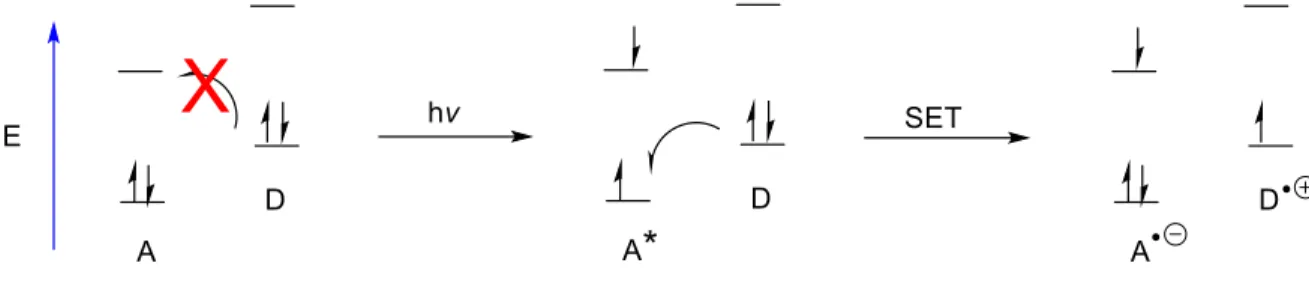
Photoredox catalysis is a form of catalysis whereby the catalyst is excited by light, thus becoming either a strong oxidant or a strong reductant, allowing it to promote single-electron transfer (SET) processes from the excited state. In considering a simple diagram, one can see that excitation of a particular acceptor molecule (A) by light can elevate an electron, leaving a hole in what had been the HOMO (Figure 1.1). This produces a strong single electron oxidant, which can oxidize the donor molecule if energetically favorable. Depending on the relative energy levels of the relevant molecular orbitals, one could envision the promotion of single-electron reduction via light excitation as well (Figure 1.2). Although photoredox catalysis via single-electron reduction of a substrate is an important field, and valuable contributions have been made1,2, the focus of this work will be on single-electron oxidation.
Figure 1.1: Photoinduced electron transfer promoting single-electron oxidation
2
As can be seen in figure 1.1 and 1.2, single-electron transfer via photoinduced electron transfer (PET) could be a powerful tool for chemical catalysis, as it has the ability to form a strong single electron oxidant (or reductant) relative to the ground state, as well as the ability to drastically change the polarity of the substrate by removal (or addition) of one electron. Early reactions employing this type of activation strategy, such as that developed by Gassman3, employed the use of cyanoarenes under ultraviolet irradiation with biphenyl as a cosensitizer, in stoichiometric quantities (Figure 1.3). Nevertheless, Gassman was able to demonstrate key photoredox mediated transformations in the anti-Markovnikov addition of water, methanol, and acetate to olefins.
3
The transformations rely on the single-electron oxidation of the alkene to the alkene radical cation by the excited cyanoarene. The major byproduct of these transformations comes from the photo-NOCAS4-6 (Photochemical Nucleophile-Olefin Combination, Aromatic
Substitution), whereby the cyanoarene incorporates into the final product (Figure 1.4). Notice the determination of regiochemistry. The nucleophile, methanol, adds to the radical cation such that the more stable radical intermediate is formed. This radical then recombines with the aryl radical anion, and loss of cyanide gives the product. This arylation side reaction contributes to the need for high loadings, and complicates their ability to be used catalytically.
Figure 1.4: Typical mechanism of photo-NOCAS reactivity
4
strong ionic interactions, especially in less polar solvents, which facilitates back electron transfer instead of the dissociation of the ion pair. Another issue with using cyanoarenes in synthesis is that, with the exception of 9,10-dicyanoanthracene, they all absorb in the uv spectrum, which requires the use of specialized glassware. The high energy light also poses a risk for byproduct formation, and limits the use to substrates that do not also absorb in the uv.
Nevertheless, these early transformations demonstrate the utility of photoredox catalysis to undergo anti-Markovnikov hydrofunctionalization reactions via oxidation of olefins to a key radical cation intermediate. In recent years, attention has returned to this type of reactivity, with the aim of developing truly catalytic transformations.8 This new generation of interest in
photoredox catalysis started with reports in 2008 from Yoon9 and MacMillan10 and their use of ruthenium polypyridyl complexes to undergo photoredox processes. Ruthenium polypyridyl complexes have had decades of widespread study in inorganic chemistry, and were studied for potential synthetic use because of a few key factors.11 They could be excited by lower energy visible light, they had long lived excited states, and in the excited state the complex can undergo single electron transfer via both oxidation and reduction, depending on the nature of the
quencher. These advances will be discussed in more detail in section 1.3. 1.2 Thermodynamics of photoinduced electron transfer
When considering whether an electron transfer event is thermodynamically favorable, between ground state reagents, one can estimate the feasibility of transfer by comparing the standard reduction potentials of the reductant and oxidant. These standard reduction potentials can be related to the standard change in Gibbs free energy of the reaction by the following
5
In this case, only reduction potentials are used. Ground state oxidation potentials are identical to reduction potentials and as such standard potentials are reduction potentials.
∆𝐺𝑜 = −𝑛𝐹(𝐸(𝐴/𝐴𝑜 −)− 𝐸(𝐷𝑜+/𝐷)) (1.1)
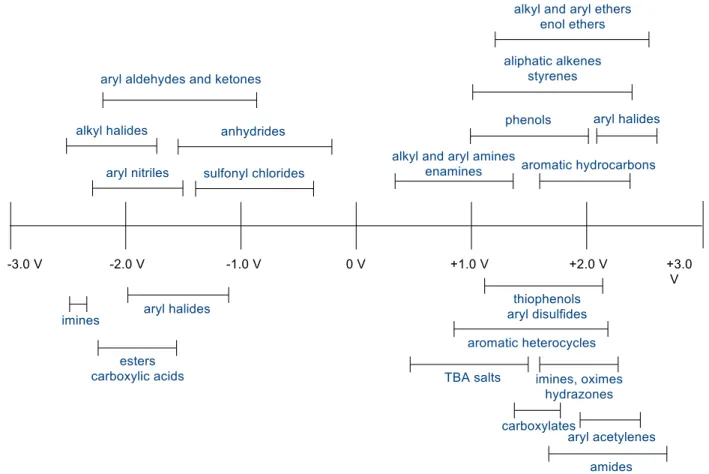
Ground state reduction potentials for a variety of organic substrates have been calculated by many researchers before12, however more recently an extensive study of the ground state reduction potentials of organic compounds has been undertaken by Hudson Roth and Nathan Romero, of the Nicewicz lab.13 A general summary of the findings is shown in Figure 1.5.
Figure 1.5: Trends in ground state reduction potential based on functional group
6
(Figure 1.6). In the shown representative alkenes, one can see how factors such as substitution pattern, ring strain, and the presence of electron donating or withdrawing substituents can affect the reduction potential of the alkene. For example, the di-substituted alkene 2-methylpent-1-ene, at +2.5 V, is much harder to oxidize than the di-substituted alkenes in rings (norbornene at +2.22 V and cyclopentene at 2.32 V). The tri-substituted alkene 2-methyl-2-butene, at 1.98 V, is easier still. Phenyl substitution decreases the reduction potential even further, and increased
substitution and the presence of electron donating substituents decreases the reduction potential further still. Again, a lower reduction potential of Eo(D+/D) indicates that the substrate is easier to oxidize.
Figure 1.6: Reduction potentials of representative alkenes
7
calculated by the relationship between measurable quantities. Unlike in ground state reduction potentials, the potential at which the excited catalyst is oxidized is different than the potential at which the excited catalyst is reduced.14 The excited state oxidation potential of a catalyst which undergoes oxidation (equation 1.2) is equal to the ground state reduction potential of the catalyst, minus the one-electron potential corresponding to the zero-zero spectroscopic energy (E0,0 in eV). The excited state reduction potential of a catalyst which undergoes reduction (equation 1.3) is equal to the ground state reduction potential of the catalyst plus the E0,0. Thus, it is important to note that excited state species are both stronger oxidants and stronger reductants than their ground state counterparts, and how the catalyst behaves depends on its nature and the potential of the substrate.
𝐸(𝐴𝑜+/∗𝐴) = 𝐸(𝐴𝑜+/𝐴)− 𝐸0,0 (1.2)
𝐸(∗𝐴/𝐴𝑜 −) = 𝐸(𝐴/𝐴𝑂 −)+ 𝐸0,0 (1.3)
Photoinduced electron transfer, in the case shown using a catalyst that is behaving as an oxidant, is favorable when the excited state reduction potential of the acceptor (i.e. the catalyst) is larger than the ground state reduction potential of the donor (i.e. the substrate), as can be seen in equation 1.4.
∆𝐺𝑜 = −𝑛𝐹(𝐸(∗𝐴/𝐴𝑜 −)− 𝐸(𝐷𝑜 ∙+/𝐷)) (1.4)
8
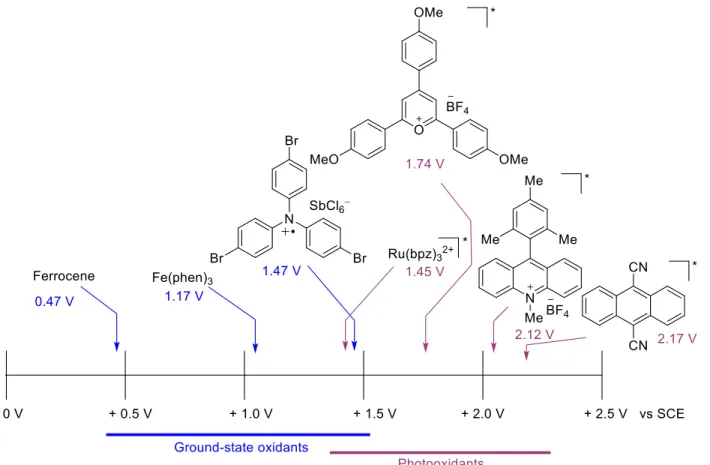
SCE16) and tris-(4-bromophenyl)aminium hexachloroantimonate (Ep/2 = 1.47 V vs. SCE17).In considering Figure 1.6, one can see that many of these photooxidants would be able to oxidize a variety of synthetically useful substrates, such as aliphatic alkenes and styrenes, which most ground state oxidants could not. The reason for this is the added bonus that E0,0 gives to photooxidants (equation 1.3).
Figure 1.7: Reduction potentials of some Ground-state and Excited-state oxidants
Another advantage that photooxidants have is that these excited-state reduction potentials are not obtained without irradiation, and as such the photooxidants are both bench-top stable and can be chemoselective.
9
As previously mentioned in section 1.1, photoredox mediated reactions have been known for many decades. However, these early reactions were generally not catalytic. More recently, attention has been given to inorganic photoredox catalysts to generate new reaction
methodologies. However, many but the most electron rich olefins have remained beyond the oxidative ability of these photooxidants, as inorganic photoredox catalysts generally have lower excited-state reduction potentials than the organic photoredox agents, as seen by the comparison of Ru(bpz)32+ (E*
red = +1.47 V vs. SCE) and 9,10-dicyanoanthracene (E*red = +2.17 V vs. SCE) in Figure 1.7.
Amines, however, have much lower reduction potentials than olefins (Ep/2= +0.7 V vs. SCE for N,N-dimethylaniline18). When an amine is oxidized by one electron, the bond
dissociation of a C-H bond α to the nitrogen radical cation (aminium) is greatly reduced. This has allowed for the development of reactions in which the α hydrogen atom can be abstracted, furnishing an iminium ion, which can then act as an electrophile to a wide variety of
nucleophiles, forming α-functionalized amines. The Stephenson group, for example, published an aza-Henry reaction between nitromethane and a catalytically generated iminium ion.19 The photoredox catalyst used was Ir(ppy)2(dtbbpy)PF6 (E*red= 0.66 V vs. SCE20), and molecular oxygen was used to turn over the catalyst via oxidation (Figure 1.8). The product of this oxidation, superoxide, could then abstract the α-hydrogen atom of the aminium ion, thus generating the key iminium ion intermediate. Nitromethane anion then added to this electrophile, generating the aza-Henry products.
10
The Yoon group was able to utilize Ru(bpy)3Cl2 as a photooxidant to access alkene cation radicals by using methyl viologen as an oxidative quencher to access the ground state
Ru(bpy)33+, in order to conduct [2+2] cycloadditions.21 Ru(bpy)32+ (E*red = 0.77 V vs SCE22) would not on its own be strong enough, however Ru(bpy)33+ (Ep/2 = 1.29 V vs. SCE) was a strong enough single-electron oxidant to generate alkene radical-cations. However, it was only strong enough to oxidize electron rich olefins such as p-methoxy and o-methoxy styrenyl derivatives (Figure 1.9). Unsubstituted styrenyl substrates and m-methoxy substituted styrenyl substrates had reduction potentials outside of the range of the catalytic system, and as such were unreactive.
11
A few years later, Yoon developed a method for intermolecular [2+2]
heterodimerization23 which used a different ligand system on the Ruthenium, Ru(bpm)32+ (E* red
= 1.2 V vs SCE24), allowing for a greater excited state reduction potential (Figure 1.10).
However, the method still relied on the oxidation of the electron rich olefin anethole (Ep/2 = 1.24 V vs. SCE, Figure 1.6), prior to undergoing [2+2] cycloaddition with less oxidizable alkenes.
12
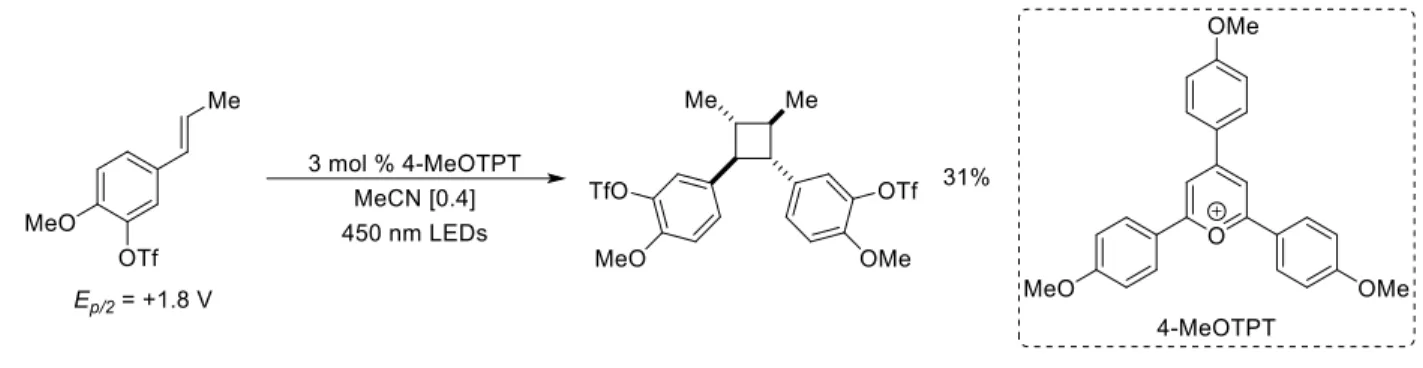
Michelle Riener, of the Nicewicz lab, was able to demonstrate the utility of 2,4,6-tris(4-methoxyphenyl)pyrylium as a photooxidant in a [2+2] homodimerization reaction method.25 This method gave access to a broader range of alkenes for [2+2] reactivity, as the photooxidant has a high excited state reduction potential (E*red = +1.74 V vs. SCE26, corrected as the reported literature value is +1.98 V vs. NHE). The use of triarylpyryriliums as photooxidants have been the subject of reviews.27
Figure 1.11: Access to more challenging alkenes using an organic photooxidant
The elevated excited state reduction potential of the triarylpyrilium allows access to a broader range of alkene substrates, however the susceptibility of these highly electrophilic species to nucleophilic attack limits their use in a broader range of transformations. These developments, a brief summary, demonstrate the need for the development of stronger, and more stable and robust, photooxidants to be able to catalytically generate radical cation intermediates from alkenes, and other substrates, that are more challenging to access.
1.4 The Fukuzumi acridinium catalyst
In 2004, Fukuzumi reported the synthesis and characterization of
13
In this initial report, Fukuzumi made an argument for a long lived charge-transfer state (CT) with a reduction potential of 1.88 V vs SCE, whereby after excitation of the acridinium, charge
separation could occur with a radical cation on the nearly perpendicular mesityl substituent, and a radical on the acridine core. A year later, however, Verhoeven29 and co-workers reported a singlet excited-state localized on the acridinium chromophore (LES) with a reduction potential of 2.18 V vs. SCE, a singlet CT state with a reduction potential of 2.06 V vs. SCE, and a triplet excited-state localized on the acridinium chromophore (LET) with a reduction potential of 1.45 V vs. SCE.30 The information from these reports is summarized in Figure 1.12.31
14
In 2011, Fukuzumi reported that 9-mesityl-10-methylacridinium (Mes-Acr-Me) could catalyze the bromination of electron rich arenes.32 The transformation occurred upon visible light irradiation of an oxygen saturated solution containing the oxidizable aryl substrate, catalytic amounts of Mes-Acr-Me, and 50% aqueous hydrogen bromide (Figure 1.13). Such strong conditions of aqueous hydrogen bromide demonstrate the broader range of conditions this catalyst can tolerate, in comparison with the triarylpyryliums. Electron rich arenes, such as methoxy substituted arenes and some heteroaromatic compounds gave brominated products in good regioselectivity and in good yields. For reference, 1,3-dimethoxybenzene has a reduction potential of +1.50 V vs. SCE.13 The reaction was shown to proceed via the formation of aryl radical cations, and dissolved molecular oxygen could turn over the catalyst.
15
This important report demonstrates the ability of Mes-Acr-Me to catalyze reactions via oxidizing substrates to their radical cation intermediates. The presence of multiple excited states, some with high reduction potentials of > +2.0 V vs. SCE, begged the question of whether this photocatalyst could be used to access radical cation intermediates from alkenes or other substrates with higher reduction potentials.
1.5 Development of the hydrofunctionalization catalyst system
David Hamilton, of the Nicewicz lab, was instrumental in developing a broader synthetic use for the Mes-Acr-Me catalyst. He developed a catalytic system that formed the basis for a number of advances in the Nicewicz lab over the subsequent few years, including the advances that will be discussed in chapters 2 and 3. Inspired by Gassman’s work in the anti-Markovnikov addition of water, methanol, and acetic acid to methylcyclohexene3, Hamilton considered
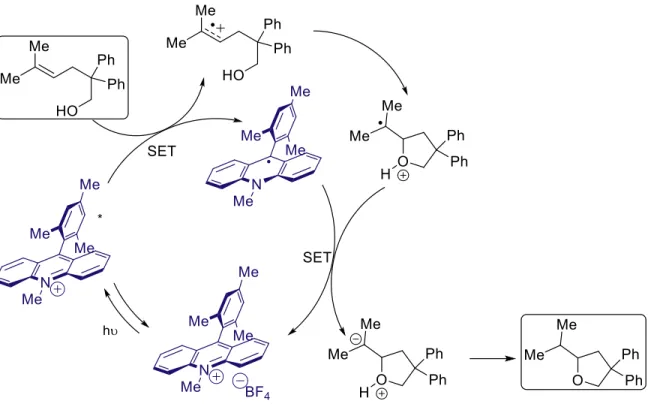
whether the Fukuzumi acridinium catalyst might be used in a similar type of transformation, instead of stoichiometric quantities of a cyanoarene (Figure 1.14). In order to explore this possibility, Hamilton considered using the acridinium in an intramolecular hydroetherification reaction.33 With mechanistic insight on nucleophilic additions to radical cation intermediates from Arnold,34 Hamilton believed that a catalytically generated radical cation could form a basis for anti-Markovnikov hydrofunctionalization methodology. He reasoned that a nucleophile would add to the radical cation with regiochemical control such that the more stable radical would be formed.
16
In his initial exploration, Hamilton proposed that the radical intermediate of the substrate would turn over the catalyst by oxidizing the acridine radical to the ground state Mes-Acr-Me. However, despite the high conversion, low yields of the desired product were observed even after extended 96 hours of irradiation (Figure 1.15).35
17
While the conditions gave the desired product in good anti-Markovnikov selectivity, the major byproduct arose from intramolecular aryl trapping of the radical intermediate. The appearance of this byproduct prompted Hamilton to consider additives that might improve the turnover of the catalyst. Under this strategy, instead of having the substrate radical intermediate turn over the catalyst forming an anion which would subsequently undergo proton transfer, the substrate radical intermediate would instead form the product directly via hydrogen atom transfer (Figure 1.16). In trying a number of different additives, Hamilton found success with
substoichiometric quantities of 2-phenylmalononitrile (PMN).
Figure 1.16: Addition of 2-phenylmalononitrile as hydrogen atom donor
The success of 2-phenylmalononitrile in this reaction is attributed to its ability to facilitate multiple key steps in the mechanism. It can behave as a hydrogen atom donor, the resultant radical can oxidize the acridine radical and turn over the acridinium catalyst, and the subsequent anion can act as a base to quench the oxonium ion intermediate (Figure 1.17).
18
The framework of this catalyst system, of the Fukuzumi acridinium working in concert with a redox active hydrogen atom donor, became the basis of many transformations developed subsequently in the Nicewicz lab. Using this system, many nucleophiles have been added to oxidizable olefins, including carboxylic acids36, allyl alcohols37, amines38,39, allyl amines and unsaturated amides40, mineral acids41, as well as the work that will be discussed in chapter 2.42
19
active hydrogen atom donor. Nathan Romero has studied the mechanism of the
hydrofunctionalization methodology.31 He computed the transition structures of hydrogen atom transfer between both 2-phenylmalononitrile and thiophenol and a standard intermediate for the intramolecular hydroetherification, and found that hydrogen atom transfer with thiophenol had a significantly decreased activation barrier relative to 2-phenylmalononirile, resulting in a
calculated 4-fold rate enhancement for that key step. In addition, Romero demonstrated that disulfides behaved comparably to thiophenols in these reactions, because they could be homolytically cleaved by the 450 nm LEDs and enter the catalytic cycle as the thiyl radical. 1.6 Other uses of the Fukuzumi acridinium
Photoredox catalysis does not inherently need to be used to promote nucleophilic attack of olefins. The Nicewicz lab has pursued other synthetic uses of the Fukuzumi acridinium, including what will be discussed in chapter 3.43 For example, Dale Wilger and Nathan
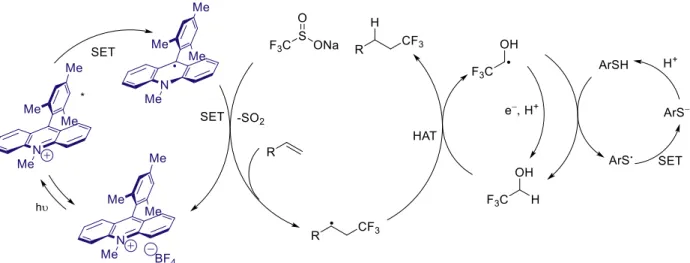
Gesmundo developed an anti-Markovnikov hydrotrifluoromethylation reaction which proceeds through a different mechanism than the other hydrofunctionalization reactions.44 In this
transformation, Langlois reagent (CF3SO2Na) is oxidized by the photocatalyst, losing SO2 and forming a trifluoromethyl radical. This radical then adds into the olefin, and then undergoes a hydrogen atom transfer process similar to the other systems. A variety of olefins were found to be successful, even those which would not otherwise be oxidized by the Mes-Acr-Me, a result of the mechanistic difference. They also find improved yields with trifluoroethanol as an additive, and they propose that this aids in the hydrogen atom transfer step(s). They propose that the acridine radical can be oxidized by either the TFE radical or the thiyl radical.
20
Nathan Romero, Kaila Margrey, and Nick Tay, of the Nicewicz lab, developed a site-selective arene C-H amination reaction using an acridinium catalyst.45 This reaction relies on the oxidation of electron rich arenes to the corresponding radical cation, followed by nucleophilic addition. TEMPO, in the presence of air, is the terminal oxidant and allows for turn-over of the catalyst as well as aromatization of the aminated arene. This transformation required that something other than thiophenol be used to turn over the catalyst, as the desired transformation was a net oxidative transformation instead of redox neutral, and greatly expanded the toolbox of reactivity being developed in the Nicewicz laboratory.
21
22 REFERENCES (1) (2) (3) (4) (5) (6) (7) (8) (9) (10) (11) (12) (13) (14) (15) (16) (17) (18)
Prier, C.K.; Rankic, D. A.; MacMillan, D. W. C. Chem. Rev. 2013, 113, 5322. Meyer, A. U.; Slanina, T.; Yao, C. J.; König, B. ACS Catal. 2016, 6, 369. Gassman, P. G.; Bottorff, K. J. Tetrahedron Lett. 1987, 28, 5449.
Arnold, D. R.; Chan, M. S. W.; McManus, K. A. Can. J. Chem. 1996, 74, 2143. McManus, K. A.; Arnold, D. R. Can. J. Chem. 1995, 73, 2158.
Mangion D.; Arnold, D. R. Acc. Chem. Res. 2002, 35, 297. Kavarnos, G.; Turro, N. Chem. Rev. 1986, 86, 401.
Narayanam, J. M. R.; Stephenson, C. R. J. Chem. Soc. Rev. 2011, 40, 102.
Ischay, M. A.; Anzovino, M. E.; Du, J.; Yoon, T. P. J. Am. Chem. Soc. 2008, 130, 12886. Nicewicz, D. A.; MacMillan, D. W. C. Science 2008, 322, 77.
Kalyanasundaram, K. Coordination Chemistry Reviews, 1982, 46, 159. Connelly, N. G.; Geiger, W. E. Chem. Rev. 1996, 96, 877.
Roth, H. G.; Romero, N. A.; Nicewicz, D. A. Synlett, 2016, 27, 714.
Ceroni, P.; Balzani, V. Photoinduced Energy and Electron Transfer Processes. In The Exploration of Supramolecular Systems and Nanostructures by Photochemical
Techniques, Lecture Notes in Chemistry 78; Ceroni, P., Ed; Springer Science+Business Media B., 2012; pp.21-23
Batterjee, S. M.; Marzouk, M. I.; Aazab, M. E.; El-Hashash, M. A. Appl. Organomet. Chem. 2003, 17, 291.
Schmittel, M.; Ammon, H.; Wöhrle, C. Chem. Ber. 1995, 128, 845.
23 (19) (20) (21) (22) (23) (24) (25) (26) (27) (28) (29) (30) (31) (32) (33) (34) (35) (36) (37) (38)
Condie, A. G.; González-Gómez, J. C.; Stephenson, C. R. J. J. Am. Chem. Soc. 2010, 132, 1464.
Slinker, J. D.; Gorodetsky, A. A.; Lowry, M. S.; Wang, J.; Parker, S.; Rohl, R.; Bernhard, S.; Malliaras, G. G. J. Am. Chem. Soc. 2004, 126, 2763.
Ischay, M.; Lu, Z.; Yoon, T. J. Am. Chem. Soc. 2010, 132, 8572. Juris, A.; Balzani, V. Helv. Chim. Acta 1981, 64, 2175.
Ischay, M. A.; Ament, M. S.; Yoon, T. P. Chem. Sci. 2012, 3, 2807
Kawanishi, Y.; Kitamura, N.; Kim, Y.; Tazuke, S. Sci. Pap. Inst. Phys. Chem. Res. (Jpn.), 1984, 78, 212.
Riener, M.; Nicewicz, D. A. Chem. Sci. 2013, 4, 2625
Martiny, M. A.; Steckhan, E.; Esch, T. Chem. Ber. 1993, 126, 1671 Miranda, M.; Garcia, H. Chem. Rev. 1994, 94, 1063.
Fukuzumi, S.; Kotani, H.; Ohkubo, K.; Ogo, S.; Tkachenko, N. V.; Lemmetyinen, H. J. Am. Chem. Soc. 2004, 126, 1600.
Verhoeven, J. W.; van Ramesdonk, H. J.; Zhang, H.; Groeneveld, M. M.; Benniston, A. C.; Harrimar, A. Int. J. Photoenergy 2005, 07, 103.
Benniston, A. C.; Harriman, A.; Li, P.; Rostron, J. P.; van Ramesdonk, H. J.; Groeneveld, M. M.; Zhang, H.; Verhoeven, J. W. J. Am. Chem. Soc. 2005, 127, 16054.
Romero, N.; Nicewicz, D. A. J. Am. Chem. Soc. 2014, 136, 17024.
Ohkubo, K.; Mizushima, K.; Iwata, R.; Fukuzumi, S. Chem. Sci 2013, 135, 10334. Hamilton, D.; Nicewicz, D. A. J. Am. Chem. Soc. 2012, 134, 18577.Oh
Arnold, D. R.; Chan, M. S. W.; McManus, K. A. Can. J. Chem. 1996, 74, 2143 Hamilton, D. S. PhD. Dissertation, UNC Chapel Hill, 2014.
24 (39)
(40) (41) (42) (43) (44) (45)
Nguyen, T. M.; Monohar, N.; Nicewicz, D. A. Angew. Chem. Int. Ed. 2014, 53, 6198. Gesmundo, N. J.; Grandjean, J. M.; Nicewicz, D. A. Org. Lett. 2015, 17, 1316. Wilger, D. J.; Grandjean, J. M.; Nicewicz, D. A. Nature Chem. 2014, 6, 720. Zeller, M. A.; Riener, M.; Nicewicz, D. A. Org. Lett. 2014, 16, 4810.
Griffin, J. D.; Zeller, M. A.; Nicewicz, D. A. J. Am. Chem. Soc. 2015, 137, 11340. Wilger, D. J.; Gesmundo, N. J.; Nicewicz, D. A. Chem. Sci. 2013, 4, 3160.
25
CHAPTER TWO
SYNTHESIS OF BUTYROLACTONES
2.1 Introduction
2.1.1 Importance of the butyrolactone moiety
γ-Butyrolactones are highly prevalent moieties in natural products. It is estimated that α-methylene and α-alkylidine γ-butyrolactones alone make up 3% of known natural products, and many of these compounds exhibit high levels of biological activity.1 Butyrolactones with any substitution pattern in the α position make up an estimated 10% of known natural products.2 Of these bioactive natural products, the α-unsaturation, if present, is often implicated as the active pharmacophore.2 Butyrolactone natural products can exist as monocyclic, bicyclic, and tricyclic compounds. Due to the prevalence of the butyrolactone core in natural products, many strategies exist for their synthesis.3 However, these strategies generally use prefunctionalized starting materials in order to synthesize a single desired product. Convergent methods that can be used to synthesize a variety of butyrolactones from simple starting materials are much rarer in the literature. In Figure 2.1, some representative multicyclic bioactive α-methylene and α-alkylidine natural products are shown. Andrographolide was the first isolated α-alkylidine natural product, first isolated in 1911.
26 2.1.2 Importance of the paraconic acids
27
Figure 2.2: Examples of paraconic acids
2.1.3 Intramolecular strategies for the synthesis of butyrolactones
One of the more widely used intramolecular methods for the synthesis of γ-butyrolactones is halocyclization, whereby a halide (often iodide) activates an alkene for intramolecular carboxylic acid nucleophilic attack through a three membered halonium ion intermediate. Recently, advances have been made in asymmetric iodolactonization
28
Figure 2.3: Butyrolactones via dynamic kinetic resolution of α-ketoesters
Pd catalyzed en-yne cyclizations have been developed, such as the method employed by Zhu and coworkers in the synthesis of (-)-Methylenolactocin11 (Section 2.1.7, Figure 2.14). 2.1.4 Intermolecular strategies for the synthesis of butyrolactones
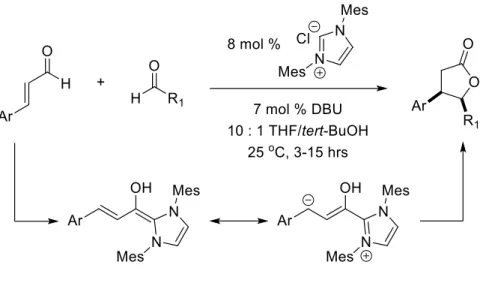
Bode12 and Glorius13 have demonstrated the synthesis of butyrolactones through an enal-aldehyde annulation. The key homoenolate intermediate is catalytically generated via N-heterocyclic carbene catalysis (Figure 2.4).
29
In 2013, Wu reported an Ir(III/IV) catalyzed photoredox method for the synthesis of butyrolactones from α-Bromo esters and activated alkenes.14 The proposed mechanism for this methodology involves the single electron reduction of the carbon-bromine bond by the excited Ir(III) species, followed by radical addition to the alkene, followed by single electron oxidation of that resultant stabilized carbocation. Nucleophilic addition of water to that carbocation and subsequent lactonization gives the product (Figure 2.5).
Figure 2.5: Synthesis of butyrolactones via photoreduction
A Pd (II) carbonylation-lactonization reaction, such as that utilized by Tamaru in 1991, forms γ-butyrolactones and α-alkylidine butyrolactones from homoallylic and homopropargylic alcohols with carbon monoxide.15
30
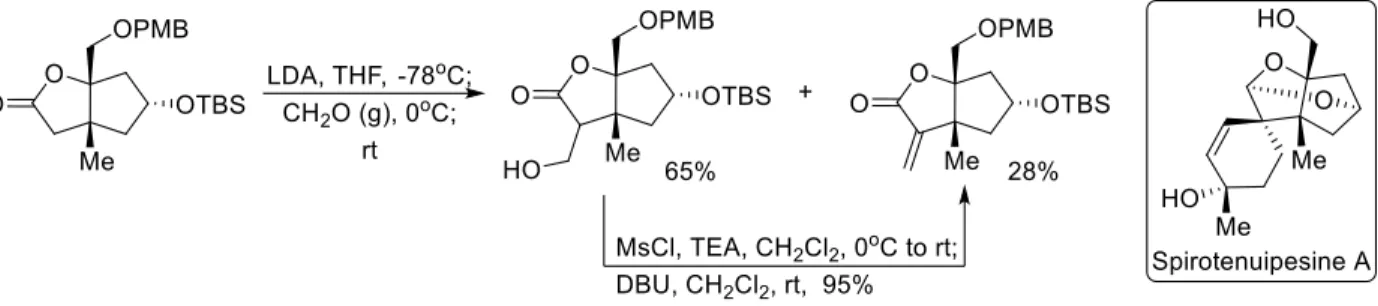
One of the most widely used methods to obtain the α-methylene functionality is to append it to an already existing lactone via an aldol/elimination sequence or similar method (Figure 2.6). Danishefsky employed this method in the total synthesis of Spirotenuipesines A and B, whereby the α-methylene unit is later employed in a Diels-Alder reaction with
Danishefsky’s diene.16 Although this method is convenient as it can be appended to a large variety of lactone substrates, it also has the limitation of being highly linear.
Figure 2.6: Aldol-elimination strategy for α-methylene installation
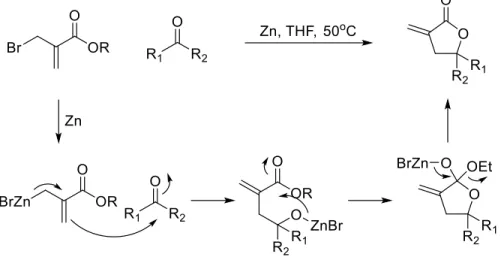
One of the most convergent, commonly used methods is the Dreiding-Schmidt reaction, and variations thereof, independently developed by Schmidt17 and Dreiding18 in 1970 (Figure 2.7). Although the initial scope was limited, the reaction has been used on numerous occasions and has also been reported using chromium19, tin20, indium21, and Cu/Zn22.
31
Modification of the starting material allyl bromide to an allylboronic ester with addition of catalytic Lewis acids allows for enhanced substrate tolerance and enhanced reactivity. Hall first discovered that the addition of Lewis acid could be used to dramatically increase the rate of this reaction.23 The addition of 10 mol% scandium triflate, or a different effective Lewis acid, greatly increased the rate of the reaction. A standard reaction would take 14 days at room temperature or 24 hours at 110 oC without a Lewis acid additive, however the addition of scandium triflate allowed the same reaction to complete at room temperature in 6 hours. Hall proposes that the Lewis acid coordinates with the pinacol oxygen and the ester, increasing the Lewis acidity of the boron (Figure 2.8). He proposes a closed transition state, as he observes a high diastereoselectivity for the transformation. He also finds that when the ester group on the allylboronic ester is removed, a dramatic rate enhancement is not observed.
32
In 2012, Krische extended this type of reactivity to an enantioselective catalytic version involving carbon-carbon bond formation through a transfer hydrogenation (Figure 2.9).24
Figure 2.9: Butyrolactone formation via transfer hydrogenation
α-Alkylidine moieties are often installed through a Horner-Wadsorth-Emmons reaction. This technique involves synthesis of the desired lactone and alkylidine R group separately, and subsequent modification to add the α-alkylidine functionality, and as such is a highly linear methodology. For example, (+)-Pacovatinin A was synthesized by Akita and co-workers using this strategy (Figure 2.10).25
Figure 2.10: Horner-Wadsworth-Emmons strategy for α-alkylidine butyrolactone synthesis
33
Due to how common butyrolactones are, there are many methods to generate them. Many of these more common methods, especially those mentioned in sections 2.1.3 through 2.1.5, rely on reactivity with the carbonyl functionality from previously functionalized starting materials. Our method sought to synthesize butyrolactones through a different strategy of bond formation. Instead of synthesizing complicated prefunctionalized starting materials, we wanted to synthesize butyrolactones from simple, often commercially available, alkene and unsaturated acid starting materials (Figure 2.11), greatly increasing the complexity in a single synthetic step. Additionally, we wanted to develop a method that was applicable to a wide variety of alkenes and unsaturated acids, so that α-methylene and α-alkylidine functionality would not have to be appended in a later step. We foresaw synthesizing α-unsaturated butyrolactones from alkynoic acids and alkenes.
Figure 2.11: Proposed disconnection for our strategy
34
cation) is followed by the radical step (cycloaddition via a 5-exo-trig radical cyclization) (Figure 2.12).
Figure 2.12: PRCC strategy for butyrolactone synthesis
2.1.7 Previous syntheses of paraconic acids
Methylenolactocin was first synthesized by Greene in 1992.27 Meepowpan reported a partial diastereoselective synthesis of methylenolactocin in 2009, where diastereoselectivity was controlled by the use of a dimethyl itaconate-anthracene aduct as its base (Figure 2.13).28 Zhu and Lu reported an enantioselective synthesis in 1995, where they utilized a Pd(II) catalyzed ene-yne cyclization to form the butyrolactone core (Figure 2.14).11 The key butyrolactone forming step, the Pd catalyzed ene-yne cyclization, was mentioned in section 2.1.3. Methylenolactocin has been synthesized in an enantioselective manner many times, including by Hajra29, Ghosh30, and Fernandes.31 Many groups have also reported the enantioselective synthesis of both
methylenolactocin and protolichesterinic acid, including Brückner32, Phansavath33, and Roy.34
Figure 2.13: Diastereoselective control from Meepowpan
35 2.1.8 Initial strategy for the synthesis of paraconic acids
Initially, we proposed synthesizing the paraconic acids methylenolactocin and
protolichesterinic acid in three steps. We would synthesize the desired styrene with the aliphatic chain via an olefination reaction such as the Wittig olefination, and would react it with propiolic acid to form the aryl substituted α-methylene butyrolactone. This would then undergo an oxidative aryl degradation to the desired β-carboxylic acid. The diastereoselectivity for the process would be determined by the diastereoselectivity of the initial polar-radical crossover cycloaddition reaction.
36 2.2 Background
2.2.1 Anti-Markovnikov hydroacetoxylation of alkenes
The proposed strategy of butyrolactone synthesis relies on the ability of carboxylic acids to add to alkenes. However, the addition of carboxylic acids to alkenes is not a trivial matter. Historically, strong acids can add to alkenes. For example, in the industrial synthesis of 2-propanol in concentrated H2SO4, this acid adds to propene and is later hydrolyzed. However Hammett acidity function of 18.4 M sulfuric acid is -12.35 However, carboxylic acids are much stronger, and require a catalyst to add to alkenes. Andrew Perkowski, of the Nicewicz lab, developed a method for the direct, anti-Markovnikov hydroacetoxylation of alkenes.36 This system provides direct precedent for the addition of carboxylic acids to cation radical
37
substoichiometric quantities of base were necessary for reactivity (entry 7). In addition to hydroacetoxylation reactions, Perkowski also extended this reactivity to include propiolic acid,
n-butyric acid, iso-butyric acid, pivolic acid, and benzoic acid. He found, however, that the bulkier acids required extended reaction times. Pivolic acid, for example, only achieved a 30% yield after 96 hours of reaction time.
Table 2.1: Optimization of the hydroacetoxylation reaction
38
substrate by one electron to its corresponding cation radical intermediate, forming the ground state acridine radical. This high energy intermediate reacts with the acetate anion nucleophile, forming the resultant radical species. Hydrogen atom transfer from the redox active hydrogen atom donor forms the product, and the resultant radical turns over the catalyst and regenerates the base.
Figure 2.16: Proposed mechanism for the hydroacetoxylation reaction
Andrew Perkowski’s work on the hydroacetoxylation reaction utilizing the acridinium photocatalyst and acetic acid indicated the possibility that other types of acids could be added in a similar manner to radical cation intermediates. It indicated that the polar step in our proposed polar radical crossover cycloaddition (PRCC) reaction was well precedented.
2.2.2 Synthesis of tetrahydrofurans via polar radical crossover cycloaddition
39
intermediate, to be intercepted by a pendent alkene prior to hydrogen atom transfer. Jean-Marc Grandjean demonstrated in 2013 that a radical cyclization could occur subsequent to nucleophilic addition but prior to hydrogen atom transfer.37 He was able to demonstrate this polar radical crossover cycloaddition with the use of allyl alcohols as nucleophiles to alkene radical cation intermediates. In this case, instead of the reaction undergoing a hydroetherification to form an uncyclized product, the benzylic radical intermediate undergoes a 5-exo-trig radical cyclization following nucleophilic addition but prior to hydrogen atom transfer (Figure 2.17). Grandjean finds optimum reactivity with a full equivalent of 2-phenylmalononitrile (PMN) as hydrogen atom donor. PMN was also tested by Andrew Perkowski in the hydroacetoxylation, and was found to demonstrate suboptimal reactivity (Table 2.1 entry 3)
Figure 2.17: Proposed method for the PRCC synthesis of tetrahydrofurans
40
polar step (Figure 2.18), while the selectivities for the radical cyclization were generally around 1.5:1 d. r.
Figure 2.18: Diastereoselectivity in the PRCC reaction
The slight preference for the trans-cis diastereomer over the all trans was rationalized through the use of a Beckwith model of the more stable transition state (Figure 2.19).38
Figure 2.19: Rationalization of the diastereoselectivity
In addition to allyl alcohols, Grandjean was able to demonstrate that propargyl alcohol was also a competent nucleophile (Figure 2.20). This result indicated the possibility that propiolic acid, as a carboxylic acid analog to the alcohol, could be used to acquire α-methylene butyrolactone products, or that a substituted propiolic acid derivative could provide α-alkylidine butyrolactone products.
41
2.2.3 5-exo-trig radical cyclizations to form butyrolactones
Although Grandjean demonstrated that a 5-exo-trig radical cyclization could occur with allyl ethers, the analogous cyclization onto α,β-unsaturated esters would be electronically very different. Clive demonstrated this radical cyclization in a similar system, in the radical ring closure of β-phenylselenocrotonates (Figure 2.21).39 The ring closure step had to be carried out under very dilute, slow addition conditions. Clive specifies that individual benzene solutions of Ph3SnH (1.7-2.2 mmol, 0.17-0.22 M) and AIBN (0.03-0.06 mmol, 0.003-0.006 M) were injected over a 10 hour period to a refluxing solution of the phenylselenocrotonate in benzene (1.5-2.0 mmol, 0.015-0.02 M). Although an explanation is not discussed, it is probable that these conditions are important to favor the lactone product over an uncyclized byproduct arising from premature hydrogen atom transfer.
42
Clive found that crotonates gave much better yields than acrylates (Figure 2.22), perhaps due to increased byproduct formation when the post cyclization radical intermediate is a primary radical vs. a secondary radical.
Figure 2.22: Comparison of phenylselenocrotonates to phenylselenoacryaltes
He also found that phenylselenocrotanates arising from both cis and trans alkenes gave nearly identical diastereoselectivities (Figure 2.23). The all trans diastereomer of the lactone product was generally the slight favorite of the four possible diastereomers, although the selectivity was not very high. This is in contrast to the slight preference for the trans-cis
43
With precedent from Perkowski, Grandjean, and Clive, we were confident that a method could be developed to produce butyrolactones from oxidizable alkenes and unsaturated acids, with the mesityl acridinium as catalyst and a redox active hydrogen atom donor.
2.2.4 The arene oxidation
The proposed synthesis of paraconic acids relies on a late stage arene degradation to form the β-carboxylic acid from the arene that had initially been present in the styrene. Arene
degredations have been utilized already in the synthesis of paraconic acids.27 Arene degredation to carboxylic acids via oxidation are typically performed using ozonolysis or a ruthenium
44
however, did not rely on selectivity of oxidation for one arene in the presence of another, but rather on the selectivity of one arene in the presence of an electron deficient olefin. Initially, we proposed performing the arene oxidation as the final step in paraconic acid synthesis, on an α-methylene-β-aryl-butyrolactone. In 2003, Plietker showed that electron deficient olefins could be selectively oxidized in the presence of arenes, under conditions nearly identical to typical arene oxidation conditions (Figure 2.24).42 This electron deficient olefin could be oxidized under significantly lower loadings of catalyst and sodium periodate than would be required to
sufficiently oxidize the phenyl ring, as well as drastically reduced times, and highlights a significant challenge in our strategy. The added sulfuric acid was used only to favor the dihydroxylation products over oxidative cleavage products.
Figure 2.24: Oxidation of electron deficient alkenes with RuO4
2.3 Results and Discussion
2.3.1 Initial results with acrylic and crotonic acid
45
considered dichloromethane as solvent. Both the hydroacetoxylation reaction and the
tetrahydrofuran PRCC worked well in chlorinated solvents. The hydroacetoxylation reaction was developed in dichloroethane, while the tetrahydrofuran used dichloromethane. When 2-phenylmalononitrile (PMN) or 9-cyanofluorene (9-CNF) were used, the lactone product could be produced along with a significant amount of an uncyclized byproduct (Table 2.2, entries 1 and 2). When thiophenol was used, the lactone product was suppressed in favor of the uncyclized byproduct (entries 3 and 4). This has to do with the relative rates of cyclization compared to hydrogen atom transfer. As mentioned in section 1.5, Romero calculated the rates of hydrogen atom transfer from 2-phenylmalononitrile and thiophenol to a representative alkyl radical, and found that thiophenol should have a 4 fold rate enhancement (Chapter 1, Section 1.5).
Table 2.2: Initial consideration of crotonic and acrylic acid
46
to the radical intermediate prior to the radical cyclization step. As the desired reactivity required radical addition to the unsaturated ester intermediate with regiochemical control contrary to the polarization of that electron deficient alkene, these results do not come as a complete surprise. Without the constraint of a ring, free radical additions to unsaturated esters occur at the β-position, subsequently forming a stabilized α-radical (Figure 2.25). This is the case in the polymerization of methyl methacrylate to form polymethylmethacrylate (PMMA) or plexiglas.43
Figure 2.25: Polymerization of polymethylmethacrylate
Although we were pleased to see that a lactone product could be formed under the described conditions, it appeared that true gains in product distribution would not be had unless there were fundamental electronic modifications made to the nature of the unsaturated acid. If the unsaturated acid could be changed such that the alkene was not so polarized, then perhaps the necessary radical addition at the α-position could occur at a more reasonable rate.
2.3.2 Adaption to monoester fumarates
47
demonstrated that phenyl disulfide could be an effective hydrogen atom donor, as the S-S bond homolyzes under our light conditions to the thiyl radical, which can then enter the catalytic cycle.44 Furthermore, it was found that removing base resulted in a small reduction in yield (entry 5).
Table 2.3: Optimization with mono-t-butylfumarate
With these optimized conditions in hand, we turned our attention to substrate scope (Figure 2.26). It was found that m-methyoxy β-methylstyrene was a good substrate, although the
48
alkene in solution. Additionally, it was found that the use of p-nitrothiophenol (5 mol %) instead of phenyl disulfide gave optimum results for this particular substrate.
Figure 2.26: Alkene scope with mono-t-butyl fumarate
2.3.3 Adaption to cinnamic acid derivatives
Michelle Riener adopted this methodology to cinnamic acid derivatives (Figure 2.27). In the course of her optimization, she found that the addition of 2,6-Lutidine did not give as
49
the diastereoselectivity was improved with cinnamic acid derivatives vs. the monoester fumarate derivatives.
Figure 2.27: Alkene scope with cinnamic acid derivatives
2.3.4 Adaption to alkynoic acids
3-50
(thiophene-3-yl)propiolic acid, as well as 3-cyclohexylpropiolic acid, benefited in reactivity by the addition of 10 mol % 2,6-lutidine. However, 3-(trimethylsilyl)propiolic acid obtained similar reactivity without the addition of base. Interestingly, similar yields could be optained using a lower ratio of alkene:acid when m-methoxy-β-methylstyrene was used as alkene with 3-(trimethylsilyl)propiolic acid, which would prove a useful find in our initial route towards paraconic acid synthesis. With 3-(trimethylsilyl)propiolic acid as an example of a standard alkynoic acid, we considered the varieties of alkenes that could be viable reaction partners. 2-propenethiophene and indene reacted in good yield. 2-methyl-2-butene was a viable alkene substrate, and interestingly only the (Z)-isomer was observed. It is possible that the fleeting vinyl radical intermediate equilibrates to relieve nonbonding interactions between the neighboring gem-dimethyl group and the bulky trimethylsilyl group.45
51 2.3.5 Determination of relative stereochemistry
The described methodology results in substantial amounts of two diastereomers, with diastereoselectivities ranging from 1.3:1 to 4.9:1 d.r. Of the four possible diastereomers, the 3rd and 4th are sometimes observable via NMR, however are never found in substantial amounts. The two most common diastereomers are generally favored by >20:1 d.r. over the two least common diastereomers (Figure 2.29). The high relative selectivities for these centers is
rationalized by low barrier to inversion of the benzylic radical intermediate. For this reason, and the loss of geometrical control in the alkene radical cation intermediate, both the cis and trans
alkene starting materials give identical product distributions.
Figure 2.29: Diastereoselectivities of the PRCC products
This is similar to the selectivities observed for the tetrahydrofuran methodology
52
Figure 2.30: Epimeriztion of butyrolactone products
The epimerization study revealed that the major product continued to be the major product, however in much higher ratios. This indicates that the major product of the polar radical crossover cycloaddition reaction is the all trans diastereomer.
2.3.6 Insights into the irreversibility of the radical cyclization
In an effort to understand the potential reversibility of the putative radical cyclization step, we synthesized the trans-cis β-bromobutyrolactonefrom bromoacrylic acid and
53
cyclization step of the PRCC is irreversible and that the observed predominance of the
uncyclized adduct, particularly in the reaction of acrylic acid with β-methylstyrene (Table 2.2 entry 4), is likely the result of a slow radical cyclization relative to hydrogen atom abstraction when thiophenol is used and not due to a thermodynamic property.
Figure 2.31: Radical dehalogenation of minor diastereomer
2.3.7 Application to the synthesis of methylenolactocin and protolichesterinic acid
54
We then considered masking α-unsaturation. We considered circumventing this selectivity issue by using a β-halogen acrylic acid, which could form a butyrolactone with protected, pre-α-methylene functionality. We were pleased to see that (Z)-β-chloroacrylic acid could give the desired lactone in a 64% combined yield as a mixture of diastereomers (Figure 2.32).
Figure 2.32: Synthesis of the chloro-butyrolactone
We reasoned that the low diastereoselectivity of this reaction would not be a negative to the strategy as a whole, because the suspect stereocenter would not be present in the final product. High diastereoselectivity, of greater than 20:1, was observed for the other two stereocenters.
Figure 2.33: Rationalization for the inconsequential low diastereoselectivity
55
byproduct. The combined yield was 80% for the oxidation, with the bybroduct formed in a 1:1 ratio by NMR.
Figure 2.34: Arene oxidation and the bicyclic byproduct
We theorized that the pathway that lead to the undesired bicyclic byproduct proceeded through an intramolecular 5-exo-tet SN2 reaction between a bare carboxylate and the halide. We hypothesized that this pathway could be shut down if the carboxylic acid would remain
protonated throughout the reaction (Figure 2.35).
Figure 2.35: Theory on how to limit byproduct production
This proved to be the case, as the addition of 5 mol% acetic acid to the oxidation reaction resulted in the formation of the desired product of both diastereomers (Figure 2.36).
56
However, this discovery was not fruitful for our desired strategy, as the elimination conditions to form the α-methylene functionality were incompatible with preventing this
pathway, and the bicyclic byproduct was formed regardless in the subsequent step (Figure 2.37).
Figure 2.37: Elimination conditions and the re-emergence of the byproduct
The key drawback of this strategy is the diastereoselectivity of our photoredox catalyzed polar radical crossover cyclization methodology. If the desired chloro-lactone intermediate could be formed in either high all trans selectivity, or easily and effectively epimerized to the all trans, the bicyclic byproduct could be minimized and the paraconic acids could be synthesized in much higher yields. As is, the bicyclic byproduct accounts for a significant amount of the mass balance. Nevertheless, the paraconic acids methylenolactocin and protolichesterinic acid
(synthesized by Michelle Riener), could be obtained in high diastereoselectivity (>20:1) in three synthetic steps from simple alkene and unsaturated acid starting materials.
57 2.4 Conclusion
Using knowledge gained from precedented reactions developed in the Nicewicz lab, we were able to develop a method for the synthesis of γ-butyrolactones from simple, often
commercially available, alkene and unsaturated acid starting materials. The catalytic system consists of the Fukuzumi acridinium photooxidant and a redox active hydrogen atom donor. The methodology relies on the single electron oxidation of oxidizable olefins, which makes them competent electrophiles for the nucleophilic addition of unsaturated carboxylic acids. Radical cyclization onto the unsaturated acid can be made more favorable by appropriate substitution. Monoesterfumarates and cinnamic acid derivatives, as well as a variety of substituted propiolic acid derivatives and β-haloacrylic acids, allow for adequate rates of radical cyclization, while unactivated acrylic and crotonic acids have a much slower rate of radical cyclization and as such the uncyclized product predominates. In all, 23 examples of this reactivity have been
demonstrated using a variety of alkenes and unsaturated acids, in yields ranging from 41 to 85%, and diastereoselectivities as high as 5:1. This method has been applied to a highly