Health Care Disparities Among Latinx Migrant Field Workers: A Literature Review
Sandra Garcia
Senior Honors Thesis School of Nursing
University of North Carolina at Chapel Hill
09 April 2019
Abstract
Despite being one of the fastest growing populations in the United States, the health of migrant agricultural workers often goes unnoticed. The purpose of this literature review was to
Introduction
The Latinx community continuously encounters barriers leading to disadvantages in obtaining basic human necessities, such as consistent healthcare. Restrictions to low-status and hazardous occupations due to documentation and citizenship has caused the Latinx community to be constrained socially and financially and thus, have limited access to health care. Reasons for restricted health care include, “frequent relocation between states, language and cultural barriers, and limited economic and political resources” (Bechtel, Shepherd, & Rogers, 1995). A research study in California surveyed farmworkers and found only 29.6% of the farm workers in Sonoma County reported having any health insurance coverage, the majority being of Latinx decent. These results suggested farmworkers who are undocumented are at the most risk to delay health care services (Moore, Mercado, Hill, & Katz, 2016). Because of this, the migrant population who has relocated to the United States from Central America, South America, and Mexico and now work in the agricultural occupations in North Carolina has been chosen as a focus in this review.
The purpose of this literature review is to understand the health care disparities
experienced by Latinx migrant farmworkers, including the negative impact that exposures (e.g., pesticides) in their occupation have on their health. Although pesticide exposure has been linked to poor health outcomes, research suggests that Latinx migrant farmworkers do not fully
important because lack of culturally competent care causes ineffective health education, as well as health care that does not adequately meet the need and values of patients (Sobel & Sawin, 2016). The development of culturally tailored interventions have the potential to increase access to care for Latinx migrant workers by implementing programs that address the disparities they are challenged with.
Methods
Literature was obtained through the database PubMed. The key-terms used included: (latin OR hispanic) AND (immigrant OR migrant OR emigrant) AND (farm OR agricultural OR seasonal) AND (pollutant OR toxin OR chemical OR pesticide). These terms were chosen with the assistance the School of Nursing librarian to provide literature of relevance to this topic and include variants of different terms that allow for inclusion of all relevant research available. The search resulted in 50 entries. Following analyzation of each entry, 12 were found to qualify for this review (see table 1.1). Qualification was based on specific criteria. For this review, only articles pertaining to agricultural farmworkers were included. A narrowing of the literature was guided by PRISMA 2009 Flow Diagram (see diagram 1.1) on the impact pesticides have on this select population, rather than health implications other agricultural occupations might have, such as poultry farming. A focus on Latinx migrant workers was selected because 70% of the
information gathered and synthesized through this literature review will allow for the cultivation of interventions based on the distinct disparities faced by this community that could later be implemented in health care services.
Results
Lack of Pesticide Exposure Knowledge among Latinx Migrant Farmworkers Protection Latinx migrant workers come from a history of low education and low English
proficiency (Walton, LePrevost, Linnan, Sanchez-Birtkhead, & Mooney, 2017). This can become a barrier for educating this population in the importance of protecting themselves from pesticides while working in the fields. In a study that interviewed 72 farmworkers, there were no participants who had a full understanding of the link between pesticide exposure and cancer (Walton el al., 2017). Although the majority of these farmworkers reported receiving previous training on pesticide protection training, they were only most aware of short-term reasons as to the importance of protection (Walton el al., 2017). In another study it was estimated that a quarter to two thirds of farmworkers do not receive any training on pesticides, and of those that do, most (70%) reported not fully understanding the training (Quandt et al., 2010). One study randomly sampled Latinx farmworkers at two different times between June and August to gather the knowledge exchange amongst the farmworkers themselves for safety precautions against pesticide use. In the first round of collecting data, participants referenced farmworkers who lived on other farms (17.5%), fellow farmworkers living in the same camp (21.1%), and their
employers 15.9% (Spears et al., 2012). The data suggests Latinx migrant workers refer to each other for educational advice increasingly throughout the agricultural season (Spears et al., 2012). Barriers found reducing personal protection equipment against pesticides were:
1. Wetness: 37% of the participants in one study found morning dew and sweating wets long sleeve clothing and pants, leading farmworkers to not cover themselves while working (Walton et al., 2017). In an observational study, Observed and self-reported pesticide protective behaviors of Latino migrant and seasonal farmworkers, participants used water-resistant outerwear during morning hours but 90% of the participants
removed it by 11:00 AM (Walton et al., 2016).
2. Heat: As one worker explained, the heat can become unbearable while wearing the suggested protective clothing. He gave the example of how the glasses he wears to protect his eyes heat up his “vision” and explained how “a lot of the times you pull them up a little” but went on to explain that he knows “it is important to have the glasses on in case the wind brings a pesticide back and it can land in your eyes” (Walton et al., 2017). Thirty-three percent of the participants in this study also mentioned heat as a barrier to … (Walton et al., 2017).
3. Flojera, translated as “weakness” and “lethargy” (Walton et al., 2017): Only 10% of the participants in one study found lethargy as a reason to not protect themselves from pesticide exposure (Walton et al., 2017).
long-sleeve shirts. However, of the 91% of participants wearing closed toe shoes, only 86% wore protective shoes, meaning they were fabric made. When observing glove usage, only 39% wore gloves throughout the day consistently, and 41% wore them more inconsistently (i.e., only worn sometimes throughout the day). Washing hands before lunch was harder for the researchers to observe because participants ate at different times throughout the day and in different locations. Only 41 participants were observed before eating, and of these 41 only 17% of them washed their hands and 0% washed their face. After participants were asked to report their frequency on the interventions mentioned above, there was no statistical difference found between observed and self-reported, except in face-washing. Fifteen participants reported sometimes washing their face and 46 always washed their face (p = < 0.001). When asked about washing their hands (p = <0.001), 91% of the workers reported always washing their hands and 6% reported they did sometimes. In over a third of the observations (33%), inadequate supplies were provided to farmworkers based on the requirements for pesticide protective behaviors.
Pesticide Exposure in Latinx Migrant Farmworkers
Community Participatory Approach to Measuring Farmworker Pesticide Exposure: PACE3 (R01 ES08739) was a large study conducted in the agricultural season in 2007 (Arcury et al., 2009). Data was collected on 287 farmworkers within 11 counties of Eastern North
Pesticide exposure, determined by urinary analysis, was examined in North Carolina farmworkers. All 939 urinary samples collected for this study contained pesticide metabolites. Pesticides detected ranged from 97.4% of para-nitrophenol (PNP) to 0.9% for 5-chloro-1,2-dihydro-1-isopropyl-[3H]-1,2,4-triazol-3-one (CIT). Farmworkers with a detection of 3,5,6-trichloro-2-pyridinol (TCPy) in their urine showed a significant percentage increase of this contaminant over the data collection period: 20.0% in period 1, 48.5% in period 2, 59.4%, in period 3, and 59.5% in period 4. Malathion dicarboxylic acid (MDA) was statistically significant and increased over time as follows: 15.2% in period 1, 39.9% in period 2, 39.9% in period 3, and 24.2% in period 4. This article also suggested the importance of not relying on a single measure of urinary metabolites because of the variability in prevalence seen throughout the agricultural season. In another study by Grzywacz et al. (2010), levels of the dialkyl phosphate (DAP) pesticide were analyzed and showed similar prevalence as the previously mentioned pesticides. There was an increase of DAP metabolites in the urine, increasing from 53.6% at the beginning of the season to 85.2% by the end of the season.
In another study evaluating the same population, cholinesterase was valued using blood samples from the participants (Quandt et al., 2010). Among the 231 participants in this study, the highest level of cholinesterase (48.1%) was recorded in August. Cholinesterase depression caused by pesticide exposure was noted in 50.5% of the participants in June, compared to 14.3% in August. This is closely related to the time of year pesticides are applied to plants. Most
pesticides are applied earlier in the year around spring and the beginning of summer. The participants in this study transitioned from vegetable farming at the beginning of the study to tobacco farming at the end. This trend aligns with the higher exposure to pesticides
Health Effects of Pesticide Exposure
Green Tobacco Sickness (GTS) is a poisoning that occurs when the wet tobacco leaves touches the skin and becomes absorbed. Symptoms include dizziness, nausea, vomiting, and headaches (Rm, Quandt, & Arcury, 2002). This case study used an explanatory model of illness framework, developed by Kleinman, to understand how this illness was perceived by migrant workers. Three case studies were described to provide an overall synthesis of the what was believed to be GTS (Rm et al., 2002):
1. Field Worker (FW) 01: This participant explained how he experienced GTS when he first started working in tobacco fields and treated it with motion sickness medication given to him by his employer. He also explained how some workers take analgesics, such as Tylenol prophylactically. He also notes that workers perceive GTS as a serious illness because it is seen more in workers when they initially begin working in the tobacco fields before the body adjusts.
2. FW17: This participant accurately described GTS as an effect on the body after it is “saturated with nicotine” following contact with wet tobacco leaves. He described the symptoms as following: insomnia, feeling hungover, headaches, lack of appetite,
vomiting, nightmares, and muscle aches. Unlike the previous participant, he perceives the illness as very severe and says all workers will eventually…. He also explained how he believes there are long-term effects of impotence and cancer.
3. FW25: Pesticides were believed to be the cause of GTS by this participant. His symptoms lasted approximately 3 to 4 days, predominately at night. He also noted that many
day with empty stomach, leading to weakness, and regaining strength during the weekend (Rm et al., 2002).
Skin disease associated with pesticide exposure was evaluated using an exploratory study by interviewing Latino farmworkers during two different times in the work season. The first being considered as the early season, June and July and the second during the late season, August and September. The prevalence of itching, burning of the skin, or a skin rash was evaluated in participants up to 2 months before the interview was conducted. The results showed 24% and 37% of the participants experienced the symptoms mentioned above in early and late seasons, respectively. Factors that increased experiencing skin disease include, re-wearing work clothes, showering after work, and being 35 or older. The data collected was found to suggest the need of more education of skin disease due to pesticide exposure. Education needs to include specifics on signs and symptoms, diagnosis, and risk factors for skin disease (Arcury, Quandt, & Mellen, 2003).
The exposure of pesticides like organophosphates and carbamates cause cholinesterase depression, as previously mentioned by numerous studies (citations). The impacts of
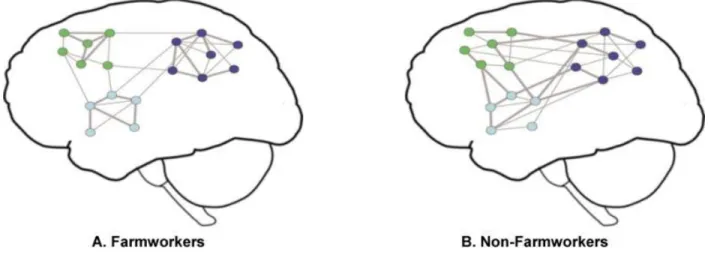
cholinesterase on the brain has been examined using a mixed-effects modeling framework to analyze brain networking, blood levels of acetylcholinesterase, demographics (e.g., age, gender, smoking status, education level), and their interactions in Latino farmworkers and
“more segregated neural processing and less sharing of information between brain regions” as a result of pesticide exposure, which could have important long-term health implications since modified brain connectivity can result in neurodegenerative disorders (Bahrami et al., 2017).
Figure 1.1 This figure illustrates the neurological differences between farmworkers and
non-farmworkers. (Bahrami et al., 2017)
Grzyacz et al. (2010) also considered how job demands and the farmworker’s level of control impacts pesticide exposure. They found that an increase in physiologic demand did not have a positive association with DEP or DMTP pesticide exposure in urine. However, there was a positive correlation between DAP detection and high job demands and little to no job control. The study concluded with a greater need to protect against pesticides based on what the job entails and the components of the job. Similar to this study, Levesque & Arif (2014) also found that more control and knowledge of job tasks and pesticides resulted in lower pesticide exposure. In interviews with 187 Latinx migrant workers in North Carolina, these researchers found that over 68% (p<0.001) believed control over pesticide usage would decrease pesticide exposure and among participants who felt they had control, 50% were less likely to be exposed to pesticides, regardless of confounding variables, such as age.
All 10 of the articles used in this literature review identify the lack of appropriate interventions to decrease pesticide exposure in the Latinx migrant farmworkers. Based on the literature, this population is at increased risk for pesticide exposure with subsequent negative health impacts. This literature review synthesized all available publications found through PubMed that focused on pesticide exposure for Latinx migrant workers in North Carolina. Eastern North Carolina has an economy that focuses predominantly on agriculture, and thus employs a large amount of Latinx migrant farmworkers.
Three of the publications analyzed the use of pesticide protection by Latinx migrant farmworkers and the education of those in the occupation on how to implement pesticide protection. All studies evaluated the short- and long-term effects of pesticide exposure
knowledge. The findings suggest there is education being provided to the field workers, but not in ways they understand or retain. Questions are being guided and answered by fellow
farmworkers instead of occupation management. There is a need to restructure the education provided to this population to allow for a better understanding of the impact pesticides can have on the health of farmworkers. As the research suggests, better education and control over pesticides used by farmworkers lowers pesticide exposure by 50% (Levesque & Arif, 2014). More effective methods should be considered beyond the use of videos, which are most commonly used (Walton et al., 2017).
exposure on the health Latinx migrant farmworkers when proper interventions are not implemented to limit their exposure.
Limitations are identifiable in this literature review. Due to the focus on North Carolina, generalizations cannot be made to other Latinx migrant farmworkers in different regions which might have different pesticide exposure based the farming of different crops. Also, the decision to include three articles using PACE3 data carries the assumptions that PACE3 data is accurately representative of the majority of agriculture workers in North Carolina. Despite the limitations of this literature review, identifying disparities in education and the health of Latinx migrant
farmworkers can lead to future research on how the health care system can better support the health needs of this population. For this population to achieve optimal health, culturally-sensitive interventions should be designed to reduce occupational pesticide exposure and its related
adverse effects.
Title Author(s) Sample Findings Conclusion
An exploratory analysis of occupational skin disease among Latino migrant and seasonal farmworkers in North Carolina Arcury TA, Quandt SA, Mellen BG Latino farmworkers in North Carolina. 95% male 95% Mexican origins 24% reported skin signs & symptoms during early season (June and July)
37% reported skin signs & symptoms during late season (August and September)
barriers, and strategies to improve pesticide protective Behaviors: insights from farmworkers in North Carolina tobacco fields Linnan L, Sanchez-Birkhead A, Mooney K North Carolina 96% male 97% Mexican origins pesticide protection: Availability of supplies and comfort of supplies while working. provided results to provide policies for pesticide protection barriers. Observed and self-reported pesticide protective behaviors of Latino migrant and seasonal farmworkers Walton AL, LePrevost C, Wong B, Linnan L, Sanchez-Birkhead A, Mooney K
71 Latino field workers in North Carolina
96% male
97% of Mexican origins
Observations: N=70 wore long pants
N=65 wore closed shoes
N=64 wore long sleeve shirts
N=28 work gloves all day
N=29 wore glove part of the day 33% of observation found inadequate supplies for PPBs. Reported: N=71 wore long pants
N=69 wore long sleeve shirts
Pesticide
training needs to emphasize the importance of using PPBs so that they are utilized more. Education needs to be properly provided for fieldworkers to understand why they are using PPBs. Very alarming to find more than 33% of inadequate supplies
N=66 wore closed shoes N=59 wore gloves Informal occupational safety information exchange among Latino migrant and seasonal farmworkers Spears CR., Summers PY, Spencer KM, Arcury TA 64 Latinx migrant field workers in North Carolina
Farmworkers reported where they sought the most information for pesticide protection in 2 phases:
Phase 1:
Workers in their field: 21.1% Workers from other fields: 17.5% Employers: 42.1% Phase 2:
Workers in their field: 50.8% Workers from other fields: 42.9% Employers: 15.9% Fieldworkers rely on each other for pesticide protection education more than their employers, leading to question tactics used to provide education for field workers.
Seasonal variation in the measurement of urinary pesticide metabolites among Latino farmworkers in Arcury TA, Grzywacz JG, Isom S, Whalley LE, Vallejos QM, Chen H, Galván L, Barr DB, Quandt SA
eastern North
Carolina PACE3
season.
May 1- June 8: n = 250
June 9 - July 7: n = 233
July 8 - August 5: n = 229 August 6 - September 4: n = 227
Pesticide exposure for each period for TCPy:
Period 1: 20.0% Period 2: 48.5% Period 3: 59.4% Period 4: 59.5%
pesticide exposure, one sample would be unreliable because of variability. Cholinesterase depression and its association with pesticide exposure across the agricultural season among Latino farmworkers in North Carolina Quandt SA, Chen H, Grzywacz JG, Vallejos QM, Galvan L, Arcury TA 231 Latino farmworkers in North Carolina PACE3 Cholinesterase depression was found in 50.5% in June and 14.3% in August.
The beginning of the summer is when pesticides are applied.
There is evident pesticide
exposure for this population and current safety regulations are not sufficient to protect these workers.
Job demands and pesticide exposure among immigrant Latino farmworkers Grzywacz JG,, Quandt SA, Vallejos QM, Whalley LE, Chen H, Isom S, Barr DB, Arcury TA 231 Latino farmworkers in North Carolina PACE3 DAP pesticide increased in urine prevalence from 53.6% at the beginning of the summer to 85.2% by the
Similar to study above, pesticide exposure is prevalent in over half the
end of the season.
notion that not enough is done to prevent pesticide exposure. Hispanic farmworker interpretations of green tobacco sickness
Rao P, Quandt SA, Arcury TA
23 Latinx farmworkers
All were born in Mexico
Male: 21 Female: 2
GTS was seen as the following 3:
1: GTS is not a severe illness and it happens to everyone when beginning work in tobacco fields.
2. GTS occurs from contacts with wet tobacco leaves. It is very severe and hinders work efficiency.
3. GTS is caused by the pesticides used on the plants. It is very severe and believe it will have long-term effects, as many workers contract it yearly.
Although there was no common consensus as to the etiology of GTS, it is evident workers are being
impacted by this disease.
The impacts of pesticide and nicotine exposures on functional brain Bahrami M, Laurienti PJ, Quandt SA, Talton J, Pope CN, Summers P,
N = 74
48: farmworkers 26:
non-farmworkers
There is an increased strength of connection in the brain of the
networks in Latino immigrant workers
Burdette JH, Chen H, Liu J, Howard TD, Arcury TA, Simpson SL All farmworkers were from Mexican origin Non-farmworkers- 58% from mexican origin 42% from various latino countries farmworkers, compared to the farm workers with cholinesterase depression. Farmworkers also experienced strong modular brain networks. segregated neural processing” and less sharing between the brain. Further research is needed to evaluate the effects these changes can have on the farmworkers’ lives. Does the perception of psychosocial factors increase the risk of pesticide exposure among seasonal Hispanic farmworkers? Levesque DL, Arif AA
N = 187
Latinx migrant field workers in North Carolina
All of Mexican origin
Farmworkers who felt in control of their tasks were less likely to be exposed to pesticides. No association was found with lack of social support.
Pesticides are a part of a
farmworkers occupation, but this study suggests proper education and knowledge of pesticides and job tasks of farmworkers can lower pesticide exposure.
PRISMA 2009 Flow Diagram
Diagram 1.1
Records identified through database searching
(n = 50 )
Additional records identified through other sources
(n = 0 )
Records after duplicates removed (n = 47 )
Full-text articles assessed for eligibility
(n = 17 )
Studies included in qualitative synthesis
(n = 10 ) Records screened
(n = 47 )
Records excluded (n = 30 )
Studies included in quantitative synthesis
(meta-analysis) (n = )
Full-text articles excluded, with reasons
References
Bechtel, G., Shepherd, M., & Rogers, P. (1995) Family, Culture, and Health Practices Among Migrant Farmworkers, Journal of Community Health Nursing, 12:1, 15-22, DOI: 10.1207/s15327655jchn1201_2
Walton, A. L., LePrevost, C. E., Linnan, L., Sanche-Birkhead, A., & Mooney, K. (2017).
Benefits, Facilitators, Barriers, and Strategies to Improve Pesticide Protective Behaviors: Insights from Farmworkers in North Carolina Tobacco Fields. International journal of environmental research and public health, 14(7), 677. doi:10.3390/ijerph14070677
Walton, A. L., LePrevost, C., Wong, B., Linnan, L., Sanchez-Birkhead, A., & Mooney, K. (2016). Observed and self-reported pesticide protective behaviors of Latino migrant and seasonal farmworkers. Environmental research, 147, 275–283.
doi:10.1016/j.envres.2016.02.020
Spears, C., Summers, P., Spencer, K., & Arcury, T. (2012). Informal Occupational Safety Information Exchange Among Latino Migrant and Seasonal Farmworkers. Journal of Agromedicine, 17(4), 415–420.
https://doi-org.libproxy.lib.unc.edu/10.1080/1059924X.2012.713830
Arcury, T. A., Grzywacz, J. G., Isom, S., Whalley, L. E., Vallejos, Q. M., Chen, H., Gavan, L., Barr, B. B., & Quandt, S. A. (2009). Seasonal variation in the measurement of urinary pesticide metabolites among Latino farmworkers in eastern North Carolina. International journal of occupational and environmental health, 15(4), 339–350.
doi:10.1179/oeh.2009.15.4.339
season in organophosphorus pesticide urinary metabolite levels for Latino farmworkers in eastern North Carolina: project design and descriptive results. American journal of
industrial medicine, 52(7), 539–550. doi:10.1002/ajim.20703
Quandt, S. A., Chen, H., Grzywacz, J. G., Vallejos, Q. M., Galvan, L., & Arcury, T. A. (2010). Cholinesterase depression and its association with pesticide exposure across the
agricultural season among Latino farmworkers in North Carolina. Environmental health perspectives, 118(5), 635–639. doi:10.1289/ehp.0901492
Grzywacz, J. G., Quandt, S. A., Vallejos, Q. M., Whalley, L. E., Chen, H., Isom, S., Barr, D. B., & Arcury, T. A. (2010). Job demands and pesticide exposure among immigrant Latino farmworkers. Journal of occupational health psychology, 15(3), 252–266.
doi:10.1037/a0019303
Rm, P. , Quandt, S. A. and Arcury, T. A. (2002), Hispanic Farmworker Interpretations of Green
Tobacco Sickness. The Journal of Rural Health, 18: 503-511.
doi:10.1111/j.1748-0361.2002.tb00917.x
Arcury, T. A., Quandt, S. A., Mellen, B. G., (2003), An exploratory analysis of occupational skin disease among Latino migrant and seasonal farmworkers in North Carolina. Journal of Agricultural Safety and Health, 3:221-32.