The quality of instruments to assess the
process of shared decision making: A
systematic review
Fania R. Ga¨rtner1*, Hanna Bomhof-Roordink1, Ian P. Smith1, Isabelle Scholl2,3, Anne M. Stiggelbout1, Arwen H. Pieterse1
1 Department of Medical Decision Making, Leiden University Medical Centre, Leiden, the Netherlands, 2 Department of Medical Psychology, University Medical Center Hamburg-Eppendorf, Hamburg, Germany, 3 The Dartmouth Institute for Health Policy and Clinical Practice, Lebanon, NH, United States of America
Abstract
Objective
To inventory instruments assessing the process of shared decision making and appraise their measurement quality, taking into account the methodological quality of their validation studies.
Methods
In a systematic review we searched seven databases (PubMed, Embase, Emcare,
Cochrane, PsycINFO, Web of Science, Academic Search Premier) for studies investigating instruments measuring the process of shared decision making. Per identified instrument, we assessed the level of evidence separately for 10 measurement properties following a three-step procedure: 1) appraisal of the methodological quality using the COnsensus-based Standards for the selection of health status Measurement INstruments (COSMIN) checklist, 2) appraisal of the psychometric quality of the measurement property using three possible quality scores, 3) best-evidence synthesis based on the number of studies, their methodo-logical and psychometrical quality, and the direction and consistency of the results. The study protocol was registered at PROSPERO: CRD42015023397.
Results
We included 51 articles describing the development and/or evaluation of 40 shared deci-sion-making process instruments: 16 patient questionnaires, 4 provider questionnaires, 18 coding schemes and 2 instruments measuring multiple perspectives. There is an overall lack of evidence for their measurement quality, either because validation is missing or meth-ods are poor. The best-evidence synthesis indicated positive results for a major part of instruments for content validity (50%) and structural validity (53%) if these were evaluated, but negative results for a major part of instruments when inter-rater reliability (47%) and hypotheses testing (59%) were evaluated.
a1111111111 a1111111111 a1111111111 a1111111111 a1111111111
OPEN ACCESS
Citation: Ga¨rtner FR, Bomhof-Roordink H, Smith
IP, Scholl I, Stiggelbout AM, Pieterse AH (2018) The quality of instruments to assess the process of shared decision making: A systematic review. PLoS ONE 13(2): e0191747.https://doi.org/ 10.1371/journal.pone.0191747
Editor: Jacobus P. van Wouwe, TNO,
NETHERLANDS
Received: June 29, 2017
Accepted: January 10, 2018
Published: February 15, 2018
Copyright:©2018 Ga¨rtner et al. This is an open access article distributed under the terms of the Creative Commons Attribution License, which permits unrestricted use, distribution, and reproduction in any medium, provided the original author and source are credited.
Data Availability Statement: All relevant data are
within the paper and its Supporting Information files.
Funding: This study was supported by a grant
from the Dutch Cancer Society, project number: UL2013-6108.
Competing interests: FG, IPS and HB declare that
Conclusions
Due to the lack of evidence on measurement quality, the choice for the most appropriate instrument can best be based on the instrument’s content and characteristics such as the perspective that they assess. We recommend refinement and validation of existing instru-ments, and the use of COSMIN-guidelines to help guarantee high-quality evaluations.
1. Introduction
There is growing recognition that shared decision making (SDM) is imperative as a decision making model in clinical practice when more than one option is medically relevant or when patient preferences vary strongly. Various conceptual models describe what the process of SDM between health care providers and patients entails [1,2]. Many of these models describe steps that have to be taken as part of SDM. In a recent paper, Stiggelbout and colleagues iden-tify four key steps: “(1) the professional informs the patient that a decision is to be made and that the patient's opinion is important; (2) the professional explains the options and their pros and cons; (3) the professional and the patient discuss the patient's preferences and the professional sup-ports the patient in deliberation; (4) the professional and patient discuss the patient’s wish to
make the decision,they make or defer the decision,and discuss follow-up.”[2] SDM aims to
pro-mote patient autonomy, to limit practice variation, and ensure that treatment decisions reflect patient preferences [1,3,4]. Research shows that the occurrence of SDM in routine clinical practice is still limited [5,6]. Current research agenda focuses on studies on the level of SDM seen in clinical care [5], effects of training and tools for healthcare providers and patients to promote SDM in the clinical practice [7,8], and the effect of SDM on psychosocial and physi-cal patient outcomes [9–11]. The quality of these studies highly depends on the availability of psychometrically sound instruments to assess the actual realization of SDM. It is notable that the SDM measures used vary greatly with regard to their characteristics, such as the source of the data and the perspective of the scorers (self-report questionnaires based on the experience of patients or providers versus coding schemes applied by independent raters to audio- or video-taped consultations) [12]. These differences can impact research outcomes, as might be the case for a review on the relationship between SDM and patient health outcomes which found that the perspective from which SDM is measured affects the associations found with health outcomes [8]. Furthermore, it is not clear if there are differences in measurement qual-ity between different instruments. To assist researchers in their choice of the most feasible, reli-able, and valid SDM measure, and to optimally improve existing instruments, insight into measurement quality of the existing measures is needed.
Previous literature reviews have provided an overview of existing instruments, but have not systematically appraised the quality of the instruments’ measurement properties in a process that accounts for the methodological quality of their validation [12–15] Concerning the instru-ments’ measurement quality, the existing reviews only presented results on reliability and validity testing in a descriptive manner. None of the previous reviews systematically appraised the quality of the measurement properties of existing instruments, taking into account the methodological quality of their validation studies. In any study, poor methodological quality can bias the results. Consequently, when drawing conclusions on the quality of measurement instruments, one should appraise and correct for the risk of bias arising from the methods applied in the validation studies of the instruments under investigation [16]. Therefore, we aim to perform a systematic literature review that presents an overview of all SDM process instruments and their measurement quality, by answering the following research question: compensation for this. AP and AS held lectures for
pharmaceutical companies (Sanofi en Amgen) for which they received time and travel
What is the measurement quality of existing instruments measuring the process of SDM, tak-ing into account the methodological quality of the available validation studies?
This systematic review was registered at PROSPERO: CRD42015023397 Available from:
https://www.crd.york.ac.uk/PROSPERO/display_record.php?RecordID=23397
2. Methods
2.1 Search strategy
Seven electronic databases (PubMed, Embase, Emcare, Cochrane, PsycINFO, Web of science, Academic Search Premier) were systematically searched for peer-reviewed articles in May 2015 and the search was updated on September 1, 2017. A librarian experienced in systematic searches of academic databases assisted the researchers in developing and performing the search strategy. Our search strategy was developed in line with recommendations and existing search filters specifically developed for systematic reviews, assessing the measurement quality of measurement instruments in the medical field, described by Terwee and colleagues [17]. We combined three search groups with the Boolean operator AND: Group I consisted of search terms presenting the construct of interest, i.e., SDM; group II consisted of search terms for instrument types, such as questionnaire and coding schemes; and group III consisted of search terms for measurement properties. Index terms specific for each database (such as MESH and Major terms in PubMed) were combined with free-text words. We added a fourth search group using the Boolean operator NOT, to exclude specific publication types such as editorials. The complete search strategy is presented in the Appendix. We then reviewed all articles citing the of articles that meet our inclusion criteria to check for additional relevant articles with a publication date prior to October 10, 2017. Furthermore, we contacted a net-work of SDM researchers via the Shared-l mailing list ([email protected];http://www. psych.usyd.edu.au/mailman/listinfo/shared-l) and asked them to inform us of any ongoing studies related to the development or evaluation of instruments measuring the process of SDM.
2.2 Selection of eligible articles
The search aimed to include all articles that describe the development or evaluation of instru-ments that measure the SDM process, which is an assessment of the actual realization of SDM in clinical practice. Articles that evaluate instruments measuring antecedents of SDM (e.g., preferred role in decision making) or SDM outcomes (such as decisional regret) were not included. The inclusion criteria are presented in detail inTable 1. To check eligibly for inclu-sion, each article retrieved in the search was independently assessed by two members of the research team (MB, HB-R, FG, IPS, IS, AP). In a twofold process, researchers reviewed the titles and abstracts of each article. If these indicated potential inclusion, the full-text of the arti-cle was assessed using the inclusion criteria. Disagreements were resolved in consensus between the two reviewers and a third reviewer was consulted if necessary.
2.3 Data extraction
Table 2. Definition of measurement properties based on COSMIN [20] and Terwee et al.[21]. Measurement property Definition
I. Reliability
Internal consistency The degree to which items in a (sub)scale are intercorrelated, thus measuring the same construct.
Reliability The extent to which subjects can be distinguished from each other, despite measurement errors (relative measurement error).
Measurement error/ Agreement
The degree to which the scores on repeated measures are close to each other (absolute measurement error).
II. Validity
Content validity The degree to which the instrument is an adequate reflection of the construct to be measured.
Construct validity
Structural validity The degree to which the scores of the instrument are an adequate reflection of the
dimensionality of the construct to be measured.
Hypotheses testing The degree to which the scores of the instrument are consistent with hypotheses,
based on the assumption that the instrument validly measures the construct to be measured.
Cross-cultural validity The degree to which the performance of the items on a translated or culturally
adapted instrument are an adequate reflection of the performance of the items of the original version of the instrument.
Criterion validity The degree to which the scores of the instrument are an adequate reflection of a ‘gold standard’.
III. Responsiveness
Responsiveness The ability of the instrument to detect changes over time in the construct measured.
Interpretability Interpretability is the degree to which one can assign qualitative meaning- that is, clinical or commonly understood connotations–to an instrument’s quantitative scores or change in scores.
Table 1. Eligibility criteria.
Inclusion criteria
1. The article had to describe a primary study in which the development or evaluation of one or more instruments occurred.
2. Instruments under investigation:
a. were developed with the aim of measuring the process of SDM between a patient (with or without family) or proxy and a healthcare provider; or
b. were evaluated in their ability to measure the process of SDM even though they were not originally developed to measure the process of SDM; or
c. were developed or evaluated in their ability to measure patient participation in decision making. To guarantee
a focus on SDM, these instruments should assess at least one of four key steps of SDM [8,18,19]:
i. explaining that a decision has to be made,
ii. discussing all relevant treatment options and their associated benefits and harms,
iii. discussing patients’ ideas, concerns and expectations and supporting patients in the process of deliberation, before reaching a decision,
iv. patient involvement in making the final decision.
3. The article had been peer-reviewed. (Not applicable to unpublished work received via the SHARED e-mail list.) 4. The article was written in English, Dutch, or German.
Exclusion criteria
To guarantee that the instrument under investigation measures a decision making process that includes both the health care provider and the patient, the following two exclusion criteria were applied:
1. Articles investigating instruments that measure inter-professional SDM that does not include the participation of patients.
2. Articles about instruments developed or evaluated for the measurement of SDM about screening. These decisions often rather relate to informed decision making and thus crucially differ from SDM in two aspects: a) the healthcare provider is not necessarily involved in making the decision; b) a decision usually is not needed by a certain time point.
No restrictions were held for:
1. The type of measurement instrument (e.g. self-report questionnaire or coding scheme), 2. The healthcare setting in which the instrument was evaluated.
the quality appraisals that we performed, as described in section 2.5. For each instrument iden-tified by the included articles we extracted i) the instrument’s measurement aim and construct, ii) the measurement characteristics, i.e., underlying measurement model, number of subscales and items, response scale, and score range, and iii) details on the development process. For each included article, the data was extracted by one and checked by a second project team member (HB-R, FG, IS, ISCH, AP, AS); disagreements between these two were discussed until consensus was reached. In case of doubt a third researcher was consulted. Only information listed in the included article was extracted and considered for assessment, unless the article specifically referred to some other source for this information.
2.4 Quality appraisal of measurement properties of SDM instruments
For each instrument, we appraised the quality of ten measurement properties (seeTable 2) described in the validation studies in two ways. First, we rated the quality of the methods used to evaluate the measurement properties of an instrument; from here on referred to as the appraisal of methodological quality. Second, we rated the measurement properties based on the results of the validation studies. Data from these two appraisals were combined to provide a best-evidence synthesis of the quality of the measurement properties for each instrument included.
2.4.1 Appraisal of methodological quality. To appraise the methodological quality we
used the COnsensus-based Standards for the selection of health status Measurement INstru-ments (COSMIN) checklist [20,22,23]. The COSMIN checklist describes how ten different measurement properties should ideally be evaluated and provides scoring criteria for the meth-odological quality appraisal. For each measurement property, the quality of the methods used to evaluate it is scored by a number of items (ranging from 4 to 18) on a four-point rating scale: “excellent”, “good”, “fair”, or “poor”. For some items, the lowest response options were “good” or “fair”. The scoring criteria for each category on the rating scale are uniquely defined per item. The overall score per measurement property was determined by taking the lowest item-level score for that specific measurement property. That is, if one item in a property was rated as “poor” then the entire property was rated as “poor”. For instruments following item response theory (IRT), specific IRT criteria were scored, instead of internal consistency and structural validity. There are no COSMIN criteria to appraise methodological quality for the property interpretability. Therefore, for interpretability we only inventoried if two aspects of interpret-ability were evaluated, i.e., floor and ceiling effects, and minimal important change value. More information on COSMIN and the checklist items can be found onhttp://COSMIN.nl.
The 10 measurement properties and their definitions based on COSMIN [20] and Terwee et al.[21] are presented inTable 2. Due to variability in the field regarding names used for mea-surement properties, we classified the meamea-surement properties evaluated in included articles using the terminology and definitions of COSMIN [20] and Terwee et al.[21] (seeTable 2) rather than the labels given by the authors of the articles. For example, if authors used the term ‘convergent validity testing’ to designate the testing of hypotheses about the relationship of the instrument under investigation with another existing instrument measuring related con-structs, we extracted and evaluated this information using COSMIN criteria for hypotheses testing.
patients stable in the interim period on the construct to be measured?); for inter-rater validity: item 6 (Was the time interval stated?), item 7 (Were patients stable in the interim period on the construct to be measured?), and item 8 (Was the time interval appropriate?).
We applied two modifications to the COSMIN rating. First, we diminished the impact of the item “Was there a description of how missing items were handled?” on the total score for a measurement property. This item is included in the rating of most measurement properties and often received the lowest possible score, a “fair” rating. This score often was the lowest score on the measurement property and would then obscure how the other methodological aspects for that measurement property were rated. We therefore decided to let this item have less impact on the final score by upgrading the total score on a measurement property in case the score on this specific item was the lowest of all scores. E.g., if all items for the measurement property had received “good” or “excellent” rating, and the score on this specific item was a “fair”, the total score was set on “good”, or: if all items had been rated as “excellent” and the score on this specific item was a “fair”, the total score was set at “good”.
Second, we adapted the rating of content validity. The COSMIN checklist requires that for content validity testing, three types of relevance should be assessed, regarding a) the construct to be measured, b) the study population, and c) the purpose of the measurement instrument. These requirements are quite stringent and therefore we have adapted the scoring of these three items as follows: If one or two types of relevance were missing, the concerning items were not scored. The score for items concerning the type of relevance thatwasassessed was downgraded by one score. That is, an excellent score for content validity testing was only pos-sible when two or more types of relevance had been assessed.
2.4.2 Appraisal of the measurement properties. To rate the measurement property of an
instrument within a particular study, we used three possible quality scores: a positive rating (labeled +), an inconclusive rating (labeled?), and a negative rating (labeled -). The criteria we used were based on Terwee et al.[21] and Schellingerhout et al. [24,25] and are presented in Table 3.
Table 3. Quality criteria for results on measurement properties based on Terwee et al.[21].
Measurement property Criteria for appraisal of the results on measurement properties evaluation Internal consistency + Cronbach’s alpha(s) are0.70
? Not able to score because of unclear or missing information, e.g., the
dimensionality is not known or Cronbach’s alpha(s) are not presented.
- Criteria for ‘+’ not met.
Reliability + ICCagreement/weighted Kappa0.70 OR ICCconsistency/ICC without approach
stated/Pearson’s r0.80 OR unweighted kappa/or kappa without approach
stated0.80
? Not able to score because of unclear or missing information, e.g., neither ICC,
Kappa, nor Pearson’s r is determined.
- Criteria for ‘+’ not met.
Measurement error/ Agreement
+ MICSDC OR MIC outside the LOA OR convincing arguments that agreement
is acceptable
? Not able to score because of unclear or missing information, e.g. SEM, SDC not
calculated, or MIC not defined.
- Criteria for ‘+’ not met.
Content validity + Target group and/or experts considered all items to be relevant AND considered the item set to be complete.
? Not able to score because of unclear or missing information, e.g. no results on item
relevance according to experts reported
- Criteria for ‘+’ not met.
Table 3. (Continued)
Measurement property Criteria for appraisal of the results on measurement properties evaluation Construct validity
Structural validity + For exploratory factor analyses: Factors chosen explain at least 50% of variance
OR factors chosen explain less than 50% of variance but the choice is justified by the authors. For confirmatory factor analyses: (The goodness of fit indicators fulfil the following requirements: (CFI or TLI or GFI or comparable measure
>0.90) AND (RMSEA or SRMR<0.08)) AND (results confirm models with the
original factor structure OR results confirm a model with slight changes if these changes are justified by the authors.
? For exploratory factor analyses: Not able to score because of unclear or missing
information, e.g. explained variance not mentioned. For confirmatory factor
analyses: Not able to score because of unclear or missing information, e.g., no fit
indices are presented
- Criteria for ‘+’ not met.
Hypotheses testing + (At least 75% of the results are in accordance with the hypotheses AND, if
calculated, the correlation with an instrument measuring the same construct
is0.50) AND correlations with related constructs are higher than with unrelated
constructs if calculated.
? Not able to score because of unclear or missing information, e.g. no correlations
with related construct are calculated
- Criteria for ‘+’ not met.
Cross-cultural validity + The original factor structure is confirmed AND no important DIF found. If only
one of these properties are investigated: either the factor structure is confirmed OR no important DIF found.
? Not able to score because of unclear or missing information, e.g. no confirmative
factor analyses is performed nor the DIF is investigated.
- Criteria for ‘+’ not met
Criterion validity + Correlations with chosen gold standard0.70, OR AUC0.80, OR (specificity
AND sensitivity80).
? Not able to score because of unclear or missing information
- Criteria for ‘+’ not met.
Responsiveness + Correlations of change scores of the target instrument with an instrument
measuring the same construct are0.40 OR at least 75% of the results are in
accordance with the hypotheses OR AUC0.70) AND Correlations of change
scores of the target instrument with an instrument measuring a related constructs are higher than with unrelated construct if calculated.
? Not able to score because of unclear or missing information, e.g. no correlations of
change score with related constructs are calculated or no AUC investigated.
- Change score correlation with an instrument measuring the same construct<0.40
OR<75% of the results are in accordance with the hypotheses OR AUC<0.70
OR change score correlations with related constructs are lower than with unrelated constructs.
Interpretability No quality scoring performed Item response theory
(IRT)
+ At least limited evidence for unidimensionality or positive structural validity AND no evidence for violation of local independence: Rasch: standardized item-person fit residuals between -2.5 and 2.5; OR IRT: residual correlations among the items
after controlling for the dominant factor<0.20 OR Q3’s<0.37 AND no evidence
for violation of monotonicity: adequate looking graphs OR item scalability>0.30
AND adequate model fit: Rasch: infit and outfit mean squares0.5 and1.5 OR
Z-standardized values>-2 and<2 OR IRT: G2>0.01. Optional additional
evidence: Adequate targeting; Rasch: adequate person-item threshold distribution; IRT: adequate threshold range. No important DIF for relevant subject
characteristics (such as age, gender, education), McFadden’s R2<0.02
? Model fit not reported
- Criteria for ‘+’ not met
2.4.3 Best-evidence synthesis. As recommended by Terwee et al [16] we determine the overall quality of a particular measurement property of an instrument. We used the approach of Schellingerhout and colleagues [24,25], in which the results from the different articles are synthesized for each instrument by combining: the appraisal of methodological quality of the studies (see 2.5.1), the appraisal of the measurement property (see 2.5.2), the number of studies assessing the property, and the consistency of the results in case of multiple validation studies. For this overall rating, five levels of evidence were applied: unknown evidence (?), conflicting evidence (+/-), limited (+ or -), moderate (++ or--), and strong evidence (+++ or---). The lat-ter three could point in either a positive or negative direction, which we indicated by respec-tively using the plus sign and minus sign. The scoring criteria are presented inTable 4.
Two members of the research team (HB-R, FG, IPS IS, AP) rated the methodological qual-ity and measurement properties of each article, with discrepancies discussed until consensus was reached. In case of doubt a third team member was consulted. For the methodological quality appraisal, consensus had to be reached on the item-level, not only on the total scores per measurement property rated. One team member performed the best-evidence synthesis (FG) and a second (AP) checked it. Team members who were co-author of an included article were not involved in data extraction and quality appraisals of that article. For instruments con-sisting of multiple subscales, we performed the quality appraisals of the methods and proper-ties separately for each subscale. To provide an overall score for a measurement property for these instruments, we used the lowest subscale scores as input for the data synthesis.
3. Results
3.1 Search results
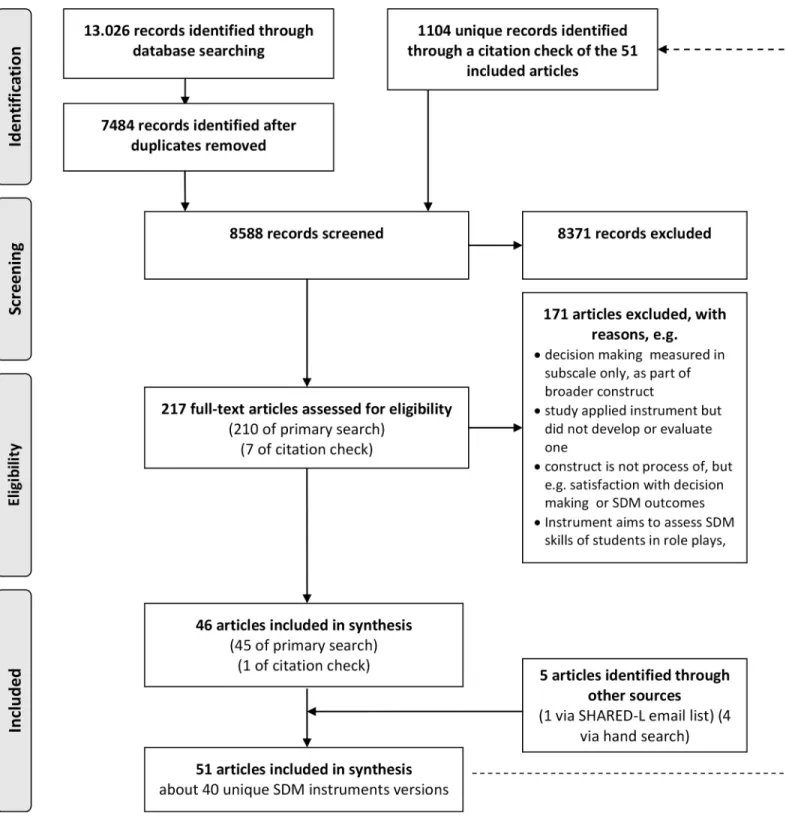
The primary search in seven databases retrieved 13.026 articles, of which, after removing duplicates, 7484 unique hits were screened for inclusion. Another 1104 unique articles were identified by the citation check of all articles that were eligible for inclusion in this systematic review. After title abstract screening, 217 articles were assessed for eligibility based on their full-text. In total, fifty one articles met our inclusion criteria (Fig 1), of which forty-five derived from the primary search, one from the citation check, 4 through the call in the e-mail list of SDM researchers and 1 via hand search. The 51 included articles describe the development and/or evaluation of 40 unique instruments that assess the process of SDM (Fig 2). In total 21 instruments were originally developed versions, 4 were revised versions, and 15 were trans-lated versions. InTable 5, we describe the characteristics of the instruments. Most instruments were observer-based coding schemes (N = 18), followed by patient questionnaires (N = 16)
Table 4. Levels of evidence for the best-evidence synthesis.
Level of evidence Rating Criteria
Strong +++ or --- Consistent findings in multiple studies of good methodological quality
OR one study of excellent methodological quality
Moderate ++ or -- Consistent findings in multiple studies of fair methodological quality
OR one study of good methodological quality
Limited + or - One study of fair methodological quality
Conflicting +/- Conflicting findings
Unknown ? Only studies of poor methodological quality
A plus sign (+) indicates = positive results for a measurement property evaluation and a minus sign (-) indicates negative results for a measurement property evaluation, e.g., + stands for limited evidence for positive results and ---stands for strong evidence for negative results for a measurement property.
and provider questionnaires (N = 4); two were mixed, including two or more instruments assessing multiple perspectives: the dyadic OPTION, consisting of a patient and a provider questionnaire [26] and the Mappin’SDM, consisting of a patient questionnaire, a provider questionnaire, and a coding scheme [27]. For the quality appraisal of mixed instruments, we Fig 1. Flow diagram of article selection process.
rated the measurement quality of mixed instruments separately for each perspective; result in a total number of instruments for which we performed a best evidence synthesis of N = 43. The number of validation studies per instrument varied between zero and four. For most instruments (N = 28), one validation article has been published.
3.2 Best-evidence synthesis
InTable 6, we present the best-evidence synthesis for each measurement propertyper instru-ment, (N = 43). For seven instruments (all of which questionnaires), moderate or strong Fig 2. Number of included articles and instrument.
Table 5. Characteri stics of the instrument s measurin g the process of SDM regarding the construct and the instruments’ measuremen t features . Instrument 1 st author, publication year Perspective Version Language Target setting Measurement aim Construct and its definition
Measurement model (formative
versus reflective) Number of Subscales (total number of items) 1. name of subscales 1(# items), 2. Name of subscales 2 (# items), Response-scale; total score range Development process a) how construct defined; b) item generation; c) item selection; d) pilot test e) (cultural) adaptation/ translation process Patient questionnaires PPC Patients’ preferences for control Bradley, 1996 [ 36 ] Patient Original assumed to be English Generic Patient desire for involvement in making medical decisions in general and in 10 scenarios depicting different acute and chronic medical situations Not reported Not applicable because exists of 1 item only 1 (1) 7-point scale: 1 = I prefer that my doctor tell me what to do to 7 = I prefer that I make the decision without any information or recommendation from the doctor; not reported a) Literature; b) by authors (family physician, internist, social worker), based on the literature, clinical scenarios were then reviewed by family physicians (N = 2); c) not reported; d) lay people (N = 12) assessed readability and understanding of items; e) n/a CPS post post Control Preferences Scale (actual role) Degner, 1997 [ 37 ] Patient Original assumed to be English Generic
Consumer preferences regarding participation
Table 5. (Continued ) Instrument 1 st author, publication year Perspective Version Language Target setting Measurement aim Construct and its definition
Measurement model (formative
Table 5. (Continued ) Instrument 1 st author, publication year Perspective Version Language Target setting Measurement aim Construct and its definition
Measurement model (formative
Table 5. (Continued ) Instrument 1 st author, publication year Perspective Version Language Target setting Measurement aim Construct and its definition
Measurement model (formative
versus reflective) Number of Subscales (total number of items) 1. name of subscales 1(# items), 2. Name of subscales 2 (# items), Response-scale; total score range Development process a) how construct defined; b) item generation; c) item selection; d) pilot test e) (cultural) adaptation/ translation process CollaboRATE (Swedish) Rosenberg, 2017 [ 41 ] Patient Translation Swedish Generic Shared decision making Not provided Assumed to be reflective as cronbach’s alpha is calculated 1 (3) 5-point scale: 0 = no effort was made to 4 = every effort was made, 0–12 b-d) n/a; e) First permission to translate was obtained by developers. Second, independent translation by 2 researchers, native Swedish speakers fluent in English, independently translated the instrument into Swedish. Third, retranslation into English by a third researcher, native English speaker also fluent in Swedish, and with no previous knowledge of the original instruments. Fourth, possible transcultural differences between the original and the translated versions were discussed in the research team with the purpose of making the instrument culturally equivalent in order to promote a sound content validity. SMDMQ Taiwan Shared Medical Decision Making Questionnaire Chang, 2014 [ 42 , 43 ] Patient Original Taiwanese Generic Shared medical decision making process Shared medical decision making : Four components define the shared medical decision making process: 1. Patient Autonomy, 2. Control preference, 3. Patients’ perceived involvement, 4. Risk information communication IRT 1 (15) Not reported; 0–15 a) Literature review; b) author generated; c) original 25 items were reduced to 16 based on experts’ opinion (N = 12) on content validity and relevance; 1 further item was removed based on Rasch analyses; d) not reported; e) n/a SDM Process Score Fowler, 2016, in progress [ 44 ] Patient Original assumed to be English Generic Quality of decision making at a clinical practice or site SDM : In SDM, patients are faced with potential medical tests or treatments for which there are reasonable options, and they should be informed about those options, including the known pros and cons, and should have a voice in making the decisions Unclear 1 (4) Items 1–2: 4-point scale: 0 = not at all to 3 = a lot, dichotomized into 0 = not at all or a little to 1 = some or a lot, items 3–4 dichotomous: 0 = no, 1 = yes; 0–4 a) Literature; b) based on previous questionnaire; c) not reported; d) cognitive testing with patients for relevance and clarity of items; e) n/a MADM Mother’s Autonomy in Decision Making scale Vedam, 2017 [ 45 ] Patient Original English
Primary maternity care
Table 5. (Continued ) Instrument 1 st author, publication year Perspective Version Language Target setting Measurement aim Construct and its definition
Measurement model (formative
Table 5. (Continued ) Instrument 1 st author, publication year Perspective Version Language Target setting Measurement aim Construct and its definition
Measurement model (formative
versus reflective) Number of Subscales (total number of items) 1. name of subscales 1(# items), 2. Name of subscales 2 (# items), Response-scale; total score range Development process a) how construct defined; b) item generation; c) item selection; d) pilot test e) (cultural) adaptation/ translation process SDM-Q-Doc (Dutch) Rodenburg, 2015 [ 33 ] Provider Translation Dutch Generic SDM process during a consultation SDM : In partnership with their clinicians, patients are encouraged to consider the likely harms and benefits of available treatment options, communicate their preferences, and select the option that best fits these Assumed to be reflective as Cronbach’s alpha calculated 1 (9) 6-point scale: 0 = completely disagree to 5 = completely agree; 0–45, rescaled range: 0–100 a) Literature; b-d) n/a; e) multiple forward-backward translations of the original German version by two native Dutch and two native German speakers, comparison and discrepancy discussion in consensus meeting with four team members, including author of original German version; final version presented to clinicians for their opinion on wording (N not reported) SDM-Q-Doc Shared
Table 5. (Continued ) Instrument 1 st author, publication year Perspective Version Language Target setting Measurement aim Construct and its definition
Measurement model (formative
versus reflective) Number of Subscales (total number of items) 1. name of subscales 1(# items), 2. Name of subscales 2 (# items), Response-scale; total score range Development process a) how construct defined; b) item generation; c) item selection; d) pilot test e) (cultural) adaptation/ translation process IDM Elements of Informed Decision Making Braddock, 1999 [ 48 ] Observer Original English Generic Characterize the completeness of informed decision making during consultations as a function of the complexity of the decision Informed decision making : Informed decision making is a meaningful dialogue between provider and patient Unclear 1 (7) Frequencies for two scores: a) if item is required (yes/no), b) if item is present (yes/no); not applicable a) Literature review and professional consensus; b) earlier work of author and iterative group techniques among providers and laypersons to define completeness for basic, intermediate and complex decisions, and to determine complexity of specific kinds of decisions; c) not reported; d) not reported; e) n/a DSAT Decision Support Analysis Tool Guimond, 2003 [ 49 ] Observer Original assumed to be English Generic Providers’ use of decision support and related communication skills during clincial encounters SDM : In an SDM situation, patients’ and practitioners’ active cognitive and affective participation is imperative for the success of the interaction. Providers actively elicit patients’ points of view, help them to express themselves openly, and ask questions about issues that affect decision making Unclear 2 Parts: Part 1, 6 categories of decision support skills (22): 1. Discuss decision making status (5), 2. Discuss knowledge/information (5), 3. Discuss values (4), 4. Discuss support (3), 5. Discuss commitment to act (1), 6. Discuss learning for future decisions (3) and Behaviour not classified (1). Part 2, 4 categories of communication skills (14): 1. Managing the encounter (4), 2. Listening (5), 3. Questioning (2), 4. Sending messages (2) and Behaviour not classified (1) Frequency of behaviour; not reported a) Literature and theoretical models; b) existing instrument; c) a panel of researchers, clinicians, and specialists in decision support and communication revised and re-classified the existing instrument; d) not reported; e) n/a DSAT-10 Brief Decision Support Analysis Tool Stacey, 2008 [ 50 ] Observer Revision English Generic Decision support skills Decision support : Decision support is preparing clients for decision making by providing tailored information, clarifying values, and enhancing self-help skills in decision-making and implementation Unclear 1 (5 elements encompassing 10 assessment criteria) dichotomous: present vs. absent; 0–10 a) Based on the Ottowa Decision Support Framework; b) used items from existing DSAT instrument; c) changed and removed items, simplified scoring procedure; d) five coders trained on original DSAT instrument coded encounters between standardized patients and experienced call centre nurses, their findings were discussed and the DSAT-10 was adjusted based on findings; e)
n/a (Con
ti
n
u
ed
Table 5. (Continued ) Instrument 1 st author, publication year Perspective Version Language Target setting Measurement aim Construct and its definition
Measurement model (formative
Table 5. (Continued ) Instrument 1 st author, publication year Perspective Version Language Target setting Measurement aim Construct and its definition
Measurement model (formative
Table 5. (Continued ) Instrument 1 st author, publication year Perspective Version Language Target setting Measurement aim Construct and its definition
Measurement model (formative
Table 5. (Continued ) Instrument 1 st author, publication year Perspective Version Language Target setting Measurement aim Construct and its definition
Measurement model (formative
versus reflective) Number of Subscales (total number of items) 1. name of subscales 1(# items), 2. Name of subscales 2 (# items), Response-scale; total score range Development process a) how construct defined; b) item generation; c) item selection; d) pilot test e) (cultural) adaptation/ translation process SDM Scale Shared Decision-Making Scale Singh, 2010 [ 60 ] Observer Original assumed to be English Oncology SDM behaviours used by cancer specialists in their consultations SDM : In an SDM model, the patient is given information regarding their disease and possible treatments and is a participant along with the provider in medical decision making Assumed to be reflective as Cronbach’s alpha is calculated 3 (18); 1. Treatment (7), 2. Evidence (8), 3. Patient challenges (3) 2-point scale: 0 = absent, 1 = present or non-applicable; total score: 0–18, subscale 0–10 a) Literature review; b,c) based on literature (including another coding system) a list with key themes and provider behaviours in a consultation was made and reviewed by a team of medical oncologists, oncology nurses and health psychologists; d) coding system created by the team was applied to consultations (N = 5), reviewed, and appropriate adjustments were made; e) n/a PES Parental Engagement Scale Kearney, 2011 [ 61 ] Observer Original no items yet available Pediatric palliative care
Parental engagement in decision making and planning for seriously ill children during pediatric palliative care consultations Parental engagement : Parental engagement is a psychobehavioral construct that denotes not just parental presence but effective participation Unclear 3 (not reported); 1. Information-centered dialogue, 2. Insightful participation, 3. Achievement of a collaboratively agreed-upon plan Not reported;? -9 (lowest score not reported) a) Literature review and deductive conceptual reasoning; b,c) first: analysis of consultation narratives with content analyses approach, second: integrative process of construct refinement by two researchers based on an iterative process of grouping categories and identifying observable indicators of behaviour for each category; expert content validity checks with clinical experts in paediatric palliative care (N = 3), no results reported; d) actual scoring by two researchers, process not further described; e) n/a DEEP-SDM Detail of Essential Elements and Participants in Shared Decision Making Clayman, 2012 [ 62 ] Observer Original English Generic Essential elements of shared decision making SDM : SDM is based on the premise that patients should be involved to the extent that they wish, and their values and preferences are crucial to deciding the ‘‘right” course of action Unclear 1 (13) Frequencies, except for the item "Degree of decision sharing: 9-point scale: 1 = physician-led decision to 9 = patient-led decision; not applicable a) Literature; b) revised previous patient choice instrument and added components; c) not reported; d) two coders independently applied coding scheme to video-recorded consultations of two samples (Sample 1, early stage breast cancer, N = 9; Sample 2, metastatic breast cancer patients, N = 20), modifications and additions were made to the codebook and the examples within definitions to be more inclusive; e)
n/a (Con
ti
n
u
ed
Table 5. (Continued ) Instrument 1 st author, publication year Perspective Version Language Target setting Measurement aim Construct and its definition
Measurement model (formative
Table 5. (Continued ) Instrument 1 st author, publication year Perspective Version Language Target setting Measurement aim Construct and its definition
Measurement model (formative
versus reflective) Number of Subscales (total number of items) 1. name of subscales 1(# items), 2. Name of subscales 2 (# items), Response-scale; total score range Development process a) how construct defined; b) item generation; c) item selection; d) pilot test e) (cultural) adaptation/ translation process MAPPIN’SDM Inventory (including a patient questionnaire, a doctor questionnaire and a coding scheme) (with the possibility to calculate a compound measure, called the SDM Meeting its concept’s Assumptions (SDMmass)) Kasper, 2012 [ 27 ]
Patient, provider, observer
Original German Generic Interrelations of SDM indicators administered from different perspectives (doctor, patient, observer); (For the
SDMmass: Integrative compound
positive evidence was found for at least one type of reliability (internal consistency, test-retest reliability, intra-rater reliability, inter-rater reliability, or measurement error) and one type of validity (structural validity, hypotheses testing, cross-cultural validity, or criterion validity): the FPI [28], the SDM-Q-9 original German version [29], the SDM-Q-9 Spanish version [30–32] the SDM-Q-9 Dutch version,[33] the SDM-Q-9-PSY in Hebrew [34], the SDM-Q-doc original German version,[35] and the SDM-Q-doc Dutch version [33]. Of these instruments however, the 9 Spanish version [30–32], the 9-PSY in Hebrew[34] and the SDM-Q-doc original German version,[35] are the only instruments without any negative evidence on other measurement properties. In the online Supporting Information (S2 Table), we present the separate ratings for each included article, for both the appraisal of the methodological qual-ity and the qualqual-ity of measurement properties.
3.3 Overall results for the quality of validation studies and measurement
properties
In the next three sections we will describe overall results on the quality of included studies and instruments, beginning with an overview of measurement properties that have been evaluated for the included instruments (section 3.3.1), the overall results on the methodological quality of the included validation studies (section 3.3.2), and overall results on the best-evidence syn-thesis (section 3.3.3). To allow for generalization, we present overall results only for measure-ment properties that have been evaluated in at least five studies (section 3.3.2) or for at least five instruments (section 3.3.3). We do not present overall results on the quality rating of mea-surement properties (seeMethodssection 2.4.2), because we regard them as being irrelevant without the correction for methodological quality. The results on the measurement properties evaluation for each included article and each instrument evaluated in the articles can be found in the online Supporting Information (S1 Table)
3.3.1 Overall results on which measurement properties are evaluated. The
measure-ment property evaluation results are presented inTable 7. The number of instruments for which each of the different measurement properties have been evaluated, taking into account whether the property was applicable or not, is presented inTable 7, column 2 and 3. Two mea-surement properties were evaluated in more than two-thirds of the instruments: hypotheses testing, and intra-rater reliability in case of coding schemes. Seven measurement properties were evaluated for in less than one-third of instruments: Test-retest reliability, measurement error, content validity, cross-cultural validity, criterion validity, responsiveness, and thefloor
and ceiling effectsandminimal important change values,bothaspects of interpretability. Of
note, internal consistency and structural validity were evaluated for a majority of question-naires, but a minority of coding schemes.
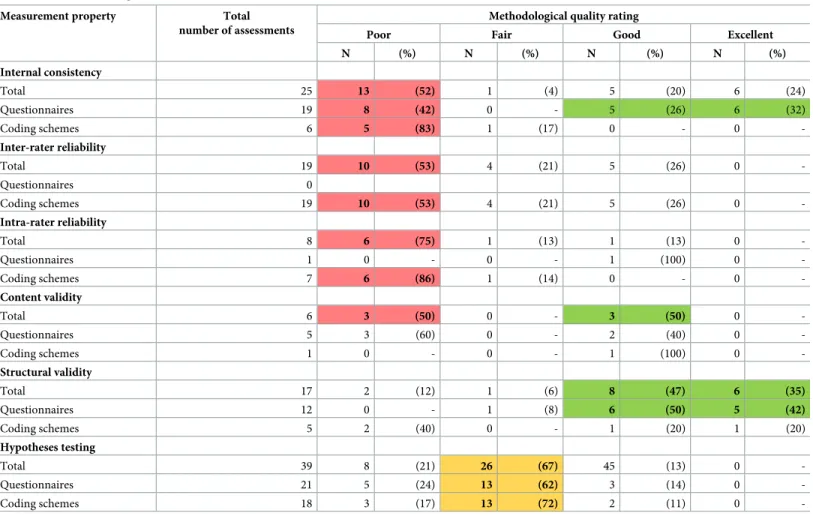
3.3.2 Overall results on the methodological quality of included validation studies. The
Table 7. Overall results on best-evidence synthesisper measurement property of instruments measuring the process of SDM (N = 43).
Measurement property Applicable to instruments Evaluated for instruments
Overall level of evidence
Unknown Negative Conflicting Positive
N N (%) N (%) N (%) N (%) N (%)
Internal consistency
Total 36 22 (61) 12 (55) 0 (0) 0 (0) 10 (46)
Questionnaires 19 16 (84) 7 (44) 0 (0) 0 (0) 9 (56)
Coding schemes 17 6 (35) 5 (83) 0 (0) 0 (0) 1 (17)
Test retest reliability
Total 24 4 (17) - - -
-Questionnaires 24 4 (17) - - -
-Coding schemes 0 n.a. n.a. - - -
-Inter-rater reliability
Total 19 15 (79) 7 (47) 7 (47) 0 (0) 1 (7)
Questionnaires 0 n.a. n.a. - - -
-Coding schemes 19 15 (79) 7 (47) 7 (47) 0 (0) 1 (7)
Intra-rater reliability
Total 19 7 (37) 5 (71) 0 (0) 0 (0) 2 (29)
Questionnaires 0 1 n.a. - - - - - - -
-Coding schemes 19 6 (33) 5 (83) 0 (0) 0 (0) 1 (17)
Measurement error
Total 43 0 (0) - - -
-Questionnaires 43 0 (0) - - -
-Coding schemes 43 0 (0) - - -
-Content validity
Total 43 6 (14) 3 (50) 0 (0) 0 (0) 3 (50)
Questionnaires 24 5 (21) 3 (50) 0 (0) 0 (0) 3 (50)
Coding schemes 19 1 (5) - - -
-Structural validity
Total 36 15 (42) 4 (27) 3 (20) 0 (0) 8 (53)
Questionnaires 19 10 (56) 2 (20) 1 (10) 0 (0) 7 (70)
Coding schemes 17 5 (29) 2 (40) 20 (40) 0 (0) 1 (20)
Hypotheses testing
Total 43 32 (74) 5 (16) 19 (59) 1 (43) 7 (22)
Questionnaires 24 19 (79) 4 (21) 11 (58) 0 (0) 4 (21)
Coding schemes 19 13 (68) 1 (8) 8 (62) 1 (8) 3 (23)
Cross-cultural validity
Total 15 2 (13) - - -
-Questionnaires 9 2 (22) - - -
-Coding schemes 6 0 (0) - - -
-Criterion validity
Total 43 1 (2) - - -
-Questionnaires 24 0 (0) - - -
-Coding schemes 19 1 (5) - - -
-Responsiveness
Total 43 1 (2) - - -
-Questionnaires 24 1 (4) - - -
-Coding schemes 19 0 (0) - - -
-Interpretability: Floor and ceiling effects
rating of “poor” was most often due to small sample sizes (COSMIN checklist for reliability, item 3) or to the application of statistical methods that were inappropriate for the measure-ment level of the scale (COSMIN checklist for reliability, items 11–14).
3.3.3 Overall results on the best evidence synthesis of includedinstruments. The best
available evidence was unknown for 50% or more of the instruments for the measurement properties of internal consistency, intra-rater reliability, and content validity due to poor meth-ods (Table 7). For two measurement properties, the best available evidence indicated positive results (limited, moderate, or strong) for 50% or more of the instruments: Content validity and structural validity. The best available evidence indicated negative results (limited, moderate, or strong) for hypotheses testing for 59% of the instruments and for intra-rater reliability for 47% of the instruments. Results for questionnaires were overall more positive and for coding-schemes more often unknown regarding internal consistency and structural validity.
4. Discussion
The aim of this systematic review was to provide an overview of the measurement quality of exist-ing instruments measurexist-ing the process of SDM. In total, 40 instruments were included in our analysis; primarily patient questionnaires or observer-based coding schemes, but also a few pro-vider questionnaires and ‘mixed’ instruments. There is a general lack of evidence for the appraisal of most measurement properties. This is either because the property was not evaluated, or because the methodology applied was of poor quality. The best-evidence synthesis indicated positive results for at least half of the instruments that have investigated content validity (50%) and struc-tural validity (53%), but negative results for a major part of instruments that have been evaluated for inter-rater reliability (47%) and hypotheses testing (59%). We will highlight the results that in our opinion are most relevant for further validation of existing instruments and the development of new instruments, and provide recommendations for future research.
4.1 Lack of detailed description and assessment of the construct
During data extraction, we noticed that instrument developers often only provided a vague definition of the construct being measured or none at all. Furthermore, or as a consequence of Table 7. (Continued)
Measurement property Applicable to instruments Evaluated for instruments
Overall level of evidence
Unknown Negative Conflicting Positive
N N (%) N (%) N (%) N (%) N (%)
Total 43 11 (26) - - -
-Questionnaires 24 7 (29) - - -
-Coding schemes 19 4 (21) - - -
-Interpretability: Minimal important change
Total 43 0 (0) - - -
-Questionnaire 24 0 (0) - - -
-Coding schemes 19 0 (0) - - -
-Color-coding is used to indicate that a specific measurement property had a particular direction of the best level of in50% of instruments evidence (blue = unknown,
red = negative and green = positive) and the best evidence synthesis was performed for at least five instruments. n.a. = not applicable
Results in negative or positive direction have either a “limited”, “moderate” or “strong” level of evidence, based on the best-evidence synthesis.
The measurement property intra-rater reliability is usually not applicable to questionnaires. Authors of one questionnaire have used this type of evaluation as an
alternative for test-retest reliability assessment.
this, for only 14% of the instruments content validity testing was described, (including assess-ment of item relevance and comprehensiveness of the item set for the measured construct). Additionally, the underlying measurement model was made explicit for only two instruments, with a formative model applied in both instances. The major difference between reflective and formative models is the direction of causality between the construct and its items. In formative models the latent construct of interest is a result of independent items measured (causal indi-cators), whereas in reflective models the latent construct determines the items (effect indica-tors) being measured [78,79]. Therefore, exploratory factor analysis and internal consistency are only relevant for reflective models. In 2011, Wollschla¨ger called upon the SDM field to reach consensus on the most suitable underlying model [80], but it appears that the field is only slowly responding to this call. For most questionnaires, the authors apparently assumed a reflective model, as they assessed factor structure and/or internal consistency. However, this practice may have resulted from a lack of a clear definition of the construct, which is needed to correctly specify the underlying measurement model (see Jarvis et al 2003,Table 3) [78], or from the assumption that assessing these properties is required, even when inappropriate. Fol-lowing the steps Jarvis presents to decide on the most suitable model, we suggest that it may be Table 8. Overall results on methodological qualityof the studies that evaluated measurement properties of instruments measuring the process of SDM, as based on COSMIN checklist scoring.
Measurement property Total number of assessments
Methodological quality rating
Poor Fair Good Excellent
N (%) N (%) N (%) N (%)
Internal consistency
Total 25 13 (52) 1 (4) 5 (20) 6 (24)
Questionnaires 19 8 (42) 0 - 5 (26) 6 (32)
Coding schemes 6 5 (83) 1 (17) 0 - 0
-Inter-rater reliability
Total 19 10 (53) 4 (21) 5 (26) 0
-Questionnaires 0
Coding schemes 19 10 (53) 4 (21) 5 (26) 0
-Intra-rater reliability
Total 8 6 (75) 1 (13) 1 (13) 0
-Questionnaires 1 0 - 0 - 1 (100) 0
-Coding schemes 7 6 (86) 1 (14) 0 - 0
-Content validity
Total 6 3 (50) 0 - 3 (50) 0
-Questionnaires 5 3 (60) 0 - 2 (40) 0
-Coding schemes 1 0 - 0 - 1 (100) 0
-Structural validity
Total 17 2 (12) 1 (6) 8 (47) 6 (35)
Questionnaires 12 0 - 1 (8) 6 (50) 5 (42)
Coding schemes 5 2 (40) 0 - 1 (20) 1 (20)
Hypotheses testing
Total 39 8 (21) 26 (67) 45 (13) 0
-Questionnaires 21 5 (24) 13 (62) 3 (14) 0
-Coding schemes 18 3 (17) 13 (72) 2 (11) 0
-Color-coding is used to indicate that the assessment of a specific measurement property had a particular level of quality in50% of studies (red = poor, yellow = fair
and green = good or excellent) and the assessment had been done in at least five studies; we summed the categories ‘good’ and ‘excellent’ for this purpose.
more suitable to assume a formative model to measure the process of SDM. Definitions of the SDM process often contain required but independent steps, each of which do not necessarily relate to each other. Changes in one or more of these steps result in changes in levels of SDM, but changes in SDM are not necessarily reflected in changes in all items. That is, a physician explaining that a decision has to be made will increase measures of the SMD process, but increases in the SDM process will not necessarily be reflected in a physician explaining that a decision has to be made. Choosing a formative model has implications for the development of an instrument, as factor structure and internal consistency are not relevant to determine valid-ity of instruments with formative models, and thus cannot inform the selection of the items. For instrument with formative models, content validity testing is therefore even more relevant to make the final selection of items. We want to stress the importance of a clear construct defi-nition and sound content validity testing as a first step in the development and validation of measurement instruments. In any case, the choice of the underlying model should be explicitly described.
4.2 Lack of stability
Test-retest evaluations of questionnaires were performed infrequently (for 17% of question-naires). The main barrier might be that it cannot be assumed that patients’ and providers’ views are stable between test and retest. Decisions might have been made and/or acted upon which can bias how participants look back on decision processes. Despite these barriers, from a psychometric point of view, lack of stability evaluations of the questionnaires compromises the interpretation of questionnaire results. As an alternative, the developers of the Collabo-RATE used analogue patients to determine the intra-rater reliability of their questionnaire [70]. Investigating the validity of this and other methods as possible equivalents for test-retest reliability testing may prove valuable for psychometric testing of SDM measures.
Inter-rater reliability of coding scheme scores has often been assessed but these assessments frequently show negative results, raising questions about the stability of the scores. Caution should be applied when comparing observer scores between studies when intra-rater reliability is poor. Training might improve agreement between the coders within a study. However, training does not automatically improve inter-rater agreement between research groups. More detailed definitions of items and response scales and more frequent consensus discussions throughout the coding process limit the opportunity for subjective interpretation of the items, and thus might improve inter-rater reliability further.
4.3 Hypotheses testing: Poor results or poor hypotheses?
construct validity testing. A good alternative for hypotheses testing about the relationship between instruments that define the construct differently or that measure the same construct but from another perspective could be to assess known group differences.
4.4 Lack of insight into the ability to measure change and to interpret
change
Measurement properties relevant to the validity and interpretation of change scores have barely been studied. This is in line with what Scholl et al. already concluded in 2011. Measurement error, responsiveness (evaluated once but using poor methods [70]) and minimal important change values are unknown for the instruments included, even though they are indispensable for interpreting results of intervention studies. Anchor-based methods that make use of an external criterion [81] are well-suited to determine which change is regarded as relevant in terms of important improvements or deteriorations of the process of SDM. Another obstacle however is that the determination of measurement error is essential for the interpretation of minimal important change values, but its determination might face the same barriers as the test-retest evaluation.
4.5 Strengths and limitations of the review
A first strength of our study was the comprehensive search in multiple online databases, for which we set no time limits on publication date, nor did we exclude any type of instrument (i.e.patientquestionnaires,providerquestionnaires orobserverbased coding schemes). Sec-ond, two raters and when necessary three, evaluated the eligibility of articles, extracted the data, and performed the quality appraisal for each measurement property. We therefore expect our results to be highly valid. Third, to provide an unbiased appraisal of the measurement quality of included instruments, we took into account the results and methodological quality of all their validation studies for the best-evidence synthesis and we rated methodological qual-ity based on the widely-accepted COSMIN standards. Fourth, due to the high number of included instruments, we were able to provide insight into overall trends on the existence of measurement property evaluations, their quality, and the overall quality of instruments. This insight makes it possible to provide general recommendations on how to improve the quality of SDM process instruments and their validation studies.
can be drawn on the suitability of these instruments for other purposes, such as for the evalua-tion of individual healthcare providers’ SDM skills. With the current emphasis on value-based healthcare, the applicability of instruments measuring the process of SDM within routine clini-cal settings needs to be investigated in future research.
4.6 Conclusions
A large number of instruments are available to assess the SDM process, but, evidence is lacking regarding the measurement quality of these instruments, partly because measurement proper-ties have not been evaluated at all, partly because the validation studies are of poor quality. Clearly, this does not imply that existing instruments measuring the process of SDM are of poor quality, but that often their quality is unknown. In practice, the choice for the most appropriate instrument can therefore best be based on the content of the instrument and other characteristics of the instruments that suit best the aim of the study and the resources available for the study, such as the perspective that is assessed and the number of items. We suggest the following recommendations for quality improvement of existing instruments and their valida-tion studies:
• Provide a clear definition of the construct of SDM process.
• Perform content validity analyses prior to further validation.
• Include large-enough sample sizes in validation studies; improvement of sample sizes is especially needed for inter- and intra-rater reliability testing of coding schemes.
• Seek alternative ways to evaluate test-retest reliability of questionnaires for the process of SDM.
• Find ways to improve inter-rater reliability of coding schemes; e.g., by providing more detailed descriptions of coding scheme items.
• Include constructs that are as similar as possible to the process of SDM when formulating hypotheses to evaluate construct validity, and, alternatively, make use of known-group dif-ferences testing.
• Determine minimal important change values to inform the interpretation of change scores in intervention studies.
Above all, we recommend to further evaluate and refine existing instruments and to adhere as best as possible to the COSMIN guidelines [20,21,23] to help guarantee high-quality evaluations.
Appendix A: Search strategy
PubMed
patient involvement[tiab] OR patient involvement[ot] OR patients involvement[tiab] OR patients involvement[ot] OR patient’s involvement[tiab] OR patient’s involvement[ot] OR consultation[tiab] OR encounter[tiab] OR consultation[ot] OR encounter[ot])) OR shared decision[tiab] OR shared decision[ot] OR shared decisions[tiab] OR shared decisions[ot] OR shared decisionmaking[tiab] OR shared decisionmaking[ot] OR SDM[tiab] OR SDM[ot] OR Shared medical decision[tiab] OR Shared medical decision[ot] OR Shared treatment decision [tiab] OR Shared treatment decision[ot] OR Shared medical decisions[tiab] OR Shared medi-cal decisions[ot] OR Shared treatment decisions[tiab] OR Shared treatment decisions[ot] OR Shared clinical decision[tiab] OR Shared clinical decision[ot] OR Shared clinical decisions [tiab] OR Shared clinical decisions[ot])
AND
(Health Care Surveys [majr:noexp] OR "Outcome and Process Assessment (Health Care)"[-majr:noexp] OR "Outcome Assessment(Health Care)"[Care)"[-majr:noexp] OR "Patient Outcome Assessment"[majr:noexp] OR "Questionnaires"[majr] OR scale[tiab] OR scale[ot] OR scales [tiab] OR scales[ot] OR instrument[tiab] OR instrument[ot] OR instruments[tiab] OR instru-ments[ot] OR questionnaire[tiab] OR questionnaire[ot] OR questionnaires[tiab] OR question-naires[ot] OR survey[tiab] OR survey[ot] OR surveys[tiab] OR surveys[ot] OR assess[tiab] OR assess[ot] OR coding scheme[tiab] OR coding scheme[ot] OR coding schemes[tiab] OR codingscheme[tiab] OR codingscheme[ot] OR codingschemes[tiab] OR codingschemes[ot] OR rating[tiab] OR rating[ot] OR ratings[tiab] OR ratings[ot] OR selfreport[tiab] OR selfre-port[ot] OR self report[tiab] OR self reselfre-port[ot] OR selfreports[tiab] OR selfreports[ot] OR self reports[tiab] OR self reports[ot] OR "Checklist"[majr] OR measure[tiab] OR measure[ot] OR measures[tiab] OR measures[ot] OR "observation"[majr] OR observation[tiab] OR observa-tion[ot] OR observations[tiab] OR observations[ot])
AND
![Table 2. Definition of measurement properties based on COSMIN [20] and Terwee et al.[21].](https://thumb-us.123doks.com/thumbv2/123dok_us/8292546.2195995/4.918.300.863.616.1076/table-definition-measurement-properties-based-cosmin-terwee-et.webp)
![Table 3. Quality criteria for results on measurement properties based on Terwee et al.[21].](https://thumb-us.123doks.com/thumbv2/123dok_us/8292546.2195995/6.918.300.866.680.1041/table-quality-criteria-results-measurement-properties-based-terwee.webp)