arXiv:1609.05927v2 [astro-ph.CO] 10 Jul 2017
Isaac Raj Waldstein,1,∗
Adrienne L. Erickcek,1 and Cosmin Ilie1, 2 1
Department of Physics and Astronomy, University of North Carolina at Chapel Hill, Phillips Hall CB 3255, Chapel Hill, North Carolina 27599, USA
2
Department of Theoretical Physics, National Institute for Physics and Nuclear Engineering, Magurele, P.O.Box M.G.-6, Romania
Dark matter drops out of kinetic equilibrium with standard model particles when the momentum-transfer rate equals the expansion rate. In a radiation-dominated universe, this occurs at essentially the same time as dark matter kinetically decouples from the plasma. Dark matter may also fall out of kinetic equilibrium with standard model particles during an early matter-dominated era (EMDE), which occurs when the energy content of the Universe is dominated by either a decaying oscillating scalar field or a semistable massive particle before big bang nucleosynthesis. Until now, it has been assumed that kinetic decoupling during an EMDE happens similarly to the way it does in a radiation-dominated era. We show that this is not the case. By studying the evolution of the dark matter temperature, we establish a quasidecoupled state for dark matter in an EMDE, during which the dark matter temperature cools faster than the plasma temperature but slower than it would cool if the dark matter were fully decoupled. The dark matter does not fully decouple until the EMDE ends and the Universe becomes radiation dominated. We also extend the criteria for quasidecoupling to other nonstandard thermal histories and consider how quasidecoupling affects the free-streaming length of dark matter.
I. INTRODUCTION
Weakly interacting massive particles (WIMPs) are prime candidates for cold dark matter. WIMPs inter-act with other standard model (SM) particles solely via the electroweak force, which allows them to fall out of kinetic equilibrium with the relativistic plasma as early as one second after the big bang. This departure from equilibrium occurs when the momentum-transfer rate,γ, between WIMPs and SM particles equals the Hubble ex-pansion rate,H,
γ(Tneq)≡H(Tneq), (1)
which defines the nonequilibrium temperatureTneq [1].1
After dark matter (DM) kinetically decouples from the plasma, its temperatureTχ begins to scale asa−2, where
a is the scale factor. It has been customary to define the kinetic decoupling temperature for DM based on the late-time behavior ofTχ [2, 3],
Tkd≡Tχ|T→0 a
akd 2
, (2)
whereT is the plasma temperature andakd is the value
of the scale factor whenT =Tkd.
In a radiation-dominated (RD) universe, Eqs. (1) and (2) imply that Tkd = Tneq/Kn, where Kn is a numerical factor of order unity that depends on how
∗Electronic address: [email protected]
1 The EMDE literature typically uses Eq. (1) to defineT kd in a
generic nonstandard thermal history, but we are using Eq. (1) to define a new temperatureTneqin order to distinguish it from
Tkddefined in Eq. (2).
the velocity-averaged DM scattering cross section scales with temperature (hσvi ∝ Tn): K
2≃1.03 for p-wave
scattering [4, 5]. Therefore, in a RD universe, the tem-perature at which DM falls out of equilibrium with the plasma is essentially the same as the kinetic de-coupling temperature. The timing of kinetic decou-pling sets the cutoff scale in the matter power spectrum [1–3, 6–10]. The small-scale cutoff, in turn, fixes the mass of the smallest protohalos that can form at high redshift [1–3, 6–11].
Several investigations have explored the possibility that the Universe was not radiation dominated when DM kinetically decoupled from the plasma [4, 12–19]. Big bang nucleosynthesis (BBN) requires the Universe to be radiation dominated at a plasma temperature of
T ≃3 MeV [20–23], but the evolution of the Universe at higher temperatures is unknown. Both delayed infla-tionary reheating and the presence of gravitationally cou-pled scalar fields support the possibility that the Universe could have been dominated by an oscillating scalar field prior to BBN. Since scalar fields that oscillate around the minimum of a quadratic potential behave like a pres-sureless fluid, these scenarios include an early matter-dominated era (EMDE) prior to BBN [24–31]. A recent review [32] concluded that EMDEs are a generic conse-quence of gravitationally coupled scalars in string theo-ries. EMDEs have also been explored in the context of models where the inflaton decays to a hidden sector [33] and where a long-lived light mediator is responsible for interactions between DM and SM particles [34].
If DM is produced thermally from interactions with SM particles in the plasma, then an EMDE raises the value of Tneq relative to its value in a RD era, which
value ofTneq and make the transition from fully coupled
to fully decoupled less sharp [13]. Most recently, Ref. [4] derived analytic expressions for how the DM temperature evolves during an EMDE and other nonstandard thermal histories.
DM kinetic decoupling in an EMDE has received a great deal of recent attention because it has been shown that an EMDE enhances the small-scale matter power spectrum and boosts the abundance of microhalos if DM stops interacting with the plasma before the onset of ra-diation domination [15–18].2 Matter perturbations that
enter the horizon during radiation domination grow log-arithmically with the scale factor, but they grow linearly during an EMDE.3 The resulting enhancement in the
small-scale matter power spectrum significantly increases the abundance of microhalos at high redshift (z &100) [15, 18], which can boost the DM annihilation rate by many orders of magnitude [18]. Such a boost to the an-nihilation rate can bring formerly untestable DM can-didates within reach of current and future observations [19].
In this short paper, we reconsider the differential equa-tion governing the evoluequa-tion of the DM temperature,
Tχ. All prior analyses of DM kinetic decoupling in an EMDE assume that Tχ ∝a−2 when γ < H, just as it does in a RD universe. We show that this is not the case: at plasma temperatures T < Tneq in an EMDE,
Tχ decays faster thanT, but slower thana−2, which im-plies that DM does not fully decouple in an EMDE. This
quasidecoupled state for DM implies that the value of
Tneq is much greater than the value ofTkd in an EMDE
and thatTkdisnot the temperature at which DM starts
cooling asa−2. We show thatT
kd, as defined by Eq. (2),
does not correspond to any physical transition in the evolution of Tχ during an EMDE. Rather, Tneq marks
the moment that DM drops out of equilibrium with the plasma, and the reheat temperature TRH marks the end
of the EMDE and the onset of full kinetic decoupling,
Tχ ∝a−2. Finally, we establish the criteria for quaside-coupling in other nonstandard cosmologies.
A quasidecoupled state for DM is likely to have pro-found implications for our understanding of DM behav-ior in EMDE scenarios, including the growth of den-sity perturbations, the free-streaming length, the abun-dance of microhalos, and the observational signatures of an EMDE. As a first pass at understanding these ramifications, we calculate the DM free-streaming length with quasidecoupling in an EMDE. While the DM
free-2 If DM remains kinetically coupled during the EMDE, then the
evolution of the matter and radiation perturbations generate isocurvature perturbations that enhance the small-scale matter power spectrum [35].
3 The enhanced growth of density perturbations in an EMDE may
enable primordial black holes (PBHs) to form on subhorizon scales, but PBHs only constrain EMDE scenarios if the primor-dial power spectrum is blue tilted [36].
streaming length is still smaller than it would be in the absence of an EMDE, it is an order of magnitude greater than it would be if DM fully decoupled during the EMDE. We begin in Sec. II by establishing the cosmological framework that we use throughout this paper. In Sec. III, we solve the evolution equation for the DM temperature in a generic cosmology in the post-equilibrium limit and show how a quasidecoupled state for DM occurs during an EMDE. We then explore the conditions for quaside-coupling in other thermal histories, and we confirm that the general solution to the differential equation for the DM temperature agrees with the solution to the differ-ential equation for the DM temperature in the postequi-librium limit. We also discuss the difference between the nonequilibrium temperatureTneq, as defined by Eq. (1),
and the kinetic decoupling temperatureTkd, as defined
by Eq. (2), in an EMDE. In Sec. IV we use a piecewise model for the DM velocity to study the effect of quaside-coupling in an EMDE on the free-streaming length of DM. Finally, we summarize our results in Sec. V. The appendix presents a proof of the asymptotic series ex-pansion for the upper incomplete gamma function that enters into the general solution for the DM temperature in a generic cosmology. We use natural units (~=c= 1)
throughout this work.
II. THE COSMOLOGICAL FRAMEWORK
We employ the same cosmological framework as Ref. [4]: the plasma temperature and scale factor are related byT ∝a−α, whereαis a positive constant. The Hubble rateH is
H =Hi
T
Ti
ν
= Hi
a
i
a αν
∝ρ1/2, (3) where ρ is the energy density of the Universe, ν is a positive constant, and Hi, Ti, and ai are the expansion rate, plasma temperature, and scale factor, respectively, at some initial reference point. During a RD era,α= 1 andν = 2 if we neglect changes in the number of relativis-tic degrees of freedom as the Universe cools. During an EMDE, entropy is generated by a decaying scalar field, so that the energy density of radiation scales asρR∝a−3/2, which impliesα= 3/8 [37]. Since the scalar field behaves like a pressureless fluid during an EMDE, its energy den-sity scales as ρφ ∝ a−3, which forces H ∝ a−3/2 and implies thatν = 4 in an EMDE. In our analysis, we re-strict to thermally produced DM and neglect any energy transfer into DM from the decaying scalar field.
An EMDE ends when the scalar field’s decay rate Γφ is approximately equal to the Hubble rate. At that time, the scalar field’s energy density begins to decrease expo-nentially, and the Universe becomes radiation dominated shortly thereafter. It is customary to define the reheat temperatureTRH by
Γφ≡
r
8π3g ∗(TRH)
90
T2 RH
where mpl = G−1/2 is the Planck mass and
g∗(T) =ρR(T)/[(π2/30)T4] is the number of relativistic
degrees of freedom. It is also convenient to defineaRHas
the value of the scale factor when Γφ=Hi(ai/a)3/2,
aRH
ai ≡
Hi Γφ
!2/3
. (5)
Since the transition from scalar domination to radiation domination is not instantaneous, these definitions ofTRH
andaRH do not imply that T(aRH) =TRH. On the
con-trary, numerically solving the equations that govern the evolution of the scalar and radiation energy densities re-veals thatT(aRH)≃0.74TRH.
The kinetic decoupling of DM is governed by the elastic collision rate Γ = hσvinrel between DM and relativistic
particles with number densitynrel. In most WIMP
mod-els, thep-wave (n= 2) scattering channel dominates [9], but we maintain arbitrary n for generality. Relative to the elastic collision rate, the momentum-transfer rate,γ, is suppressed by a factor of (T /mχ), wheremχis the mass of the DM particle: γ≃(T /mχ) Γ. The suppression fac-tor (T /mχ) encodes the fact that it takes (mχ/T) ≫1 elastic scatterings to appreciably alter the DM particle’s momentum [1]. Thus, the momentum-transfer rate is given by
γ=γi
T
Ti
4+n
= γi
a
i
a
α(4+n)
, (6)
whereγi=γ(Ti). Lastly, sinceTneqis defined by Eq. (1),
we denote the equilibrium regime by (γ/H) ≫ 1 and the postequilibrium regime by (γ/H)≪1. The equilib-rium regime describes the period in whichTχ(a)≃T(a) and the postequilibrium regime includes all phases during whichTχ(a) diverges fromT(a).
III. THE POSTEQUILIBRIUM BEHAVIOR OF THE DM TEMPERATURE
Using a Fokker-Planck equation for the DM particle occupation numberfχwith the approximation 1±fχ≈1, it can be shown thatTχsatisfies the differential equation [2, 9]
adTχ
da + 2Tχ(a)
1 + γ(a)
H(a)
= 2 γ(a)
H(a)T(a). (7) In the postequilibrium regime, (γ/H)≪1, so if we drop the (γ/H) term on the lhs of Eq. (7) and assume that
γ/H
T ≪Tχ, thenTχ∝a−2, and DM fully kinetically decouples from the plasma. However, the assumption that γ/H
T ≪Tχ is not always valid, even in regimes where (γ/H)≪ 1. To demonstrate this point, we solve Eq. (7) in the postequilibrium limit
adT
PE
χ
da + 2T
PE
χ (a)≃2
γ(a)
H(a)T(a). (8)
We can rewrite T(a) and (γ/H), respectively, as
T(a) =Tneq aneq/a
α
and (γ/H) = aneq/a
αβ , where
aneq is the value of the scale factor when T =Tneq and
β≡(4+n−ν). We restrict to the caseβ >0 to guarantee that (γ/H) monotonically decreases with time.
If we perform the variable transformations
g(a)≡(a/aneq)2TχPE(a) and y ≡ (a/aneq), then we
obtain (dg/dy) = 2Tneqy[1−α(β+1)], which integrates to
TχPE≃ C
aneq
a 2
+ 2Tneq 2−α(β+ 1)
aneq
a
α(β+1) , (9)
where C is a constant of integration. If α(β+ 1) > 2, then Eq. (9) shows that theC(aneq/a)2term dominates
over the second term in the postequilibrium regime, such thatTPE
χ ≃C(aneq/a)2. In other words, DM fully
kinet-ically decouples from the plasma, which also follows from Eq. (8) if we neglect the (γ/H)T term.
The second term in Eq. (9) is proportional to (γ/H)T. Ifα(β+1)<2, then the second term in Eq. (9) dominates in the postequilibrium regime, such thatTPE
χ ∼(γ/H)T, and (γ/H)Tin Eq. (8) cannot be approximated as 0. Un-der these conditions,TPE
χ falls offfaster than the plasma temperature, but slower than a−2, which implies that
DM never fully kinetically decouples from the plasma. Instead, DM enters aquasidecoupled state, which repre-sents a surprising new behavior, because all prior analy-ses of kinetic decoupling in nonstandard cosmologies as-sume that DM is fully decoupled from the plasma when
T < Tneq.
Table I shows how the DM temperature evolves in several cosmological scenarios. An EMDE is the only cosmology listed that permits quasidecoupling. In an EMDE,α(β+ 1) = (3/8) (1 +n) is less than 2 forn≤4. Equation (9) then demands TPE
χ ∝a−(3/8) (1+n), which forces TPE
χ to decrease faster than the plasma temper-ature (T ∝a−3/8) but slower than T
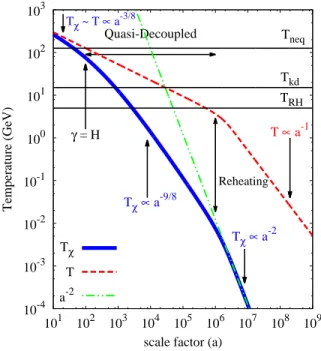
χ ∝ a−2. Fig-ure 1 illustrates the quasidecoupled behavior of DM in an EMDE for p-wave scattering; this plot of Tχ is ob-tained from the numerical solution to Eq. (7). The mo-ment whenγ=H and the onset of radiation domination (reheating) are labeled in Fig. 1, we see that the equi-librium regime (γ ≫H) describes the era during which
Tχ(a)≃T(a)∝a−3/8, while the postequilibrium regime
includes the quasidecoupled phase, whereTχ(a)∝a−9/8, and the fully decoupled phase, whereTχ(a)∝a−2.
While Eq. (9) highlights the sensitivity of a quasidecoupled state to the size of α(β+ 1) relative to 2, Table I suggests a deeper explanation for quasidecou-pling. In all thermal histories listed where entropy is conserved, such that T ∝ a−1, quasidecoupling is not
Thermal History α(β+ 1) γ/H
T TPE
χ ∼ Quasidecoupling?
Λ dom. (T ∝a−1, H∝T0, w=−1) 5 +n Tneq aneq/a(5+n) C(aneq/a)2 No
Matter dom. (T ∝a−1, H∝T3/2, w= 0) (7/2) +n Tneq aneq/a[(7/2)+n] C(aneq/a)2 No
RD (T ∝a−1, H∝T2, w= 1/3) 3 +n Tneq aneq/a(3+n) C(aneq/a)2 No
Kination (T ∝a−1, H∝T3, w= 1) 2 +n Tneq aneq/a(2+n) C(aneq/a)2 No
EMDE (T ∝a−3/8, H∝T4, w= 0) (3/8) (1 +n) Tneq aneq/a[(3/8) (1+n)] Tneq aneq/a[(3/8) (1+n)] Yes
TABLE I: The impact of the cosmology and scattering process on the postequilibrium behavior of DM temperature TPE
χ in
various thermal histories. The equation of state parameterw≡ P/ρis defined in terms of the pressure,P, and energy density ρof the dominant energy component. The abbreviations Λ dom. and matter dom. denote cosmological constant-dominated and matter-dominated scenarios, respectively.
10-4 10-3 10-2 10-1 100 101 102 103
101 102 103 104 105 106 107 108 109
Temperature (GeV)
scale factor (a)
Tχ ~ T ∝ a-3/8
γ = H
Quasi-Decoupled
Tχ∝ a-9/8
Reheating
T ∝ a-1
Tχ∝ a-2
Tneq
Tkd
TRH
Tχ
T
a-2
FIG. 1: The evolution of the DM temperatureTχ(solid curve)
and plasma temperature T (dashed curve) vs a for p-wave (n = 2) scattering in an EMDE with TRH = 5 GeV. The
EMDE ends and the Universe becomes radiation dominated when a≃aRH: in this figure,aRH = 106. The
momentum-transfer rateγ equalsH whenT =Tneq= 126.5 GeV, which
corresponds to a DM particle that would haveTneq= 20 GeV
in a radiation-dominated universe (i.e. TkdS = 20 GeV).
Equation (2) gives Tkd= 15.1 GeV. In the quasidecoupled
regime, Tχ decays faster than the plasma temperature, but
slower thana−2.
and use ρ ∝ a−3(1+w) to find w = (2/3)ν −1. Our
quasidecoupling condition, α(β+ 1)<2, then implies that w >1 + (2/3)n. Thus, quasidecoupling is not pos-sible if entropy is conserved and n ≥ 0 unless w > 1 (which does not necessarily violate causality [38–40]).
In cases of entropy production, we look beyond an EMDE by searching for a condition on w that permits quasidecoupling. If the Universe is dominated by a scalar field with energy densityρφ that decays into relativistic particles with energy densityρR, then
a H d
daρR+ 4H ρR= Γφρφ. (10)
Equation (10) implies that ρR ∝ √ρφ while ρφ≫ρR, which fixes ν = 4 and α= (3/8) (1 +w). Applying
α(β+ 1)<2 yields w <16/[3 (1 +n)]−1. Therefore, any w <5/3 allows quasidecoupling for n= 1 (s-wave) scattering. For p-wave scattering, quasidecoupling is permitted for allw < 7/9. Table I shows that a stan-dard kination scenario does not permit quasidecoupling, but a decaying kination scenario (ν = 4,w= 1) would support quasidecoupling if thes-wave channel dominates the elastic scattering cross section.
We now verify that the general solution to Eq. (7) is consistent withTPE
χ in Eq. (9). The general solution to Eq. (7) withTχ(ai) =T(ai) is [4]
Tχ(a) =T(a)sλesΓ(1−λ, s), (11) where s(a) = [2/(αβ)](aneq/a)αβ is the decoupling
pa-rameter for β > 0, λ ≡ (2 −α)/(α β), and Γ(p, s) is the upper incomplete gamma function defined by Γ(p, s) =R∞
s dt t p−1
e−t
for all p and all s ≥ 0. Refer-ence [4] obtained Eq. (11), but failed to notice thatTχ
does not scale as a−2, i.e. that DM does not fully
de-couple, when (γ/H)≪1 in an EMDE. However, we can coax the quasidecoupled behavior from Eq. (11) by not-ing that Γ(1−λ, s) obeys the asymptotic series expansion (see the appendix)
Γ(1−λ, s) = Γ(1−λ)− s 1−λ
1−λ +O(s
2−λ
), (12)
where Γ(p) = Γ(p,0) = R∞ 0 dt t
p−1e−t for p > 0 and
Γ(p) = (1/p) Γ(p+ 1) for p < 0. Equation (12) shows that Γ(1−λ, s) approaches a constant value as s → 0 if (1−λ)>0, which is consistent with the RD scenario for all n > 0. However, Γ(1−λ, s) diverges as s → 0 if (1−λ) < 0, which is equivalent to α(β + 1) < 2. Usinges ≃ 1 for small s and substituting Eq. (12) and
s(a) =
2/(αβ)
aneq/a
αβ
into Eq. (11) yields
Tχ ≃
"
2
αβ λ
TneqΓ(1−λ) #
aneq
a 2
(13)
+ 2Tneq 2−α(β+ 1)
a neq
a
α(β+1)
1 +O a
neq
a αβ!
which is consistent with Eq. (9) for TPE
χ and fixes the constant of integration,C.
In a RD universe, the values ofTneqandTkdare nearly
identical. In an EMDE, the value ofTneq is much greater
than the value ofTkd, as demonstrated in Fig. 1. In an
EMDE, Eq. (2) implies that Tneq> Tkd> TRH.
More-over, Tkddoes not mark a transition in the evolution of
Tχ. For small values ofγ, corresponding to small scatter-ing cross sections, the quasidecoupled stage is very long (Tneq ≫TRH), so treating the DM as fully coupled and
then fully decoupled with a transition point marked by
Tkdis inappropriate.
We can use the numerical solutions to Eq. (7) to determine the discrepancy between Tneq and
Tkd in an EMDE. These numerical solutions
re-veal that Tχ|T→0=κ1Tχ(aRH) (a/aRH)
−2, where
κ1= 1.37, aRH is defined by Eq. (5), and Tχ(a)
is given by Eq. (11).4 During an EMDE,
a/aRH = (2/5)2/3(TRH/T)8/3 [18], which implies that
Tkd= (2/5)4/13TRHTRH/[κ1Tχ(aRH)] 3/13
, where TRH
is defined by Eq. (4). Since Tχ decreases faster than T while the DM is quasidecoupled, κ1Tχ(aRH) ≪ TRH,
and thereforeTkd≫TRH.
If Tneq/TRH ≫ 1, then we can approximate Tχ(aRH)
using Eq. (13). This approximation allows us to re-late the value of Tkd to the value of Tneq in a RD
uni-verse, which we refer to as TkdS to maintain consistency
with prior investigations of kinetic decoupling in non-standard thermal histories. If DM decouples during an EMDE, then Tneq=p5/2 (TkdS2 /TRH) [12, 18]. During
an EMDE, the second term on the rhs of Eq. (13) is dominant fora≫aneq. It follows that
Tkd
Tneq
= 0.53
T RH
TkdS 14/13
. (14)
For (TRH/TkdS)≪1, (Tkd/Tneq) ≪ 1, which
con-firms the generality of the temperature hierarchy
Tneq> Tkd> TRH shown in Fig. 1. The temperatures
Tneq and Tkd are vastly different in an EMDE with a
sufficiently long quasidecoupled phase.
IV. IMPACT ON THE MATTER POWER SPECTRUM
The existence of a quasidecoupled phase could affect the evolution of DM perturbations in two ways. First, the DM perturbations may remain at least partially coupled
4 Equation (11) and the following expressions in this section
assume that the number of relativistic degrees of freedom, g∗(T), is constant. If g∗(T) changes, then Eq. (11) is no longer an exact solution to Eq. (7). However, using s= [2/(αβ)](T /Tneq)4+n(a/aneq)3/2in Eq. (11) provides an
ac-curate approximate solution, and a value ofκ1can be found for
each value ofTRH.
to the perturbations in the relativistic plasma during the EMDE. The radiation density perturbations grow dur-ing the EMDE because they are sourced by an increas-ingly inhomogeneous scalar field, but they do not grow as quickly as the uncoupled DM perturbations [15–17, 35], so any residual interactions between the plasma and the DM particles may suppress the growth of matter perturbations during the EMDE. Second, the fact that the DM temperature does not scale as a−2 during the
EMDE implies that the velocities of the DM particles,
vχ, do not scale as a−1, which profoundly affects the
calculation of the comoving DM free-streaming horizon:
λfs=R
t0
tneq(vχ/a)dt, wheret0 is the present age of the Universe. The evolution of the DM and plasma pertur-bations lies beyond the scope of this article, but we can estimate the impact of the quasidecoupled phase onλfs
by assuming thatvχ∝pTχ. We restrict our analysis to
p-wave scattering in an EMDE. In this case,Tχ∝a−9/8 during the quasidecoupled phase.
To isolate the effect of the EMDE on the postre-heating velocities of the DM particles, we consider the velocity at the reheat temperature TRH. We also
use the fact that Tneq ≃ TkdS2 /TRH for TkdS> TRH
[12, 18]. Since T ∝ a−3/8 during the EMDE,
vχ(TRH)≃p(TkdS/mχ)(TRH/TkdS)5/2. Therefore, the
velocities of the DM particles are suppressed by a factor of (TRH/TkdS)3/2if they quasidecouple during an EMDE,
as opposed to if they fully decouple during radiation dom-ination. While this suppression is not as large as it would have been if the DM fully decoupled during an EMDE [in which case the suppression factor is (TRH/TkdS)23/6 [18]],
it does imply that an EMDE still reduces the DM free-streaming horizon even though the DM particles do not fully decouple from the plasma.
To quantify the impact of quasidecoupling on the free-streaming horizon, we compute
λfs= Z a0
aneq
da vχ(a)
a2H(a) (15)
using a piecewise model for the DM veloc-ity: vχ≃
p
Tkd/mχ(akd/a) for a > aRH and
vχ≃
p
0.8Tχ(aRH)/mχ(aRH/a)9/16 for a < aRH,
where Tχ(aRH) is evaluated using Eq. (11). The factor
of 0.8 in the latter expression accounts for the fact that the DM temperature obtained by numerically solving Eq. (7) is 0.8 times the value given by Eq. (11) when
a = aRH. This model overestimates vχ fora≃aneq;
to compensate, we start the integration in Eq. (15) when 0.8Tχ(aRH)(aRH/a)9/8=T(a), instead of at
a=aneq. In contrast, if we had assumed thatTχ ∝a−2 while γ . H, then vχ≃
p
(Tneq/mχ)(aneq/a) for all
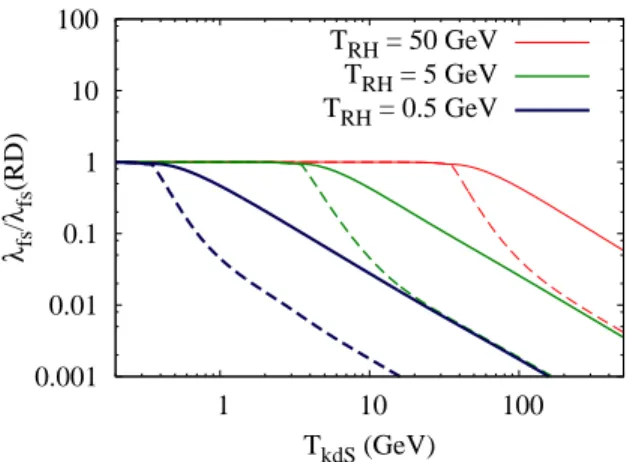
T < Tneq. Figure 2 shows how these two models
predict different free-streaming horizons if DM de-couples during an EMDE. In this figure, we plot the ratio λfs/λfs(RD), where λfs(RD) is computed
0.001 0.01 0.1 1 10 100
1 10 100
λfs
/
λfs
(RD)
TkdS (GeV) TRH = 50 GeV
TRH = 5 GeV TRH = 0.5 GeV
FIG. 2: The comoving free-streaming horizon in an EMDE di-vided by the comoving free-streaming horizon in a radiation-dominated universe for DM particles that would kinetically decouple at a temperatureTkdSin a radiation-dominated
uni-verse. IfTkdS> TRH, then the DM kinetically decouples
dur-ing an EMDE. The solid curves show how the free streamdur-ing is reduced relative to its value in a radiation-dominated uni-verse given that the DM is quasidecoupled during the EMDE (vχ ∝ pTχ ∝ a−9/16). The dashed curves show how the
free-streaming horizon would be even smaller if the DM fully decoupled during the EMDE, as assumed in earlier investiga-tions of EMDE scenarios [12–19].
vχ ≃
p
(TkdS/mχ)(akdS/a) for allT < TkdS.
Figure 2 confirms the expectations stated above: it shows that including the effects of the quasidecoupled period increasesλfsby about an order of magnitude
com-pared to what it would be if DM fully decoupled during an EMDE, butλfsis still smaller than it would have been
in the absence of an EMDE. Since the mass enclosed within the free-streaming horizon sets a lower bound on the mass of the smallest DM halos [1–3, 6–11], an EMDE will still decrease the minimum halo mass ifTkdS> TRH,
but the minimum halo mass will be∼1000 times greater than stated in Ref. [12], which lays the foundations for subsequent treatments of DM free streaming in EMDE cosmologies [13–19].
V. CONCLUDING REMARKS
We have established the existence of a quasidecou-pled state for DM in thermal histories in which en-tropy is produced by a decaying scalar field with
w <16/[3(1 +n)]−1, where n determines how the DM scattering cross section depends on temperature (hσvi ∝Tn). The nonequilibrium temperature T
neq is
still higher than it is in a radiation-dominated era, but it marks a transition from tightly coupled to quaside-coupled as opposed to a shift from tightly quaside-coupled to fully decoupled. The DM remains quasidecoupled until the onset of radiation domination; the transition from quasidecoupled to fully decoupled does not depend on the interactions between DM and the SM. Therefore, the quasidecoupled phase should be considered as a
funda-mentally new state of DM.
These surprising results force us to reconsider the body of work on kinetic decoupling of DM in nonstandard ther-mal histories, which, until now, has been built on the assumption that DM fully decouples from the plasma when the momentum-transfer rate falls below the expan-sion rate. Quasidecoupling calls all previous work on the behavior of DM during an EMDE into question and merits new investigations. We have demonstrated that quasidecoupling increases λfs by an order of magnitude
compared to the fully decoupled calculation, which has profound implications for the small-scale cutoff in the matter power spectrum, the size of the first microhalos, and the timing of their formation [18]. In future work, we will explore these ramifications in more detail [41].
ACKNOWLEDGMENTS
The authors thank Dan Hooper for comments on this manuscript. This work was supported by NSF Grant No. PHY-1417446. I.R.W. also acknowledges support from the Bahnson Fund at the University of North Carolina at Chapel Hill.
APPENDIX: DERIVATION OF EQ.(12)
The upper incomplete gamma function is given by Γ(p, s) =R∞
s dt t
p−1e−t for allpand all s
≥ 0. In this appendix, we derive Eq. (12) for the series expansion of Γ(p, s) for s ≪ 1. If p > 0, then the complete gamma function, Γ(p), is given by
Γ(p) = Γ(p,0) =
Z ∞
0
dt tp−1e−t, (A.1)
which gives
Γ(p, s) =
Z ∞
0
dt e−ttp−1 −
Z s
0
dt e−ttp−1
,
= Γ(p)−
∞ X
n=0
(−1)nsp+n
n! (p+n), (A.2)
where we used the series expansion for the e−t
in the second integral. The series in Eq. (A.2) converges for all
s.
Ifp <0, then Γ(p) is defined by the recursion relation
Γ(p) =1
pΓ(p+ 1). (A.3)
follows:
Γ(p, s) =
Z ∞
s
dt tp−1
S+e−t
− S ,
=
Z ∞
s
dt tp−1
S −
Z s
0
dt f(t) +
Z ∞
0
dt f(t),
=I1−I2+I3, (A.4)
where
S ≡ N
X
n=0
(−1)ntn
n! ,
f(t)≡tp−1
[e−t
− S], I1≡
Z ∞
s
dt tp−1
N
X
n=0
(−1)ntn
n! ,
I2≡ Z s
0
dt tp−1 e −t − N X n=0
(−1)ntn
n!
,
I3≡ Z ∞
0
dt tp−1 e −t − N X n=0
(−1)ntn n!
,
and whereN is the largest integer less than|p|. Integrals
I1 and I2 can be evaluated term by term. Integral I1
becomes
I1=
N
X
n=0
(−1)n
n!
Z ∞
s
dt tp+n−1
=− N
X
n=0
(−1)nsp+n
n! (p+n). (A.5) The integral in Eq. (A.5) converges because −1<(p+N)<0 demands (p+n)< 0 for 0≤n≤N. Using the series expansion for e−t and then combining
the sums inI2, integralI2 can be written as
I2= ∞ X
n=N+1
(−1)n
n!
Z s
0
dt tp+n−1= ∞ X
n=N+1
(−1)nsp+n
n! (p+n). (A.6) The integral in Eq. (A.6) converges because (p+n)>0 forN+ 1≤n≤ ∞.
Substituting the results of Eqs. (A.5) and (A.6) into Eq. (A.4) yields
Γ(p, s) =I3− ∞ X
n=0
(−1)nsp+n
n! (p+n) . (A.7)
We show thatI3= Γ(p) by integratingI3 repeatedly by
parts. It is simplest to start with the case of N = 1, which corresponds to p-wave scattering in an EMDE, wherep=−7/6. Suppose we integrateI3 by parts once;
then
I3=B
t=∞
t=0
+I3,
where the boundary term
B= t
−7/6
(−7/6)
e−t
−(1−t)
, (A.8)
= 1
(−7/6)
∞ X
n=2
(−1)nt−7/6+n
n! , (A.9)
and
I3= 1
(−7/6)
Z ∞
0
dt e−t −1
t−7/6. (A.10)
The (1−t) term in Eq. (A.8) removes the first two terms from the series expansion ofe−t, so we combined it with the series expansion ofe−tto produce Eq. (A.9).
Equa-tion (A.8) makes it easy to see that B vanishes at the upper limitt = ∞: the polynomial terms in Eq. (A.8) vanish at t =∞ because they are both proportional to a negative power oft. Equation (A.9) shows thatB also vanishes at t = 0 because the sum in Eq. (A.9) starts atn= 2, such that the lowest power oft is (−7/6 + 2), which is positive. ThusB
t=∞
t=0 = 0, which implies that
I3=I3.
Equation (A.10) forI3 is easily evaluated by
integrat-ing by parts once more: the boundary term vanishes at
t= 0 andt=∞leaving a convergent integral
I3=
1
(−7/6)(−7/6 + 1)
Z ∞
0
dt t(−7/6+2)−1e−t, (A.11)
= Γ(−7/6 + 2)
(−7/6)(−7/6 + 1) = Γ −7/6
. (A.12)
Since (−7/6 + 2)>0, the integral in Eq. (A.11) is equal to Γ(−7/6 + 2), as defined by Eq. (A.1). The second equality in Eq. (A.12) follows from applying the recur-sion relation in Eq. (A.3)twotimes to Γ(−7/6 + 2). In summary, to obtain I3 = Γ(−7/6) for N = 1, we
per-formedN+ 1 = 2 integrations by parts onI3in order to
guarantee thatI3 could be expressed in terms of a
com-plete gamma function with positive argument. To this function, we then applied Eq. (A.3)N+ 1 = 2 times to achieve Γ(−7/6), which shows that Eq. (A.7) is identical in form to Eq. (A.2) forp = −7/6 as long as Γ(−7/6) in Eq. (A.7) is given by Eq. (A.3). Therefore, we can apply Eq. (A.2) for Γ(−7/6, s) which gives Eq. (12) for 1−λ=−7/6,
Γ(−7/6, s) = Γ(−7/6)− s
−7/6
(−7/6) +O(s
−1/6
).
The iterative procedure outlined above for p =−7/6 andN = 1 generalizes to arbitrary noninteger values of
p <0. No matter how negative such a value ofpis, inte-gratingI3by partsN+1 times generates a Γ(p+N+ 1),
where (p+N + 1)>0, and the boundary term always vanishes att=∞and t= 0 for reasons similar to those stated above: thet−7/6(1
−t) term in Eq. (A.8) gener-alizes to a contribution that is proportional toPN
which vanishes att=∞since (p+n) remains negative for all 0≤n≤N, and the sum in Eq. (A.9) vanishes at
t= 0 because it attains a new lower limit such that the smallest power of t in Eq. (A.9) becomes (p+N + 1), which is positive. Then, Eq. (A.3) can be applied to
Γ(p+N+ 1)N+ 1 times to produceI3= Γ(p).
There-fore, Eq. (A.2) provides a series expansion for Γ(p, s) if
p <0 and noninteger, provided that Γ(p) is defined by Eq. (A.3).
[1] S. Hofmann, D. J. Schwarz, and H. Stoecker, Phys. Rev.
D64, 083507 (2001), astro-ph/0104173.
[2] T. Bringmann and S. Hofmann, JCAP 0704, 016 (2007), [Erratum: JCAP1603,no.03,E02(2016)], hep-ph/0612238.
[3] T. Bringmann, New J. Phys. 11, 105027 (2009), 0903.0189.
[4] L. Visinelli and P. Gondolo, Phys. Rev. D91, 083526 (2015), 1501.02233.
[5] I. R. Waldstein and A. L. Erickcek, Phys. Rev. D 95, 088301 (2017), URL
https://link.aps.org/doi/10.1103/PhysRevD.95.088301. [6] A. M. Green, S. Hofmann, and D. J. Schwarz, Mon. Not.
Roy. Astron. Soc.353, L23 (2004), astro-ph/0309621. [7] A. M. Green, S. Hofmann, and D. J. Schwarz, JCAP
0508, 003 (2005), astro-ph/0503387.
[8] A. Loeb and M. Zaldarriaga, Phys. Rev. D71, 103520 (2005), astro-ph/0504112.
[9] E. Bertschinger, Phys. Rev.D74, 063509 (2006), astro-ph/0607319.
[10] P. Gondolo, J. Hisano, and K. Kadota, Phys. Rev.D86, 083523 (2012), 1205.1914.
[11] S. Profumo, K. Sigurdson, and M. Kamionkowski, Phys. Rev. Lett.97, 031301 (2006), astro-ph/0603373. [12] G. B. Gelmini and P. Gondolo, JCAP0810, 002 (2008),
0803.2349.
[13] G. Arcadi and P. Ullio, Phys. Rev.D84, 043520 (2011), 1104.3591.
[14] G. L. Kane, P. Kumar, B. D. Nelson, and B. Zheng, Phys. Rev.D93, 063527 (2016), 1502.05406.
[15] A. L. Erickcek and K. Sigurdson, Phys. Rev.D84, 083503 (2011), 1106.0536.
[16] G. Barenboim and J. Rasero, JHEP 04, 138 (2014), 1311.4034.
[17] J. Fan, O. ¨Ozsoy, and S. Watson, Phys. Rev. D 90, 043536 (2014), 1405.7373.
[18] A. L. Erickcek, Phys. Rev. D92, 103505 (2015), 1504.03335.
[19] A. L. Erickcek, K. Sinha, and S. Watson (2015), 1510.04291.
[20] M. Kawasaki, K. Kohri, and N. Sugiyama, Phys. Rev. Lett.82, 4168 (1999), astro-ph/9811437.
[21] M. Kawasaki, K. Kohri, and N. Sugiyama, Phys. Rev.
D62, 023506 (2000), astro-ph/0002127.
[22] S. Hannestad, Phys. Rev. D70, 043506 (2004), astro-ph/0403291.
[23] K. Ichikawa, M. Kawasaki, and F. Takahashi, Phys. Rev.
D72, 043522 (2005), astro-ph/0505395.
[24] G. D. Coughlan, W. Fischler, E. W. Kolb, S. Raby, and G. G. Ross, Phys. Lett.B131, 59 (1983).
[25] B. de Carlos, J. A. Casas, F. Quevedo, and E. Roulet, Phys. Lett.B318, 447 (1993), hep-ph/9308325.
[26] T. Banks, D. B. Kaplan, and A. E. Nelson, Phys. Rev.
D49, 779 (1994), hep-ph/9308292.
[27] T. Banks, M. Berkooz, and P. J. Steinhardt, Phys. Rev.
D52, 705 (1995), hep-th/9501053.
[28] T. Banks, M. Berkooz, S. H. Shenker, G. W. Moore, and P. J. Steinhardt, Phys. Rev.D52, 3548 (1995), hep-th/9503114.
[29] B. S. Acharya, P. Kumar, K. Bobkov, G. Kane, J. Shao, and S. Watson, JHEP06, 064 (2008), 0804.0863. [30] B. S. Acharya, G. Kane, S. Watson, and P. Kumar, Phys.
Rev.D80, 083529 (2009), 0908.2430.
[31] N. Blinov, J. Kozaczuk, A. Menon, and D. E. Morrissey, Phys. Rev.D91, 035026 (2015), 1409.1222.
[32] G. Kane, K. Sinha, and S. Watson, Int. J. Mod. Phys.
D24, 1530022 (2015), 1502.07746.
[33] T. Tenkanen and V. Vaskonen, Phys. Rev.D94, 083516 (2016), 1606.00192.
[34] Y. Zhang, JCAP1505, 008 (2015), 1502.06983.
[35] K.-Y. Choi, J.-O. Gong, and C. S. Shin, Phys. Rev. Lett.
115, 211302 (2015), 1507.03871.
[36] J. Georg, G. S¸eng¨or, and S. Watson, Phys. Rev. D93, 123523 (2016), 1603.00023.
[37] G. F. Giudice, E. W. Kolb, and A. Riotto, Phys. Rev.
D64, 023508 (2001), hep-ph/0005123.
[38] F. D’Eramo, N. Fernandez, and S. Profumo (2017), 1703.04793.
[39] C. Armendariz-Picon, T. Damour, and V. F. Mukhanov, Phys. Lett.B458, 209 (1999), hep-th/9904075.
[40] A. J. Christopherson and K. A. Malik, Phys. Lett.B675, 159 (2009), 0809.3518.
[41] I. R. Waldstein, C. Ilie, and A. L. Erickcek, in preparation (2017).