ONE TEACHER’S JOURNEY IN IMPLEMENTING AND LEARNING THROUGH SYMBOLIC LANGUAGES IN A PUBLIC KINDERGARTEN- A CASE STUDY
Shin-Yu Tzeng
A thesis submitted to the faculty of the University of North Carolina at Chapel Hill in partial fulfillment of the requirements for the degree of Master of Arts in the School of Education
(Early Childhood, Special Education, and Literacy).
Chapel Hill 2017
©2017 SHINYU TZENG ALL RIGHTS RESERVED
ABSTRACT
SHIN-YU TZENG: One teacher’s journey in implementing and learning through symbolic languages in a public kindergarten classroom- a case study
(Under the direction of Rebecca S. New)
In early childhood education, symbolic languages such as art, drama and music are still considered an essential element in the curriculum, although current policy places greater emphasis on reading, writing and mathematics. The aim of this study was to explore how one teacher integrated symbolic languages into a public kindergarten curriculum, including her methods, motivations, and obstacles. This research was conducted using qualitative methods including Participant Observation in the classroom and semi-structured interviews with the teacher, whose approach was heavily influenced by ideas from Reggio Emilia, Italy. Data analysis highlighted the teacher’s decision-making process and her reflections on teaching through symbolic languages, including the challenges that she faced given district mandates and her students’ different learning needs. Findings of the study include how the teacher interpreted art as being significant in early childhood education, even though she rarely used the term “symbolic languages,” as discussed by Reggio Emilia educators. The teacher described her motives in the implementation of Reggio Emilia ideas, particularly the use of projects to achieve mandated curriculum goals. The study highlights challenges the teacher has faced, and then overcome, as reasons for persisting in her belief of using art in children’s learning. Further research is suggested to see how other teachers attempt to employ Reggio Emilia ideas about symbolic languages in a different context.
ACKNOWLEDGEMENTS
TABLE OF CONTENTS
LIST OF FIGURES………...………..…...………..…..………..ix
CHAPTER 1: INTRODUCTION ... 1
CHAPTER 2: LITERATURE REVIEW ... 3
Art and Children’s Learning ... 3
Symbols as Ways of Expressing and Making Meaning ... 6
Reggio Emilia and Children’s Multiple Symbolic Languages. ... 7
The Contemporary Context of “REA” in the U.S ... 10
Academics and Art in Early Childhood Education ... 13
Continued Gaps in Research and Implementation ... 15
CHAPTER 3: CONCEPTUAL FRAMEWORK ... 18
The Purpose of the Study ... 20
Research Questions ... 20
CHAPTER 4: METHODOLOGY ... 22
School Setting ... 22
Participants ... 23
Research Methods ... 23
Data Collection Schedule and Analysis ... 25
CHAPTER 5: RESULTS ... 27
Art’s Significant Role in Children’s Learning ... 27
“Art” of Reggio Emilia Ideas as a Way of Expressing Themselves ... 28
The introduction to the Eno River project ...29
The beginning of the Eno River project ... 30
Supporting activities during the Eno River project learning ... 32
River words poetry ... 32
Dots books ... 34
Under a rock ... 36
Writer’s workshop ... 37
Museum at the end of the project ... 39
Challenges that the Teacher Faced ... 40
Children’s varying academic needs ... 40
Children’s energy and focus ... 41
District educational policy ... 42
CHAPTER 7: DISCUSSION ... 44
My Position ... 45
Limitations ... 47
CHAPTER 8: CONCLUSION ... 48
Implications ... 48
APPENDIX A: FIGURES ... 51
APPENDIX B: SAMPLE OF THE FIELD NOTES ... 62
APPENDIX C: SAMPLE OF SEMI-STRUCTURED INTERVIEW ... 64
APPENDIX D: TEACHER CONSENT FORM ... 66
APPENDIX E: PARENT CONSENT FORM ... 68
TABLE OF FIGURES
APPENDIX A: FIGURES ...51
Figure 1. Children could use this rice box to develop their motor skills and cultivate their creativity. ... 51
Figure 2. Children could utilize clay for making their meaning visible. ... 52
Figure 3. The teacher provided those materials for children to make creatures or insects. . 52
Figure 4. Children constructed houses nearby the river and a bridge on the river by stacking wooded blocks. ... 53
Figure 5. Children constructed houses nearby the river and a bridge on the river by stacking wooded blocks. ... 53
Figure 6. A designed table with the stones upon which river words are written. ... 54
Figure 7. One child was done with her work by the negotiation with peers ... 54
Figure 8 A girl drew a reflection on the river. ... 55
Figure 9. A girl wrote her thoughts on the back of her Black Dots picture. ... 56
Figure 10. A boy found his creatures by showing a lot of details. ... 56
Figure 11. A poster showed all key points from dialogues between the teacher and children. ... 57
Figure 12. Children looked at a picture of the calendar, and drew. ... 58
Figure 13. A museum displayed all children’s works at the Eno River Project. ... 58
Figure 14. The museum displayed all children’s writings ... 59
Figure 15. Children’s abstract paintings ... 59
Figure 16. Children’s abstract paintings ... 60
Figure 17. A big picture that children and the teacher co-paint and draw. Children also wrote one sentence about the river along the frame of the picture. ... 61
CHAPTER 1: INTRODUCTION
The infusion of art in an early childhood curriculum is intended to promote learning in various aspects of child development (Bowman et al., 2001). However, current early child educational policy, such as Common Core State Standards (CCSS) and No Child Left Behind (NCLB), has favored children’s academic performance in literacy and math over art (Copper & Bredekamp, 2009). Still, many scholars continue to believe that the use of art, also
described as symbolic (or multiple) languages, in the early childhood classroom helps enhance children’s learning in all areas: cognitive, affective, physical, and social (Ibid.). Some scholars on early readiness suggest that, in order to cultivate “a whole child”, a more holistic emphasis on children’s cognitive, emotional, physical, and social development is needed (Bowman et al., 2001). Using art in a curriculum provides a holistic learning environment for children.
From Dewey to current scholars, art’s meaning and functions have changed over time. Art’s purpose has shifted from self-expression to a new vocabulary, an interpretation which expanded upon previous theoretical interpretations and became a discussion about the ways to utilize art in learning environments. This was especially true when ideas from Reggio Emilia, Italy came to the U.S. 30 years ago, casting art in the context of symbolic languages, through which “children represent their understanding and learning in a great variety of ways” (New, 1990, p. 8). As a founder of Reggio Emilia’s municipal early childhood services, Loris Malaguzzi (1998) argued that children represented their ideas instinctively through the use of symbolic languages and also advanced their thinking through the process of manipulating these languages. “Symbols can be said to be bearers of culture for a
learns a way to keep the concepts at hand ready to be transferred to another situation or context.” (Malaguzzi, 1998, p. 93). Thousands of teachers since then have tried to understand and apply some of this “Reggio Emilia approach” to their own classrooms. However, few studies have focused on how public school teachers can implement this interpretation of art in a curriculum that is under the current educational policy constraints. My study explored how one public kindergarten teacher interpreted and applied Reggio Emilia ideas as part of her teaching philosophy in a public kindergarten classroom. Because the study takes place in a school originally dedicated to creative activity, but which now emphasizes academic performance, my study thus also investigated how one teacher has persevered in utilizing art in her class.
This thesis begins with a brief review of literature on art and children’s learning, including Reggio Emilia’s interpretation of symbolic languages and its influence on U.S. early childhood educators. Subsequent pages describe the conceptual framework, research questions and methods, followed by presentation of results. The concluding discussion highlights the importance of one teacher’s beliefs about art and symbolic languages, her strategies of implementation, and the challenges she teacher faced while using art in an increasingly academic environment. Because the teacher in this study is effectively working in a silo environment, implications for teacher education reform are also considered,
CHAPTER 2: LITERATURE REVIEW
This literature review includes a history of theorizing about children’s art, scholarship on symbolism from different perspectives, and the impact those theories had on Reggio Emilia’s educational philosophy. The literature review concludes with a review of research on U.S. interpretations of this Italian approach to art and early education.
Art and Children’s Learning
This literature review highlights the evolution of how we understand art in early childhood education. Early childhood education changed dramatically in the beginning of the 1900’s due to the work of Friedrich Wilhelm August Froebel. A pioneer of educational theory in Germany, Froebel coined the term “kindergarten” to describe an educational opportunity for children aged four to six. Froebel (1908) saw children as creative human beings, saying, “they yield themselves in childlike trust and cheerfulness to their formative and creative instinct” (Ibid., p. 31). He believed that educators should provide “creative and productive activity” for young learners (Ibid., p. 34). He also believed that art was a
foundational expression of one’s true self, saying that works of art are “always
representations of the most individual, the most personal inner life of the artist” (Ibid., p. 154). Through their works of art, an artist allows us to understand their inner thoughts and feelings – their creative spirit (Ibid., p.153).
way of guiding children in their knowledge acquisition through creativity, providing various vehicles to express their understanding. John Dewey, an American philosopher, psychologist and leader of the Child Study Movement, believed that young children learn in a cooperative way through multiple activities, including music, games, art, play. and that these activities are dictated by the children’s interest (Dewey, 1915). Dewey advocated that the mission of teachers was to help children express their ideas, and also explained that an environment rich with art is integral to children’s learning. He said, “make each one of our schools an
embryonic community life, active with types of occupations that reflect the life of the larger society and permeated with the spirit of art, history, and science” (Dewey, 1934, p. 27). That is, a learning environment with art guides children through the real world. Moreover, art serves as expression, because “words taken by themselves are not the expression; they only hint at it. The expressiveness, the esthetic meaning, is the picture itself” (Ibid., p. 86).
because children unnecessarily think how to draw (Lowenfeld, 1982). Offering those books also weaken children’s self-confidence due to the fact that children impossibly drew like shapes which machines made. So, in his viewpoints, teachers should be warm and friendly and allow children to do what they were interested in and passionate about. Public school teachers should not merely provide a supportive and rich learning environment, but allow children to access material freely and flexibly. A healthy education system should focus on children’s cognitive and emotional development, instead of merely highlighting the
acquisition of knowledge (Lowenfeld, 1982). The role of teachers in children’s learning through art was to provide “an atmosphere conducive to inventiveness, exploration, and production” (Ibid., p. 145).
Several scholars have addressed different roles of art in children’s learning since the era of Dewey and Lowenfeld. Arnheim (1990) explained art as a way of showing intellectual activity, believing that teacher could understand children through their artifacts. Howard Gardner, who designed the theory of multiple intelligences in 1983, expounded on the need to recognize visual-spatial art as an intellectual pathway. Gardner also believed that children, even those who are uneducated, could conceptualize something through their interpretation of works of art, thereby revealing their innate capacity of making art. Teachers who understand students with multiple intelligences can help them succeed in various fields (Gardner, 1990). Arnheim and Gardner agreed that teaching through art could benefit their students and teachers themselves.
Eliot Eisner, a former President of AERA, echoed these ideas and explained the importance of arts in children’s learning as,
score, more than one way to describe a painting or a sculpture, more than one appropriate form for a dance performance, more than one meaning for a poetic rendering of a person or a solution. In the arts diversity and variability are made central” (Eisner, 2002, p. 197).
Those scholars and educators believed that art plays a crucial role in children’s acquisition of knowledge, development and self-expression, and teachers have a vital responsibility in guiding children how to use art.
Symbols as Ways of Expressing and Making Meaning
refers to a time when children can learn through hands-on activity. In the iconic stage,
children use shapes or diagrams for representing their thoughts. In the last stage, the symbolic stage, words and symbols are abstract, but they can inform children’s conceptual ideas (Ibid.).
Although this understanding of symbols, especially semiotics, has been more recently criticized as overly logical, rigid, and inapplicable to visual art (Elkins, 2003), those theories focused on meaning-making revealed through symbols influenced the philosophy of Reggio Emilia, in which curriculum was tightly associated with what many labeled as “art,” yet the Italian educators called “symbolic representation.” Reggio Emilia’s ideas began to attract educators from around the world who were interested in art as a way of fostering children’s physical, emotional, cognitive, and social development.
Reggio Emilia and Children’s Multiple Symbolic Languages.
Before describing these ideas about art as they are translated into this city’s early childhood settings, it is important to understand where they came from. The town of Reggio Emilia is located in a wealthy region of northern Italy. After World War II, parents needed childcare and decided to run small schools for their children by themselves. Parents worked with teachers both to learn from and guide the students, learning what was necessary
alongside the children. “Well in advance of the 1968 national law that established funding of public preschools for all three- to six-year-old Italian children, the two councils of Reggio Emilia established the first public preschools [scuola del infanzia]” (New, 1990, p.4). By 1971, the community of Reggio Emilia also served infants and toddlers of working mothers in child-care centers [asili nido] (Ibid ).
Malaguzzi’s ideas for Reggio Emilia’s municipal early childhood schools. John Dewey first raised an idea of project learning as “he was inspired to urge a method of education
combining pragmatic philosophy, new psychological knowledge, and - on the teacher side – mastery of content with enquiry, creative experience for children” (Ibid., p.72). Malaguzzi also described his thoughts in relation to Jean Piaget’s ideas of children’s creativity, portrayed a way of “inquiring, ordering, and even transgressing the given schemes of meaning” (Ibid., p. 76). Vygotsky theories had an important impact on Malaguzzi’s interpretation of the role of teachers, as he believed they would be concerned with “how thought and language are operative together to form ideas and to make a plan for action, and then for executing, controlling, describing, and discussing that action,” (Ibid., p. 79).
Children could level up with assistance from peers with higher skills or teachers.
Malaguzzi understood these various theories and drew from them, transforming them into a new philosophy for the city’s early childhood services. However, Malaguzzi did not agree with every aspect of the theories about children’s art, particularly ideas from
Lowenfeld and Gardner. For example, he did not accept Lowenfeld’s (1982) proposal that, in order to allow children to freely construct their learning, the role of the teacher was to
provide a learning environment where children can address their ideas easily and flexibly, saying “When the teacher is accessible and democratic in nature, youngsters can express themselves freely, both in words and in artistic expression; but it also is vital that the teacher be able to provide the flexible format so that the expression can be formed into an art product” (Ibid., p.147). Malaguzzi also disagreed with Gardner’s concept of multiple intelligences, arguing that all children could be creative and teachers could foster this if they provided a proper learning environment and appropriate instruction.
Malaguzzi understood these various theories and drew selectively from them,
were not ‘translated’ into pre-planned art activities. Rather, Malaguzzi’s interpretations of children’s art and creativity were also found in –and fundamental to the success of--other features of the Reggio Emilia philosophy, including an image of the child as capable and creative, teachers as researchers, a concept of the environment as a ‘third teacher,’ and the critical importance of documentation and long-term projects as they support and build on children’s multiple symbolic languages.
Reggio Emilia educators’ image of children is as intellectually “active and competent protagonists who seek completion through dialogue and interaction with other” (Edwards,
1993, p.152), and who are full of curiosity and creative potential. They are trusted and allowed to access various materials such as “constructive play material” (New, 2007). Children can utilize any type of material to communicate with others or display their experience and learning. Teachers as researchers can scaffold children's learning activities based on children’s interests and support ideas for problem solving, if needed, or ask wh-questions to encourage further exploration (Edwards, et al., 1993; New, 1990, 1993, 2007a). The learning environment becomes a third teacher who helps children learn to use materials efficiently and provides an aesthetically gorgeous classroom, full of authentic and creative materials. Based on children’s manipulation of those materials, teachers can collect their creative explorations with a variety of forms of symbolic representation, thanks to the presence of various art media and intriguing teaching tools that may peak children’s interest in learning (New, 2007a). Due to the benefit of children’s symbolic languages, teachers can also study and understand children’s experiences and learning based on the artifacts or
symbolic languages collected by them as “documentation” (Edwards, et al., 1998; Malaguzzi, 1998; New, 1993, 2007a). Reggio Emilia educators often use long-term projects as a popular method for applying symbolic languages. This pedagogical method was influenced by
gather artifacts of learning. In Reggio Emilia, through long-term projects, children have many opportunities to learn using hands-on materials and their symbolic languages, to share their understandings, and to show their creativity and problem-solving process. That is to say, documentation allows teachers and parents to know what children are learning, provide an opportunity for teachers to reflect on their teaching, and help children reflect on what they are learning (Edwards et al., 1993; Edwards, 1998; Edwards et al., 2012; Gandini, 1997; Gandini, 2002; Malaguzzi, 1998; New, 2007b). By the 1970’s, educators in Reggio Emilia had begun to share examples of these ideas using this documentation with European educators via travel exhibits sponsored by The City Administration of the Municipality of Reggio Emilia.
The Contemporary Context of “REA” in the U.S
The first English-language version of the exhibition from Reggio Emilia, Italy arrived in the US in 1987, the same year that the National Association for the Education of Young Children (NAEYC) published its first edition of Developmentally Appropriate Practice, hereafter referred to as DAP (Bredekamp, 1987). Three years later, NAEYC’s leading professional journal Young Children published a widely distributed article in which Rebecca New described the town of Reggio Emilia and its publically funded municipal preschools (New, 1990). The article was published when Reggio Emilia’s traveling exhibition kook place and a special conference session where Reggio Emilia educators, including Vea Vecchi [the city’s first ATELIERISTA], at NAEYC’s annual conference in Washington, D.C.
(Rebecca New, personal communication, July 12, 2017). Within the Reggio Emilia philosophy and of special interest to many in the U.S. was a new interpretation of art, described by Italian educators as “symbolic languages” (New, 1990). Following this initial exposure to the exhibition plus NAEYC leadership’s enthusiastic endorsement, U.S.
another three years-- the key features of this Italian community’s early childhood services, referred to by some as being similar to the “Project Approach” (Katz, 1989), had been
transformed into the “Reggio Emilia Approach” (Edwards, Forman & Gandini, 1993). These Italian ideas about children, art, and early childhood inspired the first revisions in DAP Guidelines (Bredekamp, 1997; New, 1994).
The first edition of “The Hundred Languages of Children: The Reggio Emilia Approach” included a compilation of chapters based on interviews and research by scholars
about the Italian origins and U.S. interpretations and adaptations of the Reggio Emilia Approach (Edwards et al, 1993). Its title was inspired by Loris Malaguzzi's poem, The Hundred Languages of Children, and illustrates the foundational role of symbolic languages
to the Reggio Emilia philosophy. The poem – and many chapters in this edited volume -- - describes children’s hundred ways of using languages for articulating their understanding, knowledge, and ideas across a wide range. In the following years, two further editions were published (Edwards et al., 1998 & 2012). In each edition, Italian and U.S. educators
continued to explore and define symbolic languages as ways that children visualize their ideas, reflect on their thinking, construct their knowledge, and even negotiate with peers. Sometimes these scholars agreed, and other times they incorporated diverse points of view. For example, Rebecca New claimed “the most exciting and challenging aspect of the Reggio Emilia approach to the care and education of young children is the emphasis on children’s symbolic languages as a means of making sense of their world” (1993, p. 223).
Other U.S. researchers suggested that teachers, too, even those with a solid understanding of Reggio Emilia philosophy, have varying interpretations of symbolic languages. For example, Roselyn Saltz, a former professor of education at the University of Michigan-Dearborn, had an interest in how teachers applied Reggio Emilia philosophy in practice and how they viewed the role of symbolic languages in children’s learning. Saltz (1997) interpreted symbolic languages as “written and spoken words, drawings, drama, movement, dance, music, computers, and more” (p.170), all of which teachers collected as documentation of children’s learning. Saltz further described the role of symbolic languages and their benefit in children’s acquisition of knowledge, explaining “I use documentation to tell a story about their [children’s] learning. Teachers, parents, and the children use this so-called documentation to piece together the learning that has occurred during a given project” (Saltz, 1997, p.172). This view is similar to another U.S. educator’s idea of symbolic
languages that, when displayed, emphasized children’s thinking and ideas so that each one was represented differently, rather than merely the production of a beautiful object for children to bring home (Hertzong, 2001).
American educators were intrigued with these ideas, e.g., that symbolic languages gave children the capacity to negotiate with people, reflect on their learning, and address new concepts or make hypotheses (Edwards, 1998; Hendrick, 1997; New, 2007a; Nimmo, 1998 & Saltz, 1997). As increasing numbers of U.S. teachers began to collect children’s symbolic languages in their documentation, researchers began to emphasize this
combination (documentation and symbolic languages) as a way that allowed children’s thoughts to be visible (Edwards et al., 1993/1998/2002). A team of researchers from Harvard’s Project Zero explored this potential, in collaboration with Reggio Emilian
educators, by conducting an in-depth study of children’s symbolic language as a means to a more authentic evaluation of learning through documentation. This way of “making
learning visible” presented “the relationship of experience, skill, knowledge, and insight – the cognitive processes in coming to know something” (Guidici, Rinaldi, & Krechevsky, 2001, p.307).
Academics and Art in Early Childhood Education
identified a list of subjects that should be taught, and students were required to meet the standards for each subject (North Carolina State Board of Education, 2005). The “pushdown” effect in these new standards meant that kindergarten children were expected to learn what, in previous decades, would have been considered a first grade literacy curriculum, while a first grader was now expected to learn what had previously been expected of a second grader. The rationale for this heightened expectation for children’s learning was that they must be
prepared to succeed academically, beginning at earlier ages. Although the standards for art in North Carolina were designed to understand it in terms of “visual literacy”, “contextual relevancy”, and “critical response” (North Carolina State Board of Education, 2005), the school’s curriculum was restricted to this instruction being given only by the art teacher in her classroom.
Other challenges associated with growing concerns over children’s early school achievement are sometimes traced to changing demographics in U.S. classrooms, including increasing numbers of children of immigrants. Over the past 20 years, the number of children in the U.S. whose first language is not English has increased, and children’s literacy levels at the beginning of their school career have become more varied (Copple & Bredekamp, 2009). The common assumption is that children, especially those whose first language is not English, therefore need more exposure to literacy learning. The increasing emphasis on academic achievement for students has placed additional pressure on teachers with culturally and linguistically diverse populations of students in kindergarten (Dougan & Pijanowski, 2011). This increased focus on pre-academics, especially literacy and mathematics, poses a great challenge to curriculum design in states such as North Carolina, which has followed policies that have reformed its kindergarten classrooms in ways contradictory to core ideas of the Developmentally Appropriate Practice (DAP) and not easily open to the inclusion of symbolic languages.
So, given the many educational policies that favor academic achievement, teachers and educators who have remained steadfast in the belief that applying symbolic languages helped children’s learning have often had to explore these ideas on their own (Wein, 2008). While most early childhood educators agree that literacy and mathematics are, if taught in ways suitable to young children, important learning goals (Copple & Bredekamp, 2009), many U.S. educators inspired by Reggio Emilia also believe that symbolic languages, or art – no matter its name - is still an important factor in early childhood education.
Continued Gaps in Research and Implementation
their understanding. In order to demonstrate how drawing helps children’s learning, Forman (1996) conducted a case study in a private Reggio Emilia school and explored how a boy constructed a water wheel using five media. Forman describes how the child began by drawing a wheel, then making the concrete object, and finally demonstrated his
understanding of how a water wheel works. The child’s drawings revealed the increasing complexity of his knowledge. Forman’s work has helped many educators understand the potential of children’s symbolic languages for their own learning.
Another teacher and researcher, Karen Gallas also believed that “art” can serve the same function as symbolic languages in Reggio Emilia ideas because it is a helpful way for children to gain knowledge without any learning boundaries. In one study (Gallas, 1991), she documented that children with learning challenges (e.g. with a diagnosis of attention deficit disorder) could express an understanding of what they had learned from a life cycle of the insects with different types of pictorial compositions. Children with special needs can also display their ways of understanding through various symbolic languages.
As noted previously, Lilian Katz (1998) drew attention to how teachers might also benefit from the use of symbolic languages in their classrooms, especially to assist in their ability to understand children’s learning and simultaneously reflect on their teaching methods (Katz, 1998). Mary Jane Moran took these ideas one step further as she examined pre-service teachers’ uses of symbolic languages to better understand the relationship between teachers’ thinking, their practices and children’s learning. In one long-term project she found that teacher reflection upon and documentation of their pre-service thinking and practice was beneficial in their own professional development and understanding of children’s learning (Moran, 2006).
documented efforts at applying them in public schools, where there are often significant demands on time and structured curriculum standards. Cheryl Brig-Allen, as an associate professor at MAT Early Childhood Education, and James Dillion, as a professor at University of California at Riverside (1997), tried to implement Reggio Emilia ideas. They reflected that they had to change their teaching approach from managing a tightly-scheduled curriculum to slowing down everything for children, in order to allow them time to think about what to do next (Breig-Allen & Dillon, 1997). One of the most extensive studies on adapting ideas from Reggio Emilia to U.S. public schools was conducted by Carol Ann Wein (2008). She
CHAPTER 3: CONCEPTUAL FRAMEWORK
This study was grounded in social-cultural theory based on early ideas of Lev
Vygotsky, who described how human development proceeds from inter-subjectivity based on social relationships to an intra-psychological awareness based on individuals’ past experience and cultural context (Vygotsky, 1978). His social-cultural theory placed emphasis on the contexts shaping values, social relations, and previous experience that also involved a person’s attention in their society (Vygotsky, 1987). This theory is used to explain how both child and adult behavior and human development are influenced by social-cultural settings. Many post-Vygotskian scholars have joined psychological anthropologists in the study of cultural influences on parental beliefs and childcare practices (LeVine, 1974; Rogoff, 2003). Children and teachers in a classroom illustrate many of the key features of socio-cultural theory, as they both bring their previous experiences to bear on what they learn from each other. They both will draw their own interpretation based on their culture traditions and more immediate environments. “We have learned that when primary classrooms open up social learning space and encourage collective use of the available multimodal tools of the classroom culture, children and teachers transform and, in the process, transform the very culture of the classroom itself. (Crafton, Brennan, & Silvers, 2007, p.517).
Vygotsky also emphasized the use of tools and of symbols in child development, helping us realize the importance of how children develop cognition and language through interactions and problem solving with others (Vygotsky, 1978). Vygotsky explained,
cultural differences, explaining that different cultures led to different narratives of experience. Bruner described one study of the kindergarten children by Joan Lucariello, in which the two opposite versions of the stories told to children were followed by different results (Bruner, 1990). Children learn through these types of interactions within the context of their society. That is, child development “is not so much a set of logical propositions as it is an exercise in narrative and storytelling. It is supported by a powerful structure of narrative culture- stories, myths, genres of literature” (Bruner, 1990, p. 138).
More recently, early childhood education researchers have considered the role of culture and educators’ beliefs about teaching and learning. For example, in Joe Tobin’s study, Japanese teachers were observed dealing with a disruptive child, according to their teaching beliefs. They explained that being a kind teacher was important, and they weren’t supposed to face a disruptive child with an unhappy voice or manners (Tobin, 2011). Instead, the teacher encouraged the child’s peers to help the child correct his behavior or let another strict manager do so. Tobin’s study of Japanese teachers noted their concern over how their own behavior would influence children’s development, which had a direct impact on their
teaching style. And yet, although culture is a powerful influence, not all teachers who share a cultural background necessarily share the same beliefs. Rebecca New’s study of early childhood programs in Italy, including Reggio Emilia, Milano, Trento, Parma, and San Miniato, demonstrated that teachers in these diverse settings had different beliefs about children’s early learning and development, even if they shared some of the same cultural values (New, 1999).
keep their beliefs about children as individuals, no matter what school policy stands opposite of their thoughts nor who disagrees with their ideas. She said, “…Teachers who work against the grain must name and wrestle with their own doubts, must fend off the fatigue of reform and depend on the strength of their individual and collaborative convictions that their work ultimately makes a difference in the fabric of social responsibility” (Ibid. p.23).
This story draws on theories of socio-cultural influences and research on the importance as well as diversity of teachers’ belief systems, in a study that explores a teacher’s belief that “art” is a helpful tool in children’s development. The context of this study includes several layers, including a state, a school district, a school and classroom; and considers classroom size, student demographics, common core standard assessments, and another local school inspired by Reggio Emilia - each of which had an impact on the teacher's ability to put her beliefs into practice successfully.
The Purpose of the Study
This thesis explored how a kindergarten teacher implemented Reggio Emilia ideas in a curriculum. Although researchers have observed and studied teachers in Reggio Emilia settings, relatively few studies have focused on U.S. teachers, especially public kindergarten teachers under the constraints of the Common Core State Standards (CCSS), and how they may have infused “symbolic languages” in their curriculum. This balance is especially difficult in states with strong allegiance to the CCSS. This study’s primary purpose is to address this research gap by deepening understandings of and contribute helpful ideas for supporting public school teachers interested in applying Reggio Emilia’s ideas about art and symbolic languages in U.S. classrooms.
Research Questions
2) How have RE’s ideas about art influenced her interpretation?
3) What does the teacher do in the classroom based on these beliefs and interpretations? 4) What challenges does the teacher face while she is implementing symbolic languages?
The study of one teacher’s implementation of Reggio Emilia ideas will incorporate the theoretical principles as outlined previously, giving attention to the relationship between beliefs, practices and (cultural) contexts. Methods of data collection and analysis are
CHAPTER 4: METHODOLOGY
School Setting
This study was conducted in a public kindergarten classroom in an urban school district in a southeastern state in the U.S. The school is a short distance from a prominent private university and has four kindergarten classrooms with approximately twenty children per class. This school serves students from a broad range of economic backgrounds, ranging from poverty to middle class. In the year this study took place (2015-16) State-generated School Report Cards, based on children’s math and reading performances on standardized
assessments, assigned the school a grade of D, with only 48% and 50% of students in this school reaching academic proficiency in math and reading, respectively.
The school curricula from kindergarten through grade five were designed by the school district, with enrichment as well as state-mandated academic courses, including math, science, music, and English. The school is also designated as an “A-plus school,” a special designation of a school that “combines interdisciplinary teaching and daily arts instruction, offering children opportunities to develop creative, innovative ways of thinking, learning and showing what they know” (Durham Public School website). As a result of this special
designation, there is an expectation that art will be incorporated into the curriculum. Other characteristics of the school include the use of a literacy evaluation using the mClass Reading Assessment, which assesses the reading level, strengths and weaknesses and determines
The kindergarten classroom chosen for this study was selected because of the teacher’s well-known interest in ideas associated with Reggio Emilia, including a project-based approach to the curriculum.
Participants
The classroom teacher who inspired this study has eighteen years of kindergarten
teaching experience. She has an undergraduate degree in elementary education, and received her Master’s degree in literacy. She also has licensure in Academically Gifted instruction. She became interested in Reggio Emilia concepts while her son was enrolled in a Reggio Emilia-inspired preschool in the same town1. For the last five years, she has explored the use of art as a means of implementing symbolic language into her curriculum as a better way to promote and understand their learning.
At the time of this study, her classroom had 19 students: three Latino, four African-American, and thirteen Caucasian. All three Latino children were native Spanish speakers learning English in school as a second language2. The African-American and Caucasian children spoke only English. One child had special needs.
Research Methods
This study took place over a period of six months, and utilized a qualitative research methodology, which Horvat (2013) described “as an umbrella that provides the basic epistemological assumptions that guide the paradigm” (p.3). Three types of data collection were utilized to address the research questions. Each of the following strategies, aligned with the conceptual framework, generated data on the teacher’s beliefs and her practices in the context of the classroom and the larger school.
• Semi-structured interviews. The researcher interviewed the kindergarten teacher five times over the course of the study for approximately 30-minutes each, applying a semi-structured interview format3. The interviews focused on three broad topics: (1) her personal philosophy of teaching, including the role of using symbolic languages as a teaching method, (2) her interpretation of the challenges of incorporating
symbolic languages in the classroom, and (3) her perspectives on the role of symbolic language sin children’s early learning and their educational experience. The first and second interviews were conducted at the beginning of the project (described in) in order to understand her purposes for implementing symbolic language in her teaching and to ask for her interpretation of the children’s reaction to it. The third one occurred mid-project and included questions about the teacher’s interactions with students to-date, as well as solicited the teacher’s input on any perceived challenges or successes. The fourth and the last interview took place after the project was completed to again assess how the teacher perceived children’s symbolic language and documented the teacher’s thoughts and feelings about the implementation of symbolic languages. • Informal classroom conversations. These took place after observations and were
specific to the challenges of implementing a project-based curriculum and the use of symbolic language within this particular classroom or school context. These
conversations were sometimes initiated by the researcher, for example, if the teacher was observed staying longer with one group of children. At other times, the
conversations were initiated by the teacher, such as when she was exhausted or frustrated by the challenges of teaching a child with special needs who needed a lot of
instructional support. Occasional telephone conversations were sometimes used to clarify the teacher’s thoughts of Reggio Emilia ideas.
• Participant-observations. There were a total of twelve observations, and each time the researcher stayed in the classroom for 2-3 hours, either in the morning or in the afternoon. Field notes were taken during this time to document teacher activities, with special attention to her strategies for eliciting children’s interpretation of their
experience related to the Eno River project. The researcher sat near students and sometimes near the teacher and students while they interacted, without any
interruption. Sometimes the researcher sat at a distance from students and the teacher to better observe children’s activities and, when possible, jotted down verbatim teacher-student conversations.
• Documentation and collection of artifacts. To supplement field notes, the researcher photographed children’s various products associated with this project, teacher’s hand-written posters, and other artifacts for the project. The artifacts collected include children’s products associated with a Writing Workshop Activity, an introduction to Abstract Painting, the creation of a “Seasons” Book, and an activity labeled “Black Dots” Activity. Parental permission was granted for all photos of artifacts.
Data Collection Schedule and Analysis
CHAPTER 5: RESULTS
Study findings described below focus on the three research questions, beginning with what this teacher believes about “art,” followed by a description of how she interpreted and implemented symbolic languages in support of children’s learning, including strategies she employed and simultaneously what challenged her. Through interviews and classroom observations, the researcher identified four themes from the data analysis:
1. Art has a significant role in children’s learning.
2. “Art” corresponds to some Reggio Emilia ideas about symbolic languages -- as a way of encouraging children to express themselves.
3. Teacher creativity in using art to pursue a long-term project.
4. Challenges faced by this public school kindergarten teacher. Art’s Significant Role in Children’s Learning
literacy was limited and their fine motor skills were still developing, art allowed children to better express their emotions and thoughts and explain what they want to say. Ms. M. also became convinced, through her son’s experiences, that art also provided classrooms with various media for different children to elaborate their ideas. Ms. M. said, “Art is really important to the specialty of teaching children. Art is their form of expression. They might struggle with another area, but art is a very free-forming way of expressing themselves.” (Ms. M., personal communication, April 30, 2015). She further articulates, “Art is a very
important part of our classroom because it is another intelligence that I am trying to tap into and children can explain, and the abstract painting means an idea. Children can draw their ideas.” (Ms. M., personal communication, April 30, 2015) Those ideas contributed to Ms. M’s emerging conviction that teaching children should not be attempted without art. “Art” of Reggio Emilia Ideas as a Way of Expressing Themselves
In public schools, art is the name of a subject. Yet, the term “art” has also been used by many in the U.S. in reference to symbolic languages as interpreted among Reggio Emilia educators. Ms. M used the term “art” to refer to symbolic languages because, as she explained, “art” is more easily understood by others. In an early conversation, she further interpreted and explained the functions of art (i.e. symbolic languages) and described what Malaguzzi said about it in One Hundred Languages of Children. She said,
“The symbolic language of a child would be - look what this child did with the piece of clay. Whether it be that child did nothing with that clay except just squeeze it and get their emotions, or strengthen their fine motor skills, or the child with the clay made a sculpture out of it. That piece of clay is going to be symbolic to that in so many different ways. But, if that child never has the clay or listens to music or
child? So, my philosophy in a Reggio-inspired style classroom is to watch or give the children lots of different ways of expressing themselves, or giving them provocations to see where they go with it.” (Ms. M, personal communication, Jan 25, 2016)
Within the public school environment, the role of the teacher is to serve as a “social influence” (Rogoff, 2003) and help children to acquire knowledge. In this study, Ms. M. played this influential role and utilized “art” as well as “symbolic languages,” explaining that art is an important way for children to express themselves and make their meaning visible.
The Implementation of two big ideas from Reggio Emilia
During the period in which this study took place, the teacher not only shared her beliefs about the role of art in children’s learning. She also explained and demonstrated her belief in the importance of using a project approach for children to acquire knowledge and literacy.
The introduction to the Eno River project
The Eno River is a significant waterway in the state and, therefore, meaningful for children to explore. Children innately love water, and this river is proximal to where these children live. So, this teacher relied on children’s interest and adopted this river as the initial topic, expanding the concept of the Eno River from the river to water, from water to animals, and from animals to people. Ms. M believed that, through this process, the children’s
knowledge would increase.
Questions Book, the Under a Rock activity, River Words Poetry, Play, Drop Books, a Hiker Guide, a Questions Book, an Association Box. Ms. M. believed that, echoing Vygotsky (1978), through such hands-on activities and the process of problem solving, children could acquire language skills and be encouraged to use new vocabulary about the topic. Moreover, in order to carry out those activities, Ms. M. designed learning centers, which could provide more opportunities for children to negotiate and communicate with each other. New (2007a) articulated this idea about how children could be encouraged to talk and understand through the manipulation of tasks. In Ms. M’s class, the curriculum was designed to include six-to-seven learning centers and two or more rotations in a week. Learning centers were all
differentiated, but Math and Literacy were always present in the centers. In each activity, Ms. M. prepared various materials for children to make their ideas visible. She believed that using various materials in teaching was a helpful way of working with the different strengths of children. Since the children’s literacy was limited, and their fine motor skills were still developing, her approach enabled children to explain what they want to say.
However, Ms. M. expressed her feelings about the difficulties of teaching young children, specifically of keeping them focused at that age. That is why she designed small groups, as these facilitate their learning from peers, not merely directly from the teacher. And, children in a small group are better able to learn at their own pace. She explained, “ I try to keep children busy in class everyday!” (Ms. M, personal communication, Feb 3, 2015). This sort of design of multiple centers and small groups was intended to address the difficulties of keeping the children focused and engaged.
The beginning of the Eno River project
fact is, that we all went to the Eno River; we all had that experience that we can draw from.” (Ms. M, personal communication, April 30, 2015). On the field trip, all of the children were very excited. They saw turtles, fish, birds, rocks, plants, grass and so on. What they learned from what they saw at the Eno River would contribute to their project learning. According to sociocultural theory, “learning and developing is dialectical in nature, working together as a dynamic process in a socio-cultural context. The learner brings prior knowledge and
combines it with new knowledge through his or her interaction with others” (Vygotsky, 1978, p.10). This field trip helped children to engage with the same experience and learn in
confidence.
In order to give children a sense of walking along the riverbank and exploring the area, as if they were back at the Eno River again, Ms. M would also design an outdoor river,
incorporating a bridge, bamboo, flowers, a tree, and some plants in a yard next to the classroom.
Supporting activities during the Eno River project learning
Based on theories about the use of the tools and of symbols in child development (Vygotsky, 1978), Ms. M also believed that children could learn and develop their cognition, and acquire languages through social interaction with others and problem solving activities. The purpose of a select group of her activities is described below.
River words poetry
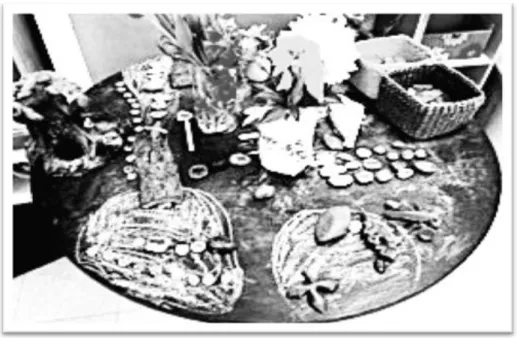
The purpose of this activity was to cultivate children’s sense of appreciation for a ‘river’ vocabulary and development their ability to make sentences. A design table covered with stones upon which river words are written near the door (Figure 6). River and some backgrounds drew with chalks by Ms. M. A book related to a river usually placed in one place on the table. She thought that maybe parents came in and read. Children and parents would make their poetry together on the table as well. So, people entering the classroom would see this first. Ms. M designed this activity called “River Words Poetry,” which
provided children the opportunity to appreciate poetry and allows them to use those stones to make their own poem anytime when children are free, so that no learning center was
designed for this activity Here is an observation of her implementation of symbolic languages with “River Words Poetry.”
Before having children do their poetry, Ms. M adopted one book for children to express their feelings about river words. She said,
interprets his feelings. Like in a painting, show your feelings. You can show your abstract thinking. You can write your poem on a designed table with the stones upon which river words are written. They don’t write. They have lovely, melodic sounds when you read them.” (Ms. M, Observation, April 30, 2015)
Then she read a poem from River of Words by Jen Bryant: “The Great Figure Among the rain and lights
I saw the figure S in gold on a red fire truck
moving tense unheaded to going clangs
strange howls and wheels rumbling through the dark city”
She continued by saying, “Close your eyes and imagine the picture. You can feel them although you don’t know meaning of the words.” (Observation, April 30, 2015). I later noticed one child’s poem on the table when my observation to children’s learning centers was done.
A child wrote her poem with these words stones.
The Eno River is free
See water are love life
Lovely waves wet and sweet
On some algae
Dots books
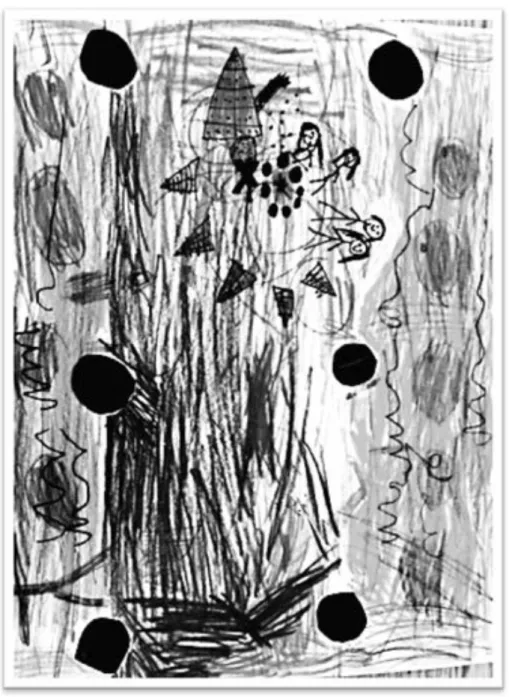
One of the learning centers in the Eno River Project was dedicated to Math. Ms. M adopted a book called the Dots Books to teach children numbers and also reinforce children’s sense of numbers in math. She gave children one to ten sticky dots for creating something in
their Black Dots activity, in order to illustrate their creative instincts. She said, “I am trying to get them to draw pictures of it and think about it as a real life that they can talk. Mostly we just talk about it. Not all of the children spell well. Some kids are not getting it, but they draw.” (Ms. M, personal communication, April 30, 2015). In the observation of the Black Dots activity, children used the black dots to represent something related to the Eno River Project without asking any questions to Ms. M. I also found that Ms. M did not interfere in the children’s activity in order to provide more thinking space for them. So, I asked children to explain their stories.
I What are you drawing by using six black dots? Children 1: I am making a paw print.
Children 2: It is supposed to be for the Eno River. Right? I: Yeah!
Children 2: It can be a paw at the Eno River. (Pause)
Children 1: I am making a trail. And, the rocks are on the trail. Children 4: I am making a …. Do you remember that little house? Children 3: Do you mean “cabin”? It is called a cabin. It’s woods…. Children 4: Yes! I am making a cabin.
Children 3: Oh yeah! I got a really good idea; if there’s smoke coming out, you should put fire, because there’s fire.
Children 4: Oh yeah. There! Children 1: River, river, river…
Children 2: I’m gonna make a tiny, tiny star…. Children 3:Fire…fire…fire…
I: Who and what lives along the river? Children 1: It’s unknown.
Children 2: The star’s hiding in the river.
Children 4: I am going to make a beautiful rainbow (Figure 7). Children 3: Do you think there is supposed to have a rainbow? Children 2: You can make it beautiful.
Children 1: A beautiful rainbow.
Based on the Vygotsky’s Zone of Proximal Development (1978), children reach their goals by negotiating or learning from peers with higher skills or literacy. In this example, children learned new vocabulary from classmates and created a story through their conversations with each other.
symbolic languages allowed children to learn not only math, but also developed children’s ability to organize a story and then enhance their cognition.
Under a rock
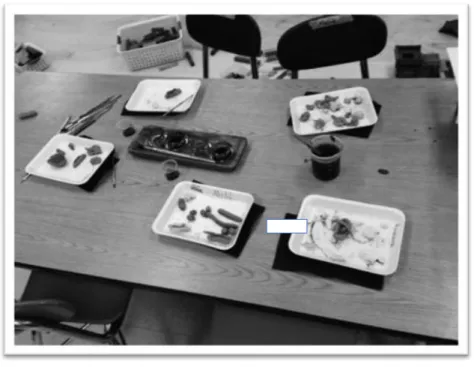
The activity “Under a Rock” was designed for children to learn about animals by drawing and describing them, and also advance children’s observational skill. That is also an idea of George Forman’s thought- Draw to learn (1996). Children chose ten creatures to create and wrote an introduction to each creature on a card, after looking at several books. So, the process was that children identified, sketched, cut, and colored their creatures, and then wrote about them. Children were able to learn about these animals independently through their production of them, and their final products revealed the various depths of their understanding. For example, one child provided various complexities and detail in his creatures (Figure 10).
Drawing to learn helped children detect the whole body of knowledge of what they had learned. This idea met with Forman’s, drawing to learn. Children chose what they were enthusiastic about and tended to focus on learning. In this activity, although the steps were complicated for children to complete, Ms. M changed some process instead of giving up this activity. From this activity, children’s spontaneous concept gradually transferred to a
scientific concept. Children closed detected their creatures by books, pictures or specimens with a magnifier so that the creatures displayed in many details. Children learned through drawing.
Writer’s workshop
The writing center included sections of the activities for children to write about what they drew and also to acquire literacy and enhance children’s reading ability, as this is a state education standard. That method also followed by Vygotsky’s theory of language
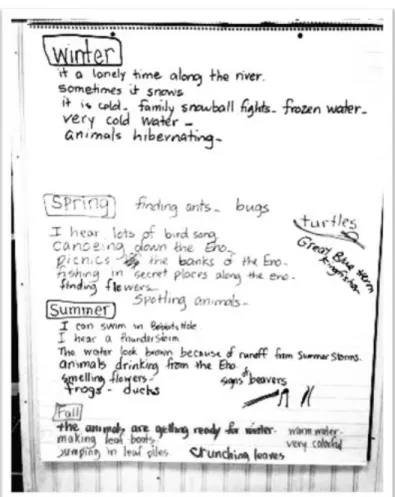
development (1978). In order to increase children’s literacy, Ms. M read books related to the Eno River for expanding children’s literacy and asked some questions for them to answer in their own Seasons Book. The seasons Book was designed to interpret children’s feelings about the dramatic change among the four seasons at the Eno River and offered children an opportunity to imaginatively display, explore these feelings, and learn new literacy. Children drew their feelings about anticipated sensorial changes from winter to spring, from spring to summer, etc. While they were given the opportunity to write down what they expected, they could also demonstrate their ideas (regardless of linguistic ability) through drawing and painting. Colors could be mixed into various layers of the hues. Based on the hue, saturation, and value of the children’s drawings, they could display feelings about the transition of the four seasons.
Seasons Book, which could increase children’s literacy. During the discussion, she invited the children to imagine what they would find in the river.
Ms. M: “I will give you a lot of information. I think you will find greens in the river. We will look at the colors over there. Give you inspiration! What do you see in the wintertime at the Eno River? How do you feel? What do you hear? What can you imagine?”
Children 1: “In the woods, you might hear bugs.”
Children 2: “We might hear girls running over the leaves.”
(The teacher asked back to the second child) “What about you running over the leaves? What sounds will we make?”
Children 2: “Cra. Cra. Cra.” Ms. M: “Crunching!” (Figure 11).
Ms. M persisted her belief under the policy of the Common Core State Standard and asked open-ended questions as a way of enhancing children’s cognition. I found that children could draw more about the changes of the four seasons and some children even learned new words. Their literacy was literally improving.
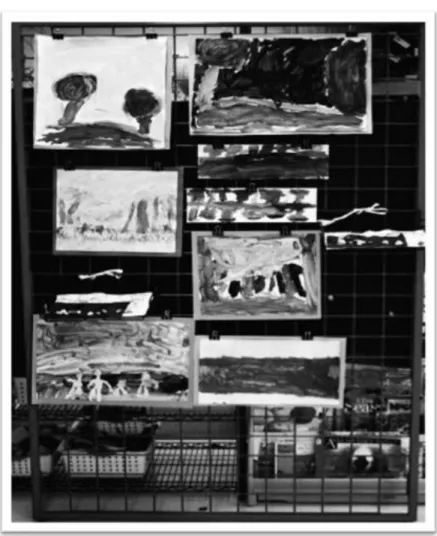
Abstract paintings
Machon, 2007). Ms. M. explained that she wanted them to understand that “The abstract painting means an idea,” and “When we were studying the river… they couldn’t hear the river; well, they went to the river, but they were still able to make that connection to the river, having just seen it once into a painting that looks like an image of what they just saw” (Ms. M., Personal communication, June 4, 2015). When asked about whether she can identify emotion in their paintings, she replied “Some, definitely, more than others, like this one that you’ve pulled up, just how it’s not sharp; it’s very curvy and soft edges; the colors kind of blend. Yes, she’s an amazing painter… and emotional as well…just the fact that she chose to paint this particular image makes it an emotional piece, right?” (Ms. M., Personal
communication, June 4, 2015).
Museum at the end of the project
Even following such a successful conclusion to their project, in which the children showed competence and strong performancesin the context of discussing year-end
assessments and time demands during the final interview, Ms. M. said, “Projects are not easy” (Personal communication, June 4, 2015). In the end of the interview, she further explained that she did not have much time to do documentation. At school, she needed to focus on each child’s learning by providing so many activities. Being a mother and a wife, she had no time even if she hoped to complete some documentation at home.
Challenges that the Teacher Faced
Throughout this project, Ms. M. encountered some challenges when she incorporated symbolic language into her curriculum. In spite of those challenges, Ms. M. repeatedly tried to teach against the grain, as advocated by Wirth (1989) and Cochran-Smith (1991). Key themes of these challenges are described below:
Children’s varying academic needs
During two interviews, Ms. M. expressed the difficulty in teaching children with various and significantly disparate academic needs. One of the most significant challenges for Ms. M. was the children’s different literacy levels, particularly those for whom English is a second or other language (ESL). Because these groups have different instructional demands, she
described her feeling that she must continually try to balance her time and energy in order to serve all the groups equitably. “The most difficult part of project work is just the organizing.” (Ms. M., personal communication, April 30, 2015) She said, “The really smart kids deserve just as much attention as low kids, but teachers need to pull low kids up. I will lose my mind if I focus every day on the low children. I will lose my mind.” (Ms. M., personal
personal communication, June 4, 2015). Ms. M. wanted to academically engage all of the children, regardless of their level, but seemed to struggle with this goal, saying, “I have to believe that you need to have an exhilarating class. Focusing on your lower children is not going to make it an exhilarating classroom. If I make an exciting kind of high functioning class, I am happy; and, you can only hope those lower are moving along.” (Ms. M., personal communication, June 4, 2015).
Children’s energy and focus
Ms. M. also repeatedly expressed the difficulty of keeping the children focused. In our second interview, she said, “So it is hard to stay focused and get the most out of them that can possibly be found in your project work. This time of year, kids are very different. They need a break from each other. They are becoming outgoing in the classroom. Some of them are growing, and some are regressing. It happens every year. Their behaviors are out of control. They are doing thing that they would never have done, like twirling around. You have to laugh otherwise you will go crazy. Those high-functioning capable kids can lose structure and their focus and control just as quickly. And they do! So it is such a mess” (Ms. M., personal communication, May 12, 2015).
District educational policy
Over three interviews, Ms. M repeatedly mentioned district educational policies’ focus on children’s reading, writing, and mathematics, which constrained her flexibility of teaching methodology and curricular planning. According to Ms. M., some of the most significant restrictions on project work are the demands of standardized testing and
preparation for those tests. And, because this testing is administered on a one-on-one basis, it takes considerable time for 19 students to take the test, let alone the time spent preparing for this testing. So, Ms. M. sometimes postponed her project activities due to the demands of these standard assessments.
Along with demands on time, testing requirements impact the overall design of the project. For example, in the Seasons Book, Questions Book, Drop Book, and Black Dots, it was necessary to include sections for children to write about what they drew, as this is a state education standard requirement. Ms. M. said that she would have preferred not to have these writing elements in each of her activities. Her project also included a Writer’s Workshop, through which she felt the children received adequate exposure and practice with writing. She felt that children of this age are generally not ready to do so much writing (Ms. M, personal communication, May 12, 2015).
In addition to the time and curricular design demands of standardized assessment, there were further restrictions on her project time for those students requiring special services (ESL, and Special Needs). During the course of a typical school day, those children who receive special instruction might be pulled from the classroom and were then unable to
participate in the project. She especially mentioned three English as a Second Language (ESL) children. She said,
say, “I,” but he could not know “I.” When I say, “like,” he could not tell, “like.” Or not making the sounds. Every letter sound. He does not have any ideas of sounds. The same situation happens with another ESL child. I taught her, “I like ice cream.” She repeated after me and said, “I like an ice cream.” I said no an. Try again. She still said, “an ice cream.” She
connected them together.”
Ms. M was frustrated that the system was caught up and moved them to a higher level, but some children’s brains were not ready to figure out the activity. However, she still
provided positive relationships with ESL children. In an observation of the teacher with one ESL child, she said, “I make a challenge to you. You can write something and draw what you want to say. I am expecting so much of you. You are doing powerful things, even if I am not around to watch you. It is just powerfulness” (Ms. M, observation, May 21, 2015). Although the child did not have any idea about what to write, she happily drew something in her work. In spite of these ongoing challenges, Ms. M. remained enthusiastic about the learning
CHAPTER 7: DISCUSSION
This study revealed important insights into how one public kindergarten teacher both interpreted and implemented symbolic languages in her classroom in spite of numerous challenges she faced. This study also illustrated ways in which this one teacher’s beliefs and practices were aligned with other theories, including those from Reggio Emilia.
First, Ms. M. believed that art is an essential element in children’s learning, leading her to design a curriculum project with several art activities; and she provided various helpful and interesting materials to use following a meaningful field trip. Children within this rich learning environment, full of art, exhibited their understanding in various ways.
Second, art as interpreted by Ms. M. was similar to the interpretations of many
described in the Literature Review. She shared John Dewey’s beliefs (Dewey, 1934) of art as both as a means of children’s expression and as an element for a learning environment. Ms. M. also shared some of Reggio Emilia educators’ beliefs, e.g., that she could understand children’s thinking through her observation of their working process and communication with them (Edwards, 1998). Along with these benefits of implementing symbolic languages, Ms. M demonstrated an understanding that children from various backgrounds carried different knowledge and could make their meaning clear by using various materials; that using
didn’t merely reinforce motor skill abilities, but expanded and enhanced children’s cognition through scaffolding, sometimes with high-skilled peers.
This study also demonstrated the power of teacher’s beliefs and philosophy of education. Despite constraining state curriculum policies, Ms. M. followed her heart, doing what she believed helpful and practical for children’s learning. As described by Wirth (1989) and Cochran-Smith (1991), teachers should fight against the grain and teach what indeed they believe helps children. Ms. M is a good example of such a teacher, even though she was teaching in a silo without enough support to easily translate her beliefs into action. My Position
As a former part-time public kindergarten teacher in Taiwan, I also thought that the implementation of symbolic languages was a challenge due to curricular constraints. How to bring symbolic languages into a public kindergarten has long been a question for me. In my opinion, children are born with artistic talent, and they are capable of expressing themselves in wide variety of ways, if they are in a resource-rich environment. Because verbal language limits children’s performance, I could understand children’s learning through another means. So, the ways that Ms. M. implemented symbolic languages shed some light for me.
again about their work. That is likely why children’s works in Ms. M.’s class show so many different perspectives.
Since the thesis began, I have now had several experiences to learn more about symbolic languages in other private infant-toddler schools and preschools, including two – the Boulder Journey School in Colorado, and the Seasons Art kindergarten in Taiwan-- that were also influenced by RE ideas or REA. I recognized that different teachers with different experience and cultures interpreted these ideas differently. Those experiences strengthened my understanding that children have many languages (Malaguzzi, 1998) and informed my insights into Ms. M.’s efforts in a public kindergarten, allowing me to compare her
interpretation of symbolic languages in a multi-cultural, multi-lingual, and multi-skilled setting. In her class, I found that using a project approach helps children expand on one simple idea and this extended time enhances children’s cognition. I had many opportunities to see how children’s symbolic languages helped them reveal their thoughts, and I also learned about involving families as a way of improving children’s motivation for learning and even possibly connect them to their family’s knowledge.
Ms. M’s way of displaying symbolic language is different from what I observed in Taiwan. Most obvious is that her classroom was decorated with many children’s symbolic languages, especially paintings hanging on the walls, and that learning materials were