TO HELP OR NOT TO HELP:
THE EFFECTS OF AFFECTIVE EXPECTANCIES ON REACTIONS TO PROSOCIAL PERSUASIVE MESSAGES
Sheetal Janak Patel
A dissertation submitted to the faculty of the University of North Carolina at Chapel Hill in partial fulfillment of the requirements for the degree of Doctor of Philosophy in Mass Communication in the School of Journalism and Mass Communication.
Chapel Hill 2011
Approved by:
Advisor: Sriram Kalyanaraman Reader: Janas Sinclair
ABSTRACT
SHEETAL J. PATEL: To Help or not to Help:
The Effects of Affective Expectancies on Reactions to Prosocial Persuasive Messages (Under the direction of Sriram Kalyanaraman)
Researchers examining the concept of compassion fatigue have suggested that negative affective expectancies (expectations about how a person will feel in the future) about the outcomes of prosocial acts resulting from the news can negatively influence prosocial behavior and decrease compassion within the population. Yet, there has been little empirical evidence on which to stake this claim.
The overarching purpose of this dissertation was to add to the theoretical nature of compassion fatigue by examining the effects of affective expectancies, social marketing messages, and cognitive load on feelings, attitudes, and behavior related to prosocial acts. In doing so, this dissertation used the theories of affective expectancies and attitude toward the ad to explain the possible influences of expectancies on responses to persuasive messages. The main experiment employed a 3 (valence of affective expectancy: positive, negative, no expectancy) x 2 (valence of social marketing messages: positive, negative) x 2 (cognitive load: high, low) between-subjects factorial experiment to examine the influence of affective expectancies on feelings, attitudes, and behaviors.
Overall, the findings from this research suggest some evidence that affective
To my parents, Kanak and Janak Patel, and my husband, Anup Suresh, who have shown faith in me no matter the circumstance and never fail to amaze me with their unending support and
ACKNOWLEDGEMENTS
While working on this dissertation, I have truly experienced the meaning of “It takes a village.” I am thankful for my parents and husband, who have spent their time showing their faith in me, encouraging me, and sharing in both the ups and downs of being a graduate student. I am also lucky to have been raised in a family whose values are rooted in education, starting with my great grandfather – he did everything in his power to educate his loved ones, enabling me to be not only the third college-educated generation in my family, but the third generation to receive graduate level education.
I would also like to thank my advisor, Sri Kalyanaraman, for understanding my need for research to serve a greater purpose than pure knowledge and for always asking, “So what?” Without his expertise and creativity, I may have never been able to produce a
dissertation that fed people suffering from hunger. My gratitude also goes to Jane Brown for her kindness, support, and generosity, without which I would not have made it through the first year of the PhD program. I would also like to extend my thanks to my other committee members, Janas Sinclair, Melanie Green, and Mary Beth Oliver for their guidance and time. I am lucky to have had such an esteemed committee interested in theoretically significant scholarship.
Dissertation Award, and the Minnie S. and Eli A. Rubinstein Research Award. I have had the honor of developing my program of research in my dissertation with these financial gifts.
Lastly, I have to thank each member of my graduating cohort: Autumn, my
TABLE OF CONTENTS
LIST OF TABLES ... x
LIST OF FIGURES ... xii
Chapter I. INTRODUCTION AND LITERATURE REVIEW ... 1
Literature Review ... 6
News-induced Affective Expectancies ... 7
The Influence of Affective Expectancies on Persuasive Messages ... 11
Affective Expectancy Influences on Compassion, Attitudes, and Behavior ... 20
Hypotheses and Research Questions ... 24
II. MAIN STUDY ... 29
Method ... 29
Participants ... 29
Independent Variables ... 30
Stimulus Materials ... 32
Manipulation Check Measures ... 34
Dependent Variables ... 35
Control Variables ... 37
Procedure ... 37
Results ... 38
Tests of Hypotheses ... 41
Summary of Results... 54
III. DISSCUSION ... 57
Interpretation of Findings ... 57
Affective Expectancies ... 57
Social Marketing Messages ... 60
Interaction of Affective Expectancies, Social Marketing Messages, and Cognitive Load ... 63
Limitations ... 65
Threats to Internal Validity... 65
Threats to External Validity ... 67
Implications and Future Research ... 68
Theoretical Implications ... 69
Practical Implications ... 73
Conclusion ... 74
APPENDICES ... 96
Appendix A ... 96
Appendix B ... 103
Appendix C ... 110
Appendix D ... 114
LIST OF TABLES
Table 1: Hypotheses ... 76
Table 2: Main Experiment Study Design ... 78
Table 3: Descriptive Statistics for Dependent Measures ... 78
Table 4: Summary of Means and F Values for Manipulation Checks ... 79
Table 5: Summary of Means and F Values for Main Effects for Compassion ... 79
Table 6: Summary of Means for 3-way Interaction on Compassion ... 79
Table 7: Summary of Means and F Values for Main Effects for Feelings ... 80
Table 8: Summary of Means for 3-way Interaction on Negative Feelings ... 80
Table 9: Summary of Means for 3-way Interaction on Positive Warm Feelings ... 80
Table 10: Summary of Means for 3-way Interaction on Positive Upbeat Feelings ... 81
Table 11: Summary of Means and F Values for Main Effects for Attitudes ... 81
Table 12: Summary of Means for 3-way Interaction on Attitude toward the Ad ... 81
Table 13: Summary of Means for 3-way Interaction on Attitude toward the Organization ... 82
Table 14: Summary of Means for 3-way Interaction on Attitude toward the Prosocial Behavior ... 82
Table 15: Summary of Means and F Values for Main Effects for Behavior ... 82
Table 16: Summary of Means for 3-way Interaction on Behavioral Intentions ... 83
Table 17: Summary of Means for 3-way Interaction on Attitude Actual Rice Grains Donated ... 83
Table 19: Summary of Means for 3-way Interaction on Self-reported
Grains of Rice Donated ... 84
Table 20: Means, Standard Deviations, and Correlation Coefficients among Observed
Variables (N = 263) ... 84
Table 21: Model Fit Indices for Predicted Model and Re-specified Model ... 85
Table 22: R-Squares for the Predicted and Re-specified models ... 85
Table 23: Unstandardized Regression Weights for the Predicted Model ... 86
Table 24: Indirect Effects: Bootstrap Estimates of Significant and Marginally Significant Indirect Effects for the Predicted Model ... 86
Table 25: Unstandardized Regression Weights for the Re-specified Model ... 87
Table 26: Indirect Effects: Bootstrap Estimates of Significant and Marginally Significant Indirect Effects for the Re-specified Model ... 87
LIST OF FIGURES
Figure 1: Predicted Model of Affective Expectancy Effects on Feelings, Attitudes, and
Behavior ... 91
Figure 2: Valence of Affective Expectancy X Valence of Social Marketing Message X
Cognitive Load Interaction Effect on Attitudes Toward Prosocial Behavior ... 92
Figure 3: Predicted Model of Affective Expectancy Direct and Indirect effects
with Specified Indicators for Latent Variables. ... 93
Figure 4: Standardized Parameter Estimates for the Predicted Model ... 94
CHAPTER ONE
INTRODUCTION AND LITERATURE REVIEW
John and Sarah are a married couple who both enjoy reading the news online in the
morning. One day, John reads a news story that addresses the problem of hunger in the
United States. It states that the number of people needing help is so high that people who
wish to help by donating time or money are overwhelmed and experience a sense of
disillusionment. John reflects on what he has just read, especially about how people feel bad
even after helping out. He figures that if he were to donate his time or money, he too would
end up feeling sad.
Sarah, on the other hand, reads a completely different news story regarding hunger,
one that is more optimistic about the possibilities of solving the hunger problem. She reads
quotes from people who specifically say that they feel great about donating despite the
number of people needing help. Sarah surmises that she would also feel good if she donated
something.
Later that day, John and Sarah both happen to see a webpage that solicits donations
to relieve hunger as part of a nonprofit organization’s social-marketing efforts. In contrast to
the news story that John read, the webpage is very upbeat, similar to Sarah’s news story. It
discusses how wonderful people feel after donating or volunteering. In light of the expected
Sarah thinks she will feel good, will they react differently to the positive advertisement?
Furthermore, will John even notice that there are differences between the two messages he
read, and if so, does it even matter in terms of his decision to donate?
As the above narrative illustrates, people often develop expectations about how they might feel at a future time (Wilson & Klaaren, 1992). These expectations—which are known as affective expectancies—have been the focus of considerable empirical attention (e.g., Geers & Lassiter, 1999) and have been shown to influence subsequent emotions and behavior in different domains (e.g., MacInnis, Patrick, & Park, 2005; Wilson, Lisle, Kraft, & Wetzel, 1989). Yet how these expectations might influence attitudinal and behavioral reactions to a persuasion attempt, as exemplified by the narrative above, is still unclear. Central to the current study is the premise that people’s expectations about how they will feel can influence affective reactions to persuasion attempts, and subsequent attitudes and behavior.
Social marketing messages and news stories, for example, may focus solely on the social problem and may not provide a solution or positive outcomes of helping or may also focus on the negative feelings people in encounter when helping, as was the case in John’s news story (negative frame); or they may focus on the solution to a social problem and the positive feelings of those people involved in efforts to relieve suffering (positive frame), as was the case in Sarah’s news story (see Moeller, 1999). It is also possible that social
marketing messages and news stories may not even address feelings of people trying to help (neutral frame). In this context, to frame is to make some aspects of a certain message more salient in a communicating text, in a way that may encourage a certain perspective on a particular problem (Entman, 1993).
compassion research suggests, it can occur immediately depending on the number of suffering people that need help (Cameron & Payne, 2011).
However, researchers have inferred that it may be possible for such news-induced expectations to influence intended outcomes of social-marketing messages that are juxtaposed with these new stories. This is because expectations can influence affect, attitudes, and behavior, which are typical outcomes of social marketing messages (see Kinnick et al., 1996; Moeller, 1999). This may occur perhaps because expectations could influence emotional reactions to social marketing messages through assimilation (matching) and contrast (mismatching) effects (Wilson & Klaaren, 1992). For example, John’s news-induced negative expectations may negatively influence affective reactions to the webpage ad due to assimilation effects, despite the fact that the ad was positive. Thus, the valence of expectations could influence persuasive message outcomes regardless of the frame
(positive/negative) of the marketing message. Should this be the case, negative affective expectations could adversely influence the intended positive affective outcomes from a social marketing message. Accordingly, positive or negative emotional reactions may then
influence attitudes and prosocial behavior, as posited by research on CF. Despite the potential fallout from negative expected feelings, such as decreased funding, there is little empirical study of the joint media effects of news stories about social causes and social-marketing messages on emotions and resulting attitudes and behavior. In fact, more broadly speaking, little research exists to suggest how persuasion attempts might be influenced by affective expectancies.
survival situations (Goetz, Keltner, & Simon-Thomas, 2010). In this stream of research, the emotion of compassion serves to help a person to survive by protecting the welfare of those that are vulnerable and are important to a person and enables cooperative relations with others. Other motivations for helping suggested from a functional perspective that are related to the emotion of compassion are one’s own values, social goals, and protective and self-enhancement goals (Clary et al., 1998). Each of these motivations comes with the expectancy of feeling good after acting compassionately and affecting some kind of change in the
suffering population. Even outside of being compassionate, motivations related to career and learning still come with the end goal of feeling good after helping. Therefore, these
expectancies are important to motivating people to act compassionately.
The issue of studying the relationship between news-induced affective expectancies and social marketing messages is further compounded by the limited processing resources that consumers have. This is because processing resources can influence information
processing of such media. While the media have increasingly bombarded consumers, people cannot devote all their attention to processing media messages. As social-marketing
messages vie for consumers’ limited attention in a tough competitive environment,
Given the potential influence of affective expectations in the persuasion process, this dissertation aimed to answer the following research question:
What is the relationship between valence of news-induced affective expectations (positive, negative, no expectancy), valence of a social-marketing message (positive, negative), and processing resources (high or low) and affective reactions to a social marketing message, attitudes, and prosocial behavior?
This study endeavors to extend the literature on affective expectancies, persuasion and advertising, and health communication by investigating the effects of affective
expectancies on emotional reactions to health-related social marketing advertisements as well as consequent attitudinal and behavioral outcomes. The applied ramifications include
informing more effective message designs and campaign strategies for nonprofit organizations seeking to increase prosocial behavior for the benefit of societal health, especially when audiences experience CF. Findings can also be more broadly applied to health communication efforts and product advertising.
The remainder of this chapter reviews the literature and theoretical frameworks of CF and affective expectancies. Chapter Two describes the methods and results of the
experimental study conducted. Chapter Three concludes by discussing implications and limitations of this dissertation and suggests directions for future research.
Literature Review
news-induced affective expectations can influence affective reactions to a positive or negative social marketing message, depending on the amount of processing resources available. Then, the rationale underlying how affective expectancies and affective reactions to an ad can influence attitudes and behavior is discussed. Finally, hypotheses for the experimental study are presented.
News-induced Affective Expectancies
Affective expectations are defined as “people’s predictions about how they will feel in a particular situation or toward a specific stimulus” (Wilson & Klaaren, 1992, p. 3). The word “stimulus” refers to a certain future event or situation, such as seeing a movie, attending a friend’s wedding, or donating to a charity.
People can have expectations about certain aspects of feelings. Prior research has defined four characteristics of feelings for which people may have expectations: (1) the valence of a future feeling (e.g., positive or negative), (2) specific emotions to be
encountered (e.g., sadness, joy, happiness, fear, anger), (3) the intensity of an emotion, and (4) the duration of that future emotion or feeling (MacInnis et al., 2005; Wilson & Gilbert, 2003). For instance, audience members may feel that volunteering at a soup kitchen will make them feel good (valence of a feeling) for a short period of time (duration). Of relevance to prosocial behavior are the influences of expectations about the valence of feelings after acting prosocially on subsequent affective reactions to a marketing message, the later of which may include both valence of feelings and the specific emotion of compassion as related to CF.
current study, as they relate directly to how affective expectancies about acting prosocially may be influenced by news stories. First, affective expectancies may be based on normative belief rules, which include norms that dictate how people should feel in different social settings (Wilson & Klaaren, 1992). An example of a common norm-based expectation is that an individual should feel good after helping another person because it is the right thing to do. Second, target-based affective expectancies are based on a person’s own previous reactions to a certain stimulus. An example of a target-based expectancy might be that a person expects to enjoy volunteering, because they have enjoyed volunteering in the past. Category-based expectations are predicated on how other people have reacted to a stimulus, such as John’s experience in the opening narrative. He expected to feel bad after donating, because people in the news story he read also felt bad. According to Moeller (1999), news stories may
influence negative affective expectations about acting prosocially by presenting norm- and category-based rules. They may include norms about how one should feel bad after acting prosocially and the negative feelings of others who have acted prosocially.
In his analysis of the relationship between compassion, morality, and the media, Tester (2001, p. 13) describes the feelings of CF that can result from negative affective expectancies that can emanate from news media about social issues:
next time and that to empathize with victims of ethnic cleansing will not stop them becoming the perpetrators of atrocity when they get the opportunity.
Kinnick et al. (1996), after conducting a survey of 316 people, found that CF does exist, and at its simplest, can be defined as a type of burnout towards social problems. The authors conclude that negative feelings about helping, similar to those described by Tester (2001), can result in CF and decreased feelings of compassion. These findings are consistent with similar studies by Höijer (2004) and Moeller (1999) who independently conclude that a person will not feel good after helping because the media provide the frame that there will be another person who needs to be helped or that there are too many people to help or, at the extremes, that a compassionate prosocial act will not alleviate any suffering.
Negative affective expectancies caused by news media are developed due to what Moeller (1999) deems is formulaic news reporting and also the use of negative frames within social issue news stories. Moeller uses the example that such negative phrases as “hellish,” and “single worst crisis,” are used to describe famine and convey the overwhelming larger numbers of suffering people affected. These frames influence whether people think they can help those suffering. Additionally, Kinnick et al. (1996) suggest that certain persuasive appeals use negative or guilt-ridden emotional appeals to persuade people to act, also creating negative affective expectations.
compassionately will make them feel good (Höijer, 2004; Moeller, 1999). In other words, they develop feelings of CF. It is affective expectancies that are, thus, blamed for decreases in prosocial behavior in addition to impeding social marketing efforts to increase prosocial behavior.
While previous research has not focused directly on affective expectancies in the news media, studies do indicate its negative influence on emotions and expectancies in audience members. In a content analysis of 300 news articles covering pollution and other social problems, Kensicki (2004) found that news coverage rarely indicated a specific cause, effect, responsible party, or means to act to solve the problems. When media coverage does not discuss any likelihood that problems can be solved, public apathy may result due to a lack of connection between social problems, nonprofit or government organizations, and potential individual action (Kensicki, 2004).
Negative framing in news coverage coupled with an apparent lack of solutions can cause audiences to avoid social cause-related persuasive messages and news stories. For example, a survey of American Red Cross donors following the 2004 Tsunami in Southeast Asia showed that donors experienced feelings of dissonance following the tsunami, and that making a donation restored donors' mental balance (Waters, 2009). However, the study also found that donors avoided or reduced news consumption during that time to avoid additional negative feelings (Waters, 2009).
had either strong emotional reactions or were desensitized to the images. Of those that did have emotional reactions, some people experienced what she called guilt and shame-filled compassion, where people know they have the means to help, but refrain from doing so, as they do not think they can influence the outcome.
Additionally, the collapse of compassion literature suggests that as the number of victims in need increases, people may feel less compassion (Cameron & Payne, 2011). Varying reasons exist for this effect in this research. However, it has been suggested that this could be due to the cost associated or perceived in helping several others. Given that large numbers of people are typically reported in the news (Moeller, 1999), this research also suggests the potential for people to expect to feel bad when prosocially acting due to a news story.
The Influence of Affective Expectancies on Persuasive Messages
While affective expectations may influence persuasion outcomes (such as affective reactions to social marketing messages, attitudes, and behavior), it is unclear as to how this occurs. The AEM provides a theoretical framework in which to examine how affective expectations influence persuasion.
Affective Expectancy Model. The AEM posits that affective reactions to a stimulus
are formed in reference to affective expectations. Specifically, Wilson et al. (1989) and Wilson and Klaaren (1992) suggest that a person may assimilate (match) or contrast
solution, e.g., donating, and letting people know this will actually help those in need. A negative message on the other hand would consist of an ad that lacked any solution or how any action would help a suffering other, but instead would only describe the problem. As described by previous research, it is this “no solutions” approach that can have a negative influence on expectations of helping and compassion by not providing any information on how prosocial behavior may improve a suffering other’s wellbeing (see Höijer, 2004, Moeller, 1999).
Thus, as specified by the AEM, affective reactions to a persuasive message may match or mismatch affective expectations developed beforehand. Wilson et al. (1989) state four related possible situations that showcase when assimilation or contrast effects are found. Examples used for each case indicate the application of the framework to the persuasion process.
No Expectation. In this particular situation, a person has no affective expectation
Matching. In this situation, an affective expectation is confirmed by (or matches) a
stimulus, in which case people do not need as much time to determine actual affective reactions, because they use the expectation more than actual feelings in evaluating affective reactions. For example, if people expect donating food will make them feel good (positive expectancy) and they see an advertisement that states donating does feel good (stimulus confirms expectancy), they may assimilate or match feelings about the positive persuasive message and donating with the positive affective expectancy. In this case, it will take less time to actually develop affective reactions, as the expectation about donating is used more to inform reactions rather than actual reactions to the persuasion attempt. If both the expectancy and the message were negative, similar matching effects would occur, producing negative reactions to the message.
Unrecognized Mismatch. In this particular situation, an affective expectation is not
to previous negative affective expectations. Therefore, the ad would have the unintended effect of increasing negative feelings about the ad and potentially negative attitudes as well as decreasing intentions to act prosocially. Similar matching effects would occur if the affective expectancy was positive and the message was negative, thus, producing positive reactions to the negative persuasive message.
Recognized Mismatch. In this situation, an affective expectation is not confirmed by
(mismatches) the stimulus. This discrepancy, however, is recognized by people, in which case, people will contrast affective reactions with the original expectancy. In other words, if the person thinking about building a house in the example above had noticed the discrepancy between the news-induced negative affective expectations and the positive persuasive
message, he or she would mismatch affective reactions to the positive message with the original negative expectancy. This would result in positive reactions to the persuasive message. In this case, evaluating affective reactions takes longer, as a person must resolve the discrepancies he or she finds between the expectation and the experience. Again similar effects would occur if the discrepancy between a positive affective expectancy and a negative marketing message was noticed, producing more negative reactions to the message.
In a pilot study, the experimenters used the common belief or the norm (normative belief rule) that people should be in a good mood on their birthday. The authors hypothesized that people who were in fact in a good mood on their birthday would be characterized by the
Matching situation, where expectations and the stimulus match, and a person should respond quickly to questions about their mood. On the other hand, if people were not in a good mood, their feelings would mismatch the affective expectancy. If people noticed the discrepancy (Recognized Mismatch), the experimenters hypothesized it would take longer for a person to answer questions about their mood. The authors found the results they expected.
In a follow-up experimental study, the authors looked for specific evidence of the effects of a person recognizing discrepancies between affective expectancies and a stimulus (Recognized Mismatch). Participants were given a set of 20 cartoons to evaluate. In the positive and negative affective expectation conditions, depending on the participants’ high or low rating (respectively) of funniness of the cartoon, they were told the cartoons came from a particular magazine called Punch. In the no expectation condition, none of the cartoons purportedly came from the Punch magazine. Participants were then asked to evaluate a new set of cartoons that were said to be from Punch. Those in the positive expectation condition then viewed cartoons that were not funny while those in the negative expectation condition viewed cartoons that were funny. This created the discrepancy between expectations and the cartoon stimulus.
cartoon (Recognized Mismatch). However, if a person rated the cartoon as a whole, they would be less likely to notice any difference (Unrecognized Mismatch). In other words, how closely one examines a stimulus may influence whether or not a person recognizes any differences between expectations and the actual stimulus. The more closely people examine a stimulus, the more information they may gain from that stimulus, which may allow them to notice discrepancies. The authors found evidence consistent with the Unrecognized
Mismatch case, but failed to find evidence for the Recognized Mismatch case.
Stimulus scrutiny in the AEM. Geers and Lassiter (1999) suggest that the reason
Wilson et al.’s (1989) experiment did not find evidence of the Recognized Mismatch case is that people need to scrutinize the cartoon while viewing it rather than while evaluating it. Geers and Lassiter (1999, p. 408) state that, “Manipulating the amount of information people gain from an expectation-discrepant stimulus can effectively alter affective evaluations.” They conclude from a series of studies that creating differences in what data an individual can access from a stimulus may change affective expectancy effects on affective evaluations of the stimulus (Geers & Lassiter, 1999, 2002, 2003, 2005).
the discrepant film. Participants were either told, as in the previous Wilson et al. (1989) studies, that they should like the film or told nothing at all in relation to expectations. The authors found both the assimilation and contrast effects proposed in the AEM in the
Matching, Unrecognized Mismatching, and Recognized Mismatching cases.
This study demonstrates that when people notice a discrepancy by scrutinizing the message, they will contrast affective reactions with the expectancy (Recognized
Mismatching). Additional studies indicate that there are different ways to influence the level of scrutiny a person uses to examine a stimulus (Geers & Lassiter, 2002, 2003, 2005). Geers and Lassiter (2003) hypothesized that people with high need-for-cognition would be more likely to contrast affective reactions with affective expectancies because high need-for-cognition participants would scrutinize the stimulus information, gain more information, and thus, notice the discrepancy. They found the expected contrast results under the Recognized Mismatch case, where those high in need-for-cognition were more likely to scrutinize the stimulus, and thus, contrast affective reactions with original predictions.
support for their hypothesis that pessimists would contrast expectations and affective reactions to a stimulus while optimists would assimilate affective reactions.
Together, the AEM studies described above provide evidence for the predictions made by the AEM and support the claim that affective expectations about acting prosocially may influence actual feelings in reaction to a positive or negative social-marketing message in the form of assimilation and contrast effects. One of the key components in these studies,
however, is how much a person scrutinizes a stimulus. The Geers and Lassiter studies (1999, 2002, 2003, 2005) show that there are different ways to influence the level of scrutiny used to examine a stimulus.
Scrutiny and processing resources. Similar to the AEM, other models suggest that
changes in information can also influence assimilation and contrast effects (Geers & Lassiter, 1999). For example, Schwartz and Bless (2007), in the Inclusion/Exclusion model, also state the possibility that under conditions of low cognitive capacity, assimilation effects are more likely to occur, and that under conditions of high cognitive capacity, contrasts are more likely to occur. These outcomes may be due to people’s differing abilities to notice discrepancies between different sets of information under varying levels of processing resources. In other words, their ability to gain more or less information can change the data gained from a stimulus, and thus, influence reactions to that stimulus (Schwartz & Bless, 2007).
demand on the same processing resources needed for processing information in a message (Gilbert, Giesler, & Morris, 1995; Shiv & Fedorikhin, 1999; Trope & Alfieri, 1997). Thus, the amount of processing resources available, or cognitive load, can influence affective expectancy effects on affective reactions toward advertisements by influencing whether discrepancies are recognized between expectancies and a persuasive message.
When processing resources are restricted (high cognitive load), people may be less able to scrutinize the social-marketing message in order to gain more information. They may then be less able to recognize discrepancies between a social-marketing message and affective expectancies (Unrecognized Mismatch), producingcorresponding assimilation (matching) effects.
On the other hand, if processing resources are available (low cognitive load), people may have the ability to scrutinize the information more closely in order to gain more
information from the message. They may then be more likely to notice discrepancies between expectancies and the marketing message (Recognized Mismatch), producing the
corresponding contrast (mismatching) effects. As such, positive or negative affective expectancies and high or low processing resources may influence assimilation or contrast in affective reactions to either a positive or negative social-marketing message.
In summary, affective expectancies may influence affective reactions to persuasive messages depending on the availability of processing resources. In fact, the above discussion suggests that affective expectancies can completely change responses to persuasive
The relationship between expectancies, specific emotions, attitudes, and behavior has yet to be investigated. The emotion of compassion is of interest in this particular study, given that feelings of CF may influence decreased compassion, and accordingly, prosocial attitudes and behavior. Previous scholarship on the emotion of compassion and advertising effects can shed light on how the AEM might work to influence compassion, attitudes, and behavior in relation to a social marketing message.
Affective Expectancy Influences on Compassion, Attitudes, and Behavior
Until now,studies of the AEM have generally assessed the effects of affective expectancies on the valence of feelings (positive or negative). However, the CF literature suggests that news-induced negative affective expectancies can influence not only positive or negative feelings toward social marketing messages, but also compassion, attitudes, and prosocial behavior (Moeller, 1999; Tester, 2001).
Compassion Fatigue. CF is related to the process a person goes through to feel the
emotion of compassion. Compassion includes the emotional component of feeling concern for another person suffering and the desire to relieve that suffering (Fehr & Sprecher, 2009; Goetz, et al., 2010; Tudor, 2001).Additionally, media-influenced compassion is also defined as perceiving the suffering and the needs of distant others. Media images and reports
Goetz et al. (2010) proposed that the process of feeling compassion includes
antecedents, appraisals, experience, and resulting behavior. In the appraisal model of feeling compassion, several steps influence whether a person feels compassion, and accordingly, acts prosocially. First, a person must identify another person suffering. The media can make audiences aware of suffering through photographs and social issue stories, therefore allowing for the first appraisal step (Höijer, 2003). As long as the suffering victim may be seen as deserving of help (e.g., the suffering victim is not seen as deserving of their circumstances) and a person has the resources to help (e.g., money or time), a person may then feel
compassion for the suffering victim and behave in a way that relieves suffering (Goetz et al., 2010; Isen, Clark, & Schwartz, 1976). However, if a person does not have the resources to help or if using resources to help would cost a person too much (e.g., money, time, positive mood), the person may feel fear, anxiety, empathic distress, or guilt/shame-filled compassion and will not behave to relieve suffering (Goetz et al., 2010; Höijer, 2004; Isen, Clark, & Schwartz, 1976; Isen & Simmonds, 1978).
Thus, when considering the costs of feeling and acting compassionately, people must feel that their resources for helping will not be exploited, feel that they would not be taking too many risks, and feel a sense of efficacy (Goetz et al., 2010). This sense of response-efficacy in aiding a suffering other is likely to increase compassion. The consequences of the appraisal process for the emotion of compassion include positive attitudes toward the
News-induced affective expectations can influence the cost–benefit analysis described in the appraisal process for the emotion of compassion (Goetz et al., 2010; Underwood, 2009; Tudor, 2001). According to Moeller (1999) and Tester (2001), negatively framed news stories can make costs seem too high and produce expectations that a person will not feel good if they feel compassionate and act accordingly. News-related CF may suggest that the costs of being compassionate could outweigh the benefits. Content in the news story, for example, may introduce norms as to how one should feel after being compassionate, or show how other people feel. Presumably, this may result in low response efficacy because
consumers may perceive that regardless of the degree of help rendered, it would not alleviate suffering. Therefore, it is the news media that are sometimes blamed for potentially
negatively influencing this cost–benefit analysis that leads to compassion (Höijer, 2004; Kinnick et al., 1996; Moeller, 1999; Tester, 2001).
Thus, news-induced affective expectations could negatively influence feelings of compassion in reaction to social marketing messages through assimilation and contrast effects, depending on the processing resources available when viewing the message. Levels of compassion then, according to the appraisal model for feeling compassion, could predict resulting attitudes and behaviors.
Persuasion. In terms of persuasive messages, further support is provided for the
behavior in terms of purchase intentions, social marketing messages intend to change prosocial behavioral intentions (Kotler & Zaltman, 1971). The brand in this case would be the nonprofit organization (Kotler & Zaltman, 1971). However, given the suggested
influence of CF, social marketing messages may also influence attitude toward the prosocial behavior. According to MacKenzie et al. (1986) and the CF literature, these emotional reactions to an ad may influence both attitudes toward the organization (brand), attitudes toward the prosocial behavior, as well as intentions to act prosocially (purchase intentions).
Several theories in health communication also suggest that emotional response to a persuasive message can influence attitudes and behavior, such as the Transtheoretical Model and Prospect theory, as applied to health communication (e.g., Dillard & Nabi, 2006;
Prochaska, Redding, & Evers, 2008) as well as Peters, Lipkus, and Diefenbach’s (2006) review of how emotion can influence health communication and behavior.
While the current study examines behavior for the benefit of another’s health and wellbeing, the findings can also be applied to the influence of affective expectancies on self-health and wellbeing or caregiver behavior. For example, one self-health communication study found that parents of children with eating disorders expect to feel selfish (affective
expectancy) if they were to engage in self-care behaviors (e.g., seeing a therapist, going for a walk to relieve stress). Parents reported that this sometimes negatively influenced their emotional response to messages that encouraged them to do self-care for the benefit of their child’s recovery. In turn, this could increase negative attitudes toward self-care behaviors and decrease their actual behavioral intentions (Patel, Shafer, Zucker, Bulik, 2011).
attitudes and behavior. Specifically, affective expectancies about acting prosocially have the potential to influence affective reactions to a social marketing message in terms of
compassion and feelings. Additionally, these affective outcomes of the persuasive message may then influence attitudes and prosocial behavior. Figure 1 shows the implied model of these relationships.
Hypotheses and Research Questions
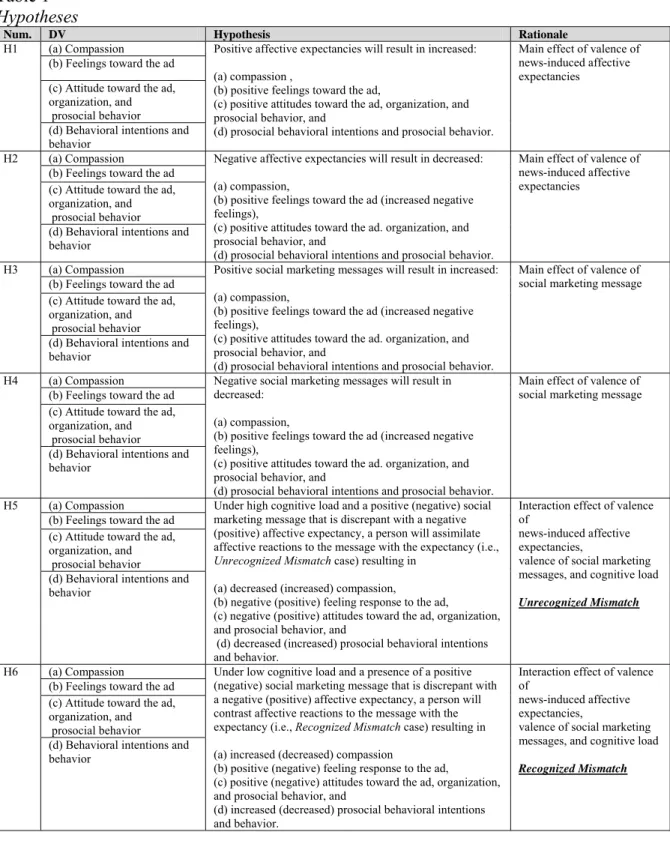
Based on the discussion thus far, formal hypotheses are presented. The hypotheses are summarized in Table 1.
Valence of news-induced affective expectancies. CF may be preceded by the
affective expectation that neither compassion nor helping a suffering person will result in positive feelings (Tester, 2001). These expectations result from negative news frames that imply that the costs of being compassionate may be too high because any help given will not alleviate the suffering of others (Goetz et al., 2010; Moeller, 1999). These negative
expectancies may influence lower levels of compassion, decreased positive attitudes, and prosocial behavior. However, if the news story is positively framed, the opposite effects may ensue. Thus, the following main effects of positive and negative news-induced affective expectancies are presented:
Valence of social marketing messages. Social marketing messages may also be
framed negatively or positively. The CF literature posits that negatively framed social marketing messages can also influence negative reactions to the advertisements (Kinnick et al., 1996). Positive messages would result in the opposite. Thus, the following main effects of a positive or negative social marketing message are presented:
H3: Positive social marketing messages will result in increased: (a) compassion, (b) positive feelings toward the ad, (c) positive attitudes toward the ad, organization, and prosocial behavior, and (d) prosocial behavioral intentions and prosocial behavior. H4: Negative social marketing messages will result in decreased: (a) compassion, (b) positive feelings toward the ad, (c) positive attitudes toward the ad, organization, and prosocial behavior, and (d) prosocial behavioral intentions and prosocial behavior.
Affective expectancies, social marketing messages, and processing resources.
Previous research on the AEM provides a theoretical foundation for how affective expectancies may influence affective reactions toward a social marketing message. The appraisal process in feeling compassion also describes how affective expectations may consequently influence attitudes and behavior. In light of the processing resources available (high or low cognitive load), affective expectancies (positive or negative or no expectancy) can have differing influences on affective reactions to positive or negative persuasive
messages, and subsequent attitudes and behaviors. Accordingly, three interaction hypotheses are presented as follows:
Mismatch case) resulting in (a) decreased (increased) compassion, (b) negative (positive) feeling response to the ad, (c) negative (positive) attitudes toward the ad, organization, and prosocial behavior, and (d) decreased (increased) prosocial behavioral intentions and behavior.
H6: Under low cognitive load and a presence of a positive (negative) social marketing message that is discrepant with a negative (positive) affective expectancy, a person will contrast affective reactions to the message with the expectancy (i.e., Recognized Mismatch case) resulting in (a) increased (decreased) compassion, (b) positive (negative) feeling response to the ad, (c) positive (negative) attitudes toward the ad, organization, and prosocial behavior, and (d) increased (decreased) prosocial behavioral intentions and behavior.
H7: Under either high or low cognitive load and presence of a positive (negative) social marketing message that matches a positive (negative) affective expectancy, a person will assimilate affective reactions to the stimulus with the expectancy (i.e.,
Matching case) resulting in (a) increased (decreased) compassion, (b) positive (negative) feeling response to the ad, (c) positive (negative) attitude toward the ad, organization, and behavior, and (d) increased (decreased) prosocial behavioral intentions and behavior.
No affective expectancies. It is posited in the AEM that not having an expectancy is
H8: Regardless of cognitive load, when no affective expectancy is present, (a) compassion, (b) feeling response to the ad, (c) attitude toward the ad, organization, and prosocial behavior, and (d) prosocial behavioral intentions and prosocial behavior will be influenced by the valence of the social marketing message.
Feelings and compassion. Finally, the CF and persuasion literature posit that
affective reactions toward social marketing messages can influence later attitudes and behavior. In other words, it may be possible that affective expectancies may directly
influence emotional responses to ads and compassion levels and may be indirectly related to attitudes toward the ad, organization, and prosocial behavior, as well as prosocial behavioral intentions and prosocial behavior (see Figure 1). Given the lack of previous research on affective expectancy effects on attitudes and behavior, the following research question is posed:
RQ1: What are the relationships between affective expectancies and the dependent variables of attitudes and behavior?
Negative Social Marketing Messages. The CF literature suggests that negative
that people who saw negative pictures containing sad faces may be more likely to donate than people who saw happy pictures due to emotional contagions. Other studies suggest that there are different circumstances in which negative ads may or may not work to increase positive feelings, attitudes, and prosocial behavior (e.g., Hung & Wyer, 2009; Robert, 1998; White & Peloza, 2009). Given the conflicting nature of the literature, a research question is posed:
CHAPTER TWO MAIN STUDY
Method
A 3 (valence of news-induced affective expectancy: positive vs. negative vs. no expectation) x 2 (valence of social marketing message: positive vs. negative) x 2 (cognitive load: high vs. low) fully-crossed factorial between-subjects experiment was designed to test the hypotheses (see Table 2). In each condition, participants (N = 268) read a news story containing the affective expectancy, received the cognitive load manipulation, and viewed a matching or mismatching advertisement. Participants then completed a post-exposure questionnaire after viewing each stimulus.
Participants
An a priori power analysis was conducted to determine the required sample size to ensure adequate power. Using Cohen’s (1988) effect size estimates, the required sample size to detect moderate effect sizes (f = .25) with power of 0.95 and p < .05 for this between – subjects design was estimated to be 251 (N = 251, λ = 15.69, critical F(2, 239) = 3.03). This analysis was conducted according to the Faul, Erdfelder, Lang, and Buchner (2007)
credit for their participation. Informed consent was obtained according to the University of North Carolina’s Institutional Review Board (IRB) stipulations (see Appendix A). The mean participant age was 20.85 years (SD = 1.41), and all participants were between 18 and 32. Of the 268 participants, 81.7% were female (n = 219) and 18.3% were male (n = 49).
Independent Variables
In this study, three independent variables were manipulated: valence of news-induced affective expectancy, valence of social marketing message, and cognitive load. The valence of the social marketing message (positive or negative) resulted in an ad that was either consistent or discrepant with an affective expectancy. Three pretests were conducted to determine the effectiveness of the manipulations for the independent variables of affective expectancy and valence of the social marketing message.
Valence of news-induced affective expectancy. Previous studies which manipulated
expectancies did so through making certain normative or category-based rules salient. Accordingly, the current study used a news story to manipulate the affective expectancy of whether or not feeling and acting compassionately would make a person feel good. The three conditions included 1) a positive expectancy condition, where the news story contained certain quotes and rules about how one should expect to feel good after acting
compassionately, 2) a negative expectancy condition, where people should not expect to feel good after acting compassionately according to the news story, or 3) a no expectancy
condition, where expectancies are not directly addressed in the content of the news story. A pretest revealed that the manipulation was successful, F(2, 31) = 3.41, p < .05.
Valence of social marketing message. In previous AEM studies, the actual future
Wilson et al. (1989), cartoons that were not funny mismatched the manipulated affective expectancy. In the current study, a social marketing advertisement soliciting prosocial involvement to relieve hunger was the stimulus that either matched or mismatched the induced affective expectancy about acting prosocially. These two conditions included an ad that matched the positive affective expectancy and an ad that matched the negative affective expectancy. The advertising content therefore either confirmed the affective expectancy that feeling and acting compassionately will make the “self” and the suffering “other” feel good or disconfirmed this positive expectancy (confirming the negative expectancy) by only stating the problem. Two pretests were conducted for this manipulation. Argument strength of the claims about the hunger crisis in the U.S. was tested. Twenty-two arguments were tested, of which the top arguments with the highest means (M > 5.25 on a 9-point scale) were used in the advertisement. The second pretest revealed that the manipulation was successful,
F(3, 50) = 7.43, p < .01), where the positive ad was perceived as more positive (M = 6.57, SD
= 1.43) than the negative ad (M = 4.49, SD = .79).
Cognitive Load. In order to manipulate processing-resources available, Shiv and
Wilson et al., 1989). This is because as more information is gained from the stimulus, there is more possibility for recognition of any existing discrepancy between the affective expectancy and ad stimulus.
Stimulus Materials
The stimuli created for each of the affective expectancy conditions in this study contained a news article about hunger in the United States (see Appendix B for stimulus materials). The news story was embedded in a fictitious Washington Post webpage. The participant read about the growing hunger crisis in the United States. Statistics were taken from “Feeding America,” one of the largest hunger-relief charities in the U.S. Other content in the article was gathered from various news stories on hunger from the New York Times.
Embedded in the news articles were quotes and information about how other volunteers, aid workers, and donors felt when they attempted to help relieve hunger. For example, a negative expectancy news story stated norms about how people should feel when acting prosocially by reporting, “Recent attitude surveys have found that donors, aid workers, and volunteers report that other people helping should not expect to feel hopeful after trying to help.” A category-based rule was used when a donor stated, “I couldn’t feel good after I donated. I am deeply concerned because there are too many people that need help.” The negative feelings portrayed in the negative expectancy news story were consistent with feelings of those people with CF, where volunteers and donors did not feel good because there were too many people to help. Either a positive, negative, or neutral picture was also included to match the affective expectancy valence.
problem, and accordingly, will feel good after helping. The story encouraged a person that their actions will positively influence the hunger crisis occurring in the U.S. The negative news story claimed that there were millions who needed help and provided no solution, making negative feelings the cost of being compassionate or acting prosocially due to the inability to help enough people.
The social marketing advertisement was a donation webpage for a fictitious nonprofit organization called the Hunger Relief Now Organization. The ad asked for donations to help relieve hunger. In the positive ad condition, the webpage stated how donors and volunteers should expect to feel good after helping relieve hunger. For instance, in the positive ad
condition, readers were told they may feel good after helping. This ad would match a positive expectancy. In the negative expectancy condition, only the problem of the hunger crisis was discussed. No solution was offered and no reference to how a person would feel was
mentioned. According to the CF literature this would mismatch a positive expectancy, given that no solution or positive feelings are mentioned. The negative ad did not include that a person would feel bad about giving. This is because it is unlikely that an advertisement would tell audience members they might feel bad about giving and the fact that argument strength (M: 2.83 to 5.13 on a 9-point scale) and message strength (M = 4.39 on a 9-point scale) were weaker for ads that included this type of statement.
advertisement, like the news stories, included positive or negative pictures to match the valence of the advertisement.
The cognitive load manipulation involved participants seeing a computer screen with instructions to memorize either an eight-digit number (high cognitive load) or a two-digit number (low cognitive load). They were asked to memorize the number, as they would be reporting it later in the study.
Manipulation Check Measures
Valence of news-induced affective expectancy. Participants were asked to evaluate
the news story. Similar toGeers and Lassiter’s AEM studies (1999, 2002, 2003, 2005), within several filler questions for evaluating the news stories, items were included to measure affective expectancy. Affective expectancy was measured using two scales: self-affective expectancy and other-affective expectancy. The first was an index made up of four semantic differential measures. The items addressed how the participant would expect to feel after helping (e.g., “good/bad,” “satisfied/unsatisfied”). The second measure was an index made up of four semantic differential measures. These items addressed how the participant expected someone else to feel according to the news story (e.g., “happy/unhappy,”
“hopeful/hopeless”). These measures demonstrated a high level of internal consistency (α = .96, α = .97 respectively). All measures can be found in Appendix C.
Valence of social marketing message. Participants were asked to evaluate if the
advertisement was positive or negative. A four-item index made up of semantic differential measures was used to measure how positive or negative the ad content appeared (e.g.,
“optimistic/pessimistic,” “hopeful/hopeless”). This measure also demonstrated internal consistency (α = .88).
Cognitive Load. The same measure used by Shiv and Fedorikhin (1999) to check the
cognitive load manipulation was used for this study. First respondents were asked to recall the number they had to memorize. Second, a thought-listing measure was used in order to count the number of thoughts. A greater number of thoughts indicated higher available processing resources, while a lower number of thoughts indicated lower processing resources.
Dependent Variables
Valence of feelings toward the advertisement. Valence of feeling response toward
the advertisement was measured using 40 items that asked participants to rate how much they felt certain emotions (e.g., “offensive,” “bad,” “warm,” “peaceful,” “happy”) (1 = “not at all” 9 = “very strongly”) in response to the advertisement. These items were adapted from the Feelings Towards Ads scale developed by Edell and Burke (1987). The scale has three subscales: negative feelings (e.g., “sad,” “unhappy,” 15 items) (α = .81), positive warm feelings (e.g., “touched,” “moved,” 13 items) (α = .86), and positive upbeat feelings (e.g., “strong,” “joyous,” 12 items) (α = .91). Confirmatory Factor Analysis was conducted separately for each dependent variable. Results can be found in Appendix D. Descriptive statistics of the dependent variables can be found in Table 3.
Compassion.Compassion levels were measured using an index of 17 items that
true of me”). These items were adapted from the Compassionate Love Scale for Strangers, which measures compassion levels toward strangers as opposed to close others (e.g., family or friends) (Hwang, Plante, & Lackey, 2008; Sprecher & Fehr, 2005). Higher scores
indicated higher levels of compassion. The 17-item scale was assessed for unidimensionality (α = .95).
Attitude toward the ad. Attitude toward the advertisement was measured using an
index made up of five semantic differential measures (e.g., “appealing/unappealing,” “pleasant/unpleasant” “favorable/unfavorable,” “good/bad,” “enjoyable/not enjoyable”) anchored on a 9-point scale. These measures were adapted from Homer (1990), MacKenzie et al. (1986), and Geers and Lassiter (1999). This measure was internally consistent (α = .88).
Attitude toward the organization. Attitude toward the nonprofit organization,
Hunger Relief Now Organization, was measured using an index made up of five semantic differential measures (e.g., “Helpful/Unhelpful,” “Not Useful/Useful”) anchored on a 9-point scale. This measure was internally consistent (α = .95).
Attitude toward prosocial behavior. Attitude toward donating food, time, or money
was measured using an index made up of five semantic differential measures (e.g.,
“pleasant/unpleasant,” “good/bad”) anchored on a 9-point scale that was reliable (α = .93).
Prosocial behavioral intentions.Three items on a 9-point scale were used to
measure behavioral intentions. Participants were asked if they would be willing to donate food, time, or money for hunger relief (1 = “not at all willing,” 9 = “very willing”). The three items were averaged to create a measure for prosocial behavioral intentions that was
Prosocial behavior. All participants were directed to a website to play a game to
donate rice (www.freerice.com) to help relieve hunger. Freerice.com is a website where participants simply answer questions on different subjects (e.g., chemistry, English). For each correct answer, ten grains of rice are donated through the United Nations World Food
Program. The website also provides more information on the issue of world hunger.
Participants were tracked for the length of time spent on the website (M = 134.67seconds or 2.25 minutes) and total number of grains of rice donated (M = 208.92).They were asked to self-report how many questions they answered correctly (M = 19.12) and the number of grains of rice they helped donate (M = 202.41).
Control Variables
Participants’ pre-existing propensity to act prosocially, specifically, to volunteer was assessed using an index of five Likert-type items (e.g. “I can do something for a cause that is important to me”) on a 9-point scale. The items were adapted from Clary et al. (1998). This measure was internally consistent (α = .93). Participants were also asked to answer basic demographic questions, such as age and gender.
Procedure
stories consistent with the cover story. The participants, after viewing the news stories, answered the first manipulation check questions and filler questions consistent with the cover story of evaluating news stories.
To avoid demand characteristics of the experiment, participants were then told to sign a second consent form that signaled the start of the second study, which participants were told was about the effects of memory on evaluations of an online advertisement. Participants were first given either a two- or eight-digit number to memorize. The instructions requested participants to view and memorize a number presented on the computer screen, as they would be reporting it later. Participants then viewed the hunger relief webpage for as long as they needed. They were then asked to answer a web-based questionnaire containing the second set of manipulation check questions, dependent variables, and control variables.
Participants were asked at the end of the study what they thought the study was about to make sure that they did not suspect the nature of the connection between the first study (evaluating news stories) and the second (evaluating advertisements). The reason for this is because conscious awareness that the news stories may influence reactions to ads may make people correct for these influences (Wilson & Gilbert, 2003). No participant suspected a connection, and, as a result, no cases were eliminated from the analysis in relation to this. After completing the questionnaire, participants were debriefed, thanked, and dismissed.
Results
Prior to tests of the hypotheses, the data were screened for univariate and multivariate outliers with regard to the dependent variables, and cases were removed accordingly.
Manipulation Checks
Valence of news-induced affective expectancy. To test the efficacy of the affective
expectancy manipulation, two ANOVAs were run with valence of the news-induced affective expectancy, valence of the social marketing message, and cognitive load as independent factors, and the two indices for self- and other- affective expectancy as the dependent variables. The first ANOVA, with self-affective expectancy as the dependent variable revealed a statistically significant main effect for affective expectancy F(2, 256) = 152.58, p
< .001, such that affective expectancies were more positive for the positive affective expectancy conditions (M = 7.58, SE = .29 ) than for the negative affective expectancy conditions (M = 5.01, SE = .26) and the no expectancy conditions (M = 5.94, SE = .26).The effects of the valence of the social marketing message and cognitive load were not
statistically significant, nor were any of the interaction effects between valence of the
affective expectancy, valence of the social marketing message, and cognitive load. Therefore, the ANOVA on self-affective expectancy indicated that the affective expectancy
manipulation was successful. Results for manipulation check analyses are shown in Table 4. The second ANOVA, with other-affective expectancy as the dependent variable revealed a statistically significant main effect for affective expectancy F(2, 256) = 210.34, p
other-affective expectancy indicated that the affective expectancy manipulation was successful.1
Valence of social marketing message. To test the efficacy of the valence of the
social marketing message manipulation, an ANOVA was run with valence of news-induced affective expectancy, valence of social marketing message, and cognitive load as
independent factors, and the valence of the social marketing message index as the dependent variable. The effect of valence of the social marketing message on the dependent variable was significant, F(1, 256) = 244.81, p < .001, such that ad content was perceived as more positive in the positive ad message conditions (M = 7.44,SE = .14) than the negative ad message conditions (M = 4.42, SE = .14). Neither the main effect of valence of affective expectancy or cognitive load, nor the interaction effects between valence of the affective expectancy, valence of the social marketing message, and cognitive load attained statistical significance. Therefore, the ANOVA on the valence of the social marketing message measure indicated that the valence of the social marketing message manipulation was successful.2
Cognitive Load. To test the efficacy of the cognitive load manipulation, an ANOVA
was run with valence of the news-induced affective expectancy, valence of the social marketing message, and cognitive load as independent factors and the number of thoughts generated during the thought-listing portion of the study as the dependent variable. The ANOVA revealed a statistically significant main effect for cognitive load, F(1, 256) = 17.46,
p < .001, with participants generating more thoughts in the low cognitive load conditions (M
1The credibility of the news articles was measured using a six-item scale. Results indicated that the news
articles were credible (M = 6.81).
= 8.59,SE = .28) than in the high cognitive load conditions (M = 6.90, SE = .28). Neither the main effect of valence of affective expectancy or social marketing message, nor the interaction effects between valence of the affective expectancy, valence of the social marketing message, and cognitive load attained statistical significance. Therefore, the
ANOVA on the number of thoughts generated indicated that the cognitive load manipulation was successful.
Tests of Hypotheses
Compassion: H1a-H8a. Hypotheses 1a (positive affective expectancies) and 2a
(negative affective expectancies) predicted that there would be a main effect for affective expectancies on compassion, such that positive affective expectancies would result in increased compassion. Hypotheses 3a (positive social marketing message) and 4a (negative social marketing message) predicted that there would be a main effect for the valence of the social marketing message on compassion, such that a positive message would result in increased compassion. The data were analyzed using a series of 3 x 2 x 2 between-subjects ANOVAs. A summary of the analyses for the main effects is located in Table 5.
A between-subjects ANOVA with compassion as the dependent variable indicated no significant main effect for affective expectancy, F(2, 251) = 1.50, p = .23. Therefore, H1a and H2a were not supported. The results did indicate the means were in the predicted
direction with positive expectancies resulting in higher compassion (M = 6.24) than negative expectancies (M = 6.00).
A significant main effect for valence of the social marketing message was found, F(1, 251) = 6.52, p <.01. The negative ad condition elicited more compassion (M = 6.38, SE =
analysis indicated the means were in the opposite of the predicted direction, hypotheses 3a and 4a were not supported.
Hypotheses 5a, 6a, 7a, and 8a (H5a-H8a) predicted that there would be a three-way interaction effect between valence of the affective expectancy, valence of social marketing message, and cognitive load on compassion. A between-subjects ANOVA with compassion as the dependent variable indicated no significant interaction effect, F(2, 251) = .64, p = .53. The means, however, were partially in the direction hypothesized. A high cognitive load, negative affective expectancy, and a positive ad condition (unrecognized mismatch)
produced lower compassion levels (M = 5.94) than the negative ad condition (matching) (M = 6.34) as predicted by H5a. Under low cognitive load and negative affective expectancy however, a positive ad (recognized mismatch) produced higher compassion levels (M = 5.98) than the negative ad (matching) (M = 5.75) as predicted by H6a (means are located in Table 6). Given that the interaction effects were not significant, H5a-H8a were not supported.
Valence of feeling: H1b-H8b. Hypotheses 1b (positive affective expectancies) and
2b (negative affective expectancies) predicted that there would be a main effect for affective expectancies on valence of feelings, such that positive expectancies would result in increased positive feelings toward the social marketing message. Hypotheses 3a (positive social