AUSTRALIAN JOURNAL OF BASIC AND
APPLIED SCIENCES
ISSN:1991-8178 EISSN: 2309-8414 Journal home page: www.ajbasweb.com
Open Access Journal
Published BY AENSI Publication
© 2016 AENSI Publisher All rights reserved
This work is licensed under the Creative Commons Attribution International License (CC BY). http://creativecommons.org/licenses/by/4.0/
To Cite This Article: K. Senthil Kumar and R. Amutha, Delay Efficiency Analysis of Turbo Coded Cooperative Communication in Wireless Sensor Networks. Aust. J. Basic & Appl. Sci., 10(1): 451-456, 2016
Delay Efficiency Analysis of Turbo Coded Cooperative Communication in
Wireless Sensor Networks
1K. Senthil Kumar and 2R. Amutha
1Department of ECE Rajalakshmi Engineering College Tamil Nadu -602 105, India. 2Department of ECE SSN College of Engineering Tamil Nadu -603 110, India.
Address For Correspondence:
K. Senthil Kumar, Department of ECE Rajalakshmi Engineering College Tamil Nadu -602 105, India E-mail: [email protected]
A R T I C L E I N F O A B S T R A C T Article history:
Received 10 December 2015 Accepted 28 January 2016 Available online 10 February 2016
Keywords:
delay efficiency; C-MISO; turbo codes; QAM; WSN
Delay efficiency is one among the main issues in Wireless Sensor Network (WSN). In this paper, a Cooperative Multiple-Input-Single-Output (C-MISO) scheme based on turbo codes with Multi level-Quadrature Amplitude Modulation (M-QAM) is proposed, which overcomes the delay constraint in WSN. Also, delay analysis of turbo coded C-MISO scheme is compared with the traditional uncoded cooperative scheme and turbo coded Single-Input-Single-Output (SISO) scheme. The simulation results show that significant delay efficiency can be obtained through the proposed turbo coded cooperative communication.
INTRODUCTION
Wireless sensor networks (WSNs) are composed of a number of sensor nodes equipped with small batteries. So, there is a strict energy limitation and also the replacement of batteries for these devices is impossible or difficult. In order to overcome this limitation, the data transfer between the nodes in WSN should be carried out efficiently within less time and also the nodes should consume less energy. Multiple antenna systems enable communication at high data rate over multipath fading channels using Multiple-Input-Multiple-Output (MIMO) technology. However, it is impractical to apply MIMO technology to small WSN devices since small sensor nodes may only be able to have a single antenna. Therefore, through collaboration of several single-antenna-equipped devices, a multi-device virtual MIMO technique called cooperative MIMO (C-MIMO) has been proposed in (Li, X., 2003).
Using this approach, WSNs can configure several virtual topologies including Cooperative Single-Input- Multiple-Output (C-SIMO), Cooperative Multiple-Input- Single-Output (C-MISO) and C-MIMO which are collectively called C-MIMO technology (Ahmad Hasan Khan and K.C. Roy, 2013; Shuguang Cui, A.J. Goldsmith and Ahmad Bahai, 2004; Sudharman, K. Jayaweera, 2006) and (Shuguang Cui, A.J. Goldsmithand A. Bahai, 2006).
452 K. Senthil Kumar and R. Amutha, 2016
Australian Journal of Basic and Applied Sciences, 10(1) January 2016, Pages: 451-456
incorporated in cooperative communication as an error control code. The delay model for the proposed turbo coded C-MISO scheme is developed. Later, the proposed scheme is compared with turbo coded SISO communication to analyze the delay efficiency.
Multi-hop C-MISO Scheme:
A. System Model:
In wireless sensor network, to apply C-MISO scheme the nodes need to be equipped with Space Time Block Codes (STBC) (Paulraj, A., R. Nabar and D. Gore, 2003; Proakis, J.G., 2000) and (Alamouti, S.M., 1998) encoding and decoding capability as well as basic relaying capability. Consider a homogeneous two hop C-MISO network. “Homogeneous” refers to a multi-hop configuration with the same configuration applied to all hops (Jong - Moon Chung, et al., 2012).
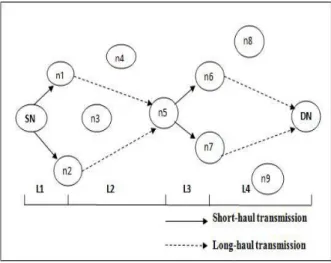
The considered network model shown in Figure 1 includes a total of 11 nodes- SN, DN, n1, n2, n3,n4, n5, n6, n7, n8 and n9. It is a two hop model, where the first hop is from the source node (SN) to node n5 and the second hop is from n5 to the destination node (DN). In the first hop, SN is the upstream node and n5 is the downstream node. Likewise, in the second hop n5 is the upstream node and DN is the downstream node. As the node n5 connects two hops it is referred as the inter-hop node. Here, C-MISO networking starts with SN sequentially distributing packets to its cooperating nodes n1 and n2 in level L1 (short-haul transmission at the transmitter end).
Fig. 1: Two hop C-MISO network model
In level L2, the nodes n1 and n2 encode the received packets and simultaneously transmit to node n5 (long-haul transmission at the transmitter end). Node n5 decodes the two space diversifying signals and in level L3 it repeats the actions of SN in level L1. Similarly, in level L4 the nodes n6 and n7 repeats the actions of nodes n1 and n2 in level L2 (long-haul transmission at the receiver side) and finally the packets reach the destination node (DN).
B. Delay Model:
The total time delay (T) required for a system with Mt transmitting nodes and Mr receiving nodes each with
one antenna can be calculated as the sum of transmission delay (Ttr), propagation delay (Tpr) and processing
delay (Tpc) [13]. The total time delay is given by Equation (1) as,
t r p r p c
T
=
T
+
T
+
T
(1)For an uncoded cooperative MISO system with Mt=2 nodes and Mr =1 node, the total time delay (TC-MISO)
can be calculated as the sum of transmission delay (Ttr_MISO), propagation delay (Tpr_MISO) and processing delay
(Tpc_MISO), which is given by Equation (2) as,
MISO pc MISO pr MISO tr MISO
C
T
T
T
T
−=
_+
_+
_(2)
+
=
∑
=∑
= m i i t i i i s MISO trb
b
T
T
1 1_ (3)
where
b
it represents the constellation size (bits per symbol) used during the local transmission on thetransmitter side, bm represents the constellation size used in the alamouti code, Ts is the symbol period which is
assumed to be approximately equal to B Ts
1
≈ for a fixed transmission bandwidth B and Ni is the number of bits
to be transmitted, where i = 1,…Mt . The first term in Equation (3) is the local delay value contributed by the
transmitter side, and the second term is the delay caused by the long-haul C-MISO transmission.
The propagation delay of uncoded C-MISO system (
T
pr_MISO ) is given by Equation (4) as,c
d
c
d
T
l L MISOpr_
=
+
(4)where c is the velocity of light, dL and dl represents the long-haul transmission distance and local
transmission distance at the transmitter side.
The processing delay of uncoded C-MISO system,
(Tp c_M IS O) is given by Equation (5) as,
_ m o d m o d
p c M I S O d e
T = T + T
(5)
where
m o d
T is the time taken for modulation and Td em o d is the time taken for demodulation.
Similarly, for the turbo coded C-MISO (Tturbo_C-MISO) system with Mt=2 nodes and Mr =1 node, the total
time delay can be calculated as the sum of transmission delay (Tturbo_tr_MISO), propagation delay (Tturbo_pr_MISO)
and processing delay (Tturbo_pc_MISO), which is given by Equation (6) as,
_ _ _ _ _ _ _
turbo C MISO turbo tr MISO turbo pr MISO turbo pc MISO
T
−=
T
+
T
+
T
(6)
The transmission delay of the turbo coded C-MISO system (
_ _
tu r b o tr M I S O
T ) with the turbo code rate rt and
Mt=2 nodes, Mr =1 node is given by Equation (7) as,
1 1 _ _ t t M M i i i i
t u r b o t r M I S O s t
t i t m
N N
T T
r b r b
= = = +
∑
∑
(7)The propagation delay of the turbo coded C-MISO system (Ttu rb o_p r_M IS O ) with Mt=2 nodes and Mr =1
node is given by Equation (8) as,
_ _
L l
t u r b o p r M I S O
d d
T
c c
= + (8)
The processing delay of the turbo coded C-MISO system (
_ _
tu r b o p c M I S O
T ) with Mt=2 nodes and Mr =1
node is given by Equation (9) as,
_ _ m o d m o d
t u r b o p c M I S O d e e n c o d e d e c o d e
T =T +T +T +T
(9)
where
en co d e
T and
d e c o d e
T is the time taken for turbo encoding and decoding respectively.
SISO can be treated as a special case of C-MISO with Mt = Mr = 1. A SISO differs from C-MISO as it does
not have local transmission on the transmitter side, it only has long-haul transmission between the source and
destination node. Thus, the total time delay of uncoded SISO system (TSISO) can be calculated as the sum of
transmission delay (Ttr_SISO), propagation delay (Tpr_SISO) and processing delay (Tpc_SISO), which is given by
Equation (10) as,
_ _ _
S IS O tr S IS O p r S IS O p c S IS O
T =T +T +T (10)
The transmission time of the uncoded SISO system (Ttr_SISO) is defined by Equation (11) as,
_
i t r S IS O s
n N T T b = (11)
where Ni is the number of bits to be transmitted and bn is the constellation size used in the SISO long-haul
transmission. The propagation time of the uncoded SISO system (Tpr_SISO) with long-haul transmission distance
454 K. Senthil Kumar and R. Amutha, 2016
Australian Journal of Basic and Applied Sciences, 10(1) January 2016, Pages: 451-456
_
p r S I S O
d T
c
= (12)
The processing time of the uncoded SISO system (Tpc_SISO) is given by Equation (13) as,
_ m o d m o d
p c S I S O d e
T
=
T
+
T
(13)Similarly, for the turbo coded SISO system the total time delay (Tturbo_SISO) can be calculated as the sum of
transmission delay (Tturbo_tr_SISO), propagation delay (Tturbo_pr_SISO) and processing delay (Tturbo_pc_SISO), which is
given by Equation (14) as,
_ _ _ _ _ _ _
turbo SISO turbo tr SISO turbo pr SISO turbo pc SISO
T
=
T
+
T
+
T
(14)The transmission delay of the turbo coded SISO system (
_ _
tu r b o tr S I S O
T ) with turbo code rate, rt is given by
Equation (15) as,
_ _
i t u r b o t r S I S O s
n t
N
T T
b r
=
(15)
The propagation time of the turbo coded SISO system (Tturbo_pr_SISO) with long-haul transmission distance d
is given by Equation (16) as,
_ _
t u r b o p r S I S O
d T
c
= (16)
The processing time of the turbo coded SISO system (Tturbo_pc_SISO) is given by Equation (17) as,
_ _ mod mod
turbo pc SISO de encode decode
T
=
T
+
T
+
T
+
T
(17)
The delay difference (DD) is a measure of the performance of the system. Delay difference is calculated by the equation (18) as,
_ _
tu r b o S IS O tu r b o M IS O
D D
=
T
−
T
(18)Positive value of delay difference from Equation (18) depicts that the proposed turbo code based C-MISO networking is delay efficient in WSN.
Performance Analysis:
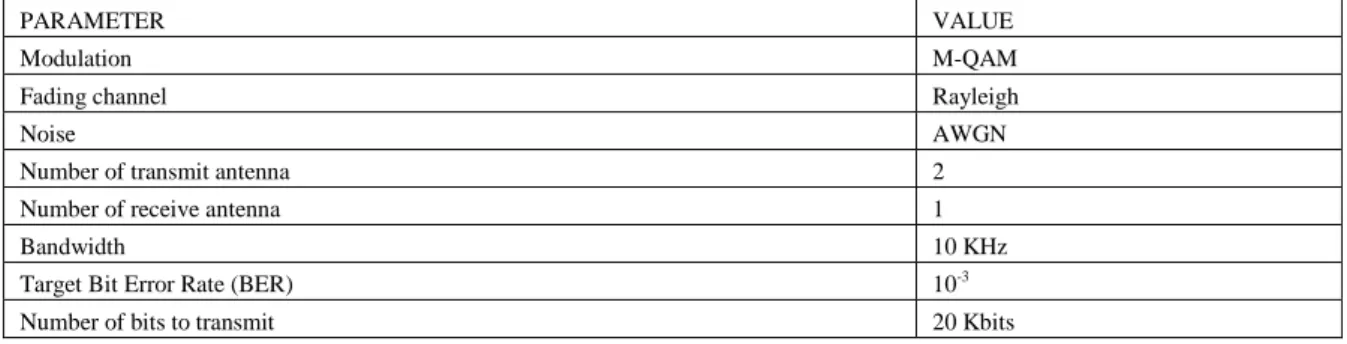
The performance analysis of the delay efficient cooperative communication in WSN using turbo codes is carried out using MATLAB. The performance of turbo coded and uncoded C-MISO systems are compared and the system with significant delay efficiency is analyzed. Table 1 summarizes the simulation parameters used in the analysis. The optimized constellation size for M-QAM modulation is listed in Table 2 (Shuguang Cui, et al., 2005).
Table 1: Simulation parameters
PARAMETER VALUE
Modulation M-QAM
Fading channel Rayleigh
Noise AWGN
Number of transmit antenna 2
Number of receive antenna 1
Bandwidth 10 KHz
Target Bit Error Rate (BER) 10-3
Number of bits to transmit 20 Kbits
Table 2: Optimized constellation size for M-QAM modulation
Distance (m) 1 5 10 20 40 70 100 150 200
MISO 14 10 8 6 5 4 3 2 1
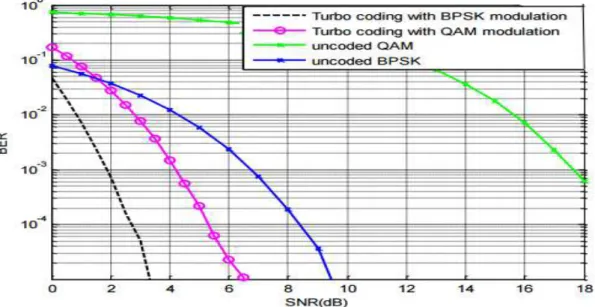
Figure 2 shows the BER performance of uncoded and turbo coded system for Binary Phase Shift Keying
(BPSK) and QAM modulations. From the Fig. 2, it can be observed that for a target BER of 10-3, the SNR
required for the uncoded system is higher than the turbo coded system. Therefore, it is clear that turbo coding reduces the required signal power and thus it is energy efficient. On considering the modulation technique, turbo code with BPSK requires less SNR when compared to turbo code with QAM modulation. But, on analyzing with respect to delay efficiency, the number of symbols to be transmitted is 20,000 in BPSK; on the other hand, it is only 10,000 symbols for QAM modulation (4-QAM). Thus, it can be concluded that turbo code with BPSK modulation is efficient in terms of energy and not delay. On the other hand, QAM modulation achieves significant energy saving when compared to the uncoded system and is also delay efficient. Therefore, QAM modulation technique is used for further analysis.
Figure 3 shows the delay performance comparison between the turbo coded C-MISO and SISO systems. The total time delay of the turbo coded C-MISO system with optimal constellation size for various distances is computed. Similarly, the total time delay of the turbo coded SISO with optimal constellation size for various distances is computed. With the computed delay values, the Delay Difference (DD) is calculated and plotted with respect to distance. From the Fig. 3, it can be observed that the delay difference is negative for distance less than 50 m. The delay difference becomes positive after a distance of about 50 m. The positive values of delay difference indicate that the turbo coded C-MISO system is delay efficient when compared to the turbo coded SISO system.
Fig. 2: BER Performance comparison of uncoded system with turbo coded system for various modulation
techniques
456 K. Senthil Kumar and R. Amutha, 2016
Australian Journal of Basic and Applied Sciences, 10(1) January 2016, Pages: 451-456 Conclusion:
Delay efficient data transmission is one of the key factors for delay constraint wireless sensor network. In this paper, a delay model for cooperative communication with M-QAM modulation using turbo codes is proposed. Simulation results show that turbo coded C-MISO communication system achieves significant delay efficiency when compared to turbo coded SISO system. Thus, it can be concluded that turbo coded cooperative MISO system is delay efficient.
REFERENCES
Ahmad Hasan Khan and K.C. Roy, 2013. “Comparison of turbo codes and low density parity check codes”, IOSR journal of electronics and communication engineering, e-ISSN: 2278-2834, p- ISSN: 2278-8735, 6(6): 11-18.
Alamouti, S.M., 1998. “A simple transmit diversity technique for wireless communications”, IEEE J. Sel. Areas Commun., 16(8): 1451-1458.
Jong - Moon Chung, Joong Kim, and Donghyuk Han, 2012. “Multihop Hybrid Virtual MIMO Scheme for Wireless Sensor Networks”, IEEE Transactions on vehicular Technology, 61(9): 4069-4078
Li, X., 2003. “Energy efficient wireless sensor networks with transmission diversity”, IEEE Electron. Lett., 39(24): 1753-1755.
Mohammad Rakibul Islam and Y.S. Han, 2011.“Cooperative MIMO Communication at Wireless Sensor Network: An Error Correcting Code Approach,” Sensors 11: 9887-9903; DOI: 3390/s111009887.
Paulraj, A., R. Nabar and D. Gore, 2003. “Introduction to Space-Time Wireless Communications”, preprint, Cambridge University Press: Cambridge, UK.
Proakis, J.G., 2000. “Digital Communications”, 4th Ed. New York: McGraw-Hill.
Shuguang Cui, A.J. Goldsmith and A. Bahai, 2003. “Modulation optimization under energy constraints,” in Proc. ICC’03, AK, pp: 2805-2811.
Shuguang Cui, A.J. Goldsmith and Ahmad Bahai, 2004. “Energy efficiency of MIMO and co-operative MIMO techniques in sensor networks”, IEEE selected areas in Communications, 22(6): 1089-1098.
Shuguang Cui, A.J. Goldsmith and Ahmad Bahai, 2005. “Energy – constrained modulation optimization”, IEEE Transactions on Wireless Communications, 4(5): 2349-2360.
Shuguang Cui, A.J. Goldsmithand A. Bahai, 2006. “Cross-layer design of energy constrained networks using cooperative MIMO techniques,” EURASIP J.Appl. Signal Process., 86(8): 1804-1814.
Sudharman, K. Jayaweera, 2006. “Virtual MIMO based Cooperative Communication for Energy- constrained Wireless Sensor Networks”, IEEE Transactions on Wireless Communications, 5(5): 984-989.