Taylor Polynomials and Taylor Series Math 126
In many problems in science and engineering we have a function f(x) which is too complicated to answer the questions we’d like to ask. In this chapter, we will use local information near a point x =b to find a simpler function g(x), and answer the questions usingginstead off. How useful the answers will be depends upon how closely the function g approximates f, so we also need to estimate, or bound, the error in this approximation: f −g.
§1. Tangent Line Error Bound.
Ken is at work and his car is located at his home twenty miles north. Fifteen minutes from now, in the absence of any other information, his best guess is that the car is still at home. How accurate is this guess? If Ken knows his son will drive the car no faster than 40 miles per hour in the city, how far away can the car be in 15 minutes? A moment’s reflection should give you the estimate (or bound) that his son can drive the car no further than 10 miles (14 hour at 40 mph) so that the car will be within 10 miles of home, or no more than 30 miles from Ken. We can also see this by using the Fundamental Theorem of Calculus. Suppose Ken’s son is driving the car in a straight line headed north and suppose x(t) is the distance of the car from Ken at time t then
x(t)−x(0) =
Z t
0
x0(u)du.
Herex0(u) is the velocity at timeu. In this problem we know|x0(u)| ≤40 for all ubetween 0 and t, so that
|x(t)−x(0)|=
Z t
0
x0(u)du
≤
Z t
0 |
x0(u)|du
(1.1) ≤
Z t
0
There are a couple of steps above that need justification. First we used the inequality
Z
x0(u)du
≤
Z
|x0(u)|du.
The integral R
x0(u)du represents the area which is below the curve y = x0(u) and above the u-axis minus the area which is above the curve and below the u axis. Whereas the right-hand side is equal to the total area between the curve and the u axis, and so the right-hand side is at least as big as the left. Secondly we replaced the function |x0(u)| by the larger constant 40 and the area under the curve y = 40 is at least as big as the area under the curve y=|x0(u)|.
This was a rather long-winded way to get the same bound, but it works in general: if |f0(t)| ≤M for all t between b and x, then
|f(x)−f(b)| ≤M|x−b|.
Test your understanding by writing out the reasoning behind this inequality.
If we have more information, then we can get a better approximation. For example, suppose Ken’s wife called and said that their son left home driving north at 30 miles per hour. Then we might guess that after 15 minutes he is 30/4 or 7.5 miles north of Ken’s home. Here we’ve used the tangent line approximation
x(t)−x(0)≈x0(0)(t−0).
Recall that the equation of the line which is tangent to the graph of y =f(x), when x=b, passes through the point (b, f(b)) and has slopef0(b). The equation of the tangent line is then:
y−f(b) =f0(b)(x−b) or
y =f(b) +f0(b)(x−b),
(b, f(b))
x y
y =f(x)
Figure 1. Tangent line through (b, f(b))
In Chapter 3 of Stewart, we found that the tangent line was useful for approximating complicated functions: the graph of the linear function y= f(b) +f0(b)(x−b) is close to the graph of y =f(x) if x is near b. In other words
f(x) =f(b) +f0(b)(x−b) + error. How big is the error?
error
b x
y y=f(b) +f0(b)(x−b)
y =f(x)
Figure 2. Error in tangent line approximation.
Tangent Line Error Bound. If |f00(t)| ≤M for allt between x and bthen
|error|=
f(x)−[f(b) +f0(b)(x−b)]
≤
M
2 |x−b| 2.
In terms of the previous example, if we know that Ken’s son starts with a speed of 30 mph and accelerates no more that 20mi/hr2 while driving away, then at time t we can estimate his location as
x(t)≈x(0) +x0(0)t
and the error in this approximation can be bounded by the Tangent Line Error Bound:
x(t)−[x(0) +x0(0)t]
≤
20 2 t
In particular, after 15 minutes, the error
x(14)−[20 + 30· 14]
is at most 202(14)2 = 58 miles. Check the details to be sure you understand.
Another question we could ask is: how long will it take Ken’s son to be 25 miles from Ken? Replace the complicated (and unknown) functionx(t) with the linear approximation y=x(0) +x0(0)t to answer the question:
25 =|x(0) +x0(0)t|=|20 + 30t|, so t= 1/6, or 10 minutes would be the approximate answer.
A more difficult question is: when can Ken be sure his son is at least 25 miles from Ken? To answer this question, we write the error bound (1.3) in a different form:
−10t2 ≤x(t)−(20 + 30t)≤10t2. Adding 20 + 30t to the left hand inequality we obtain
20 + 30t−10t2 ≤x(t).
So to guarantee 25≤x(t), it is sufficient to have
25≤20 + 30t−10t2,
or at least (3−√7)/2 hours, which is about 11 minutes. (It might take this long if he is “decelerating” because we really assumed that the absolute value of the acceleration was at most 20.)
Why is the Tangent Line Error Bound true? Suppose x > b then by the Funda-mental Theorem of Calculus
f(x)−f(b) =
Z x
b
Treat x as a constant for the moment and setU =f0(t),V =t−x and integrate by parts to obtain
f(x)−f(b) =f0(t)(t−x) x b−
Z x
b
(t−x)f00(t)dt
(1.4) =f0(b)(x−b) +
Z x
b
f00(t)(x−t)dt.
Subtracting f0(b)(x−b) from both sides we obtain
f(x)−[f(b) +f0(b)(x−b)]
≤
Z x
b |
f00(t)|(x−t)dt≤
Z x
b
M(x−t)dt= M
2 (x−b) 2.
Here we used the same ideas as the inequalites in (1.1) and the fact that x−t≥0. The case when x < b is proved similarly. You might test your understanding of the above argument by writing out a proof for that case.
Example 1.1. Find a bound for the error in approximating the functionf(x) = tan−1(x) by the first Taylor polynomial (tangent line approximation) based atb= 1 on the interval I = [.9,1.1].
The first step is to find the tangent line approximation based at 1:
y= π
4 + 12(x−1). Then calculate the second derivative:
f00(x) = −2x (1 +x2)2 and for x in the interval I,
|f00(x)|= 2x (1 +x2)2.
By computing a derivative, you can show that |f00(x)| is decreasing on the interval I so that its maximum value on I is equal to its value at x= 0.9, and
|f00(x)| ≤ 2(0.9)
Setting M = 0.55, the Tangent Line Error Bound gives
tan−1(x)−[π
4 + 12(x−
π
4)]
≤
0.55
2 (x−1)2 ≤0.0028. In other words, if we use the simple function y = π
4 + 12(x−1) instead of the more complicated tan−1(x), we will make an error in the values of the function of no more than 0.0028 when x is in the intervalI.
Example 1.2. For the same function f(x) = tan−1(x), find an interval J so that the error is at most 0.001 on J.
The interval J will be smaller than the interval I, since .001 < .0028, so the same bound holds for x in J:
tan−1(x)−[π
4 + 12(x−
π
4)]
≤
0.55
2 (x−1)2. The error will be at most 0.001 if
0.55
2 (x−1)2 ≤0.001 or
|x−1|< .0603...
Thus if we set J = [.94,1.06] then the error is at most 0.001 when x is in J.
§2. Quadratic Approximation
In many situations, the tangent line approximation is not good enough. For example, if h(t) is the height of baseball thrown into the air, then h(t) is influenced by its initial positionh(0), initial vertical velocityh0(0) and vertical accelerationh00 =−gdue to gravity.
A simple model for the h(t) can be found by integration: h(t)≈h(0) +h0(0)t− g
2t
2. (2.1)
However, there are other forces on the baseball, for example air resistance is important. The right-hand side of (2.1) is called a quadratic approximation to the function h. How do we find a quadratic approximation to a function y = f(x) and how accurate is this approximation? The secret to solving these problems is to notice that the equation of the tangent line showed up in our integration by parts in (1.4). Let’s integrate (1.4) by parts again.
Treat x as a constant again and set U = f00(t), V = −12(x−t)2 and integrate (1.4) by parts to obtain
f(x)−f(b) =f0(b)(x−b) +
Z x
b
f00(t)(x−t)dt
(2.2) =f0(b)(x−b)−f00(t)12(x−t)2
x b+
1 2
Z x
b
f000(t)(x−t)2dt. Moving everything except the integral to the left-hand side,
f(x)−[f(b) +f0(b)(x−b) + 21f00(b)(x−b)2] = 12 Rx b f
000(t)(x−t)2dt.
Definition. We call
T2(x) =f(b) +f0(b)(x−b) + 12f00(b)(x−b)2
the quadratic approximation or second Taylor polynomialfor f based at b.
Quadratic Approximation Error Bound. If |f000(t)| ≤ M for all t between x and b then
|f(x)−T2(x)|=
f(x)−[f(b) +f0(b)(x−b) + 12f00(b)(x−b)2]
≤
M
6 |x−b|3.
The differencef(x)−T2(x) is the error in the approximation off by the second Taylor polynomial based at b. The third derivative measures how rapidly the second derivative is changing. In the baseball example above, if we can bound how rapidly the acceleration can change: |h000(t)| ≤ M, then we can bound how closely the second Taylor polynomial h(0) +h0(0)t+ 12h00(0)t2 approximates the true height h(t).
Another important property of the second Taylor polynomial, which you can verify by differentiation, is thatT2 has the same value, the same derivative, and the same second derivative as f at b:
T2(b) =f(b), T20(b) =f0(b), T200(b) =f00(b).
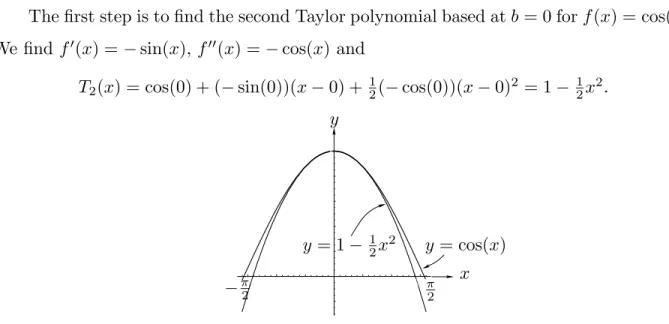
The second Taylor polynomial T2 is the only quadratic polynomial with this property. Example 2.1. Find a bound for the error in approximating the function f(x) = cos(x) using the second Taylor polynomial (quadratic approximation) based at b = 0 on the interval I = [−.2, .2].
The first step is to find the second Taylor polynomial based atb= 0 forf(x) = cos(x). We find f0(x) =−sin(x), f00(x) =−cos(x) and
T2(x) = cos(0) + (−sin(0))(x−0) + 12(−cos(0))(x−0)2 = 1− 12x2.
-1.5 -1 -0.5 0.5 1 1.5
-0.2 0.2 0.4 0.6 0.8 1
x y
y= cos(x) y = 1− 12x2
π
2 −π
2
To bound the error, we find |f000(x)|= |sin(x)| ≤1. Setting M = 1 in the Quadratic Approximation Error Bound
|cos(x)−[1− 12x2]| ≤ 16|x3| ≤.0014
since |x| ≤ 0.2 on I. If we were a bit cleverer, we might have noticed that |f000(x)| =
|sin(x)| ≤ |x| ≤0.2 (see page 212 in Stewart) so that we could have takenM = 0.2 instead of M = 1, which gives the better error bound of 0.00027.
§3. Higher Order Approximation and Taylor’s Inequality
In this section we will extend the ideas of the two preceeding sections to approxima-tions by higher degree polynomials. The ideas are the same. But first we introduce some notation to make it easier to describe the results.
n! =n·(n−1)·(n−2)· · ·2·1,
read “n factorial”, is the product of the first n integers, so that 1! = 1, 2! = 2, 3! = 6, 4! = 24 and so forth. Also
f(k)(x)
denotes the kth derivative of f at x. If we integrate equation (2.2) by parts again, we
obtain
f(x) =f(b) +f0(b)(x−b) + 12f00(b)(x−b)2+ 1
3·2f(3)(b)(x−b)3+ 31·2
Rx
b f(4)(t)(x−t)3dt.
The pattern continues (and can be proved by mathematical induction) by integrating by parts:
f(x) =f(b) +f0(b)(x−b) +. . .+ 1 n!f
(n)(b)(x−b)n
+
+1 n!
Z x
b
f(n+1)(t)(x−t)ndt. (3.1) The dots “. . .” in the above formula mean that the pattern continues until the term after the dots is reached.
Definition. The nth Taylor polynomial forf based at bis
Tn(x) =f(b) +f0(b)(x−b) +
1 2·1f
(2)(b)(x
−b)2+. . .+ 1 n!f
(n)(b)(x
−b)n.
There are a lot of symbols in the above formula. Keep in mind thatx is the variable. The base b is a fixed number. The nth Taylor polynomial has terms which are numbers
(called coefficients) times powers of (x−b).
Equation (3.1) gives a formula for the errorf(x)−Tn(x). We can bound this error in
Taylor’s Inequality. Suppose I is an interval containing b. If |f(n+1)(t)| ≤ M for all t in I then
|f(x)−Tn(x)| ≤
M
(n+ 1)!|x−b|
n+1
for all x inI, where Tn is the nth Taylor polynomial for f based at b.
By equation (3.1) and the definition of Tn, if x > bthen
|f(x)−Tn(x)| ≤
1 n!
Z x
b |
f(n+1)(t)(x−t)n|dt
≤ 1 n!
Z x
b
M(x−t)ndt= M
(n+ 1)!(x−b)
n+1.
The case x < b can be proved similarly.
A few observations might be useful.
• The Tangent Line Error Bound is just Taylor’s Inequality with n= 1 and
• the Quadratic Approximation Error Bound is just Taylor’s Inequality with n= 2. • The nth Taylor polynomial T
n based at b has the same value as f at b and the same
first n derivatives as f at b. In fact Tn is the only polynomial of degree n with this
property.
• The right-hand side in Taylor’s Inequality is similar to the last term in Tn+1. It has the same power ofx−band the same (n+ 1)! but otherwise it is different.
Check the third observation for yourself by finding the first few derivatives of Tn and
evaluating them at b. The rigorous proof uses mathematical induction.
Example 3.1. Suppose f(x) = 1−x1 . Find the nth Taylor polynomial T
n(x) for f based
at b= 0.
We first find the derivatives of f(x) = (1−x)−1:
f0(x) = (1−x)−2
f(3)(x) = 3·2(1−x)−4. It should be clear now what the pattern is:
f(k)(x) =k!(1−x)−k−1, and
f(k)(0) =k!. The coefficient of (x−0)k in the Taylor polynomial is
f(k)(0) k! = 1, so that
Tn(x) = 1 +x+x2+. . .+xn.
Example 3.2. Let f(x) =ex.
(a) Find the nth Taylor polynomial T
n for f based at b= 0.
(b) Find n so that |Tn(x)−ex|<0.01 on the intervalJ = [−2,2].
(c) On the smaller interval I = [−1,1], how close is Tn (from part (b)) to ex?
Since f0(x) = ex, it follows that f(k)(x) = ex and f(k)(0) = 1 for all k and all x, so that
Tn(x) = 1 +x+
x2 2 +
x3
3! +. . .+ xn
n!. To answer (b), note that for −2≤x≤2
|fn+1(x)|=|ex| ≤e2. So that by Taylor’s Inequality
|f(x)−Tn(x)| ≤
e2 (n+ 1)!|x|
n+1 ≤ e
22n+1 (n+ 1)!.
Now use your calculator to find the last quantity for n = 1,2, . . .. We get 14.78,9.86, . . . Perserving a bit, when n= 8 we get 0.0104. . .and when n= 9 we get 0.00208. . .. So it is sufficient to take n= 9.
The ninth Taylor polynomial T9(x) provides a better approximation to ex on the interval −1≤x≤1. Since |f(10)(x)|=ex ≤e, applying Taylor’s Inequality we have
|f(x)−T9(x)| ≤ e 10!|x|
10 ≤ e
10! ≤7.5×10
Below are graphs of various functions and a few of their Taylor polynomials. In each casef(x) is black,T1(x) is red,T2(x) is green,T3(x) is blue,T4(x) is brown,T5(x) is yellow, and T15(x) is turquoise (not all of these are on each picture). The Taylor polynomials are based at b= 0, except the Taylor polynomials for f(x) = lnx are based at b= 1.
-1 -0.5 0.5 1
1 2 3 4 5 6 error
-2 2 4 6
10 20 30 40
f(x) = 1
1−x f(x) =e
x
-7.5 -5 -2.5 2.5 5 7.5
-4 -2 2 4
0.5 1 1.5 2
-2 -1.5 -1 -0.5 0.5 1
f(x) = sinx f(x) = lnx
§4. Taylor Series.
If we have some control on the size of the derivative|fn+1|on an intervalI containing bthen Taylor’s Inequality gives a quantitative bound for the error made in approximating f by Tn on I. If x−bis small enough then the error is much smaller than every term in
Tn on I. This suggests that we can take a limit as n→ ∞. This section is about
lim
n→∞Tn(x).
To make it easier to describe the ideas in this section, we first recall the sigma notation introduced in section 5.1 in Stewart. For integers m and n with m ≤ n, the notation
Pn
k=mak represents the sum n X
k=m
ak =am+am+1+am+2+. . .+an−1+an.
For example
7
X
k=3
k2 = 32+ 42+ 52+ 62+ 72 = 135.
The capital Greek letter Σ corresponds to S, the first letter in the word “sum”. Sums using the Sigma notation are similar to definite integrals.
n X
k=m
ak∼ Z c
a
f(t)dt.
The index k in the sum is just a dummy index that ranges over all integers betweenmand n, just like the lettert is a dummy variable of integration ranging over the numbers in the interval a ≤ t ≤c. The lower index m is like the lower limit a in the integration and the upper index nis like the upper limit c in the integration.
We can write thenth Taylor polynomial based at busing the sigma notation:
Tn(x) =f(b) + n X
k=1 1 k!f
It may be a bit overwhelming to see so many symbols in one quantity, but x is the variable, b is the (fixed) base, and k is the index telling you how to find the value of this function. The quantity
1 k!f
(k)(b)
is the coefficient of (x −b). Actually mathematicians are a bit lazy and get tired of writing the special f(b) at the beginning. It is much easier to write
Tn(x) = n X
k=0 1 k!f
(k)(b)(x −b)k.
Notice the small change that is made in the starting index from 1 to 0. Of course 0! doesn’t make much sense as the product of the first 0 integers, nor does (x−b)0 make sense when x = b. But we can salvage this problem by defining the sum above to mean f(b) for the index k = 0. In other words, define 0! = 1, f(0)(b) = f(b) and take (x−b)0 to be 1 even when x = b. We haven’t really raised x− b to the power zero, but rather we are just defining what we mean by the term in the sum corresponding to the index k = 0.
Definition. The Taylor series for f based at bis defined to be
∞ X
k=0 1 k!f
(k)(b)(x
−b)k = lim
n→∞Tn(x) = limn→∞ n X
k=0 1 k!f
(k)(b)(x −b)k,
provided the limit exists.
Notice the analogy to improper integrals:
Z ∞
0
f(t)dt= lim
x→∞ Z x
0
f(t)dt,
Taylor’s Inequality in many circumstances can be used to prove that the Taylor series for f in fact is just f:
f(x) =
∞ X
k=0 1 k!f
(k)(b)(x
−b)k.
Example 4.1. For all x
ex =
∞ X
k=0 xk
k!.
The example claims two things: the Taylor series converges for all numbers x and the limit for each x is ex. As we saw in Example 3.2, the nth Taylor polynomial for ex is
Tn(x) = n X
k=0 xk
k!.
If x >0 and −x≤t≤x, then
|f(n+1)(t)|=|et
| ≤ex.
By Taylor’s Inequality
|f(x)−Tn(x)| ≤
e|x|
(n+ 1)!|x|
n+1. (4.1)
Equation (4.1) also holds when x <0 with a similar proof. We need the following Lemma:
Lemma. For all numbers x
lim
n→∞
|x|n
n! = 0.
The lemma can be proved by choosing an integer m >2|x| and writing for large n |x|n
n! =
|x| 1 ·
|x| 2 · · ·
|x| m−1 ·
|x| m
· |x| m+ 1· · ·
|x| n−1 ·
|x| n
If k ≥m
|x| k ≤
1 2, so that
|x|n
n! ≤
|x| 1 ·
|x| 2 · · ·
|x| m
Notice that in the right-hand side above m is fixed and there are n−m products of 12. Since (12)n−m →0 as n→ ∞, we conclude that limn→∞ |x|
n
n! = 0 for all x.
Applying the Lemma, with n replaced by n+ 1, to equation (4.1) we conclude that the Taylor series for f(x) =ex converges and it converges to ex for eachx.
Examples 4.2. A few series are worth remembering since they will be encountered in many areas of science and engineering: For all numbers x
ex =
∞ X
k=0 xk
k! (4.2a)
cos(x) =
∞ X
k=0
(−1)k x 2k
(2k)! (4.2b)
sin(x) =
∞ X
k=0
(−1)k x 2k+1
(2k+ 1)! (4.2c)
and for −1< x <1
1 1−x =
∞ X
k=0
xk. (4.2d)
Notice that the terms with odd powers of x are missing in the series for cos(x). In fact we found in section 2 that the second Taylor polynomial for cos(x) wasT2(x) = 1−x
2
2
which does not have a term involving only x. Similarly the even powers of x are missing from the series for sin(x). You will be asked to prove (4.2b) and (4.2c) in the exercises.
Notice also that (4.2d) only holds for |x| < 1. In fact if you tried to put x > 1 into the nth Taylor polynomial
Tn(x) = n X
k=0
xk = 1 +x+x2+· · ·+xn−1+xn
then the last term xn tends to ∞ as n → ∞ so these sums diverge when x > 1. On the
other hand, the function 1/(1−x) makes perfect sense for x > 1. It can be a delicate problem to determine when the Taylor series for a function will converge.
Here’s how to prove (4.2d): In the section 3 we showed that thenthTaylor polynomial
for f(x) = (1−x)−1 is
Write
(1−x)Tn(x) = 1 +x+x2+· · ·+xn−1+xn
−x−x2− · · · −xn−1−xn
−xn+1
= 1−xn+1. Since limxn+1 = 0 if |x|<1, we conclude
lim
n→∞Tn(x) = limn→∞
1−xn+1 1−x =
1 1−x.
Another problem that can arise is illustrated by the next Example.
Example 4.3. Iff(0) = 0 and f(x) =e−x−2
for x 6= 0, then f(k)(0) = 0 for allk.
The conclusion in Example 4.3 implies that the Taylor series for f is just the series where all terms are equal to zero. In particular this series converges, but it doesn’t converge to f. The example can be proved by many applications of L’Hospital’s rule.
One word of caution: it is common to think of a Taylor series as adding infinitely many terms together. It is not possible to actually perform an infinite number of additions. Observe that we have not defined the Taylor series in this way, but rather as a limit of a (finite) sum.
§5. Operations with Taylor Series.
The recipe for finding the Taylor series or the nth Taylor polynomial involves
com-puting many derivatives of a function and then evaluating at the base b. Sometimes the pattern is easy to recognize as in the examples we have done. But other times it is tedious, if not impossible. However, if the function f is built from simpler functions whose Taylor series we already know, then many times we can use those Taylor series to build the Tay-lor series for f. This section gives several techniques for building new Taylor series from known Taylor series: substitution, addition, subtraction, multiplication, differentiation, and integration.
Example 5.1. Find the Taylor series expansion forex based atb= 2.
If u=x−2 then by Example 4.1
ex =eu+2 =e2eu =e2
∞ X
k=0 uk
k! =
∞ X
k=0 e2
k!(x−2)
k
.
We observed earlier that the nth Taylor polynomial is the only polynomial with the
same value and the same first n derivatives as f. Since differentiation is linear,
• thenth Taylor polynomial for the sum of two functions is the sum of theirnth Taylor
polynomials.
Moreover, if the Taylor series for f and g converge on an interval I, so does the Taylor series for the sum, and the Taylor series for the sum f +g is the sum of the Taylor series. The same statements hold for subtraction and multiplication by a constant.
Example 5.2. If|x|<1,
2ex
− 3
1−x = 2
∞ X
k=0 xk
k! −3
∞ X
k=0 xk =
∞ X
k=0
2 k! −3
xk.
Example 5.3. If|x|< 52,
1 2x−5 =
∞ X k=0 − 2 k
5k+1
xk.
The idea for Example 5.3 is to try to make the function look like 1−x1 . Write 1
2x−5 =
1 −5(1−(2
5x))
=−1 5 ·
1 1−u
where u= 25x. Observe that|u|= 25|x|<1 since |x|< 52. Since|u|<1, 1
1−u =
∞ X
k=0 uk =
∞ X k=0 2x 5 k , so that 1
2x−5 =− 1 5 ∞ X k=0 2k
5kx k = ∞ X k=0 − 2 k
5k+1
xk.
Example 5.4. If|x|<2then 1 x2+ 4 =
∞ X
k=0 (−1)k
4k+1 x 2k
.
As in Example 5.3, write
1 x2+ 4 =
1 4(1 + x2
4 ) and substitute u=−x2/4. If |u|=|x2|/4<1, then
1 x2+ 4 =
1 4(1−u) =
1 4
∞ X
k=0
uk = 1
4 ∞ X k=0 −x 2 4 k
=X(−1)k x2 k
4k+1. The condition |x2|/4<1 is the same as|x|<2.
Example 5.5. Find the Taylor series for f(x) = x
2+ 3x+ 3 (x−2)(x2+ 2x+ 5) based at b=−1, and give an interval where it converges.
First make the substitution u=x−b=x−(−1), or x=u−1 so that x2+ 3x+ 3
(x−2)(x2+ 2x+ 5) =
u2 +u+ 1 (u−3)(u2+ 4) =
1 u−3 +
by partial fractions. (note to the instructor: it might be useful to review partial fractions here). As in Examples 5.3 and 5.4
f(x) = 1
−3(1− u3)+
∞ X
k=0
(−1)k u 2k
4k+1 =
∞ X
j=0 − 1
3j+1(x−(−1))
j
+
∞ X
k=0
(−1)k 1
4k+1(x−(−1)) 2k
.
We used a different dummy index in the first summation so that it is not confused with the dummy index of the second sum. The second sum involves only even powers of x+ 1 whereas the first involves all powers. One way to write the final result is:
f(x) =
∞ X
n=0
an(x+ 1)n
where
an =
−3n1+1 when n is odd −3n1+1 + (−1)
n 2 1
4n
2+1 when n is even
Where does this Taylor series converge? For the first sum, we needed |u| <3 and for the second we needed |u|<2, so if |u|<2 then both sums converge. In terms ofx, this means |x−(−1)|<2, or −3< x <1.
In the next example we use the fact that the Taylor series for f0(x) is the same as
the term-by-term derivative of the Taylor series for f. Moreover, if the Taylor series for f converges to f on an open interval (c, d), then the Taylor series for f0 converges on the same interval.
Example 5.6. Find the Taylor series for
g(x) = 1 (x−3)2, based at b= 0 and give an interval on which it converges.
The key observation here is that
g(x) = d dx
−1 x−3
By the technique used in Example 5.3, if|x|< 3, −1
x−3 =
∞ X
k=0 xk
3k+1, so that
1 (x−3)2 =
∞ X k=0 d dx xk
3k+1
= ∞ X k=0 k 3k+1x
k−1
converges also when |x| <3. Change the dummy index to j =k−1 or k = j+ 1 and we obtain
1 (x−3)2 =
∞ X
j=0 j + 1
3j+2 x
j
,
on the interval (−3,3). Technically we should have started the sum at j = −1, but the first term is equal to 0, so we can begin at j = 0.
Using partial fractions and the ideas above, it is possible to find a Taylor series expan-sion for any rational function from the series for 1−x1 using the operations in this section.
We can also integrate Taylor series term-by-term. The integration should be a definite integral from the baseb tox. The integrated series will also converge on the same interval as the original series.
Example 5.7. Find the Taylor series expansion for
f(x) = tan−1(x)
based at b= 0, and give an interval on which it converges. Write
d dttan
−1(t) = 1 1 +t2 =
∞ X
k=0
(−t2)k =
∞ X
k=0
(−1)kt2k,
which converges for |t|<1. Integrating from 0 to x we get
tan−1(x) =
Z x
0 1
1 +t2dt=
∞ X
k=0
Z x
0
(−1)kt2kdt=
∞ X
k=0
(−1)k
which also converges for |x| < 1, since integration does not change the (open) interval of convergence.
Calculators use methods related to, but more sophisticated than, Taylor polynomials to approximate values of transcendental and trigonometric functions. Since thenth Taylor
polynomial for tan−1(x) is just the sum of the terms of its Taylor series involving powers of x with degree at most n, we can (for example) read off the 5th Taylor polynomial for f
based at b= 0:
T5(x) =x− 1 3x
3+ 1 5x
5.
As we stated earlier, if the Taylor series for f converges on an open interval (c, d), then the Taylor series for the integral of f also converges on the same interval. Moreover, if the Taylor series for the integral of f converges on an interval (a, b) then the Taylor series forf also converges on (a, b), sincef is the derivative of its integral. In other words, the largest open interval of convergence for f is the same as the largest open interval of convergence for the integral off. By the same argument, it is the same as the largest open interval of convergence for the derivative of f. These statements are not true for closed or half-closed intervals, so we will stick to open intervals in this course.
Taylor series can sometimes be used to calculate integrals which we could not do otherwise. The next example involves a function which is widely used in statistics. The integral cannot be computed explicitly, but the Taylor series or Taylor polynomials can be used to give a very good approximation to the function.
Example 5.8. Find the Taylor series expansion based at b= 0 for
f(x) =
Z x
0
e−t2dt,
Solution:
Z x
0
e−t2dt=
Z x
0
∞ X
k=0
(−t2)k
k! = ∞ X k=0 Z x 0
(−1)k
k! t 2k dt= ∞ X k=0
(−1)k
(2k+ 1)·k!x 2k+1
=x− x 3
3 + x5
10 +. . . .
Finally we give an example of the multiplication of two series.
Example 5.9. Find the Taylor series expansion for ex
1−x based at b= 0.
Solution: multiply the series as if they were polynomials.
1 1−x ·e
x = ∞ X k=0 xk ∞ X k=0 xk k!
= 1 +x+x2+x3+. . . 1 +x+ x
2
2! + x3
3! +. . .
= 1 + 2x+ (1 + 1 + 1 2!)x
2+ (1 + 1 + 1 2! +
1 3!)x
3+. . .
= ∞ X k=0 k X n=0 1 n! xk
The reason we can multiply series this way is that a function f (assuming it has a Taylor series expansion based at b = 0) equals its nth Taylor polynomial plus terms
involving powers of x higher than n. So if we multiply two such functions, their product equals the product of theirnth Taylor polynomials plus terms involving powers ofxhigher
thann. In other words, to compute thenthTaylor polynomial of a product of two functions,
find the product of their Taylor polynomials, ignoring powers of x higher than n.