Dealing with Information
about
Complex Issues
The role of source perceptions
Proefschrift
ter verkrijging van
de graad van Doctor aan de Universiteit Leiden,
op gezag van Rector Magnificus prof. mr. P.F. van der Heijden,
volgens besluit van het College voor Promoties
te verdedigen op woensdag 10 juni 2009
klokke 16.15 uur
door
Emma ter Mors
geboren te Rockanje
Promotiecommissie:
Promotor: Prof. dr. N. Ellemers (Leiden University) Copromotor: Dr. M. W. H. Weenig (Leiden University) Referent: Prof. dr. C. J. H. Midden (Technical University
Eindhoven)
Overige Leden: Prof. dr. J. van der Pligt (University of Amsterdam) Dr. L. R. Pol (Hogeschool Utrecht; Tabula Rasa) Prof. dr. E. van Dijk (Leiden University)
Dr. D. D. L. Daamen (Leiden University)
This research has been carried out in the context of the Dutch national research program on carbon dioxide capture and storage (CATO). CATO is financially supported by the Dutch Ministry of Economic Affairs (EZ) and the consortium partners.
Cover picture: http://www.wordle.net/
Print: Ipskamp Drukkers B.V.
Contents
page
1. General introduction, discussion and conclusions 1
Summary of the main findings 10
Discussion and conclusions 14
2. Credibility and perceived information quality 19
Study 2.1 25
Study 2.2 28
General discussion 34
3. Credibility and information selection 37
Study 3.1 44
Study 3.2 49
Study 3.3 56
General discussion 60
4. Collaboration and perceived information quality 65
Study 4.1 71
Study 4.2 75
Study 4.3 81
General discussion 86
References 89
Nederlandse samenvatting (Summary in Dutch) 95
Acknowledgements (Dankwoord) 101
Chapter 1
General Introduction,
Discussion and Conclusions
Nowadays, people have an abundant amount of information at their disposal (e.g., via the Internet, television, newspapers). They use this information, among other things, to gain an understanding of the world around them, to form opinions and to make decisions. In practice, people make a selection of the total amount information available, in which they pay attention to those pieces of information they expect to be valuable. With familiar topics and issues it is relatively easy for people to evaluate the information provided, because they can use their pre-existing background knowledge to judge the information on its merits. But how will people arrive at information judgments when they cannot rely on such background knowledge to judge the quality of this information themselves, as is the case when they receive information about a complex issue they are not familiar with? This question is central in the present thesis. I argue that is such cases, the way people deal with information depends on their perceptions of information sources.
The complex issue I focus on throughout this thesis is “the large-scale implementation of a novel technology of carbon dioxide capture and storage (CCS) in the Netherlands”. In short, CCS involves the capture of carbon dioxide in power plants, the transportation of the carbon dioxide to underground storage sites (e.g., depleted gas fields), and its subsequent storage in these sites. a The Dutch
government considers the implementation of implementation of CCS technology as an important climate change mitigation strategy, in addition to saving on energy consumption and increasing the use of sustainable sources (e.g., solar and wind energy). Currently, the development of CCS enters the stage in which the technology is to be demonstrated in the field. At this point, it is important to
a Detailed information about CCS is available on the website of the Intergovernmental Panel on Climate
consider how information about this technology and its likely consequences can be effectively communicated to the general public.
CCS is a complex issue to judge for people as they lack the necessary knowledge to evaluate information about the technology on its merits (cf. De Best-Waldhober, Daamen, & Faaij, in press; Huijts, Midden, & Meijnders, 2007; Meijnders, Midden, & Wilke, 2001). In addition, CCS is complex as it has many aspects (e.g., technological, environmental, legal, economic, societal) that people can take into consideration when forming an impression of the technology.
When issues are complex, like in the case of CCS, people may experience great difficulty in information processing. Illustrative of this point, when back in 2005 the Dutch government consulted the general public via a referendum about the desirability of participation of the Netherlands in the novel European Constitution, people found it extremely difficult to reach an informed opinion. Citizens felt they lacked the necessary knowledge and background to judge the different aspects (e.g., economic, legal, societal aspects) of the Constitution. This led them to abstain from voting in the referendum or to vote against the Constitution (Flash Eurobarometer, June 2005). Thus, citizens’ voting behavior was determined not so much by their evaluations of the Constitution in terms of its content or merits, as by their feelings of lacking the necessary backdrop to judge the issue. What is striking about the case of the EU Constitution is that in the months preceding the referendum citizens had been intensively informed by the Dutch government. A TNS NIPO poll conducted in May 2005 for instance indicated that the majority of Dutch citizens consulted the door-to-door leaflet on the EU Constitution that had been provided by the government. b So how can we
explain the public’s apparent dissatisfaction with the actual information provided? I argue the answer to this question lies—at least in part—in Dutch citizens’ distrust in the Dutch government (cf. Flash Eurobarometer, June 2005). At the time of the referendum, the Netherlands' centre-right coalition government, led by Jan Peter Balkenende, was suffering a lack of popularity and there was widespread disillusion with the country's political elite (TNS NIPO/PM, 2005). Survey data by Elenbaas and De Vreese (2007) indicate that distrust in government indeed may have played a part in citizens’ dissatisfaction with the information provided on the EU Constitution: The more citizens distrusted the Dutch government, the less positive their perceptions of the government’s information campaign were.Survey
b Retrieved August 25, 2008, from
data also indicate that opposition to the national government or certain political parties played a role in citizens’ abstaining from voting and their rejection of the Constitution (Flash Barometer, 2005). It is my expectation that dissatisfaction with the information provided (at least in part) mediated this relationship between trust in government and citizens’ voting behavior. In sum, I argue that not so much the issue or information itself, but the way people view the source of this information determines the way people evaluate the information they receive, and their position regarding the complex issue.
The main objective of this thesis is to examine whether the effectiveness of communication about complex issues such as the European Constitution depends on people’s perceptions of the source that provides the relevant information. In the present thesis I focus on the complex issue of carbon dioxide capture and storage technology (CCS). I examine whether people’s responses to information about CCS depend on a) whether or not they perceive the information source that provides the information to be credible, and b) whether the information originates from collaborating sources or from individual sources. Of course, the topic of potential influence of source perceptions on people’s responses to communications is not new; it has been extensively investigated in the literature on persuasive communication. However, as I will explain in the next sections, my work differs fundamentally from this line of research in that I focus on informative
communication instead of on persuasive communication. This also has important
implications for the outcome variables I address. In this thesis I focus on information-related outcome variables such as perceived information quality and information selection, while previous research has focused on persuasion-related variables such as attitude-change.
Informative communication
In order for people to gain understanding of a complex issue such as CCS, they need to be informed about the issue. Informing people in a CCS context involves providing them with factual, balanced information about CCS technology and its potential benefits and risks. Such information lets the established facts speak for themselves and allows people to reach their own conclusions about the technology on the basis of the information provided (cf. Fischhoff, 2007). The present analysis does not pertain to persuasive messages that aim to induce public acceptance of the issue. In fact, in the case of CCS the deployment of a persuasive “say-yes-to-CCS” campaign can be expected to backfire, because persuasive campaigns are highly unlikely to fulfill the information needs of involved citizens, and people may show reactance to messages they suspect to be of persuasive intent (Petty & Cacioppo, 1977; Wood & Quinn, 2003). To illustrate this point, in case of the European Constitution the Dutch government’s intensive “yes” campaign regarding the European Constitution caused more harm than good as it was established to contribute to the “no”’ vote (Flash Eurobarometer, 2005). Moreover, campaigns that aim to persuade people can be considered unethical in the case of CCS, given the potential risks of the technology (e.g., in terms of safety, economic and social costs) for those citizens living near potential storage sites. In sum, communication that aims to inform people—instead of aiming to persuade them— seem indispensable in the context of complex issues such as CCS (cf. Fischhoff, 2007). Hence, it is highly relevant to examine the conditions under which such communication is effective.
In the present thesis I focus on informative communication, which refers to communication that aims to create awareness and deeper understanding of the issue of consideration (cf. Kinneavy, 1971; Rowan, 2003), enabling people to form an informed opinion. This in contrast to communicationthat aims to persuade people (i.e., persuasive communication: Kinneavy, 1971; Rowan, 2003). This has implications for the measures I use to assess communication effectiveness. While persuasive communication is considered effective when people change their opinions as a result of the message, informative communication can be considered effective when people regard the information they receive to be valuable for the purpose of their own opinion formation. This is why in the present thesis I address information-related variables such as perceived information quality and information
selection as novel central outcome variables, rather than persuasion-related
subjective value and completeness of information, whereas information selection refers to people’s tendency to make a selection from the total amount of information they have at their disposal.
To date, surprisingly little is known about the factors that determine the effectiveness of informative communication, while researchers from different fields (e.g., from social psychology, advertising, health science, political science) have devoted a lot of attention on the effectiveness of persuasive communication (cf. Rowan, 2003). It is beyond discussion that an important part of the communications that we encounter in our daily lives aim to change our opinions. Nevertheless, informative communications are around us as well. Examples of such communications are product-comparison websites on the Internet, which provide people with factual information about product features, but leave the decision about which product best meets their needs to the people themselves. Online Encyclopedias such as Wikipedia also exemplify the considerable amount of informative communication that surrounds us. As such, both from an applied and a social-psychological perspective it is highly relevant to examine the factors that may influence people’s evaluations of communications that aim to inform them.
First, it is important for designers of information campaigns to understand the conditions under which informative communications are valued. As illustrated by the example of the European Constitution, communications that are perceived to be poor can cause more harm than good in cases such as these. Second, at a more theoretical level, the examination of the effectiveness of informative communication could advance the existing literature on communication in important ways. For instance, previous persuasion studies have not explicitly addressed the question of whether source perceptions can affect people’s perceptions of information quality, and neither have they addressed whether source perceptions can affect the information people select. Thus, the examination of people’s responses to communications in terms of information selection and perceived information quality can be expected to complement and extend previous findings from research in the area of persuasive communication. One important contribution of the present thesis is that I examine whether source perceptions affect the effectiveness of informative communication.
Source credibility
information source. More specifically, I examine whether source credibility affects people’s perceptions of information quality and their information selection. Source credibility refers to the perceived expertise and trustworthiness of an information source (e.g., Kelman & Hovland, 1953, see also Pornpitakpan, 2004; Stiff & Mongeau, 2003). That is, source credibility comprises the extent to which an information source “is perceived to be capable of making correct assertions” (source expertise: Hovland, Janis, & Kelly, 1953, p. 21), as well as its “perceived honesty, integrity, and believability” (source trustworthiness: Erdogan, Baker, & Tagg, 2001, p. 40).
quality and their information selection. I will illustrate this point in the next two sections.
Perceived information quality
Persuasion researchers first have not explicitly addressed the question of whether source credibility can affect people’s perceptions of information quality. While persuasion researchers have examined the effects of argument quality on persuasion as a means to identify the mechanism through which source credibility affects persuasion (Chaiken, 1980, 1987; Chaiken et al., 1989; Petty & Cacioppo, 1986a, 1986b; Petty & Wegener, 1999), they have seldom treated perceived information quality as a central outcome variable. Relevant for the present work, however, persuasion research in the area of biased information processing does suggest that source credibility can color people’s responses to persuasive messages. That is, this line of research has shown that messages by credible sources elicit more favorable (i.e., message-congruent) thoughts than the same messages from less credible sources (e.g., Bohner et al. 2002; Chaiken & Maheswaran, 1994). In the present thesis I systematically examine whether a parallel effect can be observed for perceived information quality. More specifically, I examine whether people perceive information that originates from a highly credible source to be of higher quality than when the same information is provided by a low credible source. In addition, I examine the implications of these information-quality perceptions for people’s self-reported understanding of the issue under consideration.
Information selection
By contrast, the information people select has been central in research on selective exposure. Researchers in this area have convincingly shown that people’s initial beliefs, attitudes, and decisions can guide their information selection preferences (for overviews see Frey, 1986; Smith, Fabrigar, & Norris, 2008). An important and consistent finding from this work is that people tend to select information that supports their own views and avoid information that contradicts these (see Frey, 1986; Smith et al., 2008). But how will people decide what information to select in case of complex issues they are not familiar with, and on which they have no pre-existing views? Previous research (Brannon, Tagler, & Eagly, 2007) suggests that in this type of situation it is not very likely that people’s own initial attitudes will guide their information selection. In the present thesis I examine the possibility that in this particular situation the credibility of an information source affects people’s information selection preferences. To the extent that source credibility affects people’s information selection, I argue that this will have important implications for their further thoughts about the issue as well as the attitudes they form. For example, when people predominantly select information in favor of a novel CCS technology, this should probably elicit more positive thoughts and attitudes towards this technology than when they predominantly select information arguing against this technology. The present thesis contributes to the existing literature, by examining whether perceived source credibility affects the way people deal with information about complex issues in terms of information selection.
Collaborating versus individual sources
A second central question I address in this thesis is whether people’s responses to information about complex issues in terms of their perceptions of information quality depend on whether this information is provided by collaborating sources (e.g., an oil company and an environmental non-governmental organization that provide information in collaboration) or by individual sources.
multi-message paradigm. That is, in the multiple-source conditions in these studies each of the different sources separately provided participants with a different persuasive message in favor of the issue under consideration: The sources did not provide a message in collaboration, which is the situation which I examine in the present thesis. Also, the outcome variable in these studies was attitude change, instead of perceived information quality which I focus on in the present thesis. Hence, there was no pure source effect and these previous studies do not provide an answer to the question of how people evaluate information provided by sources that collaborate in providing this information. The present thesis contributes to existing communication literature by examining whether collaboration between information sources affects the way people evaluate the information provided.
Overview of the present thesis
In the present thesis I examine whether people’s responses to information about complex issues—in terms of their perception of information quality and their information selection—depend on a) whether they perceive the sources that provide the information to be credible or not, and b) whether the information originates from collaborating sources or from an individual source. As mentioned before, the complex issue I focus on throughout this thesis is “the large-scale implementation of carbon dioxide capture and storage (CCS) in the Netherlands”.
In this thesis I combine different research methodologies and measures. The starting point of this thesis is a field study that measures Dutch citizens’ credibility perceptions of different organizations (i.e., stakeholders) involved in CCS. Next, I report seven experiments examining whether the way people deal with information about CCS depends on their perceptions of CCS stakeholders that provide such information. I opted for this experimental methodology because it allows for causal inferences and enables me to compare the effectiveness of different possible interventions. The paradigm I use throughout the experimental studies is roughly the same in all studies. Participants are provided with the opportunity to read a report that contains factual information about CCS. Before participants actually read the information, they are presented with background information about who allegedly has written the report (i.e., source manipulation). Then, participants read the report and respond to the information provided.
information-quality expectations in turn are highly consequential for the way people respond to the information they receive, both in terms of their information evaluations (Chapters 2 and 4) and in terms of their information selection (Chapter 3).
With regard to my investigation of source credibility, throughout the present thesis I focus more on the trustworthiness dimension of source credibility than on its expertise dimension, following the results of the field study on credibility perceptions of CCS stakeholders among Dutch citizens. That is to say, I examine how variations in stakeholder trustworthiness affect the way people deal with CCS information when relevant stakeholders who serve as information sources are perceived as experts. That participants expect the relevant stakeholders to be experts is not only important for reasons of ecological validity, however; it also prevents that participants would infer the stakeholder’s expertise from the trustworthiness information provided.
Now I have outlined the general scope of this dissertation, I will provide the reader with an overview of the structure, the content and the main findings of the empirical chapters.
Summary of the Main Findings
Credibility and perceived information quality
The first empirical chapter (Chapter 2) provides insight in how variations in source credibility affect the way people deal with information about the complex issue of CCS. The first study in Chapter 2 (Study 2.1) was an internet survey (N = 264) among members of the Dutch general public designed to examine whether people’s credibility perceptions of different CCS stakeholders would vary, and if so, on which dimension of credibility (expertise and/or trustworthiness). I focused on two types of CCS stakeholders in this study: industrial stakeholders versus environmental non-governmental organizations (NGOs). As predicted, it was shown that environmental NGOs involved in CCS are perceived to be more credible than industrial CCS stakeholders. Furthermore, this difference was shown to be grounded in the trustworthiness dimension of stakeholder credibility, but not in its expertise dimension.
experts. As predicted, Study 2.2 showed that people perceive information originating from a trustworthy stakeholder to be of higher quality than when the same information is provided by an untrustworthy stakeholder. Moreover, Study 2.2 showed that as a result of these different information-quality perceptions, people indicate being better able to form an accurate impression of CCS in case of a trustworthy stakeholder compared to with an untrustworthy stakeholder.
Accordingly, the research presented in Chapter 2 indicates that source credibility (and in particular source trustworthiness) plays an important part in the way people evaluate information about complex issues, and as a result affects their understanding of the issue under consideration.
Credibility and information selection
In the second empirical chapter (Chapter 3) I address the idea that even when people are highly motivated and able to process information to form an attitude, they cannot pay attention to all information available. As a result people must make a selection from the total amount of information they have at their disposal. The central idea guiding the studies reported in this chapter is that people’s information selection can be source-guided. The key hypotheses in this chapter are that the information people select depends on their perceptions of source credibility, and that people’s information selection is consequential for their resulting thoughts about the issue and the attitudes they form. As in Chapter 2 I tested these hypotheses in the context of CCS technology.
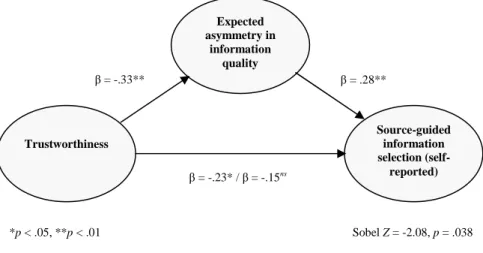
Study 3.1 focused on the trustworthiness dimension of source credibility and showed that people’s information selection is more source-guided in case of a trustworthy than with an untrustworthy source, as predicted. Furthermore—in line with the recently-proposed evaluation model of information search (Fischer, Jonas, Frey, & Schulz-Hardt, 2005)—this effect of source trustworthiness on the extent of source-guided information selection was shown to be embedded in people’s expectations regarding information quality. With an untrustworthy source people more strongly anticipate an asymmetry in information quality (e.g., an untrustworthy proponent of a novel CCS technology can be expected to exaggerate arguments pro, and to discount arguments arguing against the technology) than in case of a trustworthy source. As a result, people’s information selection is more source-guided under low than under high source trustworthiness.
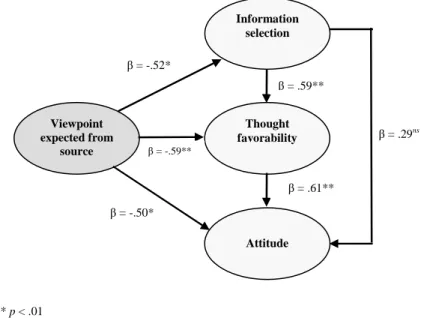
Furthermore, in extension of Study 3.1, Study 3.2 showed that under low source trustworthiness people’s information selection is characterized by a preference for information that counters the source’s expected viewpoint. That is to say, when people expect an untrustworthy source to be a proponent of CCS, they appear to disconfirm the source by selecting more information about the cons than about the pros of this technology. Conversely, when people expect the relevant source to be an opponent of CCS, they show a preference for pros over cons. Finally, Study 3.2 provided initial evidence that biases in information selection under low source trustworthiness indeed (at least in part) explain biases at later stages of attitude formation.
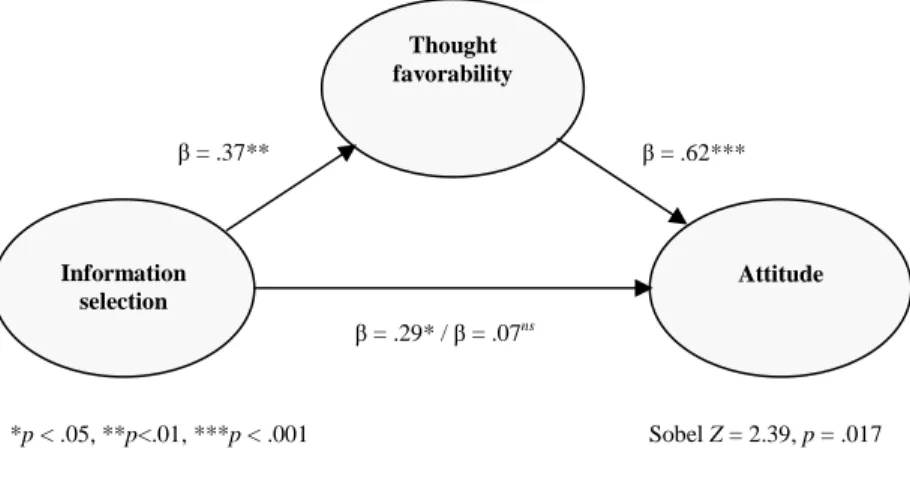
In the third and final study in this chapter (Study 3.3) I further addressed the relationship between information selection, thought favorability and attitudes. In addition, I broadened my examination of how source credibility affects information selection: I explored whether similar conclusions of the first two studies (Studies 3.1 and 3.2) in which I examined the trustworthiness dimension of source credibility can be drawn for its expertise dimension. The results of Study 3.3 indicate that the variations on the expertise dimension of source credibility— unlike its trustworthiness dimension—do not elicit source-guided information selection. Furthermore, Study 3.3 demonstrated that information selection appears to be an important stage in attitude formation indeed: The information people select predicts the favorability of their own thoughts about the issue and the attitudes they subsequently form.
Thus, Chapter 3 provides insight in how source credibility affects information selection, and in this way has the potential to impact on thoughts about the issue and attitudes formed. Especially when sources are not trusted, source-guided information selection occurs, which in turn has important repercussions on the thoughts about the issue people form.
Collaboration and perceived information quality
In Study 4.1 it was predicted and found that people expect more balanced information (i.e., information that represents a variety of perspectives on CCS) when an oil company and an environmental NGO (i.e., dissimilar stakeholders) provide information about CCS in collaboration than when each of these stakeholders provides the same information separately. In addition, Study 4.1 showed that collaboration between credible and less credible stakeholders does not harm the perceived credibility of individual stakeholders.
Study 4.2 was designed to replicate and extend findings of Study 4.2. As in Study 4.1, it was found that people expect more balanced information from collaborating stakeholders than from individual stakeholders. Moreover, Study 4.2 confirmed findings of Study 4.1 that when divergent stakeholders team up, the credibility perceptions people hold of these stakeholders are not affected in a negative way. Also, in extension of Study 4.1 and as predicted, Study 4.2 demonstrated that people expect information originating from collaborating stakeholders to be of higher quality than when the same information originates from individual stakeholders. This effect was mediated by their expectation of more balanced information content in case of collaborating compared to individual stakeholders. Finally, Study 4.2 showed that people’s initial expectations regarding information quality lead them to evaluate the actual information provided by collaborating stakeholders to be of higher quality than when the same information is provided by individual stakeholders.
The third and final study in Chapter 4 (Study 4.3) addressed the processes underlying the collaboration effects observed in Studies 4.1 and 4.2. In this study perceived dissimilarity of collaborating stakeholders (e.g., dissimilarity in perspectives, viewpoints) was found to be an important precondition for the effects observed in Studies 4.1 and 4.2. When two similar stakeholders (e.g., two oil companies) join forces, people have no reason to expect that the information provided by these stakeholders will be more balanced than when each of these stakeholders provides the information individually. As a result people do not expect the quality of information provided to exceed that of the individual stakeholders.
worry that joining forces with other (less credible) stakeholders will harm their own reputation.
Discussion and Conclusions
This section is structured as follows. First, based on the combined findings of this thesis, I discuss what the present findings tell us about the role of source perceptions in the way people deal with information about complex issues. I also discuss how these findings contribute to the existing literature. Second, I discuss the practical implications of this program of research. Finally, I discuss the limitations of the present research along with directions for future research.
Dealing with information about complex issues: The role of source perceptions
The work in the present thesis has shown that the way people deal with information about complex issues depends on their perceptions of the sources that provide the relevant information. The combined findings of the studies reported in Chapters 2 and 3 suggest that in order for communications by single sources to be effective, relevant sources need to be perceived as credible. More specifically, it is important that these sources are trusted. When trust in information sources is lacking, people’s information selection and their information evaluations are affected in a negative way, with detrimental consequences for the impressions of the issue they form. Additionally, the present work demonstrates the surplus value of having divergent sources provide information about complex issues in collaboration, instead of separately (Chapter 4).
first to show that source credibility can affect which information people select, and in this way impacts on their impressions of the issue. Second, the present findings add to the existing literature by comparing the effectiveness of individual sources with that of collaborating sources. The studies reported in Chapter 4 are the first to show that collaborative communications by dissimilar sources are more effective than when the same information is provided by individual sources.
The present findings also contribute to research in the area of selective exposure. First, the present thesis adds to the literature as it sheds light on the relationship between the information people select, their subsequent thoughts and the attitudes they form. That is, the studies in Chapter 3 show that biases in information selection explain biases at later stages of attitude formation. Second, the studies in this chapter are the first to show that in the case of novel topics people’s information selection can be source-guided, that is, guided by expectations about the source’s viewpoint about the issue under consideration.
Practical implications
The results of the studies reported in this thesis have important practical implications for parties responsible for informing Dutch citizens about carbon dioxide capture and storage technologies (CCS). The message of this thesis for designers of information campaigns is that the way people evaluate factual information about CCS and their resulting position towards CCS depends on their perceptions of the sources that provide the relevant information.
First, this thesis shows that in order for CCS communications to be perceived as valuable, it is important that citizens consider the sources that provide the information about the technology as credible. In particular, these sources need to be trusted, aside from being experts on the topic. Hence, in the context of CCS, trusted stakeholders such as environmental non-governmental organizations (NGOs) or research institutions may be the most suitable sources to inform the public about CCS. The findings of the present thesis also imply that the Dutch government—an obvious stakeholder to provide information to the public— should reconsider its role in communication about CCS, given Dutch citizens’ lack of trust in government and politicians (e.g., Dekker & Van der Meer, 2004).
stakeholders in turn have a restraining influence on people’s evaluations of the information they receive. Second, relying on the credibility of a single stakeholder may be a risky choice in itself, as stakeholder reputations are easily harmed. For instance, when an environmental NGO that is appointed to communicate about CCS all of a sudden is put in a bad light because of misappropriation of funds, this could have detrimental effects on the way people perceive its CCS communications. Third, in a multi-stakeholder environment as is the case with CCS the strategy of appointing just one highly credible stakeholder as information source may not prove to be very realistic. The many different stakeholders that are involved in CCS each approach the technology from their own background, and each of them likely wishes to have a finger in the pie when it comes to communication about CCS.
stakeholders. In addition to this, research by De Best-Waldhober et al. (in press) suggests that collaborative communications are feasible.
Finally, I cannot stress enough that the above-mentioned recommendations pertain to the best practices in informing people about CCS. In other words, the recommendations relate to the provision of information to the public, not to the provision of messages that aim to persuade the public into the technology. When stakeholders jointly provide CCS information this will not necessarily result in public acceptance of the technology, but at least it is likely to prevent that citizens reject the technology for the wrong reasons (i.e., for reasons unrelated to the technology, such as dissatisfaction with the information provided or distrust in individual CCS stakeholders).
Limitations and future directions
On the pragmatic level, it is worthy to note that the communication results reported in the present thesis were found under experimental conditions with students as participants. I recognize that it would be worth considering the role of recipient characteristics (e.g., education level, involvement, trust in authority) in relation to the present effects in future research. However, I expect that the communication results obtained in the present work will be similar or even larger under real-life conditions with a more representative sample of the Dutch general public (e.g., when the local community is informed by CCS stakeholders about an actual CCS project). For example, the average citizen can be expected to trust authorities and institutions to a lesser extent than the highly-educated sample I used in the present thesis (Tanner & Dekker, 2007). Consequently, collaborative information provision may prove to be an even more important communication strategy among the average citizen than among the student sample I used in the present thesis. However, future research near CCS demonstration sites is needed to monitor whether these (larger) effects under real-life conditions indeed emerge.
and collaboration of sources in communication to be especially strong for issues that are high rather than low in complexity. Future research could test this expectation.
Finally, in the present research I established that in order for collaborative communications to be effective, sources that team-up in information provision should be seen as representing different perspectives on the issue. I suspect more boundary conditions to the collaboration-effects obtained in the present studies can be identified, however. For example, I would expect the present effects to hold true when a limited number of different sources provides information together, but to disappear when the number of collaborating sources exceeds a certain threshold. When too many different sources collaborate, people likely doubt whether the joint information still represents each source’s true feelings, which in turn raises doubt about the quality of information provided. Both from a pragmatic and a theoretical perspective it is relevant to address these issues in future research.
Preceding note on Chapters 2–4
Chapter 2
Credibility and Perceived Information Quality
cClimate change is among the biggest challenges the world faces today. Scientists and other experts almost unanimously recognize that recent changes in the climate of the Earth are man-made, caused by ever increasing greenhouse-gas concentrations in the atmosphere (IPCC, 2007; Oreskes, 2004). The greenhouse gas making the largest contribution from human activities in this context is carbon dioxide (CO2), a gas that is released into the atmosphere through combustion of
carbon-containing fossil fuels such as coal, oil and natural gas in power plants, cars, and industrial facilities. Given the far-reaching negative consequences associated with climate change (for an overview see IPCC, 2007), the urge to cut CO2 emissions is widely recognized, and political leaders from industrialized
countries have committed themselves to reduce their CO2 emissions. Relevant for
the present research, the Dutch government has committed itself to an emission reduction target in 2020 that lies 30 percent below the Netherlands’ 1990 levels. The Dutch government aims to meet this target by means of an integrated package of three groups of measures (i.e., trias energetica). At the core of this portfolio is the reduction of CO2 emissions through reduction of energy use and switching to
renewable energy sources (e.g., wind and solar). However, the combined effect of energy efficiency and renewables cannot yet achieve the required reductions in emissions alone, and therefore the deployment of existing and new technologies that reduce CO2 emissions is considered as a third category of important measures.
One of these new technologies currently considered by the Dutch government is carbon dioxide capture and storage technology (CCS). In short, CCS involves the capture of CO2 in power plants, the transportation of the CO2 to
underground storage sites (e.g., depleted gas fields), and its subsequent storage in these sites. d Currently, the development of CCS in the Dutch context is
c This chapter is based on: Ter Mors, Weenig, Ellemers, & Daamen (2008a).
d Detailed information about CCS is available on the website of the Intergovernmental Panel on Climate
Change (IPCC: http://www.ipcc.ch), especially recommended is the ‘summary for policy makers’ in the 2005 special report about carbon dioxide and storage (IPCC, 2005). Information about CCS in the Dutch context is available on the website of CATO, the Dutch research program on CO2 capture, transport and
transcending from a (laboratory) research phase to a demonstration stage in which the technology is demonstrated in the field. Hence, in the near future members of the Dutch general public—and in particular those citizens living near possible demonstration sites—will need to be informed about the technology. In this context, organizations involved with CCS—in other words CCS stakeholders—are obvious sources of information given their expertise on the topic of CCS.
Regarding the provision of information about CCS to the public, it is important that citizens evaluate CCS communications to be valuable and of high quality, in order for them to feel able to form accurate impressions of the technology. Dissatisfaction with the information provided would be highly undesirable, because it could result in resentment of CCS for reasons unrelated to the characteristics of the technology. However, the difficulty with communication about CCS is that people lack the necessary background knowledge to evaluate information about the technology on its merits (cf. De Best-Waldhober, Daamen, & Faaij, in press; Huijts, Midden & Meijnders, 2007; Meijnders, Midden, & Wilke, 2001). This raises the important question of how citizens in this case will decide whether information about CCS is valuable. In the present research we argue that citizens’ evaluations of CCS information will depend to a considerable extent on whether or not they perceive the stakeholders that provide the relevant information to be credible.
Informative communication about CCS
In order for people to gain understanding of CCS and to take a position on the technology, they need to be informed. Importantly, in a CCS context this entails the provision of factual information, enabling people to form an informed opinion about CCS. Such information lets the established facts speak for themselves and recognizes that people may reach different conclusions on the basis of the information provided (cf. Fischhoff, 2007).The present analysis does not pertain to persuasive messages intended to increase public acceptance of CCS. In fact, the deployment of a persuasive “say-yes-to-CCS” campaign can expected to backfire, because persuasive campaigns are highly unlikely to fulfill the information needs of involved citizens, and people may show reactance to messages they suspect to be of persuasive intent (Petty & Cacioppo, 1977; Wood & Quinn, 2003). Moreover, persuasive campaigns can be considered unethical in the case of CCS, given the potential risks of the technology (e.g., in terms of safety, economic and social costs) for those citizens living near storage sites. In sum, communication that aims to inform people seem indispensable in the context of CCS (cf. Fischhoff, 2007). Hence, it is highly relevant to examine the conditions under which such communication is effective.
To date, surprisingly little is known about the factors that determine people’s perceptions of information quality, let alone about the consequences of people’s information-quality perceptions for their perceived ability to form an accurate impression of the issue under consideration. While researchers from different fields (e.g., from social psychology, advertising, health science, political science) have devoted a lot of attention on examining the effectiveness of persuasive communication, the factors that determine the effectiveness of informative communication have remained relatively under examined (cf. Rowan, 2003).
Examining these is highly relevant, both from an applied and a social-psychological perspective. First, it is important for designers of information campaigns to understand the conditions under which information about complex issues such as CCS is perceived to be valuable and worthy of consideration. Poor communication about complex issues can be expected to cause more harm than good: Dissatisfaction with information provided for instance may lead to citizens’ rejection of CCS. In this case, citizens’ opinions about CCS would not so much be determined by their evaluations of CCS in terms of its content or merits, as by their feelings of lacking the good-quality information to judge the issue. Such a situation in which rejection of CCS is communication-related instead of issue-related can be considered highly undesirable.
Second, at a more theoretical level, the examination of the effectiveness of informative communication could advance the existing literature on communication in important ways. Previous persuasion studies do not explicitly address the question of whether source credibility affects people’s perceptions of information quality. Thus, the examination of perceived information quality can be expected to complement and extend previous findings from research in the area of persuasive communication. One important contribution of the present work is that we examine whether source credibility affects the effectiveness of informative communication in terms of perceived information quality.
Stakeholder credibility
perceptions of information quality, and in this way affects their understanding of what CCS entails. Stakeholder credibility refers to the perceived expertise and trustworthiness of a stakeholder (e.g., Kelman & Hovland, 1953, see also Pornpitakpan, 2004; Stiff & Mongeau, 2003). That is, source credibility comprises the extent to which a stakeholder “is perceived to be capable of making correct assertions” (stakeholder expertise: Hovland, Janis, & Kelly, 1953, p. 21), as well as its “perceived honesty, integrity, and believability” (stakeholder trustworthiness: Erdogan, Baker, & Tagg, 2001, p. 40).
While persuasion researchers have examined the effects of argument quality on persuasion as a means to identify the mechanism through which source credibility affects persuasion (Chaiken 1980, 1987; Chaiken et al., 1989; Petty & Cacioppo, 1986a, 1986b; Petty & Wegener, 1999), they have seldom treated perceived information quality as a central outcome variable. Relevant for the present work, persuasion research in the area of biased information processing does suggest, however, that source credibility can color people’s responses to persuasive messages. That is, this line of research has shown that messages by credible sources elicit more favorable (i.e., message-congruent) thoughts than the same messages from less credible sources (e.g., Bohner et al. 2002; Chaiken & Maheswaran, 1994). In the present research we systematically examine whether a parallel effect can be observed for people’s perceptions of information quality. That is, we examine whether people perceive CCS information that originates from a highly credible stakeholder to be of higher quality than when the same information originates from a low credible stakeholder. Moreover, we examine the implications of people’s information-quality perceptions for their perceived understanding of what CCS entails.
Overview
Study 2.1
In Study 2.1 we examined by means of an Internet survey how Dutch citizens perceive different CCS stakeholders in terms of credibility. e In this study we
focused on two types of CCS stakeholders, namely environmental non-governmental organizations (NGOs) and industrial stakeholders. From prior research it is known that industrial organizations are typically considered to be low-credible sources and that environmental NGOs typically are perceived being the most credible sources (Trumbo & McComas, 2003). In line with research by Huijts et al. (2007) we predicted this finding to also hold true in the context of CCS technology. More specifically, we predicted that environmental NGOs involved with CCS would be considered to be more credible than industrial CCS stakeholders (Hypothesis 1). In addition to a general impression of perceived stakeholder credibly, we also explored whether such potential variations in stakeholder credibility would be grounded in the expertise and/or trustworthiness dimension of stakeholder credibility.
Method
Participants
Two-hundred and sixty-four Dutch citizens were recruited to participate in an Internet survey via advertisements in national newspapers and on the Internet. A lottery for 25 Euros gift vouchers served as an incentive to participate. The age of the participants varied from 17 to 88 years (M = 38.05, SD = 14.34) and 25.8% of the participants was male. A considerable part of the participants (37.5%) had received higher education (university or higher vocational education), 44.1% had only completed lower education (lower vocational education or high school). The societal position that was most applicable to the participants was “employee” (48.1 %), “scholar/student” (19.3%), and “housewife/houseman” (9.8%). These variables did not influence participants’ perceptions of stakeholder credibility, and will not be discussed any further.
Design and procedure
Participants learned that the main goal of the survey was to measure their perceptions of several Dutch organizations involved in a project regarding CCS
technology. After a brief explanation of CCS we presented participants with six specific CCS stakeholders that represented two types of CCS stakeholders, namely with three industrial stakeholders and three environmental NGOs. For each of these six CCS stakeholders participants indicated whether they had ever heard of the relevant stakeholder. Subsequently, participants were randomly assigned to answer questions about oneof the stakeholders they had indicated to be familiar with. As a result of this procedure, 121 participants answered questions regarding their credibility perceptions of a specific industrial stakeholder, while the remaining 143 participants answered questions about a specific environmental NGO. By addressing the perceived credibility of specific stakeholders we aimed to draw general conclusions about the perceived credibility of the two types of CCS stakeholders we examined in this study. While we recognize that credibility perceptions between specific stakeholders also are likely to differ, these differences are not what we focused on in the present research. Hence, we do no compare specific stakeholders in this study. Instead we aggregate perceptions of the six specific stakeholders into two clusters of CCS stakeholders—namely industrial stakeholders versus environmental NGOs—in order to test whether Dutch citizens in generalperceive environmental NGOs involved with CCS to be more credible than industrial stakeholders.
Measures
Overall impression of stakeholder in terms of credibility. Participants’ overall impression of the relevant stakeholder in the context of CCS in terms of credibility was measured through one item: “To what extent do you consider the organization to be credible” (1 = not at all to 7 = very much).
Perceived stakeholder expertise. To measure perceived stakeholder expertise in
the context of CCS we adapted three items from existing credibility scales (McCroskey, 1966; Newell & Goldsmith, 2001). Participants indicated the extent to which they agreed the stakeholder to be knowledgeable, expert, and to employ experts (1 = very much disagree, 7 = very much agree). Perceived expertise was computed by averaging participants’ responses to the three expertise items (α = .83), with higher scores indicating higher perceived expertise of the relevant CCS stakeholder.
Perceived stakeholder trustworthiness. Perceived stakeholder trustworthiness in
7-point scale ranging from 1 = very much disagree, to 7 = very much agree the extent to which they agreed the stakeholder to be honest, to tell the truth, not to withhold important information, to have a hidden agenda (recoded) and to state whatever is best for the organization’s own interest (recoded). Perceived trustworthiness was computed by averaging the responses to the five trustworthiness items (α = .90), with higher scores indicating a higher perceived trustworthiness of the relevant stakeholder.
Results and Discussion
Unless noted otherwise, responses were analyzed at the aggregate level, comparing the cluster of industrial stakeholders to the cluster of environmental NGOs.
Overall impression of stakeholders in terms of credibility
As predicted in Hypothesis 1, participants considered environmental NGOs involved with CCS to be more credible (M = 5.13, SD = 1.49) than industrial stakeholders (M = 4.32, SD = 1.29), t(262) = -4.84, p < .001.
Perceived stakeholder expertise and trustworthiness
Next, we examined whether these differences in overall stakeholder credibility were grounded in the expertise dimension of stakeholder credibility and/or in its trustworthiness dimension. We first performed a principal components analysis (PCA) with varimax rotation on the eight credibility items to confirm that the expertise and trustworthiness items in the present study indeed measured distinct dimensions of stakeholder credibility. This analysis revealed a solution with two orthogonal factors explaining 73.6% of the variance. The first factor comprised stakeholder trustworthiness and explained 44.9% of the variance in the individual items. The second factor captured stakeholder expertise and explained 28.8% of the variance in the individual items. Of importance, the five trustworthiness items loaded exclusively on the first factor, while the three expertise items loaded exclusively on the second factor. Thus, the expertise and trustworthiness items in the present study captured distinct dimensions of stakeholder credibility, as intended.
trustworthy (M = 4.72, SD = 1.10) than industrial stakeholders (M = 3.66, SD = 1.06), t(262) = -7.94, p < .001. f Expertise perceptions did not vary for both types of
stakeholders, however, t(262) = .14, ns: Participants considered environmental NGOs and industrial stakeholders to be equally expert (Moverall = 4.55, SD = .98).
Further, regression analyses with either perceived stakeholder trustworthiness or stakeholder expertise predicting participants’ credibility scores indicated stakeholder trustworthiness to be a better predictor of participants’ overall credibility impressions (β = .68, p < .001) than stakeholder expertise (β = .29, p = .15). In fact, when we included both predictors in a regression analysis, only stakeholder trustworthiness was found to predict participants’ overall stakeholder credibility impressions (β = .68, p < .001). g Thus, the finding that people consider
environmental NGOs to be more credible than industrial stakeholders in the context of CCS seems to be grounded more in their trustworthiness perceptions of relevant stakeholders than in their expertise perceptions.
Study 2.2
Study 2.2 builds on the findings of Study 2.1. Study 2.1 showed that stakeholders involved with CCS are perceived to be experts irrespective of their identity, but that people’s trustworthiness perceptions of the relevant stakeholders vary. In Study 2.2 we addressed the implications of such variations in perceived stakeholder trustworthiness for the way people respond to CCS information provided by these stakeholders. More specifically, we examined whether people perceive CCS information that originates from a trustworthy stakeholder to be of higher quality than when the same information originates from a low-trustworthy stakeholder. In addition, we examined the implications of these information-quality perceptions for people’s self-reported understanding of CCS. While in this
f Additional analyses comparing the perceived trustworthiness of each of the three individual NGOs to
that of each of the three individual industrial stakeholders showed that even the least trusted NGO still was perceived to be more trustworthy than two of the three of the individual industrial stakeholders, ps ≤. 008. Moreover, there was a small—but nonsignificant, p = .187—tendency for the least trusted NGO to also be perceived as more trustworthy (M = 4.49, SD = .97) than the third industrial stakeholder (M = 4.09, SD = 1.07). Thus, also at the level of individual stakeholders we found that industrial stakeholders are perceived to be less trustworthy than environmental NGOs.
g Reported analyses were performed for the entire sample. We also performed separate regression
study we varied stakeholder trustworthiness, we kept stakeholder expertise constantly high a) for reasons of ecological validity, building on the findings of Study 2.1, and b) to prevent that participants would infer the stakeholder’s expertise from the trustworthiness information provided.
As explained in the general introduction, in parallel to previous research in the area of biased processing (e.g., Chaiken & Maheswaran, 1994) we argued that stakeholder trustworthiness would color people’s evaluations of CCS information. More specifically we predicted that participants in the high-trust condition would expect higher-quality information than participants in the low-trust condition (Hypothesis 2). We further predicted these information-quality expectations to influence participants’ subsequent perceptions of the actual information provided (Hypothesis 3). That is, we predicted participants in the high-trust condition to perceive the CCS information provided to be of higher quality than participants in the low-trust condition (Hypothesis 3a), and that this effect would be due to their information-quality expectations (Hypothesis 3b).
Finally, in Study 2.2 we addressed the implications of information-quality perceptions for people’s self-reported understanding of what CCS entails. We argued that participants would feel more able to form an adequate impression of what CCS entails when they perceive they have high-quality information at their disposal, compared to the situation in which they have serious doubt about the quality of information provided. Consequently, we predicted that the higher perceived information quality in the high than in the low-trust condition would result in better self-reported understanding of what CCS entails in the high than in the low-trust condition. Thus, we predicted a main effect of stakeholder trustworthiness on self-reported understanding of CCS (Hypothesis 4a), that would be mediated by perceived information quality (Hypothesis 4b).
Method
Participants and design
other half of participants was told the stakeholder was a proponent of CCS. Participants received 4.5 Euros for their participation.
Procedure
On arrival at the laboratory participants were seated in separate cubicles. After having provided informed consent participants read a brief introduction a novel technology of carbon dioxide capture and storage (CCS) in the Netherlands via the computer. In this introduction we told them that the Dutch government was considering the implementation of this technology, and had asked a variety of organizations to write a report about the pros and cons of the technology. Next, we informed participants that they would be given the opportunity to read one of these reports produced. Stakeholder trustworthiness was manipulated by informing participants that the report they were about to read came from an organization (i.e.., a stakeholder) that—on basis of behavior in the past that was described in the manipulation— was known to be “very trustworthy and honest in the context of greenhouse gasses and technology” (high-trustworthiness condition) or “not very trustworthy and honest in the context of greenhouse gasses and technology” (low-trustworthiness condition). h However, for reasons of
experimental validity and to avoid suspicion we stressed that this general reputation would not necessarily imply untrustworthy (low-trustworthiness condition) or trustworthy (high-trustworthiness condition) behavior on the behalf of the stakeholder in the present CCS context. In addition, all participants read that the organization was high in expertise: “The organization has a lot of experience and expertise in the context of greenhouse gasses and technology”. h Importantly,
we did not specify which type of stakeholder (e.g., industrial stakeholder, environmental NGO, or government) had allegedly written the report, so participants were provided with information about the stakeholder’s trustworthiness and expertise, but no information was provided about the stakeholder’s identity. Finally, we controlled for stakeholder viewpoint by informing one half of the participants that the stakeholder had indicated to favor the implementation of CCS (proponent of CCS) whereas the other half of participants was informed that the stakeholder opposed CCS (opponent of CCS).
After answering questions concerning their expectations of information quality participants read the report. The report was identical in all experimental conditions, and contained information about eight pros and eight cons of the
implementation of CCS in the Netherlands. After reading the report, participants evaluated the quality of the report and answered questions about their perceived understanding of what CCS entails.
Measures
Manipulation checks. To check the effectiveness of the trustworthiness
manipulation we asked participants to indicate whether they perceived the stakeholder to be trustworthy and honest in the context of greenhouse gasses and technology (1 = not at all, 7 = very much). Perceived stakeholder trustworthiness was computed by averaging participants’ responses to the two trustworthiness items (r = .76) with higher scores indicating higher perceived stakeholder trustworthiness. To check whether stakeholder expertise in all experimental conditions indeed was perceived as high we asked participants to indicate whether they perceived the stakeholder to be expert and experienced in the context of greenhouse gasses and technology. Perceived stakeholder expertise was computed by averaging the responses to the two expertise items (r = .71) with higher scores indicating higher perceived stakeholder expertise.
Further, as indicated by Study 2.1, people associate certain levels of credibility with different stakeholders. Hence, the provision of participants with information about a stakeholder’s credibility could induce participants in the low-trust condition to have a different type of stakeholder in mind (e.g., an industrial stakeholder) during the experiment than participants in the high-trust condition (e.g., an environmental NGO). We checked for this, by asking participants to indicate which type of stakeholder they thought had written the report (multiple-choice question: a (multiple-choice between six different types of stakeholders).
Finally, to check whether participants had perceived the information about the stakeholder’s viewpoint regarding CCS accurately, we asked them to indicate whether the organization had indicated 1) tofavor implementation of CCS, or 2) to oppose implementation of CCS.
been presented to them in terms of correctness, value and completeness (1 = not at all, 7 = very much). Perceived information quality was subsequently calculated by averaging the responses to the three items (α = .72), with higher scores indicating higher perceived information quality.
Self-reported understanding of the issue. As an indicator of their understanding of CCS, participants indicated the extent to which they had been able to form an accurate impression of what CCS entails (1 = not at all, 7 = very much).
Results
We tested the hypotheses regarding main effects of stakeholder credibility on information processing (Hypotheses 2, 3a, and 4a) by means of ANCOVA, with stakeholder trustworthiness as independent variable and stakeholder viewpoint as control variable. Further, we tested the mediation hypotheses (Hypotheses 3b, and 4b) by means of regression analyses, with stakeholder viewpoint as a control variable next to the independent variable of stakeholder trustworthiness.
Manipulation checks
Participants in the high-trust condition clearly expected the stakeholder that provided the CCS information to be more trustworthy (M = 5.56, SD = .70) than participants in the low-trust condition did (M = 3.11, SD = 1.16), F(1, 77) = 123.70, p < .001, η2 = .62, as intended. Thus, the stakeholder trustworthiness manipulation
Expected information quality
Participants in the high-trust condition expected the CCS information to be of higher quality (M = 5.06, SD = .98) than participants in the low-trust condition did (M = 4.17, SD =1.10), F(1, 77) = 13.85, p < .001, η2 = .15, as predicted in Hypothesis 2.
Perceived information quality
After participants had read the information in the report, we asked them to evaluate the quality of the actual information provided. The analysis on participants’ perceived information quality scores showed that participants in the high-trust condition perceived the information in the report to be of higher quality (M = 4.80, SD = .89) than participants in the low-trust condition did (M = 4.38, SD =1.00), F(1, 77) = 3.99, p = .049, η2 = .05, as predicted in Hypothesis 3a. Next, we
examined by means of mediation analyses (Baron & Kenny, 1986) whether the effect of stakeholder trustworthiness on perceived information quality was due to participants’ information quality expectations. Providing support for Hypothesis 3b, we found that the effect of the trustworthiness manipulation on perceived information quality (β = .22, p = .049) became nonsignificant and was significantly reduced (β = .06, p = .581, Sobel Z = 2.74, p = .006) after controlling for expected information quality. Thus, participants’ higher information-quality expectations in the low- compared to the high-trust condition explained why the CCS information was evaluated more positively in the high-trust condition than in the low-trust condition.
Self-reported understanding of the issue
In line with predictions (Hypothesis 4a), participants in the high-trust condition indicated they had been more able to form an accurate impression of what CCS entails (M = 4.47, SD = .99) than participants in the low-trust condition (M = 3.98, SD = 1.20), F(1, 77) = 3.93, p = .051, η2 = .05. Next, we examined by means of