Review for Outcomes 1 … SOUND
1) Pitch depends on _________________________________ 2) Amplitude depends on _________________________________ 3) Decibel is a unit of _________________________________ 4) Hertz is a unit of _________________________________ 5) Loudness depends on _________________________________ 6) Wave speed depends on_________________________________ 7) Frequency depends on _________________________________ 8) Intensity depends on _________________________________ 9) Wavelengths measured in _________________________________ 10) Wave Speed measured in _________________________________ 11) Frequency measured in _________________________________ 12) Loudness measure in _________________________________
13) Compressions make ear drums _________________________________ 14) Rarefactions make ear drums _________________________________ 15) High pitch sounds make ear drums _________________________________ 16) Low pitch sounds make ear drums _________________________________ 17) Draw loud and soft sound waves (as transverse waves).
18) Draw high and low pitch sound waves.
19) An illustration of a loud sound doesn’t depend on _________________________________ 20) An illustration of a low pitch sound doesn’t depend on _________________________________ 21) Draw a sound wave that is changing pitch. 22) Draw a 3 Hz sound wave (box = 1 second)
23) Draw a sound wave that is changing loudness.
loud soft
REVIEW FOR OUTCOME 2 … WAVE INTERACTIONS Know these words and illustrations for each:
>> Look at your notes, Light Interaction Lab, and definitions for the following:
Interference, Reflection, Resonance, Refraction, Diffraction, Absorption, Transmission,
REVIEW FOR OUTCOME 4 (& some 6) … Doppler Effect Videos that could help:
http://www.youtube.com/watch?v=nyUf_LiWyp8
https://www.youtube.com/watch?v=h4OnBYrbCjY
Use these words to fill the blanks (not all will be used and some used more than once):
observer, source, both observer and source, pitch, amplitude, higher, lower, louder, softer
1)The Doppler Effect causes a sound to shift its _________________________
when a(n) ____________________________ moves. As the sound comes closer to the observer the ____________________ appears to be __________________. As the sound gets farther from the observer the ____________________ appears to be
__________________.
2) Draw the Doppler Effect below.
3) The Doppler Effect for Light is called: ________________________. Objects producing their own light in space (or on the earth) that move away from an observer have a shift in the object’s visible light toward the [ higher \ lower ] frequency and [ longer \ shorter]
REVIEW for Outcome 3 … Standing Waves
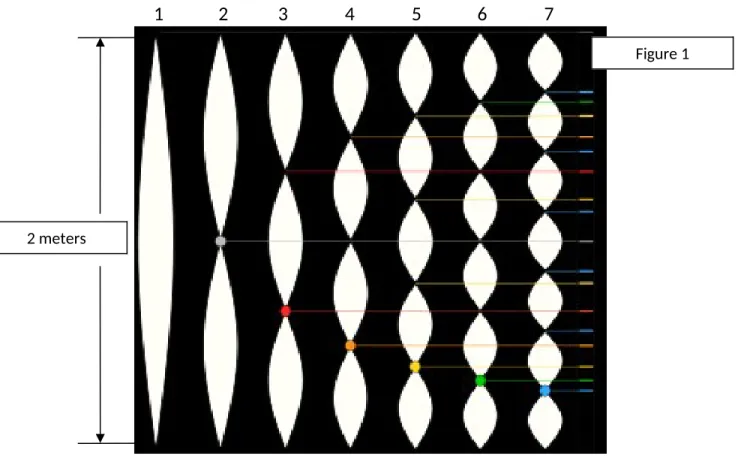
Figure 1 illustrates a series of standing waves made on a string like we did with our lab equipment. 1) What is the wavelength of these harmonics?
1st
________________ 2nd
________________ 5th
________________ 6th
________________
2) The frequency needed to make the 2nd
harmonic is 10 Hz. Using information for the 2nd
harmonic from the previous question what is the wave speed of the energy passing through the string?
Show Work (3 pts): 1 pt = Write the formula needed; 1 pt = Substitute the data into the formula; 1 pt = Correct answer with correct label.
3) How many wavelengths are represented by these harmonics? 1st
________________ 2nd
________________ 5th
________________ 6th
________________
4) Explain why this statement is true: The speed of wave energy through the string is the same at the 1st harmonic as it is for 7th harmonic (and for all harmonics).
Figure 1
1 2 3 4 5 6 7
REVIEW for Outcomes 5-6 … Light & Color
DIRECTIONS: You will want to use: 1) an EM Spectrum. 2) the Colors of Light Triangle
1) Identify ALL forms of Electromagnetic (EM) Energy that are harmful to humans.
2) Identify the TWO that determine the difference between all types of Electromagnetic (EM) energy. Identify TWO of the following:
A) speed B) wavelength C) color D) pitch E) frequency
3) For light, since light speed is consistent, frequency depends on __________________.
4) For light, photon energy is highest when wavelength is ________________________.
5) In E=mc2
, E = __________________, m = ___________________, c = ___________________
6) In general, for EM energy the higher the frequency the [ higher | lower ] the photon-energy.
7) In general, for EM energy the longer the wavelength the [ higher | lower] the frequency.
8) In general, for EM energy the higher the energy the [ longer | shorter] the wavelength.
9) (Three answers) Compared to most EM energy Microwave energy has:
[ High | Low ] photon-energy, [ Short | Long ] wavelength, [ high | low ] frequency.
10) (Three answers) Compared to most EM energy X-Ray energy has:
[ High | Low ] photon-energy, [ Short | Long ] wavelength, [ high | low ] frequency.
11) (Three answers) Compared to the most of the other colors of visible light, orange has:
[ High | Low ] photon-energy, [ Short | Long ] wavelength, [ high | low ] frequency.
12) Type of all EM energy with the highest photon energy.
13) Electromagnetic energy with the longest wavelength.
14) Electromagnetic energy with the lowest frequency.
16) Identify ALL forms of EM energy, if any, with photon-energy lower than Visible:
Radio | Microwaves | Infrared | Visible | Ultraviolet | X-Ray | Gamma | NONE
17) Identify ALL forms of EM energy, if any, with frequency greater than Gamma:
Radio | Microwaves | Infrared | Visible | Ultraviolet | X-Ray | Gamma | NONE
18) Identify the ONE color on the visible spectrum with the lowest photon energy and longest wavelength. Pick ONE.
Red | Orange | Yellow | Green | Blue | Indigo | Voilet
19) True/False: On the visible part of the EM spectrum Red light has a longer wavelength, lower frequency AND lower photon energy than Green light.
20) True/False: There is at least one form of EM energy that meets all the following requirements: Longest wavelength, highest frequency, highest photon energy?
21) Identify ALL colors, if any, of the visible spectrum that have higher photon energy than Green? Red | Orange | Yellow | Green | Blue | Indigo | Voilet | NONE
22) Identify ALL colors, if any, of visible light that have longer wavelengths than yellow? Red | Orange | Yellow | Green | Blue | Indigo | Voilet | NONE
23) Electromagnetic energy with a wavelength closest to 10-3
meters:
Radio | Microwaves | Infrared | Visible | Ultraviolet | X-Ray | Gamma
24) Electromagnetic energy with a frequency closest to 105
Hz:
Radio | Microwaves | Infrared | Visible | Ultraviolet | X-Ray | Gamma
25) Additive colors of light [ reduce | add to | don’t change ] the number of photons.
26) Pigments are known as subtractive because they [ reduce | add to | don’t change ] the number of photons reflected off of matter.
27) Blue & Green are: COMPLIMENTARY \ PRIMARY \ SECONDARY
28) Green & Magenta are: COMPLIMENTARY \ PRIMARY \ SECONDARY
30) Combining Blue, Green and Red light equally = ______________________
31) Combining Blue light and Green light = ___________________
32) Combining Green light and Magenta light = ___________________
33) Combining Cyan light and Red light = ___________________
34) Primary pigments are: __________, ___________, ____________ and when mixed in equal amounts results in _______________.
35) Pigments do this to light: ____.
A) reflect and refract B) diffract and absorb C) absorb and reflect D) absorb and refract
For questions 36-39 imagine you are in a cave and the only light source is a green light.
36) The blue shirt you’re wearing ___ the green light: [ absorbs \ reflects \ transmits ]
37) The blue shirt you’re wearing will appear: [ blue \ green \ blue-green \ black \ white ]
38) The green hat you’re wearing will appear: [ blue \ green \ blue-green \ black \ white ]
Draw light’s interaction with the following lenses:
40) If the total angle between the incidence ray and reflected ray is 80o:
what is the angle of incidence? _______________ what is the angle of reflection? _______________
41) Below, show a ball striking a flat surface with no spin from an incident angle of 20o.
Show the Incident Ray, Reflected Ray and Normal. Label the Incident and Reflected Angles.