VYSOKÉ UČENÍ TECHNICKÉ V BRNĚ
BRNO UNIVERSITY OF TECHNOLOGYFAKULTA PODNIKATELSKÁ
ÚSTAV FINANCÍ
FACULTY OF BUSINESS AND MANAGEMENT
INSTITUT OF FINANCES
FINANCIAL REPORTING QUALITY CONTROL FOR
INTERNAL CONTROL IMPLEMENTATION
KONTROLA KVALITY FINANCNÍCH VÝKAZU PRO ZAVEDENÍ SYSTÉMU VNITRNÍ KONTROLY
DIZERTAČNÍ PRÁCE
DOCTORAL THESIS
AUTOR PRÁCE
Ing. TIMUR GAFAROV
AUTHOR
VEDOUCÍ PRÁCE
Ing. HELENA HANUŠOVÁ, CSc
SUPERVISOR
ABSTRACT
Though at the enterprises the estimation of a financial condition is annually, it is necessary to develop, to improve constantly and to evaluate the system of the internal control, necessary to develop a technique of the reporting quality estimation of the enterprise specially for the certain enterprise in view of all features, to take advantage of statistical data and to draw corresponding conclusions, to make constant monitoring. The purpose of development of the mechanism - detection of deviations of data in the reporting from actual results of activity, definition of clauses causing distortion of a real financial condition of the enterprise, revealing of size of influence of the given distortions and qualities of the reporting as a whole on decision-making, and also revealing of the reasons causing these deviations and distortions, and development of recommendations on corresponding correction separate directions for improvement of quality of the reporting.
How can high reporting quality and internal control create an advantage? In survey of institutional investors is reported that investors apply a penalty if they believe a company’s internal control to be insufficient. Sixty-one percent of respondents said they had avoided investing in companies and 48% had de-invested in companies where internal control was considered inadequate. As additional support, they study went on to report that 82% of respondents agreed that good internal control was worth a premium on share price. These institutional investors are pushing for greater transparency on risk issues and related internal control efforts. Simply put, an organization’s ability to implement and maintain a leading-class control framework can create competitive advantage in today’s market.
A system of the financial reporting conducting with strong management, quality control and good legislative base is the key factor of economic development. The trust of investors in the financial and not financial information is based on strong Internal Control, high-quality standards of the financial reporting, audit and ethics, thus, standards and Internal Control play the leading part in assistance of economic growth and financial stability in the country. Nevertheless, every company meets the problems of implementation of the internal control. Among them there can be problems in labor qualification, legislation and so on. It is also necessary to examine the successful experience at the micro level.
KEY WORDS
Internal control Financial reporting
Qualitative characteristics of financial reporting Quality reporting
Influencing factors Information filters
BIBLIOGRAPHIC CITATION
Gafarov T., Financial reporting quality control for internal control implementation.
Brno: Brno University of Technology, Faculty of Business and Management, 2009. 148 p. Ph.D. thesis supervisor Ing. Helena Hanušová, CSc.
CERTIFICATION OF DISSERTATION
I certify that the ideas, results, analyses and conclusions reported in this dissertation are entirely my own effort, except where otherwise acknowledged. I also certify that the work is original and has not been previously submitted for any other award, except where otherwise acknowledged.
_________________ ____________________
Signature of Candidate Date
ENDORSEMENT
___________________ _____________________
ACKNOWLEDGMENTS
I would like to acknowledge the assistance of many people who provided help, support, and encouragement, enabling me to complete my PhD dissertation. In particular, I would like to acknowledge the contribution of my principle supervisor, Ing. Helena Hanusova, CSc who guided and encouraged me from the beginning and throughout my whole PhD candidature, as well as my associate supervisor associate professor Galina Bushmeleva, CSc. Other friends and colleagues in the Faculty of Business and Management and particularly in the Department of Finance provided invaluable assistance, support and feedback.
Special thanks to Ing. Martin Pernica, who helped me at many critical stages of my research and to Ing. Josef Polak and Ing. Jakub Tabas, whose friendships helped me greatly on completion of this dissertation.
Finally, I wish to express my gratitude and love to my family and to Agafonova Ekaterina for their unreserved love, support and encouragement. The courage and determination they taught me have made my life so wonderful.
CONTENT
INTRODUCTION 11
1 THESIS TASKS AND PURPOSES 13
1.1 Problem introduction 13
1.2 Ph.D. thesis purposes and tasks 14
1.3 Research approach and methodology 16
1.4 Scientific novelty 17
1.5 Time harmonogramm 18
1.6 The theoretical importance 18
1.7 The practical importance 19
1.8 Approbation and introduction of results of research 19
1.9 Volume and dissertation structure 20
2 THE THEORY OF INTERNAL CONTROL AND FINANCIAL REPORTING
QUALITY ASSURANCE 21
2.1 The financial reporting as an economic information needed for decision-making 21
2.1.1 Economic information 21
2.1.2 Accounting information 24
2.1.3 Financial reporting 31
2.2 Requirements to the quality of financial reporting 33
2.2.1 Quality 33
2.2.2 Financial reporting quality 34
2.2.3 Qualitative characteristics of financial reporting 39
2.3 Essence of quality assurance of the financial reporting 46
2.3.1 Topicality and urgency. Financial reporting quality importance 48
2.3.2 Financial reporting quality through the internal control 51
2.3.3 Present day research field 53
2.3.4 Success factors for Internal control from practice 55
2.4 Financial reporting quality control 57
3 THEORETICAL POSITIONS ON METHODICAL ASPECT OF QUALITY
ASSURANCE OF THE FINANCIAL REPORTING 62
3.1 A place of quality control of the reporting in an enterprise management structure 62
3.1.2 Financial reporting quality control concept 68
3.2 Methodical aspects of quality control of the financial reporting 74
3.2.1 Technique general requirements 74
3.3 Some factors evaluation methods 82
3.3.1 The analysis of financial indexations as the judgment instrument about reliability of
the financial reporting 82
3.3.2 Risks of distortions 92
3.3.3 Information filters 96
4 FINANCIAL REPORTING QUALITY CONTROL APPROBATION 101
4.1 Characteristics of the enterprise 101
4.2 Organization of quality control 104
4.3 Recommendations made to improve the IC of “ZMT” 129
CONCLUSION 132
LIST OF LITERATURE 137
TABLES AND PICTURES
Pictures
Picture 1. Economic information classification ...23
Picture 2. Accounting systems ... 27
Picture 3. Accounting branches... 28
Picture 4. Hierarchy of desirable characteristics of accounting information ...40
Picture 5. Reporting quality influence on decisions ... 47
Picture 6. Reporting quality influence on decisions ... 50
Picture 7. Cube «COSO»...64
Picture 8. Control levels ...72
Picture 9. Internal control in operation of business ... 73
Picture 10. Block-scheme of the financial reporting quality control...75
Picture 11. Hierarchy of quality influencing factors... 77
Picture 12. Function of desirability for the factor "Experience"...77
Picture 12. Recommendation working out scheme... 81
Picture 13. Process scheme...93
Picture 14. Administrative personnel Structure ...102
Picture 15. Hierarchy of quality influencing factors... 107
Picture 16. Matrix of estimation... 110
Picture 17. Techniques of performance evaluation of management...121
Tables Table 1. Various definition of quality...34
Table 2. Different quality characteristics...36
Table 3. Definitions of system of the intrafirm (internal) control...62
Table 4. Relevant factors...76
Table 5. Function of desirability for factor “Experience”...78
Table 6. Matrix of paired comparisons for the factor "Personnel" ...79
Table 7. Matrix of paired comparisons of factors of the first order...79
Table 8. Criteria of quality of factors of the second order ...80
Table 9. The process description «Preparation of documents on merchandise payment»... 94
Table 10. Process risks...94
Table 11. Process risk relevance ... 95
Table 13. The factors influencing quality of the financial reporting are essential...106
Table 14. The certificates confirming professional level of the accountant...107
Table 15. Factor estimation «Qualification of staff»...110
Table 16. Estimation of the factor "Experience"...110
Table 17. Neutrality accounting policy test...112
Table 18. The test for revealing of changes in an accounting policy ...114
Table 19. The analysis of financial indexations...115
Table 20. Estimation of the expected size of overall risk...116
Table 21. Associativity indicators of forms of accounts. ...117
Table 22.The test of an estimation of criterion «Completeness of the account»...117
Table 23.The test of an estimation of the auditor company...118
Table 24. The internal control system test...119
Table 25. Weight of quality...121
Table 26.Quality points ...123
Table 27. Weight of quality evaluations...123
Table 28. Conformity of total evaluation of an internal control system quality and significance of an indicator of a degree of quality of an internal control system ...124
Table 29. Estimation of information filters...125
Table 30. Significance of function of desirability of factors of the second order...125
Table 31. Matrix of paired comparisons for the factor "Personnel"...126
Table 32. Matrix of paired comparisons for the factor "Neutrality"...126
Table 33. Matrix of paired comparisons for the factor "Audit quality" ... 126
Table 34. Matrix of paired comparisons for the factor "Faithful representation"...126
Таble 35. Matrix of paired comparisons for the factor “Completeness”... 126
Table 36. Matrix of paired comparisons of factors of the first order...127
INTRODUCTION
Today’s organizations are operating and competing in an information age. Information has become a key resource of most organizations, economies, and societies. Indeed, an organization’s basis for competition has changed from tangible products to intangible information. More and more organizations believe that quality information is critical to their success. However, not many of them have turned this belief into effective action. Poor quality information can have significant social and business impacts. There is strong evidence that data quality problems are becoming increasingly prevalent in practice. Most organizations have experienced the adverse effects of decisions based on information of inferior quality. It is likely that some data stakeholders are not satisfied with the quality of the information delivered in their organizations. In brief, information quality issues have become important for organizations that want to perform well, obtain competitive advantage, or even just survive in the 21st century. In particular, accounting maintains and produces the data used by organizations to plan, evaluate, and diagnose the dynamics of operations and financial circumstances. Providing and assuring qualitative data is an objective of accounting. With the advent of financial reporting quality, the traditional focus on the input and recording of data needs to be offset with recognition that the systems themselves may affect the quality of information. Indeed, empirical evidence suggests that information quality is problematic in financial reporting. Accounting information quality is concerned with detecting the presence or absence of target error classes in accounts.
Still publications on problematics of the reporting quality in the majority are reduced to system of maintenance of standards of the financial reporting. It has been caused by bankruptcies Enron, WorldCom, Parmalat, which distortions of the financial reports have reached the unprecedented size.
Most of the information system researches into data quality focuse on the theoretical modeling of controls and measurements. For example, there is a research on the impact and propagation of errors throughout information systems. Other studies focus on editing data and input controls. Many studies in AIS have focused on internal controls and audit. However, few studies have attempted to understand what causes the difference in information quality outcomes, and what should be done to ensure high quality accounting information and how to measure this quality. Therefore, there is lack of knowledge of the factor’s estimations for
information quality in Accounting that can assist organizations to ensure and improve accounting information quality.
One of the major directions of accounting and the control development is a problem of the continuous scientifically-proved tracing of current processes at the enterprise, external and internal factors, their estimation and forecasting of influence on the financial reporting quality.
1 THESIS TASKS AND PURPOSES
1.1 Problem introduction
One of the major condition of economy and its functioning elements such as entities, infrastructure and authorities is a presence of the economic information which satisfies to a number of requirements to make the valid decisions.
It is theoretically and historically proved, that accounting in the form of the accounting reporting (further - the financial reporting) can give such information. Accounting forms information on a financial position of the entity, financial results of its activity and movements of money resources for satisfaction of the information users requirements. Requirements to the accounting information are fixed not only in the international standards and concepts, but also in local legislative, and standards confirmed by the state.
It is generally accepted, that mistrust to the financial reporting brakes market development of investments. Foreign, and also internal investors not always wish to become shareholders of the enterprises. Poor quality of the financial reporting creates a barrier to hit the population money on a securities market. On the one hand, that brakes investment processes in the country, and on the other - increases a inequality, doing the income to be the exclusive privilege of rich people who dispose large share holdings and often have access to the additional information which has been not mentioned in the public financial reporting.
Today accounting systems and the internal control (further - IC) concepts are subjects of constant changes. Continuous reforming of the European, Russian and American systems of the accounting is observed. Especially the Russian accounting worries the difficult period of reforming. Thus usually due value and attention is not given to qualitative characteristics of the financial reporting
The decision of these problems is carried out intuitively without a support on scientifically proved systems, and has a formal character. At such approach it is difficult to estimate objective a condition of accounting process, to define tendencies of its development, and to set up necessary corrective amendments in process of the accounting, reporting and control.
One of the major directions of accounting improvement is a problem of the continuous scientifically-proved tracing of current processes in the enterprise, external and internal factors detection, their estimation and forecasting of influence on the financial reporting quality.
The present dissertational research is devoted to implementation of the financial reporting quality control, as a tool of the managers who will use it for supervision and estimation of the financial reporting quality.
Quality assurance, monitoring and control of quality of the financial reporting - insufficiently known a theoretical and practical field of knowledge. On analogies to financial management and financial monitoring, tax management, quality control has arisen originally in the economic environment, i.e. in practical activities, and only subsequently there were attempts of theoretical generalization and development of this field of knowledge.
At the same time most of the publications targeting on a problematics of report’s quality were reduced to systems of maintenance of the financial reporting standards. It was reason of Enron, WorldCom, Parmalat bankruptcies. In the USA reaction to the given scandals was acceptance of the Sarbanes-Oxley Act1 (further - SOX) in 2002, the exacting control over the financial reporting. The eighth directive of the European union of the corporate law also has undergone to change.
The comparative youth of this theoretical and practical field of knowledge, and also specificity of national legislations and the impossibility of foreign experience transformation in the field of quality of the financial reporting, distinction of experience, and also absence of the fact of wide spread of IFRS explains lack of the economic literature. The uniform approach to this function of intrafirm management in available publications is absent, and there is no still a conceptual device of discipline.
1.2 Ph.D. thesis purposes and tasks
At the enterprises the analysis of financial and economic activity showing an available financial condition of the enterprise is periodically carried out, but frequently there is no estimation of the financial reporting quality, the control and monitoring is not existing. The
1
dissertational work purposes is set: to introduce the parameters of the reporting quality in a control system of the enterprise and to develop a technique of control. For achievement of an object it is necessary: to define the concept of quality of the reporting; to reveal features; to study theoretical bases of the quality estimation; to lead the analysis; to develop recommendations on introduction of qualitative parameters in control system of the enterprise, for its efficiency, to develop the control technique.
Object of the research is managerial activity at the enterprises. Subject of the research is the internal control as a tool of improvement of accounting, analytical and financial economic processes of the industrial enterprise.
The research aims are generalisation of theoretical and practical knowledge, working out of scientifically proved recommendations for organizational-methodical maintenance of quality assurance of the financial reports in the enterprise and creation the concept of the quality control.
According to the purpose following tasks have been defined:
- to specify the definitions of the financial reporting and internal control; - to show the necessity of the self-control of reporting quality;
- to develop the concept of financial reporting quality control of the enterprise; - to define a place of the control in structure of operation of business;
- to define factors influencing on the financial reporting quality; - to specify concept of the financial reporting quality control; - to reveal sources of a supply with information of the control;
- to create a technique of carrying out the financial reporting quality control of the enterprise and to approve it in the enterprises;
- to formulate generalizations of the control concept and in this connection to develop scientifically-practical recommendations on improvement the managers decisions.
Though the estimation of a financial condition is constantly made, it is also necessary to develop, constantly to improve and estimate the system of the internal control. It is necessary to develop a technique of estimation of the reporting quality specially for the certain enterprises in view of all features, to take advantage of statistical data and to draw corresponding conclusions, to make constant control.
Thus, reporting quality control can be named as the mechanism of the constant supervision over the major current processes of financial and economic activity, and estimation of their influence on the financial reporting quality in conditions of constantly varying external and internal environment. The purposes of development of the mechanism of control are: constant detection of deviations of data in the reporting from actual results of activity, definition of clauses causing distortion of a real financial condition of the enterprise, revealing of size of influence of the given distortions and quality of the reporting as a whole
on decision-making, and also revealing of the reasons causing these deviations and distortions, and recommendation development on corresponding correction for an improvement of the reporting quality.
In addition, three research hypotheses were formed to help answer the research questions. Those hypotheses are listed below:
Hypothesis 1. There are factors influencing on financial reporting quality which are
possible to measure
Hypothesis 2. It is possible to measure the financial reporting quality characteristics
Hypothesis 3. The internal control implementation and evaluation can be and should
be based on financial reporting quality control.
1.3 Research approach and methodology
Theoretical and methodological basis, and also information base of research are made by proceedings of the Russian, Czech and foreign scientists on an investigated problem, official documents and legislation of The Russian Federation, The Czech Republic, EU, and The USA.
Empirical base of the thesis includes data got during the research according to the Internal Grant Agency of Business and Management faculty Brno University of Technology N AD179001M2.
Induction and deduction were used to specify the key definitions, the system analysis and synthesis were used for concept formulation, interrogation, supervision, questioning were used for influencing factors study.
The financial reporting quality control technique is developed with use of economic-mathematical methods. In a final part of work modeling and approbation of a technique by creation of imitating model and the system of the quality reporting expert evaluation are made on the base of fuzzy logic, hierarchy analysis and on a base of qualimetry.
And also to make the analysis and synthesis of the received results of experiment the methods of the comparative analysis are used. And to generalize, to compare results of supervision were used statistical and mathematical methods.
The experiment is approbated in an industrial and audit enterprises of Udmurt republic, Russia.
1.4 Scientific novelty
Scientific novelty of research consists in the following:
1. The concept of the financial reporting quality is specified as a category of the economic information which is presented by set of the financial indicators and has quality characteristics
2. The necessity of allocation of such segment as an estimation of the financial reporting on conformity to requirements to qualitative characteristics is shown as an independent direction in system of the internal control and allows to estimate quality of the accounting (financial) reporting of the enterprises.
3. The influencing reporting quality factors were overviewed and their hierarchy were designated.
- The major factors influencing quality of the financial reporting are formulated, their hierarchy is designated, qualitative characteristics of the reporting on which there is an influence are defined;
- Necessity of an estimation of internal factors influencing quality of the information - information filters is revealed, filters definitions are given and their essence is shown.
4. Techniques for an estimation of the factors influencing qualitative characteristics of the financial reporting, and also on quality of the reporting as a whole with use of fuzzy logic bases are offered, the documentation for an estimation is developed.
5. The methodical aspect to an estimation of quality of the financial reporting in a kind of the multicriterial characteristic uniting the major qualitative characteristics, giving in to the description by means of qualitative and the quantitative indicators defining the possibility of
its use for decision-making, as bases for process of Internal Control construction and constant improvement is worked out.
1.5 Time harmonogramm
1.6 The theoretical importance
The theoretical importance on the research termination can be that:
Necessity of allocation of such segment as a financial reporting quality estimation on conformity to requests of qualitative characteristics which is an independent direction in system of the internal control is reasonable and allows to evaluate quality of the accounting (financial) reporting of the enterprises.
Submission is given and the hierarchy of factors influencing quality of the financial reporting is designated. Internal control concept Quality information influencing factors study
Financial reporting quality control concept Information filters
Literature review Economic information
Financial reporting as a category of economic information
Financial reporting
Quality of financial reporting
Approbation Conclusion August 2009 July 2007 January 2008 July 2008 January 2009 October 2009
Methodological aspect of financial reporting quality control
July 2009
Problem study September
Techniques for an estimation of the factors influencing qualitative characteristics of the financial reporting, and also on quality of the reporting as a whole with use of bases of fuzzy logic is offered, the documentation for an estimation is developed.
The methodical aspect to the financial reporting quality estimation as a kind of multicriteria characteristic uniting the major qualitative characteristics for its use on decision-making, as bases for process of implementation and constant internal control improvement is offered and can be used in the enterprises.
And also theoretical positions, recommendations and work conclusions can be used for courses “Audit”, “Analysis”, “Operation of business”, “Financial accounting”, “Accounting”, “IFRS”, etc., and also for study-methodical materials.
1.7 The practical importance
The practical importance of research consists that identifying the influencing factors could enhance the ability of accounting to gather data, process information and prepare reports. Outcomes of this research will contribute to the body of knowledge both in Accounting Information System and Internal control, and it may benefit other research into these areas. For example, it can help arouse the awareness of data quality issues in AIS field, and to make it possible to establish the linkage of the identified factors with the existing data quality dimensions for outcomes assessment. Thus, understanding how these factors affect financial reporting quality may be useful to practitioners. Focusing on those factors that are more critical than others will lead to efficiency and effectiveness management procedures. In brief, the results from this research are likely to help organizations’ top management, accountants, and IT managers obtain better understanding of financial reporting quality issues.
1.8 Approbation and introduction of results of research.
Main results of research were reported and discussed on faculty meetings «Accounting and the economic activities analysis» in the Izhevsk State Technical University, at the European international scientifically-practical conference in Brno, on international online-video conference between Izhevsk State Technical University and Technological University
of Brno, at annual scientifically-methodical conference MendelNet (2009), and also at carrying out of seminars and a practical training for foreign students. Experiment has been spent in one industrial enterprise and audit company of the Udmurt republic, Russia.
1.9 Volume and dissertation structure.
The dissertation consists of the introduction, four heads, the conclusion, the list of the used literature and appendices. Total amount of the dissertation pages of the text is 148, including 37 tables, 17 pictures. The literature list consists of 112 names of works of domestic and foreign authors, and also statutory acts.
2 THE THEORY OF INTERNAL CONTROL AND FINANCIAL
REPORTING QUALITY ASSURANCE.
2.1 The financial reporting as an economic information needed for
decision-making
2.1.1 Economic information
The significance of the information in our modern life and activity of each modern person is great. The role of the information for the successful decision and specific targets in management of an enterprise is great. It is possible to avoid errors in decision-making to the only one who is good guided in an information space of an enterprise and who does possesses the quality information.
The category “information” occurs from Latin “informatio” that means an explanation, a notification, an exposition. From items of materialistic philosophy the information is reflexion of the real world by means of data (messages). The message2 is a form of submission of the information in the form of speech, the text, images, figures, schedules, tables, etc.
In Ushakov's explanatory dictionary3 the information is understood as the message informing on a state of affairs or about someone's activity, data on something.
The Russian legislation define the information as data on persons, subjects, the facts, events, the phenomena and processes irrespective of the form of their submission4.
The modern economic dictionary5 gives following definitions of the information – 1) any message on something. 2) the data, the significances of economic indicators which are objects of storage, processing and transfer and used in the course of the analysis and decisions-making in management. 3) one of kinds of a resource used in the economic
2Simonovich S.V. Informatika. Bazovyi kurs. 1999. p 640. 3
Ushakov. N.Tolkovyi slovar' russkogo yazyka Ushakova: Gos. In-t «Sov. Incikl.»; Gos. Izd-vo inostr. i nac. slov., 1935-1940.
4
Federal'nyi zakon RF N 149-FZ : 27.07.2006 Ob informacii, informacionnyh tehnologiyah i o zashite informacii // Rossiiskaya gazeta. – 2006. № 165.
processes which reception requires expenses of time and other resources. In this case these expenses should be included in production costs.
Thus, the information is data (the messages, facts, showings, record) irrespective of the form of their submission about persons, subjects, the facts, events, the phenomena and the processes, which is necessary for decision-making.
But the economic information is necessary for management of an enterprise. The explanatory law dictionary6 defines that the economic information is the information on processes of production, distribution, an exchange and consumption of the material benefits occurring at macroeconomic and microeconomic levels. Includes analytical, planned, statistical, industrial-technological, commercial, financial, social, scientific, administrative information.
The big Soviet encyclopedia7 gives the economic information as a data, messages, documents on an economic condition of company, including state economic policy, about its level and production structure, about movement of work, the goods, the capital, about incomes of the population, budgetary and tax relations etc. It is possible to allocate the economic information as the statistical information, productive and economic, commercial, business, bank, scientific etc.
The modern economic dictionary makes following definition: «the economic information - the information on processes of production, distribution, an exchange and consumption of the material benefits occurring at macroeconomic and microeconomic levels.
Borisov А.B8 considers the economic information as the information on public processes of production, distribution, an exchange and consumption of material benefits
The Economic mathematical dictionary9 makes following definition of the economic information - the data reducing uncertainty and the defect of knowledge supplementing presentation about social and economic processes, both of production sphere, and of non-productive sphere at all levels and in all bodies. The economic information displays the facts
6
Tolkovyi slovar' SPS «Garant». [legislative database]
7
Prohorova A.M. Bol'shaya sovetskaya enciklopediya. 3rd ed. T 1: «Sov. enciklopediya», 1969-1978.
8
Borisov A.N., Korneeva G.V. Lingvisticheskii podhod k postroeniyu modelei prinyatiya reshenii v usloviyah neopredelennosti //Metody prinyatiya reshenii v usloviyah neopredelennosti.. Riga, 1980. № 7. p. 4-11.
9
of economic activities by means of system natural and cost indexes and, as a rule, is transmitted and processed in the form of the signs fixed on various material carriers. Set of the signs used for an exchange of the economic information in a certain economic system, forms language of the economic information.
Hence, it is possible to draw from the definitions a conclusion that the economic information (just the information on a microeconomic level further will be considered, i.e. in an enterprise context) – is a basis for the person, making the decision.
It is necessary to distinguish the economic information from «the economic data» which represents display of the economic events which have been written down in certain language on concrete material carriers (the indicators which have been written down in documents, texts or tables), but not connected with a certain problem or the consumer. In economy the information is understood as the data which define expectations and a choice of individuals. Thus, in the given work it is necessary to understand that the economic information is the messages, showings, value of economic indicators, messages, documents on an economic condition of the enterprise, and also its activity, which are the objects of storages, processings and transfers and used in the course of the analysis and working out of economic decisions in management which define the expectations and a choice of users.
In a turn of the economic information the greatest relative density is borrowed with data of the control and analytical accounts (inside of the enterprises), the transport and bank documentation (in a turn between the enterprises), the accounting and statistical reporting, the scheduled and normative documents, given operative management. According to various inspections, an annual interfarm turn of the fixed economic data within the limits of the industrial enterprise can be from 50 up to 2000 thousand documents (3,5-100 million parameters). The external turn (volume of entrance and target data) industrial enterprise is made approximately with 100 thousand documents and 1000 thousand parameters a year, including the transport bank documentation makes 80-90 % on number of documents and 40-50 % - on number of parameters. The industrial enterprise - 60-80 thousand parameters for a year represent the statistical and accounting reporting on the average volume10.
Vahrushina M. A. considers that if to define significance of an accounting information at decision-making it constitutes of management accounting about 20-30 %
10
from all information, 40-50 % are constituted by the information of the financial accounting, and other part is necessary on an analysis share11.
This citation confirms an urgency of the economic information in managerial process. It is visible from the aforesaid analysis that strict classification of the economic information does not exist. Information can be statistical, productive and economic, commercial, business, tactical, bank, exchange, referral (including about taxes, the prices and tariffs), scientifically-economic, standard (regulating legal relations in economic sphere), etc. The clear boundary between the mentioned kinds of the economic information is absent. It is expedient to notice that in various kinds of the economic information the accounting information has the greatest weight.
2.1.2 Accounting information
It is considered that the economic information can be classified on management functions, in an occurrence place, on degree of stability and to other signs. Having considered classification offered by T.P. Karpova12, S.N.Shirina13, N.M.Blazhenkova14 (Karpova, 2003, Shirina, 1999, Blazhenkova, 2004) and taking into account that on the majority of the enterprises information requirements are approximately identical and also grouping methods coincide, it is possible to present classification of the economic information in the form of picture 1.
The accounting information is divided into groups: tax, financial, managerial. The information of each kind can be generated in the accounting system.
Different authors give various definitions of the account:
- Accounting is art of records, classification and generalization of accounts by registration in monetary units of bargains and events which have, at least, in any part, financial character, and also is interpretations of the received results15;
- According to the Russian Federal act "About accounting" Accounting represents the ordered system of the gathering, registration and information generalisation in money
11
Vahrushina M.A. Buhgalterskii upravlencheskii uchet: uchebnik dlya studentov VUZov, obuchayushihsya po ekonomicheskim specialnostjam. 5th ed. 2006. p. 570.
12
Karpova T.P. Upravlencheskii uchet : uchebnik dlya VUZov. 2003. p 350.
13
Shirina S.N. Informacionnoe obespechenie formirovaniya upravlencheskogo ucheta (Na materialah predpriyatii neftehimicheskoi promyshlennosti). CSc thesis: 08.00.12. Kislovodsk. 1999. p. 255.
14
Blazhenkova N. M. Formirovanie podsistemystrategicheskogo upravlencheskogo ucheta na promyshlennom predpriyatii : CSc thesis: 08.00.12. Izhevsk. 2004. p 159.
15
terms about property, obligations of the company and their movement by the contiguous, continuous and documentary registration of all economic operations16.
Picture 1. Economic information classification
In 1970 the American institute of accountants has declared that accounting function is to ensure the quantitative information, mainly financial character, about managing subjects with the purposes of use of this information for decision-making17.
The accounting helps the manager: a) to manage the processes for which he is responsible; b) to co-ordinate these processes on the company as a whole. The information is formed in the accounting for execution of following three main objectives18:
1. Drawing up of the periodic (routine) internal accounts and reports for administrative decisions. It ensures by the information the decisions accepted with certain degree of a regularity.
16
Federal'nyi zakon RF N 129-FZ: 21.11.1996 O buhgalterskom uchete // Rossiiskaya gazeta. 28.11.1996.
17
Fedosova T.V. Organizaciya buhgalterskogo ucheta na predpriyatii. Taganrog: TTI YuFU. 2007.
18
Horngren.Ch., Foster D., Datar S. Upravlencheskii uchet. 10th ed. 2005. p. 1008. ISBN: 978-5-94723-174-8 Functions Managerial accounting Accounting Referenced Planned Financial accounting Managerial information (Managerial reporting) Financial information (Financial reporting) Tax information (Tax reporting) Economic information Stability Origin place Input Interim Output Constant Conditional -constant Tax accounting
2. Drawing up of irregular (special) reports for administrative decisions. The information in them is formed for maintenance of decisions in situations which arise without certain periodicity or represent precedent.
3. Drawing up of the external reporting intended for investors, public authorities and other users. In some cases the information from the external reporting can be used by managers of the third-part organizations.
The information for each of the considered main objectives can be generated in an accounting system and is presented in the various methods. The ideal database consists of the numerous detailed micro complete sets of the information which can be used for maintenance of a set of problems. Accountants process the information with allowance for practical requirements of various external and internal users.
Internal users:
Chiefs of the enterprise – the persons quoted by the proprietors for realization of an operational administration, require the information on organization financial circumstances. Having such information, the management ensures efficient control for acceptance of corresponding administrative decisions.
Shareholders - on the basis of the accounting data evaluate, how much effectively the administration executes the functions, that is how much financially the organization successfully functions. Make the decision on sale of shares.
Investors – accept purchasing and selling of shares decisions, shares and other securities of the enterprise.
Workers of the enterprise – wish to have the information on a financial position and on incomes as the size of their wages depends on it, stability of jobs.
External users:
Commercial partners – suppliers it is necessary for them to know about solvency of the enterprise and buyers who should be assured that the enterprise is a reliable source of deliveries.
Creditors – banks and other lenders granting to the enterprise short-term and long credits, should be assured that it will be capable to redeem or pay off a loan and pay percents.
Taxing authority – it is necessary for them to have the information on profits of the enterprise and its property condition for the definition of the sums of taxes.
Having carried out the comparative analysis in accounting definition [26, 20, 11, 6, 124, 25, 13]. It is possible to draw a conclusion that there are disagreements between the authors in definition of kinds of the accounting which have been caused first of all by distinction of accounting models (see picture 2).
Picture 2. Accounting systems Undoubtedly, principal causes of distinctions of two models are:
1) economic (development of markets of capital, quantity of investors and creditors, inflation, the sizes and organizational structure of the companies, use of cross-border markets of the capital, the general educational level, legislative systems);
2) political and geographical.
“The greatest influence on formation of accounting systems was rendered by development and the size markets of capital, and also legal systems” [26, p.164]. The countries usually are divided on two big groups: the countries code law (continental, code) and the countries of the common (Anglo-Saxon, case law) (see picture 2).
Case law Macroeconomic orientation Code law Business practice Law practice UK Ireland UK influence USA influence Australia SAR Germany Spain Italy France Russia USA Canada Japan Mexico Legislative system Microeconomic orientation Accounting systems Tax system
Reforming of the Russian and Czech accounting according to IFRS has led to necessity of a recognition accounting on three blocks: financial Accounting, management accounting (managerial accounting) and tax accounting. In picture 3 constituents of registration system are shown.
Picture 3.Accounting branches
Comparative analyses made by Alborov R. A.19, and also which is presented in works of Bushmeleva G. V.20, and also Needles B., and Anderson H.21 had been processed and added for more complete understanding of distinctions between branches of accounting. The received results are presented in the appendix 3. Main appointment of the financial accounting consists in formation of the reporting intended for external users. The financial accounting carries out measurement and registration on the accounts of economic operations and drawing up of the financial reporting on the basis of the accepted principles of the accounting. Industrial chiefs bear responsibility for reliability of the financial information represented to interested persons. Thus, managers are interested both in managerial, and in the financial accounting.
Before acceptance of the concept of the accounting development in the conditions of the economic market the accounting in Russia and The Czech Republic was considered as a unit without division into kinds.
However approchement with IFRS and development in integrated market relations have required from the state to change the attitudes to the accounting.
Today the special attention is given for studying of the international standards in the field of the financial accounting (the International Financial Reporting Standards, further -
19
Alborov R.A. Razvitie ucheta i kontrolya v sisteme upravleniya sel'skohozyaistvennym prizvodstvom. DSc thesis:08.00.12. Kazan. 2004. p.417.
20
Bushmeleva G.V. Monitoring v sisteme upravleniya predpriyatiem.: Ros. akad. nauk. Ural. otd-nie. Int. ekonomiki. Ekaterinburg; Izhevsk. p. 60.
21
Needles В., Anderson H.R., Caldwell J.C. Principles of Accounting, 4-th ed. Houghton Mifflin Company, 1991. Accounting
Tax Financial Managerial
IFRS) that allows to generate and prepare the financial reporting promoting reception of the economic information, necessary for investors and management. As a result the requirements to the quality of reporting and its structure constantly increase. Terms "the financial accounting" and "financial reporting" are used in IFRS and ISA (the international standards of audit) in relation to the external accounting and the reporting which is constituted on its basis. As modern standards of the different national accounting and audit are developed on the basis of IFRS and ISA, it is necessary to use terminology adequate to the international standards22.
The problems connected with formation of the financial reporting, definition of qualitative characteristics of the reporting, were recently object of attention of scientists-economists. Formation of methodology of the accounting, the analysis, management and the control have the significant contribution made by: Alvin A., Arens K., Loebbecke J. K., Benesh M., Вurnham S., Gable C., Diamant D., Spencer K., Pickett H., Braiotta L., Switzer S., Pratt J., Fight A., Akinyemi J., Jin D., Willborn W., Myller, Montgomery R, Anthony R., Jones I., Hirsh B. and also Babaeva J.A., Bakanova M.I, Bakayev А.С, Balabanova I.T., Barngolts S.B., Armless I.W., Bychkova S.M., Burtsev V.V., Voznesenskij E.A., Guttsajta E.M., Danilevskij J.A., Dmitrieva I.M., Ivashkevich V.B., Kirjanova Z.V., Kondrakov N.P., Shouters А.В., Labyntsev N.T., Makarova L.G., Maksimova G.V. and others.
Thus, in the special literature the separate parties of formation of the financial reporting, internal audit and an internal control system are fully presented and studied. Nevertheless, a number of the aspects concerning quality assurance of the financial reporting require the further research. Questions concerning to the methodology and functioning of an internal control system, an estimation of factors influencing quality of the financial reporting are insufficiently studied.
Position is aggravated with existing rupture of direct interrelation between the general concept of management and principles of the accounting and the internal control which are accepted in Russia and The Czech Republic and the IFRS requests to the accounting. Development of the theory and methodology in a direction of quality evaluation of the financial reporting, conformity to qualitative characteristics and internal control system conditions, urged to promote more reliability of the accounting and (financial) reporting of managing subjects, efficiency of management.
22
Nowadays there are two systems of accounting often used at the international level: Generally Accepted Accounting Principles of the USA (further - GAAP US) and IFRS. Both systems are close to Anglo-American model of the accounting though there is a considerable quantity of essential distinctions.
Both these systems subdivide the accounting into three types (see picture 3). Thus, among the Russian experts there is an ambiguous understanding of English concept «accounting». Depending on a context it can be translated into Russian both as the financial reporting, and as book keeping. However in the first case English-speaking experts for whom accounting is a financial reporting synonym, usually put in concept "accounting" wider contents, than the Russian experts. Current record process is designated in English language by other term - «bookkeeping».
In process of strengthening of Anglo-American model influence on accounting development in Russia and The Czech Republic, it is possible to meet concept "financial reporting" even more often (for example, Laws of the Russian Federation "About Accounting"23 and "About audit"24). Accurate definition of this concept is not presented, however, from a context, as a rule, it is visible that terms "accounting" and "financial reporting" are understood as synonyms. In the Law "About audit" the concept "the accounting (financial) reporting" is used.
Let's notice that some attempts to conduct at least formal distinction between accounting and the financial reporting nevertheless are undertaken. In Russia the concept "accounting reporting" is traditionally used, however, with growth of influence of Anglo-American school of the accounting preferring the term "financial reporting" last began to be applied more and more widely in the domestic special literature and even in some laws. Essential distinction between these terms is not presented and, as a rule, difference between them can be seen that in comparison with accounting the financial reporting contains more significant volume of analytical decoding and explanatory comments that just and ensures its bigger suitability for decision-making of financial character25.
Thus, the financial reporting is understood as uniform system of the indicators reflecting both a financial position and property of the economic subject and results of its
23
Federal'nyi zakon RF N 129-FZ: 21.11.1996 O buhgalterskom uchete // Rossiiskaya gazeta. 28.11.1996.
24
Federal'nyi zakon RF N 119-FZ: 7.08.2001 Ob auditorskoi deyatel'nosti // Rossiiskaya gazeta. 2001. №151
25
economic activities, constituted on the basis of the data financial and management accounting by results of an accounting period and as of accounting date under the established or independently developed forms.
The financial reporting purpose - satisfaction of information requirements of investors, shareholders, creditors, counterparts, employees, state structures and the public by submission of the information on a financial position, results of economic activities and changes of a financial position of an enterprise for the expired accounting period, useful for a wide range of users from the point of view of decision-making. Also the financial reporting can contain the information on events both last, and future which can essentially affect financial indicators.
The primary goal of the financial reporting is the truthful reflection (imaging) of economic circumstances allowing adequately to evaluate financial circumstances and results of activity of an enterprise.
2.1.3 Financial reporting
It is possible to allocate some features of the financial reporting:
The financial reporting is formed with the established periodicity, its structure is regulated, and reliability is confirmed with outside audit;
The financial reporting information has historical character: the accounting is come under only by the come true facts of economic activities though at definition of cost estimates the information of perspective character is often enough used.26
It is possible to make a conclusion on the basis of the above mentioned that the financial accounting department solves the problems of formation property and a financial position of the enterprise, calculation of end results of its activity; its "production" is intended mainly for management of financial both commercial activity and external users of the financial reporting of the enterprise. Accounts of the financial accounting are used for generalization of the information on availability and movement of assets and, inventory, about accounts, taxes and their use, funds and reserves, credits and target financing. Result of the financial accounting is the financial reports which are necessary to understand as a category of the economic information presented by set of indicators of the financial accounting on set
26
forms, reflected in the form of certain tables and the data representing uniform system about property and a financial position of an enterprise (balance sheet), financial results (profit and lost statement) and changes in a financial position (cash flow statement) of the managing subject for the certain period, constituted on the basis of the data of the accounting (financial) for the purpose of granting to external and internal users of the generalised information on position of an enterprise in the form convenient and clear users for decision-making, in terms established by internal or normative acts.
2.2 Requirements to the quality of financial reporting
2.2.1 Quality
As a starting point one has to ask whether quality is a state, a condition, a feeling, an impression or reality? Linked to this is the question of whether quality has any components and if so what are they? In modern works quality consider from the different points of view.
Quality can refer to
1. A specific characteristic of object
2. The achievement or excellence of an object 3. The essence of an object
4. The meaning of excellence itself
The first meaning is technical, the second practical, the third artistic and the fourth metaphysical. All four meanings, and therefore the meaning of quality, are synonymous with good.
Philosophy and common sense tend to see quality as related either to subjective feelings or to objectives facts. The subject-objective in question might be a concrete functional value to be learnt and applied or a physics ideal to be apprehended and represented. A third tends to see quality not as the secondary value that something has, rather a primary truth which comprises apparent and objects.
Quality refers to certain standards and the ways and means by which those standards are achieved, maintained and improved upon. Most definitions given to quality refer to „fitness for use“ or „conformance to requirements“.
The standard definitions on quality have been given by various institutions such as the British Standards Institution (BSI), the American Society for Quality Control (ASQC), the European Organisation for Quality Control (EOQC) and the International Organisation for Standardisation (ISO) amongst others.
„Quality therefore is the totality of features and characteristics of a product or service than
bears on its ability satisfy given needs.“ [ANSI/ASQC A3 1978]27
27
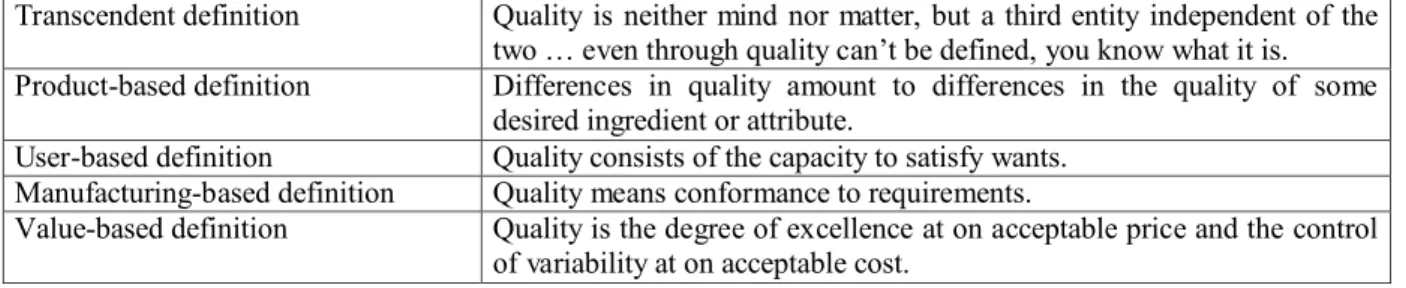
Table 1 illustrates a classification of various definitions of quality based on intrinsic and extrinsic factors. These various approaches highlight the wide and varied views on the quality concept. There is however growing support for quality to be closely associated with customer demands, views and perceptions.
Table 1. Various definition of quality
Transcendent definition Quality is neither mind nor matter, but a third entity independent of the two … even through quality can’t be defined, you know what it is. Product-based definition Differences in quality amount to differences in the quality of some
desired ingredient or attribute.
User-based definition Quality consists of the capacity to satisfy wants. Manufacturing-based definition Quality means conformance to requirements.
Value-based definition Quality is the degree of excellence at on acceptable price and the control of variability at on acceptable cost.
The meaning for the term quality has developed over time. Various interpretations are given. However the American Society for quality defines “quality” as “a subjective term from which each person has his or her definition.
2.2.2 Financial reporting quality
What is financial reporting quality? What quality characteristics should have financial reporting? To answer these questions remarks of Chief Accountant of U.S. Securities & Exchange Commission Lynn E. Turner at the European FASB-SEC Financial Reporting Conference (Frankfurt, Germany) are cited. Criteria for high quality financial reporting include: relevance, reliability, representational faithfulness, verifiability, neutrality, comparability and consistency, operationality. Let’s describe each of these criteria28:
Relevance. A high quality accounting standard requires relevant accounting
information. The information is relevant if investors can use it when they make investment decisions. The information should permit investors to evaluate past performance and to predict future performance. The information should also enable investors to estimate the risk of an investment.
28
Lynn E. Turner Speech by SEC Staff:Charting a Course for High Quality Financial Reporting. The European FASB-SEC Financial Reporting Conference Frankfurt, Germany. March 2000. www.sec.gov. < http://www.sec.gov/news/speech/spch356.htm>
Reliability. High quality financial statements must convey reliable information. Information is reliable to the extent that investors can depend on it to represent the economic conditions or events that it purports to represent. Reliable information has three ingredients: representational faithfulness, verifiability, and neutrality.
Representational Faithfulness. High quality financial statements should reflect the real
economics of the transaction being reported. In the U.S., we refer to this concept as representational faithfulness. A map's representational faithfulness may be determined by how well the map describes the coastline. In the same way, a financial statement's representational faithfulness may be evaluated by how well it represents the economic resources and obligations of the company, and by how well the transactions and events that change those resources and obligations are described. For example, suppose that a company reflects future costs in its income statement by setting up reserves in a profitable year and then reducing those reserves in a bad year when the costs are actually incurred. Investors are unable to see the real economic results of the business. Accounting standards that permit this practice lack high quality because they don't exhibit representational faithfulness.
Verifiability. Verifiability means the degree to which different people, when asked to
measure something using the same approach, arrive at the same amount. Cash held by a company will possess a high degree of verifiability if several people can count the cash and arrive at the same amount.
Neutrality. Information should be free from bias towards a predetermined result. This
quality is referred to as neutrality. For example, in determining income for a period, high quality financial reporting should not bias income to be a high amount or a low amount. Instead, high quality accounting standards should lead to reporting an amount that reports economic activity as faithfully as possible.
Comparability and Consistency. Information about a particular company is more
useful if an investor can compare it with similar information about other companies with similar information about the same company for some other time period. The purpose of comparison is to detect and explain both similarities and differences. High quality accounting requires accounting for similar transactions and circumstances similarly and accounting for different transactions and circumstances differently.
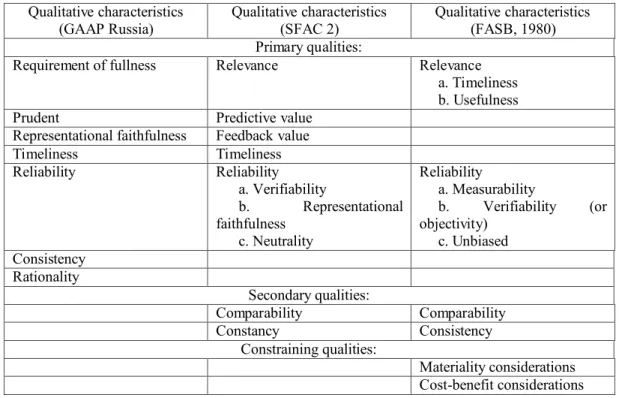
In the follow table I would like to show the differences of quality characteristics between IFRS and U.S. GAAP and GAAP in Russia:
Table 2. Different quality characteristics Qualitative characteristics (GAAP Russia) Qualitative characteristics (SFAC 2) Qualitative characteristics (FASB, 1980) Primary qualities:
Requirement of fullness Relevance Relevance
a. Timeliness b. Usefulness
Prudent Predictive value
Representational faithfulness Feedback value
Timeliness Timeliness Reliability Reliability a. Verifiability b. Representational faithfulness c. Neutrality Reliability a. Measurability b. Verifiability (or objectivity) c. Unbiased Consistency Rationality Secondary qualities: Comparability Comparability Constancy Consistency Constraining qualities: Materiality considerations Cost-benefit considerations
There are many well-travelled roads in the quality management profession. Managers have been implementing quality management in typical manufacturing environments for many years, and the principles for doing it are well known. The big challenge in the future will be to take the same principles have learned so well and apply them to areas not so well travelled. There are many fertile areas that are off the beaten path and haven’t had much contact with any formalized quality management system. Appears some questions: what place occupies quality requirements of financial reporting in activity of enterprise? How to measure it? How to mange it? How to control it? In the future works the object is set: introduction of parameters of quality of the reporting in a control system of the enterprise and development of a technique of carrying out of monitoring. And it will be based on International Standards of Financial Reporting its principles and concepts.
Thus, the financial reporting is understood as uniform system of the indicators reflecting property both a financial position of the economic subject and results of its economic activities, made on the basis of the data of book keeping by results of the accounting period and as of accounting date under the established forms.
The financial reports purpose - satisfaction of information requirements of investors, shareholders, creditors, counterparts, workers of the various organizations, state structures and the public by submission of the information on a financial position, results of economic activities and changes of a financial position of the enterprise for the expired accounting period, useful for a wide range of users from the point of view of decision-making. Also the financial reports can contain the information on events both last, and future which can essentially affect financial indexations of the reporting industrial enterprise.
The primary goal of the financial reporting is the truthful presentation of an economic situation allowing adequately to evaluate a financial condition and results of activity of the enterprise. It is possible to allocate some features of the financial information:
- the financial accounting is formed with the established periodicity, its structure is regulated, and reliability is confirmed with external audit;
- the financial information has historical character but the come true facts of economic activities are often used as the information of perspective character.
On the basis of the above-stated it is possible to draw a conclusion that the financial accounting department solves the problems of formation property and a financial position of the enterprise, calculation of end results of its activity; its "production" is intended mainly for management of financial both commercial activity and external users of the financial reporting of the enterprise. Accounts of the financial accounting are used for generalization of the information on presence and movement of the basic means, non-material actives, securities and other financial investments, industrial stocks, money resources, calculations, financial results and their use, funds and reserves, credits and target financing. Result of the financial accounting is the financial reporting which is necessary for considering as a category of the economic information presented by set of indicators of the financial accounts under established forms, reflected in the form of certain tables and the data representing uniform system about property and a financial position of the industrial enterprise (accounting balance), financial results (the report on profits and losses) and changes in a financial position (the report on movement of funds) the managing subject for the certain period, made on the basis of the data of the financial account for the purpose of granting to external and internal users of the generalized information on position of the enterprise in the form convenient and clear users for acceptance of administrative decisions, in terms established internal or statutory acts.
- the majority of economic indicators is measured in quantitative expression (cost, a factory load, profit, etc.);
- recurrence, characteristic for the majority of industrial and economic processes allows to reuse the created program;
- dimensions of informational flows (the detailed information on economic processes allows to apply mathematical models to forecasting and management of them);
- has qualitative characteristics (completeness, reliability, timeliness, utility, etc.);
- possibility of the control over reliability of the information (transfer and processing of the economic information is carried out only on legally issued carrier - the document with the signature, the electronic message with a code, etc.).
In this connection the basic directions of researches in the field of the economic information are: adequate display of economic units and processes; development of economic-mathematical methods and models of processing of the economic information; creation of a system of the economic information, satisfying to requirements of management of modern economy. All directions pay significant attention to quality of the information.
Questions connected to quality are considered in such discipline as quality management. In this work pays attention to the problematic of quality evaluation of the financial reporting and internal control system construction. Application of approaches of the quality management (in particular, requests of standards series ISO 900x) for the improvements purpose of characteristics of quality of accounting is expedient. Different aspects of the concepts of quality, allow to apply the given category to any object, called to meet the requirements of consumers. So, in particular, in standard ISO 8402:1994 «Quality management and quality maintenance» is made following definition: Quality – is a set of characteristics of the object concerning its ability to satisfy established and prospective requirements.29
As an object of quality in thesis is the financial reporting - an information product in an information society acts. Thus established and prospective requirements associated with requirements of groups of accounting information users.
In view of quality definition, and also that circumstance that quality is the complex concept characterizing all structural elements of accounting system, it is necessary to designate following basic aspects of the given category in the reporting:
29
1. Quality is a satisfaction of q