Calhoun: The NPS Institutional Archive
Theses and Dissertations Thesis Collection
2015-03
Examining cyber command structures
Tanner, Leah
Monterey, California: Naval Postgraduate School
NAVAL
POSTGRADUATE
SCHOOL
MONTEREY, CALIFORNIA
THESIS
Approved for public release; distribution is unlimited EXAMINING CYBER COMMAND STRUCTURES
by Leah Tanner
March 2015
Thesis Advisor: Dorothy Denning
REPORT DOCUMENTATION PAGE Form Approved OMB No. 0704–0188 Public reporting burden for this collection of information is estimated to average 1 hour per response, including the time for reviewing instruction, searching existing data sources, gathering and maintaining the data needed, and completing and reviewing the collection of information. Send comments regarding this burden estimate or any other aspect of this collection of information, including suggestions for reducing this burden, to Washington headquarters Services, Directorate for Information Operations and Reports, 1215 Jefferson Davis Highway, Suite 1204, Arlington, VA 22202-4302, and to the Office of Management and Budget, Paperwork Reduction Project (0704-0188) Washington, DC 20503.
1. AGENCY USE ONLY (Leave blank) 2. REPORT DATE
March 2015
3. REPORT TYPE AND DATES COVERED
Master’s Thesis
4. TITLE AND SUBTITLE
EXAMINING CYBER COMMAND STRUCTURES
5. FUNDING NUMBERS 6. AUTHOR(S) Leah Tanner
7. PERFORMING ORGANIZATION NAME(S) AND ADDRESS(ES)
Naval Postgraduate School Monterey, CA 93943-5000
8. PERFORMING ORGANIZATION REPORT NUMBER
9. SPONSORING /MONITORING AGENCY NAME(S) AND ADDRESS(ES)
N/A
10. SPONSORING/MONITORING AGENCY REPORT NUMBER 11. SUPPLEMENTARY NOTES The views expressed in this thesis are those of the author and do not reflect the official policy or position of the Department of Defense or the U.S. Government. IRB Protocol number N/A.
12a. DISTRIBUTION/AVAILABILITY STATEMENT Approved for public release; distribution is unlimited
12b. DISTRIBUTION CODE
A
13. ABSTRACT (maximum 200 words)
As the Department of Defense executes its mission in its newest warfare domain, cyberspace, some have questioned its choices with regard to command and control of its cyber forces. This thesis examines historical cases of new warfare domains and how the Department of Defense structured the command and control elements of its forces dedicated to the air and space domains. It explores the current cyber command and control construct, and looks at two others that would likely be employed if a change in command and control were to occur. Those examined include a new functional combatant command focused on cyber, similar to U.S. Special Operations Command, and a stand-alone U.S. Cyber Force. This thesis considers the benefits and drawbacks of each, and seeks to serve as an informative tool should policymakers determine a new command and control model is necessary for cyber forces.
14. SUBJECT TERMS
warfare domains, cyber, command and control, USCYBERCOM, combatant command, cyber force
15. NUMBER OF PAGES 65 16. PRICE CODE 17. SECURITY CLASSIFICATION OF REPORT Unclassified 18. SECURITY CLASSIFICATION OF THIS PAGE Unclassified 19. SECURITY CLASSIFICATION OF ABSTRACT Unclassified 20. LIMITATION OF ABSTRACT UU
NSN 7540–01-280-5500 Standard Form 298 (Rev. 2–89)
Approved for public release; distribution is unlimited
EXAMINING CYBER COMMAND STRUCTURES
Leah Tanner
Lieutenant, United States Navy B.S., United States Naval Academy, 2005
Submitted in partial fulfillment of the requirements for the degree of
MASTER OF SCIENCE IN CYBER SYSTEMS AND OPERATION
from the
NAVAL POSTGRADUATE SCHOOL March 2015
Author: Leah Tanner
Approved by: Dorothy Denning Thesis Advisor
Daniel Verheul Second Reader
Cynthia Irvine
ABSTRACT
As the Department of Defense executes its mission in its newest warfare domain, cyberspace, some have questioned its choices with regard to command and control of its cyber forces. This thesis examines historical cases of new warfare domains and how the Department of Defense structured the command and control elements of its forces dedicated to the air and space domains. It explores the current cyber command and control construct, and looks at two others that would likely be employed if a change in command and control were to occur. Those examined include a new functional combatant command focused on cyber, similar to U.S. Special Operations Command, and a stand-alone U.S. Cyber Force. This thesis considers the benefits and drawbacks of each, and seeks to serve as an informative tool should policymakers determine a new command and control model is necessary for cyber forces.
TABLE OF CONTENTS
I. INTRODUCTION...1
A. BACKGROUND ...1
B. RESEARCH QUESTIONS ...3
C. BENEFITS OF STUDY ...3
D. SCOPE AND LIMITATIONS ...3
E. METHODOLOGY ...4
F. ORGANIZATION OF THESIS ...4
II. AIR DOMAIN ...5
A. HISTORY ...5
B. WHY AN AIR FORCE? ...9
1. The Nuclear Mission ...10
2. Airpower Strategy ...10
C. RELATIONSHIP TO CYBER DOMAIN ...12
D. SUMMARY ...13
III. SPACE DOMAIN ...15
A. HISTORY ...15
B. WHY NOT A SPACE FORCE? ...17
C. RELATIONSHIP TO CYBER DOMAIN ...20
D. SUMMARY ...22
IV. COMPETING CYBER COMMAND STRUCTURES ...23
A. HISTORICAL APPLICATION TO CYBER DOMAIN ...23
B. CURRENT STRUCTURE ...25
1. Benefits of Current Structure ...26
2. Drawbacks of Current Structure ...27
C. MODIFIED JOINT STRUCTURE ...28
1. Benefits of a Modified Joint Structure ...30
2. Drawbacks of a Modified Joint Structure ...31
3. Application to the Cyber Domain ...32
D. STAND-ALONE FORCE ...32
1. Benefits of a Stand-Alone Force ...34
2. Drawbacks of a Stand-Alone Force ...35
E. COMPARISON OF ALTERNATIVES ...37
1. Comparison of Modified Joint Structure to Current Structure ....37
2. Comparison of Stand-Alone Force Structure to Current Structure ...38
F. SUMMARY ...39
V. CONCLUSION AND FUTURE WORK ...41
A. CONCLUSION ...41
B. FUTURE WORK ...41
LIST OF FIGURES
Figure 1. Cyber Command Structure ...26 Figure 2. Cyber Command Structure Using USSOCOM Model ...30 Figure 3. Notional Cyber Force Command Structure ...35
LIST OF ACRONYMS AND ABBREVIATIONS
AAF Army Air Forces
C2 command and control
CIA Central Intelligence Agency
CMT cyber mission team
CNA computer network attack
CND computer network defense
CNE computer network exploitation
COCOM combatant command
CPT cyber protection team
DCO defensive cyber operations
DHS Department of Homeland Security
DOD Department of Defense
DODD Department of Defense Directive
DODIN Department of Defense Information Network
FOC full operational capability
GCC geographic combatant commander
IC intelligence community
ICBM intercontinental ballistic missile
ISR intelligence, surveillance, and reconnaissance
JCS Joint Chiefs of Staff
JFC Joint Force Commander
JFCC ISR Joint Functional Component Commander for Intelligence, Surveillance, and Reconnaissance
JFCC Space Joint Functional Component Command for Space
JFCC-NW Joint Functional Component Command-Network Warfare
JFICC Joint Force Information Component Commander
JTF-GNO Joint Task Force-Global Network Operations
NASA National Aeronautics and Space Administration
NMT national mission team
NRO National Reconnaissance Office
NSA National Security Agency
NSA/CSS National Security Agency/Central Security Service
OCO offensive cyber operations
RAF Royal Air Force
SAC Strategic Air Command
SECDEF Secretary of Defense
SIGINT signals intelligence
SLBM submarine launched ballistic missile
SOF special operations forces
TCOC Theater Cyber Operations Command
TSOC Theater Special Operations Command
USAF U.S. Air Force
USCENTCOM U.S. Central Command
USCYBERCOM U.S. Cyber Command
USSOCOM U.S. Special Operations Command
USSPACECOM U.S. Space Command
ACKNOWLEDGMENTS
I would like to thank my wife, Jen, for her love, support, and encouragement through this process. Thank you for everything you do to keep our lives moving and entertaining. To my parents and brother, thank you for your love and continuing support, especially in light of this “momentous” occasion.
To my advisors, Dr. Dorothy Denning, and CAPT Daniel Verheul, thank you for your guidance and mentorship, and for the patience to review countless versions. To my original co-advisor, Dr. Jon Czarnecki, I wish you a speedy recovery. Thank you for your help in getting my thesis off the ground.
To my editor and formatter, Nancy Sharrock, thank you for your help in getting through this process, and for cleaning up the numerous revisions.
I.
INTRODUCTION
A. BACKGROUND
Historically, the Department of Defense (DOD) has taken one of two tracks when organizing to operate in a new warfare domain. The first track was taken in the domain of air. When looking at the formation of a force to fight in this domain, the Army created the Air Service in 1918, which became the Army Air Corps in 1926.1 Following World War II, the National Security Act of 1947 not only restructured the foreign policy apparatus and military within the United States (U.S.) government but also created an independent Air Force.2
The second track was taken in the domain of space. With space operations beginning in the 1950s, and human travel to space in the 1960s, the foundation was laid for the establishment of space as the fourth warfare domain.3 However, even after operating in this domain for nearly 60 years, a stand-alone “space force” still does not exist. The closest the DOD came was with the establishment of U.S. Space Command (USSPACECOM) in 1985 as a functional combatant command (COCOM).4 USSPACECOM was responsible for coordinating the DOD use of space assets to provide missile warning, communications, navigation, weather, and imagery and signals intelligence until its disestablishment in 2002.5 Following the deactivation of USSPACECOM, U.S. Strategic Command (USSTRATCOM) assumed the space mission within the DOD, with the Air Force as the Executive Agent for Space, under the Joint
1 “History,” accessed February 16, 2015, http://www.airforce.com/learn-about/history/part1/. 2National Security Act of 1947, Pub. L. No. 253 (1947).
3 “Cyberwar: War in the Fifth Domain,” July 1, 2010, http://www.economist.com/node/16478792. 4 Connie Dillon, “Air Force Space Command’s Roots Traced Back to the 1940s,” Air Force Space
Command, December 10, 2012, http://www.spacedaily.com/reports/Air_Force_Space_Commands_roots_ traced_back_to_the_1940s_999.html.
5 “United States Space Command,” accessed January 30, 2015, http://www.globalsecurity.org/space/
Functional Component Command for Space (JFCC Space).6 Each branch of the military is involved in space and conducts space operations, as well as coordinates operations via JFCC Space.7
In 2009, Secretary of Defense (SECDEF) Robert Gates ordered the creation of a subordinate unified command under USSTRATCOM that would focus on military cyberspace operations.8 U.S. Cyber Command (USCYBERCOM) merged several components of the DOD’s network security mechanism, and unified them at the command’s Fort Meade headquarters. The memorandum further detailed that the commander of USCYBERCOM would also be the director of the National Security Agency (NSA).9 While the command achieved full operational capability (FOC) in 2010, it will not be at full strength until 2016.10 The responsibilities and mission of USCYBERCOM are discussed in Chapter IV.
In a recent U.S. Naval Institute Proceedings Magazine article, ADM James Stavridis, USN (Ret.), and David Weinstein, a former strategic planner at USCYBERCOM, argue for the creation of a stand-alone cyber force.11 They claim that the military’s tradition-oriented and inelastic nature make the military ill suited, as currently constructed, to command and control cyber forces. Everything from recruiting the wrong people to personnel grooming and fitness standards are held up as flawed to attract the kind of talent necessary to fight and win in cyberspace.12 While debate
6 William S. Moncrief, “Building a United States Space Force,” Army Space Journal, Winter/Spring
2010, 37; “Joint Functional Component Command for Space (JFCC Space),” accessed January 30, 2015, http://www.stratcom.mil/factsheets/7/JFCC_Space/.
7 “Joint Functional Component Command for Space,” March 15, 2013, http://www.vandenberg.af.mil/
library/factsheets/factsheet.asp?id=12579.
8 Robert M. Gates, Establishment of a Subordinate Unified U.S. Cyber Command Under U.S. Strategic
Command for Military Cyberspace Operations, Secretary of Defense Memorandum (Washington, DC: Department of Defense, 2009).
9 Ibid.
10 “U.S. Cyber Command,”accessed October 11, 2014, http://www.stratcom.mil/factsheets/2/Cyber_
Command/; “USCYBERCOMMAND Cyber Mission Force,” 2013, http://www.safcioa6.af.mil/shared/ media/document/AFD-140512-039.pdf.
11 James G. Stavridis and David Weinstein, “Time for a U.S. Cyber Force,” Proceedings Magazine,
accessed January 10, 2015, http://www.usni.org/magazines/proceedings/2014-01/time-us-cyber-force.
regarding its effectiveness is premature, efforts to improve cyber operations capability are vital to ensuring the DOD is able to succeed in the execution of its cyber mission.
With the advent of the cyber domain as the fifth warfare domain, determining the proper command and control (C2) structure of DOD cyber efforts is crucial.13 The idea to create a new military branch dedicated to cyber issues has gained traction, while USCYBERCOM has begun operations as a sub-unified command of USSTRATCOM focused on cyber issues.14 Analyzing several structures for a cyber force, and the benefits and drawbacks of each, is critical to ensure it is properly organized in a coherent command structure.
B. RESEARCH QUESTIONS
This thesis will answer the following questions.
What are the benefits and drawbacks of various C2 structures in the cyber domain?
What alternative C2 structures would be appropriate for the cyber force?
What can be learned from past decisions to create a stand-alone force dedicated to a new warfare domain?
What can be learned from past decisions to utilize a joint force approach dedicated to a new warfare domain?
C. BENEFITS OF STUDY
Presenting cyber force command structure options will inform decision makers with respect to C2 of cyber forces. Relying on structures that fail to meet the needs of the U.S. military should not occur. By better understanding C2 options, policy-makers will be better able to determine the proper structure for cyber forces.
D. SCOPE AND LIMITATIONS
This thesis examines three command structures and the benefits and drawbacks of each, as well as historical examples of command structures for new warfare domains. It
13 “The Cyber Domain: Security and Operations,” accessed February 16, 2015, http://www.defense.
gov/home/features/2013/0713_cyberdomain/.
will not cover desirable personnel traits or incentives and benefits for consideration in populating a cyber force. It will also not recommend any particular option. Instead, it will provide information that can serve as a basis for decisions regarding the proper structure of the cyber force.
E. METHODOLOGY
The methodology used for this thesis consists of a literature review of relevant materials covering historical case studies, current C2 structures, and a proposed stand-alone organization with responsibility for DOD cyber forces. Analysis of this review focused on potential application to cyber C2 and how historical references could provide context to C2 of forces in the cyber domain.
F. ORGANIZATION OF THESIS
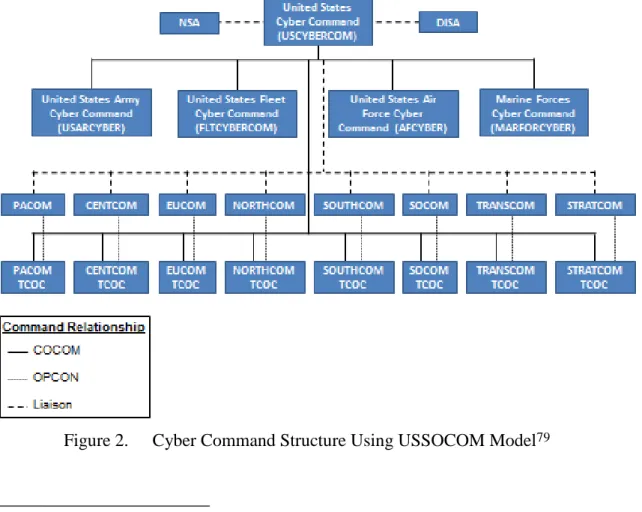
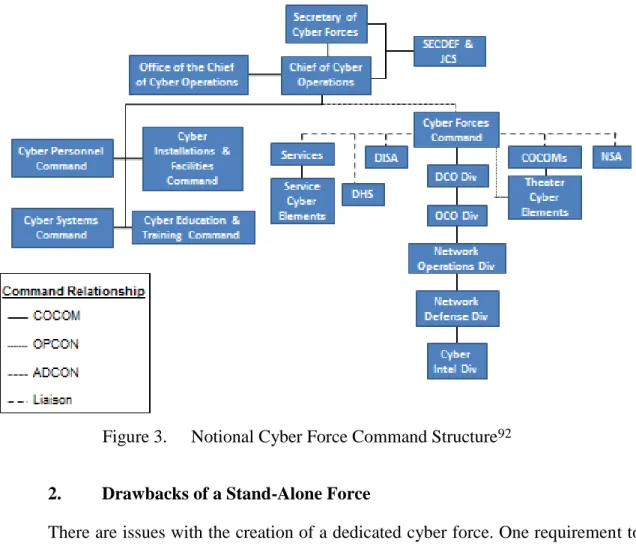
Chapter II examines the historical case of the DOD determining the C2 model for air as a new warfare domain. It focuses on the evolution of air forces within the DOD from a branch of the Army to an independent Air Force. Chapter III deals with the DOD organization with respect to its space forces, and the DOD decision to forgo a separate space force. Chapter IV examines the historical application of experiences with the air and space domains, and how decisions regarding C2 of those domains could apply to future decisions regarding cyber C2. It also explores three command structures for cyber forces: the model in use with USCYBERCOM as a sub-unified command within USSTRATCOM, a modified joint structure with USCYBERCOM as a stand-alone functional COCOM, and finally, a notional stand-alone cyber force. Chapter V provides a summary of findings and suggestions for future work on the topic of C2 of cyber forces.
II.
AIR DOMAIN
This chapter examines decisions made by the United States when confronted with the need to operate in a newly accessible warfare domain. From the first flight of a heavier-than-air vehicle in 1903, the U.S. military was forced to adapt to operating in a new environment. Over a four-decade span, the United States evolved from an Army-centric air force to creating a flying branch, the U.S. Air Force (USAF), in 1947. The chapter will also look at why the USAF exists today, what roles it serves, and how the experience of creating the Air Force applies to the cyber domain.
A. HISTORY
The idea of branches in the U.S. military comes from its foundations under the British as a colonial force, as well as each branches’ focus on “a unique mission within the overall mission of U.S. security and peace.”15 Under the U.S. Constitution, Congress is charged, “To raise and support Armies…to provide and maintain a Navy.”16 To that end, President Washington appointed a Secretary of War and a Secretary of the Navy to oversee those departments as cabinet secretaries.17 Based on the unique mission sets of each of the services, military branches exist to segregate the services into separate entities in order to focus their training and funding to carry out their missions in unique warfare domains. Thus, as militaries considered leveraging access to the air domain in the early 20th century, determining how to structure forces to fight in the air became important.
Aviation officially became a part of the U.S. military in 1909, with the Army receiving a purpose-built Wright aircraft, just six years after the first aircraft flight in
15 Richard W. Stewart, ed., American Military History Volume I: The United States Army and the
forging of a Nation, 1775–1917 (Washington, DC: Center of Military History, 2005), 28; “U.S. Armed Forces Overview,” accessed March 9, 2015, http://www.military.com/join-armed-forces/us-military-overview.html.
16 U.S. Constitution, Article I, Section 8.
17 William Gardner Bell, Secretaries of War and Secretaries of the Army: Portraits and Biographical
Sketches (Washington, DC: Center of Military History, 2010), 2; “Secretaries of the Navy,” accessed March 10, 2015, http://www.u-s-history.com/pages/h1225.html.
1903.18 U.S. military aircraft began military service in the Army as part of the Army Air Service during World War I. Following the war, Air Service leaders, led by Brigadier General William Mitchell, began advocating for an independent air force.19 They saw the Army’s use of the Air Service as limiting the application of air power to a strictly ground combat support role.20
During World War I, the Air Service served primarily to provide reconnaissance, artillery surveillance, and limited ground combat support roles, and was limited to mainly daylight flight, due in great part to the relatively unsophisticated nature of its aircraft.21 Airpower theories related to strategic bombing and innovative uses of the airplane to fight and win wars were superseded by the need to provide reconnaissance and air support to ground troops, as agreed to during a meeting between Army Chief of Staff General MacArthur and Chief of Naval Operations Admiral Pratt in January 1931.22 The full application of capabilities, such as long-range bombing, air-to-air engagements, and troop transport provided by operating in the air took a backseat to the Army’s desire to support ground troops.
Despite the successful creation of the British Royal Air Force (RAF) during World War I, “created for a single purpose—to defend the skies over Britain,” the best U.S. air power advocates could achieve was to improve aviation’s importance within the Army in the inter-war period, leading in 1926 to the creation of the Army Air Corps.23 Several further reorganizations led to the creation of Army Air Forces (AAF) in June 1941, with responsibility “for operational training and development of air doctrine…in
18 “U.S. Army Aviation Timeline,” accessed January 5, 2015, http://www.army.mil/aviation/timeline/
index.html.
19 Herman S. Wolk, Planning and Organizing the Postwar Air Force: 1943–1947 (Washington, DC:
United States Air Force, Office of Air Force History, 1984), 11–12.
20 Ibid., 6.
21 Maurer Maurer, ed., The U.S. Air Service in World War I (Washington, DC: United States Air
Force, Office of Air Force History, 1978), 38.
22 Wolk, Planning and Organizing the Postwar Air Force: 1943–1947, 19.
23 “Royal Air Force History: World War I,” accessed March 12, 2015, http://www.raf.mod.uk/history/
addition supply the War Department with the ‘basis for requirements of personnel, equipment, and stores to be furnished by arms and services to the Army Air Forces.’”24
While the experience of the British showed the value of having a separate service dedicated solely to the air domain, the lack of proximate war and relative American isolationism in the early 20th century were likely sufficient to prevent the creation of a U.S. air force. As World War I was mainly fought in close proximity to England, there was little threat of air operations against the United States. American isolationism would continue, even as World War II began, until 1941, when the United States was attacked by Japanese forces at Pearl Harbor. The combat experience of the AAF during World War II, technological improvements, such as long-range heavy bombers, long-range fighter escorts, high performance engines, and lightweight and strong metal construction, allowed the AAF to tackle new missions in an innovative manner.
During World War II, the military dedicated a great deal of manpower and effort to its postwar structure and force planning. Through World War II, both the Army (under the War Department) and the Navy were separate cabinet level departments. While a great deal of planning focused on creating a unified department to cover all defense-related activity, the elevation of air forces to a co-equal position with the Army and Navy was a point of focus for senior AAF leaders.25
Due to the close working relationship between Generals Eisenhower (Supreme Allied Commander, Europe during the war, then Army Chief of Staff after) and Spaatz (head of Strategic Air Forces in Europe during the war, then Commanding General of AAF and the first Chief of Staff of the Air Force after the war), General Eisenhower became a proponent of an independent Air Force.26 General Eisenhower experienced first-hand the effects of massed air operations. The bombardment of German forces in order to prepare the beaches of Normandy for the D-Day Invasion, providing air cover
24 United States Army, Army Regulation 95-5, Army Air Forces (Washington, DC: United States
Army, 1941), para. 4(d) and 5(c), in Wolk, Planning and Organizing the Postwar Air Force: 1943–1947, 21–22.
25 Herman S. Wolk, Toward Independence: The Emergence of the U.S. Air Force 1945–1947, Air
Force History and Museums Program (Bolling AFB, DC: Air Force History Support Office, 1996), 10.
for the invasion force, and the massive air drop of Army personnel in the enemy’s rear area during the invasion all likely played a role in his support for an independent Air Force. As the Allied and Joint Commander for the invasion, he saw the success provided by using the U.S. military in a joint and mutually reinforcing fashion. Likely, as a result of his time in command, he became an advocate for a unified defense department, dedicated to defense of the United States, which became the DOD.
Unlike the leadership of the Army and AAF, the senior leadership of the Navy at the time was opposed to both a unified department, and an independent air branch. Their argument was that the Joint Chiefs of Staff (JCS) was sufficient to deconflict prioritization between the War and Navy Departments. Navy leaders feared “a distinct threat to the existence of the Fleet Air Arm and the Marine Corps.”27 While the senior leadership of the Army had come around to the idea of unification and an independent air branch, the Navy’s resistance played a role in the delay of both unification and creation of the USAF.
The Navy’s concern was not without cause, considering the experiences of the British Royal Navy when the RAF was created. At that time, Britain’s Royal Navy lost its air element, which was merged with the RAF, creating a unified flying force under one branch of service. This was a decision the British would ultimately rescind in 1938, likely in response to the looming threat of war in Europe.28 While U.S. Navy leadership focused on the Royal Navy’s loss of its air arm after World War I, the British saw the error of taking fleet aviation away from their navy, a lesson the United States would likely have observed and learned from. U.S. Navy leadership fears regarding this point were probably unfounded in this respect.
U.S. Navy leadership was also of the opinion that unification would lead to one military officer being left to command the entirety of the military, which they saw as,
27 Wolk, Planning and Organizing the Postwar Air Force: 1943–1947, 36.
28 Ibid., 86; “Naval Aviation History and Fleet Air Arm Origins: History of Naval Aviation of the
Royal Navy and the Commonwealth,” accessed March 11, 2015, http://fleetairarmarchive.net/History/ Index.htm.
“beyond the capacity of one man.”29 In light of the success of the JCS at coordinating the war effort, such a view was uninformed. No one person would be left to command all the U.S. military without assistance and guidance from senior leaders in the other branches.
As seen in the case of the Department of the Navy, having a Secretary of the Navy does require that individual to set aside the requirements and provisioning of the Marine Corps, which is also under the Secretary’s purview. Whatever the disagreement, the Navy’s resistance would be overcome by lessons learned from the military at war as to why air power deserved its own dedicated branch of service.
B. WHY AN AIR FORCE?
The evolution of air operations from troop support mechanism to a dynamic force capable of a number of different combat missions made the decision to create a unique branch of service easier to accept among senior Army leaders. Leadership within the AAF that had long advocated for independence now had allies within Army leadership, and in President Truman.30 Based on combat experience in World War I, and especially in World War II, senior military leaders saw the benefits of strategic bombing, fighter escorts, and a heavy lift capability to move large formations of troops over long distances in relatively short order. Pre-war notions of air power’s relevance in combat were rendered obsolete by the experiences of the war.
While the Army successfully managed the AAF throughout the war, the growing relevance of the aforementioned broader missions required something more. As was the case after World War I, the Army likely would have cut research and development of aircraft in order to advance its ground forces. As can be seen in the technological advancement of aircraft and the growing uses for those aircraft, post-World War II, an air force unable to adapt and change would have put the United States at a great disadvantage with its chief post-war adversary, the Soviet Union. Having a separate air branch, able to test and develop new combat systems, would allow the United States to ensure its defense, while also improving the military’s overall combat power.
29 Wolk, Planning and Organizing the Postwar Air Force: 1943–1947, 87. 30 Ibid., 98.
Additionally, the invention and use of nuclear weapons during World War II signaled a vast new mission for an air force.
1. The Nuclear Mission
The nuclear mission required massive bombers to haul weapons to targets across great distances, something the Navy would be unable to provide with its carrier aircraft being limited in size due to flight deck restrictions.31 Furthermore, at the dawn of the nuclear age, the only delivery mechanism in existence for such weapons was the B-29 Superfortress, something over which the AAF had control.32 Even after the advent of intercontinental ballistic missiles (ICBMs) and subsequent growth of the strategic nuclear forces in the 1950s, the Air Force maintained sole ownership of the U.S. military’s nuclear mission.33 The arrival of submarine launched ballistic missiles (SLBMs), and tactical nuclear weapons (i.e., those weapons with shorter delivery ranges or lower nuclear yield) in the 1960s did provide an opportunity for both the Navy and Army to take on nuclear roles, but the Air Force retained the majority of the strategic deterrence mission.
2. Airpower Strategy
The strategic nuclear mission, coupled with the strategic bombing campaign of German and Japanese cities during World War II, were the realization of Italian General Giulio Douhet’s vision of air forces as a strategic tool capable of winning wars. Douhet, and those air power proponents citing his ideas, argued for air forces acting independently of ground and naval forces to bypass enemy forces, instead focusing attacks on the civilian population to decrease support for war, and thus achieve a strategic victory.34 In the view of U.S. advocates of Douhet’s vision for air power, an independent
31 Herman S. Wolk, The Struggle for Air Force Independence: 1943–1947, Air Force History and
Museums Program (Bolling AFB, DC: Air Force History Support Office, 1997), 244.
32 Ibid., 133.
33 “The First ICMBs,” accessed March 11, 2015, http://www.britannica.com/EBchecked/topic/135
7360/rocket-and-missile-system/57336/The-first-ICBMs.
air force would be freed from the necessity to focus mainly on support to ground troops, and thus able to both develop aircraft and use them in pursuit of an airpower strategy.
Based on experiences in World War II, many in the United States, including senior AAF leaders, believed that large scale ground warfare “could now be relegated to the past.”35 In this respect, their view coincided with the views of Royal Air Force leadership at the time.36 The shared combat experience and joint operations of the RAF and AAF during World War II showed the result of having an independent air force, able to plan and carry out strikes against the enemy’s war support efforts at will. An air force tied solely to the needs of the Army would be restricted from operating in a manner of its choosing, able to pursue its own objectives and tasks in support of war efforts.
In this view, Douhet can be seen as somewhat akin to a Clausewitz, or a Mahan, in terms of his long-term influence on his particular warfare domain of interest. While not applicable only to ground warfare, Clausewitz concerned himself with the conduct of ground wars. That his theories on war apply to other domains show its relevance and importance. Similarly, Mahan serves as one of the early naval warfare theorists, one whose ideas continue to influence naval strategy, especially U.S. Navy strategy, to this day. It is in this tradition that Douhet continues to influence USAF leadership, who continue to stress the strategic nature of airpower, and argue that it is possible to win wars by aviation alone.37
Following President Truman’s support, Congress finally began drafting the legislation that would ultimately become the National Security Act of 1947, creating the structure in place today. In addition to creating a unified DOD headed by a SECDEF, the Act also legally separated the Air Force from the Army, leading to the creation of a separate Department of the Air Force, and the USAF.38 After nearly four decades and two world wars, the Air Force became a unique branch of service. In the case of the Air Force, it was the experience of air operations under the Army, and the limitations of that
35 Wolk, Planning and Organizing the Postwar Air Force: 1943–1947, 40–41. 36 Ibid., 41.
37 “Our Mission,” accessed March 11, 2015, http://www.airforce.com/learn-about/our-mission/. 38National Security Act of 1947, Pub. L. No. 253 (1947), Section 207, 9–10; Section 208, 10–11.
relationship mentioned previously, that ultimately won the argument in favor of the proponents of an independent air branch.
C. RELATIONSHIP TO CYBER DOMAIN
As cyber warfare continues to evolve and grow in importance as a military mission, it is possible the mission could grow sufficiently to necessitate a dedicated force, as in the case of the Army-controlled air forces from 1909–1947. A cyber force with an expanded mission set, and the necessary tools to conduct independent operations in support of cyber objectives could support the argument to create a separate branch of service. Such a branch would be dedicated solely to the cyber domain, as occurred with the Air Force and its missions.
Although there are parallels between the strategic (i.e., nuclear) mission and the strategic nature of offensive cyber operations (OCO), clear definitions of the cyber mission is still at a very early stage. As seen with the Air Force’s struggle for independence, creating a cyber force focused solely on the cyber domain will require sufficient justification as its mission evolves to necessitate taking the cyber mission from the individual services and beginning, and then growing, a dedicated force.
Creating a cyber force would not necessarily end the cyber missions of the services. Despite the fears of Navy leadership during the debate of forming the Air Force, the Navy did not lose its fleet air mission. In fact, each of the branches retains an aviation capability to support their unique missions. In the cyber domain, the services would still have responsibility for their own network defense and incident response. Some portion of their individual cyber operations would be turned over to an independent force, but this would likely not entirely end their missions in cyberspace.
What is more likely is an iterative approach to change, as seen with the gradual evolution from the Army Air Service serving in a supporting role, to a broader air mission requiring ever greater forces to succeed. In this approach, USCYBERCOM would gain more autonomy through structural changes, similar to how the Army Air Corps, and then the AAF were granted more independence to conduct operations, yet
remained a part of the Army. The stand-alone force model mentioned above will be explored in greater detail in Chapter IV.
D. SUMMARY
As examined in this chapter, the United State adjusted to operations in the air domain relatively slowly. While the U.S. military gained an aviation mission in 1909, it did not create a separate military branch dedicated to fighting in that domain until 1947, despite attempts to change the C2 structure. The Air Force remains an important part of the DOD today, and it is widely regarded as one of the best air forces in the world. That is a testament to its growth as a force, and the skill with which it executes its numerous missions. As the cyber domain matures, there could be some forcing event or decision to act that leads to the creation of a branch of service dedicated solely to the cyber domain, much as happened to the Air Force.
Chapter III serves as the counterpoint to the military’s experience with the air domain. Although the DOD has operated in space for nearly 60 years, it remains a joint mission, executed by each branch of the military. The chapter examines how the U.S. military has chosen to operate in space, why the military chose its C2 construct, and will examine how the C2 structure of space forces relates to cyber forces.
III.
SPACE DOMAIN
This chapter examines decisions made by the United States when confronted with the need to operate in the space domain. The Soviet Union’s launch of Sputnik in 1957 ushered in the space age, and was a forcing function that pushed the United States to accelerate its space program. Unlike of its response in the air domain, the United States has resisted creating a stand-alone space force in the 57 years of U.S. space operations; instead, the military considers space a joint domain.
A. HISTORY
The United States began operating in space with the launch of Explorer 1 on January 31, 1958.39 Manned U.S. space operations began May 5, 1961, with the successful launch and recovery of Mercury-Redstone 3 and astronaut Alan B. Sheppard.40 Prior to that point, U.S. space experiments focused on studying the layers of the atmosphere through a series of sounding rocket launches, beginning as early as 1945, in a joint project between the Jet Propulsion Laboratory and U.S. Army Ordnance.41 These early suborbital experiments helped advance the U.S. space program, eventually leading to sustained U.S. space operations.
Even from these earliest tests, the U.S. military was heavily involved in the U.S. space program, as the military understood the advantages of operating in this new domain. The ability to overfly an enemy’s territory, while not violating its sovereignty, was a great advancement in the ability to collect intelligence about enemy force disposition, location and type of bases, new weapons systems, and a host of other information. It also offered a new method for striking an adversary in war, as the invention of ICBMs allowed. These advancements also lowered the risk of losing aircraft
39 “The First United States Satellite and Space Launch Vehicle,” accessed January 6, 2015, http://
history.nasa.gov/sputnik/expinfo.html.
40 “Mercury: MR-3,” accessed January 6, 2015, http://www-pao.ksc.nasa.gov/kscpao/history/
mercury/mr-3/mr-3.htm.
and pilots on reconnaissance missions, and allowed for peacetime surveillance of potential adversaries.
By the early 1950s, The Navy, Army, and Air Force all had individual space programs. The Air Force focused its early efforts (and cooperated heavily with the Central Intelligence Agency [CIA]) on reconnaissance programs to support the Air Force’s Strategic Air Command (SAC) in its strategic nuclear mission against the Soviet Union by collecting photographic intelligence of SAC targets.42 Concurrently, the Navy and Army joined efforts to research their own reconnaissance satellites. The Navy and Army roles were subsequently reduced by the establishment of the National Aeronautics and Space Administration (NASA) in July 1959, and by the Department of Defense Directive (DODD) 5160.32 of 1961, which, “made the Air Force responsible for the research, development, production, and deployment of space systems for all three services.”43
As the Air Force refined its space mission, it added spaced-based infrared sensors to warn of Soviet ICBM launches in the late 1950s, and give advanced warning of a nuclear attack.44 Following the shoot-down of Francis Gary Powers’ U-2 over Soviet territory in 1960, the United States focused on using space as an intelligence collection medium via on-orbit satellites. This led to the creation of the National Reconnaissance Office (NRO) that same year.45 With the creation of the NRO, the Air Force lost its position of authority with regard to reconnaissance satellites, as the NRO was tasked with developing satellites on behalf of the military and the intelligence community (IC).46 The Air Force was charged to focus “on the launching and tracking of missiles, and the conduct of various military support missions including communications, missile early
42 Joshua Boehm et al., “A History of United States National Security Space Management and
Organization,” Federation of American Scientists, accessed March 10, 2015, http://fas.org/spp/eprint/ article03.html#22; “History,” accessed March 12, 2015, http://www.stratcom.mil/history/.
43 Ibid.; Morgan W. Sanborn, “National Military Space Doctrine,” Air University Review, January–
February 1977, http://www.airpower.maxwell.af.mil/airchronicles/aureview/1977/jan-feb/sanborn.html.
44 Boehm et al., “A History of United States National Security Space Management and Organization.” 45 Ibid.
warning, meteorology, navigation, and the detection of nuclear detonations on earth from space.”47
This was the first indication of where C2 of space forces and assets was headed, with the Air Force as the DOD’s Executive Agent for Space. It was reasonable to grant the Air Force the power to lead DOD space operations, given the number of missions it was already executing. As Executive Agent, the Air Force could oversee all DOD space procurement and operations. This increased efficiency, decreased redundant systems and missions, and allowed the Army and Navy to focus more on their missions in their traditional domains, while still allowing those services to procure space systems they required to execute their missions.
B. WHY NOT A SPACE FORCE?
As the space mission grew, the Air Force continued to receive a greater portion of DOD funding for space programs, reaching as high as 90% of all DOD funding for space research by 1961.48 DODD 5160.32 was updated in 1970 to allow for service-specific research, testing, and development with respect to space systems, with the Air Force in a supporting role as necessary.49 But, as it has since the late 1950s, the DOD still considers the space domain a joint warfare domain. As Executive Agent for Space, the Air Force receives the bulk of space funding, and also requires a larger cadre of space operations personnel than the other services. Of the military’s $6.2 billion space budget request for fiscal year 2015, the Air Force received $5.6 billion of the funding, and has over 40,000 personnel (active duty service members, civilians, and contractors) assigned to the Air Force Space Command (this includes 5,400 personnel assigned to 24th Air Force, the cyber force branch of the USAF), with approximately 34,600 dedicated to the space
47 Curtis Peebles, High Frontier: The United States Air Force and the Military Space Program, Air
Force History and Museums Program (Bolling AFB, DC: Air Force History Support Office, 1997), 15 in Boehm et al., “A History of United States National Security Space Management and Organization.”
48 Department of Defense Directive 5030.18, “DOD Support of National Aeronautics and Space
Administrations,” 99 in Boehm et al., “A History of United States National Security Space Management and Organization.”
mission.50 By way of comparison, the Army has 2,400 personnel (active duty personnel and civilians) assigned to space cadre billets, while the Navy has just 127 active duty personnel in space cadre billets, as well as 11 active duty astronauts.51
As in the arguments regarding a specialized force dedicated to combat in the air domain, a debate about the need to create a stand-alone space force within the DOD has been ongoing for at least two decades.52 Numerous reports cite a variety of factors for the lack of long-term planning and strategy development with respect to the DOD space assets and strategy. Unlike in the case of the Air Force, no stand-alone space force acting to secure freedom of maneuver in space for U.S. use has been created to-date.53 From its earliest operations in space, the U.S. military and the IC saw space as a medium for intelligence collection. As such, early space C2 organizations focused on launching and managing satellites to collect intelligence information.
The creation of USSPACECOM in 1985 sought to synchronize all U.S. space operations in a functional COCOM C2 construct, but the command was disestablished in 2002, its functions given over to USSTRATCOM.54 This likely had to do with the fact that USSTRATCOM was already responsible for the strategic nuclear mission, so granting it authority over space assets, with the capability to warn of an impending nuclear attack, made sense, and USSPACECOM became JFCC-Space, a sub-unified command under USSTRATCOM.
50 “United States Department of Defense Fiscal Year 2015 Budget Request Overview,” accessed
March 12, 2015, http://comptroller.defense.gov/Portals/45/Documents/defbudget/fy2015/fy2015_Budget_ Request_Overview_Book.pdf, 6–1; “United States Air Force: Fiscal Year 2016 Budget Overview,” accessed March 12, 2015, http://www.saffm.hq.af.mil/shared/media/document/AFD-150210-043.pdf, 18 (FY15 enacted); “Air Force Space Command Fact Sheet,” accessed March 12, 2015, http://www.afspc.af. mil/library/factsheets/factsheet.asp?id=3649; “24th Air Force Fact Sheet,” accessed October 17, 2014, http://newpreview.afnews.af.mil/24af/library/factsheets/factsheet.asp?id=15663.
51 “Army Space Personnel Development Office Fact Sheet,” accessed March 12, 2015, http://www.
smdc.army.mil/FactSheets/ASPDO.pdf; “Navy Space Cadre,” August 6, 2014, http://www.doncio.navy. mil/chips/ArticleDetails.aspx?ID=5356.
52 Kurt S. Story, A Separate Space Force: An Old Debate with Renewed Relevance (Carlisle Barracks,
PA: U.S. Army War College, 2002), 1; John D. Cinnamon, U.S. Department of the Space Force: A
Necessary Evolution (Norfolk, VA: Joint Forces Staff College, 2012), 11;Leah Tanner, “A Cyber Force for U.S. Cyberspace Operations” (unpublished manuscript, September 17, 2014), 1–2.
53 Mark E. Harter, “Ten Propositions Regarding Space Power: The Dawn of a Space Force,” Air &
Space Power Journal, Summer 2006, 76.
With space surveillance part of its purview, in 2005, USSTRATCOM stood up the Joint Functional Component Command for Intelligence, Surveillance, and Reconnaissance (JFCC ISR) in 2005, thus making it responsible to advocate for and apportion all aspects of intelligence, surveillance, and reconnaissance (ISR) to the geographic combatant commands (GCCs).55 As can be seen, USSTRATCOM’s role has grown, and it has taken on many different missions that provide strategic value to the U.S. military, including the two newest warfare domains, space and cyber. This was likely a result of improving DOD efficiency, as USSTRATCOM is a supporting commander to the other COCOMs. Rather than the other COCOMs having to reach out to several commands for assistance with operations and planning, the remaining COCOMs can work through a single functional COCOM. USSTRATCOM can act as a single point of contact for a host of mission-essential support functions, decreasing response time and helping COCOMs in need of support much more rapidly.
The disestablishment of USSPACECOM does not equate to decreased importance of space operations from a U.S. perspective. On the contrary, space is even more vital to U.S. interests than at any previous point in time, “The United States considers the sustainability, stability, and free access to, and use of, space vital to its national security interests.”56 Reliance on space for command and control purposes, communication, navigation, and many other factors has only increased.57 As U.S. reliance on space has expanded, historical advantages have shrunk. Adversary nations increasingly are capable of impacting U.S. space operations. This provides U.S. adversaries with the potential to hinder terrestrial operations, a capability seen in the Chinese anti-satellite missile test of 2007, and foreseen in the 2012 Joint Operational Access Concept, “space and cyberspace
55 “Joint Functional Component Command for Intelligence, Surveillance, and Reconnaissance (JFCC
ISR),” accessed March 12, 2015, http://www.stratcom.mil/factsheets/6/JFCC_ISR/.
56 Barack H. Obama, National Space Policy of the United States of America (Washington, DC: The
White House, 2010), 3, http://www.whitehouse.gov/sites/default/files/national_space_policy_6-28-10.pdf.
57 Department of Defense, Joint Operational Access Concept (JOAC) (Washington, DC: Department
will be priority domains for many future adversaries, both state and non-state, because U.S. forces critically depend on them.”58
More than ever, space assets are of critical importance to a broad spectrum of military operations, and USSTRATCOM fulfills its role as a supporting COCOM with a broad spectrum of capabilities, including space operations. Although C2 of space forces have changed constantly over nearly six decades, and regardless of any perceived advantages in creating a stand-alone space force, USSTRATCOM is more than capable of meeting challenges to U.S. space superiority, and ensuring continuity of U.S. space operations.
C. RELATIONSHIP TO CYBER DOMAIN
The arguments in favor of creating a space force parallel several of the arguments for a cyber force, and the relative advantage enjoyed by the United States in the cyber domain is similar to the early stages of space operations. The widely-cited lack of an overarching space strategy, lack of unified control over space forces, and difficulty countering adversary space activities are all similar to problems debated with respect to the cyber domain. Several proponents of a stand-alone cyber force allude to issues with C2 of cyber forces, lack of a cyber strategy, and adversary activity in cyberspace against the United States.59
While there are certainly issues with C2 of cyber forces, USCYBERCOM is in the process of filling out its various mission teams with trained personnel, and C2 of those forces will likely improve in the near-term. As for cyber strategy, just because it is
58 Department of Defense, Joint Operational Access Concept (JOAC), 12; Marc Kaufman and Dafna
Linzer, “China Criticized for Anti-Satellite Missile Test,” Washington Post,January 20, 2007, http://www. washingtonpost.com/wp-dyn/content/article/2007/01/18/AR2007011801029.html.
59 David C. Hathaway, Digital Kasserine Pass: The Battle Over Command and Control of DoD’s
Cyber Forces (Washington, DC: Brookings Institute, 2011); Ben FitzGerald and Parker Wright, Digital Theaters: Decentralizing Cyber Command and Control (Washington, DC: Center for a New American Security, 2014), http://www.cnas.org/sites/default/files/publications-pdf/CNAS_DigitalTheaters_ FitzGeraldWright.pdf; “U.S. Needs to Construct National Cyber Security Policy,” February 15, 2015, http://www.businessinsurance.com/article/20150215/NEWS06/302159999/u-s-needs-to-construct-national-cyber-security-policy?tags=%7C302; Paul J. Pena, “Evolving Threats Demand an Evolving National Security Strategy,” Forbes, February 19, 2015, http://www.forbes.com/sites/realspin/2015/02/19/evolving-threats-demand-an-evolving-national-security-strategy/.
not discussed openly does not prove nonexistence. There is likely a strategy, but due to the sensitive nature of the methods in use, it is likely classified, and thus not available to debate its merits or flaws. The same applies to adversary activity in cyberspace. As seen with the indictment of five Chinese citizens suspected of cyber espionage against the United States, and the publicity surrounding the alleged North Korean cyber attack against Sony, there is likely a very robust network of highly trained personnel countering U.S. adversaries in cyberspace. Again, just because it is not well known does not provide proof of one way or the other with respect to U.S. military cyber capabilities.
One key difference between the space and cyber domains is the 1967 Outer Space Treaty, which restricts all signatories from putting any nuclear weapons into orbit, basing them on any celestial body (e.g., the moon), or stationing weapons in space via any other means. Furthermore, the treaty prevents signatories from establishing any bases in outer space, testing weapons in space, or conducting military maneuvers on celestial bodies. Finally, the treaty does allow the use of military personnel to conduct scientific research for peaceful purposes, as well as the free exploration of space for the benefit of all mankind.60
There is no analogous treaty with respect to cyberspace, and the difference is critical. Offensive activity can originate in cyberspace, and the military is free, within policy and legal limits, to operate in the domain. Therefore, the restraints that apply to the space domain do not apply to the cyber domain, enabling U.S. military cyber operations. If the United States were to accede to a treaty limiting or preventing military use of cyberspace, the situation would potentially resemble the space domain.
The early phase of cyber operations (prior to the proclamation of a cyber domain by the DOD) seems to mirror that of space operations, in that different components of the cyber mission set belonged to a host of different organizations. In terms of space, missions fell to different commands. From a cyber perspective, organizations like the NSA, Joint Functional Component Command-Network Warfare (JFCC-NW, responsible
60 U.S. Department of State, Treaty on Principles Governing the Activities of States in the Exploration
and Use of Outer Space, Including the Moon and Other Celestial Bodies (Washington, DC: Department of State, 1967), http://www.state.gov/www/global/arms/treaties/space1.html.
for computer network attack [CNA]), and Joint Task Force-Global Network Operations (JTF-GNO, responsible for computer network defense [CND]) all had roles in cyberspace. Unlike space, the functions of the disparate organizations (other than the NSA) were brought together relatively quickly and tasked to USCYBERCOM, as opposed to nearly 30 years from the first U.S. space operations to the creation of USSPACECOM.
D. SUMMARY
As seen in this chapter, C2 of space forces evolved over time. The one constant was the primacy of the Air Force with respect to space operations. While the Air Force has been the Executive Agent for Space for some time, C2 of space forces has remained a joint venture. In some respects, C2 in this domain mirrors that of the cyber domain. While USSPACECOM provided the space domain its own functional COCOM for a time, C2 in the space domain now falls to JFCC Space, which like USCYBERCOM, is a sub-unified command of USSTRATCOM.
Chapter IV examines how historical decisions regarding C2 of forces in new warfare domains applies to the cyber domain. It considers three separate C2 structures. The first is the current structure in operation today. The second is a functional COCOM, similar to USSOCOM, by removing USCYBERCOM from USSTRATCOM. The final structure is a stand-alone U.S. Cyber Force, as proposed by Stavridis and Weinstein, and mentioned earlier in this thesis.
IV.
COMPETING CYBER COMMAND STRUCTURES
This chapter examines historical applications of the air and space domains, and how those constructs would fit in a cyber C2 structure. It then considers three separate C2 structures for cyber missions, while highlighting some of the benefits and drawbacks to each. The three different C2 structures it examines are: 1) the existing structure, with USCYBERCOM as a sub-unified command under USSTRATCOM, and service cyber elements as the component commanders under USCYBERCOM, 2) a modified joint structure following the U.S. Special Operations Command (USSOCOM) model, with USCYBERCOM as a stand-alone functional COCOM and service elements providing cyber personnel to USCYBERCOM for tasking to support the GCCs, and 3) a stand-alone cyber force as a separate, co-equal branch of the military, responsible for all DOD cyber activities.
A. HISTORICAL APPLICATION TO CYBER DOMAIN
With the declaration of cyberspace as an operational domain in 2011, cyber operations are at a relatively nascent stage when compared to the historical cases mentioned in this thesis.61 The decision to spin-off the air domain from the Army into the Air Force took 38 years, while space operations continue as a joint function 57 years after U.S. space operations began. As these two domains have shown, time and planning are necessary to ensure successful C2 transitions. While the Air Force took nearly four decades to evolve from the Army Air Corps into the USAF, by proving the utility of full-spectrum air operations, independent air force advocates gained support for their vision. With regard to the space domain, numerous changes in C2 structure actually hampered effective C2 of space forces and assets. This resulted in more changes, before finally settling on the creation of JFCC Space, with the Air Force as the DOD’s Executive Agent for space.
61 David Alexander, “Pentagon to Treat Cyberspace as “Operational Domain,”” Reuters, July 14,
2011, http://www.reuters.com/article/2011/07/14/us-usa-defense-cybersecurity-idUSTRE76D5FA20 110714.
As it stands, USCYBERCOM is not fully manned at authorized levels and is completing force build out to reach its end-strength by 2016.62 While a full examination of USCYBERCOM’s effectiveness and ability to satisfy requirements cannot be complete until it is fully manned, there are different models to consider for cyber forces’ C2 structure. In the historical cases mentioned in Chapters II and III, unique aspects of the air and space domains drove separate approaches that resulted in vastly different outcomes. When considering the cyber domain, it is instructive to look back and take stock of how the United States chose to organize its forces in the domains of air and space.
With respect to the cyber domain, the example of the space domain is more relevant today than that of the air domain. Not only is there no U.S. Cyber Force, both JFCC Space and USCYBERCOM are sub-unified commands under USSTRATCOM. Along with its other sub-unified commands, USSTRATCOM is well suited to fulfill its mission to, “Detect, deter, and prevent strategic attacks against the United States and our Allies,” and is quite capable of doing so in the cyber domain.63 While both space and cyber are warfare domains, the nature of operations in both domains is ill suited to an independent branch of the military. There is still the possibility that the evolution of the cyber mission could necessitate creation of a branch, but small changes to the C2 structure of cyber forces is more likely in the near term.
In terms of how the historical examples examined apply to the cyber domain, the case of the space domain mirrors that of the cyber domain, with the only distinction being the rapid evolution of C2 of cyber forces to match that of the space domain. With respect to C2 regarding the air domain, the outcome of modeling cyber C2 after that of the air would be a stand-alone branch of the military, focused solely on operations in the cyber domain. As in the case of the air domain, some cyber functions would remain with the services, and as each branch of service has an air arm, so too would each service have cyber operations specialists. If C2 of the cyber domain were to fall between the two
62 “USCYBERCOMMAND Cyber Mission Force.”
extremes, USCYBERCOM would become its own functional COCOM, similar to the space domain and USSPACECOM between 1985–2002.
What follows is an examination of each of the three C2 structures considered for purposes of this thesis. The current C2 structure of cyber forces is presented first.
B. CURRENT STRUCTURE
As currently constructed, USCYBERCOM is a sub-unified command that reports directly to the commander of USSTRATCOM, while each service has its own cyber element that falls both under the service and USCYBERCOM.64 The mission statement for USCYBERCOM states that,
USCYBERCOM plans, coordinates, integrates, synchronizes and conducts activities to: direct the operations and defense of specified Department of Defense information networks; and prepare to, and when directed, conduct full spectrum military cyberspace operations in order to enable actions in all domains, ensure U.S./Allied freedom of action in cyberspace and deny the same to our adversaries.65
In this role, USCYBERCOM is tasked with defending the Department of Defense Information Network (DODIN), providing support to the GCCs for mission execution, and improving the nation’s ability to withstand and respond to cyber attacks. To execute these three focus areas, the command is standing up separate cyber mission teams dedicated to specific functions within the focus areas. The teams are, respectively, cyber protection forces (cyber protection teams—CPT), cyber combat mission forces (cyber mission teams—CMT), and cyber national mission forces (national mission teams— NMT).66 To populate the teams, USCYBERCOM is determining the necessary team structure, training requirements, and necessary certification to allow for mission execution.67 Figure 1 shows the current command structure. Personnel assigned to the service cyber ranks fall under the administrative authority of each of the services, while
64 “U.S. Cyber Command.”
65 “USCYBERCOMMAND Cyber Mission Force.”
66 Ibid.
those assigned to USCYBERCOM fall under USCYBERCOM’s authority. Combatant command and operational control over all cyber personnel resides with USCYBERCOM.68
Figure 1. Cyber Command Structure69
1. Benefits of Current Structure
Since achieving FOC October 31, 2010, USCYBERCOM has been led by a four-star commander in a dual-hatted role with additional responsibilities as the Director of the National Security Agency/Central Security Service (NSA/CSS).70 The decision to tie the commands together was based on the resident capability at the NSA’s Fort Meade headquarters to conduct both computer network exploitation (CNE) and CNA (previously
68 Duane Davis, “CY4400: Cyber Mission Planning” (lecture, Naval Postgraduate School, Monterey,
CA: January 27, 2015).
69 “U.S. Cyber Command.”
70 Gates, Establishment of a Subordinate Unified U.S. Cyber Command Under U.S. Strategic
under the aegis of JFCC-NW). The relocation of JTF-GNO to Fort Meade in 2010 and subsequent disestablishment also brought the CND mission to USCYBERCOM.71 In this dual-hatted setup, the USCYBERCOM and NSA head is responsible for both the DOD Title 10 authorities related to warfighting in cyberspace, and the IC Title 50 authorities related to signals intelligence (SIGINT) collection and exploitation.72 Having the NSA and USCYBERCOM in the same location, with the same commander, provides the military with the unique capabilities of both commands, and improves both Title 10 and Title 50 support to the GCCs.
2. Drawbacks of Current Structure
One factor routinely cited by critics of the current command structure is the centrally controlled manner in which cyber forces and efforts are managed by USCYBERCOM. While the command is tasked with support for GCC missions worldwide, the distributed nature of the GCCs and the rigid control mechanisms in place are highlighted in several sources as a hindrance to the effective inclusion of cyber operations in GCC operational and planning efforts.73 Various statements made in testimony before Congress by both former commander GEN Alexander, and current commander ADM Rogers, lead to confusion about how exactly the command intends to provide support to the GCCs. For example,
DOD has at various points said that theater cyber will be ‘under the command and control of whichever combatant command to which they are assigned’, will be ‘aligned under one of four Joint Force Headquarters-Cyber in direct support of geographic and functional combatant
71 Gates, Establishment of a Subordinate Unified U.S. Cyber Command Under U.S. Strategic
Command for Military Cyberspace Operations.
72 James G. Stavridis and David Weinstein, “Divide and Conquer: Why Dual Authority at the NSA
and Cyber Command Hurts U.S. Security,” Foreign Affairs, October 23, 2013, http://www.foreignaffairs. com/articles/140206/james-g-stavridis-and-dave-weinstein/divide-and-conquer.
73 Hathaway, Digital Kasserine Pass: The Battle Over Command and Control of DoD’s Cyber Forces,