Evaluation of Software
License Management
Frameworks for Grid
Environments:
The Four Ts for Agile Systems
Filip Eriksson (filer663) & Joel Östlund (joeos007) 2/15/2014
Contains a Case Study and Experiences from:
Master’s thesis
Economic Information Systems
Industrial Engineering and Management
Department of Management and Engineering
Linköping University, Sweden
LIU-IEI-TEK-A--14/01801--SE
1
Evaluation of Software
License Management
Frameworks for Grid
Environments:
The Four Ts for Agile Systems
Filip Eriksson (filer663) & Joel Östlund (joeos007) 2/15/2014
Examiner: Alf Westelius Mentor: Carl-Johan Petri
Master’s thesis
Economic Information Systems
Industrial Engineering and Management
Department of Management and Engineering
Linköping University, Sweden
LIU-IEI-TEK-A--14/01801—SE
2
Abstract
Business Agility could be the means to survive in a competitive environment of continuous and unanticipated change and to respond quickly to rapidly changing, fragmenting global markets that are catered by competitors. To leverage the potential benefits of Business Agility, many companies use Information Technology as a major force for augmenting their agility. The topic of increasing Business Agility through Information Technology has been pervasively studied in research papers. And in the context of this thesis, we will investigate research papers in order to develop an evaluation model for facilitating making informed decisions regarding agile Information Systems in computational Grid environments. The Information Systems in this thesis will focus on license management systems, which is an intricate but coherently integrated blend of many different modules compiled as a technical solution that enables software license management. We will use our evaluation model to compare license management frameworks, easily grasped as a draft for a license management system, for Grid environments and also underpin it with a case study on an in-use license management system in order to strengthen its business applicability.
The research was conducted as a qualitative comparison and a case study, combining both research papers and a real business context in order to fulfill the goals and purposes of this thesis.
The results of the analysis implies that most of the license management frameworks for Grid environments lacks various details needed for making a feasible implementation in a certain business context, whilst those that have been trialed in a real business situation fulfilled almost every aspect of our evaluation model.
The conclusion drawn is that our evaluation model is a seemingly good start for making informed decisions when choosing or designing an agile license management system for Grid environments.
3
Acknowledgements
We give our special thanks and regards to the following persons involved in contributing to our essay: Carl-Johan Petri, our supervisor at Linköping University: for tireless efforts, valuable insights, and countless hours of devotion to making this essay possible.
Andreas Ehrlund, our supervisor at Ericsson: for the daily guidance in the field of software licensing and always effortlessly helping us out when needed.
Johan R. Olsson, our contact person for arranging interviews: for the deep and nuanced insights and participation in making our essay possible.
Alf Westelius, our examiner at Linköping University: for interesting angles, discussions, and suggestions. Axel Crona and Jonna Bertilsson, our opponents at Linköping University: for rigorous participation and well thought through suggestions.
All the interview subjects and other people participating in making our essay possible: it would not have been possible without your participation.
4
Table of Contents
1. Introduction ... 7
1.1. Background ... 7
1.2. Problem discussion ... 8
1.3. Purpose and research questions ... 9
1.4. Delimitations ... 10
1.5. Basic terminology ... 10
1.6. Report structure ... 13
2. Methodology ... 14
2.1. Background of the authors ... 14
2.2. The Study Object ... 14
2.3. The Evaluation Model ... 15
2.4. Approach ... 16
2.5. Approach criticism ... 21
2.6. Scientific approach ... 22
2.7. The literature study ... 24
2.8. The case study ... 27
3. Theoretical framework ... 34
3.1. Introduction ... 34
3.2. Business Agility ... 35
3.3. From theory to evaluation model ... 44
3.4. The Evaluation Model ... 51
4. Our interpretation of Ericsson’s criteria in relation to the Evaluation Model ... 52
4.1. Evaluation Model comparison ... 55
5. A Spectrum of License Management Frameworks ... 56
6. Analysis ... 85
6.1. SmartLM ... 85
6.2. GenLM ... 93
6.3. Service Oriented License Providing (SOLP) ... 99
6.4. On-demand software license provisioning in Grid and Cloud computing (OSGC) ... 105
6.5. Floating License Sharing System (FLSS) ... 111
5
6.7. The Ericsson analysis ... 124
7. Conclusions and discussions ... 126
8. Bibliography ... 130
9. Interviews ... 137
10. Appendix 1 – Terminology ... 138
10.1. Web Service ... 138
10.2. Virtual Organization ... 138
10.3. Quality of Service (QoS) ... 138
6
Abbreviations
LMS License Management System
LMF License Management Framework for Grid environments ISV Independent Software Vendor
ASP Application Service Provider GUI Graphical User Interface
API Application Programming Interface IT Information Technology
SaaS Software as a Service SLA Service Level Agreement SOA Service Oriented Architecture
7
1.
Introduction
The first subchapter will provide the background to the problem. This leads to the next subchapter which discusses the core of the problem and why there is need for further research. Later, by clarifying the purpose, research questions, and delimitations of the study facilitates to reduce the abstraction of the scope. Subsequently, the purpose of the basic terminology section is to clarify important concepts in order to prevent misunderstanding and instead give the reader the prerequisites to fully understand this thesis, this section is recommended to read first for readers that are not fully experienced within the field of this thesis. Finally, the outline of this thesis is presented.
1.1.
Background
At present, companies have to survive and develop competitive advantage in a dynamic and turbulent environment of global competition and rapid business change (Sambamurthy, et al., 2003; van Oosterhout, 2010); hence augmenting the urge to proactively predict the changes before they impact business operations (Thao, et al., 2012). Surviving in an ever changing environment has since the last decades been crucial, owing to that the lifespan of products has dramatically declined since the beginning of the 1990s (Melarkode, et al., 2004). A company’s ability to deal with these kinds of issues is denoted Business Agility and have been comprehensively summarized by van Oosterhout (2010) as:
“[...] the ability of an organization to swiftly change businesses and business processes beyond the normal level of flexibility to effectively manage highly uncertain and unexpected but potentially consequential internal and external events, based on the capabilities to sense, respond and learn.”
Software licensing mechanisms are controls put in software to grant or deny the use of the whole or parts of the software, even though it might be fully installed on one hardware device and already capable of bringing the whole functionality. It has played an important part in the distribution and control of software, especially commercial software. (Manoharan & Wu, 2007) The importance for commercial software to use software licensing mechanisms is because these vendors often, beside the acquisition price, use license fees to sustain and increase profits. (Mazhelis, et al., 2013; Ferrante, 2006) It is therefore important for these vendors that the licensing shall be strong enough to mitigate cracking and piracy (Manoharan & Wu, 2007). From an enterprise perspective, the biggest issue is inadvertently application of the product in a way that violates the software license agreement. Software vendors can protect their assets with the act of auditing the customer and enforcing the legal agreement by building mechanisms into the product that disable the use when the purchaser violates any terms of the agreement. (Ferrante, 2006)
In a McKinsey Quarterly article, Persson et al. (1999) claimed that for most of the industries producing software, their transition towards software licensing has not been easily grasped. An example is traditional providers of telecom equipment that have long been hardware oriented; this industry failed to seize emerging software opportunities and the new services they made possible. As hardware prices are declining, the importance of capturing value from software becomes even more important as it offers economies of scale. In traditionally hardware oriented industries, the transition from hardware to
8 software orientation is a potential growth area, and they should therefore develop a clear strategy for the parts of their businesses that depend on software. (Persson, et al., 1999)
This research paper is conducted on the international telecommunications company Ericsson, who had the problem described in the previous paragraph. Ericsson began to seize the emerging opportunities for software licensing during the early 1990s. (Process Architect ELIS & BNET, 2013) Since then, a lot of new software licensing revenue models has appeared on the market, which in some cases demands new technologies for software licensing practices (Robinson, 2006). Ericsson have been reluctant in this field, and are therefore curious to explore new software license management techniques that adheres to contemporary technical and customer demands (Process Architect ELIS & BNET, 2013). A well-known problem of sticking to an old computer system is posed by the IT-flexibility paradox that claims that strategic benefits of Information Technology are not sustainable over time. This is due to that technology can contribute to organizational flexibility since (new) IT is inherently more flexible than its predecessors. However, since technology ages so rapidly and becomes hard to maintain, flexibility is quickly lost, which affects the companies’ ability to reactively adapt to their environment. (Lukas Jr & Olson, 1994) This causes a problem since executives often find it difficult to justify large expenditures on IT, especially if they are not tied to a specific business benefit and, thus, causes the expenditure to be seen as an unaffordable overhead or even as a dispensable IT “toy”. (Duncan, 1995) Ericsson hopes that a new license management system could bring greater profits due to the new abilities (and flexibility) that it might unleash (Process Architect ELIS & BNET, 2013); hence augmenting the company’s need for increased Business Agility (Ericsson’s Strategic Direction, 2013; Director of Software and Product Packaging, 2013). Due to the nature of telecom networks, Grid computing is a feasible choice for the business environment. (Berde, et al., 2009; Robertazzi, 2007; Future Generation Grids, 2004) Since a Grid is a specialization of a distributed computing environment (Grid café, 2013), the following authors agree to that Grid computing is the most feasible choice for working with telecom networks. (Gregory, 2000; Sukumar, 2007; Peleg, 2000)
1.2.
Problem discussion
As the case of Ericsson in the previous section mentions, new ways of working with software licensing brings the hope of sustaining and increasing profits (which Mazhelis et al. (2013) and Ferrante (2006) also mentioned was the purpose of software licensing).
As the IT-flexibility paradox states: old systems lead to diminishing returns on the strategic value of Information Technology. A way to still keep the systems flexible could be to period-wisely implement new computer systems. Enhancing the flexibility of a system could reasonably increase the Business Agility of the company; hence augmenting the ability to proactively predict the changes before they impact business operations. A shortcut for implementing a new software licensing management system in order to upgrade or implement a new system to support contemporary technologies and maintain flexibility in Grid environments is to use a proposed license management framework adjusted to the computational environment.
As this thesis was conducted at Ericsson, the assignment was to investigate feasible software license management frameworks for their business environment and contemporary technical demands. As
9 Ericsson’s Strategic Direction (2013) urges for boosting the company’s Business Agility, this research paper will be based upon elaborating a framework to evaluate different software license management frameworks from a Business Agility perspective. To the best of our knowledge, there has been no previous research conducted on the topic of comparing license management frameworks for Grid environments, which makes this paper unique in its field of study.
This thesis, reports on our investigation of research articles that elicit criteria for computational Grid environments that augment Business Agility. The criteria are compiled into an evaluation model that is used to evaluate the different licensing management frameworks for Grid environments that are proposed by the scientific literature. The next step is to check the applicability of the Evaluation Model with regard to the case study. After this, the license management frameworks for Grid environments are compared with the Evaluation Model, without intention of making recommendations for choosing a framework. After this, we discuss the various frameworks and what would be suitable for Ericsson. At last, we draw conclusions regarding our evaluation model concerning its generalizability and applicability.
1.3.
Purpose and research questions
The purpose of this study is to develop an evaluation model for license management frameworks for Grid environments, validate this evaluation model through expert interviews, and apply it on a set of license management frameworks for Grid environment. The Evaluation Model development leads to the first research question:
RQ1: Which aspects have previous authors argued for regarding systems in grid environments?
These aspects were synthesized into a number of categories. The Evaluation Model is then validated by licensing experts after answering the second research question:
RQ2: Which criteria do five licensing experts at Ericsson consider important when evaluating a license management system?
In order to apply the Evaluation Model we must discover which license management frameworks for Grid that has been described by previous research which leads to the third research question:
RQ3: Which license management frameworks for Grid environment are mentioned in previous research?
After applying the Evaluation Model on the license management frameworks for Grid environment the last two research questions can be answered:
RQ4: To which extent do license management frameworks for Grid environment, presented in previous research, match the aspects of our evaluation model?
RQ5: Which license management frameworks for Grid environments seem to be the most feasible for the particular case study?
10
1.4.
Delimitations
When creating the Evaluation Model, criteria were gathered from previous research in the fields of Business Agility, systems in Grid environment, and licensing systems in Grid environment.
In order to validate the Evaluation Model, Ericsson’s criteria regarding an LMS were gathered. It would have been interesting to use licensing experts from more companies in order to increase the generalizability of the Evaluation Model, but we will leave that aspect as a case for further research. Also five employees were interviewed for these criteria and it might have been useful to talk to more people at Ericsson, but this was also not prioritized due to time limitations. There were limitations regarding the information received from Ericsson, where criteria could be discarded for the following three reasons (these are more thoroughly described in section 2.4.2):
The criterion is considered too fundamental
The criterion is considered too implementation specific
The criterion is not within the scope of being applicable on an LMF
There was one limitation regarding the LMFs that were chosen. They had to support Grid environment since it, according to Berde et al. (2009), Robertazzi (2007), and Future Generation Grids (2004) is feasible in the telecom industry. The information regarding the LMFs could include the following (which can be found in section 2.2):
1. The authors’ knowledge: The aggregated expertise of the authors of the frameworks articles, regarding the framework, which refers to knowledge that has not been documented.
2. The documentation of the framework and its references: Apart from the actual framework articles, there might be other texts written by the authors themselves or somebody else that clarifies or completes its content.
3. General method: The general method explains on a conceptual level how the framework can be used. This method can be used regardless of the chosen implementation.
4. The requirement specification: The requirement specification describes how the framework can be implemented with regard to technical aspects.
5. System implementation: The system implementation is an actual implementation of the framework.
Only the documentation of the framework and its references were used (bullet 2) and an explanation of this choice can be found in section 2.2. The information presented regarding the LMFs was limited to give a brief overview of the framework and then give the information that was available regarding the criteria of the Evaluation Model.
1.5.
Basic terminology
This section is meant to provide the reader with general knowledge to fully understand the concepts in this thesis. All the details in this section will not be mentioned in the rest of the thesis, but will be useful for the reader to grasp for his own understanding of important concepts.
11 1.5.1. License
German & Hassan (2009) defines the license as a set of grants that each has their set of conditions, which must be achieved for the grant to be given. A license in turn consists of one or more rights that, in turn, have zero or more obligations. This is visualized in the meta-model by German & Hassan (2009) which is shown below:
Figure 1-1: The meta-model by German & Hassan (2009) where the plus (+) denotes one or more and the asterisk (*) denotes zero or more
Furthermore, Jena & Thompson (2005) explains that the purpose of a license is to protect the owner’s property rights. This determines how the content can be sold or used, in order to regulate the compensation.
1.5.2. Software licensing
Software licensing is any procedure that lets an enterprise or user purchase, install, and use software on a machine or network in accordance with the agreement specified by the software producer or as negotiated between the parties. All software licensing aims to protect both the vendor’s investment by minimizing the risk of attempts to bypass a product’s licensing protections and the enterprise’s investment by minimizing the risk of auditing fines from inadvertently apply the product in a way that violates the software license agreement. Software vendors can protect their products by building in mechanisms that enforces the legal agreement and disable unauthorized use when the purchaser violates any aspects of the agreement. (Ferrante, 2006)
Software licensing mechanisms are controls put in software to grant or deny the use of the whole or parts of the software, even though it might be fully installed on one computer and already capable of bringing the whole functionality (Manoharan & Wu, 2007). Software licensing is changing how organizations and individuals purchase and use software. For enterprises that rely on software to maintain a market share, the software licensing model can strongly influence the return on software investment (Ferrante, 2006).
12 1.5.3. Grid computing
In the article “The Grid Economy”, Buyya, et al. (2005), comprehensively summarizes the background and definition of a Grid computational system:
“A grid enables, the sharing, selection, and aggregation of a wide variety of geographically distributed resources including supercomputers, storage systems, data sources, and specialized devices owned by different organization for solving large-scale resource intensive problems in science, engineering, and commerce.”
1.5.4. Resources
Open Grid Forum (2007), which is a community of users, developers, and vendors for standardization of grid computing, defines a resource in a Grid environment as:
“A resource is a physical or logical entity that supports use or operation of a computing application or environment. In a grid environment, those resources are often accessed through services and encompass entities that provide a capability or capacity (e.g., servers, networks, disks, memory, applications, databases, IP addresses and software licenses). Dynamic entities such as processes, print jobs, database query results, and virtual organizations may also be represented and handled as resources.”
1.5.5. License Management System (LMS) In this thesis we define License Management System as:
“a technical solution that enables software license management.” 1.5.6. License Management Framework
In this thesis we define License Management Framework as:
“established practices for creating, managing, interpreting, analyzing, and using systems for software license management.”
A License Management System could easily be grasped as an implementation of a License Management Framework, but is not always the case. In the context of this thesis we will only take License Management Framework for Grid environments in consideration. Hereafter, we will denote License Management Framework for Grid environments as LMF.
13
1.6.
Report structure
The structure of the report is relatively standard for a research report. The structure is presented to provide the reader with an overview of what can be expected of the coming chapters.
Chapter 2: presents the methodology of this study, which serves the purpose of presenting the methods used for this study.
Chapter 3: contains the theoretical frame of reference.
Chapter 4: comprises our interpretation of Ericsson’s criteria in relation to the Evaluation Model Chapter 5: contains a presentation of the different study objects, namely the LMFs.
Chapter 6: is the analysis chapter.
Chapter 7: is the discussion and conclusion chapter.
Appendix: contains information regarding key word used in this essay and the material used for interviews.
14
2.
Methodology
In this chapter the methodology of the thesis is presented. First the background of the authors is presented, followed by an explanation of the Study Object and the Evaluation Model. The overall approach of the thesis is then explained, which will give a summary of how the work was structured in order to fulfill the purpose and answer the research questions. After that the scientific approach towards knowledge is presented. Then, the structure of the literature and empirical study is more thoroughly described under their respective headlines. The generalizability of the thesis is then presented, which implies explaining to what extent in which the result of this thesis can be used.
2.1.
Background of the authors
We are Master students at Linköping University, studying Industrial Engineering and Management with specialization in Computer Science and Economic Information System. We did not have any licensing or telecom experience since before we began this research which also was a choice from Ericsson since they wanted their Research Interns to be able to think “outside of the box”. The thesis implied interaction with interviewees with technical knowledge and the technical specialization in Computer Science was important in order to understand them and the Study Object. Interviews were also held with interviewees with a more overall and strategic role, and for those, both the overall economic background was useful but also the specialization towards Economic Information Systems.
2.2.
The Study Object
In this thesis the Study Object is the LMFs, which are analyzed using the Evaluation Model that is specified in section 2.3., the Evaluation Model. The purpose of this section is to clearly define an LMF from the perspective of this thesis.
At first, the extent of the LMF will be explained, which in our thesis, can include all the five aspects explained below:
1. The authors’ knowledge: The aggregated expertise of the authors of the frameworks articles, regarding the framework, which refers to knowledge that has not been documented.
2. The documentation of the framework and its references: Apart from the actual framework articles, there might be other texts written by the authors themselves or somebody else that clarifies or completes its content.
3. General method: The general method explains on a conceptual level how the framework can be used. This method can be used regardless of the chosen implementation.
4. The requirement specification: The requirement specification describes how the framework can be implemented with regard to technical aspects.
5. System implementation: The system implementation is an actual implementation of the framework.
Even though LMFs theoretically could include all those aspects, they will in this thesis only include the second aspect, the documentation of the framework and its references.
15 Since the frameworks can be implemented in a lot of different ways it would be too time consuming to compare different implementations instead of the overall concepts, and hence aspect four and five are discarded.
Furthermore, aspect three is discarded since the method, for how the framework shall be used, is not within the scope of this thesis; it is more important what is included in the frameworks rather than how it can be done.
The first aspect will not be regarded either because it is assumed that all important aspects, that are supported by research, have been documented; the scientists of the LMFs want the readers to use their frameworks and their advantages should hence be mentioned. When focusing on the second aspect the most important texts were the descriptions of the frameworks in academic articles and on their respective websites (in case the websites were available). These articles and websites presented both conceptual ideas and more implementation specific aspects of the frameworks. The implementation specific aspects were discarded unless they brought clarity to general ideas. The references of the framework articles were used for clarification which in some cases implied going even further back among references.
2.3.
The Evaluation Model
The purpose of this thesis is to elaborate a framework for evaluating the study object. This framework is referred to as the Evaluation Model. It consists of criteria, from previous research, which have been categorized in order to make the Evaluation Model more perspicuous. The criteria and sub-criteria of the Evaluation Model are used for evaluating LMFs. Hence, the difference between LMF criteria and LMS criteria are explained in the next section.
2.3.1. Clarification of criteria for LMFs and LMS
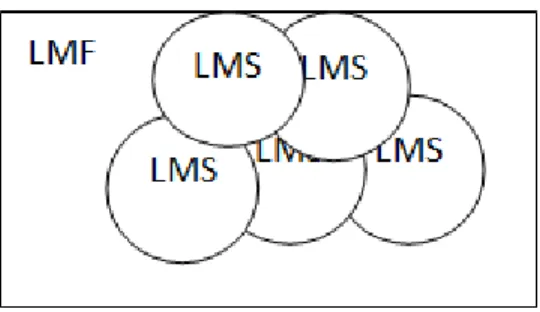
In this section the difference between an LMF and LMS criteria is clarified, using figure 2-1. First of all, an LMS can be regarded as an implementation of an LMF, but it does not have to be based on an LMF. An LMF can enable several different LMSs (as shown in the figure); a criterion valid for an LMF is therefore valid for its LMS. Criteria for an LMS might, however, be too implementation specific and are therefore not always relevant for an LMF. The criteria from previous research used were general and could therefore hold for both an LMS and LMF. Ericsson has both requirements that are general, and directly applicable for an LMF, and more implementation specific, that either could confirm a general criterion or else be discarded. Hence, Ericsson’s requirements are regarded as LMF criteria.
16 Figure: The relation between an LMF and an LMS
2.4.
Approach
In this section the approach of this thesis is presented. This is done by dividing it into the three sequential phases: initial study, Establish the Evaluation Model and the Study Object, and the analysis, which are presented separately, and this is visualized in figure 2-2.
Figure 2-1: Visualization of the approach of the thesis
2.4.1. The initial study
Klein & Myers (1999) suggest in their first principle (The Fundamental of the Hermeneutic Circle) of their article A Set of Principles for Conducting and Evaluating Interpretive Field Studies in Information Systems, that:
“[...] all human understanding is achieved by iterating between considering the independent meaning of parts and the whole that they form”.
The initial study has been an iterative process which has mainly consisted of understanding the problem background at Ericsson and gathers previous research in order to understand what has been accomplished in the field of licensing. In the end of the initial study the scope was specified.
Understand the problem background
The first part of the thesis implied understanding the licensing situation at Ericsson. This included both a general presentation of Ericsson, but also an introduction to the licensing situation at Ericsson. This introduction consisted of a licensing history introduction, an explanation of the current licensing situation, and some requirements regarding an alternative licensing solution.
17 Gather previous research
The first step, when looking through the literature, was to get familiar with the field of licensing and the accomplishment of previous research. This implied reading about licensing and understand its advantages and challenges. Thereafter the literature was used to find and understand important terminology and technologies regarding licensing. It was during this step that solutions for handling the licensing were found, which in this thesis are referred to as LMFs and LMSs.
Define the scope
The scope of the thesis was not agreed upon before the start, but was about to be more clearly specified. The objective and important steps for it to be accomplished, was determined. Furthermore, what was included in a license management solution is diffuse and needed to be explained (which is done in section 2.2. The Study Object).
2.4.2. Establish the Evaluation Model and the Study Object
This phase consisted of four separate steps: create the Evaluation Model, make our interpretation of Ericsson’s criteria in relation to the Evaluation Model, compare it with the evaluation, and present the Study Object.
The establishment of the Theoretical Evaluation Model and the Study Object implied a literature study, whilst creating our interpretation of Ericsson’s criteria in relation to the Evaluation Model induced a case study (how these are performed are described thoroughly in section 2.7. The literature study and 2.8. The case study).
The data collection for the four steps was not performed sequentially due to the limited time where the interviews of the case study were the limiting factor. The employees of Ericsson were not always available, whilst the literature study could be performed at any time, and this implied that the empirical study had a higher priority.
There was however some dependencies regarding the descriptions of the four steps where the Evaluation Model was created first. Ericsson’s criteria were supposed to follow the structure of the Evaluation Model and were hence created after it. After that the Evaluation Model could be compared with Ericsson’s criteria in order to confirm its applicability for the particular case study.
The description of the Study Object followed the structure of the Evaluation Model and was established after the comparison, since the outcome of the comparison affected the analysis. In case the Evaluation Model would have diverged from Ericsson’s criteria then another structure might have been more feasible for describing the Study Object.
18 Create the Evaluation Model
In order to be able to fulfill the purpose of this thesis (which is to elaborate an evaluation model for license management frameworks for Grid environments) and answer RQ1 (Which aspects have previous authors argued for regarding systems in grid environments?) the Evaluation Model was created using criteria from previous research.
In order to avoid too niched criteria and thereby increase the likelihood for the chosen criteria to be generic and relevant for the case study, their importance had to be emphasized by more than one author. Furthermore, sub-criteria were identified and described and the intention of using them was to facilitate the discussion of the criteria.
The criteria that were gathered were important aspects related to Business Agility IT-architecture, Grid, and licensing, accomplished by previous research. These have been synthesized and categorized in order to create the Evaluation Model.
The criteria within a category and whole categories are supposed to be mutually independent, in order to avoid redundant criteria (and in worst case redundant categories). This was however hard to accomplish, but similar criterion were merged into one, in order to avoid redundant criterion. These categories and their respective criteria became the Evaluation Model.
Make our interpretation of Ericsson’s criteria in relation to the Evaluation Model
This thesis was performed at Ericsson and their LMF requirements were gathered in order to strengthen the perception that the Evaluation Model is feasible for the particular case study (RQ2), but also for discussing the LMFs applicability for the particular case study (RQ5).
Ericsson’s criteria were gathered in two ways: either by reading internal documents or by interviewing Ericsson’s employees and this is more thoroughly described in section 2.8.3 Collection of Ericsson’s criteria.
An internal document shows awareness and accordance regarding the criteria, and is thereby considered reliable. In case there is no formal documentation the interpretation of interviewees must be regarded.
If several interviewees emphasize the significance of a criterion it decreases the likelihood for it to be irrelevant.
However, in order not to miss any aspects, no criteria, presented by employees at Ericsson or written in internal documents, were discarded because they were not confirmed by another source. Some criteria were however discarded which could be for the following reasons:
The criterion is considered too fundamental
The criterion is considered too implementation specific
19 Too fundamental criteria were considered tacit and do not need to specified. An example is presented in Focal Point report where Product Manager License Management, BNET (2013) writes the following:
“The access to software functionality and capacity, licensed by Ericsson to customers, shall be provided by means of software keys used by a License Manager which is a software key and lock functionality used by our platforms and applications”.
Criteria considered too implementation specific might not rely on the LMFs. Ericsson have for instance several criteria in Focal Point Report that emphasizes the importance of their LMS to be safe and robust. This should not depend on the LMF chosen but on the way in which it is implemented. Furthermore, there are criteria in Focal Point Report saying that each hardware module shall have a unique identification (a so called fingerprint) and this also is something that does not rely on the LMF chosen. The criteria that have been considered out of the scope of the LMFs have been rules regarding the people who are interacting with the LMS, and this includes for instance tasks of the regions of Ericsson. After gathering these criteria, they were categorized in the same manner as the Evaluation Model and hence became our interpretation of Ericsson’s criteria in relation to the Evaluation Model. Since no further categories or criteria were needed the structure of the Evaluation Model could be followed. If that would not have been the case, categories or criteria would have been added.
Compare the Evaluation Model with our interpretation of Ericsson’s criteria in relation to the Evaluation Model
After creating the Evaluation Model and our interpretation of Ericsson’s criteria in relation to the Evaluation Model these were compared in order to investigate whether the Evaluation Model is applicable for this case study.
Due to the accordance between Ericsson’s criteria and the Evaluation Model, the Evaluation Model is used for analyzing the LMFs. Hence, we can answer RQ5 (Is our evaluation model feasible for the particular case study?). This analysis is however complemented with a shorter extension which is specific for the particular case study, in order to answer RQ5 (Which license management frameworks for Grid environments seem to be the most feasible for the particular case study?).
Present the Study Object
The information used in order to describe the LMFs were gathered from previous research. This included reading the framework article, its references, and its website, and this is more thoroughly described in section 2.7.3 Relevant literature.
The only reason not to present a framework was if it was not designed for Grid environments, since the Grid network structure is a feasible choice in the telecom industry. (Berde, et al., 2009; Robertazzi, 2007; Future Generation Grids, 2004)
20 When describing the LMFs the reader is first given an overview of the different frameworks and then more details regarding the different criteria. These criteria were grouped as in the Evaluation Model and a description was made for each criterion. The reason for this structure is that it gives the reader enough information to understand the LMF analysis later on. When this step was done RQ3 (Which license management frameworks for Grid environment are mentioned in previous research?) was answered.
2.4.3. The analysis
The analysis can be divided into three steps which were performed sequentially and these implied discussing the LMFs using the Evaluation Model, comparing the LMFs with each other, and thereafter analyze the applicability of the LMFs for the particular case study.
Analyze the Study Object using the Evaluation Model
The LMFs were analyzed individually using the Evaluation Model. This implied structuring the analysis after the categories and criteria of the Evaluation Model.
The analysis induced evaluating the Study Object by discussing the LMFs’ characteristic regarding the different criteria of the Evaluation Model. In some cases it was possible to determine that an LMF satisfied a particular criterion or sub-criterion. It is however difficult to say that an LMF does not satisfy a criterion (unless it is explicitly written) due to their flexibility.
This analysis enabled the LMF comparison, which implied answering RQ4 (To which extent do license management frameworks for Grid environment, presented in previous research, match the aspects of our proposed framework?) and by extending this comparison for the particular case study also answer RQ5 (Which license management frameworks for Grid environments seem to be the most feasible for the particular case study?).
Compare the Study Objects
After analyzing the LMFs individually, as described in the previous section they were compared with each other.
This comparison was visualized in a table where the performance of the LMFs was commented for each criterion and sub-criterion. This comparison gave a good overview of the different LMFs. By comparing whether the aspects of the Evaluation Model were covered by the different LMFs RQ4 (To which extent do license management frameworks for Grid environment, presented in previous research, match the aspects of our proposed framework?). This gave a hint of the general feasibility of the Evaluation Model. Perform the Ericsson analysis
Since the Evaluation Model and Ericsson’s criteria cohered the LMF comparison is valid for the case study as well. However, one sub-criterion was missing in the Evaluation Model which was present among Ericsson’s criteria. Furthermore, one criterion was present in the Evaluation which could not be found in among Ericsson’s criteria. Both these aspects were discussed together with the result of the
21 Study Object comparison, and this led to the answer of RQ5 (Which license management frameworks for Grid environments seem to be the most feasible for the particular case study?)
2.5.
Approach criticism
In this section the thoughts behind the approach is discussed, and this is done for each of the three phases: initial study, establish the Evaluation Model and the Study Object, and the analysis.
The initial phase was necessary in order to understand the situation at Ericsson, get an overview of what has been written in the field of licensing and thereby determine the scope of the thesis.
The phase, establish the Evaluation Model and the Study Object, was designed to be straightforward regarding satisfying RQ1 (Which aspects have previous authors argued for regarding systems in grid environments?), RQ2 (Which criteria do five licensing experts at Ericsson consider important when evaluating a license management system?), and RQ3 (Which license management frameworks for Grid environment are mentioned in previous research?), where the Evaluation Model was established, Ericsson’s criteria were gathered, and the Study Object was created. The Evaluation Model was also validated by licensing experts at Ericsson during this phase.
The Study Object was created during this phase in order to be able to answer RQ4 (To which extent do license management frameworks for Grid environment, presented in previous research, match the aspects of our proposed framework?) and RQ5 (Which license management frameworks for Grid environments seem to be the most feasible for the particular case study?).
The analysis implied first analyzing the LMFs separately before comparing them. This comparison implied answering RQ4 (To which extent do license management frameworks for Grid environment, presented in previous research, match the aspects of our proposed framework?) and by some further Ericsson analysis answer RQ5 (Which license management frameworks for Grid environments seem to be the most feasible for the particular case study?).
The approach has been designed to answer the research questions and fulfill the purpose, in a structured and straightforward manner.
Something that could have been interesting to do differently is that the comparison between the Evaluation Model and Ericsson’s criteria could have been on sub-criteria level and not only on criteria level. These sub-criteria were hard to gather for Ericsson because they tended to be too implementation specific and were hence not feasible on an LMF level. Since the LMF comparison is clearly visualized an Ericsson reader can easily neglect criteria in case they would disagree, which is unlikely considering that the Evaluation Model is supposed to be general.
Klein & Myers (1999) are in their second principle, the Principle of contextualization, suggesting a critical reflection regarding the contextualization of the research.
When creating the Evaluation Model, criteria were gathered regarding license management systems in Grid environments, Grid environment systems, systems but also regarding Business Agility.
22 The contextualization of using criteria for Grid environment systems was made in order to get a wider perspective. It is important to be aware of that these are not specifically for licensing but since they are supposed to be valid for systems in Grid environment they should hold for license management systems in Grid environments as well.
The main reason for using Business Agility as an approach for developing the Evaluation Model is that several authors claim that the concept is important for success (e.g., Goldman, et al., 1991) but also because Ericsson, through Ericsson Strategic Direction (2013), opted the importance of being business agile. There is also a pervasive amount of research papers that link the concept of Business Agility to Grid computing and Information Systems. The contextualization was hence made that Business Agility was important for licensing and aspects for Business Agility could therefore be used as criteria for the Evaluation Model. Focusing on Business Agility might imply missing important licensing aspects but since the literature found, that included criteria for Grid environment, also linked to Business Agility, no criterion was discarded for not having a connection to Business Agility.
2.6.
Scientific approach
In this section the scientific approach of this thesis is presented. First, the relation between theory and empiricism is discussed, and therefore the approach regarding deductive, inductive, and abductive reasoning is presented.
This section also includes discussions regarding whether hermeneutics or positivism reflects the perception of knowledge.
Furthermore, it implies discussions about whether the approach of this thesis is qualitative or quantitative.
2.6.1. Deductive, inductive, and abductive reasoning
Deductive reasoning implies that conclusions are reached regarding a case, by the use of generalized principles and established theory. It is common to come up with hypotheses using theory that later on are tested empirically. Due to the use of theory this approach is supposed to be objective, but the limitations of previous research might prevent the scientist from discoveries. (Patel & Davidson, 2007) An inductive approach implies that the research can be performed without the use of established theory. The discovery, however, implies formulating a theory, but a negative aspect with this approach is that it is hard to determine the generalizability of the research. (Patel & Davidson, 2007)
Abductive reasoning is a combination of deductive and inductive reasoning where a theory is formulated from an observation, and this implies that hypothesis is created. This hypothesis is tested for more cases and it might be modified in order to be more general. Then a theory is established. The advantage with this approach, according to Patel & Davidson (2007), is that the scientist is less limited compared to the previous two approaches. On the other hand, scientists using this approach are, according to Patel & Davidson (2007), affected by their experience and previous research, and make choices that exclude other interpretations. (Patel & Davidson, 2007)
23 The approach chosen in this thesis is mainly deductive since the Evaluation Model relies on generalized principles and established theories. Furthermore, the criteria of the Evaluation Model can be regarded as a hypothesis where the assumption is that they are suitable for the particular case study. This is however tested empirically by comparing the criteria of Ericsson’s criteria.
Due to our experience regarding the field of licensing it would have been difficult to present a reliable evaluation model using an inductive approach. Using an abductive approach, where the Evaluation Model would have been tested empirically, would have required more than one case study for this thesis (it would not have been sufficient to perform this thesis only at Ericsson), due to the nature of abductive reasoning.
2.6.2. Hermeneutics or positivism
Patel & Davidson (2007) describe positivism as an objective scientific approach whilst hermeneutics implies interpretations.
The scientific approach of positivism is according to Patel & Davidson (2007) performed as the deductive approach where a hypothesis based on theory is empirically tested. One characteristic for positivism is the perception of reductionism which implies that a problem can be broken down to different parts which are studied separately. (Patel & Davidson, 2007)
In hermeneutics the scientists are examining the study object using their thoughts, impressions, feelings, and knowledge, and this regarded as an asset and not a hinder in order to interpret and understand the study object. (Patel & Davidson, 2007)
The main approach of this thesis is positivism since it has been chosen since it uses a deductive approach. Furthermore the perception of reductionism has been used in order to analyze the LMFs; this implies dividing the Evaluation Model into criteria which in turn often are broken down to several sub-criteria. The criteria are grouped into categories; if all criteria within a category are satisfied then that category is satisfied.
Hermeneutics, which we think seems more useful for an inductive approach, have not been used in the same extent. However, when analyzing the Study Object our interpretations affected the analysis which implies a hermeneutic approach, but in order to increase the objectivity we have both critically examined and approved everything that has been written; it did not imply any major changes since our opinions have been concurrent. According to Klein & Myers (1999) first principle, The Fundamental Principle of Hermeneutic Circle, A Set of Principles for Conducting and Evaluating Interpretive Field Studies in Information Systems:
“human understanding is achieved by iterating between considering the independent meaning of parts and the whole as they form”.
This is how the initial phase was performed and the scope of this thesis determined, and the approach of this thesis was therefore partly hermeneutical.
24 2.6.3. A qualitative or quantitative approach
In this thesis a qualitative approach has been chosen even though a quantitative approach could have been used in which the LMFs are given points that corresponds to their performance regarding the different criteria. Thereafter the points could have been weighted and summarized, and the LMF with the highest score would have been the preferable one. This would have been an interesting approach but there are some obstructions in order to get a reliable result from it. First of all, the frameworks presented are general and can be implemented in different ways and this makes it hard to give them a fair grade since the performance of the actual implementation is not revealed. Furthermore, just because no solution is presented for a certain criterion (for an LMF) it does not mean that it cannot be supported. Thirdly, it might be hard to compare different ways of handling a criterion which makes it hard to give the LMFs a correct and objective grade. Not only is the grading part complicated but also to weight the scores of each criterion before summing them. No literature has been found that weights the importance of the different criteria. One approach would be to let a lot of experts determine the weights and take the average of their results, this would have implied that the result of the Study Object analyze would have been objective but it would be hard to assure the academic result.
Due to the limitations with the quantitative approach a qualitative has been chosen, for analyzing the Study Object, in which logical interpretations have been performed. However, the interpretations that have been made are clearly motivated and shall be backed up with facts.
2.7.
The literature study
There were four purposes with the literature study, where the first was to get a basic knowledge in relevant fields. Secondly, it was used to find criteria in order to evaluate the different LMFs. Thirdly; LMFs were gathered in order to have different alternatives for license handling. The last purpose was to improve the structure of the report and improve the interview technique and this was done by reading research methodology literature.
2.7.1. Literature search
The literature used in this thesis was found on internet using the following search engines: LiU UniSearch, Springer, Google, Google Scholar and IEEExplore. Almost all of those search engines were used for every particular search word.
The challenge of this thesis was that Ericsson were not satisfied with their way of handling their licenses and in order to improve the knowledge in that field the following two search words were initially used: software license and software license control.
After that more literature was found in two different ways where the first was to use the references of the literature already found. Secondly, keywords or important concepts were used to expand the search. This resulted in searches regarding different aspects of IT management and important technical concepts.
The following searches was performed regarding IT management: IT management, IT asset management, software asset management, license audit, product management, asset management,
25 technology management, IT governance, IT audit, software architecture, IT architecture, Business Agility, Business Agility architecture, access control, semantic modeling, and design theory.
The search for relevant technical concepts included the following search words: SaaS, Cloud, Grid, Grid computing, Grid environment, distributed environment, distributed computing, virtual servers, virtualization, and virtual machine.
2.7.2. Literature categorization
When searching for literature the list of search results were regarded for each search engine. A first selection was performed which implied first reading the title and if it seemed to be irrelevant for this thesis the literature was discarded. The abstract was read (for the literature passing “the title test”) and the article could once again be discarded. The articles passing “the title test” and “the abstract test” included at least one of following bullets:
Clarification of challenges and benefits with licensing. Explanation of ways of managing software licensing. Criteria for managing software licenses.
Clarification of the relation between Business Agility and IT Explanation of important concepts regarding Business Agility Definitions of terminology that is relevant for previous bullets.
The articles passing “the title test” and “the abstract test” were summarized in a reference document. The summary contained the title, author, search engine, search word, and a short explanation of its usefulness.
After reading the literature it was classified as follows:
Relevant: The literature contained LMFs or criteria for LMSs to be used.
Relevant facts: The literature included definitions of relevant terminology and clarification of challenges and benefits with licensing.
Potentially relevant: The literature consisted of potentially useful terminology definitions, facts that might be useful, or presentation of LMFs that might be used.
Irrelevant: The literature does not include any important LMFs, criteria for software licensing, or important facts.
Literature that had not been read was classified as not read, but categorization changed when the literature was read. Furthermore, literature could be reread and hence reclassified, but literature that was classified as relevant, relevant facts or irrelevant did generally not change. After limiting the thesis not to include pricing models, literature in that field went from potentially relevant to irrelevant. No irrelevant literature was reclassified and the reason for that was that if there was any chance that the literature later on would be useful it was classified as potentially relevant. Potentially relevant literature could be reread and basically be reclassified to any of the three categories depending on its usefulness.
26 2.7.3. Relevant literature
The literature classified as relevant consisted of data for theoretical criteria and empirical data for the LMFs and these are about to be explained. This data was as explained earlier gathered in the same way as any other literature but were important for achieving the purpose of this thesis and will therefore be explained.
Data collection for the Evaluation Model
The data collection for the Evaluation Model implied gathering literature from previous research and this was done in the same manner as the rest of the literature. The criteria found for systems in Grid environments were related to Business Agility, and hence no criterion was discarded for not being connected to Business Agility. The only reason for discarding criteria were not within the scope of an LMF (for instance too implementation specific). Some of the criteria found were directly adapted for license management systems in Grid environments whilst others were for Grid environment systems in general they were all used in the Evaluation Model. The authors of these articles were coherent regarding the criteria, but the sub-criteria could in some cases differ. They were, however, not contradictory and they seemed plausible for evaluating the Study Object and were hence included in the Evaluation Model.
Data collection for the Study Object
The empirical LMF collection was found in the same manner as the rest of the literature and did not imply any specific search words. When an article included a presentation of an LMF its references was used in case it would give more information about the LMF. Google was also used to search for the websites of the LMFs. In case they were available they were searched through for complementing information. In order to understand how this LMF information was used one must read section 2.4.2. Establish the Evaluation Model and the Study Object.
2.7.4. Literature handling
Before reading the literature summarized in the reference list it had to be gathered, which could be done in three ways: download it online, physically borrow it from the library or purchase it.
The majority of the literature was downloadable and these files were stored in folders named according to the different classifications in section 2.7.2. Literature categorization. Downloaded files that were about to be read were also printed and put into binders that were structured in the same way.
The literature that was not downloaded could not be stored in this way and that literature had the same categorization written on Post-it notes that were attached to it. Furthermore, Post-it notes could also be used to identify important sections of the literature.
After reading literature the reference list was updated which implied modifying the comments and in some cases the classification. In case downloaded literature was reclassified the printed copy had to be moved to the correct binder section, and the file to the correct folder.
27 In the beginning of the thesis the literature was used to get familiar with the research regarding software licensing, whilst it later became more important to gather LMFs, criteria for software license handling and understanding relevant terminology. The reference document turned out to be an efficient way to find the information that was currently needed.
2.7.5. Source criticism
There are some limitations regarding the literature study. Six search engines have been used in order to find literature, and using more search engines might have led to finding of more relevant literature. Due to the limited time, and considering that a lot of relevant literature was found in this way, no more search engines were used. Saturation was, however, reached for those search engines, in the literature study since the literature towards the end referenced to articles that had already been regarded.
Secondly, in the process of choosing literature articles and books were discarded after reading their title and abstract. Some of the discarded might have contained interesting information, but it is unlikely that any of them would contain something as important as an LMF considered that the LMFs found are the main contribution of its articles. In a perfect world it would have been interesting to read all this literature, but this was not possible within the scope of this thesis.
One important issue is if important search words are missing which is difficult to say. However basic search words like software license and software license control were used and the literature found gave new important search words, which also led to new search words and so forth.
The original source was used as long as it was available in either English or Swedish.
2.8.
The case study
There were three different purposes with the case study which were: get the licensing problem background of Ericsson, gathering Ericsson’s criteria, and gather information regarding Ericsson’s LMS. The techniques used for all this are described in the subsequent section 2.8.1. Case study gathering and thereafter more specified for each of the three purposes, and thereafter the case study criticism is presented.
2.8.1. Case study data gathering
The different techniques for gathering the data for the case study were basically interviews and Ericsson’s documentation and this is presented in this section.
A part of the interviews were carried out as presentations held by the interviewee, during which questions could be asked at any time. The presentations were held on a certain topic that the interviewee or the audience thought to be interesting for this research. The other interviews were carried out in a semi-structured manner, where questions prepared beforehand were the basis for discussion with the interview subjects, and can for each session be found in appendix 2. Notes were taken during the interview and the conversation was recorded if the interviewee allowed. Some interviews were performed face to face with the interviewee, whilst others have been performed using the software Microsoft Lync. The face to face recordings only included the audio while the recording on Microsoft Lync also included a video of the interviewee’s computer screen. The purpose of the two
28 interview forms is mainly gathering information that is needed for the essay, and in some cases consulting a person of special expertise to get answers on various topics.
Documents received from Ericsson were also used in this thesis. This included both slides that the employees used during lectures but also internal documentation from Ericsson’s Intranet.
2.8.2. Understanding Ericsson’s problem background
In the Ericsson data collection during the initial phase the information was gathered through interviews carried out as presentations and PowerPoint slides that belonged to the different presentations.
2.8.3. Collection of Ericsson’s criteria
The collection of Ericsson’s criteria implied reading internal documents and performing interviews with employees of Ericsson. These interviews were performed as presentations where the interviewee explained their criteria for an LMS, but also the criteria for Ericsson’s LMS.
When collecting these requirements triangulation was used which, according to Malterud (2009), means that phenomenon are studied using several observations. This makes it, according to Patton (2002), possible to exclude inaccuracy in the process.
This meant that several employees were interviewed in order to gather Ericsson’s criteria. Using triangulation was one way to discover contrarious criteria, but that did not occur, which increases the relevance of the criteria.
In case more than one person suggest the same criteria its importance is emphasized, but in order to get a wide perspective no criterion was discarded.
One challenge when gathering the criteria was not to get too implementation specific criteria but more general that can be used in order to evaluate LMFs. This was not done by explaining that the criteria had to work for LMFs but to emphasize that more general criteria were desirable.
2.8.4. The interviewees
The interviewees were employees at Ericsson but with different tasks and expertise. Some had a broad and overall perspective, whilst others had more specific and detailed knowledge. Some of the interviewees were directly working with the LMS where some were responsible for the licensing strategy for product areas or for whole business units and others were experts for parts of the LMS. Furthermore employees with a more indirect relation to the LMS, and this included expertise within product packaging or the pricing strategies were also interviewed.
The main interviewee of this thesis was the Process Architect ELIS & BNET and Strategic Supply Manager BNET. He has worked with licensing as a requirement analyst, and after observing the drawbacks with the current License Management System he took the initiative to let Research Interns investigate if there were better solutions for the license management of Ericsson.
The Director of Software and Product Packaging within the company division BNET (hereby denoted Director of Software and Product Packaging) focuses on strategic portfolio management, and is currently
29 integrating all Ericsson’s pricing models with their services for the business unit BNET. The Process Architect ELIS & BNET (2013) and Strategic Supply Manager BNET (2013) emphasizes that the requirements of BNET regarding licensing reflect the requirements of Ericsson in general (since it covers the requirements of the other Business Units), but that there are no explicit requirements for the whole company. The licensing aspects are important for the Director of Software and Product Packaging and due to his position in BNET he has a good overview regarding them.
The Product Manager Licensing Management within the company division BNET works with licensing on a strategic level and is responsible for Ericsson License Register (ELIS).
The Price Manager within the company division BNET has a commercial responsibility and determines the price models of BNET, which requires knowledge regarding the licensing at Ericsson.
Since we had no contacts on Ericsson before starting this thesis, the Process Architect ELIS & BNET has been important for finding interviewees. He had contacts in different positions and with different experience regarding license management. Depending on which information that was needed different contacts were recommended and these were asked for further interviewee recommendations.
2.8.5. Case study criticism
The case study has basically implied performing interviews and gathers lecture material and internal documents from Ericsson. The reliability of the internal documents is considered high since errors or ambiguity can be rectified since they, according to Process Architect ELIS & BNET (2013) are continually edited and updated in order to be relevant, and errors and ambiguity can therefore be rectified. The reliability of the lecture material and the interviews will however be discussed, and those will be discussed in the same manner since they both only reveal one person’s interpretation.
The Principle of Multiple Interpretations (Principle six) implies sensitivity to different interpretations among participants of the case study (Klein & Myers, 1999).
The interpretation for Ericsson’s criteria has differed between the sources, which include internal documents and the interviews. The difference gave a wider perspective and depended probably on different knowledge and experience among the participants. Since none of the criteria were contradictious they were all accepted.
The attitude towards the current LMS at Ericsson has varied among the participants, when some have expressed that even though problems have been faced, they can be overcome with the current solution. Others have pointed out its weaknesses and think that the current solution is not feasible for Ericsson. This can be further discussed using the Principle of Suspicion (Principle seven) which implies sensitivity to biases and distortions in the data collected from participants of a case study (Klein & Myers, 1999). This different interpretation among the participants does not necessarily depend on biases or distortions. The employees have different knowledge and experience regarding Ericsson’s LMS which therefore can affect their opinion in this matter.
30 No matter if the current solution is feasible or not, there might still be LMFs that are better and hence can be introduced.
Klein & Myers (1999) suggested the Principle of Interaction between the Researchers and the Subject (Principle three), which implies a reflection on how data was gathered through the interviews.
In order to affect the interviewee in as small extension as possible the questions asked were neutrally asked not to lead the interviewee in a certain direction. Furthe