Quadra
Therm
640i
/780i
H I G H A C C U R A C Y : F O U R - S E N S O R : M A S S F L O W M E T E RFrom Sierra’s beginning over forty years ago, Founder Dr. John G. Olin was driven by the vision of supplying industrial customers with the world’s most accurate mass flow meter. And, he knew it was a “sensor” game.
The development of an industrialized metal-sheathed sensor in the early 80s was Sierra’s first big step, but Dr. Olin is a driven innovator, and this was only the begin-ning for someone who saw “Thermal Mass Flow” as his life’s work. Many successful innovations followed, but in 1999 Sierra experienced a major breakthrough with the introduction of their patented no-drift DrySense™ mass velocity sensor. Sierra engineers now recognized they were on the cusp of realizing Dr. Olin’s vision.
Realizing the Vision
Thermal technology, by its very nature, uses the physics of heat transfer and conser-vation of energy in an open system to measure mass flow rate. This means that for a thermal mass flow meter to achieve the greatest accuracy, it must solve the First Law of Thermodynamics (Heat Energy In = Heat Energy Out) for each data point. As you can imagine, solving the First Law in a flow instrument was no easy task. By Dr. Olin’s own accounting, decades of “hard-nosed dedication to excellence” by himself and Sierra’s engineering team, years of testing, and his stack of yellow note pads over five feet high, jammed with his handwritten equations and designs, finally yielded the secret in the form of two revolutionary technologies—QuadraTherm®
and qTherm™, now both patented worldwide.
QuadraTherm, Beyond Traditional Thermal
Traditional thermal sensors have two sensors-–one temperature sensor and one velocity sensor, each in a separate probe sheath. QuadraTherm (the term “Quad” meaning “four”) introduces four sensors—three precision platinum temperature sensors and one patented DrySense mass velocity sensor. Sensor performance improvements never thought possible are gained with QuadraTherm as forced convection is completely isolated (the critical variable for measuring gas mass flow rate) by calculating and then eliminating unwanted heat-transfer components, like sensor stem conduction, one of the major causes of false flow readings.
qTherm, the Brains Behind it
qTherm is the true “Brain” of the instrument and a revolutionary, living, learning algorithm set made possible by today’s hyper-fast microprocessors and QuadraTherm sensor inputs. qTherm manages changes in gas flow, gas temperature and gas pressure, as well as outside temperature, via a comprehensive heat-transfer model. The result is a proprietary, fundamentally different gas mass flow rate calculation using all pertinent variables for the most precise, stable and accurate mass flow measurement possible.
* Verified by an independent NIST and NVLAP accredited metrology laboratory
Introducing the World’s Most Accurate
Thermal Mass Flow Meter
•Accuracy: +/- 0.5% of Reading* •Multivariable: Mass
flow rate, temperature & pressure
•Revolutionary QuadraTherm®
four-sensor design •DrySense™ no-drift
sensor with lifetime warranty •qTherm™ living,
learning “Brain” manages all inputs •Dial-A-Pipe™ :
Change pipe size •Dial-A-Gas®:
Change gas type •qTherm Gas Library:
Most common gases & mixtures (growing & improving) •ValidCal™ Diagnostics: Assure performance •Smart Interface Program: Computer interface software •Foundation Fieldbus, Profibus DP, HART, Modbus (pending) •CE and FM approved
QuadraTherm
640i / 780i
• 780i inline version has built-in flow conditioning (note transparent pipe)
QuadraTherm Makes it Possible.
The challenge for Dr. Olin and the Sierra engineering team was to develop a sensor that isolated forced convection, a prominent source of heat loss.
In traditional thermal mass flow meters, the heated velocity sensor is inserted into the tip of a tubular probe and is surrounded by potting compounds, such as epoxy, ceramic cement, thermal grease, or alumina powder. These so-called “wet” sensors have several weaknesses. They have an increased skin resistance which creates a “droop” in the output curve and decreased sensitivity (specially at high flows) as a consequence. They are hard to produce repeatably, which ultimately means reduced accuracy. And finally, wet sensors can create long-term measurement errors caused by aging and cracking due to differential thermal expansion between the parts of the heated velocity sensor.
QuadraTherm builds on the long-term stability of our patented no-drift DrySense velocity sensor technology. As the name implies, Sierra’s velocity sensor is the only thermal sensor in the world that is truly “dry”. Our proprietary swaging process eliminates all air gaps between the heated velocity sensor and the tubular probe without the need for any potting compounds. The result is maximum sensitivity, reproducibility, immunity to cracking and shifting over time, and ultimately greatly improved accuracy. We back our DrySense Technology with a lifetime warranty.
In addition, by radically reworking the physical sensor head design, Sierra’s engineering team minimized the effects of downdrafts and other interferences that cause false flow readings in traditional thermal flow meters. As Dr. Olin states, “We are trying to create a flow field for the velocity sensor where it is unaffected by anything else around it, so it can do what it was meant to do—measure the free-stream mass flow rate.” Wind-tunnel testing and CFD modeling verified that we accomplished our goal.
QuadraTherm’s Four-Sensor Design
Sierra’s biggest breakthrough occurred when two new temperature sensors (T2 and T4—See Figure) were added to the existing two-sensor design (T3 temperature & T1 DrySense velocity) used in previous models. The two additional sensors perform real-time correction for the heat lost to the outside environment due to a phenomenon called “stem conduction.” To better understand the benefits, let’s look at a typical example.
Let’s say the temperature of the flowing gas is higher than the outside temperature. In this case, stem conduction causes a substantial fraction (between 10% to 25%) of the electrical power supplied to the heated velocity sensor to be lost through the probe shaft to the outside environment. What happens if this is a traditional thermal mass flow meter and the outside temperature in the field application drops by a few degrees? The heat lost via stem conduction will increase and a flow measurement error will occur. QuadraTherm eliminates this source of error by first accurately measuring, and then correcting for, the heat lost via stem conduction.
•
AeroMax contouring eliminates downdraftsQuadraTherm (T2) Temperature Sensor
AeroMax sensor tip isolates velocity sensor QuadraTherm (T4) Temperature Sensor
QuadraTherm (T1) DrySense Velocity Sensor (cutaway view)
QuadraTherm (T3) Temperature Sensor Pressure Sensor Port (optional)
•
•
•
•
•
•
And with qTherm, it Learns.
QuadraTherm’s four-sensor technology provides the critical inputs for qTherm’s living, learning algorithm set and gas library to accurately manage changes in gas and pipe selection, gas temperature, gas pressure, and outside temperature.
qTherm solves the First Law of Thermodynamics in a fraction of a second for each mass flow data point. It calculates stem conduction and all other unwanted heat loss components, subtracts them out, and then computes the mass flow rate from the remaining forced convection component. And, with Dial-A-Pipe, it lets you relocate the probe to different pipe sizes and types in the field. With Dial-A-Gas, it provides gas change capability with highly accurate readings.
qTherm’s Expanding Gas Library
The qTherm Gas Library stores proprietary Gas Packets. A Gas Packet is analogous to the DNA of a specific gas. It stores all the parameters needed to instantly calculate the thermodynamic and transport properties of every gas or gas mixture versus temperature and pressure.
Currently, the library has mapped most common gases and mixtures, and it continues to grow and improve by the day. Furthermore, the millions of data points collected over time in Sierra’s metrology laboratories can be used to tune the instrument for better performance and accuracy. Expect hundreds of data sets and gas/gas mixture combinations in the future that can be downloaded to your QuadraTherm meter via the internet.
•
•
•
Multivariable Readout: Mass flow, temperature, pressure,
totalizer, and alarms
Pushbutton control for Dial-A-Gas, Dial-A-Pipe, alarms, and engineering units
Explosion proof glass and enclosure
4
User Interface
Local keypad with a six-button interface Exit Enter Four-way directional arrows
RS-232 with PC software for communication and programming Digital Display
UltraBright, backlit, LCD digital display, 2 x 16, 2 x 32 scrolling 780i Inline Version Process Connections
See page 9 and 10 for NPT, ANSI class 150 flange and PN16 DN sizes. 640i Insertion Version Process Connections
See page 6 through 8 for insertion sizes. ANSI 1-inch - ANSI class 150 flange (optional) Low pressure hot tap rated to 150 psia (10.3 bara) High pressure hot tap and retractor 230 psia (15.9 bara) Wetted Materials
316 SS and 316L SS flow body and Pt/Ir (velocity sensor) Leak Integrity
1 x 10⁻⁴ sccs of helium
Approval Agencies
FM–Explosion proof for Class I, Div I, Groups B,C,D CE–European Conformity
Enclosure
NEMA 4 (IP66), hazardous-area explosion proof, flow pointer, meter information tag. NEMA 4X (E2 option only).
PERFORMANCE SPECIFICATIONS
OPERATING SPECIFICATIONS
ANALOG AND DIGITAL OUTPUTS
PHYSICAL SPECIFICATIONS
Input Power100 to 240 VAC (0.4 Amps RMS at 230 VAC) 24 VDC +/- 10%, 1 Amp
POWER REQUIREMENTS
Gas MeasuredAll inert gases and all non-condensing clean gases
Flammable gases: methane, propane, hydrogen, digester gas, natural gas Corrosive gases compatible with 316L stainless steel
qTherm Gas Library: most common gases and mixtures; air is standard; qTherm Dial-A-Gas option for choice of three additional gases Mass Velocity Range for Air
0 to 60,000 sfpm (0 to 305 smps) at 21.1°C (70°F), 1 atm Multivariable Outputs
Mass flow rate (standard) Temperature (standard) Pressure (optional)
Totalized flow: totalized value is stored in non-volatile memory Mass Flow Accuracy
780i Inline version accuracy (highest accuracy):* +/- 0.5% of reading above 50% of the full scale flow +/- 0.5% of reading plus 0.5% of full scale below 50% of full scale flow 640i Insertion version accuracy:*
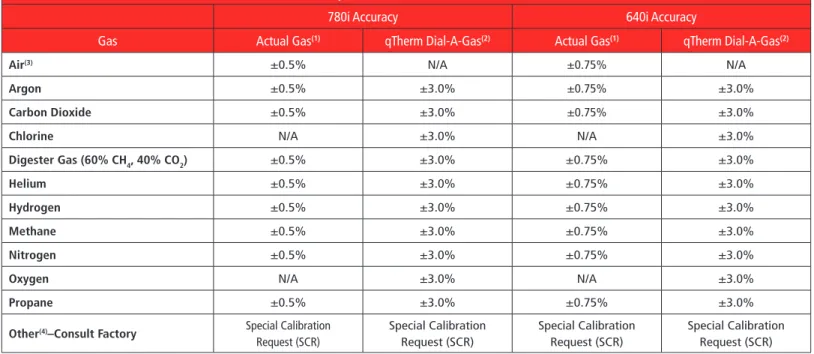
+/- 0.75% of reading above 50% of the full scale flow +/- 0.75% of reading plus 0.5% of full scale below 50% of full scale flow qTherm Dial-A-Gas: all 640i/780i units can either be calibrated on actual gas (optional) or use qTherm Gas accuracies. See Table 1: qTherm Dial-A-Gas Selection Chart on next page
Gas pressure accuracy +/- 1.0% full scale
* Accuracy statements verified by an independent NIST and NVLAP accred-ited metrology laboratory.
Gas Temperature Accuracy +/- 1ºC (1.8°F)
Gas Pressure Ranges
30 psia (2.1 bara), 100 psia (6.9 bara), 300 psia (20.7 bara), 500 psia (34.5 bara), VTP only.
Repeatability
Mass flow rate: +/- 0.15% of full scale Gas temperature: +/- 0.5ºC (0.9ºF) Gas pressure: +/- 0.5% of full scale Response Time
Three seconds to achieve 63% (one time constant) of final value Mass Flow Rate Turndown
100:1
Output Signals 4-20 mA flow 4-20 mA temperature 4-20 mA pressure (optional)
Alarm output (contact SPST/opto relays) User definable pulse output for totalized flow Optional Communications Modules (pending) MODBUS
Foundation Fieldbus DeviceNet
Profibus DP
HART
Note: Maximum operating pressure must not exceed the full scale of the pressure transducer if the VTP option is ordered or damage may occur. 780i Inline Version Gas Pressure Requirements
NPT: 500 psia (34.5 bara) maximum
Flange process connections defined by the ASME B 16.5a – 1998 spec. group rating of 316L stainless steel ANSI class 150 or 300 class flanges (special) 316L stainless steel 150 class flanges:
230 psia at -20ºF to 100ºF; 195 psia at 200ºF;
145 psia at 300ºF; 160 psia at 400ºF; and 145 psia at 500ºF Equivalent DN PN16 flanges are available (see page 10 for sizes) 316L stainless steel 300 class flanges (special):
600 psia at -20ºF to 100ºF; 505 psia at 200ºF; 455 psia at 300ºF; 415 psia at 400ºF; and 380 psia at 500ºF
640i Insertion Version Gas Pressure Requirements Compression fittings: 500 psia (34.5 bara)
1-inch 150 class flange (-40°F to 250°F) 185 psia (12.8 bara) Low pressure hot tap: 150 psia (10.3 bara)
High pressure hot tap: 230 psia (15.9 bara) Gas Temperature Requirements (all versions) -40°F (-40°C) to 392°F (200°C)
High temperature (HT) option to 750°F (400°C) available in 640S model only Ambient Temperature (all versions)
5
.25"
.50"
1.5"
3"
.75" 1"
2"
4"
8"
100 (249.1) 10 (24.9) 1 (2.49) 1 (1.6) (16)10 (160)100 (1600)1000 (16,000)10,000 Denotes Upper Flow Limit (Mach No. = 0.3)Permanent Pressure Loss
(1) Inches of W ater (2) (millibars)
Mass Flow Rate scfm (3) (nm3/h) (4)
6"
780i INLINE PRESSURE DROP
TABLE 2: 640i/780i Straight Run RequirementsPiping Condition Upstream 640i Insertion with Flow ConditioningUpstream 780i Inline (1) Downstream(2)
Single 90° Elbow or T-Piece 15D 1D 0D
Reduction (4:1) 20D 3D 0D
Expansion (4:1) 40D 3D 0D
After Control Valve 15D 3D 0D
Two 90° Elbows (in same plane) 30D 3D 0D
Two 90° Elbows (different planes) 40D 5D 0D
TABLE 1: qTherm Dial-A-Gas Selection Chart
780i Accuracy 640i Accuracy
Gas Actual Gas(1) qTherm Dial-A-Gas(2) Actual Gas(1) qTherm Dial-A-Gas(2)
Air(3) ±0.5% N/A ±0.75% N/A
Argon ±0.5% ±3.0% ±0.75% ±3.0%
Carbon Dioxide ±0.5% ±3.0% ±0.75% ±3.0%
Chlorine N/A ±3.0% N/A ±3.0%
Digester Gas (60% CH4, 40% CO2) ±0.5% ±3.0% ±0.75% ±3.0%
Helium ±0.5% ±3.0% ±0.75% ±3.0%
Hydrogen ±0.5% ±3.0% ±0.75% ±3.0%
Methane ±0.5% ±3.0% ±0.75% ±3.0%
Nitrogen ±0.5% ±3.0% ±0.75% ±3.0%
Oxygen N/A ±3.0% N/A ±3.0%
Propane ±0.5% ±3.0% ±0.75% ±3.0%
Other(4)–Consult Factory Special Calibration
Request (SCR) Special Calibration Request (SCR) Special Calibration Request (SCR) Special Calibration Request (SCR) (1) % of reading at >50% of full scale flow; add 0.5% of full scale below 50% of full scale flow
(2) % of full scale
(3) Air is standard on the instrument and cannot be removed
(4) The qTherm Gas Library is a proprietary gas property index that is continually updated and improved Notes:
(1) Number of diameters (D) of straight pipe required between upstream disturbance and the flow meter (2) Number of diameters (D) of straight pipe required downstream of the flow meter
Notes:
(1) For air and nitrogen at 20°C temperature and 1 atmosphere pressure (2) 1 inch of water at 60°F = 0.0361 psi
Notes: (3) At base conditions of 21.1°C temperature and 1 atmosphere pressure
4
6
640i INSERTION DIMENSIONAL DRAWINGS
P2-DD—Side View P3-DD—Side View
P2-DD Compression Fitting—Side View P2-DD Flange Fitting—Side View
Length Chart 640i Compressions Fittings Code L X L06 6.0 (152) 7.5 (191) L09 9.0 (229) 10.5 (267) L13 12.0 (305) 13.5 (343) L18 18.0 (457) 19.5 (495) L24 21.5 (546) 23.0 (584) L36 35.5 (902) 37.0 (940) L48 47.5 (1207) 49.0 (1245) 5.5 (140) 8.5 (216) 6.6 (168)
All Versions—Front View
5.5 (140) 8.5 (216) 6.6 (168) 5.5 (140) 0.75 (19.1) 6.7 (170) 6.6 (168) X 5.3 (135) 0.5 (12.6) L 5.5 (140) 0.75 (19.1) 6.7 (170) 6.6 (168) X 5.3 (135) 0.50 (12.7) L 0.75 (19.1) 3/4-inch NPT, Typ 5.5 (140) 0.75 (19.1) 2.0 (51) 6.7 (170) 6.6 (168) X 5.3 (135) 0.50 (12.7) L 3/4-inch NPT, Typ
Length Chart 640i Flange Mounting Code L X L06 4.4 (112) 7.5 (191) L09 7.4 (188) 10.5 (267) L13 10.4 (264) 13.5 (343) L18 16.4 (417) 19.5 (495) L24 19.9 (505) 23.0 (584) L36 33.9 (861) 37.0 (940) L48 45.9 (1166) 49.0 (1245) FM Approved Probes X L 6.2 (157)
Length Chart 640i
FM Version Code L X L06 6.0 (152) 13.7 (348) L09 9.0 (229) 16.7 (424) L13 12.0 (305) 19.7 (500) L18 18.0 (457) 25.7 (653) L24 21.5 (546) 29.2 (742) L36 35.5 (902) 43.2 (1097) L48 47.5 (1207) 55.2 (1402) Note: All dimensions in inches with (mm) in brackets; certified drawings available upon request
7
640i INSERTION DIMENSIONAL DRAWINGS
Remote Electronics—Side View Remote Probe—Front View
P3-DD Remote Bracket—Side View Remote Bracket—Front View
Length Chart 640i
Remote Mount Junction Box
Code L X L06 6.0 (152) 7.5 (191) L09 9.0 (229) 10.5 (267) L13 12.0 (305) 13.5 (343) L18 18.0 (457) 19.5 (495) L24 21.5 (546) 23.0 (584) L36 35.5 (902) 37.0 (940) L48 47.5 (1207) 49.0 (1245) 4.6 (117) 0.75 (19.1) 6.7 (170) 6.6 (168) 4.6 (117) Per customer cable length requirement 200 feet maximum 4.6 (117) 0.75 (19.1) 6.7 (170) 6.6 (167) 4.6 (117) PER CUSTOMER CABLE LENGTH REQUIREMENT 200 FEET MAXIMUM 3.0 (76) 8.9 (226) 4.1 (104) 7.3 (185) 7.3 (185) 3.00 (76.20) 3.0 (76) .50 (12.7) 1.5 (38) .31 φ (7.87), 2PL
Mounting Holes for Remote Bracket
Remote Probe—Side View
X 4.5 (114) 2.6 (66) 0.50 (12.7) L 3/4-inch NPT 3.0 (76) 8.9 (226)
P2-DD Remote Bracket—Side View
Note: All dimensions in inches with (mm) in brackets; certified drawings available upon request
8
DIMENSIONAL DIMENSIONS
640i INSERTION LOW PRESSURE HOT TAP to 150 psia (10 bara)
6.7 (170) L D C T 3.3 (83.8) (165.1)6.5 4.0 (101.6) 10.8 (274.3) Restraint cable, length=R
1-inch NPT hot tap Teflon packing gland 1-inch NPT
hex nipple, 2PL
M2 Threadolet or customer supplied 1-inch weldolet
Duct Flow inward CL 7.6 (193) 1.0 (25.4) 4.3 (109.2) 0.75 (19.05)φ 1-inch NPT ball valve Probe 0.50 (12.7)
640i HIGH PRESSURE HOT TAP to 230 psia (15.3 bara)
Teflon packing gland 31.75
(806)
Position marker arrows
Provided by customer
Duct
Probe Flange, raised face,
2”, 150#, 316L SS, ANSI B16.5 Probe electronics 8.5 (216) 20.75 (527) 5.8 (147)
Note: All dimensions in inches with (mm) in brackets; certified drawings available upon request
Variables
L = Nominal Probe Length D = Duct O.D.
C = Duct I.D.
T = Height of “Threadolet” or Customer Provided Weldolet R = Restraint Cable Length
Formula
L > 12.3 + T + D/2 So L must be equal or greater than 12.3-inches plus the height of the
“Threadolet” plus half the duct O.D. R = D/2 + T + 7.3
9
780i INLINE DIMENSIONAL DRAWINGS
Remote—Side View NPT Remote—Front View
1/2”and 3/4” 150 Class Flange—Side View 1/2” and 3/4” NPT—Side View
1/2”and 3/4” 150 Class Flange—Front View 1/2” and 3/4” NPT—Front View
6.7 (170) 6.6 (168) 5.5 (140) 6.6 (168) H L2 C L1 Per customer cable length requirement 200 feet maximum 6.7 (170) 6.6 (168) 5.5 (140) 6.6 (168) H L2 C L1 Per customer cable length requirement 200 feet maximum 6.7 (170) 45° Typ 3/4-inch NPT Typ. 5.5 (140) L2 H 6.6 (168) C L1
Flow Conditioning Element (see TABLE 2, page 5)
6.7 (170) 45° Typ 3/4-inch NPT Typ. 5.5 (140) L2 H 6.6 (168) C L1 6.7 (170) H L2 5.5 (140) C L1
Male NPT Thread Flow Conditioning Element (see TABLE 2, page 5) 3/4-inch NPT Typ. 6.6 (168) 6.7 (170) H L2 5.5 (140) C L1
Male NPT Thread Flow Conditioning Element (see TABLE 2, page 5) 3/4-inch NPT Typ.
6.6 (168)
Sizes For ANSI Class 150 Flange
Size H C L1 L2 1/2-inch 11.6 (295) 9.9 (251) 2.0 (51) 4.0 (102) 3/4-inch 11.8 (300) 9.9 (251) 2.0 (51) 4.0 (102) Sizes for NPT Size H C L1 L2 1/2-inch 10.5 (267) 9.9 (251) 2.0 (51) 4.0 (102) 3/4-inch 10.8 (274) 9.9 (251) 2.0 (51) 4.0 (102)
150 Class Flange Remote—Front View
6.7 (170) 6.6 (167) 5.3 (135) 6.6 (168) H C Per Customer Cable Length Requirement 200 Feet Maximum
10
780i INLINE DIMENSIONAL DRAWINGS
1” Through 8” 150 Class Flange—Front View 1” Through 8” 150 Class Flange—Side View
NPT Remote—Front View H L2 5.5 (140) C L1 6.7 (170) 6.6 (168) A
Flow Conditioning Element (see TABLE 2, page 5)
H L2 5.5 (140) C L1 6.7 (170) 6.6 (167) A 6.7 (170) 6.6 (167) 4.6 (117) 4.6 (117) C Per Customer Cable Length Requirement 200 Feet Maximum
Sizes for ANSI Class 150 Flanges
Size H C L1 L2 A 1-inch 16.1 (409) 14.0 (356) 2.3 (58) 5.0 (127) 45 1.5-inch 16.1 (409) 14.0 (356) 2.6 (66) 6.0 (152) 45 2-inch 17.0 (432) 14.0 (356) 2.6 (66) 7.0 (178) 45 3-inch 17.7 (450) 14.0 (356) 2.6 (66) 10.0 (254) 45 4-inch 18.5 (470) 14.0 (356) 3.6 (91) 12.0 (305) 22.5 6-inch 19.5 (495) 14.0 (356) 5.6 (142) 18.0 (547) 22.5 8-inch 20.7 (526) 14.0 (356) 7.6 (193) 29.0 (737) 22.5
1” Through 8” NPT—Side View 1”Through 8” NPT—Front View
6.7 (170) 3/4-inch NPT Typ 5.5 (140) 6.6 (168) H L1 C Male NPT Thread L2
Flow Conditioning Element (see TABLE 2, page 5)
6.7 (170) 3/4-inch NPT Typ 5.5 (140) 6.6 (168) H L1 C Male NPT Thread L2
Flow Conditioning Element (see TABLE 2, page 5)
Sizes for 1-inch Through 8-inch NPT
Size H C L1 L2 1-inch 14.6 (371) 14.0 (356) 1.50 (38) 3.50 (89) 1.5-inch 15.0 (381) 14.0 (356) 2.25 (57) 5.25 (133) 2-inch 15.1 (384) 14.0 (356) 3.50 (89) 7.50 (191) 3-inch 15.7 (399) 14.0 (356) 4.00 (102) 10.00 (254) 4-inch 16.2 (411) 14.0 (356) 4.00 (102) 12.00 (305) 6-inch 17.3 (439) 14.0 (356) 6.00 (152) 18.00 (457) 8-inch 18.3 (465) 14.0 (356) 8.00 (203) 24.00 (610) 6.7 (170) 6.6 (167) 4.6 (117) 4.6 (117) C Per Customer Cable Length Requirement 200 Feet Maximum
Flange Remote—Front View
Sizes for PN16 DN Flanges
Size H C L1 L2 DN25 16.3 (414) 14.0 (356) 3.18 (81) 7.40 (188) DN40 17.0 (432) 14.0 (356) 3.61 (92) 7.40 (188) DN50 17.2 (437) 14.0 (356) 3.34 (85) 7.10 (180) DN80 17.9 (455) 14.0 (356) 4.14 (105) 10.20 (259) DN100 18.3 (465) 14.0 (356) 4.57 (116) 12.60 (320) DN150 19.6 (498) 14.0 (356) 6.77 (172) 18.90 (480) DN200 20.7 (526) 14.0 (356) 8.47 (215) 24.40 (620)
11
ORDERING THE 640i INSERTION
Feature 1: Multivariable
VT Thermal Insertion Mass Flow Meter; all 316L stainless steel construction; linear 4-20 mA output signals for Mass Flow Rate and Temperature; temperature range -40°F to 392°F (-40°C to 200°C); pressure to 500 psia (34.5 bara); standard accuracy (air) +/- 0.75% of reading above 50% of full scale flow and +/- 0.75% of reading plus 0.5% of full scale below 50% of full scale flow; 24 VDC +/- 10.0% or 100-240 VAC input power; configurable alarm and pulse outputs; CE approval, FM Approved
VTP Add a pressure output to the 640i VT version; three analog 4-20 mA linear outputs for Mass Flow Velocity; includes pressure sensor to 500 psia (34.5 bara)
Feature 2: Approvals
FM Class 1, Div 1, Groups B, C, D Approved
NAA Non-Agency Approved
Feature 3: Probe Length
L06 6 inch (15 cm) L09 9 inch (23 cm) L13 13 inch (33 cm) L18 18 inch (46 cm) L24 24 inch (61 cm) L36 36 inch (92 cm) L48 48 inch (122 cm)
L( ) Specify length in () over 48 inches (122 cm); maximum probe length 72 inches; FM version 48 inches maximum
L( ) M5
adder Probe with 1-inch ANSI class 150 flange; specify length in parenthesis
Feature 4: Mounting Formation Accessories
M0 Customer to supply own mounting hardware
M1 Compression fitting, 3/4-inch (2 cm) with 1-inch (2.5 cm) male NPT
M1-M2( ) Compression fitting, 3/4-inch (2 cm) probe feed through by 1-inch (2.5 cm) male NPT which threads into tapped hole; specify pipe O.D. in parenthesis
M3 Flat duct bracket, 3/4-inch (2 cm) tube compression fitting M4( ) Curved duct bracket, 3/4-inch (2 cm) tube compression fitting;
specify duct O.D. in parentheses
M8( ) Low pressure hot tap, includes ball valve and packing gland; specify duct O.D. in parentheses
M9 High pressure hot-tap retractor
M15( ) Quick removal hot-tap, includes ball valve and compression fitting; specify duct O.D. in parentheses; doesn’t include packing gland
Feature 5: Electronics Enclosure
E2 Hazardous-area location enclosure NEMA 4X (IP66) mounted directly on probe
E4( ) Remote hazardous-area location enclosure, includes NEMA 4 (IP66) junction box; specify cable length in parenthesis
Feature 6: Input Power
P2 24 VDC +/- 10.0%
P3 100-240 VAC
Feature 7: Output
V4 Two linear 4-20mA outputs for T and mass flow rate V6 (VTP only) Three linear 4-20mA outputs for T, P, and mass flow rate
Feature 8: Display
DD UltraBright, local LCD digital display indicates mass flow rate, T, P and totalized mass in engineering units
NR No readout
Feature 10 Through 13: qTherm Dial-A-Gas
Choose three gases in addition to air:
Gas Actual Gas Code Dial-A-Gas Code
Air 0 0 Argon 1A 1 Carbon Dioxide 2A 2 Chlorine N/A 3 Digester Gas (60% CH4, 40% CO2) 4A 4 Helium 6A 6 Hydrogen 7A 7 Methane 8A 8 Nitrogen 10A 10 Oxygen N/A 11 Propane 12A 12 Other–Consult Factory 99 99 Feature 9: Pressure
MP1 30 psia (2.1 bara), VTP only MP2 100 psia (6.9 bara), VTP only MP3 300 psia (20.7 bara), VTP only MP4 500 psia (34.5 bara), VTP only
640i -
0
Feature
-
-
-
-
-
-
-
-
-
-
-
-2
3
4
5
6
7
8
9
11
12
13
1
*10
Instructions: To order a 640i, please fill in each feature number block by selecting the codes from the corresponding features below.
Note: See Table 1 qTherm Dial-A-Gas Selection Chart on page 5 to choose your three gases in addition to air and calibration accuracy.
Dial-A-Gas Selection
*Feature 10 is air (always included)
Note: VTP not available on remotes
12
ORDERING THE 780i INLINE
Feature 1: Multivariable
VT Inline Thermal Mass Flow Meter with Flow Conditioning; all 316L stainless steel construction; linear 4-20 mA output sig-nals for Mass Flow Rate and Temperature; temperature range -40°F to 392°F (-40°C to 200°C) and pressure to 500 psia (34.5 bara); standard accuracy +/- 0.5% of reading above 50% of full scale flow and +/- 0.5% of reading plus 0.5% of full scale below 50% of full scale flow; 24 VDC +/- 10.0% or 100-240 VAC input power; configurable alarm and pulse outputs; CE approval, FM Approved
VTP Add a pressure output to the 780i VT version; three analog 4-20 mA linear outputs for Mass Flow Rate; includes pressure sensor to 500 psia (34.5 bara)
Feature 2: Approvals
FM Class 1, Div 1, Groups B, C, D Approved
NAA Non-Agency Approved
Feature 3: Inline Flow Bodies with Flow Conditioning
N2 1/2-inch (1 cm) NPT male 316 SS N3 3/4-inch (2 cm) NPT male 316 SS N4 1-inch (2.5 cm) NPT male 316 SS N5 1.5-inch (4 cm) NPT male 316 SS N6 2-inch (5 cm) NPT male 316 SS N7 3-inch (8 cm) NPT male 316 SS N8 4-inch (10 cm) NPT male 316 SS N9 6-inch (15 cm) NPT male 316 SS N10 8-inch (20 cm) NPT male 316 SS F2 1/2-inch ANSI class 150 flange 316 SS F3 3/4-inch ANSI class 150 flange 316 SS F4 1-inch ANSI class 150 flange 316 SS F5 1.5-inch ANSI class 150 flange 316 SS F6 2-inch ANSI class 150 flange 316 SS F7 3-inch ANSI class 150 flange 316 SS F8 4-inch ANSI class 150 flange 316 SS F9 6-inch ANSI class 150 flange 316 SS F10 8-inch ANSI class 150 flange 316 SS FD4 DN25, PN16, flange FD5 DN40, PN16, flange FD6 DN50, PN16, flange FD7 DN80, PN16, flange FD8 DN100, PN16, flange FD9 DN150, PN16, flange FD10 DN200, PN16, flange
Feature 5: Input Power
P2 24 VDC +/- 10.0%
P3 100-240 VAC
Feature 6: Output
V4 Two linear 4-20mA outputs for T and mass flow rate V6 (VTP only) Three linear 4-20mA outputs for T, P, mass flow rate
Feature 7: Display
DD UltraBright, local LCD display indicates mass flow rate, T, P and totalized mass in engineering units
NR No readout
Feature 4: Electronics Enclosure
E2 Hazardous-area location enclosure NEMA 4X (IP66) mounted directly on probe
E4( ) Remote hazardous-area location enclosure, includes NEMA 4 (IP66) junction box; specify cable length in parenthesis
Feature 8: Pressure
MP1 30 psia (2.1 bara), VTP only MP2 100 psia (6.9 bara), VTP only MP3 300 psia (20.7 bara), VTP only MP4 500 psia (34.5 bara), VTP only
Note: See Table 1 qTherm Dial-A-Gas Selection Chart on page 5 to choose your three gases in addition to air and calibration accuracy.
780i -
0
Feature
-
-
-
-
-
-
-
-
-
-
-2
3
4
5
6
7
8
*9
11
12
1
10
Instructions: To order a 780i, please fill in each feature number block by selecting the codes from the corresponding features below.
Feature 9 Through 12: qTherm Dial-A-Gas
Choose three gases in addition to air:
Gas Actual Gas Code Dial-A-Gas Code
Air 0 0 Argon 1A 1 Carbon Dioxide 2A 2 Chlorine N/A 3 Digester Gas (60% CH4, 40% CO2) 4A 4 Helium 6A 6 Hydrogen 7A 7 Methane 8A 8 Nitrogen 10A 10 Oxygen N/A 11 Propane 12A 12 Other–Consult Factory 99 99
Dial-A-Gas Selection
*Feature 9 is air (always included)
Note: VTP not available on remotes
Q B _ V 2 2. 13
www.sierrainstruments.com/quadratherm
N O R T H A M E R I C A
5 Harris Court, Building L / Monterey, CA 93940 / USA 800.866.0200 / 831.373.0200 / fax 831.373.4402
E U R O P E
Bijlmansweid2 / 1934RE Egmond aan den Hoef / The Netherlands +31 72 5071400 / fx +31 72 5071401
A S I A - P A C I F I C
Second Floor Building 5 / Senpu Industrial Park 25 Hangdu Road Hangtou Town / Pu Dong New District
Shanghai, P.R. China Post Code 201316 +8621 5879 8521/22 / fx +8621 5879 8586