0022-538X/81/031094-05$02.00/0
Nucleotide Sequence
Changes
in
Polyoma
Virus
A
Gene
Mutants
THRESIATHOMAS,t PATRICIAVOLLMER, AND WILLIAM R.FOLK*
Department of
Biological Chemistry, University ofMichigan
MedicalSchool,
AnnArbor,
Michigan
48109The mutational alterations
in
polyoma
virus mutants ts-a and ts-25E
which
^ause their
large T-antigens
to
be
thermolabile
have been identified. In
ts-a,
aG-* Atransitionatnucleotide 2193causesthereplacementof Ala(GCT) by
Thr
(ACT). In ts-25E,
aG
-.T transversion at nucleotide 2883
causesthe
replacement
of
Gly
(GGC) by Cys (TGC).
Revertants of both mutants have been isolated
and
shown
to
have the
original nucleotides
restored
at these
positions.
The
polyoma
virus
A gene is defined
by
the
ts-a
mutant
and other
mutants
which it fails to
complement (10,
11,
17).
These
mutants
encode
thermolabile
large
T-antigens (but
thermostable
middle and
small
T-antigens) (20,
21,
25, 30).
Marker
rescue
experiments
with
restriction
en-donuclease
fragments
have
localized the
altered
sequences
in these
mutants to
the
origin-distal
half of the
polyoma
genome
early region (Fig. 1)
(12, 13,
23). Nucleotide
sequence
analyses
indi-cate
that these
sequences
uniquely
encode the
COOH-proximal portion
of
the
polyoma large
T-antigen (19, 32).
The mutation
in ts-a occurs
between
the
HindIII
site
at
nucleotide 1671 and
the
HhaI
site at
nucleotide
2331.
The
alteration
in mutant
ts-25E
occurs
between the HhaI site
at
nucleo-tide
2331
and the
HhaI site
at
nucleotide
2913
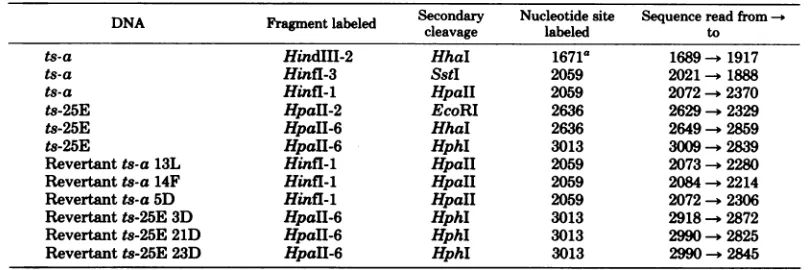
(23). We determined the
nucleotide
sequences
of
ts-a
and ts-25E
throughout
these
regions. The
DNA of
mutant ts-a was
sequenced from
nu-cleotides
1689 -* 2021
and
2072
--2370
(Table
1).
Only
one
difference
was
noted
between its
sequence and
that of the
polyoma large-plaque
strain
3
virus
sequenced by Friedmann
et
al.
(19).
A
G
-*A
transition at
nucleotide
2193
causes
the
replacement of
Ala
(GCT) by
Thr
(ACT)
in
large T-antigen.
The DNA
of mutant
ts-25E was
sequenced from
nucleotides
2329
--2629
and
2649
-+3009
(Table
1).
One difference
was
noted
between its
sequence and that of the
virus
sequenced
by
Friedmann
et al. (19). A
G
-*T
transversion
at
nucleotide 2883
causesthe
replacement
of
Gly (GGC)
by
Cys (TGC).
Previously,
we
reported the isolation of
spon-taneously occurring polyoma
virus
mutants
lack-ing HindIII
site 1, which
borders
the
A gene
region (Fig.
1)
(1).
Among the mutants that we
characterized
were several
which could grow
without
helper virus
and
which contained either
tPresent address:Departmentof Obstetrics and
Gynecol-ogy,UniversityofMinnesota,Minneapolis,MN55455.
single-base changes
or
very
small
deletions. We
have sequenced two of these mutants. Both
(1-10-1
and 1-12-1) contain a single G
-+A
transi-tion at nucleotide 1673. This mutatransi-tion causes
the loss of the
HindIII
site, but has no effect
upon
the amino acid sequence of large
T-antigen
(AAG
[Lys]
-*AAA
[Lys]).
One of
the mutants
(1-12-1) has a normal
phenotype;
the other
(1-10-1) grows poorly and gives small
plaques.
This
must
be due to a secondary mutation elsewhere
in the viral genome.
Some
variability
in
sequence occurs among
wild-type
strains of
polyoma
virus
(32;
Thomas
and
Folk, unpublished data).
For
instance,
in
ts-25E
FIG.
1.Polyoma virus early region. The
HindIII
site
I and twoHhaI sites are indicated on the circular
polyoma genome. Numbers in parentheses refer to
nucleotide numbers
from the ori region (8). The
se-quences
encoding the large, middle, and small
T-antigens are drawn
from references 19 and 32. The
dashed line indicates the region in which A gene
mutants
have been mapped by marker rescue
(12,
13,
23). The locations of the ts-a and ts-25E mutants and
the
twomutants with alterations at
HindIII site
I(1-10-1
and
1-12-1) are
specified by a X.
1094on November 10, 2019 by guest
http://jvi.asm.org/
[image:1.488.273.422.380.543.2]TABLE 1.
Sequencing
strategy for
various
DNAs
DNA Fragment labeled Secondary Nucleotide site Sequence read
from
-cleavage
labeled tots-a
HindIII-2
HhaI
1671a
1689
--1917
ts-a
Hinfl-3
SstI
20592021-+
1888ts-a
Hinfl-1
HpaII
2059
2072
- 2370
ts-25E
HpaII-2
EcoRI
2636
2629
-
2329
ts-25E
HpaII-6
HhaI
2636
2649
2859
ts-25E
HpaII-6
HphI
3013
3009
- 2839
Revertant ts-a 13L
Hinfl-1
HpaII
2059
2073
- 2280
Revertant ts-a
14F
Hinfl-1
HpalI
2059
2084
- 2214
Revertant ts-a 5D
Hinfl-1
HpaII
2059
2072
- 2306
Revertant
ts-25E 3D
HpaII-6
HphIl
3013
2918
2872
Revertant ts-25E 21D
HpaII-6
HphI
3013
2990
2825
Revertant
ts-25E 23D
HpaII-6
HphIl
3013
2990
-2845
a
The
numbering
system
used
throughout is that of
Deininger
etal. (8).
the
large
T-antigen encoding region described
above, there
are
six
sites
at
which the
sequence
of
polyoma virus determined by Soeda
et
al. (32)
is
different from that
determined
by
Deininger
et
al.
(8). Because of this
variability
and the
possibility
that other mutations
might have been
introduced
by
the chemical
mutagenesis used
to
generate
mutants
ts-a
and
ts-25E,
we
decided
to
confirm that the nucleotide
changes in
mutants
ts-a
and ts-25E
are
indeed the
source
of
their
thermosensitive
phenotypes
by
isolating and
se-quencing
several
spontaneous revertants.
Numerous
single
plaques of
mutants ts-a
and
ts-25E
were
picked from whole
mouse
embryo
(WME)
monolayers
infected
at
330C
and
were
used
to
prepare
stocks
of virus
by
infecting
60-mm
dishes
of
WME
cells
at
330C.
Each stock
was
passaged through WME cells
at
39.50C
to
enrich
for
spontaneous revertants.
These stocks
were
then
plaqued
on
WME cells
at
370C.
Ap-proximately
one-third
of the stocks contained
viruses
capable of
forming
distinct
plaques
at
this
temperature.
One
plaque
was
picked
from
each
independent
stock,
and
its viruses
were
plaque purified
at
370C
twice
more.
Virus stocks
were
prepared, tested for
growth
at
33
and
39.50C,
and then used
to
infect
mouse
3T6
cells
for viral DNA.
Three
independent
revertants
of each
mutant
(which
were
normal
in
their
capacity
to
replicate
in mouse
cells
at
39.50C)
were
characterized
with
respect
to
their
sequence
alterations. The
ts-a
revertants were
found
to
have
the G
re-stored
at
nucleotide
2193,
and the ts-25E
revert-ants
had the
G
at
nucleotide
2883
restored
(Fig.
2).
Although
not
all
of the
T-antigen
regions
of
these revertants
were
sequenced,
because
they
are
spontaneous
revertants, it is
unlikely
that
they
incurred
more
than
one
mutation.
Further-more,
a
reversion
at
the
same
site in three
in-dependent
revertants
of each
mutant
strongly
implicates
that site
as
the
cause
of the
pheno-type
of the virus and lessens
the
possibility that
they
are
revertants
by changes
at
secondary
sites.
Thus,
it
is
possible
to
conclude
that
these
amino
acid
replacements
cause
the
thermolabil-ity of the polyoma large
T-antigen.
Previous analyses
by
marker
rescue
experi-ments
indicated that the majority
of the A gene
mutants are
altered
near the
COOH-terminal
coding
sequences
of
the large T-antigen
(12,
13,
23).
Our results, together
with
the experiments
of others
(9), confirm this. The
ts-a
mutation
occurs 242
amino
acid residues from the COOH
terminus,
and the
ts-25E
mutation
occurs
only
11
amino acid residues from the COOH
termi-nus.
For
these
mutants,
elevated
temperatures
cause
instability
of the
large
T-antigen and
re-sult
in a
cessation
of viral DNA replication
(16),
impaired regulation of early
mRNA
synthesis
(5),
and a
block
in
virus-mediated cell
transfor-mation
(11,
18,
24).
The
replacements of Ala by Thr
and
Gly
by
Cys
in the
large T-antigen
of
ts-a
and
ts-25E,
respectively,
are
clearly
destabilizing
events.
The
sequence
in the
polyoma
large
T-antigen
surrounding
the site
of the
ts-a
change
(Ala-Gly-Val-Ala-Trp)
is
conserved between the
T-anti-gens
of
polyoma
virus, simian virus
40
(SV40),
and
BK
virus
proteins (14, 26, 28, 34) (Fig. 3).
These amino acids and others
nearby
are
a-helix
forners,
but the
replacement
of Ala
by
Thr
(a
helix
breaker)
may
destabilize that
structure
(4).
It
is
noteworthy that the amino acid
replace-ments
in
four
(and
possibly more)
A
gene
mu-tants
of
SV40
occur
in
the
homologous region
of
the
SV40
T-antigen (within
an area
containing
36
amino
acid
residues)
(29).
The
replacement
in
SV40
mutant
tsA239
adjoins
the residue
al-tered in the
polyoma
ts-a mutant
(29).
Similarly,
the
mutation
in
polyoma
ts-48
that
renders
its
large T-antigen
unstable is
a
Ser
-.
Ile
replace-ment
in the
same area
(49
amino
acid residues
toward the
COOH
terminus from the
ts-amu-VOL.
37,
1981
NOTES
1095
on November 10, 2019 by guest
http://jvi.asm.org/
G A+G A+C C+T C G A+G A+C C+T
(2198)
G _
T=
T
c
- Tc
T
c c
A-- C217
(2I79>-ts-25E
G A+G A+C C+T C
ts-25E Rev 21D
G A+G A+C C+T C
(2875) A
-G -T
c T
T
--A
C-c
--G
-C
T
-- G -c
-- G G G
(2894)
FIG.
2.
Autoradiograms of chemically degraded,
end-labeledDNAs. ViralDNAs produced
inmouse3T6cellswere
purified through
cesium chloride-ethidium bromidegradients after
amodified
Hirtlysis
extractionprocedure
(15). They
wereckaved with endo BamHI(ts-a,
ts-25E, 1-10-1,
and 1-12-1DNAs)
orendoHindIII
(revertants of
ts-aandts-25)
andligated
toendo BamHI- orHindIII-cleaved pBR322
DNAaspreviously
described
(3).
After transfection
intoEscherichia coliHB 101, Ampr
cloneswereselected andpurified.
Theirplasmid
DNAswereextracted and checkedfor polyoma pBR322
sequencesby
restrictionenzymedigestion.
Polyoma pBR322
DNAswereextractedfrom
chloramphenicol-amplified
culturesby
amodified
clearedlysis
procedure,
deproteinized,
andbanded in cesiumchloride-ethidium bromidegradients
aspreviously
described(3). After
the ethidium bromidewasremovedby
isopropanol extraction,
the DNAswereethanolprecipitated
and then
digested
with endonucleases. The terminalphosphates
ontheDNAfragments
wereremoved withalkaline
phosphatase,
and theDNAsweredeproteinized
and ethanolprecipitated.
Thedigests
werethenfractionated
on 6%polyacrylamide
gelscontaining
0.32%diallytartardiamide.
Theappropriate fragments
weresolubilizedinsodium
periodate
(2),
recoveredonDEAEcolumns,
andphosphorylated
with[y-32P]ATP
and
polynucleotide
kinase(3). Digestion
with a secondrestriction enzymeproduced
twoasymmetrically
labeled
fragments
whichwerepurified
by polyacrylamide gel electrophoresis. If
thesecondcleavage
occurrednear alabeled terminus and
produced
asmalllabeledoligonucleotide, frequently
itwasnotnecessaryto separate itfrom
the labeledoligonucleotide being sequenced.
Thesequencing
strategyemployed for
thevarious DNAs is
given
in Table 1. The labeledfragments
weresequenced by
the chemicaldegradation
procedure of
Maxam and Gilbert(22).
Theproducts
werefractionated
on0.4-mmpolyacrylamide gels
(8%)
asdescribed
by
Sanger
and Coulson(27).
Portionsfrom
sequencing gels, including
the sitesof
mutation orreversion
of
ats-aallele and the ts-25Eallele,
areshown.1096
C
on November 10, 2019 by guest
http://jvi.asm.org/
[image:3.488.105.393.39.464.2]Tia (P1til le(Pyts-48)
r--f
~
~
~
r
Py NH2 3 s Gly Vel AM Ttr TGl C p AG20Aim l Is PhLh Val 1101 Lou Ib Sir Lou:
-SKV NH2 30 Mt Al. GlI VrlA Tp'Lou No Cy* Lsu Lou Pro Lys 20 Tytr Trp Lu Ph LsGly ProaIl 10 Loua Leu AspLoue
-SV40NH2-_11Mt1 Ab Gly Val Al Ttp Law Hs CvsLos Lsu Pro Lys 20 Tyt Ttp Is NoI' LyIGly Pro,lr [IOJ LoLu Lau GinMLou C ISVtA236/241) CysSVtA25S) Le SYtSA20A)
CyvPyti25E)
Ser(PI h62)Amp llr Ale Gb Tytr Th Val Tyr(COOHN)jPA2)
-177 GM GM 'Gly' Amp Asp Pro L's Lvy Asp Ie Cys G Tytr St (COOH) - 177 Cy Mst O,: Ly. Cy. It. LeL. Amplb Tht At, GM Gb Amp 60 COOH)
[image:4.488.49.447.56.171.2]_177
AM Me CRY: lb GOly Vs *L.u Am TtP Los An Amn Sat A COON)FIG. 3.
Comparison of amino acid sequences of viral large T-antigen near the sites of A gene mutations.
Amino acid sequences
ofpolyoma virus
(19,
32), BK virus
(28, 34), and SV40 (14, 26)
from the middle (upper
section)
and COOH-terminal
(lower
section) portions
of
large T-antigen
aredisplayed. Numbers in brackets
refer to amino acids deleted
for the purpose of clarity. Amino acids in common among the three T-antigens
are
enclosed in
dashed boxes. Amino acid replacements in A gene
mutantsareindicated
by
arrows(9, 29).
tation) (9). This clustering of mutations in
in-dependently isolated
A gene mutants of both
viruses (Fig.
3) emphasizes the
homologous
na-ture
of their large T-antigens
and
suggests that
this
part
of
each protein is particularly
impor-tant
for
stabilizing its
structure.
The
glycine
that is altered in the polyoma
ts-25E protein is
at a
site conserved
between the
large
T-antigens
of polyoma
virus,
SV40,
and
BK
virus.
It
is interesting that this
change is
only
11
residues from the COOH terminus
and
that the alteration in
polyoma A
gene mutant
ts-52
occurs at
the
same
site
(9)
(Fig.
3). It
appears
that this site
at
the
COOH
terminus is
critical for the
stability of the polyoma large
T-antigen. Because of the number of charged
or
polar amino acids
or
both
in
this
region, it is
unlikely
that
the COOH terminus has
much
a-helix
content
(4).
It
is
curious
that one
of the
differences
be-tween
the
polyoma
virus
sequenced by
Fried-mann et
al. (19) and the
virus
sequenced by
Soeda
et
al.
(32)
occurs at
the
COOH terminus
of
large T-antigen. The
sequence
determined by
Soeda
et
al. for the
polyoma
A-2
strain
predicts
a
protein with five additional COOH-terminal
amino acids. The ts-25E
mutant
has
an
HpaII
restriction
pattern,
suggesting that it is derived
from
the
polyoma
A-3
strain; like the
polyoma
strain
3
virus
sequenced by
Friedmann
et
al.
(19),
it does
not
have the
sequence which
might
cause
this
larger T-antigen. Such sequence
var-iability
indicates
that
the
structure
of the
large
T-antigen
COOH terninus
is not
rigidly
defined.
However, the
glycine
altered
by
the ts-25E
and
ts-52
mutations
must
be
particularly important
for the
stability
of this part of the
protein.
Cu-riously,
the
large T-antigens
of
SV40
and BK
virus contain
approximately
70
additional
resi-dues
beyond
the
COOH
terminus
of the
polyoma
protein (14,
26, 28,
34).
Deletions in the
SV40
genome
removing
parts of this additional
se-quence do
not
appear
to
affect the
thermosta-bility of the large T-antigen, but diminish
its
adenovirus
helper function (6,
7). This suggests
that
these
sequences
interact
only
miniimally
with
those preceding them
which are
homolo-gous in structure
and presumably
in
function to
the
polyoma
sequences.
Finally,
several
comments can
be made about
the
nature
of the mutations that have
occurred
in
these viruses.
Both ts-a
and ts-25E
were
gen-erated by nitrous acid mutagenesis.
A
G
-*A
transition
as
observed in
ts-a can
be
explained
by deamination of the cytosine in
a
C G
base
pair, giving
rise
to a
T -A
pair. However,
a
G
-+T
transversion
is not
predicted
as an outcome
of
nitrous
acid
treatment on
straightforward
chem-ical
grounds (33). Similar G
--T transversions
have
been
found in nitrous
acid-mutagenized
4X174
(31).
The
mutations in the
spontaneously
occurring HindIII site
1 mutants
and in the
A
gene revertants
are
both
transitions
(G
--A;
A
-*
G) and transversions
(T
-+G).
These
must
be
the
results of mistakes
in
replication
(or
in
repair)
or are
the
result of
naturally occurring
damage
to
DNA.
We thank P.Deininger and T. Friedmann for sharing data beforepublication,G.LePlatte,R.Gutierrez,and R. White for technicalhelp, and H. Good for expert administrative
assistance. *
Support provided byPublic Health Service grant CA13978 from the National Institutes of Health and grant FRA152 from the AmericanCancerSocietyisgratefully acknowledged.
ADDENDUM
INPROOF
We
have
sequenced
anadditional
revertantof
ts-25E
(ts-25E 4e).
It isapparently
asecond-siterevert-ant,for the Tatnucleotide 2883
is
unchanged,
butaG
hasreplaced
anAatnucleotide
2864.This
causesan
Ile
-s Met aminoacid
substitution six residues upstream from theCys
that is thecauseof thether-molability of
theT-antigen.
LITERATURE CITED
1. Anderson,D.M.,M. M.Bendig,andW. R.Folk.1978. Isolation of polyoma viruses lacking endonuclease HindIIIsites.Virology89:637-642.
VOL. 37,1981
NOTES
1097
on November 10, 2019 by guest
http://jvi.asm.org/
1098
NOTES2. Anker, H. S. 1970. A solubilizable acrylamide gelfor electrophoresis. FEBS Lett. 7:293-295.
3. Bendig, M. M., T. Thomas, and W. R. Folk. 1980. Regulatorymutantsof polyoma virus defective in DNA replication and the synthesisofearly proteins.Cell20: 401-409.
4. Chou, P.Y., and G.D.Fasman. 1978.Empirical predic-tions ofprotein conformation. Annu. Rev. Biochem.47: 251-276.
5. Cogen, B. 1978. Virusspecific earlyRNA in3T6 cells infectedbyats-a mutantofpolyoma virus.Virology 85: 222-230.
6. Cole, C.N.,L V.Crawford,and P.Berg.1979. Simian virus40 mutantswith deletions atthe 3' end of the early regionaredefectiveinadenovirushelper function. J.Virol. 30:683-691.
7. Cole, C.N.,T.Landers,S.Goff,S.Manteuil-Brutlag,
and P.Berg.1977.Physicalandgenetic characteriza-tion of delecharacteriza-tionmutantsof simian virus40constructed in vitro. J. Virol.24:277-294.
8. Deininger,P.L.,A.Esty,P. LaPorte,H.Hsu,and T. Friedmann.1980.The nucleotidesequenceand restric-tionenzymesites of thepolyomagenome.Nucleic Acids
Res. 8:855-860.
9. Deininger, P. L., P. LaPorte, and T. Friedmann.1981. Nucleotidesequencechanges in polyomats-a mutants:
correlation withproteinstructure.J. Virol.37:871-875. 10. DiMayorca, D.,J.Callendar,G.Marin,and R. Gior-dano. 1969.Temperature-sensitivemutantsofpolyoma virus. Virology 38:126-133.
11. Eckhart, W.1969.Complementation and transformation bytemperature sensitive mutants ofpolyoma virus. Virology 38:120-125.
12. Eckhart, W. 1977.Complementation between tempera-turesensitive and hostrangenontransformingmutants ofpolyomavirus.Virology77:589-597.
13.Feunteun, J., L. Sompayrac, M. Fluck, and T. Ben-jamin. 1976.Localization ofgenefunctions in polyoma virus DNA. Proc.Natl. Acad. Sci. U.S.A. 73:4169-4173. 14.Fiers,W.,R.Contreras,A.Haegeman, R.Rogiers, A. VandeVoorde, H. Van Heuverswyn,H. V. Her-reweghe, G. Volekaert, and M. Ysebaert. 1978. Complete nucleotidesequenceofSV-40 DNA. Nature (London)273:113-119.
15.Folk, W. R.,and J.Bancuk.1976.Polyomagenomein
hamster BHK-21-C13 cells: integration into cellular DNA andinduction of theviral replicon. J. Virol.20: 133-141.
16.Francke, B., and W. Eckhart 1973. Polyoma gene
functionrequired for viral DNA synthesis. Virology55: 127-135.
17.Fried, M.1965.Isolation oftemperaturesensitivemutants
ofpolyoma virus. Virology 25:669-671.
18.Fried, M.1965.Cell-tra0sforming ability ofatemperature
sensitivemutantofpolyoma virus. Proc. Natl.Acad. Sci.U.S.A. 53:486-491.
19.Friedmann,T.,A.Esty,P.LaPorte,and P.Deininger.
1979. Thenucleotidesequenceand genomeorganization
of thepolyomaearly region:extensivenucleotide and amino acidhomologywithSV-40.Cell 17:715-724. 20. Hutchinson,M.
A.,
T.Hunter,
and W.Eckhart.1978.CharacterizationofT-antigeninpolyomainfected and transformed cells. Cell 15:65-77.
21. Ito, Y., N.Spurr, and R. Dulbecco. 1977. Characteri-zation ofpolyoma-virusT-antigen. Proc. Natl. Acad. Sci.U.S.A. 74:1259-1263.
22. Maxam,A.,and W.Gilbert. 1980.Sequencing end-la-beled DNA with base-specific chemical cleavages.
MethodsEnzymol.65:499-560.
23. Miller,L. K., and M. Fried. 1976. Construction of the genetic map of thepolyomagenome. J.Virol. 18:824-832.
24.Moore, J.L.,K.Chowdhury,M. A.Martin,and M.A. Israel. 1980.Polyoma largetumorantigenis not re-quired fortumorigenesis mediatedbyviral DNA. Proc. Natl. Acad.Sci. U.S.A. 77:1336-1340.
25. Paulin, D.,and F.Cuzin.1975.PolyomavirusTantigen. I.Synthesis of modified heat-labile T antigen in cells transforned with thets-amutant.J. Virol. 15:393-397. 26. Reddy,V.B.,B.Thimmappaya,R.Dhar,K. N. Sub-ramanian, B. Zain, J. Pan, P. K. Ghosh, M. L. Celma, and S. M. Weissman. 1978. The genome of SV-40. Science 200:494-502.
27.Sanger, F.,and A. R.Coulson. 1978. The use of thin acrylamide gels for DNA sequencing. FEBS Lett. 97: 103-110.
28. Seif, I.,G.Khoury,and R. Dhar.1979.The genome of humanpapovavirusBKV.Cell 19:963-977.
29.
Seif,
I., G.Khoury,and R.Dhar.1980.Arapid enzy-matic DNA sequencing technique: determination of sequence alterations inearlySV-40 temperature sensi-tive and deletion mutants. NucleicAcidsRes. 8:2225-2240.30. Silver,J., B. Schafhausen, and T. Benjamin. 1978. Tumor antigens induced by nontransforming mutants ofpolyomavirus.Cell15:485-496.
31. Smith,M., N. L.Brown, G. N. Air, B. G. Barrell, A. R.
Coulson,C. A. Hutchinson, and F. Sanger. 1977. DNA sequence of the C termini of the overlapping genes A and B inbacteriophage
OX174.
Nature(Lon-don)265:702-705.
32. Soeda, E.,J.R.Arrand,N.Smolar,J. E.Walsh,and B. E. Griffin. 1980. Codingpotential andregulatory
signalsof thepolyoma virus genome. Nature (London) 283:445-453.
33. Vanderbilt,A.S.,and I.Tessman. 1970. Identification of the altered bases in mutatedsingle-stranded DNA. IX. Nitrous acid induction of the transitions guanine to adenine andthyminetocytosine. Genetics 66:1-10. 34. Yang, R. C., and R. Wu. 1979. BK virus DNA: complete
nucleotide sequence of a human tumor virus. Science 206:456-461.