ENSEMBLE DIVERSITY FOR CLASS
IMBALANCE LEARNING
by
SHUO WANG
A thesis submitted to
The University of Birmingham
for the degree of
DOCTOR OF PHILOSOPHY
School of Computer Science
College of Engineering and Physical Sciences
The University of Birmingham
University of Birmingham Research Archive
e-theses repositoryThis unpublished thesis/dissertation is copyright of the author and/or third parties. The intellectual property rights of the author or third parties in respect of this work are as defined by The Copyright Designs and Patents Act 1988 or as modified by any successor legislation.
Any use made of information contained in this thesis/dissertation must be in accordance with that legislation and must be properly acknowledged. Further distribution or reproduction in any format is prohibited without the permission of the copyright holder.
Abstract
This thesis studies the diversity issue of classification ensembles for class imbalance
learn-ing problems. Class imbalance learnlearn-ing refers to learnlearn-ing from imbalanced data sets, in
which some classes of examples (minority) are highly under-represented comparing to
other classes (majority). The very skewed class distribution degrades the learning ability
of many traditional machine learning methods, especially in the recognition of examples
from the minority classes, which are often deemed to be more important and interesting.
Although quite a few ensemble learning approaches have been proposed to handle the
problem, no in-depth research exists to explain why and when they can be helpful. Our
objectives are to understand how ensemble diversity affects the classification performance
for a class imbalance problem according to single-class and overall performance measures,
and to make best use of diversity to improve the performance.
As the first stage, we study the relationship between ensemble diversity and
gener-alization performance for class imbalance problems. We investigate mathematical links
between class performance and ensemble diversity. It is found that how the
single-class measures change along with diversity falls into six different situations. These findings
are then verified in class imbalance scenarios through empirical studies. The impact of
di-versity on overall performance is also investigated empirically. Strong correlations between
diversity and the performance measures are found. Diversity shows a positive impact on
the recognition of the minority class and benefits the overall performance of ensembles in
class imbalance learning. Our results help to understand if and why ensemble diversity
can help to deal with class imbalance problems.
Encouraged by the positive role of diversity in class imbalance learning, we then
fo-cus on a specific ensemble learning technique, the negative correlation learning (NCL)
algorithm, which considers diversity explicitly when creating ensembles and has achieved
named AdaBoost.NC, for classification problems. An “ambiguity” term decomposed from
the 0-1 error function is introduced into the training framework of AdaBoost. It
demon-strates superiority in both effectiveness and efficiency. Its good generalization performance
is explained by theoretical and empirical evidences. It can be viewed as the first NCL
algorithm specializing in classification problems.
Most existing ensemble methods for class imbalance problems suffer from the
prob-lems of overfitting and over-generalization. To improve this situation, we address the class
imbalance issue by making use of ensemble diversity. We investigate the generalization
ability of NCL algorithms, including AdaBoost.NC, to tackle two-class imbalance
prob-lems. We find that NCL methods integrated with random oversampling are effective in
recognizing minority class examples without losing the overall performance, especially the
AdaBoost.NC tree ensemble. This is achieved by providing smoother and less overfitting
classification boundaries for the minority class. The results here show the usefulness of
diversity and open up a novel way to deal with class imbalance problems.
Since the two-class imbalance is not the only scenario in real-world applications,
class imbalance problems deserve equal attention. To understand what problems
multi-class can cause and how it affects the multi-classification performance, we study the multi-multi-class
difficulty by analyzing the multi-minority and multi-majority cases respectively. Both
lead to a significant performance reduction. The multi-majority case appears to be more
harmful. The results reveal possible issues that a class imbalance learning technique could
have when dealing with multi-class tasks. Following this part of analysis and the promising
results of AdaBoost.NC on two-class imbalance problems, we apply AdaBoost.NC to a
set of multi-class imbalance domains with the aim of solving them effectively and directly.
Our method shows good generalization in minority classes and balances the performance
across different classes well without using any class decomposition schemes.
Finally, we conclude this thesis with how the study has contributed to class imbalance
learning and ensemble learning, and propose several possible directions for future research
ACKNOWLEDGEMENTS
Foremost, I would like to express my deep and sincere gratitude to my supervisor Prof.
Xin Yao for his inspiration, patience and encouragement. He introduced me to the field
of machine learning and provided lots of good ideas and advice. I would have never
completed this thesis without his help. He educated me generously in how to be a good
researcher with his immense knowledge. The joy and enthusiasm he has for his research
were contagious and motivational for me to hurdle all the obstacles.
Besides Xin, I am deeply grateful to my research committee members, Dr. Peter Tino
and Dr. Ata Kaban, for their insightful comments and hard questions throughout my
Ph.D study. Their great ideas and unfailing support guided me to go further in this field.
Their wide knowledge and logical way of thinking have been of great value for me.
My sincere thanks also go to Dr. Steven Vickers, who took effort in my Ph.D progress
and helped with various applications, and Prof. Achim Jung, Prof. John Barnden and
Dr. Nick Hawes, who offered me great opportunity to be a good demonstrator. It was an
enjoyable experience of teaching.
I wish to thank the examiners of this thesis, Dr. Wenjia Wang and Dr. Ata Kaban,
for agreeing to be the examiners of my Ph.D viva.
Luckily for me, I have benefited from numerous research fellows who turned into even
better friends: Huanhuan Chen, Shan He, Leandro Minku, Pietro Oliveto, Ke Tang,
Andrea Soltoggio and Arjun Chandra. They gave me wise advice and helped me along
the way.
I am indebted to my many Ph.D colleagues for providing a stimulating and fun
Soares, Guanzhou Lu, Fubiao Xia and Haobo Fu for their support, company and laughs.
I would like to thank my best friends Siripen Songprasit and Jiayi Lee, for helping me
get through the most difficult times, and for all the emotional support, entertainment,
and caring they provided.
Last but not the least, I would like to thank my family: my parents Subin Wang
and Ruiping Dang, for all their love and encouragement. They supported me in all my
CONTENTS
1 Introduction 1
1.1 Class Imbalance Learning . . . 4
1.2 Ensemble Learning . . . 6
1.3 Research Questions . . . 9
1.3.1 Ensemble Diversity for Class Imbalance Learning . . . 9
1.3.2 Ensemble Methods for Class Imbalance Learning . . . 11
1.3.3 Negative Correlation Learning for Classification Ensembles . . . 13
1.4 Thesis Contributions . . . 15
1.5 Thesis Structure . . . 16
1.5.1 Thesis Structure . . . 16
1.5.2 Publications Resulting from the Thesis . . . 17
2 Literature Review 19 2.1 Learning from Class Imbalance Problems . . . 19
2.1.1 Resampling Techniques . . . 22
2.1.2 Ensemble Learning Methods . . . 26
2.1.3 Evaluation Criteria . . . 31
2.2 Learning from Multi-Class Imbalance Problems . . . 34
2.2.1 Class Decomposition . . . 35
2.2.2 Existing Solutions . . . 37
2.2.3 Evaluation Criteria in the Presence of Multi-Class . . . 38
2.3.1 Diversity Measures for Classification . . . 40
2.3.2 Diversity and Generalization . . . 47
2.4 Negative Correlation Learning Algorithms . . . 50
2.5 Chapter Summary . . . 54
3 Diversity Analysis for Class Imbalance Learning 56 3.1 Introduction . . . 56
3.2 Relationship Between Diversity and Overall Accuracy . . . 61
3.2.1 Definitions and Notations . . . 62
3.2.2 Q-statistic and Overall Accuracy in Patterns . . . 63
3.2.3 Patterns and Class Imbalance Learning . . . 68
3.3 Relationship Between Diversity and Single-Class Measures . . . 70
3.3.1 Recall, Precision and F-measure with Independence Assumption . . 71
3.3.2 Recall, Precision and F-measure without Independence Assumption 72 3.4 Diversity Analysis for Class Imbalance Learning . . . 74
3.4.1 Impact of Diversity on Classification Performance on Artificial Im-balanced Data . . . 74
3.4.2 Impact of Diversity on Classification Performance on Real-World Imbalanced Data . . . 83
3.5 Chapter Summary . . . 89
4 Negative Correlation Learning for Classification Ensembles 90 4.1 Introduction . . . 91
4.2 An Ambiguity Measure for Classification Ensembles . . . 92
4.3 A New NCL Algorithm – AdaBoost.NC . . . 95
4.3.1 The AdaBoost.NC Algorithm . . . 96
4.3.2 Experimental Studies . . . 99
4.3.3 Parameter Discussions . . . 105
4.5 Chapter Summary . . . 115
5 Negative Correlation Learning for Two-Class Imbalance Problems 117 5.1 Introduction . . . 118
5.2 AdaBoost.NC for Two-Class Imbalance Problems . . . 120
5.2.1 Artificial Data Sets and Experimental Settings . . . 121
5.2.2 AdaBoost.NC Tree Ensembles . . . 123
5.2.3 AdaBoost.NC Neural Network (NN) Ensembles . . . 129
5.2.4 The Analysis of Parameter Effects . . . 132
5.3 Comparisons with Other NCL Algorithms and Class Imbalance Learning Methods . . . 137
5.3.1 Real-World Data Domains and Experimental Settings . . . 137
5.3.2 Results and Analyses . . . 140
5.3.3 Additional Remarks . . . 145
5.3.4 Correlation Between Diversity and Generalization Performance . . . 147
5.4 Chapter Summary . . . 148
6 Negative Correlation Learning for Multi-Class Imbalance Problems 150 6.1 Introduction . . . 151
6.2 Challenges of Multi-Class Imbalance Learning . . . 152
6.2.1 Artificial Data Sets and Experimental Settings . . . 153
6.2.2 Multi-Minority Cases . . . 155
6.2.3 Multi-Majority Cases . . . 158
6.3 AdaBoost.NC for Multi-Class Imbalance Problems . . . 161
6.3.1 Data Sets and Experimental Settings . . . 161
6.3.2 Ensemble Algorithms for Multi-Class Imbalance Problems . . . 163
6.4 Chapter Summary . . . 173
7 Conclusions and Further Work 176 7.1 Conclusions . . . 176
7.1.1 Role of Ensemble Diversity in Class Imbalance Learning . . . 177
7.1.2 A New NCL Method for Classification . . . 178
7.1.3 How to Better Deal with Two-Class Imbalance Problems? . . . 179
7.1.4 Challenges and Potential Solutions for Multi-Class Imbalance
Prob-lems . . . 180
7.2 Further Work . . . 181
7.2.1 Sensitivity of Diversity Measures to Class Imbalance . . . 182
7.2.2 Discrimination Between “Good” diversity and “Bad” Diversity . . . 182
7.2.3 The AdaBoost.NC Algorithm . . . 183
7.2.4 Error Correlation in Sequential Training . . . 184
7.2.5 Conditions of Using AdaBoost.NC in Class Imbalance Learning . . 184
7.2.6 Analysis of Multi-Class Imbalance Learning . . . 185
7.2.7 Application of Class Imbalance Learning Methods to Software
En-gineering . . . 186
Appendix A: Connection Between Ambiguity and Bias-Variance-Covariance
Decompositions for Regression Ensembles 187
Appendix B: Choice of Classifier Weight αi in AdaBoost.NC 189
Appendix C: Paired Comparison of Algorithms on Two-Class Imbalance
LIST OF FIGURES
2.1 Illustration of ROC curves (He and Garcia, 2009). . . 33
3.1 Q-statistic and its upper bound with respect to p01. . . 67
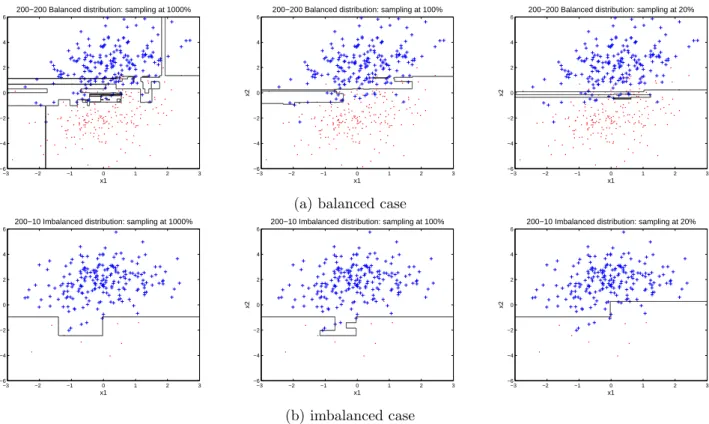
3.2 Classification boundary plots produced by Bagging-based tree ensembles at
sampling rates 1000%, 100%, and 20% on data sets “200-200” (balanced)
and “200-10” (very imbalanced). . . 79
4.1 Performance behaviour of AdaBoost.NC by varying λ. Ensemble sizeL is
set to 9. (X-axis: penalty strength λ∈ [0,12]; Y-axis: number of misclas-sified examples.) . . . 107
4.2 Performance behaviour of AdaBoost and AdaBoost.NC by varyingL. Penalty
strengthλis set to the optimal value obtained in Fig. 4.1. (X-axis:
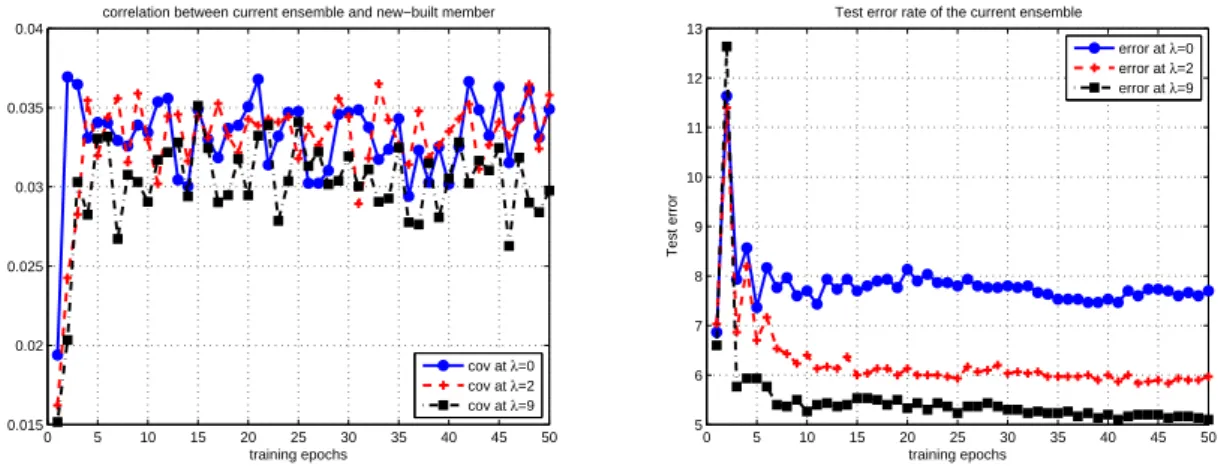
ensem-ble size L∈[5,201]; Y-axis: number of misclassified examples.) . . . 109 4.3 Error correlation and test error rate (in %) during sequential training. . . . 113
4.4 Classification boundaries of AdaBoost.NC with λ∈ {0,2,9}. . . 114
5.1 Classification boundaries on “200-200” by tree-based models. . . 126
5.2 Classification boundaries on “200-50” by tree-based models using original
data. . . 127
5.3 Classification boundaries on “200-50” by oversampling + tree-based models.127
5.4 Classification boundaries on “200-50” by undersampling + tree-based models.127
5.5 Classification boundaries on “200-10” by tree-based models using original
5.6 Classification boundaries on “200-10” by oversampling + tree-based models.128
5.7 Classification boundaries on “200-10” by undersampling + tree-based models.128
5.8 Classification boundaries on “200-200” by 4 NN-based models. . . 129
5.9 Classification boundaries on “200-50” by 4 NN-based models for three
train-ing strategies. . . 131
5.10 Classification boundaries on “200-10” by 4 NN-based models for three
train-ing strategies. . . 131
5.11 Marginal means of responses forλ*learner andλ*data. . . 135
6.1 Single-class performance patterns among classes in multi-minority cases
(x-axis: number of minority classes, y-axis: performance output). . . 156
6.2 Single-class performance patterns among classes in multi-majority cases
LIST OF TABLES
2.1 The SMOTE algorithm (Chawla et al., 2002). . . 24
2.2 The SMOTEBoost algorithm (Chawla et al., 2003). . . 30
2.3 Confusion matrix. . . 31
2.4 A 2×2 table of the relationship between a pair of classifiers (Kuncheva and Whitaker, 2003). . . 42
2.5 Summary of the 10 diversity measures. ‘↓/↑’ indicates greater diversity if the measure gets lower/higher. . . 46
2.6 The CELS algorithm (standard NCL paradigm) (Liu and Yao, 1999b). . . 51
2.7 The NCCD algorithm (Chan and Kasabov, 2005a). . . 52
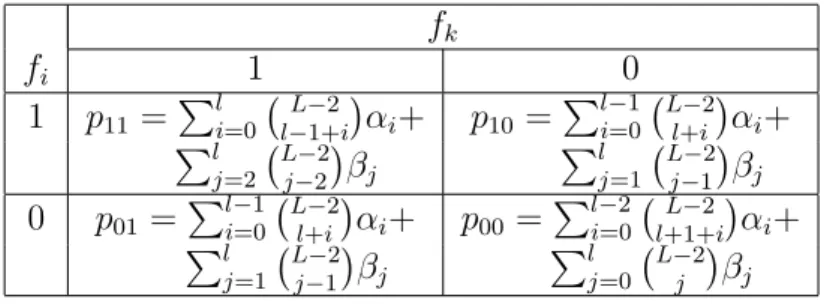
3.1 Pairwise table of the relationship between any two classifiers for the general
pattern. . . 66
3.2 The possible changing direction of Rmin, Pmin and Fmin as Q-statistic
de-creases (i.e. increasing diversity) in “good” and “bad” patterns in terms of
Povr. . . 74
3.3 Bagging-based training strategy (Wang and Yao, 2009b). . . 76
3.4 Rank correlation coefficient (in %) between overall diversity Q and 9
mea-sures on 3 artificial data sets. Numbers in boldface indicate significant
correlations. . . 77
3.5 Changing directions of single-class measures and overall accuracy by
in-creasing diversity on artificial data sets and their corresponding situations
3.6 Means of Q-statistic and the other performance measures on data sets
“200-200” and “200-10” at sampling rates 1000%, 100% and 20%. . . 80
3.7 Rank correlation coefficient (in %) betweenGD and the other performance
measures on artificial data sets “200-200”, “200-50” and “200-10”.
Num-bers in boldface indicate significant correlations. . . 81
3.8 Rank correlation coefficient (in %) between Q/GD and the other
perfor-mance measures on data set “2000-100” with 2 dimensions. Numbers in
boldface indicate significant correlations. . . 82
3.9 Rank correlation coefficient (in %) between Q/GD and the other
perfor-mance measures on data set “200-10” with 20 dimensions. Numbers in
boldface indicate significant correlations. . . 82
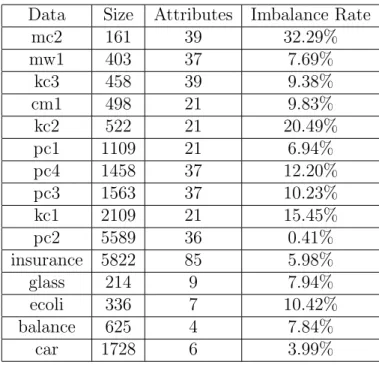
3.10 Summary of real-world data sets. . . 84
3.11 Rank correlation coefficient (in %) between diversity measured by Q/GD
and the other performance measures on real-world imbalanced data sets.
Numbers in boldface indicate significant correlations. . . 85
3.12 Changing directions of single-class measures and overall accuracy by
in-creasing diversity on 15 real-world data sets and their corresponding
situ-ations in Table 3.2. ‘-’ indicates an unclear changing behaviour obtained. 86
3.13 Rank correlation coefficient (in %) between diversity measured by Q/GD
and overall performance measures including G-mean and AUC on real
im-balanced data sets. Numbers in boldface indicate significant correlations. 87
4.1 The AdaBoost.NC algorithm (Wang et al., 2010). . . 97
4.2 Summary of benchmark data sets (‘d’ denotes a discrete attribute; ‘c’
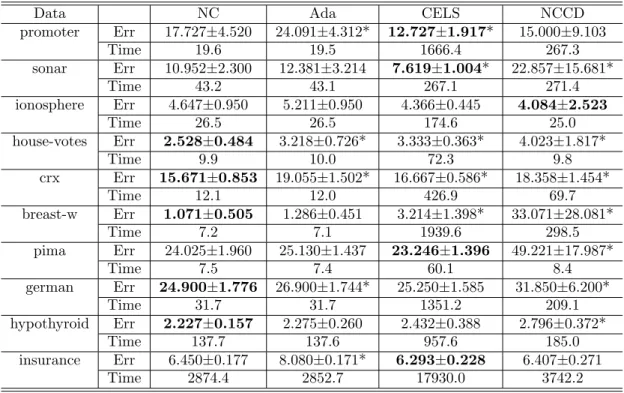
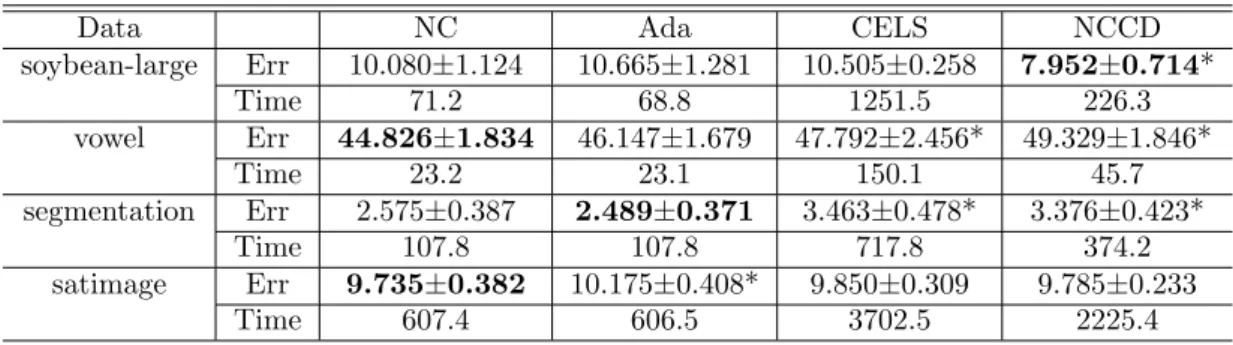
4.3 “Mean ± standard deviation” of test error rate (abbr. Err %) and mean computation time (in seconds) of AdaBoost.NC (abbr. NC), AdaBoost
(abbr. Ada), CELS and NCCD on two-class data sets with MLP as the
base learner. The lowest error rate for each data set is in boldface. The
significant difference between AdaBoost.NC and one of the other algorithms
is indicated by ‘*’. . . 102
4.4 “Mean ± standard deviation” of test error rate (abbr. Err %) and mean computation time (in seconds) of AdaBoost.NC (abbr. NC) and AdaBoost
(abbr. Ada) on two-class data sets with C4.5 as the base learner. The
lower error rate for each data set is in boldface. The significant difference
between AdaBoost.NC and AdaBoost is indicated by ‘*’. . . 103
4.5 “Mean ± standard deviation” of test error rate (abbr. Err %) and mean computation time (in seconds) of AdaBoost.NC (abbr. NC), AdaBoost
(abbr. Ada), CELS and NCCD on multi-class data sets with MLP as the
base learner. The lowest error rate for each data set is in boldface. The
significant difference between AdaBoost.NC and one of the other algorithms
is indicated by ‘*’. . . 104
4.6 “Mean ± standard deviation” of test error rate (abbr. Err %) and mean computation time (in seconds) of AdaBoost.NC (abbr. NC) and AdaBoost
(abbr. Ada) on multi-class data sets with C4.5 as the base learner. The
lower error rate for each data set is in boldface. The significant difference
between AdaBoost.NC and AdaBoost is indicated by ‘*’. . . 104
5.1 “Mean ± standard deviation” of AUC and single-class performance mea-sures on “200-200” by tree-based models. The significantly best value is in
boldface. (R-pos: recall of positive class; P-pos: precision of positive class;
5.2 “Mean ± standard deviation” of AUC and single-class performance mea-sures on “200-50” and “200-10” by tree-based models with three training
strategies (Origin: original data; Over: oversampling; Under:
undersam-pling). The significantly best value is in boldface. (R-min: recall of
mi-nority class; P-min: precision of mimi-nority class; R-maj: recall of majority
class; P-maj: precision of majority class.) . . . 124
5.3 “Mean ± standard deviation” of AUC and single-class performance mea-sures on “200-200” by NN-based models. The significantly best value is in
boldface. (R-pos: recall of positive class; P-pos: precision of positive class;
R-neg: recall of negative class; P-neg: precision of negative class.) . . . 129
5.4 “Mean ± standard deviation” of AUC and single-class performance mea-sures on “200-50” and “200-10” by NN-based models with three training
strategies (Origin: original data; Over: oversampling; Under:
undersam-pling). The significantly best value is in boldface. (R-min: recall of
mi-nority class; P-min: precision of mimi-nority class; R-maj: recall of majority
class; P-maj: precision of majority class.) . . . 130
5.5 ANOVA results: factor effects and interaction effects on AUC and
minority-class recall involving the oversampling rate (abbr. over) and λ in terms of
the base learner (abbr. learner) and training data (abbr. data). The
symbol “*” indicates the interaction between two factors. . . 133
5.6 Summary of real-world data sets. . . 138
5.7 Summary of experimental methods, their acronyms and parameter settings. 140
5.8 Percentages of win(w)-tie(t)-lose(l) cases (in ‘%’) for each experimental
method in 210 pairs of comparison using tree base learners, including AUC,
minority-class recall and minority-class precision. The results are based on
student T-test with confidence level of 0.95. The highest percentage of win
5.9 Percentages of win(w)-tie(t)-lose(l) cases (in ‘%’) for each experimental
method in 300 pairs of comparison using NN base learners, including AUC,
minority-class recall and minority-class precision. The results are based on
student T-test with confidence level of 0.95. The highest percentage of win
is in boldface. . . 143
5.10 “Mean±standard deviation” of AUC and minority-class performance mea-sures by OvNC9 tree ensembles and OvNC2 NN ensembles. The
signifi-cantly better value is in boldface. . . 146
5.11 Rank correlation coefficients (in ‘%’) between Q-statistic (Q) and
AUC/minority-class recall (R)/minority-AUC/minority-class precision (P) for the 12 tree ensembles on
15 real-world data sets. “avg” is the average over all data sets. . . 147
6.1 Rank correlation coefficients (in %) between the number of minority classes
and 5 performance measures for 3 ensemble methods. Recall, precision and
F-measure are calculated for the minority class. . . 155
6.2 Rank correlation coefficients (in %) between the number of majority classes
and 5 performance measures for 3 ensemble methods. Recall, precision and
F-measure are calculated for the minority class. . . 158
6.3 Summary of benchmark data sets. . . 162
6.4 Ensembles without using OAA: paired comparison of MAUC (upper
trian-gle) and G-mean (lower triantrian-gle) based on T-test with confidence level of
0.95 over 12 data sets. Each entry presents the amount of win-tie-lose of a
method in a row comparing with the method in a column. . . 164
6.5 Ensembles without using OAA: paired comparison of recall (upper triangle)
and precision (lower triangle) of the smallest class based on T-test with
confidence level of 0.95 over 12 data sets. Each entry presents the amount
6.6 Ensembles without using OAA: paired comparison of recall (upper triangle)
and precision (lower triangle) of the largest class based on T-test with
confidence level of 0.95 over 12 data sets. Each entry presents the amount
of win-tie-lose of a method in a row comparing with the method in a column.166
6.7 Ensembles using OAA: paired comparison of MAUC (upper triangle) and
G-mean (lower triangle) based on T-test with confidence level of 0.95 over
12 data sets. Each entry presents the amount of win-tie-lose of a method
in a row comparing with the method in a column. . . 167
6.8 Ensembles using OAA: paired comparison of recall (upper triangle) and
precision (lower triangle) of the smallest class based on T-test with
confi-dence level of 0.95 over 12 data sets. Each entry presents the amount of
win-tie-lose of a method in a row comparing with the method in a column. 168
6.9 Ensembles using OAA: paired comparison of recall (upper triangle) and
precision (lower triangle) of the largest class based on T-test with confidence
level of 0.95 over 12 data sets. Each entry presents the amount of
win-tie-lose of a method in a row comparing with the method in a column. . . 168
6.10 Ensembles using OAA with the weighted combination: paired comparison
of MAUC (upper triangle) and G-mean (lower triangle) based on T-test
with confidence level of 0.95 over 12 data sets. Each entry presents the
amount of win-tie-lose of a method in a row comparing with the method
in a column. . . 170
6.11 Ensembles using OAA with the weighted combination: paired comparison
of recall (upper triangle) and precision (lower triangle) of the smallest class
based on T-test with confidence level of 0.95 over 12 data sets. Each entry
presents the amount of win-tie-lose of a method in a row comparing with
6.12 Ensembles using OAA with the weighted combination: paired comparison
of recall (upper triangle) and precision (lower triangle) of the largest class
based on T-test with confidence level of 0.95 over 12 data sets. Each entry
presents the amount of win-tie-lose of a method in a row comparing with
the method in a column. . . 170
6.13 “Mean±standard deviation” of MAUC, G-mean and minority-class recall by AdaBoost.NC with λ = 9 and SMOTEBoost without using OAA (i.e.
OvNC9 and SMB) and using OAA with the weighted combination (i.e.
OvNC9-dw and SMB-dw). Recall is computed for the smallest class of
each data set. Values in boldface indicate “significantly better” between
OvNC9 (SMB) and OvNC9-dw (SMB-dw). . . 172
C.1 Paired comparison of AUC based on T-test with confidence level of 0.95
on 15 data sets. The upper triangle shows the results of NN-based models,
and the lower triangle shows the results of tree-based models. Each entry
presents the amount of win-tie-lose of a method in a row comparing with
the method in a column. . . 192
C.2 Paired comparison of recall of the minority class based on T-test with
confidence level of 0.95 on 15 data sets. The upper triangle shows the
results of NN-based models, and the lower triangle shows the results of
tree-based models. Each entry presents the amount of win-tie-lose of a
method in a row comparing with the method in a column. . . 193
C.3 Paired comparison of precision of the minority class based on T-test with
confidence level of 0.95 on 15 data sets. The upper triangle shows the
results of NN-based models, and the lower triangle shows the results of
tree-based models. Each entry presents the amount of win-tie-lose of a
LIST OF NOTATIONS
X . . . Instance space
Y . . . A finite label set with clabels{ω1, . . . , ωc}
xj . . . Any input example
yj . . . The true label of xj
Z . . . A data set composed of (xj, yj) pairs
|Z| . . . The cardinality of data set Z Zmin . . . . The subset of Z composed of (xj, yj) pairs whereyj is the minority class label
Zmaj . . . . The subset of Z composed of (xj, yj) pairs where yj is the majority class label
S . . . The obtained data set after Z is resampled
Smin . . . The subset of S composed of (xj, yj) pairs whereyj is the minority class label
Smaj . . . The subset ofS composed of (xj, yj) pairs where yj is the majority class label
fi . . . A single classifier
¯
f . . . An ensemble composed of Lindividual classifiers {f1, f2, . . . , fL}
Oj,i . . . The oracle output of fi on example xj
Oj,ens . . . The oracle output of the ensemble on example xj
θ . . . The imbalance rate of the training data
Q . . . Q-statistic
GD . . . Generalized diversity
R . . . Single-class measure recall
P . . . Single-class measure precision
F . . . Single-class measure F-measure
p . . . Overall accuracy of the individual classifier
pab . . . The occurrence probability of the respective combination of correct and wrong
predictions for any pair of classifiers
amb . . . The ambiguity term
CHAPTER 1
INTRODUCTION
In machine learning and pattern recognition, classification is an important and popular
research area with the task of assigning a given data input into one of finite categories
(i.e. a set of class labels), such as speech recognition, email spam prediction and defect
prediction in language programming. Given a training set of examples with definite labels,
a range of supervised learning algorithms have been well developed for learning from the
data. The resulting model (i.e. a classifier) will enable us to predict the outcome for
new unseen examples. For instance, decision trees, neural networks and support vector
machines have been successfully applied to many real-world classification problems. The
performance of a classifier is judged by itsgeneralization ability of predicting unseen data.
The overall accuracy or error rate is often measured as the evaluation criterion.
Many of current learning algorithms implicitly assume that classification errors coming
from different classes have the same cost, and treat them equally during learning. Their
learning procedure is driven by maximizing the overall accuracy (Visa and Ralescu, 2005;
Gu et al., 2008; Guo et al., 2008; Provost, 2000; He and Garcia, 2009). However, this
is not always the case in real-world applications. A number of problems have unequal
misclassification costs among classes, such as fraud detection in user behaviour and
busi-ness transactions (Fawcett and Provost, 1997; Chan and Stolfo, 1998), risk management
in telecommunications (Ezawa et al., 1996), medical diagnosis (Valdovinos and Sanchez,
prob-lems, some classes of data are heavily under-represented compared to other classes. For
the example of defect prediction for software quality, a defect case is much less likely to
occur than non-defect ones. The rare examples in specific classes are often more costly
and important. The failure of predicting these classes can cause incalculable loss. This
situation is known as the class imbalance problem. The standard classifiers with the
aim of maximum overall accuracy often have poor performance on this problem, because
small classes contribute little (Visa and Ralescu, 2005). They ignore different types of
misclassification errors (Gu et al., 2008).
For example, a classifier learns from a data set consisting of a class with 98 examples
and a second class with only 2 examples. If all data are labelled as the first class, the
classifier still achieves a 98% accuracy (Visa and Ralescu, 2005). Apparently, it is useless
in practice.
The difficulty of handling class imbalance problems has been drawing growing
inter-est from academia and industry. Numerous solutions were proposed at the data and
algorithm levels. Data-level methods include different forms of resampling techniques,
which rebalance skewed class distributions by manipulating training data directly, such
as random oversampling, random undersampling, heuristic sampling techniques and their
combinations. They are easy to use, but overfitting and over-generalization problems have
been reported. At the algorithm level, solutions adapt algorithms to enforce the learning
with regard to the small classes. The key idea is to adjust the inductive bias of a classifier
internally (Guo et al., 2008; Zadrozny and Elkan, 2001; Wu and Chang, 2003; Lin et al.,
2002). The weak point is that the treatment is algorithm-specific. Cost-sensitive
learn-ing methods have been applied to class imbalance applications when the misclassification
costs are known (Gu et al., 2008; Zhou and Liu, 2006b; Monard and Batista, 2002). They
assume that rare examples have higher costs, and the cost information is introduced into
the learning procedure with the aim of minimizing the total cost. In many cases, however,
explicit costs are not available.
another major technique of handling class imbalance problems. The idea of ensemble
learning is to build a set of learners on the same task and then combine them to form
a better one (Hansen and Salamon, 1990). Particularly, Bagging (Breiman, 1996) and
Boosting (Freund and Schapire, 1996) are the most popular ensemble learning methods
in the literature (Opitz and Maclin, 1999). They have been modified and widely used
in class imbalance learning for their flexibility and effectiveness, such as BEV (Li, 2007),
SMOTEBoost (Chawla et al., 2003), RareBoost (Joshi et al., 2001), etc. From the
indi-vidual level, an ensemble can be integrated with other class imbalance learning techniques
easily. From the ensemble level, combining multiple classifiers can stabilize the prediction
and achieve better generalization.
Through the combination of multiple learners, maintaining a certain level of diversity
in their predictions is important for the success of ensembles, which has been explained
from both theoretical (Krogh and Vedelsby, 1995; Brown et al., 2005) and empirical (Liu
and Yao, 1999a; Islam et al., 2003) aspects. It is evident that no gain can be achieved
from combining a set of identical models. However, it is still not clear about the role
of diversity in the benefit of using ensembles to deal with class imbalance problems. In
addition, most existing ensemble methods in class imbalance learning are restricted to the
use of data-level techniques and cost-sensitive strategies, which suffer from some known
drawbacks. Therefore, an in-depth study of the effect of ensembles in the context of class
imbalance learning is necessary. It can help us to understand their learning potential and
allow us to make best use of this effect for better solutions.
Considering the great efforts of ensemble learning methods in class imbalance learning
and the importance of diversity to an ensemble model, this thesis gives a thorough study of
ensemble diversity for class imbalance learning and inspires a new ensemble algorithm for
classification that promotes diversity explicitly. It is used to solve imbalanced problems
with certain advantages and success.
In this chapter, sections 1.1 and 1.2 state the problems addressed in this thesis,
of the research questions, their motivations and why they are important. It is followed by
an overview of the contributions in section 1.4. Section 1.5 presents the thesis structure
along with a chapter-by-chapter summary.
1.1
Class Imbalance Learning
Class imbalance learning refers to learning from data sets that exhibit significant
im-balances among or within classes. Any data set with uneven data distributions can be
considered imbalanced. The common understanding about “imbalance” in the literature is
concerned with thebetween-class imbalance, in which case some classes of data are highly
under-represented compared to other classes (He and Garcia, 2009). By convention, we
call the classes having more examples the majority classes, and the ones having fewer
examples theminority classes. Misclassifying an example from the minority class is
usu-ally more costly. For example, in a defect prediction problem from software engineering,
codes with defects are much less likely to occur than codes without defects. The defect
class is thus the minority and causes more concern in how to recognize defects accurately.
In practical applications, the ratio between classes can be drastic as 100:1, 1000:1 and
10000:1 (Pearson et al., 2003; Wu and Chang, 2003). It is worth mentioning that although
a lot of efforts have been devoted to two-class imbalance problems, multi-class imbalance
is of equal importance, which involves more than one minority or majority class. It exists
in many real-world domains, such as protein fold classification (Tan et al., 2003; Zhao
et al., 2008) and weld flaw classification (Liao, 2008).
The imbalance can also happen within a class, referred to as the within-class
imbal-ance. In this case, a class is composed of a number of sub-clusters and some sub-clusters
have much fewer examples than other sub-clusters (Japkowicz, 2001a). Although
under-represented sub-clusters can occur to both minority and majority classes, they are more
likely to exist in the minority class, since it is often much easier to collect examples for
“imbal-ance” without an explicit description in the rest of the thesis indicates the between-class
imbalance.
The imbalanced distribution pervasively exists in real-world applications. Although
it is often and should be the focus of research efforts, some studies have shown that the
minority concept can be learnt quite well for certain imbalanced data sets with simple
class distributions, such as a linearly separable problem (Japkowicz and Stephen, 2002;
Japkowicz, 2003; Prati et al., 2004; Batista et al., 2004, 2005). It suggests that the
imbalance degree is not the only factor responsible for the performance reduction of
learning algorithms. A learner’s sensitivity to the class imbalance was found to depend
on the data complexity and the overall size of the training set.
Data complexity comprises issues such as overlapping (Batista et al., 2005; Prati et al.,
2004) and small disjuncts (Holte et al., 1989; Jo and Japkowicz, 2004). The degree of
overlapping between classes and how the minority class examples distribute in data space
aggravate the negative effect of class imbalance. The small disjuncts problem is also
associated with the within-class imbalance (Japkowicz, 2003; Japkowicz and Stephen,
2002). In terms of the size of the training data, a very large domain has a good chance
that the minority class is represented by a reasonable number of examples, and thus may
be less affected by imbalance than a small domain containing very few minority class
examples. In other words, the rarity of the minority class can be in a relative or absolute
sense in terms of the number of available examples (He and Garcia, 2009).
Even if the degree of imbalance may not be the direct reason for the performance
reduction in the above situations, they have the same radical issue caused by the
imbal-anced distribution: the relatively or absolutely underrepresented class cannot draw equal
attention to the learning algorithm compared to the majority class, which results in very
specific classification rules for the minority class without much generalization ability for
future prediction or missing rules for the small concepts (Weiss, 2004; He and Garcia,
2009). This is because the learner assumes or expects balanced data distributions and
Provost, 2000; He and Garcia, 2009). How to better recognize examples from the minority
class causes the major concern in class imbalance learning. It has been studied by either
rebalancing the data distribution or adjusting the learning bias inside the algorithm.
Con-sidering the learning difficulty of an imbalanced problem and the high misclassification
cost of minority class examples, the learning objective of class imbalance learning can
be generally described as “obtaining a classifier that will provide high accuracy for the
minority class without severely jeopardizing the accuracy of the majority class” (He and
Garcia, 2009).
Another related study is cost-sensitive learning. Given misclassification costs for each
class, a cost-sensitive method takes the cost information into consideration and treats
misclassifications differently during the training procedure. It is natural to apply
cost-sensitive learning methods to class imbalance problems by assigning a greater cost to the
minority class. Maloof showed that learning from imbalanced data sets and learning with
unequal costs can be handled in a similar manner (Maloof, 2003). A strong connection
has been indicated between cost-sensitive learning and class imbalance learning in recent
research (Liu and Zhou, 2006; Zhou and Liu, 2006b; Monard and Batista, 2002). The
cost matrix plays the essential role in cost-sensitive methods, a numerical representation
of the penalty when an example is mislabelled from one class to another (Elkan, 2001).
In many real-world problems, unfortunately, such cost information is not available.
This thesis aims to resolve the fundamental issue of class imbalance learning and
develop an effective solution, which has good generalization ability to discriminate the
minority class examples from the majority class examples and is applicable to most class
imbalance problems.
1.2
Ensemble Learning
The idea of ensemble learning is to employ multiple learners on a given problem and
individual committee member is sometimes called base learner. In classification,
ensem-ble learning is also referred to as multiple classifier system (Ho et al., 1994), classifier
fusion (Kuncheva, 2002), committee of classifiers, classifier combination, etc. The
mem-bers’ prediction might be real-valued numbers, class labels, posterior probabilities, or any
other quality. To make best use of the strengths of the individuals and make up their
weaknesses, how to combine the predictions is important and has been studied in the
literature (Ho et al., 1994; Kuncheva, 2002; Shipp and Kuncheva, 2002a; Kittler et al.,
1998), including averaging, majority vote and probabilistic methods (Kuncheva, 2004;
Polikar, 2006; Rao, 2001).
Ensemble learning methods have some desirable features, which encourage the rapid
growth of related research. For theoretical reasons (Dietterich, 2000b; Polikar, 2006),
ev-ery single learning model has limitations and may perform differently due to insufficient
data. Averaging many of them can reduce the overall risk of making a poor
predic-tion (Perrone and Cooper, 1993). It is an innate behaviour to consult opinions from
others before a decision is made. Second, certain learning algorithms confront the local
optima problem, such as neural networks and decision trees. Ensembles may avoid it
by running local search from different views, where a better approximation to the true
function is expected. Besides, some problems are just too difficult and complex which are
beyond the learning ability of the chosen models. Ensembles allow partition of the data
space, where each individual only learns from one of the smaller and simpler sub-problems.
Their combination can then represent the whole problem better.
For practical reasons (Polikar, 2006), real-world problems can be very large or small.
A large data set can be divided into several smaller subsets, which will be processed by
multiple learners in parallel. In the case of too little data, resampling techniques can
be used in ensembles for drawing overlapping subsets to emphasize the available data.
Ensemble methods have also been applied to data fusion applications, where the obtained
data come from different sources with heterogeneous features. In protein classification,
feature space can be used to create a classifier, many of which with different views are
then combined as the complement to each other (Zhao et al., 2008).
With the above advantages, ensemble learning has made great contribution to various
fields, such as face recognition (Huang et al., 2000), speech recognition (Kirkland, 1995),
image analysis (Cherkauer, 1996) and handwritten digit recognition (Hansen et al., 1992).
A lot of efforts have been put into learning algorithms for constructing an effective
en-semble model since the 1990s. Particularly, Bagging (Breiman, 1996) and AdaBoost
(Fre-und and Schapire, 1996) have received the most attention in the literature, based on which
numerous variations have appeared for different learning scenarios. There also exist other
popular methods, such as Random Subspace (Ho, 1998), Random Forests (Breiman, 2001)
and Negative Correlation Learning (abbr. NCL) (Liu and Yao, 1999a).
The principle of designing a good ensemble learning algorithm is to consider “diversity”
among the committee members with good individual accuracies maintained. There is no
point to combine a set of identical learners. The concept of “diversity” is generally
de-scribed as the degree of disagreement or complementarity within an ensemble (Kuncheva,
2003; Kuncheva and Whitaker, 2003; Brown et al., 2005). All ensemble algorithms
at-tempt to encourage diversity. It can be achieved implicitly by manipulating training
data or using different training parameters for each individual (Polikar, 2006; Dietterich,
2002), such as Bagging and Random Subspace. It can be enforced explicitly by using
NCL algorithms.
Due to different types of error functions and combining rules, ensemble diversity has
been studied for regression and classification tasks separately. While it has been clearly
formulated in regression ensembles (Brown, 2004; Brown et al., 2005), diversity in
classifi-cation ensembles is still not fully understood theoretically (Brown, 2010; Kuncheva, 2003).
Because class imbalance learning is concerned with a type of classification problems, the
thesis will provide further investigations into diversity for classification ensembles and an
1.3
Research Questions
The focus of this thesis can be simply described as “exploring and exploiting diversity
of ensemble learning methods for class imbalance learning”. This section explains the
research questions answered by this work around the central point, the motivations behind
them, and the reasons why they are important and interesting.
1.3.1
Ensemble Diversity for Class Imbalance Learning
In recent years, ensemble learning methods have become a popular way of advancing
the classification of imbalanced data. They can be easily adapted for emphasizing the
minority class by using resampling techniques from the data level (Li, 2007; Liu et al.,
2009; Chawla et al., 2003) or by applying different misclassification costs from the
al-gorithm level (Joshi et al., 2001; Chawla and Sylvester, 2007; Guo and Viktor, 2004;
Fan et al., 1999). In addition, the idea of combining multiple classifiers itself can lower
down the risk of overfitting and reduce the error variance (Brown et al., 2005).
Particu-lar techniques, such as oversampling and undersampling, are often used with ensembles
to improve the generalization of predicting the minority class. For example,
SMOTE-Boost (Chawla et al., 2003) is a frequently-used ensemble method that generates new
training data for the minority class to adjust the learning bias towards the majority class,
and utilizes Boosting (Schapire, 1999) to maintain the accuracy over the entire data set.
Although existing ensemble methods have shown great learning advantages and
em-pirical success over other types of solutions, no explanations have been offered as to why
it performs well in class imbalance problems. Some works mention that it is attributed
to the difference of individual classifiers (Estabrooks et al., 2004; Kotsiantis and Pintelas,
2003; Chawla and Sylvester, 2007), which is concerned with ensemble diversity. Since
diversity has been proved to be one of the main reasons for the success of an ensemble,
it is natural to ask if and how class imbalance learning benefits from ensemble methods
definitions and effects in the context of class imbalance learning. It is unclear whether
diversity will have a similar or different impact on the performance of minority/majority
classes.
In addition, all existing studies of ensemble diversity are limited to its relationship to
overall accuracy or error rate. How it relates to other evaluation criteria has not caused
much attention. In imbalanced scenarios, apparently, only considering overall accuracy
is not sufficient and less meaningful (Weiss, 2004; Maloof, 2003; Provost and Fawcett,
1997; Joshi, 2002). It is highly sensitive to changes in data. Other performance measures
are adopted in the class imbalance learning literature. To assess the performance over a
specific class we are concerned with, some single-class performance are defined, including
recall, precision and F-measure (Rijsbergen, 1979). For overall performance evaluation,
ROC/AUC (Fawcett, 2003, 2006; Ling et al., 2003) and G-mean (Kubat et al., 1997)
are the most frequently used metrics. Therefore, it would be useful to establish the
relationship between diversity and these performance measures.
For the above reasons, the thesis firstly studies the questions of “what is the
relation-ship between ensemble diversity and the performance measures used in class imbalance learning? Is introducing diversity beneficial to the classification of the minority /majority
classes in the presence of imbalanced data?”.
From the viewpoint of gaining a better understanding of the role of ensemble diversity
in class imbalance learning, if diversity can be shown to be capable of alleviating the
classification difficulty of imbalanced problems, then a new possible way of handling this
problem could be to consider diversity explicitly during learning. From the viewpoint
of performance evaluation, it is always useful to understand the behaviours of major
performance measures caused by diversity, which can provide guidance for designing and
choosing a good ensemble model.
To answer the questions, we study the theoretical link between diversity and
single-class performance based on several single-classification patterns in chapter 3. In the same
through extensive experimental analyses on artificial and real-world imbalanced data sets
with highly skewed class distributions. A positive effect of diversity is found in solving
class imbalance problems.
1.3.2
Ensemble Methods for Class Imbalance Learning
A variety of ensemble methods have been proposed to deal with class imbalance problems
based on Bagging and Boosting, and show superiority in certain applications. Although
their standard forms are not very effective in imbalanced scenarios, they can be easily
modified to work with other techniques, such as oversampling and undersampling, in
order to emphasize small classes. The common strategy for Bagging-based methods is
to undersample data from the majority class, and then build component classifiers with
relatively balanced training subsets. AdaBoost, the most well-known member in
Boost-ing family (Schapire, 2002), is often modified by employBoost-ing the advanced oversamplBoost-ing
strategy at each step of sequential training. It has also been made cost-sensitive by
ma-nipulating its weight-updating rule, which assigns higher costs to rare examples than
common ones (Sun et al., 2007).
However, both resampling-based and cost-sensitive ensemble solutions suffer from some
known drawbacks. Undersampling majority class examples could abandon potentially
useful information (He and Garcia, 2009). Besides, it is always an issue of deciding how
many and which examples should be removed. Advanced oversampling techniques often
require careful parameter settings to manipulate training data before use. For example,
some data generation methods were reported to suffer from the over-generalization
prob-lem (He and Garcia, 2009), depending on the setting for creating synthetic examples. The
major reason for these problems is that they address “imbalance” by changing training
data directly, which could be risky sometimes. Cost-sensitive methods do not work on
the data level, but demand clear cost information of classes prior to learning, which is not
available in most real-world applications. Generally speaking, it is always a crucial and
for these methods.
Hence, we are motivated to seek an alternative way to overcome the problems of
existing ensemble methods. Meanwhile, it should have good generalization especially
in the minority class. Encouraged by the results in chapter 3 where diversity shows a
positive impact on the minority-class and overall performance, we ask if and how we
can take advantage of ensemble diversity to better deal with class imbalance problems.
Following this line, we devote special attention to negative correlation learning (NCL),
a successful ensemble technique that encourages diversity explicitly during training and
presents very good generalization ability with a solid theoretical grounding (Liu and Yao,
1999a,b; Brown et al., 2005). A further related question is “Can NCL methods be good
solutions to class imbalance problems?”. At least, they have the advantages of improving
generalization without changing training data and requiring much prior data knowledge.
There has been very little work on this topic yet, which will be answered in this thesis.
On one hand, it gives a further understanding of the effect of ensemble diversity in solving
a specific and important type of classification problems. On the other hand, it provides a
new way of dealing with real-world problems that suffer from the class imbalance difficulty.
It opens up a practical and novel use of ensemble learning algorithms.
In chapter 5, we explore and exploit diversity through NCL methods to facilitate class
imbalance learning with comprehensive and systematic analyses. In particular, we study
the effectiveness of AdaBoost.NC, a new NCL method for classification ensembles, in
the presence of imbalanced data in depth. More background and motivations about this
algorithm can be found in the next section. The algorithm is proposed in chapter 4.
Another emerging research area in class imbalance learning is concerned with
multi-class imbalance problems, where multiple minority or/and majority multi-classes exist in data.
Most current efforts are focused on two-class tasks. In practice, many applications have
more than two classes with uneven class distributions, such as protein fold
tion (Zhao et al., 2008; Chen et al., 2006; Tan et al., 2003) and weld flaw
not observed in two-class problems and have not been addressed so far. Many useful
techniques for two-class tasks were found ineffective on multi-class tasks (Zhou and Liu,
2006b). More investigations are necessary to explainwhat problems multi-class can cause
and how it affects the classification performance. Among limited solutions for multi-class
imbalance problems, most attention in the literature has been devoted to class
decom-position, which breaks the whole problem into several binary sub-problems. It simplifies
the problem. However, each individual classifier is trained without full data knowledge.
It can cause classification ambiguity or uncovered data regions with respect to each type
of decomposition (Tan et al., 2003; Jin and Zhang, 2007; Valizadegan et al., 2008). It is
desirable to develop a more effective method without increasing learning problems.
Ac-cording to the current progress in this topic, we would like toexplore new approaches to
tackling the multi-class difficulties in class imbalance learning effectively and directly.
In chapter 6, we study the impact of two types of multi-class, i.e. multi-minority and
multi-majority, on the performance of two basic resampling strategies that are widely
used in two-class imbalance problems. Based on the results, we propose to use the best
NCL strategy obtained in chapter 5 to handle multi-class imbalance problems.
1.3.3
Negative Correlation Learning for Classification
Ensem-bles
Motivated by the positive role of ensemble diversity in class imbalance learning found in
chapter 3 of this thesis, we study negative correlation learning (NCL) (Liu and Yao, 1997),
an important ensemble learning technique that considers ensemble diversity explicitly
dur-ing the learndur-ing procedure, with the aim of improvdur-ing the generalization on the minority
class. The fundamental part of NCL is to introduce a diversity-related term derived
from the generalization error into the ensemble training to manage the accuracy-diversity
trade-off. Because of different types of error functions and combining methods, there is
no agreed definition and theoretical framework of diversity for classification ensembles.
From the viewpoint of practical use, existing NCL algorithms suffer from some known
drawbacks that hinder them from being more widely used. The original NCL algorithm
is called Cooperative ensemble learning system (CELS) (Liu and Yao, 1999b), following
which several variations have appeared (Liu et al., 2000; Chan and Kasabov, 2005a; Islam
et al., 2003; Alam and Islam, 2007; Chen and Yao, 2009). They are all designed for and
tested on neural networks. Other base learners have not been applied successfully so far.
Besides, they can be computationally expensive for large data sets and large ensembles
due to the simultaneous and back-propagation training procedure (Chan and Kasabov,
2005a). In short, low flexibility and poor efficiency are their major problems.
To introduce the idea of NCL into class imbalance learning, we need a better NCL
algorithm for classification ensembles, which is flexible, efficient, and as effective as other
NCL methods in generalization. With this goal in mind, two questions have to be
an-swered: 1) how to express diversity of a classification ensemble? 2) How to introduce the
diversity term in the training procedure without losing flexibility and efficiency?
In chapter 4, we propose a new NCL algorithm in the classification context, called
AdaBoost.NC, in which an “ambiguity” term is obtained from the 0-1 error function to
express the difference within the ensemble and introduced into the training framework
of AdaBoost. AdaBoost.NC combines the strength of NCL and AdaBoost, and shows
very promising results in both effectiveness and efficiency. We provide theoretical and
empirical evidences to explain its generalization performance. With these encouraging
results, it is explored and exploited as a potential solution for class imbalance problems
in chapters 5 and 6.
To our best knowledge, it is the first work that uses the idea of NCL in the design of
classification ensembles. It is applicable to all classification tasks and free of choosing any
1.4
Thesis Contributions
How this thesis contributes to the fields of ensemble learning and pattern classification is
summarized here. It will be discussed in more detail in the Conclusions chapter.
• The first systematic and in-depth study of the relationship between diversity of clas-sification ensembles and single-class performance, including the possible behaviours
of three single-class performance measures widely used in class imbalance learning
as diversity varies. (chapter 3)
• Empirical work demonstrating the correlation between diversity and generalization in terms of both single-class and overall performance in class imbalance scenarios,
where strong correlations are found. Diversity exhibits a positive impact on the
minority class. It is also beneficial to the overall performance of class imbalance
problems. (chapter 3)
• A new learning algorithm for classification ensembles, which is shown to be flexi-ble, effective and efficient based on thorough theoretical explanations and empirical
discussions. (chapter 4)
• A novel way of dealing with class imbalance problems by exploiting the new ensem-ble algorithm, which shows good ability to recognize minority class examples and
balance the performance among classes. A comprehensive and in-depth analysis
is conducted over artificial and real-world imbalanced data problems. Two-class
and multi-class cases are studied separately with different learning challenges and
focuses. (chapters 5 and 6)
• The first systematic study of the “multi-class” difficulties in class imbalance learning with separate and in-depth discussions of “multi-minority” and “multi-majority”
cases. (chapter 6)
• A thorough empirical study on a set of software engineering problems, which are highly imbalanced in nature and come from real projects. (chapter 5)
1.5
Thesis Structure
1.5.1
Thesis Structure
This chapter presented a general picture for the whole thesis, clarified our research
ques-tions, and summarized the main contributions.
In chapter 2, we review the literature relating to “class imbalance learning” and
“di-versity in classification ensembles”. Section 2.1 introduces the most commonly used
tech-niques of handling class imbalance problems and corresponding evaluation criteria in
two-class learning scenarios. Section 2.2 describes the current research progress in
multi-class imbalance learning. Section 2.3 reviews existing diversity studies in multi-classification
ensembles, including the definitions of various diversity measures and their role in
gener-alization. Section 2.4 reviews main negative correlation learning algorithms proposed so
far.
In chapter 3, we give a systematic analysis of ensemble diversity for class imbalance
learning, to answer the research questions in section 1.3.1. We build mathematical links
between Q-statistic, a widely used diversity measure for classification ensembles, and
several single-class performance measures. Six different situations are found based on
the pattern analysis, showing how the single-class performance is affected by diversity.
Then, they are verified in imbalanced scenarios empirically, where we proceed with
com-prehensive correlation analysis on artificial and real-world data sets with highly skewed
class distributions. The relationship between diversity and overall performance is also
discussed. Strong correlations are found between diversity and the chosen performance
measures. Diversity shows a positive impact on the recognition of the minority class and
benefits the overall performance of ensembles.
In chapter 4, we propose a new learning algorithm based on the idea of negative
correlation learning, named “AdaBoost.NC”, in order to address the issues in section 1.3.3.
An “ambiguity” term decomposed from the 0-1 error function is introduced into the
support its effectiveness in general cases.
In chapter 5, we explore the learning ability of AdaBoost.NC in depth to solve two-class
imbalance problems, following the suggested conclusions in chapters 3 and 4. In order to
answer the research questions in section 1.3.2, comprehensive experiments are conducted
to evaluate AdaBoost.NC and other NCL algorithms, in comparison with state-of-art
ensemble solutions for class imbalance problems. AdaBoost.NC is shown to perform the
best in AUC and minority-class performance when working with random oversampling.
In chapter 6, the study in chapter 5 is extended to “multi-class” cases, where multiple
minority or/and majority classes exist. We first investigate the impact of “multi-class” on
the classification of class imbalance problems and point out the potential issues. Based
on the findings, we then use the best ensemble model obtained in chapter 5,
oversam-pling+AdaBoost.NC, to solve a set of real-world imbalanced problems with more than
two classes, in comparison with existing state-of-art approaches. Its generalization ability
is explored and exploited in a wider scope. It keeps the good capability of recognizing
minority class examples and better balances the performance among classes in terms of
G-mean, which is one of the most frequently used measures of overall performance in class
imbalance learning.
In chapter 7, we conclude this thesis, summarize the contributions to ensemble learning
and class imbalance learning areas, and propose several future studies suggested by our
research so far.
1.5.2
Publications Resulting from the Thesis
The work resulting from these investigations has been reported in the following
publica-tions:
Submitted journal publications:
[1] S. Wang and X. Yao. Relationships Between Diversity of Classification Ensembles
Data Engineering, 2011.
[2] S. Wang, L. L. Minku, and X. Yao. Negative Correlation Learning for Class
Imbal-ance Problems. In IEEE Transactions on Knowledge and Data Engineering, 2011.
[3] S. Wang and X. Yao. Multi-Class Imbalance Problems: Analysis and Potential
Solutions. In IEEE Transactions on Systems, Man and Cybernetics, Part B, 2011.
Refereed conference publications:
[1] S. Wang and X. Yao. The Effectiveness of A New Negative Correlation Learning
Algorithm for Classification Ensembles. In IEEE International Conference on Data
Mining Workshops 2010, pages 1013-1020, 2010.
[2] S. Wang, H. Chen, and X. Yao. Negative correlation learning for classification
ensembles. In International Joint Conference on Neural Networks, WCCI, IEEE
Press, pages 2893-2900, 2010. (Travel Grant Awarded)
[3] S. Wang and X. Yao. Theoretical study of the relationship between diversity and
single-class measures for class imbalance learning. InIEEE International Conference
on Data Mining Workshops 2009, pages 76-81, 2009.
[4] S. Wang, K. Tang, and X. Yao. Diversity exploration and negative correlation
learning on imbalanced data sets. In International Joint Conference on Neural
Networks 2009, IEEE Press, pages 3259-3266, 2009. (Travel Grant Awarded)
[5] S. Wang and X. Yao. Diversity analysis on imbalanced data sets by using ensemble
models. InIEEE Symposium on Computational Intelligence and Data Mining 2009,
CHAPTER 2
LITERATURE REVIEW
This chapter gives the background knowledge and reviews the relevant literature to this
thesis, including the reasons why ensemble learning approaches are widely used in class
imbalance learning and the main issues encountered when an ensemble system is created
for class imbalance problems. Section 2.1 reviews existing ensemble methods and major
techniques in class imbalance learning, from which our main research questions are
identi-fied. Section 2.2 reviews proposed methods for learning from imbalanced problems in the
presence of multiple minority or/and majority classes. For the consideration that class
im-balance learning is a specific type of classification problems, section 2.3 describes current
studies of diversity in classification ensembles. Section 2.4 explains the idea of negative
correlation learning (NCL) as an important technique of ensemble learning that
encour-ages diversity explicitly, and introduces main algorithms under this topic. Section 2.5
summarizes this chapter.
2.1
Learning from Class Imbalance Problems
Many conventional learning algorithms are not appropriate for learning from data with
imbalanced class distributions. Their training procedure with the aim of maximizing
overall accuracy often leads to a high probability of the induced classifier producing the
for future prediction, considering that the minority class usually has a much higher
mis-classification cost and deserves better performance. The negative effect of class imbalance
on classifiers, such as decision trees (He and Garcia, 2009; Japkowicz and Stephen, 2002),
neural networks (Visa and Ralescu, 2005; Japkowicz and Stephen, 2002), k-Nearest
Neigh-bour (kNN) (Kubat and Matwin, 1997; Batista et al., 2004; Zhang and Mani, 2003) and
SVM (Yan et al., 2003; Wu and Chang, 2003), has been reported in the literature.
For a better understanding, we give some concrete descriptions here. 1-NN is a method
that labels an example with the class belonging to its nearest neighbour. If the imbalance
rate is very high, the nearest neighbour of a minority class example is very likely to be
an example from the majority class. A misclassification thus happens. Constructing a
decision tree is a recursive and top-down greedy search procedure (Quinlan, 1986). It
selects the feature that can best split the classes of examples at each node. As a result,
the training set is successively divided into smaller subsets, corresponding to disjoint
rules for each class. However, the majority class dominates the leaves, and successive
partitioning results in very specific rules for the minority class. Some papers specialized
in the performance analysis of decision trees in the presence of imbalanced data (Chawla,
2003; Weiss and Provost, 2003; Drummond and Holte, 2003).
Numerous methods have been proposed to adjust the bias towards the majority class
at data and algorithm levels. Data-level methods refer to a variety of resampling
tech-niques, manipulating training data to rectify the skewed class distributions. They are
simple and efficient, but their effectiveness depends on the solving problem greatly. How
to tune them properly is a key issue. Various algorithm-level methods address class
imbal-ance by modifying their training mechanism with the more direct goal of better accuracy
on the minority class, including one-class learning (Japkowicz et al., 1995) and
cost-sensitive learning algorithms. Rather than differentiating examples of one class from the
other, one-class learning (also known as novelty detection and recognition-based
method-ology (Chawla et al., 2004)) learns a model by using mainly or only a single class of