© 2019 by University of Niš, Serbia | Creative Commons License: CC BY-NC-ND
UDC: (8+006):811.111 https://doi.org/10.22190/JTESAP1904483G
LINGUOCULTURAL IDENTITY ASPECTS IN THE PROCESS OF
FOREIGN VERBAL TRADEMARKS PERCEPTION AND
TRANSLATION
Olga Glukhova, Tatyana Evsyukova Rostov State University of Economics, Russia E-Mail: [email protected]; [email protected]
Abstract. The paper is a comprehensive interdisciplinary study of verbal trademarks in terms of cultural linguistics, psychological cultural linguistics and cognitive science. The paper considers the verbal trademarks as a distinct linguoculture capable of transmitting cultural values. The study aims to show the way linguocultural identity interrelates with the processes of verbal trademarks perception and localization. The first chapter deals with the concepts of cultural and linguocultural identity. The second chapter discusses the results of associative experiment held in terms of the paper. The experiment involved people of three age groups whose task was to share their associations with the particular verbal trademarks and resulted in a scope of various lexical material. The conceptual and value-based analysis of the data received proved the hypothesis. The last chapter is devoted to the concept of localization in marketing and translation studies. The article points out the cultural value aspects of the process.
Key words: verbal trademark, linguocultural identity, values of culture, cultural concept
1.INTRODUCTION
Along with the increasing interest of linguistics in cultural issues the translation theories also take a cultural turn introducing „localization‟ instead of translation. The idea became extremely popular in the sphere of global marketing that deals with advertisement and promotion of goods to the international market as it considers the cultural differences in information perception.
The paper deals with the verbal trademarks, taken as a distinct linguocultural field capable of transmitting values of culture. This ability of verbal trademarks can be particularly seen in the process of exporting into another culture. The article draws attention to such important concepts as linguocultural identity, the perception of foreign cultural concepts and the means of translating the cultural peculiarities. Despite the highspeed processes of globalization the idea of cultural and linguocultural identity rises as an opposing one thus in need of profound study.
The objective of this paper is to outline the problem of verbal trademarks translation regarding their ability to transmit the cultural values. To establish a more specific framework for the relationship between the stated notions the first part of the paper specifies the connection between culture and the way verbal trademarks are perceived by
different culture target groups. In the second part, this will be followed by discussing verbal trademarks localization strategies in global market. For more precise definition of terms cultural and linguocultural identity the approach by Karasik V., German N., Hauser R. is used. For theoretical basis of localization theory, the article refers to Demetskaya A., Gureeva A., Nord C., Pym A. The idea of verbal trademark cultural capacity is stated by Glukhova O., Evsyukova T. Thus, the article is a theoretical inter-disciplinary study of verbal trademarks from the standpoint of cultural linguistics, psycholinguistics, marketing and translation theories.
2.IDENTITY
The term identity relates to the new era of humanities considering the anthropocentric approach and interdisciplinary trends in ХХ–ХХІ centuries. Although the concept of identity is the subject of study in different theories and fields of knowledge, it still needs a profound working out. Robert Hauser in his paper “Cultural Identity in a Globalized World” points out the psychological origin of the concept which was later reconsidered by sociological and cultural sciences. R. Hauser refers to Graumann (1999) and states that “identity mostly means three things: identifying others, being identified oneself, and identifying with others” (Hauser, 2019).
Elena Matuzkova designates identity as a system with definite unchangeable structure and distinguishes three levels: individually-collective, subject-object and cognitive-emotional (Matuzkova, 2015). The author states the first level to be “presented by two structural components: individual identity and collective identity. The individual identity is a unique personal self-awareness and a meaningful group membership perception. The collective identity deals with the peculiarities of community life and development. The second level has such constituent elements as: self-identity and external identity that is the way the others (significant ones) let the person be identified with them. The cognitive-emotional level of identity structure is the synthesis of cognitive, value and cognitive-emotional components whose interaction reveal the functional unity of a person or community” (Matuzkova 2015, 73). The third level of identity refers to the idea of cultural identity.
2.1. Cultural identity
According to Hauser who refers to Graumann (1999) “any social identity [...] not only is incorporated in an interpersonal-interactive framework, but also always is related to locations and things” and directed as symbols. “What can be symbolised by locations and things and persons ultimately are values, all of which define a culture" (Graumann 1999, as quoted from Hauser). The stated above provides the idea of cultural identity local context that is revealed in values, symbols, history, and language.
the same time and successively in the course of his or her life, and is able to identify with them (multi-collectivity), respectively, the act of negotiating identification versus negation must be performed again and again. Cultural identity therefore must be considered a process, often full of conflicts and designed so as to be heterogeneous, which ultimately constitutes its dilemma (Hauser, 1999).
Matuzkova considers cultural identity from the cognitively discursive point of view and deduces it from the following definition of culture. Culture, she says is “a
hyper-complicatedintegrative, unstable, holistic system with an information structure. Culture is a
human, community or humankind moral experience. This experience is revealed in valuable meaning of things, processes, phenomena, relationships and actions captured in peculiar signs and sign systems. The identity in this way is the essential manifestation and comprehension of community cultural values vital for its development. It is the „immunity‟ that every culture builds when dealing with other cultures and „metaculture‟ (Matuzkova 2015, 77). The author states that any identity in general always comprises cultural identity as a vital constituent element of all identity types (individual or community ones). The above stated enables the author to identify the community cultural identity as “a dynamic sign system – a result of community self-awareness and self-presentation as a distinctive
unity of cultural values, norms and stereotypes” (Matuzkova, Linguocultural identity, 77).
Values are the most important and fundamental constituents of any culture. They guide the cognition, the behavior, the perception, and the reason of person‟s everyday life transferred by above mentioned sign systems of which the biggest and the most complicated is language.
2.2. Linguocultural identity
Language is not only the means of verbal communication but a storage of culture. It determines the perception and reason, the very development of human personality as it is incorporated in culture and transmits the culture at the same time. In this way, “every language community has its own perception of real life produced by the meanings generated in its language which, in turn, promotes cohesion and acts as a mechanism of inclusion and exclusion” (Hauser, 2019).
3.CULTURAL VALUES IN VERBAL TRADEMARKS
The ability of verbal trademark to transfer the cultural values was outlined in our book named “Verbal trademarks: onomastic and linguocultural aspects” (2011). This feature of verbal trademarks originates from their main function; to attract attention to the named goods. It should be noted that verbal trademark is an official name of a product, that in some aspects coincide with „brand name‟ notion. Although brand also identifies and represents a particular product, it is more than just a name. It is an image in consumers‟ minds that reflects what they think and feel about a product – how they value it. A distinctive name (verbal trademark), along with slogans, graphics and characters, is a tool to assist the consumer‟s memory process. And this is the point where linguistics and marketing theory meet.
Verbal trademark or brand name is a subject of linguistic study as is made up of lexical units and have denotative and connotative meanings. Denotative aspects tell what
trademark is or does (like Head and Shoulders or Intensive Care). The connotative meaning
contains suggestion or association – a meaning that is supposed to carry over to the product
such as Bounce or Mustang. Some verbal trademarks like Sony don‟t say much and take on
meaning only through extensive advertising and familiarity that comes from product use. Research into meaning reveals the connection of culture and verbal form via cultural concepts related to the lexical units used for trademarks creation. Cultural concepts are, according to Yuriy Stepanov, “slots of culture in individual consciousness, the way culture penetrates the human mental world” (Stepanov 2004, 43).
3.1. Verbal trademarks perception
The first step in the process of any phenomena penetrating into the person‟s mind is perception. The cultural perception studies are found in the papers of F. Bokh (1999), who relates perception to all the processes of getting the information about the inner and external world by a human being, asks a question could the differences in perception be caused by the differences in culture and whether people perceive things the same way. D. Howes and C. Classen claim various national communities value separate perceptual
systems in different ways ranging them in significance (Howes, Classen, Sensory
profiles, 1991). It leads to the idea of perception, cognition and culture interrelation. As perception and culture meet in the sphere of cognition, the only way to observe them is by a language. According to M. Johnson and G. Lacoff (Johnson 1987, Lakoff 1987) perception is a basis for concepts and denominations which in turn become the basis for
more abstract notions and concepts (cit. by Howes, Classen, Sensory profiles, 1991).
All stated above proves the ability of a verbal trademark influence a person‟s consciousness via perception that shapes a range of reactions i.e. verbal concepts‟ components pointing not only universal values but personal value preferences as well. That correspond to two-level structure of linguocultural identity.
How can we find out which of the brand values were communicated when transferred into another culture and which were not? The paper rests on the ideas of Classen and
Howes (2006) and further Victorya Krasnykh (Krasnykh, Psycholinguoculturology,
3.1.1. Verbal trademarks’ perception association experiment
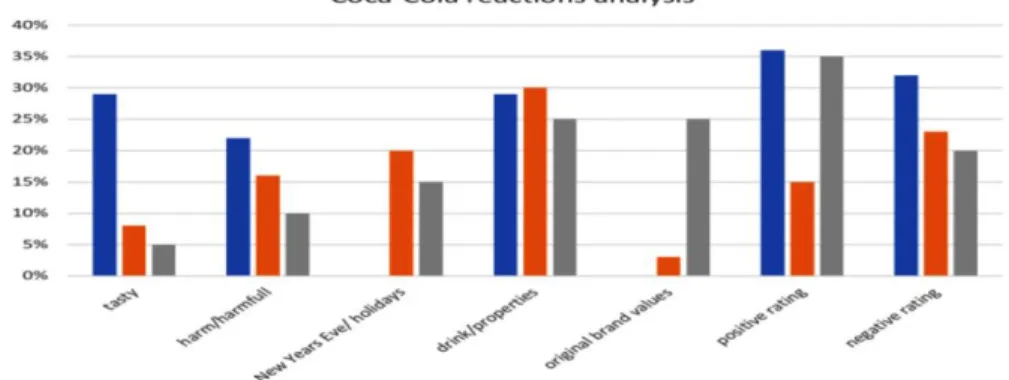
To find out perception peculiarities of foreign verbal trademarks by Russians we set an association experiment. It resulted in a conceptual analysis of linguistic reactions – associations connected with the verbal trademark. The experiment was hold in three age groups: children of the first school year, students of 17 – 25 years old and adults of 30 -50 years old. The native language of all the participants is Russian, English – is a second one. All those taking part in the study had to provide their associations with trademarks Coca-cola and Lay‟s. The experiment revealed significant differences in original values perception by the members of another cultural community as a whole, and by different age groups representatives in particular. The last depends on the age, the volume, the structure of cognitive base and the degree of native language proficiency i.e. linguocultural identity. The results of the experiment are presented in figures 1, 2.
Fig.1 Coca-Cola trademark reactions analysis
The conceptual analysis of the experiment data reveals significant changes in verbal trademark perception within different age groups. Moreover, there was an opportunity to compare the set of original brand values (deducted from the lexical material of product websites and the advertising campaigns) with the set of concepts the verbal trademark produced in Russian consumers‟ mind. According to the Coca-Cola official website (https://www.coca-colacompany.com/our-company/mission-vision-values) data the main values and aspirations of the brand are: to refresh the world; to inspire the moments of optimism and happiness; to create value and make difference. As to Lay‟s, their mission stated at the website (https://www.fritolay.com/get-to-know-us/company) is: to delight the consumer; provide the best quality and care. But the set of original brand values is partially revealed in Russian consumers‟ mind. The most important features of both brands the participants pointed out are product composition and properties. Therefore, the degree people value different aspects of product changes significantly depending on people‟s age.
The first group renders Coca-Cola and Lay‟s as tasty though harmful products. The language material produced by this group is rather simple, homogeneous and relates to the perception sphere due to the primitive, not yet developed way of world acquisition and abstract thinking underdevelopment. That is a characteristic feature of an elementary linguocultural identity formation stage. The second group provides more diverse lexical material characterized by current life experience and distinct cognitive abilities. Coca-Cola is treated mainly negatively as a harmful product though having a strong association with the New Year‟s celebration. Students are interested in the ingredients from their usefulness characteristics point of view that deals with the health value. Due to the student‟s particular native language proficiency and some English skills their reactions correspond to the original brand values. The same is true for Lay‟s trademark which is considered to be unhealthy but still used in some typical pastime situations. A significant amount of this group reactions deals with particular people, who took part in advertising campaign in Russia.
Some greater differences are found in the reactions of the third group which provides a more negative ranging of Coca-Cola and more positive ranging of Lay‟s in general. The group uses some special (often medical) vocabulary especially in product‟s detrimental properties description that points to the ability of the group to conduct some critical analysis reality objects and profound professional knowledge. The final stage of linguocultural identity formation is characterized by absolute linguistic consciousness and particular culture communicative behavior.
Thus, comparing the set of original brand concepts to the results of experiment shows the coincidence in only some of them. Not all the values are transferred into the other culture, even transferred therefore adopted by a restricted number of consumers due to linguocultural identity aspects.
4.VERBAL TRADEMARK TRANSLATION PROBLEM
business administration and marketing at Harvard Business School in 1983 (May/June
issue of Harvard Business Review) offered to treat global brands as if “differences among
cultures were not only diminishing but should be ignored because people throughout the world are motivated by the same desires and wants”. But the Levitt‟s concept of global brand turned out to be controversial as soon as there appeared a series of marketing disasters as a result of advertising campaign translation. Thus, the name Coca-Cola in China was first rendered as Ke-Kou-Ke-La. Unfortunately, the Coke company didn‟t discover until after thousands of signs had been printed that the phrase means “bite the wax tadpole” or “female horse stuffed with wax” depending on the dialect. Coke then researched 40,000 Chinese characters and foun a close phonetic equivalent. “ko-kou-ko-le”, which can be loosely translated as “happiness in the mouth” that is closer to the trademark original value. The other example is Coca-Cola‟s use of “Coke adds life” slogan in again China. The Chinese translation reportedly came out “Coke brings your ancestors back from the dead”. The problems stated above required a new approach dealing with cultural aspects of brand translation. Experience has shown that the reasonable solution is to take a cultural turn in translation techniques.
4.1. Localization and translation
All stated above leads to the concept of localization, that, according to Cambridge dictionary, is the process of making a product or service more suitable for a particular country or area. In other words, localization is the adaptation of a product or service to meet the needs of a particular language, culture or desired population‟s “look-and-feel”.
A successfully localized service or product is one that appears to have been developed within the local culture. In addition to idiomatic language translation, such details as time zones, money, national holidays, local color sensitivities, product or service name translation, gender roles and geographic references must all be considered.
Thus, localization and translation are two interrelated concepts. The concept of localization appeared in translation studies in the late 1990s due to the processes of globalization and internationalization and a great paradigm shift from the source text focus on the target purpose or function (Anthony Pym, 2004). The author states that the very concept of equivalence changed greatly since then: “For as long translation was bilateral affair of sources and targets, privilege was given to what Nida termed “natural” or “dynamic” equivalents, basically linguistic structures that existed in the source and target repertoires prior to the moment of translation. When we no longer have a source, however, equivalents are artificially determined in the place of internationalization”.
Here are some important considerations a translator should be aware of when localizing a product like naming conventions (patronymic or multiple last names); telephone numbers format; currency (symbols); date and time formats; writing direction; system of measurement; punctuation; symbols and pictograms; electrical voltages, frequencies, and plugs; legal requirements. But the most important consideration not mentioned in the list is the set of cultural values.
4.2. Verbal trademark localization
associations, unpleasant phonetic similarities) but rethinking of slogans, mottos, and product description were of particular necessity. The bilateral comparison of language material at www.fritolay.com showed the difference in values. The English slogans appeal to the sensual experience of the consumer, while the Russian ones employ the basic values of Russian
culture like Family and Home. The idea turned out to be quite profitable. Lay‟s is one of the
most popular chips brands in Russia, appealing to the very essence of culture. The global companies like Lay‟s and Coca-Cola do their best in localizing products to ensure it resonates with customers everywhere following the cultural rules and standardizations, norms of habit, ethical and legal norms, language collocation rules dealing with consumers cultural identity.
7. CONCLUSION
The issues discussed in the article respond to the actual trends in a modern humanitarian knowledge characterized by interdisciplinarity. The subject of the paper - verbal trademarks - being a phenomenon of different spheres of knowledge stands out as a separate linguocultural unity capable of transmitting values of culture by means of its cultural connotational semantic components. The study of verbal trademarks outlines their connection with cultural concepts and ideas. It helps to reveal and verify mutual interrelations of cultural identity and perception with the help of association experiment that showed the distinctive features of linguocultural identity formation stages through the perception process. The experiment showed that different age groups produce variable reactions on the same verbal trade mark due to the different linguocultural identity peculiarities. The modern trends in the Translation Studies were considered in terms of translation or localization being appropriate when transferring verbal trademarks from one culture to another within the global marketing process. The importance of value-oriented approach is illustrated by brand name localization examples. Thus, the paper shows new prospects of studies in humanitarian knowledge such as culture-oriented identity-focused marketing linguistics
both in theoretical and applied fields. The above stated leads to the necessity of profound
studies of linguoculture-based perception problems of not only trademarks but all the modern world phenomena emerging in the process of globalization.
REFERENCES
Bokh, P. K. Rethinking Psychological Antropology: Continuity and Change in the Study
of Human Action. 2nd. Ed. Waveland Pr In, 1999.
Demetskaya, V.V. “Adaptation in translation studies: the theoretical aspect”: The IX international scientific conference on translation “Fedorov readings” October 18-20, 2007. Sant: 25 - 26.
Evsyukova, T., Glukhova, O. Verbal trademarks: the onomastic and cultural linguistics
aspects. Rostov State Economic University, 2011.
German, N. “Linguocultural identity of communication subject”. Journal of Chelyabinsk
State University, no.11. (2009). https://cyberleninka.ru/article/n/lingvokulturnaya-identichnost-subekta-kommunikatsii . Accessed September 15, 2019.
Graumann, C. F. “Soziale Identit ten. Manifestation sozialer Differenzierung und
Identifikation”. Viehoff, R.; Segers, R. T. (Hg.): ultur dentit t uropa. Frankfurt/M,
Gureeva, A. “Sociocommunicative characteristics of translator‟s linguistic identity” PHD diss., Volgograd, 2014..
Hauser, R. “Cultural Identity in a Globalized World? A theoretical approach towards the
concept of cultural identity”. https://www.zak.kit.edu/downloads/Hauser-Cultural_ Identity_in_a_Globalised_World_final_2.pdf . Accessed September 10, 2019
Howes, D. Sensual Relations: Engaging the Senses in Culture and Social Theory. Ann Arbor:
the Univ. of Michigan press, 2006
Howes, D. Classen, C. “Epilogue: Sounding Sensory Profiles” The Varieties of Sensory
Experience 257-288.Toronto: Univ of Toronto Press, 1991.
Karasik, V. The other mentality”. Moscow: Gnosis, 2005.
Krasnykh, V. “Psycholinguoculturology as a science of homo speaking via cultural
linguistics”. In Neopsycholinguistics and psycocultural linguistics: the new sciences
of homo speaking. Edited by Victoria Krasnykh, 183-262. Moscow: Gnosis, 2017.
Nord, C. Text analysis in translation: theory, methodology, and didactic application of a
model for translation-oriented text analysis. Rodopi, 2005.
Pym, A. Localization from the Perspective of Translation Studies: Overlaps in the Digital
Divide?. Accessed August 25, 2019. https://www.researchgate.net/profile/Anthony_ Pym2
Stepanov, Y. Constants: the dictionaty of Russian culture. 3d edition Moscow: