Type and Effect Systems for Dynamically Changing Code
DRAFT CORRECTIONS, DO NOT DISTRIBUTE
Gabrielle Anderson
Dependable Systems and Software Engineering
School of Electronics and Computer Science
University of Southampton
Southampton, SO17 1BJ
Abstract
We extend type and effect analyses to permit dynamically changing effects and dynamically changing code in multi-threaded systems with shared resources. We guarantee that after a well typed modification a set of threads will have the specified desired effects and will continue to safely use the resources. We prove the key properties of subject reduction and fidelity (safety) for our general system. We provide an application of our system: dynamic software updating for a multi-threaded asynchronous message passing system. We show how key safety properties from session typing follow from the properties of our general system.
1
Corrections
In Section 4.1 we make explicit how the type judgement for dynamic expressions can be written as either:
ϕ o ϕ0 oΦ o Γ `e:T or ξ o Γ `e:T
In Section 4.2 we make explicit the previously implicit assumption that a resource access σ(l) always returns a value rather than an arbitrary expression. We also make explicit how the type judgement for fixed expressions can be written as either: ϕo ϕ0 o Γ `e: T or ξs o Γ `e:T In Section 4.3 nonInt(ϕ1,ϕ2,Σ) def= ∀ϕ01.ϕ 0 1ϕ1,∀ϕ02.(ϕ 0 1; (l,T))ϕ2, ∀ϕi∈int(ϕ01,ϕ 0 2).if there is a reduction
pathΣ−→ϕi ∗Σ0−−−→(l,T) Σ00thenΣ0(l)=T should read: nonInt(ϕ1,ϕ2,Σ) def = ∀ϕ0 1.ϕ01ϕ1,∀ϕ02.(ϕ02; (l,T))ϕ2, ∀ϕi∈int(ϕ01,ϕ 0 2).if there is a reduction
pathΣ−→ϕi ∗Σ0−−−→(l,T) Σ00thenΣ0(l)=T
(ϕ0
1in(ϕ01; (l, T))ϕ2changed toϕ02).
In Figure 3 include formal definitions of ξ, ξs which were previously implicitly used.
In Figure 7 σ`he1i:S1 σ`he2i:S2 `σ: Σ compat(S1,S2,Σ) (TPAR) σ`he1ikhe2i:S1kS2 should read: σ`P1:S1 σ`P2:S2 `σ: Σ compat(S1,S2,Σ) (TPAR) σ`P1kP2:S1kS2 (he1i,he2ichanged toP1, P2).
In Section 5 Fidelity property we include the previously ommited Σ,S1 (l,T) −−−→Σ0,S01 (ABSTRPARONE) Σ,S1kS2 (l,T) −−−→Σ0,S01kS2 Σ,S2 (l,T) −−−→Σ0,S02 (ABSTRPARTWO) Σ,S1kS2 (l,T) −−−→Σ0,S1kS20
2
Introduction
Type and effect systems provide a useful abstraction for reasoning about the side effects of programs [22]. Previous work on type and effect systems has focused on expressibil-ity [22] and analyses for specific problems [17, 15, 20], but has assumed that a program’s effects would not change at run time.
There are various situations where the code of a pro-gram may be modified at run-time. Operating systems may permit various extensions (normally drivers) to be installed to better manage resources, for example per application thread schedulers or an alternate disk access and caching for databases [4]. Commercial products may permit plug-ins to customise them, for example in web browsers which
can incorporate functionality from control of music players to highlighting of web pages. Self-modifying code modi-fies run-time code for many reasons, most notably in test-ing to add or remove debuggtest-ing code without performtest-ing conditional jumps and in just-in-time compilation to opti-mise the run-time code [7]. Dynamic software updating modifies possibly stateful software to fix bugs and add func-tionality without shutting that software down, and guaran-tees some safety property to hold over the update boundary [23, 20, 19, 11]. Program generation is a similar problem, and is commonly used in dynamic scripting languages such as Perl and Python. In order to extend type and effect sys-tems to languages which permit dynamic modifications we must permit the effect of code to likewise be modified.
Often when making a dynamic modification the pro-grammer may wish to preserve certain behavioural proper-ties after the modification. An example is installing drivers or extensions into an operating system kernel where any in-stabilities in the extension should not affect the rest of the kernel. This is often enforced by requiring the extension, whilst being in the same address space as the kernel, to not access any memory except its own. This behavioural prop-erty can be represented in an effect system tracking memory accesses [17].
Systems can share different types of resources: in a mes-sage passing system a mesmes-sage queue may be a shared re-source whereas in a shared state system a reference cell may be a shared resource. The type of the value returned when accessing a shared resource can depend on the current state of the resource; for example the type of the value returned by popping an item off a queue depends on the value at the front of the queue. A practical model of effects on shared resources should take account of this dynamic behaviour.
As accesses to shared resources can modify those shared resources and dynamic modifications to code can change the effect of code (the accesses the code performs) the safety of a modification may depend on the state of the shared re-sources as well as the code performing the accesses [1]. We refer to the current state of the shared resource(s) and the multi-threaded code which has yet to be executed as a snap-shotof a system.
In this paper we consider the following problem: given a snapshot of a system and some dynamic modifications to the system will the modified system have the desired effect and will it remain type safe? This approach requires that we type a snapshot of a system each time we introduce new dynamic modifications.
The core contributions of this paper are as follows. We provide a type and effect system which tracks changes in ef-fects caused by dynamics modification to expressions. We make use ofworld constraintsto track the difference be-tween the effect of a modified expression and its desired effect (which must be specified by the programmer). These
constraints provide an abstraction of how the effect of an expression may change. If the constraints are fulfilled we guarantee that after a dynamic modification that the new expression will have the desired effect. We permit the value returned by an effectful primitive acting on shared resources (and its type) to be dependent on the current state of those resources. We guarantee the type of a return value is equal to the locally expected type irrespective of the scheduling of modifications to shared resources made by parallel threads. We prove key properties of our system, namely subject re-duction and effect fidelity. We provide an instantiation of our system with rules for asynchronous message passing and a queue to implement communication. We type up-dates and guarantee that the new communications behaviour will not interfere with any communications protocols, in-cluding those which are in progress. This instantiation is the first work on preserving formal behavioural properties besides simple typing for multi-threaded dynamic software update. To the best of our knowledge our general system is the first type and effect system for shared resources where the type of the value returned by accessing shared resources is guaranteed despite its dependency on modifiable shared resources.
The remainder of the paper is structured as follows. In Section 3 we introduce the language and its operational semantics, specifically dynamic modifications to code. In Section 4 we present our type system. We particularly fo-cus on world constraints which permit modification of ef-fects and when it is safe to place threads in parallel which can modify shared resources. In Section 5 we present the subject reduction and safety properties of our system. In Section 6 we provide an application of our system for pre-serving communications protocols (session typing) in an asynchronous message passing system where the code can be dynamically modified. In Section 7 we present related work. We conclude in Section 8.
3
Language and Operational Semantics
We use a simple lambda-calculus with recursive func-tions and threads. We include a single effectful primitive acclsuch as in [15, 22]. The effectful primitive can modify accompanying resources σ. We also include the language constructdmod(e)which we use to denote where the sys-tem may perform dynamically modifications. Expressions and program threads are defined in Figure 1.
The operational semantics of this language, defined in Figure 2, is standard apart from theRACCandRDYN
reduc-tions.
TheRACCreduction modifies the resources according to
the resource modification relationσ−→l σ0. We do not define this function as it will change depending on the situation: in a message passing system it may be a message queue, in a
e ::= v | recf =λx.e | e e | accl | dmod(e) v ::= x | n | b | () P ::= hei | P kP
Figure 1. Expression and Program Thread Grammars σ,he1i−→σ0,he01i (RAPPONE) σ,he1e2i−→σ0,he01e2i σ,he2i−→σ0,he02i (RAPPTWO) σ,hv e2i−→σ0,hv e02i (RAPPTHREE)
σ,hrecf=λx.e vi−→σ,he[recf=λx.e/f][v/x]i
σ−→l σ0
(RACC)
σ,haccli−→σ0,hσ(l)i
(RDYN)
σ,hdmod(e)i−→σ,hDMod(e,µ)i
σ,P1−→σ0,P10 (RPARONE) σ,P1kP2−→σ0,P10kP2 σ,P2−→σ0,P20 (RPARTWO) σ,P1kP2−→σ0,P1kP20
Figure 2. Operational Semantics
shared state system it may be a table implementing refer-ences. We do, however, require various properties of this relation which are defined in Section 4.2. The return value of theRACCreduction is defined as the projection of the
re-sources using the effect. We refer to this projection as a
resource access.
The RDYN reduction permits us to perform dynamic
changes to an expression, using some modification informa-tionµwhich is supplied at runtime. The auxiliary function
DynamicModification(shortened toDMod) can arbitrarily change the expression; DModcan be any dynamic mod-ification function which returns expressions. We require
DModto be a function rather than simply a relation so that we can conservatively estimate the type and effect of the result.
4
Typing
A standard type and effect judgement is:
ϕ o Γ `e:T
which denotes that, given the type information Γ the ex-pressionehas simple typeT, and the side effect of evalu-ating the expression is conservatively described by the ef-fectϕ. We provide two extensions to this type judgement, one for ‘dynamic expressions’ in Section 4.1 and another for ‘fixed expressions’ in Section 4.2. We define typing of threads (which are ‘fixed code’) in Section 4.3.
4.1
Typing Dynamic Expressions
After dynamically modifying an expression frometoe0
we can compare the effect ofe0with the effect that we want following the modification. We explain this with an exam-ple. Consider the expression:
e=accl1;accl2;accl3
which is modified to the expression:
e0=true;accl2;false
We refer to the effect of an expression before a modifi-cation as itsprior effectand the effect of an expression after a modification as itsmodified effect. Consider a situation where we want the modified effect to be equal to the prior effect. To verify that this is the case we can compare the effect ofewith the effect ofe0. The safety of a modification to an expression depends on the context of that expression. In this example the modification could be safe - the effect ofe0is included in the effect ofe. If this expression is part
of a larger body of code and if, after the modification, the code precedinge0 performs an access to labell1 after per-forming its prior effect, and the code followinge0performs an access to labell3before performing its prior effect, then the modification is safe. Hence the modification safety is context dependent.
In order to guarantee safety of this modification we must guarantee the above, namely that the modified code preced-inge0 performs an access to labell1 after performing any other accesses and that the modified code followinge0 per-forms an access to labell3before performing any other ac-cesses. To represent this we defineworld constraints, ef-fects, and types in Figure 3. Effects are a tuple containing the actual effect labelland the return typeT which we ex-pect of the resource accessσ(l). We discuss the significance of the return type in the effect in Section 4.2. Function types have two possible annotations: the first annotation is for a function which is dynamic code and the second annotation is for a function which is fixed code.
ϕ ::= (l, T) | ϕ;ϕ S ::= ξs | SkS φ ::= +ϕ | −ϕ Φ ::= (φ o φ0) | FAIL | Φ, Φ ξ ::= ϕ o ϕo Φ ξs ::= ϕo ϕ T ::= BOOL | INT | UNIT | T ϕoϕ 0 oΦ −−−−−→T | T ϕoϕ 0 −−−→T
Figure 3. Type, Effect, Effect Bundle, and Fu-ture World Constraint Grammars
diff(ϕ1,ϕ2)def= 8 > > > > > > > > < > > > > > > > > : (−ϕ0o −ϕ00) ϕ1=ϕ0;ϕ2;ϕ00 (−ϕ0o+ϕ00) ϕ1;ϕ00=ϕ0;ϕ2 (+ϕ0o −ϕ00) ϕ00;ϕ1=ϕ2;ϕ0 (+ϕ0o+ϕ00) ϕ2=ϕ0;ϕ1;ϕ00 FAIL otherwise
Figure 4. Difference function
The constraint−ϕdenotes that the expression doesn’t perform effectϕ which is expected of it. The constraint +ϕdenotes that the expression performs the effect expected of it and additionally the effectϕ. World constraints place restrictions on the effect of the context of the expression. A world constraint(φo φ0)denotes that an expression places the constraintφon the code preceding it andφ0on the code following it. The above modification from eto e0 would have the constraint(−(l1, T1)o −(l3, T3)).
We generate the constraints using the function
difference(shortened todiff), which is defined in Figure 4. This function takes two effectsϕ1andϕ2, whereϕ1is the
desired effectandϕ2the actual effect of the modified code. For example, the effect of e is (l1, T1); (l2, T2); (l3, T3) and the effect ofe0 is(l2, T2). We want to keep the same effect after the modification and hence:
diff((l1,T1); (l2,T2); (l3,T3),(l2,T2)) = (−(l1,T1)o −(l3,T3))
using the first case of the definition ofdiff.
In order to compare the desired effect to the effect following the modification we need to know this mod-ified effect. Here we determine this using the func-tionEffectDynamicModification(shortened toEffDMod). Similarly toDModany function which conservatively re-turns the type and effect of a modified expression is
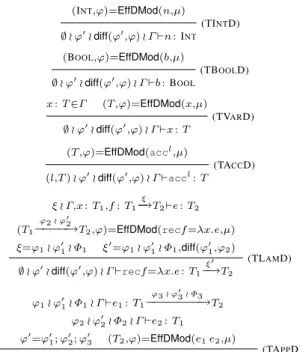
accept-(INT,ϕ)=EffDMod(n,µ) (TINTD) ∅ oϕ0odiff(ϕ0,ϕ)oΓ`n:INT (BOOL,ϕ)=EffDMod(b,µ) (TBOOLD) ∅ oϕ0odiff(ϕ0,ϕ)oΓ`b:BOOL x:T∈Γ (T ,ϕ)=EffDMod(x,µ) (TVARD) ∅ oϕ0odiff(ϕ0,ϕ)oΓ`x:T (T ,ϕ)=EffDMod(accl,µ) (TACCD) (l,T)oϕ0odiff(ϕ0,ϕ)oΓ`accl:T ξoΓ,x:T1,f:T1 ξ −→T2`e:T2 (T1 ϕ2oϕ02
−−−−→T2,ϕ)=EffDMod(recf=λx.e,µ)
ξ=ϕ1oϕ01oΦ1 ξ0=ϕ1oϕ01oΦ1,diff(ϕ01,ϕ2)
(TLAMD)
∅ oϕ0odiff(ϕ0,ϕ)oΓ`recf=λx.e:T1 ξ0 −→T2 ϕ1oϕ01oΦ1oΓ`e1:T1 ϕ3oϕ03oΦ3 −−−−−−−→T2 ϕ2oϕ02oΦ2oΓ`e2:T1 ϕ0=ϕ01;ϕ02;ϕ03 (T2,ϕ)=EffDMod(e1e2,µ) (TAPPD) ϕ1;ϕ2;ϕ3oϕ0oΦ1Φ2Φ3,diff(ϕ0,ϕ)oΓ`e1e2:T2
Figure 5. Type Rules For Dynamically Modifi-able Code φ⊕∅ = φ −ϕ⊕+ϕ = ∅ φ1⊕φ2 = φ2⊕φ1 ∅≡+∅≡−∅ Φ1Φ2 def = {(φ1oφ02)|(φ1oφ01)∈Φ1, (φ2oφ02)∈Φ2,φ01⊕φ2=∅}∪ {FAIL|(φ1oφ01)∈Φ1, (φ2oφ02)∈Φ2,φ01⊕φ26=∅} Figure 6. Combination Operations
able. We formalise this property as follows:
EffDMod(e,µ)=(ϕ,T) ⇒ ϕo o ∅`DMod(e,µ) :T Up to this point we have assumed that the desired effect would be equal to the prior effect. This may not always be the case, and hence the desired effect is the final component to our type judgement:
ϕ o ϕ0 o Φo Γ `e:T or ξ o Γ `e:T
whereϕis the effect ofe,ϕ0is the desired effect of the dy-namically modifiede, andΦare the world constraints from this expression.
Dynamic modifications can only occur to expressions which are within a dmodblock. Such expressions are re-ferred to asdynamic expressionsordynamic code. We de-fine type rules for dynamic expressions in Figure 5. The
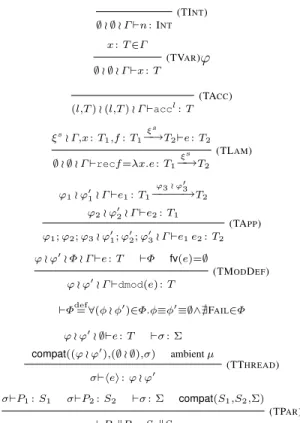
(TINT) ∅ o ∅ oΓ`n:INT x:T∈Γ (TVAR) ∅ o ∅ oΓ`x:T ϕ (TACC) (l,T)o(l,T)oΓ`accl:T ξsoΓ,x:T 1,f:T1 ξs −→T2`e:T2 (TLAM) ∅ o ∅ oΓ`recf=λx.e:T1 ξs −→T2 ϕ1oϕ01oΓ`e1:T1 ϕ3oϕ03 −−−−→T2 ϕ2oϕ02oΓ`e2:T1 (TAPP) ϕ1;ϕ2;ϕ3oϕ01;ϕ 0 2;ϕ 0 3oΓ`e1e2:T2 ϕoϕ0oΦoΓ`e:T `Φ fv(e)=∅ (TMODDEF) ϕoϕ0oΓ`dmod(e) :T `Φdef=∀(φoφ0)∈Φ.φ≡φ0≡∅∧ @FAIL∈Φ ϕoϕ0o ∅`e:T `σ: Σ compat((ϕoϕ0),(∅ o ∅),σ) ambientµ (TTHREAD) σ`hei:ϕoϕ0 σ`P1:S1 σ`P2:S2 `σ: Σ compat(S1,S2,Σ) (TPAR) σ`P1kP2:S1kS2
Figure 7. Type Rules For Fixed Expressions and Threads
main differences between these type rules and standard type and effect systems [22] are world constraints and desired ef-fects.
World constraints are normally generated by taking the difference between the desired effect following the modifi-cation and the actual effect following the modifimodifi-cation. This can be seen in the TINT, TBOOL, TVAR, TACC, TLAM rules. In TAPP, in addition to taking the difference between the
de-sired effect and the modified effect, we need to combine the world constraints from the sub-expressions. We com-bine constraints using the operator ⊕and combine world constraints using the operator; these are defined in Fig-ure 6. We require that the ‘futFig-ure’ constraintφ01fromΦ1to combine with the ‘past’ constraint fromΦ2to result in∅. In-formally this denotes that any effect that has or hasn’t been done by the preceding expression is conversely not done or done by the following expression. If this is not the case we generate FAILconstraints. Note thatis not commutative.
4.2
Typing Fixed Expressions
An expression which is not within admodblock cannot be directly modified at run-time. Its sub-expressions, how-ever, may contain admodblock, and hence the expression
is not entirely static. We refer to such expressions asfixed expressions(orfixed codein the case of threads). Fixed ex-pressions are typed using the judgement:
ϕ o ϕ0 o Γ `e:T or ξs o Γ `e:T
which denotes that after a possible dynamic modification, which could occur in a sub-expression, the desired effect is ϕ0. The type rules for fixed expressions are defined in Figure 7.
In non-compound fixed expressions the desired effect af-ter a modification will be the effect before the modification. This is as fixed expressions cannot be modified directly. In
TMODDEF we permit the desired effect to be different to the
prior effect. This is as the effect of admodblock is equal to the effect of its subexpression, and its subexpression is a dy-namic expression, and hence can be dydy-namically modified. As we are typing a dynamic sub-expression, it will return world constraints. A FAIL constraint denotes that in some application the world constraints from the sub-expressions do not combine (Figure 6). A world constraint(ϕ1 o ϕ2), whereϕ1 6= ∅ or ϕ2 6= ∅, denotes that the dynamic ex-pression performs a larger or smaller effect than the desired effect. Hence we define a valid set of world constraints`Φ
as one where the included world constraints are required to be empty and to not be FAIL(Figure 7). This requirement is sufficient to guarantee that the effect of the modified ex-pression is the desired effect. In TMODDEF we require the
dynamic sub-expression to be closed to prevent substituting fixed expressions into a dynamic expression.
The return value of the effectful primitive depends on the state of the shared resources (seeRACC). As the resources are
modifiable at run time, both by the thread in which the ac-cess occurs (thecontaining thread) and by parallel threads, it is difficult at the local level to know what the type of the return value will be solely from static information about the resources. Instead we locally infer the type of the return value and record this in the effect; we refer to this type as theexpected type. When typing the containing thread or the containing thread in parallel with other threads we must ver-ify that the type of the value returned by each resource ac-cess is equivalent to its locally inferred expected type, irre-spective of resource accesses made by the containing thread or parallel threads.
Shared resources are modified only in theRACCrule. This
modification depends on the resources reduction relation. We intentionally do not define this reduction or the struc-ture of the resources, as these will vary depending on the application. Instead we place several requirements on the resources and the resources reduction relation. We use an abstraction of the resourcesΣand a reduction relation on abstracted resources. We also place requirements on the ab-straction of the resources and the abstracted resources
re-duction relation:
Ifσ−→l σ0thenσ(l)is defined.
If `σ: Σandσ−→l σ0thenΣ−−→(l,) Σ0∧ `σ0: Σ0.
If `σ: Σandσ(l)is defined thenΣ(l)is defined. σ(l)is always a value.
The first property requires that if we can perform a re-duction using an effect label a resource access using that label is defined. The second property requires that we can abstract the resources, and that a reduction relation exists on resources abstractions which corresponds with the re-sources reduction relation. The third property requires that the resources abstraction provides simple typing of the re-turn values of resource accesses.
4.3
Typing Threads
When typing an individual thread we take the modifi-cation informationµas an ambient to the whole type tree for the body of the thread (TTHREAD). Different threads may
have different modification information; intuitively this rep-resents how we may wish to modify different threads in dif-ferent ways. Hence we can guarantee and reason about the modified effect for different threads. If we do not want to modify a thread we can define the desired effect to be equal to the actual effect and update relation which acts as the identity function.
In order to guarantee simple type safety we still need to verify the expected types. We do this when typing an indi-vidual thread or when typing parallel threads. As the return type of a resource access will depend on the state of the shared resources this verification must take account of the starting state of the shared resources. Informally, we require that irrespective of the scheduling of resource accesses , the return type for each access(l, T)isT. When typing a lone thread this simply consists of considering how the effect of the thread before a given access affects the resources. When typing multiple threads in parallel we must consider all in-terleavings of the effects on the state of the shared resources from parallel threads. If the type of a given access is equal to the expected type for that access irrespective of the schedul-ing of the resource accesses by threads in parallel or by the containing thread, up to the point of the given access, we refer to the set of threads as compatible. We also require non-interference between the desired effects of the threads. To state this property formally we define a predi-cate compatibleGeneral (shortened to compGen) and two auxiliary functions nonInterefere and interleavings
(shortened tononIntandint). ϕ2ϕ1 def = (ϕ1=ϕ2; )∨(ϕ1=ϕ2) compGen(S1,S2,Σ) def = ∀ϕ1oϕ01∈S1,ϕ2oϕ02∈S2. nonInt(ϕ1,ϕ2,Σ)∧nonInt(ϕ2,ϕ1,Σ)∧ nonInt(ϕ0 1,ϕ02,Σ)∧nonInt(ϕ02,ϕ01,Σ) nonInt(ϕ1,ϕ2,Σ) def = ∀ϕ01.ϕ01ϕ1,∀ϕ02.(ϕ 0 2; (l,T))ϕ2, ∀ϕi∈int(ϕ01,ϕ 0 2).if there is a reduction
pathΣ−→ϕi ∗Σ0−−−→(l,T) Σ00thenΣ0(l)=T
int(ϕ1,ϕ2) def= {(l,T);ϕ0|ϕ1=(l,T);ϕ01∧ϕ 0∈int(ϕ0 1,ϕ2)}∪ {(l,T);ϕ0|ϕ2=(l,T);ϕ02∧ϕ 0∈int(ϕ 1,ϕ02)} where−→ϕ ∗
is the reflexive and transitive closure of−−−→(l,T). The function interleavingsprovides all possible inter-leavings of two effects. The predicate nonInterefere in-cludes a check for the existence of a reduction path as, de-pending on the resources reduction relation, we may not be able to perform all effects in any order. For example in a blocking asynchronous message passing system we cannot receive a message before it is sent.
The predicate compGen is a formalisation of model checking the possible interleavings of the effects on the ab-stracted resources Σ. Such an approach has exponential complexity. This is, however, the general solution where the only properties we have of the resources and their reduc-tions are as in Section 4.2. Given more information about the resources reduction relation then we can define a predi-catecompatible(shortened tocompat) such that:
compat(S1,S2,Σ) ⇒ compGen(S1,S2,Σ)
In the TTHREAD andTPAR rules we use this predicate
in-stead ofcompatibleGeneral. The complexity of this pred-icate will vary depending on the situation, but can be as low as linear complexity; we provide an example of such a def-inition in Section 6.
5
Properties
We present the main properties of the general system, which are subject reduction and fidelity. These properties hold even in the presence of dynamic modifications to the code and effects.
5.1
Subject Reduction
Informally, subject reduction states that any reduction except dynamic modification preserves or decreases the type and effect of an expression [17], and dynamic mod-ification reductions modify the effect to the desired effect. We refer to this property aseffect reduction validity. We for-malise reduction validity as the smallest transitive relation defined over:
(ESKIP)
`ϕ→ϕ
(EACC)
(EDMOD) `ϕ1oϕ2→ϕ2oϕ2 `ϕ1→ϕ01 `ϕ2→ϕ02 (ETHREAD) `ϕ1oϕ2→ϕ01oϕ 0 2 `S1→S01 (EPARONE) `S1kS2→S01kS2 `S2→S20 (EPARTWO) `S1kS2→S1kS02
This relation denotes which reductions on effects are valid. Most of the definitions are straightforward. ESKIP
de-scribes reductions which don’t perform resource accesses and don’t perform dynamic modifications. EACCdescribes
reductions which perform resource accesses. EDMOD
de-scribes reductions which perform dynamic modifications and denotes that we consider the effect of a thread be-ing modified to its desired effect to be a valid reduction.
EACCdescribes how the effect of a thread may change, and EPARONE and EPARONE describe how the effects of parallel
threads may change.
Theorem 5.1. Subject Reduction Ifσ`P:Sandσ, P −→σ0, P0then
σ0 `P0: S0 `S→S0
We provide a sketch proof of subject reduction as fol-lows. We prove subject reduction by induction over the op-erational semantics.
The most important case in the proof for guarantee-ing effect reduction validity is modification reductions on a dmod(e) expression. This case is covered as, in the
TMODDEFFrule, we require that the world constraints of the
sub-expression to be the null constraint(∅ o ∅)and for there to be no FAILconstraints. Hence the actual effect after the modification will always be equal to the desired effect. As we require that, at the thread level, the actual effects and the desired effects of all threads do not interfere with the re-turn types of resource accesses then we will preserve simple typing of resource accesses in a modified thread.
The most important case for guaranteeing simple type safety and that the types of resource accesses are equal to the expected types, irrespective of how the resources may be dynamically modified, is the parallel reduction case. Given a well typed set of parallel threads, we by the compatibil-ity property that the expected types are invariant irrespec-tive of the scheduling of their effects. This is verified by performing model checking. Hence any reductions will not invalidate this property.
5.2
Fidelity
We also prove the soundness of the effect analysis. In the fidelity theorem we guarantee that the actual reductions on the resources are matched by reductions on the abstrac-tion, that such reductions can only occur if they are expected
in the effect, and that the modified resources stay consis-tent with the abstraction. This is a generalisation of the fi-delity property for session typing systems [14]. To prove this property we define a reduction relation on resources ab-stractions and parallel effects which denotes how an effect modifies the abstract resources:
Σ−−−→(l,T) Σ0 (ABSTRSTATERED) Σ,(l,T);ϕo(l,T);ϕ0−−−→(l,T) Σ0,ϕoϕ0 Σ,S1 (l,T) −−−→Σ0,S01 (ABSTRPARONE) Σ,S1kS2 (l,T) −−−→Σ0,S01kS2 Σ,S2 (l,T) −−−→Σ0,S02 (ABSTRPARTWO) Σ,S1kS2 (l,T) −−−→Σ0,S1kS20 Theorem 5.2. Fidelity
Ifσ`P:Sandσ, P →−l σ0, P0and`σ: Σthen
Σ, S−−−→(l,T) Σ0, S0 `σ0: Σ0
This result follows from our properties of the resources and the resources reduction relation in Section 4.2.
6
Application:
Session Types and
Multi-Threaded Dynamic Software Update
Type and effect systems have been applied to multi-threaded asynchronous message passing system which per-mit typed communications which are more complex than typed channels which only carry values of a certain type [14, 5, 25, 18, 12, 22]. The principle aim of that work is to provide static typing of communications protocols.
We provide a simplified version of the multi-party ses-sion typing [14, 5]. We assume that we have pre-distributed some uni-directional channelsc, where one thread holds one end and sends on the channel and the other thread holds the other and receives on the channel. Each thread’s effect is specified separately, rather than being specified in a global session type [14, 5]. We provide communications primitives to send and receive values on channels, are syntactic sugar aliasing ouracclprimitives:
send(c,v)def=accc!hvi receive(c)def=accc?()
We define the structure of the resources, which is a map-ping from channels to message queue, and the structure of the resources abstraction, which is a mapping from chan-nels to lists of types of the messages in the queue. We also define the projection of the resources and resources abstrac-tions using an effect label:
σ::= c7→q
| σ,σ
q::= v
Σ ::= c7→Q | Σ,Σ Q::= T | Q,Q σ(l)def= 8 < : v σ(c)=v,q∧l=c?() () l=c!hvi Σ(l)def= 8 < : T Σ(c)=T ,Q∧l=c?() UNIT l=c!hvi
We define the resources reduction relation and the ab-stract reduction relation.
σ0=σ[c7→σ(c),v] (RSND) σ−−−→c!hvi σ0 σ(c)=v,q σ0=σ[c7→q] (RRCV) σ−−→c?() σ0 Σ0=Σ[c7→Σ(c),T] v:T (RSNDA) Σ−−−→c!hvi Σ0 Σ(c)=T ,Q Σ0=Σ[c7→Q] (RRCVA) Σ−−→c?() Σ0
Finally we define the state typing judgement which re-lates resources and resources abstractions:
v:T (TVAL) `v:T `q1:Q1 `q2:Q2 (TQUEUE) `q1,q2:Q1,Q2 `q:Q (TMAP) `c7→q:c7→Q `σ1: Σ1 `σ2: Σ2 (TSTATECOMP) `σ1,σ2: Σ1,Σ2
This system can be used to guarantee that threads com-municate according to a communications protocol. We can make use of our definitions and the complementary function [12] to define a linearcompatiblepredicate. The comple-mentary function is defined as:
ϕdef= 8 < : (c?(),T) ϕ=(c!hvi,UNIT)∧v:T ϕ0;ϕ00 ϕ=ϕ0;ϕ00
The function is intentionally only partially defined, as we make use of this and the fact that channels are uni-directional.
In order to separate the effect of a thread on a specific channel from the rest of the thread’s effect we define a monotonic projection function:
ϕcdef= 8 > > > > > < > > > > > : ϕ ϕ=(c!hvi,T) ϕ ϕ=(c?(),T) ∅ ϕ=(c0 ,T) ϕ0c;ϕ00c ϕ=ϕ0;ϕ00
We can now define thecompatible predicate. We de-fine dom(ϕ)to be the set of channels which are used by effect labels in ϕ and make use of an auxiliary relation
compatibleSubFunction (shortened to compSub). We use the general definition of thecompatiblepredicate:
compGen(S1,S2,Σ) def
= ∀ϕ1 o ϕ01∈S1, ϕ2 o ϕ02∈S2.
nonInt(ϕ1,ϕ2,Σ)∧nonInt(ϕ2,ϕ1,Σ)∧ nonInt(ϕ01,ϕ02,Σ)∧nonInt(ϕ02,ϕ01,Σ)
but redefine thenonIntereferepredicate:
nonInt(ϕ1,ϕ2,Σ) def= ∀c∈(dom(ϕ1)∩dom(ϕ2)).
ϕ01=ϕ1c∧ϕ02=ϕ2c∧ (nonIntSub(ϕ01,ϕ02,Σ,c)∨ nonIntSub(ϕ02,ϕ01,Σ,c)) nonIntSub(ϕ1,ϕ2,Σ,c) def= (ϕ1=ϕ01;ϕ 00 1)∧Σ ϕ01 −→∗ Σ0∧ Σ0(c)=∅ ∧ϕ001=ϕ2
ThenonInterefereSubpredicate expresses that there is a reduction path on the resources abstraction which leads to the communications queue for channelc being empty. In-formally this corresponds to one thread receiving any mes-sages already in the communications queue. The predi-cate also expresses that, after emptying the queue, the fect of the receiving thread is complementary to the ef-fect of the sending thread. The nonInterefereSub predi-cate defines that, for every channel which is shared in the two effects,nonInterefereSubholds for the projection of the effects using that channel. As we do not know which effect represents the sending thread or which represents the receiving thread we require eithernonIntSub(ϕ01,ϕ02,Σ,c)or
nonIntSub(ϕ02,ϕ01,Σ,c).
This definition of compatible implies
compatibleGeneral. We provide a sketch proof as to why this implication is valid. Given an empty com-munications queue for a given channel, if the effects on a channel are complementary then, by definition of the complementary function, the types of the messages which the receiver is expecting are the same as the type of the messages the sender will send. In order to guarantee an empty communications queue for a given channel we reduce the abstraction of the current resources using the effect of the receiver until the resources abstraction queue is empty. Hence the type received is invariant irrespective of other threads’ effects if this predicate is fulfilled.
This compatibility relation and approach to updating a communications protocol in a multi-threaded message pass-ing system formalises our proposed approach in previous work. In [1] we explain how complementary effects are not sufficient and how the safety of a modification depends on the messages in the communications queue. The standard session typing properties of subject reduction and fidelity [14, 3] follow directly from our generalisation of these prop-erties. Communications safety informally denotes that the values received from a communications queue are of the type which is accepted by the receiver. Hence communica-tions safety is covered by our subject reduction property.
7
Related Work
Type and effect systems are widely used, from resource usage analysis [15] to dynamic software update [20] to
se-cure service composition [2]. The definitive work on type and effect systems is provided in [17, 22]. In [17] the au-thors provide the contribution type and effect systems for mutable state which guarantees that an expression can only access regions specified by its effect or private regions. This makes use of the novel concept of effect masking, where side effects cannot be seen outside a given expression. In [22] the authors present other applications of type and ef-fect systems, including for communications systems. The authors also discuss subtyping, subeffecting and polymor-phism and the methodology of including these properties in a system.
Resource access control for concurrent systems has been approached in various ways. It has been approached for specific problems such as session typing, discussed below. In [16] the authors guarantee that all resource accesses in a concurrent pi-calculus setting occur according the resource usage specification, and that necessary accesses such as the file close operations are eventually performed unless the program diverges. This is enforced by requiring all pos-sible access traces are included in the resource usage spec-ification. The authors present a model checking algorithm and implementation to check this property. In [21] the au-thors statically determine whether concurrent programs in a simple functional language adhere to an access control. Access policies are defined using finite state automata. The authors reduce the state space search by abstracting away behaviours inside atomic sections and simply check the terleavings of atomic sections. We extend [16, 21] by in-cluding a general representation of state and effectful prim-itives whose return value is defined by the state.
Software extension safety has studied using many methodologies, including using hardware-based protection and paging mechanisms [8], certifications and Hoare-like logic [7], and encapsulation and static type safety [4]. This work has been extended in dynamic software updating (DSU) which aims to dynamically modify code at runtime, preserving various safety properties. Most of the work fo-cuses on preserving simple type safety [6, 23, 20, 19], but also includes preserving results of regression testing [11]. In [6, 23] the authors work in a single-threaded system as-suming an update primitive, which is similar to ourDMod
function. In [20] the authors delineate regions in which an update cannot be visible, and are able to infer regions of safety where updates can occur. The authors make use of these safe regions in [19] to extend the work to multi-threaded systems where they use a “check-in” protocol to only perform an update when all threads are ready to per-form it. They also present experimental results of the delay between updates being introduced and when a suitable up-date point occurs and discuss the balance between safety and timeliness. In both [20] and [19] the authors make use of effect systems which use the effects before and after a
given expression. These effects are used for the analysis which is not focused on preserving the effects but on how types are concretely used.
Most session type analyses are based on the early work in [12, 13], though recently some errors in these papers have been discovered and corrected [25]. The early pa-pers on multi-party session types are [14, 3]. The work in [14] presents an asynchronous multi-party session type system which includes a limited form of delegation and a progress property to guarantee that a well typed session will not deadlock, in and of itself. The work in [3] is similar to that of [14] except for its communications are synchro-nised and hence a guaranteed ordering on communications can be included. Also it places a restriction of not permit-ting recursive session types. In [5] the authors build on the work in [14] and provide full, transparent, delegation as well as a progress guarantee that different well typed ses-sions will not interfere with each other and cause deadlock. Most work on session types use π calculus style calculi [12, 18, 5, 25, 14], though some use a λcalculus formu-lation [9, 10, 24].
8
Conclusions
We introduce world constraints, which abstract the changes required to the effect of code surrounding a modi-fied expression in order for the modification to be safe. We show that fulfilling these constraints is sufficient to guaran-tee that an expression has the desired effect after a mod-ification. We prove subject reduction and fidelity, which includes proving that the expected type of a given resource access is guaranteed irrespective of the scheduling of re-source accesses by parallel threads. We provide an appli-cation of our system: performing dynamic software update on a multi-threaded message passing system. We outline how we achieve subject reduction, fidelity and communica-tions safety. This is the first formal approach to preserving behavioural properties in multi-threaded dynamic software update. To the best of our knowledge our general system is the first type and effect system for shared resources where the type of the value returned by accessing shared resources is guaranteed despite its dependency on modifiable shared resources.
Our approach requires guaranteeing non-interference be-tween the effects of parallel threads on the shared resources. We show how, in the general case, this is an exponential problem. When we have an instance of the system, how-ever, this complexity of the problem can be decreased. We provide an example instantiation, where the description of compatibility is based on previous work [1].
We approach the problem by verifying safety of dynamic modifications on a snapshot of the system. The approach of verifying snapshots may be unrealistic in some situations.
Similarly, when we have an instance of the system with cer-tain restrictions on dynamic modifications we may be able to relax the requirement of verifying shapshots of the state and code and be able to verify the system as a whole [1].
Acknowledgements
Thanks to Julian Rathke for suggestions of related work and for proof reading this paper, in various versions. Thanks also for his suggesting to generalise previous attempts at this problem aimed specifically at DSU for message passing systems.
References
[1] Austin Anderson and Julian Rathke. Migrating protocols in multi-threaded message-passing systems. InProceedings of the 2nd Workshop on ACM Work-shop on Hot Topics in Software Upgrades. Orlando, USA, 2009.
[2] M. Bartoletti, P. Degano, G.L. Ferrari, and R. Zunino. Secure service orches-tration.Lecture Notes in Computer Science, 4677:24, 2007.
[3] Andi Bejleri and Nobuko Yoshida. Synchronous multiparty session types. Elec-tron. Notes Theor. Comput. Sci., 241:3–33, 2009.
[4] B. N. Bershad, S. Savage, P. Pardyak, E. G. Sirer, M. E. Fiuczynski, D. Becker, C. Chambers, and S. Eggers. Extensibility safety and performance in the spin operating system. InSOSP ’95: Proceedings of the fifteenth ACM symposium on Operating systems principles, pages 267–283, New York, NY, USA, 1995. ACM.
[5] Lorenzo Bettini, Mario Coppo, Loris D’Antoni, Marco De Luca, Mariangi-ola Dezani-Ciancaglini, and Nobuko Yoshida. Global progress in dynamically merged multiparty sessions. Technical report, 2008. http://www.doc. ic.ac.uk/˜yoshida/paper/global_progress.pdf.
[6] G. Bierman, M. Hicks, P. Sewell, and G. Stoyle. Formalizing dynamic software updating. InProceedings of the 2nd International Workshop on Unanticipated Software Evolution. Warsaw, Poland, 2003.
[7] Hongxu Cai, Zhong Shao, and Alexander Vaynberg. Certified self-modifying code. InPLDI ’07: Proceedings of the 2007 ACM SIGPLAN conference on Programming language design and implementation, pages 66–77, New York, NY, USA, 2007. ACM.
[8] Tzi-cker Chiueh, Ganesh Venkitachalam, and Prashant Pradhan. Integrating segmentation and paging protection for safe, efficient and transparent software extensions. InSOSP ’99: Proceedings of the seventeenth ACM symposium on Operating systems principles, pages 140–153, New York, NY, USA, 1999. ACM.
[9] Simon Gay, V. T. Vasconcelos, and Antonio Ravara. Session types for inter-process communication. Technical Report 133, Department of Computing, University of Glasgow, 2003.
[10] Simon Gay and Vasco T. Vasconcelos. Asynchronous functional session types. Technical Report 2007–251, Department of Computing, University of Glasgow, May 2007.
[11] Christopher Hayden, Eric A Hardisty, Michael Hicks, and Jeffrey Foster. In-vited paper: Efficient systematic testing for dynamically updatable software. In
Proceedings of the 2nd Workshop on ACM Workshop on Hot Topics in Software Upgrades. Orlando, USA, University of Maryland, College Park, USA, 2009. [12] Kohei Honda. Types for dyadic interaction. InLecture Notes in Computer
Science, Volume 715/1993, pages 509-523, 1993.
[13] Kohei Honda, Vasco T. Vasconcelos, and Makoto Kubo. Language primitives and type discipline for structured communication-based programming. InIn ESOP 98, volume 1381 of LNCS, pages 122–138. Springer-Verlag.
[14] Kohei Honda, Nobuko Yoshida, and Marco Carbone. Multiparty asynchronous session types.SIGPLAN Not., 43(1):273–284, January 2008.
[15] Atsushi Igarashi and Naoki Kobayashi. Resource usage analysis.ACM Trans. Program. Lang. Syst., 27(2):264–313, March 2005.
[16] Naoki Kobayashi, Kohei Suenaga, and Lucian Wischik. Resource usage anal-ysis for the -calculus. InVerification, Model Checking, and Abstract Interpre-tation, Lecture Notes in Computer Science, chapter 20, pages 298–312. 2006. [17] Lucassen and Gifford. Polymorphic effect systems. InPOPL ’88: Proceedings
of the 15th ACM SIGPLAN-SIGACT symposium on Principles of programming languages, pages 47–57, New York, NY, USA, 1988. ACM.
[18] Dimitris Mostrous, Nobuko Yoshida, and Kohei Honda. Global principal typing in partially commutative asynchronous sessions. InESOP ’09: Proceedings of the 18th European Symposium on Programming Languages and Systems, pages 316–332, Berlin, Heidelberg, 2009. Springer-Verlag.
[19] Iulian Neamtiu and Michael Hicks. Safe and timely updates to multi-threaded programs.SIGPLAN Not., 44(6):13–24, 2009.
[20] Iulian Neamtiu, Michael Hicks, Jeffrey S. Foster, and Polyvios Pratikakis. Con-textual effects for version-consistent dynamic software updating and safe con-current programming.SIGPLAN Not., 43(1):37–49, 2008.
[21] N. Nguyen and J. Rathke. A typed static analysis for a concurrent policy based resource access control. InFirst Program Analysis for Security and Safety Workshop Discussion (PASSWORD 2006), co-located with the Twentieth Euro-pean Conference on Object-Oriented Programming (ECOOP 2006). [22] Flemming Nielson and Hanne Riis Nielson. Type and effect systems. InCorrect
System Design, Recent Insight and Advances, (to Hans Langmaack on the oc-casion of his retirement from his professorship at the University of Kiel), pages 114–136, London, UK, 1999. Springer-Verlag.
[23] Gareth Stoyle, Michael Hicks, Gavin Bierman, Peter Sewell, and Iulian Neamtiu. Mutatis mutandis: Safe and predictable dynamic software updating. InProceedings of the 32 nd ACM SIGPLAN-SIGACT symposium on Principles of Programming Languages (POPL), pages 183–194, 2005.
[24] Vasco T. Vasconcelos, Simon J. Gay, and Antonio Ravara. Type checking a multithreaded functional language with session types. Theor. Comput. Sci., 368(1-2):64–87, 2006.
[25] Nobuko Yoshida and Vasco T. Vasconcelos. Language primitives and type dis-cipline for structured communication-based programming revisited: Two sys-tems for higher-order session communication.Electron. Notes Theor. Comput. Sci., 171(4):73–93, 2007.
![Figure 1. Expression and Program Thread Grammars σ,he 1 i − → σ 0 ,he 0 1 i (RA PP O NE ) σ,he 1 e 2 i − → σ 0 ,he 0 1 e 2 i σ,he 2 i − → σ 0 ,he 0 2 i (RA PP T WO ) σ,hv e 2 i − → σ 0 ,hv e 0 2 i (RA PP T HREE ) σ,hrecf =λx.e vi − → σ,he[recf =λx.e/f ][v/](https://thumb-us.123doks.com/thumbv2/123dok_us/9833307.2475939/3.918.112.395.125.252/figure-expression-program-thread-grammars-hree-hrecf-recf.webp)