Using Sentiment Analysis & Machine
Learning for Security Price Forecasting
Thesis submitted in partial fulfilment of the requirement for the degree of
Bachelor of Science
In
Computer Science
Under the Supervision of Dr. Mahbub Majumdar And CoSupervision of Moin Mostakim By Jyotirmoy Roy (15141006), Abdullah Al Raihan Nayeem (12101034) School of Engineering & Computer Science Department of Computer Science & Engineering BRAC UniversityDeclaration
This is to certify that the research work titled “Using Sentiment Analysis and Machine Learning for Security Forecasting” is submitted by Jyotirmoy Roy and Abdullah Al Raihan Nayeem to the Department of Computer Science & Engineering, BRAC University in partial fulfillment of the requirements for the degree of Bachelor of Science in Computer Science. We hereby declare that this thesis is based on results obtained from our own work. The materials of work found by other researchers and sources are properly acknowledged and mentioned by reference. This thesis, neither in whole nor in part, has been previously submitted to any other University or Institute for the award of any degree or diploma. We carried our research under the supervision of Dr. Mahbub Majumdar and Moin Mostakim Signature of Supervisor: Signature of CoSupervisor: ______________________ ______________________ Dr. Mahbub Majumdar Moin Mostakim Supervisor CoSupervisor Department of CSE Department of CSE, BRAC University BRAC University Signature of authors: ______________________ ______________________ Jyotirmoy Roy, Abdullah Al Raihan Nayeem, 15141006 12101034
BRAC University
FINAL READING APPROVAL
Thesis Title: Financial data analysis to predict the rise and fall of stock market. Date of submission: 20122015
This final report on our research is read and approved by the supervisor Dr. Mahbub Majumdar. Its format, citation and bibliographic style are consistent and acceptable. Its illustrative materials including figures, tables and charts are in place. The final manuscript is satisfactory and is ready for submission to the Department of Computer Science & Engineering, School of Engineering & Computer Science, BRAC University. Signature of Supervisor: Signature of CoSupervisor: ______________________ ______________________ Dr. Mahbub Majumdar Moin Mostakim Supervisor CoSupervisor Department of CSE Department of CSE, BRAC University BRAC University
Acknowledgements
We would like to start by thanking our thesis supervisor Dr. Mahbub Majumdar for allowing us to work on this thesis under his supervision and for his inspiration, ideas and suggestions to improve this work. He has offered us help to understand and supported at many difficult stages of our work.
We would also like to thank our cosupervisor Mr. Moin Mostakim for extending every possible help when asked for and giving his valuable time to discuss ideas and help with machine learning concepts.
We are also grateful to Quantopian, Sentdex and Accern for the free and extremely helpful resources of historic security price and sentiment analysis.
ABSTRACT
We worked with sentiment analysis and supervised machine learning to forecast the security movements in stock market and benefit from it. Text rich data sources like newspapers, blogs, stock market related internet forums, social networking websites contain relevant and updated information about the publicly listed companies. Sentiment analysis can help us to extract usable information from these texts to understand the overall sentiment of the articles.
In our research, we used two sentiment analyzed database provided by Accern [1] & Sentdex [19] and tried to see how positive is the relation between the market sentiment and market movement of S&P 100 index listed companies. We also implemented machine learning agent trained on the price data to find a comparable result.
With our implementation we have been able to consistently perform better than the benchmark with low beta and sharpe which suggests that algorithms based on stateoftheart sentiment analyzed data can follow the market movement stably. We have also seen that machine learning agent trained on the price data can move with the market given a higher initial investment.
TABLE OF CONTENTS
LIST OF FIGURES...………. 8 LIST OF TABLES...………..…….... 9 LIST OF ABBREVIATIONS………..………... 10 CHAPTER 1 1.1 Introduction………. 1.2 Motivation……… 1.3 Limitations of Sentiment & Daily Stock Data.………. 1.4 Research Goal……….. 11 12 13 14 CHAPTER 2 2.1 Literature Review……….... 2.2 Methodological Biases………. CHAPTER 3 3.1 Sentiment Analysis……….. 3.2 Web Indexing………....………... 3.3 Language Processing Toolkit………...……….. 3.4 Accern & Sentdex Results………....……….. 3.5 Preprocessing of Data……… CHAPTER 4 4.1 Financial Dataset……….……… 4.2 Market Price of Stocks………...………. 4.3 Data Mapping………..……… 4.4 Backtesting Engine: Quantopian………...……… CHAPTER 5 5.1 Attribute Dependency………. 5.2 Pearson’s Correlation Coefficient………..………...……….... 5.3 Linear Regression Analysis……….... 16 18 20 21 21 22 25 26 26 27 28 31 31 34CHAPTER 6 6.1 Portfolio Management……… 6.2 Buying Strategy………...………. 6.3 Selling Strategy………….……….. 6.4 Short Position………..……… CHAPTER 7 7.1 Machine Learning Approach……….……… 7.2 Supervised Learning………...……… 7.3 Feature Window………..……… 7.4 Support Vector Machine (SVM)...………. 7.5 Logistic Regression………...….…………..……… 7.6 Combined Prediction of Multiple Classifiers.……….. CHAPTER 8 8.1 Moving Average ………….………...…………. 8.2 Sentdex’s Sentiment Data………... 8.3 Accern’s Sentiment Data……… CHAPTER 9 9.1 Comparison of Different Strategies………... 9.2 Impact of Investment Size……….. 9.3 Merging Sentiment with Machine Learning………. CHAPTER 10 10.1 Conclusion……….... 10.2 Future Work……….... GLOSSARY………. REFERENCES……… 37 37 37 39 40 40 42 43 45 46 48 49 50 51 53 53 56 56 58 61
LIST OF FIGURES
Figure 3.1: POS tree using Natural Language ToolKit……… 21 Figure 5.1: Scatterplot to find the statistical regression line……….... 34 Figure 7.1: Initial performance of the untrained system………. 40 Figure 7.2: Start investing after the system is initially trained……… 41 Figure 7.3: Selecting the feature window from the security prices………. 42 Figure 7.4: Total return according to the prediction of Linear SVC………... 43 Figure 7.5: Total return according to the prediction of NuSVC………. 44 Figure 7.6: Total returns according to the prediction of Logistic regression………... 45 Figure 7.7: Total returns according to the combined prediction of the classifiers………….. 46 Figures 8.1: Total return using simple moving average.………. 47 Figure 8.2: Total returns from sentdex’s sentiment data.……….... 48 Figure 8.3: Total return using Accern’s sentiment analysis data……… 49 Figure 9.1: Backtest of Moving Average.………... 50 Figure 9.2: Backtest of Machine Learning Strategy………... 50 Figure 9.3: Backtest result using Sentdex’s Sentiment data.……….. 51 Figure 9.4: Backtest result using Accern’s Sentiment data.………... 51 Figure 9.5: Total returns in respect of investment size.……….. 52 Figure 9.6: System performance using both Sentiment Analysis & Machine Learning……. 53LIST OF TABLES
Table 3.1: Sample data from Accern’s Sentiment Analysis……… 23 Table 3.2: Sentdex’s sample data of Sentiment Analysis……….... 24 Table 4.1: Mapping security price against Sentiment Analysis……….. 26 Table 4.2: Risk metrics of Quantopian………... 28 Table 9.1: Comparison between all the implemented strategies……… 54LIST OF ABBREVIATION
BP: Back Propagation Training CBR: CaseBased Reasoning EDA: Exploratory Data Analysis EPS: Earnings Per Share ETF: ExchangeTraded Fund HFT: High Frequency Trading MA: Moving Average NASDAQ: National Association of Securities Dealers Automated Quotations NLTK: Natural Language Toolkit NLP: Natural Language Processing POS: Parts of Speech S&P: Standard & Poor’s Financial Service LLC SOP: Standard Operating Procedure SPDR: ETFs managed by State Street Global Advisors SPY: SPDR S&P 500 ETF SVC: Support Vector Clustering SVM: Support Vector Machine XLK: Technology Select Sector SPDR fundCHAPTER 1
1.1
Introduction
Predicting the stock market movement has been a subject of interest since 80s. Financial Time Series is complex to predict since as much it depends on many numeric properties as well as unquantifiable properties like public perception that forms over time about any company for many different reasons. Therefore, the behavior of this series is inherently noisy, nonstationary and deterministically chaotic [6]. The unquantifiable data of newspaper, articles, blogs however contains information about important events that are happening around the world, which may or may not affect the stock market.
Sentiment analysis is a process of finding sentiment in any kind of text media. With the advent of internet, people all over the globe has a media to convey their thought process and opinions. Sentiment analysis can harvest these texts and tell us if the text is positive or negative or neutral. While the outcome can be wrong sometimes, if the sentiment score of a topic or event is aggregated from many articles or resources, this problem can be dealt with.
Our research focuses on the synergy of these two concepts. By running sentiment analysis on popular textual media, we tried to find how accurately our model could predict market movement.
Machine Learning helps an artificial agent to learn and predict a result without being explicitly programmed. Using a training dataset, it can identify the patterns and tries to predict
the next possible output. Our paper explores different machine learning approaches and how they can help with security forecasting.
1.2
Motivation
Predicting stock market efficiently has been the holy grail of stock investors and researchers. Investors want to beat the market and thus profit as much as possible. If the investors could predict the market movement in advance, they could make money by acting on it. Media has a big influence on people in general. If a news is highlighted by major media outlets, it can sway public opinion. Besides, news outlets are source of information about what a company is doing, how their products are faring in the market, new product announcements, articles on financial reports of the companies among many other generic news. This information helps both the informed and uninformed readers and can influence their perspective. Sentiment analysis of these data would provide us information with how the company or its products are doing according to the news and how the public are reacting to it. Traditional stock market forecasting has mostly depended on analysing fundamental data of a company and are very numeric database or value focused. They tend to avoid text rich media, as it is difficult to go through them. The problem with numeric dataset is, they can tell us how the market is getting affected, but not the reasoning. However, these reasoning might also be important, because if a story saturation of an article is higher, it will reach to more audience and that way might have an elongated effect on the market.
Sentiment analysis on real time data feed would enable us to see, how quickly the market reacts to a news published. High Frequency Trading (HFT) can take advantage of real time sentiment
analysis. We aim to develop a daytoday buy/selling strategy that takes advantage of sentiment analysis to predict the security movement in the market and gain from it.
1.3
Limitations of Sentiment & Daily Stock Data
As we started our research, our first immediate hurdle was to find historic financial market data. We could not find any minute, or daily interval based data (twice a day or thrice a day) for free. The minute data is costly and not available in any public domain. We worked on daily data, but as such we are losing a very important time frame to act upon the obtained knowledge, as we are not reading from any data feed after the market opens. We close harvesting data before the market opens, say 8am and a story breaks about a company at 2pm. We do not have the ability to apply our buy/sell strategy since we do not have access to minute data and that way a very important time frame is lost as informed users have already been acting on the market accordingly and we cannot buy or sell with the new information until the next day.
Another limitation of our research is the accuracy of sentiment analysis. Though with time the accuracy of sentiment analysis has risen, sometimes it is hard for the analyzer to understand the context. Consider this example sentence in the form of formatted text foresight taken from marketwatch [16]
“Oil settles under $37 for first time since the recession.”
Though the expected result is an overly negative result. Stanford NLTK tool rates the sentence positive for failing to understand our perspective and the context. We believe as the sentiment analysis tools improve and understand the perspective of the user, sentiment analysis will be more relevant and accurate.
1.4
Research Goal
Stock market has been a playing field for investors and data analysts for a long time. As much as it is challenging, it is also rewarding with its significant wealth gain. Hedge funds and investors invest significant wealth and time to build algorithms that can perform with marginal risk. Quantopian, our backtesting engine has also an open competition where anyone can join to come up with an algorithm that can outperform others and has a low risk. After the financial crisis of 200708, risk assessment is valued even more than ever, rather than just focusing on the returns.
This research has been a platform for us to learn about stock market, how it works and learning about strategies that can further benefit the algorithm. We have also been trying to see how accurate current sentiment analysis tools are and how do they work. Furthermore, this research has also enabled us to test different machine learning approaches and experiment with how they can benefit with an already established system or model.
The main objective of our research is to find out how to predict the future market movement using sentiment data which has analyzed news articles & popular blogs. Another objective is to use machine learning to stabilize the algorithm and see if it can lower the risk factors involvement. To find the answers to this question, we must start with a dataset of sentiment analysis on popular news platforms. This needs to be mapped with security price data to further analyze it and then develop strategies that gain more from the market. Then this algorithm needs to be fed through the backtesting engine, which takes the strategy and simulates it without any signal bias. All this ideas are combined in the final programming package. With our research we hope to find answers to these questions:
Do text rich documents such as news articles carry enough indications that its sentiment can correlate with stock price of a company?
How accurately can current sentiment analysis tools or datasets predict the market sentiment?
How machine learning can perform in the finance market trained on the price data? We hope to answer these questions by building our model and analyzing backtests on historic data.
CHAPTER 2
2.1
Literature Review
Two theories are frequently discussed about security price forecasting Efficient Market Hypothesis (EMH) and Random Walk Theory. Proposed by Fama [5], EMH states that price of a security is what all the investors has agreed upon based on the available information. If any new information emerges, the market automatically adjusts according to the new information. This should mean that an investor would not be able to beat the market consistently and can at most predict with 50 percent accuracy. Random Walk Theory emerged at in the 70s, popularized by Malkiel [3], it claims that past movement of security price or market cannot be used to predict the movement, thus making it impossible to accurately predict financial time series.
Significant researches however have opposed EMH and suggests that security movement can be predict to some extent [4][14][11]. Bitcoin has been hailed as an example to counter EMH [10] as the value of Bitcoin increases to ensure people hold them. However without any flow of earnings, as it appreciates is against the proposal of EMH. It has been argued as experienced traders tend to perform better than novice traders in a controlled environment, which again contradicts EMH [13]. However, as the market gets more traders who use artificial intelligence system which the market would become more efficient as time goes by [22].
Security analysis & forecasting has been a major field for researchers and many work has been done to find how text rich data can help to point to the indicators of market movement. Preis [23] in his research experimented with how big data can reveal important data about market
trends. He found that if financial terms were analyzed and the changes in search volume terms were taken into account, it can indicate a market movement early. Analyzing the performance of 98 search terms in Google Trends, developed a strategy that changes in search volume referring to the term debt, which given the financial crisis has an obvious semantic connection. This strategy was applied to the financial dataset between 2004 and 2011 yielding a 326% return. Their algorithm specifically focused on how it could predict large movements correctly and gained by a huge margin during the 2007 2008 financial crisis. In another paper, Helen [8] discussed how Wikipedia usage patterns could indicate a market movement. She concluded that usage data from December 2007 to April 2012 might have indicated the movement of investors. Page view of the key terms concerning the companies that were about to fall increased before the financial time series slumped.
Falinouss [15] worked on the Iranian financial market. Using machine learning she was able to predict market movement correctly with an accuracy of 83% and outperformed random labelling which had an accuracy of 51%.
Bollen, Mao & Zeng [9] worked extensively with twitter data feed. Using tweets as the source of sentiment data source, they tried to see if there was any correlation between large scale data and DJIA (Dow Jones Industrial Average) using text processing. They have found a strong correlation between public mood and DJIA, but could not find the causative.
Schumaker and Chen [17] used financial news articles as the learning method for their model which according to the authors fared better than linear regression. Same duo also came up with another paper[18] that used breaking financial news which gave them a return of 2.06% in a span of 5 weeks.
Das and Prady [21] worked on using Machine Learning classifiers to predict the Indian stock market. In their research, they focused on two very popular techniques of supervised learning Back Propagation Technique (BP) and Support Vector Machines (SVM). According to their findings, performance of SVM classifiers are much better compared to Backpropagation Technique. Training a support vector machines requires a function with linear complexity which optimizes the cost. Prediction of SVM is more precise when sample space of data is bigger than its dimension.
Kim [12] also showed few advantages of using Linear SVM over Neural Networks to predict the financial time series. The result of his experiment infers that the value of upper bound and the kernel parameter plays a sensitive role in performance of SVM’s prediction. The best prediction performance of SVM according to this study is 64.75% which beats BP and Case Based Reasoning (CBR) with the value of 58.52% and 51.98% accordingly.
2.2
Methodological Biases:
Since a lot of training procedure is about feeding past data as a future emulation for the algorithm, there is higher chances to be biased to the data and noise.
a. Data Bias: The signal data that are being used to emulate could have been hard to obtain during the actual time. These might make it data biased and not effective for real time usage. Supposedly we can get documents that was originally published in 03:30 PM on January 29, 2009. However, that data wasn’t available till 7:30 PM. Such issues would cloud the ability to evaluate in real time.
b. Signal Bias: Since we are already aware of what particular events in the past had a major impact on the stock market, the algorithm could have been tweaked to reflect that. It’s relatively easy to make an algorithm pick up particular shares at the right time to make a huge profit, which might perceive the algorithm being successful.
c. Data Noise: Sometimes a keyword (suppose name of company) can be mentioned in an article that is not totally relevant. However, that might change value of different variables related to that company. This type of noise would be very hard to avoid. One approach to overcome this problem is to source the data from many different sources and compare the signal stability between variable value changes from different sources before actually changing the value in the database.
CHAPTER 3
3.1
Sentiment Analysis
Sentiment analysis has several approaches and often a model is based on combination of many layer of techniques to reach the conclusion.
In bagofwords approach a text is broken down to words, or a string of words and it does not focus on the context in the sense that this model incorporates a large dictionary of words that carry different level of sentiment. The words in the dictionary are then matched with the words and value of sentiment in the words are found. All the values are added up to reach the final sentiment valuation. There are different equations which helps with the addition and derivation of sentiment value, but it does not focus on the fundamental aspect of a language understanding it. BagofWords approach needs machine learning to produce a decent result. With a machine learning, finding a pattern is the goal through the weighted sentiment values of the words.
Another approach, Natural Language Processing tries to understand the text. This approach focuses on getting the structure of the sentence, tries to learn the grammar and finds out about the context. Parts of Speech (POS) tagging is used to determine which word of the sentence belongs to which parts of speech. Named Entity Recognition helps to find the named entities. This is how we can find out about the topic or matter of discussion in the topic.
Now after chunking the text into groups of phrases like, noun and adjective & adverbs we can find out the information about that particular named entity. From this a positive or negative sentiment score can be derived for that named entity.
3.2
Web Indexing
Sentiment analysis depends on text mining. Data is to be mined from sources that are relevant to the companies. Initially our target was to track XLK (Technology Select Sector SPDR fund) related companies, as this particular ETF tracks the technology industry which has a massive set of news magazines, blogs, news sections specifically following them.
To do the text mining we used Scrapy, a python framework that helps with text extraction from websites. We targeted Techcrunch, MarketWatch etc among many other sites. To get the targeted text, first the xpath of article header or subject and the main content has to be found. After getting the xpath, we feed the xpath to the spider or crawler of Scrapy. Then the output is passed to the database where it is saved for further processing.
3.3
Language Processing Toolkit
Natural Language Toolkit (NLTK) is a popular python library that can incorporates many text processing features such as classification, tokenization, stemming, tagging, parsing and semantic reasoning. We used NLTK to classify and tokenize our sample input.
Then on our sample data, we ran the Deep Learning for Sentiment Analysis tool provided by Stanford, Here is an output of a sample text.
Figure 3.1: POS tree using Natural Language ToolKit.
The problem with this implementation of sentiment analysis is that, it quite often fails to understand the context. There has been multiple cases where a text carried strongly positive sentiment, but the result we get is negative sentiment. A price increase of a company or share gives negative result.
We decided to use Accern[1] & Sentdex’s [19] sentiment analysis database over ours, as they provided even more variables like event impact score, source rank which could help us building our strategies and has been more consistent & accurate.
3.4
Accern & Sentdex Results
Accern Actionable Trading Analysis is a company that provides a big data media analytics and they have a public sentiment data stream for free for the time period of 20132014. Accern gets its feed from 20 million data sources which are mainly news & blogs, and fetches
about 5 million articles in a given day [1]. Accern filters out the irrelevant news sources and claims to have 97% accuracy rate.
Accern’s database comes with an interesting pool of variables which can be of utter importance for coming up with a buy/selling strategy.
Harvested at:This is a timestamp of when Accern has fetches a data source into its feed. This can be used to map the data into the market history data so that we don’t have the information beforehand and thus avoid signal bias.
Entity Ticker: Ticker of the public company. This can be used to map financial data with the company.
First Mention: A field with a 0 or 1 value which signifies if story is being mentioned for the first time in the given story.
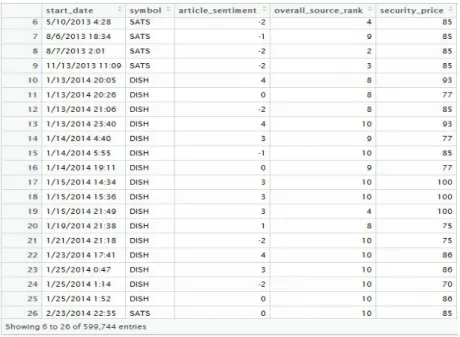
Article Sentiment: Accern uses a fairly complex 3 layer approach to find sentiment in an article. In first layer they calculate the sentiment using deep learning mechanism. Then in second layer it uses bag of words which is basically comparing the words against differently rated or weighted positive and negative words. In the final layer ngram is used where phrases or particular parts of text are identified. These 3 layers give a combined linearly weighted sentiment score within the range of 1 to +1.
Event Impact Score Entity: The impact is what Accern thinks if the story has any chance of affecting the stock price by more than 1% at the end of the trading day.
Event Impact Score Overall: The same is event impact score entity, but it finds the same relationship for the event that is occurring. This can also work as filtering mechanism. An article with higher impact score has more readership, hence can influence more people.
Event Source Rank: Event source rank provides information on the trustworthiness of the news source. This can help us filtering the news articles we might want to ignore.
Average Day Sentiment: This provides a sentiment score within the range of 1 to 1 based on the aggregated sentiment of the stories related to the company in a day.
Table 3.1: Sample data from Accern’s Sentiment Analysis.
Sentdex is another organization that works on sentiment analysis. They pull their stories and articles from 20 different sources like Reuters, Bloomberg, WSJ, Yahoo Finance among many. By using “Named Entity Recognition”, it finds named entities which can tell the system about the subject/subjects being talked about in the article. Then Sentdex applies Natural Language Processing which involves chunking the data into many pieces which is then compared against the adverbs, adjectives that were used to find out how the author presented the article or named entity as positively or negatively [20]. Sentdex’s sentiment score is a little different. It’s value ranges from 3 to +6, while 3 would mean strongly negative sentiment, +3 means strongly positive sentiment. 0 represents neutral sentiment. Sentdex’s dataset also comes
up with moving average of sentiment for last 100, 250, 500 and 5000 days. The timeline of the database is Oct, 2012 to June 15, 2015.
3.5
Preprocessing of Data
The final dataset of both Accern and Sentdex is huge. Accern’s database has 599,744 rows and has a size of 72.16 MB, while Sentdex’s dataset has 12,242,062 rows with a total size of 1.029 GB. Our backtest engine Quantopian does not allow to upload any csv (comma separated value) file that takes more than 360 seconds to upload. To compress the size of our database we removed the rows that we were not using. Even then Accern’s database could not be uploaded. We, therefore decided to divide the Accern’s database into a chunk of companies and worked with XLK holdings only.
For Sentdex’s data we divided the database by the year datestamp. We had two full years of data 20132014 and 20142015 and have run our algorithm on the backtesting engine for both year sessions.
CHAPTER 4
4.1
Financial Dataset
To get the daily security price historic data, we used yahoo finance. A complex query can fetch data for a company for the given timespan.
http://realchart.finance.yahoo.com/table.csv?s=YHOO&a=03&b=01&c=2013&d=01&e=28& f=2015&g=d&ignore=.csv
The above url fetches a csv from yahoo finance, that downloads daily data stream from April 01, 2013 to February 08, 2015. By changing the company ticker, we can download historical daily security price for any available company.
4.2
Market Price of Stocks
Historic price of securities are available from a few online sources, but they are always daily based, if free. Historic price data in minutely interval is not available for free in any public domain, which is a major setback for our system design. Since, our databases provide information in a minute based way (for example Accern’s database has a timestamp that provides the time of the day the article was uploaded in the Accern Data Stream), if we fail to use the minute data we are already losing a major advantage to act upon the gained information on the market. Currently, we stop feeding data to the system before market opens about any given date. Even if we have information at 12 am about a major story regarding a company which might
have significant impact on the stock price, we cannot do anything about it until the next trading day starts.
Our backtesting platform Quantopian supports minute based backtesting, but it does not allow to download its security pricing data. This handicap of not getting minute data has deprived us of further testing our analogy, propositions and ideas in a minute based frame.
4.3
Data Mapping
While Accern’s database has multiple fields that can be of use, it does not contain security price data. To address it, first we downloaded daily security price data from Yahoo Finance. Using python, we selected each individual row’s timestamp and company ticker value, then we queried into the downloaded price data and put the value of that particular stock of that day into the file. Sentdex’s data already had a security price data in it. Therefore it did not need any further data mapping.
4.4
Backtesting Engine: Quantopian
Quantopian is our backtesting engine. It is a website that enables its user to test their algorithm in its system. The system provides the option to run the data in daily or minute based frame.
Quantopian has two important methods where most of the work is done. In the ‘initialize’ method, we declare the list of companies we are interested to have in our portfolio. It defines our universe of the companies. Also in this method we define any variables that we might be interested to use in the code.
Another method ‘handle_data’ gives us access to an object ‘data’, which gives us access to all the information of companies defined in our universe in the ‘initialize’ method. It provides us a snapshot of the defined universe on the stated time. The time interval can be set to daily and minutely. ‘Daily’ would mean ‘handle_data’ would be called once per day and ‘minutely’ would mean, the ‘handle_data’ method would be called in every minute of the trading day.
Quantopian also supports uploading a csv file which can be matched against the portfolio data using timestamp and company ticker. With the csv we can import outside information and feed the system according to the timestamp to avoid signal bias.
One of the drawbacks of Quantopian is that it might result in timeout error if the system fails to fetch a csv file within 360 seconds. Since the datasets we are working with quite big, this has been a constant hassle and major limitation to run our algorithms at its full strength. Even a simple algorithm such as moving average takes about 4 to 5 minutes to run a backtest of 3/4 years.
A backtest in Quantopian shows us the return over the provided time span. It also gives us access to some very important metrics regarding the result of the implemented strategy like total return, benchmark return, alpha, beta, sharpe ratio, sortino, information ratio, volatility, max drawdown. Behavioral economics points that humans are loss averse [?]. Risk metrics can indicate the various risk assessments that were done on the backtest and point out to the strategies that were less risky, but achieved consistent gain.
Table 4.2: Risk metrics of Quantopian.
Alpha indicates the performance return of the company compared to a benchmark, beta indicates how much the algorithm acted against the market. Sharpe, a widely used risk assessment indicator helps to compare an strategy to another to to find the safer risk free approach. A sharpe ratio of more than 1 usually desirable, while a sharpe score of more than 3 would be very attractive risk adjusted return.
Sortino ratio is similar to sharpe ratio, however it takes into account the difference between harmful volatility and general volatility by including the standard deviation of negative asset returns. Sortino ratio focuses more on the negative return of the portfolio than the volatility of the approach.
Information ratio takes into account of that fact that how consistently a strategy has beaten the benchmark. The higher the ratio, the more is the consistency which is desirable.
CHAPTER 5
5.1
Attribute Dependency
Before moving to set up the buying and selling strategy, we looked for the statistical relations between the market price and different attributes that can possibly play a vital role for security forecasting. Sentiment value of a specific ticker against the market value of its unit security in a day was the main focus point. Market price's dependency on the outgoing moving average also broaden the depth of our analysis. As a result, an initial assumption about the impact of the these attributes was drawn to build up the further market strategy. To calculate the dependency between the attributes, we followed two of the most conventional manners – Pearson’s Correlation Coefficient and Linear Regression.
5.2
Pearson’s Correlation Coefficient
Pearson’s productmoment correlation coefficient represents the statistical linear relation between two given variables, not necessarily with the same unit of measurement. Strength of the relation depends on how these two sets of data plainly fits in a graph. If we denote the correlation coefficient by r, then the range of r would be,-1 ≤ r ≤ 1
A value of 1 indicates the negative relation between two variables which means if the value of one variable increases then the value of other one has a tendency to decrease. On the other hand, +1 value of r points to the positive relation between two variables which refers that if the value
of one variable increase, it draws same effect to the other one. However, a value of zero exhibits no relation between the given variables. According to Pearson’s model, the formula to compute the correlation between two variables is dividing the covariance of those variables by their standard deviations. For instance, if the variables are x and y along with n number of rows, then the correlation r between x and y is going to be,
To begin with, the central idea was to observe the impact of article sentiment of a specific ticker to operate its security price. As a continuation, after mapping the market price against the each day’s sentiment value, we examined the correlation between these two attributes of data. The generated result is understandably not satisfactory at all.
Pearson’s product-moment correlation data: tmp$article_sentiment and tmp$security_price t = 45.816, df = 599640, p-value < 2.2e-16
alternative hypothesis: true correlation is not equal to 0 95 percent confidence interval:
0.05654010 0.06158456 sample estimates:
cor 0.05906271
The output of Pearson’s Correlation with the size of data frame 599,640 is denoted here by cor which values precisely 0.05906271. A result tends to absolute zero is inferring that the points are plotted with a wide variation instead of following the best fit line. To be specific, Pearson’s model estimates numerically unstable correlation with large number of data as input. Moreover, outliers in data are also one of main reasons to compromise the stability in output. For instance, sentiment value is moving without any fraction from 3 to 6 whereas security price has
no fixed upper or lower bound. As a consequence, there is an abnormal distance in values of this two attributes. In addition, the value of article sentiment is rounded to an absolute value which also causes truncation error. In case of smaller volume of data, it would not have a huge effect on the output but in this case, we are working on a large sample space which has a length nearly three years with every day update.
Furthermore, to calculate the correlation under a comparatively stable system we decided to select the moving average of both sentiment analysis and security price of last 100 days. In this approach, there is a fractional sentiment value available for each security price of an event. Though, large outlier in data is still available but the truncation error is well handled through this process. As a result, large input dataset will cause effectively less harm than before. The following outcome of correlation is precisely 0.4056169 which is comparatively acceptable.
Pearson’s product-moment correlation data: tmp$value_MA100 and tmp$close_MA100 t = 239.63, df = 291590, p-value < 2.2e-16
alternative hypothesis: true correlation is not equal to 0 95 percent confidence interval:
0.4025799 0.4086448
sample estimates: cor
0.4056169
Another initial assumption about the fluctuation of ongoing market price of securities was the impact of outgoing moving average on it. To get a more appropriate understanding, a correlation matrix has been formed where sentiment value has been plotted against the moving average of price which was preset in different time length. For this purpose, moving average of last 100, 250, 500, 5000 days have been taken accordingly to observe the relation in between.
The impact of sentiment value over the moving average of price does not seem much stronger as we expected but the moving average certainly has a good grasp on the current market price. At this point, the results of correlation indicate that the sentiment value cannot entirely follow the movement of the current market but along with moving average of security prices, it can surely be considerable to upgrade the trading strategies.
5.3
Linear Regression Analysis
Linear regression is another statistical convention to identify the linear relation between two variables. Firstly, one variable is considered as explanatory or independent variable and the other one is considered as dependent variable. For example, let X be the independent variable or cause of an event and ybe the dependent variable of the effect of an event. To find the regression line, the equation would be, y = a + bX. In addition, the plotted points in the graph give a best fit line which represents the strength of the relation between X and y where a is the intercept and b
is the slope of that line. Both the variables X and y can be explained as,
The best fit line is determined by using the least square regression line (LSRL) which is a method to predict a certain event following the regression model without any other given parameters. A scatterplot of the event data provides the opportunity for better observation of regression analysis. In this case, as we are concerned about the impact of article sentiment on the price of the security, those value can be plotted in the graph for a better understanding. From the huge scale of data, we have taken a partial amount to operate regression analysis and compute the residuals to plot them against sentiment value in another graph. Scatterplot of sentiment value against the every day opening price of the security gives a visually more efficient output of the relation between them.
Figure 5.1: Scatterplot to find the statistical regression line.
Moreover, regression analysis has few other properties such as coefficient of determination, standard error and residual value that also help to determine the dependency of given parameters. For the starters, coefficient of determination is basically the correlation coefficient that we have analyzed before. Then, standard error of the regression line is the fluctuation between the actual value of dependent variable and the predicted value according to the analysis. In regression analysis, residual is the numerical difference between the value of dependent variable and the upcoming predicted value. For each day, along with the sentiment value and market price of the security, there is one residual available of the data point. Residual
CHAPTER 6
6.1
Portfolio Management
We are using S&P 100 companies as our selected companies for the portfolio. Some of the listed companies are Apple, McDonald's, Facebook, Gamestop, MSI, Caterpillar, Luluemon, Nvidia, Lockheed Martin etc. The sector of the selected company ranges from Information Technology, Industrial companies to Health Care.
In the portfolio, we keep track of the current available cash. We also declare the default investment size. In an list, we keep track of the securities we are shorting, so that we can always keep track of those companies. After each buy or sell, the cash gets updated to the new value.
The initial capital is set to 1M USD.
6.2
Buying Strategy
When moving average of price is incorporated into the algorithm, we buy when the moving average of last fixed number of days is bigger compared to moving average of larger value of days. For strategies that involve sentiment score, we went in for the buy when the sentiment score is +6 (for Sentdex database, range of sentiment score: 3 to +6) and +0.25 (for Accern, the sentiment score is in between (1 to +1). Sentdex’s data also comes up with the moving average of sentiments for 100 and 300 days.
For Accern’s database, we bought stocks of the company if the sentiment score was above 0.25 with a source rank more than 8 and impact score of 90. Our results are in line with the findings of Accern [1] who used similar condition to produce a result.
if data[stock]['article_sentiment'] > 0.25 and
data[stock]['event_impact_score_entity_1'] > 90 and data[stock]['overall_source_rank'] > 8 :
# consider to buy some position of this security
Another approach went for an aggressive buy if the story was first mentioned in the article. Strategies where we had a machine learning agent giving an output of 1 and +1 based on the training data of sentiment score, we bought if the output was +1 and we hand no security position of the company.
6.3
Selling Strategy
For strategies where only moving average is implemented, we sold if moving average of longest period is greater than moving average of shorter period of days. For strategies involving machine learning agent, we sold if the output was 1 and we had any security position of the
We also used a stop order percentage to minimize our chance of losing. A stop loss order helped us to to limit the amount we could lose from a single security.
For Sentdex, which has a sentiment output range [3, +6 ], we exit our positions of the security if the sentiment score is lower than 1. For Accern, the sentiment score is less than or equal to 0.25 and overall source rank of 8 to prove the validity of the article.
6.4
Short Position
For sentiment analysis, when our system predicts a lower sentiment score and we have no position in the company, we short a fixed amount of cash. Again, when the system predicts a significantly better sentiment score we buy back the share.
In the strategies, where machine learning is implemented, we append the stocks into shorted stock list if machine learning agent gives a score 1 (the output of the agent is 1 and +1), we have previously bought securities of the company and sentiment score is less than 1.
CHAPTER 7
7.1
Machine Learning Approach
Machine learning focuses on the constant development of the system by pattern recognition through the informed data analysis. This process is tightly related to the computational statistics where system does data extraction and search for the match. However, instead of the human understanding, machine learning provides this observation to the system to acquire an explicit perception on that case. To assist the prediction, machine learning can be implemented using different strategies. Mainly, Machine learning is classified into three different types – Supervised Learning, Unsupervised Learning, Reinforcement Learning. For the upcoming prediction of price in our analysis, we used supervised learning to acquire the ongoing market pattern.
7.2
Supervised Learning
Supervised Learning is one of the models of Machine Learning to predict the upcoming outcome determined by training data. To begin with, this model gathers example data of given specific attribute which refers to a set of realworld valuation. Precision in system’s observation depends on the accuracy and length of the training examples. In our case, we trained the system with security price of the ongoing last 100 days which is divided into the window size of 10 at a time. This is the representation of feature vector or the object description. The amount of description should not be too large to handle and it should contain enough indexes to compute
accurate prediction. To generate the learning, there are two categories – Classification, Regression. Among the multiple sets of classifiers we used Linear Support Vector Clustering (Linear SVC), NuSupport Vector Clustering (NuSVC) from Support Vector Machine (SVM) and Logistic Regression to fit the features against label to compute the prediction out of the system. As the system needs to have a proper perception the recent environment of the market, we started to invest the cash from the portfolio after 100 days of training. As we observed that the system performance is very unstable in first 100 days phase and it improves when training is complete. Figure 7.1: Initial performance of the untrained system. After losing most of the cash in first 100 days the system could not really get back to the market to make profit but it more or less followed the market for the rest of the timeline. On the other hand, with all the other variables set constant, if the investments are made on the market
after initial training we can see a completely different scenario. Figure 7.2: Start investing after the system is initially trained. System runs with rise and fall almost similar to the market and makes profit of 51% out of its capital. One more point to be noted, max drawdown is stunningly improved this time than the untrained investment.
7.3
Feature Window
To help the system to perceive the current environment of the market, we selected the security price of last 100 days as historical bars and set the feature window to 10. After rounding up the differences among prices of each day in the current window we can determine if the price is increasing or decreasing than previous window. For example, if the ongoing prices of a given security are:
Figure 7.3: Selecting the feature window from the security prices.
The beginning price of every window is one shorter than the beginning price of previous window and one more than the ending price of the last window. With the set of lists, system calculates a feature for every window and sets the label to 1 if the ending price is greater than the beginning price. Thus, system generates two independent sets of data – Feature & Label. For training dataset D,
Xi is the feature which has the limit from greater than or equal 1 to less than or equal 1. Furthermore, using different supervised learning classifiers our algorithm fits those list of indexes to compute the prediction with the value 1, 0 and 1. In this case, Market stability is denoted by 0 whereas prediction 1 refers to the upcoming increment of ticker price and 1 points to the opposite.
7.4
Support Vector Machines (SVM)
Support Vector Machines (SVM) are one of the methods to perform supervised learning using its different classifiers to predict the ups and downs of the market. In our case, in compare to dimension of the data we have a huge amount of sample. As a consequence, the outlier
detection should be more precise and efficient. We used python Scikit to cluster the trained data with Linear SVC and NuSVC.
Linear Support Vector Clustering (Linear SVC) and NuSVC are almost identical where NuSVC is only required one more parameter to complete the calculation according to the formula. We compared the outcomes of the investment according to both the classifiers. For Linear SVC,
Given the formula, is the vector of the features of the current price list and yiis the vector of individual price label which is set by the comparison of ending price and beginning price of the window which values 1 and 1.
Figure 7.4: Total return according to the prediction of Linear SVC.
On the other hand, NuSVC introduces a new parameter which controls the support vector and improves the training by identifying the errors in pattern. From limit 0 to 1, upper bound of indicates the training error and lower bound represents the fraction of support vectors. As a result, max drawdown according to NuSVC is less than the Linear SVC.
Figure 7.5: Total return according to the prediction of NuSVC.
However, total returns from the capital is around 5% less than the Linear SVC. In short, in spite of the satisfactory drawdowns on both the cases, none of the total returns according to the prediction by these classifiers can beat the benchmark returns.
7.5
Logistic Regression
To survive in the market, two of the most important decisions to make are when to
acquire and sell positions which in this case is decided the system according to the training. In logistics regression model, the system analyses one or more independent variables to predict the
outcome which can be either continuous or categorical and the outcome is only expressed in a positive or negative manner. With an expression from a dependent binary variable, every time the algorithm either goes for acquiring the position or selling the acquired position.
Figure 7.6: Total returns according to the prediction of Logistic regression.
Although, the total returns according to the Logistic Regression is no improvement compared to the Linear SVC and NuSVC but it most certainly adds a dimension to the prediction.
7.6
Combined Prediction of Multiple Classifiers
As none of classifiers could not beat the benchmark return of the market, in spite of achieving the market pattern, we thought of combining all the predictions together to see if the outcomes get any better. To begin with, system gathers all predictions from the Linear SVC, NuSVC and Logistic Regression with the same given parameters which are features and label. If the outputs of every classifier is a common case and positive then the system goes for acquiring the position of that specific security. In this case, prediction has results 1, 0 and 1 given the fact that all the other variables remain constant. One other very important parameter that we added
that threshold the system exits that position immediately. Investing according to the new combined prediction of the classifiers that the system used earlier, we observed that the result of the total return gets significantly better time to time and eventually beats the benchmark.
Figure 7.7: Total return according to the combined prediction of the classifiers.
Given the fact that the max drawdown decreases and alpha has now a better value that previous. Though, total return can vary depending on the investment size and the starting portfolio cash.
CHAPTER 8
8.1
Moving Average
We started off with a very simple approach, which calculates the moving average of stock price for last 100 and 300 days. Moving average is an widely used indicator which helps filtering price fluctuations. In this case, if we compare the moving average of 100 days and 300 days, we can see if the market is expanding or shrinking. The strategy is pretty simple if moving average of a company for last 100 days is higher, we buy stocks of that company with 10% of our total available cash. We start with 1M USD as capital, and run the backtest from January 1, 2013 to February 28, 2014.
Figures 8.1: Total return using simple moving average.
Even this simple approach gets us about 54.5% percent return with 0.90 beta and sharpe 1.57. Even though this approach initially beats the benchmark, but later fails to live up to it and underperforms compared to the benchmark (SPY) for several months.
8.2
Sentdex’s Sentiment Data
Then we introduced Sentdex’s sentiment data to our system. Sentdex indexes its streams to provide a sentiment of score of an article about a company in the day of the availability of the article. It’s sentiment score as we have discussed before is within the range or 3 to +6.
Our buying strategy is that If we find a sentiment score of a company, we check if the sentiment is 6 (which means strongly positive sentiment) and we have no previous shares of this company, we buy shares of this company with 10% worth of our available money. If our sentiment for a company’s stock is less than or equal to 1 and we have previously bought shares of this company, we sell the shares.
Figure 8.2: Backtest using Sentdex’s sentiment data.
This algorithm was really successful with a great return with very low beta score and a strong sharpe score. As the algorithm picks up good stocks with positive sentiment, it starts get
the benefit of the shares in the long run. Drawdown of just 14.8% further confirms the legitimacy of this approach.
8.3
Accern’s Sentiment Data
Accern’s sentiment data comes with many information field regarding the article. We experimented with mainly four data fields article sentiment, overall source rank, impact score on entity and first mention. Article sentiment is the sentiment of the article, source rank gives a score on the validity of the article source, impact score gives us Accern’s output of it if they think the article has any chance of affecting the stock price of the company. First mention gives information if the article was first to mention a story.
If sentiment score is above .25 and source rank more than 8 with an impact score more than 90, we get a similar return compared to the backtest using Sentdex’s sentiment data. Our findings are in line with similar work using Accern’s data[1]. Figure 8.3: Backtest using Accern’s sentiment analysis data.
CHAPTER 9
9.1
Comparison of Different Strategies
As we have established the models of our testing scenarios, we have seen some clear results. A combined machine learning approach trained can follow the market and beat basic strategies like moving average by a good margin. A quick comparison between these two approaches show that the return of machine learning is 72.23% higher comparatively. It also has 53.39% less max drawdown. Figure 9.1: Backtest of Moving Average.
Figure 9.2: Backtest of Machine Learning Strategy
We have used the same strategy for two different sentiment analysis data, which has given us very similar return with good risk assessment. We can see, till March 2015 (where the timeline ends for Accern), we have the output for both graphs and till then both performs very similarly. Accern has been consistently better from the start, but as Sentdex peaks up the pace around, May of 2014, it has steadily performed ever since. Sharpe for both of them is more than 2.3 and Accern’s one hovers around 3 which is really good. Using Accern’s database however has resulted in a far better sortino score & beta. It also has overperformed compared to the benchmark (SPY) from the beginning.
Figure 9.3: Backtest result using Sentdex’s Sentiment data.
Figure 9.4: Backtest result using Accern’s Sentiment data.
9.2
Impact of Investment Size
We found that a change of investment size can result in a significant change in return. When testing the result of the combined strategy, we saw that our algorithm found the pattern of the and could follow the market movement. However, it was still underperforming, because it wasn’t buying enough.
Figure 9.5: Total returns in respect of investment size.
Upon changing the investment size to a bigger one, we quickly beat the market and could stay on top of it and follow the market.
9.3
Merging Sentiment with Machine Learning
In our research we have experimented with various approaches to predict the market and tried to follow it. While some of the approaches has been more successful than the other, the reasoning of the output told us where we could focus to improve in the next iteration. Machine learning algorithms individually were not particularly successful, however a combination of them has been able to garner a standard return that has consistently beaten the market. The reasoning of this can be argued as that financial market is volatile, which is why it can be taken
advantage of. Different machine learning agents have been able to identify different volatility of the market. When they were combined and we went for the most common prediction, we could identify the volatility and ride with the market. Sentdex and Accern has been able to beat the benchmark by 63.9% and 64.2% respectively, which suggests that both of the sentiment analyzed dataset had similar output about the market. And as they have beaten the market by a large margin, we can argue that sentiment data is reliable and accurate.
In addition, we used both sentiment analysis (Sentdex) and machine learning in a system to decide buying and selling strategies in the market. In this case, if the combined prediction of machine learning agent and sentiment analysis score gives any positive signs about the price of that security then the system goes for buy. On the other hand, If any of the model indicates upcoming fall in price then the system exits the position of that security.
Figure 9.6: System performance using both Sentiment Analysis & Machine Learning.
Besides, security position is left when any of the identifiers shows negative sign about the upcoming situation which means the system does not take any risk at all. It considers all the possible facts in our sample space before taking a decision. As a result, in spite of having an impressive drawdown percentage, we did not find this approach much profitable in comparison to single identifier approach.