Cziva, Richard (2018)
Towards lightweight, low-latency network function
virtualisation at the network edge.
PhD thesis.
https://theses.gla.ac.uk/30758/
Copyright and moral rights for this work are retained by the author
A copy can be downloaded for personal non-commercial research or study,
without prior permission or charge
This work cannot be reproduced or quoted extensively from without first
obtaining permission in writing from the author
The content must not be changed in any way or sold commercially in any
format or medium without the formal permission of the author
When referring to this work, full bibliographic details including the author,
title, awarding institution and date of the thesis must be given
Enlighten: Theses
https://theses.gla.ac.uk/ [email protected]
N
ETWORK
F
UNCTION
V
IRTUALISATION
AT THE
N
ETWORK
E
DGE
R
ICHARD
C
ZIVA
SUBMITTED IN FULFILMENT OF THE REQUIREMENTS FOR THE DEGREE OF
Doctor of Philosophy
S
CHOOL OF
C
OMPUTING
S
CIENCE
C
OLLEGE OFS
CIENCE ANDE
NGINEERINGU
NIVERSITY OFG
LASGOWAUGUST 2018
c
Communication networks are witnessing a dramatic growth in the number of connected mo-bile devices, sensors and the Internet of Everything (IoE) equipment, which have been esti-mated to exceed 50 billion by 2020, generating zettabytes of traffic each year. In addition, networks are stressed to serve the increased capabilities of the mobile devices (e.g., HD cameras) and to fulfil the users’ desire for always-on, multimedia-oriented, and low-latency connectivity. To cope with these challenges, service providers are exploiting softwarised, cost-effective, and flexible service provisioning, known as Network Function Virtualisation (NFV). At the same time, future networks are aiming to push services to the edge of the network, to close physical proximity from the users, which has the potential to reduce end-to-end latency, while increasing the flexibility and agility of allocating resources. However, the heavy footprint of today’s NFV platforms and their lack of dynamic, latency-optimal orchestration prevents them from being used at the edge of the network.
In this thesis, the opportunities of bringing NFV to the network edge are identified. As a concrete solution, the thesis presents Glasgow Network Functions (GNF), a container-based NFV framework that allocates and dynamically orchestrates lightweight virtual net-work functions (vNFs) at the edge of the netnet-work, providing low-latency netnet-work services (e.g., security functions or content caches) to users. The thesis presents a powerful formali-sation for the latency-optimal placement of edge vNFs and provides an exact solution using Integer Linear Programming, along with a placement scheduler that relies on Optimal Stop-ping Theory to efficiently re-calculate the placement following roaming users and temporal changes in latency characteristics.
The results of this work demonstrate that GNF’s real-world vNF examples can be created and hosted on a variety of hosting devices, including VMs from public clouds and low-cost edge devices typically found at the customer’s premises. The results also show that GNF can carefully manage the placement of vNFs to provide low-latency guarantees, while minimising the number of vNF migrations required by the operators to keep the placement latency-optimal.
Behind this thesis there has been many years of discussion, work and collaboration with incredible people. The following is an acknowledgement of them.
First of all, my thanks and appreciation go to my principal advisor Dr. Dimitris P. Pezaros for his continuous feedback, support, funding, motivation and much more. Over the years Dimitris taught me to shoot for the stars and to never underestimate my work.
I would like to also thank Dr. Jeremy Singer for replying to my first unsolicited e-mail sent to him in early 2012. Jeremy took me as an Erasmus student and offered to start a PhD in Glasgow. Also, many thanks to Dr. Christos Anagnostopoulos for his recent support on the theoretical part of my thesis and encouragement in the final year of of my PhD.
Thanks to my friends and officemates Dr. Simon Jouet, Dr. Levente “Zolib´a” Csikor and Dr.
Kyle White for their friendship, input, collaboration and the occasionalone morepint.
I would like to express my special thanks to all the people around the globe who believed in me and hired to work for them during my PhD. Thanks to Jerry Sobieski from NORDUnet, Culley Angus, Chris Lorier, Jamie Curtis from REANNZ, and Chin Guok, Inder Monga from ESnet. Without them, my PhD would have been a totally different experience.
I am grateful to my PhD examiners Dr. Colin Perkins (University of Glasgow) and Dr. Nicholas Race (University of Lancaster) for providing feedback on this thesis.
Finally, I would like to thank my family and in particular my mom and dad for their en-couragement and unlimited support. Enormous thanks to my fianc´ee, Anna, for her love, relocation to Glasgow, and the unconditional understanding and support provided during these years.
Nem att´ol haladsz el˝ore, ha ¨ossze-vissza futkosol.
1 Introduction 1
1.1 Overview . . . 1
1.2 Thesis Statement . . . 3
1.3 Contributions . . . 3
1.4 Organisation of the Thesis . . . 4
2 Background and Related Work 6 2.1 Overview . . . 6
2.2 Towards a Virtualised Network Infrastructure using SDN and NFV . . . 7
2.2.1 Early Approaches to Network Programmability . . . 8
2.2.2 The Separation of the Control and Data Planes . . . 9
2.2.3 Innovation at the Control Plane - SDN and OpenFlow . . . 10
2.2.3.1 The OpenFlow Protocol . . . 12
2.2.3.2 SDN Deployments, Devices, and Controllers . . . 12
2.2.3.3 Limitations of SDN . . . 13
2.2.4 Network Function Virtualisation . . . 14
2.2.4.1 NFV Reference Architecture . . . 14
2.2.5 Example NFV Platforms . . . 18
2.3 Virtualised Network Service Deployment . . . 24
2.3.1 Traditional In-Network Middlebox Services . . . 25
2.3.2 Virtualising Middlebox Services . . . 26
2.3.3 Benefits of Service Virtualisation for Providers . . . 29
2.3.3.1 Reduced Equipment Need and Operational Costs . . . 29
2.3.3.2 Software-Based Practices . . . 30
2.3.3.3 Efficient and Flexible Resource Provisioning . . . 30
2.3.3.4 Modularity and Chaining of vNFs . . . 31
2.3.4 Moving Services to the Network Edge . . . 31
2.3.4.1 Characteristics of the Network Edge . . . 32
2.3.4.2 Trends in Edge Computing Research . . . 34
2.3.4.3 Example Devices at the Edge . . . 36
2.4 Orchestrating Virtual Network Functions . . . 38
2.4.1 NFV Resource Allocation Strategies . . . 38
2.4.1.1 Exact vNF Placement Solutions . . . 39
2.4.1.2 Heuristic vNF Placement Solutions . . . 41
2.4.1.3 Meta-heuristic vNF Placement Solutions . . . 42
2.4.2 Dynamic vNF Orchestration and Re-Allocation Strategies . . . 43
2.5 Summary . . . 44
3 Designing a Lightweight, Latency-Optimal NFV Framework 46 3.1 Overview . . . 46
3.2.2 The Need for Dynamic, Latency-Optimal vNF Placement . . . 48
3.2.3 Operational Overview . . . 49
3.2.4 High-Level Design Requirements . . . 51
3.3 Design Considerations . . . 52
3.3.1 Providing Continuity, Portability and Elasticity . . . 53
3.3.2 Performance Considerations . . . 54
3.3.3 Security and Privacy Considerations . . . 55
3.3.4 Management of vNFs at Scale . . . 55
3.3.5 Integrating Public Cloud Environments . . . 57
3.4 Container Network Functions . . . 58
3.4.1 Comparison with Virtual Machines and Unikernels . . . 59
3.4.2 Disadvantages of Containers . . . 61
3.4.2.1 Security and Isolation . . . 61
3.4.2.2 Limited Operating System and CPU Architecture . . . . 61
3.4.2.3 Limitations of the Micro-Services Architecture . . . 62
3.4.3 Hardware Requirements for Containers . . . 62
3.4.4 Operating System Requirements for Containers . . . 63
3.4.5 Docker and Other Container Alternatives . . . 65
3.5 Latency-Optimal vNF Orchestration . . . 66
3.5.1 Optimal Placement of vNFs at the Network Edge . . . 66
3.5.1.1 Rationale . . . 66
3.5.1.2 System Model . . . 68
3.5.2.1 Rationale . . . 70
3.5.2.2 Problem Formulation for Dynamic Placement Scheduling 72 3.5.2.3 Solution Fundamentals . . . 74
3.5.2.4 Optimally-Scheduled vNF Placement . . . 75
3.6 Summary . . . 77
4 The Glasgow Network Functions (GNF) Framework 79 4.1 Overview . . . 79 4.2 Infrastructure Setup . . . 80 4.2.1 vNF Host Devices . . . 82 4.2.2 SDN Network Elements . . . 83 4.3 GNF Service Plane . . . 86 4.3.1 User Interface . . . 86 4.3.2 Public API . . . 88 4.4 GNF Orchestration Plane . . . 88 4.4.1 Manager . . . 89 4.4.2 Latency-Optimal Orchestrator . . . 89
4.5 GNF Virtual Infrastructure Management Plane . . . 92
4.5.1 Agent . . . 92
4.5.2 SDN Network Controller . . . 94
4.5.2.1 Transparent Traffic Steering . . . 94
4.5.2.2 Traffic Classification . . . 96
4.5.2.3 Traffic Tunnelling . . . 97
4.6.2 Firewall . . . 101
4.6.3 HTTP Content Filter . . . 102
4.6.4 Rate Limiter . . . 104
4.6.5 DNS Load Balancer . . . 105
4.6.6 Network Monitoring . . . 107
4.6.7 Intrusion Detection using SNORT . . . 109
4.7 Summary . . . 110 5 Evaluation 111 5.1 Overview . . . 111 5.2 Performance of Container vNFs . . . 112 5.2.1 Evaluation Environment . . . 112 5.2.2 Delay of Containers . . . 112
5.2.3 Instantiation Time of Containers . . . 113
5.2.4 Memory Requirements of Containers . . . 114
5.2.5 Throughput of Container Chains . . . 115
5.2.6 Encapsulation Overhead on Throughput of GNF vNFs . . . 116
5.3 GNF in Public Clouds . . . 118
5.3.1 Evaluation Environment . . . 118
5.3.2 Throughput of Various VM Types . . . 119
5.3.3 Delay Through Various VM types . . . 121
5.4 Dynamic, Latency-Optimal vNF Placement . . . 123
5.4.1 Evaluation Environment . . . 123
5.4.3 Analysing Latency Violations . . . 129
5.4.4 Placement Scheduling Using Optimal Stopping Time . . . 130
5.4.4.1 Time Instance . . . 130
5.4.4.2 Basic Behaviour . . . 131
5.4.4.3 Comparison With Other Placement Schedulers . . . 132
5.5 Summary . . . 135
6 Conclusion and Future Work 138 6.1 Overview . . . 138
6.2 Contributions . . . 138
6.3 Thesis Statement Revisited . . . 139
6.4 GNF Use-Cases . . . 141
6.4.1 IoT DDoS Mitigation . . . 141
6.4.2 On-Demand Measurement and Troubleshooting . . . 142
6.4.3 Roaming Network Functions . . . 142
6.5 Future Work . . . 144
6.5.1 State Management of vNFs . . . 144
6.5.2 Operator-Scale Deployment of Edge vNFs . . . 145
6.5.3 Supporting vNF Chains . . . 145
6.6 Concluding Remarks . . . 146
2.1 Example edge device specifications [6]. . . 37
3.1 Table of parameters for our system model. . . 67
4.1 OpenFlow rules to forward packets from SRC to DST through its vNF using
the architecture at Fig. 4.6. . . 95
4.2 Support for GRE and VXLAN tunnelling protocols in public cloud providers [25]. 98
4.3 OpenFlow rules required to forward packets from the edge node through
vNF1 hosted on VM using tunnels [25]. . . 99
2.1 Selected key contributions to programmable network configuration and ser-vice delivery over the past 20 years leading to the contributions presented in
this thesis. . . 7
2.2 Software Defined Networks logical architecture. Source: SDxCentral . . . 11
2.3 ETSI NFV reference architecture . . . 15
2.4 Network Functions Virtualisation Relationship with SDN. Source: SDxCentral 17 2.5 T-NOVA marketplace: clicking and deploying vNFs [23] . . . 21
2.6 IoT Growth (source: Cisco [85]) . . . 32
3.1 Target infrastructure for our NFV platform [6]. . . 48
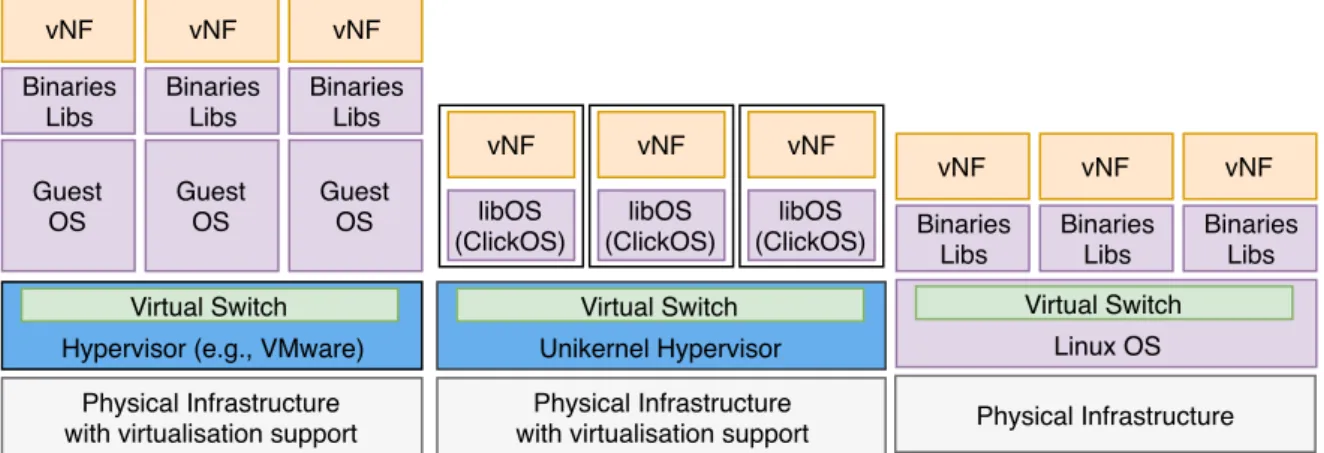
3.2 VMs vs unikernels (specialised VMs) vs containers. . . 59
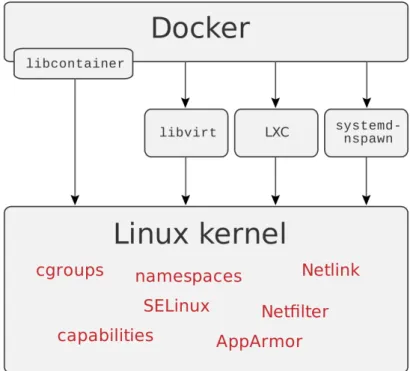
3.3 Kernel modules required for container technologies (e.g., Docker, LXC). Source: https://delftswa.github.io/chapters/docker/ . . . 64
4.1 The GNF architecture - an overview [6]. . . 81
4.2 The GNF UI’s network view: managed devices and users are visible for operators . . . 86
4.3 The GNF UI’s device overview: operators can click on a vNF to be assigned to a user . . . 87
4.4 Orchestration debugger shows topology of hosts, vNFs, users and vNF as-signments after orchestration. . . 91
4.6 Imposing a vNF to selected traffic. Table 4.1 shows the associated OpenFlow
rules installed. . . 94
4.7 OpenFlow 1.3 Classifier Stack (source: http://flowgrammable.org) . . . 96
5.1 Idle ping delays [6]. . . 113
5.2 Create, start and stop time [6]. . . 114
5.3 Idle memory consumption of container vNFs [6]. . . 115
5.4 Throughput and delay of chained container vNFs [24]. . . 116
5.5 Normalised throughput of four vNFs comparing native performance with GNF containerised performance at the 90thpercentile [25]. . . 117
5.6 RTT and end-to-end throughput evaluation on steered traffic through varying EC2, GCE and Azure VM instance types [25]. . . 119
5.7 Mean throughput and mean RTT of various instance types over Azure, GCE and EC2 [25]. . . 122
5.8 Jisc Backbone topology used for our experiments. In this figure, two exam-ple users connected at two locations with 3 ms latency to the closest edge are shown [124]. . . 124
5.9 Statistical latency characteristics of a physical link. . . 126
5.10 Comparing the average vNF-to-user E2E latency between edge and cloud deployments [124]. . . 127
5.11 Deviation from the optimal placement and the number of violations per time instance. . . 130
5.12 Our proposed scheduler triggers the optimisation just before reaching a la-tency violation threshold [30]. . . 132
5.13 Comparison of the number of migrations with various migration scheduling strategies [30]. . . 133
strategies [30]. . . 134
6.1 vNF migration between access points [27]. . . 143
Chapter 1
Introduction
1.1
Overview
Data consumption is growing exponentially in today’s communication networks. This irre-versible trend is driven by the increase of connected end-users and the wide-spread penetra-tion of new mobile devices (e.g., smartphones, wearables, sensors and more). In addipenetra-tion, data consumption is also accelerated by the increased capabilities of the mobile clients (e.g., higher resolution screens and HD cameras), and the user’s desire for high-speed, always-on, multimedia-oriented connectivity. In numbers, it has been estimated that connected devices will exceed 50 billion, generating zettabytes (1 billion terabytes) of traffic yearly by 2020 [1]. At the same time, the Telecommunication Service Provider (TSP) market is becoming com-petitive with the rise of many over-the-top providers lowering subscription fees for users. Moreover, today’s TSPs often experience poor resource utilisation, tight coupling with spe-cific hardware, and lack of flexible control interfaces which fail to support diverse mobile applications and services. As a result, TSPs have started to lose existing and new revenue, while suffering increased capital and operational expenditure that cannot be balanced by increasing subscription costs [2].
In order to cope with the aforementioned challenges, service providers have started to soft-warise their network infrastructure. By virtualising traditional network services (e.g.,
fire-walls, caches, proxies, intrusion detection systems, WAN accelerators, etc.), providers can save operational and capital expenses, and satisfy user demands for customised and rapidly evolving services. This transformation, referred to as Network Function Virtualisation (NFV), changes how operators architect their network to decouple network functionality from phys-ical locations for faster and flexible service provisioning [2]. NFV has gained significant attention since its first appearance in 2012, resulting in many, albeit still preliminary, deploy-ments at the provider’s Data Centres (DCs).
At the same time, a new concept for service delivery has emerged referred to as Multi-Access Edge Computing (MEC) [3] or fog computing [4]. These concepts present an IT service environment with cloud computing capabilities at the edge of the home, enterprise or IoT network, within close proximity to the end users [3]. Being able to utilise the edge of the network will inherently provide low-latency connectivity between services and the end users, while at the same time it would allow offloading the core of the provider’s net-work. However, the heavy footprint of today’s NFV frameworks and their lack of dynamic, temporal orchestration prevents them from being used at the network edge.
In this thesis, the design and implementation of Glasgow Network Functions (GNF), a NFV platform that brings NFV to the network edge by using generic, lightweight Linux containers in a distributed, heterogeneous edge infrastructure is presented. To show the potential of the platform, multiple useful use-cases are highlighted demonstrating that by utilising the network edge (e.g., home, enterprise, IoT edge), providers can alleviate unnecessary network utilisation (which can correspond to savings of millions of dollars per year [5]), perform better troubleshooting on their network, and provide location-transparent services [6].
Furthermore, this thesis advocates that Edge vNFs must be dynamically placed in synergy
with changing network dynamics (e.g., fluctuating latency on links), user demands (e.g., cer-tain vNFs are used in cercer-tain times of the day) and mobility (e.g., users move continuously with the mobile devices) to support low vNF-to-user end-to-end latency. Therefore, this the-sis formulates a realistic vNF placement problem for the network edge and also provides a time-optimised scheduler (along with mathematical analyses and theorems) that strives to
achieve latency-optimal allocation of vNFs in next-generation edge networks using the fun-damentals of Optimal Stopping Theory [7]. With experiments over a simulated nation-wide network topology using real-world latency characteristics, we show that, by re-calculating the optimal placement and migrating vNFs at a carefully selected time, unnecessary vNF migrations can be prevented to save resources for the operators, while the number of latency violations in the network can be kept bound to satisfy the QoS requirements of users.
1.2
Thesis Statement
This work asserts that by creating, moving, and dynamically managing lightweight virtual network functions in close physical proximity to the end users (for example at the edge of the network) will enable Telecommunication Service Providers to deliver low-latency, QoS-guaranteed network services with low impact on the provider’s network. This hypothesis has been be tested by the development and evaluation of a container-based network function framework, applying NFV and SDN technologies.
1.3
Contributions
The contributions of this thesis are as follows:
• A comprehensive review of the past and current approaches that aim to introduce
pro-grammability at different planes of the network.
• An analysis of the current limitations of today’s NFV frameworks and vNF
orchestra-tion algorithms, and the resulting hurdles of dynamic resource allocaorchestra-tion, management and orchestration when applied on future edge networks.
• A formulation of a latency-optimal edge vNF placement problem and an exact solution
• A dynamic placement scheduler that minimises the number of vNF migrations re-quired by latency changes while adhering to service level guarantees using the funda-mentals of Optimal Stopping Theory.
• The design and implementation of Glasgow Network Functions (GNF), a
compre-hensive framework that manages virtual, lightweight container network functions on various hosting devices (from low-cost network edge devices to a public cloud VMs) and transparently assigns vNFs to selected user’s traffic.
• An open-source implementation of today’s most popular types of network functions as
lightweight GNF vNFs that can be specialised to individual user requirements.
• An evaluation of the benefits of GNF vNFs compared to unikernels and traditional
VMs, and an evaluation of GNF on public cloud providers (Amazon EC2, Google Compute Engine, Microsoft Azure).
• An evaluation of GNF’s dynamic, latency-optimal vNF placement solution over a
nation-wide, simulated network topology consisting of edge and cloud servers.
1.4
Organisation of the Thesis
The work presented in this thesis is structured as follows:
• Chapter 2 discusses the need and evolution of virtualised, software-based network
infrastructures and introduces the emerging requirements of today’s end users. As a future architecture to support this evolution, the chapter outlines the concepts of Network Function Virtualisation and Software Defined Networking. It then describes the current challenges large-scale telecommunication networks face and the incentive for network providers to leverage the newly available edge architecture alongside their internal infrastructure. The chapter details current platforms for virtualised service delivery and existing orchestration solutions for vNFs.
• Chapter 3 critically discusses the limitations of previous frameworks and orchestra-tion algorithms, and motivates the need for a lightweight NFV platform. After intro-ducing the most important design considerations, the chapter compares different vir-tualisation technologies (e.g., virtual machines, unikernels, and Linux containers) and their suitability for the network edge. Furthermore, this chapter identifies the chal-lenges of virtualised service orchestration and presents a latency-optimal placement algorithm for vNFs, alongside a dynamic placement scheduler that enables efficient re-allocation of vNF services in response to evolving temporal network properties.
• Chapter 4 provides the technical aspects of the implementation for the design
dis-cussed in Chapter 3. The Glasgow Network Function (GNF) framework is presented, detailing how it manages the network functions, their placement, and the network traf-fic in various deployment scenarios. The chapter concludes with the implementation details of selected real-world network functions (e.g., firewalls, deep packet inspection modules, etc.) as GNF vNFs, highlighting the capabilities of the system.
• Chapter 5presents a comprehensive evaluation of GNF. First, it shows some
charac-teristics of container vNFs that are important for network services (e.g., throughput, delay, instantiating time, overhead etc). Then, it presents how GNF vNFs perform in public cloud environments (e.g., Amazon EC2, Microsoft Azure, Google Compute Engine). Finally, this chapter presents an evaluation of the dynamic, latency-optimal edge vNF placement orchestration over a nation-wide simulated network topology, using real-world latency characteristics.
• Chapter 6summarises the work and contributions and impact of this dissertation. It
provides some use-cases of the GNF platform (e.g., IoT DDoS mitigation, on-demand network troubleshooting, vNFs that are following users) and discusses potential re-search directions as future work in this topic.
Chapter 2
Background and Related Work
2.1
Overview
The Internet was designed almost 50 years ago as a network of computers, used only by a limited number of researchers to transmit electronic messages of files and scientific results. Since then, the Internet community has witnessed a tremendous change in the number of users and devices and also in how users interact with the network. This increase of usage and change of expectations have led network operators to look into better ways of managing and orchestrating their network in order to reduce operational expenses, and to improve the utilisation of existing resources to improve return on investment. However, managing such widespread, distributed infrastructure is challenging.
In order to facilitate efficient management and orchestration, and allow operators to better control their network, both academia and industry have made considerable effort since the early 1990s, when the Internet has really started to take off with more diverse applications and users from the general public. As shown in Figure 2.1, contributions to network pro-grammability start from early ideas originating from the active networking paradigm [31] until recent advances in Network Function Virtualisation and the use of commodity (and even resource-constrained) hardware located at the edge of the network for advanced, pro-grammable network services. While the innovations are still ongoing, the recent advances
1998 2000 2002 2004 2006 2008 2010 2012 2014 2016 2018 Tennenhouse (acti venetw orking) [8] Tempest netw ork programmability [9] Smart Pack ets[10] ForCES [11], RCP [12], SoftRouter [13] Impasse netw ork overlay virtualisation [14] Ethane [15], 4D [16] OpenFlo wSDN [17] Open vSwitch, Cloudlets [18] UNIFY NFV [19], ETSI NFV specification [2], Manzalini and Saracco [20] ClickOS vNF [21], Cloud4NFV [22], T-NO VA [23] GNF container vNFs [24, 25], NetF ATE [26] GNF onthe edge [27] Espresso [28], Edge Fabric [29], GNF edge use-cases [6] GNF latenc y-optimal vNF orchestration [30]
Figure 2.1: Selected key contributions to programmable network configuration and service delivery over the past 20 years leading to the contributions presented in this thesis.
enable a shift from legacy networking where services are bound to specific locations to de-liver user and location-specific network services.
In this chapter, the related work and background of this thesis are outlined. First, in Sec-tion 2.2, the research leading to network virtualisaSec-tion with SDN and NFV is presented by drawing a timeline from the 1990s, when the first ideas around network programmability were born. Then, in Section 2.3, the need for virtualised in-network services is described with details on next-generation, edge-based network services. In Section 2.4, particular at-tention is drawn to the the orchestration challenges of virtualised services by describing and presenting influential research papers and projects from the recent years. Finally, Section 2.5 summarises the key findings of this chapter.
2.2
Towards a Virtualised Network Infrastructure
us-ing SDN and NFV
In this section the early work on network programmability is reviewed, drawing a timeline starting from the 1990s when the Internet has just started to take off as a closed research work until today, when all network providers apply high levels of automation over their
net-work. The review presented below highlights how previous efforts (e.g., active networking, ForCES, Ethane) paved the way towards Software Defined Networking (SDN) and Network Function Virtualisation (NFV), today’s prominent trends to deliver and manage softwarised network services for the users in a highly automated, “zero-touch” way.
2.2.1
Early Approaches to Network Programmability
In the early- to mid-1990s, the Internet had taken off with many new applications outpacing file transfer and email for scientists [32]. This innovation at the end hosts was possible due to the layered structure of network protocols. While many new applications have been built on top of the protocol stack, improving and changing the behaviour of network services and the network itself was very hard, due to its distributed, multi-vendor nature and the slow protocol standardisation that is coordinated by the Internet Engineering Task Force (IETF) [33, 34]. A notable, clean-slate approach for network programmability has been presented by the ac-tive networking program [31] in the early 2000s where a programming interface exposed pro-cessing, storage resources along with control on network queues from specific devices [35]. This network API enabled the execution of custom operations that were carried in-band, en-capsulated in the data packets (also known as capsules or smart packets) [36]. Envisioned use-cases of active networking included network support for new applications, fine-grained control over packet forwarding and introducing the possibility for network experimentation. On top of presenting the well-known network APIs and an encapsulation model, active net-working research papers have also offered the vision of a unified architecture for middlebox orchestration which essentially meant unifying a wide range of network middleboxes and managing them in a unified way instead of ad-hoc, one-off approaches [37] - a very similar goal of this thesis which resonates well with today’s efforts on Network Function Virtualisa-tion introduced later.
While active networking has offered the vision of unified network programmability, it has not taken off for several reasons. One notable challenge has been a disagreement in the research community whether the network should be kept simple (only forwarding packets between
ports) or it should be enabled with processing for smarter functionality. On the other hand, active networking lacked commercial deployments and remained a research project for a long time due to the fact that there was no real need for the proposed programmability back in the early 2000s. Moreover, running executable code inside the network has raised security concerns.
Another prominent early approach was presented for ATM networks by the researchers at University of Cambridge in the work titled as Tempest [9], where the authors have outlined a practical framework for network programmability with dynamic introduction and modifica-tion of network services. Tempest enabled the deployment of alternative control architectures in the same network, allowing service providers to effectively become network operators for some well defined partition of the physical network. Moreover, the Tempest architecture even allowed switch-forwarding behaviour to be defined by a controller, foreshadowing the work on data and control plane separation.
2.2.2
The Separation of the Control and Data Planes
In mid 2000s, the demand for higher-performance, more reliable networks increased along
with the number of connected users reaching 1 billion in 20051. Subsequently, to provide
connectivity for increasing number of users, providers have started to focus on network man-agement functions, widely called Traffic Engineering (TE) - controlling the physical path used to deliver traffic. However, at the time, this was only possible by controlling conven-tional routing protocols that were very primitive, restricted and more importantly tied into conventional routers and switches. This meant that network management tasks such as cre-ating customised routing, debugging and telemetry were extremely difficult [38].
At the same time, there was a tremendous improvement in the speed of general purpose com-puters with new processors and high speed memories coming out yearly, leaving the control plane of networking equipment greatly underpowered [32]. These frustrations and the ability to implement new network functions using the resources available at general purpose
puters resulted in two innovations: anopen interfacebetween the control and data plane of
the network and also the notion of alogically centralised control plane[32].
As a result of these efforts, the ForCES (Forwarding and Control Element Separation) [11] working group at IETF has proposed a standardised, open interface between control and data planes, while logical centralisation of control has also been suggested at protocols such as the Routing Control Platform [39] in the mid 2000s. While these control and data plane sep-aration projects were important milestones in IP networks to enable innovation in separate planes, the concept of separating a control plane was already known in the telecommuni-cation industry many years before (e.g., SS7 [40] introduced signaling plane separation in 1998).
ForCES had its own shortcoming: equipment vendors had little incentive to adopt it as it exposed internal properties of the network that was not in the interest of the vendors in order to keep competitive advantage. To solve these issues, the Ethane [41] project (and its predecessor SANE [42]) instead of exposing internal properties of the device, only proposed a logically centralised, flow-level solution for access control targeted to enterprise networks. Ethane reduced a switch to only flow tables where flows could be only populated by a high-level controller. As we show in the next section, along with industry support and the right definition of a control protocol, essentially this project became OpenFlow [17], the project that has changed the networking industry.
2.2.3
Innovation at the Control Plane - SDN and OpenFlow
During mid and late 2000s, the success of experimental infrastructures (e.g., PlanetLab [43]) increased the interest towards large scale network experimentation. Many large-scale re-search projects such as the US funded Global Environment for Network Innovations (GENI) [44] or the European funded Future Internet Research & Experimentation (FIRE) [45] have started to propose ideas on how networks need to be managed on scale. Specific experiments from these programs include FIRE’s FEDERICA project that created a scalable, Europe-wide, clean slate infrastructure for Internet experimentation or GENI’s MobilityFirst experiment
that was selected for early validation of a massive scalable global name resolution service and a generalised storage aware routing. Amongst all of these, researchers at Stanford fo-cused on the campus network and created OpenFlow [17], today’s most popular realisation of the Software Defined Networking (SDN) vision.
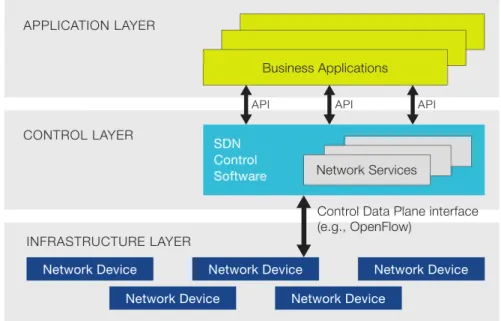
Figure 2.2: Software Defined Networks logical architecture. Source: SDxCentral
SDN brings innovation to the network control plane and changes the way networks are de-signed and managed today. It has two defining characteristics. First, it separates the network control plane specifying routing policies, route finding algorithms from the data plane’s hard-ware devices that forward the packets, as shown in Figure 2.2. Secondly, SDN consolidates the control plane into a logically centralised SDN software controller (commonly referred as SDN controller) that provides a global view of the network and is able to control multiple data plane elements. This logical centralisation allows implementing and modifying con-trol procedures (e.g., routing, traffic engineering, security functions) in one designated place (treating the network as a big switch), instead of having to modify all network devices in the network separately (often using different control protocols to different devices) to implement such control procedures. Moreover, many SDN controllers are designed for multi-tenancy, providing a so called network operating system that allows multiple high-level SDN appli-cations to run on a virtualised view instead of directly interacting with physical devices.
SDN allows policies, configuration and network resource management to be applied in short timescales, and a single control protocol to implement a range of functions such as, among others, flow-based routing [17], QoS enforcement [46], network virtualisation [47], traffic engineering [48], policy management [49], enabling content caching [50] and even managing Virtual Machine placement in cloud DCs [51].
2.2.3.1 The OpenFlow Protocol
OpenFlow [17] by McKeown et al. realises the SDN vision by defining a data forwarding pipeline along with a simple TCP-based communication protocol to be used between the SDN controller and the data plane devices of the network.
The OpenFlow data plane is based on multiple, but simple match-action tables that are able to hold a fixed amount of flow entries describing a matching pattern (that matches in bits in the packet header) and associated actions (e.g., forwarding, dropping, modifying a header field in a packet). Flow entries also contain a set of counters to track number of bytes and packets matched along with priority information that is used when a packet matches multiple flow entries.
The OpenFlow data plane is managed by an associated OpenFlow communication protocol that allows setting up and removing flow entries, querying flow statistics. While OpenFlow has had many versions in the last couple of years, three of these can be considered the most influential: OpenFlow 1.0 (which is used even today since it was the first protocol published), OpenFlow 1.3 (today’s de facto standard in hardware devices), and OpenFlow 1.5 (the most up-to-date version that is gaining popularity now).
2.2.3.2 SDN Deployments, Devices, and Controllers
The introduction of the SDN vision was quickly followed by various deployments from large-scale network and data centre operators. One of the first reported deployments of SDN is accredited to Google, where the technology was used to interconnect private DCs globally in 2013. This deployment, called B4 [52], allows setting up bandwidth guarantees between
any two hosts, even if the hosts are located in two different DCs. In the B4 paper, the authors described how they support multiple routing protocols simultaneously and how they perform centralised traffic engineering using SDN.
Many switch vendors have also joined the SDN revolution. Legacy network equipment ven-dors such as Cisco and Juniper have added OpenFlow capabilities to some of their devices alongside their own proprietary control protocols. Example legacy devices equipped with
OpenFlow support include Cisco’s Nexus 9000 series devices2or Juniper’s MX series edge
routers3. New SDN hardware vendors, such as Big Switch Networks, Noviflow, Barefoot
Networks and Corsa Technologies have started to manufacture clean slate devices designed for SDN, with high-speed programmable pipelines and up-to-date OpenFlow support. Ex-ample devices include Corsa’s DP2400 device that is a fully OpenFlow 1.5 compliant switch
with 48Gb packet buffering and a line-rate throughput of 200Gbps per device4. Apart from
hardware devices, dozens of software switches have also been designed for SDN (e.g., Open vSwitch [53], mSwitch [54], Pisces [55]).
SDN network operators have the choice to use one of the numerous SDN controllers. Popular SDN controllers include the OpenDaylight [56] or ONOS [57] controllers which are used by many enterprise network providers (e.g., Huawei, AT&T), the Faucet [58] controller that has been deployed by many research and education network providers and universities. The
Ryu5 controller that has been used in dozens of research experiments due to its lightweight
design and support for latest versions of the OpenFlow protocol.
2.2.3.3 Limitations of SDN
SDN provides the vision of a centralised, virtualised control plane along with a well defined and simplified data plane. This allows centralising distributed control applications such as unified access control management, network flow and topology management to a network
2
https://www.cisco.com/c/en/us/products/collateral/switches/nexus-9000-series-switches/guide-c07-731461.html Accessed on: 13 February 2018
3https://www.juniper.net/documentation/en
US/release-independent/junos/topics/reference/general/junos-sdn-openflow-supported-platforms.html Accessed on: 13 February 2018
4https://www.corsa.com/products/dp2400/ Accessed on: 13 February 2018 5https://osrg.github.io/ryu/ Accessed on: 25 January 2018
controller that only deals with control messages. However, SDN was not designed to handle data-intensive operations in its centralised control plane and therefore SDN controllers would introduce significant delays on the network in case each packet was directed to them for inspection or modification (for example for packet inspection purposes).
This limitation of the SDN vision has driven a few orthogonal research directions. First, some researchers have started to experiment with languages that could define an entire data plane from code. Examples of this approach include P4 [59], where a language is presented to define switch’s pipelines or BPFabric [60], where the authors proposed a platform in-dependent instruction set to define data-plane functions such as anomaly detection using Berkeley Packet Filters.
An other approach to introduce programmability to data plane functions can be achieved with Network Function Virtualisation that is introduced in the next Section.
2.2.4
Network Function Virtualisation
To extend the programmability proposed at the control plane with SDN, the Network Func-tion VirtualisaFunc-tion (NFV) paradigm aims at replacing hardware-based equipment implement-ing data plane functionality (e.g., security and performance functions) with software-based virtual network functions (vNFs). It enables implementing and running vNFs on Off-The-Shelf x86 servers by using commodity programming languages, frameworks and virtualisa-tion techniques. NFV therefore offers faster deployment and provisioning of service func-tions, and addresses the problem of compatibility of vendor-specific hardware while reducing the capital and operational expenditure associated with network service deployment [61].
2.2.4.1 NFV Reference Architecture
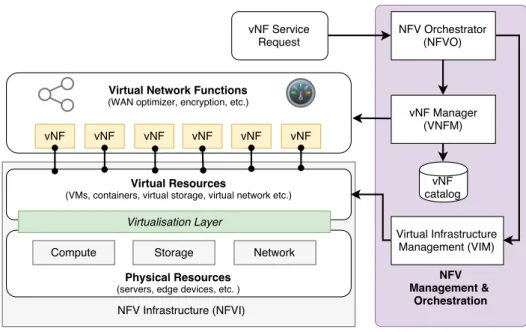
The European Telecommunications Standards Institute (ETSI), the standardisation body for NFV, defines a reference architecture of an NFV platform [2]. Since its first release in 2012, this architecture has been the basis for most NFV frameworks. As shown in Figure 2.3, the
Figure 2.3: ETSI NFV reference architecture
architecture consists of three main blocks described below: Management and Orchestration (MANO), the NFV Infrastructure (NFVI) and the virtual Network Functions.
NFV Infrastructure (NFVI) The NFV Infrastructure (NFVI) component of the
archi-tecture consists of the physical resources on which vNFs can be deployed. It abstracts the hardware resources (such as compute, storage and network) through server virtualisation (e.g., x86 virtualisation using Virtual Machines), so they can be logically partitioned and provided for vNFs.
The NFVI component works directly with vNFs, controlled by the virtual infrastructure man-agers (VIMs) managed by the NFV orchestrator, as shown in Figure 2.3. NFVI is critical to realise the business benefits outlined by NFV, as it enables the use of commodity hardware for multiple network services.
Management and Orchestration (MANO) The Management and Orchestration (MANO)
component is responsible for the overall control over an NFV system.
Within that, the vNF Manager (VNFM) is responsible for setting up the software implement-ing the vNF functionality inside the virtual resource (VM). The VNFM usually connects to a database or catalogue that describes how to set up particular vNFs. As an example, an
intrusion detection vNF can have a set of files describing attack signatures along with scripts to set up a particular intrusion detection software, all stored in a vNF catalogue or repository. The NFV Orchestrator (NFVO) has high-level control over the entire NFV infrastructure with connections to the VIM and VNFM components of the system. It has two main roles. First, it takes vNF requests from operators and allocates the new vNFs in the infrastructure based on a vNF orchestration strategy. Second, it monitors the health of the system and reacts to certain events impacting performance.
Finally, the Virtual Infrastructure Management (VIM) component manages the physical in-frastructure and creates virtual resources when called by the NFVO. It is also responsible for the health checks of the physical infrastructure and reporting available resources.
Virtual Network Functions Virtual Network Functions (abbreviated as VNFs, vNFs
or NFs) are the software components that implement the virtual services, encapsulated in a chosen virtualisation technology and deployed on a specific computer server in the infras-tructure. vNFs can be moved between servers (restricted only by the vitualisation layer) and be stopped and re-started within few minutes [24, 21]. These vNFs are implemented using virtual compute, storage, and network resources, while being managed by a vNF Manager (VNFM) component of the system, as shown in Figure 2.3.
2.2.4.2 Relationship of NFV and SDN
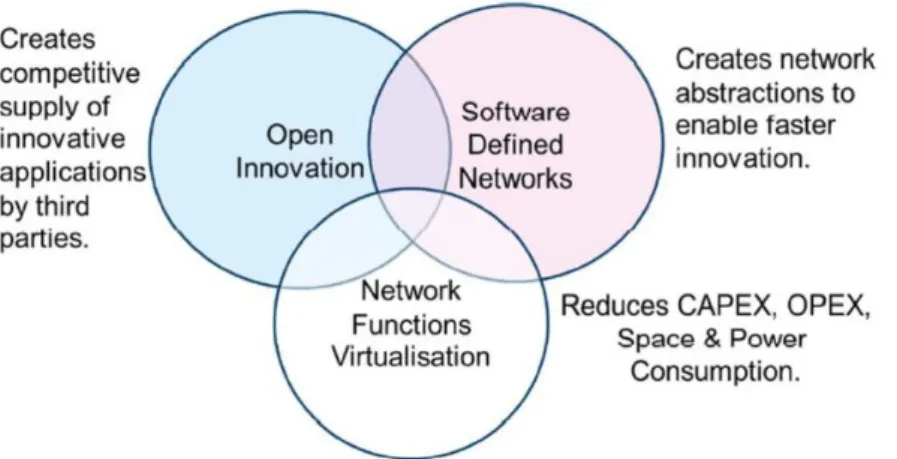
Even though SDN is not part of the ETSI NFV architecture, the two technologies often exist together, as shown in the Figure 2.4. While many different ways of integration of these two complimentary technologies are possible, in general, NFV provides the programmability to the higher layers of the protocol stack (i.e., application level network services), while SDN allows the control over the lower layers (i.e., routing) of the network. In a practical example, NFV would allow the fast creation of a vNF running a web cache, while SDN would be used to automatically re-route selected users’ traffic through this web cache.
Figure 2.4: Network Functions Virtualisation Relationship with SDN. Source: SDxCentral
2.2.4.3 Relation to the End-to-End Principle
Traditional networks have been built using the to-end principle, meaning that the end-points in a network conversation should be responsible for guaranteeing they get the levels of reliability they need from the network while treating in-network services and functions only as performance enhancements [62]. The IP protocol, among others, was built using this principle.
While it is important to note that the end-to-end principle does not advocate a dumb network (as it only states that the endpoints should be responsible to application-to-application com-munication), many in-network middleboxes break the principle. Traditional NATs, security and performance-enhancing proxies (e.g., content cache) and WAN protocol optimisers are only a few of the possible functions that can look beyond the IP header, keep state in the network and break the to-end argument. While some of these are best implemented end-to-end (e.g., encryption), functions such as content caches and NATs are best placed in the network.
Meanwhile, some protocols, such as SIP (Session Initiation Protocol) require in-network support in the form of SIP proxy servers that direct calls based on user’s locations. Deploying such functions as in-network vNFs provides flexibility in function placement while adhering to the end-to-end principle.
one can implement a network where intelligence is centralised to an SDN controller that directs dumb switches. As an example, SDN’s vision of network virtualisation creates fea-tureless pipes over the network that does not break the end-to-end principle itself. However, those overlay networks can already include intelligence in the form of virtualised appliances that can subvert the end-to-end principle.
2.2.5
Example NFV Platforms
Many NFV frameworks have been developed in both academia and industry. These frame-works usually focus on a specific network environment (e.g., the core of the provider’s net-work, DC network) or various aspects of vNF description or management (e.g., service de-scription languages, vNF service chaining). In the following paragraphs, some of the most popular NFV frameworks are introduced to the reader with some of their unique contribu-tions to the field as well as details for vNF placement algorithms used, if applicable.
As shown below, some NFV platforms are built on top of the principles of NFV Management and Organization (MANO), an guideline architecture set by a working group (WG) of the European Telecommunications Standards Institute Industry Specification Group (ETSI ISG NFV).
OpenStack OpenStack6is a free and open-source software platform for virtualised
net-work, storage and compute infrastructures. It gained popularity over the last 10 years being deployed at many cloud providers (e.g., RackSpace) and enterprise infrastructures with more than 500 companies contributing to its source code.
OpenStack’s strength is its ability to control multiple thousands of hosting servers, running tens of thousands of VMs. Therefore, many NFV platforms have been built on top of Open-Stack - as introduced later. The weaknesses of the platform are its orchestration engine and its separation from network controllers that are detailed below.
OPNFV OPNFV7 is the most influential project today among all the open-source NFV
frameworks. OPNFV works closely with the ETSI, the standardisation body of NFV and it is currently a Linux Foundation project with all major operators (e.g., Cisco, AT&T, Ericsson, Huawei, IBM, Intel, NEC, Nokia and many more) contributing to its source code regularly. The objective of OPNFV is to establish a carrier-grade, integrated open-source reference platform that can be used to validate multi-vendor, inter-operable NFV solutions. The project builds on top of countless open-source projects, such as OpenStack (virtual compute, stor-age, network management), Intel DPDK (data-plane development kit) [63], OvS (software switch) [53] and only maintains a necessary thin layer of orchestration between them. OPNFV, as many other NFV frameworks, uses OpenStack’s built-in VM placement
algo-rithm to determine the physical location of vNFs. This is implemented in OpenStack’s
nova-scheduler module involving a host weighting (based on, e.g., available RAM on hosts) and
filtering (removing hosts that are not supposed to run a VM) stages before selecting the least loaded host by default. This behaviour can be changed to random selection and developers can also provide hints to the scheduler to enforce VMs to be allocated on specific hosts.
Cloud4NFV Cloud4NFV [22] is one of the early NFV platform that originated in academia. The authors have specifically focused on data modelling that allows the description of vNFs (vNF image, VM instance used, storage used, ports and network link requirements) as well as the virtual infrastructure (cores, available VMs, links, and physical ports). Cloud4NFV also presented an implementation where vNFs could be initiated and mapped to physical resources using their data model.
Cloud4NFV’s proof-of-concept is based on OpenStack, therefore by default it uses the VM placement algorithm of OpenStack, as described for OPNFV before.
OpenMANO OpenMANO [64] is an open-source project led by the Spanish network
provider Telefonica, aiming at implementing an ETSI NFV MANO framework focusing
on performance and portability aspects. They main components of OpenMANO include
openmano,openvimand a graphical user interface.
OpenMANO’sopenvimis a lightweight reference implementation of an NFV virtual
infras-tructure manager that has been optimised for Enhanced Platform Awareness (EPA) to en-able high-performance vNF deployments. Some of the EPA features include CPU, memory, NUMA pinning (assigning specific hardware elements to vNFs) and the support for pass-through and virtualised interfaces (e.g., SR-IOV). On top of managing vNFs by calling the
appropriate APIs of an enhanced OpenStack deployment,openvimalso talk to a SDN control
for network service configurations. Their other component,openmanois a reference
imple-mentation of the management software (offering the creation and deletion of vNF templates
and instances as well as network service templates and instances) that interface withopenvim
through its APIs, and offers a northbound REST interface to their GUI.
As for orchestration, OpenMANO can be used with three different VM providers. If inte-grated with OpenStack, it will be using the default placement algorithm of OpenStack as described for OPNFV before. In case OpenMANO is integrated with VMware’s vCloud Di-rector, it uses VMware’s proprietary placement algorithm that optimises for high-availability and balanced load for hosts. OpenMANO can also be integrated with public clouds (e.g., Amazon Web Services), where physical placement of vNFs can not be explicitly controlled.
T-NOVA T-NOVA [23] (Network Functions as a Service over Virtualised Infrastructure)
is a recently completed 3-year European-funded project that involved participants from the ETSI NFV standardisation body. The project was driven by enterprises and aimed to offer an integrated solution for the deployment and management of virtualised network functions over converged (network and computer) infrastructures.
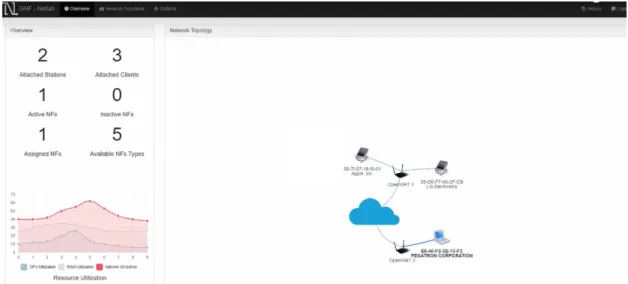
On top of a fully fledged ETSI NFV MANO implementation, T-NOVA has successfully pre-sented one of the first marketplaces for network services with accurate billing of services. Their proposed interface has made the click and deploy vision of NFV a reality. As seen in Figure 2.5, operators are able to set many parameters for vNFs, such as monitoring
require-Figure 2.5: T-NOVA marketplace: clicking and deploying vNFs [23]
ments for vNF’s CPU usage, among others.
T-NOVA presented a separate software component called TeNOR [65], a vNF orchestrator that performs mapping of virtual services to physical points of presence (PoP) in different network domains. The orchestrator optimises for overall delay, cost of deployment and over-all network utilisation at the same time.
ZOOM The ZOOM8 (Zero-touch Orchestration, Operations and Management) project is
an active collaborative project managed by the TM Forum, a global industry association that drives collaboration and problem solving for communication and digital service providers and their ecosystem suppliers.
The ZOOM project, on top of being a ETSI NFV MANO implementation itself, has two dis-tinct characteristics. First, there has been considerable amount of work put into transitioning to NFV by aligning the virtual models of the ZOOM system to industry standard infrastruc-ture management software components. Also, ZOOM has had many small proof-of-concept projects (called catalyst projects) showcasing emerging ideas. Past catalyst projects were led by major network operators and included, among others, the use of predictive analytics for vNF resource management, and the integration of 5G properties to the NFV ecosystem. ZOOM itself has also been built on top of the OpenStack VM management software,
fore by default it utilises the VM placement algorithm of OpenStack, as described for OP-NFV before.
UNIFY The UNIFY [19] project was a recently completed European-funded project
show-casing unified programmability over cloud and carrier networks. The idea behind this project was to control both a cloud and an internal carrier network in a unified way, so that vNFs can be deployed and managed with high level of agility.
While the UNIFY project was mainly focused on open interfaces in all layers of the presented unified architecture, the project has also published a few vNF placement algorithms. In one of them, Nemeth et al. [66] presented a fast and efficient algorithm to map constantly arriving service graphs to large networks consisting of tens-to-hundreds of thousands of nodes. Their approach uses a preference value based greedy backtrack algorithm based on graph pattern matching and bounded graph simulation ordering substrate nodes to be selected for a service chain by a composite preference value based on (1) node utilisation, (2) path length measured by latency and (3) average link utilisation on the path leading to the node.
The UNIFY project has also experimented with resource-constrained CPEs and envisioned a similar vision to this thesis: placing services to close proximity of the users (e.g., IPSec terminators, low-latency services) directly on the CPEs. In their work presented in [67], they focused on the network abstractions and APIs required to run a native (i.e., not virtualised) network function on resource-constrained CPE.
NetFATE NetFATE [26] proposes an open framework to enable network function at the
edge. Similar to the framework presented in this thesis, they also envision vNFs such as fire-walls, routers, WAN optimisers or a VPN termination running at low-cost customer premise equipment. NetFATE uses traditional XEN VMs along with OpenFlow, controlled using the POX SDN operating system.
NetFATE has presented a very simple and preliminary decision algorithm for vNF orches-tration in their paper [26]: for each required service, they run a VM on the access CPE node of the traffic requesting it. If a user moves from one site to another and therefore changes
his/her access CPE, all the VMs implementing the requested vNFs are migrated to the new access CPE.
OSM Open Source MANO (OSM)9 is an operator-led, ETSI-hosted project to develop
an Open Source NFV Management and Orchestration (MANO) software stack aligned with ETSI NFV, backed by companies mainly in Europe - such as Telefonica.
OSM promises a VIM-independent, production quality software stack that can oversee mul-tiple geographically distributed NFV deployments that can use different management soft-ware. This is to increase interoperability among NFV implementations with a strict and well defined model.
Open-O The Linux Foundation formed the OPEN-Orchestrator Project (OPEN-O)10 in
2016 to develop an open source software framework and orchestrator to enable agile SDN and NFV operations, back by Asian companies and vendors such as China Mobile and Huawei.
Their focus, similar to OSM introduced before, is to create deeper convergence among SDN and NFV technologies and innovation in the networking industry as well as supporting multi-vendor deployments. However, while OPEN-O is expected to build more around OpenStack, OSM is taking a neutral approach by pushing a common information model.
CORD CORD (Central Office Re-architected as a Datacenter)11combines NFV, SDN, and
the elasticity of commodity clouds to bring datacenter economics and cloud agility to the Telco Central Office. This effort builds on top of the well-known SDN controller, ONON, led by the Open Networking Foundation (ONF).
CORD lets the operator manage their Central Offices using declarative modeling languages for agile, real-time configuration of new customer services.
9https://osm.etsi.org Accessed on: 08 July 2018 10http://open-o.org Accessed on: 08 July 2018 11http://opencord.org Accessed on: 08 July 2018
Kubernetes Kubernetes [68] is a new production-grade container orchestrator designed to automate deploy, scale and manage containerised applications. It was originally designed by Google and is now maintained by the Cloud Native Computing Foundation. It has been created to work with a range of container tools, including Docker that is used in this Thesis. As of today, Kubernetes’s scheduler (the component that decides where to host containers) takes available resources only from the hosting nodes into account. Since Kubernetes is not integrated with information from the network (e.g., link latency information), it does not place containers to latency-optimal locations as it is presented in this Thesis.
Kubernetes has recently been proposed for NFV by Intel12. In this work, Intel has reported
that they are doing considerable amount of work to extend the networking capabilities of Kubernetes in order to separate multiple virtual networks and to support Intel SR-IOV, Intel’s high performance network IO virtualisation feature. The NFV solution presented in this Thesis predates these efforts.
2.3
Virtualised Network Service Deployment
As outlined in the section before, introducing programmability and virtualisation to both the data and the control plane has got paramount attention from the networking community for over 30 years. As a result of these efforts, technologies such as SDN and NFV are now available for network providers to automate, program and control specific parts of the network from software.
This section first introduces the wide spectrum of hardware-based network appliances that are installed today. Then, it focuses on the benefits of virtualising these services using SDN and NFV and in particular, it describes the advantages of running services in close proximity of the end users (e.g., at the network edge).
12https://builders.intel.com/docs/networkbuilders/enabling new features in kubernetes for NFV.pdf
2.3.1
Traditional In-Network Middlebox Services
Today, network operators rely on a wide spectrum of hardware-based appliances or ‘mid-dleboxes’ to transform, inspect, filter or otherwise manipulate traffic on top of routing. In recent years, middleboxes have become fundamental parts of operational networks, provid-ing approximately 45% of the network devices to enforce security policies (e.g., firewalls, intrusion detection and deep packet inspection services) or performance guarantees (e.g., WAN optimisers, proxies, load-balancers) throughout the topology [69].
The most commonly deployed middleboxes are [21, 69]:
1. Network Address Translator (NAT) [70]: a NAT middlebox allows the modification of source and destination IP addresses. Typically it is deployed at the edge of a private network to hide multiple internal hosts behind one public IP address to conserve global IP address space.
2. Firewalls (FW) [71]: A firewall is utilised to filter traffic based on pre-defined policies. Policies usually concern packet header fields (e.g., IP source or destination) or inspect the payload.
3. Intrusion Detection Systems (IDS) [72]: Similar to firewalls, IDS systems are usually deployed at the edge of the network to inspect incoming and outgoing traffic. However, in contrast to firewalls, IDS systems are not usually designed to make accept/decline decisions in real-time. Rather, they are deployed to analyse anomalies and report find-ings to network operators. As an example, an IDS system can report if the number of connections has exceeded the usual number in a particular time window.
4. Load Balancer (LB) [73]: Load balancers are designed to equally split network flows (or packets) between multiple servers with the aims of optimising resource usage, avoiding overloading servers, minimising response time, maximising system through-put and to introduce fault-tolerance for certain services.
in order to improve performance or to reduce high costs of wide area bandwidth. This can involve modifying some transport layer properties for flows or simply compressing and caching data at the edge of the network.
6. Flow monitor: A flow monitor can be utilised to collect flow information (e.g., flow size, number of packets, protocols used) from all flows that are directed to it (e.g., by mirroring a port from a backbone router). These middleboxes help understanding the traffic and provide information that can be used for network planning and routing optimisation.
Recent studies have shown that the advent of diverse consumer devices that rely on different, network-intensive cloud services as well as the growing need for in-network security will increase the demand for middleboxes even further [74]. Despite their expanding popularity, hardware-based middleboxes have significant drawbacks: (1) they incur significant capital investment due to being provisioned and optimised for peak-demand, (2) are cumbersome to maintain due to the expert knowledge required, and (3) cannot typically be extended to accommodate new functionality as new operational requirements emerge. Moreover (4), their proprietary software on which they run, limits innovation and creates vendor lock-in [2, 69].
In the following section, the virtualisation of these middlebox services is introduced to over-come the aforementioned limitations.
2.3.2
Virtualising Middlebox Services
The list below provides commonly considered and already deployed network functions from various mobile and residential network providers. The list contains a collection of proof of concept (POC) trials as well as information on virtualised services running in production networks.
1. Virtualisation of network switching and routing elements: Examples include virtu-alised routers, software implementations for a carrier-grade NAT or virtualisation of
the Broadband Remote Access Server (vBRAS) that provides session management for broadband subscribers from software. vBRAS has been a key NFV application for many large mobile network operators, such as ZTE that have recently released a vBRAS solution for is capable of connecting and managing the signalling for 10
mil-lion subscribers13.
2. Virtualised Customer Premises Environment (vCPE): vCPE is a service delivery model where network functions embedded in customer premises equipment are virtualised (and potentially moved to a data centre) to improve agility and reduce cost. vCPE, similar to vBRAS has also been in the focus for network operators (e.g., British Tele-com, China Mobile) as well as network equipment vendors (e.g., Juniper or NXP) to facilitate the transition. A recently completed proof of concept trial between China Mobile and NXP have shown a vCPE system that supports isolation between services and provides guaranteed security and reliability between the edge computing gateway
system and a remote cloud running the services14.
3. Application-level optimisation services: Content Delivery Network (CDN) nodes, cache nodes, load balancers, application accelerators are deployed in vNFs for flexibility and resource efficiency. Akamai, a global leader in CDN services, in collaboration with Or-ange, France’s largest residential and mobile network provider have presented a proof of concept virtualised CDN service that dynamically allocates CDNs in real-time and cost efficiently respond to rapidly changing capacity requirements such as large live
events or major software updates rolling out globally, among other use cases15.
4. Network security functions: firewalls, virus scanners, spam protection and intrusion detection systems are also commonly virtualised [75]. A proof of concept demon-stration in 2014 by Intel and Brocade has showed various Layer 2-4 DDoS attacks, e.g. NTP reflection attack, being handled in real-time using a VNF router. This PoC
13http://www.zte.com.cn/global/about/press-center/news/201711ma/1124ma Accessed on: 14 February 14
https://globenewswire.com/news-release/2018/01/16/1289624/0/en/NXP-vCPE-Solution-Successfully-Completes-CMCC-Networking-Trial.html Accessed on: 14 February 2018
15
also characterised the performance impact of implementing Layer 2-4 DDoS attack
detection and mitigation schemes in a VNF router16.
5. Traffic analysis elements: Analysing traffic can be done for security purposes (e.g., content filtering, parental control), for accounting (e.g., bandwidth usage) or measur-ing Quality of Service. An example analytics software suite has been proposed by Nokia allowing operators to collect and process network statistics in traditional VMs
and scale monitoring capacity according to demand17. Other vendors, e.g., Ericsson,
are also working on software components that allow providers to look into real-time
insight of network properties18.
6. Service assurance, diagnostics functions: many operators deploy software components that periodically check the health of the network (e.g., latency or available bandwidth).
A prominent software suite, PerfSonar19is used by wide area operators such as ESnet
or REANNZ to periodically test bisection bandwidth and latency between PerfSonar software instances deployed worldwide.
7. Tunnelling gateways and Virtual Private Network endpoints: these software elements allow secure connections (e.g., by using IPSec/SSL) to remote endpoints. This is particularly important to be deployed at the customer edge to create secure connections between the customer’s multiple networks. Such solutions are current linking together multiple research labs under GEANT, the European Research Network Operator with
a software called MD-VPN (Multi-Domain Virtual Private Network)20.
The list of virtualised network services is continuously growing, as operators are expanding their services with this new service delivery model and vendors are investing to support open
16
https://www.brocade.com/content/dam/common/documents/content-types/datasheet/brocade-interop-sdn-ddos-mitigation-flyer.pdf Accessed on: 23 February 2018
17https://networks.nokia.com/solutions/deepfield-ip-network-analytics-DDoS-protection Accessed on: 26
January 2018
18https://www.ericsson.com/ourportfolio/it-and-cloud-products/expert-analytics Accessed on: 26 January
2018
19http://www.perfsonar.net Accessed on: 26 January 2018
20https://www.geant.org/Services/Connectivity and network/Pages/VPN Services.aspx Accessed on: 26
standards and technologies such as SDN and NFV. These proof of concept trials and produc-tion deployments have already achieved industrial awareness and confidence in virtualising network services making it a workable and trusted technology. In the following section, the benefits are further analysed.
2.3.3
Benefits of Service Virtualisation for Providers
2.3.3.1 Reduced Equipment Need and Operational Costs
By running network services in software and consolidating multiple of them to a single server, NFV helps operators reduce capital and operational expenditure by exploiting the economies of scale of the IT industry. Recent studies have reported the cost reducing benefits of NFV and presented up to 95% saving of deployment cost and up to 25% in transport costs, among other categories [76].
Approaches to outsource virtualised network functions to public clouds have also been anal-ysed by Sherry et al. [69]. In this work, the authors have shown that is is possible to outsource over 90% of middlebox hardware from the internal network to a distant cloud and therefore making middlebox management someone else’s problem. This outsourcing provides savings in capital expenses, the same way as moving computing services to cloud VMs does and only introduces an average latency penalty of 1.1ms and a median bandwidth inflation of 3.8%. Reducing power consumption in particular is becoming increasingly important to meet reg-ulatory and environmental standards and to reduce the most expensive part of a provider’s operational expenditure, the electric power that is reported to account for 10% of the current operational expenditure of network providers, and it is likely to rise in the next years, accord-ing to Bell Lab’s GWATT tool [77]. By consolidataccord-ing services to fewer number of physical hosts, power consumption can be reduced drastically [78].
2.3.3.2 Software-Based Practices
NFV introduces the benefits of software practices to networks. Software solutions are inex-pensive compared to hardware appliances as they eliminate the cost of the periodical rebuild or upgrade of the security system and the cost of maintaining vendor-specific knowledge. Software solutions can also benefit vendors: they allow them to put more effort in reduc-ing the complexity of managreduc-ing and re-configurreduc-ing their products by providreduc-ing easy to use programming interfaces. Furthermore, updating or upgrading software services is a matter of dynamically retrieving new source code of software components rather than extending or replacing hardware equipment.
The challenges of software-based solutions include the risk of having not properly tested code deployed in production networks. Software solutions with frequent changes can also often cause interoperability issues that need to be considered. To mitigate this problem, Niwa et al. [79] have proposed an universal fault detection solution for NFV to detect software bugs causing memory leaks, packet congestion or session congestion.
2.3.3.3 Efficient and Flexible Resource Provisioning
The rapid and easy deployment of vNFs increases the system’s flexibility to react to events such as changing traffic dynamics, dynamic resource migrations (e.g., mobile users moving in the network) or the adding of new security functions. Therefore, it increases the efficiency of the system to handle changes i
![Figure 2.5: T-NOVA marketplace: clicking and deploying vNFs [23]](https://thumb-us.123doks.com/thumbv2/123dok_us/521798.2561453/36.892.239.762.128.402/figure-t-nova-marketplace-clicking-deploying-vnfs.webp)
![Figure 2.6: IoT Growth (source: Cisco [85])](https://thumb-us.123doks.com/thumbv2/123dok_us/521798.2561453/47.892.202.785.147.425/figure-iot-growth-source-cisco.webp)
![Figure 3.1: Target infrastructure for our NFV platform [6].](https://thumb-us.123doks.com/thumbv2/123dok_us/521798.2561453/63.892.239.755.386.741/figure-target-infrastructure-for-our-nfv-platform.webp)
![Figure 4.1: The GNF architecture - an overview [6].](https://thumb-us.123doks.com/thumbv2/123dok_us/521798.2561453/96.892.204.798.224.1006/figure-gnf-architecture-overview.webp)