A
major obstacle to financial inclusion is cost—not only the cost incurred by banks in servicing low-value accounts and extending banking infrastructure to underserved, low-income areas, but also the cost incurred by poor customers (in terms of time and expense) in reaching bank branches. Achieving financial inclusion therefore requires innovative business models that dramatically reduce costs for everyone and thus pave the way to profitable extension of financial services to the world’s poor. This is why banking agents are part of an increasingly potent model for financial inclusion.1 Take, for example, Kareem. Kareem stands behind the counter of a small general store on a bustling roundabout in the heart of Karachi. Although he sells a variety of toiletries and other products, the largest sign outside his shop advertises his role as an agent for Easypaisa, the mobile telephone funds transfer product of Tameerbank. Kareem is one of Tameerbank’s 8,000 active agents—effectively serving as an extension of the bank’s network by providing in and cash-out services and other financial services to Easypaisa customers.All parties benefit. The bank saves the cost of building expensive branches and hiring staff, enabling it to reach low-income people with financial services. Kareem earns a transaction fee from Tameerbank to supplement his sales. And customers save on transportation time and expense because Kareem’s shop is close by, and they also enjoy the generally lower cost of the service. More and more banks (and occasionally nonbank financial service providers) around the world—from Brazil to Mali, to India and the Philippines—are using agents like Kareem. This branchless banking model is evolving, with regulation assuming a central role in enabling—and sometimes limiting—its spread. Regulators struggle with how to promote financial inclusion through profitable, lower cost, delivery models while simultaneously protecting consumers and the integrity of financial services.
This Focus Note reviews global regulation of the use of agents by banks (and where noted, nonbank service providers) and focuses on four questions related to the safe and scalable use of agents: 1. Who can be an agent?
2. What roles can agents play in the provision of financial services?
3. On what commercial terms can banks engage agents?
4. What is the extent of bank liability for agents? This Focus Note concludes that regulators can safely permit the use of bank agents to offer financial services and verify customer identity for know-your-customer purposes with minimal restrictions on agent eligibility, compensation, and structuring—provided that regulators hold banks liable for the provision of financial services by their agents. (See Table 1 for selected bank agent regulatory provisions from around the world.)
Who can be an agent?
Regulators want to ensure that agents, as extensions of the banking system, are able to provide professional customer service, keep records, handle cash, and manage liquidity. As a result, one of the primary questions regulators grapple with is who can act as an agent.
Legal Form
Many countries permit a wide range of individuals and legal entities to be agents for banks. Other countries limit the list of eligible agents on the basis of legal form. For example, India permits a wide variety of eligible agents, such as certain nonprofits, post offices, kirana shop owners,2 retired teachers, and most recently, for-profit companies, including mobile network operators (MNOs).3 Explicitly excluded, however, are the largest microfinance institutions (MFIs) registered as nonbank finance companies (NBFCs). Kenya takes a different approach, requiring agents to be for-profit actors and No. 68 March 2011
fo
c
u
s
n
o
t
e
Michael Tarazi and Paul Breloff1 the use of the term “agent” in this focus note is not necessarily a reference to an agent in the traditional legal sense of a party authorized by a principal to act on the principal’s behalf and for whom such principal is liable with respect to activities taken by the agent within the scope of its agency relationship or contract.
2 Kirana shops are the traditional, sole-proprietorship “mom and pop” shops popular in India; they account for a large percentage of India’s retail market.
disallowing nonprofit entities (like nongovernment organizations [NGOs], educational institutions, and faith-based organizations).4 In another example, Brazil permits any legal entity to act as an agent, but prevents individuals from doing so.5
These different approaches reflect the different concerns of regulators in each country. In India, regulators originally excluded for-profit entities from the list of eligible agents reportedly due to a sense that for-profits would be inclined to exploit poor clients. In Kenya, by contrast, regulators reportedly felt that acting as agents could steer NGOs away from their social mission. In Brazil, the regulator felt that preventing individuals from acting as agents would reduce fraud, facilitate supervision, and promote consumer confidence, though in practice, it has been difficult to prevent individuals from operating as agents.
While these varying limits may be reasonably motivated, they may unintentionally restrict the involvement of actors who may be the most promising agents due to their existing network of retail locations and their capacity to manage decentralized operations. As global experience deepens, some countries have relaxed initial restrictions. The Reserve Bank of India, for example, initially restricted agents to nonprofits, post offices, and cooperatives—a restriction that contributed to a sluggish launch of branchless banking. But revisions in 2009 extended eligibility to small-scale retailers and other well-placed actors, and revisions in 2010 further extended eligibility to most for-profits,6 resulting in a number of bank–MNO partnerships. Regulators are now trending toward liberalizing agent eligibility requirements, recognizing that overly restrictive policies can conflict with financial inclusion.
Broad eligibility rules alone, however, do not guarantee successful agency models. For instance, Colombia’s 2006 decree on agent banking permits any type of legal entity, including savings and credit
cooperatives, to be a banking agent.7 Nevertheless, banks have been slow to engage agents—to date, only two Colombian banks have a significant number of agents.8
Location
Some countries also restrict the location of agents, though such restrictions are sometimes eased when regulators recognize that the regulations create obstacles to financial inclusion. For example, due to concerns that agents could threaten bank branches, Brazilian regulation originally allowed agents only in municipalities that did not have bank branches. To facilitate customer access to government transfers, this restriction was lifted in 2000,9 enabling the expansion of agents as a lower cost and more convenient alternative to branch banking, even in places already served by bank branches.
Indian regulators initially required agents to be located within 15 kilometers of a “base branch” of the appointing bank in rural areas, and within 5 kilometers in urban areas. This policy, intended to ensure adequate bank supervision of its agents, limited the use of agents by banks with only a few branches. Consequently, regulators have since expanded the distance to 30 kilometers, and banks can seek exemption from this requirement in areas with underserved populations where a branch would not be viable.10
Experience has shown that overly restrictive location requirements can complicate the business case for viable agent-based banking and ultimately work against financial inclusion goals. In addition, the real-time nature of most agent services has enabled remote supervision, thereby obviating one of the central arguments for location restrictions. Countries such as Mexico appear to be taking their cue from the experience of other countries and although originally having considered location-based restrictions, ultimately decided against them.
4 Guideline on Agent Banking—cBK/PG/15, section 4.2.
5 Resolution cMn 3110/03, Article 1 (July 2003), as amended by Resolution cMn 3156/03 (December 2003).
6 RBI/2010-11/217 DBoD.no.BL.Bc.43 /22.01.009/2010-11, Art. 3 (28 september 2010). However, nBfcs, the corporate form of the largest MfIs, are still expressly prohibited from acting as agents due to concerns over the possibility of comingling customer funds with intermediated funds.
7 Decree 2233 (July 2006), as amended by Decree 1121 (March 2009). 8 see cGAP (2010).
9 Resolution cMn 2707/00 (2000). 10 RBI/2007-2008/295 (24 April 2008).
Agent Due Diligence: The
“Fit and Proper” Test
Regulations often impose some form of “fit and proper” requirements, mandating a form of agent due diligence that requires financial institutions to verify that would-be agents have good reputations, no criminal records, and no history of financial trouble or insolvency. Fit-and-proper tests sometimes go beyond these requirements to specify other qualifications, such as citizenship, literacy, minimum age, or technical or operational capability. Such regulations are deemed important as a way to ensure appropriate customer service, security, and reliability. Regulators should nevertheless be mindful of unwittingly creating costly burdens that threaten the business models they are regulating. While fit-and-proper criteria listed in regulation often are not problematic, providers and agents have occasionally argued that compliance with particular details can impose significant cost, particularly with respect to gathering documentation. For example, while requiring a clean credit history may seem reasonable, many countries do not possess credit registries or, if they do, such registries would not include information about small retail establishments likely to act as agents. Even when credit registries do exist, obtaining a credit history may be costly and time-consuming, posing a particular challenge for remote retailers most likely to reach the underbanked. Recommendations
• Tailor fit-and-proper restrictions narrowly so as to enable best placed actors to be agents:
Permit organizations with large distribution networks to play an active role in serving as (or managing) agents—e.g., MNOs, chain retailers, etc.
Avoid location-based restrictions, as the costs of such restrictions unduly limit the spread of agents and ultimately limit financial access.
• Frame fit-and-proper requirements in a proportionate manner, paying particular attention to the potential costs and practicality of demonstrating fitness (e.g., credit reports, etc.) and complying with ongoing requirements (e.g., periodic recertifications).
What roles can an agent play?
Agents may be able to play a role in a broad range of services, including account opening, cash-in and cash-out services (including cash disbursement of bank-approved loans and repayment collection), payment and transfer services (including international remittances and person-to-person domestic transfers), and perhaps even credit underwriting.11 Regulation, however, often sets limits on the role agents can play in providing financial services, reflecting concerns over the reliability, security, and competence of such third parties. Some regulators are even considering different categories of agents based on the services offered—with less stringent eligibility standards for those agents offering only basic services, such as cash-in and cash-out services.Cash-in and Cash-out Services
Most regulations permit agents to process cash-in (deposit) and cash-out (withdrawal) transactions. This enables customers to conveniently store and access cash in areas underserved by traditional branch or automated teller machine (ATM) channels. It also makes commercial sense for institutions: migrating low-value transactions to cheaper channels helps the business case for offering basic accounts, and may serve to decongest crowded bank branches.12 In some contexts, however, this basic functionality has been compromised by legacy “outsourcing” or other banking regulations that restrict cash-handling outside of branches. A common obstacle is regulation that deems cash-in services as “deposit” taking, an activity that is limited to banks or that otherwise requires licensing (such as a money remittance
11 to date, with rare exception, agents have not been permitted to play a role in making decisions to extend credit on behalf of financial institutions; regulators believe this kind of technical judgment raises not only prudential concerns but also consumer protection concerns, particularly if agent fees are linked to the amount of any credit. nevertheless, agents sometimes play a role in evaluating credit applications even though final decisions on credit extension are taken by bank employees.
license). Such licenses are often burdensome to obtain and keep for smaller agents. For example, in Indonesia, agents providing cash-out services require separate licensing as a “money remitter,” and the process and requirements of such license (such as risk management mechanisms and proof of operational readiness) are impractical for small retail agents. Indeed, Indonesian regulators recognize that this requirement has effectively blocked the development of viable agent networks.13
Recommendation
Regulators should permit cash-in and cash-out services at agent locations. In particular, regulators should understand that when transactions are real time and transacted against the agent’s own account, cash-in and cash-out services do not present more risk than bank deposits. (See Box 1.)
Verifying Customer Identity
One of the biggest challenges many regulators face is what role, if any, to permit agents to play in conducting customer due diligence (CDD) measures required for account opening and other transactions. Permitting customer verification at remote locations through agents (who likely have no experience in CDD measures and are one step removed from the financial institutions well versed in CDD) could impede anti-money laundering and combating financing of terrorism (AML/CFT) efforts. Nevertheless, the potential financial inclusion benefits could be significant.
The Financial Action Task Force (FATF) is the international body responsible for developing and promoting national and international standards and policies to combat money laundering and terrorist financing. It requires that financial service providers identify “and verify” customer identity using “reliable, independent” documentation, though FATF does not expressly mandate the forms of such documentation.14 In an effort to comply with this requirement, national governments have sometimes insisted on documentation, such as specific identification cards or proof of address, that are beyond the reach of many unbanked poor. In
addition, some have even required biometric data that are not only too difficult to obtain for poor customers but also require infrastructure (such as eye scanners or fingerprint readers) that is too costly or technologically incompatible with the realities of local agent locations. Pakistani regulations, for example, require fingerprint scans as a condition of account registration, but the technology required for accurate fingerprinting makes it too costly for many smaller agents to operate in low-traffic areas. Aware of the negative impact on financial inclusion, Pakistani regulators have issued temporary exemptions to this requirement to enable the spread and adoption of branchless banking services through agents.
13 for a discussion on the use of agents in Indonesia, see cGAP (2010b). 14 fAtf 40 Recommendations, Recommendation 5.
Box 1. How Agents Commonly Provide
Cash-In/Cash-Out Services
While agents can provide a wide array of financial services, agents are most often used as cash-in/cash-out points where customers may deposit funds into their account and redeem electronic value for cash. These agents often operate, particularly when the mobile telephone channel is used, by first opening and funding their own account with the bank, and all transactions with customers are transacted against this personal agent account. For example, when a customer wishes cash to be credited to her electronic account, the agent accepts the cash and transfers electronic value from the agent’s account to the customer’s account. Conversely, when a customer wishes to redeem electronic value for cash, the customer transfers electronic value to the agent’s account, and the agent gives the customer the corresponding amount from the agent’s cash reserves. These agents are sometimes viewed as “cash merchants”—retailers who engage in the business of transferring value between electronic and physical forms. Since these cash merchants transact against their own accounts—and because transactions are typically conducted in real time, permitting the customer to confirm receipt of electronic funds—the risks involved (such as systemic or consumer protection risks) may be less than sometimes assumed.
Agents (in the traditional legal sense)15 are viewed by FATF as simply an extension of the financial services provider, and consequently, the conduct of CDD by these agents is treated as if conducted by the principal financial institution. FATF also permits third parties to perform CDD, provided the financial institution (i) remains liable for such third-party compliance with applicable money laundering and terrorist financing requirements and (ii) “satisfies itself” that CDD information will be made readily available to it and that the third party is regulated and supervised.16 This last requirement can be problematic in the context of small retailers conducting CDD since such retailers, if considered third parties by FATF, may not be adequately “regulated and supervised.”
It is unclear how FATF views the difference between an agent and a third party if the bank is liable in either case. Unsurprisingly, FATF is in the process of reviewing its recommendations and clarifying the role of agents and third parties. Recognizing that the supervision requirement de facto limits the types of entities who can act as agents, FATF is considering giving countries more discretion regarding the types of third parties permitted to engage in CDD, provided they are supervised or monitored.17 In addition, FATF is considering adopting a new standard for CDD verification by other parties—with a central factor being whether such parties apply their own CDD procedures or simply implement the procedures of the bank, subject to the bank’s control.18
Many countries are comfortable in permitting agents to conduct CDD. Throughout Latin America (such as in Peru, Colombia, Mexico, and Brazil) banking agents routinely verify customer identity. In India, banks “may, if necessary, use the services of the Business Correspondent for preliminary work relating
to account opening formalities” provided that the bank remains ultimately liable for observance of AML/ CFT requirements. In Fiji, retail agents may conduct CDD on behalf of MNOs offering mobile financial services. In the Philippines, regulators permit licensed remittance agents (RAs) to verify customer identity, provided such RAs undergo training, retain records for five years, and report suspicious transactions.19 Some countries have taken a different path with respect to the use of agents in CDD—permitting agents to conduct CDD only with respect to financial products viewed as lower risk for money laundering and terrorist financing. In Pakistan, for example, the 2008 branchless banking regulations permit banking agents to open Level 1 accounts, which carry relatively low balance and transfer limits.20 Similarly in Mexico and Peru, banking agents may conduct CDD with respect to low-transactional, low-risk, or basic accounts subject to deposit and transactional limits.
Regulators are realizing the wisdom of leveraging the reach of retail agent networks to play a role in verifying customer identity for account opening and transactional purposes. The common denominator, however, is ultimate bank liability for agent compliance with applicable AML/CFT regulations. (See “Liability for Agents.”)
Recommendations
• Enable agents to verify customer identity for AML/ CFT purposes.
• Ensure that forms of required identification are reasonable in light of technical and infrastructural realities of agent locations.
• Hold financial institution liable for agent compliance with AML/CFT measures.
15 In a traditional legal sense (and not as most commonly used in branchless banking regulations and in this focus note), an “agent” is a party authorized by a principal to act on the principal’s behalf and for whom such principal is liable with respect to activities taken by the agent within the scope of its agency relationship or contract. Liability can also sometimes extend to agent actions reasonably assumed by customers to be within the scope of the agency.
16 fAtf 40 Recommendations, Recommendation 9.
17 fAtf consultation Paper, the Review of the standards—Preparation for the 4th Round of Mutual evaluations, p. 9. (october 2010) 18 Ibid.
19 Bangko sentral ng Pilipinas, circular 471, series of 2005. It should be noted that such RAs are licensed financial services providers themselves and are, from a legal perspective, agents of the customer, not agents of another financial services provider. nevertheless, these RAs are often used by other financial services providers to expand outreach of cash-in and cash-out services to customers in areas without a bank branch.
On what commercial terms
can agents be engaged?
Beyond questions of who can be an agent and what the agent can do, the business potential for agent networks can be facilitated or limited by a number of other critical issues related to how agents are regulated. These issues include (i) how agents may be compensated, (ii) whether agents may be engaged on an exclusive basis, and (iii) how agents can be managed by an agent network manager (ANM).
Agent Compensation: Fees and Revenue
The spread of branchless banking depends on agents making an attractive return, whether directly (such as through transaction fees paid to the agent) or indirectly (such as in the form of increased footfall, brand building, customer loyalty, etc.) (Flaming, McKay, and Pickens 2011). While most regulatory approaches leave the issue of agent revenue to free negotiations between the agent and the financial institution, nearly all countries prohibit the agent from charging customers directly for agent services, and some countries even restrict how much a bank can charge customers for agent transactions. Such well-meaning regulations, aimed at protecting customers from excessive fees, can endanger the spread of branchless banking models if they leave participants unable to make an acceptable return in light of the unique challenges and costs of reaching the poor. In India, for example, agent regulation initially denied banks and agents the ability to charge customers for using agents. Recognizing the adverse impact of this approach on the viability of agent banking models, the Reserve Bank of India lifted this prohibition in November 2009,21 and now banks are permitted to charge reasonable fees under policies approved by the bank’s board. Regulators may be reassured to know that, in some cases, market forces moderate prices even without regulation. For example, Latin American countries generally permit banks to charge for agent transactions, although banks do not always apply such charges due to competitive or affordability concerns—and often because it is in a bank’s interest
to shift low-value transactions toward agents and away from more expensive bank branches.
Regulations also sometimes specify that agents cannot modify charges to customers unless cleared through the bank—this is the case in Pakistan, for example, where agents cannot alter the fee structure set by the bank in any way.22
Even in places where banks are permitted to charge customers for using agents, regulations often still require banks to collect these fees directly from customer accounts (rather than permit agents to charge customers directly). These regulations are intended to mitigate the risk of agents using the collection process to unfairly charge customers for their services, particularly in locations with few available agents.
In rare cases, agents have been permitted to set their own fees (sometimes within a range defined by the service provider). In Tanzania, agents of one bank were permitted to establish their own fees on the assumption that competition in urban areas would drive fees down, while increased costs of liquidity management in remote areas would necessitate higher agent fees. However, a free market approach carries its own risks. In the case of the Philippines, RAs can exercise some discretion in setting their own pricing. One electronic money service provider permits RAs to charge up to 3 percent of the transaction amount (even though they are encouraged by the provider to charge only 1 percent). The lack of uniform fees has led to some customer confusion and a lack of a consistent marketing message—factors that may have contributed to limited customer adoption of branchless banking services.
Recommendations
• Permit service providers and agents to freely negotiate fees paid to agents.
• Permit service providers to freely set retail prices, subject to prevailing consumer protection norms, such as transparent pricing disclosure.23
• In situations where agents are permitted to set their customer fees and charge customers directly,
21 RBI/2009-10/238, DBoD.no.BL.Bc. 63 /22.01.009/2009-10 (30 november 2009). 22 state Bank of Pakistan, Branchless Banking Regulations, section 6.1 (March 2008).
monitor such pricing for signs of exploitation or customer confusion.
Agent Exclusivity
Regulations often prohibit banks from contracting agents on an “exclusive” basis in order to promote commercial viability, financial inclusion, and competition. First, the viability of an agent business depends on sufficient transaction volume, and agents in low-traffic areas may need to process transactions on behalf of multiple banks and other service providers to generate attractive revenues. Second, in areas facing a deficit of suitable agents, some regulators believe “no exclusivity” provisions will increase the chances that multiple banks will penetrate into remote areas, promoting competition and outreach and preventing banks from monopolizing the choicest agents and locations. Regulations in Kenya for example prohibit agent exclusivity, but do require each service provider to have a separate agreement with each agent for supervision and liability purposes.24 In Fiji, regulators prohibited agent exclusivity as a condition to launching two mobile payments platforms—though operators there have suggested that they pressure agents to favor their services over those of their rival. For example, an agent that does not undertake an adequate number of transactions on behalf of a specific operator may find her contract cancelled.
In some markets, rather than simply prohibiting exclusivity, regulators go a step further to promote sharing. In Pakistan, the Branchless Banking Guidelines explicitly contemplate the adoption by banks of an “open architecture” that would enable agents to serve multiple banks without separate contracts with each bank. In rare situations, regulators have also considered mandating “agent interoperability”—in other words, requiring that an agent, once signed up by one bank, can be used by customers of any bank to process transactions. In the Maldives, the Monetary Authority currently plans to require any agent, once signed up by one bank, to be able to process transactions on behalf of customers of any bank participating in the payments system.
In other cases, regulators permit exclusivity, believing it improves incentives for providers to invest in agent banking. Without exclusivity, competitors can piggyback off of the investment of first movers— taking advantage of a first mover’s investment in identifying, vetting, and training potential agents. While agent regulations in Brazil, Colombia, and Peru are silent on the question of agent exclusivity, exclusive arrangements are common in these countries. Other jurisdictions, such as Nigeria, clarify that agents are permitted to represent more than one financial institution, but technically allow agents to enter into exclusive arrangements should they choose to. The situation in India is more complicated. While Indian regulations permit an agent (as in the case of a large retail chain or other agent with multiple outlets) to represent more than one bank, “a retail outlet or a sub-agent of a[n agent] shall represent and provide banking services of only one bank.”25 Consequently, at the point of customer interface, exclusivity is the norm—though, as with ATMs, it is assumed that banks may negotiate with other banks to arrive at pricing and other terms by which other bank customers could use the exclusively branded point of customer interface. This policy is ostensibly intended to promote clarity for the end user and ensure clear bank accountability for each location, though it may make it difficult for banks to compete in areas facing a deficit of suitable agents. Also, as a practical matter, this regulation may be difficult to enforce: industry experts suggest that individuals or family members working from the same storefront could sign separate agreements with different banks and likely escape detection.
The question of agent exclusivity goes beyond balancing first mover incentives against increased points of access to maximize short-term financial inclusion. As markets develop and more actors enter the sector, the question of exclusivity broadens into a question of competition policy. (See Box 2.)
Recommendation
Permit temporary agent exclusivity, particularly in the early stages of sector development, to provide banks
24 Guideline on Agent Banking. section 6.1. As mentioned, Kenya’s regulation applies only to banks, and not to Mnos such as safaricom. 25 RBI/2010-11/217 DBoD.no.BL.Bc.43/22.01.009/2010-11, Art. 3 (28 september 2010).
with short-term incentives to invest in building agent networks, while enabling other providers to compete effectively in the long term in areas with few suitable agents.
Agent Network Management
While banks are used to managing branches, they often find that identifying, training, and managing agents is a different and challenging undertaking. Consequently, they are increasingly turning to ANMs to play this role. There are a variety of ANM models but typically ANMs are (i) specialized third parties who contract with banks for outsourced agent management services, but who do not operate as agents themselves; (ii) large retailers (such as grocery chains) or other entities with a large, proprietary outlet network who sign a single agency agreement with the bank and who then manage agent functions at each of their retail outlets; or (iii) third parties
(such as MNOs) who sign a single agency agreement with the bank but who then subcontract other legal entities or individuals as agents.
ANMs are often critical for the development of banking agent networks. Not only do they simplify the use of agents for banks, but they also play an important role in managing risk. Due to their specialized management services and daily interaction with agent outlets, ANMs are often better positioned and capitalized to assume liability for their subagents and indemnify banks for bank payments made as a result of agent liability. (See “Liability for Agents.”)
Regulation sometimes restricts ANM models by preventing agents from subcontracting or otherwise delegating their agent duties. Kenya’s 2010 Guideline on Agent Banking, for example, explicitly provides that an agent shall not “subcontract another entity Kenya hosts the largest mobile phone-based
branchless banking service in the world. In 2007, MNO Safaricom launched M-PESA, a money transfer service. M-PESA now has nearly 13 million customers serviced by more than 20,000 agents. These agents serve Safaricom on an exclusive basis, meaning they cannot provide similar financial services on behalf of other providers, including banks. After the Kenyan Guideline on Agent Banking was issued in 2010 (which does not apply to MNO Safaricom), commercial banks sought to scale their own agent networks. But now some banks are crying foul, complaining that the Guideline does not permit banks to pursue exclusive agent contracts (putting them at a competitive disadvantage vis-a-vis Safaricom) and Safaricom’s headstart has allowed it to use exclusivity provisions to tie up the supply of potential agents. (Banks are also arguing that agent qualification criteria and approval processes applicable to bank agents are unduly burdensome in light of the lack of similar criteria and processes for MNOs.) So what’s the regulator to do? Some have argued that the lack of a level playing field is justified since banking agents can offer far more than the cash-in/ cash-out services of Safaricom agents and financial inclusion considerations weigh against permitting
this fuller array of services to be monopolized by one actor through the use of exclusive contracts. But realistically, it is the cash-in/cash-out services that banking agents also provide that would be of most immediate value to many unbanked poor. So, is the answer to allow banks exclusivity with respect to agents providing the same cash-in/cash-out services provided by Safaricom? Or is it now time for Safaricom’s exclusive arrangements to be reviewed for possible anti-competitive impact? Should Safaricom’s exclusive agent arrangements now be prohibited since they have already benefitted from their first mover advantage—and if so, what signal would that send to first movers in other countries wondering to what extent their initiative will be rewarded? On what basis should regulators evaluate bank claims that the market of potential agents has been tied up already? Should banks be forced to affirmatively prove this claim and, if so, how? Kenyan regulators, including those from the Central Bank and the Monopolies and Prices Commission, are struggling to develop a regulatory approach that promotes competition and financial inclusion, while simultaneously respecting the free market and providing incentives to first actors.
to carry out agent banking on its behalf.” Such prohibitions are often intended to ensure greater bank involvement down to the “last mile” agent locations. While such regulations prohibiting subcontracting may still permit banks to engage intermediaries to help manage agent locations, these arrangements are more costly and complex because the bank must still bear the expense and hassle of signing separate agreements with every agent location.
In most cases, regulators recognize the benefits of ANMs and permit subcontracting, so long as the bank remains liable for the provision of financial services. For example, in Mexico, regulation enables third parties, including MNOs and retailers, to set up and manage agent networks for banks. In Pakistan, the branchless banking regulations expressly contemplate a role for “superagents,” which may be organizations with existing retail outlets or a distribution setup, including fuel distribution companies, Pakistan Post, courier companies, and chain stores.26 These superagents would be responsible for managing and controlling subagents, and agreements between subagents and superagents would have to be similar in form and substance to the agreement between the superagent and the bank. In Brazil, recent regulations permit only one level of subcontacting. Regulators there believe that several levels of subcontracting created too much distance between the bank and the frontline agents for whom they were liable. Banks were not able to effectively supervise their agents, resulting in poor customer service and fraud. Recommendation
Permit agent subcontracting, provided bank is ultimately liable for the financial services rendered.
Liability for Agents
Imposing liability on banks for acts of their agents is often the key factor in giving regulators the comfort needed to permit the use of agents.27 Imposing bank liability for agent noncompliance with regulations
forces providers to ensure professional agent behavior and agent compliance with CDD norms (see “Verifying Customer Identity”) and ultimately alleviates many regulator concerns about the use of agents.
Based on the countries reviewed for this publication, all countries that permit bank agents also impose bank liability for these agents. Brazil, a country with perhaps the most widespread use of banking agents, requires banks to be “fully responsible for the services rendered by its agents.”28 Similarly, India requires that “all agreements/contracts with the customer shall clearly specify that the bank is responsible to the customer for acts of omission and commission of the [agent].”29 Interestingly, Pakistan imposes bank liability but states that the bank may “take steps it deems necessary to safeguard itself against liabilities arising out of the actions of its agents….”30 This clause suggests that banks should enter into indemnification agreements with their agents—a protection that could steer banks toward large and well-capitalized agents capable of indemnifying the bank while forgoing agent relationships with smaller retailers who may nevertheless be better positioned to serve low-income population segments.31
However, despite the widespread imposition of liability for agents, financial inclusion goals would benefit from limiting provider liability to those actions or omissions related to the provision of financial services.32 A failure to do so potentially increases costs to the financial services provider who may have to pay out damages for agent actions unrelated to the purpose of the agency. These costs could have a market chilling effect, negatively impacting not only the emergence of viable business models but also the ease and speed by which such models reach scale. Some countries more clearly limit the extent of liability in banking agency to the financial services provided. For example, Kenya’s banking agent guidelines impose liability on banks for agent actions “even if not authorized in the [agency] contract so long as 26 Branchless Banking Regulations, section 6.2.
27 Indeed, in common law jurisdictions, liability is imposed as a matter of law. 28 Resolution cMn 3110, Art. 3 (July 2003).
29 RBI circular January 2006, as restated september 2010, section 10(iv) 30 state Bank of Pakistan, Branchless Banking Regulations, section 5 (March 2008).
31 the practice in Brazil and other Latin American countries is to rely on indemnification by AnMs or sometimes even insurance.
32 the question of what act or omission is related to the provision of financial services will ultimately be based on the facts and circumstances of any particular incident.
they relate to banking services or matters connected therewith” (emphasis added).33 This language is reflected almost verbatim in Haiti’s recently issued Branchless Banking Guidelines.34
See Box 3 for a discussion on liability and M-PESA. Recommendations
• Regulation should impose bank liability for agent actions but clearly limit the extent of such liability to the provision of financial services on the bank’s behalf.
• Where the bank is ultimately liable for agent actions, regulators should feel more comfortable in minimizing restrictions on agent eligibility, location, and agent due diligence. (See “Who Can Be an Agent.”)
Looking Forward
There is no one-size-fits-all regulatory solution for the provision of financial services through agents, and markets may experiment with a number of approaches before finding one that works. As a result, some regulators have adopted a test-and-learn35 approach, permitting private sector experimentation, monitoring the market, and ultimately developing regulations based on identified market needs. In the Philippines, for example, regulators showed great flexibility in the
early stages of development, following the market and regulating informally through letter arrangements. Other countries, such as Fiji, are following a similar test-and-learn approach as they watchfully permit industry experimentation in anticipation of regulation.36 Even when regulators establish comprehensive frameworks, many of them have actively listened to feedback from the field and have revised regulations to promote market development.
Regulators are aware that business reasons often drive providers to behave in a manner consistent with the best interests of customers—since ensuring a superior customer experience, promoting transparency, and acting in the interests of long-term business sustainability often align the incentives of service providers with the interests of customers. Consequently, most regulators have generally agreed that issues such as liquidity management at agent locations or physical security safeguards are best left to free negotiation between the parties—though regulators sometimes require these issues to be addressed in some form in the contract between the agent and the financial services provider. Nevertheless, while the free market might produce results consistent with customer interests, regulators The Kenyan success story of M-PESA is sometimes
heralded as a counter-example to the general principle of bank liability for agent actions. In Kenya, MNO Safaricom launched and scaled the successful M-PESA product, which now has more than 13 million customers. Since Safaricom is an MNO, it is not subject to Kenya’s banking agency regulations. Safaricom, however, claims no liability for its agents, and indeed, the M-PESA terms and conditions customers sign expressly state that “Agents are independent contractors and Safaricom shall not be liable for the acts or omissions of M-PESA Agents.”a Nevertheless, the service has so far been well-received with relatively few complaints, suggesting that market forces (i.e., incentives to protect brand reputation and other business benefits) may be sufficient to ensure security and service quality.
This argument is a red herring. Safaricom’s disclaimer, while perhaps taken at face value by Safaricom customers, is legal posturing common to many standard contracts between big business and individual consumers. Representatives of the Central Bank of Kenya have adopted the position that Kenyan common law principles of agent liability apply to Safaricom, and if the question ever went before Kenyan courts, Safaricom would be deemed liable as a matter of law. (A number of factors would support the argument that Safaricom’s M-PESA distributors are legally agents, including M-PESA branding requirements, exclusivity arrangements, and the commission structure.) The legal likelihood of Safaricom’s liability no doubt provides some added incentive to Safaricom to ensure appropriate agent behavior—regardless of its disclaimer.
Box 3. M-PESA and the Question of Liability
a M-PesA customer terms and conditions, section 18.11. While regulation has still not been issued with respect to e-money issuers such as
safaricom (an Mno), banks are held liable for their agents under the Banking Agent Guidelines. some have justified this differential treatment on the basis that bank agents engage in a broader array of financial services than M-PesA agents.
33 Guideline on Agent Banking—cBK/PG/15, section 5.1.1.
34 Banque de la République d’Haïti, Lignes Directrices Relatives à La Banque à Distances, section 5.1 (september 2010)
35 first coined by the GsM Association, the term “test and learn” was later adopted by the G-20 in its “Principles for Innovative financial Inclusion” (toronto, 27 June 2010).
36 see tarazi (2010).
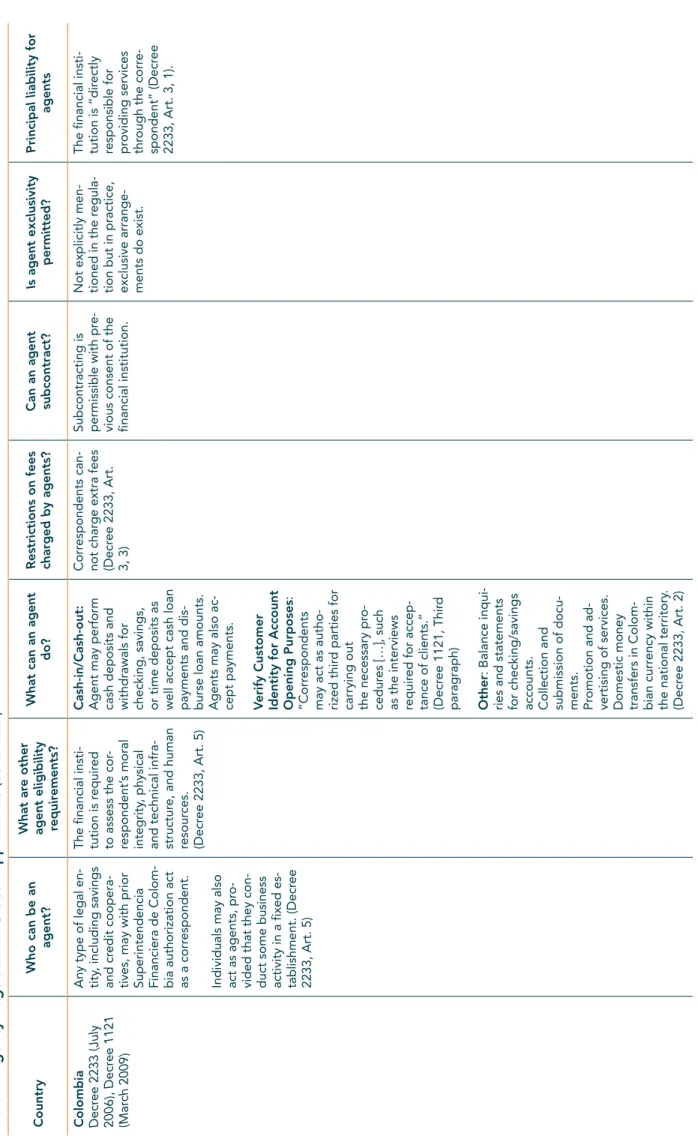
Table 1: Agency Regulations: Global Approaches
Country W ho c an b e an ag en t? What ar e other agent eligibility requir ements? What can an agent do? Restrictions on fees charged by agents? Can an agent subcontract? Is agent exclusivity permitted? Principal agentsBrazil (Resolution CMN 3110, July 2003, as amended by Resolution CMN 3156, December 2003; Resolution CMN 3654, December 2008 and Resolution CMN 3954, February 2011)
“Only entrepreneurial companies and associations (as defined by Law 10,406 of 2002) and providers of notary and registry services (as defined by Law 8,935 of 1994) can be hired as agents.” (Resolution CMN 3954, Art. 3). Financial institutions and other institutions that are part of the national financial system can be hired as agents. (Resolution CMN 3954, Art. 3, III) Except for activities such as (
i
) receiving
and forwarding proposals for credit and (
ii
) payments and
electronic transfer, it is prohibited to hire an entity whose principal or sole activity is the provision of agent services. Note: Individuals may not act as agents. In the case of agents who offer credit operations, they must pass a certification examination carried out by a recognized entity with the technical capacity. (Resolution CMN 3954, Art. 12) The certification must include technical aspects of operations, applicable regulation, consumer protection, ethics, and auditing. (Resolution CMN 3954, Art. 12, II)
Cash-in/Cash- out:
Agents may
perform deposits and withdrawals and bill payments. (Resolution CMN 3110, Art. 1) Verify Customer Identity for Account Opening Purposes: Correspondents may receive and forward account opening applications. Other:
Agents may, inter alia , ( i )
receive and forward applications for credit/ credit cards, (ii) handle receipts, payments, and electronic transfers for credit or debit to customer deposit accounts, and (iii) extrajudicial collection services. (Resolution CMN 3954, Art. 8) Agents are prohibited from “charging, on its own initiative, any fee connected with the provision of the services to which the contract refers.” (Resolution CMN 3110, Art. 4, IV(c) and Resolution CMN 3954, Art. 17)
Subcontracting is permissible with previous consent of the financial institution. (Resolution CMN 3110, Art. 4, III) Only one level of subcontracting is allowed if contract allows for this possibility. (Resolution CMN 3954, Art. 7) Not explicitly mentioned in the regulation, but in practice, exclusive arrangements do exist.
Country W ho c an b e an ag en t? What ar e other agent eligibility requir ements? What can an agent do? Restrictions on fees charged by agents? Can an agent subcontract? Is agent exclusivity permitted? Principal agents Colombia Decr ee 2233 (July 2006), Decr ee 1121 (Mar ch 2009)
Any type of legal en- tity
, including savings
and cr
edit
coopera-tives, may with prior Superintendencia Financiera de Colom- bia authorization act as a corr
espondent.
Individuals may also act as agents, pr
o-vided that they con- duct some business activity in a fixed es- tablishment. (Decr
ee
2233, Art. 5)
The financial insti- tution is r
equir
ed
to assess the cor
-respondent’
s moral
integrity
, physical
and technical infra- structur
e, and human
resour
ces.
(Decr
ee 2233, Art. 5)
Cash-in/Cash-out: Agent may perform cash deposits and withdrawals for checking, savings, or time deposits as well accept cash loan payments and dis- burse loan amounts. Agents may also ac- cept payments. Verify Customer Identity for Account Opening Purposes
:
”Corr
espondents
may act as autho- rized thir
d parties for
carrying out the necessary pr
o-cedur
es […], such
as the interviews requir
ed for
accep-tance of clients.” (Decr
ee 1121, Thir
d
paragraph) Other
: Balance
inqui-ries and statements for checking/savings accounts. Collection and submission of docu- ments. Promotion and ad- vertising of services. Domestic money transfers in Colom- bian curr
ency within
the national territory
. (Decr ee 2233, Art. 2) Corr espondents can-not char ge extra fees (Decr ee 2233, Art. 3, 3)
Subcontracting is permissible with pr
e-vious consent of the financial institution. Not explicitly men- tioned in the r
egula-tion but in practice, exclusive arrange- ments do exist. The financial insti- tution is “dir responsible for providing services thr
ough the corr
spondent” (Decr 2233, Art. 3, 1).
Table 1: Agency Regulations: Global Approaches
India BC Cir
culars and
amendments (Janu- ary 2006, Mar
ch
2006, April 2008, April 2009, Novem- ber 2009, September 2010)
”NGOs/MFIs set up under Societies/T
rust
Acts, Societies r
egis-ter
ed under Mutually
Aided Cooperative Societies Acts or the Cooperative Societ- ies Acts of States, section 25 compa- nies, … and Post Of- fices” (January 2006, Section 3.1) Later added: “r
etir
ed
bank employees, ex-servicemen and retir
ed government
employees.” (April 2008) Later added: “(i) individual kirana/ medical/fair price shop owners (
ii
)
Agents of Small Sav- ings schemes of Gov- ernment of India/ Insurance Companies (iv) individuals who own Petr
ol Pumps ( v ) Retir ed teachers and ( vi ) Authorized
functionaries of well run Self Help Gr
oups
(SHGs) linked to banks.” (Section 2, November 2009) Location: “The dis- tance between the place of business of a BC and the base branch, or
dinarily
,
should not exceed 15 Kms in rural, semi- urban and urban areas. In metr
opoli-tan centr
es, the
dis-tance could be up to 5 kms.” (April 2008) Later expanded: BC place of business must be within 30 kilometers of the “base branch” of the bank. (April 2009) Due diligence may be carried out on po- tential BCs. Such due diligence exer
cise
may include aspects such as “(
i ) r eputa-tion/market standing, ( ii ) financial sound-ness, ( iii )
manage-ment and corporate governance, (
iv
) cash
handling ability and (v) ability to imple- ment technology so- lutions in r
endering
financial services.” (September 2010)
Cash-in/Cash-out: BCs may engage in (
i ) disbursal of small-value cr edit, ( ii )
recovery of principal/ collection of inter
-est, and (
iii
) r
eceipt
and delivery of small value r
emittances /
other payment in- struments.” (January 2006, Sec- tion 3.2) Verify Customer Identity for Account Opening Purposes: “The banks may
, if
necessary
, use the
services of the BC for pr
eliminary work
relating to account opening formalities. However
, ensuring
compliance with KYC and AML norms under the BC model continues to be the responsibility of banks.” (September 2010, Section 5) Other:
BCs may also
engage, inter alia, in (i) identification of borr
owers, (
ii
)
collec-tion and pr
eliminary
“The banks may pay reasonable com- mission/fee to the BC, the rate and quantum of which may be r
eviewed
periodically
. The
agr
eement with the
BC should specifi- cally pr
ohibit them
fr
om char
ging any
fee to the customers dir
ectly for services
render
ed by them on
behalf of the bank. The banks (and not BCs) ar
e permitted to collect r easonable service char ges fr om
the customers in a transpar
ent manner”
(January 2006, as restated September 2010) Permitted by implica- tion and r
efer
enced
in Paragraph 3 of September 2010 circular
. See column
to right.
“While a BC can be a BC for mor
e than
one bank, at the point of customer interface, a r
etail
out-let or a sub-agent of a BC shall r
epr
esent
and pr
ovide banking
services of only one bank.” (September 2010, Para. 3) “[A]ll agr contracts with the customer shall clearly specify that the bank is r to the customer for acts of omission and commission of the Business Facilitator/ Corr
espondent.”
(January 2006, as restated September 2010, Section 10(iv)) ”The outsour ing of any activity by bank does not diminish its obliga- tions, and those of its Boar
d and senior
management, who have the ultimate responsibility for the outsour
ced
Table 1: Agency Regulations: Global Approaches
(continued)
Country W ho c an b e an ag en t? What ar e other agent eligibility requir ements? What can an agent do? Restrictions on fees charged by agents? Can an agent subcontract? Is agent exclusivity permitted? Principal agents India BC Cir culars andamendments (Janu- ary 2006, Mar
ch
2006, April 2008, April 2009, Novem- ber 2009, September 2010)
Later added: “any other individual including those op- erating Common Service Centr
es”
and “Companies register
ed under the
Indian Companies Act,1956 with lar
ge
and widespr
ead r
e-tail outlets, excluding Non Banking Finan- cial Companies.” (September 2010)
pr
ocessing of loan
applications includ- ing verification of primary information/ data, (
iii
) cr
eating
awar
eness about
savings and other products and educa- tion and advice on managing money and debt counseling, (iv) pr
ocessing and
submission of appli- cations to banks, and (v) sale of micr
o
in-surance/mutual fund products/pension products/other thir
d
party pr
oducts.
Kenya Guideline on Agent Banking— CBK/ PG/15 (May 2010)
La rg e ra ng e of e nt i-tie s: li m ite d li ab ili ty p ar tn er sh ip s, s ol e p ro p rie to rs hi p s, p ar t-ne rs hi p s, s oc ie tie s, co op er at iv e so ci et ie s, st at e co rp or at io ns , tr us ts , p ub lic e nt iti es , an d a ny o th er e nt ity w hi ch t he C en tr al B an k m ay p re sc rib e. (S ec tio n 4. 2. 3)
A principal institu- tion must establish that a potential agent has “existing well estab- lished commer
cial
activity which has been operational for at least eighteen months … has not been clas- sified as a deficient, doubtful, or non-per
-forming borr
ower by
an institution in the last 18 months…
C as h-in /C as h-ou t: Pe rm is si bl e ac tiv iti es in cl ud e ca sh d ep os it an d ca sh w ith dr aw al , ca sh d is bu rs em en t an d ca sh re pa ym en t o f lo an s, c as h pa ym en t of b ill s, c as h pa ym en t of re tir em en t a nd so ci al b en ef its , c as h pa ym en t o f s al ar ie s, tr an sf er o f f un ds . Ve ri fy C us to m er Id en ti ty f or A cc ou nt O p en in g P ur p os es : A g en ts m ay c ol le ct an d fo rw ar d c us to m er d oc um en ts in re la tio n to a cc ou nt o p en in g .
Agents shall not “[c]har
ge any fees
di-rectly to customers.” (Section 4.4.1(iii)) An agent shall not “subcontract another entity to carry out agent banking on its behalf.” (Section 4.4.1 (xiv)) “No contract be- tween an institution and an agent shall be exclusive. An agent may pr
ovide
services for agent banking to multiple institutions pr
ovided
that the agent has separate contracts for the pr
ovision of
such services with each institution and provided further that the agent has the ca- pacity to manage the transactions for the differ
ent institutions”
(Section 6.1)
“The institution is wholly r
esponsible
Th e fo llo w in g c an no t b e ag en ts : e nt iti es th at a re fa ith -b as ed or n on p ro fit , n on g ov -er nm en ta l o rg an iz a-tio ns , e d uc at io na l in st itu tio ns , f or ei g n ex ch an g e b ur ea us , an d a ny o th er e nt i-tie s no t p er m itt ed to c ar ry o n fo r-p ro fit ac tiv iti es . ( Se ct io n 4. 2. 4) Individuals ar e not expr essly permitted
to act as agents but are often appr
oved
as informal sole pr
o-prietorships (Sections 4.2.3 (ii), in coor
di-nation with Section 3.27). and possesses ap- propriate physical infrastructur
e and human r esour ces to be able to pr ovide
the services with the necessary degr
ee of
ef
ficiency and
secu-rity
.” (Section 3.1.1)
A principal institu- tion must also assess the moral, business and pr
ofessional
suitability of the sole pr
oprietor or
partners (and in the case of corporations, the CEO and of
ficer
responsible for agent operations) of any potential agent. In evaluating such suit- ability
, the following will be consider ed: cr edit history , crimi-nal r ecor ds, r
eputa-tion (as evidenced by two r
efer
ences),
business experience, sour
ces of funds,
business r
ecor
d, and
“any other matter which negatively or positively impacts on the person”. (Section 3.2.5)
O th er : Pe rm is si b le ac tiv iti es in cl ud e b al -an ce e nq ui ry ; g en -er at io n an d is su an ce of m in i b an k st at e-m en ts ; c ol le ct io n of d oc um en ts in r el at io n to lo an a p p lic at io ns , cr ed it an d d eb it ca rd co lle ct io n, c ol le ct io n of d eb it an d c re d it ca rd s; a g en t m ob ile b an ki ng s er vi ce s; ch ec k b oo k re q ue st an d c ol le ct io n b y cu s-to m er s; c ol le ct io n of b an k m ai l/ c or re sp on -d en ce fo r cu st om er s; an y ot he r ac tiv ity p re sc rib ed b y C en tr al B an k. ( Se ct io n 4. 4. 1) Expr essly Pr ohibited Activities: Agents
shall not, inter alia, open accounts, grant loans, or carry out any appraisal func- tion for purposes of opening an account or granting of a loan or any other facility
,
undertake check de- posit or encashment of checks, transact in for
eign curr
ency;
pr
ovide cash
Table 1: Agency Regulations: Global Approaches
(continued)
Country W ho c an b e an ag en t? What ar e other agent eligibility requir ements? What can an agent do? Restrictions on fees charged by agents? Can an agent subcontract? Is agent exclusivity permitted? Principal agentsMexico (Banking Cir
cular
,
12/2009 and amend- ments; Law on Cr
edit
Institutions,
1999
and
amendments)
Any legal entity
,
ex-cept financial institu- tions whose exclusive business is conduct- ing auxiliary cr
edit
activities as defined in law (
Law of
Auxil-iary Cr
edit Activities
and Or
ganizations,
1985 and amend- ments
), such as
br
okers and dealers.
Financial institutions can be agents only if allowed by their own bylaws, and exchange houses can be agents for certain types of services. Pawnbr
okers and
similar entities can- not be agents. (Bank- ing Cir
cular
, Chapter
XI, Section 2, article 325). Individuals can be agents only if they have a business and a permanent estab- lishment wher
e they
conduct such busi- ness. (Banking Cir
cu-lar , Annex 57, 3) Agents should ( i )
have a permanent establishment and suf
ficient capacity to pr operly operate electr onic devices, ( ii
) have the
neces-sary infrastructur e to pr ocess banking operations, and ( iii )
demonstrate good reputation and cr
edit
history
, including
lack of pr
evious civil
and criminal con- demnation and in- vestigations fr
om the Banking Commission. The r equir ements of good cr edit
his-tory and permanent establishment can be waived if an ANM fulfils them. (Banking Cir
cular
, Annex 57).
Agents should have a deposit account with the contracting bank against which all transaction will be conducted, except when a network manager is used. (Banking Cir
cular
,
Chapter XI, Section 2, Article 322, I)
Cash-in/Cash-out: withdrawals and de- posits fr
om/to bank
accounts by the ac- count holder Verify Customer Identity for Account Opening Purposes: may conduct CDD in the context of opening “low trans- actional” and “low risk” accounts—ac- counts subject to deposit and transac- tional limits. Other:
(
i
) Payments
(including loan r
e-payments) using credit and debit car
ds, checks, and
cash, (
ii
) transfers
be-tween bank accounts including of other banks, (
iii ) balance inquiries, ( iv )check cashing, and ( v )
term deposits (only thr
ough exchange
houses that have a capital adequacy ratio of at least 12%). (Banking Cir
cular
,
Chapter XI, Section 2, article 319).
Agents ar e pr ohib-ited fr om char ging
additional fees that wer
e not pr
eviously
set between bank and the client … (Banking Cir
cular
,
Chapter X, Section 2, article 324, VIII). Agents cannot sub- contract to thir
d par
-ties (Banking Cir
cular
,
Chapter X, Section 2, article 324, VIII(d)). Banks can nonethe- less hir
e agents
thr
ough agent
network managers. (Banking Cir
cular
,
Chapter X, Section 2, article 322, I).
Banks
cannot
hir
e
en-tities that have been acting as exclusive agents to another bank in the past 12 months and agents cannot sign exclusive agency agr
eements
to conduct payments of nonbank services and cr
edit car
d
payments (Banking Cir
cular
, Chapter XI,
Section 2, Article 324). Using agents does not exempt the bank, their manag- ers, employees, and legal r
epr
fr
om complying with the pr
ovisions of
Check cashing and withdrawals ar
e
lim-ited to 1,500 UDIs per client per day
.
Deposits ar
e limited
to 10,000 UDIs per client per day
, and
per agent to 25% of the average monthly gross deposits of the bank, as observed in the last 12 months. (Banking Cir
cular
,
Chapter XI, Section 2, Article 323)
Nigeria (Regulatory Frame- work for Mobile Payment Systems in Nigeria, 2009)
May be individu- als or legal entities. (Sections 5.2.1.3 and 5.2.1.4 by implica- tion.)
Service pr
ovider
must carry out agent due diligence measur
es, including
fingerprinting (in the case of individuals) and verifying r
egis-tration (in the case of legal entities). (Sec- tion 5.2.1.2) Agents must not maintain a till ex- ceeding N100,000 (appr
ox $655).
(Sec-tion 5.2.2)
Cash-in/Cash-out: Service pr
oviders
may appoint agents to facilitate “deposit and withdrawal/ cash-out.” (Section 5.2.1.1) Verify Customer Identity for Account Opening Purposes: Service pr
oviders
may appoint agents to facilitate “enr
ol-ment of customers” though unclear to what extent this per
-mits agents to verify identity for account opening purposes. (Section 5.2.1.1)
Unstated
E-money issuers may appoint agents and subagents. (Section 5.1.1)
The “agents ar
e not
restricted to any one scheme operator (they can serve as agents to multiple operators).” (2009, Section 5.2.26) Not clearly specified but common law as- sumption of liability for agent when act- ing under the au- thority of its agency agr
Table 1: Agency Regulations: Global Approaches
(continued)
Country W ho c an b e an ag en t? What ar e other agent eligibility requir ements? What can an agent do? Restrictions on fees charged by agents? Can an agent subcontract? Is agent exclusivity permitted? Principal agentsPakistan Branchless Bank- ing Regulations for Financial Institutions Desir
ous to
Un-dertake Branchless Banking (31 Mar
ch
2008)
Not specified. In practice may be legal entity or individual (provided such indi- vidual is the pr
opri-etor or operates a business). Financial institutions “should clearly de- fine various agent types and minimum agent selection cri- teria for each types. [They] should ensur
e
that agents ar
e well
established, enjoying good r
eputation and
having confidence of the local people.” (Section 6.3)
C as h-in /C as h-o ut : A g en ts m ay e ng ag e in c as h-in , c as h-ou t se rv ic es , in cl ud in g co lle ct in g c as h fo r b ill p ay m en ts (i nc lu d in g , w ith r es p ec t to u til ity p ay m en ts , f ro m b ot h re g is te re d a nd w al k-in c us to m er s) a nd lo an d is b ur se m en t an d r ep ay m en t. (S ec -tio n 6. 1) V er ify C us to m er Id en ti ty f o r A cc o un t O p en in g P ur p o se s: Fo r Le ve l 1 a cc ou nt s (a cc ou nt s he ld b y in d iv id ua ls s ub je ct t o b al an ce a nd t ra ns ac -tio n ca p s) a g en ts m ay fa ci lit at e op en in g b y co lle ct in g p ho to co p y of n at io na l I D c ar d , b io m et ric fi ng er p rin t sc an a nd d ig ita l p ho to a nd fo rw ar d in g su ch d oc um en ta tio n to fi na nc ia l i ns tit u-tio n. (S ec tio n 4)
“Agents may not alter/change char
ges/fees
struc-tur
e pr
ovided by the
bank in any way
. All char ges have to be pr e-agr eed between
the bank and the agent and should be clearly communi- cated to the custom- ers.” (Section 6.1) Agent subcontract- ing allowed and dif- ferent agent levels refer
enced (Super
Agents, Dir
ect
Agents, and Sub Agents.) (Section 6.2)
“One Agent can pr
o-vide services to mul- tiple banks pr
ovided
he (the agent) has a separate service level agr
eement with each
bank.” (Section 6.1)
“The ultimate r sponsibility for branchless banking lies with the Financial Institution. The FI may
, however
steps it deems nec- essary to safeguar itself against liabili- ties arising out of the actions of its agents, service pr partners.” (Section 5) “All agr
eements/