2009-2010 Leadership Advancement
Program Evaluation
Murari Suvedi, Professor
Sara Jablonski, Graduate Student
Center for Evaluative Studies
Department of Community, Agriculture, Recreation and Resource Studies 135 Natural Resources Building Michigan State University East Lansing, MI 48824
i
Executive Summary
In 2005, the Michigan State University College of Agriculture and Natural Resources started the Great Lakes Leadership Academy (GLLA). The goal was to develop leadership within the agriculture, natural resources, environmental and manufacturing sectors to address quality of life issues for Michigan. Part of this leadership academy is the Leadership Advancement Program, a two-year program that began in 2006. The second run of the program started in 2009. In the 2009-2010 cohort, there were 24 participants who started the program and 22 who completed it. Over the course of the program, participants were together for 45 days. The Leadership
Advancement Program was organized into 11 short sessions, ranging from one to five days in length, and a two-week international experience. Each session built on the experiences of the previous sessions. Though each session covered a different topic, they all addressed the mission of the GLLA: to promote positive change, economic vitality and resource conservation, and to enhance the quality of life in Michigan by encouraging leadership for the common good. The Leadership Advancement Program enhanced the leadership skills and knowledge of established leaders in Michigan’s private and public sectors. During each session, participants learned leadership skills and became familiar with sustainability and economic issues facing Michigan’s future. The projected outcomes of the program are: in the short-term, increased knowledge of personal and collective leadership skills based on the concept of leadership for the common good and a greater understanding of sustainability issues; in the medium-term, the creation of dynamic networks for addressing sustainability issues in Michigan and enhancing succession leadership; and in the long-term, involving program graduates in supporting the program and establishing a continually funded program.
The Michigan State University Center for Evaluative Studies performed the short-term evaluation of this program using pre- and program knowledge assessments and post-program telephone interviews. Before the post-program began, participants completed a
questionnaire to assess their leadership knowledge, styles and behaviors. This gave facilitators a baseline for gauging the progress of participants throughout the program. After the program ended, the same instrument was mailed to participants to assess their post-program leadership knowledge, styles and behaviors. Evaluation questions were based on the projected outcomes of the program and answered on a scale of strongly disagree (1) to strongly agree (5). The survey also included an open-ended question.
The survey data were analyzed using Predictive Analytics Software (PASW). Descriptive statistics such as mean, standard deviation and frequency counts were used to present findings, which show that participants in the program graduated with an increased understanding of the knowledge and skills necessary to be effective leaders. Post-program answers were recorded alongside pre-program answers in PASW where the data were analyzed using a paired t-test to determine the short-term outcomes of the program, i.e. changes in leadership knowledge, skills, and behaviors as a result of program participation. Twenty four participants completed the pre-program survey while twenty two completed the post-pre-program survey. Post-pre-program assessment open-ended comments show that many of the participants used skills learned during the program in their workplaces.
ii
As a result of participation in the GLLA Leadership Advancement Program, participants are more familiar with common leadership approaches (mean difference .78) and are more aware of their personal leadership styles. Participants also showed improvement in their vision of themselves as leaders (mean difference of .82) as well as greater
confidence in their leadership abilities (mean difference of .68).
The abilities to recognize leadership strengths in others, foster creativity in others and help people handle difficult transitions showed improvement (mean difference .57, .55 and .50, respectively).
Leadership skills such as strategic thinking, conflict resolution and communication skills improved.
Understanding of the program’s overarching concept, leadership for the common good, increased with a positive mean difference of 1.05. Participants’ understanding of the meaning of ‘systems thinking’ improved (mean difference 1.36).
Participants reported a better understanding of varying perspectives of the role of government in society (mean difference .68).
Participants stated that their understanding of group process skills and listening skills improved (mean difference .96 and .68, respectively).
After the program, participants had a better understanding of the key issues facing Michigan (mean difference .91).
Participants were contacted for follow up interviews two months after graduation from the program to gather information about whether or not they continued to use what they had learned in the program in their workplaces and communities. Analysis of the comments revealed that most participants were applying leadership concepts to their jobs and community organizations, had ideas for increasing collaboration between the sectors of agriculture, environment, natural resources, and manufacturing, and had taken on more responsibilities in their jobs or
communities or started in new positions.
The results of this evaluation show the Leadership Advancement Program as being a success. Because of the program, participants have improved their leadership knowledge, skills and abilities. Participants stated that they know more about leadership than they did when they entered the program. They also have a greater understanding of the sustainability issues affecting Michigan. Even though this evaluation focuses on assessing the short-term outcomes of the program, findings from the interviews indicate that participants are aware of both the medium and long-term objectives and are beginning to meet those objectives.
Unlike other leadership programs in Michigan, the Leadership Advancement Program focuses on the shared future of Michigan’s agriculture, natural resources, environmental, and manufacturing sectors. The skills, knowledge and abilities developed during the course will allow participants to shape the future of Michigan, not only by improving their organizations but also by improving their communities.
iii
Table of Contents:
EXECUTIVE SUMMARY ... I LIST OF TABLES: ... IV
OVERVIEW ... 1
REVIEW OF LEADERSHIP DEVELOPMENT PROGRAMS ... 1
LEADERSHIP ADVANCEMENT PROGRAM, 2009-2010: ... 4
METHODS AND PROCEDURES ... 8
RESULTS AND DISCUSSION ... 10
CONCLUSIONS ... 18
RECOMMENDATIONS ... 20
REFERENCES ... 23
APPENDIX A ... 24
POST PROGRAM ASSESSMENT INSTRUMENT APPENDIX B ... 27
POSTPROGRAM ASSESSMENT QUALITATIVE ANSWERS APPENDIX C ... 30
iv List of Figures and Tables:
Figure 1: Program Logic Model of GLLA Leadership Advancement Program ... 9 Table 1: Pre- and Post- Paired Sample Analysis………..12
1
2009-2010 Leadership Advancement Program Evaluation
OverviewIn 2005, the Michigan State University College of Agriculture and Natural Resources established the Great Lakes Leadership Academy (GLLA). The goal was to develop leadership within communities and the agriculture, natural resources, environmental and manufacturing sectors to address quality of life issues for the citizens of Michigan. The mission of the leadership
academy is to promote positive change, economic vitality and resource conservation, and enhance the quality of life in Michigan by encouraging leadership for the common good. It focuses on the issues and challenges associated with helping leaders from diverse constituencies transcend self-interest and create workable partnerships.
The GLLA provides two distinct leadership programs focusing on the needs of developing leaders throughout their careers, as well as a strong alumni support network.
(1) The Emerging Leader Program, delivered over nine months, focuses on developing individual and organizational leadership skills and applying those skills in a collaborative fashion to common issues of diverse communities.
(2) The Leadership Advancement Program is a two-year program in which participants learn from leaders in both the public and private sectors who have been social change agents on local, regional and state levels. The program is designed for experienced leaders seeking to enhance their impact on leadership for the common good. The two-year program was broken down into 12 sessions, each focusing on a topic or skill necessary for quality leadership. During the program, participants had the opportunity to travel within the state and internationally to learn from local leaders.
This study is a formative evaluation of the Leadership Advancement Program. Evaluation data were collected by surveying participants before and after the program and by performing interviews two months after the program. The evaluation focused on the short-term outcomes for the program participants.
Review of Leadership Development Program Evaluations
The fundamental definition of leadership is a “process where an individual influences [a] group of individuals to achieve a common goal” (Northouse, 2004, p. 3). Leadership is not about power or position but rather the relationship between leaders and their followers. Leadership is a skill set learned through training, skills development and evaluation (Addor et al., 2005).
Authority is not necessary for an individual to lead; however, people may resent a person who uses power and control without authority. Authority comes from the trust that individuals have for a person resulting from his/her knowledge, skills or experience. Leadership development programs give current and future leaders the skills necessary to lead with authority rather than with control (Heifetz, 1994).
Leadership development programs often have tangible results such as personal career
2
tangible results – for instance, a person’s change in values, worldview or self-awareness (Grove et al., 2002). These changes may be episodic, developmental or transformative (Grove, Kibel and Haas, 2005). Because this study deals with short-term outcomes that are immediately observed, it measures episodic changes. Episodic changes are measured based on the actions of program activities and other participants, such as an increase in knowledge or the writing of a grant proposal. Because they are tangible, episodic changes can be evaluated, using both quantitative and qualitative data, through surveys and interviews with program participants, without requiring more extensive data collection or feedback (Grove, Kibel, & Haas, 2005). Since leadership programs often have unanticipated or unknown outcomes, open-ended
questions can be an important data collection option for evaluation (Howard and Reinelt, 2007). In 2003, the W.K. Kellogg Foundation published a review of 55 leadership development
programs. The purpose of this publication was to provide information concerning evaluation methods to anyone interested in leadership development. As part of the investigation, the Kellogg Foundation used the definitions of outcomes and impacts from their Logic Model Development Guide. It defined outcomes as:
[The] specific changes in attitudes, behavior, knowledge, skills, status, or level of
functioning expected to result from program activities. Outcomes may be short-term (1-3 years) or long-term (4-6 years). Impact refers to the…future social change a program is working to create (Reinelt, Sullivan & Foster, 2003, p. 6).
Using the above definition, this study focuses on the short-term outcomes of the Leadership Advancement Program.
In 1993, the University of Wisconsin began to evaluate the outcomes and impacts of the
Wisconsin Rural Leaders Program. Their study sought to determine what knowledge and skills participants of the program had acquired (Dhanakumar, Rossing, & Campbell, 1996). The study found that program participants retained the most knowledge through a process of action and reflection. Similarly, in an analysis of various student leadership programs, Zimmerman and Burkhart (1999) found that successful leadership programs often use multiple leadership teaching strategies and have participants actively involved in running the program. These programs showed increases in civic, social and political awareness as well as improved self-esteem and communication skills.
Other studies on outcomes of leadership development programs have shown that program participants use what they have learned within and outside their organizations. Addor et al. (2005) found that graduates of the Natural Resources Leadership Institute were more confident in their abilities and were more likely to participate in collaborative projects with other
organizations compared to leaders who had not participated in a leadership development program. Diem and Nikola (2005), in a study of the New Jersey Agricultural Leadership
Development Program, found that participants were more active in their communities because of the program. They felt more prepared for career advancement and had more self-confidence in the communities where they worked. Participants also felt that other people saw them as more credible after graduating from the program. The advancement in leadership ability came not only from the skills they learned during the course but also from the self-awareness that came from its completion. Further, Ciporen (2010) found that leaders who experience personal
3
transformation as a result of leadership programs have greater impacts on their organizations than those who have not experienced such changes.
Outcomes are not limited to personal growth – leadership programs can also focus on communities and organizations. Participants in community leadership programs are firmly rooted in their communities and devoted to working with others to promote positive change. Evaluation for community leadership programs focuses on changes to the community as a whole. Attempts at change are considered positive even when observable changes do not occur (Behrens & Benham, 2007).
Studies that look at long time frames can more easily show the outcomes and impacts of leadership programs, especially at the community level. A study by Black (2007) measured the outcomes of a statewide leadership program in Ohio of ten classes of alumni from all 20 years of the program. Through surveys and focus group interviews, she found that participants improved knowledge and increased activity at the individual, business, and community levels as a result of the program. Also, a longitudinal study of the Kellogg National Fellowship Program showed that, for at least six years after completion, graduates of the program were more involved in politics than they had been prior to the program (Markus, 2001).
The GLLA Leadership Advancement Program incorporates many of the characteristics of the above programs. The GLLA program is characterized by active participant involvement and focuses on expanding leadership through the education of public and private sector leaders. It utilizes multiple teaching techniques, such as group exercises, issues teams, and an international experience to engage participants with leadership in various ways. It also encourages
participants to reflect on their personal leadership experiences throughout the program,
emphasizing self-awareness and personal growth as integral aspects of leadership development. Further, it highlights the importance of community involvement by presenting “leadership for the common good” as one of the principle program themes. A significant number of sessions are devoted to issues team projects, which engage participants in problem-solving of
interdisciplinary issues affecting Michigan’s communities.
In an evalution of seven community leadership programs,Earnest (1996) performed pre- and post participation assessments, as well as focus group and in-person interviews, to measure program outcomes. In their evaluation of the Wisconsin Rural Leaders Program, Dhanakumar, Rossing, and Campbell (1996), used surveys and interviews to collect both quantitative and qualitative data. Similar to the above studies, the present evaluation uses pre- and post-program surveys and follow up interviews to measure the short-term outcomes of the Leadership Advancement Program. Pre- and post-program questionnaires assessed the participants’ leadership knowledge before starting the program as well as perceived changes to their attitudes, knowledge and skills immediately upon program completion. Follow up interviews performed two months after graduation gathered both quantitative and qualitative data to assess the continued influence of the program on participants.
4
The Great Lakes Leadership Academy’s Leadership Advancement Program, 2009-2010:
The Leadership Advancement Program, which consisted of a total of 45 meeting days, was organized in 11 short sessions and a two-week international experience. Each session built on the knowledge gained from previous sessions. The focus of each session varied, but they all centered on the mission of the program: to promote positive change, economic vitality and resource conservation, and to enhance the quality of life in Michigan by encouraging leadership for the common good.
The Leadership Advancement Program application was advertised through various channels, including state government offices and private industries in the sectors of agriculture, natural resources, environment, and manufacturing. The GLLA directors conducted thirty applicant interviews and selected twenty four participants. While twenty four people started the program, four dropped out and were replaced by two new participants, with a total of twenty two people completing the program.
Participants included emerging and existing leaders who had demonstrated leadership ability and commitment to their communities. They were all established professionals who came from both the public and private sectors of Michigan. Professional backgrounds included agriculture, environmental management, business, manufacturing, food systems, community development and natural resources. Public sector areas included the Michigan Departments of Environmental Quality, Natural Resources and Agriculture.
The overall objectives of the Leadership Advancement Program were:
To help participants develop their individual and collective leadership to help diverse constituencies transcend self-interest and create workable solutions for the common good.
To help participants deepen their understanding of and increase their appreciation for the divergent perspectives associated with sustainability issues.
To create and implement dynamic networks to provide dialogue and encourage action on the critical sustainability challenges facing Michigan.
To enhance the capacity for succession leadership for Michigan’s future.
To involve program graduates in supporting the program as members of the governing board, coaches, mentors and speakers, and in the recruitment and selection of future cohorts.
To establish a continuing program funded by tuition, grants, private gifts and university resources.
Session Objectives
During each session, a principle objective was to enhance the personal growth and development of each program participant. In addition, the objectives for each of the twelve sessions were as follows:
5
Session one, from January 9-10, 2009 was an orientation which sought to:
• Provide participants an opportunity to meet each other and begin the process of learning about their interests in leadership for communities, agriculture, natural resources, manufacturing and the environment.
• Provide an overview of the program for spouses and significant others and create an awareness of the expectations for participants in the program.
• Begin the process of identifying and learning about key issues impacting communities, food systems, agriculture, natural resources, manufacturing and the environment in Michigan.
• Create awareness of the common leadership approaches and define “leadership for the common good.”
• Gain a greater understanding of how geography and the environment have impacted the economy and quality of life in Michigan and the Great Lakes region.
Session two, from February 18-20, 2009, focused on self-assessment/individual development with the aim to:
• Increase knowledge of self and our perception of the world around us.
• Develop a greater appreciation of differences and the value of diverse opinion. • Develop an awareness and understanding of key issues impacting communities, food
systems, agriculture, natural resources, manufacturing and the environment in Michigan. • Develop group norms.
• Develop knowledge of and practice the use of appreciative inquiry.
The third session, from March 15-19, 2009, was a wilderness experience. Its objectives were to: • Build trust and camaraderie among participants.
• Encourage group problem-solving and collaboration. • Increase self-confidence.
• Encourage group adaptability to change and new environments. • Experience the value of diverse opinions, abilities, and cultures.
• Create an understanding of natural intelligence and how nature works to address the challenges within communities.
• Strengthen the ability to listen to others and have difficult conversations.
During session four, from April 21-23, 2009, participants learned how to discuss difficult issues. The objectives of the session were to:
• Encourage group problem-solving and collaboration.
• Sharpen listening, dialogue, and conflict resolution abilities. • Start the process of forming Issues Teams.
• Develop an awareness and understanding of the key issues impacting communities, food systems, agriculture, natural resources, manufacturing and the environment in Michigan.
6
Session five, from June 24-26, 2009, was held in Detroit and explored natural resource and environmental issues from an urban perspective. Its objectives were to:
• Understand natural resource, environmental, economical and social issues from a Detroit perspective.
• Identify positive leadership “stories” from Detroit community leaders. • Understand how rural and urban issues interface.
• Finalize Issues Teams and select specific issues and coaches for each team.
In session six, from September 21-23, 2009, participants learned about how to influence public policy. The goals of this session were to:
• Provide access to state agencies, public officials, special-interest groups and university resources for Issues Teams research.
• Build awareness and understanding of the policy-making process and the role of NGO’s and special interest groups.
• Develop greater understanding and appreciation for looking at the bigger picture. • Learn how to identify performance challenges in a group or team format.
• Sharpen interviewing, research and group decision-making abilities.
• Develop skills in group facilitating, issues framing, and communication around challenging issues.
During the months of October – December 2009, individual issues teams held planning sessions to continue researching their issue and reach group consensus on how to frame and present their issue to the full cohort.
Session seven, from January 13-15, 2010, focused on Issues Team presentations. The objectives of this session were to:
• Learn about and experience critical issues related to communities, food systems, agriculture, natural resource, manufacturing and the environment.
• Provide opportunities for in-depth dialogue on critical issues as facilitated by the cohort. • See and experience various geographic areas within Michigan and learn how they are
impacted by these critical issues.
• Develop a greater desire to provide leadership for the common good that will result in an improved quality of life for the citizens of Michigan.
Session eight, from February 23-26, 2010, was a continuation of the issues presentations from session seven with a follow up discussion of what to do about Michigan’s future, focusing on how to:
• Develop systems thinking/big picture thinking and appreciation for broader perspectives. • Create one or more scenarios for Michigan’s future based on the various issues explored
7
• Create opportunities for the cohort to formulate a plan for impacting social change associated with these issues.
In session nine, from March 24-26, 2010, participants debriefed the issues team experience and also:
• Developed understanding and appreciation for entrepreneurial leadership. • Provided peer feedback.
• Prepared for the international session.
Session ten, on June 4, 2009, was a preparation for the international experience. During session eleven, from August 1-14, 2010, participants traveled to Spain for the international experience. The goals of this experience were to:
• Explore and learn about community, food systems, agriculture, natural resources, manufacturing and environmental issues from a global perspective.
• Create opportunities for developing a broader view of various economic, political, cultural and social systems.
• Examine leadership in the context of differing political, cultural and social systems. • Witness resource management, entrepreneurialism, and leadership in the context of a
developing economy.
Session twelve, from September 16-18, 2010, was a wrap-up and graduation. Its objectives were to:
• Debrief the international experience.
• Reflect on the entire two-year program as a cohort and personally.
• Provide an opportunity to celebrate personal and cohort growth during the two-year program.
• Reflect on leadership for the common good and how the alumni network can provide opportunities to leverage the experience of the previous two years.
Methods and Procedures
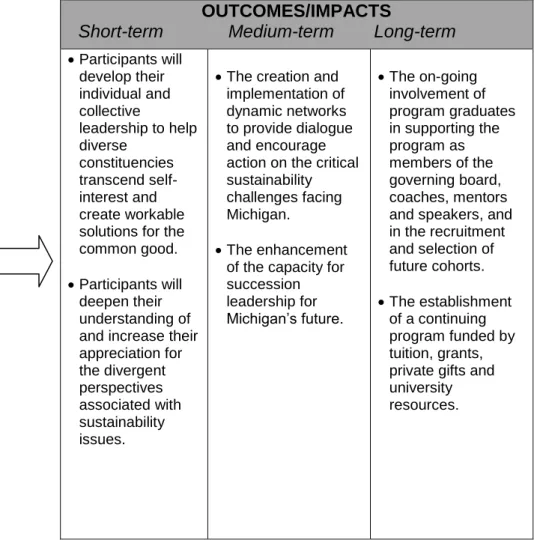
The nature of leadership development makes evaluation of leadership programs difficult. Since leadership development does not occur at a static point in time but rather through a multitude of experiences (Grove et al., 2002, p.7), outcomes are likely to occur far in the future and projected outcomes are difficult to connect back to the program with any certainty. Changes to policy or public services can also mask the impacts of leadership programs dedicated to social change (Howard & Reinelt, 2007). Considering the challenges of leadership evaluation, a conceptual framework, following the logical framework was developed to guide the evaluation of this leadership program (Figure 1).
8
Figure 1: Program Logic Model of GLLA Leadership Advancement Program
INPUTS OUTPUTS
Activities Participants
OUTCOMES/IMPACTS
Short-term Medium-term Long-term
Financial:
Grant from the W.K. Kellogg Foundation Human resources: MSU faculty and staff
members Partners W.K. Kellogg
Foundation
MSU College of ANR MSU Extension 11 short sessions teaching advanced leadership skills 1 two-week international experience connecting session knowledge to the global scale Hands-on learning
experiences Analyzing impact of
major themes on all of society
Creating a forum of diverse perspectives Infusing the program
with the experience and wisdom of Michigan leaders
Developing broader perspectives by
exposing participants to social, economic and cultural differences on the community, state, national, tribal and global levels Emerging and existing leaders who have demonstrated leadership ability and commitment to their communities. Participants will develop their individual and collective leadership to help diverse constituencies transcend self-interest and create workable solutions for the common good. Participants will
deepen their understanding of and increase their appreciation for the divergent perspectives associated with sustainability issues.
The creation and implementation of dynamic networks to provide dialogue and encourage action on the critical sustainability challenges facing Michigan.
The enhancement of the capacity for succession leadership for Michigan’s future. The on-going involvement of program graduates in supporting the program as members of the governing board, coaches, mentors and speakers, and in the recruitment and selection of future cohorts. The establishment of a continuing program funded by tuition, grants, private gifts and university resources.
9
Before the program began, participants completed a 51-item questionnaire to assess their
leadership knowledge, styles and behaviors. This gave facilitators a starting point from which to gauge the progress of participants throughout the program. After the program ended, the same instrument (see Appendix A) was mailed to participants to assess their post-program leadership knowledge, styles and behaviors. This questionnaire was sent out six weeks after the program ended. The questionnaires were based on a 5-point Likert-type scale, where 1=strongly disagree, 2=disagree, 3=neither agree nor disagree, 4=agree, and 5=strongly agree. In the post-program assessment questionnaire, participants also gave short answers about specific skills and
knowledge they took away from the Leadership Advancement Program (see Appendix B for full answers). Participants were given unique numbers on their pre-program assessments and the same numbers on their post-program instruments. Answers from the post-program survey were recorded alongside the pre-program answers. There were twenty four participants at the start of the program and twenty two at the end of the program. Researchers analyzed evaluation data, using PASW (SPSS) for mean, standard deviation and frequency percentage and paired t-test. Two and a half months after completion of the program, the researchers conducted follow up telephone interviews. Interviews consisted of nine open-ended questions about how the participants were applying what they learned in the program to their jobs and in their
communities. Interviews lasted approximately 15 minutes each. All twenty two participants who completed the program were interviewed. Results of telephone interviews were analyzed by comparing responses for each question and highlighting the themes that emerged from each question.
Results and Discussion
Development of individual and collective leadership skills to work for the common good Statistical analysis of the pre- and post-program surveys (Table 1) and responses to the follow up interview questions show that participants increased their knowledge, skills, and abilities as leaders of Michigan. Participants showed increased understanding of the themes represented in the objectives of the Leadership Advancement Program. In terms of the first short-term
objective, to help participants develop personal and collective leadership skills, the pre- and post-test analysis shows that participants were more familiar with common leadership approaches by the end of the program. On a scale of 1 to 5, the mean pretest score for this item was 3.68 (sd
=.77) and the mean posttest score was 4.64 (sd =.49). A significant increase from pretest to posttest was found (t(21) = 4.17, p =.00). They also had better visions of themselves as leaders. The mean pretest score for this item was 3.77 (sd =.80) and the mean posttest score was 4.59 (sd
=.58). A significant increase from pretest to posttest was found (t(21) = 6.71, p =.00). They also had more confidence in their abilities as leaders of others. The mean pretest score for this item was 3.68 (sd =.78) and the mean posttest score was 4.36 (sd =.49). A significant increase from pretest to posttest was found (t(21) = 4.10, p =.00). The participants increased their abilities to recognize leadership strengths in others. The mean pretest score for this item was 3.95 (sd =..50) and the mean posttest score was 4.52 (sd =.51). A significant increase from pretest to posttest was found (t(21) = 3.87, p =.00). Their understanding of how to foster creativity in others also
10
increased. The mean pretest score for this item was 3.36 (sd =..66) and the mean posttest score was 3.91 (sd =.53). A significant increase from pretest to posttest was found (t(21) = 3.91, p
=.00). Participants’ understanding of the steps involved in the listening process also improved. The mean pretest score for this item was 3.82 (sd =.50) and the mean posttest score was 4.50 (sd
=.51). A significant increase from pretest to posttest was found (t(21) = 4.95, p =.00).
In terms of working with diverse groups for the common good, the pre-and-post program survey results also suggest improvement in this area. Participants’ appreciation of cultural differences increased. The mean pretest score for this item was 4.14 (sd =.71) and the mean posttest score was 4.64 (sd =.50). A significant increase from pretest to posttest was found (t(21) = 3.17, p
=.01). Understanding of group process skills improved. The mean pretest score for this item was 3.36 (sd =.66) and the mean posttest score was 4.32 (sd =.48). A significant increase from pretest to posttest was found (t(21) = 5.70, p =.00). Participants also gained knowledge about how to use a variety of techniques to resolve conflict among others. The mean pretest score for this item was 3.32 (sd =.84) and the mean posttest score was 4.14 (sd =.47). A significant increase from pretest to posttest was found (t(21) = 4.23, p =.00). Further, understanding of the program’s overarching concept, leadership for the common good, also improved. The mean pretest score for this item was 3.50 (sd =.86) and the mean posttest score was 4.55 (sd =.51). A significant
increase from pretest to posttest was found (t(21) = 5.46, p =.00).
Responses to the follow up interviews also demonstrated that participants have enhanced their personal and collective leadership skills and have increased their understanding of themes related to helping diverse constituencies transcend self-interest and create workable solutions for the common good. In response to a question about changes in personal leadership styles and behaviors, each participant mentioned at least one of the following themes: taking a more positive, appreciative approach to leadership; looking internally at personal strengths,
weaknesses, and needs; being a better listener and communicator; incorporating more people into the decision making process; and learning to step back so that others might take ownership of decisions. Selected comments about these topics include:
“I have utilized a more positive approach through appreciative inquiry and I’ve focused on what is working in programs, the bigger picture, and working down in the details from there.”
“My relationships with my family and my co-workers have improved. This is because of my ability to start looking internally at myself. Trying to get better at listening and communicating and taking responsibility for my own personality issues.”
“I’m more communicative and not just making people know when they’ve offended me but also showing appreciation when they do something for me or someone else.” “The most personal change for me was to include everybody. It was a profound
experience over the last couple years with GLLA to learn that strength is in diversity.” “In the past I wanted to control the whole situation. Instead, I’ve now paused and allowed others to make decisions.”
These responses show that participants learned how to make better personal decisions and facilitate collective decision making.
11 Table 1: Pre- and Post- Paired Sample Analysis
Pre-test mean* (S.D.) Post-test mean* (S.D.) Diff. Paired t-value Sig. 1. I am familiar with common leadership
approaches.
3.86 (.77)
4.64
(.49) .78 4.17 .00 2. I am aware of how my personal
preferences impact my relationships.
3.95 (.49)
4.73
(.46) .78 5.92 .000 3. I am confident in my ability to help
people handle chaos during times of transition.
3.77 (.61)
4.27
(.46) .50 3.17 .01 4. I know how to facilitate time
management in group process.
3.64 (.79)
4.18
(.50) .54 3.20 .00
5. I appreciate cultural differences. 4.14 (.71)
4.64
12 6. I understand the steps involved in the
listening process.
3.82 (.50)
4.50
(.51) .68 4.95 .00 7. I can function effectively as part of an
interdisciplinary team to solve problems.
4.23 (.61)
4.59
(.59) .36 2.94 .01 8. I am aware of the common issues
shared between Canada and the United States.
3.00 (.87)
3.18
(.59) .18 .89 .38 9. I can recognize leadership strengths in
others.
3.95 (.50)
4.52
(.51) .57 3.87 .00 10. I understand how to use 360 degree
feedback to evaluate my performance.
3.27 (1.07) 4.14 (.94) .87 3.47 .00 11. I consider myself to be an entrepreneurial leader. 3.27 (.70) 3.77 (1.07) .50 2.57 .02 12. I understand how to foster creativity in
others.
3.36 (.66)
3.91
(.53) .55 3.20 .00
13. I prefer working alone. 2.45 (.67)
2.50
(1.01) .05 .21 .83 14. I understand what “systems thinking”
means.
2.59 (.80)
3.95
(.58) 1.36 6.71 .00
15. I have a vision of myself as a leader. 3.77 (.75)
4.59
(.50) .82 4.50 .00 16. I understand the policy-making process
of government.
3.68 (.89)
4.05
(.95) .37 1.89 .07 17. I am confident in my ability to manage
conflict in groups which are experiencing change.
3.59 (.91)
4.23
(.61) .64 2.85 .01
18. I understand group process skills. 3.36 (.66)
4.32
(.48) .96 5.70 .00 19. I prefer to use strategic thinking rather
than “day-to-day” thinking.
3.82 (.91)
4.14
13 20. I understand the complexity of
manufacturing, agricultural, and quality of life issues as they relate to the environment and natural resources.
3.50 (.91)
4.64
(.49) 1.14 5.14 .00 21. I have the ability to work with others to
improve the quality of life for the citizens of Michigan.
4.32 (.48)
4.64
(.49) .32 2.31 .03 22. I understand the difference between
futuring and doing business as usual.
3.27 (.94)
4.32
(.48) 1.05 5.16 .00 23. I am aware of various theories of
change management.
2.91 (.92)
4.05
(.58) 1.14 6.39 .00 24. I have an understanding of the
divergent perspectives associated with sustainability issues.
3.18 (.80)
4.36
(.66) 1.18 5.27 .00 25. I am willing to share power in
appropriate situations.
4.27 (.55)
4.64
(.58) .37 2.35 .03 26. I am aware of how my personal
preferences impact my ability to influence others.
3.86 (.64)
4.45
(.60) .59 2.89 .01
27. I am comfortable adapting to change. 4.00 (.54)
4.27
(.55) .27 2.03 .06
28. I am open to new ideas. 4.27 (.55)
4.64
(.49) .37 2.16 .04 29. I recognize the role that special interest
groups play in influencing public policy. 3.86 (.77) 4.59 (.50) .75 5.41 .00 30. I am confident in my abilities as a leader of others. 3.68 (.78) 4.36 (.49) .68 4.10 .00 31. I understand the key issues impacting
Michigan.
3.41 (.67)
4.32
(.72) .91 4.39 .00 32.I can identify my unique strengths as an
individual.
3.73 (.77)
4.41
(.50) .68 3.81 .00 33.I understand how to use a variety of
14
others. (.84) (.47)
34.I recognize my personal style of communicating.
3.59 (.67)
4.36
(.58) .77 4.17 .00
35.I can build rapport with others. 4.14 (.47)
4.64
(.49) .50 3.92 .00 36.I seek diverse perspectives when
making decisions.
4.09 (.61)
4.41
(.50) .32 2.08 .05
37.I can negotiate for win-win agreements. 3.82 (.73)
4.36
(.66) .54 2.81 .01 38.I understand various perspectives of the
role of government in society.
3.55 (.74)
4.23
(.61) .68 4.10 .00
39.I am aware of my strengths as a leader. 3.77 (.69)
4.36
(.49) .59 3.25 .00 40.I can build trust within a group during
times of organizational transition.
3.91 (.53)
4.32
(.57) .41 2.41 .03 41.I understand the critical issues
impacting various geographic areas within Michigan.
3.18 (1.01)
4.32
(.48) 1.14 4.57 .00 42.I can adapt to another person’s
communication style.
3.95 (.49)
4.14
(.47) .19 1.28 .21 43.I understand what “leadership for the
common good” means.
3.50 (.86)
4.55
(.51) 1.05 5.46 .00 44.I can communicate effectively during
times of transition.
3.68 (.57)
4.32
(.57) .64 3.31 .00 45.I look at the bigger picture when
making decisions.
4.09 (.61)
4.45
(.60) .36 2.59 .02 46.I can identify performance challenges
within a group.
3.45 (.60)
4.32
15 47.I am comfortable in my ability to assist
groups in making difficult decisions.
3.55 (.67)
4.27
(.70) .72 3.65 .00 48.I am able to reach decisions through
consensus.
4.10 (.44)
4.19
(.68) .09 .62 .54
49.I prefer working in teams. 3.82 (.59)
4.09
(.81) .27 1.24 .23 50.I encourage others to be part of the
decision-making process.
4.23 (.61)
4.55
(.51) .32 2.31 .03 51.I can facilitate cooperation among
group members.
4.00 (.62)
4.27
(.70) .27 1.82 .08 *Means calculated on a Likert scale, where where 1=strongly disagree, 2=disagree, 3=neither agree nor disagree, 4=agree, and 5=strongly agree.
Reliability analysis of the presession assessment questionnaire shows a Cronbach’s alpha value of .95.
In the short answer section of the post-program questionnaire, which asked respondents to describe skills and knowledge that they took away from the Leadership Advancement Program, eight participants noted the importance of better understanding oneself in order to become a better leader. The importance of having difficult conversations was mentioned five times. Also, four respondents noted that they learned to look at the bigger picture and work for the common good. Examples of comments related to this theme include:
“[The Leadership Advancement Program] helped me understand the importance of me making a change for the common good.”
“I have improved my ability to work with different groups of people with very different ideas about what needs to be done to help move Michigan forward, and build consensus for most problems. I have strengthened my own communication style.”
Appreciating divergent perspectives and forming networks for Michigan’s future
In terms of the second objective, participants showed increased understanding of the divergent perspectives related to sustainability issues. While awareness of the need to create dynamic networks to address Michigan’s sustainability issues is considered a medium-term outcome of the Leadership Advancement Program, participants are already taking steps toward achieving this objective. Participants’ knowledge of the complexity of manufacturing, agricultural and quality of life issues as they relate to the environment and natural resources increased. The mean pretest score for this item was 3.50 (sd =.91) and the mean posttest score was 4.64 (sd =1.14). A significant increase from pretest to posttest was found (t(21) = 5.14, p =.00). Their understanding
16
of the difference between futuring and doing business as usual increased. The mean pretest score for this item was 3.27 (sd =.94) and the mean posttest score was 4.32 (sd =.48). A significant increase from pretest to posttest was found (t(21) = 5.16, p =.00). Awareness of divergent perspectives associated with sustainability issues improved. The mean pretest score for this item was 3.18 (sd =.80) and the mean posttest score was 4.36 (sd =.66). A significant increase from pretest to posttest was found (t(21) = 5.27, p =.00). Understanding of systems thinking
improved. The mean pretest score for this item was 2.59 (sd =.80) and the mean posttest score was 3.95 (sd =.58). A significant increase from pretest to posttest was found (t(21) = 6.71, p
=.00). Participants’ awareness about the key issues impacting Michigan also showed improvement. The mean pretest score for this item was 3.41 (sd =.66) and the mean posttest score was 4.32 (sd =.72). A significant increase from pretest to posttest was found (t(21) = 4.39,
p =.00). Further, their ability to work with others to improve the quality of life for the citizens of Michigan improved. The mean pretest score for this item was 4.32 (sd =.48) and the mean posttest score was 4.64 (sd =.49). A significant increase from pretest to posttest was found (t(21) = 2.31, p =.03).
In the short answer portion of the post-program questionnaire, respondents frequently mentioned the importance of listening to and collaborating with diverse groups of people. Below are
excerpts from two participants’ comments:
“Importance of building relationships with diverse groups. Importance of reflecting upon issues and seeing things “from the balcony.” Importance of diversity and including diverse opinions in the decision-making process. Importance of thinking globally of the common good.”
The interview responses also showed that participants had increased understanding of the varying perspectives on sustainability and the need to develop dynamic networks in Michigan. During the follow up interviews, when participants were asked about the key concepts that they took away from the Leadership Advancement Program, two of the most frequently mentioned concepts were: understanding diverse perspectives and coalition building. Another question asked participants whether or not they had any new ideas or plans for increasing collaboration between the target industries of agriculture, natural resources, environment, and manufacturing. Six respondents mentioned specific projects they were thinking about that would involve green energy. Three respondents said they were interested in a biodigestor project which turns food waste into energy. Five respondents expressed a need for more collaboration in state
government, both within departments and between departments, in order to solve the state’s problems related to these areas. One said,
“We at work are redoing our district lines and between agencies no one has told the others what they’re doing. Someone needs to take the initiative to communicate between these agencies. This is something I hope to be able to do.”
One question asked respondents to describe the nature and extent of any communication and/or collaboration with program participants and facilitators since completing the program. At least half of the cohort has communicated with fellow cohort members to discuss potential
collaborations on issues pertaining to sustainability in Michigan. This communication may contribute to the development of networks to address Michigan’s sustainability issues. One respondent said:
17
“I am still in contact with most all of the participants. I’ve met with them a couple of times. We’ve shared and discussed each other’s accomplishments. It’s been a good network for bouncing off ideas.”
Another respondent has worked with 13 to 15 of the participants on an initiative to create a commuter transport rail across Michigan. This participant said,
“I’ve spoken to and worked with just about three-quarters of the participants and perhaps as many of the facilitators… But then I’ve worked with most others throughout the state at these rail meetings.”
Enhancement of leadership capacity for Michigan’s future
Although this goal is considered a medium-term objective, follow up interview responses showed how participants were already beginning the process of enhancing the capacity for succession leadership for Michigan’s future. One respondent said that he is passing on what he learned in the GLLA to his coworkers and telling others about the program:
“We do a leadership moment [at work], where people take turns teaching about a leadership topic during meetings. I’ve also recommended people for the GLLA program so I’ve promoted the program.”
Most respondents spoke very highly of the program and some said they recommended it to others. For example,
“I highly encourage others to participate. It’s been easy to get people interested.” “It’s a great program. I recommended it to many people.”
On-going involvement of program alumni
One of the objectives of the Leadership Advancement Program is to use graduates to support the program. In the follow up interviews, participants indicated that there was some level of
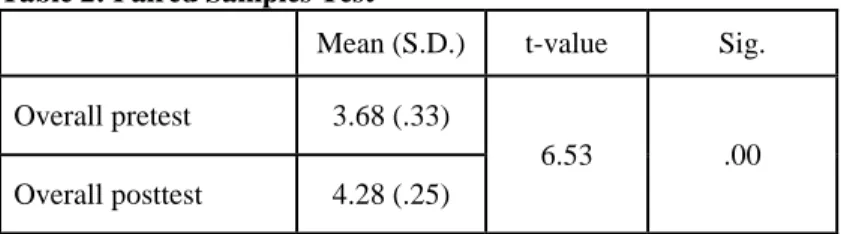
involvement with the previous cohort during the program. However, a number of participants expressed a need for more alumni participation as well as greater connections between cohorts in the future. Because this is a long-term objective of the program, the fact that many participants discussed the need to include alumni in future programs suggests that is a worthwhile and achievable objective. The recommendations section includes participant comments in this area. Overall, the paired t-test of the pretest combined means and the posttest combined means show an overall improvement in participants’ knowledge, skills, and abilities (Table 2). The mean pretest score overall was 3.68 (sd =.33) and the mean posttest score overall was 4.28 (sd =.25). A significant increase from pretest to posttest was found (t(21) = 6.53, p =.00). Means were
significantly (p 0.05) higher for 42 of the 51 questions in the post-program survey as compared to the pre-program survey.
Table 2: Paired Samples Test
Mean (S.D.) t-value Sig.
Overall pretest 3.68 (.33)
6.53 .00 Overall posttest 4.28 (.25)
18 Conclusions
The purpose of this formative evaluation was to determine the short-term outcomes of the
Leadership Advancement Program and whether they met its projected outcomes. The short-term goals of program planners were: to develop individual and collective leadership to help diverse constituencies transcend self-interest and create workable solutions for the common good, and to deepen understanding of and increase appreciation for the divergent perspectives associated with sustainability issues. The medium and long-term goals of the program were to create and
implement dynamic networks to encourage action on sustainability issues in Michigan, to enhance succession leadership, and to involve program graduates in supporting the program. Based on the findings of the paired sample test using pre- and post-test data and the results of the follow up interviews, the Leadership Advancement Program appears to have been a success. Positive mean differences for perceived leadership knowledge and skills offered evidence of such success. Participants stated that they know more about leadership and its necessary skills than they did when they entered the program. The evaluation also shows a greater understanding of sustainability, environmental, natural resource and manufacturing issues in Michigan amongst participants. Follow up interviews revealed that participants are applying leadership concepts from the program to their workplaces and communities to address the key issues facing Michigan.
The first goal of the Leadership Advancement Program was for participants to develop personal and collective leadership skills to help diverse groups develop workable solutions for the
common good. Both the pre-post program surveys and the follow up interviews demonstrate that the program met this objective. The pre-and post-test analysis shows that participants are now more familiar with common leadership approaches. They also have better visions of themselves as leaders and more confidence in their roles as leaders. The participants increased their abilities to recognize leadership strengths in others and foster creativity in others. They also reported increased understanding about leadership skills such as strategic thinking, conflict resolution and communication. Further, participants’ appreciation of cultural differences increased. Their understanding of varying perspectives of the role of government in society as well as their understanding of group process skills and abilities to manage conflict improved. They also developed a better understanding of the concept of leadership for the common good. Follow up interviews showed how participants are: taking more positive, approaches to leadership;
examining their inner abilities and weaknesses as leaders; improving their listening and communication skills; listening to diverse perspectives in decision making; and encouraging group ownership of decisions.
The second projected outcome was a deeper understanding of and increased appreciation for the divergent perspectives associated with sustainability issues. The pre- and post-program survey analysis showed an increased awareness about these topics. Participants’ understanding of systems thinking and the difference between futuring and doing business as usual increased. At the end of the program,participants had a better grasp on the complexity of manufacturing, agriculture and quality of life issues as they relate to the environment and natural resources, especially for the state of Michigan. They also showed increased confidence in their abilities to work with others to improve the quality of life in Michigan.
19
The follow up interview responses also show how the Leadership Advancement Program met the second program objective. Many participants expressed an increased understanding of the importance of diversity in decision making and stated that they were including more people in the decision making process. When asked about increasing collaboration between the target industries of agriculture, environment, natural resources, and manufacturing, participants
expressed their desire to work across these areas to create solutions for the common good. They specifically mentioned projects they were involved with related to green energy, public transport, agriculture and natural resources. Some expressed motivations to increase collaboration between state departments to address the sustainability issues affecting Michigan.
In terms of the third goal, creating and implementing dynamic networks to encourage action on sustainability issues, the program appears to be accomplishing this goal as well. In the follow up interviews, various participants stated that they have maintained contact with various members of the cohort, socially as well as professionally. Discussions amongst cohort members about green energy projects are an example of this network formation. Also, one participant is utilizing the GLLA network to address transportation issues across Michigan. Since the interviews were completed only a few months after the program, these networks may still be in the process of forming. Future data collection about the cohort’s activities will contribute to a better understanding of whether or not the program accomplished this objective.
The Leadership Advancement Program is also beginning to meet its medium-term objective of encouraging succession leadership for Michigan because participants expressed their satisfaction with the program and their hope for its continuation. A few participants said they were
encouraging others in the workplace to apply for GLLA programs. As they use the skills learned from the program in their communities and workplaces, participants will teach by example and expose others to an appreciative approach to leadership. This form of leadership may influence the development of future leaders. Further research is required to determine whether this program leads to enhanced leadership and other long-term impacts on the individuals’ careers, their communities, and ultimately on the state of Michigan.
Recommendations
Participant recommendations for changes to the program fell into five main themes: increasing diversity of the participants, changing the schedule in order to focus on specific elements of the program, making adjustments to the issues teams, increasing involvement of previous cohorts, and making adjustments to the international experience.
Respondents expressed interest in seeing more diversity during the program, both in terms of racial diversity and in the variety of business sectors represented. For example:
“We need more diversity in the cohort in the future in terms of race and the sectors. I think we could use more people from manufacturing and/or utilities.”
“If they bring on diverse participants, [the consultants] should look like their participants.”
20
“The cohort was fairly diverse but there were a couple areas that were underrepresented-specifically the federal level.”
Participants also suggested that the program should focus more time on certain themes and activities. These themes include: having difficult conversations, working with different types of people, personal growth, group reflection, and networking with the cohort. Some examples of comments were:
“I would say there could be more time spent with the cohort on coaching members of the cohort on having difficult conversations with others.”
“Spend some time in other areas. . . Example, collaborating across different personalities.”
“Maybe a little more emphasis on the personal growth part of it. We had individual coaches, the program groups, and individual assignments. I got a lot out of that, but it could be a bigger part of the program since individual improvement is so important. We don't have a lot of time for self-reflection normally, so giving even more time for that would be great.”
“Just that they have more schedule flexibility. It is too rigorous. Very little time for group reflection and little opportunity for contributions by the participants on how the program operated. The schedule was fixed and overbooked.”
“More time to network with the cohort during sessions.”
Further, three participants offered suggestions for adjustments to the issues teams portion of the program. They said,
“I didn’t like how the issues team issues were picked. The voting process was not a good process to use to pick teams. It should have been criteria based.”
“I think that if we had some more guidance [with the issues teams] I think things might have turned out better. I think that some individuals were confused on the process and that made it difficult to move through it.”
Participants suggested that the graduated cohorts should have greater involvement in newer cohorts. Specifically they said:
“Another suggestion is to be involved in future cohorts, that the organizers remember there are a number of us who want to be involved. The three LAP’s should come together. There should be connection and networking.”
“The ability to interact more directly with some of the previous participants. We had peripheral encounters, but there weren’t times set up for active engagement with
previous cohort members. More formal opportunities to engage people with the previous cohort in actual presentations and sessions to share knowledge they learned about concepts and how they have integrated what they’ve learned.”
21
Regarding the international experience, some participants thought that it should relate more directly to the overall objective of the program. Comments included:
“[The international experience] was separate from the rest of our work. Integrating it into our whole experience would be good.”
“[During the trip], there was nothing about renewable energy. There needs to be a more clear tie-in into the objectives.”
Future programs should ensure continuity between the themes presented during the domestic program and the international experience.
The pre- and post-test analysis showed that participants in the Leadership Advancement Program graduated knowing more about leadership skills than they did when they entered the program. However, while the mean ratings for all the questions in the post program survey were positive, some of these differences were not significant even though participants expressed increased knowledge in these areas during the follow up interviews. For example, during the interviews, participants expressed that they often try to use consensus building in their decision making. However, the pre-post test results show that the ability to reach decisions through consensus increased by only .09 on a 1 to 5 scale. Many participants discussed an increased appreciation for other peoples’ communication styles during the interviews, but the pre-post program survey showed that the ability to adapt to another person’s communication style increased by only .19. Perhaps further attention should be paid to these areas during future leadership programs.
22 References
Addor, M.L., Cobb, T.D., Dukes, E.F., Ellerbrock, M., & Smutko, L.S. (2005). Linking Theory to Practice: A Theory of Change Model of the Natural Resources Leadership Institute.
Conflict Resolution Quarterly, 23(2), 203-223.
Behrens, T.R., & Benham, M.K.P. (2007). Evaluating Community Leadership Programs. In K.M. Hannum, J.W. Martineau, & C. Reinelt (Eds.), The handbook of leadership development evaluation (284-314). San Francisco: Jossey-Bass.
Black, Alice M., 2007. “What did that program do? Measuring the outcomes of a statewide agricultural leadership development program.” Journal of Extension 45(4).
Black, Alice M. and Garee W. Earnest, 2009. “Measuring the outcomes of leadership development programs.” Journal of Leadership & Organizational Studies 16(2). Ciporen, Rachel, 2010. “The role of personally transformative learning in leadership development: A case study.” Journal of Leadership & Organizational Studies 17(2). Dhanakumar, V.G., Rossing, B., & Campbell, G.R. (1996). An Evaluation of the Wisconsin
Rural Leaders Perspective Program. Journal of Extension.34(3). Retrieved October 20, 2008, from http://www.joe.org/joe/1996june/rb3.html.
Diem, K.G., & Nikola, M.P. (2005). Evaluating the Impact of a Community Agricultural Leadership Development Program. Journal of Extension. 43(6). Retrieved July 9, 2008, from http://www.joe.org/joe/2005december/rb5.shtml.
Earnest, Garee W., 1996. “Evaluating community leadership programs.” Journal of Extension 34(1).
Grove, J. T., et al. (2002). The EvaluLead Framework. Retrieved October 20, 2008, from
http://pdf.dec.org/pdf_docs/PNACS171.pdf.
Grove, J. T., Kibel, B. M., & Haas, T. (2005). EvaluLead: A Guide for Shaping and Evaluating Leadership Development Programs. Retrieved July 9, 2008, from
http://www.wkkf.org/DesktopModules/WKF.00_DmaSupport/ViewDoc.aspx?fld=PDFFi le&CID=281&ListID=28&ItemID=2813740&LanguageID=0.
Heifetz, R.A. (1994). Leadership without easy answers. Cambridge, MA: The Belknap Press of Harvard University Press.
Howard, K.A., and C. Reinelt. 2007. Evaluating Leadership Development for Social Change. Pages 343-376 in K.M. Hunnum, J.W. Martineau and C. Reinelt (eds.), The handbook of leadership development evaluation. San Francisco: Jossey-Bass.
Markus, G., 2001. Building Leadership: Findings From a Longitudinal Evaluation of the Kellogg National Fellowship Program. Battle Creek, Mich: W. K. Kellogg Foundation. Northouse, P. 2004 Leadership theory and practice (rd ed.) Thousand Oaks, CA: Sage
Publications, Inc.
Reinelt, C., S. Sullivan and P. Foster. (2003). Evaluating Outcomes and Impacts: A Scan of 55 Leadership Development Programs. Battle Creek, MI: W.K. Kellogg Foundation. Zimmerman, K. & Burkhart, J.C. (1999) Leadership in the Making: A Comprehensive
Examination of the Impact of Leadership Development Programs on Students. The Journal of Leadership Studies. 6(3/4), 51-65.
23 Appendix A: Post-Program Assessment Instrument
Leadership Advancement Program – 2009-2010
Post-Program Assessment
The purpose of this evaluation is to assess your knowledge, attitudes, beliefs, and skills as they relate to your leadership competencies prior to completing this program.
Your responses will remain confidential and will only be reported in combination with those of other participants and will in no way be affiliated with your name in any published report.
Please read each statement carefully and indicate your responses by placing a “” in the box that best represents your level of agreement with each statement.
Statement Strongly agree 5 Agree 4 Neither agree nor disagree 3 Disagree 2 Strongly disagree 1
1. I am familiar with common leadership approaches.
1. I am aware of how my personal preferences impact my relationships.
2. I am confident in my ability to help people handle chaos during timesof transition.
3. I know how to facilitate time management in group process.
4. I appreciate cultural differences.
5. I understand the steps involved in the listening process.
6. I can function effectively as part of an interdisciplinary team to solveproblems.
7. I am aware of the common issues shared between Canada and the
United States.
8. I can recognize leadership strengths in others.
9. I understand how to use 360 degree feedback to evaluate myperformance.
10. I consider myself to be an entrepreneurial leader.
11. I understand how to foster creativity in others.
12. I prefer working alone.
13. I understand what “systems thinking” means.
14. I have a vision of myself as a leader.
24 Statement Strongly agree 5 Agree 4 Neither agree nor disagree 3 Disagree 2 Strongly disagree 1
16. I am confident in my ability to mange conflict in groups which are
experiencing change.
17. I understand group process skills.
18. I prefer to use strategic thinking rather than “day-to-day” thinking.
19. I understand the complexity of manufacturing, agricultural, and qualityof life issues as they relate to the environment and natural resources.
20. I have the ability to work with others to improve the quality of life forthe citizens of Michigan.
21. I understand the difference between futuring and doing business as
usual.
22. I am aware of various theories of change management.
23. I have an understanding of the divergent perspectives associated withsustainability issues.
24. I am willing to share power in appropriate situations.
25. I am aware of how my personal preferences impact my ability toinfluence others.
26. I am comfortable adapting to change.
27. I am open to new ideas.
28. I recognize the role that special interest groups play in influencing
public policy.
29. I am confident in my abilities as a leader of others.
30. I understand the key issues impacting Michigan.
31. I can identify my unique strengths as an individual.
32. I understand how to use a variety of techniques to resolve conflictamong others.
33. I recognize my personal style of communicating.
34. I can build rapport with others.
35. I seek diverse perspectives when making decisions.
36. I can negotiate for win-win agreements.
37. I understand various perspectives of the role of government in society.
38. I am aware of my strengths as a leader.
39. I can build trust within a group during times of organizational transition.
40. I understand the critical issues impacting various geographic areas25 Statement Strongly agree 5 Agree 4 Neither agree nor disagree 3 Disagree 2 Strongly disagree 1
41. I can adapt to another person’s communication style.
42. I understand what “leadership for the common good” means.
<