Comix: Joint Estimation and Lightspeed Comparison of
Mixture Models
Olivier Schwander, St´
ephane Marchand-Maillet, Frank Nielsen
To cite this version:
Olivier Schwander, St´ephane Marchand-Maillet, Frank Nielsen. Comix: Joint Estimation and Lightspeed Comparison of Mixture Models. ICASSP 2016, 2016, Shanghai, China. ICASSP 2016, 2016,<10.1109/ICASSP.2016.7472117>. <hal-01367923>
HAL Id: hal-01367923
http://hal.upmc.fr/hal-01367923
Submitted on 17 Sep 2016HAL is a multi-disciplinary open access archive for the deposit and dissemination of sci-entific research documents, whether they are pub-lished or not. The documents may come from teaching and research institutions in France or abroad, or from public or private research centers.
L’archive ouverte pluridisciplinaire HAL, est destin´ee au d´epˆot et `a la diffusion de documents scientifiques de niveau recherche, publi´es ou non, ´emanant des ´etablissements d’enseignement et de recherche fran¸cais ou ´etrangers, des laboratoires publics ou priv´es.
COMIX: JOINT ESTIMATION AND LIGHTSPEED COMPARISON OF MIXTURE MODELS
Olivier Schwander1,2, Stéphane Marchand-Maillet2, Frank Nielsen3,4 1Sorbonne Universités, UPMC Univ Paris 06, LIP6, Paris, France
2 University of Geneva, CVML/CUI, Carouge, Switzerland 3 Paris-Saclay University, Ecole Polytechnique, LIX, Palaiseau, France
4 Sony Computer Science Laboratories, Tokyo, Japan
ABSTRACT
The Kullback-Leibler divergence is a widespread dis-similarity measure between probability density func-tions, based on the Shannon entropy. Unfortunately, there is no analytic formula available to compute this di-vergence between mixture models, imposing the use of costly approximation algorithms. In order to reduce the computational burden when a lot of divergence evalua-tions are needed, we introduce a sub-class of the mixture models where the component parameters are shared be-tween a set of mixtures and the only degree-of-freedom is the vector of weights of each mixture. This sharing allows to design extremely fast versions of existing dis-similarity measures between mixtures. We demonstrate the effectiveness of our approach by evaluating the qual-ity of the ordering produced by our method on a real dataset.
Index Terms— Mixture model, Density estimation, Information geometry, Kullback-Leibler divergence, Exponential family
1. INTRODUCTION AND MOTIVATION
The Kullback-Leibler divergence [1] (KL) is the relative Shannon entropy between two probability density func-tions: KL (pkq) = Z p(x) logp(x) q(x)dx (1) =H(p, q)−H(p) (2) where H(p) is the Shannon entropy and H(p, q) ≥
H(p) is the cross-entropy. The divergence between p
andqmeasures the amount of information which is lost whenq (coming from an estimation algorithm) is used to approximatep(the true distribution).
Since it is not symmetrical, it cannot be a distance but it still bears a subset of the properties of the dis-tance: self similarity (KL (pkp) = 0); self identification (KL (pkq) = 0 ⇒ p = q); positivity (KL (pkq) > 0). Moreover it has the property of invariance to reparame-terization [2] and is infinitesimally related to the Fisher-Rao-Hotelling distance [3, 4, 5] of information geome-try. It is also a Bregman divergence, allowing to apply tools from computational information geometry such as Bregman Voronoi diagrams [6].
For all these reasons, the Kullback-Leibler diver-gence is a widespread tool in many statistical mod-eling, signal processing and pattern recognition appli-cations: source separation [7], speech recognition [8], background extraction for object tracking in videos [9].
There is a closed-form formula available when the divergence is computed between two members of the same exponential family (such as between two Gaus-sian distributions), using the bijection between exponen-tial families and Bregman divergences [10]. But for two mixture models withk1, k2>1components
m(x) = k1 X i=1 ωipF(x;ηi) m0(x) = k2 X i=1 ω0ipF(x;η0i) (3) an analytic form does not exist[11] (unlike for other divergences such as Squared Loss[12] and Cauchy-Schwartz[13]). We choose here to focus on mixtures of exponential families pF: the loss of generality is
very weak since a lot of common mixtures are ex-ponential families (including Gaussian) and it allows to build generic algorithms where the family is just a parameter[14].
When a lot of divergence evaluations are needed, the cost of the faster approximation techniques may not
be affordable: the best compromise between speed and accuracy, the variational approximation [15], needs to evaluate the k1 ×k2 Kullback-Leibler divergences
be-tween each pair of components of the two mixtures
KL (pF(·;ηi)kpF(·;ηi0)). In order to reduce the
com-putational burden, we introduce a sub-class of mixture models where the parameters of the components are shared between all the mixtures and the only degree-of-freedom is the vector of weights of each mixture (the set of shared components can thus be seen as a dictio-nary and the weights as the activation of the different atoms of the dictionary). In this case, the previous di-vergences between pairs of components can thus be pre-computed just after the estimation of the mixtures, limit-ing the computational cost durlimit-ing the evaluations of the variational approximation of the divergence.
This article is organized as follows: after this in-troduction and a description of previous works on Kullback-Leibler approximation, we define the con-cept of co-mixtures and then introduce an Expectation-Maximization-based algorithm to build such mixtures; next we introduce fast variants of the variational and Goldberger approximations; finally we experimentally study the quality of our mixture estimation and the speed-up of the approximation on a simulated retrieval application built on top of a real bio-informatics dataset.
2. COMPARING MIXTURE MODELS
A lot of work have been devoted to overcome the lack of an analytic formula for the Kullback-Leibler diver-gence, we review here the most important in practical applications. One of the major methods relies on Monte-Carlo integration to estimate the divergence. For the ran-dom variatesx1, . . . , xndrawn from the mixturem, the
Monte-Carlo estimator (KLMC) is:
KLMC mkm0 = 1 n n X i=1 log m(xi) m0(x i) (4)
This formula has the advantage of being consistent but requires a large number of variates to achieve a good precision.
Instead of trying to numerically compute the in-tegral, another approach is to design new functions which are both close to Kullback-Leibler and com-putable in closed-form. A first example is the Gold-berger approximation[8] which comes from a majora-tion of the Kullback-Leibler divergence:
KLGold mkm0 = arg min σ KL ωkσ(ω 0) (5) +XωiKL pF(·kηi)kpF ·kη0σ(i)
In this approximation, a minimization problem is solved over all the possible permutationsσ of the components in order to cope with all the possible orderings of the components of the two mixtures.
A better approximation in the state-of-the-art is the variational approximation[15]: KLvar mkm0 =X i ωilog P jωje−KL(pF(·kηi)kpF(·kηj)) P jωj0e −KL(pF(·kηi)kpF(·kηj))0 (6) This approximation achieves the lowest variance com-pared to a KLMC with a very larger number of points (more than 1 million) but is not positive.
3. DEFINITION AND ESTIMATION Definition 1. A co-mixture of exponential families (a
comix) withK components is a set ofSstatistical mix-ture models of the form:
m1(x;ω(1)i . . . ω (1) K ) = PK i=1ω (1) i pF(x;ηi) m2(x;ω(2)i . . . ω (2) K ) = PK i=1ω (2) i pF(x;ηi) . . . mS(x;ω(S)i . . . ω (S) K ) = PK i=1ω (S) i pF(x;ηi) (7)
pF is the exponential family with log-normalizerF and
η1. . . ηK are the parameters of the components and are
shared between all the individual mixtures of the co-mixture; the S vectors ω1(l). . . ωK(l) are the vectors of weights (thus positive) with the propertyPK
i=1ω (l) i = 1
for anyl. The parameter S depends on the number of sets of points which are modeled jointly.
In order to estimate the parameters of the co-mixture (the vectors of parameters components and the ma-trix of weights), we adapt the Bregman Soft Clustering algorithm[10], which is a variant of EM for exponen-tial families. The version for mixtures, called co-Expectation-Maximization (co-EM) searches for a local minimum of the average of the log-likelihoods of theS
individual mixtures on the associated input set of points
X(1), . . . ,X(S): L(X(1), . . . ,X(S)) = 1 S S X l=1 l(l)(X(l)) (8)
This is done with an iterative EM-like algorithm classi-cally divided into two main steps:
Expectation stepWe computeSresponsibility matrices
p(1), . . . , p(S):
p(l)(i, j) = ω
(l)
j pF(x(l)i , ηj)
m(x(l)i |ω(l), η) (9)
Maximization stepThe maximization step is itself di-vided in two steps: first,Spartial estimates (not shared) are computed then all these partial estimates are com-bined into the new estimate of the shared parameters.
Weights and partial estimates for thel-th dataset are computed using the observations for X(l) and the l-th
responsibility matrix: η(l)j =X i p(l)(i, j) P up(l)(u, j) t(x(l)i ) (10) ω(l)j =X i p(l)(i, j) P up(l)(u, j) (11)
For the j-th component, the new estimate of ηj
is computed as a Bregman barycenter of all the
η(1)j , . . . , η(S)j , giving the same weight to all the sets of points: ηj = 1 S S X l=1 ηj(l) (12)
Notice that we work with the expectation parameters
ηof the exponential family.
4. FAST DIVERGENCES
The dissimilarity measures between mixtures presented previously can be rephrased to take into account the shared parameters. As the terms computing KL be-tween identical components vanish, the Goldberger ap-proximation becomes the following simpler formula:
KLGold(mkm0) = KL (ωkω0). The minimization
prob-lem also vanishes since we do not have any more to cope with the different orderings of the components.
For the variational approximation, the terms involv-ing the cross dissimilarity between all pairs of com-ponents can be precomputed since the parameters are known in advance:Dij = KL (pF(·kηi)kpF(·kηj)).
5. EXPERIMENTS
From the practitioner point of view, the absolute values of a dissimilarity measure are not really important: rela-tive values are a lot more valuable in most cases. More-over, the largest values of a divergence are often of low interest since the useful information is usually concen-trated in the closest points instead of the farthest ones. In order to demonstrate both the quality of the mixture es-timation using comix and the quality of the divergence computations, we thus study in which measure the or-dering of the points is the same between a reference baseline and comix-based methods. This evaluation is made by simulating a retrieval application and measur-ing the mean average precision (mAP) over all the pos-sible queries (by successively taking each mixture as the query and looking at the retrieved mixtures in a short list of size 10). The experiments presented here are made on a bio-informatics 1D dataset[16, 17]: it consists of 211 sets of points (so the parameterSwill be 211) with 3000 to 5000 observations in each set. We estimate a density for each set of points with a Gaussian Mixture Model. The chosen baseline is made of an estimation step with classical EM (with 8 components, as set by an expert) and a comparison step made with KLMC (with 1 mil-lion variates, which is often considered enough to have a very small variance on the estimation).
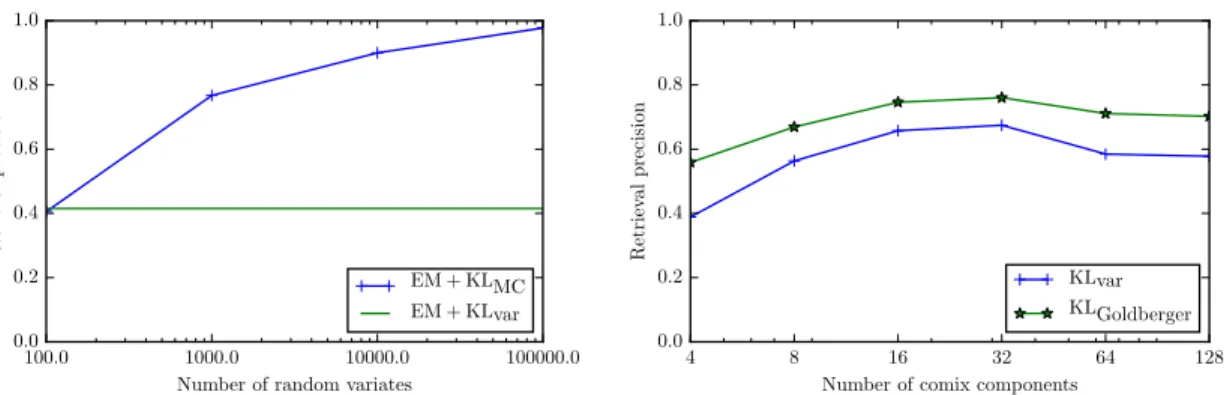
Fig. 1 (left) describes the evolution of the precision of the KLMC estimation with respect to the sample size and compares it with the precision of the variational KL approximation. A target objective to validate the qual-ity of the proposed joint estimation method is to be as good as the variational approximation between EM mix-tures. Fig. 1 (right) studies the precision of our fast versions of the KL approximations with respect to the number of components. Even if some value is consid-ered a good number of components for individual mix-tures, it may need a lot more components to cope with the variations of all the set of points during the joint es-timation. We see here that 4 components are sufficient to achieve the same precision rate for variational KL on comix and variational KL on traditional mixtures. It is even more interesting to see that with 32 components we get precision values which are only attained with the lot more costly Monte-Carlo method. The Goldberger approximation has a similar behavior but outperforms variational KL for all number of components. Our in-terpretation is that the joint estimation of a co-mixture
100.0 1000.0 10000.0 100000.0 Number of random variates
0.0 0.2 0.4 0.6 0.8 1.0 Retriev al precision EM + KLMC EM + KLvar 4 8 16 32 64 128
Number of comix components 0.0 0.2 0.4 0.6 0.8 1.0 Retriev al precision KLvar KLGoldberger
Fig. 1.Left: mAP of KLMC between EM mixtures wrt the sample size and result from variational KL.Right: mAP wrt the number of components of variational Kullback-Leibler and Goldberger between co-EM mixtures.
k co-EM Speed-up be-tween co-EM and EM8 KLvar on comix Speed-up between KLvar on comix
and KLvaron EM8
Speed-up between KLvar on comix and
KLMC100on EM8 Goldberger on comix 4 51s ×1.5 0.00020s ×180 ×20 0.00015s 8 99s ×0.77 0.00044s ×84 ×5.8 0.00030s 16 48s ×1.6 0.0012s ×28 ×1.6 0.00059s 32 150s ×0.49 0.0040s ×9.1 ×0.41 0.0012s 64 450s ×0.17 0.014s ×2.5 ×0.10 0.0024s 128 600s ×0.12 0.046s ×0.80 ×0.026 0.0049s
Table 1. Absolute times for computation on comix and speed-up when compared to the times of the equivalent computation on individual mixtures. Times for co-EM are compared with the total time for all the individual EM.
is able to capture intrinsic similarities between set of points which are missed out when the sets are looked at independently by EM.
Table 1 shows the computation times for co-EM and for the fast divergence computations and displays the speed-up compared to the estimation of the 211 mix-tures with EM and the speed-up compared to slow ver-sion of the approximations. We first see that the com-putation cost of the estimation of a comix with co-EM on all the sets of points has the same order of magnitude than the estimation of all the individual mixtures with EM, meaning that there is no significant loss of time during the estimation step. Comparison between fast variational KL and variational KL between traditional mixtures shows a big speed-up for a number of compo-nents between 4 and 64, meaning that the method would cope with a larger number of components if needed. The Goldberger approximation has a similar cost than vari-ational Kullback-Leibler, without precomputation step, making it very interesting due to its better performances. All computation were made on an Intel i5-4440 CPU.
6. CONCLUSION
We presented a new approach in the field of the approx-imations of the Kullback-Leibler divergence between mixtures: instead of designing estimation techniques or introducing different but related formulas which are easy to compute, we work on the nature itself of the mixture models, by imposing the shared parameters among all the considered mixtures. This sharing allows to build extremely fast versions of classical Kullback-Leibler ap-proximations: experiments on a retrieval task show that the combination of co-mixtures and fast approximations are not only fast but also meaningful. Nevertheless, we are able to outperform the retrieval precision attained by methods working on individual mixtures: this allows a large set of exploration paths to understand and exploit how the notion of co-mixture can improve performances in fields where mixtures are commonly used.
AcknowledgementPart of this work has been sup-ported by the Swiss National Science Foundation via Project MAAYA (Grant number 144238).
7. REFERENCES
[1] Solomon Kullback, Information theory and statis-tics, Courier Corporation, 1997.
[2] Shun ichi Amari and Hiroshi Nagaoka,Methods of information geometry, vol. 191, American Mathe-matical Soc., 2007.
[3] R. A. Fisher, “Two new properties of mathematical likelihood,” Proceedings of the Royal Society A: Mathematical, Physical and Engineering Sciences, vol. 144, no. 852, pp. 285–307, Mar. 1934. [4] C. Radhakrishna Rao, “Information and accuracy
attainable in the estimation of statistical parame-ters,” Bulletin of the Calcutta Mathematical Soci-ety, vol. 37, no. 3, pp. 81–91, 1945.
[5] H Hotelling, “Spaces of statistical parameters,”
Bull. Amer. Math. Soc., vol. 36, pp. 191, 1930. [6] F. Nielsen, J. D. Boissonnat, and R. Nock,
“Breg-man Voronoi diagrams: Properties, algorithms and applications,” Institut National de Recherche en Informatique et en Automatique (INRIA Sophia Antipolis), Research Report, vol. 6154, 2007. [7] Daniel D Lee and H Sebastian Seung,
“Algo-rithms for non-negative matrix factorization,” in
Advances in neural information processing sys-tems, 2001, pp. 556–562.
[8] Jacob Goldberger, Shiri Gordon, and Hayit Greenspan, “An efficient image similarity mea-sure based on approximations of KL-divergence between two Gaussian mixtures,” inComputer Vi-sion, 2003. Proceedings. Ninth IEEE International Conference on. IEEE, 2003, pp. 487–493.
[9] Chris Stauffer and W Eric L Grimson, “Adaptive background mixture models for real-time track-ing,” in Computer Vision and Pattern Recogni-tion, 1999. IEEE Computer Society Conference on.
IEEE, 1999, vol. 2.
[10] A. Banerjee, S. Merugu, I. S. Dhillon, and J. Ghosh, “Clustering with Bregman divergences,”
The Journal of Machine Learning Research, vol. 6, pp. 1705–1749, 2005.
[11] S Watanabe, K Yamazaki, and M Aoyagi, “Kull-back information of normal mixture is not an an-alytic function,” Technical Report of IEIE in Japanese, , no. 2004-0, pp. 41–46, 2004.
[12] Meizhu Liu, Baba C Vemuri, S-I Amari, and Frank Nielsen, “Total Bregman divergence and its appli-cations to shape retrieval,” inComputer Vision and Pattern Recognition (CVPR), 2010 IEEE Confer-ence on. IEEE, 2010, pp. 3463–3468.
[13] Frank Nielsen, “Closed-form information-theoretic divergences for statistical mixtures,” in
Pattern Recognition (ICPR), 2012 21st Interna-tional Conference on. IEEE, 2012, pp. 1723–1726. [14] Frank Nielsen and Vincent Garcia, “Statistical exponential families: A digest with flash cards,”
CoRR, vol. 09114863, 2009.
[15] J.R. Hershey and P.A. Olsen, “Approximating the Kullback Leibler divergence between Gaussian mixture models,” in IEEE International Confer-ence on Acoustics, Speech and Signal Processing, 2007. ICASSP 2007, Apr. 2007, vol. 4, pp. IV– 317–IV–320.
[16] Julie Bernauer, Xuhui Huang, Adelene YL Sim, and Michael Levitt, “Fully differentiable coarse-grained and all-atom knowledge-based potentials for RNA structure evaluation,” RNA, vol. 17, no. 6, pp. 1066–1075, 2011.
[17] Adelene Y. L. Sim, Olivier Schwander, Michael Levitt, and Julie Bernauer, “Evaluating mixture models for building RNA knowledge-based poten-tials,” Journal of Bioinformatics and Computa-tional Biology, vol. 10, no. 02, Apr. 2012.