SUNY College of Environmental Science and Forestry
Digital Commons @ ESF
Dissertations and Theses
Spring 4-20-2018
Assessing Arapaima Conservation and
Management Through Actionable Research
Daniel GurdakFollow this and additional works at:https://digitalcommons.esf.edu/etds
This Open Access Dissertation is brought to you for free and open access by Digital Commons @ ESF. It has been accepted for inclusion in Dissertations and Theses by an authorized administrator of Digital Commons @ ESF. For more information, please [email protected], [email protected].
Recommended Citation
Gurdak, Daniel, "Assessing Arapaima Conservation and Management Through Actionable Research" (2018).Dissertations and Theses.
48.
ASSESSING ARAPAIMA CONSERVATION AND MANAGEMENT THROUGH ACTIONABLE RESEARCH
by
Daniel J. Gurdak A dissertation
submitted in partial fulfillment of the requirements for the Doctor of Philosophy Degree State University of New York
College of Environmental Science and Forestry Syracuse, New York
April 2018
Department of Environmental and Forest Biology
Approved by:
Donald J. Stewart, Major Professor David Sonnenfeld, Chair, Examining Committee
Neil Ringler, Interim Department Chair S. Scott Shannon, Dean, The Graduate School
© 2018 Copyright D. J. Gurdak All rights reserved
Dedication
To my son Nico,
I hope that my generation can leave you a better world, but it may take a better generation. Tag, you’re it.
iii
Acknowledgments
This dissertation could not have been accomplished without help from the following institutions: Universidade Federal do Oeste do Pará (UFOPA), Amazon Environmental Research Institute (Instituto de Pesquisa Ambiental da Amazônia- IPAM), and SAPOPEMA. Funding was provided in part by: National Geographic Society Committee for Research and Exploration, Boticario Foundation for the Protection of Nature, US Institute for International Education Fulbright Scholar Program, US Environmental Protection Agency under the Science to Achieve Results (STAR) Graduate Fellowship Program, National Geographic Society Young Explorer’s Grant, Society of Wetland Scientists Student Research Award, Scientific Research
Crowdfunding Campaign through “Petridish.org”, and various funding sources from the State University of New York, College of Environmental Science and Forestry (Graduate
Assistantships in Department of Environmental and Forest Biology, the Robert L. Burgess Graduate Scholarship in Ecology, the Wilford Dence Fellowship, the Tropical Social Forestry Fund, and the Maurice and Annette Alexander Wetlands Research Award). All research was conducted under authorization granted by the Brazilian National Ministry of Science,
Technology and Innovation (Ministério da Ciência, Tecnologia e Inovação; CNPQ #s: 001141/2012-0, 001609/2014-9) and the Brazilian Institute of Environment and Renewable Natural Resources (Instituto Brasileiro do Meio Ambiente e dos Recursos Naturais Renováveis: SISBIO #s: 30201 and 45187). This work was authorized by the following animal care and use protocols: ESF-IACUC protocol #121001 and UFOPA-CEUA protocol #08010/2014.
I would also like to thank the individuals without whom my work would not have been possible. I would like to thank my adviser, Donald J. Stewart, for his support and encouragement while developing my work in the lab and in the field; he never let me give up. Thank you to each member of my committee for their contributions and direction: Leandro Castello, James P. Gibbs, A. Peter Klimley, and Karin E. Limburg. They often found ways to inspire, challenge, and confuse me, and for that I thank them. A special thanks to my department, Environmental and Forest Biology, and Donald J. Leopold for backing this work (and me) throughout its many years. I would like to thank past and present members of my lab for their friendship and support, including Kean Clifford, Theodore Hermann, Kapil Mandrekar, Arlen Marmolejo, Joie
Matillano, and Cynthia Watson. Our comradery got stronger with late nights in the lab, shared academic struggles, enthusiasm for aquaria and quail, and reviewing drafts of each other’s work.
iv I would like to thank L. Cynthia Watson for providing arapaima nest data from Guyana and the video in the Appendix. To my housemates when I first moved to Syracuse, James (“Jim”) Arrigoni and Kevin Shoemaker (including Turtle, and George and Makers), it was a pleasure.
I would like to thank the following individuals for their invaluable contributions during preparation and execution of fieldwork in Brazil. First, a sincere thanks to David “Toby” McGrath for his introduction to the Lower Amazon and help facilitating this work through permits and paperwork. Likewise, I would like to thank Paulo Buckup, Lenise Flôres Vargas da Silva, and Luis Reginaldo Ribeiro Rodrigues for their help throughout the permit process and for providing access to lab space and equipment. Thank you to Fábio Sarmento de Sousa for
introducing me to the várzea and to the communities that I worked with. Caroline Chaves Arantes helped with numerous translations, permit applications, and my work in the field. For their help, companionship, and collaboration in the field, I would also like to thank: Rafael Barbosa, Veronika Miranda Chase, Michael Thomas, and various students from UFOPA
(especially Càssia Adrielly do Amaral Vasconcelos and Poliane Batista da Silva whom I had the privilege to co-mentor). To Harald Weinert, thank you for giving me a home in Santarém and for extending your welcome and hospitality to the many others that traveled with me.
I could not have done this without my family. I thank my Mom for pushing me to value learning, hard work, and education. A special thanks to my wife, Camille N. Rodriguez Gurdak, for being a great field assistant, proof-reader, motivator, and the buoy that kept me afloat. To my son Nico, thank you for being you. Last but not least, I would like to thank the families of the floodplain fishing communities where my research was conducted that treated me as family. Those families and their communities, provided permissions to live and work amongst them, shared their broad knowledge of arapaima, and in many ways, greatly facilitated this work. It is through their tireless work in fisheries management that they have arapaima populations- for themselves and for the research conducted here. It is through their efforts that this work can now facilitate protection of floodplain fisheries, including arapaima.
To the many, many other people that directly or indirectly made this work possible and were not mentioned above- a wholehearted thank you. I appreciate the feedback, suggestions, and guidance from all those who reviewed various drafts of this work and made it better. The individuals and organizations mentioned here have not officially endorsed this work and the views and opinions expressed here are those of the author.
v
Table of Contents
List of Tables ... vii
List of Figures ... viii
List of Appendices ... xii
Abstract ... xiii
CHAPTER ONE – Introduction ... 1
Overview ... 1
The Arapaima ... 2
The Arapaima’s Environment ... 3
The Arapaima Fishery ... 6
Dissertation Objectives ... 8
CHAPTER TWO – Developing an Actionable, Need-Based Research Agenda for Conservation and Management of Arapaima Fisheries in South America ... 11
Abstract ... 11 Introduction ... 12 Methods ... 16 Literature Search ... 16 Data Extraction ... 17 Data Analysis ... 19 Results ... 20 Literature Search ... 20 Data Extraction ... 20 Data Analyses ... 22 Discussion ... 25 Target ID ... 27 Abundance ... 28 Biology ... 29 Catch ... 29 Implementation ... 30 Conclusions ... 31
CHAPTER THREE – Diversity in Reproductive Traits of Arapaima (Arapaima spp., Müller) in Amazonian Várzea Floodplains: Conservation Implications. ... 33
Abstract ... 33
Introduction ... 34
Methods ... 39
Study Area ... 39
Size at First Female Maturity ... 41
Sampling ... 41
Data Analysis ... 42
Nesting Habitat Surveys ... 43
Sampling ... 43
Data Analysis ... 45
Results ... 46
vi
Nesting Habitat Surveys ... 51
Discussion ... 54
Length at First Maturity ... 55
Nest Features ... 57
Conservation Implications ... 58
CHAPTER FOUR – Seasonal Movements and Site Fidelity of Arapaima (Genus Arapaima) in the Lower Amazon, Brazil: Implications for Conservation and Management ... 61
Abstract ... 61 Introduction ... 62 Methods ... 65 Study Area ... 65 Research Protocol ... 67 Data Analysis ... 69 Results ... 70 Discussion ... 75 Conclusion ... 77
CHAPTER FIVE – Evidence of Recoveries from Tropical Floodplain Fisheries: Three Examples of Management Gains for South American Giant Arapaima ... 79
Abstract ... 79
Introduction ... 80
History of Arapaima Fishing ... 85
Management: Challenges of Early Efforts ... 87
Management: A Promising Approach at a Small-Scale ... 89
Management: Successes and Challenges ... 92
Mamirauá Sustainable Development Reserve, Amazon State, Brazil ... 93
Lower Amazon, Pará State, Brazil ... 97
North Rupununi, Guyana ... 103
Lessons Learned ... 105
Conclusions ... 115
CHAPTER SIX – Concluding Remarks ... 116
References ... 120
Appendices ... 141
vii
List of Tables Chapter 3
Table 1. Localities and years for data collection for arapaima (Arapaima sp.) reproductive
ecology in Lower Amazonian floodplain communities stratified by arapaima
population density. ... 41
Table 2. Nest feature data for arapaima (genus Arapaima) is presented from: Lower
Amazon (this study), Central Amazon (Castello, 2008a), Guyana (Watson et al., 2016; Watson, unpublished data), and captivity (Fontenele, 1948, 1952). The
difference amongst means was evaluated using Tukey's HSD test (*). Multiple linear regressions evaluated the diameter-depth relations for each location and a general linear model with interaction determined which pairs of regressions are significantly different from one another (**). For each regression, slope (m), y-intercept (b), and significance (p) are presented. ... 53 Chapter 5
Table 1. Ostrom’s (1990) eight institutional design principles for sustainable governance of common property resources (adapted from Castello et al. 2009). ... 84 Table 2. Evaluation of arapaima management in Mamirauá Sustainable Development
Reserve, in the Central Amazon, Amazonas State, Brazil, using Ostrom’s (1990; see Table 1) eight sustainable governance design principles (adapted from Castello et al. 2009). ... 95 Table 3. Evaluation of arapaima management in the Lower Amazon, Pará State, Brazil,
using Ostrom’s (1990; see Table 1) eight sustainable governance design principles. .... 100 Table 4. Evaluation of arapaima management in North Rupununi, Guyana, using
Ostrom’s (1990; see Table 1) eight sustainable governance design principles. ... 104 Table 5. Comparison of managed and unmanaged conditions for arapaima fisheries using
Ostrom’s (1990) eight sustainable governance design principles in: 1) Mamiraua Sustainable Development Reserve (MSDR), 2) Lower Amazon, Pará State, Brazil,
viii
List of Figures Chapter 1
Figure 1. The life cycle of the arapaima (genus Arapaima) is divided into four main
stages: 1) nest-bound embryo and sac-fry, 2) adult-protected, schooling juveniles, 3) independent juveniles, and 4) reproductive adults. ... 3 Figure 2. Arapaima naturally occur across two main river basins (i.e. Amazon and
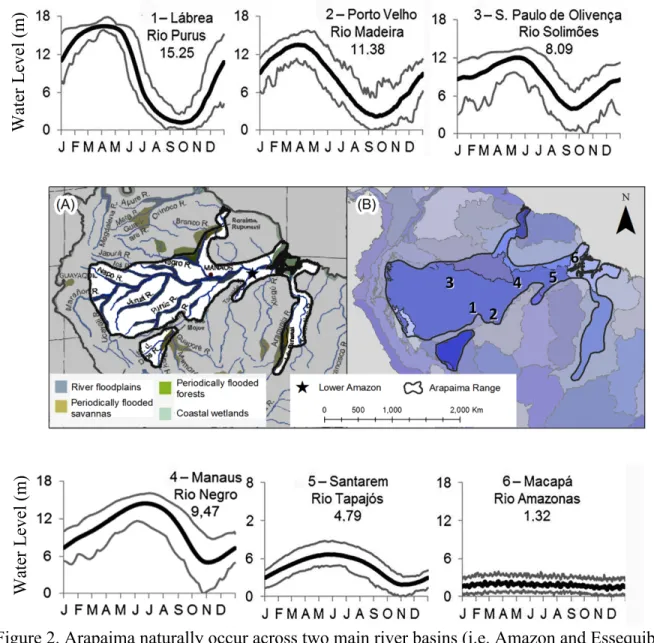
Essequibo), five countries (i.e. Brazil, Guyana, Columbia, Ecuador and Peru), (a) four major wetlands in northern South America (adapted from: Junk et al., 2014), (b) 11 unique freshwater Eco-Regions in three freshwater habitat types (Abell et al., 2008), and (1-6) various flood pulse patterns (adapted from: Junk et al., 2014). Flood pulse curves represent the average (black curve) and upper/lower limits (grey curves) of water level fluctuations (m) throughout the year based on 40 years of
monitoring; adapted from Figure 2 in Junk et al. (2014). ... 5 Figure 3. Stilt homes on the floodplain of the Lower Amazon during seasons of low
water (left) and high water (right). ... 7 Chapter 2
Figure 1. Five actionable themes were used to categorize arapaima research based on the (I) basic needs for conservation actions, and (II) information needs for fisheries management: 1) target ID, 2) abundance, 3) biology, 4) catch, and 5)
implementation. The biology, or life history, theme was further subcategorized based on the data requirements for effective fisheries stock assessment and
modeling: a) habitat use & migration, b) diet & trophic interactions, c) age/size of first reproduction, d) growth & mortality, and e) recruitment & population
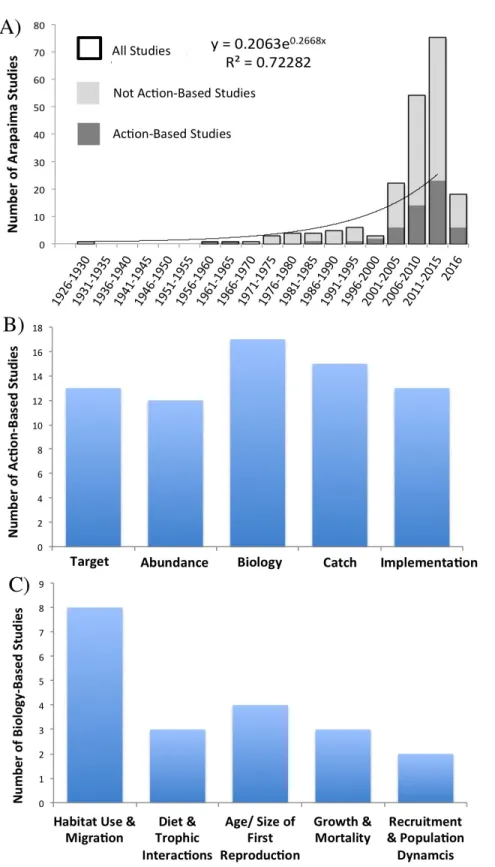
dynamics. ... 18 Figure 2. (a) The growth of arapaima research was exponential for all studies, including
actionable studies. (b) Actionable research production was distributed across five major themes: target ID, abundance, biology, catch, and implementation. (c) Most research was categorized as arapaima biology and was not uniformly distributed among subcategories: diet, reproduction, growth, mortality, and population
dynamics. ... 21 Figure 3. The natural range of arapaima was stratified into seven geographic regions:
(a) Coast & Estuary, (b) Tocantins & Araguaia, (c) Lower Amazon, (d) Central Amazon, (e) Guyana, (f) Madeira & Upper Purus, and (g) Upper Solimões & Jurua. Arapaima has also been naturalized in two regions: (h) Upper Madeira and (i) Upper Paraná River basins. Arapaima management sites and actionable research
production were unevenly distributed across these geographic regions. ... 23 Figure 4. The distribution of arapaima research production across nine geographic
regions: (a) Coast & Estuary, (b) Tocantins & Araguaia, (c) Lower Amazon, (d) Central Amazon, (e) Guyana, (f) Upper Solimões & Jurua, (g) Madeira & Upper Purus, (h) Upper Madeira, (i) Upper Paraná River basins, and five actionable research themes: 1) target ID, 2) abundance, 3) biology, 4) catch, and 5)
implementation. ... 24 Figure 5. The distribution of arapaima research production across six geographic
regions: (a) Coast & Estuary, (b) Tocantins & Araguaia, (c) Lower Amazon, (d) Central Amazon, (e) Guyana, (f) Upper Solimões & Jurua, and five biology, or life
ix history, subcategories: a) habitat use & migration, b) diet & trophic interactions, c) age/size of first reproduction, d) growth & mortality, and e) recruitment &
population dynamics. No research in the biology category was found for three
regions: (g) Madeira & Upper Purus, (h) Upper Madeira, (i) Upper Paraná. ... 25 Chapter 3
Figure 1. Study locations in the Lower Amazon near the city of Santarém, Brazil with
three arapaima (genus Arapaima) population density levels: 1) high (Aritapera), 2)
medium (Tapará), and 3) low (Atuma/Salvação). In order of decreasing arapaima population density, the five fishing communities were: 1) Ilha do São Miguel, 2a)
Santa Maria, 2b) Pixuna, 3a) Centro do Aripiri, and 3b) Ilha do Carmo. ... 40
Figure 2. Arapaima (genus Arapaima) often build nests and spawn in floodplain habitat
that is flooded during high water, but accessible on foot during low water. In addition to classifying the surrounding habitat and the following measurements were standardized (A) nest diameter, (B) nest depth or height, (C) height of the last flood as determined by water-marks on nearby trees and vegetation, and (D) diameter of area around the nest brushed clean (i.e. free of fallen tree-leaves and
small branches). ... 45
Figure 3. Logistic curves and estimated length of females at first maturity (L50) for: a)
all data, b) Aritapera (high density), c) Atuma/Salvação (low density), and d)
Tapará (medium density). ... 48 Figure 4. Reported estimates for size of female reproduction in arapaima (genus
Arapaima) compared to the typical 1.5 m minimum size of capture. Size at first female maturation (L50; horizontal bars are 95% confidence intervals) was available for the Lower Amazon, Brazil (this study) and the Solimões, Central Amazon, Brazil (Arantes et al., 2010). Using data published in length and maturity frequency tables, L50 was calculated for the Tocantins River, Brazil (Godinho et al., 2005), Puerto Nariño, Amazonas State, Brazil (Hurtado, 1997), and Pacaya Samiria National Reserve, Peru (Guerra Flores, 1980). Other observations were reported for the Pacaya River, Peru (Lüling, 1964) and in captivity (Alcantara-Bocanegra, 1990; Bard & Imbiriba, 1986; Fontenele, 1948; Franco-Rojas & Peláez-Rodríguez, 2007). ... 49 Figure 5. Size frequency distributions of arapaima sampled during harvest (left) and
progression of female arapaima maturity (right) for: a) all data, b) Aritapera (high population density), c) Tapará (medium density), and d) Atuma/Salvação (low
density). ... 50 Figure 6. The relation between population densities of arapaima and arapaima nests in
(1) three sites in the Lower Amazon under varying management regimes surveyed in 2014, and (2) one area in the Central Amazon surveyed over three years of varying arapaima population densities (Castello, 2008b; Castello et al., 2011). The
relation is non significant for all data (R! = 0.00) but is positive and significant after
removing the single outlier in the Lower Amazon where no nests were found (n = 5;
P = 0.00; y = 0.1004x - 0.7363; R! = 0.98). Shaded area represents 95% confidence
interval for the simple linear regression after excluding the outlier. P-value
x on an outlier analysis relative to the linear regression of nest density versus
arapaima density. ... 54 Chapter 4
Figure 1. (a) Density of arapaima based on population surveys in the Lower Amazon region, near confluence of the Tapajos and Amazon Rivers (adapted from Castello et al. 2015). Ultrasonic telemetry was used to monitor the movement of arapaima within highlighted study area (enlarged in Fig. 2). (b) Average annual water level cycle with 95 % confidence intervals for high and low levels were based on two decades of monitoring at a station 100 km upstream of Santarém
(www.snirh.gov.br/hidroweb/, 1990-2010, Curuai station, -2.2725 S, -55.4808 W). ... 66 Figure 2. Lakes where arapaima were tagged with ultrasonic transmitters (dark blue) in
two communities were Buraco, Purus, and Resaca. Receivers (black dots) were
positioned in each deployment lake and a fourth central lake: Pixuna. ... 68 Figure 3. Size frequency distribution of arapaima (n = 24) marked with ultrasonic
receivers in floodplain habitat of the Lower Amazon near the city of Santarém. ... 69 Figure 4. Detected locations of each tagged arapaima (n= 24) throughout the annual
flood cycle for year one (December 2014 through November 2015) of the two-year monitoring period, in relation to water level (cm) above average low-water level. Fishes marked as “Absent” were not verified as harvested and not found at end of a particular flood cycle.. ... 72 Figure 5. Detected locations of each tagged arapaima (n= 24) throughout the annual
flood cycle for year two (December 2015 through November 2016) of the two-year monitoring period, in relation to water level (cm) above average low-water level. Fishes marked as “Absent” were not verified as harvested and not found at end of a particular flood cycle. ... 73 Figure 6. Number of acoustically tagged arapaima detected in each lake area against
time in three lake areas in the Lower Amazon: (a) Buraco, (b) Pixuna, and (c) Resaca. Monitoring began in December, 2014, and continued for two flood cycles or 24 months, ending in November, 2016. The fourth lake, Resaca (not depicted above), only had one marked arapaima that was harvested in the fifth month of the
study; it was the only fish detected in that lake. ... 74 Chapter 5
Figure 1. Arapaima (genus Arapaima) are large, valuable food fish that are an
important part of local and regional economies. (a) A day’s harvest of legal-sized arapaima at Jarauá Community in the Mamirauá Sustainable Development Reserve, Amazon State, Brazil (photo by CCA). (b) Fisherman carrying ~145 kg arapaima in the Pacaya Samiria National Reserve, Peru (photo by DJS). ... 82 Figure 2. Despite drastic population declines, successful arapaima management has
been implemented at various sites: (a) Lower Amazon, Pará State, Brazil (McGrath et al., 1993), (b) Mamirauá Sustainable Development Reserve, Solimões River, Amazon State, Brazil (Castello et al., 2009), (c) Lower Purus River (including Piagaçu-Purus Sustainable Development Reserve), Amazonas State, Brazil (Petersen et al., 2016), (d) Tapauá River, Amazonas State, Brazil (Petersen et al.,
xi 2016), (e) Middle Juruá River, Amazonas State (Campos-Silva et al., 2016), (f)
Upper Purus River, Manuel Urbano, Acre State, Brazil (Oviedo & Bursztyn, 2016), (g) Envira River, Fiejo, Acre State, Brazil (Oviedo & Bursztyn, 2016), and (f)
xii
List of Appendices Chapter 2
Appendix 2.1. A total of 199 scholarly articles were found for the genus Arapaima in a
January 2017 search of two databases: “Web of Science” and “OneSearch”. ... 142
Appendix 2.2. Of the 199 scholarly articles found for the genus Arapaima in a January
2017 search of two databases (i.e. “Web of Science” and “OneSearch”, see
Appendix 2.1), 55 were considered actionable. ... 159 Chapter 3
Appendix 3.1. Arapaima parents provide substantial care for eggs and juvenile offspring. Video demonstrates biparental care where juvenile fish are schooling just above the head of one adult and the other adult is close behind, seen at the moment of aerial breathing. Video was taken in Rewa River drainage, Guyana (April 2008; Old Lady Pond, 3.92297°S, 58.7913°W) by L. Cynthia Watson:
https://youtu.be/PLTaIgTqz8A
... 165 Appendix 3.2. Gonadal development of female arapaima was determined by
macroscopic observations of gonads and ranking them on a scale from I to IV;
adapted from Lopes & Queiroz (2009) and Arantes et al. (2010). ... 166
xiii
Abstract
D.J. Gurdak. Assessing Arapaima Conservation and Management Through Actionable Research,
186 pages, 7 tables, 22 figures, 4 appendices, 2018. APA style guide used.
This work investigated floodplain fish ecology and implications for management and
conservation by studying the most historically important and overexploited fisheries in South
America, the arapaima (genus Arapaima). Through actionable research in arapaima ecology and
fishery management, this dissertation aimed to improve inland fish conservation and
management in floodplain ecosystems. First, through a systematic literature review, thematic, geographic, and temporal trends in arapaima research were identified. Despite exponential growth in arapaima research, only one-third of studies were applicable to management and notable knowledge gaps remained that could hinder decision making for arapaima management and conservation. The second analysis explored variability in arapaima reproductive traits. Observations from the Lower Amazon were compared to findings across South America. Considerable variation in size at first sexual maturation and nesting features was found within and between regions. The third analysis characterized seasonal arapaima migration patterns by using acoustic telemetry to monitor migrations of 24 arapaima over a two year period. Results showed connectivity of arapaima from different lake populations and crossover between
community-based management zones during high-water seasons. In addition, arapaima showed lake fidelity in low-water seasons. Finally, successes of small-scale co-management efforts to promote recovery for arapaima fisheries were highlighted. The history of arapaima fishing, early management efforts, and improvements to management approaches were discussed. Then, implementation of co-management at small scales was evaluated across three regions based on presence of eight principles for sustainable governance of common property resources. For each region, current and ongoing challenges were considered. Then, lessons were identified that can be useful for management of arapaima and other inland fisheries. In summary, successful floodplain fishery management and conservation practices should address knowledge gaps to establish practices based on a comprehensive knowledge base on fish ecology.
Key Words: Amazon, evidence-based, fishes, flood cycle, Osteoglossidae, reproduction, South America, Neotropics, várzea
Daniel J. Gurdak
Candidate for the degree of Doctor of Philosophy, April 2018 Donald J. Stewart, Ph.D.
Department of Environmental and Forest Biology
State University of New York, College of Environmental Science and Forestry, Syracuse, New York
1
CHAPTER ONE Introduction
Overview
Global freshwater biodiversity is widely threatened (see; Arthington el al., 2016;
Dudgeon et al., 2006; He et al., 2017; Strayer & Dudgeon, 2010). Globally, floodplains and the inland fisheries they support, are over-exploited and understudied (Allan et al., 2005). In addition, freshwater fishes are generally marginalized in scientific research and policy arenas, especially compared to large, charismatic mammals and birds, and they are often
under-represented within leading biodiversity prioritization schemes (e.g. Myers et al., 2000). Despite their economic importance and ecosystem roles, riverine megafauna are particularly threatened (Stone, 2007). Across South America, mega-fishes, such as the "data-deficient" giant arapaima, face extensive illegal fishing, habitat degradation, and poor regulation enforcement (Castello & Stewart, 2010; IUCN, 2018).
Arapaima possess unique bioecological features and significant economic, nutritional, and cultural importance that make them ideal targets for management and conservation attention. Effective management of arapaima and floodplain ecosystems can support local livelihoods and regional economies (Castello et al., 2009), promote the maintenance of healthy ecosystem
services, and support floodplain biodiversity. A comprehensive arapaima management design for South America, however, is hindered by insufficient data on arapaima migration, distribution, taxonomy, life history, and ecology within and among different regions. Here, I begin by introducing the arapaima, its environment and fishery. I then justify this body of work and introduce the main objectives of each chapter.
2
The Arapaima
Arapaima (genus Arapaima) are among the largest freshwater fishes in the world,
growing to 3 m in length and up to 200 kg in weight (Arantes et al., 2010; Stone, 2007).
Arapaima are commonly known as “arapaima,” “paiche,” or “pirarucu” depending on the region. They are in the family Osteoglossidae, an ancient group of fishes also known as the “bony-tongues.” As this name suggests, arapaima can crush prey between their bony, toothed tongue and bony plates on the roof of their mouth. Arapaima are considered piscivorous, although their diets include some macroinvertebrates (Queiroz, 2000) and juvenile diets can include
microinvertebrates and some plant debris (Oliveira et al., 2005). Watson et al. (2013) note that trophic and digestive tract morphologies of arapaima resemble those of an omnivore. Being large and powerful fishes that are covered with an armor of hard and overlapping scales, arapaima are well-equipped to survive attacks from piranhas, crocodilians and fishing gear such as harpoons.
Although five described species exist in the genus Arapaima (Stewart, 2013a,b), the group faces
incredible data shortfalls that make species identification and distributions uncertain (see Linnean and Wallacean shortfalls in Bini et al., 2006).
Arapaima are obligatory air breathers that must surface every 15-20 minutes to breath air (Castello, 2004). They have a modified swim bladder lined with blood vessels that functions as a primitive lung. Arapaima hatch with functional gills and transition from aquatic to aerial
respiration within the first few weeks of life (Brauner et al., 2004). Like many floodplain fishes, the life history of arapaima (Figure 1) is closely linked with their environment and the flood pulse (Junk et al., 1989). Typical of many floodplain fishes, arapaima spawn as rising water floods the surrounding landscape (Castello, 2008a; Welcomme, 1979). Adult arapaima (i.e. > 3-4 years of age) dig a pan-shaped nest using their mouth and, after spawning, provide parental care
3 to eggs and juveniles for up to 6 months (Castello, 2008a; Castello, 2008b; Fontenele, 1948; Queiroz, 2000).
Figure 1. The life cycle of the arapaima (genus Arapaima) is divided into four main stages: 1)
nest-bound embryo and sac-fry, 2) adult-protected, schooling juveniles, 3) independent juveniles, and 4) reproductive adults.
The Arapaima’s Environment
These tropical giants naturally occur across two major river basins (i.e. Amazon and Essequibo), five countries (i.e. Brazil, Columbia, Peru, Ecuador, and Guyana), four major wetlands in northern South America, and 11 unique freshwater eco-regions in three freshwater habitat types (Figure 2). There are three main water types (i.e. white water, black water, and clear water) within their range reflecting the combined influence of distinctive geomorphology,
4 limnology, geochemistry, soil, and vegetative cover (Junk et al., 1989; Lewis et al., 2006). The range is intersected by the equator and the majority is below 300 m a.s.l. and fairly flat. The climate is tropical with aseasonal temperature, resulting in river temperatures that are generally within a few degrees of ~29°C (Lewis et al., 2006). Cooler temperatures can be encountered near river headwaters, such as piedmont lakes (e.g., Galacatos et al., 1996) along the western edge of the arapaima’s range that is flanked by the Andes Mountains. Cooler temperatures (e.g.,
~26.5°C) also can be found in ria lakes associated with upland forests in the central Amazon (de Carvalho et al., 2017)
Seasonality across the arapaima’s range is caused by highly periodic rainfall (e.g., ~2000
mm yr-1) that results in the cyclical flooding of low-lying areas along main river channels (Junk
et al., 1989). This flooding, also called a flood pulse, creates a biologically productive and species-rich tropical ecosystem that is neither purely “terrestrial” nor “aquatic” (Junk et al., 1989). The flood pulse begins as increasing water levels result in the lateral expansion of water from the main river channel across a low-lying floodplain (Junk et al., 1989). Floodplain plants and animals are highly adapted to the annual changes in water height caused by this pulse. For example, when water is low, fishes are concentrated in river channels and floodplain lakes. As waters rise (by more than 10 m in some areas), however, fishes move into the floodplain and take advantage of access to newly available plants, fruits, invertebrates and small fishes (Castello, 2008b; Welcomme, 1979). The magnitude, timing and pattern of the flood pulse varies widely across the arapaima’s range and, depending on location, water levels begin to rise sometime between September and January (Figure 2; Junk et al., 2014). These floodplain habitats are the preferred habitat of arapaima and consist of natural levees, wetlands, lakes, and canals that often are annually isolated from the main river channel (Castello, 2008b; Welcomme, 1979).
5
Figure 2. Arapaima naturally occur across two main river basins (i.e. Amazon and Essequibo), five countries (i.e. Brazil, Guyana, Columbia, Ecuador and Peru), (a) four major wetlands in northern South America (adapted from: Junk et al., 2014), (b) 11 unique freshwater Eco-Regions in three freshwater habitat types (Abell et al., 2008), and (1-6) various flood pulse patterns (adapted from: Junk et al., 2014). Flood pulse curves represent the average (black curve) and upper/lower limits (grey curves) of water level fluctuations (m) throughout the year based on 40 years of monitoring; adapted from Figure 2 in Junk et al. (2014).
W at er L eve l ( m ) W at er L eve l ( m )
6
The Arapaima Fishery
Because their large fillets have good taste and texture without many bones, arapaima are extremely valuable as a food fish and an important part of local and regional economies and cultures. Arapaima meat is extremely common in local dishes and restaurants. Sometimes called the “cod-fish” of the Amazon, it can be cooked fresh or used later by freezing or salting and drying (McGrath et al., 2015). Arapaima have even captured local, national, and international attention as a cultural symbol and as a sport fish through popular television shows,
documentaries, and publications (e.g., Purnell, 2017).
South American arapaima fisheries, like many in the tropics, have some commercial focus but are predominantly characterized by small-scale, artisanal subsistence fishing. In general, tropical fishers are among the world’s poorest and most marginalized peoples (Pauly, 1997). For fishers who live on or near the floodplain, fishing for arapaima and other species is an essential source of income and food (Figure 3). For South American riverine inhabitants,
arapaima fishing is highly specialized and an important cultural and economic activity (Castello et al., 2009; Murrieta, 2001). The unique character of arapaima fishing is derived from the challenging techniques used to hunt arapaima. Although gill nets are increasingly used,
traditional fishers use a harpoon or bow-and-arrow to capture arapaima at the moment it surfaces to breathe air. Traditional harpoon fishers stalk arapaima from a small canoe or while perched in a tree. Unfortunately, many arapaima fisheries are poorly regulated and virtually “open-access,” leading to overfishing and fish population declines that threaten the livelihoods of local peoples.
7 Figure 3. Stilt homes on the floodplain of the Lower Amazon during seasons of low water (left) and high water (right).
Although tropical inland fisheries provide important regional income and food security, these fisheries face severe management challenges that are amplified by distinct ecological, economic, and political factors (Allan et al., 2005; Pauly et al., 1989). Monitoring and enforcement is extremely difficult because these fishers use a variety of gears, and fishing is spatially and temporally dispersed. In addition, market controls for arapaima are limited and illegal arapaima can be purchased year round. Today, arapaima are recognized on two
international endangered species lists as Arapaima gigas: CITES “Appendix II” and IUCN Red
List as “data deficient” (IUCN, 2018; World Conservation Monitoring Centre, 1996). The most significant threat to arapaima is overfishing across most of its range (Castello et al., 2015; Isaac et al., 1993; Martinelli & Petrere, 1999). Arapaima population numbers across their range have
8 plummeted to about 13% of historic abundances (Castello et al., 2011) and illegal fishing is extremely common. Recent evaluations of harvest showed that two-thirds of the arapaima harvested from lower Amazon fishing communities was illegal, with fish captured below minimum size or during seasonal closures (Cavole et al., 2015; also see Chapter 3). Arapaima populations are being decimated by overfishing that is leading to localized extinctions (Castello et al., 2015).
Dissertation Objectives
Through actionable research that addresses data deficits on arapaima ecology, life history and fishery management, this dissertation aimed to improve inland fish conservation and
management in floodplain ecosystems. Each chapter that follows, excluding the, “Concluding Remarks,” is intended to be a standalone analysis that will be published in peer-reviewed academic literature. A detailed footnote outlining co-authorship, current status, and target journal/s was including at the start of each chapter. Although each is a standalone analysis, together they contribute to a larger synthesis that addresses research gaps in arapaima conservation and management. First, the current knowledge base was evaluated to identify specific shortfalls that could impede arapaima management and conservation. Next, two aspects of arapaima life history, specifically reproduction and migration, were evaluated in the Lower Amazon. Lastly, arapaima management efforts in three different regions were evaluated in light of leading theories of political science. Hopefully, this dissertation will contribute to arapaima conservation and management while guiding future activities that can expand beyond arapaima to other floodplain fishes and their environments. Specifically, the objectives for each of the four analytical chapters were to:
9
- Chapter 2: Evaluate the existing evidence-base for arapaima management and conservation. Research efforts are not always aligned with research needs. The ideal is to inform an actionable research agenda by identifying thematic, geographic, and temporal trends in the knowledge base, thereby establishing a baseline to guide future research and management plans. Using a
systematic literature review, this analysis discusses spatial and thematic gaps in the knowledge-base needed to manage arapaima.
- Chapter 3: Compare arapaima reproductive ecology amongst sites.
Earlier studies have revealed some regional differences in arapaima reproductive traits, like size at first reproduction (Arantes et al., 2010; Godinho et al., 2005). As a result, there may be a need to manage arapaima based on local life-history information. This analysis uses field surveys and supporting literature to determine if existing regulations based on reproductive biology are adequate to manage arapaima.
- Chapter 4: Characterize arapaima migration and determine if present management units provide effective and appropriately scaled protection.
Although arapaima are not known for long distance migrations, they are known to migrate laterally, away from floodplain lakes as water level rises (Castello, 2008b). Their propensity to move throughout lagoon networks and the effect of movement on the configuration and
appropriate scale of protected areas has not been studied. Nonetheless, those patterns of arapaima dispersal, migration, and site fidelity are important for arapaima management and designing arapaima conservation schemes. This analysis employs advanced techniques in telemetry to study the migrations of arapaima over two annual flood cycles in floodplain lakes of the Lower Amazon.
10
- Chapter 5: Evaluate arapaima management efforts among regions to highlight successes and infer lessons.
Although many arapaima management initiatives now exist, an evaluation of best management practices across multiple sites is lacking. This final analysis discusses the history of arapaima fishing, the difficulties encountered by early management efforts, and later improvements to arapaima management approaches using co-management at a small scale with local residents. The implementation of this promising approach is evaluated across three regions and lessons are offered that can contribute to managing arapaima and other inland fisheries.
11
CHAPTER TWO
Developing an Actionable, Need-Based Research Agenda for Conservation and
Management of Arapaima Fisheries in South America *
Abstract
Research activities frequently do not reflect the information needed for evidence-based conservation and management action. Systematic reviews are valuable to summarize information and guide research activity. This systematic review assesses the available information for the
giant arapaima (genus Arapaima) and its fisheries in South American freshwaters. The goal is to
develop an actionable research agenda by identifying thematic, geographic, and temporal trends in the knowledge base. To evaluate gaps, arapaima research studies were identified, focusing on those applicable to arapaima conservation and management, called actionable research. These were categorized and mapped to evaluate the distribution of research topics across the
arapaima’s range and management locations. Arapaima are distributed across various
administrative zones (e.g. countries, states, municipalities), habitats, ecological regions, and a variety of flood pulse patterns. The annual growth of arapaima research has been exponential, with most conducted within the last two decades. Only one-third of studies (i.e., 55 of 199), however, could be categorized as actionable and applied to ongoing management efforts. The geographic distribution of research also was imbalanced, and there was limited overlap between research activities and managed regions. These spatial and thematic gaps hinder comprehensive arapaima management and conservation initiatives. Addressing arapaima research deficits can be
* Gurdak, D. J. (in prep). Developing an Actionable, Need-Based Research Agenda for
Conservation and Management of Arapaima Fisheries in South America. Target journal/s:
12 accomplished by focusing growing arapaima research on needed topics across relevant regions to provide evidence needed to make effective conservation and management decisions. Systematic reviews can highlight priority research needs to produce a need-based and actionable research agenda.
Key Words: Amazon, evidence-based, freshwater, gap analysis, information deficit, Osteoglossidae, pirarucu, research bias, systematic review
Introduction
Conservation and management actions depend on reliable information to develop goal-oriented interventions that achieve the best possible outcomes. Information can be drawn from various sources, such as individual experience, qualitative observations, and local or indigenous knowledge, although scientific evidence is generally preferred (c.f. dos Santos et al., 2015). In many cases, conservation and management actions are implemented in spite of information deficits because, in most cases, suboptimal action is preferred to no action (Johannes, 1998). Conservation and management conducted with information deficits falls somewhere along a spectrum between guesswork and calculated decision-making and, ideally, should serve as a temporary solution until data-driven, or evidence-based, actions are possible (e.g. Watson et al., 2016). If research interests are not aligned with research needs, the resulting information may not be relevant to conservation and management needs (Lawler et al., 2006; Trimble & van Aarde, 2012). Information deficits are caused by insufficient research and research biases. For example, research is not evenly distributed across taxonomic groups nor geographic regions (e.g. Clark & May, 2002; Cronin et al., 2014). Research attention generally is biased toward large-bodied and/or more charismatic groups (such as mammals and birds) and away from the most biodiverse
13 regions, such as South America (Clark & May, 2002; Cronin et al., 2014). Research biases can be driven by needs due to ecological impact, threatened status, or economic importance but also can be unrelated to need and influenced by political motivations, difficulties of executing research, or personal affinities of researchers and funding agencies (c.f. Trimble & van Aarde, 2012). To overcome information deficits and biases, an evidence-based approach provides a framework for systematically compiling and reviewing existing information to identify research needs (see Pullin and Knight, 2009; Sutherland et al., 2004).
Information deficits in the tropics have been historically common due to limited research production (Cronin et al., 2014) despite unparalleled biodiversity and the elevated threat status of taxa and environments. Information deficits still persist for estimating biodiversity (Mora et al., 2011), and the information available for comprehensive management and conservation planning is even more limited. Such information deficits exist for the South American arapaima (genus
Arapaima), fishes that can grow to 3 m in length and 200 kg in weight and are highly valued for
their meat (Arantes et al., 2010). Arapaima are threatened fishes that should be an ideal target for conservation and management. However, the IUCN Red List of Threated Species status for
arapaima is “data deficient” (IUCN, 2018), and only one species, A. gigas, is recognized. That is
in spite of recent recognition of additional species (see Stewart, 2013a,b) and significant genetic diversity (Watson et al., 2016). This is particularly troubling considering that arapaima are among the Amazon’s most over-exploited freshwater fishes, and their current abundance is merely ~13% of historic levels (Castello et al., 2011). There is even evidence of local extinctions in some regions (Castello et al., 2015). Although small-scale arapaima management initiatives developed over the last few decades have promoted recoveries of overexploited arapaima stocks in some areas (e.g. Campos-Silva & Peres, 2016; Castello et al., 2009; Oviedo & Bursztyn, 2016;
14 Petersen et al., 2016), there remain biological and ecological uncertainties about these fishes that may impact on-going management efforts (Castello et al., 2011).
Generally, existing arapaima conservation efforts involve basic fisheries management regulations, including minimum size of capture, seasonal closure during breeding seasons and annual catch quotas. These regulations are based on what is currently known about the biology of these fishes. For example, minimum size of capture for arapaima is 150 cm to protect juveniles before reaching reproductive age (e.g. Arantes et al., 2010), and seasonal closures for arapaima (e.g. December - May in Brazil) loosely coincide with the annual flood and reproductive seasons. In addition, leading management efforts have adopted the use of establishing arapaima catch quotas that are based on fishers’ ability to count arapaima when they surface to breathe (Castello, 2004). Despite these regulations, it is the information deficits and geographical gaps that can have negative consequences for conservation and management planning for arapaima. First, knowledge of their genetic and taxonomic variation is necessary to conserve the remaining diversity in already decimated arapaima populations (Castello et al., 2015; Watson et al., 2016). The geographic range of arapaima spans a large area across South America that could contribute to regional variation in life histories. The variation in life history traits for other fish species has proven critical in understanding population dynamics and establishing successful management models based on abiotic factors (e.g. McDermid et al., 2010) or genetic diversity (e.g. Zhao et al., 2008). Specifically, geographic variation in reproductive strategies of a South American
relative of the arapaima, the silver arowana (Osteoglossum bicirrhosum), has important
consequences for conservation and management (Duponchelle et al., 2015). For arapaima, geographic variation in ecology exists in the sizes at first maturity. For example, female
15 al., 2005) and at 157 cm in the lower Solimões River basin of the Central Amazon (Arantes et al., 2010). A further complication is that size-selective overfishing in the Central Amazon (i.e. in the 1990’s and earlier) caused the size of first sexual maturation to increase from 157 to 164 cm (Arantes et al., 2010). Specifically, halting juvenile harvest led to faster average growth of the surviving fishes and size of first reproduction decreased (Arantes et al., 2010). It is uncertain how reproductive ecology and other aspects of arapaima ecology vary across the arapaima’s range. Ultimately, this unrecognized variability in arapaima life histories could inhibit the well-intended actions that are based on limited available information because regulations for one region may not be appropriate for another.
For this review, I evaluated the research and its geographic extent relative to conservation and management initiatives of arapaima. Due to shortfalls in taxonomic and geographic
information for the genus (see Stewart, 2013a,b), this review will consider available literature for
the entire genus Arapaima. The evaluation involved a systematic review of arapaima literature.
After performing a literature search, a classification scheme was developed to identify and categorize actionable, or action-based, research. “Actionable research” is defined here as
research with applicability to conservation and management activities. The primary objective for this review is to determine if sufficient data is available for the conservation and management of
the genus Arapaima. First, this meant identifying and categorizing the research needs for
arapaima fisheries management and conservation. Then, three trends in research production were evaluated to assess how the available evidence was aligned with conservation and management needs. First, temporal trends were used to access research production over time for all arapaima research and action-based research. Second, categorized research was used to determine if and how the major research themes for arapaima conservation and management were represented.
16 Third, geographic trends were used to determine where research production occurred, if important research themes were represented for each region, and how well management and research locations overlapped. The need and benefit of developing an actionable research agenda is highlighted in light of observed trends in arapaima research production.
Methods
Arapaima research studies were located, categorized, and mapped in a geographic information system. A typology for actionable research needs for arapaima was developed and used to evaluate the evidence-base across themes and geographic regions. The geographic range of arapaima was established using the best available information on the natural arapaima
distribution in South America (Castello & Stewart, 2010; Miranda-Chumacero et al., 2012) and adapted using the boundaries of freshwater ecoregions (Abell et al., 2008). The natural range of arapaima was stratified into major geographic regions. Areas in South America where arapaima have been established outside its natural range were also mapped.
Literature Search
In January of 2017, a protocol for systematic reviews (adapted from Moher et al., 2009) was applied to search two databases for arapaima literature: (1) Web of Science (Thomson Reuter) and (2) OneSearch (@ ESF Libraries- SUNY College of Environmental Science and Forestry). Both searches were conducted using comparable parameters and combining keywords using the Boolean argument “or” as: “ ‘arapaima’ OR ‘pirarucu’ OR ‘paiche’.” No limits were imposed with respect to topic, journal, or language. All publications up to and including the year 2016 were included (note: Web of Science database begins in 1985). Both database searches
17 were limited to academic articles by filtering for “article” in Web of Science and “academic journal” in One Search. All duplicates were removed and a preliminary review was conducted to
remove any literature not related to the South American genus Arapaima. The final selection
included only scholarly articles with methods and results, excluding theses, conference abstracts, popular articles, and opinion pieces.
Data Extraction
Only the final selection of scholarly articles on arapaima was categorized. The target taxon for each study was noted and articles conducted based on fishes in captivity (i.e. laboratory or aquaculture settings) were identified. To demonstrate research productivity over time, the number of studies per year was plotted against year. Also identified were actionable, or action-based, scholarly articles, defined here as studies with applicability to arapaima conservation and management activities. Actionable research was categorized into five themes based on the needs for arapaima conservation and management activities (Figure 1): 1) target ID, 2) abundance, 3) biology, 4) catch, and 5) implementation.
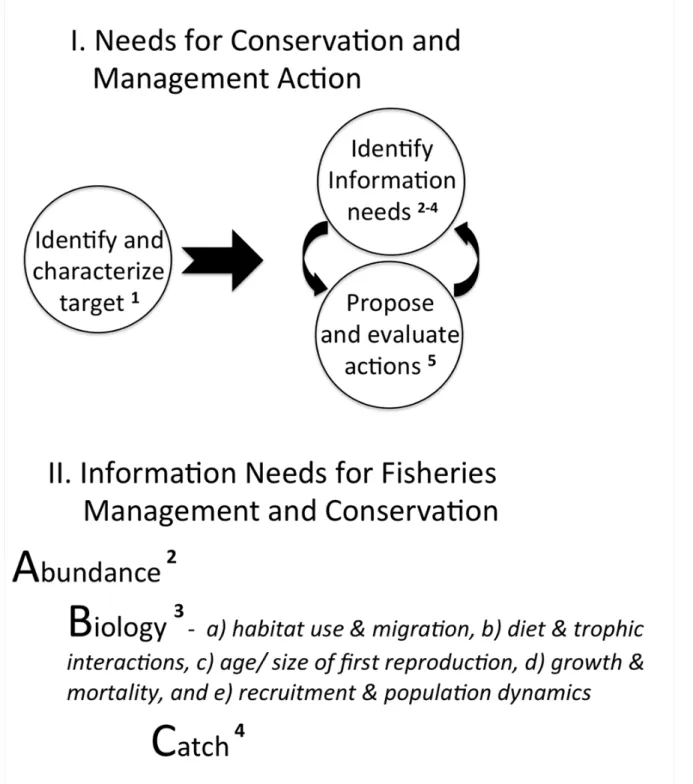
18 Figure 1. Five actionable themes were used to categorize arapaima research based on the (I) basic needs for conservation actions, and (II) information needs for fisheries management: 1) target ID, 2) abundance, 3) biology, 4) catch, and 5) implementation. The biology, or life history, theme was further subcategorized based on the data requirements for effective fisheries stock assessment and modeling: a) habitat use & migration, b) diet & trophic interactions, c) age/size of first reproduction, d) growth & mortality, and e) recruitment & population dynamics.
19 First, it is important to identify and characterize the target of conservation and
management actions. Next, target-specific information needs should guide and be guided by the implementation and evaluation of conservation and management actions (Figure 1 (I)). For arapaima, the information needs were comprised of three themes adapted from the requirements for effective fisheries assessment (Mace et al., 2001; NMFS, 2012): abundance, biology, and catch (Figure 1 (II)). The biology, or life history, theme was further subcategorized based on the data requirements for effective fisheries stock assessment and modeling (Mace et al., 2001; Methot & Wetzel, 2013): a) habitat use and migration, b) diet & trophic interactions, c) age/size of first reproduction, d) growth & mortality, and e) recruitment & population dynamics.
Data Analysis
Data were mapped in a geographic information system (ArcGIS 10.3.1). The range of arapaima was compared to freshwater eco-regions (Abell et al., 2008) and river flood pulse patterns (Junk et al., 2014). Geographic coordinates were determined for each actionable study and stratified into one or more geographic regions. Arapaima management sites were mapped and their distribution compared to research production. Management sites were obtained from (Figueiredo, 2013) and from personal communications with staff from the Mamirauá Sustainable Development Institute, a pioneer in arapaima management and research activities (Figueiredo, pers. comm., July 2015).
20
Results
Literature Search
The “Web of Science” search generated 178 unique records while the “OneSearch” database generated 336 records, totaling 261 unique records after removing duplicates.
Combining both queries totaled 264 unique records, of which 159 were found in both databases.
Of those, 209 records were related to the fish arapaima (genus Arapaima) and 199 were
considered scholarly articles (Appendix 2.1). The annual increase in arapaima research was exponential, with 80 % of all studies having been conducted during the last two decades (Figure 2a).
Data Extraction
Of the 199 scholarly articles on arapaima, only 55 were categorized as actionable
(Appendix 2.2). The focus of research was predominantly on A. gigas, comprising 90% of all
199. The focus on A. gigas decreased to 75% for actionable studies due to a more general,
nonspecific acknowledgement of species diversity (e.g. Arapaima spp.). In addition, 48 studies
were conducted with arapaima in a captive setting and only one of those could also be classified as actionable. Each of the five actionable themes had between 12 and 17 studies, with the majority in the biology theme (Figure 2b). Geographic distribution of studies in the biology theme was highly variable (Figure 2c).
21 Figure 2. (a) The growth of arapaima research was exponential for all studies, including
actionable studies. (b) Actionable research production was distributed across five major themes: target ID, abundance, biology, catch, and implementation. (c) Most research was related to arapaima biology and was not uniformly distributed among subcategories: diet, reproduction, growth, mortality, and population dynamics.
22 Data Analyses
Arapaima naturally occur across two major river basins (i.e. Amazon and Essequibo), five countries (i.e. Brazil, Columbia, Peru, Ecuador, and Guyana), four major wetlands in northern South America, and 11 unique freshwater eco-regions in three freshwater habitat types (see Figure 3 in Chapter 1). Flood pulse patterns vary widely across its range and, depending on the geographic location, water levels rise sometime between September and January (Junk et al., 2014; also see Figure 3 in Chapter 1). The natural range was stratified into seven geographic regions: (a) Coast and Estuary, (b) Tocantins & Araguaia, (c) Lower Amazon, (d) Central Amazon, (e) Guyana, (f) Upper Solimões & Jurua, and (g) Madeira and Upper Purus (Figure 3). Arapaima also have been naturalized in two regions: (h) Upper Madeira (in Bolivia and Peru) and (i) Upper Paraná River Basin (in south-eastern Brazil; Figure 3).
Of the 55 actionable studies, three were general or evaluations and one did not have a location. Therefore, 51 studies had locations, three of which were conducted across multiple regions. The majority of actionable studies were conducted in the Central and Lower Amazon regions (c and d in Figure 3). A total of 21 arapaima management locations were identified, spanning across four countries and various administrative zones and geographic regions (Figure 3). These management locations were unevenly distributed across the arapaima’s range, with eleven management locations clustered within a 300 km diameter in the Central and Upper Amazon. There is a non-significant but suggestive relation between number of management
studies and number of research sites per region (p= 0.1; R2= 0.32). For example, 14 of the 55
actionable studies were conducted (at least in part) at a single management area in the Central Amazon (i.e. Mamirauá Sustainable Development Reserve). Within the natural range of
23 arapaima, Colombia is notable for the complete absence of known management sites and published studies found during this review.
Figure 3. The natural range of arapaima was stratified into seven geographic regions: (a) Coast & Estuary, (b) Tocantins & Araguaia, (c) Lower Amazon, (d) Central Amazon, (e) Guyana, (f) Madeira & Upper Purus, and (g) Upper Solimões & Jurua. Arapaima has also been naturalized in two regions: (h) Upper Madeira and (i) Upper Paraná River basins. Arapaima management sites and actionable research production were unevenly distributed across these geographic regions.
Stratified by theme, research was not uniformly distributed and only three regions had at least one study in each of the five themes (Figure 4). Stratified by biology subcategories,
research was not uniformly distributed and no topics were represented across all regions (Figure 5). Although no region had studies in all five biology categories, the Central Amazon was the closest with four of five categories.
24 F igur e 4. T he di st ri but ion of a ra pa im a re se ar ch pr oduc ti on ac ros s ni ne ge ogr aphi c re gi ons : ( a) C oa st & E st ua ry, ( b) T oc ant ins & A ra gua ia , ( c) L ow er A m az on, ( d) C ent ra l A m az on, ( e) G uya na , ( f) U ppe r S ol im õe s & J ur ua , ( g) M ade ir a & U ppe r P ur us , ( h) U ppe r M ade ir a, ( i) U ppe r P ar aná R ive r ba si ns , a nd fi ve a ct iona bl e re se ar ch the m es : 1) ta rge t I D , 2) a bunda nc e, 3) bi ol ogy, 4) ca tc h, a nd 5) im pl em ent at ion.
25 Figure 5. The distribution of arapaima research production across six geographic regions: (a) Coast & Estuary, (b) Tocantins & Araguaia, (c) Lower Amazon, (d) Central Amazon, (e) Guyana, (f) Upper Solimões & Jurua, and five biology, or life history, subcategories: a) habitat use & migration, b) diet & trophic interactions, c) age/size of first reproduction, d) growth & mortality, and e) recruitment & population dynamics. No research in the biology category was found for three regions: (g) Madeira & Upper Purus, (h) Upper Madeira, (i) Upper Paraná. Discussion
An evidence-based approach provides a framework for decision-making that is based on adequate information needs. This study provides an example for identifying conservation and management needs for arapaima and then using a systematic review to highlight information deficits and establish a need-based research agenda. As highly valued and threatened fishes, as well as the focus of on-going management efforts, the arapaima also should be the focus of significant research effort, providing an example of evidence-based decision-making for tropical freshwater fisheries. Even though it is likely that there is more information available for the
26 arapaima than for most other freshwater fisheries in South America, a systematic literature review revealed shortfalls in the available evidence-base.
Although geography is infrequently included in systematic reviews (with some exceptions: Malhado et al., 2014; dos Santos et al., 2015; Trimble & van Aarde, 2012), both geography and content are important to completely address information deficits. With respect to arapaima, geography is particularly important considering the genus is distributed across various administrative zones (e.g. countries, states, municipalities), habitats, ecological regions, and a variety of flood pulse patterns. These variations could impact ideal regulations. For example, although the seasonal floods are highly variable in time across regions, Brazil’s national seasonal closure for arapaima is from December through May (see Figure 3 in Chapter 1). Since arapaima reproduction is closely linked with the timing of the flood season, ideal closure periods may vary regionally.
This study demonstrates that despite exponential growth in arapaima research effort, research and management are disconnected from each other. Nearly half of all arapaima research was published in the last decade alone, and although this trend is also reflected in the growth of actionable research, only about one quarter of all arapaima research output was considered actionable and could contribute to the conservation and management of these fisheries. This growth in arapaima research presents an opportunity to focus growing research activity on actionable themes and research gaps.
It is important to note that it is likely this search did not access the entire literature for arapaima. This is because this work considered only published, academic papers and does not consider technical reports and other grey literature published by management sites and NGOs (e.g. Mamirauá Sustainable Development Institute). Another limitation is that each study was
27 categorized, tabulated, and considered equal. Although difficult to quantify, there was variability in the scope, robustness, and quality of various research efforts.
Research production was distributed across all major actionable themes and life history subcategories. In a few regions, mostly in the Central and Lower Amazon, more than a quarter of research was conducted, at least in part, at a single protected area: Mamirauá Sustainable
Development Reserve. Pioneer arapaima management and research at Mamirauá serves as an example to be replicated across the Amazon. When stratified by geographic region, research does not cover the full scope of topics needed to optimize arapaima actions. In fact, some regions and management locations lack several research topics critical for establishing regulations. As a result of research limitations, current arapaima actions and regulations are based on research from a limited number of locations. Research trends, deficits, and prospects are further discussed for each of the five actionable research themes:
Target ID
Research characterizing taxonomic and genetic diversity for arapaima has the widest geographic distribution, being conducted in all but two geographic regions. However, there was a
significant bias toward one species, A. gigas. This is likely a result of the long-standing belief
that the genus was monotypic and only recently has this been challenged (see Stewart, 2013a,b). Despite the number and geographic extent of genetic and taxonomic papers, there remain
significant taxonomic (“Linnean”) and distributional (“Wallacean”) data deficiencies in the
genus Arapaima (see Whittaker et al., 2005). There are currently five nominal species in the
genus Arapaima (see Stewart, 2013a,b): A. gigas (Schinz 1822), A. agassizii (Valenciennes
28
Stewart 2013. Four of the five species still are known from single specimens, and one, A.
agassizii, is missing specific geographic information (Stewart, 2013a,b). Only A. arapaima from
Guyana has complementary information on genetics, morphology and ecology recently taken near the type locality (Stewart, 2013a,b; Watson et al., 2016). These shortfalls regarding inter-
and intra- specific diversity in the genus Arapaima are among the most significant impediments
to conserving and managing these important South American fisheries because the target of actions cannot be adequately identified.
Abundance
Arapaima abundance estimates are available across five geographic regions with the majority of studies being conducted in the Central Amazon. Estimating arapaima abundance is facilitated by a method to count individual fish at the moment of aerial breathing (Castello, 2004). Effective management in multiple protected areas has resulted in recovered populations (e.g. Castello et al., 2009; Petersen et al., 2016). Estimates of arapaima densities outside of protected areas, however, are limited.
One such evaluation shows that overfishing has led to local extinctions of arapaima in several fishing communities of the Lower Amazon (Castello et al., 2015). It is likely that this is true across the range of arapaima but no definitive conclusions can be made. There is a need to conduct routine surveys for arapaima population densities across various locations in and outside of protected areas to monitor long-term trends.
29 Biology
Most biological, or life history, topics are limited to only a few research studies. In fact, studies of recruitment and population dynamics have only been conducted for one protected area in the Central Amazon (Castello et al., 2011). Thus critical information to understanding
population-level trends is lacking. In addition, following from the discussion in target ID,
coordinated studies are needed to better understand variations in life history and possible genetic correlates. In order to be successful, existing management efforts should be founded on
biological research at appropriate site-, species-, habitat-, and population- levels.
These knowledge gaps for arapaima life history can be filled in two ways. First, there is a need for more field-based arapaima research across the range and life history topics. Despite its importance, the frequency of field-based research is declining globally (Uniyal, 2014). Second, there remains potential for captive research to assist in arapaima conservation and management. Only one captive study was classified as actionable (i.e. Farias et al., 2015), shedding light on the reproductive ecology and behavior of arapaima. Captive research has great potential in revealing basic facets of arapaima life history that might be difficult to adequately study in the field.
Catch
Catch statistics are available for five of the nine regions. The majority of catch studies are published for the Central and Lower Amazon regions that have a longer track record and history for collecting these types of data. In protected areas of the Central Amazon, arapaima harvest is closely monitored and catch quotas are based on estimates of arapaima populations (Castello et al., 2009; Castello et al., 2011; Maccord et al., 2007). The harvest of arapaima in Bolivia where it
30 has been introduced is now more than 50% of the total commercial catch (Macnaughton et al., 2015; Van Damme et al., 2015).
In many cases, assessments of arapaima harvest can be amongst the least accurate of fisheries estimates because of widespread illegal and black-market fishing (Bayley, 1981). In Lower Amazonian fishing communities, illegal fishing comprised nearly two thirds of the arapaima harvest, with capture occurring below minimum size limits or during seasonal closure (Cavole et al., 2015; Chapter 3; see also Martinelli et al., 1999). Compliance with seasonal regulations was better in fishing communities with larger arapaima populations due to management initiatives, but degree of size compliance was independent of population status (Castello et al., 2015). In contrast, catch surveys from the Araguaia River basin showed
compliance with minimum size limits but non-compliance with gear restrictions (Kirsten et al., 2012). It is likely that most arapaima fisheries are experiencing widespread illegal fishing across its entire range, resulting in decreasing catch over time. There is a need to monitor catch trends across various regions.
Implementation
Management plans have been developed for five of nine regions. However, management efforts are being implemented in some way in seven of nine regions. Monitoring and evaluating arapaima management and conservation actions should inform on-going activities. Despite the difficulty of managing arapaima through regulations such as minimum-size and seasonal closures (Bayley, 1981), the small-scale fisheries management model for arapaima can lead to success and sustainability (e.g. Oviedo & Bursztyn et al., 2016). Specifically, community-based management combined with arapaima population assessments is a successful and cost effective