econ
stor
www.econstor.eu
Der Open-Access-Publikationsserver der ZBW – Leibniz-Informationszentrum Wirtschaft
The Open Access Publication Server of the ZBW – Leibniz Information Centre for Economics
Nutzungsbedingungen:
Die ZBW räumt Ihnen als Nutzerin/Nutzer das unentgeltliche, räumlich unbeschränkte und zeitlich auf die Dauer des Schutzrechts beschränkte einfache Recht ein, das ausgewählte Werk im Rahmen der unter
→ http://www.econstor.eu/dspace/Nutzungsbedingungen nachzulesenden vollständigen Nutzungsbedingungen zu vervielfältigen, mit denen die Nutzerin/der Nutzer sich durch die erste Nutzung einverstanden erklärt.
Terms of use:
The ZBW grants you, the user, the non-exclusive right to use the selected work free of charge, territorially unrestricted and within the time limit of the term of the property rights according to the terms specified at
→ http://www.econstor.eu/dspace/Nutzungsbedingungen By the first use of the selected work the user agrees and declares to comply with these terms of use.
zbw
Leibniz-Informationszentrum Wirtschaft Leibniz Information Centre for EconomicsSeibel, Hans Dieter; Llanto, Gilbert; Quiñones, Benjamin
Working Paper
How Values Create Value: Social
Capital in Microfinance - The Case of
the Philippines
Working paper / University of Cologne, Development Research Center, No. 2000,2
Provided in cooperation with:
Universität zu Köln
Suggested citation: Seibel, Hans Dieter; Llanto, Gilbert; Quiñones, Benjamin (2000) : How Values Create Value: Social Capital in Microfinance - The Case of the Philippines, Working paper / University of Cologne, Development Research Center, No. 2000,2, http:// hdl.handle.net/10419/23688
University of Cologne
Development Research Center
Universität zu Köln
Arbeitsstelle für Entwicklungsländerforschung
How Values Create Value:
Social Capital in Microfinance - The Case of the Philippines
by
Hans Dieter Seibel
in cooperation with
Gilbert Llanto & Benjamin Quiñones
Updated May 2000
Published as:
Benjamin R. Quinones Jr. & Hans Dieter Seibel: Social Capital in Microfinance: Case Studies
in the Philippines. Pages 195–207 in: John D. Montgomery & Alex Inkeles, eds., Social
Capital as a Policy Resource, Kluwer Academic Publishers, Dordrecht, The Netherlands,
2001.
Table of Contents
Page
1. Norms and Values, Regulation and Supervision From the Confusion over Confucian Values … … To Normative Frameworks as Social Capital 2. Negative and Positive Social Capital
From Financial Repression as Negative Social Capital ..
… To Deregulation and the Mobilization of Positive Social Capital … Accompanied by a Deregulation of the Trade Regime
3. Grameen Banking: (Self-) Regulated but Supervised can Miracles be Replicated? Grameen Replicators in the Philippines: Struggling for Donor Funds…
… or Struggling for Viability?
Grameen vs. Individual Technologies: at what Costs and Benefits
The Case of Ahon Sa Hirap Inc. (ASHI): Repayment through Grameen Discipline The Case of CARD: a Viable Grameen Rural Bank in the Philippines
References
Tables
1.1 Social science and microfinance glossary
2.1 Offices of bank and non-bank institutions in the Philippines, 1986-1995 3.1 Viability indicators of seven MFIs in the Philippines, 1995
3.2 The Cooperative Rural Bank of Laguna Inc.: Grameen vs. entire bank operations, 1995 3.3 ASHI performance data, 1973 – 7/1998
3.4 CARD performance data, 1998 – Dec. 1999
1 1 1 4 4 6 6 8 9 10 11 12 14 18 2 7 10 12 13 15
1
HOW VALUES CREATE VALUE:
SOCIAL CAPITAL IN MICROFINANCE - THE CASE OF THE PHILIPPINES
11.
NORMS AND VALUES, REGULATION AND SUPERVISION
From the Confusion over Confucian Values...
Values are to a society what character is to a person: it reveals his true inner self, yet is difficult to describe in exact terms. Moreover, a person's character may show in his actions in various, sometimes contradictory ways so that it may be difficult to induce a person's character from his deeds. Asian values, elusive as they are, have been regarded as a cause of the economic rise of a number of Asian countries. Yet some decades earlier, Confucian values were quoted as a cause of underdevelopment of some Asian countries. Has the recent financial crisis also been due to them, in some way, or do we have to wait for economic recovery in order to attribute that to Confucian values? Max Weber, who first studied the impact of values on economic development, was more careful when he presented the results of his research. The Spirit of Capitalism is congruent with the rise of the Protestant Ethic, he said; but he claimed no causal relationship.
... To Normative Frameworks as Social Capital
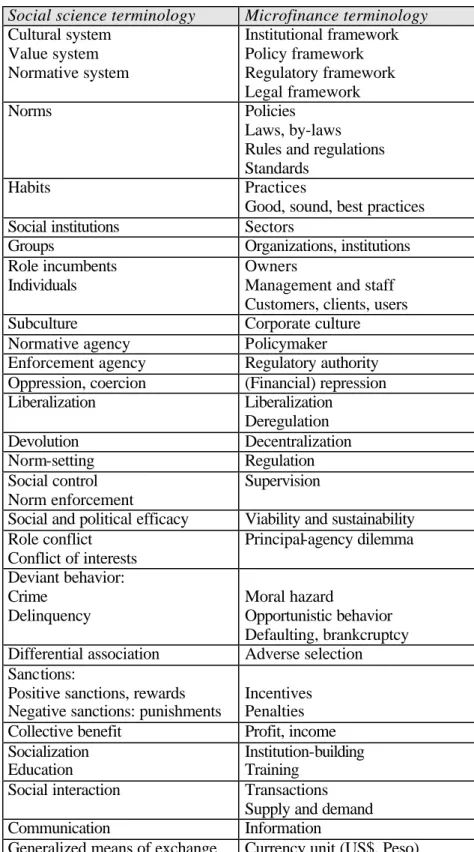
Given the state-of-the-art of sociological value research, it appears over-ambitious to expect solid results from a study of values as determinants of social capital and economic development. For the researcher, norms have a major advantage over values: they are more specific and can be recognized by the negative sanctions imposed in their breach; or by the positive sanctions associated with their observance. In our own research, we will therefore place a major emphasis on the normative framework, or, in the language of the New Institutional Economics (NIE), the institutional framework; and we will do so in microfinance: a field where norms and standards are quite specific and where both, the breach of norms and their observance, are of consequence. In the real world of finance, regulation and supervision are the key issues: how to establish norms – this is what regulation is about; and how to enforce norms – this is what supervision is about. Both are closely interrelated, regulation without supervision being empty, supervision without regulation being blind.Therefore, effective regulation requires effective supervision. In Table 1 the corresponding social science and microfinance terminology are juxtaposed.
We thus define social capital as the shared normative system of a group or organization which shapes the capacity of people to work together and produce results according to the group‘s or organization‘s purpose. The specific norms of a group or organization are in turn grounded in values, which in their totality form the subculture of a group or the corporate culture of an organization. Groups or organizations may form part of larger entities, sectors or sub-systems which are guided by more general norms: different schools are part of the school system, while schools and universities are elements of the educational system, which is somehow shaped by basic educational values. Banks, finance companies and insurance agencies are part of the formal financial sector with its own policy and legal framework, while formal-sector banks and informal-sector moneylenders are elements of the financial system, which is somehow shaped by economic values. In practical terms, regulation is the social capital of the (micro-) financial system. This may include a hierarchy of up to three or more levels of regulation and
1
This paper is part of a joint study of Social Capital Formation in Microfinance: The Case of the Philippines,
by Llanto, Quiñones & Seibel. The study is being supported through a grant by the Pacific Basin Research Center at Soka University of America in Calabasas, California, in the framework of its program on Social Capital Formation and Use in Asia and the Pacific. Grant recipient is the Asian and Pacific Development Centre in Kuala Lumpur, Malaysia, where Quiñones is Director of the Poverty Alleviation & Employment Programme
.
2 supervision: (a) fully institutionalized regulation, e.g., by the legislature (policymaking) and by the central bank or bank superintendency as a first-tier regulatory authority (bank supervision); (b) self-regulation as delegated to a second-tier regulatory authority such as an auditing federation of a network of (micro-) financial institutions; and (c) internal regulation by formal and nonformal financial institutions through their own rules and regulations, which includes supervision through organs such as boards and internal revision departments or auditing committees (sound practices). Ideally, all three levels are integrated through an effective management information and reporting system (MIS).
Table 1.1: Social science and microfinance glossary
Social science terminology Microfinance terminology
Cultural system Value system Normative system Institutional framework Policy framework Regulatory framework Legal framework Norms Policies Laws, by-laws Rules and regulations Standards
Habits Practices
Good, sound, best practices
Social institutions Sectors
Groups Organizations, institutions
Role incumbents Individuals
Owners
Management and staff Customers, clients, users
Subculture Corporate culture
Normative agency Policymaker
Enforcement agency Regulatory authority
Oppression, coercion (Financial) repression
Liberalization Liberalization Deregulation Devolution Decentralization Norm-setting Regulation Social control Norm enforcement Supervision
Social and political efficacy Viability and sustainability Role conflict Conflict of interests Principal-agency dilemma Deviant behavior: Crime Delinquency Moral hazard Opportunistic behavior Defaulting, brankcruptcy Differential association Adverse selection Sanctions:
Positive sanctions, rewards Negative sanctions: punishments
Incentives Penalties
Collective benefit Profit, income
Socialization Education
Institution-building Training
Social interaction Transactions
Supply and demand
Communication Information
3 There are formal norms which are written and binding. They may apply at the sectoral level, including government policies like interest rate regulation, and laws, such as the banking law; at the organizational level, like rules and by-laws as defined in the operations manual of a financial organization; or at the individual level, as laid down in a job description or an employment contract. There are also norms which govern the interaction between entities of different levels, such as the terms and conditions of financial contracts between primary and secondary cooperatives or banks and individuals. Furthermore, there are unwritten or informal norms of varying degrees of specificy and obligation (good practices), with a tendency towards formalization if considered important enough.
Through socialization, which may include education, training and experience-on-the-job, the norms and values are to be adopted, or internalized, by individuals in the form of knowledge, skills and habits. They are enforced through positive and negative sanctions, which act as incentives or penalties, respectively. Social conflict may arise between individuals who are involved in an organization at different levels, as in the case of the principal-agency dilemma: the shareholders of a bank, as the principal, may be interested in present or future profits, which are either distributed now or added to the bank’s equity to generate future profits; the managers, as agents for the principal, may have a personal interest in high salaries and perks such as company cars and fancy business trips; while field staff, as agents for the managers, may seek out under-the-table payments when disbursing subsidized loans.
When put into practice, the norms of a group or an organization lead to concrete behavior (good practices) with an observable or measurable output. This is then the social capital-in-action of a group or organization: the actual implementation of social capital as a shared system of norms and underlying values. In case of economic organizations, the output are products or services which can be measured in Dollar (or Peso) terms and in various efficiency and effectiveness ratios (SEEP 1995).
Measuring the value of social capital in microfinance:
Microfinance
is defined as a sector of formal, semiformal and informal financial institutions
providing financial services to the microeconomy. Microfinance services comprise
microsavings and microcredit (and perhaps other financial services such as microinsurance,
microleasing, transfer services), thereby allocating scarce resources to microinvestments with
the highest marginal rates of return. Two types of institutions are included: in a narrow sense,
small local financial institutions such as rural banks, savings and credit cooperatives, credit
NGOs and rotating savings and credit associations.; in a wider sense, national or regional
banks and development finance institutions (DFIs) with microfinance services for small
savers and borrowers.
The
microeconomy
is the primary market of MFIs and includes such populations segments as
small and microentrepreneurs, small farmers and the landless, women and low-income people
much of which falls into the informal sector which escapes an exact definition (
you know it
when you see it
).
There are
three assessment criteria
for the value of social capital in microfinance institutions
(MFIs):
•
viability
, which entails covering all costs from the interest income (, plus a profit margin;
•
sustainability
, which entails mobilizing one’s own resources and maintaining their value
in the face of inflation;
4
Accordingly, there are three major measures of the effectiveness of microfinance institutions
(MFIs), or the payoff of the social capital in microfinance.
2Viability
as measured by the
operational self-sufficiency ratio
3, which is in turn related to measures of portfolio quality,
refers to the extent to which an institution covers its costs, has its loans repaid, and makes a
profit.
Sustainability
has two aspects: (a) measured by the
financial self-sufficiency ratio
4,
it
refers to the extent to which an institution not only covers its operational costs but also
preserves the value of its resources, accounting for subsidies and the effects of inflation; (b)
measured by the
internal resources ratio
5,
it refers to the extent to which an MFI mobilizes
its own financial resources internally (equity capital, retained earnings and savings deposits)
instead of depending on government or donor funding.
Outreach,
which is closely related to
measures of staff effectiveness, or
financial deepening
, refers to the extent to which all
segments of the population, including low-income people, have access to financial
institutions and their services. It is usually measured in terms of the absolute number of
customers and the amount of financial services, particularly the number of depositors and
borrowers and the amounts of deposits and loans outstanding.
2.
NEGATIVE AND POSITIVE SOCIAL CAPITAL
From Financial Repression as Negative Social Capital...
Like financial capital, which may have a positive or negative balance, social capital comes in two forms: positive and negative. Positive social capital has a positive yield; it benefits society and its members. Negative social capital has a negative yield; its costs exceed its benefits. The former makes a society richer, the latter poorer. Countries remain underdeveloped if their overall negative social capital exceeds their positive social capital. Development ensues only to the extent that positive social capital is being generated in excess of negative social capital. In the past, financial repression, encompassing over-regulation and state interference, has been one of the most powerful forms of negative social capital in Third World countries (McKinnon 1973; Fry 1988). In the 1950s, the Philippines (like Ghana, Kenya and Uganda) had great promise as a truly developing country. Yet, in the decades thereafter, it greatly lagged behind the Tiger-states. A main factor was the amount of negative social capital it amassed through financial repression. Another, related factor was political repression through dictatorship, which implies the absence of democratic control over political and economic processes. In several Asian countries, this has included rampant political interference in lending decisions, which recently led to the Asian Financial Crisis.
However, financial repression is not all evil intentions. Based on the poverty hypothesis, which underlies modernization theory, it can also be a well-meaning social policy. The majority of people in Third World countries are poor. They are assumed to be unable to organize themselves, and incapable of self-help. In the vein of this hypothesis, countries are poor because people are poor and helpless; and people remain poor as long as their countries are poor. With regard to finance, this means that poor people are too poor to save; and poor countries are too poor to domestically mobilize financial resources.
The obvious solution was capital transfer from rich to poor countries and the disbursement of cheap credit to the poor. Special development finance institutions were created at international, bilateral and
2
SEEP/CALMEADOW, Financial Ratio Analysis of Micro-Finance Institutions. New York: Pact Publications, 1995
3
Financial Income/(Financial Costs + Operating Costs + Loan Loss Provision) 4
Financial Income/(Financial Costs + Operating Costs + Loan Loss Provision + Imputed Cost of Capital) 5
(Equity + Retained Earnings + Deposits)/Average Performing Assets. In donor-driven MFIs, the Donations and Grants Ratio is more popular.
5 national levels to channel the credit, such as the World Bank, the Asian Development Bank, Kreditanstalt für Wiederaufbau, Development Bank of the Philippines (1946) and Land Bank of the Philippines. In the process, national governments took upon themselves the combined roles of planner, banker, supplier, marketing agency, producer and welfare provider. Among their main financial instruments were interest rate ceilings and subsidies, credit targeting, credit rationing and agricultural price controls. Subsidizing interest rates on loans and directing subsidized credit to priority crops and borrowers became major development strategies, with agricultural production, rather than rural development, the objective. Institutions were instrumentalized as conduits of government funds, hampering the growth – and oftentimes even the emergence – of self-reliant local financial intermediaries. As credit was only available for government-directed purposes, farmers tended to take advantage of the fungibility of money, diverting it to other purposes and subverting project additionality. Due to resource scarcity, subsidized lending projects were narrow in scope and void of dynamic growth. Given a wide discrepancy between credit supply and demand, credit rationing became one of the principal strategies in credit allocation. Administered credit showed a persistent tendency of reaching the wrong recipients in wrong quantities at the wrong time for wrong objectives. Government officials and experts substituted their own rationality and decisions for those of the farmers and the market. This led to crop and project failures, sometimes on a large scale. Farmers were practically forced into diversion of funds. Factor allocations were distorted. In many cases, the impact of development projects, financed with hard-currency loans to be eventually repaid from incomes in ever-deteriorating local currency, was negative. Ceilings on interest rates prevented financial institutions from transaction cost-covering interest rates. As transaction costs tend to be constant per loan independent of loan size, interest rate ceilings and credit subsidies led to concentrations in the loan portfolio, allocating relatively large loans to a few big farmers, neglecting the small and the poor. Banks shifted transaction costs to borrowers, including legal and illegal charges, making cheap credit expensive to the end-user. As banks acted as conduits for government funds, rather than applying credit policies of their own, subsidized credit created its own high risks and associated default rates. Undercapitalization and contractions in the lending volume were inevitable concomitants.
In a number of cases, an inverted interest rate structure, with interest rates on deposits above lending rates, discouraged any type of commercially oriented banking and created systemic dependency on government and donor funding. Subsidized funds were channeled through specialized credit institutions which were usually barred from deposit mobilization. As a result, deposit facilities were notably absent in many rural areas, increasing the dependency of the farmer on subsidized credit and money lenders. Post Office Savings Banks offered interest rates with negative real returns and used their funds to subsidize the government budget. Potential savers, big and small, were discouraged. This hurt farmers and microentrepreneurs by restricting their self-financing capacity and prevented the emergence of institutions as financial intermediaries. Repayment rates of subsidized credit programs were usually abysmally low as neither bank staff nor beneficiaries, and least of all politicians, took the donors’ and the government’s easy money seriously. A host of factors have thus militated against the evolution of financial markets, as succinctly expressed in a book title, Undermining Rural Development with Cheap Credit (Adams et al., 1984).
Tight regulation has repressed the growth of the financial system, with interest rate controls, credit targeting, interest rate subsidies, politically motivated loan forgiveness, and legal restrictions on the growth of the financial infrastructure the chief instruments of financial repression. This has led to low bank densities, a low degree of the monetization of the economy, grossly inadequate financial services, and bank crashes which annihilated people’s savings and eroded their confidence in the financial system. Microeconomically, this has led to severely restricted and distorted allocations of resources, with a lack of growth in income and employment among all segments of the population, including the poor. At the macroeconomic level, this has led to high inflation rates, high levels of external endebtedness and low economic growth rates.
6
.... to Deregulation and the Mobilization of Positive Social Capital
Since the 1980s, the assumption that the poor cannot save and than poor countries cannot mobilize financial resources domestically has been gradually dropped. The poor do save, their marginal propensity to save being usually much higher than that of the non-poor. With appropriate strategies and products, local and national financial institutions can mobilize deposits. And there are numerous instruments governments can use to mobilize domestic resources. Many governments have therefore moved from a policy of financial repression to a policy of deregulation. The most important instruments have been:
• the deregulation of interest rates, permitting financial institutions (a) to offer attractive savings products with positive real returns and (b) to charge interest rates on loans which cover their costs and risks and allow for a profit margin
• exchange rate deregulation to ease the free flow of private capital
• the deregulation of bank entry and branching, including the provision of legal forms for local banks with lower equity requirements,
… Accompanied by a Deregulation of the Trade Regime
Pitfalls of deregulation: Yet, deregulation has met with two pitfalls: the first is a lack of effective supervision of financial institutions, frequently embedded into an autocratic polical economy, with massive political interference in the financial system, as in virtually all countries hit by the Asian financial crisis; but less so in the Philippines than say in Indonesia. The second pitfall lies in the reluctance of governments to fully implement their own deregulation policies. This has had several root-causes: the attempt by politicians to buy votes by providing cheap credit in their constituencies, particularly, in the Philippines, in the face of a failed land reform; the rent-seeking behavior of those who directly benefit from preferential credit disbursement in various legal and non-legal ways; the sheltering of disbursement agencies against competition; and, last not least, the vested interest in the continued supply of easy money among those who hold positions in national and international disbursement agencies.
Interest rates: Administrative ceilings on interest rates, based on the Anti-Usury Law of 1916 and replaced in 1973 by a more flexible regime of the central bank, have been effectively abolished in 1983 as part of the IMF-World Bank reform package. Since then, financial institutions are free to set their on interest rates on deposits and loans of various maturities according to market criteria. Yet, the government continued to use legislated interest rates as a means of directing preferential credit to priority sectors. This has distorted financial markets.
Directed credit: In the Philippines, preferential credit is a prime example of contradictions between policies and practices and their overlapping effects. With the realization of the bad effects on the financial system and the quantity and quality of financial services and under IMF and World Bank pressure, major channels of subsidized credit, particularly through Rural Banks, were closed off in the late 1980s. Yet, despite that action and a strong stance against directed credit by the governmental Agricultural Credit Policy Council, ACPC, large numbers of preferential credit programs continue to exist.
The Comprehensive Agrarian Reform Law (CARL), RA 6657 of 1988, together with a host of other laws and ordinances, provides for concessional and collateral-free credit to small landowners, farmers and farmers’ organizations. This has made the Landbank of the Philippines, the main provider of such credit, unviable. Landbank provided credit at 12%, further lowered in 1994 (AO 162) to 10%, while its credit costs ranged from 15% to 29%, depending on the source of funds (Dingcong 7/1997:10-11) Besides undermining the health of Landbank, this has created fiscal and inflationary pressures; and, micro-economically, it has directed credit flows into activities with low rates of return which would be unprofitable at market rates.
7 With an overall repayment rate of reportedly 90.4% in 23 selected agricultural credit programs as of 12/1996, performance has greatly improved compared to the 1980s, when repayment generally was below 50%. But performance varied widely, with only three out of 23 programs reporting repayment rates of 100%. The performance of most of the 13 programs channeled through cooperatives or borrower groups was poor, varying from 11% to 95% repayment; while the five programs with direct lending to individual borrowers, accounting for the larger portion of the overall portfolio, performed much better, with repayment rates between 75% and 100%.
The overall effect of preferential interest rates is contrary to the lawmakers intentions: ”The effect of this is a decrease in the supply of credit to targeted sectors... At the ceiling rate the amount lenders are willing to provide is smaller than the level they would have been willing to lend at the market rate, and less than the amount borrowers would like to avail of at the rate. With excess demand for credit, the group most discriminated against are the small borrowers, the sector which the law aims to protect.” (Dingcong 7/1997:11)
There is a large number of specialized government financial institutions which are involved in directed credit. Despite the fact that “international experience over the past 40 years suggest(ed) that specialized institutions, particularly those that have attracted foreign resources, have failed completely,” (Dingcong 1997:17) the government keeps them alive and continues to establish new ones. The latest creation has been the People‘s Credit and Finance Corporation, PCFC, created in 1995 and operational as of 6/1996, an offshoot of LBP with the obje ctive of poverty alleviation through loans to NGOs and FIs.
Bank entry and branching: Until the late 1980s, regulation on bank entry and branching was highly restrictive. Restrictions comprised the prohibition of new banks; the branching into areas categorized as overbranched; increased reserve requirements; and increased capitalization requirements. Between 1988 and 1994, these restrictions were gradually removed, leading to an increased level of competition and relative improvement in efficiency of the banking system. Between 1986 and 1989, the number of bank offices had slightly declined, while during the liberalization period, 1989-93, their number grew rapidly: from 3,565 to 4,657, or 29.8%, and continued to grow thereafter. This growth has been stronger among commercial banks than among rural banks, which showed growth rates of 14.6% during 1989-93 and 12.6% 1993-95.
Table 2.1: Offices of bank and non-bank institutions in the Philippines, 1986-1995
Type of 1986 1989 1993 1995
financial institution No. % ch.1 No. % ch.1 No. % ch.1 No. % ch.1
Commercial banks 1,766 · 1,765 -0.2 2,377 +34.7 3,047 +28.2 Rural banks 1,083 · 1,043 -3.7 1,195 +14.6 1,346 +12.6 All banks 3,614 · 3,588 -0.7 4,657 +29.8 5,569 +19.6 Non-bank FIs 2,283 · 3,465 +51.8 5,035 +45.3 6,575 +30.6 All FIs 5,979 · 7,135 +19.3 9,809 +37.5 12,266 +25.0 1
Change in percent Adopted from: Bangko Sentral Pilipinas, The Philippine Financial System Fact Book 1995
Intermediation taxes: Efforts towards financial liberalization started in 1981 but have not resulted in the total elimination of intermediation taxes on the financial sector, impinging on its efficiency. These taxes include the credit quota schemes which direct banks to set aside a portion of their loanable funds for targeted sectors at preferential terms, the gross receipts tax, the deposit retention scheme restricting the free flow of resources between different regions of the country, tax on interest income and reserve requirements.
8
Reserve requirements on deposits were as high as 25% until 1991, resulting in lower interest rates on deposits and higher rates on loans – thus putting a damper on the mobilization of deposits. Between 1993 and 1997, reserve requirements on deposit liabilities of commercial banks were decreased to 22% in 1993, 19% in 1994, 15% in 1995, 14% in 1/1997 and 13% as of 7/1997. Reserve requirements on savings and time deposits of thrift banks, and even more so of rural banks, were lower, declining, in the case of rural banks, from 14% in 1993 to 5% as of 7/1997 (Dingcong 7/1997:36).
Prudential regulation and supervision: To fully mobilize the social capital potential of a financial system through deregulation, three things have to be in place: macroeconomic stability, prudential regulation, and effective supervision. Deregulation can only succeed under conditions of macroeconomic stability. An extreme case is the Latin American Southern Cone, where liberalization collapsed during the early 80s under conditions of hyperinflation. In the Philippines, liberalization efforts were hampered, throughout the 80s, by widely fluctuating inflation rates. The problem here was not so much one of absolute magnitude, but of volatility and unpredictability. Between 1992 and 1997, inflation was down to single -digits, but then the Asian financial crisis hit in 1997/98. Prudential regulation and supervision are a major factor influencing the activities and the quality of financial institutions. There are bank and non-bank financial institutions under the authority of the central bank, which is the only institution exerting effective control; cooperatives under the Cooperative Development Authority which requires annual financial reporting but lacks the capacity to effectively supervise their activities; NGOs which are registered but not regulated or supervised; and informal financial institutions, like money lenders and savings and credit associations, which are unregistered and unsupervised. Whether regulation and supervision have a positive or negative influence depends on the policy environment. Under a repressive regime, the central bank stifles the growth of the formal financial sector, which puts nonformal finance at an enormous competitive advantage. In a liberal environment, however, prudential regulation and supervision can be very beneficial. Among MFIs in the Philippines, Rural Banks are regulated and supervised by the central bank, while cooperatives and NGOs are not: to the advantage of the former and the detriment of the latter.
3. GRAMEEN BANKING: (SELF-) REGULATED BUT NOT SUPERVISED CAN MIRACLES BE REPLICATED?
The Grameen Bank (GB) of Bangladesh, formally launched in June 1979, is widely considered as one of the world’s most successful financial institutions banking with the poor. On its website6, the Bank reports as of 31/12/95 an outreach to 2.06 million “member/borrowers”, 94% of them poor women, in 36,142 villages of Bangladesh, reached through 1068 branches. Cumulative loan disbursements are given as US$1.84b; loans outstanding, according to the balance sheet, amount to $298.8m, total assets to $474.5m, and ”deposits & other funds” to $127.47m. Many have been deeply impressed by these figures and GB’s publicity, partic ularly since the Microcredit Summit of February 1997 in Washington D.C.
Grameen’s success is explained by its social capital, a self-regulated normative framework not supervised by any authorized agency, which prescribes its operations in detail7:
• a focus on poor women, gathering detailed target group information and using rigid sele ction criteria to bar the non-poor from access to its services
• organizing the prospective borrowers in groups of five and centers of about six groups each which in turn come under a Grameen branch
• a credit-first program design, initially financed with donor or government funds
6
http://www.citechco.net/grameen/bank/stat.htm: Statistical Update 7
CARD – Center for Agriculture and Rural Development, Operations Manual. CARD Research Unit, San Pablo City, The Philippines, 4/1998
9
• internal resource mobilization through a compulsory savings component, supplemented by external donor or commercial resources
• reliance on peer pressure and joint liability of solidarity groups as a special type of risk management, which allows Grameen to lend without collateral
• strict credit discipline with absolute insistence on timely repayment (except during natural disasters)
• weekly center meetings with compulsory punctual attendance, where a pledge is sung and payments are transacted with a Grameen branch officer in the presence of all members
• special conditions of financial contracts, comprising a series of one-year repeat loans to individual borrowers at market rates of interest, starting small (around $50) and, contingent upon the group members’ repayment performance, growing bigger in predetermined steps and amounts, repayable in weekly instalments, with a five percent up-front deduction to be paid into the group’s emergency loan fund
• adoption of Grameen’s Ten Decisions of personal discipline to be followed in one’s daily life, such as growing fruits and vegetables in the backyard; abstention from drinking, smoking and gambling; improving one’s housing; building latrines; safe drinking water for better health; investing in the children’s education
• intensive training of members and staff to adopt the attitudes, practices and underlying norms and values of the Grameen approach.
Despite some criticism, there can be little doubt that Prof. Yunus, though not the only one, has achieved miracles in Bangladesh: providing short-term microcredit and longer-term housing loans to large numbers of the poor, making them repay their loans on time, turning some of the poor into telecommunication innovators who offer mobile phone services in remote villages and, last not least, freeing women from some of the fetters of repression. With donor support channeled through Grameen Trust and Cashpor, there are now Grameen programs in 26 countries including the Philippines where replication started in 1989 on a broad scale. Can the Grameen miracle be replicated be replicated in the Philippines? Is Grameen banking a form of social capital that can be effectively exported?
Grameen Replicators in the Philippines: Struggling for Donor Funds...
Our analysis is based on studies in the Philippines of 27 replicators by ACPC8 in 1993; six replicators by APDC/UNDP9 in 1996; three replicators by GTZ10 in 1997; and two supplementary case studies by Seibel in August 1998. ACPC, a government institution, examined its own experience as program executing agency with the 27 Grameen replicators in the Philippines, reduced by attrition to 23, as per 6/1993. While highlighting some positive aspects, such as a ”significant impact on the standard of living of its beneficiaries”, ”high repayment rates from 94% to 98% (averaging 96.8% in 1993)”11, and ”the poor are capable of saving on a regular basis” (p. 85), the facts yielded a rather dismal picture: In a country with a diversified MFI infrastructure of, at present, over 800 rural banks, 3000 credit cooperatives and 600 credit NGOs, 23 Grameen replicators (including banks, cooperatives and NGOs) had a negligible outreach, in 1993, of 4766 individuals (89% of them active borrowers, 184 on average), even after an expansion to 16,432 participants in 12/1995 (95% of them active borrowers).
8 Agricultural Credit Policy Council, An Evaluation of the Grameen Bank Replication Project in the Philippines. ACPC, Manila 10/1995. ACPC monitors the Grameen replicators periodically, but does not any formal sense supervise them. As NGOs, the Grameen replicators are unsupervised.
9
I. Getubig, J. Remenyi & B. Quiñones, eds., Creating the Vision: Microfinancing the Poor in Asia-Pacific. Asian and Pacific Development Centre, Kuala Lumpur, 1997
H. D. Seibel, G. M. Llanto, E. Garcia & R. Callanta, Microfinance in the Philippines, Economics and Sociology Occasional Paper No. 2367, Dept. of Agricultural Economics, Ohio State University, Columbus
10
Dorothee Rojahn & Karl Osner, Report on the Self Evaluation Workshop of the Replications of the Grameen Bank Methodology in Asia. GTZ, Eschborn 5/1998
11
As of 12/1995, the repayment dropped to 93%. The lowest rate was found among cooperative societies (86%), the highest among cooperative banks (98%), with NGOs in-between (98%).
10 The program was found to be donor-driven; internal resource mobilization was minimal; interest rates were inadequate; and costs, shared about equally between government and replicators, were exorbitant, amounting to P0.47 per Peso lent and P1.70 per Peso saved, plus the costs of institution-building (p. 77). The operational self-sufficiency ratio was 0.24 or lower.12 Noting that ”excessive brokering of low-cost funds may discourage savings mobilization”, the authors (pp. 85-88) recommended:
• to offer attractive deposit interest rates and vigorously mobilize savings;
• to charge loan interest rates that cover at least the transaction costs;
• to cancel the program guarantee fund;
• to provide start-up assistance only; and
• to focus government support on ”institution-building, training and management rather than on supplying cheap credit.” (p.85-88)
They concluded that ”... any attempt... to replicate or expand it (the program) should be carried out with great caution”.
... or Struggling for Viability?
In 1996, APDC, with UNDP support, carried out an assessment of microfinance institutions (MFIs) in eleven Asian and Pacific countries, including seven MFIs in the Philippines: one cooperative bank and six NGOs. Six of the MFIs in the Philippines use the Grameen technology, but not all of them exclusively. As of end-1995, outreach ranged from 1,260 to 7,000 clients in the seven MFIs, averaging 3,000: a substantial (almost 15-fold) increase over the average for mid-1993. 90% of them were women; 94% were classified as poor. Average loans outstanding ranged from $30 to $467 among the poor and from $1,500 to $2,600 among the non-poor. Savings mobilization continued to be weak, with a savings-to-loans outstanding ratio ranging from 0.05 to 0.41 and averaging 0.14.
Table 3.1: Viability indicators of seven MFIs in the Philippines,1995 Cost per average Peso
of loan outstanding Degree of operational self-sufficiency in % Degree of financial self-sufficiency in % A 1.30 21 19 B 1.00 8 7 C 0.71 51 42 D 0.48 67 48 E 0.19 134 118 F 0.29 113 93 G 0.34 66 .
Another remarkable development had occurred since 1993: a widening of the range between good and poor performance. Transaction costs per average Peso of loan outstanding varied from 0.19 to 1.30; the operational self-sufficiency ratio varied from 0.08 to 1.34; and the financial self-sufficiency ratio (including adjustments for subsidies received and inflation) varied from 0.07 to 1.18. The cooperative bank (E in Table 1) performed best of all seven institutions. Two of the institutions learned a lesson
12
Calculated on the basis of Annex 15 of income and expenses in the ACPC report, plus a loan loss provision of 3%. The actual ratio might be lower as it is not clear whether financial costs are included in the expenses. The ratio is 0.29 for cooperative banks, 0.24 for cooperatives and 0.20 for NGOs. No data are provided to calculate the financial self-sufficiency ratio.
11 and applied for a rural bank license: CARD (C in Table 1), which since has been transformed into a bank; and TSPI (F in Table 1), which failed to meet recently increased equity capital requirements. Two of the institutions (A and C in Table 2) are the subject of case studies reported below.
Grameen vs. Individual Technologies: at what Costs and Benefits?
In microfinance, there are two technologies which are sometimes debated among their
adherents with almost religious fervor: group vs. individual technologies - two different types
of social capital. The Cooperative Rural Bank of Laguna, Inc., the only bank and the only
fully viable institution among the 7 MFIs (as of end-1995) studied by APDC in the
Philippines, has an interesting story to tell. Established in 1977 by farmers‘ cooperatives,
which own the bank, it serves both poor and non-poor clients, with poor women in the
majority. Since 1991, it has been one of replicators in ACPC‘s Grameen program, thus
combining regular and Grameen-type (“KPP”) operations. Does the Grameen approach
enable an MFI to reach out to a poorer clientele? And, in doing so, can it cover its costs and
even make a profit? The answer to the latter question is all the more interesting in face of
overwhelming evidence from NGOs in the Philippines that Grameen-type banking is not
viable.
In 1995, the Bank served 1,792 borrowers ((74% poor, 90% women) and 2,583 savers (55% poor, 81% women). Unlike non-bank replicators, which are not authorized to mobilize voluntary savings, the Bank offers passbook savings and time deposits. But given the abundance of donor funds, the savings ratio is only 0.14.
In the field of credit, the Grameen program KPP has substantially increased the Bank‘s outreach: 1,330 or 74% of the Bank's 1,792 borrowers fall under KPP. Under KPP, loans provided through savings groups have been increasing from 1% of total loans granted in 1993 to 15% in 1995. However, in terms of volume, the contribution of KPP borrowers, P3.15 million, to the Bank's total loan portfolio of P28.25 million outstanding is modest, comprising only 11%. Evidently, loans outstanding to poor women averaging P2,367 are far below the Bank's overall average, which is P15,763 per borrower. There are wide discrepancies in terms of average loans outstanding by sex and poverty status in 1995: the average size of loans was P9,987 for women and P66,545 for men; P2,367 for the poor and P54,327 for the non-poor.
In the field of outreach to savings depositors, the Grameen program KPP has more than doubled the Bank's outreach. All of the KPP's 1,415 participants have deposited savings in the Bank, compared to 1,168 non-KPP depositors. Thus, 55% of all depositors are KPP partic ipants. However, in terms of volume, their share is substantially lower, namely 23% of a total of P3.89 million, yet much higher than their credit share. This shows once again: the poor can save, and, in particular: women are good savers! The average size of savings in the bank was P1,506. Again, discrepancies exist, but they are by far not as wide as in the field of credit: women saved on average P1,192, men saved P2,826. The poor saved an average of P642, the non-poor P2,553.
The total income of the bank per Peso of loan disbursed was an identical P0.26 for both the Grameen and entire bank operations. However, there is a substantial difference in magnitude and trend of net operating income over total performing assets, which is 0.33% for the KPP Grameen scheme (down from 0.46% in 1993) and 0.56% for the entire bank operations (up from 0.39% in 1993). Default rates resulting from bankwide operations appear within manageable limits but could be substantially improved. In the last three years, the ratio of past due loans to total loans outstanding was steady at 17-18%. Collections on matured loans improved slightly from 85% to 89%. The recovery performance of the KPP Grameen scheme was substantially better, with a repayment rate of 97% in 1995 (down from a high of 99% in 1993). The bank's earnings from interest income and fees covers more than its costs, with a degree of operational self-sufficiency (defined as the ratio of said earnings
12 to total costs less depreciation) of 134% of the entire bank operations as well as the KPP Grameen scheme.
Over the three-year period 1993-1995, the Bank has been profitable, and so has its Grameen scheme. During that period, the Bank's gross earnings averaged about P5.7 million and its costs P4.2 Million, yielding an annual average net income of over P1.4 million. The Bank profits from its Grameen scheme, but at 7% of net revenues only on a minimal scale.
Table 3.2: The Cooperative Rural Bank of Laguna Inc.: Grameen vs. entire bank operations, 1995
Grameen operations Entire bank operations
Savers 1,415 (55%) 2,583
Borrowers 1,330 (74%) 1,792
Savings deposits (million P) 0.89 (23%) 3.89
Loan portfolio (million P) 3.15 (11%) 28.25
Loans outstanding per borrower (P) 2,367 (15%) 15,763
Repayment rate, 1993→1995 99%→97% 85%→89%
Total income per Peso disbursed P0.26 P0.26
Return on performing assets, 1993→1995 0.46→0.33 0.39→0.56
Operational self-sufficiency ratio 1.34 1.34
Net revenues 7% 100%
The Bank has faced three constraints: a limitation in outreach; a not quite satisfactory repayment rate; and a weakness in savings mobilization. It has attempted to solve the first constraint by adopting the KPP Grameen replication scheme which has more than doubled its outreach in terms of numbers of clients. As the repayment rate in the KPP scheme has been far better than that of its cooperative clients, this has also contributed to a solution of its second constraint, but given the small size of the KPP loan portfolio only to an insignificant extent. No solution is in sight for its third constraint, weak savings mobilization. This is due, on the one hand, to zero or negative real returns on savings which could of course be remedied by increasing the rates of interest on both savings and loans which is optional for any institution. On the other hand, there seems to be little pressure on the bank to mobilize more savings as long as it has access to governmental sources of easy money which are liberally replenished by international donors.
The Bank has demonstrated the profitability of microfinance in two respects: both its own original operations with poor and non-poor members and its more recent operations with poor women under a Grameen-type replication scheme have covered their costs and yielded a profit. In terms of most performance indicators, its Grameen-type scheme with poor women organized in groups of five has been a success. Local outreach has surged; repayment rates are high; and the Bank makes a profit from the operation. Yet, the Bank's management is not enthusiastic. In quantitative terms, the volume of savings mobilized and loans disbursed to poor women is only an insignificant share of the bank's overall business, and so is the volume of profit derived from the KPP Grameen replication scheme. The management does not see enough potential in this market segment of poor women to argue that in the long run the Bank may contribute to the growth of their microenterprises and that these in turn will contribute to the growth of Bank. The management therefore considers terminating the KPP scheme which it finds profitable in relative but not in absolute terms.
The Case of Ahon Sa Hirap Inc. (ASHI): Repayment through Grameen Discipline
ASHI, the first Grameen replicator in the Philippines, started in 1989 as a social science research project of the University of the Philippines in Los Baños, with a grant of $50,000 from Cashpor, the regional network of Grameen replicators. In 9/1991, ASHI was registered as a non-profit, non-stock corporation, serving 100 beneficiaries in Laguna Province. At the same time, it provided Grameen
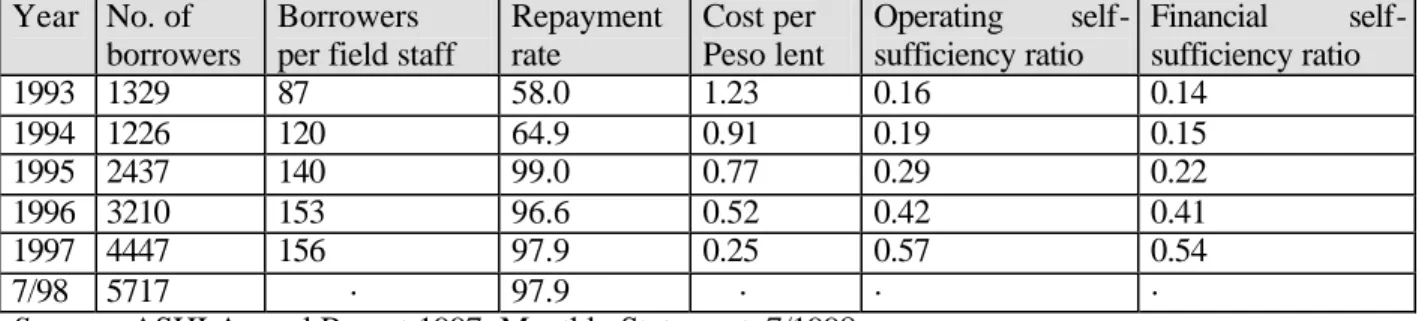
13 consultancy services to various parishes. In 1992, the founder left the Philippines. By 1993, ASHI ran out of resources, depleted by administrative expenses and a drop of the repayment rate of its 1329 borrowers to 58%. For every Peso lent, ASHI spent P1.23; its operating and financial self-sufficiency ratios stood at 0.16 and 0.14, respectively. A crisis of policy and management ensued.
ASHI first decided to fully concentrate on Grameen banking and gave up its consultancy services. For reasons of economies of scale, it increased its branch network to five by taking over the Grameen activities of parishes it has previously assisted. As ASHI was not the only Grameen replicator in jeopardy, Cashpor organized a conference in the Philippines in 1994; GTZ of Germany and ACT of Belgium got involved; a Moment of Truth was defined; and a rehabilitation project was decided for three replicators. For six months, ASHI was practically run by a Cashpor consultant, who revamped the organization branch-by-branch and center-by-center, while the number of borrowers was allowed to drop to 1.226. He retrained all staff and rigidly restored the essentials of Grameen Banking which constitute the self-regulatory Grameen social capital, including regular attendance of weekly meetings, punctuality, pledge, seating arrangements and - absolute insistence on on-time repayment! In 1995, the headoffice moved to a more central location, Quezon City, from where it runs an excellent up-to-day MIS. The number of branches grew to seven, with a growth in all-female membership to 3,521 (3,210 or 91% of them borrowers) in 1996; 4,698 (4,447 or 93% borrowers) in 1997 and 5,955 (5,717 or 96% borrowers) in 7/1998.
As a result of the restored Grameen discipline, the repayment rate soared from 64.4% in 1994 to 99.0% in 1995, hovering around 97-98% thereafter (1996: 96.6%; 1997: 97.9%; 7/1998: 97.9%). Transaction costs were drastically lowered: from P1.23 per Peso lent in 1993 to P0.25 in 1997. Accordingly, the operational self-sufficiency ratio steadily increased from 0.16 in 1993 to 0.58 in 1997, paralleled by an increase in the financial self-sufficiency ratio from 0.14 to 0.54 – still far from satisfactory, but on a promising course. With 60% of its loanable funds from grants and soft loans, financial self-sufficiency is not in sight.
Table 3.3: ASHI performance data, 1993-7/1998
Year No. of borrowers
Borrowers per field staff
Repayment rate Cost per Peso lent Operating self-sufficiency ratio Financial self-sufficiency ratio 1993 1329 87 58.0 1.23 0.16 0.14 1994 1226 120 64.9 0.91 0.19 0.15 1995 2437 140 99.0 0.77 0.29 0.22 1996 3210 153 96.6 0.52 0.42 0.41 1997 4447 156 97.9 0.25 0.57 0.54 7/98 5717 · 97.9 · · ·
Source: ASHI Annual Report 1997; Monthly Statement, 7/1998
ASHI, though barred by law from mobilizing savings, is now trying to strengthen its deposit base. In addition to the usual compulsory savings and loan deductions, it has introduced a two-year children’s savings scheme, with weekly deposits of P50 or P100 at 4% interest p.a.13 Loans of 6-12 months start with P2,000 ($46 by the 8/1998 exchange rate) and increase up to P10,000 in the fifth cycle. To increase its profitability, ASHI has added loans ranging from P15,000 to P50,000 ($345-$1150); and it is increasing its interest rate from 20% flat (approx. 37% effective) to 25% flat (approx. 46% effective) p.a.14 Another new product is a one-month loan of P3-5000 with weekly instalments, at a flat interest rate of 6%. With viability and sustainability its future goal, ASHI considers to convert the
13
At an inflation rate of 7.4%, this is equivalent to negative real returns of 3.4% 14
For the larger loans, ASHI carries out creditworthiness examinations. At the time of the field visit, Mrs. D., after having received and repaid a number of loans from ASHI totaling P87,000, had submitted a new application for a livestock loan of P50,000, for which ASHI calculated a profit rate or 158%.
14 compulsory 5% capital build-up deduction from all loans into shares and, within five years, transform the NGO into a cooperative bank owned by ASHI members and staff.15
The Case of CARD: a Viable Grameen Rural Bank in the Philippines16
Inspired by the onset of a new era after the downfall of the Marcos regime, the Center for Agriculture and Rural Development (CARD) was one of numerous new NGOs established in 1986 and thereafter. With two grants of P150,000 each, CARD, as of 1/1988, organized the poor in mixed groups of 15-45 members, registered them as associations (including some spouses to reach the required minimum number of 21 members) and channeled short-term loans (3-6 months) of P1,000 to each member. With negotiable repayment schedules, this turned out to be a false start. After eight months, only the two groups which had opted for monthly instalments had repaid their loan. The remaining five, with lump sum repayment upon maturity, defaulted. The overall repayment rate during that year was 68%. Under donor pressure, CARD was either to close or revamp its operations.
In late 1988, the president of CARD visited the Grameen Bank in Bangladesh. Deeply impressed by the ability of the poor to engage in income-generating activities and repay their loans on time, he decided, upon his return, to adopt the Grameen approach, organizing poor women in groups of 5 and centers of 30. This, however, met with considerable opposition. The complex Grameen discipline, including weekly meetings and weekly instalments, were greatly disliked, particularly by the men. Four of the associations left the project; 89 poor women agreed to participate in a pilot test, from January to December 1989. Credit discipline, which is one of the most outstanding achievements of the Grameen approach, produced repayment rates of 98.0%-100.0% since 1994. This impressed BSP, the central bank, so much that it consented to fully non-collateralized lending when CARD later established itself as a rural bank
But active membership grew only slowly: to 307 in 1990, 468 in 1991, 949 in 1992 and 1,711 in 1993. 1990-96 were years of experimentation to modify the Grameen technology. CARD developed its own training system and operations manual; substituted 6-months first-loans for one-year loans; required a minimum self-financing ratio of 25% from repeat borrowers; introduced a mutual life and accident insurance fund; replaced group funds by center funds; offered multipurpose loans for prime borrowers; added voluntary withdrawable savings (ignoring the law which bars NGOs from deposit taking); and, finally, provided a staff incentive scheme. Active membership soared from 1,711 in 1993 to 6,844 in 1996. By 1996, nonwithdrawable compulsory savings stood at P12m, voluntary savings at P1m. Operational self-sufficiency, which had declined from 0.31 in 1991 to 0.25 in 1992, went up to 0.46 in 1993, 0.77 in 1996 and 1.00 in 1999.
In May 1996, CARD submitted its application to establish a rural bank, which was approved in December. This means that CARD Bank now falls under the regulation and supervision of the central Bank, which, according to our hypothesis mobilizes an entirely new quality of CARD’s social capital. After having deposited P5m as paid-up capital with Landbank, CARD Rural Bank (RB) formally opened on 1 September 1997. There are now two institutions: CARD RB for financial intermediation, with 5 branches, and CARD NGO for group formation and guidance including financial intermediation in areas not covered by a CARD RB branch, with 16 branches. in the island provinces of Masbate, Marinduque and Mindoro. An application for branching-out has been submitted to the central bank, in order to bring all financial activities under the roof of CARD RB. Due to legal restrictions, CARD NGO owns only 25% of CARD RB; the rest is owned by five board members and staff, who have entered into a trust agreement with the NGO.
15
Special microfinance training courses, including the preparation of custom-made training materials and operational manuals, may be arranged by ASHI through INSOL ([email protected]).
16
For a detailed presentation see: Hans Dieter Seibel & Dolores Torres: Are Grameen Replications Sustainable, and Do The Reach the Poor? The Case of CARD Rural Bank in the Philippines. Journal of Microfinance (ISSN 1527-4314) Vol. 1 No. 1, 1999: 117-130.
15 Transformation into a bank appears to have greatly facilitated the growth of group membership, which soared to 10,868 in 1997 and 28,531 in 1999. CARD RB has ambitious goals: 50,000 active members by 2000 and 150,000 by 2002.
The Bank offers passbook savings at 5% and fixed deposits, ranging from a minimum of P10,000 for one month at 7% interest to P500,000 for 12 months at 15%: all above the usual commercial bank rates. As of July 1998, the savings deposit balance was P14m. There are five loan products, all with weekly instalments: regular loans increasing from a first loan of P2,000 to a fourth loan of P10,000; asset acquisition loans up to P50,000; housing loans up to P20,000; short-term multipurpose loans up P5,000; and prime-borrower loans up to P100,000. Maturities range from 12-75 weeks; but most are 50 weeks. Interest rates are 20% flat, plus an upfront service fee of 4%; effective annual interest rates are 45.6%-53.8%.
Table 3.4: CARD performance data, 1988 - December 1999
Year No. of borrowers Repayment rate Portfolio at risk No. of deposit accounts Operational self-sufficiency ratio Fin. self-suffi-ciency ratio 1988 150 68.0 1989 89 100.0 89 1990 307 98.0 307 1991 468 96.0 468 0.31 1992 949 98.2 949 0.25 1993 1,711 98.1 1,711 0.46 1994 3,547 98.0 3,547 0.77 1995 4,240 98.8 0.17 4,240 0.46 0.42 1996 6,844 99.2 0.12 6,844 0.77 0.68 1997 10,868 100.0 0.00 10,954 1.22 0.73 1998 20,617 99.9 0.06 20,880 1.00 0.73 1999 28,531 100.0 40,367 1.00 0.86
Source: Dolores M. Torres, Managing Delinquency and Quality Portfolio, 8/1998; Annual Statement, 12/1999
In 7/1998, the loan portfolio of CARD Rural Bank amounted to P32m, that of CARD NGO to P38m. By December 1998, the portfolio had increased to P39.0m (6,530 borrowers) and P44.3m (14,087 borrowers), respectively: a total of P83.3m (20,617 borrowers). Deposits in 12/1998 amounted to P14.8m (38.0 of loans outstanding) in CARD RB and P10.9m (24.7% of loans outstanding) in CARD NGO: totaling P25.8m (30.9% of loans outstanding). Together, equity and deposits account for 37.0% of loans outstanding. Each of the two entities recently obtained a loan of P15m from the People’s Credit and Finance Corporation, PCFC , which is funded by ADB and IFAD, at 12% interest p.a. and a 1% annual service fee on the outstanding balance. Other donors include CGAP and Grameen Trust. Transformation into a rural bank, which included a preparatory phase in 1996-97, seems to have brought CARD closer to its desired sustainability goals: the cost efficiency ratio (cost per Peso lent) improved from 0.69 in 1995 to 0.33 in 1997; the operational self-sufficiency ratio climbed from 0.46 in 1995 to 0.77 in 1996, 1.22 in 1997 and 1.00 in 1998 and 1999 (with 234 borrowers per field staff), financial self-sufficiency (adjusted for subsidies and inflation) grew from 42% in 1995 to 68% in 1996, 73% in 1997 and 1998, and 86% in 1999. CARD branch viability (operational self-sufficiency ratio of at least 1.0) increased rapidly: from none out of eight branches in 1995 to four out of ten in 1996 and eight out of 13 in 1997.
16 Card Rural Bank has proven that outreach to the poor and operational viability are not only compatible: they are mutually reinforcing.17 As to financial reliance and full financial self-sufficiency, the Bank has made great progress in recent years. However, continued access to easy donor money may hamper the bank’s effort to vigorously mobilize deposits and, in the case of devaluations, inordinately augment the country’s external endebtedness in Peso terms.18
The social capital of Grameen microfinance institutions
Is the Grameen approach a type of social capital that can be exported world-wide, with a success similar to that of the Grameen Bank in Bangladesh? Does the Grameen approach provide an optimal solution to the problem of how to provide financial services to the poor? We have looked at two criteria, outreach and institutional viability (ignoring a third, namely impact). In the Philippines, the outreach of Grameen replicators has been negligible compared to the totality of financial services provided by other microfinance institutions. All replic ations are donor-driven. Donor-dependency has undermined their viability. Only few of the institutions are operationally self-sufficient, covering their costs from their income. In some cases, even effective annual interest rates around 50% (or real rates, adjusted for inflation, around 40%) were not sufficient to cover the costs of the Grameen technology. But all of the institutions examined, which are of course only those who have survived, have progressed in this respect and might, eventually, be operationally fully viable.
Sustainability, however, is not in sight in any of the replicating institutions (unless Grameen replication is a side activity). None even remotely approaches an adequate level of internal resource mobilization; nor does anyone earn enough revenues to cover all operating, financial and loan loss expenses and the value of adjustments for subsidies and inflation. The biggest obstacle in the development of the Grameen replicators has been donor support: a powerful incentive to substitute external resources for local savings.19 Only domestic savings have a chance to grow dynamically; government and donor dole -outs do not. It seems speculative at this point to predict if financial self-sufficiency might ever be reached by any of the institutions. However, those who adhere to the pure and unadjusted Grameen technology and insist on banking with the poor only are unlikely to withstand the growing competition of other MFIs in the long run.
Our initial question was: do the Grameen replicators reach the poor, and are they sustainable? According to the limited evidence presented in this paper, the answer is: They are not sustainable; and therefore, they do not reach the poor in sufficient numbers. It appears that the Grameen approach is no magic formula, and no best practice or unique and optimal solution that may be applied around the world to alleviate poverty. I am not aware that any such optimal solution or best practice ever existed, or may ever be found. However, there may be sound practices, which work for a certain time under certain conditions and may compete with other sound practices.
There are a number of sound practices which may explain some of the success of some of the replicators. It appears that successful replicators share a least the following three sound practices, constituting perhaps the hard core social capital of the original Grameen approach:
• high moral commitment of leaders based on values enforced through training
• peer selection and peer enforcement, precluding adverse selection and moral hazard
17 This is also confirmed by Rojahn & Osner (p. 12) who observed that Grameen replicators which are low in operational viability are also low in outreach, while replicators high in viability are also high in outreach.
18
CARD ([email protected]) is prepared to share its experience. Since 1996, it has trained 2,500 people in courses of one to two weeks length. Training is conducted in English, at P500 ($11.50) per day.
19
This conclusion is shared by the authors of a GTZ (Bieding et al. 1998:79) study of the financial sector in the Philippines, who “do not recommend promoting Grameen Bank replicators at the institutional level because the model is not currently implemented in a sustainable manner in the Philippines. This is seen in the context of ”the need to revise the system of incentives created by national and international donors. These have accorded precedence to disbursing short -term credit to target groups over the institutional and financial sustainability of the programs and institutions.”
17
• credit discipline, including weekly instalments; rigid insistence on timely repayment; and repeat loans of growing sizes contingent upon repayment performance.
It further appears that the most promising replicators are the innovators who have experimented with modifications to the classical replication model, constituting additional core social capital dimensions outside of Bangladesh, among them in particular:
• local bank status (rather than NGO or national bank status)
• deposit mobilization through differentiated products with attractive interest rates
• differentiated loan and insurance products which cover all costs and risks
• client differentiation through larger-size loan and deposit products for non-poor members. Grameen-type MFIs in the Philippines are only successful to the extent they have implemented these criteria – and unsuccessful to the extent they have failed to do so. We may tentatively consider the seven points listed above as the essence of the social capital of Grameen-type institutions in the Philippines and perhaps worldwide. Depending on the policy environment, the legal framework, the microfinance infrastructure, and particular circumstances (such as natural disasters, which may preclude timely repayment), most of these practices may be recommended for emulation, both by Grameen and non-Grameen MFIs, though not for mechanical replication. There is no reason why a Grameen-type MFI, which registers as a bank, mobilizes its own resources through differentiated savings products, offers differentiated loan and insurance products which cover all costs and risks, and provides larger-size loan and deposit products to its non-poor members, should not become viable and financially self-sufficient and offer sustainable financial services to an ever-growing number of poor, and eventually non-poor, clients. However, whether it will do all this, depends on the will of its board and management. There is no regulatory authority supervising and enforcing these requirements of sound Grameen banking, which is perhaps its greatest weakness.
18
References
Adams, Dale W., Douglas Graham & J.D. von Pischke, 1984:
Undermining Rural Development with Cheap Credit. Boulder Westview Press Biedig, Gerd, Peter Hartig & Gabriela Sprodofski, 1998:
Country Study – The Financial Sector in the Philippines. GTZ, Eschborn Callanta, Ruth, Edgardo Garcia, Gilberto M. Llanto & H. D. Seibel, 2000:
Microfinance in the Philippines: Battling the System. Pp. 200-219 in: Remenyi & Quinones 2000 Dingcong, Clarence G., 7/1997:
Review of Financial Laws and Regulations Affecting the Provision of Financial Services to the Basic Sectors. Manila, Credit Policy Improvement Project, National Credit Council, Dept. of Finance
Fry, Maxwell J., 1988:
Money, Interest, and Banking in Economic Development. Baltimore, The Johns Hopkins University Press
McKinnon, R.I., 1973:
Money and Capital in Economic Development. Washington DC, Brookings Institution Remenyi, Joe, & Benjamin Quinones, Jr., 2000:
Microfinance and Poverty Alleviation: Case Studies from Asia and the Pacific . London & New York, Pinter
SEEP/CALMEADOW, 1995:
Financial Ratio Analysis of Micro-Finance Institutions. Pact Publications, New York Seibel, Hans Dieter, 1994:
Easy Money: How to Undermine Financial Systems and Development. Quarterly Journal of International Agriculture (Berlin) 33/1:60-77
Seibel, Hans Dieter, 1996:
Financial Systems Development and Microfinance: Viable Institutions, Appropriate Strategies and Sustainable Financial Services for the Microeconomy. Eschborn/Germany, GTZ, & Rossdorf, TZ-Verlagsgesellschaft
Seibel, Hans Dieter, & Dolores Torres, 1999:
Are Grameen Replications Sustainable, and Do The Reach the Poor? The Case of CARD Rural Bank in the Philippines. Journal of Microfinance (ISSN 1527-4314) Vol. 1 No. 1: 117-130