Copyright © August 2014 Ana G. Méndez University System. All Rights Reserved.
IMPORTANT NOTES:
Universidad del Turabo Catalog is published for informational purposes and should not be considered as a contract between a student and the Institution. Information contained herein supersedes that previously published and is subject to change.
The Ana G. Méndez University System and its institutions do not exclude from participation, nor deny benefits to, nor discriminate against, any person on the basis of race, sex, color, national origin, social status, physical or mental impediment, nor on the basis of an individual’s political, religious or social creed.
At Universidad del Turabo (UT), every effort is made to provide accurate and up-to-date information. However, the University reserves the right to change without notice statements in the catalog concerning rules, policies, fees, curricula, courses, or other matters when necessary. Changes may apply to current and former students.
Universidad del Turabo reserves the right to make changes in course offerings, curricula, and other policies affecting its programs. In the specific case of a curriculum revision, current students will be moved horizontally to the new curriculum. Students will be required to take new courses at a level higher than that at which the student is currently enrolled but never courses at a level below. All current and former students enrolled in the Institution are subject to these conditions.
In addition, UT is currently reviewing and restructuring many of our academic programs in an effort to enhance their quality and improve our efficiency. In that process, some of the programs and courses mentioned in this catalogue may be modified, consolidated with other programs or courses, or eliminated. If you have questions about a particular program or course, you should contact the appropriate university school or department. In case that a program is eliminated, the program director will prepare a course schedule to assure the graduation of those students enrolled in the program.
It is the student’s responsibility to know and comply with the rules expressed herein, which coincide with current bylaws and regulations of the University, the administrative resolutions and the federal laws on civil rights.
4 Undergraduate Catalog 2014-15 CONTENTS
Our Profile ... 7
Mission ... 7
Vision ... 7
Institutional Values Statement ... 7
Institutional Objectives ... 8
Accreditation and Affiliations ... 8
Statement of Licensure ... 8
Central Administration ... 8
And Board of Directors ... 8
Board of Directors ... 9
Campus Administration ... 9
Legislative Boards ... 10
Graduate Studies and Research ... 11
Multidisciplinary Entrepreneurial Program for Innovation (MEPI)... 11
Research Institutes ... 12
Telecommunications Institute (IT+) ... 12
Puerto Rico Energy Center (PREC) ... 12
Interdisciplinary Research Institute ... 12
International Center Of Environmental and Sustainable Development Studies (CIEMADES) ... 13
Admissions... 13
General Admissions Requirements ... 13
Admissions Formula ... 13
English/Spanish Placement Test ... 13
Readmission ... 14
Transfer Students ... 14
Course Validation ... 14
Advanced Placement Test ... 14
Pre-College Courses ... 14
Residence ... 14
Transient Students ... 14
International Students ... 14
Effective Dates ... 14
Tuition And Special Fees ... 15
Clear Statement ... 15
Adjustments and Refunds... 15
Financial Aid ... 15
Scholarships ... 15
State Funds ... 15
Federal Direct Loans ... 15
Work-Study Program ... 15
Family Federal Educational Loans Program ... 15
Financial Aid Application and Renewal ... 15
Credit Hour Definition ... 16
Academic Regulations ... 16
Registration for Courses ... 16
Classification of Students ... 16
Academic Load ... 17
Grading System ... 17
Grade Changes ... 17
Grade Appeals ... 17
Incomplete “I” Grade ... 17
Repeating Courses ... 18
Withdrawals ... 18
Standards for Academic Progress ... 18
Academic Probation ... 18
Academic Suspensions ... 18
Appeals ... 19
Reinstatement Of Financial Aid ... 19
Student Rights and Responsibilities ... 19
Family Rights and Privacy Act ... 19
Information Statement ... 19
Release of Student Information ... 20
Graduation Requirements ... 20
Graduation with Honors ... 20
Course Validity ... 20
Student Services ... 20
Enrollment Management Services ... 21
Academic and Personal Support Services ... 21
Health Services ... 22
Army, Air Force (ROTC) ... 22
Services For Disabled Students ... 23
Bookstore ... 23 Automobiles on Campus ... 23 Dining Services ... 23 Student Activities ... 23 Student Government... 23 Student Publications ... 23 Student Organizations ... 23
Universidad del Turabo Choir ... 24
Theater Workshop ... 24
Athletic And Intramural Programs ... 24
Veterans’services ... 24
Educational Resources ... 24
Information Resource Center ... 24
Library Services ... 24
Collections Development ... 24
Computer Resources ... 25
Educational Technology ... 25
Distance Education ... 25
Musseum and Center for Humanistic Studies Dra. Josefina Camacho De La Nuez ... 25
Evening and Saturday Program... 25
Continuing Education ... 25
School of Professional Studies AHORA Program ... 25
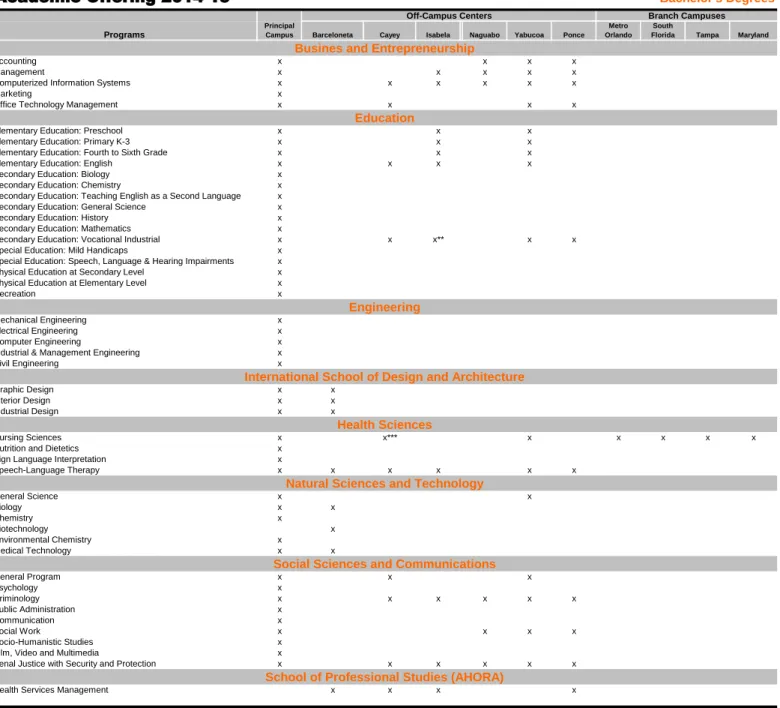
Off-campus centers ... 26
GENERAL EDUCATIONDEANSHIP...29
SCHOOL OF BUSINESS AND ENTREPRENEURSHIP ...39
Bachelor’s Degree in Business Administration: Accounting... 41
Bachelor’s Degree in Business Administration: Computerized Information Systems ... 42
Bachelor’s Degree in Business Administration: Management ... 42
Bachelor’s Degree in Business Administration: Marketing ... 43
Bachelor’s Degree in Business Administration: Office Technology Management ... 44
SCHOOL OF EDUCATION ...67
Bachelor’s Degree in Elementary Education: Preschool Education ... 69
Bachelor’s Degree in Elementary Education: Primary Education (K-3) ... 70
Bachelor’s Degree in Elementary Education: Fourth to Sixth Grade ... 70
6 Undergraduate Catalog 2014-15
Bachelor’s Degree in Secondary Education Major: Biology ... 71
Bachelor’s Degree in Secondary Education Major: Chemistry ... 72
Bachelor’s Degree in Secondary Education Major: Teaching English as a Second Language ... 73
Bachelor’s Degree in Secondary Education Major: General Science ... 73
Bachelor’s Degree in Secondary Education Major: History ... 74
Bachelor’s Degree in Secondary Education Major: Mathematics ... 74
Bachelor’s Degree in Secondary Education Major: Vocational Industrial Education ... 75
Bachelor’s Degree in Secondary Education Major: Social Sciences ... 75
Bachelor’s Degree in Secondary Education Major: Spanish ... 76
Bachelor’s Degree in Special Education K-12 ... 77
Bachelor’s Degree in Physical Education K-12 ... 77
Bachelor’s Degree in Education Major: Recreation ... 78
JOSÉ DOMINGO PÉREZ SCHOOL OF ENGINEERING ...97
Bachelor of Science in Computer Engineering ... 105
Bachelor of Science in Electrical Engineering ... 110
Bachelor of Science in Industrial and Management Engineering ... 114
Bachelor of Science in Mechanical Engineering ... 123
Bachelor of Science in Civil Engineering ... 128
SCHOOL O OF HEALTH SCIENCES ... 151
Bachelor´s Degree in Nursing Sciences ... 153
Bachelor’s Degree in Nutrition and Dietetics ... 154
Bachelor’s Degree in Speech Language Therapy ... 155
Bachelor’s Degree in Sign Language Interpretation ... 156
INTERNATIONAL SCHOOL OF DESIGN AND ARCHITECTURE ... 175
Bachelor’s Degree in Design with Concentration in Industrial Design ... 176
Bachelor’s Degree in Design with Concentration in Graphic Design ... 178
Bachelor’s Degree in Design with Concentration in Interior Design ... 179
Bachelor’s Degree in Science of Landscape Arqhitecture ... 179
SCHOOL OF NATURAL SCIENCES AND TECHNOLOGY ... 195
Bachelor Degree in Science: General Science ... 196
Bachelor’s Degree in Science: Biology ... 197
Bachelor’s Degree in Science: Chemistry ... 198
bachelor’s Degree in Science: Biotechnology... 199
bachelor’s Degree in Science: Medical Technology ... 199
SCHOOL OF SOCIAL SCIENCES AND COMMUNICATIONS ... 225
Bachelor’s Degree in Social Science: General ... 227
Bachelor’s Degree in Arts in Social Science: Public Administration ... 227
Bachelor´S Degree in Social Science: Psychology ... 228
Bachelor´S Degree in Social Sciences: Criminology ... 228
Bachelor’s Degree in Arts in Social Work ... 229
Bachellor’s Degree in Arts in Humanities: Socio-Humanistic Studies ... 229
Bachelor’s Degree in Arts in Communications ... 230
Bachelor’s Degree in Communications in Film Production, Video and Multimedia ... 231
SCHOOL OF PROFESSIONAL STUDIES ... 249
Bachelor’s Degree in Public Health: Health Services Administration ... 249
Undergraduate Catalog 2014-15 7
CATALOG 2014-2015
UNDERGRADUATE PROGRAMS
OUR PROFILE
Universidad del Turabo is a nonprofit institution of higher education located 15 miles southeast of San Juan, Puerto Rico, within easy reach of the entire east-central part of the island. Its 140-acre suburban campus and its fifteen buildings provide an ideal atmosphere for the learning experience. The university currently operates six (6) Additional Locations located in Barceloneta, Cayey, Yabucoa, Naguabo, Isabela, and Ponce, and five (5) US Branch Campuses (three (3) in Florida, one (1) in Maryland and one (1) in Texas. It offers technical certificates, associate, bachelors, masters and doctoral degrees. The University currently offers 29 associate degree programs, 47 bachelor degree programs, 35 master’s programs, and five (5) doctoral degrees.
The academia is organized into nine (9) main schools: International School of Design and Architecture, Engineering, Natural Sciences and Technology, Health Sciences, Social Sciences and Communications, Education, Business and Entrepreneurship, Technical Professional Studies, the Deanship of General Education, and the School of Continuing Education.
The General Education Deanship was established to address the particular needs of new students admitted to the University. In addition to offering first-year and second-year courses in the General Education Component (GEC), the Deanship of General Education provides an array of support services to students in their first and second year.
Two other divisions that provide educational services to different populations are the School of Technical Programs, which offers post-secondary professional careers and associate degrees in technical fields, and the School of Professional Studies (AHORA), which serves adults who have had previous university experience, are full-time employees, and can benefit from an accelerated adult learner program at the undergraduate or graduate level. The School provides a university environment for the professional adult where the teaching methodologies, as well as the academic and administrative services are tailored to meet the genuine needs of this population.
It is a professionally oriented institution with a variety of offerings, from technical certificates to doctoral degrees. The institution serves a diversified student body mostly from the surrounding communities, with a variety of economic and educational backgrounds.
Founded in 1972, Universidad del Turabo has continued to grow in the new millennium. The student population of more than 15,000 is composed of young adults and professionals. The academic staff consists of more than two hundred thirty-one (231) full-time faculty members and three hundred forty-seven (347) time equivalent professors. The full-time faculty members hold doctorates and master’s degrees in their fields of expertise. Nearly sixty (60) percent of Universidad del Turabo’s full-time faculty hold a doctoral degree and thirty-five (35) percent of part-time faculty holds a doctoral degree. The gender distribution of the faculty is equally divided. Universidad del Turabo is a member of the Ana G. Méndez University System.
MISSION
The mission of Universidad del Turabo is to enhance knowledge through excellence in teaching, and foster research, innovation, and the internationalization of its programs. The university is committed to graduate well-educated, professionally competent students who can think critically and are technologically literate. It promotes the development of ethical principles and values that allow students to contribute to the well-being of the community through their knowledge of social systems and their role as responsible citizens.
VISION
The vision of Universidad del Turabo is to be a high quality learning community dedicated to enhancing education among its student population and promoting advanced technology with an international orientation.
INSTITUTIONAL VALUES STATEMENT
Universidad del Turabo is committed, as an institution of higher education, to:
1. Freedom of thought and expression
2. Excellence in teaching and the pursuit, generation, dissemination and application of knowledge
3. Respect the dignity of the individual 4. Respect nature and the environment 5. Promote ethical, social and cultural values 6. Recognize and respect diversity
7. Promote institutional excellence in planning, operations and service
8 Undergraduate Catalog 2014-15
INSTITUTIONAL OBJECTIVES
To fulfill its mission, Universidad del Turabo:
1. Maintains a flexible admissions policy in which each academic school establishes requirements for its programs.
2. Provides services to a diversified student body to help it achieve academic and personal goals.
3. Fosters research to strengthen the teaching and learning processes as well as to improve the quality of life in the surrounding communities.
4. Promotes the internationalization of its academic programs through strategic alliances.
5. Develops and implements a systematic faculty development plan to improve academic credentials, pedagogical competencies and instructional technology skills.
6. Recruits and develops quality human resources. 7. Provides academic skills and career‐oriented activities to
precollege students, as well as opportunities for continuing education, thus fulfilling the needs of the community.
8. Promotes the use of innovative and nontraditional teaching methodologies.
9. Promotes ethical values that will allow students to exert their professional judgment and performance responsibly.
10. Fosters the preservation and dissemination of those values inherent to Puerto Rican culture in a global context.
11. Establishes collaborative partnerships among universities, government, industry, and community organizations.
12. Contributes to students’ awareness of their rights and responsibilities as citizens in a democratic society.
ACCREDITATION AND AFFILIATIONS
The Middle States Commission on Higher Education, a regional accrediting agency recognized by the U.S. Department of Education, accredits Universidad del Turabo. The University is a member of the following organizations: College Entrance Examination Board
American Council of Education
American Association of Colleges for Teacher Education American Library Association
Hispanic Association of Colleges and Universities American Assembly of Collegiate Schools of Business National Universities and Continuing Education Association Universidad del Turabo is accredited by:
Middle States Association of Colleges and Schools Council on Higher Education of Puerto Rico
Universidad del Turabo has established Memorandums of Understanding (MOUs) with several institutions in engineering and science. The affiliations include:
New Mexico State University Georgia Institute of Technology
Science and Technology Alliance: a consortium of Sandia National Laboratories, Oak Ridge National Laboratory, Los Alamos National Laboratory, New Mexico Highlands University, North Carolina A&T, and the Ana G. Méndez University System
Rensselaer Polytechnic Institute Lawrence Berkeley Laboratories University of New Mexico
Consortium for Minorities in Teaching Careers
Universidad del Turabo has extended its outreach through collaborative agreements on an international scale, promoting the exchange of students and professors with institutions such as:
Universidad Andrés Bello in Chile Universidad Sergio Arboleda in Colombia
Universidad Nacional Pedro Henríquez Ureña in the Dominican Republic
STATEMENT OF LICENSURE
Licensed by the Council of Higher Education of Puerto Rico. Licensed by the State of Pennsylvania to offer the master’s degree in education in the teaching of English as a second language.
CENTRAL ADMINISTRATION AND
BOARD OF DIRECTORS
Universidad del Turabo is a member of the Ana G. Méndez University System. A fifteen (15) -member board of trustees governs the System. Of these, five (5) are permanent and the board appoints ten (10) for four-year terms. The board is composed of distinguished educators, experienced executives, and civic and community leaders.
The executive officers of the System are: the President, the Vice President for Academic Affairs, the Vice President for Administrative Affairs, the Vice President for Human Resources, the Vice President for Planning and Research, the Vice President for Marketing and Student Affairs, the Vice President for Financial Affairs, and the Legal Adviser. They are appointed by the Board of Trustees.
The System’s bylaws define the objectives, powers, officers, committees, meetings and financial affairs of the institutions. They also specify the way in which the bylaws and regulations of each one of the autonomous institutions will be approved.
The Board is the policy-making, legislative and fiscal body of the System. It approves the mission of the System and its institutions, and its annual and special budgets; administers
Undergraduate Catalog 2014-15 9 its business; confirms appointments; establishes
compensations; approves academic programs and long-range institutional plans; and supervises the distribution of funds.
The Board has four standing committees: Executive
Academic Student Affairs Finance and Auditing
Planning and Institutional Advancement BOARD OF DIRECTORS
Mr. Héctor A. Jiménez Ramírez, President of the Board Mr. Ramiro Millán Catasús, Vice-president of the Board Dr. José F. Méndez González, President of SUAGM Ms. Zoraida Fonalledas
Mr. Juan R. Melecio, Esq. Dr. Florabel G. Mullick Dr. Víctor Hernández Dr. Félix Rodríguez Schmidt
Mr. José F. Méndez, Jr. Permanent Member Mr. René A. León Rodríguez
Mr. Rafael A. Nadal Arcelay, Esq. Permanent Member Gloria Castillo, Secretary of the Board
José E. de la Cruz Skerrett, Esq., Legal Advisor
CAMPUS ADMINISTRATION
Office of the Chancellor
Dennis Alicea / Chancellor
Gladys Betancourt / Vice-Chancellor for Administrative Affairs
Iris N. Serrano / Director of Public Relations
Jacqueline Mullen-Hunt / Vice Chancellor of External Resources
Alba Rivera / Assistant Vice-Chancellor of Development René Rhonda / Alumni Director
Carmen T. Ruiz / Director, Josefina Camacho de la Nuez Musseum and Center for Humanistic Studies
Vivian Cordero / Director of International Affairs
Office of the Vice Chancellor
Roberto Lorán / Vice-Chancellor
Elaine Guadalupe Ahedo / Associate Vice-Chancellor Edna Orta Anés / Associate Vice-Chancellor for Administrative Affairs
Ernesto Espinoza / Assistant Vice-Chancellor for Assessment Rafael Lozano / Associate Vice-Chancellor for Retention Héctor N. Miranda / Associate Vice Chancellor for Evening and Saturday Programs
René Rodríguez / Assistant Vice-Chancellor for Faculty Evaluation and Development
Keila J. Roche / Assistant Vice-Chancellor for Licensing and Accreditation
José R. Pérez Jiménez / Interdisciplinary Research Institute Director
Pilar Dávila / Virtual Education Director Armando Soto / Webmaster
Graduate Studies and Research
Sharon A. Cantrell / Dean
Minerva Soto / Student Services Coordinator
GENERAL EDUCATION DEANSHIP
Félix R. Huertas / Dean Phillip Murray / Associate Dean
Beatriz Cruz / Language Department Director
Juan E. Roque / Humanities and Social Sciences Department Director
Angel Ojeda / Mathematics Coordinator Sylvia Casillas / Language Center Director
School of Business and Entrepreneurship
Juan Carlos Sosa / Dean Virgin Dones / Associate Dean
Linda S. Miranda / Administrative Director Vacant / Director of Special Projects
Lillian Hernández / Director of Student Services
School of Education
Israel Rodríguez Rivera / Acting Dean and Associate Deanfor Undergraduate Programs
Jorge H. Garófalo / Associate Dean, Physical Education Department
Brenda Arroyo / Associate Dean
Maritza Oyola / Student Services Director
Carmen D. Rodríguez / Administrative Services Director
School of Engineering
Jack T. Allison / Dean José R. Deliz / Associate Dean
Oscar A. Sáenz / Director, Industrial Engineering Department Juan C. Morales / Director, Mechanical Engineering
Department
José L. Colón / Director, Electrical Engineering Department Luz C. Vilches / Director, Student Services
Rafael M. Rivera / Director, Institute of Telecommunications (IT+)
Nelson Martínez / Director, Institute of Engineering Technology
School of Health Sciences
Nydia V. Bou / Dean
Nilda I. Boria / Associate Dean for Administrative Affairs Diannie I. Rivera / Associate Dean for Academic Affairs Josué Pacheco / Director, Nursing Department
María A. Centeno / Director, Health Professions Department Milva Vega / Director, Naturopathic Medicine Doctoral Program
Carmen Santiago / Nursing Clinical Coordinator Nelly González / Student Services Officer Joannie Ortiz / Administrative Affairs Director Ana D. Serrano /Administrative Affairs Coordinator Angeliz Pérez / Academic Affairs Coordinator
10 Undergraduate Catalog 2014-15
School of Natural Sciences and Technology
Teresa Lipsett-Ruiz / Dean Carlos J. Olivo / Associate Dean
María F. Barberena / Director, Department of Biology José J. Ducongé / Director, Department of Chemistry and Physics
José Sánchez / Director, Department of Mathematics
School of Social and Communications
María del C. Santos / Dean
Tomasita Pabón / Associate Dean, Social Sciences Department
Edward Fankhanel / Associate Dean
María M. Ortiz / Director, Social Work Department María Vera / Director, Communications Department Jessica Velázquez / Director, Psychological Services Clinic
International School of Design and Architecture
Aurorisa Mateo / Dean
Elizabeth Castrodad / Associate Dean for Academic Affairs Rosa Musí / Associate Dean for Administrative Affairs
School of Professional Studies
Mildred Y. Rivera / Assistant Vice-President and Dean Mabelis Viera / /Director, Integrated Services
School of Technical Programs
María E. Flores / Dean
Amarilys Rivera / Academic Affairs Coordinator Norberto Pagán / Academic Advisor
Charlotte Pérez / Student Services Coordinator María de los A. Rodríguez / Administrative Services Coordinator
Information Resources
Sarai Lastra / Vice Chancellor of Information Resourcesand Director Virtual Library
Luis A. Arroyo / Director, Information Technologies
José Medina / Director, Informatics and Telecommunications Luisa Torres / Director of the Library
Julie Malavé / Director, Administrative Services
Off-Campus Centers
Alfredo Bultrón / Director, Off-Campus Center Naguabo Glenda L. Bermúdez / Director, Off-Campus Center Yabucoa Juan A. Rosado / Director, Off-Campus Center Cayey Carmen L. Rivera / Director, Off-Campus Center Isabela Carlos E. Maldonado / Director Off-Campus Center Ponce Ramón E. Díaz / Director Off-Campus Center Barceloneta
Student Affairs
Brunilda Aponte / Vice Chancellor of Student Affairs Juanita Cruz / Associate Vice Chancellor of Student Affairs María V. Figueroa / Associate Vice Chancellor of Student Affairs
Samiris Collazo / Assistant Vice Chancellor for Wellness and Quality of Student Life
María del C. Santos Rodríguez / Assistant Vice Chancellor for Internship and Honor Scholarship Program
Carmen Pulliza / Assistant Vice Chancellor, Career and Placement
Zoraida Ortiz / Registrar
Melba Sánchez / Associate Vice-Chancellor of Admission and Marketing
Carmen J. Rivera López / Director, Financial Aid Gabriel López / Bursar
Wilnelia Hernández Castro / Director Information Systems Luz E. Berríos / Nurse, Health Services
Angel Vázquez / Director, Social and Cultural Activities Eva Merced / Administrative Director
Nilda L. Toledo / Student Services Officer Vacant / Director, Admissions
Anabelle Solá / Director, Recruitment
Physical Facilities, Operations and Maintenance
Mayra Rodríguez / Manager, Physical Facilities and Operations
Carmen Torres / Assistant Manager of Physical Facilities Julio Colón / Director, Administrative Services
Carlos R.Centeno / Director, Security Vacant / Maintenance Supervisor
Statement of Legal Control
The Ana G. Méndez University System is a private nonprofit corporation registered under the laws of the Commonwealth of Puerto Rico. Its Board of Directors under the system wide bylaws governs the corporation.
Non-Discrimination Statement
The Ana G. Méndez University System and its institutions do not discriminate on the basis of race, handicap, national or ethnic origin, creed, color, gender, social condition or political, religious, social or trade union beliefs.
LEGISLATIVE BOARDS
The Administrative Council of Universidad del Turabo is the legislative body of the Institution. Its main function is to establish the institutional policy of the University in accordance with the bylaws of the Ana G. Méndez University System. The Administrative Council includes the chancellor, who chairs it, the vice chancellor, the vice chancellor of student affairs, the manager of physical facilities and operations, the deans of the academic divisions, five (5) faculty representatives, and two (2) student representatives. The Academic Board recommends the academic policy of the Institution, adopts new academic programs, approves the awarding of degrees and evaluates hiring, contract renewals, promotions, and leaves of absence for faculty members. The Academic Board consists of the vice chancellor, the library director, six (6) school associate deans, two (2) student representatives, one (1) faculty representative for each school, and as many elected faculty members as
Undergraduate Catalog 2014-15 11 needed to provide for their majority on the board. The
chancellor is an ex officio member of the Academic Board.
GRADUATE STUDIES AND RESEARCH
Science and Technology Building Office 1.2
787-743-7979 Ext. 4270 Fax 787- 743-7979 Ext. 4275 www.suagm.edu/ced E-mail [email protected]
Established in 2003, the Doctoral Studies Center (DSC) is an administrative unit whose main responsibility is to provide resources and support services for graduate students who wish to pursue doctoral studies. Through workshops, seminars and conferences, the Center contributes to the University‘s image of academic excellence and leadership. The DSC also promotes scholarly research among students and faculty.
The DSC is located in the Science and Technology Building and is directed by the Dean of Doctoral Studies. The Dean interacts with all the UT Schools and their respective coordinators of doctoral programs. In this way, the Doctoral Studies Center and the coordinators work together to ensure that all doctoral students are well attended and supported.
MISSION
The DSC is devoted to the advancement of knowledge through research activities and to the establishment of ideal support conditions for UT doctoral students. The Center also collaborates with the six UT Schools to stimulate and enhance academic and scientific experiences.
VISION
The DSC is a key facilitation agent that promotes excellence through academic and leadership opportunities for graduate students by encouraging the development of research activities.
SUPPORT SERVICES
The Doctoral Studies Center is actively involved in the recruitment, retention and graduation of doctoral students at UT. To this end, the Center provides assistance from the initial application stages to the completion of a doctoral degree. Hence, the Center supports the following initiatives: • Academic and career advising
• Professional development seminars • Group study areas
• Doctoral resources study room • Doctoral level bibliographical services • Laptop loan program for doctoral students • National and international conferences • Science authors recognition program
• Doctoral studies council
• Doctoral fellowships and scholarships database • Teaching assistant and research assistant programs Ultimately, the Doctoral Studies Center is a clearinghouse of information and resources to ensure the graduate students‘ successful completion of an advanced degree while enhancing their personal, social, academic and professional experiences.
MULTIDISCIPLINARY ENTREPRENEURIAL
PROGRAM FOR INNOVATION (MEPI)
The aim of this program is to instill entrepreneurial skills, in order to facilitate graduates’ transition from the academic environment to professional life, and to increase their motivation to start their own businesses. It presents students with the option of a non-traditional learning environment which allows them to apply technical skills long before they would learn about them in traditional lecture classes. This initiative fosters the creation by UT students of small business enterprises, thus providing a pathway toward the diversification of employment in Puerto Rico. It also promotes and encourages a framework of collaboration between the university and industry, contributing in this way to the economic development of Puerto Rico’s East Central region.
Important MEPI activities include an extensive learning environment that is centered on multi-disciplinary, active, discovery-based learning, and the formation of student enterpreneural work teams that operate using real life private enterprise paradigms.
Objectives:
Develop in students an entrepreneurial attitude resulting in the creation of new services and enterprises.
Contribute to Puerto Rico’s economic development
Students must enroll in the MEPI for six continuous semesters. Each student enterprise will be required to address and complete at least two major projects. Over a three-year period, student tasks and responsibilities will vary, contributing different elements as students progress in their levels of technical expertise, maturity and seniority. The MEPI track is registered on the student’s transcript. The MEPI Option replaces 12 credits of existing courses within the programs. These twelve credits are distributed as follows:
MEPI 351 New Venture Creation 1 MEPI 352 Legal Issues of Entrepreneurship 1
MEPI 353 The Business Plan 1
MEPI 455 Enterprise Project I 3 MEPI 456 Enterprise Project II 3
12 Undergraduate Catalog 2014-15 Elective (to be chosen from a list provided by the school) 3
RESEARCH INSTITUTES
TELECOMMUNICATIONS INSTITUTE (IT+)
Under the direction of Dr. Rafael M. Rivera, and Dr. Jeffrey Duffany, The Telecommunications Institute (IT+) of the School of Engineering of the Universidad del Turabo has installed advanced technology in the area of convergence of telecommunications technologies and in the critical area of Network Security in Central America.
The Telecommunications and Information Resources Center specializes in the following research areas:
Design of Convergence Networks Network Security Practices and Issues
Network Design
Information & Communications Technologies (ICT)
Governance
Semantic Web & Ontological Engineering
The installations are divided amongst three laboratory facilities: the Telecommunications Technologies lab, the Operating Systems lab and the Network Security lab. The main technologies available in these labs are as follows, IP Telephony and Digital Telephony
All Switching Layers and Protocols Wireless Networks
Windows Servers HP-Unix Servers
Linux Development Environment Routers
Windows, Unix and Linux programming environments PUERTO RICO ENERGY CENTER (PREC)
The Puerto Rico Energy Center will be an R&D facility in solid waste disposition and renewable energy. The technological areas of the center are plasma gasification and vitrification, photovoltaic solar cells, and fuel cells. The center will be available for demonstrations of potential applications benefiting municipalities, the pharmaceutical industry, and other private and public partners, helping to promote R&D efforts and business development. It will provide education, awareness, and technical assistance activities on renewable energy, with a particular interest in environmentally friendly solid waste treatments.
Under the leadership of Dr. Jack T. Allison, Dean of the School of Engineering, PREC will concentrate its efforts on the implementation of the project´s first phase activities:
• Construction of new PREC facilities
• Development of Cruise Ship Solid Waste Disposal Prototype
• Establishment of initial research activities related to: • Residue Composition Analysis
• Hydrogen Production • Fuel Cell Laboratory activities
INTERDISCIPLINARY RESEARCH INSTITUTE (I3 FOR ITS SPANISH ACRONYM)
The goal of the Interdisciplinary Research Center is to establish research projects that transcend basic research in the basic sciences, environmental and biomedical sciences. The objectives of this Center are to:
Foster internal interdisciplinary research projects to support the professional development of UT faculty Foster interdisciplinary research projects with external
collaborators that are relevant to the UT vision and mission.
Establish a high-quality research center that acts as a liaison between academic and research institutions in the United States and Latin America.
The I3 Research Center is funded through federal and local research grants. In addition, the Center will sponsor conferences, workshops, educational trips, and consulting opportunities to supplement their grant funded income. The Center will concentrate its efforts to establish partnership with federal agencies such as: NASA, NSF, and NIH, as well as, US EPA, NFWF, USGS, NOAA, and TNC. The Director of the Center, Dr. José R. Pérez Jiménez, is currently involved in various interdisciplinary research projects with all the previously mentioned agencies. Some examples are:
Las Cucharillas: Wetlands Management Project Environmental Health and Toxicology Vieques Project Disaster Prevention and Management
SIG and Environmental Informatics Environmental Disaster Mitigation Bridges to the Doctorate
Environmental Assessment Center in Cabo Rojo Fellows Enhancing Science and Research Environmental Education School Network Asthma Prevention and Management
Justice, Education and Environmental Information Awareness Program
Undergraduate Catalog 2014-15 13 Environmental Professional Development Certification
Institute
INTERNATIONAL CENTER OF ENVIRONMENTAL AND SUSTAINABLE DEVELOPMENT STUDIES (CIEMADES) CIEMADeS is an international R & D initiative involving Puerto Rico, the Dominican Republic and Haiti; its purpose is to address environmental and sustainable development issues in these three Caribbean countries. This collaboration is driven by the Caribbean area’s insufficient environmental protection, increasing population density, territorial limitations, lack of social awareness regarding the
environment, increasing and urgent economic
developments, and the need to strengthen specialized government infrastructures.
Through CIEMADeS, these three countries will be able to: focus attention on regional issues, share experiences and available resources, and facilitate academic and scientific synergy-related activities. The following initial projects have been proposed to establish this international initiative: • Host a regional conference to discuss environmental
and sustainable development issues
• Develop a human resources (environment and sustainable development) experts inventory • Characterize environmental and sustainable
development parameters
• Create a regional environmental resources database to be used as a baseline
• Establish a post graduate scholarship program • Develop a formal and informal environmental
curriculum IMPORTANT NOTE:
This catalog contains the major points of the current agreements between the students and Universidad del Turabo. The University limits its agreement to the semester or session in which the student is duly enrolled and for which (s)he has paid the corresponding fee.
It is the student’s responsibility to know and comply with the rules expressed herein, which coincide with current bylaws and regulations of the University, the administrative resolutions, and the federal laws on civil rights.
ADMISSIONS
GENERAL ADMISSIONS REQUIREMENTS
Students wishing to be admitted to Universidad del Turabo undergraduate programs must meet the following requirements:
1. File an application with the Admissions Office within the stipulated time limit.
2. Graduate from an accredited high school or complete studies equivalent to high school and submit the necessary certifications.
3. If 25 years of age or less, take the College Entrance Examination Board and the test of the Diagnostic and Placement Center (DPC) of Universidad del Turabo. Students over the age of 25 will take the DPC test. 4. Possess the minimum admission index approved by the
Academic Board. Candidates with an index below the minimum must be interviewed to determine eligibility. 5. Submit a $15.00 nonrefundable application fee. 6. Candidates for programs with additional admission
requirements, such as additional tests, interviews and letters of recommendation, must comply with these requirements.
ADMISSIONS FORMULA
Some schools applies the Admission Index formula. It is computed using the results of the following areas of the College Entrance Examination Board: verbal aptitude, mathematics aptitude and English achievement. The high school grade point average is also considered.
ENGLISH/SPANISH PLACEMENT TEST
1. Incoming first-year students MUST take the UT placement exam. Information about when and where the tests are offered is provided to entering students by the Vice Chancellor of Student Affairs.
2. The placement exams are used to assess the performance of entering students in the fundamental subjects of Spanish and English. The scores of these tests are used to place students in courses that are appropriately challenging.
3. Students with Advanced Placement College Board Scores of 4 or higher in English or Spanish are exempt from taking the English/Spanish Placement Test and are placed automatically in second year English/Spanish. 4. If you are a transfer student and your transcript has
been evaluated by your admitting college, then you may have already received credit for a particular English/Spanish course. Your college will alert you to the next English/Spanish course you will need to take. 5. If you are a transfer student who has NOT been given
transfer credit for an English/Spanish course, you will need to take the placement test.
6. Students who have not taken English/Spanish MUST take the Universidad del Turabo placement exam before enrolling in any English/Spanish course.
14 Undergraduate Catalog 2014-15 READMISSION
1. Students must apply for readmission if they interrupted their studies and did not attend the university for one semester or longer. (Summer sessions do not count as interruptions.)
2. Students must complete the required number of credits for their year of study.
3. Students must comply with the requirements of the study program of their choice as well as other general requirements that may apply.
4. In order to be readmitted, the period of suspension for academic or disciplinary reasons must have elapsed. 5. Candidates for readmission may be required to have an
interview with the Admissions Committee. It is comprised of the Vice Chancellor of Student Affairs or his representative, the Director of Admissions, the Vice Chancellor for Wellness, the Registrar, the Vice Chancellor or his representative and the dean of the school. In special cases, the Committee will have the final authority to determine admissions.
TRANSFER STUDENTS
Transfer students are considered for admission if they have followed a course of study in an accredited university and have completed no fewer than 12 credits in the institution from which they proceed. Their grade point average (GPA) must be above the institutional minimum requirement. The students must not be under academic or disciplinary sanction in the institution from which they proceed. In order to be admitted, students wishing to transfer must meet the requirements of the program of their choice. The Admissions Committee can evaluate applications.
COURSE VALIDATION
Transfer students have the option of validating courses taken no more than 12 years prior to admission for equivalent courses offered at Universidad del Turabo. The students must have a minimum grade of C in each course.
ADVANCED PLACEMENT TEST
Credit will be granted for the Advanced Placement Tests of the College Entrance Examination Board if the score obtained is 3 or more, on a scale of 1 to 5.
PRE-COLLEGE COURSES
Credit will be granted to students for courses offered by Universidad del Turabo at the high school level. These courses must be in addition to those required for graduation and must be approved with a grade of A, B or C. The various schools will establish the grades required in the courses to be credited.
The Pre-College Program will keep record of the student’s progress and will send evidence of the completed courses to
the Registrar’s Office, after the student is officially admitted to the University. This documentation will become part of the student’s file.
RESIDENCE
All transfer students must observe the following rules to obtain residence at the University in order to qualify for graduation:
1. Complete the last (30) thirty credits of their bachelor’s degree at Universidad del Turabo, (12) of which must be in their major field of study.
2. Successfully complete the last twelve (12) credits of the associate degree at Universidad del Turabo.
3. Twelve (12) credits of residence (set by each program) will be required of students from Off-Campus Centers.
TRANSIENT STUDENTS
Transient students must be authorized by their own university to take courses at Universidad del Turabo for no longer than two academic semesters.
Universidad del Turabo admits visiting students or auditors. They must apply for admission within the time limit established by the Admissions Office. They must attend their regular courses but will receive no credits or grades. These students are not eligible for financial aid.
Authorization for enrollment of transient students and auditors does not constitute a formal admission into the institution, and it terminates at the end of the academic session for which it was granted. To obtain regular student status, students must comply with the admission requirements in force at the time when the application for admission was filed. All applications are subject to an interview by the Admissions Committee.
INTERNATIONAL STUDENTS
The Universidad del Turabo accepts foreign students as permitted by immigration laws. Foreign students are subject to the admission, readmission and transfer requirements established by the Universidad del Turabo.
EFFECTIVE DATES
Admission or readmission at Universidad del Turabo will be valid for one semester of the academic year, beginning on the date it is granted. Applications that do not include the required documents, or that do not meet all the established requirements, will be considered provisional. If all the documents are not received within 60 days from the first day of class, the institution may invalidate the provisional admission.
Undergraduate Catalog 2014-15 15 Applications forms should be requested from:
UNIVERSIDAD DEL TURABO ADMISSIONS OFFICE P O BOX 3030 UNIVERSITY STATION GURABO PR 00778
TELEPHONE: (787) 746-3009
TUITION AND SPECIAL FEES
Once a year the Office of the Vice President of Financial Affairs publishes a circular letter with information about tuition costs for all academic programs, and special fees for student services at Universidad del Turabo. Upon request, this document is available at the Bursar’s Office to students and to anyone in the institution who requests it.
Tuition, fees and service charges must be paid in full during registration or at the time the student requests services. Payments can be made in cash or by check, money order, debit cards or credit cards. Receipts for all transactions must be requested and retained, and presented with any claim or request for adjustment. The Bursar’s Office will not accept claims without receipts.
In accordance with established rules and regulations of the institution, the Ana G. Méndez University System may amend standards and tuition fees.
The Deferred Payment Plan is available to parents, tutors or adult students who do not receive financial aid. The recipient will sign a promissory note and payments will be made on or before the specified date on the promissory note. If the University is forced to contract legal or collection services in order to collect, the student will pay the legal and/or agency fees.
CLEAR STATEMENT
Students with an outstanding debt balance will not be allowed to take final examinations until such balance is paid in full. Upon receipt of payment, the Bursar’s Office will issue a Clear Statement, which must be presented by the student at each examination. Students who do not comply with this requirement will receive a grade of Incomplete.
ADJUSTMENTS AND REFUNDS
Active students who request total withdrawal before 60% of the registration period has ended will receive an adjustment in the fees and assigned funds in accordance with federal regulations for programs with Title IV funds. In addition, students identified as NA (not attending) a course will be charged a 12% fee for each course in which they enrolled. These fees will not be covered by federal funds. During the add/drop course adjustment period, students can add or drop sections without additional cost.
FINANCIAL AID
Universidad del Turabo makes every effort to help its students obtain government financial aid for those who are unable to begin or continue their university education without such aid. There are three categories of financial aid: scholarships, loans and work-study programs.
SCHOLARSHIPS
Scholarships are granted according to the educational and financial needs of the student. Only undergraduate students are eligible to receive funds through Pell Grants. However, a Free Application for Federal Student Aid (FAFSA) application is needed to determine the student’s eligibility for other federal aid programs.
STATE FUNDS
The Council of Higher Education of Puerto Rico provides funds to supplement the cost of graduate education. This aid applies to all students who are eligible according to the student’s eligibility index provided by the FAFSA evaluation.
FEDERAL DIRECT LOANS
The Financial Aid Office will recommend and process the loan directly to the U.S. Department of Education in its electronic form. This loan must be repaid in cash; the repayment should begin six (6) months after the student graduates or ceases to study. The Federal Government will pay the interest while the student is enrolled in a recognized post-secondary institution. Borrowers should check the interest rate on their promissory note.
WORK-STUDY PROGRAM
This program provides jobs for undergraduate and graduate students. The Financial Aid Office assigns a specific amount of hours that the student works on campus.
FAMILY FEDERAL EDUCATIONAL LOANS PROGRAM The Financial Aid Office will recommend and process the loan directly to WACHOVIA in its electronic form. This loan must be repaid in cash; the repayment should begin six (6) months after the student graduates or ceases to study. The guaranty agency HIGHER EDUCATION SERVICES CORPORATION will pay the interest while the student is enrolled in a recognized post-secondary institution. The interest is variable but does not exceed 8.25 percent. Borrowers should check the interest rate on their promissory note.
FINANCIAL AID APPLICATION AND RENEWAL The deadline for application or renewal of financial aid for the academic year is May 2. Applications received after this date will be classified as late applications and will be processed as such after receiving the applications submitted on time. Late applications will be reviewed if funds are available. Students who have participated in the financial aid program during the first term do not need to renew their financial aid program during the same academic year if they
16 Undergraduate Catalog 2014-15
comply with the requirements for continuing in the program. Financial aid must be requested through the FAFSA form on the Web, in person at the Financial Aid Office or by mail at: Universidad del Turabo
Financial Aid
P O Box 3030 University Station Gurabo, Puerto Rico 00778
The FAFSA includes the list of requirements and documentation necessary to apply for financial aid.
CREDIT HOUR DEFINITION
At Universidad del Turabo (UT) course work is measured by means of a credit hour unit, which reflects the amount of time spent in class, and the amount of outside preparatory work expected for the class. Thus, looking for consistency and transferability within and between institutions, UT conforms to commonly accepted practices in higher education. The Institution adopts and apply a policy on credit-hours consistent with the US Department of Education definition of “credit hour”as:
“…An amount of work represented in intended learning outcomes and verified by evidence of student achievement that is an institutionally established equivalency that reasonably approximates not less than:
(1) One hour of classroom or direct faculty instruction and a minimum of two hours of out-of-class student work for approximately fifteen weeks for one semester or trimester hour of credit, or ten to twelve weeks for one quarter hour of credit, or the equivalent amount of work over a different amount of time; or,
(2) At least an equivalent amount of work as required in paragraph (1) of this definition for other academic activities as established by the institution, including laboratory work, internships, practica, studio work, and other academic work leading to the award of credit hours.”
Important Note
The above-mentioned aid is conditioned to the availability of the respective federal, state and institutional funds. It is the student’s responsibility to take the steps necessary to obtain financial aid from the government. Such aid is directed to the student as a citizen and not necessarily to the University. Universidad del Turabo is a private, secular, nonprofit institution, and is independent of any government.
The institution fully complies with the Privacy Rights of Parents and Students Act of 1974 (Title IV of the U.S. Public Law 90-247), as amended, which specifically governs access to records maintained by institutions to which funds are made available under any federal program for which the U.S. Commission of Education has administrative responsibility, and the release of such records. Such institutions must give
parents of students access to official records that are directly related to the students and an opportunity for a hearing to challenge such records on the grounds that they are inaccurate, misleading or otherwise inappropriate.
Institutions must obtain the written consent of parents before releasing or relinquishing data with personal identification from the records, except to certain specified parties. (Parents and students must be notified of these rights transfer to students at certain points, and an office and review board has been designated at the federal office of Health, Education and Welfare to investigate and decide on complaints and violations of this law.
*In order to receive financial aid, students must comply with the Satisfactory Academic Progress Policy.
ACADEMIC REGULATIONS
REGISTRATION FOR COURSES
a. The Vice Chancellor of Student Affairs establishes the period for the registration process and includes the enrollment period in the calendar.
b. Students are required to register during the period specified in the calendar.
c. The official notification of admission is required to begin the enrollment process.
d. For registration to be official, the bursar must validate the student’s program-receipt.
Students are also required to register during the assigned calendar period, for day or evening, sessions, and this information will become part of their academic record. The institution has the right to change the time, the calendar or the classrooms of announced courses and to close or eliminate sections or courses from its academic offerings.
CLASSIFICATION OF STUDENTS
Full-time regular students are those who have registered for programs of no less than twelve (12) credit hours and are degree-seeking candidates. Half-time students are those with an academic workload of six (6) to eight (8) credits hours and are degree-seeking candidates. Less than half-time students are those with an academic workload of five (5) credit hours or less and are degree-seeking candidates. Three quarter students are those with an academic workload of nine (9) to eleven (11) credit hours and are degree-seeking candidates.
Undergraduate Catalog 2014-15 17 ACADEMIC LOAD
Academic load will not exceed twelve (12) credits per term for students with a GPA of 2.00 or less, and eighteen (18) credits per term for students with a GPA of 2.01 to 3.00. An academic load or more than twenty-one (21) credits will require prior approval by the dean of the school.
For summer sessions, academic load will not exceed twelve (12) credits, distributed over two (2) sessions. An academic load or more than twelve (12) credits will require prior approval by the dean of the school and a referral by a counselor.
CENSUS
The Institution is not required by any state or regional accrediting agency to take attendance. Nevertheless, a census is made during the first weeks of each semester to determine whether the student attended at least once during the period of enrollment. This census is made for reporting requirements only.
Nevertheless, professors may take into consideration the student’s attendance when grading and should explain the possible impact of absences on the student’s final grade, if any. The student is also responsible for all material covered during the course, even if he misses classes during the semester. Thus, attendance is strongly recommended to better retain the student and facilitate achievement of his/her academic goals.
GRADING SYSTEM
The Office of the Registrar distributes final grades after the end of each term. Students are graded according to the following system of letters and percentage values.
A (90-100) = excellent
B (80-89) = good
C (70-79) = average
D (60-69) = deficient
F (0-59) = failure
A – 4 grade points per credit hour B – 3 grade points per credit hour C – 2 grade points per credit hour D – 1 grade point per credit hour F – O grade points per credit hour
In special cases the following grading system will be used: W - Official withdrawal
I - Incomplete Work IP - Incomplete, in progress
P - Passing grade – Grades of P are not counted toward grade point average.
NP - Failure NR - Not reported
* - Repeated course
WA - Administrative withdrawal
WF - Stop attending the course and have not submitted an official withdrawal
WN - Non Attendance – enrolled but did not attend classes.
AU – Audit course T – Transfer credit
GRADE CHANGES
Students who believe that there is an error in one or more grades should notify the Office of the Registrar within the first thirty (30) calendar days of the beginning of the next session. Students who do not receive their grades at the end of any semester should immediately contact the Office of the Registrar.
An instructor may change a previously assigned grade by processing an official change of grade form in the Registrar’s Office. The instructor must request the grade change form, cite the reason for changing the grade, and submit it to the school or program dean(s) for approval. All grade changes must be submitted to the Registrar’s Office no later than the last day of class of the following semester.
GRADE APPEALS
If the student feels that he or she has not been graded fairly, (s)he should first consult the professor. If this proves unsatisfactory, the student should then consult the dean of the school or program. If still unsatisfied, the student may consult the Vice Chancellor and submit an official grade appeal to the Registrar’s Office. A committee hearing will be scheduled.
INCOMPLETE “I” GRADE
The student will receive a provisional grade of INCOMPLETE only in the case of a justifiable absence from the final examination and if there are a minimum of three partial grades required in the course.
The opportunity to make up the examination or final project will be offered only to those students who have a chance of obtaining a minimum final grade of “D”.
It will be the responsibility of the student in question to make the necessary arrangements with the professor or dean of the corresponding area to determine the final project and to change the INCOMPLETE.
The INCOMPLETE (I) status can be changed if the student completes the required work within the first thirty (30) days of the next academic session, in accordance with the established dates of the academic calendar.
The student who, due to the INCOMPLETE received in one or more courses, does not demonstrate academic progress will
18 Undergraduate Catalog 2014-15
recuperate financial aid once the INCOMPLETE is removed in accordance with institutional norms, providing that this occurs within the deadline established by the federal government for assigning such aid has not elapsed.
For the purpose of evaluating a student’s satisfactory academic progress at the end of the academic year, the (I) will be considered. After the removal of the Incomplete (I), he or she can appeal the institutional decision regarding academic standing.
REPEATING COURSES
Students may repeat a course in order to improve their academic average. Credit will be given for the higher grade, which will be used to compute the grade point average. If the grade in the second attempt is the same as the first, only one will be used to calculate the cumulative average.
a. Students who wish to repeat a course may do so. However, they must repeat all courses required for graduation where a D, F, W, or WF grade was obtained. b. The institution will allow students who earned a C, D, F, W or WF, WN in a course, to receive financial aid to repeat the course provided that 150% of the intended courses have not been exceeded.
c. Students who repeat a course will receive the higher grade.
d. If the grade obtained in a repeated course is the same as the previous grade, it will count for the cumulative average but will count only once for the graduation GPA. e. With respect to practicum courses, the student will have only two opportunities to repeat the course pending the recommendations and approval of the program dean and practicum supervisor.
f. A student will not be able to repeat the course until a grade has been posted.
WITHDRAWALS
Students wishing to officially withdraw from a course or from the institution must file an application with the Office of the Registrar within the period established in the academic calendar. A reduction in course workload may jeopardize the student’s financial and/or veteran’s benefits. The academic standing of the student will be affected by partial or full withdrawals from the institution so long as the withdrawal is carried out before the end of the period specified by the institution for tuition refund eligibility. In the case of full withdrawal from the institution, the student will be considered not to have studied that semester.
Dropping courses or withdrawing from the institution after the end of the above-mentioned specific period will affect the academic standing of the student. The student will be classified in the category in which he or she falls at the end of the period for withdrawal eligible for refund of registration fees.
CHANGES IN THE PROGRAM OF STUDIES
Students can apply for a reclassification in a program or major if they comply with the following:
1. Have an interview with the school dean
2. Apply for reclassification at the Office of the Registrar. Students can apply for only one reclassification during a semester.
The enrolled credits and the cumulative average from student’s previous program will be applied for the programs into which the students have been reclassified, for the purposes of the Satisfactory Academic Progress.
STANDARDS FOR ACADEMIC PROGRESS
There are three categories of regular students according to their grade point average and number of courses completed: students with excellent achievement; students with satisfactory achievement; and students on probation. Students with a satisfactory academic progress are those with a grade point average equal to or higher than the established retention index and who satisfy the percentage of approved credit hours established by the academic norms. At the end of each academic year, the Registrar will determine the grade point average (GPA) and the credit hours required of each student per academic year. This information will be measured against the established retention standards in order to determine the academic status of the student.
ACADEMIC PROBATION
Students whose academic achievement is below the established retention index or who do not complete the percent of approved credit hours required according to regulations will be placed on academic probation for one (1) year. During this period the students will not be eligible for financial. Aid. The student request an appeal. The student’s appeal will be reviewed by a committee. For students of Technical Programs, the probation period will be for one (1) semester.
Upon completion of the probation period, students must meet the required percentage of credit hours and grade point average as established by their academic degree program.
For retention indexes, and percentage of credits required see Appendix.
ACADEMIC SUSPENSIONS
Students will receive a one (1) year academic suspension if the cumulative academic index is lower than the retention index, or if they have not met the percentage of required credit hours upon completion of their probation period.
Undergraduate Catalog 2014-15 19 The University will not accept courses, diplomas or degrees
earned by a student during the academic suspension period. Students who wish to be readmitted upon completion of their academic suspension period must meet the current university readmission requirements.
Students who interrupt their studies or program during the probation period will still be considered on probation during the readmission process.
Readmitted students who have completed their one (1) year suspension period will be evaluated by the Admissions Committee of their academic program. Upon readmission, students will be placed on probation for a second period. If a student does not meet the required retention index and the percentage of approved credit hours during the second probation period, he or she will be suspended academically for a maximum period of two (2) years.
The institution may suspend a student on recommendation of the Disciplinary Committee or the Vice Chancellor of Student Affairs, following the dispositions of the Student Regulations available in the Students’ Rights and Responsibilities Manual.
Under extraordinary conditions, the Academic Suspension Appeals Committee may approve an additional probation period of one (1) year if a student is able to complete all the graduation requirements within that academic year.
APPEALS
a. A student may appeal an institutional decision regarding satisfactory academic progress, if under extenuating or crisis circumstances he or she was not able to meet the requirements or conditions established by the University.
b. The University will consider the following crisis or extenuating circumstances to accept a student’s appeal: illness of the student or a relative, economic crisis due to illness affecting the head of household, natural disasters, divorce, death in the immediate family, loss of transportation, abusive relationships from their parents or parner, family problems, legal circumstances, and justified changes in academic objectives which cause an impact on the student’s academic progress.
Appeals Committee
A. The Appeals Committee will be composed of one representative from each of the following offices: Registrar, Vice Chancellor for Student Affairs, Financial Aid, Retention and Quality of Life or designated representatives.
Appeals Application
A. Students who meet any of the academic progress appeals criteria must submit all the necessary documentation to justify their request.
B. If a student requests an appeal based on a mathematical or calculation error, and it is corrected by the Office of the Registrar, he or she will not go through the full Appeals process.
REINSTATEMENT OF FINANCIAL AID
If a student’s appeal is accepted by the Appeals Committee, he or she will be eligible to receive financial aid as long as he or she meets the federal financial aid deadlines and guidelines.
Appeals decisions are issued in writing by the Office of the Vice Chancellor for Student Affairs. This communication is issued by the Office of Admissions and Financial Aid to reinstate a student’s financial aid package.
If a student meets the conditions regarding his or her academic progress or those related to any academic sanction, he or she will be eligible to receive financial aid during the following enrollment period.
STUDENT RIGHTS AND RESPONSIBILITIES
A Students’ Rights and Responsibilities Manual, available to all students, sets forth the rights of students, along with corresponding responsibilities. This document also addresses issues associated with the relationship between the student and the University. It provides information on protection in academic pursuit and privacy of records; sets forth all the conditions for responsible behavior on the campus; lists the various appeal and grievance procedures available to students; and includes a section on student discipline with control and discipline of college students. This document complies with relevant federal regulations such as the awarding of financial aid, protection of privacy of records, and equal access/equal opportunity.
FAMILY RIGHTS AND PRIVACY ACT
INFORMATION STATEMENT
Universidad del Turabo has a longstanding commitment to protect students’ rights and privacy of information. This commitment will continue as a matter of University practice. The University complies with the provisions of the federal Family Rights and Privacy Act. These federal and state requirements relate to accessibility and confidentiality, provide pertinent and detailed information concerning classification of student records, and access and release provisions.
University procedures are available to