Florida International University
FIU Digital Commons
FIU Electronic Theses and Dissertations University Graduate School
4-10-2018
User-Centric Privacy Preservation in Mobile and
Location-Aware Applications
Mingming Guo
DOI:10.25148/etd.FIDC006533
Follow this and additional works at:https://digitalcommons.fiu.edu/etd
Part of theArtificial Intelligence and Robotics Commons,Databases and Information Systems Commons,Digital Communications and Networking Commons,Information Security Commons, Probability Commons, and theTheory and Algorithms Commons
This work is brought to you for free and open access by the University Graduate School at FIU Digital Commons. It has been accepted for inclusion in FIU Electronic Theses and Dissertations by an authorized administrator of FIU Digital Commons. For more information, please [email protected]. Recommended Citation
Guo, Mingming, "User-Centric Privacy Preservation in Mobile and Location-Aware Applications" (2018).FIU Electronic Theses and Dissertations. 3674.
FLORIDA INTERNATIONAL UNIVERSITY
Miami, Florida
USER-CENTRIC PRIVACY PRESERVATION IN MOBILE AND
LOCATION-AWARE APPLICATIONS
A dissertation submitted in partial fulfillment of
the requirements for the degree of
DOCTOR OF PHILOSOPHY in COMPUTER SCIENCE by Mingming Guo 2018
To: Dean John L. Volakis choose the name of dean of your college/school
College of Engineering and Computing choose the name of your college/school
This dissertation, written by Mingming Guo, and entitled User-Centric Privacy Preservation in Mobile and Location-Aware Applications, having been approved in respect to style and intellectual content, is referred to you for judgment.
We have read this dissertation and recommend that it be approved.
_______________________________________ Deng Pan _______________________________________ Bogdan Carbunar _______________________________________ Kang Yen _______________________________________ S.S. Iyengar, Co-Major Professor
_______________________________________ Niki Pissinou, Co-Major Professor
Date of Defense: April 10, 2018
The dissertation of Mingming Guo is approved.
_______________________________________
choose the name of dean of your college/school Dean John L. Volakis
choose the name of your college/school College of Engineering and Computing
_______________________________________ Andrés G. Gil Vice President for Research and Economic Development
and Dean of the University Graduate School
© Copyright 2018 by Mingming Guo
DEDICATION
ACKNOWLEDGMENTS
First, I would like to express my great gratitude to my advisor and mentor, Dr. Niki
Pissinou, whose encouragement, guidance and support from the initial to the final level
enabled me to complete this work. Her encouraging advice and strict training have been
guiding me to conduct ethical and independent research.
I would like to thank my co-advisor, the Director of School of Computing and
Information Sciences, Dr. S.S. Iyengar for his support and encouragement from a higher
level for my doctoral studies and research. Without Dr. Iyengar’s enormous support to me
on my publications, this research would have not been possible.
Many thanks to Dr. Deng Pan, who has been served as my dissertation committee as
well as my qualifier committee. His attitude and hard-working style for research has set a
wonderful example for me to follow. Thank Dr. Bogdan Carbunar, who has been guiding
me on research problems and encouraging me to resolve them independently. I also
appreciate Dr. Kang Yen for serving on my dissertation committee and giving me valuable
comments.
I would like to acknowledge the interactive research environment provided by our
research laboratory. Special thanks go to Mr. Jerry Miller, the research coordinator in
Discovery Lab, for his effort on coordinating our research projects. Thank all the
colleagues, including Dr. Xinyu Jin, Dr. Sitthapon Pumpichet, Dr. Hao Jin, Dr. Charles
Kamhoua, Concepción Sánchez Alemán, Samia Tasnim, Georges A. Kamhoua, Abdur
Rahman Bin Shahid, and Sanjeev Kaushik Ramani.
Thanks to Florida International University, U.S. National Science Foundation - RET
supporting my research. Thanks to University Graduate School for supporting my research
with a Dissertation Year Fellowship in the final stage of my doctoral study.
Finally, I would like to show my deepest gratitude to my entire families for giving me
unconditional love, support and inspiration to pursue my dreams in the United States of
ABSTRACT OF THE DISSERTATION
USER-CENTRIC PRIVACY PRESERVATION IN MOBILE AND
LOCATION-AWARE APPLICATIONS
by
Mingming Guo
Florida International University, 2018
Miami, Florida
Professor Niki Pissinou, Co-Major Professor
Professor S.S. Iyengar, Co-Major Professor
The mobile and wireless community has brought a significant growth of location-aware
devices including smart phones, connected vehicles and IoT devices. The combination of
location-aware sensing, data processing and wireless communication in these devices leads
to the rapid development of mobile and location-aware applications. Meanwhile, user
privacy is becoming an indispensable concern. These mobile and location-aware
applications, which collect data from mobile sensors carried by users or vehicles, return
valuable data collection services (e.g., health condition monitoring, traffic monitoring, and
natural disaster forecasting) in real time. The sequential spatial-temporal data queries sent
by users provide their location trajectory information. The location trajectory information
not only contains users’ movement patterns, but also reveals sensitive attributes such as
users’ personal habits, preferences, as well as home and work addresses. By exploring this
type of information, the attackers can extract and sell user profile data, decrease subscribed
This research spans from the realization that user privacy is lost along with the popular
usage of emerging location-aware applications. The outcome seeks to relive user location
and trajectory privacy problems. First, we develop a pseudonym-based anonymity zone
generation scheme against a strong adversary model in continuous location-based services.
Based on a geometric transformation algorithm, this scheme generates distributed
anonymity zones with personalized privacy parameters to conceal users’ real location
trajectories. Second, based on the historical query data analysis, we introduce a
query-feature-based probabilistic inference attack, and propose query-aware randomized
algorithms to preserve user privacy by distorting the probabilistic inference conducted by
attackers. Finally, we develop a privacy-aware mobile sensing mechanism to help vehicular
users reduce the number of queries to be sent to the adversarial servers. In this mechanism,
mobile vehicular users can selectively query nearby nodes in a peer-to-peer way for privacy
TABLE OF CONTENTS
CHAPTER PAGE
1. INTRODUCTION ...1
1.1 Background and Motivating Applications ...2
1.2 Research Challenges ...3
1.3 Research Objectives ...5
1.4 Research Contributions ...7
1.5 Dissertation Outline ...10
2. RELATED WORK ...11
2.1 Location and Trajectory Privacy Protection in LBS ...12
2.1.1 Trusted Third-Party Based Techniques ...12
2.1.2 Semi-Trusted Third-Party Techniques ...15
2.1.3 Trusted Third-Party Free Techniques ...16
2.2 Location and Trajectory Privacy Preservation in MSN ...23
2.2.1 Location Trajectory Privacy of Mobile Sinks ...24
2.2.2 Location Trajectory Privacy of Mobile Sensors ...25
2.3 Location and Trajectory Privacy in P2P, MANET and VANET ...27
2.4 Query Privacy Preservation in LBS ...30
2.5 Summary ...35
3. PSEUDONYM-BASED ANONYMITY ZONE GENERATION FOR LBS ...36
3.1 Introduction ...36
3.2 System Model ...37
3.2.1 System Architecture ...37
3.2.2 Attack Model ...37
3.3 Pseudonym-based Mechanism Design ...38
3.3.1 The Basic Geometric Transformation Process ...38
3.3.2 The Dynamic Pseudonym Changing Process ...40
3.3.3 The Personalized Dummies Generation Process ...40
3.3.4 Results Filter Deployed on User Devices ...41
3.4 Analysis and Simulation ...43
3.4.1 Simulation Setup ...44
3.4.2 Privacy Level ...44
3.4.3 Communication Cost ...45
3.4.4 Performance Evaluation ...49
3.5 Summary ...55
4. QUERY-FEATURE-BASED ATTACKS AND PRIVACY PROTECTION ...56
4.1 Introduction ...56
4.2 System Model ...57
4.2.1 System Architecture ...57
4.2.2 Feature-based Inference Attack Model ...57
4.3 Query-Aware Privacy Algorithm Design ...62
4.4 Analysis and Performance Evaluation ...67
4.4.1 Privacy Level by Entropy ...67
4.4.2 Utility Analysis ...70
4.4.3 Approximation Ratio ...70
4.4.4 Computation Complexity ...73
4.4.5 Communication Cost ...74
4.5 Summary ...77
5. PRIVACY-AWARE MOBILE SENSING MECHANISM FOR VANET ...78
5.1 Introduction ...78
5.2 System Model ...80
5.2.1 System Architecture ...80
5.2.2 Attack Model ...80
5.2.3 Problem Statement ...81
5.3 Privacy-Aware Mobile Sensing Mechanism for VANET ...81
5.4 Comparative Analysis ...84 5.4.1 Privacy-Level Analysis ...85 5.4.2 Service-Quality Analysis ...86 5.5 Performance Evaluation ...87 5.5.1 Simulation Setup ...87 5.5.2 Performance Evaluation ...88 5.6 Summary ...94
6. LIMITATIONS, FUTURE WORK AND CONCLUSION...95
6.1 Limitations ...95
6.1.1 Pseudonym-based Distributed Anonymity Zone Generation Scheme...95
6.1.2 Query-Feature-based Inference Attacks and Defense Randomized Algorithms ...96
6.1.3 Cache-based Mobile Sensing Mechanism for Mobile Vehicles ...97
6.2 Future Work ...98
6.2.1 A Comprehensive Understanding of the Attack Space from Advanced Attackers ...98
6.2.2 An Intelligent and Adaptive Privacy-Preserving and Secure Framework ...100
6.3 Conclusion ...101
BIBLIOGRAPHY ...103
LIST OF FIGURES
FIGURE PAGE
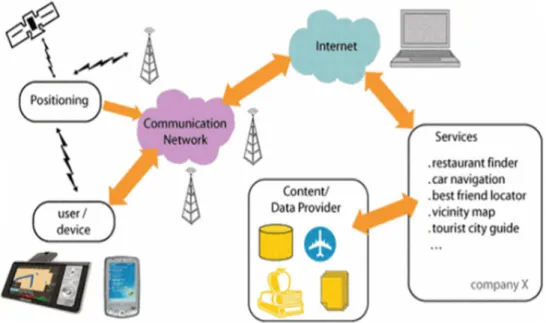
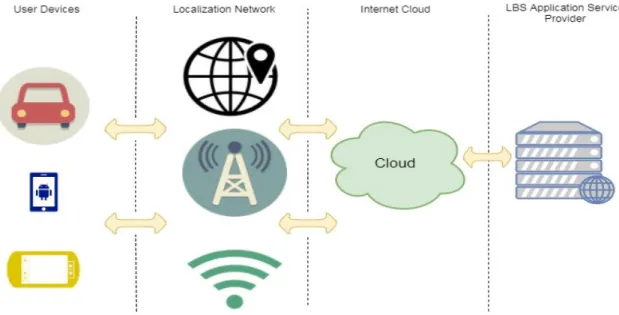
3.1LBS system architecture ...37
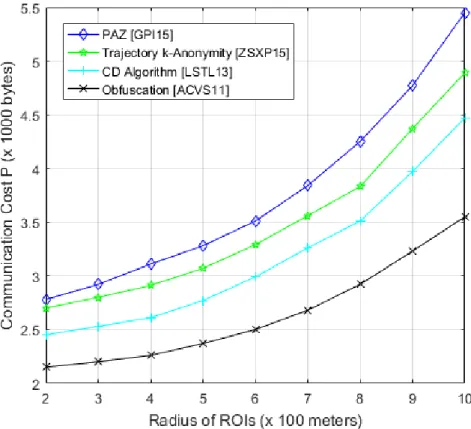
3.2Communication cost when radius of ROIs R = 2, 3, 4, 5, 6, 7, 8, 9 and 10 (× 100 meters)...46
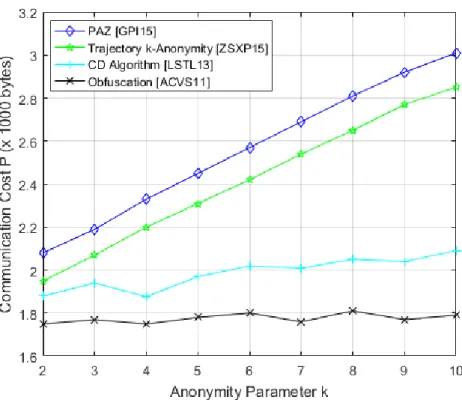
3.3Communication cost when anonymity parameter k = 2, 3, 4, 5, 6, 7, 8, 9 and 10 ...48
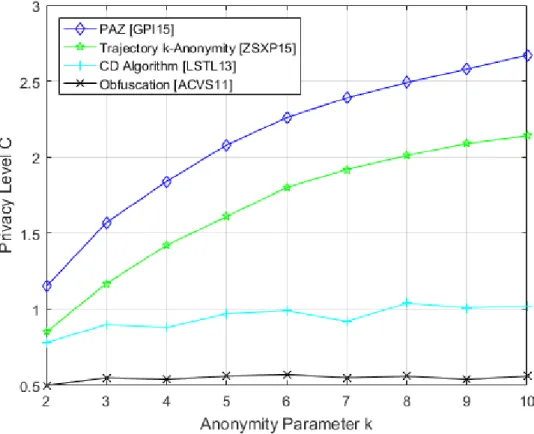
3.4Privacy level when anonymity parameter k = 2, 3, 4, 5, 6, 7, 8, 9 and 10 ...50
3.5Privacy level when radius of ROIs R = 2, 3, 4, 5, 6, 7, 8, 9 and 10 (× 100 meters) ....51
3.6Overall Anonymity Zone vs. Anonymity Parameter k ...52
3.7Overall Anonymity Zone vs. Radius of ROIs R ...53
4.1System service architecture...57
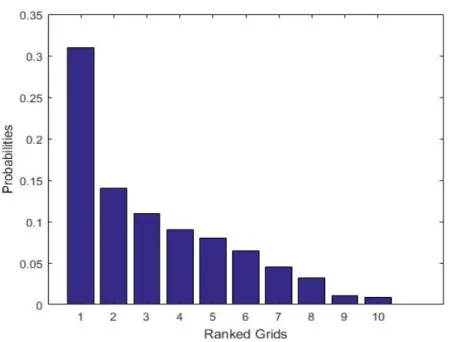
4.2The probabilities for the top 10 girds ...59
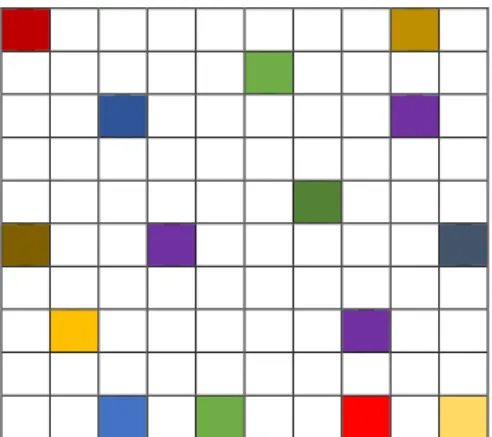
4.3Location probability distribution example ...64
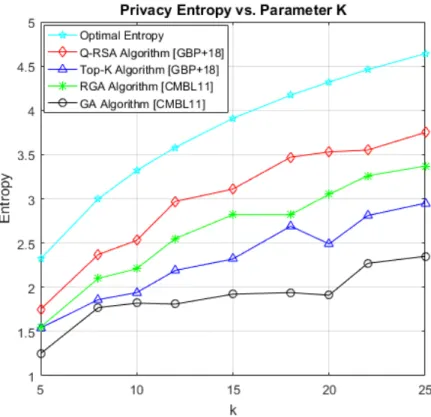
4.4Entropy E vs. Privacy Parameter k ...69
4.5Entropy E vs. Iteration Parameter r...69
4.6Approximation Ratio R vs. Iteration Parameter r ...71
4.7Approximation Ratio R vs. Privacy Parameter k ...72
4.8Average Communication Costs vs. Algorithms...76
5.1Mobile system architecture ...80
5.2Mobile sensing privacy mechanism logic flow ...82
5.3The statistical information about the trace length for all users ...88
5.4Privacy Gain G vs. Percentage of Sensitive Contexts P ...89
5.6Quality of Service Q vs. Percentage of Sensitive Contexts P ...91
CHAPTER 1
INTRODUCTION
With the advancement of mobile and wireless networks, as well as the recent development
of affordable mobile sensors, location-aware mobile services and applications are rapidly
growing. Meanwhile, privacy is becoming an indispensable concern. These services and
applications, which collect data from mobile sensors carried by users or vehicles, return
valuable data collection services (e.g., health condition monitoring, traffic monitoring, and
natural disaster forecasting) in real time. Mobile nodes, such as users or vehicles,
continuously communicate with the base station or peer nodes to exchange data through
wireless media. The sequential spatial-temporal data queries sent by users or vehicles form
their location trajectory information. The location trajectory information not only contains
the movement patterns of the mobile sensors, but also reveals the sensitive attributes like
users’ personal habits, preferences as well as other valuable information such as home and
work addresses. By exploring this type of location trajectory information, the attackers can
extract and sell user profile data, decrease subscribed data services, and even jeopardize
personal safety.
User privacy issues stem from the fact that many mobile service providers aggressively
collect sensitive data without clear statements about how to use and share user data beyond
the regular services. A study shows that half of the popular Android applications they
investigated built user profiles for other purposes, such as targeted advertising and selling
to third parties for revenue without user agreements [EGC+10]. In addition, peer nodes can
through them. The location data sharing experience can lead to location and trajectory
privacy leakage and even serious safety vulnerabilities. There is limited effort to solve this
problem and more research participation is needed.
1.1Background and Motivating Applications
This research aims to develop practical privacy preservation techniques for a variety of
location-aware applications that can use location data for providing valuable services. For
example, location-aware mobile applications, such as Google Maps [GM18] and
Foursquare [Fou18], can use a user’s current location to provide different Point-of-Interests
(POIs). A restaurant or a gas station finder app can use users’ real-time coordinates to find
the closest restaurants or gas stations in the search region. A car navigator app can utilize
users’ current location to provide navigation services. These location-aware apps collect
users’ location data either in a one-shot way or a continuous way.
The installation of mobile sensors or wearable devices can provide users with valuable
monitoring services, such as healthcare applications, etc. Sensor data, including location
(where), time stamp (when), and sensed value (what), can be transmitted to the base station,
the internet, and finally reach the third-parties which can provide instant insights and
actions based on what they received. For example, mobile sensors that are carried by
human beings, such as heart beat sensor [Mon17], can be used for monitoring real-time
heart conditions, critical for instant care. An online doctor service can also send alerts or
suggested actions to the patients themselves or to other people to help the patients in real
Mobile sensors that are installed on mobile vehicles can be used to report road
conditions, traffic monitoring and driving habit detecting. For example, a new driver wants
to buy insurance for his or her vehicle. The insurance companies may require the driver to
install a mobile sensor to report his/her driving habit in a certain time period to determine
the insurance price [Ins16]. Thus, the driver’ location trajectories are recorded and may
even be analyzed by the insurance companies [Tra14].
However, those location data sharing behaviors can pose serious threats to users’
location and trajectory privacy. For example, the insurance companies can find more
sensitive and personal information by analyzing the driver’s trajectories [DRK16]. They
may find the driver prefers to stop at a bar for a certain time before reaching home which
may not a good signal for the driver. Thus, service providers that provide data services to
users can compromise user privacy by tracking and analyzing users’ location and trajectory
in real time. In addition, the eavesdroppers, who can monitor the communication packets
through wireless media, can also obtain users’ location data from the communication
packets. Furthermore, malicious peer nodes can also launch privacy attacks within the
network when a mobile node or user decides to transmit data through them.
1.2Research Challenges
While the research community has made a lot of progress trying to solve the one-shot
location privacy problem, little work has been focused on location trajectory privacy and
query privacy. There are different types of privacy preservation techniques in the earlier
research. Location anonymization is a popular technique. k-anonymity has been widely
eavesdroppers from obtaining mobile subscriber locations [GG03, NLZ+14]. Researchers
attempt to make the user's real location indistinguishable from other users’. However, these
approaches with k-anonymity have a strong drawback because they need a trusted
third-party who may not always be available, creating a bottleneck within the service system.
Another approach is called dummy user generation which can also achieve k-anonymity
without the involvement of trusted third-parties. The work [LLG+13] proposed a game
theoretic dummy user generation scheme for a set of non-cooperative users to achieve
k-anonymity when the number of real users is less that k. However, the drawback is that the
incentives for other users to participate in the game may not be strong enough, which makes
the scheme fail to work.
There are also some other techniques, and Mix Zone is a famous one among them. Mix
Zone is like a black box. Multiple users enter into the zone, and at a certain time they must
all be in it. When they are all in the zone, they change their pseudonyms to break the links
between the entry point and exit point to avoid tracking activities. Researchers proposed
optimal Mix-Zone placement schemes to protect user location privacy [FSH09, PL11,
PL15]. However, a centralized trusted authority is needed for coordinating the process
which may not be available. Cryptography is another popular category. The work in
[GKK+08] proposed a cryptography protocol to defend against strong attackers that know
the system and the temporal relations among the query updates. However, this work is only
applied to these specific applications such as nearest neighbor queries. The cryptography
methods cannot be directly applied to general location-aware applications.
Recently, the geometric approach is becoming pervasive. This approach is where a
sends the translated information to the application service server. It has no effect on the
existing system model and does not require any other user involvement. The work
[LSTL13] proposed a smart geometric transforming mechanism. However, the drawbacks
for this mechanism are that it only considers a user's one-shot location privacy;
furthermore, this mechanism is also vulnerable to a strong adversary model named
inference attack, which uses side-information to identify the real user among a set of
dummy users through the information collected by the application service provider.
Obviously, more research needs to be done to address the research challenges.
1.3Research Objectives
The aim of this research is to develop privacy-preserving algorithms and mechanisms for
preserving location and trajectory privacy of mobile objects with spatial-temporal data
communications. This research needs to explore and model the knowledge and capacity of
potential attackers. Based on the attackers’ knowledge, this research tries to develop
distributed real-time and privacy-aware algorithms for defending mobile users and/or
vehicles in a robust way. Furthermore, this research intends to improve user experiences
by considering the diverse privacy requirements from different users or vehicles.
This dissertation involves the design, development and performance evaluation of
lightweight, novel algorithms and mechanisms in mobile and location-aware applications.
This dissertation uses metrics like k-anonymity, information entropy, etc., for comparative
analysis and performance evaluation. To be specific, we made the investigations in the
1. Prevent the location trajectory privacy leakage of mobile users in continuous
location-based services from third-parties and eavesdroppers
The modeling of attackers’ knowledge is the first step for designing privacy-preserving
solutions. In the location-based service system, users need to report location data to the
service providers, compromising user privacy. The eavesdroppers can also monitor the
communication packets to obtain or infer users’ location. Previous work mainly focuses on
one-shot location privacy without further investigating the trajectory privacy for mobile
users. For protecting users’ trajectory privacy, our first objective is to design
anonymization scheme to let users conceal their real location trajectories so that the
attackers have strong difficulties to effectively track the users.
2. Use a query-aware privacy model to prevent query-feature-based inference attack
from adversarial servers
In location-aware applications, user query features or interests can leak a user’s private
information. Pervious research has mainly focused on how to prevent location privacy
leakage from location data itself in a user query. However, query keywords or query
interests can also leak users’ location information. Query keywords can have certain
relationship with the location information in user queries. We should investigate on a new
user privacy problem from a historical query point of view, considering query search
features as new tools for the attackers to locate users in a specific region. Our second
objective is to analyze how query-feature-based probabilistic inference attack works, and
3. Prevent the privacy leakage of mobile vehicles in the mobile sensing process in a
peer-to-peer way
In vehicular networks, mobile vehicular users’ sensing privacy is a serious issue. The main
research in vehicular networks has been focused on authentication and security for mobile
vehicles without user privacy consideration. Mobile vehicles are moving on road networks.
In order to reduce the tracking risk from vehicular service providers, we should let mobile
vehicular users reduce the number of queries to be sent to online servers. Mobile vehicles
can collaborate with other nearby vehicles to achieve this purpose. There is a need to reuse
cache data in each vehicle. Our third objective is to design a mechanism for a group of
mobile vehicles to share cache data to reduce the number of queries to be sent to the
vehicular service providers. This mechanism shall allow vehicular users to query nearby
mobile vehicles in a peer-to-peer way for privacy protection purposes.
1.4Research Contributions
Following the research goals, we first proposed a pseudonym-based anonymity zone
generation approach to address the location and trajectory privacy problem in
location-based services. Second, we investigated the query privacy problem caused by query search
features and designed randomized algorithms to prevent user privacy leakage from query
search features. Last but not least, we focused on mobile vehicular user privacy in vehicular
networks. We developed a privacy-aware mobile sensing mechanism with peer-to-peer
cooperation and evaluated the performance of the proposed approach with intensive
1. Design a pseudonym-based distributed anonymity zone generation scheme for
protecting location and trajectory privacy of location-based service users [GPI15]
• We improve a geometric algorithm by adding a periodic pseudonym changing
mechanism. This mechanism allows the mobile user to stay anonymous to the
application service providers as well as eavesdroppers. This novel design breaks
the linkage among the query updates from mobile users so that the attackers cannot
directly track the continuous query behaviors for the targeted users.
• We propose a personalized dummies generation with user-controlled parameters
for defending against side information aided inference attack. The privacy
requirement can be different for different users. This fact calls for a customized
solution for mobile users. With our method, users can adjust the privacy parameter
based on their needs. This dummy generation process further enlarges the
anonymity region to maximize user privacy.
• With the combination of the geometric method and personalized dummy generation
approach, we achieve a new level of trajectory privacy preservation for mobile
users. This design breaks the linkage among query updates, and enlarges the
anonymity zone for users in each query update.
2. Design a query-aware randomized algorithm for location-aware service users to
prevent the query-feature-based probabilistic inference attacks [GBP+18]
• We propose a novel attack model named query-feature-based location regional
probability distribution inference attack that can be launched by attackers based on
• We model the user query privacy protection problem as a linearly-constrained
convex optimization problem.
• We propose randomized approximated searching algorithms to solve the
optimization problem, and perform probabilistic k-anonymity with grid obfuscation
to stop the probabilistic inference attack.
• We comprehensively evaluate the proposed solution by privacy level, utility
analysis, approximation ratio, computation complexity and communication cost.
• We conduct simulation and analysis based on a real word location-based social
network dataset, showing the effectiveness and efficiency of the inference attack
model and the proposed randomized algorithm.
3. Design a privacy-aware mobile sensing mechanism with peer-to-peer collaboration
for privacy protection in vehicular networks [GPI16]
• We develop a peer-to-peer collaborative mechanism for mobile vehicular users to
query nearby peers for privacy preserving purposes when they are in certain
sensitive contexts (e.g. location such as work site).
• We use data caching technique to let mobile vehicular users store query results from
context-aware vehicular applications. Cache data can be reused to reduce the query
numbers to be sent by vehicular users since the previous query results can be used
to answer the repeated search queries.
• We identify the quality of query result reduction problem in existing sensing
privacy solutions especially when users are in sensitive contexts (e.g. locations).
When users are in sensitive contexts, the system transformed the query data into
this process adds noise data into the real query data, thus reducing the accuracy of
the query results. This process certainly decreases the users’ experiences.
• We propose a mechanism for improving user experience by considering both
privacy preservation and service quality. We combine a peer-to-peer collaboration
process with local and nearby query caching capability to better preserve mobile
vehicular users’ privacy with service quality consideration.
1.5Dissertation Outline
The rest of this dissertation is organized as follows. In chapter 2, we survey the related
work and provide the literature review. Chapter 3 proposes the pseudonym-based
distributed anonymity zone generation scheme. It demonstrates the advantage of our
scheme compared with the state-of-the-art result. Chapter 4 presents a query-feature-based
attack model and shows how our query-aware randomized algorithms can stop the
probabilistic inference attacks. In Chapter 5, we propose a cache-based mobile sensing
mechanism for achieving privacy protection in a peer-to-peer way for mobile vehicular
users. Finally, we summarize the limitations of our existing work, point out research
CHAPTER 2
RELATED WORK
The practical privacy protection techniques are widely needed to address the location and
trajectory privacy issues of emerging location-aware applications, such as Location-Based
Services (LBS), Mobile Sensor Network (MSN) and Vehicular Networks (VANET).
Location-aware applications offer service providers a unique opportunity to make use of
users’ real-time location data to provide them with valuable services. For example, LBS is
the key technology that enables next-generation content consumption such as POI
discovery, car navigation, and tourist city guides. However, these valuable data services
often come at the cost of compromised user privacy, potentially allowing mobile users’
location and trajectory to be tracked. Significant progress has been made in the past several
years concerning user privacy. Most of the works have been focused on preserving users’
one-shot location privacy in LBS. However, there are only a few solutions that attempted
to address the serious trajectory privacy and query-related privacy issues. In MSN and
VANET, mobile sensors and mobile vehicles are also generating location and trajectory
data for different purposes. The location and trajectory data contain valuable information,
and thus become the target of adversaries. The recent development of privacy-preserving
works in the two areas draw our attention.
In this chapter, we provide a brief literature review of those related areas, including
LBS, MSN and VANET. We also survey the query privacy, an emerging topic in LBS. We
categorize and organize each area based on its own features and structures. We present a
2.1 Location and Trajectory Privacy Protection in LBS
LBS can provide mobile users with convenient functions and services with respect to their
locations. In LBS, mobile users need to report their coordinates, obtained from GPS,
Cell-ID or Wi-Fi connections, to the LBS server for accessing the data services. However, in
this way, a user’s real-time location and/or trajectory is revealed to the LBS service
provider which may compromise the user’s privacy. Since the LBS systems rely heavily
on mobile applications running on smart phones, smart watch or other smart mobile
devices, users’ trajectory privacy protection should consider the users’ mobility pattern.
Based on the types of LBS system architectures, we provide the categories of the
techniques in the literature. The first LBS architecture has a trusted third-party involved,
the second LBS architecture has a semi-trusted third-party involved, and the last one has
no trusted third-party involved. The specific categories for each architecture are organized
and surveyed.
2.1.1 Trusted Third-Party Based Techniques
Anonymity Based Techniques
Anonymity-based techniques consist of many cloaking region based solutions. The idea is
to hide a user’s location into a location set, so that the attackers have difficulties to figure
out which location is the user’s real location. To create a location set, the user’s query needs
to be combined with other users’ queries to send to the service provider. The majority of
the pervious works are using k-anonymity. k-anonymity in [Swe02] is originally developed
also called quasi-identifier, indistinguishable with other k-1 data records. Consequently,
the k data records cannot be identified by their identifiers. In the work [GG03], the concept
of k-anonymity is firstly applied to the LBS area, used to hide a user’s location with other
k-1 users’ when sending a query set to the service provider. The work in [PR08, PR09]
focused on the personal privacy requirement by allowing users to predefine their personal
profiles for privacy protection purposes.
To achieve k-anonymity property, the work [Ghi09] presented an anonymizer or a
cloaking agent, which serves as a trusted third party, to process the user request and
generate k-anonymous query requests. When a user sends a query request to the
anonymizer, the anonymizer collects other k-1 users’ query request and aggregates them
in a query area to be sent to the server provider. The query requests with the location data
form a cloaking region to hide the original user’s location. The anonymizer receives the
query results from the service provider and sends the specific query results to the original
user. By dividing the query region into different hierarchical levels, a data structure with
cell and pyramid structure is used to generate the cloaking regions. The solutions in [GKS
07, YJHL08, DBS08] tried to generate the cloaking regions using different techniques,
including k Nearest Neighbors (kNN) queries and Hilbert area decomposition. [GL08]
proposed an adaptive solution so that users can increase or decrease the privacy degree
based on k-anonymity, considering both time and space.
In [WXH+12], Wang et al. proposed several location-aware algorithms to protect
location privacy of mobile users. In this work, a user can adjust the privacy level according
to his/her preference along with the movement. Based on the surrounding conditions and
in several ways. Masoumzadeh and Joshi proposed an alternative anonymity concept
named LBS (k, T)-anonymity to defend against location attacks in a time window [MJ11].
The main idea is to make sure that the user population should achieve k in a time period T,
which is not always available in other main methods based on k-anonymity. In this work,
the problem is formed as an optimization problem related to spatiotemporal dimensions. A
greedy algorithm is proposed to ensure that all queries have k, the coverage value.
Gong et al. designed a framework that only needs the server to handle the incremental
nearest-neighbor queries, and then it guarantees that a user cannot be distinguished from
other k-1 users [GSX10]. Instead of sending all the points to the server, this method only
sends the center of a k-anonymizing spatial region. The authors also proposed an
anonymizer-side kNN algorithm to processes the query for the LBS server. Consequently,
the LBS server sends POIs back to the anonymizer. These methods only need kNN query
processes without more complex computation at the server side. Hwang et al. introduced
an r-anonymity concept to blur the user’s trajectory by preprocessing some similar
trajectories R [HHC12]. This approach provides a time-obfuscation method which can
break the list of time issuances of the users’ queries. When the users are traveling, the
anonymity server applies the time-obfuscated method to break the normal sequence of the
queries, and sends them randomly to the LBS server. The approach can prevent the attacker
from learning the user’s trajectory information with the direction. Moreover, this work
considers the s-segment together with k-anonymity to enhance the privacy level when a
user sends out a query request. The key aspect is that when the users are moving, the
anonymity server applies the time-obfuscated method to break the normal sequence of
can be cached in the anonymity server and the query results can be sent back to the users.
In [SVAC10], Shin et al. tried to divide the whole request trajectory into many shorter
trajectories in an optimal way. This work introduced the concept of trajectory k-anonymity,
meaning that a user's trajectory should be anonymized by at least k-1 other trajectories.
Pseudonym Based Techniques
Mix zone is one of the famous methods in this category. Liu et al. proposed a traffic-aware
mix zone scheme to set multiple mix zones along with the movement of mobile users
[LZP+12]. By utilizing a graph theory, the problem becomes an optimization problem with
certain constraints. The placement of mix zone is also affected by the traffic conditions. By
computing the entropy, the best mix zone locations are selected. In [PL11], the authors also
proposed a mix-zone approach that considers multiple factors to protect users’ location
privacy. These factors include the zone’s geometric shape, the user population’s statistical
behavior, and the spatiotemporal resolution of the location’s exposure. By devising a suite
of construction methods to build a mix zone, this work provides a lower bound on the
anonymity level and a higher level for the attack resilience.
However, the assumption that an anonymity server is always available is not a realistic
one. The major drawback of the trusted third-party based techniques is that the trusted
third-party becomes the bottleneck of the LBS system, as well as the single targeted point,
for the attacks.
2.1.2 Semi-Trusted Third-Party Techniques
For semi-trusted third-party techniques, the system assumes that a semi-trusted third-party
user-defined privacy system to provide the privacy-preserving LBS [SCHW15]. This approach
deploys a semi-trusted party in the system. A user sends a query request including the
encrypted query and the encrypted identifiers to the semi-trusted party. The semi-trusted
party stores all the identifiers, and only forwards the encrypted query to the service
provider. When the query result returns, the semi-trusted party stores the whole set of
encrypted results, and only returns to the user with a subset of encrypted results whose
corresponding identifiers match any one initially sent by the user. After this process, the
user can decrypt the received data to obtain the query results. However, the drawback for
this type of solution is that the encryption process creates too much overhead and consumes
more energy. In addition, users may refuse to encrypt and decrypt data on their devices.
Peng et al. proposed an entity, named Function Generator, to be deployed in the LBS
system [PLW17]. This entity can distribute the spatial transformation parameters to the
users and the service providers. Both users and the service providers use the parameters to
perform the mutual transformation between a real location and a pseudo-location. Without
the transformation parameters, the semi-anonymizer has no knowledge about a user’s real
location. However, this design incurs too much communication overheads to exchange the
transformation parameters.
2.1.3 Trusted Third-Party Free Techniques
Pseudonym Based Techniques
Montazeri et al. introduced an information-theoretic notion named perfect location privacy
[MHP17]. By changing a user’s pseudonym before a certain number of observations made
user’s current location is independent from his or her past locations. Next, the authors
considered the user’s movement as a Markov chain. The experiment results showed that if
the user changed his or her pseudonym before a new number of observations collected by
attackers, the user can also preserve his or her perfect location privacy. The new number
of observations is a function of the number of edges in the Markov chain model of the LBS
user.
Obfuscation Based Techniques
Suzuki et al. tried to generate scatter locations closing to a user based on the former fake
locations and the user’s real location [SIC+10]. According to the real road conditions, this
work can adjust the process to obtain a better effect. Ma et al. explored an effective tool
named Gaussian Process Regression (GPR) to preserve the trajectory privacy [MLSK11].
The idea is to re-construct the trajectory information of mobile users by exposing selected
locations. The GPR is used for inference of the possible direction for the trajectory, and
then provides the estimated information by feeding the GPR tool the location samples. By
carefully selecting the locations to be exposed, the exposure rate can be controlled within
a certain level. This work allows mobile users to send necessary information to LBS servers
while controlling the trajectory privacy levels. The drawback is that the service quality
heavily depends on the selected exposing locations.
Zhu et al. designed a system to allow mobile users to report fake positions to the LBS
server to obtain the query results [ZC11]. In this system, mobile devices generate location
proofs, and the location proof server can be used by the devices to verify the trust level of
statistically. The location privacy model with user concentration evaluates the user privacy
level periodically, and makes the decision to accept the request of a location proof. This
approach focuses on the combination of location proof and location privacy to improve
users’ privacy level. In [ACVS11], the authors devised some basic obfuscation operators
to transform a location measurement by changing the center or radius. In addition, the basic
operators can be used together to be executed in a sequence to effectively protect users’
location. Feng et al. argued to generate fake paths along with users’ true trajectories
[FLZ12]. A noisy location is considered as a real location if it is reachable at the generated
time with map information. A message containing a user’s true position and the noise data
should be sent to the server with two scheduling strategies. The first one is the normal
scheduling strategy, and the other one is the disordered scheduling strategy. Both are used
to confuse the attackers.
Anonymity Based Techniques
In [CML11], Chow et al. proposed a spatial cloaking algorithm for LBS based on the
peer-to-peer environment we mentioned in the previous section. This algorithm has several
functions, including an information sharing scheme, a historical location scheme, and a
cloaked adjustment scheme. For the first two schemes, the algorithm is divided into a peer
search step and a cloaked area building step. For the cloaked area adjustment scheme, the
algorithm is divided into a center adjustment step and an area adjustment step. This
algorithm satisfies k-anonymity as well as the privacy requirement of the least area
specified by users. Jia and Zhang proposed two anonymity algorithms for the LBS users in
algorithm generates grid areas, allowing the users to judge the areas, and then sends the
grid area IDs instead of the real coordinates to the LBS server. The second algorithm allows
a proxy peer to generate an anonymized spatial region for the query user. However, this
work cannot resist the attack with respect to continuous queries.
Pingley et al. proposed a context-aware privacy scheme that has two components,
named location perturbing and anonymous routing components, to eliminate the disclosure
of private information [PYZ+09]. The perturbing component utilizes the Hilbert curve
mapping to produce the perturbed location. The anonymous routing component attempts
to reduce users’ network identities by relaying the LBS queries to other nodes in an
anonymous network. Nussbaum et al. introduced an (i, j)-privacy method, which uses the
information of the travel time to distribute the probabilities and to assign less likely
travelled locations to the users [NOS12]. Each user’s location in one area should be
available with at least i locations in another area, and each user’s location in the latter area
should have at least j locations with the first area. By this way, the anonymized degree of
a user becomes higher along with increase of the value i and j.
Liu et al. adopted game theory to achieve k-anonymity for the LBS users [LLG+13].
The method is to allow users to generate fake positions according to the privacy level they
need, especially when the preferred privacy level is less than k. The work proposed two
Bayesian games in both static and time-aware contexts to model users’ behaviors, helping
them achieve the optimal payoffs. In [ZKMC13], Zhu et al. proposed a two-tier adaptive
location privacy-preserving system. The separation tier introduces artificial perturbations
deduce which points have been modified. The conformation tier smoothens these
anomalies to reduce the appearance that the location information has been tampered.
Protocol/Encryption Based Techniques
A protocol means that all the participators in a system should follow the same set of rules.
In the protocol based techniques for LBS, all the participators in a mobile system should
collaborate and follow a protocol to protect the location and/or trajectory information of
mobile users. Without the assistance from an anonymizer, an offline phase to map POI
locations in the service regions into indexes is required in [GKK+08]. During the query
process, the users encrypt the queries with redundant information, and then filter the
redundancy in the response. A similar idea proposed in [RB12] is to simply generate
dummy queries to confuse attackers. In [KSS11], Khoshgozaran et al. introduced an
approach to handle range and kNN queries based on the principle of Private Information
Retrieval (PIR). This approach places trust on a secure coprocessor used for initiating PIR
requests inside the LBS server. The range queries are handled by a sweeping algorithm.
The kNN queries are privately evaluated by three algorithms, which are Hierarchical,
Progressive and Hilbert-based algorithms. This approach prevents the server from learning
users’ location information, and even the content of the users’ queries. By applying PIR,
the user privacy can be guaranteed better than the cloaking and anonymity based
techniques.
Buchanan et al. proposed an encryption approach to protect users’ location and
trajectory privacy based on private equality primitive. By creating a single encrypted table
the table [BKE13]. The protocol also allows users to privately select the interesting records
provided by the server. Ardagna et al. proposed a protocol that allows the local users of a
Wi-Fi network to form a group to defeat a global adversary [AJSS13]. They also provide
an incentive to stimulate the peers to cooperate in the process. The peers who participate
in the protection process will be anonymously rewarded by a micropayment scheme. In
addition, this protocol tried to minimize the probability of the fake reward in hybrid
scenarios.
Multiple Shares Techniques
The idea of location sharing is to divide the original position information into a set of
imprecise location shares, distributed to many different LBS servers. As the result, a single
LBS server cannot reveal the accurate location of a user. In [SVAC10], Shin et al. proposed
a share generation algorithm to protect user location privacy in non-trusted systems. The
algorithm reduces the location predictability so that it is harder for attackers to obtain more
accurate locations of the users. With a map-aware position sharing approach, the size of
the obfuscation area that is defined by the map information shares can be adapted
accordingly.
Xue et al. proposed a sub-trajectory synthesis algorithm to predict the destination of a
LBS user [XZZ+13]. The algorithm uses a Markov model to compute the posterior
probability for an online given query trajectory. Subsequently, the author tried to use a grid
graph for abstracting the map and to use Bayer’s rule to predict the destination. A user can
remove some critical locations in the query trajectory so that the destination of the query
Wernke et al. devised a location sharing method to manage users’ private location
information. This method divides users’ location data into location shares, and then
distributes the location shares to different location servers that are used by multiple LBS
providers [WDR13]. As a result, the malicious LBS providers can only discover some
locations with a lower degree of precision. This approach is powerful as it can defend
against the maximum velocity attack, as well as the mapping attack, to a certain degree.
Shokri et al. introduced a method to store a user-side profile, representative of the user’s
preference on the user client, and only push a subset of that profile on the server side
[SPTH09]. The users can contact each other and update their offline profiles by introducing
a subset of their peers’ profiles. The server that receives the aggregated profiles can report
back to the users with a set of recommendations. Moreover, the user client removes
redundant or irrelevant recommendations based on its privileged information. This work is
further refined in [SPTH11, STP+14] with the use of MobiCrowd. MobiCrowd establishes
a mobile transparent proxy among nearby users through an ad-hoc network. The LBS
queries are checked against nearby devices by this proxy. Only if there are no nearby
devices having the request cached, the request should be sent to the LBS provider. By
hiding in the crowd, the users can minimize their location leakage to the application service
providers. However, the minimal number of nearby peers cannot be always guaranteed
when the users query targeted services in the local area.
Geometric Based Techniques
In [LSTL13], Li et al. proposed a geometric approach to solve the location privacy problem
the application service provider instead of sending a user’s real location and his/her real
interesting scanning radii. By devising a geometric computation algorithm, the query set
can cover the user’s original interesting area. As a consequence, an attacker can only derive
the anonymity zone from these multiple queries. The attacker knows that users are located
in the anonymity zones without learning their exact positions. The drawbacks for this
method are that it is still vulnerable to trajectory attack for continuous LBS users and it
mainly focuses on POIs related applications. Guo et al. extended this method by proposing
a pseudonym changing process and a dummy generation mechanism to defend against
trajectory privacy attacks [GPI15]. By generating distributed anonymity zones and
breaking the linkages among query updates on the fly, users’ location and trajectory
privacy leakage can be reduced dramatically.
Furthermore, privacy is also an issue in trajectory data publications. Researchers
attempted to preserve user privacy when publishing a data set for public research purposes.
For example, the work [TZX+17] proposed a trajectory data processing scheme to protect
trajectory privacy against semantic attacks. It considers k-Anonymity [Swe02], l-Diversity
[MKGV07], and t-Closeness [LLV07] properties for privacy protection. However, this
work only considers the offline data in databases. It does not apply to the online data
processing scenario when user data arrives the LBS server on the fly. The reason is that the
work needs the whole data set to apply the scheme.
2.2 Location and Trajectory Privacy Preservation in MSN
There are only a few works that studied trajectory privacy issues specifically focusing on
algorithms and their studied objects. Based on the mobility mode for the sensor nodes and
the base station, we categorize the literature into two main parts, one is location trajectory
privacy for mobile sinks, and the other one is location trajectory privacy for mobile nodes.
Depending on the specific applications, either the nodes are mobile or the base station/sinks
are mobile, or both the sensor node and the base station are mobile. For each assumption
or setup, the solutions are different.
2.2.1 Location Trajectory Privacy of Mobile Sinks
Ngai and Rodhe proposed a random data collection scheme to preserve the mobile sink’s
location privacy in sensor networks [NR09]. The scheme is composed of two stages. The
first stage is the data forwarding and storage process. The source node forwards its data
randomly to its neighbors, and continues the forwarding process for several hops until the
data are stored. The second stage is that the mobile sink moves randomly in the area,
requests the data from its neighbors periodically, and filters out the data that have been
received. Due to the randomness of the data storage and the movement of the mobile sink,
it is very difficult for the attackers to track and attack the mobile sink. The drawbacks are
that the delivery latency is larger than the non-random methods, and the message loss rate
is also high. To improve these drawbacks, Yao adopted an improved random walk scheme
[Yao10]. The first step is called local flooding where the source node broadcasts the
packets to all its neighbors. Subsequently, the mobile sink takes a greedy random walk in
the sensor region from the start point to the unreached area, and continues moving to the
Rios et al. proposed two protocols for the probabilistic receiver location privacy
protection [RCL15]. The first protocol prevents traffic analysis attacks by probabilistically
hiding the real traffic flow. The second protocol is a perturbation protocol that can modify
the routing table of the nodes to inject uncertainty to prevent attackers from retrieving the
routing information for the nodes. However, the major drawback for those methods is that
they cannot supply an end-to-end solution to preserve trajectory privacy for both the sensor
nodes and the sinks.
2.2.2 Location Trajectory Privacy of Mobile Sensors
One proposed technique to preserve mobile nodes’ trajectory privacy is to reduce the
location resolution to achieve a desired level of safety protection [XC09]. The authors
consider an ad hoc network formed by a set of sensor nodes deployed in a hostile
environment, where the communications among the nodes may be open to the attackers.
This location cloaking technique allows the nodes to reveal their location information, yet
make it practically infeasible for the attacker to locate them based on such information. To
be more specific, each node will recursively compute a cloaking box by broadcasting its
current locating region partition P and counting the number of neighbors within P. P is
divided into equal halves until the number of nodes within P meets the desired safety level,
and then P is set to be the cloaking box. This cloaking box is used as location information
for reporting to the service providers. To compute the cloaking box in the presence of the
node mobility, three types of messages need to be created to update the cloaking boxes for
all the nodes in the corresponding partitions upon movements from the nodes. If a node M
for them to compute the new safety level of P. This message contains the status of the node
M who sends out the message. When M tries to join a new partitionP', it broadcasts a
joining message to the nodes inside of P' to compute the new safety level. If the safety
level is lower than a certain value, each node inside of P'will take the parent partition P''
of P' and broadcasts a merging message to the nodes inside ofP''. The other nodes who
are receiving these messages can take certain actions toward improving the safety level of
the current partition.
Another technique is proposed in [JPC+12]. The authors consider that the infrastructure
of mobile sensor networks is under passive attacks. To hide the trajectory of the target node
in an online manner, Basic Trajectory Privacy (BTPriv) and Secondary Trajectory Privacy
(STPriv) preservation algorithms were developed. Both of BTPriv and STPriv employ the
unique privacy-aware routing process, where each node selects the next-hop node
according to the dynamic trajectory distance to hide its trajectory. The privacy-aware
routing phase requests that each node should route its data packet through a privacy-aware
path instead of the shortest path. In order to select the proper next-hop node that helps the
target node hide its location at the time of data transmission, the next-hop node needs to
collect limited trajectory information from its neighboring nodes. To avoid privacy
invasion of the neighbors’ trajectory privacy, the one-time pad virtual name is used to
exchange messages. Using the trajectory information from the neighbors, the target node
computes the dynamic trajectory distances to its neighbors. The dynamic trajectory
distance indicates the irrelevance between two trajectories at a specific time. Finally, the
target node selects the neighbor that has the highest probability to mislead invaders as the
Although both two techniques have strong limitations, such as frequent message
exchanges for updating trajectory information for privacy preservation, which consume
extra power and create traffic burden for the network, they are good beginnings as early
works to address the trajectory privacy issues for MSN in an online manner.
2.3 Location and Trajectory Privacy in P2P, MANET and VANET
Given the highly restricted network resources and special mobile network topologies, the
trajectory privacy issue in MSN has been a challenge, and only a few works have been
developed. In this subsection, we briefly review some location and trajectory privacy
preservation works in Peer-to-Peer (P2P) networks, Mobile Ad hoc Networks (MANET),
and VANET in the hope to motivate new techniques.
In P2P networks, Chow et al. designed a peer-to-peer spatial cloaking scheme that can
preserve the users’ location privacy while using LBS [CML11]. The idea is to allow the
mobile user to cooperate with other users to map his/her location into a cloaked region in
order to increase the difficulty for the attacker to find the exact location of the user. The
scheme allows mobile users to share their location information with each other in the local
areas, and also cache the historical location of other peers that can be used for k-anonymity
privacy computation. This scheme also avoids the situation that the target user might
always be the center of the cloaked areas, thus providing a strong location protection
against the attacker. Freudiger et al. provided a framework to evaluate the privacy gains
from the mix zones [FMBH10]. In a mix zone, the mobile nodes can change their
pseudonyms at the same time. The mix zone is a region that can be used by the mobile
attackers only know the location of the zone but not the targeted user’s exact location. By
utilizing multiple pseudonyms and proper age for each pseudonym, strong privacy
protection for mobile nodes can be achieved.
Liang et al. proposed a message authentication scheme to protect user privacy in
MANET [LLLS10]. There are two important aspects. First, the service provider can trace
the users’ identities while keeping them invisible from each other in a group of users.
Second, the message receiver should not deliver the authenticity to other parties when a
node delivers authenticity of the message to him or her. The user location privacy can be
improved significantly due to the fact that the total number of authenticated messages is
reduced, and the attackers cannot easily justify which one is true when they receive the
messages. In [DS10], a protocol has been proposed to protect the source and destination
privacy against a powerful global adversary in MANET. The first stage of the protocol is
an initialization process, where all nodes will be initialized in a broadcast mode at a certain
rate. The second stage is the route extrapolation process using a Dijkstra algorithm. Both
the sender and the receiver use the algorithm to select nodes until the two selected nodes
are facing each other. The third stage is to generate dummy traffic at a rate that should be
the same as the source node to hide the real packet transmission pattern. This protocol can
provide privacy for both the sender and receiver in a flexible level. However, there will be
a high delivery latency to find a pair of nodes facing each other.
Hao et al. defined a uniform framework for privacy protection that combines
perturbation-based privacy preservation and malicious node revocation [HLD10]. In this
framework, a node protects its location privacy by controlling the distribution of its
The second mechanism is to defend against the inner malicious nodes which may reveal
the location of the sender. It defeats the malicious node by verifying the group signature
for data transmission. A malicious node can be revoked according to the bad reputation
level accumulated by its malicious behaviors. This framework can handle inner malicious
nodes and achieve node-controlled privacy. However, the heavy traffic load generated by
the excessive controlling activities reduces the node’s lifetime dramatically.
For VANET, Yu et al. proposed an accumulative pseudonym exchanging mechanism
for vehicular location privacy [YKH+16]. It devised an entropy-optimal negotiation
procedure for the pseudonym exchanges among the moving vehicles. In the procedure,
each vehicle evaluates the benefit and risk before participating in the pseudonym exchange
process. The risk and benefit are quantified by the predefined pseudonym entropy.
Moreover, mobile vehicles choose to have consecutively increased pseudonym entropy
based on their calculations and evaluations. However, this method has more overhead to
continuously calculate the entropy in each pseudonym exchange process. While the privacy
protection method allows each user to become a new node to its neighbors after a
pseudonym change, the reputation management requires a user to maintain a long term
identity. Balancing the reputation and the privacy protection for the same vehicle remains
a challenge.
Li et al. developed a localized model to enhance both privacy and reputation
management for mobile vehicles [LC14]. Each node uses a neighbor-certified reputation
label to demonstrate its reputation history. In face of the network topology’s change caused
by the changed pseudonym and the node’s mobility, the reputation information of any node
the same reputation in a privacy-preserving way. However, even if this work has a strong
notation on maintaining a vehicle’s reputation, it is still vulnerable to the external attackers
who have more information about the network topologies.
2.4 Query Privacy Preservation in LBS
Query privacy is an emerging issue in the LBS system. Most past works have been focused
on location and trajectory privacy without query privacy in mind. There are few works in
this area. Query privacy mainly comes from the fact that users’ query interests can reveal
some personal and even sensitive information. For example, if a user always searches for
“casino” in his or her query keyword, the LBS servers can learn that the user may have a
bad habit. We summarize the related work in query privacy in this section.
The work [WLY+17] proposed a k-anonymity approach with cloaking region-based
technique to preserve query privacy in LBS. When query interests have similar prior
probability, a circle segment is used to provide effective query privacy. Two privacy
metrics, named expected entropy and expected max-min ratio, are adopted by this work to
evaluate the approach. However, this work lacks a study about how to conduct a probability
generation process that can be performed by attackers. The measure of similarities and
probabilities for two given query interests is not illustrated in the work. Another problem
of this work is that it has no consideration of the location privacy, and only directly keeps
the user’s original location in the query.
This work [YPBV16] studied the location and query privacy problems in approximate
kNN queries for LBS. The work proposed a public-key cryptosystem for protecting
service provider what type of PoIs that are retrieved, the user query privacy is preserved.
The proposed PIR protocol is used to achieve the privacy preservation in the computation
stage when the server provider is processing the kNN queries. The major drawback is the
query overhead due to the heavy computation for the PIR protocol.
A distributed sensing framework is proposed for real-time queries of popular paths with
user privacy protection in the work [DNZG17]. The work uses the MinHash data structure
to record the query data of mobile entities. The MinHash signature provides privacy
protection for the users with a differential privacy model. The major drawback of this work
is that the user privacy is heavily dependent on where the MinHash is implemented. The
entity that is carrying the MinHash becomes the bottleneck and single point of failure of
the LBS system.
[PKYB14] presented a solution for location-based query content protection. The
solution is divided into two steps. The first step is based on oblivious transfer stage, and
the second approach is based on a PIR protocol. In the first stage, based on the oblivious
transfer function, the user privately determines his or her location within an open and public
cloaking area. The user ID and related symmetric key are contained in the data for his or
her private location or area. In the second stage, the user tries to extract the data block in
the private grid using a communication-efficient PIR protocol. The data block can be
decrypted by the key generated in the first stage. The PIR protocol creates a serious
problem because of the generated overhead in the primality test in the two stages. Another
drawback is that the key management may create more security problems for the mobile