NFC Mobile Coupon Protocols:
Developing,
Formal Security Modelling and Analysis,
and Addressing Relay Attack
Ali Alshehri
A thesis presented for the degree of
Doctor of Philosophy
Department of Computing
University of Surrey
Contents
1 Introduction 9
1.1 NFC mobile coupon application . . . 9
1.2 Motivation . . . 10
1.2.1 Formal security analysis, and developing, of NFC mobile coupon protocols . . . 10
1.2.2 Addressing relay attack . . . 12
1.3 Contributions and overview . . . 13
2 Background 17 2.1 Near Field Communication . . . 17
2.1.1 NFC technology . . . 17
2.1.2 NFC Applications . . . 19
2.2 NFC security . . . 19
2.3 Cryptography . . . 20
2.4 Security protocol analysis . . . 21
2.4.1 Approaches . . . 21
2.4.2 Model checking tools . . . 22
3 The CasperFDR Approach 27 3.1 Introduction . . . 27
3.2 CasperFDR threat model . . . 27
3.3 Illustrating example . . . 28
3.4 CasperFDR modelling . . . 29
3.5 The CSP view of CasperFDR modelling . . . 29
3.6 Hierarchy of Authentication and secrecy . . . 34
3.7 More on placing security events in CasperFDR . . . 37
3.8 Channels . . . 37
3.9 Conclusion . . . 39
4 Formalising NFC Mobile Coupons Security Requirements 40 4.1 Introduction . . . 40
4.2 NFC mobile coupons system . . . 40
4.3 NFC M-coupons threat model and security requirements . . . 41
4.4 Formal definition of NFC M-coupon security requirements . . . 41
4.4.1 Confidentiality . . . 41
4.4.2 Forgery Protection (No Unauthorised Generation/No Manipulation) . . . 42
4.4.3 Unauthorized Copying (Not Transferable) . . . 43
4.4.4 Unauthorized Copying (User Authentication) . . . 43
4.4.5 Data Integrity . . . 43
4.4.6 No Multiple Cash-in . . . 44
4.4.7 Issuer’s ID anonymity . . . 44
5 Modelling and Analysis of Dominikus et al. Protocols 46
5.1 Introduction . . . 46
5.2 Protocols description . . . 46
5.2.1 The Simple M-coupon protocol . . . 47
5.2.2 The Advanced M-coupon protocol . . . 47
5.3 Modelling . . . 48
5.3.1 The protocol: messages and system . . . 48
5.3.2 The protocol’s requirements . . . 48
5.3.3 Intruder knowledge . . . 52
5.3.4 Assumptions . . . 53
5.4 Analysis . . . 53
5.5 Suggested solution . . . 54
5.6 Conclusion . . . 56
6 Modelling and Analysis of Hsiang et al. (Hash-Based) NFC M-coupon Protocol 57 6.1 Introduction . . . 57
6.2 Protocol Description . . . 57
6.3 Modelling . . . 58
6.3.1 The protocol: messages and system . . . 58
6.3.2 The protocol’s requirements . . . 58
6.3.3 Intruder knowledge . . . 61
6.3.4 Assumptions . . . 61
6.4 Analysis . . . 62
6.5 Suggested solution . . . 62
6.6 Conclusion . . . 63
7 Modelling and Analysis of Hsiang et al. (QR-Based) NFC M-coupon Protocol 64 7.1 Introduction . . . 64
7.2 Protocol description . . . 64
7.3 Modelling . . . 66
7.3.1 The protocol: messages and system . . . 66
7.3.2 The protocol’s requirements . . . 68
7.3.3 Intruder knowledge . . . 70
7.4 Analysis . . . 70
7.5 Conclusion . . . 72
8 New Marketing-Oriented NFC M-coupon Protocols: Developing, Modelling and Anal-ysis 73 8.1 Introduction . . . 73 8.2 Protocol description . . . 73 8.2.1 Footfall protocol . . . 73 8.2.2 Premium protocol . . . 74 8.3 Modelling . . . 75
8.3.1 The protocol: messages and system . . . 75
8.3.2 The protocol’s requirements . . . 78
8.3.3 Intruder knowledge . . . 81
8.3.4 Assumptions . . . 81
8.4 Analysis and discussion . . . 81
9 User Key Confirmation Protocols: Addressing NFC Mobile Relay attacks 84
9.1 Introduction . . . 84
9.2 Relay attack . . . 86
9.2.1 Relay attack and cryptographic protocols . . . 86
9.2.2 Threat model . . . 87
9.3 NFC User Key Confirmation Protocols . . . 87
9.3.1 Terminology . . . 87
9.3.2 Proximity authentication methods . . . 87
9.3.3 Security characteristics . . . 89
9.4 NFC UKC protocol in card emulation mode . . . 89
9.5 NFC UKC protocol in Peer-To-Peer mode . . . 90
9.6 NFC UKC protocol in Reader/Writer mode . . . 91
9.7 Discussion and residual risks . . . 91
9.8 Modelling and analysis of NFC User Key Confirmation . . . 92
9.8.1 Modelling the user and their mobile . . . 92
9.8.2 Modelling the reader’s touch screen . . . 92
9.8.3 Modelling the proximity . . . 93
9.9 Conclusion . . . 93
10 Conclusion 97 10.1 Contributions . . . 97
List of Figures
1.1 General NFC mobile coupon . . . 10
1.2 NFC mobile coupon security requirements . . . 11
1.3 Thesis overview and contributions . . . 16
2.1 The basic architecture of NFC mobile . . . 18
2.2 NFC mobile mode of operations . . . 18
2.3 Scyther modelling of the illustrating example . . . 23
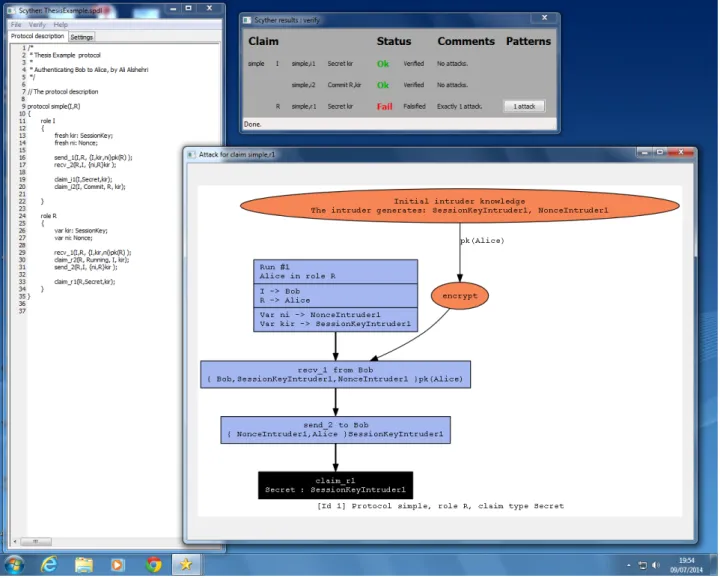
2.4 Scyther interfaces: protocol model and attack trace . . . 24
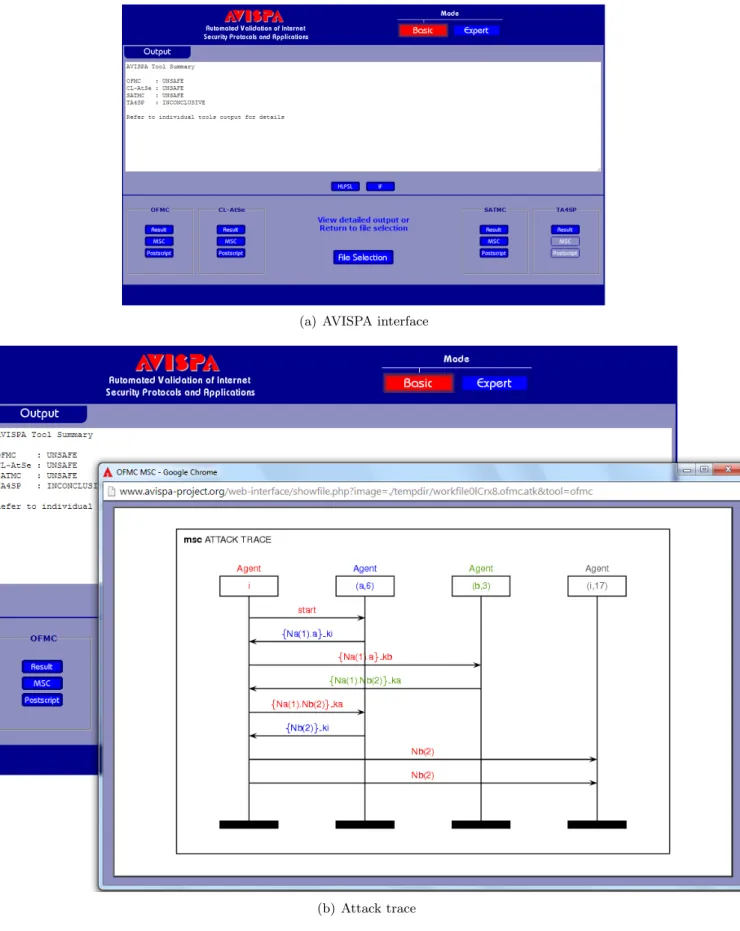
2.5 AVISPA . . . 26
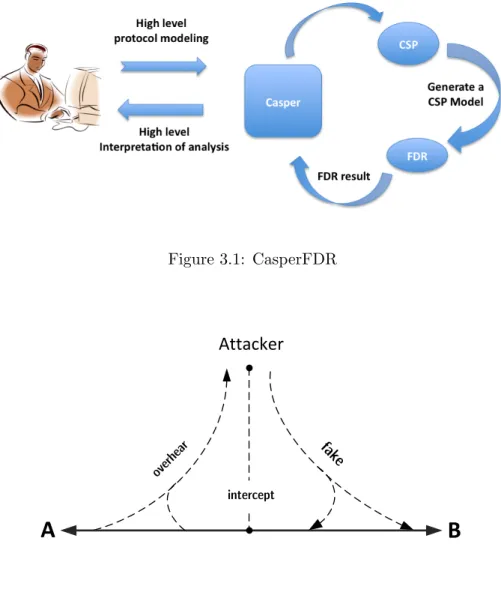
3.1 CasperFDR . . . 28
3.2 Dolev-Yao threat model . . . 28
3.3 CasperFDR modelling of the illustrating example . . . 30
3.4 The concept of authentication and secrecy events in a protocol . . . 32
3.5 Placing authentication and secrecy events in the illustrating example . . . 33
3.6 Hierarchy of authentication . . . 35
3.7 Hierarchy of secrecy . . . 36
3.8 Placing authentication and secrecy events in a three parties protocol . . . 37
3.9 Channels in CasperFDR . . . 38
4.1 General NFC mobile coupon . . . 40
4.2 Capturing NFC M-coupon requirements in CasperFDR . . . 42
4.3 Hierarchy of authentication/secrecy properties . . . 45
5.1 The simple M-coupon protocol . . . 47
5.2 The advanced M-coupon protocol . . . 48
5.3 CasperFDR modelling of the simple protocol . . . 49
5.4 CasperFDR modelling of the advanced protocol . . . 50
5.5 Capturing the Dominikus et al. protocols properties . . . 51
5.6 The advanced protocol attack trace . . . 53
5.7 The modified advanced protocol . . . 55
6.1 The Hsiang et al. (hash-based) M-coupon protocol . . . 58
6.2 CasperFDR modelling of the Hsiang et al. (hash-based) protocol . . . 59
6.3 Capturing Hsiang et al. (hash-based) NFC M-coupon requirements . . . 60
7.1 Quadratic Residue-based M-coupon protocol . . . 65
7.2 CasperFDR modelling of the Hsiang et al. (QR-based) protocol . . . 67
7.3 Capturing Hsiang et al. (QR-based) NFC M-coupon requirements . . . 69
7.4 The QR-based Protocol Attack Trace . . . 71
8.1 The footfall M-coupon protocol . . . 74
8.2 The premium M-coupon protocol . . . 75
8.3 CasperFDR modelling of the footfall protocol . . . 76
8.5 Capturing the footfall M-coupon protocol properties . . . 78
8.6 Capturing the premium M-coupon protocol properties . . . 79
9.1 NFC UKC protocol elements . . . 85
9.2 RFID/NFC relay attack . . . 86
9.3 Methods of proximity authentication in the NFC User Key Confirmation protocols . . . 88
9.4 CasperFDR modelling of NFC UKC Card Emulation protocol . . . 94
9.5 CasperFDR modelling of NFC UKC peer-to-peer protocol . . . 95
List of Tables
2.1 Comparison of formal model checking tools [69] . . . 22
5.1 Dominikus et al. protocol notation . . . 47
5.2 Encryption based protocols against intended/addressed/failed requirements . . . 54
6.1 Hashed-based Protocol notation . . . 58
6.2 Hash based protocol and provided solutions against intended/addressed/failed requirements . 62 7.1 Hsiang et al. (QR-based) Protocol notation . . . 66
7.2 QR based protocol against requirements . . . 72
8.1 Footfall/Premium Protocols notations . . . 74
8.2 Marketing based protocol against requirements . . . 81
8.3 All NFC M-coupon protocols against intended/addressed/failed requirements . . . 83
9.1 UKC protocols security characteristics . . . 89
Acknowledgement
First of all, I thank God, The Almighty, The All Knowing, for giving me the strength to carry on this project and for blessing me with many great people who have been my greatest support in both my personal and professional life.
I would like to express my special appreciation and thanks to my first supervisor Professor Steve Schnei-der, you have been a tremendous mentor for me. Thank you for encouraging my research and providing critical advises in which this research forms its contributions and draws its path to success.
My sincere thanks also go to Dr Johann Briffa and Dr Stephan Wesemeyer for the great ideas, thoughtful discussions and being very helpful, especially at the first stage of my research.
My deepest gratitude go to my parents for their caring and love in the past, the present and the future. They seem happier than me that I have finished.
My wife, thank you from the bottom of my heart. You are the one that I believe shares this achievement with me. I will not forget your support throughout this journey.
My little one, Moath, I will not forget you. Thank you for adding new amazing aspects to my life. Even though you have not spoken yet, you have taught me that life is more than just a thesis!
Abstract
N
ear Field Communication (NFC) is a Radio Frequency (RF) technology that allows data to be exchanged between devices that are in close proximity. An NFC-based mobile coupon (M-coupon) is a coupon that is retrieved by the user from a source such as a newspaper or a smart poster and redeemed afterwards. The NFC-based mobile coupon (M-coupon) is a cryptographically secured electronic message with some value stored at user’s mobile. The M-coupon requires secure issuing and cashing (redeeming). Uncontrolled copies of the M-coupons would cause losses for a company and damage its reputation. The main goal of this thesis is to enhance the security of NFC mobile coupon protocols.In order to address the NFC M-coupon threats, there are specific and general security requirements. For the specific NFC M-coupon requirements, a number of protocols have been proposed in the literature. We perform a formal security analysis of NFC M-coupon protocols, using formal methods (CasperFDR), in an effort to check the the security of these protocols and whether they address their requirements. We develop a general framework of capturing the NFC M-coupon requirements and apply it to four existing protocols in the literature, and two new protocols that we have developed.
The general security requirement that affects all NFC protocols is the issue of relay attacks. A relay attack happens when an intruder extends the distance between two NFC devices while both devices are under the impression they are close to each other. We propose threeNFC User Key Confirmation Protocols
(UKC) to address the NFC relay attack. The UKC protocols are a collaboration between the cryptographic protocols, the user and the NFC mobile in an effort to prove the proximity. We formally verify the three protocols using CasperFDR.
Chapter 1
Introduction
Nowadays, mobiles are powerful and interesting devices that can do more than just a phone call. The Internet has become a popular platform where mobiles are increasingly used to communicate with the outside world. In the last decade or so, a promising technology calledNear Field Communication (NFC) [50] was invented. NFC is believed to be the very dream-like technology that allows mobiles to communicate with nearby objects if they are in the vicinity of each other. NFC-based mobiles are an emerging technology changing the way we communicate with objects. NFC as a new communication channel, has serious implications and dramatic possible applications for future endeavors. For instance, payments, tickets and coupons can be exchanged just by waving the NFC-based mobile at the point of sale. In 2011, Google announced its first NFC mobile wallet1. With this system, people are able to store their credit cards in their mobile phones. It can be used with any contactless card merchants, which currently exist in a variety of shops.
On the other hand, the security of NFC has become a critical issue, especially as many of NFC applica-tions are sensitive and require proper security. For example, it has been discovered that Google Wallet has not encrypted a significant amount of information, with only the 16 digits of the credit card being encrypted [96]. The unencrypted information could be used for a social engineering attack, for example an intruder could pretend to be one of the bank’s staff by using this information. The main security problem in NFC, as with all previous technologies when they started, is that people think it will work as it is expected. However, this is not completely true. This is due to the fact that unauthorized intruders can go unnoticed by engaging parties. This unauthorized behaviour may result in fake transactions, losing value (e.g. cash back or free coffee), unauthorized access or privacy breach. Therefore, investigating NFC security is definitely critical.
The best technique to address NFC threats is by considering issues related to a specific NFC application. This is important because different applications have different security requirements. Nevertheless, an NFC application threat may include issues that all NFC applications share. In this thesis, the NFC application that we focus on to enhance its security isNFC mobile coupon (M-coupon).
1.1
NFC mobile coupon application
Coupons are a well-established way of marketing. They are a good way of establishing a relationship with customers, or to encourage people to visit the company’s shop with promised bonuses (discounts, points, free coffee, etc.).
Coupons can be offered in a paper-based format or electronically. As illustrated in Figure 1.1, the main players in the coupons system are: Issuer of coupons, targeted customers (users), and cashier for cashing coupons. The issuer of coupons may be a person on the high street distributing copies of a company’s coupons or an online website. The cashier is situated at a company’s shop, physically or online, which is used for coupons’ cashing-in.
There are two main phases for coupons systems: The issuing phase, where coupons are issued by trusted entities, and the cashing phase, where coupons are cashed in. Defining these phases is important, especially with designing secure electronic coupons. Note that Issuer in the coupon system is the entity that issues the coupon during the protocol, not the original designer of the coupon e.g. the company.
User
User Cashier Issuer
M-coupon
M-coupon
Figure 1.1: General NFC mobile coupon
There are many advantages for electronic coupons. They are cost-effective, requires no human interaction at issue and cashing phases, and it is easy to manage information associated with coupons. It can be done over the internet E-coupon [12, 11, 55, 76, 88] (either by computer or mobile), or over NFC mobile devices (NFC M-coupons). The main difference between them is that the E-coupons system requires online access for issuer, users and cashier. However, with M-coupons, normally, there is no online access for the issuer and the user, which makes it much easier to build and distribute but trickier to secure. M-coupon issuers may be a smart poster or an NFC tag on a newspaper.
The NFC M-coupon system has a typical scenario, for this see Figure 1.1. Initially, all parties will have NFC capabilities in order to communicate with each other. Firstly, a user scans his NFC mobile against an NFC issuer (smart poster, newspaper). Then, a coupon is issued and sent to his mobile. Later, the user goes to the shop to cash in the coupon with the cashier. The cashier may perform proper authentication procedures to make sure the user is who he/she is pertaining to be. Finally, the cashier provides the promised bonus.
1.2
Motivation
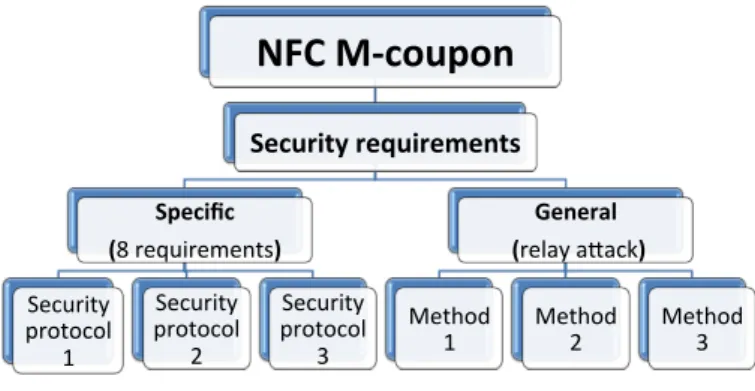
NFC M-coupon application has a number of issues, which require attention and can be addressed by meeting some security requirements. As illustrated in Figure 1.2, these security requirements address two categories of threats: specific NFC coupon threats and a general NFC technology threat that endangers the NFC M-coupon application (relay attack). The core of this thesis deals with the specific NFC M-coupon threats by addressing the desirable security requirements through security protocols with a systematic formal approach, discussed in Section 1.2.1. The remaining part of the thesis addresses the issue of relay attacks and is discussed in Section 1.2.2.
1.2.1 Formal security analysis, and developing, of NFC mobile coupon protocols
It is very important to design secure protocols for NFC mobile coupon applications for a number of reasons [1, 12, 21, 87, 99]. Unauthorized issuing of coupons can cause huge losses for a company. The Disney Company is an example where such losses have occurred 2. It offered, for its customers who spend $65 or more in one of its physical stores, or over the phone or Internet, a code that allows them to purchase next time up to $15 without a minimum purchase. In order to redeem the coupon online or over the phone, customers were asked to provide the coupon’s code. However, the fact that the company did not make any countermeasures for the risks of double spending or passing the coupons to unauthorized users, caused huge losses for the company. Codes were distributed among many people and, as a result of this, the company could not distinguish any more whether the code’s holder is a genuine customer who really spent $65 or not. The result was that a vast amount of people ended up getting free stuff up to $15, even though they did not buy anything. Even genuine customers were able to use the coupon multiple times.
Furthermore, the investment in NFC M-coupons is expected to exceed $43 US billion globally by 2016
NFC M-‐coupon
Security requirements Specific (8 requirements) Security protocol 1 Security protocol 2 Security protocol 3 General (relay a6ack) Method 1 Method 2 Method 3Figure 1.2: NFC mobile coupon security requirements
[56]. In addition, according to a survey3, discounts and coupons will drive further the adoption of mobile payments. Moreover, although NFC has the disadvantage that it requires a complex ecosystem in payment and ticketing [90], this is not the case in coupons, i.e. an M-coupon would be managed by the company only; no need for mobile operators or banks. This will make the adoption of M-coupons much quicker than other applications. Yet, an interesting statement made by the Chief Technology Officer at coupons.com
that “the future for national coupon schemes lies with NFC technology”4, which is quite significant as it comes from a person who is responsible for coupon’s technologies at a well-known coupon website. All the above show how M-coupon schemes have a significant value and need a robust security system before the proliferation and implementation.
In order to address the security concerns surrounding NFC mobile coupons, a number of security pro-tocols have been proposed in the literature [33, 48, 47, 4]. Part of the propro-tocols deal with getting a coupon onto a mobile device (issuing phase), and other parts deal with redeeming the coupons (cashing phase), and all with respect to particular requirements, e.g. whether a coupon can be transferred, whether it can be used more than once, whether it can be faked etc.
The story of the NFC M-coupon protocols development started with Dominikus et al. when they proposed the first protocol in the literature [33]. The protocols utilized in Dominikus et al. study were based on encryption and signatures meeting four basic security requirements:
• No Multiple Cash-in
• No Unauthorized Generation
• No Manipulation
• No Unauthorized Copying
Then, another protocol was proposed by Hsiang et al., [48] where light hash function were used to meet the same requirements with two additional requirements: Confidentiality and Data Integrity. The third protocol [47] is a further development of the hash-based protocol carried out by the same authors. In particular, they used thequadratic residue theorem [85, 22] to enhance the secrecy of the protocol. Issuer’s ID anonymity is an additional requirement in this protocol. Finally, we propose our protocol that we developed in the light of lessons learned from previous protocols. We meet eight refined security requirements:
• Confidentiality
3
http://www.nfcworld.com/2011/06/23/38289/survey-discounts-and-coupons-will-drive-adoption-of-mobile-payments/ 4
• Issuer’s ID anonymity • Forgery Protection: – No Unauthorized Generation – No Manipulation • Unauthorized Copying – Not Transferable – User Authentication • Data Integrity • No Multiple Cash-in
Cryptography is an important security mechanism for a NFC M-coupon application. A cryptographic protocols is an agreed sequence of messages, between two or more parties, of using cryptographic algorithms to meet some security requirements [70]. However, implementing strong cryptographic algorithms in a pro-tocol is only half of the solution. In fact, the way encryption is used between entities is the more challenging part of protocol design. It is quite difficult to establish secure cryptographic protocols even with robust cryptographic algorithms. Many attacks can be realised during the execution of the cryptographic protocols just by intercepting and replaying encrypted messages between entities, without any kind of decryption. For example, the Needham-Schroeder protocol had been regarded as a secure protocol for 17 years (1978-1995), before an attack was discovered by Gavin Lowe [62]. Therefore,formal verification of cryptographic proto-cols has been an important field of research [69]. It gives the chance to check mathematically the security claimed in the protocol and examine its promises.
However, none of the NFC mobile coupons protocols have been formally analysed yet. The first motivat-ing issue for this thesis is that these protocols need to be formally verified to examine whether they address their requirements.
Throughout the thesis we illustrate the significance of this research with an airport example. The airport wants to explore how airline companies can utilise NFC M-coupons. Tags are distributed throughout the airport and includes a basic M-coupon.
1.2.2 Addressing relay attack
The second motivating issue is addressing therelay attack in NFC mobiles. A relay attack happens when an intruder extends the distance between two NFC devices while both devices are under the impression they are close to each other. A dangerous, and yet interesting, aspect of the relay attack is that cryptography is believed to be not sufficient to address the attack on its own. The relay attack threatens all NFC/RFID protocols even when the secure protocols have no flaw in them, particularly as the attack circumvents cryptographic measures anyway. The main challenge of addressing the relay attack is confirming that the other NFC device is in close proximity.
There are a number of non-cryptographic measures for addressing the relay attack. Distance bounding protocols (DB) [16, 6, 74, 58, 59, 72, 95, 89, 82, 45, 20, 18] are a group of protocols which measure the round-trip time taken to transfer a single bit between two engaging parties. This imposes a limit based on the transmission speed of information. If there is a delay, then this suggests the time taken is more than needed either by internal or external intruder. The delay indicates an attacker may be relaying the channel. DB protocols make the relay attack very difficult for the attacker and provide the best solution so far for the passive contactless cards. DB protocols intend to address internal [16, 27], external [30, 7] or both internal/external intruders [30]. Finally, DB protocols are not suitable for NFC channels [42].
However, there are some disadvantages with DB protocols. The fact that both parties require addi-tional time because of computaaddi-tional processes, means that it is difficult to measure the round-trip latency caused by the different computational process required by both parties. As a result, the real reason for the latency would not be known; whether it is due to a computational reason or by an attacker relaying the communication. Because of the computational process problem, the DB protocols have been developed
with an assumption of a constant computational time. In addition, DB protocols try to address security requirements in entity authentication beside proximity authentication. Even though entity authentication requirements are important, they are not the main requirement of the DB protocol. The DB protocols were invented firstly for addressing proximity authentication, while entity authentication was included to make a complete protocol that addresses both requirements. The DB protocols address more security requirements than needed, focusing on improving the less important requirements (i.e. entity authentication). On the other hand, it is a reasonable argument that it is difficult to apply a normal entity authentication protocol alongside a proximity proof protocol (bit round-trip) because of the limited choices in a passive contactless card (e.g. a contactless credit card) and the nature of the proximity proof. However, assuming a constant computational time, which breaks the core element of measuring the bit round-trip, and focusing on entity authentication issues are a major disadvantage in these protocols. In theory, the security of DB protocols can be proven mathematically [13], but applying them in practice is questionable and requires further research. Finally, DB protocols are not suitable for NFC channels [42].
A different approach is by using an RF “fingerprint” [81, 28] associated with each device, where the intruder would not be able to have the same “fingerprint” of a proxy device. However, generating a fingerprint to each device is not a practical solution [38].
Another approach measures the ambient conditions between parties [92]. This is based on the fact that if the engaging parties are in close proximity, then they should share similar ambient conditions such as GPS, sound, light or temperature. However, the accuracy of these measures is a major concern. A GPS signal needs an outside clear environment. Light and sound may be affected by the source’s direction or interferences. Temperature can be quite similar in two far places. Not to mention if these measures require additional equipment to measure the ambient conditions. Nonetheless, advantages of the ambient conditions solutions are that they focus on the main problem by seeking to prove the proximity. Additionally, they also can be implemented on top of any cryptographic protocols.
The final approach in by engaging the user either by requiring them to carry another device [5] or by utilising NFC button solutions. The NFC button is used either as a turn on/off NFC function [65, 3] or measuring the time between showing and pressing buttons showed on both devices [57]. A disadvantage of this approach is that it relies on the user significantly.
As far as the current relay attack measures are concerned, an ideal solution should feature the following: 1. Response time should not be a critical factor due to the difficulty associated with measuring it. 2. Focusing on the main problem (proving the proximity).
3. The ability to run on top of, or within, normal cryptographic protocols. 4. Easy to apply where no additional equipment is required.
5. Accurate in detecting relay attacks.
The above features represent the motivation to develop theNFC User Key Confirmation protocols (NFC UKC). NFC UKC protocols overcome issues related to the current relay attack countermeasures.
1.3
Contributions and overview
An overview of the thesis with the contributions in Figure 1.3 where boxes in bold are the contribution. The thesis is divided into two main key contributions.
• Formal Security Analysis of NFC Mobile Coupons Protocols:
The first contribution related to the NFC M-coupon protocols, left branch in Figure 1.3. Related contributions are as follows:
1. A Formal Framework for Security Analysis of NFC Mobile Coupon Protocols, using formal methods (CasperFDR). The framework aims to check whether NFC M-coupon protocols address their security requirements. It also includes formal definitions and the capturing of the NFC M-coupon requirements, and how these can be applied to a variety of protocols.
2. Contributing towardshaping the NFC security requirements.
3. Formal security analysis, and modelling, of six NFC M-coupon protocols (four were in the literature and two are new) in accordance with the framework. A number of vulnerabilities were identified and addressed formally. Analysed protocols are as follows:
– Dominikus et al. protocol [33]:
∗ Simple
∗ Advanced
– Hsiang et al. (hash-based) protocol [48] – Hsiang et al. (QR-based) protocol [47] – Marketing-based protocol [4]:
∗ Footfall
∗ Premium
4. Propose new NFC mobile coupon protocols, the Marketing-based: – Footfall
– Premium
5. Customised use of CasperFDR:
– A systematic approach for using the tool for capturing various security properties.
– Introducing alternative, yet equivalent, ways for modelling some non-standard part of the protocols such as NFC specific assumptions.
We published all work in this section as follows:
– A. Alshehriand J. A. Briffa, “Modelling and analysis of NFC mCoupon protocol,” in 9th Annual
PhD Conference (CompConf 2012), Department of Computing, University of Surrey, 2012.
– A. Alshehri, J. A. Briffa, S. Schneider, and S. Wesemeyer, “Formal security analysis of NFC
m-coupon protocols using CasperFDR,” in Near Field Communication (NFC), 2013 5th Interna-tional Workshop on, 2013, pp. 1–6.
– A. Alshehri and S. Schneider, “Formal security analysis and improvement of a hash-based
NFC m-coupon protocol,” in 12th Smart Card Research and Advanced Application Conference (CARDIS 2013), 2013.
– A. Alshehri and S. Schneider, “Formally defining NFC m-coupon requirements, with a case
study,” in Internet Technology and Secured Transactions (ICITST), 2013 8th International Con-ference for, Dec 2013, pp. 52–58.
– A. Alshehriand S. Schneider, A Tutorial on Cracking and Improving Cryptographic Protocols
, 7th Saudi Students Scientific Conference-UK 2014.
– A. Alshehri, and S. Schneider, “A Formal Framework for Security Analysis of NFC Mobile
Coupon Protocols,” Journal of Computer Security,under review.
• User Key Confirmation protocols:
The second contribution is related to addressing the relay attack, the right branch in Figure 1.3. We develop three NFC User Key Confirmation (UKC) Protocols to address the NFC relay attack in NFC mobiles. Related contributions are as follows::
1. Propose three NFC UKC protocols:. – The UKC protocol in card emulation mode. – The UKC protocol in peer-to-peer mode. – The UKC protocol in reader/writer mode.
2. Formalsecurity analysis, and modeling, of the three NFC UKC protocols. 3. Customised use of CasperFDR:
– Introducing ways for modeling some non-standard part of the protocols. We have submitted the work of this section as:
• A. Alshehri, and S. Schneider, “Addressing NFC Relay Attack: NFC User Confirmation Protocols,”
Co nferen ces : 1-‐ 9th A nn ual P hD C on fe re nc e, C om pC on f 2 01 2 (ac ce pte d) . 2-‐ 5th In te rn a> on al W or ks ho p on N ear F ie ld C om m un ic a> on (ac ce pte d) . 3-‐ 12 th S m ar t C ar d Re se ar ch an d Ad van ce d Ap pl ic a> on C on fe re nc e, C ARD IS 2 01 3 (ac ce pte d) . 4-‐ Th e 5th In te rn a> on al W or ks ho p on RF ID S ec ur ity an d Cr yp to gr ap hy 2 01 3 (RIS C’ 13 ) ( ac ce pte d) . 5-‐ 7th S au di S tu de nts C on fe re nc e-‐ U K (ac ce pte d) . U se r K ey C on fir m a. on Pr ot oc ol s UKC car d em ul a> on UKC Pe er -‐to -‐p ee r UKC Re ad er /W rite r Fo rm al S ec ur ity An al ysi s of N FC M-‐ co up on P ro to co ls D om in ik us e t al . Hs ian g et al . (h as h-‐ bas ed ) Hs ian g et al . (Q R-‐ bas ed ) Mar ke >n g-‐ bas ed Fo oV al l Premi um Ad van ce d Sim ple An al ys is A6 ac ks Me as ur es D om in ik us e t al . ( m od el le d/ an al ys ed ) Hs ian g et al . (h as h-‐ bas ed ) ( m od el le d/ an al ys ed ) Hs ian g et al . (Q R-‐ bas ed ) ( m od el le d/ an al ys ed ) Mar ke >n g-‐ bas ed ( m od el le d/ an al ys ed ) UKC car d em ul a> on ( m od el le d/ an al ys ed ) UKC Pe er -‐to -‐p ee r ( m od el le d/ an al ys ed ) UKC Re ad er /W rite r ( m od el le d/ an al ys ed )
N
FC
M-‐
co
up
on
F
or
m
al
F
ram
ew
or
k
An al ys is
Fo
rm
al
V
er
ifi
ca>
on
THESI
S
Jo urn al s: 1-‐ Jo ur nal o f C om pu te r S ec ur ity (s ub m i[ ed ) 2-‐ In te rn a> on al Jo ur nal o f RF ID S ec ur ity an d Cr yp to gr ap hy (IJ RF ID SC ) ( su bm i[ ed ) Figure 1.3: Thesis o v e rvie w and con tributionsChapter 2
Background
2.1
Near Field Communication
2.1.1 NFC technology
NFC is a standard-based Radio Frequency (RF) communication link technology that can be embedded into any device (computers, mobiles, PDA, TV, printers, etc.), in order to allow data to be exchanged between devices that are normally less than 10 cm apart [37]. NFC has become more prevalent in mobile phones as a majority of people have got one. For example, NFC is the technology that enables people to make payments, at the supermarket or the train station, just by waving their mobile at the point of sale.
NFC is not a new idea. It is the logical evolution of ISO/IEC 14443 contactless card technology [51, 54, 52, 53], which allows contactless communication between cards and readers, through a RF field when they are close to each other. Nowadays, contactless technology is used in a variety of industries such as banking and transport. It is faster and more convenient than traditional contact cards1. Figure 2.1 shows the basic NFC architecturein mobiles [67]. The components are as follows:
• Applications downloaded on the mobile.
• NFC module: Built in or external antenna that enables the mobile to communicate with other devices.
• Secure Element (SE): The NFC secure element is the trusted security component, used for secure execution of sensitive application and information, e.g. encryption keys, and has a restricted access control. Nonetheless, not all applications need access to the secure element.
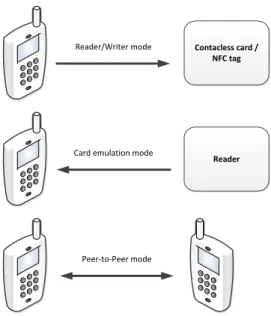
NFC mobile operates in three different modes. As shown in Figure 2.2, NFC mobiles can operate in three differentNFC modes determined by the application used [25]:
• Card Emulation Mode: the NFC mobile emulates a contactless card and communicates with an NFC reader, such as payment and ticketing contactless cards. This mode uses the existing standard ISO 14443 [51, 52, 53, 54].
• Reader and Writer Mode: the NFC mobile acts as a reader and communicates with a passive RFID/NFC tag. The NFC mobile is able to read and write on contactless objects. This mode uses the existing standard ISO 14443 as well.
• Peer-to-Peer Mode: In this mode the NFC mobile can exchange information with another NFC mobile. In this mode it uses the NFC standard ISO 18092 [50].
NFC mobiles can beactive orpassive. NFC relies on the RF field as a transmission medium. If the NFC mobile emulates a reader, it must generate the RF field to power the other device, see the arrows’ direction in Figure 2.2. If it emulates a card, then it has to wait for the RF and a command. However, in peer-to-peer
1
Processor
NFC
antenna element Secure Applications
Figure 2.1: The basic architecture of NFC mobile
Reader/Writer mode
Reader Contacless card /
NFC tag
Card emulation mode
Peer-to-Peer mode
NFC communication, mobiles can be a reader and/or a card. Therefore, things have been defined from a slightly different perspective [50]. There are two methods of how NFC mobiles can communicate with other devices. This depends on whether the device generates its own RF field during communicating. Thus, there is an active mode if the device has a power source to generate its own RF field, and there is a passive mode if it has no source of power and relies on the power of another device to be able to engage in communication. The passive mode is the default state for all NFC devices. In addition, if a number of cards are presented in the reader’s RF field, a reader (active NFC) must choose only one card (NFC devices). The device that starts the communication is called an ‘Initiator’. This must be done in the active mode as the ’initiator’ needs a source of power. The response device is called the ‘Target’, and is not required to be active as it does not need a source of power.
RF anti-collision [50] is performed by the initiator. NFC devices must check for any existing RF fields before they begin generating their own RF field. In the case where there is no RF field, the “initiator” promptly generates one and begins communication. The other device is either passive or active. If both devices are active, then both of them perform RF anti-collision before sending data.
2.1.2 NFC Applications
The fact that NFC can perform three modes of operation has inspired a significant number of possible applications. In addition, many passive devices can now be interactive, NFC enabled, devices.
NFC is just a communication link. Therefore, it is hard to mention all its possible applications. However, NFC applications could be categorised into the following classes [71]:
• Contactless Token: When applications use NFC to emulate passive tokens, such as smart card or a RFID label. The main feature of these applications is that neither a source of power, nor a link to the device CPU, is required. However, the contactless tokens cannot run a complex protocol, since they only deal with limited computing power. Ideally, they store data to be read by NFC active devices. An example of such an application is a URL stored in an NFC tag, which gives a direct link to a website address.
• Ticketing/Micro Payment: When applications use NFC to transfer more valuable information, such as ticket or micro payment. This can be a contactless smart card but can also be a mobile phone. The capability to perform complex protocols is normally required. The NFC secure element becomes important here. The NFC mobile coupon protocols are an example of the Ticketing/Micro Payment application. It requires the capability to perform complex protocols and it runs on the NFC mobile phone platform.
• Device Pairing: NFC is used to establish a connection between devices. For example, it can be used to transfer initial Bluetooth settings between two devices, just by bringing the two devices close to each other.
2.2
NFC security
NFC is a wireless communication. There are no security measures provided by the NFC ISO 18092 standard at the NFC communication link [71], i.e. it is determined by the implementers. This section discusses threats and attacks related to NFC.
NFC threats can be categorised by highlighting the three main information security aspects CIA ( Con-fidentiality, Integrity, Availability). Note that these definitions are considered from a security protocol aspect:
• Confidentiality: Confidentiality is the security property of maintaining the secrecy of information throughout the protocol. Confidentiality is violated by a number of attacks such aseavesdropping and
skimming: If an attacker listens to a communication, this is eavesdropping. Eavesdropped messages may include sensitive information which the intruder is not allowed to see . If an attacker interacts with the card without a user’s permission, this is skimming, which is different from cloning normal contact cards. The feasibility of such attacks also depends on a variety of other factors [44], which are
out of scope. This can be done by designing new equipment, or using equipment already designed, such as OpenPCD2. ISO 14443 is vulnerable to skimming attacks from around 30 cm and eavesdrop-ping attacks from 3.5 m [41]. Related threats are privacy attacks, e.g. tracking and tracing, and a compromise of the encryption key.
• Integrity: Integrity is the security property of maintaining the accuracy of information throughout the protocol. Integrity is violated by a number of attacks. Replay attack: the attacker replays a previous message. Replay attacks violate the integrity of the protocol from the aspect that the other party would finish the protocol with the wrong belief. Data integrity: such as message reconstruction, data modification and data insertion. Relay attack [38]: the reader cannot distinguish between the real token and the proxy-token [43] where the attacker can pretend to be any card if he has a relay channel with the genuine, victim card.
The integrity of NFC tags is critical. An example of an attack is when a smart poster should direct you to X website but, after manipulation by an intruder, it directs you to Y website [71]. NDEF ‘Signature Record Type’ [73] is a countermeasure specification by NFC Forum for verifying tag content. However, Roland et al. in [83] have discovered a vulnerability in this signature. The attack combines two halves of different tags’ signatures to make a new signature. This shows that integrity still can be violated even with applying cryptographic measures.
• Availability: Availability is the security property of providing information whenever it is needed throughout the protocol. Availability is violated if the availability of an NFC device is prevented by the attacker e.g. Denial of Service attack (DoS).
Countermeasures need to be in place to address these threats and attacks. The requirement for robust security in NFC in general has been emphasised in the literature [44, 71]. NFC-SEC standards [36, 35] enable two NFC devices, in Peer-to-Peer mode, to establish a secure channel. However, they do not provide entity authentication and are not suitable for applications requiring specific security mechanisms.
For any NFC application, cryptography is the ideal measure to address security threats, such as confi-dentiality, integrity and availability. On the other hand, cryptography cannot address the relay attack on its own since the attack circumvents cryptographic measures. The relay attack measures are discussed in more depth in Chapter 9, including a proposed solution.
2.3
Cryptography
Cryptography underpins secure communications. In order to use cryptography, there are two questions that must be considered. The first concern is which cryptographic algorithms should be used (cryptographic primitives), and the second is how to use these in a secure protocol (security protocols). In this thesis, the concern is with the second question: how to use cryptography in a protocol, with assumed secure cryptographic algorithms. Therefore, the main function of cryptographic primitives is described below:
• Symmetric Cryptography: uses a shared key between entities, say Alice and Bob. Both Alice and Bob have the same key used for encryption and decryption (which opens the encrypted message to its original unencrypted form), e.g. DES and IDEA [70]. The addressed security properties are Confidentiality and Integrity.
• Asymmetric Cryptography: every entity has two different keys,PublicandPrivatekeys. So, anyone can encrypt messages using Alice’s public key and Alice will be the only who one can decrypt messages with her private key, e.g. ElGamal public-key encryption [70]. In addition to addressing Confidentiality, Asymmetric Cryptography is used to address Integrity with a slightly different use called Digital Signature.
– Digital Signature: is a digital analogue of a real signature which guarantees where a message has come from, e.g. DSAand RSA[70].
2
• Hash Function: is a one-way algorithm which takes an arbitrary block of data and gives a fixed size unique string of data. The addressed security property is Integrity, e.g. SHA-1 and MD5 [70].
• Nonce: is a Number Used Once (random number) used for message’s freshness (Integrity). A nonce might be used for confidentiality as well (e.g. using it in the generation of a new key).
• Cryptographic Protocol: describes an agreed way of using the above cryptographic algorithms in mes-sages exchanged between entities to address some security requirements, e.g. entity authentication protocols [70].
2.4
Security protocol analysis
Attacks can occur during the process of implementing cryptographic primitives in a security protocol. This section discusses how security protocols can be analysed to check whether they meet the necessary security requirements
2.4.1 Approaches
An analysis of the security protocol is categorised into the following approaches [78, 69, 2]:
• Computational approach
• Formal methods approach
The main difference between the two approaches is the way cryptographic primitives are modelled. In the computational approach, cryptographic primitives are modelled as functions dealing with strings of bits in which the intruder is able to try and break them i.e. cryptanalysis. In contrast, the intruder in the formal methods approach does not perform cryptanalysis, but has full control of the communication medium. The only way for encryption/decryption is when the intruder holds the appropriate key. This assumption in the formal methods approach is commonly known as the perfect encryption assumption [32]. The formal methods approach is much easier to automate than the computational approach. With regard to this thesis, the analysis tool falls into the formal methods approach.
The formal methods approach uses a common way to find vulnerabilities. First, a system and its specifications are modelled as formulas of logic. Then, a test is performed to check a claim that the system and its specifications are related. Finally, the result is either true (i.e. error-free) or false where a counterexample is generated to show how the claim is violated. In the security protocol context, the system is the security protocol, the specifications are the security requirements and the counterexample is the attack.
Tools based on the formal methods approach fall into three main approaches:
1. Belief logic[17, 39, 15, 66]: This approach was the first attempt to automate the verification of security protocols. BAN Logic [17] is the most significant belief logic, where beliefs of entities can be described and evaluated through inference rules. Then, based on the evaluation process, a final statement is concluded whether the protocol is correct or not. However, there are some disadvantages, e.g. it only checks authentication properties, and assumes only honest parties are engaged in the protocol.
GNY (Gong, Needham and Yahalom)[39] is an extended logic that address some disadvantages of the BAN logic. However, it becomes more complicated and still only checks authentication properties.
BGNY is an extended logic of GNY which has been automated by software [15, 66]. Nevertheless, only authentication properties can be checked.
2. Theorem proving [98, 23, 24, 94, 93, 29, 14, 77] is an approach that verifies the security through a formal proof. Tools based on theorem proving fall into two branches: Higher Order Logic and First Order Logic, such as: HOL theorem prover, the ACL2 theorem prover and Isabelle theorem prover. However, this approach is time consuming as it is not fully automated and does not provide good support for flaw detection.
3. State exploration: Vulnerabilities are found in the state exploration approach by exploring all possible traces of a protocol to check whether a property holds. Tools based on state exploration fall into two branches: Model checking is a method that identifies vulnerabilities in the given model by checking if a security requirement is violated. However, the model checking approach does not establish if the protocol is reallycorrect. This limitation motivates the second approach, theStrand Spaces approach. Nonetheless, the majority of tools are based on the state exploration approach. With this in mind, the analysis tool utilised in this thesis falls into the model checking approach. There are a number of tools based on the state exploration approach such asScyther [26], AVISPA [97],OFMC [8],Athena
[91],ProVerif [10],SMV [68] and BMC [9].
2.4.2 Model checking tools
Table 2.1: Comparison of formal model checking tools [69]
Tool name Publicly Available Falsification Verification Termination Bounded Unbounded
CasperFDR Yes Yes Yes No Yes
OFMC Yes Yes Yes No Yes
CL-Atse Yes Yes Yes No Yes
SATMC Yes Yes Yes No Yes
TA4SP Yes Yes No Yes Yes
Avispa Yes Yes Yes Yes Yes
HERMES Yes Yes No Yes Yes
Interrogator No Yes Yes No Yes
NRL Protocol analyser No No No Yes Yes
Brutus No Yes Yes No Yes
Murϕ Yes Yes Yes No Yes
ProVerif Yes Yes No Yes Yes
Athena(Bounded) No Yes Yes No Yes
Athena(Unbounded) No Yes No Yes No
Scyther Yes Yes Yes Yes Yes
Table 2.1 illustrates a comparison of formal model checking tools [69], wherefalsificationhighlights when a tool finds a flaw and gives a response,bounded verification means the protocol is analysed within a finite system, unbounded verification means the protocol is analysed within an infinite system and termination
means whether the tool ends successfully or not. As suggested in Table 2.1, the tools that satisfy all features are AVISPA and Scyther.
Scyther
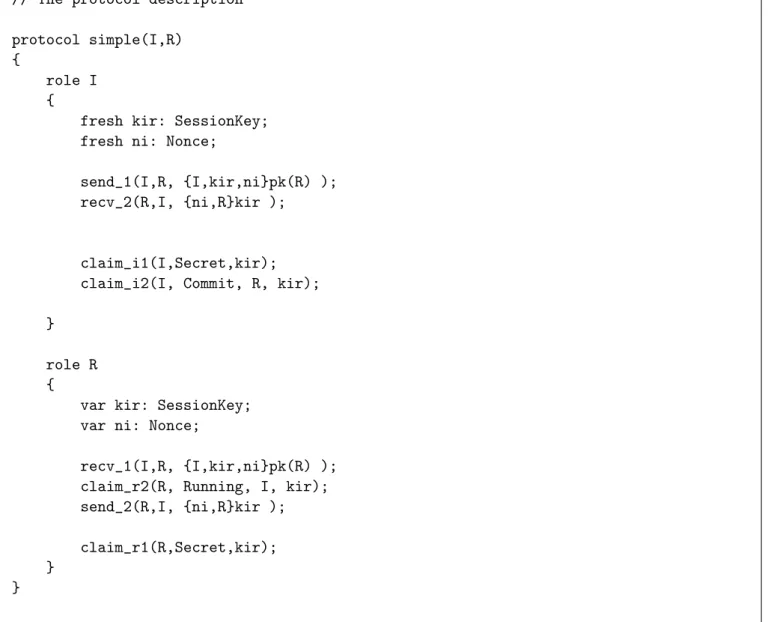
Scyther [26] is a tool, developed by Cas Cremers, for security protocols verification. Figure 2.3 shows a Scyther modelling script of a protocol of two messages aiming to authenticate Bob to Alice:
1- Alice→Bob : {A , NA, KAB}PKB
2- Bob→Alice : {NA}KAB
where: A: Alice’s ID. B: Bob’s ID.
NA: Alice’s nonce (number used once).
// The protocol description protocol simple(I,R)
{
role I {
fresh kir: SessionKey; fresh ni: Nonce;
send_1(I,R, {I,kir,ni}pk(R) ); recv_2(R,I, {ni,R}kir );
claim_i1(I,Secret,kir); claim_i2(I, Commit, R, kir); }
role R {
var kir: SessionKey; var ni: Nonce;
recv_1(I,R, {I,kir,ni}pk(R) ); claim_r2(R, Running, I, kir); send_2(R,I, {ni,R}kir ); claim_r1(R,Secret,kir); }
}
Figure 2.3: Scyther modelling of the illustrating example
PKB: Bob’s public key.
Scyther seems to be the easiest tool for modelling if we compare it to AVISPA and CasperFDR. In Figure 2.3, Alice is modelled as role I (Initiator) and her role is defined between the two brackets. Alice generates afresh session keykir and nonceni. Alice’s action is that shesends the first encrypted message to BobR(responder), then in turn receives (recv) the second message from Bob. Bob is defined in the second sectionrole R. He will accept variables (var kir) as session keys, andni as a nonce. The first action for Bob is that he willreceive a message that appears to be sent by Alice, then sends the second message to Alice. The secrecy of the session key can be captured by placing claims, for both entities, at the end of the protocol. The authentication is captured by placing a Running event after Bob receives the first message indicating that he is running the protocol with Alice, apparently. Then, placing aCommit event at the end of Alice’s run indicates that she has completed a run of the protocol apparently with Bob. This approach is quite similar to CasperFDR approach which will be explained in more detail in chapter 3.
Scyther found an attack. Bob’s claim of the session key secrecy does not hold. Scyther generates a graphical user interface of the attack trace as shown in Figure 2.4.
AVISPA
AVISPA [97] (Automated Validation of Internet Security Protocols and Applications) is a push-button tool for the automated validation of the Internet protocols. Protocols are specified in HLPSL language (High Level Protocols Specification Language), and are analysed by four model checking tools: OFMC, AtSe, SATMC and TA4SP. To get a flavour of the tool, Figure 2.5 illustrates modelling, and an attack, of the Needham Schroeder Public-Key Protocol available from the AVISPA web interface3:
1- Alice→Bob : {A , NA}PKB
2- Bob→Alice : {NA, NB}PKA
3- Alice→Bob : {NB}PKB
where: A: Alice’s ID.
NA: Alice’s nonce (number used once).
NB: Bob’s nonce (number used once).
PKA: Alice’s public key.
PKB: Bob’s public key.
Why CasperFDR?
This section justifies the use of the analysis tool of this thesis CasperFDR[64, 46, 86]. It also discusses its related disadvantages and possible affects.
The advantages of CasperFDR fall into the following aspects:
1. It allows modification of the intruder’s power on every channel (i.e. each message) of the protocol. Such settings are needed in our work on NFC protocols to capture some behaviour in the analysed protocols. This is not possible in AVISPA and Scyther, while in CasperFDR it is a default setting. 2. Accessing the original CSP code which allows direct modification of the model when appropriate. 3. The ability to use the tool for more advanced analysis such as capturing various security requirements
in NFC mobile coupon. This is also possible in AVISPA and Scyther.
4. It features various automated and robust security specifications, e.g. Agreement, Noninjectiveagree-ment etc. as they will be explained in the next chapter. This is also provided in AVISPA and Scyther but not as powerfully as in CasperFDR, as discussed previously in 1.
On the other hand, as Table 2.1 suggests, the limitation of CasperFDR is that it only analyses the protocol within a bounded, finite system. CasperFDR checks vulnerabilities within the limited given system, not like some other tools which explore attacks in an unbounded system such as AVISPA and Scyther. However, our NFC threat model does not require such feature where the intruder, unlike in the Internet, is assumed to have a very limited access to engaging parties as we will explain in Section 3.2. A less significant disadvantage is that even though CasperFDR provides “Alice-Bob” diagram of attacks, it does not provide a graphical interface as in AVISPA and Scyther.
(a) AVISPA interface
(b) Attack trace
Chapter 3
The CasperFDR Approach
3.1
Introduction
Communicating Sequential Processes CSP [46], with its model checker Failures Divergence Refinement
(FDR), has been proven to be an effective method in analysing the security of protocols [86]. However, modelling protocols in CSP is not a trivial task. Gavin Lowe developedCasperFDR [64]. CasperFDR is, as shown in Figure 3.1, a tool that allows the user to write an abstract description of a security protocol, then the tool produces code in the CSP language, and directly checks it with FDR2.
CasperFDR has been used to analyse a huge number of protocols [34, 75, 60], which proves its capability of finding vulnerabilities, and makes it a robust CSP model producer. In addition, research was done on the formal verification of the Australian E-passport system, using CasperFDR [75]. This scheme is based on the contactless card reader standard ISO 14443. It confirmed existing gaps in the literature and discovered a new vulnerability. Another study has been done on formal verification of the hash based RFID security protocol using CasperFDR [60]. They have analysed existing protocols, which they found to be vulnerable. This suggested a new hash based protocol, which is formally checked by CasperFDR. Finally, research has been done on formal verification of IEEE802 wireless secure protocols, using CasperFDR [80, 61, 79].
CasperFDR performs a refinement check of the protocol against its requirements. When refinement fails, then it provides a trace which shows how the property fails, which corresponds to an attack. Moreover, CasperFDR managesalgebraic equivalences where attacks against these algebraic properties are considered and captured in CasperFDR.
CasperFDR is a formal method tool which supports symbolic protocol analysis in the Dolev-Yao model [32]. The best way to illustrate the CasperFDR approach is by a simple example.
The contribution made by this chapter toward the literature is its illustration modelled from the underlin-ing theory angle (CSP aspect), which is beyond the knowledge required for modellunderlin-ing usunderlin-ing the CasperFDR tool (black-box approach). Modelling protocols in CasperFDR requires only an abstract description of the protocol and the security requirements to be checked. Then, CasperFDR provides the results detailing whether an attack was found or not. We call this a black-box approach, as the underlying models are not shown to the user. In this chapter, this point is considered by illustrating the modelling from the underlying theory perspective. This is important in enabling a black-box user to become more powerful in protocol analysis using CasperFDR and modelling the protocol and its requirements in a precise approach. Therefore, this chapter facilitates a case study for a “black box” CasperFDR user to become a more powerful analyser.
3.2
CasperFDR threat model
The threat model used in the formal analysis is the Dolev-Yao model [32], see Figure 3.2, which assumes no encrypted message can be decrypted without the decryption key, thus the intruder does not perform any cryptanalysis. However, he or she has full control of the network traffic, i.e. an ability to block, replay, redirect, spoof and duplicate messages, and tries to break the security protocol from what has been learned. In addition, since NFC is a wireless communication, there is a limit on how many times the intruder can access engaging parties. Therefore, all the participants (the user, the issuer and the cashier) are engaging
Figure 3.1: CasperFDR
Attacker
A
B
intercept over hear fakeFigure 3.2: Dolev-Yao threat model
in the protocol only once. The intruder does not have unlimited access to the parties but has a minimum number of accesses to try attacking the protocol.
The analysis threat model does not include proximity. Therefore, the Relay attack is not considered in our analysis since it is a general attack against NFC technology [38]. Relay attack is a well-known attack that manipulates the proximity factor between entities. Cryptographic measures are believed to be not sufficient for addressing the attack on its own. The main danger of the relay attack is the fact that the attack works even with secure protocols. Thus, it is warranted to assume that there are some non-cryptographic techniques for addressing NFC relay attacks, discussed in [38], and in which case relay attacks are not a primary concern of the formal analysis. However, we propose a solution to address relay attacks after the formal security analysis of the NFC M-coupon protocols.
3.3
Illustrating example
Our illustrating protocol is a two message protocol which aims to authenticate Bob to Alice: 1- Alice→Bob : {A , NA, KAB}PKB
2- Bob→Alice : {NA}KAB
KAB, encrypted with Bob’s public key. Then, Bob sends message 2 by encrypting the Nonce (NA) with the
session key. Alice authenticates Bob based on the fact that since message 1 is encrypted by Bob’s public key, he is the only one who can extract the session key and the nonce and send message 2. At the end of the protocol both Alice and Bob believe the session key KABis concealed.
3.4
CasperFDR modelling
Figure 3.3 shows the Casper script of the illustration protocol model.
There are eight sections which can be considered from two main perspectives, protocol definition and system definition:
• The Protocol Definition:
The first four sections give a general description of the protocol:
# Protocol description
Defines the exchanged messages within the protocol. The first line means A starts the protocol with B, maybe through A’s user or the environment. The other lines are the messages of the protocol.
# Free variables
Defines any variables, or functions, used in the protocol description.
# Processes
Defines every agent in the protocol description, as CSP processes, including their initial knowledge.
# Specifications
Defines the requirements of the protocol which will be checked. Having modelled the exchanged messages between entities, the claimed authentication and secrecy properties are checked using the following claims (where B is Bob and A is Alice):
Agreement(Bob,Alice,[NA]) Secret(Bob, KAB,[Alice])
TheAgreement specification means it will check whether Bob is authenticated to Alice and they have both agreed on the Nonce NA. TheSecret specification is checking whether the key KABaccepted by
Bob is secret between Bob and Alice. Here, Bob is the one who claims the secret. One does not have to check what Alice’s belief about the key KAB is i.e. Secret(Alice, KAB,[Bob]), as she is the one
who generated it.
• The System Definition:
CasperFDR, or CSP, requires a specific system to be checked within the protocol e.g. how many agents take B’s role or how many sessions B can engage in the protocol. The defined system must be finite, otherwise the tool will crash due to the state explosion problem or the analysis will never finish. Identifying a particular system requires these four steps:
# Actual variables
Similar to ‘Free Variables’ above but explicitly specifying the names of the variables.
# Functions
Functions used in the protocol are defined here.
# System definition
Defines the instances of the roles acting by agents in the protocol and how many times they can engage in the protocol.
# The intruder
Defines the initial intruder’s knowledge.
3.5
The CSP view of CasperFDR modelling
Understanding how these specifications are captured underneath CasperFDR, the CSP view, is important if one wants precise descriptions of how claimed properties are modelled in a specific application, as shown in later chapters. Here, an example will be given from a CSP point of view.
#Free variables A,B: Agent na : Nonce PK :Agent -> PublicKey SK :Agent -> SecretKey InverseKeys = (kab,kab), (PK, SK) kab : SessionKey #Processes
INITIATOR(A,B,na, kab) knows PK
RESPONDER(B,A) knows PK, SK(B) #Protocol description 0. -> A : B 1. A -> B : {A,na,kab}{PK(B)} 2. B -> A : {na}{kab} #Specification Agreement(B,A,[na])
Secret(B, kab , [A])
#Actual variables
Alice, Bob, Mallory : Agent Na, Nm : Nonce Kab,Km : SessionKey InverseKeys = (Kab,Kab), (Km,Km) #Functions symbolic PK, SK #System INITIATOR(Alice,Bob,Na,Kab) RESPONDER(Bob,Alice) #Intruder Information Intruder = Mallory
IntruderKnowledge = {Alice, Bob, Mallory, Nm, Km,PK, SK(Mallory)}
Initially, Alice and Bob are modelled as independent CSP processes. Every agent in the protocol is modelled from their different views of the protocol including newevents. These events areRunning,Commit
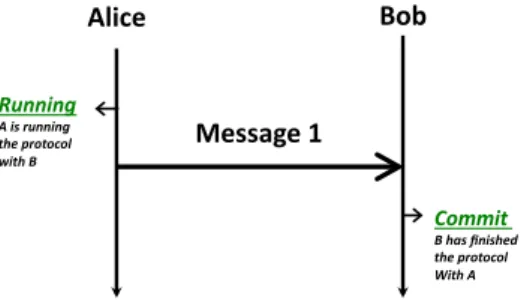
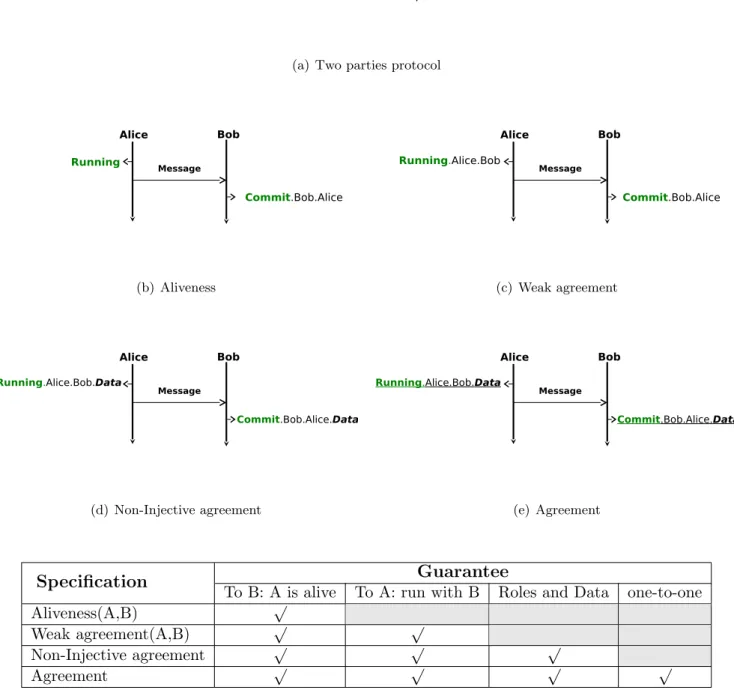
andClaim Secret which are injected in the protocol. Figure 3.4 demonstrates the general concept of placing these events in a protocol which will define what security properties are expected, especially at a particular point during a run of the protocol. The agents are allowed to express their belief in the protocol by these events. Figure 3.4b shows how authentication is captured by CasperFDR.Running allows the authenticated agent, Alice, to say “I am running the protocol with Bob”. TheRunning event is performed before the last message is sent by Alice, which means she has progressed at least as far as the prior message sent by her. The Commit event is performed after the last message in the protocol done by the verified agent (Bob), which allows Bob to say “I have finished the protocol with Alice”. Figure 3.4c shows how secrecy is captured by CasperFDR. After Alice sends a secret message, she claims a value that is secret and only known by Bob. Figure 3.5 applies this concept to the illustrated example. The final structure of the protocol emerges through the following steps, where events are tagged by>:
1. Alice’s view of the protocol (as initiator):
Msg 1: Alicesends to Bob : {A , NA, KAB}PKB
Msg 2: Alicereceives from Bob: {NA}KAB
> Msg 3: AliceCommit to Bob : NA
2. Bob’s view of the protocol (as responder):
Msg 1: Bobreceives from Alice: {A , NA, KAB}PKB
> Msg 2: BobRunning with Alice: NA
Msg 3: Bobsends to Alice: {NA}KAB
> Msg 4: BobClaim Secret with Alice : KAB
3. Running the final protocol in theDolev-Yao intruder model.
Capturing authentication between Alice and Bob in the protocol is done by utilising the Running and the Commit events. In Figure 3.5b after message 1, Bob performs the Running event, which means Bob has apparently began running the protocol with Alice. Then, Alice will perform the Commit event at the end of her part of the protocol, which means Alice has finished a run of the protocol with Bob. Alice could make sure she was running the protocol with Bob based on the fact that if Alice reaches theCommit event, then Bob must have reached theRunning event beforehand. Launching an attack relies on the possibility of the intruder, without taking Bob’s role, to engineer a trace of the protocol in which Alice runs theCommit
event without a corresponding Running event from Bob.
For secrecy, only the Claim Secret event is used by Alice and Bob. Figure 3.5b only shows when Bob performsClaim Secret event. An attack is launched if the intruder could break this claim by finding a trace of the protocol in which the intruder knows a claimed secret, without taking Alice’s or Bob’s roles.
TheRunning,Commit andClaim Secret events can also contain more information specific to the agree-ment required between the participants. They are constructed by
Agent.Agent.Message
For exampleRunning.Bob.Alice.NA, means Bob starts a run of the protocol, apparently with Alice, using
nonce NA.
The CasperFDR analysis finds no attack on authentication, but there is an attack on secrecy. Figure 3.5c illustrates how an intruder can obtain a session key that Bob believes is secret with Alice. Anyone can generate message 1 since Bob’s public key is publicly known. The intruder impersonates Alice by including Alice’s identity, making Bob believe the session key KMB is secret with Alice. A trace of the attack which
Alice Bob Message 1 (a) A protocol Alice Bob Message 1 Commit B has finished the protocol With A Running A is running the protocol with B
(b) Placing authentication events in a protocol (Bob au-thenticates Alice) Alice Bob Message 1 Claim_Secret A believes Message 1 is secret with B
(c) Placing secrecy events in a protocol (Alice claims)
Alice Bob
M1: {A,NA,KAB}PKB
M2: {NA}KAB
(a) Illustrating protocol
Alice Bob M1: {A,NA,KAB}PKB M2: {NA}KAB Commit. Alice.Bob.NA Running. Bob.Alice.NA Claim_Secret. Bob.Alice.KAB
(b) Placing events in the illustrating protocol
Alice Bob M1: {A,Nm,KMB}PKB M2: {Nm}KMB Intruder Claim_Secret. Bob.Alice.KMB Knows.KMB
(c) illustrating protocol attack
![Table 2.1: Comparison of formal model checking tools [69]](https://thumb-us.123doks.com/thumbv2/123dok_us/1426524.2690924/23.892.62.834.385.742/table-comparison-formal-model-checking-tools.webp)