1 Paper number 510.00 accepted to Refereed Special S sessions for the Session theme "ZZB. SS- Industrial
districts and clusters facing globalisation" in the 51st European Congress of the Regional Science Association International 2011
Looking for the Core of a Knowledge Sea Cluster: A Social
Network Analysis in a Maritime Region
Ana Rita CRUZ*i, Ana Isabel GONÇALVES*, Hugo PINTO*§; Pedro PINTASSILGO* and João GUERREIRO*
*University of Algarve
§
University of Coimbra, Centre of Social Studies
Abstract:
For more than two decades cluster policies have emerged as a central focus for decision-makers trying to instigate territorial development. The benefits, especially in terms of collective learning, knowledge sharing and other types of agglomeration economies and spill-over effects, are well stressed in the regional science literature. Today the relevance of maritime activities and marine resources to economic development is acknowledged. For several European countries, the Atlantic Ocean is part of their common history, identity and potential for developing advanced economic niches of excellence. There is no surprise that several regions are trying to implement their development strategies based in a broad Sea Cluster notion that encompasses a diversity of activities from fisheries and aquaculture, to coastal tourism, marine transports or even economic activities based in marine sciences and maritime technologies. Departing from the trans-regional evaluation performed under the Atlantic Area cooperation project KIMERAA, this communication debates the possibilities to consolidate the Sea Cluster as one of the driving forces of the economy in the Algarve, a Portuguese region, internationally recognized by the coastal tourism activities but with a growing capacity in economic activities that benefit from a relevant knowledge production capacity in marine sciences. The regional cluster did not emerged spontaneously and in this way several initiatives to promote the formalization of the cluster are being developed. From the regional actors’ interviews, to structure the cluster, at least, two tensions worth mentioning: i) which organization is the main mediator to bridge science to market, and ii) what is the actor that is in a better position to assume a pivotal role in the formal consolidation of the cluster. Using social network analysis the main knowledge transfer mediator and the central actors are identified. Their roles and specific policy implications are underlined.
Key-words:
Cluster; Maritime Economy; Innovation Actors; Social Network Analysis
i Contact Author: e-mail: [email protected]; Phone number: +351 289 800 090; Address: CRIA - Centro Regional para a Inovação do Algarve, Divisão de Empreendedorismo e Transferência de Tecnologia da Universidade do Algarve, Campus de Gambelas, Pavilhão A5, 8005-139 Faro PORTUGAL
2
1. Introduction
In the last two decades cluster policies have emerged as a central focus for decision-makers trying to instigate territorial development. The benefits, especially in terms of collective learning, knowledge sharing and other types of agglomeration economies and spill-over effects, are well stressed in the regional science literature. Today the relevance of maritime activities and marine resources to economic development is acknowledged. For several European countries, the Atlantic Ocean is part of their common history, identity and potential for developing advanced economic niches of excellence. There is no surprise that several regions are trying to implement their development strategies based in a broad Sea Cluster notion that encompasses a diversity of activities from fisheries and aquaculture, to coastal tourism, marine transports or even economic activities based in marine sciences and maritime technologies. One of these regions is the Algarve, a Portuguese region located in the South of the continental territory.
The Algarve regional economy is mainly based in tourism, retail commerce, real estate and construction. In the last years, the GDP level that was rising in an incredibly pace since the 60’s has stopped and the region is falling behind other comparable European and Portuguese regions and the investments in traditional sectors like agriculture and fisheries, including aquaculture and agro-industry, were substituted in the region by investments linked with tourism with shorter economic return periods. Aligned with the National Strategy for the Sea, the region is trying to consolidate its maritime economy potential as a way to overcome the limitations of the few investments in the diversification of the regional economy.
Departing from the evaluation performed under the Atlantic Area cooperation project KIMERAA, this communication discuss the possibilities to consolidate and formalize the Sea Cluster as one of the driving forces of the economy in the Algarve becoming increasingly acknowledged by the growing capacity in economic activities that benefit from a relevant knowledge production capacity in marine sciences. From the regional actors’ interviews, to structure the cluster, at least, two important tensions emerged: i) which organization is the main mediator to bridge science to market, and ii) who is the actor that is in a better position to assume a pivotal role in the formal consolidation of the cluster. With the purpose of answering these questions the social network analysis is used as an important instrument to identify the main knowledge transfer mediator and the central actors that integrate the Sea Cluster in the Algarve.
3 The article is organized as follows. The first section reviews synthetically theoretical approaches to cluster theory and specifically maritime activities. It is also mentioned the national and regional contexts in which the Sea Cluster emerge highlighting the main developed policy instruments. The main added value that social network analysis can provide to better understand the relations between the actors that constitute in a cluster is underlined. The second section presents some methodological considerations and the analysis results. Finally, the last section presents some concluding remarks.
2. Maritime Clusters and Development
2.1. Theoretical Notions to Cluster Emergence in Maritime Activities
The focus on the emergence and consolidation of clusters has been growing in the field of social sciences. This attention derives from the fact that territorial clusters can play a central role in the development strategies of the territories. Thus, scientific enquire is giving special attention to this domain highlighting the economic and social effects that this situation enhances.
The attention on clusters has particularly increased from the works of Michael Porter. For Porter (2003: 562) one of the most remarkable aspects of regional economies is the presence of clusters and its definition is based on two key aspects: the fact that the actors are interconnected in a geographic base and are strongly linked to externalities, mainly positive, that affect them. In this sense, it is possible to distinguish between innovation networks and clusters by the fact that the actors that constitute the cluster can benefit from the actions of other actors even if there is not an explicit relationship between them
(Fritsch and Monz, 2010). Therefore, Porter defines a cluster as a “(...) geographically
proximate group of interconnected companies, suppliers, service providers and associated institutions, linked by externalities of various types. […] Clusters are important because of externalities that connect the constituent industries, such as common technologies, skills, knowledge and purchased inputs.”
To Doloreux and Shearmur (2009: 521) the increased attention to this theme is essentially based on three occurrences. First, the traditional views have revealed some of its weaknesses, particularly in terms of continuity of regional disparities. Second, understanding the dynamics of innovation is increasingly based on the idea of innovation as a process which relies on interactive learning and regional externalities establishing itself as a social and evolutionary process. Finally, the dissemination of successful examples of
4 regions (e.g. Silicon Valley) highlights how particular geographical contexts can affect regional productivity and competitiveness.
Cooke (2001) states that cluster formation thrive on entrepreneurial talent, intellectual capital and tacit knowledge exchange. However, by questioning the importance of proximity to the clusters creation his perspective is close to the Porter's vision saying that
geographical proximity is a key factor in the formation of clusters, i.e., “(…) it is well known
that codified knowledge transcends space easily but not new knowledge that is often created by ‘epistemic communities’ of distinctively skilled people exploiting spillovers in specific knowledge-intensive places” (Cooke, 2001: 965). In cluster theory geographical proximity is the driving force for the creation of agglomeration and network economies even if it is accepted that other types of proximity are also relevant for inducing institutional and collective learning (Torre and Rallet, 2005).
Doloreux and Shearmur (2009) in their analysis to the maritime cluster in three regions of Canada have relied on the cluster definition of Porter (2003) to build their own definition, which in our point of view seems complete and consistent with the level of analysis intended. So, for these authors a cluster is a “(…) geographic location (region) which has (i) a higher than average concentration of firms in a particular domain, (ii) research and education organizations which are active in a related field, and (iii) the presence of public support mechanisms operated by the government and regional stakeholders, through which actors share a common vision of growth and innovation strategies” (Doloreux and Shearmur, 2009: 522).
What these authors argue is that a cluster can only be considered as such if there is an effective governmental involvement in its implementation and consolidation. Without this involvement the concentration of actors, in particular the firms, will not be more than an industrial district, as defined by Alfred Marshall in the late XIX century and recovered in the 1990’s by Bruno Becattini, or a simple geographic concentration of companies. Therefore, is emphasized the fact that economic development strategies have to focus their attention and be targeted to the regional level, enabling an effective involvement of all actors.
Cluster actors share similar barriers to their external environment that can be easily removed by coordinated action. A cluster emerges because there is a institutional context that creates advantages based on the physical proximity and created social capital. Firms can be more efficient, reacting quicker than when isolated, work with customers and other firms to develop new products and processes, and reduce the perception of risk and induce trust.
5 Many economic activities rely on to their physical location because of different kinds of need, from access to raw materials to be closer to the markets. That is the case of what can defined as Maritime cluster activities that are largely located in coastal areas. In this way
Chang (2011) defines Maritime clusters as “(…) a network of firm, research, development and
innovation units and training organisations, sometimes supported by national or local authorities, which cooperate with the aim of technology innovation and of increasing maritime industry’s performance”
(Chang, 2011: 489).
For this author the development of maritime cluster needs to be based on existing manufacturing industries. An example is the crucial relevance of ports within coastal areas and their role within the logistics chain of shipping and transport. Ports have become key locations for industrial activities but also tourism. Far from being dedicated to solely one activity, ports are becoming multifunctional. To conclude Chang assures that is crucial to recognise and assess the overall logistical requirements which the transport modes, in combination, are established to meet the goals of cluster development.
2.2. National and Regional Contexts for Maritime Clusters in Portugal
The discussion around the topic of cluster development in order to maximize both the resources that countries have and the regions themselves has been increasing in the last two decades in Portugal. In fact this is an issue that is on the ‘order of the day’, particularly concerning the Maritime Cluster. Portugal both for the coastline and maritime exclusive area that offers and the maritime tradition, is a country with large ties to the Sea, and in recent years, the development of maritime economy has received attention and being part of the political agenda.
Recognizing the potential that the Sea holds for a country with the characteristics of Portugal, in 2006 the government set up for the first time a National Strategy for the Sea. This strategy sought to fundamentally align the guidelines for the exploitation of maritime resources of the country based on three key strategic pillars: knowledge, planning and spatial management and the promotion and defence of national interests. In fact, when analyzing the economic value of sea-related activities demonstrated by Hernâni Lopes (Lopes, 2009) it is clear that despite the direct impact of these activities are still emergent, representing around 1,5% of GDP, could not be an area to pass alongside mainly because of the potential that mean to the country's economy (table 1) It is relevant to note that the induced and other indirect effects are not taken into account.
6
% Sea related activities direct effect (2006)
GVA 1,49
Employment 1,16
Taxes without products 1,69
GDP 1,52
Table 1: Weight in the Portuguese economy of maritime activities
Source: Own elaboration based in Lopes (2009)
According to the National Strategy for the Sea, the region of Algarve has been trying to follow the national guidelines assuming itself as one of the regions with high potential for a Sea Cluster development. Thus, in recent years have efforts been made to claim the region in this direction. To this end, policy instruments have been established which seek to emphasize the maritime economy potential in the Algarve.
Currently the solutions are expressed in several reference documents, such as the Regional Development Strategy 2007-13 delivered to the European Commission (CCDR, 2006). The tourism potential is incredible but only if it is linked and creates a demand in other regional activities, stimulates the robustness of the economic base and the diversity of the tourism product. A competitive region should not completely depend on a sector or economic activity (Porter, 2003) incurring in the risk to external modifications creates difficulties to overcome in the case of modification of the relevance of this specific activity.
To overtake this context the Algarve has been assuming, increasingly, the ocean as a central resource for the regional economy. Thus, major programs and strategic plans for the region have set a closer look at fundamental issues related to sea, its potential and its sustainability. It is therefore possible to find in the Territorial Management Regional Planning (CCDR, 2007) the recognition of the importance of the Sea for the region. PROT Algarve argues that the strategy of the tourism sector must strengthen elements that bind to the Sea with an emphasis on coastal tourism as structuring element. Also the Regional Development Strategy for 2007-2013 recognizes the opportunities arising from multiple resources and activities related to the Sea. This strategic document was influential to the Regional Innovation Plan (Guerreiro, 2007) that focused the Sea as one of the key-areas for oriented policy intervention. It was underlined the need to interconnect two traditional sectors (fisheries and aquaculture) with the knowledge production of regional research units. These
7 documents were critical to design the Regional Operational Programme Algarve 21 (CCDR, 2008). In parallel, also the National Strategic Plan of Tourism (Turismo de Portugal, 2007) reaffirms the recognition of the potential of Sea in the Algarve, associated not only with Sun and Beach but with other products like nautical tourism and reinforces the need to diversify and deepening the existing supply.
This regional vocation for Sea activities, identified in the strategic documents, was being pushed by the Regional Development Coordination Commission (CCDR), the regional authority in the Algarve, to formally constitute a Sea Cluster with all relevant stakeholders. To the creation of the cluster, Algarve´s Sea Agenda (CCDR, 2009) was prepared providing insights for the activities in the field of structural interventions in fisheries, aquaculture and salt production, the support of nautical recreation and scientific research. This agenda originated the initiative Mar Algarve that is currently in construction and it has the goal to create a formal organization assuming the pivot role in the regional cluster constitution. Other generally accepted premise is that the region to be competitive needs to increase extremely its knowledge base. It means not only qualifying the human resources that are going to be working in public and private organizations but also gaining capacity of producing relevant scientific knowledge. The production of knowledge requires competencies, infra-structures and international networks. The Algarve has increased heavily its capacity in this specific issue. It gained a very relevant capacity, even in international terms, in Marine Sciences. This scientific domain is in the genesis of the university where important centres coexist and it is often connected with regional needs and is the most significant area of advanced knowledge transfer in the Algarve. Economic activities based in Marine Sciences have a great potential to affirm the region as a competitive sustainable knowledge-based maritime region.
3. The Maritime Activities in the Algarve Region
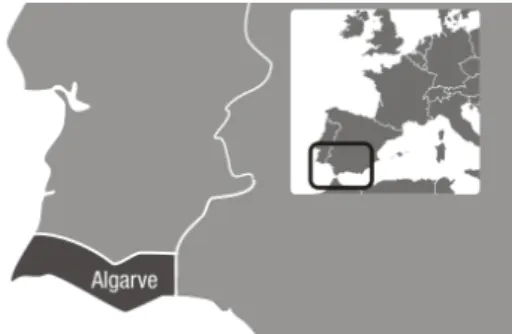
The Algarve is the most southern Portuguese region of mainland Portugal, bounded north and east by the regions of Alentejo and the Spanish Andalusia, specifically the province of Huelva (figure 1). The region comprises the district of Faro, the capital city, divided into sixteen districts, which represent about five percent of the Portuguese territory. The morphology gives the Algarve a peripheral nature, the region has surpassed the last thirty years with an enormous structural change. From one of the poorest and lowest standards of living in the country, mass emigration, economy based on agriculture, fisheries and traditional manufactures, the region has become a fastest growing region in terms of
8 population in Portugal. With four hundred and fifty thousand inhabitants the Algarve left the group of European structural funds 'convergence' regions, with the GDP lower than 75% of EU average in 2007-13. This status of the region in transitional assistance brought significant falls in financial support coming from the structural funds and an island effect compared to neighbouring regions that have maintained this status. The region is the Portuguese NUTS II, after to Lisbon, with the highest GDP per capita and purchasing power (Guerreiro, 2008). The Algarve's development reflects a dynamic tourism industry, boosted by Faro International Airport, encouraged by tourism related activities, construction or real estate.
Figure 1: Location of the Algarve
Source: Own Elaboration
However, over-specialization in tourism-related activities, in particular the "sun and beach," originated high opportunity costs of investing in other sectors, leading to reduction of regional economic base. The most relevant economic activities, in terms of employment and regional production, are accommodation, catering and construction. The economic activity transcends these sectors with activities such as agriculture and fisheries with significant value in the collective memory of the region. Tourism has gradually been diversifying its business in products such as golf or associated with nautical and cruise tourism. Other knowledge-based activities begin to emerge especially related to marine science pushed by the strong emphasis of the regional university and research units in this scientific area. The Algarve has increased heavily its capacity in this specific issue. It gained a very relevant capacity, even in international terms, in Marine Sciences. This scientific domain is in the genesis of the university where two important centres coexist. Today it represents a huge proportion of international research and is linked with other external R&D units. The scientific activity is connected often with regional needs and is the most significant area of advanced knowledge transfer in the Algarve. Economic activities based in Marine Sciences have a great potential to affirm the region as a competitive knowledge-based region.
The map below (figure 2) shows the geographical distribution of maritime activities. The coastline can be analysed with different infrastructures (ports a
related with coastal tourism. Even if the potential for coastal tourism is in all regional coastline territory it is concentrated in Lagos
marine research units are in Faro and Olhão, underl municipalities to structure this branch of the Sea cluster.
Figure 2: Distribution of Coastal Tourism and Marine Sciences in the Algarve.
In table 2 some relevant general statistics ca a glance about the region and underlines
slowdown in economic growth rates and specially a increase in unemployment rates in the last years. In parallel, it is worth mentioning that the
process of abandonment, desertification human, with problems of aging, very low income and limited access to facilities and community services, in contrast to the high density of occupation of the coast, where about two thirds of
percent of the territory.
igure 2) shows the geographical distribution of maritime activities. The coastline can be analysed with different infrastructures (ports and marines) and services related with coastal tourism. Even if the potential for coastal tourism is in all regional coastline territory it is concentrated in Lagos-Portimão, Albufeira and Loulé
marine research units are in Faro and Olhão, underlining the potential of these contiguous municipalities to structure this branch of the Sea cluster.
Distribution of Coastal Tourism and Marine Sciences in the Algarve. Source: Pinto et al (2011)
In table 2 some relevant general statistics can be found. The statistical information and underlines also the low resilience of the Algarve
slowdown in economic growth rates and specially a increase in unemployment rates in the In parallel, it is worth mentioning that the region countryside has undergone a process of abandonment, desertification human, with problems of aging, very low income and limited access to facilities and community services, in contrast to the high density of occupation of the coast, where about two thirds of population resides in about twenty
9 igure 2) shows the geographical distribution of maritime activities. The nd marines) and services related with coastal tourism. Even if the potential for coastal tourism is in all regional Portimão, Albufeira and Loulé-Olhão. All ining the potential of these contiguous
Distribution of Coastal Tourism and Marine Sciences in the Algarve.
The statistical information provides also the low resilience of the Algarve with a major slowdown in economic growth rates and specially a increase in unemployment rates in the untryside has undergone a process of abandonment, desertification human, with problems of aging, very low income and limited access to facilities and community services, in contrast to the high density of population resides in about twenty
10
Population 2010 458 (thousands)
GDP pc 2008 16,2 thousand euros
Unemployed 2008 (%) 7% (15 076)
Unemployed post-2009 (%) 13.6% (28 831)
Education Level of labour market - No Higher Education (%) 85,4
Higher Education (%) 14,6
High Skill Employees (%) 33,9
Low Skilled Employess (%) 66,1
Economic Performance of region over time 1960- 1970 64.2% (e) Economic Performance of region over time 1970-1980 58.8% (e) Economic Performance of region over time 1980-1990 102.2% (e) Economic Performance of region over time 1990-2000 31.8% (e) Economic Performance of region over time 2000-2010 21.8% (e)
Size of Region (sq. Mi) 1928,96 (4996 Km2)
Algarve’s economic contribution to the country? (%) 4,2 (2007)
Table 2: Statistical Profile of the Algarve [Unemployment data: rates from Instituto Nacional de Estatistica, Total amounts from Instituto de Emprego e Formação Profissional; Growth in
GDPpc, calculations based in INE data, current prizes); Source: Pinto et al (2011)
It is important to underline some figures to exemplify the weight of tourism in the region (table 3). Please note that several of these figures are estimates (e) and not real values. The Algarve is the Portuguese region at NUTS II with higher specialization in Maritime activities. Table 3 underlines the relevance of Maritime activities in the Algarve but shows that its contribution decreased with the relevance of other national coastal tourism activities, the fall of the local traditional fisheries sector and the recent difficulties of aquaculture production. Advanced maritime sectors have for now only a residual impact in the regional economy.
Crucial Sectors for the Algarve’s maritime economy consolidation Coastal Tourism, Maritime Services (including Research)
Other Relevant Maritime Sectors Fisheries including Aquaculture
Size of maritime economy in region 220 km (coastline)
Present economic value of maritime economy 3 019 M€ (e)
Economic value of marine economy - 2007 3 017 M€ (e)
People employed in marine economy of region - 2010 114 (thousand employees) (e)
How many people employed in marine economy of region circa 2007? 116 (thousand employees) (e)
Current contribution of maritime economy to regional economy 0,45% (e)
Contribution of maritime economy to regional economy - 2007 (%) 0,47% (e)
Current economic contribution of each sector (listed above) in marine economy to whole marine economy in region (%)
Coastal Tourism (85,4%) and Maritime Services including Research (>0,5%) (e)
Economic contribution of each sector (listed above) in marine economy to whole marine economy in region circa 2007(%)
Coastal Tourism (86,7%) and Maritime Services including Research (>0,3 %) (e)
What is the marine economy’s in the region economic contribution to the country?
~2,1 of national GDP (e)
Table 3: Maritime Cluster Analysis
11
4. Possibilities for Cluster Consolidation in the Algarve Maritime Activities
4.1. The Relevance of Social Network Analysis for Regional Science
In the context of the “Innovation Actors in the Algarve Sea Cluster” report for the project KIMERAA (Pinto et al, 2011) the marine sub-clusters of coastal tourism and maritime services (including research) were studied with attention. This first sub-sector is considered the central economic activity in the Algarve and the second is the one with greater economic potential in terms of knowledge production.
This analysis followed a qualitative approach based on semi-structured interviews with key actors within the Sea Cluster in the Algarve. These innovation actors were selected according the importance for the regional Sea cluster. The results of this Algarve’s qualitative analysis and a inter-regional comparison are discussed in detail elsewhere (Pinto et al, 2011; Cooke et al, 2011). From this qualitative study two important questions emerged repeatedly. The first regards the relevance of mutual learning and sharing knowledge in the cluster. Which organization is the main mediator to bridge science to market? The other issue is related with the notion that once the cluster did not emerged spontaneously and the latent potential in maritime activities remains largely unexplored the innovation actors agree in the need for a top-bottom approach. The idea that it is crucial to formalize the cluster in the form of an organization that could assume the pivotal role in the process of cluster formation is a common consensus. Who is the actor that is in a better position to assume a pivotal role in the formal consolidation of the cluster?
This paper will try to provide an answer to both questions using social network analysis (SNA). Social network analysis has emerged as a fertile field for the analysis of the involvement of regional actors and the inter-organizational linkages. In fact, there are already several authors (Wal and Boschma (2009), Cooke (2001), Fritsch and Monz (2010), among others) that support the need for this approach according to the importance that the interaction between actors and knowledge flows close on the analysis of regional development. In this sense, it is a useful analytical tool for mapping networks of relationships that the actors that constitutes the regional innovation systems and clusters have with each other’s (Cooke, 2001).
The article of Wal and Boschma (2009) is central to summarize the interest in applying a social network analysis in regional science. In the vision of these authors there are two
12 perspectives regarding the study of cluster networks: the first and most often employed, is the static perspective that seeks to describe the network at a specific moment in time; the second newest and least employed, is the dynamic perspective in which concepts such as
"preferential attachments" play a central role. This concept refers to the process by which the
growth of a network based on the probability of a new node connecting to another is proportional to the number of links it already has. This approach is very relevant when the interactions within a cluster are considered, since it shows that the central actors that constitute the network tend to become more and more central and peripheral tend the remain in the condition. Another aspect that emerges from the literature around the social
network analysis is what brings out the discussion around the opposition between "space of
places" and "space of flows” (Wal and Boschma, 2009). Thus, the centrality of geographical proximity is questioned giving more prominence to the idea that networks and their knowledge flows in a virtual understanding are important vehicles for the transfer and dissemination of knowledge. Therefore, questioning the thesis that knowledge networks are
tied to geographic location, Wal and Boschma claim that "(knowledge) networks are not
territorial but social constructs that may cross the boundaries of regions. Knowledge diffuses through social networks which can be denser among local agents, but may also span across the world”. (Wal and Boschma, 2009: 741) In fact, several authors mentioned that actors tend to concentrate near the source of knowledge, i.e., in the specific case, within the geographical boundaries of the cluster.
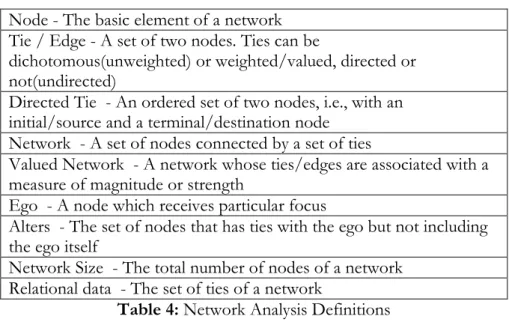
Social network analysis is an interdisciplinary methodology that had a rapid development of formal analyzing techniques based on an assumption of the importance of relationships among interacting units or nodes. As summarized by Coulon (2005) networks which are only made of one type of nodes are homogeneous, otherwise they are heterogeneous. Ties connect pairs of nodes and can be directed (i.e., potentially one-directional) or undirected (as in being physically proximate), can be dichotomous (present or absent) or weighted (measured on a scale of intensity). When network analysts collect data on ties from a set of nodes, they call it relational data. Relational data can be visualised in matrix form or in graphic form.
13 Node - The basic element of a network
Tie / Edge - A set of two nodes. Ties can be
dichotomous(unweighted) or weighted/valued, directed or not(undirected)
Directed Tie - An ordered set of two nodes, i.e., with an initial/source and a terminal/destination node
Network - A set of nodes connected by a set of ties
Valued Network - A network whose ties/edges are associated with a measure of magnitude or strength
Ego - A node which receives particular focus
Alters - The set of nodes that has ties with the ego but not including the ego itself
Network Size - The total number of nodes of a network Relational data - The set of ties of a network
Table 4: Network Analysis Definitions
Source: Coulon (2005)
Four central concepts used in network analysis that can be grouped under several measures are network density, centrality, betweenness and centralization.
Network Density
Density is a measure of the connectedness of the network. It is defined as the actual number of ties in a network, expressed as a proportion of the maximum possible number of ties. It is a number that varies between 0 and 1. When density is close to unity, the network is said to be dense. The measure of density is sensible to the number of nodes, so it cannot be used for comparisons between networks different in size.
Centrality: local and global
Centrality encompasses two levels: local and global. A node is central (locally) when it has the higher number of ties with other nodes. Local centrality only considers direct ties (the ties directly connected to that node) whereas global centrality also considers indirect ties (which are not directly connected to that node). Local centrality measures are expressed in terms of the number of nodes to which a node is connected, global centrality is expressed in terms of the distances among the various nodes. Local and global centrality also depend on, among other things, the size of the network, and therefore they cannot be compared when networks differ significantly in size. Relative measures of centrality have been developed to solve this problem.
Betweenness
Betweenness explores the concept of centrality measuring the extent that a specific node lies “between” the other nodes in the network. A node with few ties may play an important intermediary role and so be very central to the network. The betweenness of a node measures the extent to which an agent plays the role of a broker or gatekeeper with a potential for control over others. The same concept is often described by the notion of “structural holes”. A structural hole exists where two nodes are connected at distance. Methodologically, betweenness is the most complex to calculate of the measures of centrality and suffers from the same disadvantages.
Centralization
Centralization measures provide information on the extent the network has a centralized structure. It describes the degree to which connectedness is organized around particular focal nodes. Centralization and density are important complementary measures.
Table 5: Central Concepts in SNA
14 Additionally, as referred in the review of Coulon, there are four measures of network performance: robustness, efficiency, effectiveness and diversity. Network’s performance can be understood as a combination of the robustness to the removal of ties and nodes, the efficiency in terms of the distance to navigate from one node to another and its non-redundant size, the effectiveness of information benefits allocated to central nodes, and the diversity of the history of each of the nodes.
Robustness
Social network analysts have highlighted the importance of network structure in discussion of network’s robustness. Robustness can be evaluated by studying how a network becomes fragmented when a fraction of nodes is removed. Robustness is measured by an estimate of the tendency of individuals in networks to form local groups or clusters of individuals with whom they share similar characteristics. When the measure of the clustering of individuals is high for a given network, the robustness of that network increase.
Efficiency
Efficient networks are those in which nodes can access instantly a large number of different nodes through a relatively small number of ties. Given two networks of equal size, the one with more non-redundant contacts provides more benefits. There is little gain from a new contact redundant with existing contacts. Social network analysts measure efficiency by the number of non-redundant contacts and the average number of ties an node has to traverse to reach any alter, this number is referred to as the average path length. The shorter the average path length relative to the size of the network and the lower the number of redundant contacts and the more efficient is the network.
Effectiveness
While efficiency targets the reduction of the time and energy spent on redundant contacts, effectiveness targets the cluster of nodes that can be reached through non-redundant contacts. Each cluster of contacts is an independent source of information. One cluster around a non-redundant node, no matter how numerous its members are, is only one source of information, because individuals directly connected tend to have similar knowledge at a given period. A network is more effective when the information benefits provided by multiple clusters of contacts are broader. Because non-redundant contacts are only connected through the central node, the central node is assured of being the first to see new opportunities created by needs in one group that could be served by skills in another group.
Diversity
While efficiency is about reaching a large number of (non-redundant) nodes, node’s diversity, not to be confused with network heterogeneity introduced previously, suggests that it is critical from a performance point of view that those nodes are diverse in nature, i.e., the history of each individual node within the network is important. It is particularly this aspect that can be explored through case studies (Yin, 2003).
Table 6: Central Concepts for Network Performance
15
4.2. Searching the Core of the Maritime Cluster in the Algarve
This research tries to answer two questions which became prominent during the interviews with regional actors.
1. Who is the actor that is in a better position to assume a pivotal role in the formal
consolidation of the cluster?
2. Which organization is the main mediator to bridge science to market?
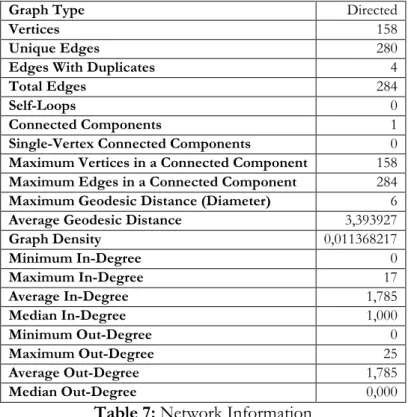
The forty five semi-structured interviews conducted to Algarve maritime cluster actors facilitate a social network analysis. Actors interviewed were companies, development agencies, public regional authorities, university departments, research units and intermediary organizations. Complete information and additional details about the interviews can be found at Pinto et al (2011). In the interviews respondents were asked to refer in detail the organizations that they were linked and cooperating in the context of maritime activities. From the transcriptions and audio records it was possible to systematize the relations in the maritime activities. We have found 154 nodes that represent organizations that were referred. The software used was the NodeXL Version 1.0.1.160. In table 7 additional information and statistics of the network are presented.
Graph Type Directed
Vertices 158
Unique Edges 280
Edges With Duplicates 4
Total Edges 284
Self-Loops 0
Connected Components 1
Single-Vertex Connected Components 0
Maximum Vertices in a Connected Component 158
Maximum Edges in a Connected Component 284
Maximum Geodesic Distance (Diameter) 6
Average Geodesic Distance 3,393927
Graph Density 0,011368217 Minimum In-Degree 0 Maximum In-Degree 17 Average In-Degree 1,785 Median In-Degree 1,000 Minimum Out-Degree 0 Maximum Out-Degree 25 Average Out-Degree 1,785 Median Out-Degree 0,000
Table 7: Network Information
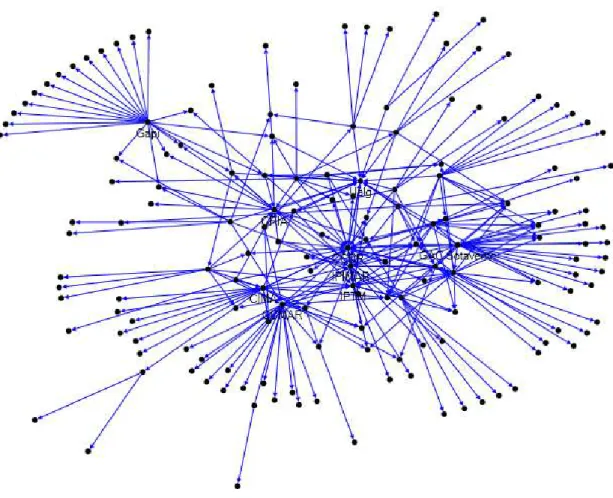
16 From this analysis possible answers to our questions were found. In Figure 1 it is possible to observe that there is a set of very connected actors of which the Commission for Coordination and Regional Development of the Algarve (CCDR) is the most central. The CCDR is the regional authority, responsible for developing and implementing regional strategies in the Algarve. It is also the manager of the European structural funds allocated to the region, in particular the Operational Programme Algarve 21 that regards the European Regional Development Fund financial support. This graphical evidence confirms the notion that the research team had from the interviews where the institutional relevance of this actor was pointed out as the one who was in best position to assume a pivotal role in consolidating the Sea Cluster in the Algarve.
Figure 3: Algarve Sea Cluster Network
Source: Own Elaboration with Haren-Korel Fast Multiscale representation in Node XL
Linking companies and science is a crucial aspect of regional development and for the emergence of competitive and innovative clusters. The graphical representation underlines that is CRIA, the Technology transfer and Entrepreneurship Division of the University of
17 Algarve that assumes, for now, the most relevant role mediator between companies and research units in the region.
5. Some Concluding Remarks
The valorisation of the Portuguese maritime resources has been increasing. Affirming the National Strategy for the Sea is a possibility for regional actors to organize themselves around the sustainable development of maritime economy. The Maritime Cluster was being formalized at national level with an initiative from North and Centro regions with the support of COMPETE Operational Programme Efficiency collective actions.
The Algarve has been trying to benefit from the marine resources and maritime potential to overcome limitations and constraints that the region faces in development. Therefore, the consolidation of a Algarve Maritime Cluster is central for the region be able to diversify the tourism supply give to more traditional activities new life and by making worthy the knowledge available in the region around the Marine Sciences. The regional actors, pushed by the CCDR, are debating the possibility to integrate this “Knowledge Economy and Sea Cluster”. For now it is important to grant the institutional support of regional actors. In a posterior phase is crucial to include private agents and its necessary to create an entity, in the format of a non-profit private association, which is supposed to be the operational unit of the cluster. This association can be the engine for sharing information and cooperating. In a period where the regional actors are being stimulated to formalize the cluster association, this research confirms that is CCDR that is in the adequate position to assume a pivotal role in the process for a formal consolidation of the cluster. The University also plays a central role that should be specially taken into account for the mediation and bridging scientific knowledge to market.
This research underlines the interest of social network analysis in dealing with regional aspects of development and cluster formation. This approach is illustrative of the explicative potential of network concepts in regional dynamics. The tools of SNA are in development and better measures and richer interpretation of results are still required. In this research we have found and additional limitation of understanding what is a node in real world. In theory, thinking in each organization as a node is sufficiently adequate but in practice sometimes it is not the best solution to map the diversity, heterogeneity and relevance of a specific actor. A clear example of this situation in the current article is the case of the University of Algarve. We found more adequate to take into account in the
18 analysis different UAlg’s departments, faculty, schools, research units, and other entities. Taking the university as a whole biases the analysis creating in our opinion an excessive importance of the university. In fact the higher organization institution is itself a group of nodes with a significant dimension in the region that the analysis should not eliminate. To conclude, the participation of the Algarve region in the national cluster is important to grant regional stakeholders an increased possibility for cooperation and benefiting from cluster economies. But a worrying note should be still underlined. Several important organizations, public and private, were not engaged in the clustering process and had felt the process as being not of their preoccupation. This is a issue that deserves attention to guarantee that the maritime cluster can flourish in the region.
Acknowledgements
The authors acknowledge the financial support of the European Atlantic Area project KIMERAA – Knowledge Transfer to Improve Marine Economy in Regions from the Atlantic Area (co-financed by ERDF) for this research.
References
CCDR Algarve (2006): Estratégia de Desenvolvimento do Algarve 2007- 2013, Comissão de Coordenação e Desenvolvimento do Algarve, Faro.
CCDR Algarve (2007): Plano Regional de Ordenamento do Território do Algarve – PROTAlgarve, Comissão de Coordenação e Desenvolvimento do Algarve, Faro.
CCDR Algarve (2008): Agenda Regional do Mar Algarve. Contributos para o Plano de Acção para o Cluster Mar Algarve, Comissão de Coordenação e Desenvolvimento Regional do Algarve, Faro.
CHANG, Y.C. (2011) Maritime Clusters: What can be learnt from the South West of England, Ocean & Coastal Management, 54, pp 488-494.
COULON, F. (2005): The use of Social Network Analysis in Innovation Research: A literature review, Division of Innovation – LTH, Lund University: Sweden
COOKE, P. (2001): Regional Innovation Systems, Clusters, and the Knowledge Economy, Industrial and Corporate Change, Vol. 10, Number 4, Oxford University Press, Oxford.
19 COOKE, P. , PORTER J, CRUZ, A.R, PINTO, H., (2011): Maritime Clusters: Institutions
and Innovation Actors in the Atlantic Area, University of Algarve: Faro.
DOLOREUX, D., SHEARMUR, R. (2009): Maritime Clusters in diverse regional contexts: The case of Canada, Marine Policy, 33, pp. 520-527.
FRITSCH, M., MONZ, M. (2010): The impact of network structure on knowledge transfer: an application of social network analysis in the context of regional innovation networks, Annual Regional Science, 44, pp. 21-38
GUERREIRO, J. (coord.) (2007): Plano Regional de Inovação do Algarve, Universidade do Algarve: Faro.
GUERREIRO, J. (coord.) (2008): Caracterização da Estrutura Económica do Algarve, NERA: Loulé.
LOPES, E. (coord.) (2009): O Hypercluster da Economia do Mar, SaeR/ACL: Lisboa. PORTER, M. (2003): The Economic Performance of Regions, Regional Studies, Vol. 37:
549-578.
PINTO, H., CRUZ, A.R., GONÇALVES, A., IMAGINÁRIO, S., (2011) Innovation Actors in the Algarve Sea Cluster, Project KIMERAA, Report, University of Algarve. SCOTT, J. (2000): Social Network Analysis. A Handbook. Sage: London.
TORRE, A., RALLET, A., (2005): Proximity and Localization, Regional Studies, 39, pp. 47-59.
Turismo de Portugal (2007): Plano Estratégico Nacional do Turismo, Turismo de Portugal, Lisboa.
YIN, R.K., (2003): Case Study Research, Sage: London.
WALL, A., Boschma, R., (2009): Applying social network analysis in economic geography: framing some key analytic issues, The Annals of Regional Science, 43(3), pp. 739-756.