http://dx.doi.org/10.4236/mme.2016.62006
How to cite this paper: Onuoha, O.J., Abu, J.O., Lawal, S.A., Mudiare, E. and Adeyemi, M.B. (2016) Determining the Effect of Cutting Fluids on Surface Roughness in Turning AISI 1330 Alloy Steel Using Taguchi Method. Modern Mechanical Engi-neering, 6, 51-59. http://dx.doi.org/10.4236/mme.2016.62006
Determining the Effect of Cutting Fluids on
Surface Roughness in Turning AISI 1330
Alloy Steel Using Taguchi Method
Onyemachi Joachim Onuoha, James Oseni Abu, Sunday Albert Lawal
*, Edeki Mudiare,
Michael Bolaji Adeyemi
Department of Mechanical Engineering, School of Engineering and Engineering Technology, Federal University of Technology, Minna, Nigeria
Received 2 March 2016; accepted 1 May 2016; published 5 May 2016
Copyright © 2016 by authors and Scientific Research Publishing Inc.
This work is licensed under the Creative Commons Attribution International License (CC BY).
http://creativecommons.org/licenses/by/4.0/
Abstract
Taguchi method has been employed to investigate the effects of cutting fluids on surface rough-ness in turning AISI 1330 alloy steel, using manually operated lathe machine. Experiments have been conducted using L27 (34) orthogonal array and each experiment was repeated three times
and each test used a new cutting tool, High Speed Steel (HSS), to ensure accurate readings of the surface roughness. The statistical methods of Signal-to-Noise (S/N) ratio and the Analysis of Va-riance (ANOVA) were applied to investigate effects of cutting speed, feed rate and depth of cut on surface roughness under different cutting fluids. Minitab 14 software was used to analyze the ef-fect of variables on the surface roughness. Results obtained indicated that optimal variables for the minimum surface roughness were cutting speed of 35 m/min (level 2), feed of 0.124 mm/rev (level 1), depth of cut of 0.3 mm (level 1) and a cutting fluid with a viscosity of 2.898 mm2/s (level
3). Hence, the optimal parameters to obtain better surface roughness of the workpiece material were obtained when groundnut oil based cutting fluid was used. Analysis of variance shows that feed rate has the most significant effect on surface roughness.
Keywords
Taguchi Method, Surface Roughness, Turning Process, Cutting Fluid
1. Introduction
Machining processes result in the generation of enormous heat due to the friction between the cutting tool and
the workpiece material, and between the tool face and the chips gliding over it [1]. This, to a great extent, affects the tool life and the surface integrity of machined products. To minimize the effect of friction and the resultant heat on tool life, and the consequent effect on the integrity of the machined surface, cutting fluid is used as a means of conducting heat from the cutting zone [2]. Vegetable oil-based emulsions are also a part of recent re-search to produce stable emulsions to use as metalworking fluids and in other applications [3]. A comprehensive review of the application of vegetable oil-based metalworking fluids in machining ferrous metals by Lawal et al. [4] shows that a better performance can be achieved during machining processes using vegetable oil-based me-talworking fluid. Vegetable oil-based cutting fluids are environmentally friendly, renewable, less toxic and eco-nomical in the reduction of the waste treatment costs due to their inherently higher biodegradability [5]. Ma-chining industry concerned with the development of preventive legislation and the increased interest in almost green products reduces the soil pollution by biodegradability which makes the manufacturing processes a clean process [6]. Vegetable oil-based cutting fluids seem to be the best alternatives to mineral oil based cutting fluids due to certain inherent chemical properties and their biodegradability ability. The better performance of vegeta-ble oil-based cutting fluids can be traced to its high flash point, high viscosity index, high lubricity and low evaporative loss compared to mineral oils [7]. Poor oxidative and hydrolytic stability, high temperature sensitiv-ity of tribological behaviour and poor cold flow properties are the limitations of vegetable oils for lubricants [8]. However, these shortcomings in the vegetable oils can be addressed with addition of chemical additives such as emulsifier, corrosion prevention, pH regulator, binding, anti-foaming, odour prevention, flash point improver, spreading and wetting to improve its functions as lubricant.
Jacob et al. [9] developed a vegetable-based emulsion that can be used in the metal working industry, to re-place partially or completely the commonly used petroleum based emulsions. Lawal et al. [10] evaluated the ef-fect of vegetable and mineral oil-in-water emulsion cutting fluids in turning AISI 4340 steel with coated carbide tools on the surface roughness and cutting force. The study involved the selection of cutting fluid additives for the formulation of oil-in-water emulsion, using palm kernel and cottonseed oils. Similarly, Xavior and Adithan [11] studied the influence of cutting fluids on tool wear and surface roughness during turning of AISI 304 auste-nitic stainless steel. They identified the influence of coconut oil in reducing the tool wear and surface roughness during turning processes. Ojolo et al. [12] studied the effect of some straight biological oils (groundnut oil, co-conut oil, palm kernel oil and shear butter oil) on cutting force when turning with round bars of three selected materials (mild steel, copper and aluminium) using tungsten carbide tool. The results obtained showed that bio- oils were suitable for metalworking fluids and that the effects of the bio-oils on cutting force, however, were material dependent. Belluco and De Chiffre [13] investigated the effects of new formulations of vegetable oils on surface integrity, part accuracy in reaming and tapping operations with AISI 316L stainless steel. Cutting fluid was found to have a significant effect on surface integrity and thickness of the strain hardened layer in the sub-surface, as well as part accuracy. Cutting fluids based on vegetable oils showed better performance than mineral oils. Cydas [14] studied the effect of dry cutting on surface roughness, tool flank wear and temperature during turning of AISI 4340 steel with ceramic tools. Suresh et al. [15] examined the effect of dry cutting on surface roughness, tool wear, cutting force, machine power during machining of AISI 4340 steel with cemented carbide tools. Dhar et al. [16] evaluated tool wear and surface roughness under dry, wet (conventional) and MQL during turning of AISI 4340 steel with coated carbide tools. There are other studies on machining of AISI 4340 steel under dry cutting, however, only Avila and Abrao’s [17] work investigated the effect of emulsion without mineral oil, emulsion synthetic, emulsion with mineral oil on tool wear, tool life, surface roughness and chip formation during turning of AISI 4340 steel with alumina tools. In this study, the effects of false walnut and groundnut oils based cutting fluids and commercial cutting fluid on surface roughness during turning of AISI 1330 alloy steel using high speed steel tool were investigated.
2. Materials and Method
2.1. Materials
2.1.1. Cutting Fluidswere used:
1) emulsifier (polyoxyethylene sorbitan monostrate or Tween-80). 2) antioxidant (butylated hydroxytoluene-BHT).
3) corrosion Inhibitor (banana sap obtained from banana stem–musa acuminate plant [18]. 4) biocide (triazine) and distilled water (laboratory made).
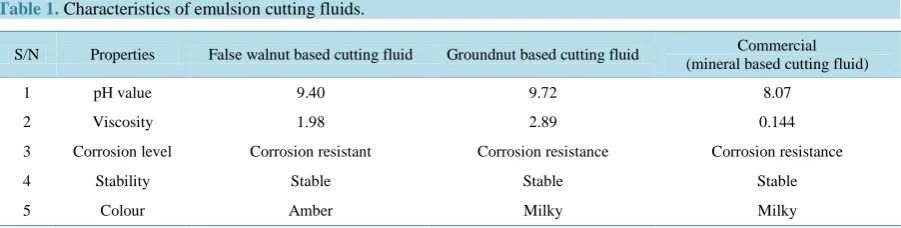
Table 1 shows the characteristics of the formulated emulsion cutting fluids from false walnut and groundnut oils, and commercial cutting fluid (UNICUT Soluble Oil, NKO 287E716K).
2.1.2. Workpiece
An annealed AISI 1330 alloy steel workpiece material of 45 mm diameter and ×500 mm long sourced from Ajaokuta Steel Company, Ajaokuta-Nigeria was used in this study. The elemental analysis of the material was determined at the National Metallurgical Development Centre, Jos, Nigeria. The hardness value of the material is 30.1 HRC with the following composition percentages by weight: C (0.296), Si (0.461), Mn (1.230), Cr (0.060), Ni (0.022), Cu (0.080), W (0.011), P (0.040), S (0.023) and Fe (97.70).
2.1.3. Cutting Tool
High speed steel (HSS), AISI M-42 type with the following geometry: nose radius of 0.5 mm, back rake angle of 6˚, side rake of 10˚, end cutting edge of 12˚ and side cutting edge of 12˚. was used in this study
2.2. Method
2.2.1. Experimental Design
Taguchi method is an experimental design technique which is useful in reducing the number of experiments dramatically, by using orthogonal arrays to minimize the effects of the factors from being out of control. The basic philosophy of the Taguchi method is to ensure quality in the design phase. The greatest advantages of the Taguchi method are to decrease the experimental time, to reduce the cost and to find out significant factors in a shorter time period [19]. The most reliable of Taguchi’s techniques is the use of parameter design, which is an engineering method for product or process design. It focuses on determining the parameter settings producing the best levels of a quality characteristic with minimum variation. The most important stage in the design of an experiment lies in the selection of control factors. As many factors as possible should be included in order to make possible to identify non-significant variables at the earliest opportunity [20] [21]. Taguchi creates a stan-dard orthogonal array to accommodate this requirement. Taguchi used the signal-to-noise (S/N) ratio as the quality characteristic of choice. Signal to noise ratio is used as a measurable value, instead of standard deviation, because as the mean decreases, the standard deviation, also decreases and vice versa [20]-[22]. The S/N ratio characteristics can be divided into three categories, given as nominal is the best characteristic, smaller is the better characteristic and larger is the better characteristic. In this study, experimental set up was based on design of experiment (DOE) via Taguchi method, and four variables namely; cutting speed, feed rate, depth of cut and cutting fluids. These were considered for experimentation. Hence, there were four input parameter and for each parameters, three levels were assumed as shown in Table 2. For a four-factor-three-level experiment, Taguchi specified L27 (34) orthogonal array for experimentation. The confidence level specified for the analysis is 95%.
2.2.2. Turning Conditions
[image:3.595.88.539.608.722.2]The machining experiment involved the turning of the workpiece on a manually operated POTISJE PA 25 centre
Table 1. Characteristics of emulsion cutting fluids.
S/N Properties False walnut based cutting fluid Groundnut based cutting fluid Commercial (mineral based cutting fluid)
1 pH value 9.40 9.72 8.07
2 Viscosity 1.98 2.89 0.144
3 Corrosion level Corrosion resistant Corrosion resistance Corrosion resistance
4 Stability Stable Stable Stable
Table 2. Machining parameters and their levels.
Factor Unit Level 1 Level 2 Level 3
Cutting speed m/min 28 35 42
Feed rate mm/rev 0.124 0.178 0.249
Depth of cut mm 0.3 0.6 0.9
Viscosity of cutting fluids mm2/s 1.986 2.898 0.144
lathe, using a HSS cutting tool. In each experimental run, a fresh cutting tool was used for a fixed cutting time of 20 minutes. The cutting fluid was applied using conventional (flood) method. Surface roughness was chosen as an output parameter for evaluation, using the two vegetable oil-based cutting fluids and mineral oil- based cut-ting fluid. A portable surface roughness tester, model number CRV 135 used to measure the surface roughness (Ra) of the workpiece material after each experimental run. The surface roughness, (Ra), was taken using the surface roughness tester at three points on the workpiece. The average of three readings taken per sample were used for the analysis of the corresponding signal-to-noise (S/N) ratio, and the smaller the better the characteris-tics as represented in Equation (1) was used for the analysis.
(
2)
1 10 log yi
n
η= −
∑
(1)where η is the S/N ratio for “the smaller-the-better” case, yi is the measured quality characteristic for the ith repe-tition and n is the number of repetitions in a trial.
3. Results and Discussion
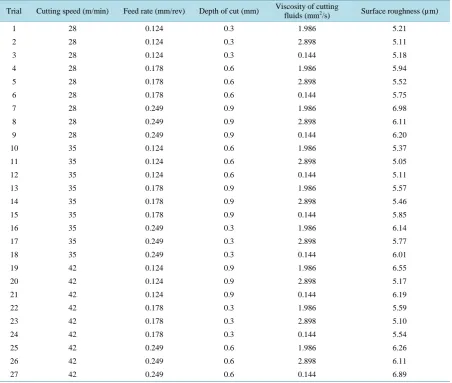
The input factors and the response obtained from the experiments are shown in Table 3. The results of the expe-riments were subjected to the signal-to-noise (S/N) ratio and analysis of variance (ANOVA) to determine the optimum and significant factors that affect the surface roughness in this study.
3.1. Signal-to-Noise (S/N) Ratio Analysis
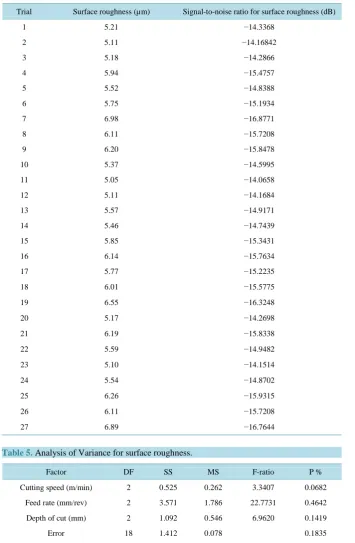
Table 4 shows the corresponding S/N (dB) ratio for the surface roughness. Since the smaller-the-better-value of the response is desirable, the performances of the three cutting fluids were analyzed using Taguchi optimization process. This is based on the principle of static problems of “smaller-the-better” characteristic (S/N) ratio for the surface roughness. For ease of computing and analyzing the ratios, statistical analysis software (Minitab-14), widely used in engineering applications was used to investigate the optimal parameters for the surface rough-ness.
The main effect plots for the surface roughness obtained from S/N ratio values of the machining parameters at different levels are shown in Figure 1. The plots indicated that the optimal machining parameters for the mini-mum surface roughness were obtained at cutting speed of 35 m/min (level 2), feed rate of 0.124 mm/rev (level 1), depth of cut of 0.3 mm (level 1) and a cutting fluid with a viscosity of 2.898 mm2/s (level 3). Hence, the op-timal parameters to obtain better surface finish of the workpiece were obtained when groundnut oil based cutting fluid was used. This may be as a result of the higher viscosity of the groundnut oil based cutting fluid.
3.2. Analysis of Variance for Surface Roughness
MAIN EFFECTS PLOT FOR SURFACE ROUGHNESS S/N RATIOS
Figure 1. Main effects plot for surface roughness S/N ratios.
Table 3. Experimental data obtained from machining of AISI 1330 Alloy steel.
Trial Cutting speed (m/min) Feed rate (mm/rev) Depth of cut (mm) Viscosity of cutting fluids (mm2/s) Surface roughness (µm)
1 28 0.124 0.3 1.986 5.21
2 28 0.124 0.3 2.898 5.11
3 28 0.124 0.3 0.144 5.18
4 28 0.178 0.6 1.986 5.94
5 28 0.178 0.6 2.898 5.52
6 28 0.178 0.6 0.144 5.75
7 28 0.249 0.9 1.986 6.98
8 28 0.249 0.9 2.898 6.11
9 28 0.249 0.9 0.144 6.20
10 35 0.124 0.6 1.986 5.37
11 35 0.124 0.6 2.898 5.05
12 35 0.124 0.6 0.144 5.11
13 35 0.178 0.9 1.986 5.57
14 35 0.178 0.9 2.898 5.46
15 35 0.178 0.9 0.144 5.85
16 35 0.249 0.3 1.986 6.14
17 35 0.249 0.3 2.898 5.77
18 35 0.249 0.3 0.144 6.01
19 42 0.124 0.9 1.986 6.55
20 42 0.124 0.9 2.898 5.17
21 42 0.124 0.9 0.144 6.19
22 42 0.178 0.3 1.986 5.59
23 42 0.178 0.3 2.898 5.10
24 42 0.178 0.3 0.144 5.54
25 42 0.249 0.6 1.986 6.26
26 42 0.249 0.6 2.898 6.11
Table 4. Signal-to-noise ratio values for the responses.
Trial Surface roughness (µm) Signal-to-noise ratio for surface roughness (dB)
1 5.21 −14.3368
2 5.11 −14.16842
3 5.18 −14.2866
4 5.94 −15.4757
5 5.52 −14.8388
6 5.75 −15.1934
7 6.98 −16.8771
8 6.11 −15.7208
9 6.20 −15.8478
10 5.37 −14.5995
11 5.05 −14.0658
12 5.11 −14.1684
13 5.57 −14.9171
14 5.46 −14.7439
15 5.85 −15.3431
16 6.14 −15.7634
17 5.77 −15.2235
18 6.01 −15.5775
19 6.55 −16.3248
20 5.17 −14.2698
21 6.19 −15.8338
22 5.59 −14.9482
23 5.10 −14.1514
24 5.54 −14.8702
25 6.26 −15.9315
26 6.11 −15.7208
[image:6.595.141.497.98.642.2]27 6.89 −16.7644
Table 5. Analysis of Variance for surface roughness.
Factor DF SS MS F-ratio P %
Cutting speed (m/min) 2 0.525 0.262 3.3407 0.0682
Feed rate (mm/rev) 2 3.571 1.786 22.7731 0.4642
Depth of cut (mm) 2 1.092 0.546 6.9620 0.1419
Error 18 1.412 0.078 0.1835
Total 26 7.694
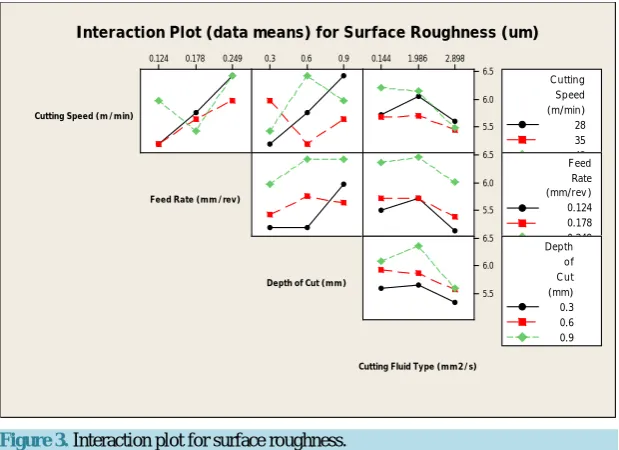
3.3. Contour and Interation Plots of Surface Roughness
Contour Plot of Surface Roughness (µm) vs Cutting Speed (m/min) and Feed (mm/rev)
Figure 2. Contour plot of Surface roughness versus cutting speed and feed.
Cutting Speed (m/min)
Depth of Cut (mm)
Cutting Fluid Type (mm2/s) Feed Rate (mm/rev)
0.249 0.178
0.124 0.3 0.6 0.9 0.144 1.986 2.898
6.5
6.0
5.5
6.5
6.0
5.5
6.5
6.0
5.5
Cutting
42 Speed (m/min) 28 35
Feed
0.249 Rate (mm/rev) 0.124 0.178
Depth
0.6 0.9 of Cut (mm) 0.3
[image:7.595.158.468.326.551.2]Interaction Plot (data means) for Surface Roughness (um)
Figure 3. Interaction plot for surface roughness.
increase in cutting speed from 30 m/min to 32.5 m/min had little or no effect on the surface roughness.
In Figure 3, there are interactions between the three cutting speeds and the three feed rates. The cutting speed of 28 m/min interacted with cutting speed of 35 m/min at the feed rate of 0.124 mm/rev, and with the cutting speed of 42 m/min at feed rates of 0.16 and 0.249 mm/rev respectively. On the other hand, the cutting speeds of 35 and 42 m/min interacted at feed rates of 0.165 and 0.185 mm/rev respectively. In the same vein, there is inte-raction between cutting speed and depth of cut. It is observed that the cutting speed of 28 m/min interacted with that of 35 and 42 m/min, at depths of cuts of 0.5 and 0.8 mm respectively
interact with any other parameters. For feed rate and cutting fluid types, only the feed rates of 0.124 and 0.178 mm/rev interacted at cutting fluid viscosity of 1.986 mm2/s. The feed rate of 0.249 mm/rev did not interact with any other feed rate. It was observed that only the depth of cuts of 0.6 and 0.9 mm interacted at the cutting fluid viscosity of 2.898 mm2/s. The depth of cut of 0.3 mm did not interact with any other depth of cut.
4. Conclusion
Experiments involving high speed steel tools and AISI 1330 alloy steel under varying machining conditions and cutting fluids were conducted. These were done using L27 (34) orthogonal array and each experiment was re-peated three times. Each test used a new cutting tool to ensure accurate readings of the surface roughness. Expe-rimental results were analyzed using signal-to-noise ratio and ANOVA. Results showed optimal machining pa-rameters for obtaining minimum surface roughness at cutting speed of 35 m/min (level 2), feed of 0.124 mm/rev (level 1), depth of cut of 0.3 mm (level 1) and a cutting fluid with a viscosity of 2.898 mm2/s (level 3). Analysis of variance shows that feed rate (46.42%) has the significant influence on surface roughness, followed by the type of cutting fluid, in this case groundnut oil based cutting fluid with 14.22% significant.
References
[1] Abu, J.O. (2011) Manufacturing Engineering and Production Management. Aboki Publishers, Makurdi, 275-287.
[2] Abu, J.O. (2011) Manufacturing Engineering and Production Management. Aboki Publishers, Makurdi, 289-291. [3] Alander, J. and Warnhein, T. (1989) Model Microemulsions Containing Vegetable-Oils 1, NONIONIC Surfactanct
systems. Journal of the American Oil Chemists Society, 66, 1656-1660. http://dx.doi.org/10.1007/BF02636197
[4] Lawal, S.A., Choudhury I.A. and Nukman, Y. (2012) Application of Vegetable Oil-Based Cutting Fluids in Machining Ferrous Metals—A Review. International Journal of Machine Tools & Manufacturing, 52, 1-12.
http://dx.doi.org/10.1016/j.ijmachtools.2011.09.003
[5] Cetin, M.H., Ozcelik, B., Kuram, E. and Demirbas, E. (2011) Evaluation of Vegetable Based Cutting Fluids with Ex-treme Pressure and Cutting Parameters in Turning of AISI 304L by Taguchi Method. Journal of Cleaner Production,
19, 2049-2056. http://dx.doi.org/10.1016/j.jclepro.2011.07.013
[6] Alves, S.M. and Oliveira, J.F.G. (2006) Development of New Cutting Fluid for Grinding Process Adjusting Mechani-cal Performance and Environmental Impact. Journal of Materials Processing Technology, 179, 185-189.
http://dx.doi.org/10.1016/j.jmatprotec.2006.03.090
[7] Adhvaryu, A. and Erhan, S.Z. (2002) Epoxidized Soybean Oil as a Potential Source of High Temperature Lubricants. Industrial Crops Production, 15, 247-254. http://dx.doi.org/10.1016/S0926-6690(01)00120-0
[8] Erhan, S.Z. and Asadauskas, S. (2000) Lubricant Base Stocks from Vegetable oils. Industrial Crops Production, 11, 277-282. http://dx.doi.org/10.1016/S0926-6690(99)00061-8
[9] Jacob, J., Bhattacharya, M. and Raynor, P.C. (2004) Emulsions Containing Vegetable Oils for Cutting Fluid Applica-tion. Colloids and surface A: Physiochemical Engineering Aspects, 237, 141-150.
http://dx.doi.org/10.1016/j.colsurfa.2003.12.029
[10] Lawal, S.A., Choudhury I.A. and Nukman, Y. (2014) Evaluation of Vegetable and Mineral Oil-in-Water Emulsion Cutting Fluids in Turning AISI 4340 Steel with Coated Carbide Tools. Journal of Cleaner Production, 66, 610-618.
http://dx.doi.org/10.1016/j.jclepro.2013.11.066
[11] Xavior, M.A. and Adithan, M. (2009) Determining the Influence of Cutting Fluids on Tool Wear and Surface Rough-ness during Turning of AISI 304 Austentic Stainless Steel. Journal of Material Processing Technology, 20, 900-909.
http://dx.doi.org/10.1016/j.jmatprotec.2008.02.068
[12] Ojolo, S.J., Amuda, M.O.H., Ogunmola, O.Y. and Ononiwu, C.U. (2008) Experimental Determination of the Effect of Some Straight Biological Oils on Cutting Force during Cylindrical Turning. Matérial, 13, 650-663.
http://dx.doi.org/10.1590/s1517-70762008000400011
[13] Belluco, W. and De Chiffre, L. (2004) Performance Evaluation of Vegetable-Based Oils in Drilling Austenitic Stain-less Steel. Journal of Material Processing Technology, 148, 171-176.
http://dx.doi.org/10.1016/S0924-0136(03)00679-4
[14] Cydas, U. (2010) Machinability Evaluation in Hard Turning of AISI 4340 Steel with Different Cutting Tools Using Statistical Technique. Proceeding of Institution of Mechanical Engineering Part B: Journal of Engineering Manufac-ture, 224, 1043-1055. http://dx.doi.org/10.1243/09544054JEM1822
[16] Dhar, N.R., Kamruzzaman, M. and Ahmed, M. (2006) Effect of Minimum Quantity Lubrication (MQL) on Tool Wear and Surface Roughness in Turning AISI 4340 Steel. Journal of Materials Processing Technology, 172, 299-304.
http://dx.doi.org/10.1016/j.jmatprotec.2005.09.022
[17] Avila, R.F. and Abrao, A.M. (2001) The Effect of Cutting Fluids on the Machining of Hardened AISI 4340 Steel. Journal of Material Processing Technology, 119, 21-26. http://dx.doi.org/10.1016/S0924-0136(01)00891-3
[18] El-Sayed, M., Mansour, O.Y., Selim, I.Z. and Ibrahim, M.M. (2001) Identification and Utilization of Banana Plant Juice and Its Pulping Liquor as Anti-Corrosive Materials. Journal of Scientific & Industrial Research, 60, 738-747. [19] Sanyılmaz, M. (2006) Design of Experiment and an Application for Taguchi Method in Quality Improvement Activity.
M.S. Thesis, Dumlupınar University, Kütahya.
[20] Aslan, E., Camuscu, N. and Bingoren, B. (2007) Design Optimization of Cutting Parameters When Turning Hardened AISI 4140 (63 HRC) with Al2O3 + TiCN Mixed Ceramic Tool. Materials & Design, 28, 1618-1622.
[21] Ghani, J.A., Choudhury, I.A. and Hassan, H.H. (2004) Application of Taguchi Method in the Optimization of End Mil-ling Operations. Journal of Material Processing Technology, 145, 84-92.
http://dx.doi.org/10.1016/S0924-0136(03)00865-3
[22] Park, S.H. (1996) Robust Design and Analysis for Quality Engineering. Chapman and Hall, London.