The didactic value of linking models:
experiences from the LEI model funnel
Vorzüge und Schwächen gekoppelter Modelle:
Erfahrungen mit dem Modellverbund am LEI
John F.M. Helming and Martin Banse
Agricultural Economics Research Institute LEI, The Hague, Netherlands
Abstract
The complexity of agri-environmental economic issues is such that a model that is fully consistent at all levels of aggregation and all type of questions to be addressed is not available at the Agricultural Economics Research Institute in the Hague LEI. Such a model is probably also not feasible. At LEI this problem is solved by linking models at different scales of analysis: global economic, national economy-wide, regional agricultural, national spatial and farm lev-els. This linked model system enlarges scope and consistency of the analysis. The goal of the model linking, however, is not a full integration and, ultimately, simultaneous optimization of the mod-els. Therefore, the different models of the LEI model funnel are often rather loosely linked. Hence, it is not surprising that the models sometimes produce different results even for the shared variables. This article describes the difficulties to share and exchange infor-mation between different models and identifies possible solutions which aim at a more consistent analysis along the models combined at LEI while maintaining the diversity of modelling approaches.
Key words
economic models; combined models; quantitative policy analysis
Zusammenfassung
Am agrarökonomischen Forschungsinstitut LEI (Den Haag) werden vielfältige quantitative Modelle in einem Modellverbund gekoppelt. Durch die Komplexität ökonomischer und umweltpolitischer Frage-stellungen erscheint es unmöglich, nur ein Analysemodell anzu-wenden, dass allen Ansprüchen hinsichtlich des Grades der Aggre-gation auf Regions- und Produktebene gerecht wird. Daher werden Modelle gekoppelt, die Analysen auf gesamtwirtschaftlicher, regio-naler, agrarwirtschaftlicher, räumlicher und agrarbetrieblicher Ebene ermöglichen. Dabei werden die Modelle jedoch in der Regel nicht im Rahmen einer simultanen Optimierung vollständig integriert. Bei einem solchen ‚losen’ Verbund einzelner Modelle bleiben zwar die modell-spezifischen Eigenschaften erhalten, aber mit dem Nachteil inkonsistenter, voneinander abweichender Ergebnisse bei einzelnen Variablen. Dieser Artikel beschreibt, wie diesen Nachteilen am LEI (Den Haag) begegnet wird, um in einem Verbund gekoppelter Modelle den gestiegenen Anforderungen quantitativer Politikanalyse im Agrar- und Nahrungsbereich gerecht zu werden.
Schlüsselwörter
ökonomische Modelle; Modellkopplung; quantitative Politikanalyse
1. Introduction
A model is defined as an as good as possible representation of a (very) limited but relevant portion of reality; it is often described in mathematical relations or (and) computer codes (REINHARD, 2000). Agricultural technical economic
models are used to gain quantitative insights into effects of policy changes or scenarios on agricultural prices,
produc-tion, input use, income and environment at different levels of aggregation. The availability of different models describ-ing various aggregation levels of agricultural economics environment is considered to be a principal asset for the LEI (REINHARD, 2000). The institute needs models to achieve its mission statement ‘to be leading in agricultural econo-mics information’.
It is quite safe to state that an agricultural technical eco-nomic model that is fully consistent on all levels of aggre-gation from micro to macro is not available and probably also not feasible. As a result different types of models at different levels of aggregation (world, EU, country, re-gional and farm) are available at LEI (VAN TONGEREN,
2000). Taken together the models constitute the ‘LEI model funnel’. The models in the LEI model funnel cover the entire domain from broad (global) international trade issues to farm specific analysis in the Netherlands and enables to support policy and scenario analysis. To create value added from the models in the LEI model funnel they should inter-act in some way (REINHARD, 2000).
Model funnels can be found at other places as well. At an International Workshop on ´Software Use in Agricultural Sector Modelling´ in Bonn goals of the ‘model family’ at FAL were summarized as follows (ISERMEYER et al., 1996): •teamwork instead of “single combat”-strategy;
•“model family” instead of “all-embracing model”;
•linking of definable models;
•interpretation of modelling results by experts of different scientific fields;
•providing an updated set of models that is always ready for action;
•development of an efficient permanent data flow for the continuous update of models;
•providing opportunities for the use of models by other research institutes;
•embedding the model development work in international cooperation.
In the remaining part of this article we first discuss some experiences of model linking at LEI from the past. Next we discuss the current state of the art of the LEI model funnel. This entails a short description of the models if necessary. Moreover, more recent experiences with model linking at LEI are presented. In doing so different approaches from loose linkages to more integrated approaches are discussed. We finish this paper with some conclusions concerning the value of model linking in general and the LEI model funnel in particular.
2. Past experiences of model linking at LEI
In the past the LEI model funnel was put to work as a ‘loosely’ coupled set of models. Consistency between the different levels of aggregation (world, the EU, The Nether-lands, regions and the farm) was mainly achieved through passing outcomes from a higher aggregation level as ex-ogenous input to an adjacent model at a lower level of ag-gregation (VAN TONGEREN, 2000). Although it was con-cluded by VAN TONGEREN (2000) that interaction between dedicated models is feasible and fruitful, many problems were encountered. These problems can be differentiated between general problems of model linking and specific problems of model linking at LEI. General problems of model linking are:
•models are built with a different purpose, they were not designed to exchange information towards other aggrega-tion levels;
•models are based upon economic theory, which is not uni-vocal;
•the different theoretical base of the separate models should be preserved;
•the time horizon of the models differs;
•overlapping endogenous variables;
•the variables and variable definitions used differ.
Specific problems based on LEI experience with model linking are the following (REINHARD, 2000):
•very specialist type of work, very few researchers in-volved;
•large lead time of different model runs. If an error is de-tected the entire process has to be repeated.
•A standard method to use information from one model into another model is not available at LEI.
•The model representatives’ knowledge about the possi-bilities and characteristics of the other models in the LEI model funnel is limited.
•Agriculture and horticulture are not described in the same level of detail in most models
To improve the process of model linking the following recommendations were done (REINHARD, 2000):
•a LEI model funnel co-ordinator should be appointed. His/ her task will be to improve the tuning of the separate models;
•underlying mechanisms of the models should be dis-cussed and parameters used in various models should be compared (e.g. price elasticities, technical change). Over-lapping model results should be compared. Deviations between the models should be explained, till the source of the variation is identified. This is an essential step in the co-operation of economic models. It will enlarge the knowledge about the underlying processes and provides a more thoughtful answer to policy questions;
•to achieve a slow but certain convergence into a consis-tent model funnel the omissions of each model and the potential improvements should be listed. If maintenance, redesign or extensions of a certain model is considered the requirement coming from the LEI model funnel should be incorporated as well. This could be the task of the LEI model funnel co-ordinator.
•input and output definitions should be tuned to one an-other. At an aggregate level, outputs are expressed as groups of products. These groups should correspond to outputs at a lower level. Regions should be made more compatible
•lean models are more suitable in the LEI-model funnel than complex models, because lean models can be under-stood and adapted more easily than complex models.
•For continuity of the LEI-model funnel the development of models and the actual running of models should be employed by different persons.
•Missing sectors should be included.
Following the points and model linking goals mentioned above, advantages of model linking are not only in the field of widening the scope of the research (quantity). Linking dif-ferent types of model requires team work, including check-ing of model results by other researchers than model build-ers. This potentially will improve the quality of the results.
3. Agricultural economic models at LEI
model funnel: state of the art
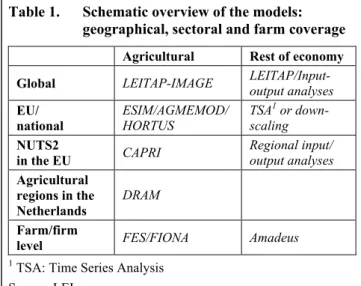
The models included in the LEI model funnel are presented in figure 1. Compared to VAN TONGEREN (2000), the LEI
model funnel is extended with models at EU and national level (ESIM, AGMEMOD, HORTUS), EU regional level (CAPRI) and farm level (FIONA). The global economy-wide dimension is covered by the economic LEITAP model and the biophysical IMAGE model (table 1). ESIM and AGMEMOD provide more agricultural detail for the EU-27 countries. CAPRI is doing the same for the regional (NUTS2) level in the EU-27. DRAM describes agricultural production in 66 agricultural regions in the Netherlands. At the farm level different types of models can be used. These models range from simple budget models to calculate first order or direct income effects of policy changes using FADN to farm level optimization models as FIONA and investment simulation models as FES.
The gap in our (and the EU research community) modeling framework is what happens with the other sectors (i.e. rest of the economy) at the regional level in the EU-27. An example of downscaling of results from the country level to the regional level in the EU can be found in HELMING et al.
Table 1. Schematic overview of the models: geographical, sectoral and farm coverage
Agricultural Rest of economy Global LEITAP-IMAGE LEITAP/Input-output analyses EU/ national ESIM/AGMEMOD/ HORTUS TSA 1 or down-scaling NUTS2
in the EU CAPRI Regional input/ output analyses Agricultural
regions in the Netherlands
DRAM Farm/firm
level FES/FIONA Amadeus
1 TSA: Time Series Analysis Source: LEI
(2008). For the Netherlands regional input-output tables are sometimes available. Amadeus is a pan-European financial database at the level of the firm. It contains up to 10 years of detailed accounting information of about 8.5 million firms, of which 350,000 are Dutch firms (BACKUS et al., 2007).
LEITAP is an adapted version of the GTAP model. A gen-eral description of LEITAP can be found in NOWICKI et al.
(2006). General descriptions of DRAM and FES can be found in VAN TONGEREN (2000). AGMEMOD, ESIM and
CAPRI are well known models of European agricultural at national and regional (CAPRI) level and are not further described here. HORTUS (modelling HORTiculture Use and Supply) is an applied partial equilibrium model for European horticulture (BUNTE and VAN GALEN, 2005). The model is developed at LEI. HORTUS specifies supply and demand for six fruits, five vegetables and two ornamentals for twenty-seven regions: the EU-25, Morocco, Turkey and the Rest of the World. The focus on horticulture accommo-dates the message from REINHARD (2000) that missing
sectors should be included.
FIONA is a bio-economic model with which the effects of changes in the institutional or physical environment on income, agricultural production, nature and the environ-ment can be analysed at the level of the individual dairy farm. FIONA maximizes the farm’s financial balance within a set of restrictions that describe the structure of the farm under consideration (GROENEVELD and SCHRIJVER, 2006).
Summarizing the characteristics of the models in the LEI model funnel, it can be concluded that farm optimization models, other than dairy farm optimization models and models of structural change at farm level are lacking. An important recommendation in REINHARD (2000) also mentioned by ISERMEYER et al. (1996) was that the
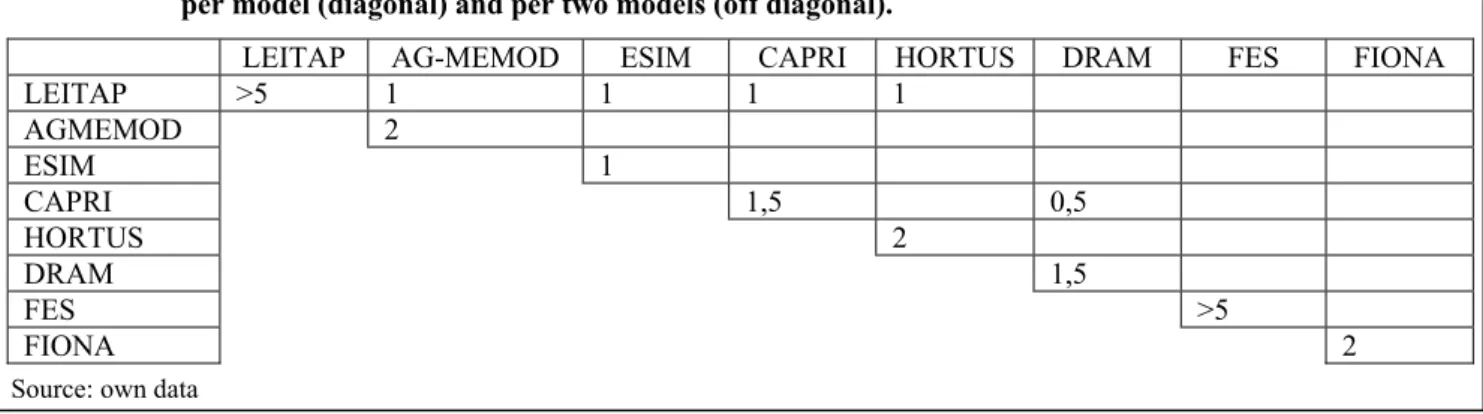
devel-opment of models and the actual running of models should be employed by different persons. At least two persons should be capable of developing and/or running one model. These are the representatives of the model. Table 2 shows the number of representatives per model (the number of persons on the diagonal) and per two models (off diagonal number of persons). Only the upper triangular part of the table is used. Data presented in table 2 shows that quite some researchers at LEI are capable to apply LEITAP and at least one other model. LEITAP is however quite an ex-ception. FES also has more than 5 representatives. How-ever, none of them are capable to run other models from the model funnel. In general the number of representatives per two models is limited to one out of the eight models have less than 2 representatives per model.
4. The information flow between LEI models
In this chapter some recent examples of model linkages are presented. We start with the linkages between the general equilibrium (GE) model LEITAP and the partial equilib-rium (PE) models ESIM and CAPRI. Next we discuss the linkages between PE models that is to say between CAPRI and ESIM and ESIM and AGMEMOD. Next a description of the linkage between CAPRI and DRAM and DRAM and FIONA is presented. To complete the LEI model funnel, the linkage between FIONA and FES is described.
LEITAP-ESIM
In order to combine the advantages of GE and PE models it is a promising analytical approach to use GE and PE mod-els in a consistent manner to analyze the same scenarios (BANSE and GRETHE, 2008). The problem, however, is that
both model types have a subset of all variables being en-dogenous in both of the models, which poses the challenge to use models consistently. Their reliance on different be-havioral assumptions, parameters and data aggregation, results in inconsistent vectors of changes in variables which are endogenous in both models. For example, based on the same vector of domestic price changes, LEITAP would produce a vector of supply quantity changes which would be different from ESIM. Due to this difficulty, the integra-tion of simulaintegra-tion models is typically limited to two differ-ent approaches: First, the incomplete consistency of model results and second, the iterative use of two models at differ-ent aggregation stages, where one block of equations in the higher level model, typically supply response, is effectively replaced by a block of equations taken from the lower level model.
In BANSE and GRETHE (2008) the mapping down of
vari-ables which are endogenous in LEITAP and exogenous in ESIM is pursued as in the Scenar 2020 project (NOWICKI et
al., 2006). However, in addition several steps are undertaken to make supply response more consistent among ESIM and LEITAP.1
LEITAP-CAPRI
In JANSSON et al. (2008) a full integration of CAPRI and
LEITAP is described. The purpose of the linkage is twofold: firstly, LEITAP adds factor market feedback to CAPRI and allows simulation experiments involving sectors other than
1 For further details see the chapter on model linking in B
ANSE
and GRETHE (2008).
Table 2. Number of model representatives (persons that are capable to further develop and/or run the model) per model (diagonal) and per two models (off diagonal).
LEITAP AG-MEMOD ESIM CAPRI HORTUS DRAM FES FIONA LEITAP >5 1 1 1 1 AGMEMOD 2 ESIM 1 CAPRI 1,5 0,5 HORTUS 2 DRAM 1,5 FES >5 FIONA 2
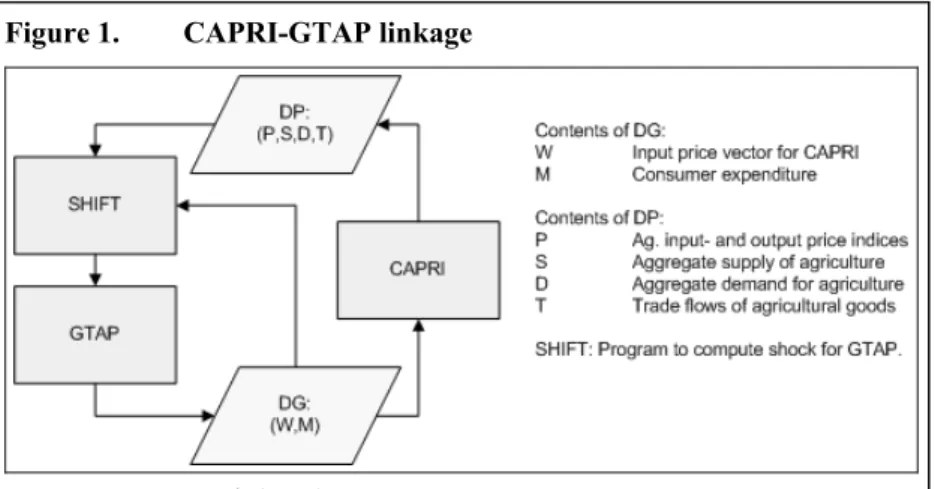
agriculture. Secondly, the detailed agricul-tural sector of CAPRI replaces the more aggregated (at least in terms of technology) agricultural sector in LEITAP. The linkage between CAPRI and GTAP is illustrated in figure 1. In the figure, shaded boxes denote computer programs (models), and rhom-boids denote data sets. Solving GTAP (bottom left) particularly obtains the price vector W containing prices of agricultural intermediate inputs, capital and labour, and the vector M of consumer expenditures per country (aggregate). Those data are written to the dataset DG. Next, CAPRI is solved, using W and M as exogenous variables (parameters). CAPRI computes for the
aggregate agricultural sector price indices of output P per region, total supply S, demand D disaggregated into human consumption, processing consumption and intermediate demand by agriculture itself, and trade flows T. This is written to the dataset DP. Finally, the program SHIFT com-putes shocks for GTAP. If we, as is common “GTAP lan-guage” use lower case letters to denote percent change relative to a baseline, then the shocks computed by SHIFT are such that, given prices (w,p) the agricultural sector would produce s, demand for agricultural goods would equal d and agricultural trade flows are t. That is we shock the agricultural producers of GTAP so that they, in a partial setting, would replicate the outcome of CAPRI, and similar for consumption and trade of agricultural goods.
An important difference between JANSSON et al. (2008) and
BANSE and GRETHE (2008) is that the latter authors used a disaggregated version of LEITAP in order to depict world market price effects for individual agricultural products. In JANSSON et al. (2008) agricultural production in GTAP is
mapped into one sector.
CAPRI-ESIM
Until now the linkage between CAPRI and ESIM is very limited. CAPRI should be classified as a comparative static model that can be used for agricultural policy analysis. To describe agricultural production and income in some future year, the approach of CAPRI is first to establish a calibrated baseline. In doing so, price and quantity trend line forecasts from ESIM are used in the calibration step.
AGMEMOD-ESIM
For the study ‘Perspectives for Dutch agriculture until 2020’ the two partial models, AGMEMOD and ESIM have been used together to provide projections of EU prices for agri-food products. Projections for key commodity prices at EU level are achieved by ESIM. These results are transferred to the stand-alone version of the Dutch AGMEMOD model which provides more details in terms of commodity cover-age compared to ESIM.
CAPRI-DRAM
CAPRI and DRAM both are comparative static mathemati-cal programming models. The NUTSII differentiation and product lines included in CAPRI in many cases coincide with the product lines and the level of aggregation of DRAM. Agricultural policies and restrictions are treated in
a similar way in both models. However, the market module of CAPRI is lacking in DRAM and many specialties and technologies included in DRAM are lacking in CAPRI. Until now the link between CAPRI and DRAM is limited by harmonizing scenario specific restrictions and agricultural policy changes and passing price changes from CAPRI to DRAM.
FIONA-DRAM and DRAM-FIONA
In a more recent project about the contribution of agricul-tural production to socially important values, an iterative link between DRAM and FIONA was used (HELMING and SCHRIJVER, 2008)2. FIONA focuses on nature and
envi-ronmental friendly production at the dairy farm level. Extra restrictions to stimulate alternative production methods affect feeding rations, cropping plans and quantity of pur-chased feed at the dairy farm level. These changes are transported from FIONA to DRAM. Next, new equilibrium prices for grass, maize and manure disposal are calculated in DRAM and transported back to FIONA. DRAM presents the change in total number of dairy cows, milk production, land use and production in other agricultural sectors in the Netherlands at the regional level. FIONA calculates changes in farm income for different types of dairy farms.
FIONA-FES
FIONA delivers changes in gross margin per ha per type of dairy farm. These dairy farms can be linked to farms in the Dutch Farm Accountancy Data Network (FADN). Farms in FADN are also input for FES. Given the changes in gross margin per ha, FES analyses the effects on farm income, replacement investments and farm continuity using all dairy farms in FADN.
5. Discussion and conclusion
The reason for linking the different types of models is that the chain of models gives results that are more realistic and consistent with the economic behaviour at the different levels of aggregation. Linking models also allows to conduct economic analysis which covers various degrees of regional and commodity coverage. Strict linking of models is not warranted because the driving mechanisms at the various
2 Type of dairy farms simulated by FIONA and type of dairy cows in DRAM are harmonized.
Figure 1. CAPRI-GTAP linkage
aggregation levels differ too much. Adjustment of the exist-ing models can improve lose couplexist-ing of the models within the LEI model funnel. Linking the models unfortunately requires as much (or perhaps more) software development as economic theory. Linkages from sector models to farm models are still very limited and based on transfer of prices and/or gross margins information. Therefore, at current state the flow of information along the model chain could be summarized by the following statement: “Mainly top down and only a little bottom up”.
Linking models, however, seems to be one answer to the growing demand for economic analyses of policy instru-ments which are targeted at different commodity and re-gional levels, e.g. Pillar II measures at NUTS 2 level. This kind of detailed policy analysis can only be pursued by a team of economists, modelers, and people being able to manage huge amount of data. Even if some data manage-ment processes might be possible in an automated process, meaningful model linking still requires some ‘handcraft’ and thorough economic background.
References
BANSE,M.andH.GRETHE (2008): Top Down and a little bottom Up: Modelling EU Agricultural Policy Liberalization with LEITAP and ESIM. Paper presented at the Eleventh Annual Conference of the Global Trade Analysis Project (GTAP) “Future of Global Economy”, Helsinki, June 12-14, 2008. BACKUS,G.B.C.,J.A.BOONE,E. TEN PIERICK, F.H.J.BUNTE and
K.J. VAN CALKER (2007): Ketenrendementen in de Nederlandse
agribusiness; Varkensvlees, zuivel, groente en fruit (in Dutch with English summary). LEI, 2007, Rapport 5.07.05, The Hague. BUNTE,F.H.J.andM.A. VAN GALEN (2005): HORTUS; Modelling HORTicultural Use and Supply, LEI, 2005, Rapport 8.05.05, The Hague.
GROENEVELD, R.A. andR.A.M SCHRIJVER (2006): FIONA 1.0.
Technical description. WOT natuur en milieu. WOT-document 36, Wageningen. In: http://www.wotnatuurenmilieu.wur.nl/NR/ rdonlyres/E3C76DB8-B6EE-4EA2-8204-2A9E4CC79CAF/32 603/WOtwerkdocument36webversie.pdf.
HELMING, J.F.M., D. VERHOOG, H. VAN MEIJL andP. NOWICKI
(2008):Effects of CAP Reform on regional employment in the EU. Paper presented at the 12th Congress of the European Asso-ciation of Agricultural Economists – EAAE 2008, Ghent, Bel-gium. In: http://www.wotnatuurenmilieu.wur.nl/NR/rdonlyres/ E3C76DB8-B6EE-4EA2-8204-2A9E4CC79CAF/32603/WOt werkdocument36webversie.pdf.
HELMING,J.F.M. AND R.A.MSCHRIJVER (2008): Effects of
agri-environmental measures and changes in EU single farm pay-ments on Dutch agriculture. Paper presented at the 107th EAAE Seminar “Modeling of Agricultural and Rural Develop-ment Policies”, Sevilla, Spain.
ISERMEYER,F.,T.HEMME,P.HINRICHS,W.KLEINHANSS,D.H EIT-MANN,A.SCHEFSKI,F.FASTERDING andD.MANEGOLD (1996):
Software Use in the FAL “model family”. Paper presented at the International Workshop on Software Use in Agricultural Sector Modelling. Institute for Agricultural Policy, Bonn, 27-28 June, 2008.
JANSSON, T., M. KUIPER, M. BANSE, T. HECKELEI and M.
ADENÄUER (2008): Getting the best of both worlds? Linking CAPRI and GTAP for an economywide assessment of agricul-ture. Paper presented at the Eleventh Annual Conference of the Global Trade Analysis Project (GTAP) “Future of Global Economy”, Helsinki, June 12-14, 2008.
NOWICKI,P.,H. VAN MEIJL,A.KNIERIM,M.BANSE,J.HELMING,
O.MARGRAF,B.MATZDORF,R.MNATSAKANIAN,M.REUTTER, I.TERLUIN,K.OVERMARS,D.VERHOOG,C. WEEGER andH.
WESTHOEK (2006): Scenar 2020 – Scenario study on agriculture and the rural world. Contract No. 30 - CE - 0040087/00-08. European Commission, Directorate-General Agriculture and Rural Development, Brussels.
REINHARD,S.(2000): The Information flow between LEI models. Notitie 00.07, LEI, The Hague.
VAN TONGEREN,F. (2000): Perspectives on Modelling EU Agri-cultural Policies. In: Agrarwirtschaft 49 (3/4): 157-163.
Acknowledgement
The authors like to thank all colleagues from LEI who de-livered input for this paper.
Corresponding author: DR.JOHN F.M.HELMING
Agricultural Economics Research Institute LEI P.O. Box 29703, NL-2502 LS The Hague, Netherlands phone +(31)-70-33 58 353, fax: +(31)-70-33 58 196 e-mail: [email protected]