I n n o v a t i v e W o r k B e h a v i o r :
M e a s u r e m e n t a n d V a l i d a t i o n
Jeroen P.J. de Jong Deanne N. Den Hartog
This report is published under the SCALES-initiative (SCientific AnaLysis of
Entrepreneurship and SMEs), as part of the 'SMEs and Entrepreneurship programme' financed by the Netherlands Ministry of Economic Affairs.
EIM Research Reports
reference number H200820
publication november 2008
emailaddress corresponding author [email protected]
address EIM Bredewater 26 P.O. BOX 7001 2701 AA Zoetermeer The Netherlands Phone: +31 79 343 02 00 Fax: +31 79 343 02 03 Internet: www.eim.nl
Most recent EIM reports and much more on SMEs and Entrepreneurship can be found at: www.entrepreneurship-sme.eu.
The responsibility for the contents of this report lies with EIM bv. Quoting numbers or text in papers, essays and books is permitted only when the source is clearly
mentioned. No part of this publication may be copied and/or published in any form or by any means, or stored in a retrieval system, without the prior written permission of EIM bv. EIM bv does not accept responsibility for printing errors and/or other
Innovative Work Behavior: Measurement and Validation
Jeroen P.J. de Jong
EIM Business and Policy Research P.O. Box 7001
2701 AA ZOETERMEER The Netherlands Tel. +31 79 343 02 12
E-mail [email protected]
Deanne N. Den Hartog University of Amsterdam Amsterdam Business School
Working paper November 2008
Author bio
Jeroen de Jong is a project manager and researcher at EIM, and an assistant professor at RSM Erasmus University.
Deanne N. Den Hartog is a full professor of Organizational Behavior at the University of Amsterdam Business School.
Innovative Work Behavior: Measurement and Validation Abstract
Although both scientists and practitioners emphasize the importance of innovative work behavior (IWB) of individual employees for organizational success, the measurement of employees' IWB is still in evolution. Here, we present two multi-source studies that aimed to develop and validate a measure of IWB. Four related dimensions of IWB are distinguished: opportunity exploration, idea generation, championing and application. We derived a ten-item measure of these IWB dimensions from a pilot survey among matched dyads of 81 professionals in a research institute and their supervisors. Next, a survey among a matching sample of 703 knowledge workers and their supervisors from 94 different firms was done. We used confirmatory factor analyses to examine convergent and discriminant validity, and hierarchical multilevel regression to test hypothesized relationships of IWB with participative leadership, external work contacts and innovative output (proposed as an initial nomological network). Results demonstrate strong convergent validity of the IWB measure as all four dimensions contribute to an overall measure of IWB. Support for discriminant validity is weaker as correlations between some dimensions are relatively high. Finally, IWB is positively related with participative leadership, external work contacts and innovative output, providing first evidence for nomological validity.
Keywords
Innovative Work Behavior: Measurement and Validation
The ability to continuously innovate and improve products, services and work processes is nowadays crucial for organizations. Individual employees need to be both willing and able to innovate if a continuous flow of innovations is to be realized (e.g. Janssen, 2000). The idea that actions of individual employees are of crucial importance for continuous innovation and improvement is not just found in academic literature on innovation (e.g. Van de Ven, 1986; Janssen, 2000), but also stressed in work on several other popular management principles, such as total quality management (McLoughlin & Harris, 1997) and corporate entrepreneurship (Sharma & Chrisman, 1999).
Individual innovation has been studied in terms of personality characteristics, outputs, and behaviors. For instance, Hurt, Joseph, and Cook (1977) focus on generalized willingness to change, a personality-based aspect of individual innovation. West's (1987) measure of role innovation captures how many changes an individual has initiated in his or her job in comparison to the last role occupant. Similarly, Axtell et al.'s (2000) measure assesses individuals' self-ratings of their suggestions and realized innovations. Both take an output-based view of individual innovation. Others conceptualize individual innovation as a set of discretionary employee behaviors (e.g. Scott & Bruce, 1994). Here, we also take this behavioral approach.
Innovative work behavior (IWB) typically includes exploration of opportunities and the generation of new ideas (creativity related behavior), but could also include behaviors directed towards implementing change, applying new knowledge or improving processes to enhance personal and/or business performance (implementation oriented behavior). Most previous work focused on employee creativity and the generation of creative ideas, in other words, on the early phases of the innovation process. Several researchers have called for extending the construct and to devote more scientific attention to the implementation of ideas (Mumford, 2003; Zhou & Shalley, 2003). In line with this, IWB is typically seen to encompass a broad set of behaviors related to the generation of ideas, creating support for them, and helping their implementation (e.g. Scott & Bruce, 1998; Jansen, 2000). However, the available measures of IWB are mostly short and one-dimensional and empirical evidence of the validity of these measures is limited. Many studies have relied solely on single source data, where individual employees provide the ratings of IWB as well as its correlates. The aim of this study is to contribute to the field of individual innovation by developing and validating a measure of IWB and examining a partial and initial nomological network of IWB in the workplace.
INNOVATIVE WORK BEHAVIOR
Innovation theory has repeatedly stressed that innovation is broader than only creativity and also includes the implementation of ideas (e.g. King & Anderson, 2002). Thus, IWB does not only include idea generation, but also behaviors needed to implement ideas and achieve improvements that will enhance personal and/or business performance. Following Farr and Ford (1990) we define innovative work behavior as an individual's behavior that aims to achieve the initiation and intentional introduction (within a work role, group or organization) of new and useful ideas, processes, products or procedures. The measure of IWB developed here thus captures both the initiation and implementation of creative ideas.
The construct of IWB is closely related to employee creativity. Creativity is defined as the production of new and useful ideas concerning products, services, processes and
procedures (e.g. Oldham & Cummings, 1996; Amabile, 1988). However, some differences between the constructs exist (West & Farr, 1990; Scott & Bruce, 1994). Unlike creativity IWB is explicitly intended to provide some kind of benefit. It has a clearer applied component and is expected to result in innovative output. Creativity can be seen as a crucial component of IWB, most evident in the beginning of the innovation process, when problems or performance gaps are recognized and ideas are generated in response to a perceived need for innovation (West, 2002).
Despite the differences between IWB and creativity, the overlap is clear and the application processes has also started to receive attention in the creativity literature. For example, in his review of creativity research, Mumford (2003) calls for the investigation of so-called 'late cycle' skills, that is, the implementation of creative ideas. He stresses that real-world performance – the expression, shaping and execution of ideas – represents 'another important component of creative work' (p. 116) and considers the investigation of implementing ideas to be an important emerging issue for creativity research. Similarly, Basadur (2004) included 'solution implementation' in his model of leading the creative process. The distinction between IWB and creativity thus seems to be one of emphasis rather than substance. As stated, here we address a broad range of IWB encompassing both the initiation and implementation of ideas.
Dimensions
More recent measures of IWB distinguish between various dimensions, which are often linked to different stages of the innovation process. For example, Scott and Bruce (1994) operationalize IWB as a multistage process. Drawing on Kanter (1988), they outline three stages relevant to IWB, namely idea generation, coalition building and implementation. Individual innovation begins with problem recognition and the generation of ideas or solutions, either novel or adopted. Next, an innovative individual seeks sponsorship for an idea and through coalition building tries to gain support for it. Finally, the innovative individual contributes to idea implementation, for example, by producing a prototype or model of the innovation or working on the execution of the idea in other ways.
Of the three forms of innovative behavior Scott and Bruce distinguish, idea generation is rather broad as it includes both generating ideas and the recognition of problems (Scott & Bruce, 1994, p. 581). Several creativity studies indicate that these two behaviors rely on distinct cognitive abilities (e.g. Runco & Chand, 1994; Basadur, 2004). Similarly, in the entrepreneurship literature, the discovery of opportunities is seen as a behavior preceding idea generation, and has been demonstrated to have distinct personality and environmental determinants (e.g. Krueger, 2000; Shane, 2003). We therefore distinguish four types of IWB, and label them as 1. opportunity exploration, 2. idea generation, 3. championing, and 4. application. We will describe these below.
The realization of something new begins with a person identifying new opportunities (e.g. Parnes et al., 1977; Basadur, 2004; Amabile, 1988). The start of an innovation process is often determined by chance: the discovery of an opportunity, a problem arising or a puzzle that needs to be solved. The trigger may be a chance to improve conditions or a threat requiring immediate response. Drucker (1985) identified seven sources of opportunities, including: unexpected successes, failures or outside events; incongruities or gaps between 'what is' and 'what should be'; process needs in reaction to identified problems or causes of failure; changes in industrial- and/or market structures; changes in demographics such as birth rates or labor force composition; changes in perception; and, new knowledge. An opportunity is often a serendipitous event and intentionally discovering such events may seem a logical impossibility. However, some people do appear to be consistently 'lucky', implying that their exploration behavior is different (Leonard & Swap, 2005). Opportunity
exploration includes looking for ways to improve current services or delivery processes or trying to think about work processes, product or services in alternative ways (e.g. Farr & Ford, 1990; Kanter, 1988).
Idea generation is the next element of IWB and forms a first step in the exploitation of opportunities. Mumford (2000) suggests that ultimately, the individual is the source of any new idea. To be able to innovate, besides being aware of a need or an opportunity, the ability to construct new ways to address the need is also crucial (Kanter, 1988). Idea generation refers to generating concepts for the purpose of improvement. The generation of ideas may relate to new products, services or processes, the entry of new markets, improvements in current work processes, or in general terms, solutions to identified problems (e.g. Kanter, 1988; Van de Ven, 1986; Amabile, 1988). The key to idea generation appears to be the combination and reorganization of information and existing concepts to solve problems or to improve performance. Good idea generators are individuals who can approach problems or performance gaps from a different angle. Kanter (1988) speaks of 'kaleidoscopic thinking'. In a kaleidoscope a set of fragments form a pattern but when shaken or twisted, the same fragments form an entirely new pattern. Idea generation often involves rearranging already existing pieces into a new whole. In his study of Nobel laureates Rothenberg (1996) found that these new combinations often provide a basis for advances in science. Similarly, Mumford et al. (1997) found that skill in combining and reorganizing concepts is one of the best predictors of creative achievement.
Championing is a relevant aspect of IWB once an idea is generated. Most ideas need to be sold. Although ideas may have some legitimacy and appear to fill a performance gap, for most ideas it is uncertain whether their benefits will exceed the cost of developing and implementing them, and resistance to change is to be expected (Kanter, 1988). Coalition building is often needed to implement an innovation; this involves acquiring power by selling an idea to potential allies. In many cases, the prospective users of a proposed innovation (colleagues, leaders, customers, etc) may feel uncertain about its value and such innovations will often need to be 'sold' to users. The innovative individual who takes prime responsibility for the introduction of innovations is often not formally appointed, but rather someone who feels a strong personal commitment to a particular idea and is able to 'sell' it to others (Kanter, 1988). A champion has been described as someone in an informal role that pushes a creative idea beyond roadblocks within the organization (Shane, 1994) or as someone who emerges to put efforts into realizing creative ideas and bringing them to life (Kleysen & Street, 2001). This can involve the champion's own or other people's ideas. Championing includes behaviors related to finding support and building coalitions, such as persuading and influencing other employees or management, and pushing and negotiating (e.g. Howell & Higgins, 1990; King & Anderson, 2002, Van de Ven, 1986).
Finally the supported idea needs to be implemented and put into practice. Implementation can mean improving existing products or procedures, or developing new ones. Considerable effort and a results-oriented attitude are needed from employees to make ideas happen. Application behavior relates to the efforts individuals must put forth to develop an idea selected for implementation into a practical proposition. Application often implies making innovations a regular part of work processes (Kleysen & Street, 2001) and includes behaviors like developing new products or work processes, and testing and modifying them (e.g. West & Farr, 1990; Van de Ven, 1986; Kanter, 1988).
Previous measures
Most studies on and measures of individual level innovative behavior to date have focused on the generation of new ideas (creativity) rather than the behaviors involved in championing or implementing these creative ideas. Only few measures of broader conceptualizations of IWB
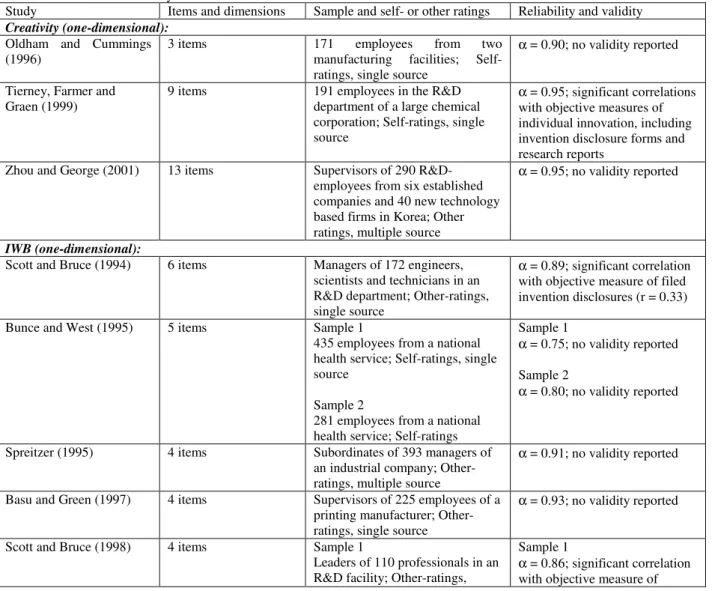
including all of these behaviors are available. Table 1 lists available measures of employee creativity and IWB. Most measures focus on a single element of IWB. Even if different behaviors are included they are often treated as one-dimensional in measurement. Moreover, previous work provides only very little information about the validity and psychometric properties of the measures. Scale development and validation have to date not fully been done; most studies only report exploratory factor analyses or reliability of the scales without providing any information on validity. Another drawback is that about half of the measures were self-reports, rather than (also) collecting data from other raters. Below we will outline some of these issues in more detail. Here, we aim to develop a multi-dimensional IWB measure and test its convergent and discriminant validity as well as start to develop an initial nomological network that will help ascertain construct validity.
Table 1 first lists three widely used measures for employee creativity (Oldham & Cummings, 1996; Tierney et al., 1999; Zhou & George, 2001). Their items typically relate to specific creative behaviors such as idea generation and exploring opportunities. These behavioral measures are often used in field studies. In the field, behavioral measures of individual innovation are more frequently used than Amabile's (1983) consensual assessment technique (expert judges of the overall creativity of a solution or product, often used in experiments) and 'objective' or quantifiable output measures, such as patent disclosures or counts of technical reports, that can sometimes be used if employees have jobs where such innovative outcomes are relevant (Zhou & Shalley, 2003).
Table 1. Measures of creativity and IWB
Study Items and dimensions Sample and self- or other ratings Reliability and validity Creativity (one-dimensional):
Oldham and Cummings (1996)
3 items 171 employees from two
manufacturing facilities; Self-ratings, single source
α = 0.90; no validity reported
Tierney, Farmer and Graen (1999)
9 items 191 employees in the R&D department of a large chemical corporation; Self-ratings, single source
α = 0.95; significant correlations with objective measures of individual innovation, including invention disclosure forms and research reports
Zhou and George (2001) 13 items Supervisors of 290 R&D-employees from six established companies and 40 new technology based firms in Korea; Other ratings, multiple source
α = 0.95; no validity reported
IWB (one-dimensional):
Scott and Bruce (1994) 6 items Managers of 172 engineers, scientists and technicians in an R&D department; Other-ratings, single source
α = 0.89; significant correlation with objective measure of filed invention disclosures (r = 0.33)
Bunce and West (1995) 5 items Sample 1
435 employees from a national health service; Self-ratings, single source
Sample 2
281 employees from a national health service; Self-ratings
Sample 1
α = 0.75; no validity reported
Sample 2
α = 0.80; no validity reported
Spreitzer (1995) 4 items Subordinates of 393 managers of
an industrial company; Other-ratings, multiple source
α = 0.91; no validity reported
Basu and Green (1997) 4 items Supervisors of 225 employees of a printing manufacturer; Other-ratings, single source
α = 0.93; no validity reported
Scott and Bruce (1998) 4 items Sample 1
Leaders of 110 professionals in an R&D facility; Other-ratings,
Sample 1
α = 0.86; significant correlation with objective measure of
multiple source Sample 2
Leaders of R&D engineers working at four locations of a manufacturer of electronic equipment; Other-ratings, multiple source
individual innovation (number of invention disclosures) Sample 2
α = 0.84; no validity reported
Janssen (2000) 9 items Self-ratings of 170 employees of a
food manufacturer and 110 supervisor (other) ratings of innovative behavior, multiple source
α = 0.95 (self-ratings) and 0.96 (supervisor ratings); significant correlation between both scales (r = 0.35)
Kleysen and Street (2001) 14 items 225 employees from different organizations; Self-rating, single source
α = 0.97; no support of validity (inadequate fit of structural equation model)
IWB (multi-dimensional):
Krause (2004) 8 items related to two dimensions (5 items on creativity, and 3 on implementation)
399 middle managers from different German organizations; Self-ratings, single source
α-values of 0.78 and 0.81 are reported; exploratory factor analysis shows the two factors are factorially distinct. Dorenbosch et al. (2005) 16 items related to two
dimensions (10 items on creativity and 6 items on
implementation)
132 non-managerial employees in a Dutch local government organization; Self-ratings, single source
α-values of 0.90 and 0.88 are reported; the additive scale of both dimensions had α = 0.92; no validity reported
As stated, most measures of IWB are one-dimensional. Scott and Bruce (1994) developed a six-item IWB scale covering idea generation, coalition building and idea realization, but they did not attempt to separate these dimensions. In later work, Scott and Bruce (1998) presented a shorter, four-item version of their measure. Other authors have also operationalized IWB in such short scales. Bunce and West (1995) used five items to measure the 'propensity to innovate', a measure that basically fits in with our definition of IWB. Spreitzer (1995) and Basu and Green (1997) also used four-item scales. The short measures in these studies tend to ask supervisors to rate employees' innovativeness and originality, without distinguishing specific types of behavior. Many of these were not validated, but rather used as outcome measures in studies where other constructs (e.g. empowerment) were the focus of the study and received more attention.
Janssen (2000) first tried to develop a truly multidimensional measure, using both self- and other ratings of employees IWB. He formulated items specifically tapping idea generation, idea promotion, and idea implementation. However, he found strong correlations between these three behaviors and concluded that his items could best be combined and used as a single additive scale. This also held for the self-report measure of Kleysen and Street (2001). Krause (2004) and Dorenbosch et al. (2005) presented IWB measures tapping two dimensions, namely idea generation and idea implementation. This distinction draws on the widely used two-stage (initiation vs. implementation) representation of the innovation process (e.g. Zaltman et al., 1973; King and Anderson, 2002).
Previous measures thus have some problems that we try to address. To prevent problems such as common source bias and social desirability, IWB data should preferably be collected from an independent source, for example a supervisor or colleague. With a few exceptions (e.g. Scott & Bruce, 1994; Janssen, 2000) most studies have not used such an independent source and instead rely solely on self-reported IWB (and they correlate IWB ratings only with other variables also collected from the same source). Moreover, a thorough analysis of the validity of IWB measures is yet to be done. A few researchers have demonstrated that their IWB measure correlates significantly with related variables, such as objective innovation outcomes (Scott & Bruce, 1994; 1998) or self-reports of innovativeness
(Janssen, 2000). However, the demonstration of convergent and divergent validity of IWB dimensions as well as establishing a nomological network for IWB is still missing. Here, we hypothesize four dimensions of innovative work behavior and attempt to develop and validate a measure for these. A critical component of validation is establishing convergent and discriminant validity (Campbell & Fiske, 1959) of these dimensions. Establishing convergent validity requires that each dimension contributes to an overall construct of IWB. Discriminant validity requires that, though they are related, the dimensions of a construct reflect distinct components. Thus, we hypothesize:
Hypothesis 1A: Opportunity exploration, idea generation, championing and application behavior contribute to an overall construct of innovative work behavior.
Hypothesis 1B: Opportunity exploration, idea generation, championing and application behavior are four distinct dimensions of innovative work behavior.
An initial nomological network
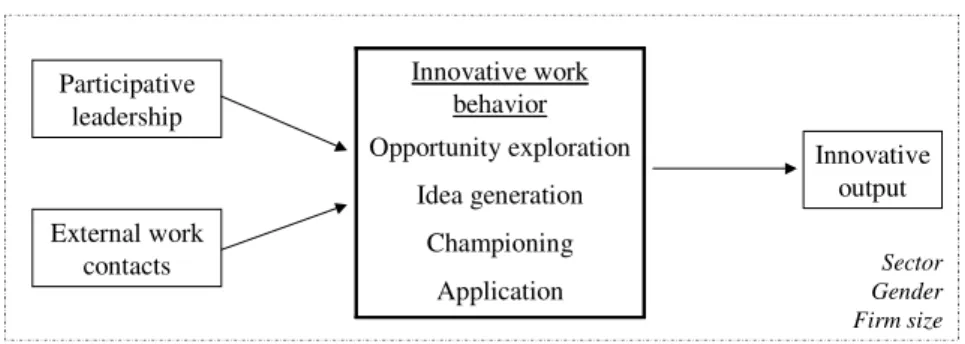
Construct validity of IWB is adressed by investigating its relationship with several key correlates. The proposed nomological network is not comprehensive; far more factors can be part of it. We test the role of participative leadership and having external networks as potential antecedents, and individuals' self-rated innovative output as a potential outcome of supervisor-rated IWB (see figure 1). Although we use the terms antecedents and outcomes, we stress that we use a cross-sectional design that does not allow for testing causal directions. These directions are assumed on basis of prior theory and empirical work.
Figure 1. Partial nomological network of innovative work behavior
Application Championing Idea generation Opportunity exploration Innovative work behavior Participative leadership External work contacts Innovative output Sector Gender Firm size
As stated, a first proposed antecedent of IWB is a participative leadership style. Participative leadership involves the use of decision-making procedures that allow subordinates influence in important decisions and autonomy to design and guide their own tasks. Participative leadership can take different forms, including consultation, joint decision-making and delegation (Yukl, 2002). In the context of individual innovation, participative leadership has been mentioned as a potential antecedent (e.g. Rickards & Moger, 2006: p.6). Amabile's (1983) work on creativity suggests that an important way to affect IWB may be through intrinsic motivation. Intrinsic motivation is defined as any motivation that arises from the individual's positive reaction to a task itself rather than some source outside of it. Amabile premises that people will be most creative (and thereby innovative) when they are intrinsically rather than extrinsically motivated. Participative leadership enhances individuals' sense of self-determination, control and responsibility for the task at hand as well as individuals' level of intrinsic motivation to do a task. In turn, this is expected to result in higher levels of IWB. In contrast, when individuals perceive that their thoughts and actions are constrained and that others force them to do things in specific ways, they perceive that others rather than they themselves are responsible for their actions. Their intrinsic motivation is likely to diminish, which in turn, is likely to lead to less innovative work behavior.
Several studies provided empirical support for the importance of participative leadership. For example, Kanter (1983) found that effective managers used a substantial amount of consultation and delegation to encourage employees and to give them a sense of ownership for activities and decisions. This triggered their idea generation and implementation trials. More recently, Krause (2004) investigated whether supervisors could exert influence on the innovation process by granting their employees freedom and autonomy. Using a database of 399 middle managers from German enterprises, she found that freedom and autonomy were positively related to various types of innovative behavior, including the generation and testing of ideas and the implementation of ideas. Also, Axtell et al. (2000) studied employees of a manufacturing plant in Northern England and demonstrated positive connections between participation and employees' innovative output, measured through self-ratings of employees' suggestions and implementation efforts. Finally, Amabile et al. (2004) compared two groups of R&D workers that differed strongly on creativity, a construct closely related with IWB. The supervisor of the highly creative team strongly involved subordinates in decision making during weekly meetings and worked together with the team to set priorities and goals. In contrast, the supervisor of the less successful team never asked team members' input for decisions. This lack of consultation undermined subordinates' motivation and led to a lack of alternative views to base decisions on. Thus:
Hypothesis 2: Participative leadership is positively related to innovative work behavior.
Less often studied to date is the potential role of employees' external work contacts in enhancing IWB. External work contacts relate to the frequency of employees' contacts with individuals or groups outside the organization who may form a relevant source of information, such as customers, suppliers, knowledge institutes, and competitors. We expect that employees with more frequent and more diverse external work contacts will be more innovative as such contacts expose them to more diverse views and ideas that may help spark their IWB. For example, meeting colleagues who work in different places can help employees' see how others solve similar problems in different ways. Having close contact with customers provides opportunities to get feedback on products or services and test ideas for improvements with them. Exposure to such diverse people and information may spark new ideas, aid in the generation of additional creative insights, and help to find verbal and material support for implementation.
The notion that IWB will benefit from external work contacts has not been directly tested, but related research and theory suggests a positive impact. Kanter (1988) noted that close contacts with 'need sources' can form an innovation activator. She states: 'Contact with those who see the world differently is a logical prerequisite to seeing it differently ourselves' (p.175). Kimberly and Evanisko (1981) found that contact with professionals outside the organization was related to the increased adoption of innovations in the organization and Kasperson (1978) found that scientists with access to different scientific disciplines were rated as making a more creative contribution to their field. Also, Perry-Smith and Shalley (2003) developed propositions on the association between social relationships and the related construct of creativity. Drawing on social network theory, they suggest a variety of mechanisms through which the social context influences creativity. Individuals with frequent external work contacts have a more diverse network with many so-called "weak ties", as external work contacts are usually characterized by little affect or social exchange. The access to non-redundant information and diverse social circles provided by these weak ties facilitates several processes helpful for innovative work behavior, including better options for opportunity exploration, sources of ideas, and support of support to aid in the implementation of innovations. Supporting employees' in having regular contacts with external clients as well
as professional or social activities that promote contact with professionals outside the organization may thus be a way to enhance employees' innovative behavior. Thus, we hypothesize:
Hypothesis 3: External work contacts are positively related to innovative work behavior.
Finally, we explore how IWB relates to innovative output of employees. Scott and Bruce (1994) report significant correlations between IWB and independently rated counts of invention disclosures. In their follow-up study drawing on samples of R&D professionals and engineers, similar results were found (Scott & Bruce, 1998). In line with this, we include innovative output in the partial and initial nomological network as a consequence of IWB. When tasks of employees are fully focused on innovation (e.g. R&D workers), one can often find 'objective' measures of innovative outputs (e.g. number of patents). However, in firms offering knowledge-intensive services (our population, see below), such objective measures for the innovative output of employees are not available. Therefore, in this study, we follow the example of Axtell et al. (2000). Innovative work behavior is expected to affect different forms of innovative output, for example, more suggestions for innovations and more ideas for change being put forward as well as more realized innovations, such as new products and processes being developed. We therefore use employee self-ratings of innovative output in terms of how often they offered suggestions, contributed to innovations or new product development, or acquired new customers or new knowledge. Those rated higher by their manager on IWB are expected to show more innovative output in these terms. Thus, we hypothesize:
Hypothesis 4: Innovative work behavior (manager-rated) is positively related to innovative output (employee self-rated).
PILOT STUDY
A pilot study was done among matched dyads of 81 knowledge workers and their supervisors in a single organization. This study aimed to develop an initial version of the IWB measure and test the measures of participative leadership, external contacts, and innovative outcomes. Next, the main study presented below tests the hypotheses on the validity of the IWB measure.
Sample
The pilot study was done at an institute for business and policy research in the Netherlands. Its customer base includes policy makers from Dutch ministries, local government, or the European Commission, representatives of intermediate organizations (e.g. sector organizations, Chambers of Commerce), and large enterprises. Data was collected from two sources. 81 knowledge workers and their supervisors participated. At the time of the survey (summer of 2003) the firm employed about 130 people. All 102 knowledge workers this firm employed were invited to participate, employees that did not do knowledge work, such as those providing domestic services (cleaning, restaurant services), did not take part in the survey.
Employees first received an introduction letter announcing the survey. Next, one week later they received a packet with the questionnaire, a cover letter (ensuring confidentiality, explaining the procedure, indicating participation was voluntary, and providing details of a contact person available to answer questions), and a stamped return envelope. Employees filled out items on participative leadership, external work contacts, and
innovative outputs (see below). 81 of the 102 employees participated, a response rate of 79%. Their mean age was 42 years, 86% of the respondents had a university education and 64% was male. Next, we requested all supervisors to rate their subordinates' IWB. The researchers personally spoke to each manager to explain what was needed, stressing that participation was voluntary and answers would be handled confidentially. All supervisors were willing to participate. They filled out the questionnaire for each of their subordinates (an average of 7 subordinates per supervisor) and sent these to the researchers.
Measures
We used multi-item scales to measure all constructs. For IWB, the item pool consisted of 17 items. These items were based on previous work in this area (e.g. Janssen, 2000; Kleysen & Street, 2001; Scott & Bruce, 1994), although they were reworded or adapted where needed. Four experts in the field of organizational psychology independently assessed the items and provided feedback for a better formulation. In the initial version, 5 items measure opportunity exploration, 4 idea generation, 4 championing, and 4 cover application behavior. The appendix lists all items. Responses were given on 5-point scales (ranging from 'never' to 'always').
Participative leadership was measured with 6 items tapping employees' perception of whether their leader encourages and facilitates their autonomy as well as joint decision-making (based on a Dutch measure validated by Den Hartog, 1997). Items were rated on a 5-point scale ('totally disagree' - 'totally agree') and are listed in the appendix.
To measure external work contacts, we used an available Dutch scale (developed by De Jong & Den Hartog, 2005) that is based on Afuah's overview (2003) of functional sources of innovation. He stresses that various parties such as competitors, knowledge institutes and universities can enhance the innovation process and be a source of opportunity. The measure contained statements on having contacts with customers, people from other companies, knowledge institutions and universities, and visiting conferences (see appendix for all items). Responses were given on a 5-point scale ('never' – 'always').
Our self-rated innovative output scale consists of 6 items on the frequency of employees' suggestions and implementation efforts related to new products and services, work practices, knowledge, and markets (groups of customers). These are all widely recognized objects of innovation (Shane, 2003). Axtell and colleagues (2000) used a similar measure in research among workers of a UK manufacturing plant. Answers could vary from 1 ('never') to 5 ('always'). The appendix lists all items.
Results
Most important in the analysis of the pilot sample was the examination of the factor structure of our initial IWB measure, and to develop an initial version with factorially distinct dimensions that could be part of our main survey. Exploratory factor analysis (EFA) with oblique rotation was used. Given that our primary objective was to identify latent dimensions (rather than data reduction), we preferred this method to principal component analysis and orthogonal rotation (Hair et al., 1998, p. 102). For the other scales, we first checked one-dimensionality using exploratory factor analysis, and subsequently reliability measures were calculated. For examination of reliability we examined Cronbach's α and assessed mean inter-item correlations and item-rest correlations (IRCs, i.e. corrected item-total) as α
increases with the number of items. Recommended critical values are 0.70 for α, 0.40 for the mean inter-item correlation, and 0.30 for item-rest correlations (Cortina, 1993; Hair et al.,
1998).
Using our 17 IWB items, pre-analysis tests for the suitability of the pilot data for factor analysis were computed as recommended by Hair et al. (1998). The
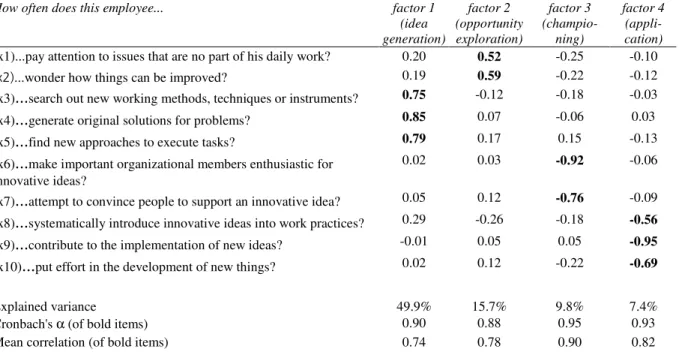
Kaiser-Meyer-Olkin (KMO) measure of sampling adequacy was 0.93, and the Bartlett test of sphericity was significant at p < 0.001, indicating suitability of the data. An initial EFA was computed. Only the first two factors had eigenvalues larger than one, yet the scree criterion suggested a four-factor solution. A further analysis with oblique rotation (as interrelated four-factors were expected) was computed limiting the number of factors to four. This solution extracted 87% of the variance, however some factor loadings were ambiguous. Following Hair et al. (1998) factor loadings should be preferably be above 0.50, while any cross-loadings should not exceed 0.30. An item-selection process applying these rules-of-thumb left us with a shorter, ten-item scale, explaining 83% of the variance. Table 2 lists these items (an overview of dropped items is provided in the appendix). The table also shows that each dimension meets the common threshold values for the reliability statistics (Cronbach's α > 0.70 and mean correlation > 0.40).
Table 2. Exploratory factor analysis of innovative work behavior (n=81)
How often does this employee... factor 1 (idea generation) factor 2 (opportunity exploration) factor 3 (champio-ning) factor 4 (appli-cation)
(x1)...pay attention to issues that are no part of his daily work? 0.20 0.52 -0.25 -0.10 (x2)...wonder how things can be improved? 0.19 0.59 -0.22 -0.12 (x3)...search out new working methods, techniques or instruments? 0.75 -0.12 -0.18 -0.03
(x4)...generate original solutions for problems? 0.85 0.07 -0.06 0.03
(x5)...find new approaches to execute tasks? 0.79 0.17 0.15 -0.13
(x6)...make important organizational members enthusiastic for innovative ideas?
0.02 0.03 -0.92 -0.06
(x7)...attempt to convince people to support an innovative idea? 0.05 0.12 -0.76 -0.09 (x8)...systematically introduce innovative ideas into work practices? 0.29 -0.26 -0.18 -0.56
(x9)...contribute to the implementation of new ideas? -0.01 0.05 0.05 -0.95
(x10)...put effort in the development of new things? 0.02 0.12 -0.22 -0.69
Explained variance 49.9% 15.7% 9.8% 7.4%
Cronbach's α (of bold items) 0.90 0.88 0.95 0.93
Mean correlation (of bold items) 0.74 0.78 0.90 0.82
For each of the other measures used in this research (participative leadership, external work contacts and innovative output), one-dimensionality was checked using exploratory factor analysis (cf. Hair et al., 1998). For each scale, at least 50% of the variance was accounted for by the first factor, and only one factor had an eigenvalue greater than unity. Screeplots supported the single factor solutions. Cronbach's α was .87 for participative leadership, .85 for external work contacts and .82 for innovative output scales. Lowest IRC for items on any of the scales was .45 and mean correlation was above .40. Thus, these three scales all satisfy the recommended critical values specified above.
MAIN STUDY Sample and measures
The sample for the main study consisted of 703 knowledge workers and their managers from 94 small knowledge-intensive service firms in engineering services, IT services, juridical services and consultancy services in the Netherlands. To obtain a homogeneous sample, within each participating firm only knowledge workers were allowed to participate (engineers, computer programmers, lawyers, consultants, etc). Altogether, these firms
employed 2,720 people, an average firm size of 29 employees. Firms' general managers were first contacted and asked to participate. In firms with fewer than 10 employees, managers were asked to provide details on all staff doing knowledge work. Managers of larger firms were asked to draw a random sample of 10 knowledge workers, based on whose date of birth came up first. In all, firms provided the contact details of 905 employees, who were all invited to take part in the survey.
Data was collected from two sources. The participating managers received a questionnaire asking them to rate the IWB of each of their sampled subordinates. The 10-item version of the measure developed in the pilot study was used. A stamped envelope was provided to return the completed questionnaires. We received a total of 879 ratings of subordinates on IWB (97%). Next, managers announced the study to subordinates to ensure that no one would be surprised by a questionnaire covering potentially sensitive subjects such as participative leadership. One week later the researchers sent out the questionnaire along with a cover letter ensuring confidentiality and explaining the voluntary nature of participation, and a stamped return envelope. The measures of participative leadership, external work contacts and innovative output were identical to those tested in the pilot study.
A total of 703 employees participated, a response rate of 78%. Of these respondents 66% were males. Besides 32% were employed in engineering services, 14% in IT services, 12% in juridical services, and 42% in consultancy. Using χ2-tests, we compared the distributions of responding subordinates and non-respondents on gender and type of service. Both tests revealed no significant differences (p=0.56 and p=0.11, respectively), providing some evidence that responses were not selective. As an additional test, we used a procedure proposed by Armstrong and Overton (1977), who suggested comparing those participants that respond immediately after the start of the survey with those that respond just before the deadline. Assuming that late respondents may be more similar to non-respondents than early respondents, significant differences in our measures would suggest non-response bias. A comparison of the first and last 25 percent of respondents revealed no significant differences. Manager as well as subordinate questionnaires contained a unique user ID that served to pair responses. After merging both files, the dataset consisted of 693 complete leader-subordinate dyads (77% of all sampled dyads).
Results
We first repeated the scale analyses performed above for the samples of 879 cases (IWB measure filled out by managers) and 703 cases (leadership, contacts, and output measures filled out by employees). These analyses yielded results similar to the pilot study. For the principal component analysis of the IWB measure, the scree criterion again suggested four factors, although now only the first had an eigenvalue exceeding unity. Extracting four factors and using oblique rotation led to the expected pattern of factor loadings (detailed results are available from the authors). Reliability was good for all measures (α > 0.70, mean correlation > 0.40 and IRCs > 0.30).
Confirmatory factor analysis (CFA) was used to examine convergent and discriminant validity, that is, to test our hypotheses 1A and 1B. We used the AMOS software package for structural equation modeling (SEM) (Arbuckle & Wothke, 1999). As the strongest test of a proposed model is to identify and test competing models that represent different hypothetical relationships (Hair et al., 1998), we compared various models in terms of absolute, incremental and parsimonious fit. Theory suggested three alternatives to our four-dimensional model. First, a model with all items loading onto a single factor was run. This model mirrors previous scales that depict IWB as one-dimensional (e.g. Spreitzer, 1995; Basu & Green, 1997). It also provides a test of the large share of variance of the first factor that we found in our exploratory factor analysis, suggesting that IWB may indeed be
one-dimensional. Then, a two-factor model was run with items on opportunity exploration and idea generation loading on the first factor and items on championing and application on the second factor. This model reflects the findings of Krause (2004) and Dorenbosch et al. (2005) and builds on the two-stage model of innovation contrasting initiation and implementation. Next, a three-factor model was estimated. This model reflects the work of Scott and Bruce (1994), and Janssen (2000) in assuming that IWB consists of idea generation (now also including opportunity exploration), championing and application. Finally, we estimated a four-factor model that specified each item to load on its proposed dimension.
The second, third and fourth model were all specified as second-order CFA models. The factor structure was further specified to account for the relationships among the first-order factors (in this case, the dimensions of IWB) to estimate the contribution of the various dimensions to the overall construct of innovative work behavior. Table 3 gives the results. It reports absolute fit measures (GFI and RMSEA, both indicating recovery of observed correlations between the items), incremental fit measures (TLI and NFI, comparing a proposed model to a baseline one-factor model with all items having unity factor loadings) and a parsimonious fit measure (χ²/df, indicating whether model fit has been achieved by 'overfitting' data using too many coefficients). For χ²/df, the recommended threshold value is 3.0, however since χ² is sensitive to sample size, for large samples values up to 5.0 are acceptable (Hair et al. 1998, p. 658).
Table 3. Overall fit indices for innovative work behavior scales (threshold values in brackets) (n=879)
Absolute fit Incremental fit Parsimonious fit Model GFI (> 0.90) RMSEA (< 0.08) TLI (> 0.90) NFI (> 0.90) χ²/df (< 5.0)
One factor 0.78 0.18 0.81 0.85 30.19
Two factors 0.85 0.15 0.88 0.90 20.49
Three factors 0.96 0.07 0.97 0.97 5.80
Four factors 0.97 0.06 0.98 0.98 4.63
The results indicate that the four-factor model provides the best fit. Values of all indices are within acceptable ranges. The three-factor model is also acceptable for most indices, although
χ²/df just fails to meet the (generously chosen) threshold value of 5.0. It can be regarded as an acceptable model, but more marginally so than the four factor model. The others models provide a weaker fit. Figure 2 provides the factor loadings of the four-factor CFA model. Each first- and second-order factor loading is statistically significant at p < 0.001. Results clearly support hypothesis 1A suggesting convergent validity.
Opportunity exploration
Idea
generation Championing Implementation
x1 x2 x3 x4 x5 x6 x7 x8 x9 x10 0.79** 0.79** 0.83** 0.69** 0.79** 0.86** 0.84** 0.72** 0.87** 0.87** IWB 0.84** 0.84** 0.79** 0.73** ** p < 0.001, * p < 0.01, ^ p < 0.05.
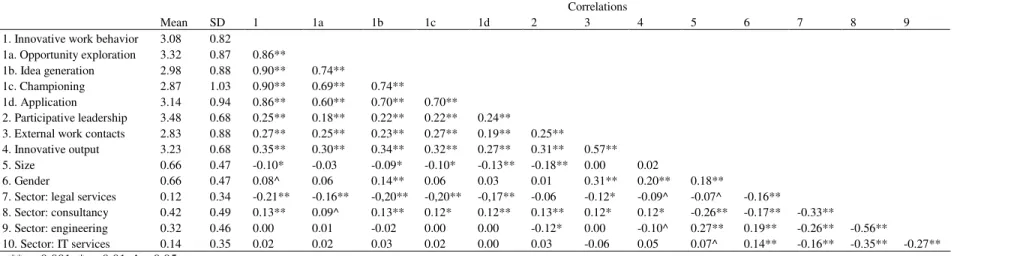
To assess discriminant validity, some alternative four-factor models were run. Rather than modeling a second order factor of IWB, these models all had plain correlations between the four dimensions. The four IWB dimensions show high positive intercorrelations of .60 and above (see table 4). Next, we ran six models that subsequently fixed each correlation between a pair of dimensions on unity. Discriminant validity is indicated when the constrained models have a deteriorated fit compared to the unconstrained model (Bollen, 1989). For this purpose, we assessed the ∆χ²-statistic. In each case a model with a less optimal fit emerged (∆χ² > 38.0 with one additional degree of freedom). Although this provides some support for hypothesis 1B, the intercorrelations between the factors are strong and highly significant (between .60 and .74). Thus, although we find some support for discriminant validity through CFA, taken as a whole our results do not strongly support hypothesis 1B. Given these results, in line with Janssen (2000) the dimensions may be best viewed to combine additively to create an overall scale of innovative work behavior. We will use the overall IWB scale in the analyses below that test the remaining hypotheses.
The assessment of criterion validity involved a range of regression analyses. Table 4 provides descriptive statistics and correlations for all relevant measures, including firm size, gender and sector that were used as control variables. Both the four separate IWB scales and the overall IWB measure are included in the table. As expected the correlations between IWB and participative leadership, external contacts and innovative output are positive and significant. Several control variables were used. Size is a dummy variable, with knowledge workers employed in a firm with more than 20 employees coded 1. Formal organizational arrangements such as task descriptions are usually introduced at this size and when work relations become more formalized and directed by rules and procedures, opportunities to be innovative may be smaller (Bodewes, 2000). In line with this, table 5 shows a negative correlation between size and IWB. Gender was a dummy variable with males coded 1 and females 0. It may form a proxy for type of contract as in the Netherlands women relatively often employed in part-time jobs, which may leave fewer opportunities to innovate. Sector is a proxy for the organization's larger economic and competitive environment, which may influence individuals' opportunities to innovate (Shane, 2003; Kanter, 1988). Dummies are used for legal, consultancy and engineering services, IT services forms the reference group.
Table 4. Descriptives and correlations among scales (n = 693)
Correlations
Mean SD 1 1a 1b 1c 1d 2 3 4 5 6 7 8 9
1. Innovative work behavior 3.08 0.82
1a. Opportunity exploration 3.32 0.87 0.86**
1b. Idea generation 2.98 0.88 0.90** 0.74**
1c. Championing 2.87 1.03 0.90** 0.69** 0.74**
1d. Application 3.14 0.94 0.86** 0.60** 0.70** 0.70**
2. Participative leadership 3.48 0.68 0.25** 0.18** 0.22** 0.22** 0.24**
3. External work contacts 2.83 0.88 0.27** 0.25** 0.23** 0.27** 0.19** 0.25**
4. Innovative output 3.23 0.68 0.35** 0.30** 0.34** 0.32** 0.27** 0.31** 0.57**
5. Size 0.66 0.47 -0.10* -0.03 -0.09* -0.10* -0.13** -0.18** 0.00 0.02
6. Gender 0.66 0.47 0.08^ 0.06 0.14** 0.06 0.03 0.01 0.31** 0.20** 0.18**
7. Sector: legal services 0.12 0.34 -0.21** -0.16** -0,20** -0,20** -0,17** -0.06 -0.12* -0.09^ -0.07^ -0.16**
8. Sector: consultancy 0.42 0.49 0.13** 0.09^ 0.13** 0.12* 0.12** 0.13** 0.12* 0.12* -0.26** -0.17** -0.33**
9. Sector: engineering 0.32 0.46 0.00 0.01 -0.02 0.00 0.00 -0.12* 0.00 -0.10^ 0.27** 0.19** -0.26** -0.56**
10. Sector: IT services 0.14 0.35 0.02 0.02 0.03 0.02 0.00 0.03 -0.06 0.05 0.07^ 0.14** -0.16** -0.35** -0.27**
To test hypotheses 2, 3, and 4 we used hierarchical multilevel regression analysis. As our data have a nested structure (employees within firms), using OLS regression analysis might provide inaccurate standard errors and false significance tests (Snijders & Bosker, 1999; Bliese, 2000). To examine whether multilevel analysis is needed, Snijders and Bosker (1999) recommend computing the intraclass correlation coefficient (ICC) and one-way analyses of variance. ICC estimates the share of variance in a dependent variable that is due to group membership, while one-way analysis of variance reveals significant differences between employees in different firms on a dependent variable. A positive ICC combined with a significant F-value indicates that multilevel regression is necessary. Both of our dependent measures (IWB and innovative output) met these criteria. IWB had an ICC-value of 0.21 and F-value of 3.72 (p < 0.001), innovative output had ICC = 0.10 and F = 1.84 (p < 0.001).
Hierarchical multilevel regression explicitly accounts for nested structures in data. It allows the simultaneous examination of the effects of group level and individual level variables on individual level outcomes, while accounting for the non-independence of observations within groups. The variance of the outcome variable is split up into various levels, in our case the levels of employees (individuals) and firms. Similar to OLS regression, the multilevel regression equation contains a fixed part, with estimates of independent variables and t-tests to assess significance. A major difference is the random part of the equation, which includes an error term for each specified level. A simple variant is the random intercept model, which only treats differences between firms as a source of variance in the intercept of the regression equation. More complicated is the random slope model, which also allows different effect parameters for different firms (Snijders & Bosker, 1999, p. 38-85). For each effect parameter we analyzed whether the introduction of a random slope model would provide a better fit. As this was never the case, we present the estimates of the random intercept models here.
As hierarchical multilevel regression uses maximum-likelihood estimates, model fit is assessed by comparing deviance measures of subsequent models: A decrease of the deviance measure (∆ dev) is related to ∆ df (degrees of freedom) and tested against a χ²-distribution. To test hypotheses 2 and 3 we estimated three models using IWB as dependent variable. To test hypothesis 4 we followed a similar procedure with innovative output as dependent variable. The analyses were run with the MIXED procedure in SPSS and included three steps. First, the estimation of an empty model (no predictors) to provide the initial value of the deviance measure (model 1), next the estimation of a random intercept model with all control variables (model 2), and finally the estimation of a random intercept model including all predictor variables: participative leadership and external work contacts in the first analysis, and innovative work behavior in the second analysis (model 3).
Table 5 presents the outcomes of the hierarchical multilevel regression for IWB. The initial deviance measure is 2034.34. Entering the dummy variables of size, gender and sectors significantly increased model fit (∆ dev = 21.90 with ∆ df = 5, p < 0.001). T-tests revealed this effect was due to size, gender and legal services. In the next step participative leadership and external work contacts were entered as predictors, again causing a significant increase in model fit (∆ dev = 517.01 with ∆ df = 2, p < 0.001). In line with hypotheses 2 and 3, both predictors had positive and significant effect parameters. Thus, employees with more external work contacts and with more participative leaders show more innovative work behavior.
Table 5. Hierarchical multilevel regression of innovative work behavior (n = 693)
model 1 model 2 model 3
Standardised effect parameters:
gender 0.07^ -0.01
Sector: legal services -0.17^ -0.23*
Sector: consultancy services 0.04 -0.05
Sector: engineering services -0.01 -0.02
participative leadership 0.18**
external work contacts 0.23**
Model fit: deviance 2034.34 2012.44 1495.43 ∆ deviance 21.90 517.01 ∆ df 5 2 significance ** ** ** p < 0.001, * p < 0.01, ^ p < 0.05.
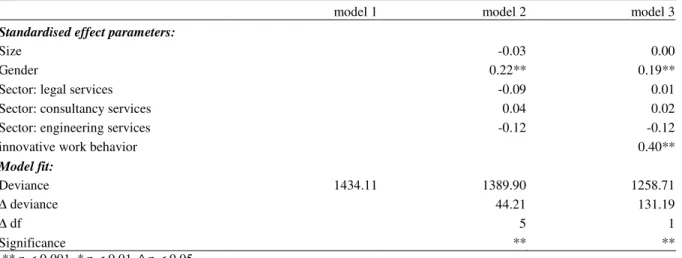
Table 6 presents the results of the hierarchical multilevel regression for innovative output. Here, the initial deviance measure had a value of 1434.11. Using the control variables as predictors resulted in a better fit. Adding IWB in the equation gives an even better fit (∆ dev = 131.19 with ∆ df = 1, p < 0.001). T-tests revealed that the positive effect parameter of IWB was highly significant, providing support for hypothesis 4. In other words, employees higher on innovative work behaviors show more innovative output.
Table 6. Hierarchical multilevel regression of innovative output (n = 693)
model 1 model 2 model 3
Standardised effect parameters:
Size -0.03 0.00
Gender 0.22** 0.19**
Sector: legal services -0.09 0.01
Sector: consultancy services 0.04 0.02
Sector: engineering services -0.12 -0.12
innovative work behavior 0.40**
Model fit: Deviance 1434.11 1389.90 1258.71 ∆ deviance 44.21 131.19 ∆ df 5 1 Significance ** ** ** p < 0.001, * p < 0.01, ^ p < 0.05. DISCUSSION
Individual innovation is crucial for many firms' survival. As Katz (1964) put it: 'An organization which depends solely upon its blueprints of prescribed behavior is a very fragile social system' (p. 132). This research aimed to increase both our understanding of innovative work behavior (IWB) and its correlates and improve our measurement of IWB. Despite an extensive amount of work that has been carried out in investigating individual innovation, behavioral measures are still in evolution and so far, attempts to validate the measures that are used are limited. Self-reports have often been the sole source of information and studies that do use independent sources to rate innovative behavior of employees have often used measures that assess only one dimension of the construct, whereas theory suggests IWB should be seen as multi-dimensional. Drawing on the work on employee IWB and creativity, we suggested IWB consists of four dimensions: opportunity exploration, idea generation, championing and application. Contrary to previous work we used confirmatory factor analysis (CFA) to examine convergent and discriminant validity in two separate studies,
separate data sources to measure IWB and its correlates, and employed hierarchical multilevel regression to test the relationships of IWB with other variables in an initial and partial nomological network.
A ten-item measure of the four IWB dimensions derived from a pilot study was tested in our main study. In terms of absolute, incremental and parsimonious fit the proposed four-factor model performed better than competing models, including a three-four-factor model that merged opportunity exploration and idea generation into a single dimension. Second-order CFA suggested that each of the four dimensions contributes to an overall construct of IWB, supporting convergent validity. However, evidence of discriminant validity is weaker as the four dimensions show high intercorrelations. As Kanter (1988) as well as King and Anderson (2002) noted, conditions for innovation may theoretically be best understood if one assumes the discovery of ideas and their implementation as discrete stages, but in reality, the innovation process has a reciprocal and recurring nature. Thus, finding high intercorrelations might then be expected, especially when IWB is measured at a single point in time using questionnaires. Scott and Bruce (1994) hold that since innovation is characterized by discontinuous activities rather than discrete, sequential stages, 'individuals can be expected to be involved in any combination of these behaviors at any one time' (p. 582). Given these views and the high intercorrelations, IWB dimensions may be best viewed as strongly related dimensions that combine additively to create an overall, composite scale of IWB.
Nonetheless, we feel there is a case for continued work on discriminant validity of dimensions of IWB that are strongly correlated, yet not equivalent. Two routes may be particularly worthwhile. First, while self-ratings of IWB have inherent problems, supervisor ratings may have pitfalls as well. Supervisors' ratings might be somewhat biased due to their overall, holistic view of the capabilities and performance level of a particular employee. This might inflate intercorrelations between the dimensions of IWB. Thus, investigating discriminant validity based on ratings of others who closely observe the focal employee's IWB (peers, subordinates, customers) may be of interest. Second, the assessment of discriminant validity in different work contexts is also recommended. The present study was done among knowledge workers in small firms. The high levels of autonomy and lack of structures guiding the type of innovation process in these small firms may inflate intercorrelations. In the context of small firms and knowledge-intensive services, more individuals might be involved in all stages of innovation, in other words those who discover and implement innovative ideas may more often be the same ones than in large firms. A test of whether these results are replicated in larger organizations with formally organized innovation processes is thus of interest. For example, Van Dijk and Van den Ende (2002) describe the use of employee suggestion systems and award schedules to stimulate individual innovation in multinational enterprises. Perhaps in such large firm contexts, lower correlations might be seen. In all, the exploration of the dimensions of IWB with different sources of data and in different work contexts as well as in longitudinal studies could make a valuable contribution to our understanding of the construct.
We also tested the validity of the construct of IWB in an initial nomological network, focusing on the composite scale of IWB and taking the nested structure of the data into account. As expected, participative leadership proved to be a strong predictor of employees' innovative work behavior. Participation in decision-making and autonomy encourage employees to generate and implement ideas. Likely, participative leadership enhances employees' intrinsic motivation as well as their feelings of responsibility, efficacy, and control. These, in turn, are likely to enhance employees' willingness to engage in IWB.
External work contacts also proved to be positively and significantly related with IWB. Our results show that the more diverse external contacts are reported by knowledge workers, the more their leader rates them as showing innovative behavior. This underscores
Perry-Smith and Shalley's (2003) suggestion that we need to empirically explore the social side of individual innovation in which (external) network contacts seem to have a crucial role. Apparently, it is tougher to be innovative when one is isolated or surrounded only by people from inside the organization. Employees can enrich their pool of ideas and innovative results by being stimulated to go outside, i.e. by having frequent contacts with people and environments that are 'different'.
Finally, in line with previous work, the expected relationship between innovative work behavior and innovative output (suggestions and implemented innovations) was found in this study. This confirms that increased employee IWB help enhance the organization's innovative ability and results.
Future work should extend the initial nomological network we defined in order to obtain more robust evidence for construct validity. Except for innovative outputs and measures related to the work context, other potential antecedents of IWB include personality, job and work group characteristics (e.g. Janssen, Van de Vliert & West, 2004). Positive but also potentially negative consequences of IWB are studied less often. A potential measure for inclusion would be conflict with colleagues as a result of work group resistance to idea implementation (Janssen, 2003).
IWB forms a suitable direction for future field studies to examine individual innovation. Objective measures such as patents counts and technical reports are usually only available for specific tasks (e.g. scientists, R&D workers). Mumford (2003) indicates future research is most needed in those contexts where innovation and every day work performance are not the same (in other words, innovative efforts of all employees rather than just those in innovation-oriented jobs). Thus, we expect that supervisor and peer ratings of individual innovation and IWB will be increasingly useful, however that holds only if the measures used are reliable and valid. Although some further development and validation is needed this study has tried to provide a valid measure that is applicable in different contexts, especially when innovative efforts are needed from all employees. It can be used in further research aimed to enhance our understanding of individual innovation.
Appendix: measures
* item dropped after pilot survey.
Innovative work behavior (supervisor rated)
How often does this employee...
…pay attention to issues that are no part of his daily work? …look for opportunities to improve things?*
…consider innovative opportunities?* …wonder how things can be improved? …explore new products or services?*
…search out new working methods, techniques or instruments? …generate original solutions for problems?
…create new ideas?*
…find new approaches to execute tasks? …mobilize support for innovative ideas?* …acquire approval for innovative ideas?*
…make important organizational members enthusiastic for innovative ideas? …attempt to convince people to support an innovative idea?
…transform innovative ideas into useful applications?*
…systematically introduce innovative ideas into work practices? …contribute to the implementation of new ideas?
…put effort in the development of new things?
Participative leadership (employee rated)