A Review of Studies on Collaborative Concept
Mapping: What Have We Learned About the
Technique and What Is Next?
HONG GAO, E. SHEN, SUSAN LOSH, AND JEANNINE TURNER Florida State University, USA
[email protected] [email protected] [email protected]
Collaborative concept mapping engages two or more students in coordinated and sustained efforts in the creation of one or more concept maps in order to learn and construct knowl-edge. It is a potentially powerful instructional strategy in that it fosters meaningful learning and group knowledge construc-tion and helps the building of common ground among learn-ers. However, limited research studies in this area have gen-erated mixed findings. This article attempts to find possible reasons for the mixed findings by reviewing some studies that specifically addressed the use of concept mapping in individ-ual learning and/or group knowledge construction. Based on the findings, the article proposes the use of other instruction-al strategies instruction-along with collaborative concept mapping for better implementation of the technique in both face-to-face and online environments. The implications for further inves-tigations in this area are also discussed.
As collaboration becomes one of the major thrusts in today’s education and online learning is gaining increasing popularity, how to assist learners with their collaboration in face-to-face and online environments to bring about individual learning and group knowledge construction is one of the main concerns of educational researchers and practitioners. Many researchers, to reveal the process of online learning, have gone in depth to study online interaction (Hara, Bonk, & Angeli, 2000; Jonassen & Kwon, 2001; Kaptelinin, 1996; Makitalo & Hakkinen, 2002). In addition, many technological tools to foster learning have been developed and studied, such
as case-based libraries for students of biology (Lajoie, Lavigne, Guerrera, & Munsie, 2001), computer tools to support reflection (Lin, Hmelo, Kinzar, & Secules, 1999), and online communities formed by networked learners (Lamon, Reeve, & Scardamalia, 2001).
One of the tools that has the potential to enhance collaboration and fos-ter learning and knowledge construction but has not received wide-spread attention, is the use of concept maps in collaborative learning situations. This article is an attempt to examine the potential of the collaborative cept mapping technique as an instructional strategy by elaborating how con-cept mapping can help learners in their learning and collaboration. Given that few studies have examined this technique in an online environment, this article focuses mostly on research studies that have investigated the tech-nique in face-to-face situations to see what has been found so far about this technique. Based on the findings, suggestions for better implementation of the technique in both face-to-face and online situations and the directions for further research efforts are also provided.
Concept mapping by individual learners has been found to be powerful in improving learning and learner attitudes (Horton et al., 1993; Jegede, Alaiyemola, & Okebukola, 1990; Littrell, 1999; Mason, 1992). In addition, cognitive scientists have found that external representations assist problem solving (Zhang, 1997, 1998) and research on shared representations also point to the potential benefits of using and/or creating external artifacts to support discourse and learning in both face-to-face and online environments (Suthers, 1999, 2001a, 2001b; Suthers, Girardeau, & Hundhausen, 2002; Suthers & Hundhausen, 2001, 2002).
Concept mapping in a group setting, or collaborative concept mapping, is a process where two or more students are engaged in coordinated and sus-tained efforts in the creation of one or more concept maps to learn and con-struct knowledge. In the following section, the potential benefits of collabo-rative concept mapping will be presented from two aspects: (a) concept map-ping as a tool to foster both individual learning and collectively constructed knowledge; and (b) concept mapping as a tool to facilitate the building of common ground among learners. Following that, findings from the studies on collaborative concept mapping will be reviewed and implications of the find-ings for further research on collaborative concept mapping will be discussed. COLLABORATIVE CONCEPT MAPPING: AN INSTRUCTIONAL STRATEGY TO FOS-TER BOTH INDIVIDUAL LEARNING AND GROUP KNOWLEDGE CONSTRUCTION
The concept mapping technique was developed by Novak and his research team based on Ausubel’s assimilation theory, also known as “sub-sumption theory” (Novak & Gowin, 1984). Assimilation theory is based on the assumption that new knowledge can be added to the existing cognitive
structure either through subsumption, superordinate learning, or combinato-rial learning (Driscoll, 2000). Regardless of the specific process in which learners are engaged, new knowledge is related to the existing ideas or struc-ture in a nonverbatim, nonarbitrary, and substantive fashion. Ausubel labeled this process “meaningful learning,” a process in which concept map-ping helps learners to engage.
One apparent difference between individual concept mapping and collab-orative concept mapping is that the latter involves more than one learner. The small difference in the number of learners engaged in the process results in many other important changes in the learning process, as will be elaborated. In individual concept mapping, the learners are seldom allowed to com-municate with other students, and ideas are formulated and presented in pic-torial forms by an individual. To make the implicit ideas explicit, learners are communicating constantly with themselves and are engaged in a trans-formative process. As Sharples noted, “putting ideas down on paper is not a matter of emptying out the mind but of actively reconstructing it, forming new associations, and expressing concepts in linguistic, pictorial, or any explicit representational forms” (Sharples as cited in Ostwald, 1996, p. 54).
The transformative process is more intensive when concept mapping is employed in collaborative learning situations and multiple instances of pre-senting and interpreting ideas must occur before ideas are communicated and understood within the group. Studies have revealed that constructing a joint artifact facilitates the activation of the prior knowledge of the individ-uals involved (Ostwald, 1996). For learners to successfully construct a shared artifact, learners must mentally engage in more activities than those in individual concept mapping. Similar to individual concept mapping, ideas first will be formulated by individual learners and presented in pictorial forms. Additionally, the ideas must be presented explicitly using linguistic, pictorial, or more often a combination of representation forms for others to interpret and understand. In such a process, tacit knowledge will be elicited and made explicit to both the presenter and the audience.
The process of presenting ideas explicitly to a group actually engages the presenter in activation of prior knowledge. Likewise, in an effort to interpret what is conveyed in the representations, the viewers must activate relevant knowledge that will then be used to make sense of what has been presented. Thus all the parties involved must activate their knowledge and make an effort to establish connections between their prior knowledge and the new knowledge they are about to learn or construct. Thus the researchers propose (Ostwald, 1996) that when engaged in collaboratively constructing a shared representation such as a concept map, participants inevitably will activate prior knowledge to connect what others present. This activation of prior knowledge to establish connections with the existing knowledge structure makes learning more “meaningful” to all of the involved participants.
More importantly, interaction between and among learners is an impor-tant source of idea generation in collaborative learning situations. When proper questions are asked and dialogues are constructed (King, 1999), ideas presented become stimulants to others who are to advance the idea by mak-ing refinements to the idea or proposmak-ing another new idea (Gunawardena, Lowe, & Anderson, 1997). Overtime, not only does conceptual understand-ing deepen, but a body of new knowledge will be constructed as well. For instance, Derry and her colleagues (Derry, Gance, Gance, & Schlager, 2000) observed that new concepts emerged from daily discussions of a group of researchers and became part of the language that the group frequently used later for within-group communication.
Interaction in collaborative learning as an impetus for idea generation and knowledge construction, absent in individual concept mapping, apparently gives collaborative concept mapping the potential to foster both individual learning and group knowledge construction. Thus, collaborative concept mapping is a potentially effective instructional strategy to facilitate learners in both group knowledge construction and individual learning.
CONCEPT MAPPING: A TOOL TO ESTABLISH COMMON GROUND AMONG LEARNERS
In addition to the potential effect of engaging learners in individual learn-ing and group knowledge construction, concept maps, as external represen-tations and shared artifacts, can also be used to facilitate the building of common ground among learners, which is a critical factor in the process of group knowledge construction (Ostwald, 1996). In the communication process, there will be breakdowns resulting from the limited shared contexts of participants from different cultures, personal experiences, or professional engagements. The concept maps as explicit representations provide shared points of reference, and functions of such representations are evident in Suthers’ statements on the role of external representations in collaborative learning, “(the external representations) serve as a representation proxy for purpose of deixis, and to provide an implicit foundation for shared aware-ness” (Suthers et al., 2002).
In a similar vein, Crook (1998) used the term “referential anchor” in ref-erence to the supporting role that a shared artifact can play in creating a common ground. That is, with the presence of the shared artifact, partici-pants can draw others’ attention to an object by pointing to it or naming it in the explicit representation to ensure all are referring to the same thing, and in some cases, the explicit representations themselves become the medium of communication (Suthers et al., 2002). As the shared context between par-ticipants increases, their interpretations of the explicit representation become similar to each other, as illustrated in Figure 1.
RESEARCH ON COLLABORATIVE CONCEPT MAPPING
Despite the potential of collaborative concept mapping as a powerful instructional strategy, studies carried out in this area have generated mixed findings. In this section, positive and negative findings from research on col-laborative concept mapping will be presented. The studies included in this review are studies published from the 1990s and onward in which collabo-rative concept mapping was used mainly as an instructional strategy rather than an assessment tool. Both positive and negative findings from the stud-ies will be reported. This is followed by a summary of the findings, a dis-cussion on the ways to better implement the technique in both face-to-face and online environments, and the implications for further research on col-laborative concept mapping.
POSITIVE EFFECTS OF COLLABORATIVE CONCEPT MAPPING ON LEARNING AND/OR KNOWLEDGE CONSTRUCTION
Some studies on collaborative concept mapping have shown that students had significant knowledge gains reflected in the significant improvements from pretest to post-test (van Boxtel, 2000; van Boxtel, van der Linden, & Kanselaar, 1997; Ledger, 2003) or changes in the concept maps over time
Figure 1.Explicit representations in creating a shared context
(Roth & Roychoudhury, 1992, 1993). Other studies, however, found collab-orative concept mapping fostered knowledge construction more effectively in certain groups if the activity was supported with other instructional strate-gies. For instance, Carter (1998) found that placing emphasis on proposition formation prior to collaborative concept map construction could effectively assist knowledge construction, especially for relatively balanced pairs.
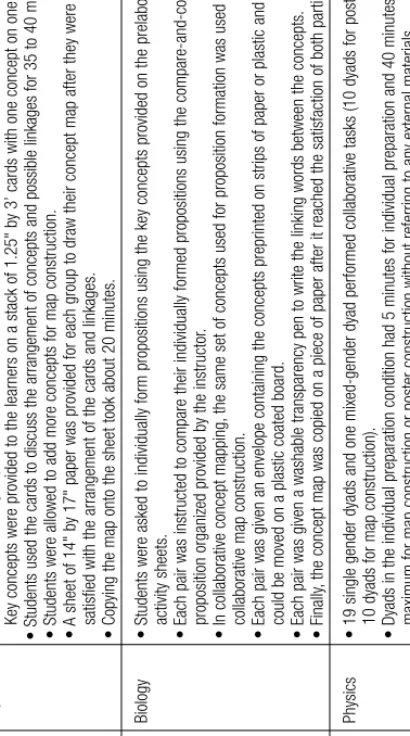
In addition to the assessment of learning outcomes, many studies on col-laborative concept mapping also used interaction as an important index of knowledge construction as they attempted to find out whether concept map-ping facilitated the desired interaction in group work. Most of the studies found little off-task talk among the learners engaged during collaborative concept mapping (Chiu, 2003; Roth & Roychoudhury, 1992, 1993) and numerous indications that most of the interaction centered on the concepts and their relationships (van Boxtel, van der Linden, Roelofs, & Erkens, 2002; Roth & Roychoudhury, 1992, 1993), as illustrated in the summary table (Table 1).
The qualitative study by Roth and Roychoudhury (1993) is representative of the studies in this area in that the collaborative concept mapping tech-nique was an integral component of the course and the study. With data from multiple sources, this study investigated the concept mapping process, prod-ucts from the concept mapping sessions, and achievement at both the indi-vidual and group levels. Examination of the group concept maps found dif-ferences in the number of linkages and the hierarchical organization. In addi-tion, analysis of those individual concept maps constructed on two separate occasions to assess individual cognitive achievement indicated improve-ment of declarative knowledge for several students as well as the existence of dramatic differences in the concept maps developed by different individ-uals from the same collaborative concept-mapping group. Micro-level analysis of instances of knowledge construction revealed that the students were engaged in a sustained science discourse involving processes similar to those of a science community: collaborative construction of propositions, the use of adversarial exchanges, and the formation of temporary alliance. The positive findings from these studies point to the positive effect of col-laborative concept mapping on promoting individual achievement and the quality of group interaction and knowledge construction.
NEGATIVE FINDINGS ASSOCIATED WITH COLLABORATIVE CONCEPT MAPPING Negative findings also have been obtained from studies on collaborative concept mapping. For instance, Ledger (2003) found that collaborative con-cept mapping did not have any effect on students’ self-efficacy nor on their attitudes toward the targeted discipline for the two groups of female eighth-grade science students. In other cases, individual concept maps revealed that
Table 1
A
Summary of Mapping
Technique in the Selected Studies on Collaborative Concept Mapping
Stud y Participant Discipline Mapping Te chnique (i.e.,
The manner in which concept mapping was conducted)
Char
acteristics
Roth &
Roychou-29 males from two
Physics
• Learners worked in groups of three or four
.
dhur
y (1993)
sections of a
Key concepts were provided to the learners on a stack of 1.25" by 3’ cards with one concept on one c
ard.
senior year physics
• Students used the cards to discuss the arrangement of concepts and possible linkages for 35 to 40 minutes
.
course at a private
• Students were allowed to add more concepts for map construction.
school for boys
•
A sheet of 14" by 17" paper was provided for each group to draw their concept map after they were satisfied with the arrangement of the cards and linkages.
• Copying the map onto the sheet took about 20 minutes.
Carter (1998)
College students in
Biology
•
Students were asked to individually form propositions using the key concepts provided
on the prelaborator
y
general biology
activity sheets.
• Each pair was instructed to compare their individually formed propositions using the compare-and-contrast- proposition organized provided by the instructor
.
• In collaborative concept mapping,
the same set of concepts used for proposition formation was used for
collaborative map construction.
• Each pair was given an envelope containing the concepts preprinted on strips of paper or plastic and they could be moved on a plastic coated board. • Each pair was given a washable transparency pen to write the linking words between the concepts. • Finally
,
the concept map was copied on a piece of paper after it reached the satisfaction of both participants.
van Boxtel,
2000
Forty (40) 15 to
16-Physics
• 19 single gender dyads and one mixed-gender dyad performed collaborative tasks (10
dyads for poster and
year
-olds from two
10 dyads for map construction).
physics classes in
• Dyads in the individual preparation condition had 5 minutes for individual preparation and 40 minutes
secondar
y education
maximum for map construction or poster construction without referring to any external materials.
in Netherlands
• Students individually designed the concept map in the preparation phase • Dyads in the control condition had 45 minutes maximum for map or poster construction without referring to external materials.
some students’ declarative knowledge improved while oth-ers did not (Roth & Roychoud-hury, 1993). Some studies in other fields such as manage-ment of information systems have found that the use of con-cept maps failed to assist sys-tem analysts in understanding the conceptual construct of the user(s) for a particular system in the requirement elicitation phase of information system development (Freeman, 2000).
Further negative findings have been gathered from some studies focused on group inter-action as an index for knowl-edge construction. van Boxtel et al. (2002) found that the interac-tion seldom reached the explanatory level where reasons for certain propositions were elaborated by the group. In addi-tion to their positive findings mentioned earlier, Roth and Roychoudhury (1992, 1993) also observed instances where incorrect notions went unchal-lenged and became ingrained. Along the same line, Chiu (2003) found that while few instances of off-task interaction were noted, most of the ontask interactions were devoted to process-oriented exchanges including task collaboration, procedure coordination, and team coordination rather than discussions on the concepts, propositions, or relationships, interactions that are central to knowledge construction.
Simi-Continued fr
om page 485
Table 1
A
Summary of Mapping
Technique in the Selected Studies on Collaborative Concept Mapping
Stud y Participant Discipline Mapping Te chnique (i.e.,
The manner in which concept mapping was conducted)
Char acteristics Chiu, 2003 Thirty (30) 12 to 13-Biology
•The number of nodes/concepts and the number of links were predetermined for each concept
map. year -olds, elementar y related
•Reference to a sheet of theme-related information was allowed.
students working in
(based on
•Communication and map construction occurred through a web-based collaborative concept mapping syst
em.
groups of three in an
the topics)
online learning environ- ment in
Taiwan Ledger , 2003 Eighth-grade science Astronomy
•Students worked in single-sex dyads or triads to construct concept maps.
students from three
•Five maps were constructed during 12 weeks.
schools in the
north-•Key concepts were given to the students for map construction
lar problems were identified in Carter’s study (1998) where collaborative con-cept maps were used in a college biology laboratory. Analysis of the interaction suggested that most students did not pay close attention to each other’s com-ments and did not capitalize on possible opportunities of knowledge construc-tion. It was also observed that students used memorized but not necessarily accurate answers, had difficulty in forming explicit relationships between con-cepts, and found the hierarchical nature of the concept maps to be problematic.
POSSIBLE REASONS FOR MIXED FINDINGS
The mixed findings within and across studies, as illustrated in the sum-mary table below (Table 1), indicate that, although collaborative concept mapping is a promising strategy that can help enhance the quality of inter-action and foster learning and knowledge construction, there are many other factors in the learning environment that influence the collaborative concept mapping activity and affect its effectiveness. The following is a list of pos-sible factors that may have contributed to the different findings.
As stated earlier, collaborative concept mapping resulted in cognitive gain for some students but not for others (Roth & Roychoudhury, 1993). One of the factors is related to learner characteristics and/or learner prefer-ences. Okebukola and Jegede (1988) found that cognitive preference (recall, principles, questioning, and application) significantly influenced meaningful learning through individual concept mapping. The learning process becomes more complicated in collaborative concept mapping as learners working together may have different cognitive preferences, which are simultaneous-ly mediated by the concept map in construction.
Another factor of concern is the context in which the activity is imple-mented. Contextual factors include the type of groups in which the learners were placed (e.g., whether they work in balanced groups or not), the degree of learners’ familiarity with concept mapping techniques, the type of learn-ing environment (e.g., face-to-face learnlearn-ing unmediated by network or net-worked collaboration), the amount of scaffolding presented in the task (e.g., whether key concepts are made available to the learners for map construc-tion), as well as the use of other instructional strategies implemented along with the collaborative concept mapping technique.
The aforementioned studies vary in many aspects of the context in which the collaborative concept mapping activity was implemented. Both the Carter (1998) and van Boxtel (2000) studies had students individually prepare for the collaborative concept mapping activity while others did not. However, the two studies engaged students in different activities in the individual prepara-tion session: Carter’s study had students individually form proposiprepara-tions using the key concepts provided on the prelaboratory activity sheet, and the propo-sitions were discussed prior to the collaborative session. On the other hand,
van Boxtel’s study instructed students to prepare designs for the concept map without referring to external materials. Other differences in the concept map-ping tasks were in the external materials/information allowed as references for map construction. In some cases (Ledger, 2003; Carter, 1998; Roth & Roychoudhury, 1992; 1993), key concepts were provided, while in others (Chiu, 2003) information sheets were available for reference and the number of nodes and links was predetermined by the instructor for the learners. Dif-ferences in the availability of external assistance (e.g., physical tools, the availability of key concepts and/or linking phrases, whether references are allowed during the activity) at the time of concept mapping may have led to engagement of different cognitive processes (Yin, Vanides, Ruiz-Primo, Ayala, & Shavelson, 2004) and diverse levels of cognitive gain.
In addition to the factors revealed in the studies on collaborative concept mapping, findings from the studies on collaborative learning in general also point to some other factors influencing the effectiveness of this learning strategy. These factors include the manner in which the labor was divided (Gifford & Enyedy, 1999), the learners’ perception of their peers’ under-standing of the subject matter and the roles they played in the group (Kittle-son & Southerland, 2004), the nature of the tasks (van Boxtel et al., 1997; Cohen, 1994), the learners’ familiarity with the modes of communication in use (McGrath, Arrow, Gruenfeld, Hollingshead, & O'Connor, 1993), the stu-dents’ orientation towards the work, and the epistemological approach to knowledge (Southerland, 1994). All these play a role in a collaborative activity and may lead to different findings in the studies.
CONCLUSION
The findings from these studies point to some venues for more success-ful implementation of the concept mapping technique in face-to-face situa-tions. For instance, strategies such as placing students in balanced groups and having them individually construct propositions prior to collaboration have been found to result in better knowledge construction (Carter, 1998). In addition, scaffolding and support (e.g., the use of references, the availabili-ty of the key concepts, and linking phrases) are necessary for map construc-tion, particularly for learners who have had little exposure to the concept mapping technique (Gao, 2005). To improve the quality of interaction, pro-tocols or scaffolds (Cho & Jonassen, 2001) may be used in combination with the concept mapping technique and this will be discussed in more detail in the following section on the use of the technique online. The use of the con-cept mapping technique in combination with other instructional strategies will hopefully augment the positive results associated with the technique.
These findings also have implications for the use of the collaborative concept mapping technique in an online environment. The unique feature of
concept maps as shared representations for the learners gives the technique the potential to be powerful online. Research studies conducted in face-to-face situations suggest that the technique has the potential to bring about high quality interaction, help generate explanatory-level justifications, and lead to better learning outcomes and knowledge construction in groups.
However, additional efforts have to be made to successfully implement the technique online. One of the factors that should be taken into considera-tion is the manner in which ideas are communicated during the activity. The study by Simone, Schmid, and McEwen (2001) found that learners preferred synchronous communication over asynchronous communication in online collaborative concept mapping. In addition, online facilitation plays a vital part in successful implementation. Chiu (2003) found more process-orient-ed interaction than content-orientprocess-orient-ed conversation among the participants when they collaborated online. Suthers (2001a) revealed that the participants had more off-topic interactions than those who worked face-to-face. Online facilitation may help alleviate such problems.
Another useful technique previously mentioned is the use of interaction protocols or conversation scaffolds. Conversation scaffolds such as the begin-ning of a statement provided to the learners (Scardamalia & Bereiter, 1994) and protocols with message labels (Jeong & Joung, 2003) may constrain con-versation and make learners more meta-cognitively aware of the interaction process (Holton & Clarke, 2002). With employment of those strategies, it is expected that use of the collaborative concept mapping technique may help achieve desired results in learning and knowledge construction.
IMPLICATIONS FOR FURTHER RESEARCH ON COLLABORATIVE CONCEPT MAPPING
It is clear from review that the studies on collaborative concept mapping are not systematic enough to provide informed guidance for practice. Most of the studies on collaborative concept mapping are conducted with science stu-dents at the secondary or high school level and few studies used the technique with students in other subject areas or disciplines or at different levels.
The previous analysis of the studies in this area also indicates that many different factors are at play in collaborative concept mapping. One of the fac-tors that varied in these studies, as evident in the summary table, is how col-laborative concept mapping is conducted. Examples of variations of the fac-tor are the amount of external support that is made available to the students such as references to which the students have access, and the key concepts and/or linking phrases given to the students for the map construction, and the physical tools provided to learners (e.g., removable cards, erasable board). In addition, factors such as learners’ exposure and experience with the concept mapping technique, the manner in which labor is divided in the group, as well
as the rules imposed upon the groups while they engage in the activity. The factors should be systematically manipulated to examine their impact on both individual learning and group knowledge construction. Knowledge obtained from such studies will not only inform the implementation of the technique in face-to-face situations, but also in online learning environment.
References
Boxtel, C. van (2000).Collaborative concept learning: Collaborative learning tasks, student
interaction and the learning of physics concepts. Unpublished doctoral dissertation, Utrecht University, Utrecht, The Netherlands.
Boxtel, C. van., Linden, J. van der., & Kanselaar, G. (1997). Collaborative construction of conceptual understanding: Interacting processes and learning outcomes emerging from a concept mapping
and a poster task.Journal of Interactive Learning Research, 8(3/4), 341-361.
Boxtel, C. van, Linden, J. van der, Roelofs, E., & Erkens, G. (2002). Collaborative concept mapping:
Provoking and supporting meaningful discourse.Theory into Practice, 41(1), 40.
Carter, C. W. (1998).A case study of meaningful learning in a collaborative concept mapping
strategy as a preparation for a college biology laboratory. Unpublished doctoral dissertation, Georgia State University, Atlanta.
Chiu, C.-H. (2003). Exploring how primary school students function in computer supported collaborative learning. International Journal of Contemporary Engineering and Lifelong Learning, 13(3/4), 258-267.
Cho, K. L., & Jonassen, D. H. (2001). The effects of argumentation scaffolds on argumentation
and problem solving.Educational Technology: Research & Development, 50(3), 5-22.
Cohen, E. G. (1994). Restructuring the classroom: Conditions for productive small groups. Review of Educational Research, 64(1), 1-35.
Crook, C. (1998). Children as computer users: The case of collaborative learning.Comptuers in
Education, 30(3), 237-247.
Derry, S. J., Gance, S., Gance, L. L., & Schlager, M. (2000). Toward assessment of
knowledge-building practices in technology-mediated work group interactions. In S. Lajoie (Ed.),
Com-puter as cognitive tools II. Mahwah, NJ: Lawrence Erlbaum.
Driscoll, M. P. (2000).Psychology of learning for instruction. Needham Heights, MA: Allyn &
Bacon.
Freeman, L. A. (2000).The effects of concept mapping on shared understanding during the
requirement elicitation phase of information systems development.Unpublished doctoral dis-sertation, Indiana University, Bloomington.
Gao, H. (2005). Factors that mediate learning and knowledge construction in collaborative
concept mapping: A case study from activity systems perspective. Paper presented at the 1st Southeast IST Conference, Mobile, AL.
Gifford, B. R., & Enyedy, N. D. (1999).Activity centered design: Towards a theoretical framework
for CSCL. Paper presented at the Third International Conference on Computer Support for Collaborative Learning, Stanford University.
Gunawardena, C., Lowe, C., & Anderson, T. (1997). Analysis of global online debate and the development of an interaction analysis model for examining social construction of knowledge
Hara, N., Bonk, C. J., & Angeli, C. (2000). Content analysis of online discussion in an applied
educational psychology course.Instructional Science, 28(2), 115-152.
Holton, D., & Clarke, D. (2002).Scaffolding and metacognition. Paper presented at the Annual
Meeting of the American Educational Research Association, New Orleans, LA.
Horton, P. B., McConney, A. A., Gallo, M., Woods, A. L., Senn, G. J., & Hamelin, D. (1993). An
investigation of the effectiveness of concept mapping as an instructional tool.Science
Edu-cation, 77(1), 95-111.
Jegede, O. J., Alaiyemola, F. F., & Okebukola, P. A. O. (1990). The effect of concept mapping on
students' anxiety and achievement in biology.Journal of Research in Science Teaching,
27(10), 951-960.
Jeong, A., & Joung, S. (2003).The effects of response constraints and message labels on
inter-action patterns and argumentation in online discussions. Retrieved December 1, 2003, from http://garnet.acns.fsu.edu/~ajeong/
Jonassen, D. H., & Kwon, H. I. (2001). Communication patterns in computer mediated versus
face-to-face group problem solving. Educational Technology Research & Development,
49(1), 35-51.
Kaptelinin, V. (1996). Computer-mediated activity: Functional organs in social and developmental
contexts. In B. A. Nardi (Ed.),Context and consciousness: Activity theory and
human-comput-er inthuman-comput-eraction(pp. 45-68). Cambridge, MA: The MIT Press.
King, A. (1999). Discourse patterns for mediating peer learning. In A. M. O'Donnell & A. King
(Eds.),Cognitive perspectives on peer learning(pp. 87-115). Mahwah, NJ: Lawrence
Erl-baum.
Kittleson, J. M., & Southerland, S. A. (2004). The role of discourse in group knowledge
con-struction: A case study of engineering students.Journal of Research in Science Teaching,
41(3), 267-293.
Lajoie, S. P., Lavigne, N. C., Guerrera, C., & Munsie, S. D. (2001). Constructing knowledge in the
context of BioWorld.Instructional Science, 29(2), 155-186.
Lamon, M., Reeve, R., & Scardamalia, M. (2001).Mapping the growth of deeply principled
understandings in a knowledge building community. Paper presented at the Annual Meeting of the American Educational Research Association, Seattle, WA.
Ledger, A. F. (2003).The effects of collaborative concept mapping on the achievement, science
self-efficacy and attitude toward science of female eighth grade students. Unpublished doc-toral dissertation, University of Massachusetts-Lowell.
Lin, X., K., C., & J., T. (1999). Designing technology to support reflection.Educational Technology
Research & Development, 47(3), 43-62.
Littrell, R. L. (1999). Concept mapping: An instructional tool for learning economics and a
research tool for determining students' understanding of economics. Unpublished doctoral dissertation, the University of Kansas, Lawrence.
Makitalo, K., & Hakkinen, P. (2002).Building and maintaining common ground in web-based
interaction. Paper presented at the CSCL 2002, Boulder, CO.
Mason, C. L. (1992). Concept mapping: A tool to develop reflective science instruction.Science
Education, 76(1), 51-63.
McGrath, J. E., Arrow, H., Gruenfeld, D. H., Hollingshead, A. B., & O'Connor, K. M. (1993). Groups,
tasks, and technology: The effects of experience and change.Small Group Research, 24(3),
Novak, J. D., & Gowin, D. B. (1984).Learning how to learn. Cambridge UK; New York: Cambridge University Press.
Okebukola, P. A., & Jegede, O. J. (1988). Cognitive preference and learning mode as determinants
of meaningful learning through concept mapping.Science Education, 72(4), 489-500.
Ostwald, J. (1996).Knowledge construction in software development: The evolving artifact
approach. Unpublished doctoral dissertation, University of Colorado, Boulder.
Roth, W.-M., & Roychoudhury, A. (1992). The social construction of scientific concepts or the
concept map as conscription device and tool for social thinking in high school science.
Sci-ence Education, 76(5), 531-557.
Roth, W.-M., & Roychoudhury, A. (1993). The concept map as a tool for the collaborative
construction of knowledge: A microanalysis of high school physics students.Journal of
Research in Science Teaching, 30(5), 503-534.
Scardamalia, M., & Bereiter, C. (1994). Computer support for knowledge-building communities. The Journal of the Learning Sciences, 3(3), 265-283.
Simone, C. D., Schmid, R. F., & McEwen, L. A. (2001). Support the learning process with collaborative
concept mapping using computer-based communication tools and processes.Educational
Research and Evaluation, 7(2-3), 263-283.
Southerland, S. (1994).Factors influencing conceptual change in evolution: A longitudinal,
multicase study. Unpublished doctoral dissertation, The Louisiana State University, Baton Rouge.
Suthers, D. (1999).Representational support for collaborative inquiry. Paper presented at the
IEEE, Maui, Hawai'i.
Suthers, D. (2001a).Collaborative representations: Supporting face to face and online knowledge
building discourse. Paper presented at the 34th Hawaii International Conference on the Sys-tem Sciences (HICSS-34), Maui, Hawai'i.
Suthers, D. (2001b). Towards a systematic study of representational guidance for collaborative
learning outcomes.Journal of Universal Computer Science, 7(3).
Suthers, D., Girardeau, L. E., & Hundhausen, C. D. (2002).The roles of representations in online
collaborations. Paper presented at the Annual Conference of the American Educational Research Association, New Orleans, LA.
Suthers, D., & Hundhausen, C. D. (2001).Learning by constructing collaborative representations:
An empirical comparison of three alternatives. Paper presented at the Computer-Supported Collaborative Learning Conference, Universiteit Maastricht, Maastrict, the Netherlands.
Suthers, D., & Hundhausen, C. D. (2002).The effects of representation on students' elaborations
in collaborative inquiry. Paper presented at the CSCL Conference, Boulder, CO.
Yin, Y., Vanides, J., Ruiz-Primo, M. A., Ayala, C. C., & Shavelson, R. J. (2004).A comparison of
two construct-a-concept-map science assessments: Created linking phrases and selected linking phrases. CSE Report 624. (Eric Document Reproduction Service No. ED483390)
Zhang, J. (1997). The nature of external representations in problem solving.Cognitive Science,
21(2), 179-217.
Zhang, J. (1998). A distributed representation approach to group problem solving.Journal of