A Dissertation
Entitled
THE DRIVERS OF ERP IMPLEMENTATION AND ITS IMPACT ON
ORGANIZATIONAL CAPABILITIES AND PERFORMANCE AND
CUSTOMER VALUE
By
Woosang Hwang
Submitted as partial fulfillment of the requirements for
the Doctor of Philosophy degree in
Manufacturing Management
_______________________________
Adviser: Dr. Mark A. Vonderembse
_______________________________
Adviser: Dr. T.S. Ragu-Nathan
_______________________________
Graduate School
Committee Members,
Date of Signature
__________________________ ____________________
Dr. Jenell Wittmer
__________________________ ____________________
Dr. Iryna Pentina
__________________________ ____________________
Dr. Abraham Nahm
__________________________ ____________________
Dr. Peter Lindquist
AN ABSTRACT OF
THE DRIVERS OF ERP IMPLEMENTATION AND ITS IMPACT ON ORGANIZATIONAL CAPABILITIES AND PERFORMANCE AND CUSTOMER
VALUE
Woosang Hwang
Submitted as partial fulfillment of the requirements for the Doctor of Philosophy degree in
Manufacturing Management
The University of Toledo June 2011
In a constantly changing global business environment, firms have no other choice but to continually expand their capabilities and sharpen their competitive edge. Toward this goal, an increasing number of organizations are turning to Enterprise Resource Planning (ERP) systems. An ERP system utilizes various kinds of information processing capabilities and places the gathered data into a single database. Thus, an ERP system is often considered to be a vital element in organizational infrastructure for enhanced visibility and improved performance.
organizational performance. Implementing an ERP system is expensive and time consuming, and firms often fail to obtain the benefits of ERP investments within the anticipated timeframe.
Because of its impact on the organization, ERP implementation must be viewed and undertaken from the perspective of the entire organization and environment, not just as a software installation. Until now, many researchers have only focused on studying the critical success factors in ERP implementation; little attention has been given to the impact of external and internal factors upon ERP implementation. Moreover, researchers have paid little attention to the impact of ERP implementation on suppliers‘ capabilities, organizational capabilities, and customer value. In addition, not many researchers emphasize the importance of integration, configuration, adaptation, and user training in the course of implementing an ERP system.
Drawing from the contingency theory, a resource-based perspective, and dynamic capabilities theory, this study develops a conceptual model and empirically examines the impact of external and internal environments upon successful ERP implementation. This research makes a contribution to the literature by proposing a conceptual model that investigates the causal relationships among eight variables: (1) the internal and (2) external factors that influence ERP implementation, (3) actual ERP implementation, (4) supplier capabilities, (5) organizational capabilities, (6) supplier performance, (7) organizational performance, and (8) customer value.
Through the literature review, 37 sub-constructs for external and internal environment, ERP implementation, supplier/organizational capabilities, supplier/organizational performance, and customer value were identified. Potential measurement items were generated through a literature review and from construct definitions. The measurement items developed for these 37 sub-constructs were tested through structured interviews and Q-sort. Final testing of the instruments was performed through responses from 205 Korean manufacturing firms. Structural
equations modeling (PLS) methodology were used for the testing of relationships among constructs.
Research findings support the notion that organizational readiness and resources led by external environment would affect ERP implementation and further organizational capabilities and performance. It also supports the relationship between ERP implementation and organizational capabilities as well as between ERP implementation and supplier capabilities. Organizational capabilities were highlighted as the mediating variable between ERP implementation and organizational performance. This research found out that customer value is the ultimate outcome of ERP implementation. It also identified the key dimensions that firms should consider in the course of implementing ERP systems. It did not support, however, the relationship between external environment and ERP implementation. The nature of this relationship appears to be indirect rather than direct, being mediated through internal environment. Recommendations for future research and implications for academics and practitioners are provided.
ACKNOWLEDGEMENTS
First of all, I thank God for leading me to Toledo to complete my Ph.D study. At the beginning of my study, I did not know what to do but He surrounded me with the most intelligent and supportive faculty members and colleagues, who guided me step by step to finish my degree.
My special thanks go to Drs. Mark A. Vonderembse and T.S. Ragu-Nathan, who led me to finish my dissertation. I especially thank Dr. Vonderembse, who bore my weaknesses and faithfully advised me for more than 4 years, so that I was able to finish my work and obtain this doctoral degree. Without his strong support, guidance, patience, and support throughout the years, I would not have been able to accomplish this.
My special thanks also go to dissertation committee, Drs. Jenell Wittmer, Iryna Pentina, Peter Lindquist, and Abraham Nahm. They were willing to help me by reading through my dissertation manuscript, engaging in lengthy discussions, and making sincere and thoughtful comments that made this dissertation possible. I am also grateful for the wonderful faculty members who had guided me through the doctoral seminars and classes: Drs. Jeen S. Lim, T.S. Ragu-Nathan, William Doll, Paul Hong, Mark A. Vonderembse, Udayan Nandkeolyar, Ram Rachamadugu, and P.S. Sundararaghavan. I really appreciate Drs. Udayan Nandkeolyar and Mesbah Ahmed who co-worked with me to develop the case-based ERP courses. They helped me to have basic understanding of ERP and encouraged me to study more on ERP systems.
I express my profound gratitude to Dr. Paul Hong, my mentor spiritually and academically during my MBA and PhD study. His practical support, help, and advice were very
instrumental in the continuous growth of my academic and spiritual career. I also cannot forget the faithful prayers the UBF coworkers offered in my behalf. I thank all leaders in both Hanyang and Toledo UBF who prayed for my dissertation. My special thanks go to Dr. Samuel H. Lee and Okhee Lee, shepherd Joshua Lee in Hanyang UBF and Good shepherd fellowship members (Kirk Kayser, Anthony Coca, Alex Helfrish, Sarah Jeong Jr., and Dr. Ruth Jeong) in Toledo UBF. I really appreciate the help of Drs. Daniel Jeong, Joseph Park, James Roh, and Ruth Jeong. I believe many prayers and support offered by these hidden servants of prayer were the real reason behind my success. Praise and thank God!
Lastly, I thank God for Pauline, Paul, Sarah, and Eunice, who prayed and supported their husband and dad with sacrificial love. Pauline really motivated and supported me to study in MBA and PhD programs, working full time as a nurse and taking care of our three children. May I live up to your expectations as a loving husband and a wonderful dad. I also thank my parents who also motivate me to obtain PhD degree. This degree may be used for the salvation of my family members in Korea including my parents. This degree may also be useful to guide many fellow students and even raise up future leaders.
TABLE OF CONTENTS
ABSTRACT ... III ACKNOWLEDGEMENTS ... VI TABLE OF CONTENTS ... VIII LIST OF TABLES...XII LIST OF FIGURES ... XV LIST OF APPENDICES ... XVI
CHAPTER 1. INTRODUCTION ... 1
1.1. Problem statement ... 3
1.2. Research questions ... 5
1.3. Research contributions ... 8
CHAPTER 2. THEORY DEVELOPMENT ... 9
2.1. Introduction of ERP ... 11
2.1.1. The definition of ERP ... 11
2.1.2. The history of ERP ... 12
2.1.3. The key critical success factors of ERP implementation ... 13
2.2. Theoretical background ... 15
2.2.1. The contingency theory ... 15
2.2.2. The resource-based view of a firm ... 17
2.2.3. The dynamic capabilities theory ... 22
2.3. The identification and discussion of constructs... 29
2.3.1. The identification and discussion of constructs... 30
2.3.1.1. Technological change
...
322.3.1.2. Level of competition
...
332.3.1.3. Rapid market change
...
342.3.1.4. Supplier uncertainty
...
352.3.2 Internal environment ... 36
2.3.2.1. Top management support ... 39
2.3.2.2. Organizational culture ... 39
2.3.2.3. Communication ... 41
2.3.2.4. Organizational structure ... 42
2.3.3. ERP implementation ... 46 2.3.3.1. Integration
...
48 2.3.3.2. Configuration...
50 2.3.3.3. Adaptation...
51 2.3.3.4. User Training...
52 2.3.4. Supplier capabilities... 53 2.3.4.1. Information access ... 55 2.3.4.2. Process improvement ... 56 2.3.4.3. Product innovation ... 57 2.3.5. Organizational capabilities ... 58 2.3.5.1. Cross-functional coordination ... 59 2.3.5.2. Information access ... 61 2.3.5.3. Process improvement ... 62 2.3.5.4. Product innovation ... 63 2.3.5.5. Flexibility ... 64 2.3.5.6. Agility ... 65 2.3.6. Supplier performance ... 662.3.6.1. Short lead time
...
682.3.6.2. Product variety
...
70 2.3.6.3. Delivery reliability...
71 2.3.6.4. Cost performance...
71 2.3.6.5. Quality...
72 2.3.7. Organizational performance ... 72 2.3.7.1. Cost performance...
74 2.3.7.2. Product variety...
75 2.3.7.3. Delivery reliability...
77 2.3.7.4. Time-to-market...
77 2.3.7.5. Quality...
78 2.3.8. Customer value... 792.3.8.1. Value for money
...
812.3.8.2. Convenience
...
822.3.8.3. Timely response
...
822.3.8.4. Reputation for quality
...
822.4. Theoretical Model and Hypotheses ... 83
2.4.1. External environment and internal environment ... 83
2.4.2. External environment and ERP implementation ... 85
2.4.3. Internal environment and ERP implementation ... 86
2.4.4. ERP implementation and supplier capabilities ... 88
2.4.5. ERP implementation and organizational capabilities ... 89
2.4.6. Supplier capabilities and supplier performance ... 91
CHAPTER 3. RESEARCH METHODOLOGY ...97
3.1. Item generation ... 97
3.1.1. Item generation for external environment ... 98
3.1.2. Item generation for internal environment ... 99
3.1.3. Item generation for ERP implementation ... 101
3.1.4. Item generation for supplier and organizational capabilities ... 102
3.1.5. Item generation for supplier and organizational performance ... 104
3.1.6. Item generation for customer value. ... 106
3.2. Structured interviews ... 107
3.3. The Q-sort method ... 109
3.3.1. Sorting procedures ... 111
3.3.2. Inter-Rater reliabilities... 111
3.3.3. Results of first sorting round for 1st part... 112
3.3.4. Results of second sorting round for 1st part ... 117
3.3.5. Results of first sorting round for 2nd part ... 121
3.3.6. Results of second sorting round for 2nd part ... 126
3.3.7. Results of third sorting round for 2nd part ... 130
3.4. Pre-testing of questionnaire ... 134
CHAPTER 4. INSTRUMENT DEVELOPMENT PHASE II:
EXPLORATORY DATA ANALYSIS ...137
4.1. Description of sample ... 145
4.2. Research Methods ... 145
4.3. Large scale measurement results ... 150
4.3.1. External environment instrument ... 150
4.3.2. Internal environment instrument ... 155
4.3.3. ERP implementation instrument... 162
4.3.4. Supplier capabilities instrument ... 166
4.3.5. Organizational capabilities instrument ... 170
4.3.6. Supplier performance instrument ... 176
4.3.7. Organizational performance instrument ... 181
4.3.8. Customer value instrument ... 186
4.4. Summary of measurement analysis ... 190
4.5. Construct-level correlation analysis ... 193
CHAPTER 5: CAUSAL MODEL AND HYPOTHESES TESTING ...195
5.2.1. Discussion of structural modeling and results of hypotheses ... 198
CHAPTER 6: SUMMARY AND RECOMMENDATIONS FOR FUTURE
RESEARCH ...212
6.1. Summary of the research findings and major contributions ... 212
6.2. Implications for academics and practitioners ... 214
6.2.1. Implications for academics ... 214
6.2.2. Implications for practitioners ... 218
6.3. Limitations of the research ... 220
6.4. Recommendations for future research ... 221
6.4.1. Recommendations and discussion of measurement Issues ... 222
6.4.2. Recommendations and discussion of structural Issues ... 222
LIST OF TABLES
Table 2.2.2. Resource characteristics ... 19
Table 2.2.3.1. Categories of dynamic capabilities ... 24
Table 2.3.1. List of sub-constructs for external environments ... 32
Table 2.3.2. List of sub-constructs for internal Environments ... 38
Table 2.3.3. List of sub-constructs for ERP implementation ... 48
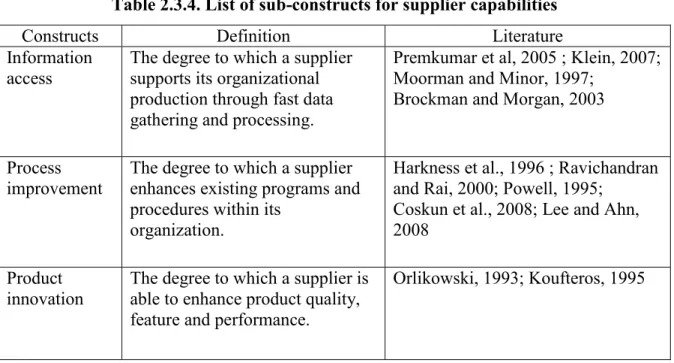
Table 2.3.4. List of sub-constructs for supplier capabilities ... 55
Table 2.3.5. List of sub-constructs for organizational capabilities ... 59
Table 2.3.6. List of sub-constructs for supplier performance ... 68
Table 2.3.7. List of sub-constructs for organizational performance ... 74
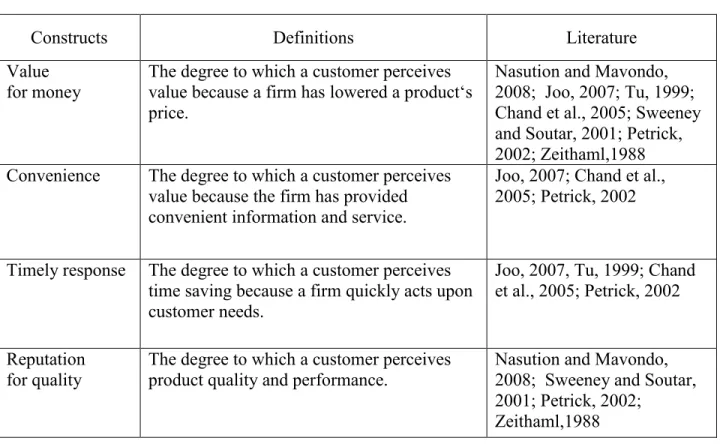
Table 2.3.8. List of sub-constructs for customer value ... 81
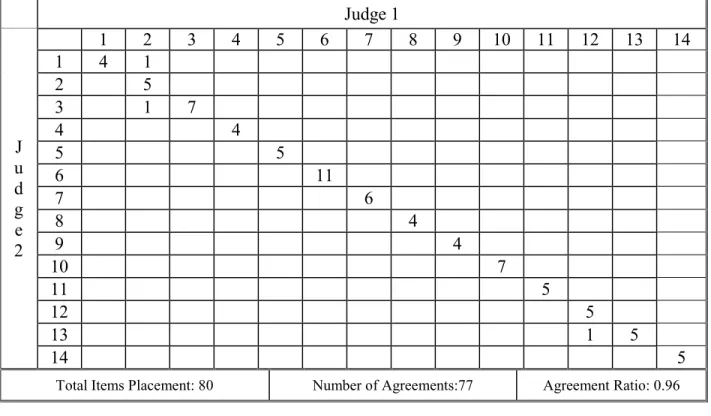
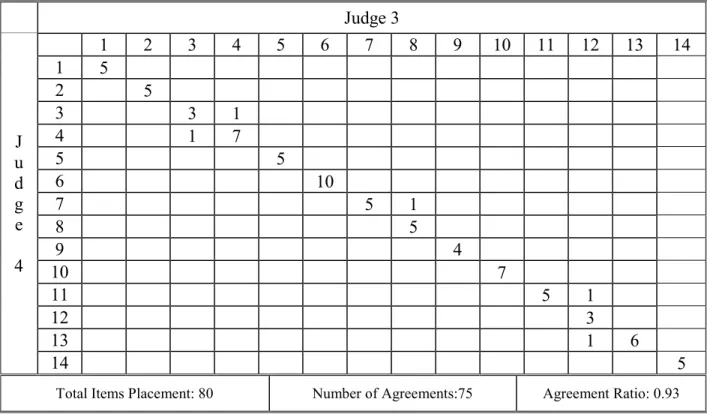
Table 3.3.3.1. Inter-judge raw agreement scores: the first sorting round for the 1st part of the Q-sort ... 114
Table 3.3.3.2. Items placement ratios: the first sorting round for the 1st part of the Q-sort .... 115
Table 3.3.3.3. Inter-judge agreements (the 1st part of the Q-sort) ... 116
Table 3.3.4.1. Inter-judge raw agreement scores:the second sorting round for the 1st part of the Q-sort ... 119
Table 3.3.4.2. Items placement ratios: the second sorting round for the 1st part of the Q-sort 120 Table 3.3.5.1. Inter-judge raw agreement scores:the first sorting round for the 2nd part of the Q-sort ... 123
Table 3.3.5.2. Items placement ratios: the first sorting round for the 2nd part of the Q-sort .... 124
Table 3.3.5.3. Inter-judge agreements (the 2nd part of the Q-sort) ... 125
Table 3.3.6.1. Inter-judge raw agreement scores: the second sorting round for the 2nd part of the Q-sort ... 128
Table 3.3.6.2. Items placement ratios: the second sorting round for the 2nd part of the Q-sort 129 Table 3.3.7.1. Inter-judge raw agreement scores: the third sorting round for the 2nd part of the Q-sort ... 132
Table 3.3.7.2. Items placement ratios: the third sorting round for the 2nd part of the Q-sort ... 133
Table 4.1 Description of Sample ... 139
Table 4.3.1.2. Exploratory factor analysis for retained External Environment items ... 153
Table 4.3.1.3. Item correlation matrix, descriptive statistics, and discriminant validity tests for External Environment (large scale) ... 154
Table 4.3.1.4. Goodness of Fit Indexes for First and Second Order Model ... 155
Table 4.3.2.1. Purification for Internal Environment (large scale) ... 158
Table 4.3.2.2. Exploratory factor analysis for retained Internal Environment Items (large scale) . ... 160
Table 4.3.2.3. Item correlation matrix, descriptive statistics, and discriminant validity tests for Internal Environment (large scale) ... 161
Table 4.3.3.1. Purification for ERP Implementation (large scale) ... 164
Table 4.3.3.2. Exploratory factor analysis for retained ERP Implementation (large scale) ... 165
Table 4.3.3.3. Item correlation matrix, descriptive statistics, and discriminant validity tests for ERP Implementation (large scale) ... 166
Table 4.3.4.1. Purification for Supplier Capabilities (large scale) ... 168
Table 4.3.4.2. Exploratory factor analysis for retained Supplier Capabilities items (large scale) .. ... 169
Table 4.3.4.3. Item correlation matrix, descriptive statistics, and discriminant validity tests for Supplier Capabilities (large scale) ... 169
Table 4.3.5.1. Purification for Organizational Capabilities (large scale) ... 173
Table 4.3.5.2. Exploratory factor analysis for retained Organizational Capabilities (large scale) . ... 174
Table 4.3.5.3. Item correlation matrix, descriptive statistics, and discriminant validity tests for Organizational Capabilities (large scale) ... 175
Table 4.3.6.1. Purification for Supplier Performance (large scale) ... 178
Table 4.3.6.2. Exploratory factor analysis for retained Supplier Performance items (large scale)
... 179
Table 4.3.6.3. Item correlation matrix, descriptive statistics, and discriminant validity tests for Supplier Performance (large scale) ... 180
Table 4.3.7.1. Purification for Organizational Performance (large scale) ... 183
Table 4.3.7.2. Exploratory factor analysis for retained Organizational Performance items (large scale) ... 184
Table 4.3.7.3. Item correlation matrix, descriptive statistics, and discriminant validity tests for Organizational Performance (large scale) ... 185
Table 4.3.8.3. Item correlation matrix, descriptive statistics, and discriminant validity tests for
Customer Value (large scale) ... 190
Table 4.4.1. Summary of measurement analysis ... 192
Table 4.5.1. Construct-level correlation analysis results ... 194
Table 5.2.1. Summary of PLS Generated Data for Indicators ... 206
Table 5.2.2. Summary of PLS generated data for hypotheses testing ... 210
LIST OF FIGURES
Figure 2.2.1. Evolution of ERP ... 13
Figure 2.2.2.1. The resource-based view over time ... 20
Figure 2.2.2.2. Transformation from resources to competitive advantage ... 21
Figure 2.3. The research model ... 29
Figure 4.1. Respondents by job title ... 141
Figure 4.2. Respondents by firm size (# of employees) ... 142
Figure 4.3. Respondents by product complexity ... 143
Figure 4.4. Respondents by SIC code ... 145
Figure 4.4.1. Revised research framework ... 191
Figure 5.1.1. Primary causal model ... 205
Figure 5.2.1. Result of PLS analysis ... 207
Figure 5.2.2. Result of PLS analysis (Beta coefficients) ... 208
LIST OF APPENDICES
APPENDIX A: MEASUREMENT ITEMS ENTERING Q-SORT ... 255
APPENDIX B: COHEN‘S KAPPA AND MOORE AND BENBASAT COEFFICIENT ... 261
APPENDIX C: LIST OF CONTEXTUAL AND PERFORMANCE VARIABLES ... 265
APPENDIX D: ACRONYMS USED FOR CODING OF ITEMS IN EACH SUB-CONSTRUCT
... 266
APPENDIX E: MEASUREMENT ITEMS BEFORE THE LARGE STUDY ... 268
CHAPTER 1. INTRODUCTION
In a global business environment, firms are seeking to improve or maintain their competitiveness in the increasingly challenging global marketplace. Information systems are often used as tools to improve customer service, reduce cycle times, increase effectiveness, and decrease cost. Enterprise Resource Planning (ERP) systems have drawn increasing attention because they provide a variety of benefits to a business. ERP, which evolved from Manufacturing Requirements Planning (MRP), is an integrated information system that supports business processes and functions by managing the entire organization‘s resources efficiently and effectively. In other words, ERP involves the planning and managing of the organization‘s resources in the most efficient, productive, and profitable manner (Barker and Frolick, 2003). It enables companies to integrate their business processes and all information relevant to their organization (Nah and Delgado, 2006). Kumar and Van Hillegersberg (2000) define it as configurable information systems packages that integrate information and business processes within and across functional boundaries within an organization. ERP is a comprehensive software solution that seeks to integrate the complete range of business processes and functions, in order to present a company-wide view of the business from a single IT architecture (Al-Mashari et al., 2003). When companies have efficient business processes, they can be more competitive in the marketplace.
The benefits of ERP systems are linked to effectiveness and efficiency of business processes because firms can get more accurate and timely information (Trott and Hoecht, 2004). Through integrating business functions, firms can reduce data collection time and avoid data
quality as well as facilitates communication between users. Barriers between business functions and departments are lowered because an ERP system is a vehicle that integrates business processes across functional boundaries. Links with suppliers and customers can be significantly strengthened (Gupta, 2000; Trott and Hoecht, 2004). ERP systems improve coordination and facilitate cooperation with suppliers, and they improve responsiveness to market and customer requirements. ERP systems also allow firms to access electronic commerce. Therefore, implementation and upgrades of ERP systems are identified as one of the top five IT priorities among global chief information officers (CIOs) (Deloitte Touche and IDG Research Services Group Report, 2002; Beatty and Williams, 2006). A recent study by AMR1 Research indicates that the enterprise application market is expected to grow from $28.8 billion in 2006 to $47.7 billion by 2011. Core ERP license revenue grew to $9.2 billion in 2006, an 18% increase over 2005.
Many researchers have studied the reasons for ERP implementation (Jones et al, 2006; Beatty and Williams, 2006; Shang and Seddon, 2002; Al-Mashari et al, 2003, Finney and Corbett, 2007; Nah and Delgado, 2006; Soja, 2006; Ulrich, 2007): Companies want to (1) integrate financial data; (2) standardize manufacturing processes; (3) standardize human resource (HR) information; (4) have real-time information; (5) generate information for decision making; (6) reduce costs; (7) increase sales; (8) fulfill taxation requirements; and (9) respond to growing global competition. ERP systems can be comprehensive and useful in integrating many kinds of information processing abilities by placing data into a single database. Successful ERP implementation is quite beneficial to firms and provides them with competitive advantages
(Teece et al., 1997). This explains why an ERP system is generally considered to be a vital element for enhanced business performance.
1.1. Problem statement
ERP implementation, however, brings not only business gain but also business pain (Cissna, 1998). Although ERP systems have many advantages and become a focal point of business and technology planning, implementing ERP systems is expensive and time consuming (Sweat, 1998). The cost associated with ERP implementation is often greater than planned because of many hidden costs such as training, customization, integration, and data conversion. The business managers of organizations with significant ERP experience suggest that the cost of introducing ERP systems is close to the cost to rebuild the firm‘s information infrastructure (Trott and Hoecht, 2004). Firms typically fail to obtain the benefits of ERP investment within the anticipated timeframe (Pollock et al., 2003; Barker and Frolick, 2003). Besides, little attention has been given to the impact of external and internal environmental factors of firms that have implemented ERP. Because of its impact on the organization, ERP implementation must be viewed and undertaken from the perspective of the entire organization and its environment, not just as a software installation.
Despite the need of the comprehensive framework to understand the drivers of ERP implementation and its impacts, many researchers have focused their efforts on studying the critical success factors of ERP implementation (Al-Mashari et al., 2003; Nah and Delgado, 2006; Soja, 2006; Nah et al., 2001; Ulrich, 2007) and the direct relationship between ERP implementation and business performance (Hendricks et al., 2007; Huang et al., 2007). Besides,
impact of ERP implementation on both suppliers and organizational capabilities. Recently, researchers have begun to explore how some organizations develop firm-specific capabilities and how they renew competences to respond to a turbulent business environment, and to study the impact of IT capabilities on a firm‘s performance (Li et al., 2006; Sanders and Robert, 2005; Santhanam and Edward, 2003). However, not many researchers pay attention to the impact of ERP implementation on both suppliers and organizational capabilities.
In addition, not many researchers emphasize the importance of integration, configuration, adaptation, and user training in the course of implementing an ERP system (Hong and Kim, 2002; Davenport, 1998). In order to work efficiently and effectively, ERP systems must work with organizational processes (Hong and Kim, 2002; Davenport, 1998; Kim et al., 2005; Klein, 2007). ERP systems do not easily fit into a typical organization which needs to keep moving forward and change its processes and plans to respond to the turbulence of today‘s business environment. Thus, in order to improve the efficiency and effectiveness of an ERP system, there is a growing need to focus on integration, configuration, and adaptation (King and Flor, 2007; Al-Mashari et al., 2003; Hong and Kim, 2002; Finney and Corbett, 2007; Markus and Tanis, 2000). From a human perspective, ERP user training is also a critical issue in ERP implementation (Hong and Kim, 2002; Davenport, 1998; Nah et al., 2001).
Because ERP implementation affects the entire organization, important issues related to ERP implementation should be examined. They are the external and internal environment of ERP implementation, critical issues in actual ERP implementation, and the effects of ERP implementation on both the organization and its suppliers. Therefore, this study intends to provide new perspectives in understanding both the impact of the environments on successful ERP implementation and the role of an ERP in creating sustained competitive advantages for the
firm. Drawing from contingency theory, the resource-based view of a firm theory, and the dynamic capabilities theory, this paper proposes that successful ERP implementation enables firms to improve organizational capabilities as well as customer value.
1.2. Research questions
Acknowledging the need to understand the impact of ERP implementation on organizations, this research attempts to answer the following questions.
(1) What are the drivers of ERP implementation?
What makes firms implement an ERP system? This study explores the driving factors of ERP implementation. In a dynamic business environment, organizations need to become globally competitive. The need to accommodate customer demands and provide quality goods and services in the shortest lead time force firms to adopt ERP systems. Organizational readiness, resources and capabilities in the internal environment enable a firm to implement an ERP system. In a sense, environments of organizations can change the way they do business. Therefore, it is critical to study the external and internal environmental factors that influence ERP implementation.
(2) What is the ultimate outcome of ERP implementation?
In the past, firms focused on profit maximization and stockholder wealth maximization. They were the ultimate goals of most firms. But these days, many firms emphasized customer value. Those who really consider customer value can survive in an uncertain business environment. However, many researchers do not see customer value as the ultimate goal or
implementation from the perspective of organizational performance as well as customer value. Therefore, it is valuable to examine the ultimate outcome of ERP implementation.
(3) What are the mediating variable between ERP implementation and performance?
Many researchers have mentioned a direct relationship between IT investment and organizational performance. However, research on the ERP benefits is often contradictory. Better information integration through ERP implementation provides a competitive advantage (Davenport, 1998; Al-Mashari et al., 2003; Hong and Kim, 2002; Finney and Corbett, 2007). Some researchers have reported that firms typically fail to obtain the full benefits of ERP investment (Pollock et al., 2003; Barker and Frolick, 2003). The main reason that benefits are uneven is that research tends to focus on financial performance. That is, business performance is usually quantified in productivity measures or profitability measures such as ROE (Return on Equity), ROI (Return on Investment), and market share. However, there are many factors which affect the financial performance of organizations such as strategy, organizational culture, organizational competences, and financial standing.
On the other hand, organizational capabilities may be important variables that firms should regard as successful outcome of ERP implementation. Recent research has sought to identify and explain how and why information technology creates business value via the inclusion of organizational factors (Shin et al., 2000; Cao et al., 2011). Instead of assuming that information technology directly impacts organizational performance, a mediation model asserts that information technology affects the organizational factors, which in turn impacts organizational performance. Therefore, it is imperative to examine the complementary outcomes that the implementation of an ERP resource can facilitate (resource complementarity). It has
been found by some research that the implementation of an ERP system can impact organizational performance directly or indirectly (Ng, 2006; Wade and Hulland, 2004).
(4) What are the critical factors for successful ERP implementation?
In the course of ERP implementation, what factors should firm consider? In this study, the critical sub-constructs in the ERP implementation stage will be examined to better understand the relationships with other constructs such as the firm‘s internal environment and organizational capabilities. Separated from environmental factors, there are some important success factors in the ERP implementation stage. From the perspective of the dynamic capability theory, this study will examine key factors critical to implementing an ERP system in a turbulent and changing business environment.
1.3. Research contributions
This research proposes a conceptual model that investigates the causal relationships among eight variables; (1) the internal and (2) external factors that influence ERP implementation, (3) actual ERP implementation, (4) supplier capabilities, (5) organizational capabilities, (6) supplier performance, (7) organizational performance, and (8) customer value.
This research will contribute to the literature by exploring the relationships among internal and external factors for ERP implementation, actual ERP implementation, supplier and organizational capabilities and performance. Few empirical measures exist to identify the critical factors in ERP implementation most conducive for enhanced organizational capabilities, supplier capabilities, and performance. This research will respond to these needs by using a large sample
would be the development of valid and reliable measurement instruments for each construct, such as the external and internal environments for ERP implementation, actual ERP implementation, and supplier/organizational capabilities. The measurement instruments for other constructs in the proposed model are adapted with modification from earlier studies.
From a practitioner‘s point of view, this research provides an organization with important guidelines to better understand ERP implementation issues and its impact on both the organization and its partners including suppliers and customers. This research also identifies the factors for facilitating ERP implementation. Moreover, the measures of organizational performance and customer value provide a valuable tool for organizations to evaluate the results of ERP implementation.
The rest of this paper is organized as follows. In Chapter 2, a brief review of the contingency theory, the resource-based view of the firm, and dynamic capability theory, as well as the overall framework that depicts the relationships among the constructs are presented. The research methodology for generating survey items is discussed in Chapter 3. This study uses interviews with practitioners, Q-sort method as a pilot study, and a large scale survey method. Next, chapter 4 deals with instrument development and exploratory data analysis. This includes large-scale survey methods, validity and reliability results. In chapter 5, the results of hypotheses testing are presented. Chapter 6 concludes with a summary of research findings, major contributions, implications for academics and managers, limitations of the research, and recommendations for future research.
CHAPTER 2. LITERATURE REVIEW AND THEORY
DEVELOPMENT
In a turbulent and uncertain business environment, a firm develops its resources and capabilities to improve or maintain its competitiveness. A firm needs to provide a product or service in the right place at the right time at the lowest cost. Many firms are employing ERP solutions to respond to customers‘ demands with speed and accuracy. Using ERP systems effectively is essential to stay competitive and profitable. In order to further understand the impact of ERP systems, different theories have offered insights into finding the critical success factors of ERP implementation and understanding the consequences of it on organizations. The following sections provide a brief introduction of an ERP system, theories that support the rationale of successful ERP implementation, and its impact on organizations. Next, a research model that is grounded in reviewed theories is presented. After that, the literature review is proposed and hypotheses are developed.
2.1. Introduction of ERP
2.1.1. The definition of ERP
Enterprise Resource Planning (ERP) is a useful system to organize activities, decision, and information flows across many different functions and departments in a firm (Jacobs and Weston Jr., 2007; Basoglu et al. 2007; Koh et al., 2008). ERP is the leading approach to integrate business management and information technology. Basoglu et al. (2007) defined ERP systems as
handles the majority of an enterprise‘s system requirement in all functional areas, such as accounting, human resources, finance, sales, marketing, and manufacturing. ERP systems provide a seamless integration of all the information flows in an organization to eliminate cross-functional coordination issues in the business process (Davenport, 1998). Through implementing of ERP system, firms can reduce the overall costs, make accurate data available in real time, and exchange information with customers and suppliers (Umble et al., 2003, Basoglu et al., 2007). Thus, a firm implementing an ERP system can have benefits such as fast and accurate information gathering, quick decision making, low inventory cost, improved interaction with customers, and improved product quality. Therefore, ERP can be defined as an integrated information system that supports the business processes and functions through managing the entire organization‘s resources efficiently and effectively.
2.1.2. The history of ERP
The evolution of an ERP system dates back to 1960. In the 1960s the primary source of competitiveness was cost. At that time, firms focused on high-volume production, cost minimization, and managing large inventories efficiently (Umble et al., 2003; Basolgu et al., 2007). An information system was designed to forecast inventory needs for companies. The shortcoming of this initial system is that it did not factor in customer demand for products. However, the introduction of a computerized reorder point system (ROP) was enough to satisfy basic manufacturing planning and control.
Material Requirements Planning (MRP)–the predecessor of Manufacturing Resource Planning (MRP II) and ERP—was born in the late 1960s. The MRP system was developed to
requirements for products according to the master production schedule (MPS) (Rashid et al., 2002; Umble et al., 2003). Bill of material files identified the specific materials needed to produce each finished items, supporting a master production schedule. For the first time in manufacturing, there was a formal mechanism to keep priorities straight in a manufacturing environment (Basolgu et al., 2007; Ptak and Schragenheim, 2000). MRP systems fit the adoption of target-market strategies with an emphasis on greater production integration and planning quite well because of the integration between forecasting, master production scheduling, procurement, and shop floor control. MRP was essential for implementing the materials planning concept in production management and control (Jacobs and Weston Jr., 2007).
In the 1980s, the MRP system evolved from a simple MRP tool to become standard manufacturing resource planning (MRPII) (Basoglu et al., 2007). MRP II emphasizes optimizing manufacturing processes by synchronizing materials with production requirements. With the change in the scope of software applications, there came a change in manufacturing theory. Competitive firms started to focus more on quality. This gave rise to -the emergence of the quality gurus such as Deming and Juran (Jacobs and Weston Jr., 2007). Manufacturing strategy began to focus on process control, closed-loop scheduling, reduced overhead costs, enhanced shop floor reporting, and detailed cost reporting (Summer, 2005). MRP II systems incorporated the financial accounting and management systems along with the manufacturing and materials management systems (Umble et al., 2003; Basoglu et al., 2007). However, MRP II had shortcomings in managing a production facility‘s orders, production plans, and inventories. It has a few inherent drawbacks such as limited focus to manufacturing activities, forecasting of mass production needs, and poor budgetary controls. The shortcomings of MRP II led to the
In the early 1990s, the term Enterprise Resource Planning (ERP) was first employed by the Gartner Group. This system connected all departments in a firm. Certainly, a major factor in the growth of ERP systems was the year 2000 (Y2K) problem. Small-to medium-sized enterprises (SMEs) as well as large companies were to adopt ERP systems to address needed fixes to legacy systems that were not Y2K compliant. However, Y2K was the single event that enabled the ERP industry to become mature and ERP vendors to be consolidated. ERP is an updated MRP II system that includes relational database management, graphical user interface, and client-server architecture (Basoglu et al., 2007). In addition, ERP systems are useful to integrate inventory data with financial, sales, and human resource data. They enable organizations to set prices on their products and produce financial reports. They also enable firms to effectively manage their resources in areas such as HR, finance and materials (Markus et al., 2000, Basoglu et al, 2007).
ERP systems produced by companies such as SAP gained more interest in the market because they enabled firms to upgrade their capabilities and to improve their business processes and procedures. In the highly competitive and rapidly changing business environment, a firm needs to make right and timely decisions. ERP systems enabled firms to gain competitive advantages through integrating and optimizing business processes (Davenport, 1998). For that reason, ERP has gained importance in the business strategy field.
Initially, ERP systems focused on back office functions, but front office functions such as customer relationship management (CRM), e-business systems, or supplier relationship management (SRM), became integrated by using Electronic Data Interchange (EDI) systems. "ERP II", web-based software, was employed in the early 2000s. Both employees and partners, such as suppliers and customers were allowed real-time access to the system. In a word, current
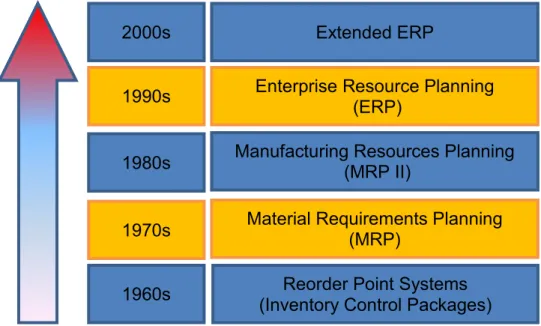
ERP systems are more incorporated solutions. They integrate the manufacturing process with the supply chain process across the firm. It was designed to integrate the firm‘s business processes to create a seamless information flow beginning with suppliers, going through the manufacturing process, and finally ending with the customer (Summer, 2005). Figure 2.2.1 shows the historical evolution of ERP systems in detail.
Figure 2.2.1. Evolution of ERP (Rashid et al., 2002)
2.1.3. The key critical success factors of ERP implementation
Researchers who study the key success factors of ERP implementation point to leadership and management commitment as the most important critical success factor of ERP implementation (Bingi et al., 1999). The software selection steps and the implementation procedures are also key success factors in ERP implementation (Umble et al., 2003). All the processes within a firm must coordinate with the ERP system (Mashari et al., 2003).
Al-Extended ERP 2000s
1960s 1990s
1980s Manufacturing Resources Planning (MRP II) 1970s Material Requirements Planning (MRP)
Enterprise Resource Planning (ERP)
Reorder Point Systems (Inventory Control Packages)
between implementation approach and business-wide performance measures is established. They emphasized the importance of top management support, visioning, and planning for setting an ERP system up. In their paper, ERP package selection, communication, process management, training and education, project management, legacy system management, system integration, system testing, and cultural as well as structural changes were stressed for implementation. They also highlighted performance evaluation and proposed a way to manage the evaluation of the system.
Nah et al. (2003) identified five key success factors from the CIO‘s perspective, which are (1) top management support; (2) the presence of a project champion; (3) ERP teamwork including the composition of the team; (4) project management including a change of management program; and (5) culture. Many researchers also emphasize organizational fit, internal restructuring, and pre-implementation attitudes (Hong and Kim, 2002; Abdinnour-Helm et al., 2003; Ke and Wei, 2008; Morton and Hu, 2008). Tarafdar and Roy (2003) present the ERP implementation process consisting of distinct stages: planning, implementation, and post-implementation review. They emphasized the importance of four elements in the planning stage: building up a business case for ERP, understanding the specific characteristics of the business implementing the ERP system, assessing the IT readiness of the organization, and project planning. In the implementation stage, management of technical aspects and organizational change management are highlighted. Finally, they underlined the importance of institutionalizing process changes, formalizing organizational benefits, and assimilating learning in the post-implementation review stage. Ehie and Madsen (2005) divided the ERP post-implementation into five major phases: project preparation, business blueprint, realization, final preparation, and go live and support. Project management principles, feasibility/evaluation of ERP projects, process
re-engineering, top management support, cost/budget, and consulting services are identified and measured as critical factors for the implementation of ERP systems. Sarker and Lee (2003), in their paper, indicate that three key social enablers – strong and committed leadership, open and honest communication, and a balanced and empowered implementation team are essential conditions for ERP implementation success.
2.2. Theoretical background
2.2.1. Contingency theory
Contingency theory, which was developed in the late 1960s, is one of the behavioral theories that study how environmental variables influence the behaviors of organizations (Lawrence and Lorsch, 1967; Franks, 2000; Chandra and Kumar, 2000). Contingency theory argues that there is no best way to make decisions and to organize a company. Organization‘s decisions and actions are contingent on internal and external situations. In other words, the organizational strategy is dependent on its endogenous and exogenous business environments (Donaldson, 2001). Previous researchers have failed to consider contingency factors, such as technological changes, rapid market changes, and globalization, which in turn influence management techniques, organizational culture, and structure (Donaldson, 2001; Nahm et al., 2003). When a firm‘s environmental turbulence is high, greater effort is required to process information (Sherman et al., 2005; Citrin et al., 2007). In highly turbulent business environments, a firm faces difficulty in interpreting the needs of the customers and in forecasting market trends. As a result, having relevant and accurate information for decision making becomes more critical for the success of the firm (Citrin et al., 2007).
Organizational structures are determined by contingencies in the external environment, such as the degree of environmental uncertainty and technological change (Lawrence and Lorsh, 1967; Parker, 1995). Forms of organizations can be different according to the external environments they are placed in. Attaining goodness of fit between a firm‘s external environment and structure affects its performance significantly (Parker, 1995). Historically, contingency theory in operations management literature has sought to find the best fit for the use of various technologies in a given environment to which an organization must relate (Parker, 1995; Lawrence and Lorsh, 1967; Hong and Kim, 2002). Many researchers have studied the impact of contingency factors such as environmental uncertainty on organizational structure, strategy, and performance. They emphasize the importance of a ―good fit‖ between business strategy and IT strategy (Nahm and Vonderembse, 2002; March and Simon, 1958; Chandler, 1962).
In their strategic alignment model, Henderson and Venkatraman (1999) stressed the importance of strategic fit and functional integration. They argue that the lack of fit between business and IT strategy can make it difficult for a firm to recognize the actual value of an IT investment. Management information systems researchers generally assume that organizational performance is contingent on a number of variables such as strategy, technology, innovation, environmental change, structure, size, task, and individual characteristics (Cao et al., 2011; Morton and Hu, 2008; Donaldson, 2001). When the fit between these variables is good, better performance is expected, but misalignment results in problems, dysfunctions, and inferior performance (Weil and Olson, 1989).
Applying contingency theory in the context of ERP implementation, ERP systems can be seen to possess characteristics that relate to external environment uncertainty, as well as the internal environment. Examples of these are organizational structure, business process
reengineering, organizational culture, IT readiness, and other organizational characteristics. The fit between organizational environments and characteristics of ERP systems has a significant role in the success of ERP implementation within organizations. An organizational culture in which sub-units are inter-dependent can give a better fit to a company that has an ERP with global operation needs (Hong and Kim, 2002). Soh et al. (2000) suggested that the firm-specific requirements that do not match ERP capabilities lead to ERP misfit within an organization. The congruence between the characteristics of an ERP system and its organizational context is critical for ERP implementation success.
Therefore, identification of a set of dimensions of organizational environments internally and externally and ERP system characteristics provides some insights into successful ERP implementation.
2.2.2. The resource-based view of a firm
The resource-based view of a firm (RBVF) argues that firms which possess unique resources achieve competitive advantage and have superior long-term performance (Barney, 1991, Wade and Hulland, 2004; Grant, 1991; Wernerfelt, 1984). Individual and firm-specific resources have significant effects on performance (Wade and Hulland, 2004). Resources are referred as ―all assets, capabilities, organizational process, firm attributes, information, knowledge, etc. controlled by a firm that enable the firm to conceive and implement strategies that improve its efficiency and effectiveness‖ (Barney, 1991). These resources are the ones used to create, produce, and offer its products to a market (Sanchez, 1995).
1995). Assets are defined as anything tangible (e.g. computer hardware, software, or network infrastructure), or intangible (software patents, relationship with supplier) the firm can use in its processes to provide product to a market. In contrast, capabilities are repeatable patterns of actions in the use of assets to offer products to a market. Capabilities enable a firm to transform inputs into outputs of greater worth (Amit and Schoemaker, 1993; Wade and Hulland, 2004). In the resource based view of a firm, many researchers mention that not only a firm‘s assets but also its capabilities are important to gain a competitive advantage (Barney and Clark, 2007; Bharadwaj, 2000; Carmeli and Tishler, 2004).
In the literature, the resource-based view of a firm claims that firms compete on the basis of "unique" corporate resources that are valuable, rare, difficult to imitate, and non-substitutable (VRIN) by competitors (Barney, 1991; Wade and Hulland, 2004). Two characteristics (appropriable and imperfectly mobile) are added in VRIN conditions (Wade and Hulland, 2004). The definitions for the characteristics of resources are summarized in Table 2.2.2. These resource characteristics enable firms to create and sustain competitive advantage and superior long-term performance (Grant, 1991; Penrose, 1959; Wade and Hulland, 2004).
Table 2.2.2. Resource characteristics
(Adapted from Wade and Hulland, 2004)
RBVF
Characteristics Definition
Value
(Valuable) A valuable resource enables a firm to implement strategies that improve efficiency and effectiveness (Barney, 1999). A firm that possesses resources with little value have a limited possibility to have g a sustained competitive advantage (Wade and Hulland, 2004)
Rarity (Rare) A rare resource is scare and not simultaneously available to a large number of firms (Amit and Shoemaker, 1993). A firm that has resources with little rarity cannot easily create a strategic benefit. Appropriability
(Appropriate) An appropriate resource is suitable for a particular firm environment (Amit and Shoemaker, 1993; Grant, 1991). Fitting a firm with rare and valuable resources create competitive advantage.
Inimitability
(Inimitable) An inimitable resource is not quickly duplicable (Barney, 1991). Inimitable resources can only be developed over long periods of time. This can include organizational culture, tacit attributes, reputation and trustworthiness.
Non-substitutability
(Non-substitutable)
A non-substitutable resource is not replaceable by other elements (Amit and Shoemaker, 1993). The resource should be both rare and inimitable (e.g., excellence in information system product development and systems integration)
Immobility (Imperfectly mobile)
An imperfectly mobile resource is non-tradable (Amit and Shoemaker, 1993; Barney, 1991). Compared to resources such as computer hardware and software that are more easily bought and sold, the resources such as company culture and brand assets are not tradable (Wade and Hulland, 2004)
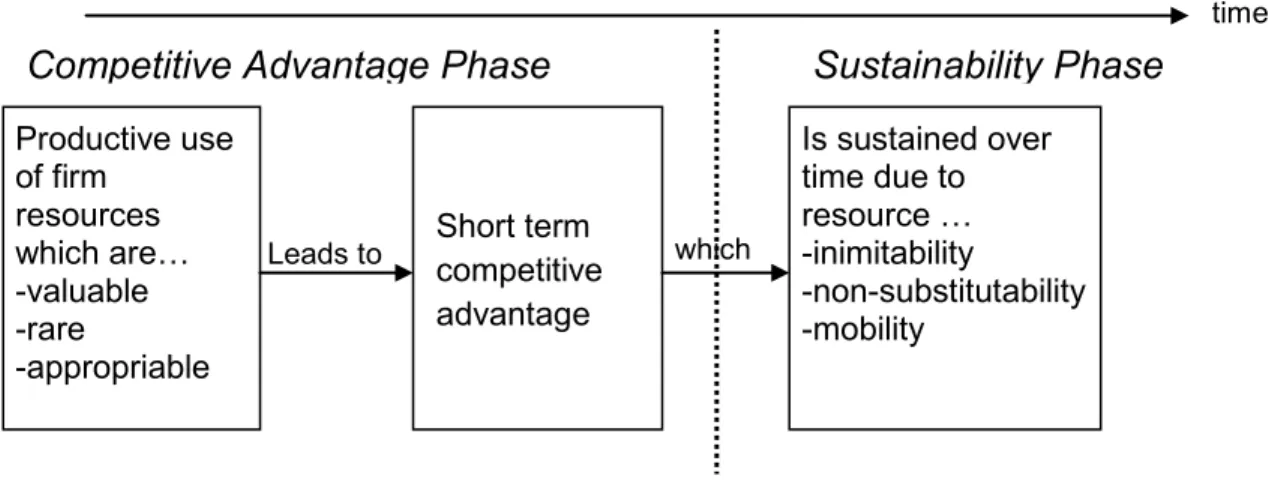
Wade and Hulland (2004) made the useful distinction between resources that enable a firm to gain a competitive advantage and those that enable a firm to sustain that advantage (Refer Figure 2.2.2.1). In the attaining competitive advantage phase, a firm competes by using a resource that is valuable, rare and appropriate. However, in the sustainability phrase, a firm can sustain over time due to resources that are inimitable, non-substitutable, and imperfectly mobile. The advantage can be sustained to the extent that the firm can protect against resource imitation, transfer, or substitution. In the theory, Barney (1991) assumes that ―the resources
firms and that these differences remain stable over time.‖ It means that resources must be heterogeneous and immobile. Differences in market performance are basically due to the distinctive resources and capabilities of a given firm (Barney, 1991; Wernerfelt, 1984; Wade and Hulland,2004).
Figure 2.2.2.1 The resource-based view over time
(Source: Wade and Hulland, 2004)
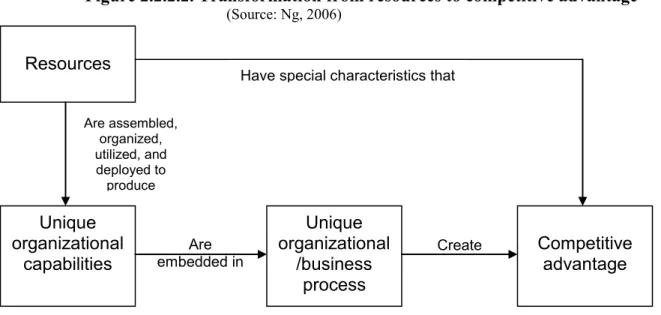
Ng (2006) presented two different scenarios that give a firm a competitive advantage. Figure 2.2.2.2 illustrates the transformation process of resources to a competitive advantage for a firm. The first scenario is that the resources themselves possess special characteristics that enable a firm to have a competitive advantage by having unique corporate resources. The second case highlights a firm‘s unique assembly and deployment of the resources to create a competitive advantage. A firm can create unique organizational capabilities by firm-specific and optimal assembling, organization, and deployment of its resources. The unique organizational capabilities that are embedded in unique organizational and business process create a firm‘s competitive advantage and provide better business efficiency and effectiveness than its competitors (Grant 1991; Ng, 2006). Improved organizational performance leads to better customer service. The second case is useful to explain how a firm creates competitive advantage
which time Leads to Productive use of firm resources which are… -valuable -rare -appropriable Short term competitive advantage Is sustained over time due to resource … -inimitability -non-substitutability -mobility
valuable organizational capabilities and processes via firm-specific assembly, deployment, and utilization of the resources.
Figure 2.2.2.2. Transformation from resources to competitive advantage
(Source: Ng, 2006)
Many information systems researchers generally divided Information Systems (IS) resources into two categories: (1) IS assets (technology-based) and (2) IS capabilities (systems-based) (Wade and Hulland, 2004). Compared to IS capabilities, IS assets are easy to copy and the most fragile source of sustainable competitive advantage for a firm (Teece et al., 1997). However, IS capabilities embedded in a firm through optimal assembly, organization, utilization, and deployment of IS resources over a long period of time is difficult to move and substitute. That is, IS resources alone can rarely meet the VRIN requirements, but when IS resources are developed and deployed or properly combined with other complementary organizational factors, they meet the necessary VRIN conditions and become a source of sustainable competitive advantage. Resources Unique organizational /business process Competitive advantage Unique organizational capabilities Are assembled, organized, utilized, and deployed to produce Are embedded in Create
Have special characteristics that create
competitive advantage. Information systems may enable companies to obtain competitive advantage when they are valuable for the company, heterogeneously distributed, leveraged, and costly to copy within industry. In addition, the concept of resource complementarity is useful to explain how information technology creates organizational capabilities and competitive advantage and eventually improved organizational performance. ERP systems that fulfill VRIN conditions within the companies and create organizational capabilities enable companies to have sustainable competitive advantage and to improve firm performance.
2.2.3. The dynamic capabilities theory
The dynamic capabilities perspective is an expansion of the resource-based view of a firm focusing on resource integration, reconfiguration, and development in changing environments. Many researchers define dynamic capabilities as an ability to integrate, build, and reconfigure internal and external competencies to address rapidly-changing environments (Teece et al., 1997; Eisenhardt and Martin, 2000). Consistent with the resource-based view of a firm, dynamic capability is a firm‘s ability to create competitive advantage by leveraging IT and complementary organizational resources to develop unique, change-oriented capabilities. These capabilities enable firms to meet customer needs and respond to competitors (Teece et al, 1997). It is the capacity to renew organizational resources and capabilities which achieve congruence in the changing business environment.
The concept of dynamic capabilities has been introduced in many research areas due to the shortcomings of the resource-based view of the firm (Eisenhardt and Martin, 2000; Teece et al., 1997; Peng et al., 2008). One of weaknesses of the resource-based view of a firm theory is that it does not address how a firm develops, manages, and deploys resources to support both business and IT strategy. That is, the resource-based view of the firm ignores factors surrounding
resources, simply assuming their existence. However, the important factors—such as how resources are developed, how they are integrated within the firm, and how they are released— should be considered in the research. While the resource-based view of the firm emphasizes resource choice or the selection of appropriate resources, dynamic capabilities emphasize resource development and renewal.
Dynamic capabilities are strategically imperative for a firm to operate in a rapidly changing business environment due to the necessity of responding and adapting in a timely manner to change. ―Dynamic‖ is referred to as the concurrency of organizational renewal with environmental change (Teece et al., 1997). Flexibility and innovation are critical for responsive decisions and organizational change to adjust to new market environments. ―Capabilities‖ is a firm‘s ability to adapt, integrate, and reconfigure endogenous and exogenous organizational skills, resources, and functions to respond to market change. Both definitions are important to understand the characteristics of dynamic capabilities.
The theoretical framework identified by Teece et al. (1997) describes the dimensions of dynamic capabilities: (1) processes, (2) positions, and (3) paths. They argue that the competitive advantage of firms depends on its managerial and organizational processes, shaped by its asset position, and the paths available. Managerial and organizational processes are referred to as ―the way things are done in firms, its routines, or patterns of current practice and learning.‖ (Ibid) Position is defined as ―its current specific endowments of technology, intellectual property, complementary assets, customer base, and its external relationship with suppliers and complementors‖. Paths refer to ―the strategic alternatives available to the firm.‖(Ibid)
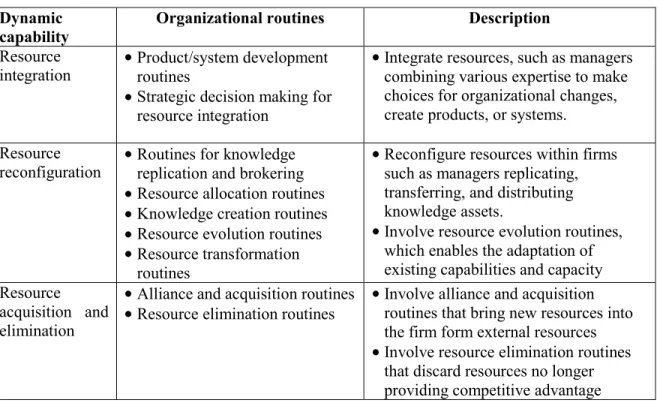
Chen et al. (2008) mentioned that dynamic capabilities lie with many organizational routines, which are tacit and difficult to replicate. Typical routines are resource integration, reconfiguration, acquisition, and elimination (Refer Table 2.2.3.1).
Table 2.2.3.1. Categories of dynamic capabilities
(Source: Chen et al., 2008)
Dynamic
capability Organizational routines Description
Resource
integration Product/system development routines Strategic decision making for resource integration
Integrate resources, such as managers combining various expertise to make choices for organizational changes, create products, or systems. Resource
reconfiguration Routines for knowledge replication and brokering Resource allocation routines Knowledge creation routines Resource evolution routines Resource transformation routines
Reconfigure resources within firms such as managers replicating, transferring, and distributing knowledge assets.
Involve resource evolution routines, which enables the adaptation of existing capabilities and capacity Resource
acquisition and elimination
Alliance and acquisition routines
Resource elimination routines Involve alliance and acquisition routines that bring new resources into the firm form external resources Involve resource elimination routines that discard resources no longer providing competitive advantage
Most researchers in information systems use the resource-based view of a firm and regard information systems as ―assets‖ in organizations. The dynamic capabilities theory, which emphasizes renewing, integrating, and configuring information systems, has not been fully shown in the literature to understand how firms develop Information systems and analyze their impacts on organizations, including business strategy. From the dynamic capabilities perspective, the development process of information systems, such as ERP systems, can be seen as integrating, reconfiguring, and adapting specific information technology assets to improve
2.3. The identification and discussion of constructs
The research framework in Figure 2.3 depicts the relationship among external environment, internal environment, ERP implementation, supplier capabilities, organizational capabilities, supplier performance, organizational performance, and customer value based on these three research theories: the contingency theory, the resource based view of a firm, and the dynamic capabilities theory. Coping with a highly uncertain, competitive and rapidly changing external environment with internal readiness and support, a firm can integrate and differentiate its organization by using an ERP system. According to Lawrence and Lorsh (1967), the contingency theory seeks to find the best fit for the use of various technologies in a given environment. To deal with a turbulent environment, a firm develops resources, such as an ERP system, that are valuable, rare, difficult to imitate, and non-substitutable by competitors and that increases its competitive advantage (Barney, 1991; Penrose, 1959). Through integrating, configuring, and adapting an ERP system and appropriate user training, a firm can deal with a rapidly-changing environment (Teece et al., 1997; Eisenhardt and Martin, 2000).
The external environment includes technology, level of competition, market change, and uncertainty (Doll and Vonderembse, 1991; Skinner, 1985; Vonderembse et al., 1997; Nahm and Vonderembse, 2002). In their paper, Nahm and Vonderembse (2002) define ―an external environment‖ in the post-industrial era as having a high degree of: (1) heterogeneity in their market; (2) many narrow market segments; (3) short product life cycle; (4) economies of scope as the driving force for adopting manufacturing technology; and (5) multiple criteria for customer satisfaction. Vonderembse et al. (1997) characterize the post-industrial environment as
having high levels of global competition, rapid market change, shorter product life cycles, and advances in manufacturing and information technology.
The external environment of a firm drives the changes in the organization‘s internal environment, which is made up of organizational resources, its capabilities, and competencies. The internal environment, such as top management support, organizational structure, communication, organizational culture, business process reengineering, and IT readiness, plays a crucial role in the corporate strategy of an organization. Top management support includes the recognition, encouragement, and commitment of the top manager for new business strategies or implementation of new technology, such as an ERP system. Top management support reinforces the commitment of all employees and leads to the success of projects in an organization (Ulrich, 2007; Bingi et al., 1999).
Organizational culture includes the organization‘s approach to managing its internal resources, organization of work, scope of decision-making, and the focus of managing its relationships with customers and suppliers (Clark et al., 1987; Gerwin, 1993; Nahm et al., 2004). Nahm et al. (2004) define organizational culture in a post-industrial environment as having the characteristics of: (1) investments in facilities and equipment for intellectual work; (2) teamwork on integrative tasks; (3) decision making based on an integrated perspective; (4) management based on collaboration and consensus; (5) focus on value to customers; and (6) long-term strategic partnerships with suppliers. Effective communication between managers and workers as well as between workers generates significant benefits in an organization, and eventually leads to successful completion of projects (Loh and Koh, 2004).
Organizational structure includes the centralization of authority and the degree of formalization (Swamidass and Newell, 1987; Germain et al, 1994; Nahm et al., 2003). An
organizational structure, which has the characteristics of (1) decentralized decision making for operational decisions, (2) rules and regulations that encourage creative, autonomous work and learning, (3) few layers in organizational hierarchy, and (4) a high level of horizontal integration is flexible, has a flat structure and can have a positive impact on corporate strategy (Nahm et al., 2003). The fundamental rethinking and radical redesign of business processes enables a firm to achieve successful IT implementation (Davenport, 2000). It is very important to have the technological readiness, such as IT skills and IT infrastructure, for the successful completion of IT projects (Somers and Nelson, 2004)
Internally ready and prepared organizations have the ability to develop and implement strategies or systems that are appropriate for the business environment. ERP implementation includes the extent to which the firm adapts, configures, and integrates information flow and business processes across departments and functions (Davenport, 2000; Abdinnour-Helm et al., 2003; Klein, 2007; Hong and Kim, 2002; Loh and Koh, 2004). In achieving ERP implementation, the important factors are (1) the integration of different modules, software, and legacy systems to achieve unity in an organization, (2) matching the software to the needs of organizational processes, (3) adjusting new technology to cope with changes, and (4) preparing and developing the IT workforce (Morton and Hu, 2008; Hong and Kim, 2002; Davenport, 1998; Somers and Nelson, 2004).
Successful implementation of ERP systems has an impact on the capabilities of both an organization and its suppliers. Through fast and accurate information sharing, firms can increase (1) efficiency including cross-functional coordination, information access, and process improvement, (2) innovativeness including product innovations, and (3) responsiveness to