Journal of Hospitality Financial Management
The Professional Refereed Journal of the Association of Hospitality Financial
Management Educators
Volume 25 | Issue 1 Article 6
7-13-2017
The Lodging Franchise Relational Model: A Model
of Trust, Commitment, and Resource Exchanges
Leonard A. Jackson
J. Mack Robinson College of Business, Georgia State University, Atlanta, GA
Hayun Jung
J. Mack Robinson College of Business, Georgia State University, Atlanta, GA
Follow this and additional works at:https://scholarworks.umass.edu/jhfm
This Refereed Article is brought to you for free and open access by ScholarWorks@UMass Amherst. It has been accepted for inclusion in Journal of Hospitality Financial Management by an authorized editor of ScholarWorks@UMass Amherst. For more information, please contact
Recommended Citation
Jackson, Leonard A. and Jung, Hayun (2017) "The Lodging Franchise Relational Model: A Model of Trust, Commitment, and
Resource Exchanges,"Journal of Hospitality Financial Management: Vol. 25 : Iss. 1 , Article 6.
DOI: https://doi.org/10.1080/10913211.2017.1314125
The Lodging Franchise Relational Model: A Model of Trust, Commitment, and
Resource Exchanges
Leonard A. Jackson and Hayun Jung
J. Mack Robinson College of Business, Georgia State University, Atlanta, GA
ABSTRACT
Franchising is the most dominant mode of operation for U.S.-domiciled lodging companies. This mode of operation has grown significantly as a result of the benefits received by franchisors and franchisees. Using a foundation of trust and commitment theory, this research developed a model that illustrates and explains the components of the lodging franchise relationship. The model suggests that the lodging franchise relational model is a bi-directional, value driven, mutually beneficial, symbiotic relationship of resource exchange and success is contingent on trust and commitment by both parties.
Introduction
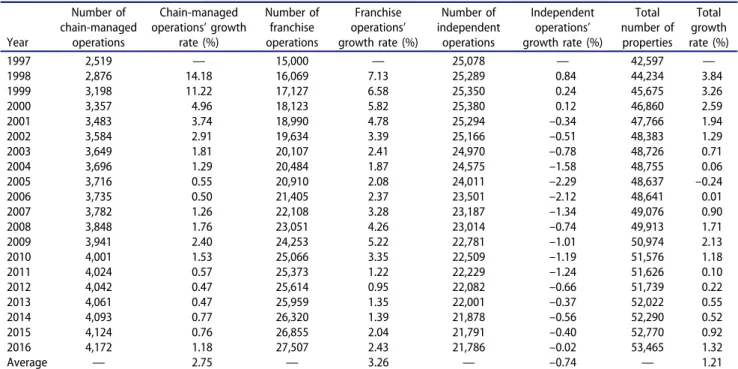
Over the past two decades, franchising has emerged as a dominant component of lodging firms’ busi-ness operating model. This is especially the case for several U.S.-domiciled lodging parent companies and their chains, many of which have shifted away from property ownership and property manage-ment to a business model driven largely by fran-chising. For some of these firms, their entire revenue model is largely dependent on streams of income generated from franchise-related services and activities. The bourgeoning dominance of this mode of operation is illustrated by the growth in the numbers of properties and rooms operated under this business mode over the past 20 years. During the period, the number of franchise oper-ated hotels in the United States grew from an annual average of 15,000 properties in 1997 to more than 27,000 properties at the end of 2016. During this period, the annual average number of rooms under franchise operation grew from more than one-and-a-half million (1,583,897) rooms in 1997 to more than two-and-a-half million (2,684,313) rooms by the end of 2016 (Smith Travel Research,2016). Franchising is also the fast-est growing operation type, growing at an annual rate of 3.26% compared with managed (2.75%) and
independent operation (–0.74). In fact, franchising growth has outpaced the industry (1.21%). These growth rates and changes in the operating structure of the U.S. lodging industry are illustrated in
Table 1and Figures 1and2.
Franchising is not a new phenomenon in the lodging industry. This business strategy has been used widely by hospitality firms as a major vehi-cle for corporate expansion for more than six decades. Although the exact date of its use in the hospitality industry is opaque, it is widely accepted that the first significant use of this fran-chising in the lodging segment of the industry dates to the 1950s when Kemmons Wilson used it to franchise the Holiday Inn concept. Ray Kroc and the McDonald’s Corporation are widely accepted as the individual who and company that, respectively, contributed significantly to the commercial use of the concept in the restaurant segment of the industry in the 1950s. However, in recent years, the franchise business format has gained in popularity because of the actual and ostensible benefits of this business arrangement for both parties involved in the franchise relation-ship: the franchisor and the franchisee. As a result of these value-driven benefits, the franchise arrangement has become the most widely used
CONTACTLeonard A. Jackson [email protected] J. Mack Robinson College of Business, Georgia State University, 35 Broad Street, Suite 210, Atlanta, GA 30302, USA.
2017, VOL. 25, NO. 1, 56–73
https://doi.org/10.1080/10913211.2017.1314125
© 2017 International Association of Hospitality Financial Management Education
Table 1.U.S. Hotels, by Operation Type and Growth Rate, 1997–2016. Year Number of chain-managed operations Chain-managed operations’growth rate (%) Number of franchise operations Franchise operations’ growth rate (%) Number of independent operations Independent operations’ growth rate (%) Total number of properties Total growth rate (%) 1997 2,519 — 15,000 — 25,078 — 42,597 — 1998 2,876 14.18 16,069 7.13 25,289 0.84 44,234 3.84 1999 3,198 11.22 17,127 6.58 25,350 0.24 45,675 3.26 2000 3,357 4.96 18,123 5.82 25,380 0.12 46,860 2.59 2001 3,483 3.74 18,990 4.78 25,294 –0.34 47,766 1.94 2002 3,584 2.91 19,634 3.39 25,166 –0.51 48,383 1.29 2003 3,649 1.81 20,107 2.41 24,970 –0.78 48,726 0.71 2004 3,696 1.29 20,484 1.87 24,575 –1.58 48,755 0.06 2005 3,716 0.55 20,910 2.08 24,011 –2.29 48,637 –0.24 2006 3,735 0.50 21,405 2.37 23,501 –2.12 48,641 0.01 2007 3,782 1.26 22,108 3.28 23,187 –1.34 49,076 0.90 2008 3,848 1.76 23,051 4.26 23,014 –0.74 49,913 1.71 2009 3,941 2.40 24,253 5.22 22,781 –1.01 50,974 2.13 2010 4,001 1.53 25,066 3.35 22,509 –1.19 51,576 1.18 2011 4,024 0.57 25,373 1.22 22,229 –1.24 51,626 0.10 2012 4,042 0.47 25,614 0.95 22,082 –0.66 51,739 0.22 2013 4,061 0.47 25,959 1.35 22,001 –0.37 52,022 0.55 2014 4,093 0.77 26,320 1.39 21,878 –0.56 52,290 0.52 2015 4,124 0.76 26,855 2.04 21,791 –0.40 52,770 0.92 2016 4,172 1.18 27,507 2.43 21,786 –0.02 53,465 1.32 Average — 2.75 — 3.26 — –0.74 — 1.21 -5% 0% 5% 10% 15% 20% 0 5,000 10,000 15,000 20,000 25,000 30,000
Chain Managed Franchise Census Props Independent Hotels Chain Managed Growth Rate Franchise Growth Rate Independent Hotels Growth Rate Linear (Chain Managed Growth Rate) Linear (Franchise Growth Rate) Linear (Independent Hotels Growth Rate)
Figure 1.Number of properties and growth rate, by operation type, 1997–2016.
0 10,000 20,000 30,000 40,000 50,000 60,000 1997 1998 1999 2000 2001 2002 2003 2004 2005 2006 2007 2008 2009 2010 2011 2012 2013 2014 2015 2016 Number of Properties
Yearly Number of Properties by Operation Type in US
Chain Managed
Franchise
Independent
Total
Figure 2.Annual operation trend, by property type, 1997–2016.
business organization and ownership structure in the lodging and restaurant industries.
Factors facilitating lodging franchise growth
Lodging firms that include the franchising model as a component of their business model have gen-erally experienced growth in revenue, and number of system units locally and internationally. The model has also enabled these firms to expand their product-service distribution networks. In sum, these factors have resulted in increased use of this operation mode as a vehicle for unit and revenue growth. Furthermore, for several lodging firms, the shift away from an ownership or asset heavy model toward a franchising model is driven by the fact that franchising lends itself to a much leaner operation (than do ownership or manage-ment contracts), given that there is little or no capital expenditures and other expenditures asso-ciated with managing the real estate aspect of the business. Franchising has also grown because the model is attractive to entrepreneurs. For example, the franchise business model provides entities that want to own lodging facilities an advantage and competitive edge over other ownership models given that franchising provides these entities with immediate access to reputable, trusted, and experi-enced trade names; expert services such as market-ing services; trainmarket-ing of key personnel; advertismarket-ing support; and access to systems such as reservation services. Entrepreneurs also gain immediate access to value-chain activities and services such as access to established distribution networks and access to the brand’s supply chain. For entrepreneurs, immediate access to these activities and services increases the likelihood of venture success.
The growth of franchising in the lodging industry has also been driven by benefits received by chisees and franchisors. Benefits obtained by fran-chisees are numerous and include the following: (a) reduction of entrepreneurial startup risks given that franchises are usually turnkey operations and their business risks are lower than those of independent startups because there is product acceptance; (b) management and operational expertise and profes-sional assistance from the franchise; (c) assistance with on-site training; (d) reduced operating costs derived from savings obtained from economies of
scale and group purchasing; (e) assistance with site selection, market and feasibility analysis, develop-ment, design, and construction of the physical plant; (f) advice on purchasing furnishings and fixtures; (g) use of a valuable protected trade name, which allows the franchisee to acquire an established brand name with regional or national brand recog-nition at the inception of the business; (h) national and international market research, marketing, and advertising; (i) tie-in and access to existing reserva-tion systems; (j) immediate access to tried and pro-ven strategic and operational systems and methods; (k) access and assistance with relevant technology and prosperity software such as point-of-sale or property management systems; (l) inclusion in a network that includes referrals between properties; (m) financial assistance where appropriate; (n) immediate access to proven; (o) operational and structural controls, which helps the franchisee with administrative controls of the entity; (p) training, technical support, and guidance provided by the franchisor; and (q) a proven product service mix with an established market. Hence, franchising vides entrepreneurs with an easily replicated, pro-ven business model with an established value chain, proven value proposition, a proven profit mechan-ism, a strong brand or trademark, and a unique concept which can be used immediately to grow their businesses quickly. In so doing, the franchise model allows entrepreneurs to bypass several steps in the entrepreneurial process such as the business model validation. For franchisors, the benefits include (a) increase revenue from fees paid by the franchisee, which supports overhead and operating costs; (b) brand spread, or growth of the franchise (nationally and internationally) with each additional franchise sold; and (c) influx of capital to expand the franchise.
Lodging industry franchising: A complex and evolving relationship
The growth of franchising in the lodging industry has resulted in the relationship between franchi-sors and franchisees becoming more complex, especially as franchisors seek to generate more revenue from provision of mandatory and discre-tionary services to franchisees. In some cases, the relationship is often opaque, not only to those who
are primary stakeholders in the relationship but especially those considered to be outside existing relationships, which includes potential investors. The opaque nature of the lodging franchise rela-tionship is further complicated by the fact that lodging parent companies have several brands, and each brand has a different franchise relation-ship with their franchisees.
The role that franchising plays in lodging firms’ revenue portfolio also dictates the complexity of the franchise relationship. For example, lodging firms that are purely franchising firms will gener-ate their revenues from a stream of franchise fees. In contrast, lodging firms that are quasi-franchise firms typically offer fewer fee-laden discretionary services. Franchise services offered by lodging franchisors can be broadly described as mandatory and discretionary services. Mandatory services are those that are required by the brand or parent company to ensure consistency of brand standards while discretionary services are those designed to improve and enhance operational performance directly or indirectly and are generally selected at the discretion of the property’s management or ownership. However, failure to use discretionary services over time could lead to deviation from brand standards, which could elicit noncompli-ance penalties.
As noted, lodging firms for which franchising represents a significant component of their rev-enue model have focused on providing a wide array of mandatory and discretionary services, both of which have grown in recent years espe-cially as lodging firms shift the revenue compo-nent of their business model away from traditional sources and more toward franchising. Because these services are sold to franchisees, lodging firms have become more owner-centric, especially when compared with the lodging franchise rela-tional model of the past. This focus on the own-ership by the franchisors is simply one of economics. The closer the franchisor is to the owner, the more services he or she can potentially sell to the owner, thereby increasing revenues.
Lodging franchising is business format franchis-ing, which is when the franchisor sells a way or format of doing business. As such, in the past, lodging franchise companies have provided fran-chisees with an established brand name, standards
for design, décor, equipment, and operating procedures. Typical services included national and international central reservation networks, national and international advertising campaigns, management training programs, provision of sup-port technologies such as property management systems, and central purchasing systems. Other services provided included architecture, construc-tion, and interior decoration services. However, as parent companies move away from asset owner-ship to a revenue model reliant on franchising, the mandatory and discretional services have increased, evolved, and changed. In addition, in recent years, the goal of lodging franchisors is to centralize several services that were previously per-formed at the property level by specialists. For example, previously, revenue management was performed by revenue management specialists at the property level. However, today, these services are offered to franchisees on a per-hire or fee basis. The provision of these additional services to fran-chisees provide more revenue streams for franchi-sors. However, by offering more specialized services to franchisees, it potentially provides cost savings to franchisees because they do not have to bear employment and other operational costs asso-ciated with similar positions at the property level. Furthermore, it allows franchisees and their agents to focus their efforts on the tasks of managing the daily operations for the lodging facility.
The shifting of services away from the property level and centralizing them requires a high level of trust between the franchisor and franchisee. Furthermore, both parties must be committed to the relationship for it to be mutually beneficial. Trust and commitment are the cohesive elements in the franchise relationship and can be perceived as a facilitator of cooperative exchange under con-ditions of uncertainty. At its core, franchising is a system that is characterized by mutual interdepen-dence (between the franchisee and franchisor), but also one that is characterized by asymmetrical control given that power and control rests with the franchisor, not with the franchisee. Both par-ties enter the relationship trusting that there will be exchanges of resources and that both parties will be committed to the relationship. Franchisors trust that the franchisee will perform at expected levels and within rigid guidelines, whereas
franchisees rely on the franchisor to leverage the brand and provide services such as advertising and promotion as well as managerial support in the form of training, services, and process and system design.
Given the evolving nature of the lodging fran-chise relationship over the past two decades, it is imperative that a better understanding is developed about the roles, responsibilities, and resource exchanges involved in today’s lodging franchise rela-tionship. Hence, the purpose of this exploratory research is to develop a conceptual model that suc-cinctly captures, documents, and explains the com-ponents involved in the resource exchanges that occur in the lodging franchise relationship. This understanding will lead to a better understanding of the unique components of the relationship between lodging franchisors and their franchisees. The conceptual model is grounded in the trust-commitment constructs of marketing research. In the context of franchise relationships, trust investi-gates factors that affect the long-term success of franchise–franchisor relationships. Perceptions of trust typically develop during the early stages of the relationship and guide behaviors and actions during future interactions (Dwyer, Schurr, & Oh,
1987; Rempel & Zanna,1985). Commitment acts as a signal of intent and develops as parties in a rela-tionship purposefully engage resources to build and maintain the relationship (Dwyer et al.,1987), with trust been the major determinant of commitment (Morgan & Hunt,1994).
Literature review
The franchise relationship
Franchising involves a business relationship in which an organizing entity (the franchisor) sells a proven business operating format that allows a semi-autonomous entity (the franchisee) the right to market and sell goods and services under the organizing entity’s brand name. While the franchi-sor and franchisee are legally distinct and separate entities (Mandelson, 2004), the economic rewards and responsibilities from the franchise system are interdependent between franchisor and franchisee (Davies, Lassar, Manolis, Prince, & Winsor, 2011; Kumar, Scheer, & Steenkamp,1995). Maximization
of economic and financial rewards in the franchise business system is generally achieved if the interests of the franchisor and franchisees are aligned through a formal relationship or franchise agree-ment, as well as the execution of all elements of the contractual arrangement by both parties. Nonetheless, with most franchise agreements, the franchisor typically specifies the contractual terms, services, and responsibilities of the relational part-ners and specifies how types of services and resources and economic rewards, payments will be shared and distributed in the relationship, which often form the basis for conflicts between both parties. It is important to note that, with most franchise system, the agreement terms are estab-lished by the franchisee are nonnegotiable (Davies et al., 2011).
Although franchising offers a compelling and effective form of entrepreneurial relationship, it also imposes restrictions and penalties that com-promises entrepreneurial preferences, creativity and self-governance. In addition, the interests of the franchisor and franchisees are often dissimilar (Harmon & Griffiths, 2008), and in some cases, diametrically opposed (Michaels & Coombs,
2008), and unequal. For example, in the lodging industry, franchisors’ claim to income is usually superior than that of franchisees given that fran-chise royalties are based on gross sales, whereas franchisees profitability is contingent on their abil-ity to effectively manage their operational costs. Hence, franchisors might develop and implement strategies geared toward market share growth, brand spread, and revenue maximization growth without regard for unit or store costs, which could potentially impair the profitability of franchisees. Furthermore, franchisees are limited to the finan-cial returns generated from their unit’s operation, whereas the franchisor income is the aggregate of all the units in their system; hence, franchisors can remain solvent while units in their system fail. This often leads to a high level of divergence in trust and commitment (Davies et al., 2011).
Trust and commitment in franchise relationships
The success of franchise relationships is contingent on mutual trust and commitment between the parties, who enter a mutually beneficial, symbiotic,
and strategic relationship. Commitment and trust by both parties are important because they force each party to work at preserving the relationship investment that each party has made; further, the success of either party is dependent on the success of the other. Commitment and trust by the parties is also important because it forces the parties to resist opportunistic attractive short-term alterna-tives and instead focus on the anticipated long-term benefits of staying in the relationship (Morgan & Hunt, 1994). This commitment and trust at the core of the relationship lead to effi-ciency, profitability, productivity, and effectiveness (Cook & Emerson, 1978; Meyer & Allen, 1984; Thompson & Spanier,1983).
In the context of the franchise relationship, commitment relates to exchanges of resources— tangible and intangible—and both parties in the relationship believe in exerting effort to maintain the relationship given that such maintenance will lead to value enhancement and mutual benefits in the long term (Moorman, Deshpande, & Zaltman,
1993). From an organizational perspective, and in the franchise system, commitment is important because it leads to less contractual terminations, increased organizational citizenship behaviors, and organizational support (Eisenberger, Fasolo, & Davis-LaMastro, 1990). Trust exists when parties in a relationship have confidence in an exchange partner’s reliability and integrity (Morgan & Hunt,
1994); Moorman et al., 1993). This definition draws on the classic work of Rotter (1967), who described trust as the willingness to rely on an exchange partner in who one has confidence. Trust on the part of the franchisees suggests that they trust their partner, the franchisor, to provide agreed-upon resources, capabilities, and services, whereas franchisors trust that franchisees will adhere to all terms specified by the contractual agreement. Key to the definition is the concept of confidence on the part of the trusting parties on the basis of the belief that the trustworthy party is reliable and has a high level of integrity, which are associated with qualities such as competent, hon-est, fair, responsible, and helpful (Morgan & Hunt,
1994). Within franchise relationships, trust can be of two types—integrity trust and competence trust. Loss of integrity trust results from misunderstand-ings arising from franchisor activities (e.g., when
standards and procedures are opaque). This could occur if franchisors implement procedural and policy changes without timely consultation and conveyance of information with and to franchi-sees. In contrast, loss of competence trust can arise from franchisors failing to deliver or under-delivering benefits outlined in the franchise agree-ments such as appropriate training, because of mismanagement on the part of the franchisor (Davies et al., 2011).
Trust occurring in franchise systems can also be defined as franchisees’ confidence to accept a cal-culated risk with the franchisor and allows fran-chisees to handle vulnerabilities inherent in their relationships with the franchisors. This calculation of trust is based on the franchisee using criteria of trustworthiness. Thus, an important prerequisites of franchisee trust is integrity. Franchisees expect that franchisors will perform actions that will result in positive outcomes. Failure to generate positive outcomes will result in erosion of confi-dence and ultimately trust. This is especially important in franchise relationships because trust is central in achieving cooperation, problem sol-ving, and dialogue, which are important elements in franchise relationships. Hence, trust influences relationship commitment given that lack of trust decreases commitment, suggesting that trust is a determinant of relationship commitment (Achrol,
1991).
In the franchise system, there must be a high level of bidirectional trust. If conditions of mis-trust exist on the part of the franchisees, they might conclude that contractual obligations are not in concert with their economic interests and as such, it could lead to circumstances in which they do not feel compelled to comply with the franchise regulations. Hence, it behooves franchi-sors to maintain transparency, trust, and goodwill with franchisees, especially given that unmotivated franchisees could subvert operational policies and procedures, which could ultimately undermine the franchisor’s brand equity. Thus, trust is an impor-tant factor in the mutual long-term profitability and viability in a franchise system, which suggest that it benefits franchisors to take steps to enhance franchisees’ trust in them and their systems (Davies et al., 2011). For their part, franchisors also must trust the integrity of the franchisees.
To ensure compliance, the requirements of franchisees are outlined in the legally binding con-tract, the franchise agreement which specifies how franchisees must act. Whereas franchisees are obli-gated to act within the parameters of the agree-ment, the agreements do not always cover all possible contingencies (Crochet & Garg, 2008), and consequently, franchisors do not always believe that they have full control over the actions undertaken by franchisees in the administration and operation of their units (Stalworth, 1995). In addition, the interdependency nature of franchise agreements sometimes causes expectations and obligations to become unclear and often leads to unintentional breaches or perceptions of breaches as opposed to actual breaches (Parhankangas,
2004).
Precursors of relationship commitment and trust include relationship termination costs, rela-tionship benefits, shared value, communication, and opportunistic behavior. In a franchise rela-tionship, terminated parties will generally seek alternative relationships, which generally have high switching costs. For lodging franchise rela-tionships, such costs are often exacerbated by idio-syncratic investments or investments that are difficult to switch to another relationship (Heide & John, 1988). In some instances, there are no switching costs involved if the relationship is dis-solved. However, termination of the relationship incurs costs, which can be describes as all expected losses to both parties, which would include losses from the termination, relationship dissolution expenses, and switching costs. Expected termina-tion costs can lead to ongoing relatermina-tionships been perceived by parties as important thereby leading to commitment in the relationship as parties attempt to avoid termination costs. Hence, mutual trust between franchisor and franchisee reduces costs that could arise from distractions associated with close monitoring developed to prevent opportunism.
Both parties involved in the franchise relation-ship typically seek partners that will add value to the relationship. Hence, franchisors will typically commit to developing and maintaining relation-ships that offer superior benefits to franchisees relative to other options to ensure that franchisees will be satisfied with the services offered, given
that it will lead to commitment in the relationship.
Communication, which can be defined as formal
and informal sharing of meaningful and timely information between parties involved in the rela-tionship, is also a precursor to trust because it fosters trust as it helps in resolving disputes and aligns perceptions and expectations. In contrast, accumulation of trust leads to better communica-tion, which is positively related to trust (Moorman et al., 1993).
According to transaction cost analysis literature, parties who engage in opportunistic behavior do so out of self-interest, which have the net effect of eroding relational commitment and trust, because such behaviors are often perceived as deceit oriented which violates the underlying premise of trust. Hence, if parties in a relationship such as those in a franchise relationship perceive that the other party engages in opportunistic behavior, such perceptions will lead to an erosion of trust and, thus, commitment (Morgan & Hunt, 1994), because parties in the relation believe they cannot trust their partner.
Trust and commitment are desirable qualitative relational outcomes (Mohr & Nevin,1990) and are essential for fostering relationships such as fran-chise relationships. Other qualitative factors that enhance and promote relational outcomes include (a) acquiescence and propensity to leave, (b) coop-eration, (c) functional conflict, and (d) decision-making uncertainty. Acquiescence and propensity to leave relates the degree of adoption and adher-ence of policies or requests by partners in the relationship. Consequently, relational commit-ment positively impacts or influences acquiescence while trust influence acquiescence through rela-tionship commitment. Propensity to leave relates to the likelihood that a partner will exit or termi-nate the relationship. Hence, regarding commit-ment, there is a strong negative relationship between organizational commitment and propen-sity to leave. Cooperation or a condition in which all parties work together to achieve mutual goals (Anderson & Narus, 1990) is an important ele-ment in franchise relationships. Regarding trust and commitment, cooperation is important because it promotes relationship building and con-sequently enhances trust and commitment. In franchise systems, cooperation does not mean
absence of conflict or dispute. Instead, it means that partners (a) work together even while having differences in opinions or outlook to ensure that the relationship lasts and (b) cooperate through joint efforts to achieve synergistic outcomes. Conflicts and disagreements are normal in most relational exchanges. However, if hostility among partners is not resolved, it can lead to relationship dissolution. If disagreements and disputes are resolved in an amicable manner, the conflict can be referred to as functional conflict, given that they stimulate thought and interest, prevent corporate stagnation, and provide a way for relational part-ners to air problems, solve problems, and generate solutions. In the relationship, decision-making uncertainty relates to the extent to which partners has enough information to make decisions, predict the consequences of the decision, and have con-fidence in the decision (Achrol & Stern, 1988). Hence, if franchisors can reduce uncertainty in the franchise relationships, it will enhance trust and commitment (Morgan & Hunt,1994).
Method
Overview
This exploratory research attempted to define and explain the components of the lodging franchising relationship and present findings as a conceptual model. Hence, an inductive approach that com-bined content analysis with semi-structured inter-view data was deemed appropriate and was accomplished through a two-step approach. Content analysis of franchise disclosure docu-ments were first used to identify themes and com-ponents of the franchise relationship. This step was deemed appropriate given that the franchise disclosure documents capture the essence of the franchise relationship. The interviews were then used to verify the applicability, appropriateness and categorization of the components that emerged from the content analysis. Therefore, both methods are closely linked to enhance the validity of each other. Hence, information was collected from various sources to reduce the risk that conclusions drawn reflect systematic biases or limitations inherent in one qualitative method. Furthermore, using several sources allowed for a
broader understanding of the issues investigated and reduced threats to validity (Maxwell, 2012). Hence, validity was established using multiple lines of sight, which ultimately resulted in conver-ging lines of inquiry.
The study applied purposeful sampling and informants were selected on the basis of the con-tribution they could make to the study (Creswell,
2013). Selection of the key informants through this method was important given that only the key informants from respective lodging organizations who could provide the invaluable and in-depth information required to investigate the issues were contacted. Unlike statistical sampling whereby a sample is selected that is representative of the population, in purposeful sampling, indivi-duals are selected because they can provide useful information about the research problem and can help flush out the key issues and provide critical information that can support, challenge, or refute the issues discussed (Yin, 2009). All data were analyzed using the constant comparative method. This approach was used to identify emerging pat-terns and key themes.
Data collection
A previously noted, content analysis was con-ducted on secondary data to identify patterns and key themes in the lodging franchise relationship. The sampled secondary data were confined to franchise disclosure documents from nine leading U.S.-domiciled or quasi-domiciled (for example, Intercontinental Hotel Group) lodging parent companies. The nine companies were based on number of properties in their franchise system. Nine parent companies were deemed appropriate to accomplish the objectives of the study given that parent companies comprised multiple brands. The final sample comprised 9 parent companies and 75 brands, shown inTable 2.
Content analysis of each brand’s franchise dis-closure documents was conducted to obtain infor-mation about each company’s franchise system. Specific emphasis was placed on examination of the following areas of the franchise disclosure document:
Table 2. Sampled Parent Companies and Their Brands. Parent Companies Brands La Quinta Holdings Inc. La Quinta Inns & Suites Carlson Rezidor Hotel Group Country Inns & Suites Park Inn Radisson Red Radisson Blue Radisson Park Plaza Quorvus Collection Hyatt Hotels Corporation Park Hyatt Grand Hyatt Andaz Hyatt Place Hyatt Regency Hyatt Centric Hyatt Hyatt House Hyatt Residence Club
Hyatt Zilara/ Ziva The Unbound Collection by Hyatt Starwood Hotels & Resorts Worldwide St. Regis W Hotels The Luxury Collection Le Méridien Westin Tribute Portfolio Sheraton Design Hotels Element Aloft Four Points by Sheraton Choice Hotels International Comfort Inn Ascend Hotel Collection Comfort Suites Quality Sleep Inn Clarion Cambria Hotels & Suites MainStay Suites Suburban EconoLodge Rodeway Inn InterContinental Hotels Group InterContinental Hotels & Resorts Kimpton Hotels & Restaurants HUALUXE Hotels & Resorts Crowne Plaza Hotel & Resorts Hotel Indigo EVEN Hotels Holiday Inn Hotels Holiday Inn Express Hotels Holiday Inn Resort Holiday Inn Club Vacations Staybridge Suites Candlewood Suites Hilton Worldwide Waldorf Astoria Hotels & Resorts Conrad Hotels & Resorts Canopy by Hilton Hilton Hotels & Resorts Curio, A Collection by Hilton DoubleTree by Hilton Tapestry Collection by Hilton Hilton Garden Inn Hampton by Hilton Tru by Hilton Home2 Suites by Hilton Homewood Suites by Hilton Hilton Worldwide Embassy Suites by Hilton Hilton Grand Vacations Wyndham Worldwide Wyndham® Hotels and Resorts
Wyndham Grand® Collection Wyndham Garden® TRYP Wingate® by Wyndham Hawthorn® Suites Microtel by Wyndham Ramada® Worldwide Baymont Inn & Suites® Days Inn® Super 8® Howard Johnson® Travelodge® Knights Inn® Marriot International AC Hotels by Marriott Autograph Collection Bulgari Hotels & Resorts Courtyard by Marriott Delta Hotels & Resorts EDITION Hotels Fairfield Inn & Suites Gaylord Hotels JW Marriott Hotels & Resorts
Marriott Executive Apartments
Moxy Hotels Protea Hotels by Marriott Marriott Hotels
Marriott Vacation Club Renaissance Hotels Residence Inn by Marriott TownePlace Suites SpringHill Suites The Ritz-Carlton
Item 1: The franchisor and any parents, prede-cessors, and affiliates
Item 5: Initial fees Item 6: Other fees
Item 9: Franchisee’s obligation
Item 11: Franchisor’s assistance, advertising, computer system and training.
Themes that emerged from the content analysis suggested that a key component of the lodging franchise relationship is that it involves an exchange of resources between the franchisor and franchisee. Franchisees provide franchisors with a stream of fees and in return franchisors provide an array of services that can be classified as direct franchise support services and indirect franchise support services. Direct services included (a) mar-keting and sales, (b) development, (c) finance and risk management, (d) training, (e) technology sys-tems, (f) revenue management, (g) operations sup-port, (h) preopening services, and (i) procurement services. Once these components were identified, interview questions were developed around them and interviews were conducted to verify the themes that emerged and, hence, obtain further insights into the component of the lodging fran-chise relationship. The interview questionnaire contained six questions. The questions and the topics of exploration were developed and designed in direct relation to the main objective of the study: What are the key components of the lod-ging franchise relationship?
Interviews began with broad questioning about interviewees’ perceptions and definition of the franchise relationship and what are the compo-nents of lodging franchise relationships. Interviews were conducted face to face and over the telephone and lasted between 20 and 35 minute and were organized in structured or semi-standardized discussion format. This method allowed for the documentation of rich data given that it enabled the interviewer to ask interviewees predetermined questions on the research topic in a systematic and consistent order. This method also allowed the interviewer freedom to digress and probe beyond the prepared questions (Berg,2011). Thus, interviews were formal yet active, which made the interview likened to a conversation (Holstein & Gubrium, 1995). Responses were
digitally recorded and transcribed verbatim and a constant comparison approach was used to identify frequently occurring themes (Creswell, 2013; Silverman,2013).
A total of seven semi-structured interviews were conducted with lodging executives associated with lodging franchise systems and included corporate franchise lawyers and franchise directors. Participants were selected on the basis of their knowledge of the topic under investigation, lod-ging franchise systems. Hence, these professionals were selected because they could provide critical information on lodging franchise relationships. The final sample comprised 7 individuals, of which 4 were men and 3 were women. All indivi-duals were assured anonymity for themselves and their companies.
Results and discussion
The lodging franchise relational model (see
Figure 3) encapsulates a bidirectional, value-dri-ven, mutually beneficial, symbiotic relationship between the lodging brand and the lodging facility owner, that is contingent on trust and commit-ment. The relationship between both parties is formalized through a legal document, the franchise agreement, which governs the franchisor’s rela-tionship with the franchisees. These two entities enter a formal, legally binding relationship through the franchise agreement, which outlines the provisions and conditions of the agreement. This document governs the relationship and forms the basis and benchmark for trust and commit-ment for both parties. Hence, deviation from the agreement without the consent of either party will elicit a breach of trust and hence, affect the offended party’s commitment in the relationship. Because lodging franchise agreements are written by the franchisor, care should be taken that the agreements that govern the relationship have simi-lar clauses for all brands under parent companies. This will ensure that the parent company achieves brand spread for all brands. If this is not the case, brands under parent companies with restrictive or repressive clauses will receive less brand spread that those with less restrictive clauses.
Lodging franchise agreements are franchisor-centric and typically contains clauses governing
Owner/ Agent Performance Analytics Target Establishment Specialist Deployment Franchise Agreement Brand Owner Hotel Owner Franchisor Franchisee BRAND SPREA D FEE PAYMENTS VALIDATED BUSINESS MO DEL OPERATIONAL SY STEM MANAGEMENT EX PERTISE
Development Procurement Pre-Opening
Support
Sales & Marketing Support Revenue Management
Support
Operations Support
Technology /System Support Training Support Finance / Risk Management Lead Contact/ Generalist Communications
Initial Fee Royalty
Fee
Marketing
Fee
Frequent Traveler Program
Fee Miscellaneous Fee Sales/ Reservation Fee Figure 3. The lodging franchise relational model.
purchasing of supplies, payment of royalties and system fees, marketing and advertising, and perfor-mance by each party. Although the franchise agree-ments in the sample varied in scope, in general, the commonalities in the agreements were the follow-ing components: thenames of partiessigning agree-ment—the name of the legal entity representing the brand as well as the corporation, partnership, or sole proprietor owning the hospitality franchise unit; detailed definition of terms—clear definition of terms that might be ambiguous and could be misinterpreted by entities involved in the contrac-tual arrangement;license grant, which outlines how the franchisee can use the franchisor’s logo, signage, and name in operating the hospitality enterprise; theterm or length of the franchise agreement (hos-pitality franchise agreements typically have dura-tions of 20 years); window options for “early outs” (typically, the 5th, 10th, and 15th years of the agree-ment); fees, which include affiliation fees, royalty fees, marketing fees, reservation fees, training fees, and technology upgrade fees;required performance reports such as occupancy reports, room revenue reports, average daily rates, restaurant sales reports, and tax reports; responsibilities of the franchisor, including marketing, enforcement of brand or fran-chise standards, and inspection schedules; responsi-bilities of the franchisee, including adherence to operational standards, payment schedules, and sig-nage requirements;assignment of agreement, which outlines transfers of ownership; termination or default of the agreement, which describes conditions under which the agreement can be terminated by either party;insurance requirements—a clear indica-tion of the types and amounts of insurance required by the franchisee; requirements for alterations, which outlines the right of the franchisor to change the agreement; arbitration and legal fees, which addresses both franchisor and franchisee responsi-bilities as it regards disputes; and signature page, which is the page for both entities to sign the franchise agreement.
The relationship is bidirectional given that there is a flow of resources from and between the fran-chisor and franchisee. The intangible franchise asset that includes a tried, tested, and proven operational system, business model, and manage-ment expertise flow from the franchisor to the franchisee while the franchisor receives a stream
of fees payments and brand spread from the fran-chisee. At the broad level, the franchise operating system for lodging includes: the brand name; busi-ness and operational systems, including policies and procedures for each functional department and; systems for strategic planning. Franchisees also receive technological systems and support, which are aimed at enhancing operational effi-ciency, productivity, guest experience, transaction processing, distribution channel management, cus-tomer relationship management systems (includ-ing loyalty program management systems), revenue enhancement, and cost containment. Technological systems also include customer inter-action technologies including reservation systems and social interaction systems. Lodging franchisors will also develop and maintain websites for fran-chisees so that they can advertise products and services as well as process transactions through this medium. Lodging franchisors also provide lodging management expertise to lodging franchi-sees. The management expertise provides guidance for each functional areas of the lodging facility. In addition, expert advice is offered in areas such as training and development.
Franchisee also receive a business model whose elements (customer targets, the value proposition, the value chain and the profit mechanism) have been validated. This is arguably perhaps the most valuable resource that the franchisee receives. This is because franchising allows them to bypass this tedious and often expensive stage in the entrepre-neurial process. Hence, from the outset of opera-tions, lodging franchisees will understand precisely who are their targeted customer segments. This knowledge undoubtedly allows them to save finan-cial resources by not attempting to target unfruit-ful targets. The validated business model will also provide franchisees with a clear understanding of the lodging facility’s value proposition or the pro-ducts and services the facility should offer its tar-geted segments. In addition, franchisors provide franchisees with value chain information which documents and explains to franchisees the various processes and activities that must be performed to produce product service offerings in the most profitable and efficient manner. Finally, franchi-sors provide franchisees with the final element of the business model, the profit mechanism. This
includes aspects such as pricing structures for pro-ducts and services, cost structures, benchmarks and guidelines, and important information on how to make the entity financially viable.
Franchisors receive brand spread with each additional franchise that is added to the system.
Brand spreadcan be defined as the proliferation of the franchisor’s brand in the lodging marketplace. The more units the franchisor the more awareness and market presence it has, leading to market coverage. However, while the goal of the franchi-sor is to increase brand spread, care should be exercised spreading the brand in oversaturated markets as brands of the parent company could face a situation where they essentially cannibalize each other. If oversaturation of the brand occurs in a marketplace, franchisee could lose trust in the brand and become less committed. Hence, it behooves franchisors to take steps to ensure that brand spread does not lead to marketplace brand saturation.
In return for the intangible franchise asset, a well developed franchise operational system, a validated business model, operational systems, management expertise and brand spread, the fran-chisor receives a stream of income in the form of fees. Although each lodging franchise will have fee structures germane to its specific organization, findings suggest that fees typically comprise two broad categories:initial fees and continuation fees. The initial fee is the initial payment, which is typically submitted with the completed application or at the signing of the franchise agreement, and are simply fees paid to obtain the franchise rights. For lodging properties, the initial fees comprise a fix amount and a per room fee.
Continuing fees are paid periodically throughout the term of the agreement (usually monthly). The different types of continuing fees borne by hospi-tality franchisees are as follows. Royalty fees are payments for use of the franchisor’s brand or trade name, service marks, logos, goodwill, and other franchise services. Lodging royalty fees range from 1% to 5% of monthly gross income. Other fees include marketing and advertising fees, which usually go into a fund and are used by the franchi-sor for brand-wide advertising efforts and are based on rooms revenue and ranges from 1% to 6% of gross rooms revenue; reservation fees, which
support the processing of reservations, costs asso-ciated with the operation of a central reservation system, and 3rd-party-generated reservations. Reservations fees are mixed costs for the franchisee and have a fixed component and a per transaction component; loyalty program or frequent traveler program fees, which are fees for the administration of loyalty programs; and miscellaneous fees, which includes fees for personnel training, third-party supplier support, consulting fees, hardware and software updates, mandatory meeting and conven-tion attendance, technology support and assistance, licensing fees, and additional management expertise such as architectural assistance, legal guidance, and development expertise.
Other expenses borne by franchisees include capital costs for the purchase of real estate as well as expenditures associated with construction, purchase of inventory, and costs associated with obtaining required operational licenses. In addi-tion, franchisees are faced with hospitality firms, there are costs that are termed hidden costs that include hardware and software upgrade costs, meetings and conventions costs (franchisees are required to attend annual franchise meetings and events), and liquidated damages (if the franchisee elects to terminate the agreement without cause). Each franchisor will determine how to calculate liquidated damages, which for hotels can be based on projected occupancy percentage during a period preceding the termination; a percentage of the franchise fees that would have been earned during the remainder of the contractual term; or all projected losses, costs, and expenses the fran-chisor would incur as a result of the termination.
To aid franchisees in achieving their economic goals and to preserve brand equity, lodging firms have developed a team of franchise service support experts and specialists in centralized locations who are charged with providing expert guidance and support services to franchisees. The guidance and support is to provide expertise to the hotel opera-tors so that they can execute their daily functions effectively. In addition, the specialists and service support team is also in place to help franchisees reduce costs by eliminating several in-house spe-cialist functions. An important precursor of lod-ging franchise relationship is communication and timely response to franchisees’ request for expert
assistance from the franchisee. To aid with this process, lodging companies have developed a structured process to ensure that franchisees receive timely support and assistance from their team of experts. Timely communication between the franchisor and franchisee is essential for maintaining trust and commitment. As such, to facilitate this objective, each franchisee is assigned a lead contact person who acts as the primary or lead contact for the franchisee or the franchisee’s agent. The person in this role has general knowl-edge of hotel operations and is knowlknowl-edgeable in all the services and support functions offered by the franchisor. Other specific skills, tasks and responsibilities of the individual in this role include: (a) a thorough understanding of the com-petitive landscape; (b) understand the owner’s investment strategies and advocates for the fran-chisor’s role in the owner’s growth plans; (c) notify the development team of any growth opportunities with the owner; (d) conduct franchisee screenings; (e) attend meetings to support new hotels; (f) participate in handover of hotel from hotel open-ing support and transition to franchise perfor-mance support; (g) inform the franchisee if the hotel opening is placed in default; and (h) provide feedback to relevant franchisee license committee to approve stipulations in the franchise license agreements.
Once the franchisee or the franchisee’s agent contact the franchisor for assistance, the lead gen-eralist will identify the reason for the contact and will assign the franchisee or the agent to a direct support team specialist based on the reason for the contact. Whereas franchisors develop titles and terms germane to their specific organization, the tasks and services performed are virtually the same. The team of franchise service experts are organized in teams and can be classified as those that provide direct support and indirect support. Direct support services are provided by specialists who provide direct support and guidance for the functional areas of hotel operations as well as strategic planning and development. Hence, they provide guidance in (a) sales and marketing, (b) revenue management, (c) risk management and finance, (d) training, (e) technology and informa-tion systems, (f) development, (g) procurement, and (h) hotel preopening.
Thesales and marketing support teamis respon-sible for providing guidance in areas such as help-ing the franchisee determine market segmentation and distribution channel mix. They also help the franchisee find new business opportunities in their local markets and in so doing, help them gain and grow market share. The marketing and sales sup-port team is also charged with informing franchi-sees about available tools that will enhance marketing performance and help grow market share. In addition, they are also responsible for reviewing programs deployed at the property level as well as review hotel performance data and meet with agents of the franchisees either on property or virtually to discuss strategies for improvement and jointly develop action plans with the franchisee and follow-up as needed. Other functions of the sales and marketing team include acting as an extension of the franchisee’s sales team when circumstances warrant such actions. The marketing and sales franchise service team also assist with in integrated marketing effort initiatives (aimed at driving business through the most profitable channels) including: national, regional and trade campaigns; direct, online and social; public relations and community initiatives; and maintaining relationships with travel agencies and travel management companies.
Therevenue management franchise sales support team is responsible for consulting with the franchi-see on a frequent basis, at least once per week to discuss and set competitive pricing strategies. They are also responsible for advising franchisees on how to maximize yield from distribution channels. The team is also charged with helping franchisees with strategic demand planning, competitive rate posi-tioning, inventory management across all distribu-tion channels, Global Distribudistribu-tion Systems (GDS) market share analysis, third-party relationship man-agement and centralized reservation support, which is aimed at reducing or eliminating on property reservations employees. The revenue management service support team is also responsible for inform-ing the franchisee about revenue management tool so the hotel can be more competitive and optimize revenue performance. The team also works with the franchisee to review deployments that have been assigned and schedule time to meet with hotel members to discuss performance. Finally, the team
is available to the franchise’s revenue management lead for consulting on revenue management strategies.
Theoperations support teamfocuses on working with franchisees to ensure that they deliver brand consistency. As such, they will assist each property to implement new corporate initiatives and pro-grams. They will also train hotel staff members on these new programs and initiatives to ensure that employees deliver these programs in a manner that enhances guest experiences. They will also discuss available tools with franchisees that will help them focus on key performance metrics. They are also responsible for reviewing hotel performance data and schedule on property or virtual meetings with the franchisee’s agents.
The operations support team is also responsible for ensuring quality assurance and brand consis-tency. In some systems, this function is performed by a separate team. Responsibilities of the team includes providing frequent quality inspections and services to help monitor, measure, and improve guest quality (includes quality inspections and guest feedback) to remove underperforming hotels from the franchise system to maintain brand strength and brand equity. In addition, although some systems will have a dedicated team that provides support for the food and bev-erage function, the operations support team often provide support to franchisees for food and bev-erage. In this role, they perform the following functions: provide enhanced food and beverage support to help franchisees drive labor efficiency, generate food and beverage profits, and provide menu design support. The team also provide inno-vative food and beverage concepts to be used in hotels (e.g., coffee shop, sports bar) complete with menus, branding, training, and management system.
The procurement service support team work
with suppliers and secures negotiated prices on furniture, fixtures, and equipment and consumable items from specific suppliers. Once these nego-tiated prices are secured, owners or their agents can then contact suppliers and purchase furniture, fixtures, and equipment and other items directly from them. The goal of this team is to secure supplies at favorable prices for franchisees.
The finance service support team assist franchi-sees with: access to financial tools to track and measure the performance of the hotel (e.g., accounting tools, payroll tools); legal operational support—including assistance with customer con-tracts, supplier concon-tracts, employee issues, guest complaints/claims, aiding owners dealing with major customer and vendor bankrupts. This team also provides capital planning and management services such as administering both short and long-term capital plans and work with owners on how to spend capital and manage capital budgets. The risk management team provide owners with guidance on safety training with a view to redu-cing insurance premiums.
Another important service that is provided by the franchisor is training support. The training programs delivered by these teams are designed to deliver information that will assist employees deliver services that help to maintain brand stan-dards. Hence, the programs delivered by this team are targeted educational programs for the ongoing development of employees. The team also design, develop and deliver programs for onboarding new team members.
Franchisees also receivetechnology supportfrom the franchise services team. The role of this team is widely diverse and covers virtually all technology related functions for franchisees. Services provided by this team include (a) support for all in-room technologies including entertainment technologies, (b) assistance with property management software systems, and (c) and provision of simple off-the-shelf/out-of-the-box information technology tions that have the information technology solu-tions needed to get the hotel functioning.
The franchise development support team assist franchises with several functions related to new hotel developments or conversions of existing properties. This team assist franchisees with build-ing design, interior design, project management and construction. Assistance with building design includes the following: provision of architectural support—the team helps franchisees find and eval-uate licensed hospitality architects, negotiate agreements, and manage the relationships, ensur-ing that the design meets brand standards; assist with market feasibility study and site selection;
oversee conceptual designs and studies; reviews design programs, plans, and drawings; evaluate construction systems and products for suitability and cost effectiveness; facilitate architectural brand compliance reviews and approvals as required under the terms of franchise agreement. The team also provide engineering assistance and the engineers will provide independent technical over-sight of third-party engineering consultants, offer-ing a peer-review approach that results in cost-effective solutions for project conditions; furnish brand-specific criteria; review proposed perfor-mance standards; evaluate proposed system alter-natives, vendors, and products; review design proposals; and advise franchisees on long-term performance considerations. In terms of interior design, the team will assist the franchisee with the following: recommending and coordinating engagements with outside professional hospitality interior designers or provide such services; nego-tiating agreements and managing the design pro-cess through the sucpro-cessful completion of a capital project; and coordinating design reviews at each critical phase of design process: (concept → sche-matic → design development → documentation; furniture, fixtures, and equipment specifications review, construction). The project management team will assist the franchisee with oversight, coor-dination, planning and execution of the project. Typically, the team will divide the project into two phases: construction project management and fur-niture, fixtures, and equipment project manage-ment. Construction project management activities include (a) reviewing construction drawings for value and constructability, (b) identifying qualified contractors, (c) organizing and evaluating bids, (d) negotiating and managing the construction con-tract, (e) overseeing project schedules and capital budgets, and (f) providing owner reports as required. Furniture, fixtures, and equipment pro-ject management activities involve procurement of furniture, fixtures, and equipment in a timely manner so that the hotel can open at the scheduled opening date. During the construction phase, the team will review the brand design and standards, ensuring that they are adhered to; verify the pro-gress on mechanical, electrical, plumbing, and life safety systems; evaluate the opening date and recommend change as needed on the basis of
observed progress; review delivery schedule of major remaining equipment and furniture, fix-tures, and equipment; and confirm that all design submittals requirements are met.
The preopening franchise service support team assist the franchisee with all preopening activities. This team is a combination of field based and centralized based personnel. The field-based team strategically visits hotels and focus on hands-on delivery of key milestones throughout the hotel opening project, whereas the corporate-based team tactically focuses on helping hotels deliver on actions and touchpoints to keep their projects on track for their opening date. The team also executes the following functions: provide franchi-sees with all standard and unexpected preopening needs; provide guidance and direction on punch-list items; provide update on construction/renova-tion progress; offer sourcing assistance with exter-ior signage, property management systems, and brand standard requirements; notify the lead con-tact if there are issues or delay that needs to be addressed with the owner; and complete transition documents before transitioning the hotel from the hotel team to the lead contact.
Indirect supportare services that focus on assist-ing franchisees with performance analytics, com-munication and strategic planning. This team also provide tools and to help the specialists. Indirectly support services include performance insights and analytics, target establishments, specialist deploy-ment, portfolio managedeploy-ment, and communica-tions. The performance analytics team analyze hotel’s operational data, guest experience metrics, financial metrics, quality and compliance, training, corporate responsibility and sales and marketing related data. The performance analytics team work from centralized locations also measure the effec-tiveness of deployed programs. Whenever the ana-lytics team detect any performance related problems, they deploy the services of specialists to resolve the detected problem. Indirect support is also provided to assist franchisee in establishing realistic and achievable financial and nonfinancial targets. For example, a nonfinancial target could be establishing guest satisfaction targets and com-paring the targets to actual performance. In this case, the franchisor will provide enablers to assist the hotel in achieving its goal or target. The
communications team plays a critical role in aid-ing communications between the hotels and the franchisor’s corporate office. The goal of this team is to ensure that franchisees receive timely infor-mation about business-related and non– business-related events and activities in the franchise sys-tem. Hence, they focus on trying to ensure that each property feels as though they are part of the franchise family. Furthermore, communication in a frequently with franchisee is important given that it helps to reinforce trust and commitment. Conclusions, limitations and suggestions for further research
Franchising is the most dominant mode of operation for U.S.-domiciled lodging parent companies. This mode of operation has grown in popularity because of actual and ostensible value-driven benefits received by both parties involved in the franchise relationship, the franchisor and the franchisee. For lodging fran-chisors, franchising lends itself to a much leaner operation given that there is little or no capital expen-ditures, or expenditures associated with managing the real estate aspect of the business. Other benefits received by lodging franchisors include the following: increase revenue from fees paid by the franchisee, which supports overhead and operating costs; brand spread, or growth of the franchise with each addi-tional franchise sold; and influx of capital to expand the franchise. For franchisees, they receive a proven business model with an established value chain, pro-ven value proposition, a propro-ven profit mechanism, a strong brand or trademark, and a concept which can be used immediately to grow their businesses quickly. Hence, the franchise model allows entrepreneurs to bypass several steps in the entrepreneurial process, including business model validation.
The lodging franchise relational model proposed in this research encapsulates the bi-directional, value-driven, mutually beneficial, symbiotic rela-tionship between the lodging brand and the lodging facility owner. The model suggests that the lodging franchise relationship is based on trust and commit-ment, which are the elements that keeps the relation-ship vibrant, dynamic and economically feasible. Both parties enter the relationship trusting that there will be exchanges of resources, and further, that both parties will be committed to staying in
the relationship and their interests are aligned. This is important given that maximization of economic and financial rewards in the franchise business sys-tem is generally achieved if the interests of the franchisor and franchisees are aligned. Alignment of interests will also ensure that both parties will continue to exchange resources. A major implication for franchisees is that they should ensure that they maintain a high level of honesty, integrity and trans-parency in their dealings with franchisees.
Although this research captured the key com-ponents of the lodging franchise relationship and the resource exchanges involved, it should be noted that the focus of this research was on U.S.-domiciled lodging companies. Future research is encouraged to examine lodging franchise systems in other international jurisdictions. Future research is also encouraged to explore the deter-minants of trust and commitment in lodging fran-chise relationships. Research is also encouraged to explore the role that integrity trust and compe-tence trust plays in influencing compliance.
Notes on contributors
Leonard A Jackson, Ph.D., MAcc, MBA, M.Sc.E., M.Sc. tea-ches in the Robinson College of Business, Georgia State University. His research areas include: entrepreneurship and business development, hospitality financial management and asset performance. He can be reached at: [email protected]
Hayun Jung, Master of Global Hospitality Management, works as a resourcing analyst with Intercontinental Hotel Group
References
Achrol, R. (1991). Evolution of the marketing organization: New forms for turbulent environments. Journal of Marketing,55(4), 77–93.
Achrol, R., & Stern, L. (1988). Environmental determinants of decision making uncertainty in marketing channels.
Journal of Marketing Research,25, 36–50.
Anderson, J., & Narus, A. (1990). A model of distributor firm and manufacturer firm working partnerships. Journal of Marketing,54, 42–58.
Berg, B. L. (2011).Qualitative research methods for the social sciences(8th ed.). Upper Saddle, NJ: Pearson.
Cook, K. S., & Emerson, R. M. (1978). Power, equity, and commitment in exchange networks.American Sociological Review,43, 721–739.
Creswell, J. W. (2013).Qualitative inquiry & research design
(3rd ed.). Thousand Oaks, CA: Sage.
Crochet, O., & Garg, V. K. (2008). How do franchise con-tracts evolve? A study of three German SMEs.Journal of Small Business Management,46(1), 134–151.
Davies, M., Lassar, W., Manolis, C., Prince, M., & Winsor, R. (2011). A model of trust and compliance in franchise relationships. Journal of Business Venturing, 26, 321–340.
Dwyer, R. F., Schurr, P. H., & Oh, S. (1987). Developing buyer-seller relationships.Journal of Marketing,51(2), 11–27. Eisenberger, R., Fasolo, P., & Davis-LaMastro, V. (1990).
Perceived organizational support and employee diligence, commitment, and innovation.Journal of Applied Psychology,
75(1), 51–59.
Harmon, T., & Griffiths, M. (2008). Franchisee perceived relationship value. Journal of Business and Industrial Marketing,23(4), 256–263.
Heide, J., & John, G. (1988). The role of dependence balan-cing in safeguarding transaction-specific assets in conven-tional channels. Journal of Marketing,52, 20–35.
Holstein, J. A., & Gubrium, J. F. (1995).The active interview. Thousand Oaks, CA: Sage.
Kumar, N., Scheer, L., & Steenkamp, J. (1995). The effects of perceived interdependence on dealer attitudes. Journal of Marketing Research,32(3), 348–356.
Mandelson, M. (2004). The ethics of franchising: A British franchise association best practice guide (3rd ed.). Abingdon, England: British Franchise Association. Maxwell, J. A. (2012). Qualitative research design (3rd ed.).
Thousand Oaks, CA: Sage.
Meyer, J. P., & Allen, N. J. (1984). Testing the side-bet theory of organizational commitment: some methodological con-siderations.Journal of Applied Psychology,69(3), 372–378.
Michaels, S., & Coombs, J. (2008). Entrepreneurial failure: The case of franchisees. Journal of Small Business Management,46(1), 73–90.
Mohr, J., & Nevin, J. (1990). Communication strategies in marketing channels: A theoretical perspective. Journal of Marketing,54, 36–51.
Moorman, C., Deshpande, R., & Zaltman, G. (1993, January). Factors affecting trust in market research relationships.
Journal of Marketing,57, 81–101.
Morgan, R. M., & Hunt, S. (1994). The commitment-trust theory of relationship marketing.Journal of Marketing,58, 20–38. Morgan, R. M., & Hunt, S. H. (1994, July). The
commitment-trust theory of relationship marketing. Journal of Marketing,58, 20–38.
Parhankangas, A. (2004). Responses to psychological contract violations in the venture capitalist entrepreneurship relation-ship: an exploratory study.Venture Capital,6(4), 217–242. Rempel, J. G., & Zanna, J. G. (1985). Trust in close personal
relationships.Journal of Personality and Social Psychology,
49(1), 95–112.
Rotter, J. (1967). A new scale for the measurement of inter-personal trust.Journal of Personality,26, 443–452. Silverman, D. (2013). Doing qualitative research (4th ed.).
Thousand Oaks, CA: Sage.
Smith Travel Research. (2016).US operation types[Data File, US Operation Type-1997–2016]. Hendersonville, TN: Author. Stalworth, J. (1995). The franchise relationship:
Entrepreneurship or dependence? Journal of Marketing Channels,4(1/2), 161–176.
Thompson, L., & Spanier, G. B. (1983). The end of marriage and acceptance of marital termination.Journal of Marriage and Family,45, 103–13.
Yin, R. K. (2009). Case study research (4th ed.). Thousand Oaks, CA: Sage.